Name: Engr. AbdulSamad Malik
Designation: Internee at SEPCO
Posting: Office of the CTO
Submiti Date: 20-05-2025
Sukkur Electric Power Company
OFFICE OF THE CHIEF EXECUTIVE OFFICER
Old Thermal Station Sukkur
2.
In this week, We learnt:-
1. What is tendering?
2. Types of tendering?
3. How to Tender?
4. What are Important documents for Bidders?
5. What is procurement?
6. What are the Methods of procurement?
7. Key term definition:
3.
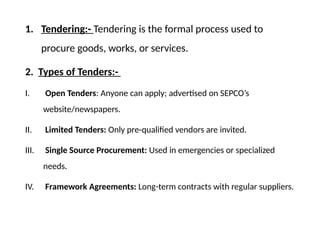
1. Tendering:- Tenderingis the formal process used to
procure goods, works, or services.
2. Types of Tenders:-
I. Open Tenders: Anyone can apply; advertised on SEPCO’s
website/newspapers.
II. Limited Tenders: Only pre-qualified vendors are invited.
III. Single Source Procurement: Used in emergencies or specialized
needs.
IV. Framework Agreements: Long-term contracts with regular suppliers.
4.
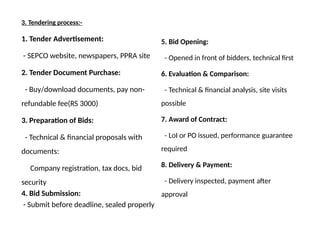
3. Tendering process:-
1.Tender Advertisement:
- SEPCO website, newspapers, PPRA site
2. Tender Document Purchase:
- Buy/download documents, pay non-
refundable fee(RS 3000)
3. Preparation of Bids:
- Technical & financial proposals with
documents:
Company registration, tax docs, bid
security
4. Bid Submission:
- Submit before deadline, sealed properly
5. Bid Opening:
- Opened in front of bidders, technical first
6. Evaluation & Comparison:
- Technical & financial analysis, site visits
possible
7. Award of Contract:
- LoI or PO issued, performance guarantee
required
8. Delivery & Payment:
- Delivery inspected, payment after
approval
5.
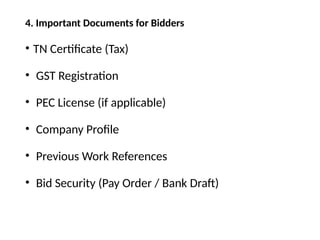
4. Important Documentsfor Bidders
• TN Certificate (Tax)
• GST Registration
• PEC License (if applicable)
• Company Profile
• Previous Work References
• Bid Security (Pay Order / Bank Draft)
6.
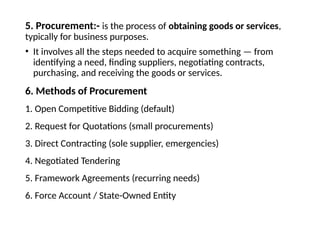
5. Procurement:- isthe process of obtaining goods or services,
typically for business purposes.
• It involves all the steps needed to acquire something — from
identifying a need, finding suppliers, negotiating contracts,
purchasing, and receiving the goods or services.
6. Methods of Procurement
1. Open Competitive Bidding (default)
2. Request for Quotations (small procurements)
3. Direct Contracting (sole supplier, emergencies)
4. Negotiated Tendering
5. Framework Agreements (recurring needs)
6. Force Account / State-Owned Entity
7.
7. Key Definitions
•Bid:Tender or offer at a price
• Bidder: Person/firm submitting a bid
• Blacklisted: Debarred for fraud or poor performance
• Competitive Bidding: Open bidding procedure
• Contract: Legally enforceable agreement
• Contractor: Entity supplying goods/services
• Corrupt/Fraudulent Practices: Bribery, collusion, coercion
• e-Procurement: Use of digital tools in procurement
• Bid Security: Ensures bidder seriousness (refundable)
• Performance Guarantee: Ensures proper contract execution
• Technical Compliance: Must meet all technical specs
• Lowest Responsive Bid: Lowest price + all conditions met
8.
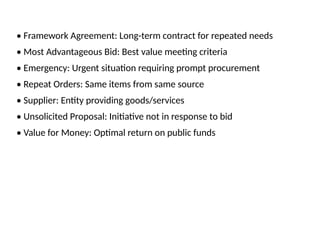
• Framework Agreement:Long-term contract for repeated needs
• Most Advantageous Bid: Best value meeting criteria
• Emergency: Urgent situation requiring prompt procurement
• Repeat Orders: Same items from same source
• Supplier: Entity providing goods/services
• Unsolicited Proposal: Initiative not in response to bid
• Value for Money: Optimal return on public funds