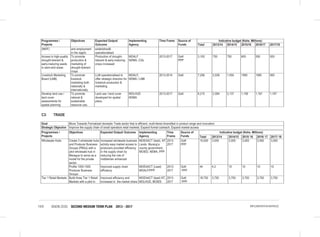
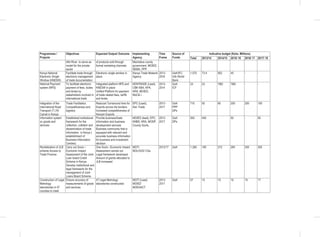
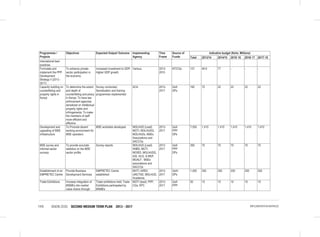
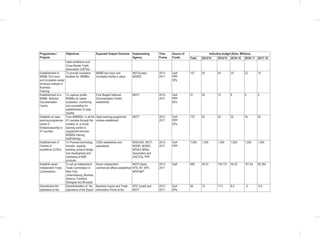
The Presidency
Ministry of Devolution and Planning
Treasury Building
P.O. Box 30005 - 00100
Nairobi, Kenya
Tel. 254-20-252299
E-mail: psplanning@devolutionplanning.go.ke
Website: www.devolutionplanning.go.ke
©Government of the Republic of Kenya 2013
REPUBLIC OF KENYA
TRANSFORMING KENYA: PATHWAY TO DEVOLUTION, SOCIO-ECONOMIC DEVELOPMENT,
EQUITY AND NATIONAL UNITY
SECOND MEDIUM TERM PLAN, 2013 – 2017
2nd MTP Report - Rizz fa_Layout 1 25/09/2013 17:39 Page 1
i VISION 2030 SECOND MEDIUM TERM PLAN 2013 - 2017
O God of all creation
Bless this our land and nation
Justice be our shield and defender
May we dwell in unity
Peace and liberty
Plenty be found within our borders
Let one and all arise
With hearts both strong and true
Service be our earnest endeavour
And our homeland of Kenya
Heritage of splendour
Firm may we stand to defend
Let all with one accord
In common bond united
Build this our nation together
And the glory of Kenya
The fruit of our labour
Fill every heart with thanksgiving
English
The National Anthem
Ee Mungu nguvu yetu
Ilete baraka kwetu
Haki iwe ngao na mlinzi
Natukae na undugu
Amani na uhuru
Raha tupate na ustawi
Amkeni ndugu zetu
Tufanye sote bidii
Nasi tujitoe kwa nguvu
Nchi yetu ya Kenya
Tunayoipenda
Tuwe tayari kuilinda
Natujenge taifa letu
Ee, ndio wajibu wetu
Kenya istahili heshima
Tuungane mikono
Pamoja kazini
Kila siku tuwe na shukrani
Swahili
2nd MTP Report - Rizz fa_Layout 1 25/09/2013 17:39 Page i
VISION 2030 SECOND MEDIUM TERM PLAN 2013 - 2017 ii
Foreword
Under Kenya Vision 2030, Kenya aims to be a middle-income rapidly industrializing country by 2030, offering all its
citizens a high quality of life. It’s first Medium Term Plan was implemented between 2008 and 2012. This Second
Medium Term Plan outlines the policies, programmes and projects which the Jubilee Coalition Government intends to
implement during the five year period starting 2013 to 2017 in order to deliver accelerated and inclusive economic
growth, higher living standards, better education and health care, increased job creation especially for youth,
commercialized agriculture providing higher rural incomes and affordable food, improved manufacturing sector and
more diversified exports. All this is necessary in order to address the acute challenges of poverty, joblessness, and
inequality and to facilitate faster realisation of Kenya Vision 2030.The Plan was prepared through an inclusive and
wide-ranging consultative process which conforms to the requirements of the Constitution of Kenya on public
participation in public policy-making. Its implementation framework has also taken cognizance of the two-tier level of
government, national and county, and new governance structures mandated by the constitution in the form of
commissions and independent offices.
In line with the priorities outlined in the Jubilee Coalition Manifesto “Agenda for Kenya 2013-17 and Beyond” the plan
aims at accelerating economic growth putting the economy on a higher, inclusive and sustainable growth trajectory
leading to a double digit GDP growth rate within the five year period. To realize these goals and secure our country’s
prosperity, the government will in the course of this plan period implement measures to strengthen our economic
competitiveness through accelerated governance and public sector reforms and by increasing government spending
on expansion, and modernisation of our railways, roads, ports, airports, energy, water and the ICT and
telecommunications infrastructure. To further enhance efficiency and competitiveness of our economy, the government
will devote more investment to infrastructure and to the key sectors of the economy that will drive growth particularly
through public private partnerships arrangements.
The Jubilee government was elected into office on a platform that prioritises job creation and increasing youth
employment over the plan period and expanding Kenya’s area under irrigation in order to increase agricultural
productivity and food security. The policy mechanisms for realizing these objectives are contained in this medium term
plan. A commercialized agriculture with high value addition remains our key priority. At the same time, the government
will establish disease free zones in our livestock-producing areas, working in cooperation with the county governments
concerned, to support higher productivity and processing of animal products for domestic consumption and exports.
Similar efforts will be made to increase value addition and employment in fisheries and in the exploitation of our rich
marine resource. In order to meet the goals of job creation, value-addition in agriculture, fisheries and livestock, and
export diversification, the government will, therefore, establish special economic zones in partnership with private
investors to support increased manufacturing and exports with high value added. To meet the demand for skilled jobs
in these and other sectors, priority will also be accorded to programmes targeting training and apprenticeships to meet
the demand for human resource skills required by the transformation of the Kenya economy which is central to this
medium-term plan. As the education and training sections of this plan demonstrate, this will be accomplished through
a variety of programmes under the social pillar. The government will also strengthen youth employment and
entrepreneurship through credit, financial assistance and training. This will enable recipients to acquire skills and
engage in productive employment on their own or as suppliers to the larger enterprises in the public or private sectors.
This medium term plan includes two key national initiatives that were not featured in its predecessor. Under the
economic pillar, the development of oil and other mineral resources, is now included among the priority sectors. This
follows the discovery of oil in commercial quantities in Kenya, in addition to substantial deposits of coal, iron ore, rare
earth minerals and other minerals. Exploitation of these resources will be done in ways that benefit the people of Kenya
most with priority on local communities and counties concerned. Mineral exports are also expected to help close the
balance of trade, and to raise government revenue. Under the “Foundations of National Transformation” this Plan has
added building “National Values and Ethics” as an additional initiative in the foundation of our national development.
2nd MTP Report - Rizz fa_Layout 1 25/09/2013 17:39 Page ii
FOREWORD
iii VISION 2030 SECOND MEDIUM TERM PLAN 2013 - 2017
The government is acutely aware of the need for proactive work to enhance national unity in line with the values and
principles of the constitution of Kenya. Achieving our development goals will depend on a strong Kenyan identity and
values that give priority to our national good above all else.
Implementing devolution is a theme that runs through this medium term plan. The Plan’s Political Pillar outlines
measures to support devolution and the legislation that will be enacted to implement it as required by the constitution.
The government is committed to supporting devolution with financial and human resources and in building capacity
within county governments. The Plan is also committed to the continued implementation of the Judicial Transformation
Framework, and to widen access to justice for all Kenyans. The government believes that justice and observation of
human rights are integral parts of improving governance and the rule of law. Over the five year plan period, the
government will therefore expand, equip and modernize the security agencies to ensure that every Kenyan is assured
of his or her safety and that of their property. Improved security will also contribute to a better environment for doing
business in Kenya, bring in more international tourists, and investment into our country. The pay and conditions of
service for security personnel will be improved and measures will be put in place to support community policing and
invest in CCTV and other technology to improve security.
I therefore call upon all Kenyans to commit themselves to the pursuit of national unity, and to play their part in the
implementation of this plan, so that we move forward to the future as a united and prosperous nation. The government
on its part is committed to coordinating all the branches of the national government, in the implementation of this plan.
I call upon our county governments, our development partners, and the private sector to join us as we seek to ensure
that the objectives of this plan to improve the livelihoods of all Kenyans are fully realized.
H.E. Hon. Uhuru Kenyatta, C.G.H.,
President and Commander-In-Chief
of the Defence Forces of the Republic of Kenya
2nd MTP Report - Rizz fa_Layout 1 25/09/2013 17:39 Page iii
VISION 2030 SECOND MEDIUM TERM PLAN 2013 - 2017 iv
Preface
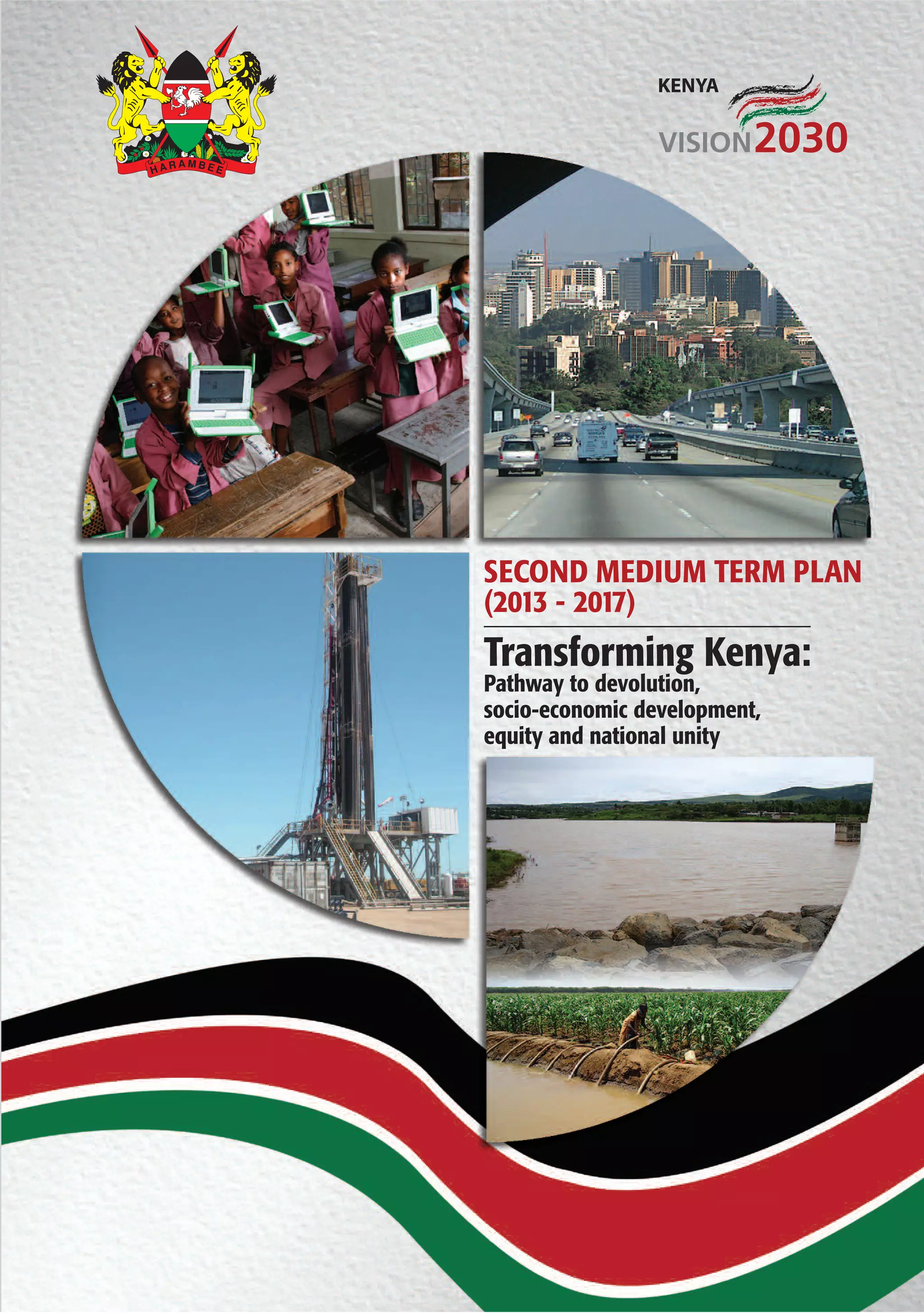
The theme of the Second Medium Term Plan of Kenya Vision 2030 is “Transforming Kenya: Pathway To Devolution,
Socio-Economic Development, Equity And National Unity” The Plan covers the period 2013-2017 which coincides with
the term of the Jubilee Government and hence its emphasis on the full implementation of devolution in the context of
a rapidly growing economy, promoting equity, inclusiveness, and employment to meet the needs of our youth. These
goals were part of the Jubilee Coalition campaign platform and are in line with the long-term objectives of Vision 2030,
and the Kenya Constitution. This medium term plan sets out the programmes, financing framework and the timelines
that will guide the implementation of the promises made to the people of Kenya in the manifesto.
Since its promulgation in 2010, the Kenya constitution has altered our governance framework fundamentally by
creating a two-tier government one at national and the other in our 47 counties. Within counties, municipalities and
urban areas which are a key part of our national development programme will be managed by independent boards
responsible to county authorities. The distribution of functions of counties is outlined in the Fourth Schedule of the
Constitution. These include development responsibilities that are central to this medium term plan among them
agriculture, county hospitals and public health, early child education, cooperatives, trade, county roads, fisheries and
livestock. Harmonizing this MTP with County Integrated Development Plans and Urban Plans will ensure faster delivery
of the promises by the government as a whole. The constitution has also created a number of commissions and
independent offices whose functions will have a strong bearing on the implementation of the MTP’s policies,
programmes and projects. The Second MTP takes all these changes into account and aims at coordinated action
between the two levels of government in the interest of a growing economy to meet the many needs of the people of
Kenya.
The Ministry of Devolution and Planning under the Presidency has under this plan, outlined an implementation
framework through which it will work closely with the National Treasury and other government ministries, the county
governments, constitutional commissions and independent offices to ensure that projects and programmes contained
in this Plan are completed with efficiency and on time. In consultation with the Transition Authority, this ministry has
published “County Profiles” containing the latest data on the geographic, resources, economic and social data of the
counties. These documents provide basic information to county governments in preparing their County Integrated
Development Plans (CIDPs) as required under the Constitution and under the Public Finance Management Act (2012).
Under the law, county budgeting is to be guided by the CIDPs. My Ministry has in addition prepared guidelines on the
preparation of County Integrated Development Plans to help the counties meet that objective. To strengthen county
planning, Ministry of Devolution and Planning will also provide financial and human resources to county governments
to enable them build the capacity to ensure that County Integrated Development Plans are used to guide the county
Medium Term Expenditure Framework and annual budgets.
In line with the MTP, government ministries are expected to prepare five-year strategic plans to guide budgeting and
plan implementation in their areas of responsibility. The Performance Contracts of the MDAs will also be tied to
delivering the Plan’s outputs and targets within the specified timelines. In this manner the government expects to
produce harmony and coordination between national and county government planning and between ministries at
national level. Such coordination is expected to minimize resource wastage and build in more efficiency in the
achievement of Vision 2030 objectives under our new governance framework.
To understand how far we have gone towards effective plan implementation at all these levels, the Ministry of
Devolution and Planning has put in place a monitoring and evaluation framework to guide policy reform and formulation
of corrective action where necessary. An effective national monitoring and evaluation system will monitor and report
progress in the implementation of the second MTP at national and county level in line with the promises contained in
the Jubilee Manifesto. The Bill for this purpose will be submitted to Parliament for enactment into law. The legislation
will support implementation of a computerized National Integrated Monitoring and Evaluation System (NIMES) at
2nd MTP Report - Rizz fa_Layout 1 25/09/2013 17:39 Page iv
PREFACE
v VISION 2030 SECOND MEDIUM TERM PLAN 2013 - 2017
national, county and ward level; establish M&E structures at all these levels; and ensure conformity with the best
reporting standards to ensure consistency of indicators and the formatting of reports nationally.
In addition, the Ministry of Devolution and Planning will also prepare regular reports on progress made under second
MTP which will be submitted to National and County Government Coordinating Summit.These reports will also be made
publicly available on the Ministry’s website, so that stakeholders and the public can access information on
implementation of projects of interest to them. We expect this to promote both efficiency and accountability in our
planning and implementation process. The Ministry will continue to publish Annual Progress Reports (APRs) on
implementation of the Second MTP of Vision 2030 and to make them widely available to all stakeholders. We expect
information generated by these documents to be useful to national stakeholders, the private sector, and international
development partners.
Our experience in the past has shown the need to link national policies, planning and budgeting more tightly. The
Ministry of Devolution and Planning will therefore work closely with the National Treasury to ensure that the MTEF and
subsequent annual budgets are aligned with the Second Medium Term Plan 2013-17 to ensure successful
implementation of the Plan and the government’s priorities.
Finally, to the people of Kenya what will matter most is the delivery of services promised to them by the government
at both levels that will be facilitated by the MTP, the MTEF and the annual budgets. The second MTP will be successful
if that objective is met in a way that demonstrates improvement in the quality of life for Kenyans.
The preparation of the second MTP 2013-17 commenced in August 2012. Since then, many people have been involved
in the Plan’s preparation. I will like to thank the many Kenyans who took part in identifying development priorities in
our county consultation forums and the business, professionals and stakeholder forums. Their inputs have been of
immense value in the preparation of this document. I would also like to thank officials in the Ministry of Devolution and
Planning and in all the other government ministries who helped in putting this document together, and ensuring the
consistency between its many objectives. I am sure the people of Kenya will join me in thanking them for their efforts,
as we move forward to realizing our common objectives under Vision 2030.
Anne Waiguru, OGW
Cabinet Secretary,
Ministry of Devolution and Planning
2nd MTP Report - Rizz fa_Layout 1 25/09/2013 17:39 Page v
VISION 2030 SECOND MEDIUM TERM PLAN 2013 - 2017 vi
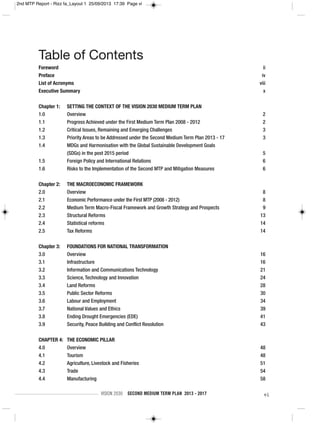
Foreword ii
Preface iv
List of Acronyms viii
Executive Summary x
Chapter 1: SETTING THE CONTEXT OF THE VISION 2030 MEDIUM TERM PLAN
1.0 Overview 2
1.1 Progress Achieved under the First Medium Term Plan 2008 - 2012 2
1.2 Critical Issues, Remaining and Emerging Challenges 3
1.3 Priority Areas to be Addressed under the Second Medium Term Plan 2013 - 17 3
1.4 MDGs and Harmonisation with the Global Sustainable Development Goals
(SDGs) in the post 2015 period 5
1.5 Foreign Policy and International Relations 6
1.6 Risks to the Implementation of the Second MTP and Mitigation Measures 6
Chapter 2: THE MACROECONOMIC FRAMEWORK
2.0 Overview 8
2.1 Economic Performance under the First MTP (2008 - 2012) 8
2.2 Medium Term Macro-Fiscal Framework and Growth Strategy and Prospects 9
2.3 Structural Reforms 13
2.4 Statistical reforms 14
2.5 Tax Reforms 14
Chapter 3: FOUNDATIONS FOR NATIONAL TRANSFORMATION
3.0 Overview 16
3.1 Infrastructure 16
3.2 Information and Communications Technology 21
3.3 Science, Technology and Innovation 24
3.4 Land Reforms 28
3.5 Public Sector Reforms 30
3.6 Labour and Employment 34
3.7 National Values and Ethics 39
3.8 Ending Drought Emergencies (EDE) 41
3.9 Security, Peace Building and Conflict Resolution 43
CHAPTER 4: THE ECONOMIC PILLAR
4.0 Overview 48
4.1 Tourism 48
4.2 Agriculture, Livestock and Fisheries 51
4.3 Trade 54
4.4 Manufacturing 58
Table of Contents
2nd MTP Report - Rizz fa_Layout 1 25/09/2013 17:39 Page vi
vii VISION 2030 SECOND MEDIUM TERM PLAN 2013 - 2017
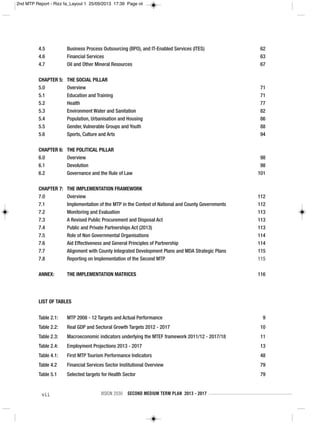
LIST OF TABLES
Table 2.1: MTP 2008 - 12 Targets and Actual Performance 9
Table 2.2: Real GDP and Sectoral Growth Targets 2012 - 2017 10
Table 2.3: Macroeconomic indicators underlying the MTEF framework 2011/12 - 2017/18 11
Table 2.4: Employment Projections 2013 - 2017 13
Table 4.1: First MTP Tourism Performance Indicators 48
Table 4.2 Financial Services Sector Institutional Overview 79
Table 5.1 Selected targets for Health Sector 79
4.5 Business Process Outsourcing (BPO), and IT-Enabled Services (ITES) 62
4.6 Financial Services 63
4.7 Oil and Other Mineral Resources 67
CHAPTER 5: THE SOCIAL PILLAR
5.0 Overview 71
5.1 Education and Training 71
5.2 Health 77
5.3 Environment Water and Sanitation 82
5.4 Population, Urbanisation and Housing 86
5.5 Gender, Vulnerable Groups and Youth 88
5.6 Sports, Culture and Arts 94
CHAPTER 6: THE POLITICAL PILLAR
6.0 Overview 98
6.1 Devolution 98
6.2 Governance and the Rule of Law 101
CHAPTER 7: THE IMPLEMENTATION FRAMEWORK
7.0 Overview 112
7.1 Implementation of the MTP in the Context of National and County Governments 112
7.2 Monitoring and Evaluation 113
7.3 A Revised Public Procurement and Disposal Act 113
7.4 Public and Private Partnerships Act (2013) 113
7.5 Role of Non Governmental Organisations 114
7.6 Aid Effectiveness and General Principles of Partnership 114
7.7 Alignment with County Integrated Development Plans and MDA Strategic Plans 115
7.8 Reporting on Implementation of the Second MTP 115
ANNEX: THE IMPLEMENTATION MATRICES 116
2nd MTP Report - Rizz fa_Layout 1 25/09/2013 17:39 Page vii
VISION 2030 SECOND MEDIUM TERM PLAN 2013 - 2017 viii
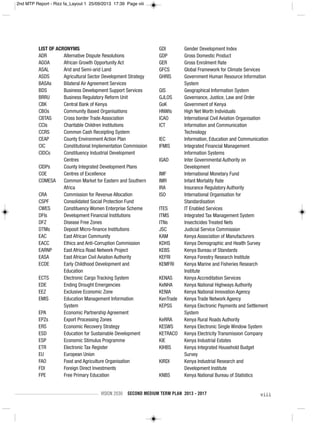
LIST OF ACRONYMS
ADR Alternative Dispute Resolutions
AGOA African Growth Opportunity Act
ASAL Arid and Semi-arid Land
ASDS Agricultural Sector Development Strategy
BASAs Bilateral Air Agreement Services
BDS Business Development Support Services
BRRU Business Regulatory Reform Unit
CBK Central Bank of Kenya
CBOs Community Based Organisations
CBTAS Cross border Trade Association
CCIs Charitable Children Institutions
CCRS Common Cash Receipting System
CEAP County Environment Action Plan
CIC Constitutional Implementation Commission
CIDCs Constituency Industrial Development
Centres
CIDPs County Integrated Development Plans
COE Centres of Excellence
COMESA Common Market for Eastern and Southern
Africa
CRA Commission for Revenue Allocation
CSPF Consolidated Social Protection Fund
CWES Constituency Women Enterprise Scheme
DFIs Development Financial Institutions
DFZ Disease Free Zones
DTMs Deposit Micro-finance Institutions
EAC East African Community
EACC Ethics and Anti-Corruption Commission
EARNP East Africa Road Network Project
EASA East African Civil Aviation Authority
ECDE Early Childhood Development and
Education
ECTS Electronic Cargo Tracking System
EDE Ending Drought Emergencies
EEZ Exclusive Economic Zone
EMIS Education Management Information
System
EPA Economic Partnership Agreement
EPZs Export Processing Zones
ERS Economic Recovery Strategy
ESD Education for Sustainable Development
ESP Economic Stimulus Programme
ETR Electronic Tax Register
EU European Union
FAO Food and Agriculture Organisation
FDI Foreign Direct Investments
FPE Free Primary Education
GDI Gender Development Index
GDP Gross Domestic Product
GER Gross Enrolment Rate
GFCS Global Framework for Climate Services
GHRIS Government Human Resource Information
System
GIS Geographical Information System
GJLOS Governance, Justice, Law and Order
GoK Government of Kenya
HNWIs High Net Worth Individuals
ICAO International Civil Aviation Organisation
ICT Information and Communication
Technology
IEC Information, Education and Communication
IFMIS Integrated Financial Management
Information Systems
IGAD Inter Governmental Authority on
Development
IMF International Monetary Fund
IMR Infant Mortality Rate
IRA Insurance Regulatory Authority
ISO International Organisation for
Standardisation
ITES IT Enabled Services
ITMS Integrated Tax Management System
ITNs Insecticides Treated Nets
JSC Judicial Service Commission
KAM Kenya Association of Manufacturers
KDHS Kenya Demographic and Health Survey
KEBS Kenya Bureau of Standards
KEFRI Kenya Forestry Research Institute
KEMFRI Kenya Marine and Fisheries Research
Institute
KENAS Kenya Accreditation Services
KeNHA Kenya National Highways Authority
KENIA Kenya National Innovation Agency
KenTrade Kenya Trade Network Agency
KEPSS Kenya Electronic Payments and Settlement
System
KeRRA Kenya Rural Roads Authority
KESWS Kenya Electronic Single Window System
KETRACO Kenya Electricity Transmission Company
KIE Kenya Industrial Estates
KIHBS Kenya Integrated Household Budget
Survey
KIRDI Kenya Industrial Research and
Development Institute
KNBS Kenya National Bureau of Statistics
2nd MTP Report - Rizz fa_Layout 1 25/09/2013 17:39 Page viii
ix VISION 2030 SECOND MEDIUM TERM PLAN 2013 - 2017
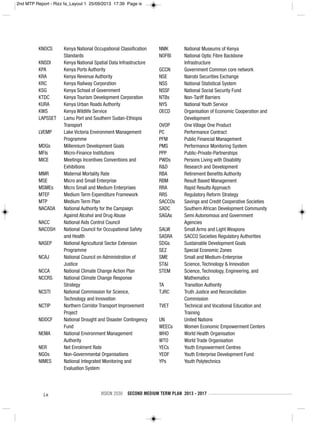
KNOCS Kenya National Occupational Classification
Standards
KNSDI Kenya National Spatial Data Infrastructure
KPA Kenya Ports Authority
KRA Kenya Revenue Authority
KRC Kenya Railway Corporation
KSG Kenya School of Government
KTDC Kenya Tourism Development Corporation
KURA Kenya Urban Roads Authority
KWS Kenya Wildlife Service
LAPSSET Lamu Port and Southern Sudan-Ethiopia
Transport
LVEMP Lake Victoria Environment Management
Programme
MDGs Millennium Development Goals
MFIs Micro-Finance Institutions
MICE Meetings Incentives Conventions and
Exhibitions
MMR Maternal Mortality Rate
MSE Micro and Small Enterprise
MSMEs Micro Small and Medium Enterprises
MTEF Medium Term Expenditure Framework
MTP Medium Term Plan
NACADA National Authority for the Campaign
Against Alcohol and Drug Abuse
NACC National Aids Control Council
NACOSH National Council for Occupational Safety
and Health
NASEP National Agricultural Sector Extension
Programme
NCAJ National Council on Administration of
Justice
NCCA National Climate Change Action Plan
NCCRS National Climate Change Response
Strategy
NCSTI National Commission for Science,
Technology and Innovation
NCTIP Northern Corridor Transport Improvement
Project
NDDCF National Drought and Disaster Contingency
Fund
NEMA National Environment Management
Authority
NER Net Enrolment Rate
NGOs Non-Governmental Organisations
NIMES National Integrated Monitoring and
Evaluation System
NMK National Museums of Kenya
NOFBI National Optic Fibre Backbone
Infrastructure
GCCN Government Common core network
NSE Nairobi Securities Exchange
NSS National Statistical System
NSSF National Social Security Fund
NTBs Non-Tariff Barriers
NYS National Youth Service
OECD Organisation of Economic Cooperation and
Development
OVOP One Village One Product
PC Performance Contract
PFM Public Financial Management
PMS Performance Monitoring System
PPP Public-Private-Partnerships
PWDs Persons Living with Disability
R&D Research and Development
RBA Retirement Benefits Authority
RBM Result Based Management
RRA Rapid Results Approach
RRS Regulatory Reform Strategy
SACCOs Savings and Credit Cooperative Societies
SADC Southern African Development Community
SAGAs Semi Autonomous and Government
Agencies
SALW Small Arms and Light Weapons
SASRA SACCO Societies Regulatory Authorities
SDGs Sustainable Development Goals
SEZ Special Economic Zones
SME Small and Medium-Enterprise
ST&I Science, Technology & Innovation
STEM Science, Technology, Engineering, and
Mathematics
TA Transition Authority
TJRC Truth Justice and Reconciliation
Commission
TVET Technical and Vocational Education and
Training
UN United Nations
WEECs Women Economic Empowerment Centers
WHO World Health Organisation
WTO World Trade Organisation
YECs Youth Empowerment Centres
YEDF Youth Enterprise Development Fund
YPs Youth Polytechnics
2nd MTP Report - Rizz fa_Layout 1 25/09/2013 17:39 Page ix
VISION 2030 SECOND MEDIUM TERM PLAN 2013 - 2017 x
The second Medium Term Plan (MTP) of Vision 2030 identifies key policy actions, reforms, programmes and projects
that the Government will implement in the 2013-2017 period in line with its priorities, the Kenya 2010 constitution
and the long-term objective of Vision 2030. Accordingly, the theme of this MTP is Transforming Kenya: Pathway to
Devolution, Socio-Economic Development, Equity and National Unity. The MTP gives priority to devolution as spelt
out in our constitution and to more rapid socio-economic development with equity as a tool for building national
unity). The Second MTP also aims to build on the successes of the first MTP (2008-2012), particularly in increasing
the scale and pace of economic transformation through infrastructure development, and strategic emphasis on
priority sectors under the economic and social pillars of Vision 2030. Under this MTP, transformation of the economy
is pegged on rapid economic growth on a stable macro-economic environment, modernisation of our infrastructure,
diversification and commercialisation of agriculture, food security, a higher contribution of manufacturing to our GDP,
wider access to African and global markets, wider access for Kenyans to better quality education and health care,
job creation targeting unemployed youth, provision of better housing and provision of improved water sources and
sanitation to Kenyan households that presently lack these. In doing all this, Kenya will pay full attention to securing
our environment and building our resilience to climate change. Much of this will be done in collaboration with county
governments and new urban management boards as provided for under the constitution and our laws. The overall
aim of the plan is that by 2018 Kenyan families will have experienced a positive transformation in their earnings and
quality of their livelihoods, and Kenya will be a more united, more prosperous society commanding respect in African
and the world.
The Macroeconomic Framework: Macro economic stability will continue to be a key objective in national economic
management. The second MTP aims at sustained growth in agriculture, manufacturing, and service sectors in order to
achieve an overall GDP growth rate of 10 per cent by 2017.To sustain and increase the growth momentum inherited
from the first MTP, this plan aims to increase local savings, remittances from the Kenya diaspora and foreign direct
investment in all the sectors. The Second MTP also aims at an enhanced regional and international trade strategy to
grow and diversify our exports, in order to improve our balance of payments position and ensure exchange rate
stability.
Foundations of the Economy and Society: The second MTP will sustain and expand our physical infrastructure to
ensure that it can support a rapidly-growing economy, the demands imposed on it by higher rural and urban incomes,
and by new economic activities. A national spatial plan and county specific spatial plans will be developed in order to
rationalize utilisation of space for economic and social development. In addition, air transport facilities will be expanded
within the country, and Kenya will strengthen its position as the air transport hub in our region. Priority will also be
given to improving the efficiency of our ports, and the implementation of the single window clearance system. With the
construction of the standard gauge railway line from Mombasa to Malaba, rail transport will be expected to handle 50
per cent of the freight cargo throughput, thus easing the pressure on our roads, lowering the cost of doing business,
and enhancing trade and regional integration in Eastern Africa. The new Lamu port and the LAPSSET corridor will be
implemented as part of upgrading our national transport framework in collaboration with other countries in Eastern
Africa. To relieve congestion in our main urban areas, planned mass rapid transit systems will be constructed.
Expansion of roads will be continued, aiming at achieving a road network with 75-80 per cent of the classified roads
in good condition and construction or rehabilitation of 5,500 km of roads.
With regard to energy, a strategy is in place for modernizing energy infrastructure network, increasing the share of
energy generated from renewable energy sources, and providing energy that is affordable and reliable to businesses
and homes. This will ensure that our energy supply is adequate and efficient in order to support increased use in
manufacturing, agriculture, services, public facilities and households. The Plan aims at increasing installed capacity for
electricity generation by 5,538 MW in 2017.
Executive Summary
2nd MTP Report - Rizz fa_Layout 1 25/09/2013 17:39 Page x
xi VISION 2030 SECOND MEDIUM TERM PLAN 2013 - 2017
Development in the ICT sector will build on achievements realized under the first MTP. This will include a modern ICT
policy aimed at more growth and regulation that is necessary to increase local and foreign investment in ICT.The policy
will provide for more utilisation of digital technology in our all our goods and service sectors. The government, for its
part, intends to promote the use of ICT in our learning institutions starting with schools, and improve cyber security in
order to facilitate more use of ICT in business and commercial transactions. New policies will also aim at facilitating
usage of ICT in research and development, and to drive learning and innovation in the Kenyan economy.
In addition, the Second MTP will ensure that on-going efforts in land reform, security of land tenure, more efficient
registration of titles and records, and resolution of historic grievances are completed. Public service reforms will be
strengthened and cascaded to the counties. Most importantly, the government realizes the importance of security at
personal, county, and national levels, and will continue to support security sector reforms and infrastructure, while
paying full attention to the constitutional requirements and human rights.
The Second MTP has identified “National Values and Ethics” as one of the cornerstones of our overall development.
The Government aims to inculcate the positive values and ethics as spelt out in the constitution. This will build
sustainable peace, reduce ethnic rivalry, and promote issue-based politics that places national interest above
individual and sectional ones. The overall objective will be to build “unity with diversity” as envisioned in our
constitution as a defining characteristic of our solidarity and nationhood.
Security and Rule of Law at both levels of government will remain a priority. Economic and social development is
impossible without security. Insecurity in the country will therefore be addressed in order to provide individual safety
to Kenyans, to address investors’ concerns about security-related increase in cost of doing business in Kenya, and
to minimize crime whose occurrence affects the poor and the residents of arid and semi-arid lands disproportionately.
This will require a better trained and equipped Kenya Police Service backed by research and technology, capacity to
secure our borders, better ways to pre-empt crime and to protect life and property. In line with the constitution,
security force regulations and behavior will be made to conform to local and international human rights standards.
The Economic Pillar: The economic pillar in the Second MTP now consists of six priority sectors: tourism; agriculture,
livestock and fisheries; trade; manufacturing; BPOs/ITES; oil and other minerals. The overall strategy for the tourism
sector is to turn the country into a top 10 long haul tourist destination in the world.This will be achieved through growth
and diversification of tourist sources from the traditional areas ( i.e. Western Europe and North America), and from non-
traditional sources in the Middle East and East Asia. The sector will also market new high- end tourist segments like
business, cultural and ecological tourism. Tourist arrivals are expected to double from an average of 1.5 million in the
recent years, to 3 million each year by the end the plan period. Construction of two coastal resort cities and three
upcountry tourist resort cities in Isiolo, Lamu and Lake Turkana will be initiated, and measures taken to increase bed
capacity, to open more five-star hotels, and improve the standards of tourist accommodation and facilities.
Under Agriculture and Livestock the second MTP will give top priority to increased acreage under in irrigation in
order to reduce the country’s dependence on rain fed agriculture.A total of 404,800 hectares will be put under irrigation
during the plan period. Measures will be taken to mechanize agricultural production, revive cooperatives and farmers
unions, and subsidize farm inputs to raise productivity.
Trade within and outside the country remains a priority sector of the economic pillar. Over the plan period the government
will strengthen economic partnerships with our neighbours in East Africa and the rest of Africa. Our foreign policy will aim
at increasing international trade, and international economic partnerships. This policy will encourage Kenyan producers
and the private sector to open new product lines to meet demand in new African and global markets that will be identified.
The government will also intensify reforms to improve the overall climate of doing business in Kenya.
The Second MTP will give additional attention to growth and diversification in our manufacturing sector with the aim
EXECUTIVE SUMMARY
2nd MTP Report - Rizz fa_Layout 1 25/09/2013 17:39 Page xi
VISION 2030 SECOND MEDIUM TERM PLAN 2013 - 2017 xii
EXECUTIVE SUMMARY
of increasing the sector’s contribution to the GDP and foreign exchange earnings. To achieve this, three special
economic zones targeting manufacturing in Mombasa, Kisumu and Lamu will be established. Other initiatives in the
sector will include building clusters for meat and leather products, a stronger dairy sector, and the development of
industrial and SME parks that will provide linkages to other sectors like agricultural and services.
Kenya has established itself as a global leader in mobile money, and growth driven by new information and
communications technology. This trend will be continued. Growth in global business outsourcing (BPO) industry has
also opened a new window for Kenya to initiate greater expansion of IT Enabled Services (ITES) and BPO. The sector
is especially critical to this plan because it has the potential to create job opportunities in large numbers while
contributing strongly to the overall GDP growth as it has in the past. To achieve this,the Government will aim at
universal access to ICT, development of digital content, promoting e-Government services and encourage the
establishment of more ICT based industries.
Oils and Other Mineral Resources is a new priority sector under the economic pillar of this plan given the continued
discovery of oil and other minerals in Kenya. In the plan period, the government will develop the policy, legal, and
institutional framework for the exploitation and management of Kenya’s natural resources (oil, gas and other minerals)
for the maximum economic benefit of the country and local communities, done in a transparent and accountable
manner. It will also ensure that legislation for transparency and fair sharing the revenue generated is enacted, and
safeguards erected to protect the environment and to avoid risks usually associated with huge inflows of resource-
based external earnings.
The Social Pillar: Under education, ECDE will be mainsteamed and the government will continue strengthening
access to universal primary education and to provide wider access to secondary education for all primary school
leavers. It will also introduce universal access to computers starting with standard one in 2014, promote wider use of
ICT as an instrument of instruction and training in schools, lower the student/teacher ratio by more recruitment of
teachers, and provide more textbooks and teaching equipment to schools. Education in ASAL counties will be enhanced
through special programmes.
In the health sector, the government in partnership with county governments, will continue to emphasize primary health
care, access to clean water to households, and better management of communicable diseases. Additional resources
will be devoted to the challenges posed by maternal and child mortalities and by rise in morbidity by non-
communicable diseases.The government will continue to support efforts to make Kenya a regional health services hub,
and to encourage new local and foreign investment in medical research, pharmaceutical production, and modern
hospital care.
Kenya has a young growing population and it is urbanizing rapidly. Urban housing and improvement of rural homes are
priorities in the social pillar of this MTP. In association with the private sector and county government, the national
government will aim at increasing the supply of modern housing units especially for the low-income segment of the
market where supply lags behind demand. The government will address this problem by facilitating the construction
of 200,000 units annually through PPP arrangements. In addition, the government will develop integrated investment
plans for six key metropolitan areas and reform the NSSF to increase available investment to the housing sector.
The government will increase support for policies and institutions devoted to promoting gender equity. It will also
increase allocation of resources to enterprises led by youth and women. In addition to the Youth Enterprise
Development Fund, and Women Enterprise Fund, the Uwezo Fund will provide more funds for loans to the youth,
women and vulnerable groups in order to support them start small business. More resources will be allocated to social
protection, including cash transfers to the most vulnerable members of our society. The Government will fully
implement policies for protection of rights for women, the handicapped and vulnerable groups. The government will
also identify and nurture talent, especially among youth, and support commercialisation of talent in order to raise
personal incomes and widen employment opportunities. It will also provide the necessary infrastructure at national
2nd MTP Report - Rizz fa_Layout 1 25/09/2013 17:39 Page xii
EXECUTIVE SUMMARY
xiii VISION 2030 SECOND MEDIUM TERM PLAN 2013 - 2017
and county levels to nurture youth talents in sports and entertainment. More secure centres for victims of domestic
violence will be established and the government will strengthen education against female genital mutilation and spouse
abuse.
Devolution and implementation of the Constitution “Making Devolution work” is a cross-cutting theme of this MTP. The
Government is committed to ensuring a rapid and efficient transition to a two-tier government under which county
governments assume full responsibility of the functions assigned to them under the constitution. Priority at the national
level will be given to provision of adequate finance to match functions allocated to counties, and capacity for policy-
making and project implementation in all county governments in order to bring the full benefits of devolution to the
people. This will in turn ensure more accountability as government is brought closer to the people. The Public Financial
Management Act (2012) will be implemented with the aim of exercising controls in public spending and improving the
quality of public expenditure through full implementation of the Integrated Public Financial Management Systems
(IFMIS) at national and county levels. Further training of public officials involved in MTEF and budgeting and expenditure
at both levels of government will be undertaken.
The Government will ensure that all pending legislation required by the Constitution are completed and enacted. It will
provide full support to the ongoing transformation of an independent judiciary by providing it with adequate human and
financial resources and with political support. Under the Second MTP, the government will also strengthen public
service reforms, performance contracting, accountability and transparency. Under the plan, the Governance, Justice
and Rule of Law Programme will be expanded to build capacity in the State Law Office, the Office of Public Prosecution
and the relevant independent commissions.
Conclusion: The policies, legal and institutional reforms that are required for the successful implementationof the
second MTP are elaborated in subsequent sections of this document. The Government would like to assure the Kenyan
public, private investors and our international development partners that it will honour the pledges it has made to the
people of Kenya through major policy statements and under this MTP. It is convinced that with the broad partnership
between Kenyans and our partners, the objectives contained in this medium term plan will be achieved, and will create
a better Kenya for all.
2nd MTP Report - Rizz fa_Layout 1 25/09/2013 17:39 Page xiii
THE MACROECONOMIC FRAMEWORK
2nd MTP Report - Rizz fa_Layout 1 25/09/2013 17:39 Page 1
2 VISION 2030 SECOND MEDIUM TERM PLAN 2013 - 2017
1 SETTING THE CONTEXT OF THE
SECOND MEDIUM TERM PLAN
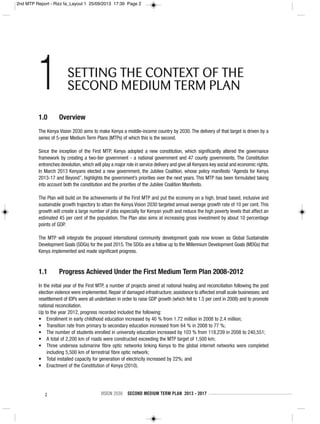
1.0 Overview
The Kenya Vision 2030 aims to make Kenya a middle-income country by 2030. The delivery of that target is driven by a
series of 5-year Medium Term Plans (MTPs) of which this is the second.
Since the inception of the First MTP, Kenya adopted a new constitution, which significantly altered the governance
framework by creating a two-tier government - a national government and 47 county governments. The Constitution
entrenches devolution, which will play a major role in service delivery and give all Kenyans key social and economic rights.
In March 2013 Kenyans elected a new government, the Jubilee Coalition, whose policy manifesto “Agenda for Kenya
2013-17 and Beyond”, highlights the government’s priorities over the next years. This MTP has been formulated taking
into account both the constitution and the priorities of the Jubilee Coalition Manifesto.
The Plan will build on the achievements of the First MTP and put the economy on a high, broad based, inclusive and
sustainable growth trajectory to attain the Kenya Vision 2030 targeted annual average growth rate of 10 per cent. This
growth will create a large number of jobs especially for Kenyan youth and reduce the high poverty levels that affect an
estimated 45 per cent of the population. The Plan also aims at increasing gross investment by about 10 percentage
points of GDP.
The MTP will integrate the proposed international community development goals now known as Global Sustainable
Development Goals (SDGs) for the post 2015.The SDGs are a follow up to the Millennium Development Goals (MDGs) that
Kenya implemented and made significant progress.
1.1 Progress Achieved Under the First Medium Term Plan 2008-2012
In the initial year of the First MTP, a number of projects aimed at national healing and reconciliation following the post
election violence were implemented. Repair of damaged infrastructure; assistance to affected small scale businesses; and
resettlement of IDPs were all undertaken in order to raise GDP growth (which fell to 1.5 per cent in 2008) and to promote
national reconciliation.
Up to the year 2012, progress recorded included the following:
• Enrollment in early childhood education increased by 40 % from 1.72 million in 2008 to 2.4 million;
• Transition rate from primary to secondary education increased from 64 % in 2008 to 77 %;
• The number of students enrolled in university education increased by 103 % from 118,239 in 2008 to 240,551;
• A total of 2,200 km of roads were constructed exceeding the MTP target of 1,500 km;
• Three undersea submarine fibre optic networks linking Kenya to the global internet networks were completed
including 5,500 km of terrestrial fibre optic network;
• Total installed capacity for generation of electricity increased by 22%; and
• Enactment of the Constitution of Kenya (2010).
2nd MTP Report - Rizz fa_Layout 1 25/09/2013 17:39 Page 2
SETTING THE CONTEXT OF THE 2ND MEDIUM TERM PLAN
VISION 2030 SECOND MEDIUM TERM PLAN 2013 - 2017 3
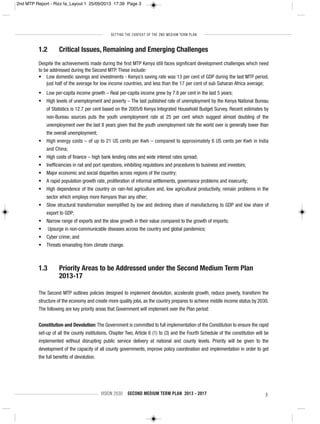
1.2 Critical Issues, Remaining and Emerging Challenges
Despite the achievements made during the first MTP Kenya still faces significant development challenges which need
to be addressed during the Second MTP. These include:
• Low domestic savings and investments - Kenya’s saving rate was 13 per cent of GDP during the last MTP period,
just half of the average for low income countries, and less than the 17 per cent of sub Saharan Africa average;
• Low per-capita income growth – Real per-capita income grew by 7.8 per cent in the last 5 years;
• High levels of unemployment and poverty – The last published rate of unemployment by the Kenya National Bureau
of Statistics is 12.7 per cent based on the 2005/6 Kenya Integrated Household Budget Survey. Recent estimates by
non-Bureau sources puts the youth unemployment rate at 25 per cent which suggest almost doubling of the
unemployment over the last 8 years given that the youth unemployment rate the world over is generally lower than
the overall unemployment;
• High energy costs – of up to 21 US cents per Kwh – compared to approximately 6 US cents per Kwh in India
and China;
• High costs of finance – high bank lending rates and wide interest rates spread;
• Inefficiencies in rail and port operations, inhibiting regulations and procedures to business and investors;
• Major economic and social disparities across regions of the country;
• A rapid population growth rate, proliferation of informal settlements, governance problems and insecurity;
• High dependence of the country on rain-fed agriculture and, low agricultural productivity, remain problems in the
sector which employs more Kenyans than any other;
• Slow structural transformation exemplified by low and declining share of manufacturing to GDP and low share of
export to GDP;
• Narrow range of exports and the slow growth in their value compared to the growth of imports;
• Upsurge in non-communicable diseases across the country and global pandemics;
• Cyber crime; and
• Threats emanating from climate change.
1.3 Priority Areas to be Addressed under the Second Medium Term Plan
2013-17
The Second MTP outlines policies designed to implement devolution, accelerate growth, reduce poverty, transform the
structure of the economy and create more quality jobs, as the country prepares to achieve middle income status by 2030.
The following are key priority areas that Government will implement over the Plan period:
Constitution and Devolution: The Government is committed to full implementation of the Constitution to ensure the rapid
set-up of all the county institutions. Chapter Two, Article 6 (1) to (3) and the Fourth Schedule of the constitution will be
implemented without disrupting public service delivery at national and county levels. Priority will be given to the
development of the capacity of all county governments, improve policy coordination and implementation in order to get
the full benefits of devolution.
2nd MTP Report - Rizz fa_Layout 1 25/09/2013 17:39 Page 3
SETTING THE CONTEXT OF THE 2ND MEDIUM TERM PLAN
4 VISION 2030 SECOND MEDIUM TERM PLAN 2013 - 2017
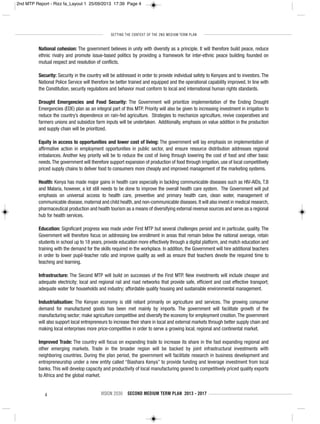
National cohesion: The government believes in unity with diversity as a principle. It will therefore build peace, reduce
ethnic rivalry and promote issue-based politics by providing a framework for inter-ethnic peace building founded on
mutual respect and resolution of conflicts.
Security: Security in the country will be addressed in order to provide individual safety to Kenyans and to investors. The
National Police Service will therefore be better trained and equipped and the operational capability improved. In line with
the Constitution, security regulations and behavior must conform to local and international human rights standards.
Drought Emergencies and Food Security: The Government will prioritize implementation of the Ending Drought
Emergencies (EDE) plan as an integral part of this MTP. Priority will also be given to increasing investment in irrigation to
reduce the country’s dependence on rain-fed agriculture. Strategies to mechanize agriculture, revive cooperatives and
farmers unions and subsidize farm inputs will be undertaken. Additionally, emphasis on value addition in the production
and supply chain will be prioritized.
Equity in access to opportunities and lower cost of living: The government will lay emphasis on implementation of
affirmative action in employment opportunities in public sector, and ensure resource distribution addresses regional
imbalances. Another key priority will be to reduce the cost of living through lowering the cost of food and other basic
needs.The government will therefore support expansion of production of food through irrigation, use of local competitively
priced supply chains to deliver food to consumers more cheaply and improved management of the marketing systems.
Health: Kenya has made major gains in health care especially in tackling communicable diseases such as HIV-AIDs, T.B
and Malaria, however, a lot still needs to be done to improve the overall health care system. The Government will put
emphasis on universal access to health care, preventive and primary health care, clean water, management of
communicable disease, maternal and child health, and non-communicable diseases. It will also invest in medical research,
pharmaceutical production and health tourism as a means of diversifying external revenue sources and serve as a regional
hub for health services.
Education: Significant progress was made under First MTP but several challenges persist and in particular, quality. The
Government will therefore focus on addressing low enrollment in areas that remain below the national average, retain
students in school up to 18 years, provide education more effectively through a digital platform, and match education and
training with the demand for the skills required in the workplace. In addition, the Government will hire additional teachers
in order to lower pupil-teacher ratio and improve quality as well as ensure that teachers devote the required time to
teaching and learning.
Infrastructure: The Second MTP will build on successes of the First MTP. New investments will include cheaper and
adequate electricity; local and regional rail and road networks that provide safe, efficient and cost effective transport;
adequate water for households and industry; affordable quality housing and sustainable environmental management.
Industrialisation: The Kenyan economy is still reliant primarily on agriculture and services. The growing consumer
demand for manufactured goods has been met mainly by imports. The government will facilitate growth of the
manufacturing sector; make agriculture competitive and diversify the economy for employment creation.The government
will also support local entrepreneurs to increase their share in local and external markets through better supply chain and
making local enterprises more price-competitive in order to serve a growing local, regional and continental market.
Improved Trade: The country will focus on expanding trade to increase its share in the fast expanding regional and
other emerging markets. Trade in the broader region will be backed by joint infrastructural investments with
neighboring countries. During the plan period, the government will facilitate research in business development and
entrepreneurship under a new entity called “Biashara Kenya” to provide funding and leverage investment from local
banks. This will develop capacity and productivity of local manufacturing geared to competitively priced quality exports
to Africa and the global market.
2nd MTP Report - Rizz fa_Layout 1 25/09/2013 17:39 Page 4
SETTING THE CONTEXT OF THE 2ND MEDIUM TERM PLAN
VISION 2030 SECOND MEDIUM TERM PLAN 2013 - 2017 5
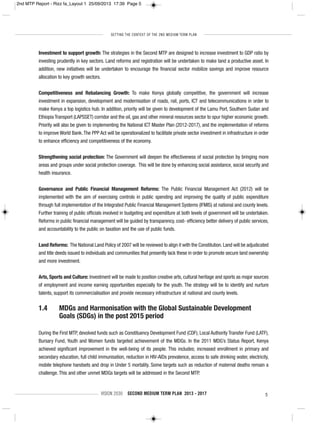
Investment to support growth: The strategies in the Second MTP are designed to increase investment to GDP ratio by
investing prudently in key sectors. Land reforms and registration will be undertaken to make land a productive asset. In
addition, new initiatives will be undertaken to encourage the financial sector mobilize savings and improve resource
allocation to key growth sectors.
Competitiveness and Rebalancing Growth: To make Kenya globally competitive, the government will increase
investment in expansion, development and modernisation of roads, rail, ports, ICT and telecommunications in order to
make Kenya a top logistics hub. In addition, priority will be given to development of the Lamu Port, Southern Sudan and
Ethiopia Transport (LAPSSET) corridor and the oil, gas and other mineral resources sector to spur higher economic growth.
Priority will also be given to implementing the National ICT Master Plan (2012-2017), and the implementation of reforms
to improve World Bank.The PPP Act will be operationalized to facilitate private sector investment in infrastructure in order
to enhance efficiency and competitiveness of the economy.
Strengthening social protection: The Government will deepen the effectiveness of social protection by bringing more
areas and groups under social protection coverage. This will be done by enhancing social assistance, social security and
health insurance.
Governance and Public Financial Management Reforms: The Public Financial Management Act (2012) will be
implemented with the aim of exercising controls in public spending and improving the quality of public expenditure
through full implementation of the Integrated Public Financial Management Systems (IFMIS) at national and county levels.
Further training of public officials involved in budgeting and expenditure at both levels of government will be undertaken.
Reforms in public financial management will be guided by transparency, cost- efficiency better delivery of public services,
and accountability to the public on taxation and the use of public funds.
Land Reforms: The National Land Policy of 2007 will be reviewed to align it with the Constitution. Land will be adjudicated
and title deeds issued to individuals and communities that presently lack these in order to promote secure land ownership
and more investment.
Arts, Sports and Culture: Investment will be made to position creative arts, cultural heritage and sports as major sources
of employment and income earning opportunities especially for the youth. The strategy will be to identify and nurture
talents, support its commercialisation and provide necessary infrastructure at national and county levels.
1.4 MDGs and Harmonisation with the Global Sustainable Development
Goals (SDGs) in the post 2015 period
During the First MTP, devolved funds such as Constituency Development Fund (CDF), Local Authority Transfer Fund (LATF),
Bursary Fund, Youth and Women funds targeted achievement of the MDGs. In the 2011 MDG’s Status Report, Kenya
achieved significant improvement in the well-being of its people. This includes; increased enrollment in primary and
secondary education, full child immunisation, reduction in HIV-AIDs prevalence, access to safe drinking water, electricity,
mobile telephone handsets and drop in Under 5 mortality. Some targets such as reduction of maternal deaths remain a
challenge. This and other unmet MDGs targets will be addressed in the Second MTP.
2nd MTP Report - Rizz fa_Layout 1 25/09/2013 17:39 Page 5
SETTING THE CONTEXT OF THE 2ND MEDIUM TERM PLAN
6 VISION 2030 SECOND MEDIUM TERM PLAN 2013 - 2017
The Second MTP will integrate the SDGs for the post 2015 which include:
• Ending extreme poverty and hunger;
• Achieve development and prosperity for all without ruining the environment;
• Ensure learning for all children and youth;
• Achieving gender equality and reduce inequalities;
• Achieve health and wellbeing at all ages;
• Increasing agricultural production in an environmentally sustainable manner, to achieve food security and rural
prosperity;
• Make cities productive and environmentally sustainable;
• Curb human-induced climate change with sustainable energy;
• Protect ecosystems and ensure sound management of natural resources; and
• Improve governance and align business behavior with all the goals.
1.5 Foreign Policy and International Relations
During the second MTP period and beyond, measures will be taken to realign Kenya’s foreign policy with the nation’s
international trade objectives.These include more training of staff in trade analysis and negotiation techniques, deepening
economic and commercial diplomacy, regional integration, bilateral and multilateral partnerships to increase market share
in traditional export destinations, penetration of new markets in emerging economies as well as enhancing the role of
private sector in regional integration initiatives. Additionally, the realigned foreign policy will link regional peace and
security with Kenya’s economic and commercial diplomacy interests and ensure the diplomatic presence in all African
region and new emerging economies. Kenya’s foreign policy shall also be directed towards promoting Nairobi as a
diplomatic centre, international economic hub, and venue for multi-lateral diplomacy.
1.6 Risks to the Implementation of the second MTP and Mitigation Measures
The Second MTP has been prepared against the backdrop of sluggish growth in the Euro Area and economic instability in
Southern Europe. Promises of renewed growth of the industrialized economies such as the US, Britain and Japan in mid-
2013 provides positive prospects. However, growth in Brazil, Russia, India, China and South Africa (BRICS) states generally
seemed to be slowing down. Likewise, some Kenyan markets in North Africa such as Egypt have suffered low growth and
instability. Diversification of trade and investment will be influenced by the recovery in the BRICS economies.
Other risks include un-anticipated geo-political developments which could include increased international oil prices,
negative effects of climate change, and external and internal security risks. The government will implement strategies to
mitigate against these risks.
2nd MTP Report - Rizz fa_Layout 1 25/09/2013 17:39 Page 6
SETTING THE CONTEXT OF THE 2ND MEDIUM TERM PLAN
2nd MTP Report - Rizz fa_Layout 1 25/09/2013 17:39 Page 7
8 VISION 2030 SECOND MEDIUM TERM PLAN 2013 - 2017
2.0 Overview
The medium term macroeconomic framework for the period 2013-2017 is consistent with Kenya Vision 2030 and aims
at putting the economy on a high growth path, to ensure that double digit growth is realized, by the end of the plan period.
The effectiveness of the framework is supported by the policy, legal, institutional, and structural reforms that will be
implemented by the government to enhance macroeconomic stability, improve business environment and ensure
transparent and accountable use of public resources. Employment creation is a key component of the overall strategy to
contribute to the socio-economic objectives of tackling poverty and income inequality.
2.1 Situation Analysis of the Economic Performance under the ERS (2003-2007)
The implementation of the Economic Recovery Strategy (ERS) 2003-2007 saw the economy grow from 2.9 % in 2003
to 7.1 % in 2007. However, during the first MTP 2008-2012, growth slowed as a result of adverse multiple shocks,
namely, the post-election crisis, drought, the global financial and economic crisis, high international oil and food prices,
and slowdown in global economic activity.
These factors contributed to low attainment of projected GDP growth, and investment and savings targets. In addition,
the slow implementation of key economic reforms, such as the policy and legal framework for Public Private
Partnerships (PPPs) enacted at the end of the Plan period, and absense of legislative framework for establishment of
Special Economic Zones partly explains the missed sectoral investment and growth targets in agriculture, industry and
service sectors of the economy.
Nonetheless some sectors such as financial services, building and construction, and the ICT registered strong growth
during the first MTP period. The Government also made notable progress in meeting macro-fiscal targets related to
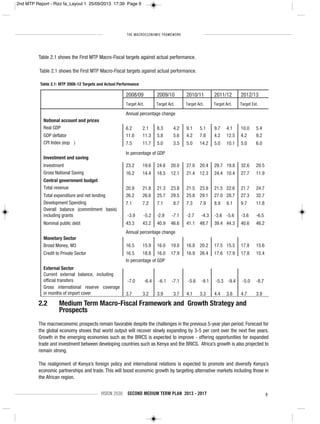
revenue collection and increased share of development spending to GDP, with actual outcomes exceeding the set
targets (Table 2.1).
2 THE MACROECONOMIC
FRAMEWORK
2nd MTP Report - Rizz fa_Layout 1 25/09/2013 17:39 Page 8
THE MACROECONOMIC FRAMEWORK
VISION 2030 SECOND MEDIUM TERM PLAN 2013 - 2017 9
Table 2.1: MTP 2008-12 Targets and Actual Performance
2008/09 2009/10 2010/11 2011/12 2012/13
Target Act. Target Act. Target Act. Target Act. Target Est.
Annual percentage change
National account and prices
Real GDP 6.2 2.1 8.3 4.2 9.1 5.1 9.7 4.1 10.0 5.4
GDP deflator 11.0 11.3 5.8 5.6 4.2 7.8 4.2 12.5 4.2 9.2
CPI Index (eop ) 7.5 11.7 5.0 3.5 5.0 14.2 5.0 10.1 5.0 6.0
In percentage of GDP
Investment and saving
Investment 23.2 19.6 24.6 20.0 27.0 20.4 29.7 19.8 32.6 20.5
Gross National Saving 16.2 14.4 18.5 12.1 21.4 12.3 24.4 10.4 27.7 11.9
Central government budget
Total revenue 20.9 21.8 21.3 23.8 21.5 23.9 21.5 22.6 21.7 24.7
Total expenditure and net lending 26.2 26.6 25.7 29.5 25.8 29.1 27.0 28.7 27.3 32.7
Development Spending 7.1 7.2 7.1 8.7 7.3 7.9 8.9 9.1 9.7 11.8
Overall balance (commitment basis)
including grants -3.9 -5.2 -2.9 -7.1 -2.7 -4.3 -3.6 -5.6 -3.6 -6.5
Nominal public debt 43.3 43.2 40.9 46.6 41.1 48.7 39.4 44.3 40.6 46.2
Annual percentage change
Monetary Sector
Broad Money, M3 16.5 15.9 16.0 19.0 16.8 20.2 17.5 15.5 17.8 15.6
Credit to Private Sector 16.5 18.8 16.0 17.9 16.9 26.4 17.6 17.9 17.8 15.4
In percentage of GDP
External Sector
Current external balance, including
official transfers -7.0 -6.4 -6.1 -7.1 -5.6 -9.1 -5.3 -9.4 -5.0 -8.7
Gross international reserve coverage
in months of import cover 3.7 3.2 3.9 3.7 4.1 3.3 4.4 3.6 4.7 3.9
Table 2.1 shows the First MTP Macro-Fiscal targets against actual performance.
2.2 Medium Term Macro-Fiscal Framework and Growth Strategy and
Prospects
The macroeconomic prospects remain favorable despite the challenges in the previous 5-year plan period. Forecast for
the global economy shows that world output will recover slowly expanding by 3-5 per cent over the next five years.
Growth in the emerging economies such as the BRICS is expected to improve - offering opportunities for expanded
trade and investment between developing countries such as Kenya and the BRICS. Africa’s growth is also projected to
remain strong.
The realignment of Kenya’s foreign policy and international relations is expected to promote and diversify Kenya’s
economic partnerships and trade. This will boost economic growth by targeting alternative markets including those in
the African region.
Table 2.1 shows the First MTP Macro-Fiscal targets against actual performance.
2nd MTP Report - Rizz fa_Layout 1 25/09/2013 17:39 Page 9
THE MACROECONOMIC FRAMEWORK
10 VISION 2030 SECOND MEDIUM TERM PLAN 2013 - 2017
On the domestic front, Kenya is implementing major legal and institutional reforms that will provide a better
environment for sustained macro-economic stability and improved management of public resources. These include:
the Public Finance Management Act (2012); the County Governments Act (2012); the Urban Areas and Cities Act (2011),
National Government Coordination Act (2013), and Transition to Devolved Governments Act (2012). In addition, the
government is continuing to deepen reforms in the judiciary, police and land sectors. These reforms will enhance
administration of justice, governance, law and order, and provide the country with a more conducive environment for
doing business, promote investment, growth and employment creation.
Foreign direct investment is expected to increase especially following the recent discovery of oil, gas, rare earth
minerals and coal. In addition, the country will maximize its geographical comparative advantage through
implementation of the LAPSSET corridor project, modernisation of the Port of Mombasa, construction of a standard
gauge railway from Mombasa to Malaba, and expansion of Jomo Kenyatta International Airport to serve as the regional
airport hub. Construction of the Ethiopia power interconnectivity line, to source cheaper hydropower, and completion
of the Olkaria IV by 2014 and other geothermal energy projects are also expected to boost growth through supply of
cheaper and reliable power.
The growth strategy will also benefit from exploitation of “green growth” opportunities such as the use of carbon
credits (especially in reforested catchment towers), clean energy use in geothermal, hydro, wind and solar power, the
promotion of natural products initiatives, promotion of resource efficiency and clean production systems. During the
plan period, the 47 Counties are also expected to attract investment and emerge as regional growth hubs.
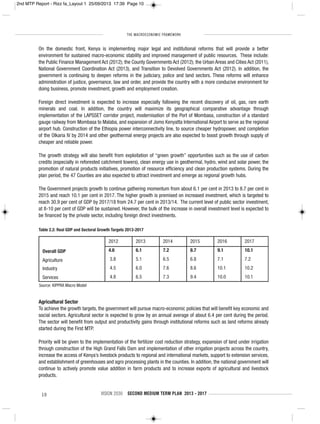
The Government projects growth to continue gathering momentum from about 6.1 per cent in 2013 to 8.7 per cent in
2015 and reach 10.1 per cent in 2017. The higher growth is premised on increased investment, which is targeted to
reach 30.9 per cent of GDP by 2017/18 from 24.7 per cent in 2013/14. The current level of public sector investment,
at 8-10 per cent of GDP will be sustained. However, the bulk of the increase in overall investment level is expected to
be financed by the private sector, including foreign direct investments.
Agricultural Sector
To achieve the growth targets, the government will pursue macro-economic policies that will benefit key economic and
social sectors. Agricultural sector is expected to grow by an annual average of about 6.4 per cent during the period.
The sector will benefit from output and productivity gains through institutional reforms such as land reforms already
started during the First MTP.
Priority will be given to the implementation of the fertilizer cost reduction strategy, expansion of land under irrigation
through construction of the High Grand Falls Dam and implementation of other irrigation projects across the country,
increase the access of Kenya’s livestock products to regional and international markets, support to extension services,
and establishment of greenhouses and agro processing plants in the counties. In addition, the national government will
continue to actively promote value addition in farm products and to increase exports of agricultural and livestock
products.
Table 2.2: Real GDP and Sectoral Growth Targets 2013-2017
2012 2013 2014 2015 2016 2017
Overall GDP 4.6 6.1 7.2 8.7 9.1 10.1
Agriculture 3.8 5.1 6.5 6.8 7.1 7.2
Industry 4.5 6.0 7.6 8.6 10.1 10.2
Services 4.8 6.5 7.3 9.4 10.0 10.1
Source: KIPPRA Macro Model
2nd MTP Report - Rizz fa_Layout 1 25/09/2013 17:39 Page 10
THE MACROECONOMIC FRAMEWORK
VISION 2030 SECOND MEDIUM TERM PLAN 2013 - 2017 11
Industrial sector
To transform the economy, the industrial sector growth needs to expand steadily from 6.0 per cent in 2013 to 10.2 per
cent in 2017. The Government will focus on an export led growth strategy through the establishment of Special
Economic Zones (SEZs), industrial clusters, and SME parks. In addition, the government will support growth in the
mining industry by creating an enabling policy, legal, and institutional framework for investment and maximisation of
benefits from exploitation of Kenya’s natural resources especially oil, natural gas, coal, and other minerals. The
construction and building sector will benefit from continued infrastructure spending with expansion of roads, ports, rail
and power plants. Kenya will also continue to aggressively exploit market opportunities through regional integration,
and exploit export opportunities in African states outside the East African Community (EAC), Common Markets for
Eastern and Southern Africa (COMESA) and in the global market.
Service Sector
Services sector is expected to grow from about 6.5 per cent in 2013 to about 10 per cent by 2017. The sector will
benefit from sustained growth in tourism, ICT, and related businesses such as Business Process Outsourcing (BPOs),
and expansion of regional trade and transport services. In addition, the financial sector is expected to expand rapidly
as business confidence improves and as new strategies to boost savings are implemented. The establishment of the
Financial Services Center during the plan period is expected to further improve the sector’s growth, and to attract more
local and international firms in the sector.
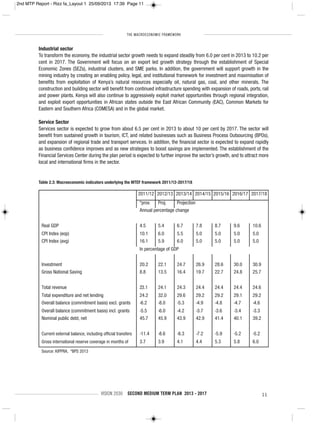
Table 2.3: Macroeconomic indicators underlying the MTEF framework 2011/12-2017/18
2011/12 2012/13 2013/14 2014/15 2015/16 2016/17 2017/18
*prov. Proj. Projection
Annual percentage change
Real GDP 4.5 5.4 6.7 7.8 8.7 9.6 10.6
CPI Index (eop) 10.1 6.0 5.5 5.0 5.0 5.0 5.0
CPI Index (avg) 16.1 5.9 6.0 5.0 5.0 5.0 5.0
In percentage of GDP
Investment 20.2 22.1 24.7 26.9 28.6 30.0 30.9
Gross National Saving 8.8 13.5 16.4 19.7 22.7 24.8 25.7
Total revenue 23.1 24.1 24.3 24.4 24.4 24.4 24.6
Total expenditure and net lending 24.2 32.0 29.6 29.2 29.2 29.1 29.2
Overall balance (commitment basis) excl. grants -6.2 -8.0 -5.3 -4.9 -4.8 -4.7 -4.6
Overall balance (commitment basis) incl. grants -5.5 -6.0 -4.2 -3.7 -3.6 -3.4 -3.3
Nominal public debt, net 45.7 45.9 43.9 42.9 41.4 40.1 39.2
Current external balance, including official transfers -11.4 -8.6 -8.3 -7.2 -5.9 -5.2 -5.2
Gross international reserve coverage in months of 3.7 3.9 4.1 4.4 5.3 5.8 6.0
Source: KIPPRA, *BPS 2013
2nd MTP Report - Rizz fa_Layout 1 25/09/2013 17:39 Page 11
THE MACROECONOMIC FRAMEWORK
12 VISION 2030 SECOND MEDIUM TERM PLAN 2013 - 2017
2.2.1 Medium Term Fiscal Projections
The government will pursue prudent macroeconomic policies to ensure fiscal and debt sustainability. The debt to GDP
ratio is projected to decline to 39.2 per cent by 2017/2018 from 43.9 per cent in 2013/14. The implementation of the
contributory pension scheme for public servants (The Public Service Superannuation Act, 2012) will enhance domestic
savings and reduce government contingent liabilities.Tax reforms will be given priority including enhancing compliance
and broadening the tax base. These will be supported through the implementation of Integrated Tax Management
system (ITMs) and revamping enforcement mechanisms.
The Government will continue to borrow from domestic and external sources with the latter being largely on
concessional terms and will aim at a 30:70 ratio of domestic to external financing. This will ensure that the private
sector is not crowded out in the credit market and that Government projects are financed at lower costs. The
Government will also issue a debut sovereign bond at the International markets within the Second MTP period. This
bond will primarily finance infrastructure development in the country, help the Government diversify its investor base,
establish a pricing benchmark for future issuance by both the public and private sector, and promote Kenya’s reputation
and visibility in the international investor community.
The Central Bank of Kenya (CBK) will pursue a prudent monetary policy to ensure price stability with inflation projected
to remain at about 5 per cent as a policy target. In addition, the CBK will build international reserves to 6 months import
cover as agreed by all EAC Member States compared to 4 months during the First MTP period. In order to cushion the
country from the vulnerabilities of hikes in food prices and higher inflation, the government will maintain sufficient
strategic grain reserves.
2.2.2 Medium Term Employment Projections
The First MTP had projected an annual average employment growth of 6.0 per cent and creation of a total of 3.7 million
new jobs. However, an annual average of 511,000 jobs against a target of 740,000 jobs was created between 2008
and 2012. Moreover, about eighty (80) per cent of the new jobs created were in the informal sector, where most jobs
are characterized by underemployment and low productivity. The challenge under the Second MTP is to increase the
share of quality jobs created in the formal sector.
During the Second MTP, the Government is committed to create 1 million new jobs annually to address youth
unemployment and also improve skills training. The government will also seek a major and permanent shift toward
formal employment, with the aim of increasing the proportion of modern sector employment from 12 per cent in 2012
to 40 per cent by the end of the plan period.
Table 2.4: Employment Projections 2013-2017
As part of the employment creation strategy, the government will:
• Initiate labour intensive public works programs;
• Support SMEs;
• Facilitate establishment of Special Economic Zones and Industrial Parks; and
• Exploit green employment opportunities in organic products industries, organic farming, resource efficient and
clean production, renewable energy, forestry, environmental planning and urban waste management.
Over the plan period, rationalisation of the public service will continue. The government aims at an efficient, effective
and accountable public service that will adopt innovative ways to deliver public services including leveraging on ICT.
The public service wage bill will be managed on the principle of moderation. The Salaries and Remuneration
Commission (SRC) will continue to set the salaries of state officers that will ensure fiscal prudence and sustainability
among other key public finance principles. In addition, the government will develop wages and incomes policy to
2nd MTP Report - Rizz fa_Layout 1 25/09/2013 17:39 Page 12
THE MACROECONOMIC FRAMEWORK
VISION 2030 SECOND MEDIUM TERM PLAN 2013 - 2017 13
provide a framework and necessary guidance on wage levels, wage formation and adjustment mechanisms and other
wage administration issues to reduce incidences of industrial disputes.
2.3 Structural Reforms
Kenya’s global ranking on the World Bank’s Ease of Doing Business Indicators fell from 72nd position in 2008 to 121st
position in 2012. The government is committed to reversing this trend, and the overall goal is to ensure that by the end
of the Plan period the country rank among the top 50 countries in the both ‘Ease of Doing Business’ ranking and the
World Economic Forum’s “Global Competitiveness Index”. The government will, thus speed-up implementation of
structural and institutional reforms and put in place the necessary enabling legislation in all sectors to enhance
efficiency and competitiveness and investment.
During the first year of the Plan, priority will be given to: full implementation of the provisions of the PPP Act (2013);
fast tracking the enactment into law of the Business Regulatory Reform Bill and Special Economic Zones Bill. These
key pieces of legislation are expected to facilitate private sector investment in infrastructure and in other areas of the
economy.
To enhance competition and economic efficiency, the National Productivity Center and the Competition Authority will be
strengthened to effectively perform their mandates. In addition to reforms under the Public Finance Management Act
(2012), the National Treasury will strengthen the Debt Management Office and establish a financial management
Employment Projections, 2013 -2017 ('000 )
2008 -2012 (MTPI) 2013 2014 2015 2016 2017 2013 -17 (MTPII)
Total Avg Projections Total Avg
Total Employment 2,557 511 723 821 1,000 1,194 1,432 5,170 1034
Formal 334 67 108 164 250 418 573 1513 303
Agriculture 15 3 31 48 93 153 221 546 109
Industry 52 10 22 34 54 92 136 338 68
Services 267 53 55 83 103 174 216 631 126
Informal 2,223 445 615 657 750 776 859 3657 731
Agriculture 591 118 165 173 173 190 200 901 180
Industry 340 68 102 122 159 175 212 770 15 4
Services 1,291 258 348 360 396 411 448 1,963 393
Ratio of formal to total employment 0.15 0.2 0.25 0.35 0.4 0.29
Ratio of informal to total employment 0.85 0.8 0.75 0.65 0.6 0.71
Table 2.4: Employment Projections 2013-2017
Note: Employment targets were based on the 2001-2011 elasticity defined as per cent increase in employment level for every one per cent
increase in GDP levels as follows: Agriculture 0.43; Industry 0.50; and Services 0.75
Source: Ministry of Devolution and Planning, The National Treasury
2nd MTP Report - Rizz fa_Layout 1 25/09/2013 17:39 Page 13
THE MACROECONOMIC FRAMEWORK
14 VISION 2030 SECOND MEDIUM TERM PLAN 2013 - 2017
system for all levels of government.
Implementation of the Strategy for Public Finance Management Reforms (PFMR) 2013-2018 will enhance transparency
and accountability for improved service delivery. The Public Procurement and Disposal Act, 2005 will be reviewed to
address procurement bottlenecks and build capacity at the national and county government levels. ICT initiatives such
as the re-engineered IFMIS, NIMES, e-Promis, and e-government will be fast-tracked and cascaded to the devolved
government level to ensure faster project implementation, and monitoring and evaluation.
2.4 Statistical reforms
The government will strengthen the national statistical system to support planning, and monitoring and evaluation of
government policies and programmes. This will include establishment of statistics offices in all the 47 counties, which
will supervise and coordinate statistical programmes at the county level and ensure that international standards are
applied in the production and dissemination of county statistics, and that there will be harmony between national data
and aggregated county data. Continuous capacity building and development of regulatory procedures will be
undertaken, to ensure that statistics produced are of high quality.
To improve the quality of data, the following surveys and censuses will be carried out within the period of the second
MTP:
• Kenya Integrated Household Budget Survey (KIHBS) II;
• Census of Agriculture;
• Labour force survey;
• Census of Business establishments ; and
• Generation of county statistical profiles.
2.5 Tax Reforms
Tax reforms are key to enhancing the government’s revenue capacity to finance development programmes and
projects. Kenya Revenue Authority (KRA) will continue to benchmark its services to the standards of selected upper
middle income countries so as to meet the international best practices.
The following interventions will be implemented under tax reforms in the plan period:
• The second phase of the Integrated Tax Management System (ITMS);
• Payments of taxes via mobile money;
• Revamping the Turn over tax to make it more efficient and easy for the taxpayers to comply with;
• Use of geo-spatial information to enhance revenue collection from the real estate sector;
• Taxation of High Net Worth Individuals (HNWIs);
• Implementation of Single Customs Territory (SCT) to introduce tax payment at first point entry;
• Development of the KRA dynamic risk management system;
• Implementation of Electronic Cargo Tracking System (ECTS);
• Review the governance of transfer pricing programme;
• Review of tax legislation; and
• Local KRA offices reorganisation to assist County governments collect County revenue, and to strengthen and
revamp tax enforcement mechanisms.
2nd MTP Report - Rizz fa_Layout 1 25/09/2013 17:39 Page 14
THE MACROECONOMIC FRAMEWORK
VISION 2030 SECOND MEDIUM TERM PLAN 2013 - 2017 15
2nd MTP Report - Rizz fa_Layout 1 25/09/2013 17:39 Page 15
16 VISION 2030 SECOND MEDIUM TERM PLAN 2013 - 2017
3.0 Overview
The realisation of the objectives and targets of the Second MTP hinges on successful implementation of the enablers or
foundations. These include: infrastructure (roads, rail network, sea ports airports and pipeline); Information
Communication and Technology (ICT); Science Technology and Innovation (ST&I); Land Reforms; Human Resource
Development, Labour and Employment; Security; Public Sector Reforms; National Values and Ethics; and Ending Drought
Emergencies (EDE).
This Chapter outlines the policies, programmes and projects planned for implementation during the Plan period.
3.1 Infrastructure
“Deploying World Class Infrastructure Facilities and Services”.
The target for the Second MTP will be to gradually close Kenya’s “infrastructure deficit” while building on the
achievements of the first MTP. Efficient, accessible and reliable infrastructure is an enabler for sustained economic
growth, development and poverty reduction. It lowers the cost of doing business; improves security; improves livelihoods
and the country’s global competitiveness. Implementation of programmes and projects will focus on accessibility, quality,
their functionality, job creation, disaster preparedness and protection of the environment.
The strategies for successful improvement of infrastructure both at national and county governments include:
strengthening of the institutional framework for infrastructure development; operationalizing the Public Private Partnership
(PPP) legislation to encourage private investment in public projects; establishing a Kenya Development Bank to provide
finances to the private sector for investment in infrastructure development; regular maintenance of infrastructure facilities;
raising the efficiency and quality of infrastructure as well as increasing the rate of implementation of infrastructure
projects.
3.1.1 Situation Analysis
During the First MTP, the infrastructure sector recorded good progress in the development and expansion
andimprovement of airports, ports, rail, pipelines, hydropower, geothermal plants, ferries, housing and public works
facilities. Key achievements realized include:
• Expansion and modernisation of Aviation facilities at Jomo Kenyatta International Airport, Kisumu International Airport
and selected airstrips countrywide;
• Improvement of Shipping and Maritime Facilities that includes dredging and widening of Mombasa Port and the
development of Berth No.19;
• Improvement of Railway Transport Systems that includes the upgrading of the Commuter Core System, completion
of JKIA Commuter Rail Phase I, the construction of a railway station at Syokimau and completion of preliminary
designs for Mombasa - Malaba / standard Gauge Rail;
• Road Expansion Programme which consisted of 2,200 km of roads constructed, 1,863km rehabilitated/reconstructed,
3 FOUNDATIONS FOR NATIONAL
TRANSFORMATION
2nd MTP Report - Rizz fa_Layout 1 25/09/2013 17:39 Page 16
FOUNDATIONS FOR NATIONAL TRANSFORMATION
VISION 2030 SECOND MEDIUM TERM PLAN 2013 - 2017 17
2,649km on periodic maintenance and 236,603km routine maintenance.
• The completion of Nairobi-Thika super-highway, Northern Corridor Transport Improvement Project (NCTIP);
• Decongestion of cities, towns and urban centres;
• Construction of Nairobi missing links;
• Improvement of rural accessibility through the Roads 2000 Programme;
• Implementation of National Road Safety Programme;
• Installed capacity of electricity generation, increased from 1,268MW in 2008 to 11,606MW in 2012;
• New customer connectivity to electricity increased from 1,060,383 in 2008 to 2,330,962 customers by June 2013;
an increase of 1,270,579 new customers against the first MTP’s target of 1,000,000 customers;
• Installed capacity from the new and renewable sources increased from 100MW in 2008 to 241MW in 2012.
• Initiation of the development of Lamu Port Southern Sudan and Ethiopia Transport (LAPSSET); and
• Key policy, legal and institutional frameworks were developed and fast-tracked to support implementation of
programmes and projects in the sector.
3.1.2 Emerging Issues and Challenges
Emerging issues that slowed down further infrastructure development include concerns over the length of future planning
and consultative processes, inadequate funding, contracting disputes and low/poor maintenance of key projects.
In addition to the above, the sub-sector specific challenges include:
• Aviation: Lack of adequate and skilled flight safety inspectors; rapid technological changes in equipment for the
provision of Air Navigation Services;
• Shipping and Maritime: lengthy customs and documentation procedures; lack of electronic cargo tracking system
and non-tariff barriers; multiple weighbridges; inadequate equipment and machinery thereby limiting handling
capacity of the port; lack of training vessel to offer sea time to trainees;
• Railway: huge capital outlay required to construct standard gauge railway line and commuter rail services,
inadequate trained engineers, encroachment of railway lines, and aging wagons;
• Roads: Congestion in Cities and Urban areas, lack of harmonisation of cross-border transport regulation and
operational procedures, rapid urbanisation and increased traffic volume, lack of specific standards and capacity for
devolved county roads, huge maintenance backlog of the road network, weak enforcement of axle load rules and
regulations, high cost/delays in relocation of utilities and services along and across road reserves, and high cost of
road construction;
• Buildings and Other Public Works: Outstanding problems include completion of stalled projects under the Economic
Stimulus Programme, and high rental accommodation charges in foreign missions abroad;
• Energy: over-dependence on hydropower with its vulnerability to variations in hydrology and climate, high cost of
rural electrification projects, outdated refinery and pipeline system, inadequate storage infrastructure for strategic
reserves of the petroleum products, volatility of international crude oil prices and weak legal and regulatory
framework for energy resources exploration, exploitation and development.
3.1.3 Programme and Projects for 2013-2017
Flagship Programmes and Projects
The infrastructure sector is expected to play a pivotal role in steering Kenya’s economy towards a middle income level
as envisaged in the Vision 2030. The following are the key programmes and projects to be implemented.
Expansion and Modernisation of Aviation Facilities: The Government aims at making Kenya the aviation hub in the
African region through construction and modernisation of aviation facilities and targets annual capacity of 45 million
passengers. Key projects includes: reconstruction of terminal two at JKIA; construction of Green Field Terminal, second
runway and associated facilities at JKIA; improvement of terminal and airside capacity at Kisumu International Airport,
2nd MTP Report - Rizz fa_Layout 1 25/09/2013 17:39 Page 17
FOUNDATIONS FOR NATIONAL TRANSFORMATION
18 VISION 2030 SECOND MEDIUM TERM PLAN 2013 - 2017
improvement of safety and support operations at Moi International Airport; modernisation of Air Navigation Services
Phase II & III and construction, rehabilitation and maintenance of Airstrips and Airports.
Expansion of the Route Network: The Government will negotiate and conclude additional Bilateral Air Agreement
Services (BASAs) and ratify new international conventions and protocols aiming at expanding the route network of Kenya
Airways and other designated national carriers.
Improvement of Shipping and Maritime Facilities: The objective of this programme is to build port capacity of 50
million tonnes and transform Kenya into a maritime hub by facilitating trans-shipment of cargo at the port of Mombasa.
In order to achieve this, the Government will improve port efficiency, construct second container terminal at KPA, provide
new handling facilities at the Mombasa Port, develop Dongo Kundu Free Trade Port, and modernize ferry services to
increase passenger capacity per year.
Expansion of Railway Transport: the aim will be to increase the railway capacity to handle 50 per cent of freight cargo
(25 Million Tonnes) from the Mombasa Port. To achieve this objective, the government will: develop a standard gauge
railway line between Mombasa through Nairobi to Malaba with connectivity to Kisumu,Uganda and Rwanda; expand
Nairobi Commuter Railway Services system that involves upgrading of the Commuter Core System (existing commuter
rail line); construction of a railway line from JKIA to the Syokimau Railway Station, and construction of Kisumu and
Mombasa commuter rail systems.
Expansion of Roads Programme: The programme is aimed at enhancing domestic and regional trade through upgrading
of the national and county roads network. The target is to construct and rehabilitate approximately 5,500 km of roads
comprising of 3,825 km national trunk roads and 1,675 km county roads. About 1,700 km for Non-Motorized Transport
(NMT) including paths and walkways will be constructed. About 800 km of roads will be designed and 4,257 km and
1,735 km of national trunk roads and county roads will be periodically maintained respectively. In addition approximately
200,000 km will be routinely maintained.
The PPP arrangements, such as concessioning, Build Operate Transfer, Design Build Operate, Design and Build will be
used for roads construction and/or maintenance on Nairobi bypasses and other major roads including sections of
Mombasa-Nairobi-Malaba, Mau-Summit-Kisumu-Busia and Nairobi-Thika highway.
To achieve the above targets, the following flagship programmes/projects will be implemented:
• Northern Corridor Transport Improvement Project (NCTIP);
• East Africa Road Network Project (EARNP);
• Kenya Transport Sector Support Project;
• Rehabilitate and Upgrade Eldoret-Kitale-Lodwar-Nadapal (600km): This is a transnational project to promote and
facilitate regional economic integration between Kenya and South Sudan;
• Decongestion of Cities, Urban Areas and Municipalities: aimed at easing congestion, reduce travel time and costs
and enhance connectivity in cities, urban areas and municipalities. These will include Construction of Bypasses,
Construction of Missing Links and improvement of roads in Nairobi and other Cities and Municipalities; and
• Scale up the Roads 2000 Programme which is labour intensive and has the potential to create more jobs.
Development of the Lamu Port-Southern Sudan-Ethiopia Transport (LAPSSET) Corridor: The objective of the
LAPSSET project is to open up northern Kenya and provide a reliable transport corridor for Ethiopia and Southern Sudan.
The following components will be constructed:
• A standard gauge railway line;
• A new road network;
• An oil pipeline, crude oil pipeline and refined oil pipeline from Lamu to Jubaa and Ethiopia;
• An oil refinery at Lamu with capacity of 120,000 barrels per day;
• A modern oil terminal at Lamu port to facilitate tanker loading and offloading;
• A refined petroleum products pipeline from Lamu connecting to the existing Mombasa-Kampala pipeline;
2nd MTP Report - Rizz fa_Layout 1 25/09/2013 17:39 Page 18
FOUNDATIONS FOR NATIONAL TRANSFORMATION
VISION 2030 SECOND MEDIUM TERM PLAN 2013 - 2017 19
• International airports at Lamu, Isiolo and Lokichoggio;
• A free port at Lamu (Manda Bay) including three berths to handle container, conventional and bulk cargo vessels,
Lamu Port Management Building, Lamu Port Police Station and staff housing, and dispensary and a club house;
• Three resort cities in Lamu (at Manda Bay), Isiolo and on the shores of Lake Turkana; and
• 1,420km 220 KV double circuit electricity transmission line along the LAPSSET Corridor.
National Road Safety Programme: The established National Transport and Safety Authority (NTSA) will be
operationalised while Transport Integrated Management System (TIMS) will be developed to automate and integrate
data from traffic department, registrar of motor vehicles, transport licensing board, motor vehicles inspection unit,
Association of Kenya Insurers, Courts and the Ministry of Transport and Infrastructure for effective management of the
road transport sub-sector.
Development of Mass Transport Transit Systems in Major Cities: Rapid Bus Transport Network and the Light Rail
Technology will be developed. Kenya Transport Support Sector Project (KTSSP) will be implemented.
Development of a 50 Year Transport Master Plan (TMP): The aim of the project is to ensure that investment and
location of the transport infrastructure and services are consistent with other public policies.The government will finalize
the TMP and implement the recommendations contained therein.
Improvement of Living and Working Conditions in Government Buildings: The objective of this program is to improve
functionality and appearance of public buildings as well as securing them from man-made and other calamities. It will
include completion of 35 stalled public buildings; design, document and supervise completion of 300 new government
buildings as requested by government ministries, agencies, departments and county governments; and rehabilitate and
maintain 250 public buildings in both national and county governments.
Development and Maintenance of Coastline Infrastructure and Inland Water Transport: Construction and
maintenance of 8 jetties and 7,500 meters of sea wall will be undertaken to improve movement into and out of waters,
and protect land and property in low lying areas from erosion, flooding and sea wave action. Inland water berths facilities
will also be improved
Improvement of Communication in Human Settlements: The objective of this programme is to improve accessibility
especially in areas of difficult terrain through the construction and maintenance of footbridges. It is targeted that 250
footbridges will be constructed in various parts of the country.
Regulation and Development of the Construction Industry in Kenya: The National Construction Authority (NCA) will
be stregthened to regulate standards in the construction industry; oversee and coordinate construction industry; register
contractors and regulate their conduct for improved performance in the construction industry.
Development of Foreign Missions Abroad and Development of Nairobi as a Multilateral Hub: This programme
aims to facilitate accommodation of foreign missions and ensure reduction in rental bills. The programme further aims
at promoting Nairobi as a multilateral hub.The projects to be undertaken during the plan period include: the construction
of chancery and ambassador’s residence in Kampala, Uganda; the construction of commercial buildings with chanceries
in Juba, Bujumbura and Kigali; the construction of convention centre, office blocks and hotel in Gigiri, Nairobi and
construction of an ultra modern building to house the Ministry headquarters.
Research in Appropriate Building Technology: The aim of the programme is to conduct research and disseminate
findings on appropriate building technologies. Over the plan period, seven researches on alternative building technologies
will be undertaken namely: brick/soil based materials; natural stones; cement based materials; wood based materials;
indigenous roofing materials; interlocking bricks; and prefabricated buildings.
2nd MTP Report - Rizz fa_Layout 1 25/09/2013 17:39 Page 19
FOUNDATIONS FOR NATIONAL TRANSFORMATION
20 VISION 2030 SECOND MEDIUM TERM PLAN 2013 - 2017
Increasing Electricity Availability through Power Generation: The government will improve the energy infrastructure
network and promote development and use of renewable energy sources to create a reliable, adequate and cost effective
energy supply regime to support industrial take off for economic growth. The key programmes and projects prioritized
for implementation to increase electricity installed capacity by 5,538 MW in 2017 are as follows:
• 250 MW (Diesel Plants);
• 24 MW (Hydropower – Kindaruma and import from Ethiopia);
• 1,646MW (Geothermal Resources: Orpower 4;at Olkaria I; at Olkaria IV; Olkaria V; Olkaria II; Eburu geothermal
project; new wellheads; Menengai; and Silali-Bogoria Phase I);
• 630 MW (Wind power –at Ngong, at Lake Turkana, Kinangop Aeolus, Kipeto, Prunus, and Isiolo);
• 1,920 MW Coal
• 18 MW co-generation
• 1,250 MW LNG Liquified Natural Gas /Compressed Natural Gas (CNG).
Drilling and Steam Field Development of Wells: A total of 620 geothermal steam production wells will be drilled and
developed at Olkaria (80), Menengai Phase 1(120), Mengai Phase 2 (210) and Silali-Bogoria Phase 1 (210) to be
completed by 2017.
Development of Multi-Purpose Dams by Regional Development Authorities: The dams with their power generation
capacities to be developed include: High Grand Falls Multipurpose dam (700 MW); Magwagwa Multipurpose dam (120
MW); Development of the Arror Multipurpose dam (60 MW); and Development of the Nandi Forest Multipurpose dam (50
MW).
Increasing Electricity Access: The government will increase access to electricity through upgrading and expansion of
the national power transmission and distribution network to improve supply and reliability, reduce losses and connect
two million new customers by 2017. Rural Electrification Authority (REA) will continue implementing Rural Electrification
Programme countrywide and targets to connect 6,304 public facilities.These will include electrifying the remaining 2,600
main public facilities (trading centres, secondary schools, health centres and dispensaries) and other public facilities
including primary schools, tea buying centres, water supply systems, places of worship among others.
Construction of Pipeline and Storage Facilities: the programme will be implemented through: Development of the
Mombasa Petroleum Trading Hub: It entails development of Very Large Crude Carrier (VLCC) size tankers and a tank
farm of at least 800,000MT through Public Private Partnership to provide storage for strategic petroleum stocks;
construction of a new oil pipeline from Mombasa to Nairobi (Line-5); construction of a parallel oil pipeline from Sinendet
to Kisumu; Kenya – Uganda Oil Pipeline; construction of additional storage tanks at Nairobi Terminal (4 tanks) and at
JKIA Depot ( 2 tanks); installation of a third pump in the Mombasa – Nairobi oil pipeline; expansion of truck loading
facilities at Eldoret depot; installation of integrated security system in all KPC’s depots; and upgrading of the oil refinery.
Development of New and Renewable Sources of Energy: The government will promote development of renewable
energy as an alternative source of energy.This includes generation of energy from solar, wind, biogas (“Biogas for Better
Life”) and development of bio-energy including bio-ethanol and diesel value chains.The use of improved cooking stoves
and charcoal kilns, and re-afforestation of water towers will be promoted. National Renewable Energy Master Plan and
updated renewable energy database will be developed.
Other Programmes and Projects
Other key projects to be implemented in the plan period include:
• Capacity Building Programme for East African School of Aviation (EASA) and Kenya National Shipping line;
• Improvement of Aviation Facilities at the Wilson Airport;
• Equipment Replacement Programme at KPA;
• Construction of container depot with forklift and purchase of new containers;
• Implementation of vessel chartering and purchase of new ones;
2nd MTP Report - Rizz fa_Layout 1 25/09/2013 17:39 Page 20
FOUNDATIONS FOR NATIONAL TRANSFORMATION
VISION 2030 SECOND MEDIUM TERM PLAN 2013 - 2017 21
• Implementation of the Resettlement Action Plan for 10,006 displaced persons along the railway reserve in Nairobi;
• County Roads programmes involving constructing/rehabilitating 1,675 km, maintenance of 1,735 kms and routine
maintenance of 130,000 km of roads;
• Acquisition of road construction plant and machinery;
• Road construction materials research and testing;
• Establishment of Transport Data Centre;
• Establishment of One-Stop Border Post at Malaba, Busia, Isebania,Taveta, Lungalunga, and Namanga to harmonized
systems for processing of transit cargo and this will facilitate cross border trade;
• Develop Transport Integrated Management System to integrate all road transport and related institutions;
• Introduction of second generation smart card based driving license;
• Establishment of Nairobi LPG storage, bottling and distribution facilities;
• Construction of an oil and container storage terminal at Konza;
• Upgrading of Supervisory Control and Data Acquisition/Energy Management System (SCADA/EMS);
• Improvement of Geographical Information System (GIS) utility database by completing the digitizing and mapping of
the grid network;
• Implementing customer service improvement programs including roll out of Automatic Meter Reading (AMR) for
large customers and pre-paid meters for small to medium customers; and Expansion of Fuel Retail Network
3.1.4 Policy, Legal and Institutional Reforms
To promote timely implementation of programmes and projects, the following Policies, Legal and Institutional Reforms
will be fast-tracked:
Transport: Establish an Autonomous National Aircraft Accident Investigation agency; review of Kenya Ports Authority
(KPA) and Kenya Railway Corporation (KRC) Acts; review and implement the Sessional Paper No.2 on Integrated National
Transport policy; finalisation and enactment of the Roads Subsector Policy and Kenya Roads Bill 2013; establishment of
Nairobi Metropolitan Transport Authority and setting up of the LAPSSET Corridor Implementation Fund; and development
of Intergrated Maritime Policy.
Energy: Review of the Feed in Tariffs policy; Review and approve competitive Profit Sharing Contracts; Enact legislation
to govern proposed petroleum special economic zones and petroleum trading; Legislation of regulatory framework for
enhancement of an independent system operator; Finalisation and enactment of the Energy Bill; Development of a policy
on management of commercial discoveries of oil and gas resources; Review and update the Petroleum (Exploration and
Production) Act (Cap 308); Review of the existing legislations on Licensing of Petroleum Businesses; Review of the
Energy (Petroleum Pricing) regulation, 2010; Review of the National Oil Corporation Act;
Building and Construction: Review of the Architects and Quantity Surveyors Act, CAP 525 to establish separate
legislations for each profession.
3.2 Information and Communications Technology (ICT)
“Strengthening the foundation for a knowledge economy”
The government recognizes ICT as a foundation for economic development. Kenya’s vision of knowledge based economy
aims at shifting the current industrial development path towards innovation where creation, adoption, adaptation and
use of knowledge remain the key source of economic growth. ICT is a critical tool for expanding human skills and rests
largely on a system of producing, distributing and utilizing information and knowledge that in turn plays a great role in
driving productivity and economic prosperity.
3.2.1 Situation Analysis
2nd MTP Report - Rizz fa_Layout 1 25/09/2013 17:39 Page 21
FOUNDATIONS FOR NATIONAL TRANSFORMATION
22 VISION 2030 SECOND MEDIUM TERM PLAN 2013 - 2017
Under the First MTP, the sector made tremendous progress. Kenya led the world in electronic cash transfer through
mobile telephony platform as a result of which micro-credits and savings are being raised using the same platform.The
sector also witnessed development of 60 per cent of the planned national ICT infrastructure to improve universal access
to ICT services.The country is currently connected to the international broadband highway through the SEACOM,TEAMS,
EASSY, and LION cables. All major towns in the country are now connected through the National Optic Fibre Backbone
Infrastructure (NOFBI) and Government Common Core Network (GCCN). Demand for internet and data services has been
rising with Internet subscription increasing from 1,579,387 subscribers in 2009 to 8,506,748 in 2012.This has enhanced
business activities and created job opportunities.
The Government developed the tier-2 Government Data Center (GDC) infrastructure to ensure security of Government
data and applications. Bandwidth support to government offices was increased from 80 to 100 MB Broadband internet
capacity. This has improved the quality and reliability of Government communication system. Several ministries have
developed online systems geared towards improving service delivery. These systems include: the re-engineered
Integrated Financial Management Information System (IFMIS), County Revenue Collection System, application of public
service jobs online, status tracking of ID and passports, public examination results and candidate selection into secondary
schools, digitized education content in 12 subjects in secondary school level; online submission of tax returns, online
custom declaration, electronic reporting of corruption, and a business licensing e-registry.
Konza Techno City business plan with its physical development plan was developed. The focus areas to drive growth of
Techno City include Business Process Outsourcing (BPO), Internet Enabled Services (ITES), software development, data
centers, disaster recovery centers, call centers and light assembly manufacturing.
Other initiatives in the sector included: establishment of digital villages, digitalizing government records and providing
connectivity to government, learning and social Institutions; software development and film production; and establishment
of an open data portal. This has made Kenya to be ranked second in Africa and 22nd
(2012) worldwide in the open data
initiative.
The government developed and implemented Kenya Communications (Amendment) Act, 2009 and Kenya Information
and Communications Regulations, 2010. These legislations led to improved competition and broad choices of ICT
services.
3.2.2 Emerging Issues and Challenges
The sector faced the following challenges in implementation of its programmes:
• Inadequate financing coupled with delayed disbursement;
• Inadequate human capacity for research and development in ICT and the film industry;
• Inadequate legislation for better exploitation of ICT in commerce and entertainment with adequate safeguards against
crime and ICT media abuse;
• Decentralized ICT coordination structures leading to slow implementation of automated systems, duplication and
implementation of ICT innovations;
• Digital divide between the rural and urban areas which limits public awareness of the advantages and opportunities
of ICT;
• Slow adoption of ICT services by learning, social and government institutions;
• Non-incorporation of ICT cabling in new building designs;
• Lack of harmonized data management system;
• Inadequate information resource centers in the rural areas;
• Low ICT skills;
• Vandalism of ICT infrastructure;
• Sophistication in cyber attacks and cyber crimes;
• Lack of or inadequate supply of affordable and uninterrupted power supply; and
2nd MTP Report - Rizz fa_Layout 1 25/09/2013 17:39 Page 22
FOUNDATIONS FOR NATIONAL TRANSFORMATION
VISION 2030 SECOND MEDIUM TERM PLAN 2013 - 2017 23
• Limited penetration of telecommunication infrastructure in rural areas.
3.2.3 Programme and Projects for 2013-2017
.
Flagship Programmes and Projects:
Upgrading National ICT Infrastructure through:
• Expansion of Fibre Optic Networks to cover hospitals, schools, police stations and other public service institutions.
A universal service fund that finances the roll out of infrastructure and access of service to the unserved and
underserved areas will be created.
• Establishment of Wide Area Network and Network Operations Centre to ensure that each county headquarters use
a broadband network with a minimum capacity of 4mbps per agency, VOIP telephony and unified communication
systems.
• Roll out of 4 G Networks to provide faster internet and increase bandwidth capacity.
• Establish Data Centres designed to ensure that strategic public data is stored in secure locations with minimal risk
and delivered cost-effectively;
• Setting up National ICT Centres of Excellence in order to develop a critical mass of human resource required to
support capacity for the industry;
• Promote local ICT software development and make ICT Software more affordable and accessible through the existing
fiscal concessions by the Government;
• Enhance cyber security to reduce the risk of cyber attacks and create a more secure network from the level of the
major national public gateways to the user;
• Implement Public Key Infrastructure (PKI) to authorize and authenticate information systems in the country.The Root
Certificate Authorities which will facilitate the use of digital certificates will be set up;
• Build capacity for the Kenya Computer Incidence Response Team and Coordination Center (KE-CIRT/CC) to coordinate
computer related incidences in the country; and
• Roll out of the Digital TV Infrastructure in all the remaining counties (from 60% coverage to 100%) to move from
analogue to digital TV broadcasting migration.
Improving Public Service Delivery Using ICT through:
• Support for food security through development of the following: a digital land management system, GIS, mapping
of farm productivity, forecasting, digital meteorological systems, and market information systems, e-farming, farm
produce management systems, agricultural information systems, remote sensing, population management systems,
and health and nutrition information systems;
• E-government systems initiative to complete development of the following systems: National Integrated Monitoring
and Evaluation System (NIMES), e-Promis, National Integrated Education Information Management System (NIEIMS),
National Integrated Land Management Information System (NILMIS), performance contracting online tracking system,
Government shared services, Government Data Centre, Community Learning Information Centres, IFMIS, Revenue
collection system (CIFMIS), Interactive Voice Response System and Government unified messaging system;
• Enhancing the Kenya Open Data Initiative (KODI) portal and ensure that relevant organisations and ministries upload
information in a timely manner so that information available on the portal is current and consistent; and
• Integration of ICT in education to familiarize young Kenyans with ICT as a learning tool. Primary school pupils will
be provided with laptops to enable them access information on a wider scale online.
ICT Industry Development through:
• Development of Konza Technology City (KTC) to position Kenya as the ICT hub in Africa.The project will be developed
in phases and the first phase will consist of the following: construction of a BPO Park; a science park, residential
buildings, a data centre and part of central business district. It will also involve construction of basic infrastructure
including access roads, telecommunications, water and sewerage and electricity;
2nd MTP Report - Rizz fa_Layout 1 25/09/2013 17:39 Page 23
FOUNDATIONS FOR NATIONAL TRANSFORMATION
24 VISION 2030 SECOND MEDIUM TERM PLAN 2013 - 2017
• Generation of ICT contents.The Kenya ICT board in partnership with Strathmore University and other local universities
will generate content aimed at spurring new business concerns in the 47 counties. The Board in partnership with
the universities will conduct county commissioned research, data analysis and the best business opportunities and
potential investors in each county;
• Setting up of digital villages to provide over 30,000 opportunities for Business Process Outsourcing (BPO) by 2017
up from the current 13,000; and
• Development of e-commerce to enable entrepreneurs obtain skills to sell their products/services over the internet.
The programme will involve use of high resolution GIS maps of all the inhabited areas of Kenya; development of a
national e-commerce master plan, an e-commerce policy, an updated courier services policy, a content business
model policy; and e-commerce legislation and related regulation.
Upgrading ICT Capacity through:
• Setting up of County ICT Incubation Hubs to empower the youths with the necessary training and work experience
to develop market-ready ICT services and products;
• Development of a National Addressing System project to identify streets, buildings, plots and other infrastructure
and allocating them a street address; and
• Development of ICT human resource in government to enhance ICT knowledge and skills needed for better
performance of organisations within the public sector. Career progression with clear ranks, qualification and rewards
for government ICT staff will be established.
3.2.4 Policy, Legal and Institutional Reforms
The following policy, legal and institutional reforms will be necessary for effective implementation of projects:
Policy Reforms
• Review National ICT Policy, 2006 to re-align with the Constitution of Kenya 2010 and the best international practice;
• Develop and rollout of the National ICT Master Plan;
• Develop National Broadband Strategy; and
• Finalize and operationalize National Cyber Security Framework.
Legal Reforms
• Review of Media Act 2007 and Kenya Information and Communication Act (KICA)
Institutional reform
• Establishment of a National ICT Agency
3.3 Science, Technology and Innovation
“Harnessing Science, Technology and Innovation for Regional and Global Competitiveness”
Science, Technology and Innovation have become one of the most important enabling tools, leading to shifts in
comparative advantage and competitiveness of economies worldwide. The Kenya Vision 2030 and the Constitution
explicitly place a premium on the generation and management of a knowledge-based economy and the need to raise
productivity and efficiency. To achieve the goals in the second MTP, the sector will adopt various supporting initiatives
including: Public Private Partnerships (PPPs); linking industry with academia; value chain analysis; synergy (as opposed
to institutional competition) and initiatives for closed-cycle cluster approach for enhanced cooperation. The sector will
play a critical role in ensuring that all sectors of economy have access to the necessary technologies that will increase
production and quality in a diverse range of products, processes and services.
3.3.1 Situation Analysis
The implementation of the first MTP recorded significant achievements in the growth and development of the ST&I
2nd MTP Report - Rizz fa_Layout 1 25/09/2013 17:39 Page 24
FOUNDATIONS FOR NATIONAL TRANSFORMATION
VISION 2030 SECOND MEDIUM TERM PLAN 2013 - 2017 25
sector. These include; the establishment of the National Bio Safety Authority in 2009; the National Science, Technology
and Innovation Fund; an Award Scheme for recognition of outstanding scientists in Kenya and construction of new
laboratories and workshops in all Technical and Vocational Education and Training (TIVET) Institutions.
Kenya’s ST&I interventions for 2008-2012 were to be implemented through an enabling legal and policy framework.
The ST&I policy and ST&I 2013 Act provides a platform to leverage ST&I to transform the economy through
implementation of the national priority areas, create an effective and efficient Kenya National Innovation System,
operationalize the triple helix, and commercialize research outputs through the Innovation Agency (KENIA), mobilize at
least the equivalent of 2% of GDP annually from the Government, Private Sector and other sources to fund the entire
ST&I value chain.
3.3.2 Emerging Issues and Challenges
Whereas the sector registered key successes during the First MTP, it also experienced some challenges that impacted
on full achievement of its objectives. Some of the challenges include:
• Uncoordinated and fragmented innovation system where synergies and networking among government, research
and training institutions, industry, financial sector and professional groups are weak;
• Lack of a harmonized National Research Policy, agenda and priorities;
• Inadequate funding for research;
• Absence of a skills inventory and inadequate alignment of the planning of human resource to development needs;
• Poor state of infrastructure and equipment for research in higher education and training; and
• Weak ST&I culture among the population.
3.3.3 Programme and Projects for 2013 – 2017
In setting the sector priorities, strategic thrusts will focus on strengthening technical capacities and capabilities of
individuals and institutions at both the national and devolved levels involved in research, in order to develop a highly
skilled human resource base that can trigger intensification of technologies and innovations in the priority fields.
Flagship Programmes and Projects
Nano-Sciences, Material Science and New Production Technologies Programme: Nano-sciences entails the
development of appropriate high strength materials which are low cost, effective and efficient and find wide application
in numerous technological developments. Key priority areas for implementation on nanotechnology will include: Capacity
building on nanotechnology (education) through scholarships; Investment in Instruments and techniques supporting
Nanoscience and Nanotechnology research; Implementation of the policy on Nanotechnology; Public engagement and
awareness on nanotechnology; Research in Medicine (nanomedicine), Water and sanitation; Nanomaterials for
infrastructure development and manufacturing.
The following projects will be implemented over the medium term:
• The Kenya Institute of Nanotechnology: The Kenya Institute of Nanotechnology (KIoN) will be established as a
multidisciplinary institution focused on specialized training in nanoscale science and technology. The Centre will
focus on the combined skills of universities and industry in the fields of; Chemistry, Physics, Materials, Medicine,
Electrical and Electronic Engineering, Mechanical Engineering, Chemical Engineering, Biochemical Engineering and
Earth Science.
• The National Physical Science Research Laboratory for Engineering and New Production Technologies. This
will provide infrastructure and equipment for research that will deliver cutting edge physical science solutions from
small equipment and research tools to large projects in need of complex design and fabrication. The formation of
research units of NPSRL will provide consulting, engineering, fabrication and calibration services for both public
institutions and private businesses worldwide.
2nd MTP Report - Rizz fa_Layout 1 25/09/2013 17:39 Page 25
FOUNDATIONS FOR NATIONAL TRANSFORMATION
26 VISION 2030 SECOND MEDIUM TERM PLAN 2013 - 2017
Energy Technologies Programmes: In order to meet the energy needs, the government has proposed power generation
mix which includes nuclear energy. The projects to be implemented include:
• Establishment of a Centre for Nuclear Research for Peaceful Applications: The core mandate of the research
Centre will be to sustain peaceful applications of nuclear energy for power generation, for isotopes in industries,
groundwater resource management, medicine for cancer treatment and agriculture. The Centre will also conduct
research in spent fuel processing, and safe disposal of nuclear waste.
• Establishment of the Kenya Institute of Oil and Gas (KIOG) and the Kenya Institute of Mining and Geology:
The goal of the project is to provide skills for petroleum and mining industry to enable workers and enterprises to
improve productivity.
Science, Technology, Engineering and Mathematics (STEM) Programme: The STEM education and training applies
inter-disciplinary research in learning and cognition, STEM integration, instructor development and evaluation and
assessment to STEM teaching from early childhood through graduate education. To deliver on the STEM the following
projects will be implemented:
• Kenya Advanced Institute of Science and Technology: The establishment of an advanced research institute in
Kenya will provide for specialized training in various engineering and science fields.
• Repackage STEM in Education and Training: The project is expected to promote experiential learning, innovation
creativity and attraction to STEM related disciplines through well-coordinated programmes in education, R&D and
Training in all aspects of ST&I at all levels starting from Early Childhood to Primary and Secondary Education levels
up to University.
• Integration of Science, Technology and Innovation in Education Management: The project will establish a Sector
Wide Education and Training Management Information System linking all education related Agencies in the public
and private sectors.
• Conduct a National Skills Inventory and Audit for ST&I: A National Critical Skills Development Strategy will be
formulated and implemented in order to increase the number of researchers, scientists and engineers for the industry.
This project will include an audit on the existing SET skills and the requirements for the country and draw up a
strategy for closing the gap.
Coordination of the Technology, Innovation and Commercialisation Programme: The government will implement
Knowledge Management Information System (KMIS), Innovative Technology Transfer System and undertake Science,
Technology and Innovation Indicators Surveys that will include development and adoption of Kenyan Common Science,
Technology and Innovation Indicators and establishment of an African STI Observatory.
County Technology and Innovations Delivery Services Programme: This programme aims at delivering science,
technology and innovations services to the grass roots by focusing on the County units in line with the provisions of the
Kenya Constitution. The programme will establish and empower County Technology and Innovations advisory and
prospecting centers to coordinate technology transfer and adoption. The projects to be implemented include:
• Establishment of the Kenya National Innovation Agency (KENIA): This project will seek to operationalize KENIA
as provided for in the Science, Technology and Innovation Act 2013.
• Establishment of County Technology and Innovations Advisory and Prospecting Centres: This project will
involve the establishment of centers in the counties to coordinate innovations and technology transfer and adoption
at the county level. Key activities of the project include: Surveillance of the 47 counties to establish readiness for
the centers; Acquisition of premises and operational equipment; Setting up the centers; and Recruitment and
deployment of staff.
• Develop and Transfer County Specific Technologies: The project will ensure that the technology and innovations
delivery services are available at the county level. This will entail determination of specific technological needs for
each of the 47 counties in line with the mandate of KENIA.The centers will perform the following functions: harness
existing indigenous knowledge and technological innovations for the socio-economic development of the respective
counties; scout for technological innovations from the national and global research communities; negotiate for the
proprietary rights of the acquired technologies and facilitate their adoption through appropriate technology transfer
2nd MTP Report - Rizz fa_Layout 1 25/09/2013 17:39 Page 26
FOUNDATIONS FOR NATIONAL TRANSFORMATION
VISION 2030 SECOND MEDIUM TERM PLAN 2013 - 2017 27
approaches.
Other Priority Programmes and Projects
Biotechnology and Biosciences Programme: The programme will be implemented through the following projects:
• Biotechnology Policy and Legal Framework: The goal of this project will be to review the existing Biotechnology
policy, legal and regulatory framework (National Biotechnology development policy and Biosafety Law) and develop
a new policy, legal, regulatory and institutional framework for the governance of Biological/life Sciences.
• Establish Centres of Excellence in Biotechnology Research in Research and Higher Learning Institutions:
The goal of this project will be to identify and equip Biotechnology Research laboratories in research and higher
learning institutions.
• Development of Human Capacity for Biotechnology Research and Product Development: The goal of this
project will be to develop a critical mass of a competent human resource for the development and application of
Biotechnology.
• Public Education and Awareness on Biotechnology and Biosciences: The goal of this project will be to educate
the public and create awareness on the whole subject of Biotechnology and Biosciences.
• Delivery of genetically modified (GM) crop varieties for commercial production by Kenyan farmers: The goal
of this project will be to facilitate the commercialisation of genetically modified crop varieties as products of modern
Biotechnology.
Telecommunications, Electronics and Computers Technologies Programme: Under this programme, the following
projects will be pursued:
• The Kenya Electronics Telecommunications and Computing Research Institute (KETCRI): This programme
involves establishment of a national Electronics Telecommunications and Computing Research Institute that will
advance the formulation of innovative ideas; develop new techniques; and training professional individuals in the
area of Electronics, Telecommunications and Computing to ultimately enhance social and economic aspects of the
modern society.
• Software Development and Commercialisation: The project will ensure that Kenya develops its software
application locally in order to ensure that the software available in the market are transaction based for easier and
more effective use.
• Manufacture of Electronic Devices: The project aims at increasing the use of Kenyan manufactured electronic
devices in order to make them cheaper and more available to the local users. KETRCI will be expected to develop
electronics, telecommunications and computing equipment and devices.
• Baseline Survey and assessment of National ICT Capacity / Readiness: The project aims at addressing current
and future market needs in ICT by comprehensively identifying existing knowledge/skills, supportive infrastructure
as well as other related gaps.The assessment of infrastructure and knowledge/skills adequacy will take account of
practices and benchmark with competitive countries in regard to the intensity and reach of infrastructure, and the
product and service levels that Kenya should be able to attain and maintain.
The Natural Products Programme: The programme aims at building a vibrant natural products industry through
development and exploitation of an interface between indigenous knowledge and modern science, technology and
innovations.This will promote home-grown innovations that will lead to development and manufacture of niche products
that meet national and international standards.
The key programmes to be implemented include: documentation, profiling and securing of indigenous knowledge,
technologies and associated biological resources; scientific testing and validation.
3.3.4 Policy, Legal and Institutional Reforms
The following will be developed and implemented:
Biosciences Policy and Bill: The policy will govern the entire Biosciences sub sector including Biosecurity, Bioeconomy,
2nd MTP Report - Rizz fa_Layout 1 25/09/2013 17:39 Page 27
FOUNDATIONS FOR NATIONAL TRANSFORMATION
28 VISION 2030 SECOND MEDIUM TERM PLAN 2013 - 2017
Biomedical, Bioinformatics and other related life sciences.
Atomic Energy Policy and Bill: This will address statutory and operational issues of nuclear electricity power generation,
peaceful application of nuclear science in all sectors of the economy and services, nuclear waste management and
security, radiation protection and adherence to international and regional treaties and agreements.
Kenya Institute of Nanotechnology legal framework: The framework will provide for broad strategic areas in line
with vision 2030 for investing in nanotechnology.
Kenya Space Science and Technology policy and bill: This will set the platform for mounting of a national space
programme.
Natural Products Policy and Bill: This will create an institutional set-up that will serve as the primary custodian of the
natural products industry by strategically promoting, directing and coordinating all the activities of the multiple and
diverse players in the knowledge and product value chain.
3.4 Land Reforms
Land is the most important natural resource that Kenya is endowed with. It is critical to economic, social, political and
cultural development. It is also considered as the principal source of livelihood and material wealth by playing host to
natural resources. Secure access to land, sustainable land use planning and equitable distribution of land remain
immensely important for food and nutrition security, attraction of foreign investors, employment, foreign exchange
earnings, growth of industries and generally the socio-economic development of the country.
3.4.1 Situation Analysis
During the First MTP, the government undertook the following reforms:
Modernisation of land registries:
• Constructed seven (7) land registries in Bondo, Siaya, Uasin Gishu West, Thika, Isiolo and Trans Nzoia;
• Constructed a banking hall in the Ministry headquarters, Nairobi;
• Initiated construction of Lamu and Meru Ardhi houses; and
• Rehabilitated nineteen (19) land registries in Kericho, Kwale, Nyeri, Kajiado, Garrissa, Mandera, Koibatek, Kisumu,
Kisii, Naivasha, Migori, Central Registry(Nairobi), Nairobi Registry, Kajiado, Kisumu, Kiambu, Nakuru, Ugenya and
Bomet.
Land Registry computerized (development of a National Land Information Management System):
• Initiated the safeguarding and digitisation of land records at the Ministry headquarters, Mombasa, Kitale, Nakuru
land registries;
• Established a Land Records Conversion Centre (LRCC) at the Ministry headquarters for digitizing the land records;
• Acquired and installed an electronic Records Management System in the Ministry headquarters which is at testing
stage;
• On development of National Land Information System the following was achieved:
- 10% of the National Land Information Management System developed;
- Re-engineered and redesigned the Ministry’s processes and procedures in preparation for developing a
Geographical Information System (GIS) based National Land Information Management System;
- Developed and implemented the Integrated Land Rent Information System and captured details of 150,000
Government leased plots into the system;
- Modernized the National Geodetic Framework by constructing thirteen (13) zero order Pillars/Stations; and
- Installed LAN in Thika, Nakuru, Isiolo and Kisumu Ardhi houses to ensure ease of communication and sharing of
information.
National Spatial Plan:
• Concept papers on National Land Use Policy and National Spatial Plan prepared.
• Established the institutional framework for the preparation of the National Spatial Plan
2nd MTP Report - Rizz fa_Layout 1 25/09/2013 17:39 Page 28
FOUNDATIONS FOR NATIONAL TRANSFORMATION
VISION 2030 SECOND MEDIUM TERM PLAN 2013 - 2017 29
Land cover and land use maps updated/modernized:
• 188 topographical map sheets database created; and
• 100 topographical map sheets updated.
Land Reform Programme:
• Environment and Land Court Act, 2011, National Land Commission Act, 2012, Land Act, 2012 and Land Registration
Act, 2012, Sessional Paper No 3 of 2009 on National Land Policy;
• Other Bills prepared include; the draft Evictions and Resettlement Bill and draft Spatial Planning Bill; and
• Collected Kshs. 29.5billion in revenue and Kshs. 1.13 billion in AIA.
Land settlement
• Settled 58,009 poor landless households;
• Finalized 90 land adjudication sections; and
• Registered and issued 435,650 title deeds.
3.4.2 Emerging Issues and Challenges
The Constitution made fundamental changes to the management of the land resource. These changes revolve around
the guiding principles for the management of resources in the country. The imperative of this is that, a review of all
policy, legal and institutional instruments will be required to ensure compliance and conformity of land management
interventions with the Constitution in a manner that supports achievement of Kenya Vision 2030 objectives.
On implementing the Programmes and Projects as set out in the first MTP, the sector was constrained by lack of adequate
funding, inhibitive cultural practices, demographic shifts and urbanisation, disparities in land ownership, unsustainable
land use, climate change, conflicts in land laws and the manual land information system.
3.4.3 Programme and Projects for 2013 – 2017
Flagship projects
National Land Information Management: This will involve development of a transparent, decentralized, affordable,
effective and efficient GIS based Land Information Management System.The system development will require finalizing
the safeguarding and digitisation of land paper records, deployment of the electronic Land Records Management System,
development and implementation of a Cadastral Database System, development and implementation of a GIS based
National Land Information Management System (NLIMS).
National Land Title Register: In accordance with the Land Registration Act, 2012, a National Land Title Register will be
established and will contain all land in the country. The following activities will be implemented; geo-referencing of all
parcels of land, conversion of existing land under various land registration statutes to the Land Registration Act, 2012,
transfer of the converted land records to the county land registries and issuance of both manual and digital certificate
of titles, and resolution of any disputes that may arise.
Modernisation of Land Registries: This will involve construction, rehabilitation and equipping of land registry offices
to enhance security of land information and in readiness for the implementation of the NLIMS.
National Spatial Plan: This will involve preparation of long-term framework to guide the sectoral integration and
rationalisation of the social, economic and territorial development of the country.
County Spatial Plans: This will involve preparation of guidelines to ensure that all counties follow the same standards
in implementing development projects in the country. This will involve the following:
2nd MTP Report - Rizz fa_Layout 1 25/09/2013 17:39 Page 29
FOUNDATIONS FOR NATIONAL TRANSFORMATION
30 VISION 2030 SECOND MEDIUM TERM PLAN 2013 - 2017
• Developing a framework for the preparation of 47 County Spatial and Urban development Plans;
• Reviewing and finalizing of physical planning manuals, guidelines and standards; and
• Monitoring and supervision of integrated strategic physical development plans for the major cities and urban areas.
Kenya National Spatial Data Infrastructure (KNSDI): This will involve development of a national infrastructure for
access and use of geospatial information in decision making, establishing a modern Geodetic Framework, updating and
digitisation of maps and KNSDI guidelines at local, county and national levels.
Land Adjudication and Titling Programme: During the second MTP, the following will be carried out under this
programme:
• Finalisation and operationalisation of Community Land Bill in order to embark on adjudication and titling of community
land
• Establish special community land tribunals working with local leaders to resolve disputes on Community Land
• Finalisation of land adjudication and settlement programmes in order to ensure the land owners have security of
tenure for their land.
• Complete the process of registering and unregistering community land
Policy, Legal and Institutional Reforms;
National Land Policy: A comprehensive review will be done to incorporate the emerging issues and the changes that
have been brought about by the Constitution.
Finalisation of the Kenya National Spatial Data Infrastructure Policy: This will provide an appropriate framework
for preparation and implementation of national, regional and local area land use plans and ensure that the planning
process is integrated, participatory and meets stakeholder needs.
Legal Reforms: Preparation of subsidiary legislation and review of the enacted Acts to eliminate any inconsistencies
will be undertaken. Land related legislations will also be harmonized with the new Acts such as the Survey Act Cap.
299. In addition to the Community Land Bill and the Spatial Planning Bill, the Eviction and Resettlement Bill will be
finalized and enacted.
Institutional Reforms: The National Land Commission will be operationalized and field offices and County Land
Management Boards will be established.
3.5 Public Sector Reforms
“Transforming the Public Service for accountability and provision of efficient and quality services”
Public sector reforms will be guided by the principles in the Constitution and the Kenya Vision 2030 which bind all public
officers to observe the principles of efficiency, human rights and good governance, integrity, transparency, accountability
and sustainable development. The sector will be transformed by building and implementing service delivery systems
that will not only ensure efficiency, quality, speed, convenience and dignity in service delivery, but also global
competitiveness.
3.5.1 Situation Analysis
During the First MTP, a number of public sector reform initiatives were undertaken:These include: institutionalisation of
Results Based Management (RBM) through such tools as; Rapid Results Approach (RRA) in implementation of programs;
Performance Contracting and Performance Appraisal Systems. Other reforms focused on transformative leadership,
structured stakeholder engagement, Public Financial Management, and mainstreaming gender and disability issues.
2nd MTP Report - Rizz fa_Layout 1 25/09/2013 17:39 Page 30
FOUNDATIONS FOR NATIONAL TRANSFORMATION
VISION 2030 SECOND MEDIUM TERM PLAN 2013 - 2017 31
3.5.2 Emerging Issues and Challenges
Some of the challenges faced include:
• high expectations of citizens on public service delivery;
• Inadequacy of some specialized skills and incentives necessary for implementation of Vision 2030 projects.
• Inadequate linkage between, budgeting, planning and results.
• Inadequate budgetary support for public sector reforms
• Weak monitoring and evaluation of public sector reforms
3.5.3 Programme and Projects for 2013 – 2017
The proposed programmes and projects will have the potential for the creation of a public service that upholds integrity,
innovation, creativity, diversity and inclusiveness for efficient service delivery.
Flagship Programmes and Projects
Public Service Transformation Strategy: The government will implement a Public Service Transformation Strategy
aimed at creating an efficient and effective public service with moral and ethical values and ethical standards, and a
highly motivated human resource capacity for efficient public service delivery. The Strategy will seek to address the
global governance environment by enhancing responsible citizenship and value based socialisation.
Institutionalisation of Results Based Management (RBM) in the Public Service: Institutionalisation of RBM in the
Public Service will continue with a special focus on the County Governments to ensure citizens access quality services
in line with the spirit of the Constitution. Current RBM tools that include Rapid Results Initiatives, Performance Contracting,
Performance Appraisal System, among others will continue to be implemented.
Huduma Kenya Integrated Service Delivery Model: Integrated Service Delivery is now a global standard for Public
Service innovation in service delivery and has been adopted by many developed and developing countries such as
Canada, Singapore, South Africa, Australia, Brazil and India. The Huduma Kenya programme aims at providing a Multi-
channel, “single window” citizen access to transactional Government services using a variety of channels such as: i)
One Stop Shop Huduma Citizen Service Centres; ii) online Huduma web portal; iii) mobile phone Huduma platform; iv)
a Huduma call centre and; v) an Integrated Huduma payment gateway.The Huduma Kenya programme will also unlock
opportunities for the ICT Sector, create Business Process Outsourcing (BPO) jobs and promote youth enterprise to
accelerate economic development and enable the achievement of Kenya Vision 2030.
Training and Capacity Building: During the Second MTP, focus will shift to competency based training and capacity
building for improved service delivery. The Kenya School of Government (KSG) will continue the development of
infrastructural facilities and curriculum for training of both national and county government officials. The curricula will
include such programs as: transformational leadership; management for results; Business Process Re-engineering;
public service values, and; Information, Communication and Technology.The school will also ensure that the right trainer
capacity is built to respond to the needs of the Public Service.
Other Programmes and Projects
Tax Reforms: The following tax reforms will be implemented to raise resources to finance government programmes
and meet the fiscal deficit targets:
i. Integrated Tax Management System (ITMS): The second phase of the implementation of ITMS will ensure that
a wide range of electronic services will be availed including electronic filing and registration, electronic payment,
electronic taxpayer accounts, core internal modules covering compliance, audit, debt and refund, incorporation
of road transport department’s functions into ITMS and electronic tax register data transmission. The system will
2nd MTP Report - Rizz fa_Layout 1 25/09/2013 17:39 Page 31
FOUNDATIONS FOR NATIONAL TRANSFORMATION
32 VISION 2030 SECOND MEDIUM TERM PLAN 2013 - 2017
enable large and medium taxpayers make online filing of their returns as well as online payments. It will also
reduce the frequency of payments made in a year and thereby improve Kenya’s ranking as a preferred investment
destination in the World Bank’s Doing Business ranking.
ii. Payments of Taxes via Mobile Money: Common Cash Receipting System (CCRS) as a common revenue collection
platform in KRA will be enhanced and rolled out to cover all business systems. In addition, CCRS will be fully
integrated with CBK and appointed commercial banks for seamless flow of revenue collection information. CCRS
will be enhanced to incorporate electronic payment of taxes (e-Pay) and mobile banking.
iii. Turnover Tax: The Turn over tax will be revamped to make it more efficient and easy for the taxpayers to comply
with. A sector specific taxpayer education programme as well as an expanded scope of electronic payment will
be implemented to increase recruitment and registration of taxpayers and revenue collection.
iv. Taxation of Real Estate Sector: KRA will put in place new information technology called GEOCRIS that uses geo-
spatial information to locate property and track landlords to pay rental income.
v. Taxation of High Net Worth Individuals (HNWIs): KRA will enhance its strategy to identify and tax HNWIs and
work with other jurisdictions through tax information exchange agreements to conduct joint audits of HNWIs.
vi. Single Customs Territory: Implementation of Single Customs Territory (SCT) and introduction of tax payment at
first point of entry requires that Customs Services Department (CSD) develop an optimal revenue sharing
agreement formula with partner states. The CSD will: strengthen the computerised systems to reduce cost of
doing business and ensure timely disbursement of revenues; separate policy and oversight functions from
implementation roles through addressing the non-trade barriers (NTBs) that may inhibit free movement of trade;
undertake audit visits to partner states in order to increase governance in revenue management; and also train
CSD staff on SCT procedures and structure.
vii. Dynamic Risk Management System: A wide Dynamic Risk Management System (DRMS) will be developed,
implemented, and integrated with all relevant KRA systems to target resources for higher end activities and
facilitate increased efficiency.
viii. Implementation of Electronic Cargo Tracking System (ECTS): Multi-vendor ECTS will be completed and rolled
out to allow other service providers to come on board. In addition, the system will be integrated with other regional
authorities electronic cargo systems to ensure seamless monitoring of cargo throughout the region.
ix. Transfer Pricing: To prevent loss of revenue and foreign exchange through transfer pricing the Authority will
review the governance structure of the transfer pricing programme, enhance the transfer pricing risk assessment,
implement an alternative dispute resolution strategy, build up the Authority’s third party information base and
sources and strengthen tax information exchange agreements and partnerships.
x. Implement the strategy for taxation of mining sector: The increasing activities in the mining sector are a
pointer to the potential of the sector to contribute substantially to the economy and government revenue. This
follows the recent discovery of various mineral resources in the country. KRA will put in place the requisite
mechanisms and framework to collect increased revenue from this emerging sector.
xi. Review of Revenue Acts: Several revenue statutes will be repealed to provide a wider scope for revenue
enhancement. In particular the Value Added Tax Bill will be tabled before Parliament for enactment.
xii. County Taxation: KRA will re-organize its regional structure in a manner that will bring services closer to Kenyans
and position itself for the expanded role of assisting County Governments in collecting County revenue.
xii. Strengthening and Revamping Tax Enforcement Mechanisms: KRA will revamp enforcement strategy to
address cyber crimes and other information technology related frauds to safeguard revenue and enhance
compliance. Key initiatives to be undertaken include:
• Implementation of automated risk-based audit across all tax heads with automated selection and flagging
of compliance risks;
• Overhaul of the electronic tax register (ETR) system. The focus is on electronic linkage between the ETRs
and the ITMS to allow for automated population of taxpayers’ accounts and electronic monitoring of non-
compliant taxpayers;
• Expanding mandatory reporting requirements for business, professionals, barter exchange income, broker
transactions, non-employee compensation, real estate transactions, rent and sale of securities;
• Enhance use of enforcement tools including scanners, boats and ECTS;
2nd MTP Report - Rizz fa_Layout 1 25/09/2013 17:39 Page 32
FOUNDATIONS FOR NATIONAL TRANSFORMATION
VISION 2030 SECOND MEDIUM TERM PLAN 2013 - 2017 33
• Use of automated third party information to increase potential for detection of non-registered taxpayers;
• Increasing the range of transactions for which the personal identification number (PIN) will be required as
a means of increasing the potential for detection;
• Implementation of Phase II of Valuation Database covering exports and other customs regimes to detect
under-valuations;
• Enhance Investigations and Enforcement Department’s capacity to tackle cyber crime and IT related fraud; and
• Ensure full implementation of the referral guidelines.
Capacity Building Reforms Programmes: A skills audit shall be undertaken at both the National and county
governments to be matched against the competencies required for the Public Service. Further greater efforts shall be
placed on building the required ICT skills which will include enterprise architecture.
Integrated Human Resource Information System: During the First MTP, a Government Human Resource Information
System (GHRIS) portal was developed with the objective of addressing all Government Human Resource (HR) needs.The
System will be configured to interface with other existing and future systems like IFMIS, G-Pay, and IPPD in a platform
that will ensure smooth operations in a linked up government.
E-procurement System: An e-procurement and interactive system will be developed and implemented to store
information on all pre-qualified suppliers, market prices of goods and services. This will enable any supplier to bid for
tenders in a transparent manner to avoid the delays and corruption in the procurement system.
Modernisation of Records Management: Proper IT-based records management systems will be developed and
implemented to avoid loss of records and delays in service delivery.
Real-time Performance Monitoring System (PMS): A real-time Performance Management System will be developed
to enable online real-time monitoring of performance at all levels by the President, Cabinet Secretaries, Principal
Secretaries and Chief Executive Officers down to the lowest institutional levels and obtain feed-back. A Performance
Awards System will be developed modelled around the principles of the ‘Company of the Year” for Counties.
Rolling out of Information, Education and Communication (IEC) Strategy: The IEC strategy will be rolled out with
an objective of empowering citizens by disseminating information on policies, strategies, programs and results of the
public service.
Restructuring of the Kenya Foreign Service Institute: The Foreign Service Institute, established in 2007, will be
transformed to a Foreign Service Academy and Semi Autonomous Government Agency in order to tackle the increasingly
complex international and regional diplomatic processes. It will also enhance the skills and knowledge of members of
the Foreign Service, making them more professional, effective and able to perform a variety of tasks.
3.5.4 Policy, Legal and Institutional Reforms
Rationalisation of the National Government: The National Government will be rationalized and reorganized into a
lean, efficient organisation. The rationalisation will also include a review of existing state corporations and enactment
of a new legislation to govern the management of State Corporations.
Review of Legislation to recognize electronic records and support Huduma Kenya Integrated Service Delivery and
Business Process Re-engineering: Practices, rules, regulations and pieces of legislation governing service delivery
processes will be reviewed to allow redesigning of improved processes of service delivery and recognition of electronic
records in line with Integrated Service Delivery and Business Process Re-engineering in the Public Service.
Policy on Performance Management: In order to operationalize article 190 (3) of the Constitution, the national
2nd MTP Report - Rizz fa_Layout 1 25/09/2013 17:39 Page 33
FOUNDATIONS FOR NATIONAL TRANSFORMATION
34 VISION 2030 SECOND MEDIUM TERM PLAN 2013 - 2017
government in consultation with county governments will formulate a policy framework that will guide performance of
public service institutions.
3.6 Labour and Employment
“Every Kenyan with decent and gainful employment”
An efficient, motivated and healthy human resource base is pivotal for enhanced national competitiveness, economic
growth and development. The Constitution advocates for decent work, where freely chosen productive employment is
promoted simultaneously with fundamental rights at work, adequate income from work, representation and social
security.
3.6.1 Situation Analysis
Since the launch of the Kenya Vision 2030 and its First Medium Term Plan, the country has made significant achievements
in the Human Resource Development, Labour and Employment sector. Despite improvement in economic growth, the
economy has not been able to generate sufficient employment opportunities for entrants into the labour market. For
instance, the country created 2.7 million jobs against the cumulative MTP target 3.27 million jobs between the 2008/09-
2011/12 period.
The National Manpower Survey was conducted in 2009/2010 and a basic report prepared. Key sector policies were also
developed to strengthen its implementation process. These include: the National Employment Policy and Strategy;
National Productivity Policy; National Occupational Safety; and Health Policy; National Industrial Training and Attachment
Policy and National Policy on Child Labour. The legislations that were enacted to strengthen the framework for
implementation of programmes included: the Industrial Training (Amendment) Act; 2011, Micro and Small Enterprise
Act; 2012; and the Industrial Court Act, 2012. The latter elevated the Industrial Court to the status of a High Court and
transferred it to the Judiciary. The Work Injury Compensation Bill, 2013 was also developed to amend the Work Injury
Benefits Act, 2007 and align it to the Constitution.
Key labour market institutions were established with the primary aim of facilitating social dialogue.These are the National
Labour Board, National Council for Occupational Safety and Health (NACOSH), Occupational Safety and Health Fund,
Wages Councils for General services, Agriculture, Building and Construction, Protective and Security Services, and
Floriculture and Rules Board for the Industrial Court. Construction of the Occupational Safety and Health Institute
progressed with the completion of the structure in 2013. Other key institutional reforms included the transformation of
the Directorate of Industrial Training (DIT) into a Semi Autonomous Government Agency known as the National Industrial
Training Authority (NITA) and establishment of the Micro and Small Enterprise Authority (MSEA).
Other key achievements realized include:
• Development of the Industrial Training and Attachment Portal – (ITAP) to provide online reporting of industrial
attachment vacancies and placements of trainees on attachment;
• Training of 18,759 individuals in various industrial skills;
• Examination and certification of 127,866 in various trades and expansion;
• Upgrading of the Technology Development Centre (TDC),Athi River, jointly funded by the governments of Kenya and
Korea;
• Establishment of 6 new Public Employment Offices;
• Development and rehabilitation of 130 worksites for Micro and Small Enterprise (MSE) activities; and
• Training of 470 productivity Technical Service Providers (TSPs) and reduction of the average time taked to resolve
labour disputes from 12 to 4 months.
3.6.2 Emerging Issues and Challenges
The sector still faces various challenges. Unemployment is still high; and the problem is compounded by rapid population
2nd MTP Report - Rizz fa_Layout 1 25/09/2013 17:39 Page 34
FOUNDATIONS FOR NATIONAL TRANSFORMATION
VISION 2030 SECOND MEDIUM TERM PLAN 2013 - 2017 35
growth, a growing youth population estimated at 67 per cent and structural rigidities within the labour market. Besides
these, past interventions towards addressing unemployment has been piece meal, uncoordinated and implemented
based on weak policies, legal and institutional frameworks.
Other major challenges include: lack of timely labour market information and data base on skills available in the country;
limited linkages between industry and training institutions; poor management of industrial attachment; low registration
levels with the National Industrial Training Authority (NITA); outdated trade testing; inadequate infrastructure and obsolete
technology in industrial training centres; gaps between skills possessed by graduates of training institutions and those
demanded by industry; minimal expansion of formal sector jobs; lack of a legal framework on diaspora issues; poor
coordination of the Micro and Small Enterprise (MSE) and informal sector; poor uptake of appropriate technologies
coupled with low quality of products by MSE operators, low levels of awareness on productivity; weak occupational
safety and health culture; weak and uncoordinated labour enforcement mechanisms; ignorance of labour laws; a weak
and outdated social security system; and lack of policies on wages and income, child labour, unregulated foreign
employment and labour migration.
3.6.3 Programme and Projects for 2013 – 2017
Implementation of the Sessional Paper on the National Employment Policy and Strategy for Kenya: Key
programmes to be prioritized under the policy will include: the establishment of Special Economic Zones; development
and implementation of youth targeted employment programmes; and development of MSEs. In addition, a framework
for employment creation analysis for all major projects and programmes will be developed.
Promotion of internship and industrial attachment: A Sessional Paper on national industrial training and attachment
will be developed and implemented to promote internship and industrial attachment programmes for students from all
training institutions to gain practical skills relevant to the needs of industry. Incentives will be put in place to encourage
industry actors to provide internship and attachment opportunities.
National Skills Audit and Integrated National Human Resource Development Strategy: A National Skills Audit will
be undertaken to provide a foundation for aligning training opportunities and available resources to respond to national
and county human resource demands. Further an Integrated National Human Resource Development Strategy will be
developed to realize greater harmonisation between the planning and development of the country’s human resource
base.
Updating of the Kenya National Occupational Classification Standards (KNOCS), 2000 and development of the
Dictionary of Occupational Classifications: The government will update its Kenya National Occupational Classification
Standards (KNOCS), 2000 to be in line with International Standard for Classification of Occupations (ISCO-08), 2008.
Further, the government will develop a Dictionary of Occupational Classifications to be used by both employers and
human resource practitioners in defining jobs and job requirements.
Development of the National Labour Market Information System (LMIS): An interactive LMIS will be developed to
enable storage, access, retrieval, and interrogation of data on various facets of human resource planning, development
and employment.The existing public employment services framework will be expanded and strengthened while utilizing
the proposed county industrial training and attachment offices to provide the institutional basis for the system.
Enhancing and modernisation of employment services: The existing public and private employment offices will be
modernized mainly through expansion, adoption of ICT and capacity building for officers. 17 new Public Employment
Offices will be established, and staffed while administration of Private Employment Agencies within the law will also be
enhanced. The employment offices will also be used in implementing internship programmes and career guidance and
counseling for both trainees and jobseekers.
2nd MTP Report - Rizz fa_Layout 1 25/09/2013 17:39 Page 35
FOUNDATIONS FOR NATIONAL TRANSFORMATION
36 VISION 2030 SECOND MEDIUM TERM PLAN 2013 - 2017
National Labour Force Survey: A comprehensive National Labour Force survey will be carried out in order to provide
up to date data to address the country’s unemployment challenge.
Establishment of model vocational training institutions: The government will establish model vocational training
centers in each constituency. Links will also be established between the model vocational training centers, technical
institutes, institutes of technology and other institutions of higher learning to ensure that graduates from the vocational
centers are able to transit for diploma and even degree courses.
National Youth Employment Policy and National Action Plan on Youth Employment: A National Youth Employment
Policy and National Action Plan on Youth Employment will be developed and implemented to provide clear direction on
implementation of programmes for employment of youths.
Youth leadership and entrepreneurship development: A draft National Youth Leadership and Entrepreneurship
Strategic Plan 2013-2017 has been developed and will be implemented over the medium term.The plan clearly outlines
six blocks that seek to address Youth leadership and entrepreneurship development namely; Livelihoods/economic
opportunities, Voice-citizenship and public service opportunities, Technology/ICT opportunities, Social and community
opportunities, Sports opportunities, and Arts and culture.
Youth skills development: The government will implement programs that will impart the youth with basic and advanced
sets of skills to enhance their employability. These include: entrepreneurship development and trainings, youth
development research, youth art and culture, talents identification and development, upgrading of the National Youth
Service (NYS), and establishment of centre of excellence for driver training and a maritime training institution.
Establishment of Youth Development Centres: A youth empowerment centre in each county will be upgraded to a
Youth Development Centre of Excellence that will house a fully equipped library, an ICT hub, and a social hall. In addition,
establishment of the Youth Empowerment Centres will be completed in all the remaining constituencies.
National Sports Promotion: The government will undertake a number of programs to promote sports development as
a source of employment for the youth. These will include:
• Establishment of a National Lottery Scheme to fund and support professionalisation of local sporting leagues across
the major sporting disciplines;
• Facilitation and encouragement of better management of sports;
• Professionalisation of sports through introduction of professional coaches in schools;
• Establishment of facilities for five sports (football, swimming, basketball, netball volleyball) in each of the County
Youth Development Centre of Excellence;
• Building five new national sports stadia in Kisumu, Mombasa, Nakuru, Eldoret and Garissa;
• Existing sporting facilities at the County level to accommodate swimming, tennis, basketball and rugby will be
upgraded;
• Support will be given to the Kenya Motorsport Federation to ensure Kenya gets back the Safari Rally in the World
Rally Championships calendar;
• Establish a network of national academies for young people each one specializing in a particular sport; and
• Building capacity to facilitate a bid to host the 2019 Africa Cup of Nations and the 2019 World Athletics
Championships.
Youth employment and sustainable livelihoods: To create sustainable employment and guarantee improved livelihoods
for the youth, the Government will implement the following programs:
• Agribusiness development among the youth;
• Conversion of waste to wealth;
• Implementation of the 1 billion tree planting campaign;
• Transformation of the Youth Enterprise Development Fund and Kenya Industrial Estates into a new national enterprise
2nd MTP Report - Rizz fa_Layout 1 25/09/2013 17:39 Page 36
FOUNDATIONS FOR NATIONAL TRANSFORMATION
VISION 2030 SECOND MEDIUM TERM PLAN 2013 - 2017 37
agency – Biashara Kenya as a catalyst for further economic growth.
• Establishment of a Youth Enterprise Capital/Fund designed along the CDF model to enable youth access interest
free business financing either individually or in groups without the requirement of traditional collateral.
• Establishment of youth business incubation centres;
• Development of youth SACCOs and providing grants to youth in ASALs and other marginalized areas; and
• Youth specific affirmative action to allocate 30% of all Government procurement to youth-run enterprises.
Upgrading youth polytechnics: The Government will upgrade youth polytechnics to Institutes of Technology in every
ward under National Vocational Certificate in Education and Training (NVCET) curriculum to empower youth with effective
and relevant skills to service a modern economy. The basic vocational skills will be offered free of charge at these
institutions while also ensuring remuneration and recognition of graduates are rationalized to put premium on technical
education and training.
Strengthening Linkages between Industry and Training Institutions: The government will collaborate with industry
and other institutions in providing targeted and demand-driven industrial training. This will focus on enhancing
management of industrial attachment and internship for trainees, development of curriculum and national training and
testing standards, enhancing local production of training equipment and building the capacity of the National Industrial
Training Authority (NITA).
Micro and Small Enterprise development: The government will implement the MSE Act 2012 to ensure a vibrant Micro
and Small Enterprise (MSE) sector for employment and wealth creation. MSE Baseline and informal sector surveys will
be undertaken to provide accurate profile of the sector in terms of all its facets. In addition, MSE Centres of Excellence
will be established in all counties for promoting product development and marketing of MSE products. The centres will
also avail common usage of equipments which are more often expensive for MSEs to procure and undertake incubation
programmes.
Productivity management: The Sessional Paper on the National Productivity Policy will be finalized and implemented.
Productivity measurement and improvement will be strengthened and supported by national productivity campaigns
that aim at reinforcing the productivity movement.The Productivity Centre of Kenya will be transformed into the National
Productivity Council with enhanced capacity for implementation of programmes and projects.
Promotion of Occupational Safety and Health (OSH): Implementation of the National Occupational Safety and Health
Policy will be fast-tracked to mainstream OSH issues in management systems in all sectors of the country. Priority will
be given to institutionalisation of an OSH culture, mainstreaming of OSH in training curricula at all levels and development
of a comprehensive national occupational safety and health (OSH) database.The National OSH Institute will be completed
to spearhead research and training in addressing existing and emerging OSH challenges including those in the new oil
and mineral resources sector.
Development of a Wages and Income Policy: The Government will develop a Wages and Incomes Policy to provide a
framework and necessary guidance on wage levels, wage formation and adjustment mechanisms and other wage
administration issues in line with the Constitution.
Establishment of the Conciliation and Mediation Commission: The government, in collaboration with the social and
other key partners will establish the Conciliation and Mediation Commission as an Alternative Dispute Resolution (ADR)
mechanism for industrial disputes in line with Article 159 (ii) (c) of the Constitution.
Capacity building for the Labour Inspectorate: The labour inspectorate will be strengthened to enhance the
enforcement of labour laws and improve conditions at work places. This will include building the human resource,
infrastructure and financial capacities. In addition, a baseline National Child Labour Survey will be conducted to collect
2nd MTP Report - Rizz fa_Layout 1 25/09/2013 17:39 Page 37
FOUNDATIONS FOR NATIONAL TRANSFORMATION
38 VISION 2030 SECOND MEDIUM TERM PLAN 2013 - 2017
data on all facets of child labour and thereafter, develop programmes for combating worst forms of the vice.
The Green Jobs Approach: The government will mainstream a green jobs approach in the various infrastructural
projects and programmes. Mapping of current green jobs and future green jobs opportunities in various sectors will be
finalized and human resource training strategy in green processes and technologies will be developed and implemented.
Priority will be accorded to sectors with high potential for creation of green jobs such as tree planting and re-afforestation
programme, urban waste collection and recyling projects and renewable energy projects.
Diaspora engagement: The government will mainstream and integrate the diaspora in the national development
agenda. To support this course, National Diaspora Policy will be finalized and a National diaspora Council of Kenya
(NADICOK) established to play an advisory role to the government on diaspora issues.
Foreign employment management, orientation and re-entry programmes: The Government will develop orientation
and re-entry programmes to prepare and sensitize Kenyan immigrants on the nature of jobs abroad, their terms and
conditions; the rights, obligations and remedies of the workers in case of violations; and pre-departure preparations for
the job seekers. Guidelines on employment of foreigners and on registration and accreditation of private employment
agencies will be developed/reviewed and enforced. The government will also enter into bilateral agreements with key
labour destination countries.
Transformation of the National Social Security Fund (NSSF) to a pension scheme: The NSSF will be transformed
into a social insurance pension scheme.The transformation will seek to increase coverage of the NSSF, improve adequacy
of benefits provided by the NSSF, provide benefits in the form of pension, retain a link between benefits and contributions
with the benefits largely being determined on a defined contribution basis, and ensure sustainability and affordability of
social security.
Other key programmes include:
• Capacity Building for the National Industrial Training Authority (NITA);
• Establishment and Upgrading of Industrial Training Centres;
• Establishment of Industrial Attachment, Training and Training Levy offices in the Counties;
• Establishment of employment attachés offices in Saudi Arabia and United Arab Emirates;
• Signing and implementation of Bilateral Labour agreements;
• Formulation and implementation of Labour Policy on Employment for Expatriates;
• Development and implementation of a National Internship/Volunteerism programme;
• Upgrade the National Youth Service (NYS);
• Development and upgrading of MSE infrastructure;
• Improvement of the quality of Micro and Small Enterprises Products;
• Enhancing access to affordable credit for MSEs;
• National Occupational Safety and Health awareness campaign;
• Surveillance of work environment and workers’ health;
• Reforming the work injury compensation system; and
• Awareness creation on Labour Laws.
3.6.4 Policy, Legal and Institutional Reforms
The policies that will be developed and/or implemented include:
• Finalisation and implementation of the National Diaspora Policy;
• Review of the MSE Policy;
• Formulation and implementation of the Labour Relations Policy;
• Formulation and implementation of the Foreign Employment Policy (Labour Export Policy);
• Development of a Labour Relations Policy;
• Finalisation and implementation of the National Policy on Child Labour;
2nd MTP Report - Rizz fa_Layout 1 25/09/2013 17:39 Page 38
FOUNDATIONS FOR NATIONAL TRANSFORMATION
VISION 2030 SECOND MEDIUM TERM PLAN 2013 - 2017 39
• Implementation of Social Protection Policy;
• Finalisation and implementation of the National Policy on Youth Polytechnics and the Vocational Sector (NPYPVS);
• Reviewing the National Youth Policy (2007);
• Development and implementation of a policy on Youth Talent, Identification and Nurturing; and
• Development and implementation of a National Youth Volunteerism Policy.
Legal reforms:
• Implementation of the Micro and Small Enterprise (MSE) Act, 2012;
• Finalise and implement the Foreign and Diplomatic Service Representation Bill, 2013;
• Enactment and implementation of the National Productivity Council Bill, 2011;
• Enactment and implementation of the Work Injury Compensation Bill, 2013;
• Alignment of the labour laws to the Constitution ;
• Enactment and implementation of the National Youth Enterprise Development Authority Bill;
• Youth Societies and Youth Development Bill;
• National Youth Talent Development Authority Bill;
• Review the National Youth Council Act 2009; and
• Amendment of the National Youth Service (NYS) Act.
Institutional reforms:
• Transformation of Directorate of Occupational Safety and Health Services (DOSHS) to the Occupational Safety and
Health Injury Compensation Authority (OSHICA);
• Capacity building for the Occupational Safety and Health Fund; and
• Transformation of the National Social Security Fund to social insurance pension scheme.
3.7 National Values and Ethics
National value and ethics are highly emphasized in the Constitution. They enable the nation to build a tolerant culture
based on diversity that gives top preference to the common nationhood.
3.7.1 Situation Analysis
Since Kenya’s independence,there has been a challenge of ethnic fragmentation and rivalries which led periodically to conflict
and slowed national development.The Constitution included a commitment towards nurturing and protecting the well-being
of the individuals, the family, communities and the nation. This is to be achieved through a set of values and principles set
out in Article 10 of the Constitution that are binding to all state organs, state officers and public officers. These values and
principles are classified in four categories:loyalty to the republic; promotion and protection of the rights of individuals; integrity;
and development. The Constitution ensures that each Chapter elaborates and builds upon the framework under Article 10
and mandates the President under Article 132 to report to the nation the measures taken and progress achieved.
The national values and principles of governance are intended to address challenges relating to: strong national identity;
effective representation and leadership; equitable allocation of resources and opportunities; good governance; and
sustainable development.
Key areas of focus include:
Education and Training: The education sector is instrumental in inculcating National Values and Principles of governance
because it prepares individuals to participate effectively in society in an informed manner as it opens the mind to the
world, nation, and community. It will therefore play a key role in promoting positive national and cultural expressions
through literature, arts, traditional celebrations, science, communication, information, mass media, publications, libraries
and other cultural heritage. Education will be used to dissuade young Kenya’s from adopting ethnic prejudice and to
think of themselves first as Kenyans.
2nd MTP Report - Rizz fa_Layout 1 25/09/2013 17:39 Page 39
FOUNDATIONS FOR NATIONAL TRANSFORMATION
40 VISION 2030 SECOND MEDIUM TERM PLAN 2013 - 2017
The Public Service: Every state organ will be required to establish systems, structures, programmes and guidelines for
the promotion of the National Values and Principles of Governance.The Public Service Commission will be mandated to
protect the sovereignty of the people, secure observance by all state organs of democratic values and principles of
governance and promote constitutionalism within the public service and also pay attention to ethnic and gender diversity
in its appointments.
The Presidency and County Governments: A report regarding the state of national values and principles of the
governance system will be prepared upon which the President will issue an annual national address. A comprehensive
monitoring and evaluation framework will be established to collect and compile the information on the progress the
country is making in national values at all levels of government.
Private Sector: The government will work with the private sector associations to promote national unity and cohesion
in their daily work. The private Sector will be encouraged to promote diversity in appointments and business contacts.
The private sector will also be encouraged to pursue affirmative action programmes.
Others Key Players: Professional associations, media, art, music and entertainment sector, civil society, political parties,
sports associations, families and individuals will be enjoined by national leaders and the government to promote national
values in the interests of national cohesion, peace and stability.
3.7.2 Emerging Issues and Challenges
• Lack of strong national identity, negative ethnicity, class disparities, and impunity;
• Manipulation of political process by abuse of political office by powerful elite;
• Human rights violations, unequal distribution of resources, discrimination;
• Corruption, abuse of office and unethical practices; and
• Cyber-crime and abuse of social media.
3.7.3 Programme and Projects for 2013 – 2017
• Development of an institutional framework: This framework will be charged with promoting national pride, sense
of identity, ethnic harmony, and national culture tolerant of diversity.
• A civic education and public awareness programme: This is aimed at informing the Kenyan public on the contents
of the National Values Policy and inculcating a change of behaviour towards more positive values, national
reconciliation and national unity.
• A county value systems program: The government will establish centres in all the 47 counties to build more in-
county cohesion and harmony. The centres will at the same time emphasize our national values.
• Programmes and guidelines for the promotion of the national values and principles of governance in all
relevant institutions will be created to ensure that national values policy is fully implemented, and adopted.
• A Legal, Policy and Institutional Review to integrate national values and principles of governance into national,
county and sectoral policies by amending or removing all laws or regulations that are contrary to Kenyan national
values.
• A public service national values program to promote, uphold and enforce national values and principles of
governance in public service.
• Citizen service delivery charter will be instituted and upheld in line with the National Values and Principles of
Governance. This will be carried out by all constitutional public service bodies, all state organs and private sector
organisations.
• Internal code of conduct and ethics will be instituted to give further effect to the National Values and Principles
of Governance; enhance professionalism and ethics in service delivery in order to eradicate corrupt practices and
increase ethics in service delivery.
• Performance Contracting will integrate National Values and Principles of Governance in .
2nd MTP Report - Rizz fa_Layout 1 25/09/2013 17:39 Page 40
FOUNDATIONS FOR NATIONAL TRANSFORMATION
VISION 2030 SECOND MEDIUM TERM PLAN 2013 - 2017 41
• A national recognition honours and awards program for individuals and institutions advancing national values
and principles of governance. This will be achieved by instituting mechanisms for recognizing, honoring, rewarding
and celebrating outstanding achievements on national values and principles of governance.
• Establishing Monitoring and Evaluation (M&E) mechanisms for preparation of an annual report which will be used
for the presidential address to the Kenyan public on the status and progress on national values and national unity.
• To establish a national program that targets youth aimed at inculcating national values and principles of good
governance with the objective of achieving generation shift on values and attitudes.The National Youth Service (NYS)
will be used more effectively in training youth in national values, leadership and entrepreneurship skills.
3.7.4 Policy, Legal and Institutional Reforms
Laws that will be implemented in order to foster national values include:
• National Cohesion and Integration Commission Act, 2008;
• Public Finance Management Act, 2012;
• Ethics and Anti-corruption Commission Act, 2011;
• Elections Act 2011;
• Independent Electoral & Boundaries Commission Act 2011;
• Political Parties Act 2011, Public Service Commission Act 2012; and
• National Police Service Commission Act 2011.
3.8 Ending Drought Emergencies (EDE)
Kenya is susceptible to natural disasters such as drought and flooding which are likely to increase as a result of climate
change. The management of these disasters is a cross-cutting issue that requires collaborative action by public and
private sector agencies at national, county and community levels. In this regard, the government has prioritized the
management of climate induced disasters by strengthening people’s resilience to drought and improving the monitoring
of, and response to emerging drought conditions.
3.8.1 Situation analysis
Drought is the single most disastrous natural hazard in Kenya. It destroys livelihoods and causes hunger, disease, and
even death. Of the US$12.1 billion in drought-related damages and losses between 2008 and 2011, US$11.3 billion
was attributed to lost income flows across all sectors of the economy. The livestock sector was particularly badly hit,
accounting for 72% of total damages and losses.The Arid and Semi-Arid Lands (ASALs) are more vulnerable to drought
related disasters.
The three most critical foundations for drought resilience are security, infrastructure and human capital.Competition
between communities over natural resources increases insecurity within Kenya and across its borders. Insecurity in
turn increases vulnerability to drought, by impeding migration, curtailing access to services and resources, destroying
assets, and damaging inter-communal relations. Poor infrastructure increases vulnerability to drought by reducing access
to markets and basic services and by deterring the investment needed to expand and diversify the economy. Educated
and healthy people can draw on greater reserves of capital to withstand shocks such as drought.
Despite recent improvements in early warning and contingency planning systems, drought management in Kenya has
continued to take a reactive crisis management approach. Failure to act promptly and appropriately on early warning
information, coupled with lack of contingency finance, contributes significantly to drought emergencies leading to an
over-reliance on emergency food aid. The National Drought Management Authority has now been established with a
statutory underpinning to coordinate and harmonise multi-stakeholder responses to drought.
Key projects and programmes implemented during the First MTP include:
2nd MTP Report - Rizz fa_Layout 1 25/09/2013 17:39 Page 41
FOUNDATIONS FOR NATIONAL TRANSFORMATION
42 VISION 2030 SECOND MEDIUM TERM PLAN 2013 - 2017
• Sessional Paper No. 8 of 2012 on the National Policy for the Sustainable Development of Northern Kenya and other
Arid Lands was developed, adopted and approved by the cabinet;
• Development of Vision 2030 Strategy for Northern Kenya and other Arid Lands;
• Ending Drought Emergencies strategy was formulated as part of IGAD’s Drought Disaster Resilience and Sustainability
Initiative (IDDRSI) to provide guidance and leadership in drought management in IGAD region; and
• Institutional framework for ASAL development was approved with various components established.
3.8.2 Emerging issues and challenges
These include:
• Pastoral transformation: Pastoralism is affected by the disruption of seasonal transhumance patterns, the expansion
of community conservancies, the unchecked influx of people and livestock, and the spread of invasive species.
Pastoralism nevertheless remains the dominant production system in the ASALs and underpins its regional economy.
In some counties, it provides employment and food security to more than 70 per cent of households.
• New investment: New-found oil and other natural resources, LAPSSET, and its associated investments will create
new economic opportunities and strengthen integration, but if not well designed and managed, they may pose
significant environmental challenges leading to climatic changes and drought
3.8.3 Programme and Projects for 2013-2017
Programmes and projects to build drought resilience and end drought emergencies fall into two categories: those which
will be implemented under the leadership of the National Drought Management Authority, and those which will be
implemented through other sectors.
Flagship projects
• The National Drought and Disaster Contingency Fund: The NDDCF will reduce the response and turn-around
period.
• Integrated Drought Early Warning System: This will provide accurate drought early warning information to all
actors and triggers for response.
• Integrated Knowledge Management System for Drought: This will be a platform where data, information and
learning on drought and ending drought emergencies will be collected, collated and disseminated
• Hunger Safety Net Programme: The NDMA will take on institutional responsibility for implementation of the HSNP
and oversee its scale-up within the national drought management system
The sectoral priority projects include:
• Establishing 23 County Early Warning & Response Hubs to support drought & conflict mitigation;
• Implementation of targeted peace dividend projects in 23 ASAL counties;
• Constructing and rehabilitating nine water supply systems in the ASAL counties;
• Scale up the High Impact Nutrition Intervention (HINI) in ASAL counties;
• Range land rehabilitation, fodder production & conservation;
• Promotion of ecotourism, gums & resins & aloe production as alternative sources of livelihoods;
• Establishment food security and drought information platform;
• Constructing, upgrading or rehabilitating 2,209 km of priority roads in ASAL region;
• Establishment of 20 solar-powered ICT Maarifa centers;
• Harnessing ASAL region’s energy potential through construction of various wind farms;
• Constructing and/or rehabilitating nine water supply systems in well-established permanent settlements in the arid
region;
• Constructing 9 waste water treatment plants and 9 solid waste management projects in well-established permanent
settlements in the arid region;
2nd MTP Report - Rizz fa_Layout 1 25/09/2013 17:39 Page 42
FOUNDATIONS FOR NATIONAL TRANSFORMATION
VISION 2030 SECOND MEDIUM TERM PLAN 2013 - 2017 43
• Groundwater Mapping in Turkana and Marsabit, Isiolo and four other counties selected on the basis of their water
stress indices;
• Establishment of and operationalise the National Council on Nomadic Education in Kenya (NACONEK);
• Establishment of one computer laboratory in each ASAL primary school;
• Improving 100 existing mobile schools;
• Constructing and equiping 70 Community Learning Resource Centres (CLRCs) in arid and pastoral counties;
• Equiping 600 low-cost boarding schools in 14 arid and pastoral counties;
• Constructing 15 feeder schools in each of 14 arid and pastoral counties;
• Constructing and equip one middle-level college in 6 ASAL counties;
• Establishment of and strengthening outreach and mobile clinics among nomadic communities;
• Completion and operationalisation of the abattoirs in Isiolo,Wajir and Lokichoggio, with a clear management model
in place for each, in partnership with the private sector;
• Preservation of 3,000 hectares of fodder in Turkana, Marsabit and Garissa counties;
• Dry land crop production, through production and marketing of drought-tolerant crops in semi-arid areas;
• Establishment and operationalise the Northern Kenya Investment Fund (NKIF);
• Operationalisation of Livestock Marketing Board;
• Establishment of a national livestock insurance scheme;
• Range lands rehabilitation, fodder production and conservation;
• Apiculture, eco-tourism, gums and resins and aloe vera production and emerging livestock promotion;
• Conservation agriculture promotion in semi-arid areas;
• Marketing, value addition and agro-processing in 23 semi-arid counties;
• Development of land use/land cover assessments for spatial planning of ASAL region; and
• Rainwater harvesting expansion and construction of sand dams in 9 counties.
3.8.4 Policy, legal and institutional reforms
• Domesticate the African Union Policy Framework for Pastoralism in Africa (2010);
• Policy on Small Arms and Light Weapons (SALW);
• Trans-boundary waters policy and management strategy;
• Finalize the NDMA Bill; and
• Create and operationalize the ASAL Secretariat, the National Council on Nomadic Education in Kenya, the Livestock
Marketing Board, and the National Drought and Disaster Contingency Fund.
3.9 Security, Peace Building and Conflict Resolution
“A nation of peace and stability; a society free from danger and fear”
Security is a key incentive for attracting investment as it provides an enabling environment for individuals and businesses
to thrive.The economic growth and development anticipated in the Kenya Vision 2030 can only be achieved and sustained
in a peaceful, stable and secure environment. The sector aims at guaranteeing every person in Kenya freedom from
danger (protection from physical or direct violence), and freedom from fear (a sense of safety and overall well-being).
3.9.1 Situation Analysis
During the First MTP,the security sector endeavored to address issues of national security with special emphasis on security
reforms aimed at enhancing the capacity of the state to protect its citizens and property from both internal and external
threats. These reforms included modernizing security infrastructure, enhancing policing, transforming penal facilities into
correctional institutions, improving security officers welfare, refocusing policing to be more intelligence led, enhancing
surveillance by incorporating CCTVs, and integrating vital data needed for effective security management.
The sector achieved 60% implementation of the six flagship projects namely: Forensic laboratory; Installation of
2nd MTP Report - Rizz fa_Layout 1 25/09/2013 17:39 Page 43
FOUNDATIONS FOR NATIONAL TRANSFORMATION
44 VISION 2030 SECOND MEDIUM TERM PLAN 2013 - 2017
surveillance cameras in Nairobi, Mombasa, Nakuru and Kisumu; Police reforms programme including Police Housing
project; Establishment of a National Security Database; Construction of 6 new prisons in Mwingi, Nyamira, Kwale,
Rachuonyo, Vihiga and Kaloleni and; Establishment of an Integrated Population Registration System (IPRS) and
Procurement of e-visa / Border Management System.
Other major achievements included: establishment of peace building and conflict management structures throughout
the country; scaling up of campaign against alcohol and drug abuse; acquisition of modern security infrastructure;
implementation of prisoners and prison warders welfare reforms; strengthening collaboration with International and
continental peace and security architecture; implementation of youth empowerment programmes aimed at discouraging
youths from engaging in crime and criminal activities; suppressing external security threats (like al shabaab and piracy)
and terrorism; strengthening humanitarian aid to civic authority (HCA) programme; improved efficiency in provision of
immigration and registration of persons services; improved street lighting of Nairobi Metropolitan Region; and improved
security to vital water catchment areas, wildlife and tourists, among others.
3.9.2 Emerging Issues and Challenges
These include:
• Political instability in the neighboring countries especially in Somalia and Sudan leading to proliferation of illicit small
arms and light weapons and influx of refugees and aliens;
• Conflicts over resources especially water, pastures and grazing areas;
• Sophistication of traditional criminal practices such as cattle rustling and banditry;
• Slow pace of modernisation and replacement of obsolete security infrastructure;
• Inadequate capacity (equipment, personnel, and facilitation) for effective and efficient provision of security and
policing as needed;
• Inadequate support and slow pace of implementation of security reforms (police reforms, prisons reforms etc);
• Weak collaboration framework between the security agents and the members of the public;
• High rate of unemployment and poverty in majority of sections of the population leading to high vulnerability to
engage in crime and criminal behavior;
• Inadequate research in crime and punishment to inform public policy on crime management;
• Human wildlife conflict due to environmental degradation;
• Poaching and illegal logging of forests;
• Organized crime and gangs;
• High magnitude of drug supply and abuse;
• Limited treatment and rehabilitation services for persons with substance use disorders;
• Litigations in the case of regulation of alcoholic drinks production, sale and consumption;
• Lack of policy framework for dealing with security and safety of Kenyans outside Kenya; and
• Lack of integrated approach to security management.
3.9.3 Programme and Projects for 2013 – 2017
Flagship projects
• Completion of the Forensic Laboratory;
• Installation of CCTV cameras in Nairobi, Mombasa, Kisumu and Nakuru ( Including establishment of a command
control centre with an Integrated Security Intelligence and Surveillance System);
• Complete the Police Reform Programme including housing projects;
• Establishment of a National Security Data Centre;
• Completion of the construction of 6 prisons;
• Completion of Integrated Population Registration System (IPRS); and
• Restoration of the five water towers.
2nd MTP Report - Rizz fa_Layout 1 25/09/2013 17:39 Page 44
FOUNDATIONS FOR NATIONAL TRANSFORMATION
VISION 2030 SECOND MEDIUM TERM PLAN 2013 - 2017 45
Other priority programmes
Security and Policing reform Initiative: Focus will be on: modernisation of security infrastructure; incorporation of
modern technology in investigations; policing and surveillance using an integrated approach; influencing public against
criminal behavior; replacement of ageing security infrastructure; improvement of wildlife Park management and security
of wildlife; improvement of security officers welfare (both housing and pay); improvement of security operations efficiency;
deepening of security and policing services reforms; community policing; research capacity in crime control; and
deepening of security and safety mechanism for Kenyans abroad.
Conflict Prevention, Management and Resolution: This will focus on: establishing effective peace and conflict
structures throughout the country; re-engineering the national government coordination mechanism to prevent; manage
and resolve conflicts efficiently and effectively; and enhancing the capacity of international cross border conflict
management. It also focuses on restoration of animal migratory routes to resolve human wildlife conflict.
3.9.4 Policy, Legal and Institutional Reforms
Policy Reforms
• Develop and implement the National Security Policy;
• Develop and implement the National Policing Policy;
• Develop and Implement the National Community Policing Policy;
• Develop and Implement the National Disaster Management (NADIMA) Policy;
• Develop and implement the National Small Arms and Light Weapons Control and Management Policy;
• Implement regulatory policy on private security providers;
• Review and Implement the National Youth Policy;
• Review recruitment and management of police reserve;
• Review the Anti-Terrorism Strategy to enhance its effectiveness;
• Review and implement the National Youth Policy to incorporate universal conscription of youth into the NYS;
• Review and implement the National crime prevention strategy;
• Enhance implementation of Intelligence Led Policing Model;
• Develop and implement Integrated transport policy;
• Implement Peace Building and Conflict Management Policy;
• Develop and implement Disaster operation and coordination policy;
• Develop and implement the framework on security and safety of Kenyans abroad; and
• Enhance experiential learning in both security agencies and public service.
Legal Reforms
• Amend the National Police Service Commission Act 2011;
• Amend the National Police Service Act 2011;
• Enact Private Security Industry Regulation Bill 2013;
• Enact the National Coroners service Bill 2013;
• Enact the National Disaster management (NADIMA) Act;
• Enact the Anti-terrorism Act;
• Fast track the review and implementation of Wildlife Act (CAP 376);
• Review NYS Act, Freedom of Information Act 2010, Refugee Act, Alcoholic Drinks Act 2010; Community Service
Order (CSO) Act No 10 of 1998, Prisons Act (Cap 90);
• Finalize the review of Kenya Defense Forces Act to enhance its embrace of Humanitarian Civic Activities (HCA);
• Develop and implement the Kenya Corp Engineers Act;
• Enhance implementation of Alternative Dispute Resolution (ADR) Act 2009 to institutionalize peace building and
2nd MTP Report - Rizz fa_Layout 1 25/09/2013 17:39 Page 45
FOUNDATIONS FOR NATIONAL TRANSFORMATION
46 VISION 2030 SECOND MEDIUM TERM PLAN 2013 - 2017
conflict transformation in the country;
• Implement the National Government Coordination Act 2013;
• Fast tracking review and implementation of Caps 90 and 92 of Prisons Act and correctional services policy and
rolling the parole for convicted prisoners;
• Review of the NYC Act to be in line with the Kenya Constitution 2010;
• Finalize development of Metropolitan Areas Bill;
• Revise the Forest Act;
• Finalize Kenya school of Adventure & Leadership (KESAL) Draft order/Act; and
• Fast tracking review and implementation of Caps 90 and 92 and correctional services policy and rolling the parole
for convicted prisoners.
Institutional reforms
• Create a new Border Security Force / Unit;
• Restructure Provincial Administration in accordance with the devolved system of government;
• Enhance the capacity of the National Police Service to train 15,000 police officers annually to comply with the UN
recommended police to population ratio of 1:450;
• Establish Kenya Coast Guard Service (KCGS) and Kenya National Maritime Security and Safety committee;
• Establishment of peace Building and Conflict Management structures in all the counties;
• Introduce bolus technology to deal with cattle rustling and other forms of livestock theft;
• Establish a framework for coordination of public and private security stakeholders;
• Upgrade early warning system and disaster management coordination mechanism in the country;
• Establish a mechanism to re-integrate retirees/ex-servicemen into the society;
• Roll out the integrated population registration system (IPRS);
• Transform prison farms and Industries into SAGA and Review of Kenya Prisons standing orders;
• Automate offender management system and build the capacity of probation officers to manage the developed
aftercare policy;
• Implement the parole system to expand the scope of community supervision and reintegration;
• Develope internal framework for promotion, protection and fulfillment of the right of victims support services;
• Promote peaceful coexistence and conflict management regionally and internationally through diplomacy;
• Establish a Technical Cooperation Fund to be used to advance Kenya’s influence in the region;
• Establishment of youth desk offices in all the MDAs;
• Enhance the capacity of NYS to recruit 10,000 more youth into the National Youth service annually;
• Creation of Metropolitan Police Unit;
• Creation of an agency (similar to Kenya Ordnance Factories) with re-structured and modernized Kenya Army Corps
of Engineers with seconded resources from relevant ministries and agencies, and capacity progressively built to
complete autonomy akin to similar outfits in the world e.g. USACE
• Establishment of a statutory Police Reforms Implementation Commission to coordinate, monitor and supervise the
implementation of Police Reforms;
• Establishment of a borstal girls institution;
• Establishment of one prison for special needs inmates;
• Establishment of an ultra-modern training facility at Manyani Prison for senior Kenya Prisons services officers and
also for use by the other prison officers from other regional member states;
• Strengthen security measures for the Kenya Prisons Services institutions (through purchase of helicopter / speed
boats) to curb emerging crimes like piracy;
• Establishment of Drug Rehabilitation Centres with medical centres;
• Implementing the custodial sentence in the rehabilitation of Youth affected by Alcohol and substance abuse in
collaboration with the Judiciary and law enforcement agencies;
• Enhance the capacity of the Kenya Forest Service;
• Enhance Capacity of Kenya school of Adventure and Leadership to offer functional leadership and endurance training
to security agencies and MDAs;
2nd MTP Report - Rizz fa_Layout 1 25/09/2013 17:39 Page 46
FOUNDATIONS FOR NATIONAL TRANSFORMATION
VISION 2030 SECOND MEDIUM TERM PLAN 2013 - 2017 47
• Establish functional images in various disciplines of the armed forces to maximize their respective capacities; and
• Strengthen the new Independent Police Complaints mechanisms.
2nd MTP Report - Rizz fa_Layout 1 25/09/2013 17:39 Page 47
VISION 2030 SECOND MEDIUM TERM PLAN 2013 - 201748
4 THE ECONOMIC PILLAR
4.0 Overview
Kenya Vision 2030 identified six priority sectors with high potential of spurring the country’s economic growth and
development. The sectors are: tourism, agriculture and livestock, wholesale and retail trade, manufacturing, business
process outsourcing/IT Enabled Services (ITES) and financial services. Oil and mineral resources has been introduced as
seventh sector in the Second MTP. These sectors will drive achievement of 10 percent GDP growth by 2017.
4.1 Tourism
“To be a top 10 long haul tourist destination offering a high-end, diverse, and distinctive visitor experience”
The tourism sector remains vital for the continued growth of the Kenyan economy. In recent times, tourism has
maintained its position as one of the leading foreign exchange earners. The sector is based on a wide array of natural
assets particularly: the abundant wildlife living in their natural eco-systems in game-parks and reserves across the
country, over 500 km long all-year warm sandy coastal beaches, a rich and diverse cultural heritage and products and
a robust and thriving business hub that attracts most of regional and international business travellers.
4.1.1 Situation Analysis
Tourist arrivals rose from 1.2 million in 2008 to 1.78 million in 2012, while earnings rose from KSh. 52.7 billion in 2008
to KSh. 96.02 billion in 2012. Likewise, bed nights both available and occupied grew by an average of 5.4 per cent and
6.4 per cent respectively.The slowdown in tourist arrivals in 2012 is attributed to global economic slowdown especially
in the Euro Area and negative publicity related to security along the Kenyan coast (Table 4.1). Kenya’s tourism volumes
remain relatively low compared to regional competitors such as South Africa and Egypt.
Table 4.1: First MTP Tourism Performance Indicators
“Moving the Economy up the Value Chain”
Year Tourist Annual Earnings Annual Bed-Nights Annual (%) Bed-Nights Annual
Arrivals Growth (KSh bn) Growth Available Growth Occupancy Occupied Growth
% % % %
2008 1,203,200 -34.00 52.70 -19.00 14,233,600 -3.25 25.99 3,699,000 -46.69
2009 1,490,400 23.87 62.50 18.60 17,125,300 20.32 36.45 6,242,800 68.77
2010 1,609,100 7.96 73.70 17.92 17,161,800 0.21 38.82 6,662,300 6.72
2011 1,822,900 13.29 97.90 32.84 17,419,600 1.50 40.27 7,015,200 5.30
2012 1,780,768 -2.31 96.02 -1.92 18,849,600 8.21 36.40 6,860,800 -2.20
Average 1,581,274 1.76 76.56 9.69 16,957,980 5.40 35.59 6,096,020 6.38
Source: Economic Survey 2013
VISION 2030 SECOND MEDIUM TERM PLAN 2013 - 2017 49
THE ECONOMIC PILLAR
During the First MTP, significant progress was made in implementing the flagship programmes and projects. Land for
Isiolo and Lake Turkana resort cities was identified and prefeasibility studies completed. The marketing of Kenya’s
tourism both internationally and the domestically was undertaken under the Tourism Markets Recovery Programme.
Through these marketing efforts, tourism volumes from emerging markets such as India, China and Russia increased.
The government developed a Cultural and Heritage Tourism strategy and an Agro-Tourism strategy, and a Cradle of
Mankind Tourist Circuit that incorporates Sibilo National Park, Central Island National Park and Southern Island Park
around Lake Turkana region to promote niche product. In addition, the government surveyed, gazetted and rehabilitated
several national monuments and historical sites for tourists’ attraction. A National Strategy on Meetings Incentives
Conventions and Exhibitions (MICE) was developed. The sector finalized the development of a new legal and policy
framework, namely, Tourism Act 2011 and a Sessional Paper, to guide the development of the sector.
4.1.2 Emerging Issues and Challenges
The critical issues and challenges affecting the sector’s performance include:
• Untapped product diversity as Kenya’s tourism continues to be based on a narrow product range that includes,
beach and safari holidays;
• Declining product quality due to lack of provision of unique and diverse experiences at the beach and a lack of
investment incentives to spur new developments.
• The Safari product is facing challenges that include weak product monitoring standards, poor regulation and control
of developments in wildlife areas and migration corridors.
• Security concerns, negative travel advisories and effects from global economic performance especially with regard
to key source markets;
• Inadequate standards and regulations and tourism infrastructure;
• Inadequate bed capacity and poor distribution of facilities across regions;
• Inadequate physical Infrastructure;
• Poaching; and
• Human wildlife conflicts.
4.1.3 Programmes and Projects for 2013 – 2017
The main targets for the tourism sector over the plan period include:
• Increase tourism arrivals from 1.8 million in 2012 to 3 million visitors (international and cross border);
• Increase tourism earnings from KSh. 96.0 billion in 2012 to KSh. 200 billion;
• Increase bed-nights by domestic tourists from 2.8 million in 2012 to 4 million; and
• Develop an additional 30,000 beds in high quality accommodation facilities across the country.
Flagship Projects
Development of Lamu, Isiolo and Lake Turkana Resort Cities: Lamu, Isiolo and Lake Turkana resort cities have been
proposed as part of the bigger LAPSSET project. Land for Isiolo (2,600 hectares) and Lake Turkana resorts has been
identified. A master plan and resort designs will be developed, and an international investor conference will be held to
market the resorts to both local and international investors.
Development of Coastal Beach Ecosystem Management: This project will entail the re-development of Kilifi, Kwale
and Lamu into modern resort destinations by upgrading transport infrastructure and beach management programmes.
Private sector will renovate existing hotels and build new ones, and participate in improving hygiene and sanitation
facilities and beautification programmes. The project will also entail development of new niche products that include
water sports (scuba diving, surfing, water skiing), development of Marina along the marine continental shelf, enhanced
security and safety (such as establishment of a coast guard service).
VISION 2030 SECOND MEDIUM TERM PLAN 2013 - 201750
THE ECONOMIC PILLAR
Destination Marketing Programmes:The Government will implement a comprehensive tourism marketing programme
aimed at increasing both the number of tourist arrivals and earnings per tourist. The interventions will include:
• Implementation of the tourism market recovery programme;
• Global brand advertising campaigns to build global awareness of Kenya;
• Market consolidation or penetration in new and emerging markets with special focus on BRIC (Brazil, Russia, India,
and China);
• Enhanced market segmentation to attract higher yield tourists; and
• Focused product promotion and activation with priority given to Safari, Beach, Culture, Sports; and heritage sites
tourism products.
Premium Parks Initiative: Infrastructural improvements in Amboseli and Lake Nakuru national parks will be
undertaken. Segmentation based on product and price in the parks will be sustained. Facilities to be rehabilitated
include Lake Nakuru National Park observation, picnic/camp sites; campsites and visitor facilities across the parks; and
upgrading road network of about 300 km.
Under Utilised Parks Initiative:The underutilized parks include Meru, Mt. Kenya, Tsavo East, Tsavo West, Mt. Elgon
and Ruma. Infrastructural improvements and development initiated during the First MTP will be continued. Products in
these parks shall be repackaged to increase the diversity. Specific actions will include:
• Marketing the underutilized parks; e.g. marketing Tsavo to cruise tourists;
• Providing incentives such as concessionary land leases and tax incentives; and
• Revamping the KWS ranger force to curb poaching and insecurity (including human-wildlife conflict through
installing electric fence around the parks)
Maasai Mara National Reserve: The Maasai Mara National Reserve flagship project will be implemented as an
independent project from the premium parks initiative. To address problems of unplanned development of lodges, poor
access roads and mismanagement of revenues, the government will work with the County government to develop and
market the Maasai Mara as a national iconic brand; and implement the Mara Ecosystem area plan.
Eden Cradle of Humankind: The broad objective of the Eden Cradle of Humankind project is to position the Lake
Turkana Basin as the renowned place for human origins internationally, while opening up the area for economic growth
and poverty alleviation for the local communities. The project will be implemented in two phases. The first of phase
will be a premier Science Park that will form the core of the story of human origins in the area. The second phase will
involve the development of camp sites at the actual location where Kenya’s most famous collections have been found,
on both the eastern and western sides of the lake.
Development of Niche Products Programme
Heritage Tourism: The facilities and infrastructure of three cultural heritage sites (Fort Jesus in Mombasa, Lamu old
town and the sacred Mijikenda Kaya Forests); three natural heritage sites (Great Rift Valley lakes - Lake Elmentaita,
Lake Bogoria and Lake Nakuru); and Mount Kenya National Park/Natural Forest will be improved to international visitor
expectations. This will involve the following programmes:
• Development of the National Museum of Kenya (NMK) Nairobi Circuit;
• Gazettement of new heritage sites;
• Revision of museum entry fees;
• Heritages sites, monument rehabilitation and maintenance promotion;
• Heritage research programs; and
• New museums and associated establishments at strategic areas in counties.
Business and Conference Tourism Initiatives: Kenya has large potential for business and conference tourism as a
major product owing to its location and ease of international connections.The Government will continue to promote this
high yield tourism segment through development of international-branded hotels, MICE and shopping tourism.
VISION 2030 SECOND MEDIUM TERM PLAN 2013 - 2017 51
THE ECONOMIC PILLAR
Community-based Tourism Initiative: The government will promote community-based tourism including home stays
and cultural tourism development. To leverage on the rich cultural diversity in the country, county governments will
provide incentives for community-based enterprise investors to engage in home-stay development.
Development of Health and Medical Tourism: These programmes will enhance the development of health and
medical tourism by enhancing the marketing of Kenya’s relatively specialized health and medical services and the
health system infrastructure. As a starting point, the government will target the regional market.
Other programmes:
Promote Nairobi as a Multilateral Diplomatic Hub: Globally Kenya’s environmental diplomacy has been boosted by
the presence of United Nations Environment Programme (UNEP) in Nairobi.Strategies to position Nairobi as a multilateral
diplomatic hub will be developed and implemented.
Eco-tourism: Eco-tourism will be promoted through the following activities:
• Identifying and mapping potential eco-tourism development sites;
• Creating awareness of the value of eco-tourism to the industry players;
• Developing standards for eco-tourism establishments;
• Facilitating access to eco-tourism development incentives; and
• Marketing eco-tourism facilities.
Agro-Tourism: The Government will conduct research to come up with an inventory of Agro-tourism sites. This will
eventually generate an Agro-tourism site guide for tourists. Potential sites to visit will include tea, coffee estates, and
food festivals.
4.1.4 Policy, Legal and Institutional Reforms
The Government will improve the policy and regulatory environment through implementation of the following:
• Tourism Act 2011 and Sessional Paper No.1 of 2010;
• Development and implementation of national Tourism Master Plan;
• Implementation of a National Tourism Coordination Initiative involving an inter-ministerial / multi-agency committee
to fast-track implementation of the tourism interventions; and
• Wildlife Policy and Bill.
4.2 Agriculture, Livestock and Fisheries
“Innovative, Commercially Oriented and Modern Farming Livestock and Fisheries Sector”
The agriculture sector contributes about 24 per cent of the GDP, about 75 per cent of industrial raw materials and 60
per cent of export earnings. The sector accounts for 65 per cent of Kenya’s total exports, 18 per cent and 60 per cent
of the formal and total employment respectively. The sector comprises five subsectors –industrial crops, food crops,
horticulture, Livestock and fisheries – and employs such factors of production as land, water and farmer institutions
(co-operatives, associations).
Kenya will adopt climate-smart agriculture such as harnessing farm waste as source of organic fertilizer, and use
of bio-fertilizer that does not contribute to harmful emissions, better weather forecasting/early warning systems,
growing resilient food crops, managing post harvest losses and crop insurance. Efforts will be put in place for increased
involvement of the youth in income generating ventures in the Agriculture, Livestock and Fisheries sector.
4.2.1 Situation Analysis
VISION 2030 SECOND MEDIUM TERM PLAN 2013 - 201752
THE ECONOMIC PILLAR
During the First MTP, the sector recorded an average annual growth rate of 4.3 per cent against a target of 7 per cent.This
was mainly caused by adverse weather conditions in some years, post election violence and increasing costs of major
inputs such as seeds, fertilizer and fuel. The value of agricultural output increased by KSh. 70,550 million per annum
between 2008 and 2011 against a target of KSh. 80,000 million per year as set out in Kenya Vision 2030 and Agricultural
Sector Development Strategy (ASDS).
Several flagship projects were implemented as follows:
Enactment of the Consolidated Agricultural Reform Bill: Out of the five (5) Bills set for enactment, three (3) Acts
were enacted and assented namely: the Agriculture, Fisheries and Food (AFFA) Act 2012, Crops Act 2012 and National
Agricultural Research Act 2012.
Fertilizer Cost Reduction Project: A total of 274,000 MT of fertilizer was procured as a price stabilization mechanism
while the feasibility study for viability of a manufacturing plant was completed. The process of identifying a strategic
investor is almost complete.
Establishment of Disease Free Zones (DFZ): A road map for implementation of Kenya DFZ was developed focusing on
one out of the four DFZ due to financial and other logistical challenges.
Expansion of Irrigation Coverage: The area under irrigation expanded from 119,000 to 159,000 hectares in small holders
as well as large schemes namely; Bura, Hola, Kano, Bunyala, Pekere an Mwea.
Other Programmes and Projects: The sector implemented a number of other priority programmes and projects. These
interventions were in research and development; improving delivery of extension services; strengthening producer
institutions; intensification and expansion of irrigation; seed improvements; livestock development and fisheries
development.
4.2.2 Emerging Issues and Challenges
The sector faced a number of challenges that impacted negatively on its development. Some of the key challenges include:
• Inadequate funding;
• Unreliable weather patterns and effects of climate change;
• Low adoption of technology and un-coordinated Research and Development (R&D);
• Security concerns/ cattle rustling, resource based conflicts;
• Low utilization of the 200 mile Exclusive Economic Zone (EEZ) for exploiting fisheries and marine resources;
• High Population and negative cultural practices;
• Regional and international barriers to trade;
• Global economic recession;
• Conversion of agricultural land to other competing land uses; and
• Availability and affordability of energy.
VISION 2030 SECOND MEDIUM TERM PLAN 2013 - 2017 53
THE ECONOMIC PILLAR
4.2.3 Programmes and Projects for 2013-2017
Flagship Projects
The sector will implement the following flagship programmes / projects:
Implementation of the Consolidated Agricultural Reform Legislations: This includes preparation of necessary
regulations to actualize implementation of the Acts and setting up institutions such as the Agriculture, Fisheries and
Food Authority (AFFA); and the Kenya Agricultural Research Organization (KARO) proposed in the new Acts. Additionally,
efforts will be made to fast track passing of the Livestock and Fisheries Bills in Parliament.
Fertilizer Cost Reduction Strategy: This will address issues of access and affordability of fertilizer. Having identified
and short-listed potential investors, the process of establishing a local fertilizer plant will be hastened. Similarly, the
identification of a private investor for blending will also be undertaken.
Establishment of Disease Free Zones (DFZ): Four DFZ will be established to facilitate access of Kenyan meat, leather
and leather products to local, regional and international markets.The first zone will be established at the Coast, covering
the counties of Kwale, Mombasa, Kilifi, Tana River, Lamu and parts of Taita-Taveta outside the Tsavo National Park. The
other three zones will be established in the Laikipia-Isiolo complex and Uasin Gishu and Garissa Counties.
Fisheries Development and Management: This will be achieved through expanding the area of fish farming from the
current high potential areas to Arid and Semi Arid Lands (ASALs) and developing fisheries related infrastructure and
strengthening of monitoring, control and surveillance systems.
ASAL Development – Irrigation: 404,800 hectares will be put under irrigation by 2017 especially in the Arid and Semi
Arid area in Turkana and Tana Delta.
Other Priority Programmes:
These will include:
Agricultural Development along LAPSSET corridor: This will involve feasibility studies, documenting investment
opportunities in the corridor and providing investment incentives to those interested in agricultural enterprises along
the corridor.
National Agricultural Sector Extension Programme (NASEP): This programme aims at improving access to
agricultural extension by farmers and further strengthening agricultural research and development.
Agri-Business Development Programme: This programme is geared towards improving access to markets by all
agriculturalvaluechainplayersaswellasimprovingandmodernizingmarketfacilities.Itwillfurthertransformagricultural
marketing functions through value chain development and strengthening producer and marketing systems. Under this
programme agricultural product development will be done through value addition programmes. The programme will
ensure creation of local, regional and international marketing opportunities for agricultural commodities.
Accelerated Agricultural Inputs Access Programme: This programme aims at improving access of agricultural
inputs such as fertilizer, agrochemicals and certified seeds.
Agricultural Credit and Financial Services Access Programme: This programme aims at improving access of
agricultural credit and insurance to agricultural value chain players.
VISION 2030 SECOND MEDIUM TERM PLAN 2013 - 201754
THE ECONOMIC PILLAR
Integrated basin based development programme: The sector will undertake the development of multipurpose dams
that will support irrigation in ASAL areas and ensure food security.
Agricultural Programme for Schools: This programme aims to train pupils in 35,000 primary schools and 7,000
secondary schools in agricultural skills and engaging them in irrigated agriculture.
Revitalising of the Coconut Industry Programme: This programme aims at revitalising the coconut industry within
the traditional coconut growing areas and other potential parts of Kenya to create wealth and employment.
4.2.4 Policy, Legal and Institutional Reforms
The Sector will undertake the following institutional and policy reforms aimed at facilitating the sustainability of
agriculture and guide the county governments in developing their policies:
• Agricultural Policy;
• The National Oceans and Fisheries policy 2008;
• National Livestock Policy;
• National Camel Policy;
• Urban and Peri-urban Agriculture and Livestock Policy;
• Agro-chemical Industry Policy;
• Organic Agriculture Policy;
• Oil and Nut crops Policy;
• Sugar Industry Policy; and
• Develop Insurance Policies that will cushion producers against vagaries of the weather.
4.3 Trade
“A Formal Sector that is Efficient, Multi-tiered, Diversified in Product range and Innovative”
The Trade sector has been identified as one of the key engines of the economy due to its immense contribution to
Kenya’s GDP and employment creation through trade and investments.
4.3.1 Situation Analysis
The Government has been implementing four flagship projects during the first MTP namely establishment of Special
Economic Zones, creation of producer business groups, creation of wholesale hubs and tier 1 retail markets. These
projects have however achieved little progress in their implementation because of inadequate budgetary allocations,
the challenge of acquiring appropriate land and absence of enabling legislative framework..
Development of Special Economic Zones (SEZs): A Special Economic Zones (SEZs) Policy and Bill was developed,
approved by the Cabinet and is awaiting approval by parliament. A total of 2,000 km2
and 700 km2
of land have been
identified for Mombasa and Lamu SEZs respectively. Consultations to identify suitable land for the proposed Kisumu
SEZ are ongoing.
Create between 1,000 – 1,500 Producer Business Groups: To enhance integration of small and fragmented individual
producers into a big individual source for final consumers and intermediate players, 1,326 producer business groups
were created.
Create at least 10 wholesale Hubs with a pilot project in Maragua: A concept paper was developed for the
development of the wholesale hub that incorporates best international practices. Twenty (20) acres of land for the
construction of the pilot Wholesale Hub in Maragua was identified and fenced. The process of preliminary design was
initiated.
VISION 2030 SECOND MEDIUM TERM PLAN 2013 - 2017 55
THE ECONOMIC PILLAR
Create at least 10 Tier one Retail Markets with a pilot project in Athi-River: A concept paper for tier one retail
market that incorporates best international practices was developed and fifty (50) acres of land for the construction of
the pilot market identified and fenced in Athi River. The process of preliminary design was initiated.
Domestic Trade
The sector share contribution to GDP averaged 10.1 per cent over the First MTP period.The main factors that supported
growth in the sector include low inflation and stable macroeconomic environment and increased credit to the private
sector. The government also undertook licensing reforms by reviewing the regulatory regimes that resulted in the
elimination, simplification, consolidation and harmonization of business licenses.
The sector generated a total of 783,700 jobs during the plan period. About 95 per cent of these jobs were created by
the private sector.
International Trade
The value of total merchandise exports grew by 48 per cent between 2008 and 2012 while imports increased from KSh.
770.7 billion in 2008 to KSh. 1.37 trillion in 2012 representing 78.3 per cent increment. The rapid increase of imports
over exports has led to widening of trade balance. Most of the imports are capital goods or raw materials for industrial
production while exports consist of agricultural products.
Regional Integration and Preferential Trade Arrangements
East African Community: Kenya’s total exports to EAC increased by 60 per cent from Ksh 83.9 billion to KSh.
134 billion between 2008 and 2012. In 2012, Uganda was Kenya’s leading export destination (absorbing 13 percent
of the country’s total exports) while Tanzania was second at 9 per cent. Kenya’s exports to the region are diversified
and include chemicals, fuels and lubricants, machinery and transport services. In 2012, Kenya’s exports to the EAC
accounted for 54 percent of the country’s total exports to Africa and 26.1 percent of its total exports.
Common Market for Eastern and Southern Africa (COMESA): Kenya’s exports to COMESA increased by 58 percent
from KSh. 111.2 billion in 2008 to KSh. 175.73 billion in 2012 and accounted for 34 per cent of total exports in 2012.
On the other hand, the total imports from COMESA increased by 117 per cent from KSh. 28.27 billion in 2008 to KSh.
61.6 billion in 2012.
World Trade Organization (WTO): Through the WTO, Kenya has negotiated for enhanced market access through
improved trading rules in goods, services and intellectual property rights.
Economic Partnership Agreement (EPA) between EAC and European Union (EU): Kenya along other EAC partner
states is negotiating an EPA that when successfully completed should see the EAC region have duty free and quota free
market access to the EU which accounts for 24 per cent of Kenya’s total exports.
African Growth Opportunity Act (AGOA): Total exports from Kenya to US increased by 28.8 percent from KSh. 20.5
billion in 2008 to KSh. 26.4 billion in 2012 out of which KSh. 22.3 billion were derived from EPZ apparel exports.
4.3.2 Emerging Issues and Challenges
Among the challenges that impede growth of trade include:
• Weak business regulatory framework;
• High cost of doing business;
• Commodity price volatility;
• Fragmented and informal trade sector;
• Infrastructure - majority of MSMEs operate from temporary business premises/work sites, inefficient distribution
VISION 2030 SECOND MEDIUM TERM PLAN 2013 - 201756
THE ECONOMIC PILLAR
value chains and inadequate utilities- water, energy;
• Inadequate Business Development Support Services (BDS) including business/ trade information, consultancy,
counselling and aftercare services;
• Limited access to trade finance for MSEs - access to affordable trade finance is crucial to the growth of trade
sector;
• Long and cumbersome process of acquisition of public land for development projects;
• Influx of counterfeit goods.
• Stringent technical requirements/Rules of Origin in the export markets;
• Inadequate capacity to develop new products, innovation, inventions and value addition on produced goods;
• Under funding of export related activities;
• Erosion of advantages accrued from preferential trade arrangements;
• Non-tariffs barriers; and
• Minimal market and product diversification.
4.3.3 Programmes and Projects for 2013 - 2017
Flagship Projects
Building wholesale hub markets: Construction of one pilot wholesale hub in Maragua to serve as a model for the
private sector.
Creation and Profiling of Producer Business Groups: Profile the 1,000 -1,500 Producer Business Groups to identify
their needs and interventions.
Building Tier-1 retail markets: Construction of one pilot Tier 1 Retail Market in Athi River to serve as a model for the
private sector.
National Electronic Single Window System: Implement the National Electronic Single Window System that allows
parties in trade and transport to lodge standardized information and documents with a single entry-point to fulfill all
imports, exports and transit-related regulatory requirements.
Credit Guarantee Scheme: Establish and operationalize a Credit Guarantee Scheme and Export Development Fund.
Establishment of Distribution Infrastructure: Establish distribution infrastructure; warehouses and business information
Centers in Kinshasa and Lubumbashi (Democratic Republic of Congo); in Juba (Republic of South Sudan); and in Dubai
(United Arab Emirates).
Establishment of Micro Small Medium Enterprise (MSME) Centers of Excellence (COEs): Establish and
operationalize forty seven (47) Micro Small Medium Enterprise (MSME) centers in all counties.
VISION 2030 SECOND MEDIUM TERM PLAN 2013 - 2017 57
THE ECONOMIC PILLAR
Other Programmes and Projects
• Establish and institutionalize the International Road Transport (T.I.R) Carnet in Kenya and its application in East
Africa.
• Establish an information system on goods and services that will collect, collate and disseminate trade information
through Business Information Centers (BICs).
• Development and institutionalization of capacity building and training programmes on technology, value addition
and business procurement negotiation skills for traders associations and their members (Producer Business
Groups/Business Membership Organizations).
• Revitalization of Joint Loans Board Scheme through carrying out socio – economic impact assessment,establishing
enabling legal and institutional framework and enhanced funding.
• Develop Regulatory Reform Strategy.
• Roll out an e-Registry that entails developing an Electronic platform for online license applications and payments.
• Construction of Metrology laboratories in 47 counties to meet international best practices.
• Formulate and implement the Private Sector Development Strategy II (2013 -2017).
• Develop a strategy to address the influx of counterfeit goods.
• Development and upgrading of 235 MSE Infrastructure worksites throughout the country.
• MSE survey and informal sector surveys. Carry out Regulatory Impact Assessment – RIA Guidelines will be
developed and all Regulators subjected to the RIA process for all upcoming regulations.
• Implement Licensing and other Business Reforms.
• Establishment of EMPRETEC Centre to provide entrepreneurial and management training, consultancy and
counseling services to Micro, Small and Medium scale enterprises and other interest groups (MSMES).
• Establishment of MSME Tool room and incubation center at Kenya Institute of Business Training Establishment of
a MSME National Documentation Centre.
• Establish an open learning programme centre on entrepreneurship in 47 counties.
• Establish Trade Commission in key trading commercial capitals between 2013 and 2017 in USA (New York),
Switzerland (Geneva), China (Shanghai), South Africa (Johannesburg), Belgium (Brussels), Germany (Frankfurt) and
India (Mumbai).
• Decentralize the operations of the Export Promotion Council to Counties and establish and operationalize a Centre
for Product Design and Development.
• Diversify export products and markets through market research in high potential markets and participation in
export promotion programmes.
• Attract investments in the export related value chains for production of value added products.
• Establish a world class trade centre and a modern exhibition and convention centre.
• Develop an Export Development Strategy.
• Develop an e-trade policy.
• Conclude negotiations for Economic Partnership Agreement (EPA) between the EAC Partner States and the EU.
• Formulate and implement a coherent regional integration strategy for Kenya.
• Implement the EAC Single Customs Territory through introduction of tax payment at first point of entry.
• Conclude negotiations on COMESA-EAC-SADC Tripartite FTA.
• Establish constituency women economic empowerment centers (WEECs).
• Implement the MSME Act 2012.
Policy, Legal, and Institutional Reforms
• Adoption of Trade Policy and the fast tracking of the enactment the Trade Development Bill and the Trade Remedies
Bill.
• Adoption of the Special Economic Zones Policy and enactment of the SEZ Bill.
• Implement the Public Private Partnership Act (2013).
• Review of the Weights and Measures Act and Kenya Bureau of Standards Act.
• Finalization of the National Quality Policy and Technical Regulation Bill.
VISION 2030 SECOND MEDIUM TERM PLAN 2013 - 201758
THE ECONOMIC PILLAR
• Enactment of the Export Development and Promotion Bill.
• Review of the Value Added Tax Bill to simplify VAT administration, increase compliance and revenue collection.
• Review of the Anti-Counterfeit Act to address emerging issues in counterfeiting and product piracy.
• Develop E-Trade Policy. The policy will provide framework for expansion of Domestic and Export Trade.
• Develop a framework for effective linkages and collaboration mechanism between Government, Private sector
Fora, Non-State Actors (NSAS) and Development Partners.
• Adopt cluster development approach to programmes and projects within the trade sector to enhance
competitiveness.
4.4 Manufacturing
“Robust Diversified and Competitive Manufacturing Sector”
Kenya Vision 2030 overall goal for the sector is to increase its contribution to Gross Domestic Product (GDP) by at
least 10% per annum and propel Kenya towards becoming Africa’s industrial hub. The sector has a high potential of
employment creation; provides stimulus for growth of the agricultural sector and offers significant opportunities for
export expansion.
4.4.1 Situation Analysis
The sector grew at an annual average of 3.2 per cent during the First MTP period. The sector’s contribution to the GDP
averaged 9.8 percent over the same period. The growth was affected by inadequate and costly infrastructure, low
technology adoption, high cost of doing business, soaring cost of fuel, a weak Kenya shilling, and recurring drought.
Formal employment within the manufacturing sector over the First MTP grew by 5 per cent from 264,800 in 2008 to
277,900 in 2012 while informal employment grew by 17 per cent from 1.57 million in 2007 to 1.83 million in 2011.
The informal sector created more additional jobs than formal sector with private sector contributing the largest share
of employment in manufacturing.
The structure of Kenya’s manufacturing sector comprises of micro, small, medium and large industries classified mainly
by employment levels and capital investment. The medium and large industries constitute less than 5 per cent of the
total number of enterprises but contribute over 60 per cent to the manufacturing sector GDP contribution. Similarly, the
micro and small enterprises comprise about 95 per cent of total industries but contribute only about 20 per cent to the
manufacturing sector GDP contribution.
The sub-sectors which recorded the highest growth changes in 2011 include textile and clothing 18 per cent; petroleum
and other chemicals 14.6 per cent; non-metallic minerals14.4 per cent; beverages and tobacco 10.3 per cent; and
metal products 10 per cent. In the export sub-sector, locally-manufactured goods comprise 25 per cent of Kenya’s
exports. However, the share of Kenyan products in the regional market is only 7 per cent of the US $11 billion regional
market. The Eastern African market is dominated by imports from outside the region and therefore provides potential
market for Kenyan products.
Key achievements in implementation of programmes and projects during the First MTP period included:
Development of Small and Medium Enterprises (SME) Parks: Development of master plans and structural designs
are in progress for SME industrial parks in Nairobi, Nakuru, Mombasa, Eldoret and Kisumu while135 and 20 acres of
land were identified in Eldoret and Taita Taveta respectively.
Development of Special Economic Zones (SEZ): The SEZ concept was approved by Cabinet and a Government-to-
Government agreement signed with the Government of Singapore for the development of the Master Plan; a SEZ policy
and Bill were developed and approved by cabinet and a sessional paper on the same prepared in readiness for tabling in
VISION 2030 SECOND MEDIUM TERM PLAN 2013 - 2017 59
THE ECONOMIC PILLAR
parliament. Land was identified in Dongo Kundu and Lamu for development of SEZ in Mombasa and Lamu respectively.
Development of Two Industrial Parks: 3,000 and 1,000 acres of land were identified for development of industrial
parks in Mombasa and Kisumu respectively. A third Industrial Park was identified for development at Jomo Kenyatta
University of Agriculture and Technology (JKUAT) in Juja.
Development of Industrial and Manufacturing clusters: A study was conducted which identified priority sectors for
implementation of the cluster strategy to enhance regional and national competitiveness. Sensitization and training of
entrepreneurs in these clusters was undertaken.
Development of the Iron and Steel Mill: A concept paper on development of the sub-sector was approved by the
Cabinet, a Memorandum of Understanding (MoU) between the Government of Kenya and a South Korean investor to
develop mini steel mill was signed, a strategy paper for promoting the sector was developed and Iron and Steel Bill
2012 drafted.
Transformation of Kenya Industrial Research and Development Institute (KIRDI): The government adopted
transformation of KIRDI as a flagship project within the manufacturing sector to undertake industrial research,
technology and innovation and disseminate findings that are expected to have an impact on national development.
Progress made in implementing other programmes and projects include: development of a strategy paper on
training of engineers; 80 One Village One Product (OVOP) projects were started in 11 pilot districts; construction of
188 CIDC; finalization of drafting of the Anti Dumping Bill; establishment of a ‘One-stop-shop’ for business licensing,
registration and taxation; fast-tracking the expansion, modernization and maintenance of roads, rail, airports, seaports
and ICT networks to industrial areas and to areas with high potential for industrial development and development of
technologies that are cognizant of climate change (low emissions of harmful gases).
Legal and institutional reforms: These included enactment of the Anti-Counterfeit Act, 2008, restructuring Kenya
Industrial Training Institute and establishment of Kenya Accreditation Services (KENAS).
4.4.2 Emerging Issues and Challenges
The emerging issues and challenges include:
Lack of Industrial land: Non-availability of suitable land hampered the timely implementation of projects and
programmes such as CIDCs, SME parks, industrial clusters among others. Similarly, FDI inflows were constrained by
the high cost of land. The National Land Commission will establish land banks for industrial development.
Devolution under the Constitution: Since the Constitution has created a devolved system of governance, flagship
projects and other programmes outlined in the Second MTP will be implemented at the county level.This calls for closer
collaboration between the national and county governments and capacity building at the local level to ensure success
in the implementation of flagship projects.
Access to financial services for industrial development: Access to long term financing is limited and this has
inhibited the competitiveness and growth of the manufacturing sector.
VISION 2030 SECOND MEDIUM TERM PLAN 2013 - 201760
THE ECONOMIC PILLAR
Market Access: Most of Kenya’s manufactured products face stiff competition in the local, regional and global market
due to high cost of production (high energy costs, inadequate and inefficient road network, port and rail infrastructure,
slow movement of cargo), non-compliance to international standards and non-tariff barriers.
Counterfeit, dumping and substandard goods: The importation of counterfeit, sub-standard, and subsidized goods
into the country has continued to impact negatively on locally produced products.
Business environment: Investment rate in the manufacturing sector has been low partly due to low investment returns
attributable to the high cost of doing business.
Infrastructure: Inadequate, unstable and costly supply of energy in Kenya has led to low productivity, high production
and distribution costs; and uncompetitive products and services. In addition, inefficiencies at the port and under
developed rail system aggravate the problem.
Innovation and Technology Development: Low technology utilization, lack of innovation and use of obsolete
technology has led to low productivity and competitiveness in the manufacturing sector.
Budget Allocation: Inadequate budgetary allocation of development funds has hampered the implementation of the
various programmes and projects.
Global Recession: The recession experienced in key Kenyan export markets has negatively affected Kenyan industrial
performance through reduced demand for goods arising out of the volatile global financial and economic developments.
Climate Change: The decline in rainfall as a result of climate change has resulted in decline in water quantities
leading to interruptions in electricity generation especially given that most of the electric power is hydro-generated.The
availability of agro-raw materials needed by industries is also adversely affected by recurring drought.
4.4.3 Programmes and Projects for 2013 – 2017
Flagship projects
Establishment of Special Economic Zones (SEZs): The SEZs will be established in Mombasa (including Dongo Kundu
Free Port), Lamu and Kisumu. The specific objectives are:
• Attraction of both local and foreign investments;
• Expansion and diversification of produce of goods and services for domestic and export Markets;
• Promotion of value addition;
• Promotion of local entrepreneurship through SMEs;
• Enhance technology development and innovation; and
• Promotion of rural and regional industrialization by exploiting comparative advantages of local resources.
Development of SME and Industrial Parks: SME and industrial parks will be developed in each of the 47 counties to
attract new companies, expand employment opportunities to citizens and attract FDI.The parks will offer infrastructure
and shared resources such as power supply, telecommunication hubs, management offices and internal transportation.
Development of Industrial Clusters: Cluster approach as a development strategy will focus on market-oriented
research, value addition and marketing of region specific products through the support of academia, the private sector
and related actors.The Sector will pursue the development of three clusters which include:
• Meat and leather cluster through establishment of meat processing plants;
• Tanneries and other related industries in Isiolo, Garissa and Kajiado; and
VISION 2030 SECOND MEDIUM TERM PLAN 2013 - 2017 61
THE ECONOMIC PILLAR
• Promotion of dairy products processing in Kiganjo (Nyeri).
Development of Integrated Iron and Mini Steel Mills: Numerical Machining Complex (NMC) has been identified as a
focal point for promoting development of iron and steel industry. The NMC will be transformed to be able to realize its
full potential in supporting the development of iron and steel sector.
Skills development for technical human resource for the manufacturing sector: A strategy for training engineers,
technologies and craftsmen will be developed and operationalized while skills need analysis will also be conducted.
To effectively support the manufacturing sector the ratio of engineers to population is proposed to improve from
approximately 1:6700 to 1:5000 benchmarked against South Africa’s 1:3200.
Transformation of KIRDI into a world class research institution: KIRDI will play a critical role in facilitating technology
transfer to MSMEs, improving product designs and promoting product innovations. The transformation of KIRDI into a
reputable and competitive research institution will be realized through deliberate capacity building initiatives, attracting
and retaining high calibre professionals, upgrading quality of Research, Technology and Innovation programmes and
activities and modernization of the institute’s infrastructure in line with the demands and expectations of industry.
Natural Products Initiatives: Kenya is endowed with an abundance of natural resources including plants with high
medicinal, cosmetic and nutritional value that is not fully exploited locally. Investment in creation of capacity for value
addition to the enormous biodiversity in the country will be prioritized. A sustainable source of raw material to support
the harnessing of this sub-sector on a commercial scale through setting up of botanicals and plantations by application
of modern biological and information technologies will also be prioritized.
Other Programmes
Value addition and productivity improvement programme: The overall objective is to promote value-addition and
commercialization of resource endowments by small and medium size industries, improve labour and total factor
productivity and promote resource efficiency and cleaner production and improve competitiveness at the enterprise
level for enhanced value-addition. The programme will be implemented through OVOP, productivity improvement and
cleaner production and research development and commercialization.
Branding and Marketing of Kenyan MSME Products: This is aimed at enhancing productivity, quality and
competitiveness of MSMEs products through provision of technology, design, product development, standardization,
and protection of innovations.
Development of a standards infrastructure: The sector will strengthen the standards infrastructure to meet the
rapidly changing consumer needs, preferences and quality requirements which include standardization, metrology,
testing and quality management including certification and accreditation.
Enhancement of local content in Government projects: The government will improve local content in all government
sponsored projects. Guidelines on the threshold for local content for the projects and programmes will be developed
and appropriate amendments made to Public Procurement and Disposal Act 2005.
Energy provision for the manufacturing sector: Energy mapping survey will be conducted with a view of increasing
peak energy surplus, and reduce waiting period for power connection.
VISION 2030 SECOND MEDIUM TERM PLAN 2013 - 201762
THE ECONOMIC PILLAR
Establishment of trading houses in export markets: The Export Promotion Council and the Kenya National Trading
Corporation (KNTC) will work together to establish and operationalized trading houses in Democratic Republic of Congo
(Kinshasha and Lumbumbashi commercial hubs), South Sudan (Juba) and United Arab Emirates.
Focus on Home Based Value Addition: The government through PPP will promote home based value addition both at
household and community level. This will be implemented through providing appropriate trainings and adoption of new
production technologies.
Cooperatives Development: the government will strengthen cooperatives to enhance collective marketing,mobilization
of financial resources and technological transfer.
4.4.4 Policy, Legal and Institutional Reforms
The development and growth of the sector will be supported by the following:
• Implementation of the Sessional paper No. 9 of 2012 on National Industrialization Policy framework (2012-2030);
• Implementation of the EAC Industrial Policy and Strategy (2012-2032);
• Enactment of the SEZ Bill;
• Implementation of National Industrialization Policy;
• Development an Anti-counterfeit Policy and strengthen the Anti-counterfeit Agency;
• Fast tracking the development of the National Quality and Standards Policy; and
• Review of the Master Plan for Kenya’s Industrial Development.
4.5 Business Process Outsourcing (BPO) and IT-Enabled Services
(ITES)
“To be a top off-shoring destination in Africa”
The growth in the global business outsourcing industry has opened a new window for Kenya to exploit a new growth
area for the Business Process Outsourcing (BPO) and IT Enabled Services (ITES). The Kenya Vision 2030 identified BPO
as a priority sector under Economic Pillar to create over 20,000 jobs and contribute over 10 per cent to GDP.To achieve
this goal, the government is implementing various initiatives that include improving universal access to ICTs, promotion
of the BPO/ITES, capacity building, development of digital content, roll out of e-government services and promotion of
ICT based industries among others.
4.5.1 Situation Analysis
During the First MTP, Kenya witnessed growth of key BPO companies such as KenCall, Safaricom, Kentech and
Horizon. Growth was also witnessed in other related industries such as computer hardware manufacturing, software
development, information and broadcasting, filming and digital content development. The government heightened its
promotion activities and ensured increased job opportunities from 1,000 in 2008 to 13,500 by June 2012.
Key Achievements under First MTP
As envisaged in Kenya Vision 2030, the government plans to make Kenya a knowledge based economy through the
establishment of the Konza Techno City. The Government is finalizing planning stage with the engagement of Master
Delivery Partner (MDP) to prepare a business plan and also prepare a detailed Local Physical Development Plan of the
project for phase one. This will pave way for the commencement of construction work.
VISION 2030 SECOND MEDIUM TERM PLAN 2013 - 2017 63
THE ECONOMIC PILLAR
The legal notice on the establishment of Konza Technopolis Development Authority (KOTDA) and the board were
gazetted and operationalized. Marketing campaigns have been undertaken at 8 international venues and local media
campaigns have also been done.Access to financial services especially on money transfers has improved substantially.
Mobile money applications have enabled financial inclusion of un-bankable incomes since allowing it through banking
and withdrawal of small amounts. Payments of bills, pensions and other small transactions are done through Mobile
Money like M-Pesa, M-shwari, M-Kesho, Orange Money and Airtel Money.
4.5.2 Emerging Issues and Challenges
Most of the BPO companies in Kenya face various challenges that impede their growth and development. This include:
inability of small firms to enjoy economies of scale; lack of comprehensive policy; regulatory and incentive framework
to attract investors; small talent pool; lack of marketing; rigid labour laws for export services; lack of a formalized one
stop shop to facilitate the ease of doing business; competition from other countries offering competitive prices due
to their comparative advantage occasioned by availability of cheap broadband infrastructure; and lack of knowledge
development procedure in various BPO companies workforce and other amenities.
4.5.3 Programmes and Projects for 2013-2017
The government’s goal over the plan period is to transform Kenya into the BPO/ITES hub for East Africa region and
beyond, building on the progress achieved to connect every Kenyan to the new infrastructure and harness ICT for
efficient and effective government, e-commerce, economic growth and job creation for the youth.
Flagship projects
Establishment of Konza Technology City: The government intends to complete the first phase of the Konza Technology
City. This will involve construction of BPO Park, Science Park, Residential Buildings, Data Centre and part of Central
business District. The first phase will also involve construction of basic infrastructure including sales pavilion, access
roads, tele-communications, water and sewerage and energy.
Other Programmes and Projects
Capacity and Skills Development: The project aims at creating a pool of BPO skills, products and services at an
operational, professional and strategic level to support expanding market needs.
Local Digital Content Development: The government will embark on initiatives aimed at leveraging on digital content
to unlock new opportunities to do business especially for the youth. This will cover development of multimedia local
content, e-government, e-learning, e-health care, e-commerce, e-marketing, and information and data gathering,
retrieval, storage and communication.
IBM Research Laboratory: This science and technology research laboratory established in 2012, will be conducting
both applied and exploratory research. It is intended to encourage and strengthen an innovative culture, and engage
local entrepreneurs and innovators to develop solutions to the challenges faced by the people of Kenya and the region.
4.6 Financial Services Sector
“A vibrant and globally competitive financial sector driving high level of savings to finance Kenya’s
investment needs.”
The Financial Services Sector (FSS) is critical to achieving the 10 per cent annual average economic growth and requires
that the sector drives a significant increase in investment through mobilising both domestic and international resources.
VISION 2030 SECOND MEDIUM TERM PLAN 2013 - 201764
THE ECONOMIC PILLAR
The goal for the sector will be achieved by deepening the financial markets through enhancing its access, efficiency,
and stability. The FSS consists of banking, capital markets, insurance, retirement benefits/pensions, development
finance and financial co-operatives (SACCOs) sub-sectors.
4.6.1 Situation Analysis
During the First MTP, net assets in the financial system increased from KSh. 951 billion in 2007 to KSh. 2,330 billion in
2012. As a result, the sector’s share of GDP increased from 6.6 per cent in 2007 to 7.8 per cent in 2011. The financial
sector continues to be dominated by the banking sector.At the end of December 2012, banking sectors assets stood at
about 66.2 per cent of GDP. Credit extended to the private sector amounted to 36.8 per cent of GDP in 2012 compared
to 28.3 per cent in 2007.
As of December 2012, the banking sector comprised of 44 banking institutions (43 commercial banks, 1 mortgage
finance company), 8 Deposit Taking Microfinance (DTM) institutions, 5 representative offices of foreign banks, 112
foreign exchange bureaus,and 2 credit reference bureaus.The banking sector is regulated and supervised by CBK under
the provisions of the Banking Act, while DTMs are licensed and supervised under the provisions of the Microfinance Act.
A number of factors contributed to the sector not meeting the envisioned First MTP targets which include major shocks
from the post-election violence of 2007/2008,adverse weather impacting the key agricultural sector,the global financial
crisis and subsequent worldwide economic slowdown. As a result:
VISION 2030 SECOND MEDIUM TERM PLAN 2013 - 2017 65
THE ECONOMIC PILLAR
• Gross national savings (as % of GDP) actually decreased from 15.4 per cent in 2007/08 to 10.4 per cent in 2011/12,
well below the First MTP set target of 24.4 per cent.
• Total investments as a percentage of GDP rose marginally to 21.9 per cent in 2012/2013 compared to 20.1 per cent
in 2010/2011 against a set target of 30-32 per cent.
Table 4.2 presents the institutional overview of the Financial Services Sector in Kenya.
Table 4.2: Financial Services Sector Institutional Overview
Category Commercial DTMs Deposit taking Non-deposit Non-deposit
Banks SACCOs SACCOs taking MFIs
Total Assets (Ksh) 2.33 trillion 30 billion 201.0 billion 21.6 billion
Gross Loans (Ksh) 1.30 trillion 19.1 billion 154.4billion 13.2 billion 29 billion
Total Deposits (Ksh) 1.71 trillion 13.8 billion 146.1 billion 14.4 billion -
Total Deposit Accounts 15.9 million 1.8 million 2.54 million .34 million -
Loan/Deposit Ratio 75.9% 129.2% 106.2% 91.6% -
NPLs 4.6% Approx. 5.9% 7.3% - -
Avg. CAR 20.1% 15.0% 8.6% - -
Avg. Liquidity Ratio 41.9%% - 17.7% - -
No. Institutions 44 8 124 3,632 53
No. Branches 1,272 67 529 - -
Regulator CBK CBK SASRA CoCD -
Source: CBK, MixMarkets, SASRA, AMFI. Data for commercial banks and DTMs as of December 2012. Data for SACCOs as of end 2012. Data
for MFIs is not widely available.
CoCD-Commissioner for Cooperative Development
VISION 2030 SECOND MEDIUM TERM PLAN 2013 - 201766
THE ECONOMIC PILLAR
Key Achievements under the First MTP:
Nairobi International Financial Centre (NIFC): A Concept Note on the NIFC has been developed. It has been agreed
that the framework should take the form of a hybrid centre compared to either off-shore or on-shore centre. In this
regard, relevant legislation and regulations will be drafted for the framework. The initiative is expected to raise jobs,
financing for the flagship projects and tap into new investments coming to Africa. Financial incentives will encourage
investment groups, stock brokerages, pension funds, banks and insurance companies to set up offices at the NIFC.
Access: According to the FinAccess Survey of 2009, overall financial inclusion increased from 26.4 per cent in 2007 to
40.5 per cent in 2009. Formal financial inclusion also increased from 18.9 per cent to 22.6 per cent. More recent data
indicate that this rate of improvement in the headline quantitative measure of access has continued.
Efficiency: Increased efficiency of financial services directly supports improved access by reducing transaction costs.
A number of interventions, including payments system, capital markets infrastructure and credit referencing contributed
to efficiency gains during the First MTP.
Stability: Attention has been focused on the deposit-taking institutions, which account for the largest proportion of the
assets in the system. However, insurers, pension and other investment funds are anticipated to become increasingly
significant as the system develops and diversifies. Oversight of these sub-sectors has been strengthened with all the
regulators adopting a risk based approach to the supervision of institutions/entities under their regulation.
AML/CFT legislation: The Proceeds of Crime and Anti-Money Laundering Act was enacted in 2009 and the new Anti-
Money Laundering Board appointed in June 2011. The Financial Reporting Centre has developed the regulations to
make the Proceeds of Crime and Anti-Money Laundering Act fully operational. The regulations are in the process of
being gazetted.
4.6.2 Emerging Issues and Challenges
These include:
• High level of exclusion from financial services;
• High bank lending rates and wide interest rate spend;
• Low utilization of financial services;
• Inadequate access to finance for SMEs;
• Low insurance penetration; and
• Low pension coverage.
4.6.3 Programmes and Projects for 2013 – 2017
Flagship Project
Nairobi International Financial Centre (NIFC): The NIFC will be established to raise funds for projects and tap into
new investments coming to Africa.
Deepening of Capital Markets: Deepening of the capital markets will be anchored on four thematic areas, namely:
• Robust policy and regulatory framework for the capital markets;
• Diversification of capital markets products and services;
• Efficient capital markets infrastructure and institutional arrangements; and
• Investor education and public awareness for the capital markets products and services.
VISION 2030 SECOND MEDIUM TERM PLAN 2013 - 2017 67
THE ECONOMIC PILLAR
Other Programmes and Projects
Promote EAC financial services integration: The objective of integration is to facilitate trade, enable cross-border
operations and movement of capital. This is expected to improve the stability of the financial services sector by
modernizing the supervisory approach for all sectors in line with new and emerging international standards.
Stimulate long-term savings and reduce vulnerability: This initiative has four broad objectives: to mobilize funds
at the sector level for investment by the Government and private sector; to increase individual savings for personal
investments in education, housing; to provide a replacement pension (income) in old age; and to provide appropriate
protection, through insurance, against risks such as illness, accident, and adverse weather.
Facilitate the expansion of electronic payments: The achievement of a ‘cash-light’ economy through the expansion
of electronic e-payments will significantly reduce transaction costs across the financial system, especially in the
provision of retail financial services and in improving the lending and investment environment.
Climate Change Fund: The Kenya Climate Fund (KCF) will be the key vehicle for mobilising and allocating resources
from international development partners towards climate change related activities and will be used for allocating
domestic public resources towards responses to adverse impacts of climate change.
4.6.4 Policy, Legal and Institutional Reforms
These include:
• Nairobi International Financial Centre: A draft policy was developed in 2012 and the NIFC legislation is expected
to be developed in 2013. Institutionalizing the Centre may require amendments to existing legislation relating to
banks, capital markets, insurance and pensions.
• EAC Integration: The policies towards EAC integration in financial services were developed as part of the overall
efforts related to the East African Monetary Union. New legislation may be required for Kenya’s participation in the
EA Monetary Authority.
• Architecture of financial sector: This is the policy on consolidation of financial service providers.
• Government Debt Market: Policy related to consolidation of Government bonds will be developed.
• Long-term savings policy: This will include an overall pension policy framework (including a policy for a Pillar 0
universal pension – the most basic of all pensions) and development of a policy document on retail savings bonds
and municipal/county bonds.
• Leasing environment: Amendments to existing legislation will be done to include requirements to simplify the tax
regime to reduce the costs of doing business and to facilitate leasing and factoring.
• National Credit Guarantee Scheme (CGS): An appropriate policy will be developed to guide structured
implementation and development of a vibrant national credit guarantee scheme. The National CGS will embrace a
public private partnership structure.
4.7 Oil and Other Mineral Resources
The Oil and Other Mineral Resources sector has been identified as an additional priority sector under the Economic
Pillar of Kenya Vision 2030. Even though the sector currently accounts for only one per cent of GDP and three per cent
VISION 2030 SECOND MEDIUM TERM PLAN 2013 - 201768
THE ECONOMIC PILLAR
of total export earnings, recent discoveries of oil, gas, and other mineral resources point to an increasing importance
of this sector to contribute to increased export earnings, higher GDP growth, broader social development, and a major
spur for infrastructure development and job creation.
4.7.1 Situation Analysis
Kenya has a wide range of minerals such as Soda Ash, Fluorspar, Limestone, Barite, Gypsium, Salt, Dimension Stones,
Silica Sand, Kisii Stone (Soapstone), Manganese, Zinc, Wollastonite, Graphite, Kaoline, Copper, Gold, Lead, Nickel,
Iron ore, Carbonic Dioxide, Chromite, Pyrite, Various Clays, Niobium and Rare Earths, and Phyrochore. Major mineral
sand deposits like titanium ores - rutile, ilementine and zircon – have been discovered along the coast. Significant
concentrations of Coal deposits exist in the Mui Basin.
Recent discoveries of oil in the Tertiary Rift Basin and gas in one of the offshore wells of Lamu Basin indicate the
existence of viable quantities of oil and gas and the potential of the country becoming an oil and gas producing
nation. The discoveries and promotions at regional and international gas forums has seen a number of International
Oil Companies (IOC) signing production sharing contracts with the government to carry out oil exploration in four
sedimentary basins, namely: Lamu covering an area of 261,000 km2 , Mandera 43,404 km2, Anza 81,319 km2 and
Tertiary Rift 105,673 km2.
The government has gazetted 46 blocks, 45 of which were licensed to 25 international oil companies. At least five new
exploration blocks will be availed (2 onshore in Tertiary Rift Basin and 3 offshore in Lamu Basin). Oil developments
in Uganda and Southern Sudan additionally make Kenya a site for oil transportation and processing facilities. The
government has signed agreements with neighbouring countries’ governments to develop regional infrastructure to
support the oil and gas industry.
Small scale mining operations make up the largest number of rights granted for mining activities (782 by February
2013); 175 exclusive or special prospecting licenses and 10 mining leases have been issued. The government issued
a tender in January 2013 to 9 pre-qualified companies for coal mining at Mui Basin, which is located in Kitui County
in the eastern part of the country. It is approximately 100 km long and 5km wide and is situated 180km North East of
Nairobi. The basin has been subdivided into four Blocks, namely: A,B,C and D. The Ministry of Energy and Petroleum
has carried out exploratory drilling in these four blocks where a total of 76 wells have been drilled. Block C has coal
reserves estimated at 400 million tonnes, while further assessment will be undertaken in the other three blocks to
quantify the reserves. The concession for Blocks C and D is at advanced stage. Blocks A and B are at Request for
Proposals evaluation stage. Another thirty one (31) coal blocks elsewhere in the country are earmarked for gazettement
and concessioning.
At present, the Kwale mineral sands deposit mining project is Kenya’s largest mine development carried out over an
area of approximately 1,355 hectares with the potential to become an important global producer of rutile, zircon, and
titanium concentrates.
4.7.2 Emerging Issues and Challenges
Several issues and challenges have emerged which include:
• Huge financial outlays for exploration and production of oil, gas and other mineral resources;
• Attraction of capital for exploration and production activities;
• Technical capacity constraints with a shortage of specialized local manpower in the fields of mining, petroleum
geology, geo-physics and reservoir and production engineering;
• Inadequate infrastructure development of the requisite network of roads, railways, ports, pipeline, and refining and
distribution systems to support the mining and oil sector;
• Weak legal and regulatory framework – inherent weaknesses in the Petroleum Exploration and Production Act
VISION 2030 SECOND MEDIUM TERM PLAN 2013 - 2017 69
THE ECONOMIC PILLAR
Cap 308 and Model Production Sharing Contract (PSC) include lack of provision for: Compensation regime;
Licensing Rounds; Community awareness and participation; Windfall profits; Gas Sharing terms; Corporate Social
Responsibility Requirements; Mechanism for working out government share out of monetary gains from transfer of
a PSC; Defined Criteria for evaluation of terms provided in PSC applications for prudence and competitive bidding
of blocks and environmental protection, conservation and management.
4.7.3 Programmes and Projects for 2013 – 2017
Flagship Project
Exploration and Development of Oil and Other Mineral Resources:The following activities and projects will be undertaken
with the objective of establishing the commercial viability, developing the requisite infrastructure and production in the
oil, gas and other minerals sector.
• Restructure the institutions within the sector.
• Sub division and creation of new petroleum exploration blocks based on technical data.
• Enhance primary data acquisition, analysis and interpretation in the open blocks so as to make them attractive to
investors.
• Establish a national petroleum data centre.
• Conducting a National Airbone Geo-physical Survey.
• Establishment of an Internationally accredited Mineral Certification Laboratory and Audit Agency.
• Establishment of Minerals and Metal Commodity Exchange.
• Creation of Special mineral Processing Economic Zones.
• Enhance partnership in data exchange so as to reduce cost in exploration and access to new technology;
• Skills Development and enhancement of local expertise in petroleum exploration and production through training,
technical collaboration with exploration companies and universities.
• Restructure and enhance the National Oil Corporation of Kenya financial capacity to conduct up stream business.
• Commercial production of the Kwale mineral sands project starting in 2014. Over the 13 years life of the project, the
estimated production of the mine is approximately 850,000 tons of rutile, 320,000 tons of zircon, and 3.5 million
tons of ileminate.
• Development of the rail and road networks for exploitation of the Coal deposits in Mui Basin and other parts of the
country.
• Development of Logistics and Supply Chains Management for the oil, gas and other minerals; and
• Effective management of the environment and social footprints.
Other Programmes and Projects
• Establishment of a Regional Geological Survey and Research Centre.
• Mineral Exploration and Evaluation.
• Undertake Geo-hazard Mapping and Monitoring.
• Establishment of a Mineral Sovereign Fund.
• Establishment of a National Seismological Network.
• Development of the LAPSSET corridor which includes construction of 1,400 km of crude oil pipeline from Lamu to
Juba in South Sudan, an oil refinery in Lamu with a capacity for 120,000 barrels per day, modern oil terminal at
Lamu port to facilitate tanker loading and offloading, a second oil pipeline to transport refined oil product to the
Ethiopian market, and construction of a pipeline from Lamu to the existing Mombasa Kampala pipeline.
4.7.4 Policy, Legal and Institutional Reforms
The following policy, legal and institutional reforms will be put in place to support the development of the sector:
VISION 2030 SECOND MEDIUM TERM PLAN 2013 - 201770
THE ECONOMIC PILLAR
• Development of a policy on management of commercial discoveries of petroleum resources;
• Revise the Energy Bill of 2012;
• Review and updating the Petroleum (Exploration and Production) Act (Cap 308);
• Restructure and enhance NOCK’s financial capability to conduct up stream business;
• Reconstituting the National Fossil Fuels Advisory Committee (NAFFAC);
• Enhancing corporate governance in the Government Institutions charged with petroleum exploration and
development;
• Develop a National Mining policy, Legal, Regulatory and Institutional Framework;
• Develop a single fiscal regime for mining; and
• Participation in the Extractive Industry Transparency Initiative (EITI).
• Establish a National Mining Corporation.
VISION 2030 SECOND MEDIUM TERM PLAN 2013 - 2017 71
5.0 Overview
The sectors which make up the Social Pillar are Education and Training; Health; Environment, Water and Sanitation;
Population, Urbanization and Housing; and Gender,Youth and Vulnerable Groups. Under the Second MTP, Sports, Culture
and Arts have been included as an addition. The Second MTP will focus on implementation of policies, programmes
and projects in each of these sectors to ensure that they contribute towards prosperity and building a just and cohesive
society that enjoys equitable social development in a clean and secure environment.
5.1 EDUCATION AND TRAINING
“Globally Competitive Quality Education, Training and Research for Sustainable Development”
Kenya views Education and Training (E&T) as the primary means of upward social mobility, national cohesion and socio-
economic development. Kenya Vision 2030 places great emphasis on the link between E&T and the labour market, the
need to create entrepreneurial skills and competencies, mainstreaming natural values in E&T and strong public and
private partnerships. The Government is further committed to achieving international development commitments such
as the Millennium Development Goals (MDGs) and Education for All (EFA). It will also address issues related to access,
equity, quality, relevance, service delivery, curriculum, teacher development and management as well as trainers in the
areas of technology and entrepreneurial skill development.
5.1.1 Situation Analysis
During the First MTP, the sector made the following progress:
Early Childhood Development and Education (ECDE): Gross Enrolment Rate (GER) increased from 60.2 per cent
to 66.3 per cent, whereas Net Enrolment Rate (NER) increased from 43.0 per cent to 53.3 per cent in 2012 against a
target of 76.6 per cent. Low levels of NER are attributable to low participation across the country because ECDE is not
mainstreamed into basic education.
Primary Education: Number of pupils increased from 8.56 million in 2008 to 9.97 million in 2012 with 4.96 million
and 5.01 million girls and boys respectively.The GER increased from 109.8 per cent in 2008 to 115.8 per cent in 2012.
The NER increased marginally from 92.5 per cent in 2008 to 95.3 per cent in 2012 against the target of 90 per cent in
2010. Completion rate increased marginally from 79.8 per cent in 2008 to 80.3 per cent in 2012, whereas transition
rate from primary to secondary increased from 64.1 per cent in 2008 to 76.6 per cent in 2012 and the gender disparity
improved in favour of girls from 0.96 in 2008 to 1.00 in 2012. However, there were regional imbalances with the North
Eastern region recording an NER of 40.3 per cent against 95.3 per cent at the national level in 2012. Kenya Certificate
of Primary Education (KCPE) examination candidates increased from 695,710 pupils in 2008 to 811,930 pupils in 2012.
During the First MTP, 29,060 teachers were employed against a target of 28,000 and on the average, pupils to teacher
ratio at primary level moved from 44:1 in 2007 to 57:1 2011/12 against target of 42:1. Textbook Pupils Ratio (TPR) for
lower primary improved from one textbook for more than 10 pupils before 2003 to 1:1 in 2010. For upper primary,TPR
improved from 1:2 in 2007 to 1:1 in 2010 against a target of 1:1 for both lower primary and upper primary. The KNEC
established a national assessment system for monitoring learner achievements at standard 3, 5 and Form II.
5 THE SOCIAL PILLAR
“Investing in the people of Kenya”
VISION 2030 SECOND MEDIUM TERM PLAN 2013 - 201772
THE SOCIAL PILLAR
Secondary Education: The number of secondary schools increased from 6,566 in 2008 to 8,197 in 2012. Enrolment
grew from 1.3 million in 2008 to 1.9 million below the target of 2.2 million in 2012. The GER increased from 42.5 per
cent in 2008 to 49.3 per cent in 2012, whereas NER increased from 28.9 per cent in 2008 to 33.1 per cent in 2012.The
growth in secondary schools to match growth in primary schools, remains a major constraint especially in urban areas
where 90 per cent of all primary school children are expected to transit to secondary school by 2018 and progress to
100 per cent thereafter as part of basic education.
Special Needs Education: There are 3,464 special needs institutions in the country with 2,713 integrated institutions
and 751 special schools. Eastern region has highest units at 734, while North Eastern had 56. Among these, there were
10 public secondary schools for learners with hearing impairments, three for learners with physical handicaps and four
for learners with visual impairments. This indicates that access and participation of children with special needs is low
and their needs are not being specifically addressed. Absence of reliable data on children with special needs across
all levels of education and inadequate funding constrained effective special education service delivery and planning.
Adult and Continuing Education (ACE): Only 61.5 per cent of adult population has attained minimum literacy level,
with only 29.6 per cent of adult population attaining desired literacy competences, leaving 7.8 million illiterate. About
29.9 per cent of youth aged 15 to 19 years and 49 per cent of adults aged 45 to 49 years are illiterate and high regional
and gender disparities in literacy achievement exist. Enrolment in ACE increased from 126,700 in 2007 to 320,000 in
2010, while 880 teachers were recruited.
Alternative Provision to Basic Education(APBE): APBE was formerly known as non formal education. In 2010, there
were 392 registered APBE institutions with the majority in Nairobi region. The government has been giving capitation
grants to registered non formal schools against the target of 700.
Teacher Education: There are 22 public and 97 private primary Teacher Training Colleges (TTCs) graduating an average
of 11,500 primary one (P1) teachers yearly within a two year program. The public diploma teacher training colleges
trains 1,340 per year within a three year programme, while ECDE teachers are trained mainly through in-service
programs at certificates and diploma levels. On an annual basis, 10,000 teachers are trained at certificate level while
12,000 are trained at diploma level. Despite the fact that the services of these teachers are required, TSC is not able
to absorb all trained teachers due to budgetary constraints.
Technical, Vocational Education and Training (TVET): Registered institutions increased to 813 institutions of which
493 were fully registered by 2012. There are two national polytechnics, 24 technical training institutes, 14 institutes of
technology, 817 youth polytechnics, one technical teachers training college and 706 private TVET institutions. In 2008,
both Kenya Polytechnic and Mombasa Polytechnic were upgraded to university colleges and ultimately to universities
in January 2013. Enrolment increased from 85,200 in 2008 to 127,691 in 2012.The sector initiated construction of 13
new public institutions as well as establishment of centres of excellence in order to provide quality and relevant skilled
human resources in the middle level cadre. Under the economic stimulus package, a total of KSh2.1 billion was utilized
for the construction of new laboratories and workshops in 48 institutions.
University and Higher Education: The number of private universities increased from 13 in 2003 to 26 in 2012,
while the number of public universities and constituent colleges increased from six universities and one constituent
college in 2003 to seven fully fledged universities and 24 constituent colleges in 2012. Enrolment in public universities
increased from 100,649 in 2008/09 to 195,528 students in 2012/13. In private universities, enrolment for 2008/09 was
22,198 growing to 45,023 in 2012/13. However, despite increase in enrolment, transition rate from secondary level to
university is low and it was 6.5 % in 2010. On gender parity, female students constituted 43.8 % of the total enrolled in
public universities and 43.1 % of the total enrolled in private universities in 2012/13.
Private Sector Provision of Education: In 2008, 10.8 per cent of total primary education students were enrolled in
private schools while 12.3 per cent of total enrolment were in private secondary schools. Growth of private secondary
VISION 2030 SECOND MEDIUM TERM PLAN 2013 - 2017 73
THE SOCIAL PILLAR
schools has been restricted largely by high cost of establishing facilities such as science and computer laboratories,
lack of access to adequate land, financing and limited incentives for potential entrepreneurs.
Laptop Programme: The laptop programme will be aligning integration of ICT into teaching and learning and the
Jubilee Manifesto key programme of provision of laptops computers equipped with the relevant content for every
school age child. There are over 20,307 public primary schools with a total enrolment of 9.97 million learners and
1,378,622 learners are expected to join standard one in 2014. The current state of e-readiness status in primary
schools is poor, with a personal computer to pupil ratio of 1:1,000. Only about 200 schools have ICT equipment such as
computers, televisions and radios. The physical infrastructure in most of the schools is undeveloped and/or dilapidated
with classrooms which lack windows, doors and concrete floors. Data show that only about 2,037 schools (10%) are
connected to the mains grid, 8,147 schools (40%) are near the main grid with the remaining 10,184 (50%) far from
main grid and have to rely solely on solar or other alternative power sources.
Since 2004, ICT curriculum has been in place in teacher training colleges and compulsory in the first year. Over this
period, 72,000 teachers have been trained and possesses ICT competencies though majority are still unemployed.
Most of the serving teachers (180,000) in primary schools lack ICT literacy and need to be trained and re-oriented on
new pedagogies of teaching and learning using ICT.
Digital content for primary education in Kenya is still very limited. However, KICD has digitized content for classes 3
to 8 in science and mathematics. Class 1 and 2 content was done in July 2013. Seven subjects of primary teacher
education have also been digitized and a mechanism has been developed to vet digital content developed by other
publishers.
About 200 primary schools have ICT infrastructure supported by government, parents and donor partners interventions.
Among these are 23 primary schools which are utilizing laptops equipped under a pilot project funded by USAID in
conjunction with the Ministry. The outcomes and lessons learnt from this project will inform the laptop programme.
In recognition of the unique and significant mandate of the Ministry regarding the integration of ICT in education, an
institutional framework has been created to address ICT integration in education. Two specialized units have been
created, namely; the ICT for Education (ICT4E) to spearhead the pedagogical use of ICT, while National ICT Innovation
and Integration Centre (NI3C) is to carry out the testing of technical solutions submitted for consideration by firms in
order to establish their appropriateness and use in curriculum delivery. Further, in order to ensure ICT is entrenched in
the curriculum, the Ministry developed an ICT integration model which emphasizes four key pillars critical to effective
implementation of ICT initiatives, which are teacher capacity development; relevant digital content; deployment of ICT
infrastructure and robust policy and strategy.
5.1.2 Emerging Issues and Challenges
The Constitution has provisions for children’s right to free and compulsory basic education, quality services and
access to educational institutions and facilities for all persons including those with disabilities, and from minorities and
marginalized groups. This marks a distinct shift to a rights based agenda from the hitherto supply side policy and, as
such, has fundamental importance to the way in which education services will be provided and the structure of E&T.
The challenges include:
• Insufficient number of trained teachers;
• Inadequate and uncoordinated funding;
• Inadequate number of pre-primary and day care centres and care givers;
• Limited availability of teaching and learning materials;
• Limited community participation;
• Low morale of teaching staff due to poor remuneration;
VISION 2030 SECOND MEDIUM TERM PLAN 2013 - 201774
THE SOCIAL PILLAR
• Poor enforcement of guidelines and standards;
• Lack of qualification framework;
• Inadequate nutrition and health support services at primary and pre-primary;
• High drop-out and repetition rates;
• Weak governance and financial management;
• Gender and regional disparities especially in ASALs and pockets of poverty in rural and urban areas;
• Imposition of levies and other fees by schools;
• Limited facilities in informal settlements;
• Cultural prejudice and negative attitude towards children with special needs and Orphans and Vulnerable Children
(OVCs);
• Increased number of OVCs;
• Inadequate data on number of children with special needs;
• Inadequate tools and skills for assessing and identifying learners with special needs, inadequate funding, and
inadequate facilities and teachers;
• Geographical disparities in quality, equity, affordability and access to education;
• Mismatch between skills acquired and demands of industry;
• Weak collaboration with professional accreditation bodies;
• Imbalance between number of students studying science and arts based courses;
• Inadequate funding and support for research and development;
• Inadequate integration of values, attitudes and patriotism in education curriculum;
• Inadequate ICT skills in teaching and learning;
• Poor planning of human resource;
• Poor governance and management;
• Land availability for construction and expansion of education facilities;
5.1.3Programme and Projects for 2013 – 2017
The sector has identified seven priority areas namely:
• Actualizing the right to free and compulsory basic education
• Enhancing quality and relevance of E&T
• Integrating ICT into teaching and learning.
• Governance of E&T sector
• Enhancing post-basic education
• Financing E&T
• Enhancing education in ASALs
Flagship Projects
Mainstreaming of Early Childhood Development Education (ECDE): This will involve: review of ECDE policy
framework; establishment of ECDE resource centres in each of the 47 counties including three feeder schools in each of
the nine pastoral counties; provision of capitation grants at KSh 1,020 (with adjustment for children with special needs
for education) per child enrolled in public ECDE centres; and recruitment of 48,000 trained ECDE teachers (24,000 in
first year and 6,000 in each of the four subsequent years).The government will also develop a framework for identifying
children’s inherent abilities and talents and aligning them to early childhood education and future professional training.
Curriculum Review and Reform: This will involve comprehensive curriculum review, reform and digitalization at
all levels in response to the Constitution, national values (mentoring and moulding), talents nurturing and any other
emerging issues in education. This will also involve establishment of competency assessment facilities in at least 10
centres every year over the plan period.
VISION 2030 SECOND MEDIUM TERM PLAN 2013 - 2017 75
THE SOCIAL PILLAR
Integrating Information, Communication and Technology into Teaching and Learning: This will entail review of
policy and institutional framework for ICT integration in E&T, procurement of ICT infrastructure for schools, carrying
out capacity development for ICT Integration in E&T and facilitating integration of ICT in special needs education. The
implementation of this programme will take into account the special needs of all those involved particularly learners
and teachers.
Laptop Programme: The government will roll-out a laptop programme estimated to cost KSh 53 billion spread over
the first three years in primary schools. The programme will include infrastructure (energy, security and connectivity),
devices, content and building of teachers capacity.
Establishment of Education Management Information System (EMIS) Centres: In order to enhance transparency
and accountability in the education system, EMIS centres will be established in all the counties. This will strengthen
and harmonize EMIS and Education Financial Management Information System (EFMIS).
Training of Artisans: This will entail training a high number of artisans in-order to meet the high demand especially in
the construction industry. Youth polytechnics and vocation training colleges will be expanded to provide students with
adequate opportunities for pursuing modular based courses.
Basic Education Infrastructure: This will entail construction/rehabilitation of 46,000 classrooms and 92,000 toilets at
ECDE level, rehabilitation of 3,000 classrooms in 1,500 primary schools, construction of 60 new classrooms in special
needs schools, 10 new classrooms in existing rescue centers. At ACE, 4,400 classes will be constructed and equipped,
300 learning and resource centres and a Multipurpose Development Training Institute (MDTI) will be constructed,
five MDTIs will be repaired and rehabilitated and 300 Alternative Basic Education (ABE)/Non Formal Education (NFE)
secondary centres will be constructed. At secondary school level, extra classes will be constructed to ensure that each
school has at least three streams as well as 600 new secondary schools, rehabilitation of 470 secondary schools,
20 special secondary schools will be constructed and 312 stalled education support programme projects will be
completed. Kagumo diploma TTC will be rehabilitated while construction of Kibabii diploma TTC will be completed. In
addition, five new diploma TTCs will be constructed, 18 TTCs will be rehabilitated, while a pedagogy/internship centre
will be established. The government will ensure that all schools infrastructure have requisite energy networks/sources
installed and accessible to all physically challenged persons through utilizing universal designs.
Technical, Vocational Education and Training (TVET) Infrastructure and Equipment: This will entail establishment
of technical training institutions in nine counties without public TVET institutions and will be done in conjunction with a
rebranding and raising awareness programme for TVET to ensure increased enrollment. The TVET institutions will also
be provided with engineering and science equipment, and laboratories. This programme will be based on strong public
private and community partnerships.
Human Resource in Support of University Education: This programme aims at strengthening human capital
development for science, technology and engineering courses by training faculty at PhD and masters level. This will
go hand in hand with provision of engineering and science equipment to the institutions as an initiative of addressing
quality of education.
Education in Arid and Semi Arid Lands: To enhance participation in ASALs, the following strategies will be put
in place:
• Establish and operationalise the National Council on Nomadic Education in Kenya (NACONEK) in order to promote
access, retention and quality education for nomadic communities;
• Recruit more teachers for schools in arid and pastoral counties so as to reach the desirable ratio at primary level
of 1:25, and at secondary level of 1:40;
• Establish one computer laboratory in each ASALs primary school;
• Construct/rehabilitate 140 low-cost boarding schools in arid and pastoral counties.The programme will supplement
the national infrastructure programme under NESSP;
VISION 2030 SECOND MEDIUM TERM PLAN 2013 - 201776
THE SOCIAL PILLAR
• Construct 15 feeder schools in each of 14 arid and pastoral counties;
• Equip 600 low-cost boarding schools in 14 arid and pastoral counties;
• Designate and upgrade three TTCs as centres for Nomadic Education in order to provide teachers in nomadic
communities with tailor-made professional support;
• Improve 100 existing mobile schools with logistics and teaching equipment;
• Develop curriculum support materials tailored to the needs of nomadic communities;
• Construct and equip one middle-level college in six ASALs counties so as to increase skilled manpower for the
region;
• Increase the bursary allocation for learners in middle-level technical colleges in ASALs;
• Increase bursary scholarship for girls’ education in arid and pastoral counties, channeled through the Northern
Kenya Education Trust;
• Develop a costed implementation strategy for the adult literacy policy framework to guide its implementation in
14 arid and pastoral counties; and
• Establish 500 Adult and Continuing Education (ACE) centres in ASALs counties.
Other Programmes and Projects:
School Health and Nutrition: School health and nutrition will be provided to socio-economically disadvantaged and
nutritionally vulnerable children, especially girls in pre-primary and primary schools in targeted ASALs districts and
informal settlements in Nairobi and other large urban areas in-order to ensure that children are well fed, healthy and
are able to learn. Specifically, the project will entail provision of school based health and enhancement of the provision
of sanitary towel programme, hygiene education and providing midday meals to disadvantaged children. In addition,
school milk programme will be re-introduced to boost the health of the pupils as well as the Home Grown School Meals
Programmes (HGSMP).
School Feeding: The programme targets vulnerable children from food insecure communities in ASALs. This will
support the Government’s efforts in achieving universal primary education (MDG 2). In order to ensure sustainability of
the School Feeding Programme, support will be provided to the current HGSMP, which provides mid-day school based
meals to children in ASALs and gradually roll-out this programme in arid areas.
Affirmative Action: Affirmative action will be undertaken to correct cultural and historical gender imbalance, physical
segregation and regional disparities in-order to promote equity in access to education. The sector will undertake
a national survey on special needs and disabilities, identify and nurture talents, revive the most vulnerable children
support grant programme, provide laboratory equipment grants and award bursary and scholarships.
Enhancing Quality and Relevance of Education: To enhance quality and relevance of E&T, skills and competencies
mapping will be carried out and a national human resource development plan will be developed. Other projects
will include teacher education, recruitment and management, modernization of teacher training, recruitment of more
teachers, establishment of education standards and quality assessment council to oversee quality assurance and
standards functions and automation of teacher management.
Education Sector Governance: This will involve reviewing and developing policies necessary to ensure that national
government and county governments cooperate in management of education sector in harmony. In this regard, the
sector will establish E&T governing bodies, develop and review education policies, establish county education data
centres, undertake capacity building for E&T sector leadership and management and establish a ministerial monitoring
and evaluation system.
Technical, Vocational Education and Training (TVET): This will involve: establishing a central admission service for
TVET government sponsored students; establishing vocational training centre at constituency level and at least one
technical college at county level; establishing a TVET authority; streamlining management and assessment of industrial
VISION 2030 SECOND MEDIUM TERM PLAN 2013 - 2017 77
THE SOCIAL PILLAR
attachment process; institutionalization of quality assurance and accreditation system and monitoring, evaluation,
reporting and inspection in TVET; and establishing labour market information system and other survey instruments for
data on actual employability of TVET graduates in partnership with industry.
University Education: This will focus on delivering University E&T system that is internationally competitive as
envisaged in Kenya Vision 2030. It will involve expanding access and equity, improving quality and relevance and
investing in human resource by enhancing institutionalization of excellence and increasing the level of research funding.
Formalization of linkages of private sector with academia and the government through curriculum development will be
enhanced.
Education and Training Financing: The sector will develop an E&T financing model that will allow and guide the
participation of national government, county governments, development partners, Non State Actors (NSA), private sector
and households. This will entail reviewing, operationalizing and enforcement of fee guidelines to protect parents,
developing allocation criteria for sharing resources among E&T programmes in devolved governance system and
developing a public private partnership policy on financing E&T.
5.1.4 Policy, Legal and Institutional Reforms
Finalization of Sessional Paper No 14 in 2012 on “A Policy Framework for E&T on Reforming E&T in Kenya’.
Implementation of the Basic Education Act,TVET Act, University Act, STI Act, KICD Act, KNEC Act,TSC Act and KQF Act.
5.2 Health
“Equitable, Affordable and Quality Health Care of the Highest Standard”
The Constitution through the Bill of Rights puts a heavy responsibility on the health sector to ensure realization of right
to health. The goal for the health sector is to provide equitable, affordable and quality health care to all citizens.
5.2.1 Situation Analysis
About 52 per cent of Kenya’s population have access to basic health services within 5 km. Access to basic Primary
Health Care (PHC) and referral services however, still remains a significant challenge. Significant disparities in service
availability exist between rural and urban areas and in hard to reach areas.
Mortality rates remains high. The main causes of deaths include: HIV/AIDS (29.3%), perinatal conditions (9.0%), lower
respiratory infections (8.1%),Tuberculosis (TB) (6.3%), diarrhoea (6.0%) and malaria at (5.8%) among others.The other
causes of death include cerebrovascular diseases, ischaemic heart disease, road traffic accidents and violence.
Maternal deaths remains a major challenge. The target of reducing Maternal Mortality Rate (MMR) from 410 to 147
per 100,000 live births was not met and instead increased to 488. One half of mothers are anaemic with an uptake of
recommended iron supplements during pregnancy below 3 per cent. Use of skilled attendance at delivery stands at
46 per cent. Although some gains have been achieved in use of modern contraceptives, the rate of contraceptive use
remain relatively low at 46 per cent. Consequently Kenya’s population growth and fertility rates remain high at 2.7 per
cent and 4.7 respectively.
Malaria remains a health and socio-economic burden and accounts for 30 per cent of outpatient consultations, 19
per cent of hospital admissions and 3–5 per cent of inpatient deaths. In order to reduce the upsurge of malaria, the
government has been issuing Insecticides Treated Nets (ITNs) to children and pregnant women and undertaking indoor
residual spraying.This led to a significant reduction in infant mortality from 73.7 per cent in 2000 to 52 per cent in 2011,
and under five mortality rate from 111.5 per cent to 74 within the same period.
VISION 2030 SECOND MEDIUM TERM PLAN 2013 - 201778
THE SOCIAL PILLAR
Child malnutrition remains rampant with stunting levels standing at 30 per cent of children under the age of five due
to long-term under-nutrition. About 40,000 children die annually due to being underweight, vitamin A deficiency and
wasting especially with populations in the chronically food-insecure arid and semi-arid districts being most affected.
In 2012,there was 105,369 registered medical personnel with a ratio of 259 per 100,000 persons.However,distribution
of human resource for health remains skewed. The ASALs remain the most disadvantaged in the provision of health
services especially, the distribution of health facilities and availability of health personnel. Throughout the country,
some categories of health workers are more concentrated in urban and private sector services. One hospital was
constructed, 48 health facilities were upgraded to hospital status, 92 hospitals were rehabilitated and 201 model health
centres under Economic Stimulus Programme were constructed. In addition, 5 referral hospital were equipped with
renal equipments and one cancer equipment was installed at Kenyatta National Hospital.
The country spends approximately 5.4 per cent of GDP on health accounting for 4.6 per cent of government expenditures.
This however remains below the Abuja target of 15 per cent. The private sector remains an important stakeholder for
health and the government is increasingly promoting Public Private Partnership (PPP). Private sector financing accounts
for 37 per cent of total health spending. 80 per cent of the population remains largely uninsured. The total membership
for National Health Insurance Fund (NHIF) is currently 3.33 million with the formal sector having 2.45 million and the
informal sector 0.88 million.
5.2.2 Emerging Issues and Challenges
Even though the sector recorded improved performance in various aspects, there still remain important issues that
will need to be addressed and foreseeable challenges that are contemplated to be considered in programming in the
Second MTP and key among these include:
• Inadequate requisite infrastructure for comprehensive basic health care (model health facilities) and level 4 health
facilities;
• Shortage of essential medicines and medical supplies;
• Low doctor to population and nurse to population;
• Inadequate emergency transportation;
• Emergence of drug resistant TB strains;
• Prevalence of HIV/AIDS, TB and Malaria;
• Increased morbidity and mortality associated with HIV/AIDS;
• Rise of cancer; hypertension, heart diseases and diabetes;
• Rise in road traffic accidents causing injuries and death;
• Micronutrient deficiency disorders for children and under-fives;
• Lack or inadequacy of a rapid referral system;
• Insufficient facilities to handle immediate maternal cases;
• Inadequate rapid and effective maternity services;
• Understaffed public health facilities;
• Inequitable distribution of the available human resource coupled with shortages of skill mix;
• High cost of health care and financing;
• Low coverage of health insurance; and
• Provision of health services under devolved system
5.2.3 Programmes and Projects for 2013-2017
The programmes proposed and defined in their respective investment areas under Second MTP period will accelerate
the progress towards attaining key health sector targets.
VISION 2030 SECOND MEDIUM TERM PLAN 2013 - 2017 79
THE SOCIAL PILLAR
Table 5.1 Selected targets for Health Sector
Indicator Baseline (2012) Mid Term (2015) End Term (2017)
Maternal Mortality Rate (MMR) 488/100,000 300/100,000 150/100,000
Under five Mortality Rate 74/1,000 50/1,000 35/1,000
Infant Mortality Rate (IMR) 52/1,000 45/1,000 30/1,000
HIV/AIDS prevalence (%) 5.6% 5% 4%
Under one immunization coverage 83% 88% 90%
Malaria in-patient case fatality 15% 8% 5%
Source: National Health Policy Framework 2012 – 2030, 2012
Flagship Projects
Country-wide Scale up of Community Health High Impact Interventions: The priority focus areas will be achieved
through the following strategies:
• Provision of level 1 MNCH high impact interventions services for all cohorts and socioeconomic groups, including
the “differently-abled” taking into account their needs and priorities;
• Building MNCH high impact interventions capacity of the Community Health Extension Workers (CHEWs) and
community based resource persons to provide services at level 1;
• StrengtheningMNCHhighimpactinterventionshealthfacility–communitylinkagesthrougheffectivedecentralization
and partnership for the implementation of level one MNCH high impact interventions services;
• Strengthening the community to progressively realize their rights for accessible and quality care and to seek
accountability from facility based health services; and
• Accelerating initiatives targeting nutrition services, family planning, immunization, sanitation and safe motherhood.
Improve Access to Referral Systems: This will be achieved through the following strategies:
• Increasing the utilization of services at lower levels of the health services and reduce self-referral to the higher
levels of care;
• Developing the service provider’s capacity to offer services and appropriately refer at each level of the healthcare
system;
• Improving the system’s ability to transfer clients and specimens between the different levels of the health care
system;
• Improving supportive supervision thereby ensuring up to-date management practices in use across the country;
• Improving reverse referral and feedback information system;
• Improving preparedness and response to emergencies and disasters;
• Strengthen outreach systems for provision of health services to marginalized and vulnerable population;
• Provision of quality emergency health services at the point of need regardless of ability to pay; and
• Establishing fully fledged low – cost diagnostic centres and provide adequate screening and treatment facilities for
persons with chronic or terminal conditions, including cancer, diabetes and kidney failure in every county.
Construct Model Level 4 Hospitals: The following strategies will be used:
• Review the health facility infrastructure norms to address emerging considerations such as distance from facility
(enforcement of norms and standards);
• Assessment of the status to identity candidate level 4 hospitals. Results from the Service Availability and Readiness
Assessment Mapping survey will inform this process; and
• Constructing, upgrading and equipping 100 identified facilities to conform to the norms and standards for level 4
VISION 2030 SECOND MEDIUM TERM PLAN 2013 - 201780
THE SOCIAL PILLAR
hospitals;
Health Care Subsidies for Social Health Protection: This will be achieved through the following strategies:
• Consolidating, expanding (new and existing) and coordinating social health subsidy mechanism for the poor with a
view of achieving universal coverage;
• Provision of free maternity services in all public health facilities;
• Expanding coverage of health benefits to all the indigents;
• Establishing a national social health insurance mechanism that caters for employees, employers and the informal
sector with a view to gain universal coverage;
• Reforming National Hospital Insurance Fund (NHIF) to effectively act as a vehicle to implement the National Health
Insurance Scheme;
• Designing a harmonized and progressive resource mobilization strategies targeting all sources of funds, both
domestic and international;
• Strengthening programming of external funding of health through improved harmonization and alignment to sector
priorities and improved reporting;
• Ensuring efficient allocation and utilization of resources; and
• Progressively eliminating payment at the point of use of health services, especially by the marginalized.
Re-engineering Human Resource for Health: To realize achievements in this project, the following strategies will be
pursued:
• Training and career paths development for human resources;
• Review and application of evidence based health work force norms and standards;
• Improving management of the existing health work force by putting in place attraction, retention and motivational
mechanism;
• Putting in place systems to measure performance and competence of health work force; and
• Facilitation of national capacity development.
Health Products and Technologies: Policies, guidelines and legal frameworks to guide the process of procurement
and quality of drugs at both tiers of the governments will be institutionalized to ensure availability and rational drugs
use. During the plan period, the sector will employ different strategies to ensure quality drugs and commodities for
service delivery and include:
• Defining and applying an evidenced based essential package of health products and technologies;
• Establishing rational appraisal mechanism for health product and technologies;
• Promoting local production, research and innovation of essential health products and technologies; and
• Ensure availability of affordable, good quality health products and technologies.
Establish E-Health Hubs in 58 Health Facilities: The following strategies will be put in place:
• Establish and equipping 50 e-health hubs in selected areas by 2017;
• Establish 8 national e-health hubs by 2014;
• Establish a web portal (including inventory of personnel/specialists and master rota) and develop software module
by 2017; and
• Capacity building for health workers in client exchange parameters for e-referral.
Mainstreaming Research and Development in Health: The sector will achieve this through developing a research
communication strategy, and establishing and maintaining a policymaker–targeted website that provides “one-stop-
shop” for optimally packaged high quality and high relevance reviews.
Health Tourism: The specific strategies to achieve this will be:
VISION 2030 SECOND MEDIUM TERM PLAN 2013 - 2017 81
THE SOCIAL PILLAR
• Positioning the country as a destination for specialized health and medical services;
• Training and retaining specialized expertise;
• Giving Kenyans access to specialized medical services within the country; and
• Creation of employment in specialized health care.
Locally Derived Natural Health Products: This will be achieved through refining existing regulatory guidelines to
allow registration of natural health products of acceptable varying standards of processing.
Modernize Kenyatta National Hospital: This will entail implementation of the ICT master plan, and constructing and
equipping a fully fledged 300 bed private wing, 2,000 accommodation units and conference facilities for health tourism.
Modernize Moi Teaching and Referral Hospital: This will entail developing Cancer Management Centre, constructing
a children hospital and modernization of infrastructure and hospital equipment.
5.2.4 Policy, Legal and Institutional Reforms
• Establish a health policy and legislation, standard setting and Standard Operating Procedures (SOPs);
• Develop policies to guide and encourage local manufacturers to produce drugs and commodities locally;
• Develop policies and guidelines to embrace research on alternative medicines (natural products) underpinned in
the legal and institutional framework;
• Develop a national policy on development of physical facilities;
• Legislate the process of accrediting and licensing health facilities;
• Finalize health care financing strategy;
• Institutionalize regulatory framework for the control of health products, health product research and technologies;
and
• Developing an explicit research policy and legal framework to guide research activities by various institutions.
VISION 2030 SECOND MEDIUM TERM PLAN 2013 - 201782
THE SOCIAL PILLAR
5.3 Environment, Water and Sanitation
“Enhancing a Clean, Safe and Sustainable Environment to Access Water and Sanitation Services
The overall goal of Environment,Water and Sanitation sector is to attain a “clean, secure and sustainable environment”
by 2030.This sector forms critical linkages with the main productive sectors namely agriculture,tourism,manufacturing
and energy. These sectors are heavily dependent on use of natural resources that are derived from the environment.
Environmental issues are also closely linked to other sectors of the economy such as development planning, population
dynamics, finance, public health and sanitation, and trade.The Economic Survey of 2013 reported that about 42% of the
country’s Gross Domestic Product (GDP) is derived from natural resource-based sectors. Environmental conservation
and management of natural capital is pivotal to the socio-economic development of the economy hence this calls
for sound management and governance structures in the sector. This consideration is even more critical in light of
commitments at the RIO+20 Summit held in Rio de Janeiro in 2012.
5.3.1 Situation Analysis
As Kenya implements the constitutional requirement of devolution to county governments, it is important that the
country ensures that sustainable exploitation, utilisation and management of its natural resources is strengthened and
that the benefits are shared equitably. Below is a summary of the current status of key natural resources and the issues
related to their utilisation and management.
Water: The Kenya Population Census, 2009 indicated that 27.9% of the population obtained piped water from water
service providers while 37.2% obtained their water from either improved or un-improved springs, wells or boreholes.
Over 29% received their water supply from other unsafe sources like streams, lakes, ponds and 5.9% received water
from water vendors.The sector is faced with high levels of non-revenue water (45%)- water that is produced but is not
accounted for.
Irrigation: The National Water Master Plan, 2013 estimates the irrigation potential at 890,000 hectares of which the
existing schemes currently cover 153,800 hectares (17%). Investment in the irrigation sub sector has increased eight
fold over the last three years because of the economic stimulus package and the expanded irrigation programme. This
has facilitated rehabilitation and expansion of irrigation schemes throughout the country.
Land Degradation: Land and environmental degradation is one of the most serious challenges affecting the country
causing an estimated annual economic loss of USD 390 million or 3 percent of the country’s GDP. In addition, land
degradation leads to socio-economic problems such as food insecurity, insufficient water, regular loss of livestock,
limited agricultural development and out-migration, especially from rural areas.
Sanitation:Thedevelopmentofwatersuppliesandwaterdistributionnetworkshasnotbeenmatchedbyacorresponding
increase in facilities for sanitary disposal of wastewater.The policy framework for implementing sanitation and hygiene
activities in rural and urban areas is provided in the National Environmental Sanitation and Hygiene Policy. The policy
places emphasis on sanitation components in both rural and urban water supply for all projects.
Biodiversity and Ecosystem Services: Kenya is endowed with an enormous diversity of ecosystems and wild
species of flora and fauna that constitute biodiversity assets as well as the home to five hot spots of globally important
biodiversity and 62 Important Bird Areas (IBAs). These unique and biodiversity-rich regions include Mau Forest
Ecosystem; Cheranganyi Hills; Indian Ocean Islands of Lamu and Kisite; coastal forests of Arabuko-Sokoke and lower
Tana River; Afro-montane forests of Mt. Kenya; Aberdare range and Mt. Elgon forests; Kakamega’s Guineo-Congolian
equatorial forest and the northern dry lands that form part of the distinct Horn of Africa biodiversity region. In addition,
the country has documented threatened ecosystems of national and global importance that are of major concern on
five of the hot spots due to their critical contribution to community livelihoods and the national economy. These are
Nairobi National Park, Maasai Mara National Reserve, Lakes Naivasha, Nakuru National Park and Tsavo National Park.
VISION 2030 SECOND MEDIUM TERM PLAN 2013 - 2017 83
THE SOCIAL PILLAR
Forests: Forests have important environmental benefits including water catchment conservation and also act as carbon
sinks. This mitigates against and provide adaptation to climate change. The area under forest and tree cover was
estimated at 4.4 per cent in 2012. Gazetted forests cover 1.24 million hectares out of which 141,000 hectares are
industrial exotic plantations which supply wood materials to the forest based industries. In addition, the country has 9.3
million hectares under farm forestry and 37.6 million hectares covered by woodlands and bush lands in ASALs. Further,
there are 60,000 hectares of mangrove forest which is important for fisheries and shoreline stabilisation among others.
Wildlife: Kenya’s known wildlife assets include 315 mammals,1,133 birds,191 reptiles,88 amphibians,180 freshwater
fish, 692 marine and brackish fish, 25,000 invertebrates (21,575 of which are insects), 7,000 plants, and about 2,000
species of fungi and bacteria. Kenya is ranked third in Africa in terms of mammalian species richness with 14 of these
species being endemic while 51 mammals have been classified as threatened. The country is famous for its diverse
assemblage of large mammals like the African elephant, black rhino, African lion, cheetah, leopard and buffalo. The
existing protected area (PA) system takes care of the most famous of wildlife herds, but fall short of conserving the
wealth of Kenya’s flora and fauna. Over the last 40 years, the country has lost almost a half of the wildlife population
especially outside Protected Areas (PAs) and experienced increased incidences of Human Wildlife Conflicts (HWC).
This wildlife population decline and HWC are mainly attributed to encroachment by human settlements and expanding
agricultural and livestock development activities that have resulted in the loss,fragmentation and degradation of wildlife
habitats. In addition, other causes of wildlife population decline include natural attrition, climate change, bio-piracy and
over exploitation. Nonetheless, wildlife based tourism contributes about 70% of the gross tourism earnings, 25% of GDP
and 10% of total formal employment, underpinning its importance to the economy.
5.3.2 Emerging Issues and Challenges
These include:
• Climate-related extreme weather events such as droughts, floods and landslides;
• Increased waste generation and unsustainable disposal particularly in urban areas;
• Degradation of water catchments due to human settlement, agricultural activities and encroachments;
• Unsustainable land management practices that threatens the quality of the environment goods and services;
• Increased human wildlife conflicts affecting conservation and community livelihoods;
• Poaching and trade in wildlife trophies;
• Increased competition and conflicts of natural resources;
• Inappropriate disposal of e-waste;
• Over reliance on non-renewable source of energy; and
• Low levels of Research and Development and funding.
5.3.3 Programmes and Projects for 2013 -2017
Flagship Programmes and Projects
Strengthening Environmental Governance: This will entail harmonisation of sectoral policies, legislation, regulations
and strengthening of institutions.
Waste Management and Pollution Control: This will involve research,legislation,viable technologies and enforcement
of statutory mechanisms for the disposal of human and industrial waste, elimination of harmful emissions including
those from factories and motor vehicles.
Rehabilitation of Urban Rivers: This will involve full rehabilitation of the Nairobi River and other major urban rivers’
VISION 2030 SECOND MEDIUM TERM PLAN 2013 - 201784
THE SOCIAL PILLAR
catchment basins in order to make them recreation sites.
Modernisation of Meteorological Services: This will be undertaken in five thematic areas: observation network,
data exchange network, data processing- analysis and forecasting systems, weather products dissemination and
research for development. In addition, the implementation of the Global Framework for Climate Services (GFCS) will be
undertaken.
Advertent Weather Modification Programme: This will entail the establishment and equipping of a weather
modification operation and research centre and the establishment and equipping of a weather modification cloud
physics laboratory.
Rehabilitation and Protection of the Water Towers: This programme will entail rehabilitation and protection of
Kenya’s five water towers namely; the Aberdares, Cherangany, Mau, Mt. Kenya and Mt. Elgon. In addition, other smaller
significant water towers and catchment areas in the country such as; the hills in Machakos and Kitui, the Chyulu,
Igembe, Manga, Maragoli, Ngong, Shimba and Taita Hills, and Mt. Kulal, Marsabit, Ndoto, Nyiru and Shella Dunes of
Lamu, and oases in the arid areas such as Loiyangalani in Marsabit will be rehabilitated.
Forest Conservation and Management: Ecosystem and participatory forest management plans will be prepared
to support sustainable forest management. Bamboo, commercial forestry and other nature based enterprises will
be promoted for poverty alleviation and environmental sustainability. This programme will be implemented both on
farmlands and dry-lands in collaboration with Community Forest Associations. Farm and dry-land provide the best
opportunity for increasing the tree cover to 10 per cent. Famers will be encouraged to integrate planting of appropriate
tree species on their land to increase the availability of tree products on farm and also attain the requisite forest cover.
Forestry Research and Development: Conduct research to develop intervention measures for causes of forest
degradation, provide forestry related base line data, establish a monitoring system on forests and aspects of climate
change. In addition, identification and improvement of tree species for various uses and services, development and
demonstration of forestry technologies and new products; generation and dissemination of knowledge and technologies
will be undertaken.
Wildlife Conservation and Management: This will involve identification, mapping and documenting hotspots and
boost their connectivity to enhance ecological integrity of habitats for wildlife. In addition, wildlife research stations
will be refurbished and equipped; ecological monitoring programs will be enhanced in all PAs and a national wildlife
research, information and database will be developed at Kenya Wildlife Service (KWS) headquarters. Wildlife security
and management will be enhanced. To promote eco-tourism among communities living with wildlife, a program of
mapping and securing community areas with ecotourism potential shall be initiated.
Promotion and Piloting of Green Energy: The sector will develop projects and pilot eco-community and renewable
energy concepts in at least eight counties.This will include promoting and sensitizing communities on the use of biogas,
solar and wind energy sources.
Carbon Credit Trading: Kenya will be positioned as the African Continent’s carbon credit trading hub by establishing
carbon trading schemes and establishment of a regional framework for carbon trading across the East African
Community and the wider African region and beyond.
Rehabilitation of Storm Water Drainage Systems in Selected Towns: Undertake rehabilitation of storm water
drainage systems in selected towns.
Digitisation of urban plans: This will involve supporting urban centres to undertake digital mapping and prepare
strategic urban development plans to guide the general development of 45 towns.
VISION 2030 SECOND MEDIUM TERM PLAN 2013 - 2017 85
THE SOCIAL PILLAR
Water Resources Management Programme: The programme will entail the review of six catchment management
strategies; preparation of 200 sub-catchment development plans; construction of 50 sand dams and/sub-surface dams
along seasonal rivers especially in ASALs; up-grading of 100 gauging stations to telemetric stations complete with
data-loggers; rehabilitation or establishment of 100 water quality monitoring stations; and development of a national
water allocation plan. The water policy will be made more accountable and the current eight regional water service
boards will be combined into a single national water services authority with devolved units at county level.
Trans-Boundary Waters: The shared water resources of the country will be mapped and their parameters established.
International treaties on trans-boundary waters will be reviewed to address the water supply management and the
negotiations for the joint management and development of all shared water resources within the riparian states will
be finalized.
Water Harvesting and Storage Programme: This will involve construction of two large multipurpose dams in Nzoia
and Nyando; construction of 21 medium sized dams for multi purpose uses; development of national rainwater
harvesting strategy and water storage investment plans for all the villages and urban centres; and revision of building
by-laws to require all new development to have water harvesting.
Marine Resources and Fisheries: Kenya’s marine resources are substantial and constitute a huge base for employment
and incomes generation and improved livelihoods, especially for residents of coastal regions. In collaboration with the
relevant stakeholders such as Kenya Marine and Fisheries Research Institute (KEMFRI) and KWS among others, efforts
will be made to harness this potential through creation of more marine reserves and protection of Kenya’s fish stocks
by enforcing fishing regulations and more effective policing of our marine parks and resources.
Urban Water Supply Sub Programme: This will involve clustering of water supply in the counties to improve on the
sustainability of the county water supplies; undertake a study on introduction of flat rate water charges on area basis;
improve water supplies in the major urban towns of Nairobi, Mombasa Kisumu, Nakuru and their surrounding satellite
towns; and strengthen WASREB to regulate water price.
In addition, there will be expansion of water supply and sanitation in the proposed resort cities of Isiolo and Lodwar;
expansion of water supply for the new port at Lamu under Lamu Port, Southern Sudan and Ethiopia Transport (LAPSSET)
corridor; and expansion of water supply and sanitation in 15 medium sized towns (Chuka, Maua, Chogoria, Homabay,
Runyenjes, Murang’a, Naivasha, Narok, Ol kalao, Maralal, Moyale, Machakos, Wote, Kitui, Mavoko, Matuu, Wajir, Lamu,
Hola, Moi’s Bridge, Matunda, Malava, Nyahururu, Kajiado, Kirinyaga, Marsabit and Nanyuki).
Rural Water Supply Sub Programme: During the plan period, the sector will construct and rehabilitate 150 rural water
schemes annually, drill an average of 70 boreholes annually in areas lacking adequate surface water and construct 160
small dams/pans in ASALs.
Operationalisation of Water Research and Resource Center (WARREC) Programme: The WARREC programme in
collaboration with other stakeholders will hold an annual national and international scientific conference to capture new
and emerging issues, trends and technologies in the broader water sector.
ProvisionofWatertoPoorUn-ServedAreasIncludingInformalSettlements:Theprogrammewillentailstrengthening
the Water Services Trust Fund (WSTF) in order to ensure that the less fortunate and vulnerable members of society who
mostly live in the rural areas and the informal settlements are catered for. The interventions will include building of
water kiosks and yard taps, development of water supply pipeline systems and sewers, and a comprehensive mapping
of all water supplies systems in the informal settlements. It will also explore opportunities of providing subsidized water
VISION 2030 SECOND MEDIUM TERM PLAN 2013 - 201786
THE SOCIAL PILLAR
through WSPs to meet the basic water services supply in the informal settlements.
Irrigation and Drainage Infrastructure: The programme will put under irrigation 404,800 hectares and undertake
research based on cost benefit analysis and introduce water recycling for irrigation purposes.
Land Reclamation: Undertake rehabilitation and reclamation of 50,000 hectares in the counties prone to landslides,
floods, heavy soil loss that lead to gullies formation and loss of landscape.
5.3.4 Policy, Legal and Institutional Reforms
This includes:
• Finalisation of National Environment Policy, Geology, Mineral and Mining Policy and Bill, Education for Sustainable
Development Policy, National Chemicals Management Policy, Natural Products Industry Policy, and Master Plan for
the conservation of water towers and the National Climate Change Response Strategy;
• Revision of Environmental Management and Coordination Act 1999; Multilateral Environmental Agreements such
as climate change will be domesticated and a Climate Change Policy formulated and a Bill prepared to guide the
country’s mitigation and adaptation;
• Finalisation of the Meteorological Services Policy and Bill ;
• Formulate an Explosives Policy and Bill to repeal the Explosives Act;
• Finalisation of Geo-information Policy;
• Finalisation of the Water Policy and Bill;
• Development of a National Water Harvesting Policy;
• Finalisation of the Irrigation Policy and Bill;
• Development of irrigation standards and regulations;
• Finalisation of the Land Reclamation Policy and Bill;
• Finalisation of Trans-Boundary Water Policy and Implementation Plan;
• Development of a Groundwater Management Policy for managing the resources with a groundwater governance
strategy;
• Review of Forest Act 2005, Forest Policy, Timber Act and finalisation of the National Forest Programme;
• Review of the Wildlife Policy and Bill;
• Validation of Natural Products Industry Policy 2012 and accompanying Bill;
• Finalisation of National Urban Development Policy and development of a framework to guide solid waste
management and storm water drainage systems in urban areas;
• Development of Geographic Information System strategy to enhance land information management systems;
• Implementation of the National Climate Change Action Plan; and
• Development of a National Green Economy Strategy.
5.4 Population, Urbanisation and Housing
“Adequate and Decent Housing in a Sustainable Environment”
High population growth, rapid urbanisation, high cost of housing and their subsequent implications on socio-economic
development are challenges the Government is committed to addressing.The Second MTP puts emphasis on formulation
of a sound policy framework for rational planning, a suitable legal framework and development and management using
the requisite technology to promote sustainable urbanisation in the realisation of the Kenya Vision 2030.
5.4.1 Situational Analysis
According to the 2009 Population and Housing Census, the country’s population was 38.6 million and was estimated
at 41.4 million in 2012. The census indicated that the population was increasing by one million people per year and is
projected to be 46.7 million by 2017. The population aged 15 to 24 years increased from 4 million in 1989 to 6 million
VISION 2030 SECOND MEDIUM TERM PLAN 2013 - 2017 87
THE SOCIAL PILLAR
in 1999 and was 7.9 million in 2009. It is currently estimated at 8.6 million and is projected to be 9.9 million by 2017.
The rapid population growth is expected to adversely affect allocation and utilisation of resources and availability of
social amenities.
Population density increased from 66.4 persons per square km in 2009 and is currently estimated at 71.2. It is projected
to reach 80.3 by 2017. About 18 per cent of Kenya’s land is arable while the remaining 82 per cent is ASAL. This will
continue to put pressure on natural resources and cause environmental degradation, and constrain the country’s ability
to produce food and guarantee quality health care and development.
Majority of the Kenyan population reside in the rural areas although recent data indicates that there has been an
increase in the rate of urbanisation mainly caused by increasing rural-urban migration and the rate of natural population
increase in urban areas. Urban population increased from 5.4 million in 1999 to 12.2 million in 2009. It was estimated
to have increased to 14.24 million in 2012 and projected to increase to 17.64 million in 2017.
According to the 2009 Population and Housing Census, the dwelling units enumerated in rural areas were more than
four times the units in urban areas while the physical state of housing stock was better in urban than in rural areas.The
results further indicate that while only 24 per cent of dwelling units in urban areas had earth floor, 77 per cent in rural
areas had the same condition. Further, over 80 per cent of households in rural areas own their dwellings while less than
30 per cent of urban households do so.
5.4.2 Emerging Issues and Challenges
This includes:
• Youthful nature of the population as a consequence of past high fertility rates;
• Teenage pregnancies;
• High rural-urban migration;
• High maternal mortality rate;
• Increasing housing shortages;
• Inadequate affordable and decent housing;
• Slow absorption of modern housing technologies;
• Inadequate financing;
• High unemployment;
• High poverty levels;
• High crime rates;
• Emergence and proliferation of informal settlements;
• High HIV and AIDS prevalence.
5.4.3 Programmes and Projects for 2013 – 2017
Flagship Programmes and Projects
• Implementation of the Population Policy for National Development.
• Preparation and implementation of strategic development and investment plans in six metropolitan regions (Nairobi,
Mombasa, Kisumu-Kakamega; Nakuru-Eldoret, Wajir-Garissa-Mandera, Kitui-Mwingi-Meru) and their respective
Spatial Plans. Similar plans will be developed for special border towns and all other municipalities. The flagship
projects will include preparation of strategic integrated physical development plans for five urban centres along
the Lamu Port, Southern Sudan and Ethiopia Transport (LAPSSET) Corridor and operationalisation of outstanding
metropolitan regions of Mombasa, Kisumu-Kakamega, Kitui-Mwingi-Meru, Wajir-Garissa-Mandera and Nakuru-
Eldoret.
• Formulation and implementation of planning standards and guidelines.
• Review and formulation of National Urban Development Policy.
VISION 2030 SECOND MEDIUM TERM PLAN 2013 - 201788
THE SOCIAL PILLAR
• Implementation of Cities and Urban Areas Act of 2011.
• Facilitation of production of 200,000 housing units annually through various initiatives.
• Development of affordable, quality and affordable houses for lower income Kenyans.
• Development of appropriate building materials and technologies.
• Installation of physical and social infrastructure in slums and informal settlements in selected urban areas.
• Implementation of Kenya Informal Settlement Improvement Programme.
Other Programmes and Projects:
Population
• Advocacy on population issues.
• Establishment of a secondary mortgage finance corporation.
• Public awareness and behaviour change communication on population issues.
• Improving institutional capacity for management of population programmes.
• Population Policy Analysis and Research.
• Partnerships on Population and Development.
Urbanisation
• Preparation of Integrated Development Plans for designated urban areas as defined in the Urban Areas and Cities
Act 2011.
• Finalisation and implementation of National Urban Development Policy, Metropolitan Policy, Markets Development
Policy, Physical Development Plans for Resort Cities of Lamu, Turkana, Isiolo, Kilifi and Diani – Ukunda.
• Implementation of 24 hour economy initiative.
• Development and implementation of the following programmes; a metropolitan branding and promotion,
metropolitan safety and emergency, metropolitan social Infrastructure and quality of life, metropolitan planning and
environment management.
• Technical assistance and support to County Governments in planning, urbanisation and infrastructure development.
• Completion, review and harmonisation of legal and institutional framework governing urbanisation.
Housing
• Establishment of national housing data base and a monitoring and evaluation framework.
• Development and implementation of housing finance initiatives.
5.4.4 Policy, Legal and Institutional Reforms
Reforms on Population, Urbanisation and Housing will include:
• The development of supportive legislation and Implementation of the National Housing Policy formulated in 2004;
• Enactment of Built Environment Bill 2012 and Landlord and Tenant Bill;
• Review and harmonisation of legal and institutional framework governing urbanisation;
• The enactment of the Housing Bill of 2012 and formulation of the following policies; Housing, Maintenance, National
Slum Prevention and Upgrading, Housing Infrastructure framework and Leasing and Accommodation;
• Implementation of the Sessional Paper No. 3 of 2012 on Population Policy for National Development;
• Formulation and implementation of Urban Development Policy; and
• Reviewing existing land tenure and administrative policy issues.
5.5 GENDER, YOUTH AND VULNERABLE GROUPS
““Equity in Access, Control and Participation in Resource Distribution for Improved Livelihoods of Women,
VISION 2030 SECOND MEDIUM TERM PLAN 2013 - 2017 89
THE SOCIAL PILLAR
Youth and Vulnerable Groups.”
The sector continues to play a critical role in creation of an enabling environment for socio-economic service delivery
and human resource utilization with a view to achieving desirable national economic growth and development. The
sector has also recognized the need to emphasize on sustainable programmes for women, youth, vulnerable groups,
and persons living with disability
5.5.1 Situation Analysis
Gender
Kenya has ensured its compliance with international and regional obligations on gender equality and women
empowerment. Key among the obligation and commitments include, the Millennium Development Goals, United Nation
Convention on Elimination of All forms of Discrimination against Women and the Protocol to the African Charter to the
Human and Peoples Rights on the Rights ofWomen inAfrica.The country has over the years implemented various gender
equality and women’s empowerment intervention programmes and policies to achieve gender parity. In 2010, Kenya
adopted a progressive Constitution that promotes gender equality and women empowerment. Women’s participation
in leadership, governance and decision-making has increased from 20.5 percent in 2008 to 38.6 percent in 2012 due
to the affirmative action measures. Notably the inclusion of gender mainstreaming in the performance contracting
process has strengthened accountability on gender equality in public service. Women are progressively realizing their
potential in all sectors especially in agriculture, education and sexual reproductive health rights. Kenya has also made
strides to ensure access to alternative financial services for women through the Women Enterprise Fund. The Fund,
a flagship project under the first medium term plan 2008-2012, disbursed Ksh 1.55 billion through the Constituency
Women Enterprise Scheme. An additional Ksh 1.85 billion was disbursed through 83 active financial intermediaries. In
total, approximately 704,026 beneficiaries from across the country accessed the fund.
Youth
The youth comprise 36% of the national population but alarmingly 61% of them remain unemployed. About 92% of the
unemployed youth lack vocational or professional skills demanded by the job market. The high unemployment levels
have led to increased dependency levels, slow economic growth, increasing poverty levels and rising national security
challenge that negatively impacts on the overall objectives of the Vision 2030 and the Millennium Development Goals
(MDGs). The unemployment challenge is further compounded by low transition to and completion rates in secondary
education, as well as limited opportunities in technical and vocational skills training institutions for the youth. Skills
development is among the sustainable interventions employed towards reducing youth unemployment in Kenya.
As of 2012,theYouth Enterprise Development Fund (YEDF) spent Kshs.6.5 billion to fund 141,316 youth enterprises.129
youth entrepreneurs benefited from incubation services, 62,239 youth trained on entrepreneurship (before receiving
loans), 9,370 facilitated to secure foreign jobs, 11,052 underwent pre-departure training, facilitated formation of 24
youth SACCOs, market support services provided to 1,982 youth entrepreneurs and 148 small enterprises linked top
large enterprises.
Youth labour export was explored with mixed success, however, the need for a better structured framework for
implementation of a deliberate strategy for youth employment abroad was realized during the period under review.
This arose out of the realization that the country lacked a system to collect and disseminate job opportunities abroad
to Kenyans.
Measures were taken to increase accessibility and quality of technical and vocational skills training. These include
revitalization, expansion and equipping of YPs, development and implementation of the Subsidized Youth Polytechnic
Tuition Scheme (SYPT).
The National Youth Service recruited a total of 25,000 youths who were engaged in basic paramilitary training,
nation building activities and vocational and technical skills training. Specifically, the youth were engaged in national
VISION 2030 SECOND MEDIUM TERM PLAN 2013 - 201790
THE SOCIAL PILLAR
development projects such as road and dam construction, disaster response, irrigation projects, environmental
conservation and community service or volunteerism.
During the First MTP, 130 Youth Empowerment Centres (YECs) were constructed (one wing) out of which 74 were
equipped to make them operational. This fell short of the target of 210 YECs. At the same time, the “trees for jobs”
component of Kazi Kwa Vijana (KKV) created 101,174 short-term jobs for the youth who were engaged to plant more
than 8 million trees countrywide.
Vulnerable Groups
The sector has been focusing on the improvement of livelihood of vulnerable groups specifically the orphans and
vulnerable children, the elderly, and persons with disability. Various Interventions have been initiated to support
these deserving vulnerable members of society. These include the establishment of Consolidated Social Protection
Fund and National Fund for Persons With Disabilities (PWDs). During the period 2008 – 2012, the PWDs fund was
able to provide12,000 assistive devices to PWDs, 1,000 scholarships to students with disabilities and funding for
205 institutions providing services to PWDs. 1,824 Disabled Persons Organization members received training in
entrepreneurial skills among others. The government also introduced disability mainstreaming as standard target in all
MDAs annual performance contract with standardized indicators.
In order to provide care, custody and rehabilitation services to children in need of special protection, the sector has
established rehabilitation schools, Children remand homes, children rescue centers, child protection centers and child
helpline stations. Further, National Standards & Regulations for Charitable Children Institutions (CCIs) were finalized.
The state embarked on an effort to formalize the process of foster care and guardianship by preparing the necessary
guidelines in a process that involved state and non-state actors.
A Consolidated Social Protection Fund was created. This established three cash transfer interventions (Cash Transfer
to the Older Persons (CT-OP), Cash Transfer to the severely Disabled Persons and the Urban Food Subsidy). This was in
addition to the Cash Transfer programme to Orphans and Vulnerable Children (CT-OVC) established in 2004.In addition,
the Kenya National Social Protection Policy was developed to enhance coordination, harmonization and consolidation of
activities across the line ministries and other key social protection practitioners including the non-state actors.
5.5.2 Emerging Issues and Challenges
Gender
• Harmful social cultural and religious factors, e.g. female genital mutilation and forced early marriages;
• Low levels of awareness on gender equality and women empowerment;
• High incidences of gender based violence especially to women and girls;
• Low levels of implementation of gender related policies and laws.
Valnanerable Groups
• Minimal reach of the Consolidated Social Protection Fund due to insufficient and unsustainable funding;
• Poor infrastructure in rehabilitation schools, children homes, remand schools and vocational rehabilitation schools;
• Lack of proper co-ordination mechanisms for the consolidated social protection programmes;
• Increase in the number vulnerable groups in need of social protection.
VISION 2030 SECOND MEDIUM TERM PLAN 2013 - 2017 91
THE SOCIAL PILLAR
Youth
• Low access to youth capital and asset base;
• Expanding youth population;
• Increasing youth unemployment;
• Mismatch between skills training and industry requirement;
• Low entrepreneurial culture and skills;
• Inadequate financial and human resources;
• Inadequate public land for youth programmes and projects;
• Low levels of youth empowerment related legal, regulatory and institutional framework;
• Increased drugs and substance abuse among the youths;
• High vulnerability of youth to HIV/AIDS.
ender based violence especially to women and girls.
Vulnerable Groups
• Low coverage of Consolidated Social Protection Fund due to insufficient funding;
• Poor infrastructure in rehabilitation schools, children homes, remand schools and vocational rehabilitation schools;
• Lack of proper coordination mechanisms for the consolidated social protection programme;
• Over reliance on donor funds creates uncertainty and sustainability issues especially when dealing with vulnerable
groups such as children; and
• Increase in the number of children in need of special protection.
Youth
• High youth population;
• Expanding youth unemployment;
• Mismatch between skills training and industry requirements;
• Low entrepreneurial culture and skills;
• Inadequate financial and human resources;
• Inadequate public land for youth programmes and projects;
• Weak legal, regulatory and institutional framework;
• Increased drugs and substance abuse among the youths;
• High vulnerability of youth to HIV/AIDS; and
5.5.3 Programmes and Projects for 2013-2017
Flagship Projects for 2013 – 2017
Gender
Gender Mainstreaming: The following specific interventions will be undertaken:
• Coordinate monitoring of gender mainstreaming across MDAs: The sub-sector will enhance the capacities of the
decentralized gender functions in order to effectively push forward the gender mainstreaming agenda;
• Enactment of a national affirmative action policy and monitoring compliance:The sub-sector will operationalize and
monitor compliance to the Constitution of Kenya 2012 provision of not more than 2/3 of either gender representation
in all appointive and elective positions;
• Development and implementation of the National Gender and Development policy: The sub-sector will develop and
implement a National Gender and Development policy in line with COK 2012 and international and regional gender
related commitments and instruments;
• Gender disaggregated data to guide policy decision making: The sub-sector will collect, analyze and utilize gender
VISION 2030 SECOND MEDIUM TERM PLAN 2013 - 201792
THE SOCIAL PILLAR
disaggregated data to update the gender development index;
• Establishment of Gender Research and Documentation Centre: The sub-sector will establish and equip the centre
with requisite resources;
• Establishment of integrated one stop sexual and gender based violence response centers in all healthcare facilities
in Kenya. The proposed centers will offer medical, legal and psychosocial support to victims of SGBV;
• Public awareness campaign against FGM, early and forced marriages: The sub-sector will develop and implement
a national sexual and gender based violence policy and operationalize the FGM Act 2011.The sub-sector will work
closely with the National Gender and Equality commission to issue sanctions and recommend prosecution on
gender discrimination cases.
Women’s Empowerment: The following specific interventions will be undertaken:
• Implementation of the 30 percent public procurement preference for women entrepreneurs: The sub-sector will
carry out a public awareness campaign on the provisions of the Public Procurement and Disposable [Preference
and Reservation] Regulations 2013 for women;
• Implementation of the Uwezo Fund; the sub-sector will seek to expand access to finances and promote women led
enterprises at the constituency level through the Uwezo Fund;
• Women Enterprise Fund:The sub-sector will seek to review the funds product and services, re-brand and re-launch
the Women Enterprise Fund.
Vulnerable Groups
Consolidated Social Protection Fund
• Establishment of the single registry for all CSPF Initiatives;
• Support to Persons with Albinism (PWA); and
• Establishment of National Safety Nets Program.
Scale up the National Development Fund for PWDs: This fund will provide assistance to persons with disabilities for
their socio-economic empowerment. It will also support infrastructure improvement to institutions providing services to
PWDs and capacity building for disabled persons’ organizations.
Implementation of the 30 percent public procurement preference for Person With Disability: The sub-sector will
carry out a public awareness campaign on the provisions of the Public Procurement and Disposable [Preference and
Reservation] Regulations 2013 for PWD’s.
Disability Mainstreaming (inclusion and accessibility): This will ensure that issues that directly affect PWDs
are adequately addressed in policies and legal frameworks, programmes and projects.
Child Protection Programmes: Under this flagship project the following interventions will be undertaken:-
• Establishment of Child Protection Centres;
• Development of Integrated Data Management System for children;
• Implementation of Children Rehabilitation Programmes;
• Facilitating alternative family care services (Adoption, foster care and guardianship); and
• Finalize and implement the National Community Development Policy.
Other Programmes
• Public awareness on the needs, aspirations and capacities of vulnerable persons;
• Review Child participation Guidelines (2006);
• Support Children Assemblies; and
• Child helpline (116)
.
VISION 2030 SECOND MEDIUM TERM PLAN 2013 - 2017 93
THE SOCIAL PILLAR
Youth
Flagship Projects
Youth Skills Development: Among the specific interventions under this flagship will be the following;-
• Establishment of youth development centers, offering mentorship, nation-building, value building opportunities,
vocational and entrepreneurial skills development.
• Ensure allocation of 2.5% of the budget to youth development.
• Development of creative industry hubs.
• Establishment of Biashara Kenya enterprise parks with job opportunities for the youth.
• Develop incentive framework for employers who hire fresh graduates and have internship programs for college
students.
• Integrated e-youth ICT platform. The sub-sector will establish a youth portal to enhance information access to the
youth
• Upgrade the National Youth Service (NYS) with projected annual youth recruitment of more than ten thousand
recruits.
• Establish a Regional Centre of Excellence for Driver Training and a Maritime Training Institution
Youth Empowerment: Among the specific interventions under this flagship will be the following;
• Implementation of the 30 percent public procurement preference for all youth in all MDAs:The sub-sector will carry
out a public awareness campaign on the provisions of the Public Procurement and Disposable [Preference and
Reservation] Regulations 2013 for youth
• Implementation of the Uwezo Fund; The sub-sector will seek to expand access to finances and promote youth led
enterprises at the constituency level through the Uwezo Fund.
• Youth Enterprise Fund: The sub-sector will seek to review the funds product and services, re-brand and re-launch
the Youth Enterprise Fund.
• Development and implementation of Youth leadership and entrepreneurship strategy
5.5.4 Policy, Legal and Institutional Reforms
Gender
• Development and Enactment of the WEF Bill
• Develop and Implement the National Equality Bill;
• Develop and Implement the Sexual and Gender Based Violence Policy; and
• Finalize and Implement the National Affirmative Action Policy
• Review the National Gender and Development Policy
• Develop and Implement the Public Financial Management (Uwezo Fund) Regulations 2013.
• Implementation of Public Procurement and Disposable [Preference and Reservation] Regulations 2013 for women.
Vulnerable Groups
• Establishment of National Safety Net Program;
• Finalize and Implement the Disability Act Amendment Bill 2012;
• Finalize and Implement the Affirmative Action Policy on PWDs;
• Develop and Implement the National Disability Mainstreaming Strategy;
• Implementation of Accessibility Action Plan;
VISION 2030 SECOND MEDIUM TERM PLAN 2013 - 201794
THE SOCIAL PILLAR
• Finalize and Implement the National Community Development Policy;
• Development of a National volunteerism policy;
• Passing of the Children Amendment Bill into law;
• Revision of child participation guidelines and guidelines on children’s services delivery to take into account amongst
others, Kinship Adoption;
• Development of a National Action Plan on Children for the implementation of the National Children’s Policy;
• Development of a National Social Protection Sessional Paper based on the National Social Protection Policy;
• Establishment of a National Social Protection Council;
• Development of a Social Assistance Bill; and
• Review of various Social Protection components (Social Insurance, Health insurance) policies to be in line with the
National Social Protection Policy.
Youth
• Reviewing the National Youth Policy (2007);
• Review the National Youth Council Act 2009;
• Review National Youth Service Act(1964);
• Develop and Enact the National Youth Enterprise Development Bill;
• Implementation of the National Industrial Training Attachment Policy;
• Develop the National Youth Employment Policy;
• Finalization and implementation of the National Policy on Youth Polytechnics and the Vocational Sector (NPYPVS);
• Develop the Youth Societies Bill;
• Develop the Policy and Framework on Youth Talent, Identification and Nurturing;
• Develop National Youth & Internship Volunteer Policy;
• Implementation the Public Procurement and Disposable [Preference and Reservation] Regulations 2013 for youth;
• Develop and Implement the Public Financial Management (Uwezo Fund) Regulations 2013.
5.6 Sports, Culture and Arts
“Celebrating the Best in Us”
Kenya Vision 2030 recognizes that regulation and effective exploitation of Public Benefits Organisations (PBOs) sector,
positive promotion and effective exploitation of our cultural diversity, preservation and promotion of national heritage,
sports and arts are critical to socio-economic, political and cultural development.
5.6.1 Situation Analysis
The sector has proved to be a major contributor to socio-economic development.Towards this end, a national policy on
heritage and culture was developed aimed at creating an enabling environment for the development of creative cultural
industry with a view to preserve, promote Kenya’s rich cultural heritage and employment creation.
An international sports academy will be set up at the Moi International Sports Centre Kasarani where land has already
been identified for development and the initial concepts, design and bill of quantities developed. The academy will
nurture top level skills development of sports men and women whose talent is tapped from the grassroots level
countrywide as well as train sports administrators, instructors and coaches.
The Kenya National Library Services has increasingly continued to improve access to information and knowledge
sources to all communities. With a network of 59 branch libraries countrywide, 11 million Kenyans visit these library
centres annually to seek information to meet their various needs, this represents a paltry 26% of total population.
VISION 2030 SECOND MEDIUM TERM PLAN 2013 - 2017 95
THE SOCIAL PILLAR
5.6.2 Emerging Issues and Challenges
This includes:
• Lack of adequate sports facilities and infrastructure has hindered the nurturing and enhancement of talent;
• Lack of credible sports institutions in the country;
• Heavy investment required to develop sports facilities;
• Low level of quality instruction in sports;
• Insufficient funding;
• Low level of interest in competitive sports, culture and arts as careers;
• Poor governance and management;
• Inadequate talent identification, nurturing and promotion mechanism
5.6.3 Programmes and Projects for 2013-2017
Flagship Project
International Academy of Sports: The academy will be set up at the Moi International Sports Centre Kasarani to serve
as an international centre for excellence in sports and thus contribute to Kenya’s tourism package. County Sports Talent
Centers will also be established and will act as feeds to the international centre to scout, nurture and develop sports
talents at the sub-national levels.
Build and Rehabilitate Sports Stadia: Five national stadia will be built in Mombasa, Kisumu, Nakuru, Eldoret and
Garissa and existing sporting facilities at the county level upgraded to accommodate swimming, tennis, basketball and
rugby. Rehabilitation of 47 county stadia to international standards to enable the youth to actively develop and tap the
immense talent in sports will be undertaken.
Establishment of ‘Kenya Houses’ in International Sports Competitions: The government will upscale the
establishment of ‘Kenya Houses” in international sports competitions specifically Olympic Games, Commonwealth
Games, all Africa Games and world championships. This will help to brand and market Kenya as a tourism destination.
In addition, cash and kind awards scheme will be established to improve sportsmen’s and women’s impetus or psyche
to participate in international competitions and stem outflow of athletes defecting to other countries.
The National Sports Lottery Fund: The fund will provide a tool for raising funds targeting sports development. The
lottery fund will have the potential to inject more than KSh500 million into the sports budget annually. The funds raised
will be used for development of the less developed sports in the country to increase the diversity and to supplement the
budgets of major sports events. In addition, the funds will be used to train the necessary technical personnel, increase
the award scheme to enhance competitiveness of the country’s sports men and women.
The International Arts and Culture Centre: This facility will be established at the Moi International Sports Centre.The
facility will be a centre of excellence for development of youth potential and nurture talent in music, arts and theatre
and also house the international hall of fame. The theatre will provide showrooms, exhibition and performance halls for
marketing and showcasing Kenya’s cultural goods and services and act as a linkage with tourism and provide platform
for cultural exchange and dialoguing. The centre will also act as a resource centre for linkages with related sectors.
The hall of fame will be used for honoring and recognizing special talents from all walks of life in the area of sports,
music, culture and other cultural contributions.
Other Programmes and Projects:
VISION 2030 SECOND MEDIUM TERM PLAN 2013 - 201796
THE SOCIAL PILLAR
Digitalization of Documents:The national archives aims at digitizing more than a million copies of documents annually
to enhance access to the archival materials.This will ensure online access through the internet and Local Area Network
(LAN), break the barriers of time and space in the utilization of the archival materials, generate backup copies of the
archival materials for security purposes and enhance preservation of the original archival materials.
Construction of Cultural Centers: This will involve construction of community cultural centres countrywide as focal
points for the revitalization, development, dissemination and promotion of the country’s diverse cultural expressions.
Kenya National Sports Institute (KNSI): The Institute’s mandate will be to develop a national institute for training of
sports coaches, instructors and technical staff.
Establishment of National Council for Kiswahili:A proposed Bill to establish the council will be reviewed to harmonize
with the proposed new legislation bill of the languages policy which will also cater for indigenous and sign language.
Empowerment of Cultural Practitioners: The project entails building capacity for cultural practitioners through
workshops, exhibitions, festivals and competitions.
Records Management: The Kenya National Archives will undertake audit and review records management best
keeping practices in all public offices to improve service delivery.This entails visits to all the public offices in the country
to undertake records survey, appraisal, monitoring and evaluation, sensitization workshops and seminars.
Acquisition and Preservation of Kenya’s Documentary Heritage: This will involve restoration of documents in
order to ensure that archival holdings do not suffer from natural, chemical and man-made deterioration. Conservation,
audiovisual and microfilming will also be enhanced.
Retrieval of Migrated Archives: The retrieval of records taken away by Britain at the eve of independence will be
undertaken. The records being retrieved are based on a survey carried out in 1979. A further survey will be undertaken
to enable extension of the exercise to other countries, such as United States of America and India where records relating
to Kenya are believed to be located.
Refurbishment of the Archives Building: The current archives building is old having been built in 1930, hence
requires constant maintenance and installations.
Controlled Environment in the Records Storage Areas: To achieve this, materials in all formats will be stored under
controlled temperatures and relative humidity which requires installation of air conditioners, mechanical ventilators and
de-humidifiers in all records storage areas both at the headquarters and regional archives.
Installation of High-Density Storage System: The current records space is filled to capacity which has impacted
negatively on acquisition, preservation and provision of access to public records. To enhance the records storage
capacity and security of the archives, there is need for high-density storage system in all storage areas both at the
headquarters and regional archives.
Publicity and Marketing of Archival Services: A publicity and marketing division will be established in the Ministry of
Sports, Culture and Arts and a documentary on services of the national archives will be developed.
Opening of County Archives: In order to effectively serve all public offices, archives will be established in all counties.
Increasing Accessibility to Sources and Resources of Information: This will involve establishment of 27 county
VISION 2030 SECOND MEDIUM TERM PLAN 2013 - 2017 97
THE SOCIAL PILLAR
libraries and upgrading of six other county libraries countrywide. The programme aims at increasing equitable
accessibility to sources and resources of information for knowledge development and transformation of livelihoods by
all communities.
Preservation and Conservation of the National Documentary Heritage for Posterity: The project will enhance
preservation and conservation of the national documentary heritage for posterity, support research for innovation and
development of a knowledge-based economy.
Establishment of Kenya Film School: This project is geared towards promoting indigenous Kenyan creativity and
production of talent and increasing domestic Kenyan content on local television to 60 per cent, half of which should be
independently produced. Support will be given to the Kenya Film Commission in order to improve its facilities and to
promote local talent and innovation .
5.6.4 Policy, Legal and Institutional Reforms
The following policy, legal and institutional reforms will be undertaken:
• Provision of necessary policy framework for tax incentives for individuals and organizations investing in sports,
culture and arts;
• Review of Cap 19 of the Laws of Kenya under which national archives and documentation service operates to take
into account the provisions of the Constitution and the emerging best practices;
• Implementation of the national records management policy in the public service;
• Development of national policy for audio visual archives to safeguard the materials from deterioration;
• Development of a policy for the national library of Kenya and public libraries;
• Review the Bill on the establishment of the national council for Kiswahili; and
• Implementation of the Kenya National Culture and Heritage Policy.
VISION 2030 SECOND MEDIUM TERM PLAN 2013 - 201798
6 THE POLITICAL PILLAR
“Moving to the Future as one nation”
6.0 Overview
The Political Pillar envisages a democratic political system that is issue-based, people-centered, result-oriented and
accountable to the public. During the first MTP period, the country achieved the most important objective under the
Political Pillar namely the promulgation of the Constitution in August 2010. Since the inauguration of the Constitution,
progress has been made in advancing strategic political, governance and institutional reforms and these include
enactment of legislation mandated by the Constitution, establishment of new governance institutions at national and
county levels, civic education, judicial transformation, police reforms, reforms in prisons and correctional services,
changes in the electoral processes, promoting national cohesion and social integration, transparency and accountability
and the rule of law. In addition, the Constitution (2010) devolves considerable functions and powers to the county
governments, which include agriculture, health services, control of air and other pollution, cultural activities, transport,
animal control and welfare, trade development, planning and development, pre-primary education, natural resources
and environmental conservation, public works and services, fire fighting services and disaster management, control
of drugs and pornography and coordinating participation of communities. The Constitution introduced a bi-cameral
legislature, separation of powers between the three branches of government, wider distribution of executive power
between cabinet secretaries and independent commissions and more stringent requirements for transparency and
accountability for holders of public office at all levels. The Constitution also contains an extensive Bill of Rights that
gives Kenyans the right to affordable health care, education, housing, clean and safe water, social security and adequate
and quality food.
Under the Constitution (2010), Kenya is governed under a two-tier system: a national government and 47 county
governments, which are distinct but interdependent. With the exception of a few urban areas that will be legally
designated as “cities”, most urban areas will be managed by boards that will be responsible to the county governments
and assemblies. Devolution is, therefore the most challenging constitutional commitment that Kenyans have made to
themselves and as such, “Making Devolution Work” with be the running theme and key flagship project of the Political
Pillar under the Second MTP so that every Kenyan is provided with the social and economic benefits that they are
entitled to under the Constitution. Article 10 (2), prescribes the national values and principles of governance which
include sharing and devolution of power. The objects of devolution that are outlined in Article 174 provide the basis for
Kenya’s system of devolved government and framework pursuant to which relevant laws for the operationalization of
county governments have been developed.
6.1 Devolution
6.1.1 Situation Analysis
Devolution is by far the most significant initiative in governance that Kenya has undertaken since independence and
as such “Making Devolution Work” will be the running theme and key flagship project of the Political Pillar. Devolution
will empower citizens to exercise their democratic rights both at national and county levels in order to realise social,
political and economic development.
The objectives of devolution outlined in Article 174 provide the basis for Kenya’s system of devolved government and
framework pursuant to which relevant laws for the operationalization of county governments have been developed.
VISION 2030 SECOND MEDIUM TERM PLAN 2013 - 2017 99
THE POLITICAL PILLAR
Under the constitution, Kenya will be governed under a two-tier system: a national government and 47 county
governments. With the exception of a few urban areas that will be legally designated as “cities”, most urban areas will
be managed by boards that will be responsible to the county governments and legislatures.
The County governments will play a pivotal role in planning and implementation of projects and programmes of the
Second MTP and Kenya Vision 2030 through the preparation and implementation of County Integrated Development
Plans (CIDPs). The enactment and enforcement of supportive legislations, creation of strong governance institutions
and enhancement of human and technical capacities in all counties is paramount. Policies, legal and institutional
measures which have been undertaken to operationalise and implement devolution include: preparation of a report
on implementation of devolved government; formulation of policy paper on implementation of devolution; enactment
of five laws on devolution (Urban Areas and Cities Act, 2011; County Governments Act, 2012; Transition to Devolved
Government Act, 2012; Intergovernmental Relations Act, 2012 and Public Finance Management Act, 2012); National
Government Coordinating Act 2013; County Governments Public Finance Transition Act 2013; and establishment of
Transition Authority and Commission on Revenue Allocation. Over the planned period, the government will continue
with the implementations of the reforms envisioned under the new laws and it will also provide human and financial
resources required to build the institutional framework mandated by the Constitution.
TheTransitionAuthority was established to facilitate and coordinate the transition to the devolved system of government.
Its mandate include: analysis and the phased transfer of the functions; coordinate integrated development planning
and funding mechanisms; undertake a comprehensive human resource audit and capacity development; conduct civic
awareness; conduct an audit of Assets and Liabilities; and determine resource requirements for each of the functions.
6.1.2 Emerging Issues and Challenges
Some of the key issues and challenges include:
• Concurrent functions are likely to present conflicts in terms of interpretation of mandates;
• Low levels of awareness of the devolved system of governance in both the public sector and the general public;
• Weak or inadequate financial and performance management systems in counties;
• Inadequate county profiling;
• Inadequate capacity for planning, implementation, monitoring and evaluation both at national and county level;
• Inadequate and delayed release of resources leading to a disproportionate reform pace, inefficiencies and
ineffectiveness in service delivery;
• Weak inter and intra-agency/sectoral collaboration and coordination;
• Weak monitoring and evaluation critical to tracking performance and inform programming;
• Human resource and management at both levels of governments; and
• Competition for resources and influence between counties, and counties and national government, leading to high
demand for resources;
6.1.3 Programmes and Projects for 2013-2017
Flagship Projects
Capacity building (Training and System Development): In order for devolution to fully become operational a training
needs assessment will be undertaken within the first one year of the Second MTP to determine the capacity gaps and
build capacity of public servants to fully embrace and implement devolution. The training will target staff both at the
national and county levels.
Civic Education on Devolution:The general citizenry and key stakeholders need to be fully sensitized on devolution with
a view to enhancing their knowledge and support to the Kenyan devolution process. The civic education programmes
VISION 2030 SECOND MEDIUM TERM PLAN 2013 - 2017100
THE POLITICAL PILLAR
will aim at empowering citizens and public sector employees on principles and values of devolution.
Policy, Legal and Institutional review: The TA will finalise the analysis of all current laws relating to devolution
to identify gaps and make recommendations on reforms so as to provide guidance and a roadmap in the overall
implementation of devolution for the second MTP period.
Resource Mobilization and Utilization: A resource mobilization programme for financing devolution will be developed
and operationalised to ensure availability of sufficient resources for effective implementation of the devolution process.
Towards this end, a Devolution Fund will be established by the government with the support of development partners.
Human Resource Management and Development: A human resource audit will be undertaken to establish staffing
and skill levels and gaps at national and county levels to guide human resource management and development issues
under the new dispensation.
Change management, institutional development and coordination: Targeted reforms and civic education on change
management will be undertaken to ensure a human resource that embrace new and revolutionary ways of doing things.
County Infrastructure and other Facilities: This will involve refurbishment/ repair of existing facilities/infrastructure
as well as building new facilities in order to facilitate county governments to take off.
Kenya National Spatial Data Infrastructure: County government will be required to develop integrated plans which
will also include spatial planning. The spatial planning process will require spatial data infrastructure which will be
useful in minimizing land disputes and enhancing its utilization.
Comprehensive Data Management System: This will involve development of a comprehensive data compilation and
management system to cater for all sectors of the economy. The system will be managed and coordinated by Kenya
National Bureau of Statistics or its equivalent in matters of Monitoring and Evaluation.
Performance Management: Kenya has been implementing reforms in the public service, aimed at improving efficiency
and effectiveness in delivery of public services and ultimate increase in overall economic growth. The country aims to
build a public service that is citizen-focused, ethical, professional and results-oriented as reflected in the entrenchment
of national values and principles of governance in the Constitution. In view of the above, a performance management
programme to facilitate improvement of public service delivery for both national and county governments will be
developed. A national audit function will also be devolved to facilitate transparency and accountability in resource
utilization at the county and sub-county levels.
Integrated Development Planning: In the new constitutional dispensation, there will be regional integrated plans
for programmes/projects transcending several counties as well as the County Integrated Development Plans. The
Ministries of Devolution and Planning, and Land Urban Development, and the TA will be facilitated to develop initial
five-year County Integrated Development Plans; ten-year County Sectoral Plans; County, Urban Areas and Cities Spatial
Plans; strategic plans and resource mapping during the transitional period.
Capacity building Transition Authority: For TA to effectively discharge its duties and responsibilities, there will be
need to undertake a needs assessment and develop the requisite capacity and skills for better delivery of its mandate.
6.1.4 Policy, Legal and Institutional Reforms
• Management of the Transition to facilitate the realization of a devolved system of government through effective and
efficient coordination of the transition process;
• Implementation of the Public Finance Management Act 2012 to ensure prudent management of public finances and
VISION 2030 SECOND MEDIUM TERM PLAN 2013 - 2017 101
THE POLITICAL PILLAR
promote equitable development of the country;
• Implement the National Government Coordination Act 2012 to facilitate the exercise of executive authority as
provided for under Article 131 and Article 132, of the constitution, and to ensure effective coordination of national
government functions;
• Review of the Urban Areas and Cities Act 2011with a view of capturing the unclassified areas; and
• Finalization of the Urban Development Policy.
6.2 Governance and the Rule of Law
6.2.1 Situation Analysis
During first MTP, Governance, Justice, Law and Order Sector (GJLOS) initiated a number of key flagships and other
high priority programmes and projects aimed at achieving, among other things, the national healing and reconciliation
and reconstructing the country following the 2007/08 post election violence. Some of the key achievements include
the promulgation of the Constitution (2010), establishment of various commissions and committees, implementation of
various programmes, enactment of laws as set out in the Fifth Schedule of the Constitution and adoption of devolution.
Devolution is by far the most significant initiative in governance that Kenya has undertaken since independence in
1963 and Kenyans wanted a devolved system of government, which is capable of contributing to the enhancement of
service delivery and citizens’ participation in governance. Kenya’s form of devolution creates a system that combines
a measure of autonomy and inter-dependence, leading to a cooperative system of devolved government that assigns
each level of government functions exclusive and concurrent as per Article 186 and Fourth Schedule of the Constitution
(2010) and thus, establishing mandates for each level of government. However, the government realises that there
will be challenges and in order to address these challenges, the government will support devolution with regular
consultations between the Presidency and the 47 governors.
The County governments are expected to play a pivotal role in planning and implementation of programmes and
projects of Vision 2030, using their strategic plans. Key importance in this regard is the enactment and enforcement of
supportive legislations, creation of strong governance institutions and enhancement of human and technical capacities
in all counties. It is also important to ensure that during MTP period, citizens are well informed through civic education
and devolution process of their role in development. The objects of devolution that are outlined in Article 174 provide
the basis for Kenya’s system of devolved government and the framework pursuant to which the relevant laws for
the operationalization of county governments have been developed. In order to actualise this, the Constitutional
Implementation Commission (CIC) was created under an Act of Parliament in October 2010 with the mandate, among
other things, “to monitor, facilitate, and oversee the development of legislation and administrative procedures required
to implement the constitution”. Between its inception in 2010 and July 2013, CIC originated 22 bills required for the
implementation of the Constitution most of which have been enacted into laws. Other policies, legal and institutional
measures which have been undertaken to operationalise and implement devolution include preparation of a report
on implementation of devolved government, formulation of policy paper on implementation of devolution, enactment
of five laws on devolution (Urban Areas and Cities Act, 2011; County Governments Act, 2012; Transition to Devolved
Government Act, 2012; Intergovernmental Relations Act, 2012 and Public Finance Management Act, 2012), National
Government Coordinating Act 2012 and County Governments Public Finance Transition Act 2013, establishment of
Transition Authority and Commission on Revenue Allocation. Under second MTP, the government will continue with the
implementation of the reforms envisioned under the new laws and it will also provide human and financial resources
required to build the institutional framework mandated by the Constitution.
6.2.2 Emerging Issues and Challenges
VISION 2030 SECOND MEDIUM TERM PLAN 2013 - 2017102
THE POLITICAL PILLAR
During the implementation of First MTP, the sector faced a number of cross-cutting challenges that affected
implementation across all the institutions under the pillar and some of the key challenges included:
• Inadequate and delayed release of resources leading to a disproportionate reform pace, inefficiencies and
ineffectiveness in service;
• Slow implementation of Constitution occasioned by lack of political will and political party differences;
• Slow and lengthy procurement procedures;
• Weak inter and intra-agency/sectoral collaboration and coordination;
• Hardware inadequacies and lack of modernization for the Kenya Police Service;
• Weak monitoring and evaluation critical to tracking performance and inform programming;
• Lack of a national anti- corruption policy;
• Slow pace of implementation, transparency problems and accountability on programmes due to insufficient political
commitment; and
• High level of insecurity.
The devolution process, being a new governance system is characterized by a number of challenges that the sector will
have to address. The legal and institutional framework in place may pose implementation challenges some of which
include:
• Concurrent functions are likely to present conflicts in terms of interpretation of mandates. There may be need for
policy and legal guidance in this regard;
• Devolution represents a major paradigm shift in the governance system and many people, including public sector
employees may resist change thus presenting obstacles to implementation of devolution; and
• Current legislative and institutional framework may have some gaps especially because regulations intended to
operationalise key laws are yet to be approved.
In respect to human resource management and civic awareness, the following are some of the emerging issues and
challenges:
• How to deal with any excess staff after rationalization in both levels of governments;
• Financial implications of early, voluntary and compulsory retirement if necessary;
• Unclear reporting system in execution of mandates given the distinctiveness and interdependence of governments
as well as the need for mutual communication, consultation and cooperation;
• Initial capacity gaps of staff in county public service;
• Low levels of awareness of the devolved system of governance in both the public sector and the general public;
Given the need for enhanced performance management, there is need to continue spearheading public sector reforms
including Results Based Management (RBA), Performance Contracting (PC), national audit and the implementation of
National Integrated Monitoring and Evaluation System (NIMES). In pursuit of these objectives or goals, the following
challenges are foreseen:
• Where to place the coordination role of RBM, PC, and NIMES
• Availability of adequate resources for such programmes
• Reduction in momentum arising from operationalization of devolution
• Likely failure of the national government to meet capacity building demands from county government, especially in
the initial stages.
Integrated development planning and financial management for county activities is a major component of devolution
that may potentially face the following issues and challenges:
• Competition for resources and influence between counties, and counties and national government, leading to high
demand for resources;
• Possibility of conflicts between the national and county governments in exercising their powers and executing their
mandates;
• Weak or inadequate financial and performance management systems in counties;
VISION 2030 SECOND MEDIUM TERM PLAN 2013 - 2017 103
THE POLITICAL PILLAR
• Inadequate county profiling; and
• Inadequate capacity for planning, implementation, monitoring and evaluation both at national and county level.
The County governments are, therefore expected to play a pivotal role in planning and implementation of projects and
programmes that are aimed at translating these national goals and aspirations into highly productive ventures. Of key
importance is the enactment and enforcement of supportive legislations, creation of strong governance institutions,
allocation of adequate budgetary resources, and enhancement of human and technical capacities in all counties. It is,
therefore important to ensure that during MTP II, citizens are informed properly through civic education and devolution
process is accorded the necessary political good will from all players at national and county levels. The overall goal
of devolution is to empower citizens to exercise their democratic rights both at national and county levels in order to
realise social, political and economic development.
6.2.3 Programmes and Projects for 2013 – 2017
Under Second MTP GJLOS focuses on 13 key programmes categorized into six flagships programmes and seven other
projects and programmes.
Flagship Programmes and Projects for 2013 – 2017
During the plan period, the sector will implement six flagship projects, which include.
1. Implementation of Constitution and Legal Reforms
This flagship project has three components, namely the development of laws to implement the Constitution (fifth
schedule laws), civic education on the Constitution and inculcating a culture of constitutionalism.
(i) Development of Laws to Implement the Constitution
With regard to the development of laws to implement the constitution, the following strategies will be adopted:
• Prioritization and audit of all existing laws to ensure their conformity with the Constitution;
• Review of legislation leading to recommendations for amendment, consolidation or repeal;
• Development of model laws and provision of technical assistance to counties on the development of
county specific legislation;
• Drafting of bills in support of progressive fulfillment of schedule five; and
• Development of rules and regulations on all Constitution implementation legislation.
(ii) Civic Education on the Constitution
It is critical that the Kenyan people understand their rights and responsibilities under the supreme law well
enough to actively engage government and governmental processes as part of their civic engagements. In this
regard, the sector will ensure sustainable access to information and awareness on the Constitution, its
principles, structures and processes.
(iii) Inculcate a Culture of Constitutionalism
It is important to ensure adherence to Constitution amongst government agencies, non-state actors and
individuals. Steps will be undertaken to build a culture of respect for the rule of law while fostering a system
that ensures governmental responsiveness to its citizens and citizens’ responsibility for keeping government
in check.
2. Leadership, Ethics and Integrity
During second MTP leadership, ethics and integrity programme will be implemented. This programme seeks to
strengthen legislative, policy and institutional framework for ethics and integrity. To implement the programme, the
VISION 2030 SECOND MEDIUM TERM PLAN 2013 - 2017104
THE POLITICAL PILLAR
following key strategies will be adopted:
• Reviewing and strengthening legislative, policy and institutional framework for ethics and integrity in the
country;
• Strengthening capacity of ethics and anti corruption agencies to promote leadership, ethics and integrity;
• Enhancing investigative capacity of Ethics andAnti-Corruption Commission (EACC) and granting the Commission
prosecutorial powers;
• Enhancement of asset tracking and asset recovery ;
• Establishment of effective accountability mechanisms;
• Education, sensitization and awareness on corruption, integrity and ethical issues;
• Mainstreaming preventive measures against corruption;
• Promoting standards and best practices in ethics, integrity and anti-corruption for state and public officers;
• Promoting targeted and integrated research, monitoring and evaluation on governance, ethics, anti-corruption
and integrity policies, strategies and programmes;
• Enhancement of mechanism for filing, analysis and access to wealth declarations of public officers;
• Development of the National Ethics and Integrity Policy;
• Leadership and integrity training, education programme, establishment of a leadership and integrity institute;
• Development of whistleblower protection legislation;
• Enacting necessary legislation so that Kenyan companies found guilty of corrupt practices will be liable to have
their assets frozen by the courts; and
• Introducing an automatic freeze on the assets of anyone indicted on corruption charges with appropriate
judicial approval
3. National Cohesion and Integration
During second MTP, National Cohesion and Integration programme will be implemented and the main focus will
include:
• Reviewing of National Cohesion and Integration Act (2008) and align it to Constitution 2010;
• Enactment and operationalisation of policies and legal framework towards National Cohesion and Integration;
• Integration of National Cohesion into the curriculum for training staff from the public and private sector;
• Development and implementation of cohesion barometer to evaluate the contribution of the activities done
towards promoting cohesion and integration in the country; and
• Monitoring of hate speech as well as negative.
4. Legal Aid and Awareness
This programme has two sub-programmes legal aid and legal education and professionalises the cooperation of
the non-state actors in the legal sector
(i) Legal Aid and Legal Education
The following strategies will be undertaken to implement the respective sub-programmes.
• Operationalise countrywide legal aid scheme and establish fully functional legal resource centres.
• Finalization of legal aid policy and legislation framework
• Development of legal aid guidelines.
(ii) Professionalise the Cooperation of the Non-State Actors in the Provision of Legal Aid
In view of non-existence of a robust state-lead legal aid scheme, there is need for the state to:
• Develop of a regulatory framework for legal aid;
• Enhance capacity of non-state actors;
• Undertake measures to streamline the training, certification, accreditation and remuneration of paralegals; and
• Establish a code of conduct for paralegals.
5. Strengthening the Criminal Justice System
A just and cohesive society is one that enjoys equitable social development. The sector will undertake to
VISION 2030 SECOND MEDIUM TERM PLAN 2013 - 2017 105
THE POLITICAL PILLAR
strengthen the criminal justice system by ensuring independent institutions with a clear mandate as well as formal
collaboration mechanism amongst the relevant institutions such as the police service, Office of the Director for
Public Prosecution (ODPP), judiciary, correction services, prison and probation and aftercare service and EACC
among others. This programme will entail three sub programmes, which are prosecution services, correction
service (including probation and prison services) and witness protection services
(i) Prosecution Services
• Fully operationalizing ODPP
• Professionalization and absorption of police prosecutors into ODPP
• Decentralization of prosecution services in alignment with the judiciary’s decentralisation of court services.
(ii) Correction Services (Prison and Probation Services)
• Audit, review and develop relevant legislation for correction services
• Decongestion of correctional facilities through infrastructural development of facilities for both the officers
and the detainees
• Strengthening alternatives to imprisonment and promoting non-custodial sentences
• Enhance measures for effective reintegration of offenders through establishment of community reception
centers and half way houses
• Develop policy and legislative framework for the enhancement of alternative measures to imprisonment
• Strengthen correctional and rehabilitation centres for youthful offenders
(iii) Witness Protection Services -
• Providing special protection, on behalf of the state, to persons in possession of important information and
who are facing potential risk or intimidation due to their cooperation with prosecution and other law
enforcement agencies.
6. Judicial Transformation
In fulfillment of its constitutional mandate as provided under Article 159 and responding to the high public
expectations and demands for improved performance, the judiciary has developed an Integrated Judiciary
Transformation Framework (IJTF). The framework aims at transforming the judiciary into a legitimate, effective
and independent custodian of justice through ensuring access to and expeditious delivery of justice to all - the
transformation envisions:
• Transforming judiciary into an independent but complementary partner with other arms of government, other
institutions of justice chain and other stakeholders involved in justice sector.
• Transforming court procedures, processes, organizational culture and management to re-orientate them towards a
culture of responsive, proactive, friendly, effective and accessible service delivery.
• Redesigning institutional and administrative arrangements of judiciary to create a unified national institution with
appropriate levels of devolution.
• Equipping judiciary to develop a robust, indigenous, patriotic and progressive jurisprudence.
Other Programmes and Projects
1. Implementation of the Bill of Rights
(i) National Policy and Action Plan on Human Rights-
The sector will prioritize the adoption and implementation of the national policy and action plan on human
rights which provide a comprehensive framework for the implementation of the Bill of Rights and adoption of
the policy by Parliament as well as its dissemination to stakeholders.
VISION 2030 SECOND MEDIUM TERM PLAN 2013 - 2017106
THE POLITICAL PILLAR
(ii) Human Rights Based Approach to Development
The Constitution 2010 espouses a human-rights based approach to development by encapsulating important
national values and principles of governance, which must inform all aspects of government development
planning.The sector therefore will undertake to build capacity and implement human-rights based approaches
to development and service delivery. The sector will further ensure that the rights of all Kenyans are preserved
through good governance, democracy, respect for the rule of law, social protection and welfare for the
disadvantaged
(iii) Human Rights Reporting Mechanism
Over the medium term period, the sector will continue to develop timely and periodic reporting on national,
regional and international obligations on human rights treaties that Kenya has ratified or acceded to.
2. Coordination of Sector Reforms
i. GJLOS –Policy and Results Framework
The overall sector policy, reform dialogue plan implementation and coordination will be championed by the
National Council on the Administration of Justice (NCAJ) and the National Collaboration for Oversight and
Accountability (NCOA).
ii. National Council on the Administration of Justice
The NCAJ is a high level policy making, implementation and oversight coordinating mechanism established
under Section 34 of the Judicial Service Act (No. 1 of 2011). During the planning period, the sector will
undertake to formulate policies relating to the administration of justice; implement, monitor, evaluate and
review strategies for the administration of justice; facilitate the establishment of Court Users Committees at
the county level and mobilise resources for purposes of the efficient administration of justice. Periodically,
NCAJ will provide feedback to Parliament on the status of the justice system.
iii. National Collaboration for Oversight and Accountability
The NCOA is a high level policy making, implementation and oversight coordination mechanism established
under GJLOS II. The NCOA covers public oversight and accountability institutions within GJLOS. The
mechanism will mainstream cross-cutting public sector reforms and provide a forum for engagement with
wider public sector reforms. The strategies to be implemented under MTP II include:
• Strengthening GJLOS coordination office
• Roll out county pilots of GJLOS institutions for reform monitoring and coordination at county levels.
• Operationalization of NCAJ secretariat
• Implementing a comprehensive monitoring and evaluation and reporting framework.
• Formulation of a joint-sector investment plan.
3. Political and Economic Governance
(i) Electoral and Political Processes
Credible elections are a critical component for issue-based politics. To ensure that electoral and political
processes form a core element of the Constitution implementation, the sector will facilitate the full
operationalization of the Political Parties Act, 2011, the Elections Act, 2011, and Campaign Finance Bill, as
well as the provision of the civic education programmes on electoral and political processes. The sector will
develop a policy and further introduce a charities legislation to regulate political campaigning and conduct of
Non Government Organizations to ensure that they only campaign on issues that promote their core mandate
but not engage in party politics.
(ii) Economic Governance
VISION 2030 SECOND MEDIUM TERM PLAN 2013 - 2017 107
THE POLITICAL PILLAR
In order to achieve an economic growth rate of 10% as envisaged in the Economic Pillar, the following laws
will need to be implemented among others Anti-Corruption and Economic Crimes (Amnesty and Restitution)
Regulations, 2011, Proceeds of Crime and Anti-Money Laundering Act, 2009, Mutual Legal Assistance Act,
2012, and Leadership and Integrity Act 2012. In addition, the sector will promote timely provision of legal
advice and implement strategies to ensure adherence to contractual obligations.
4. Judicial Transformation
The following priority projects and programmes will be undertaken during the plan period to enhance service
delivery and sustain judicial transformation.
• Construction of 19 Magistrates’ Courts and refurbishment/renovation of 10 more courts across the country
towards achieving the goal of a Magistrate Court in every sub-county.
• Establishment of a High Court in each of the 47 counties and Courts of Appeal in each of the former provinces
headquarters.
• Establish and encourage use of Alternative Dispute Resolutions (ADR) mechanisms as well as Alternative
Justice Systems (AJS) to help address the case loads and backlogs. This will include training and accreditation
of formal and informal ADR providers and provision of mechanisms for diversion of dispute to ADR where
appropriate.
• Development and deployment of an electronic case management system and an integrated document
management system, audio-visual recording and transcription of court proceeding to facilitate expeditious
delivery of justice.
• Institutionalise performance management and contracting for judicial officers in order to improve efficiency
and clear historical backlogs.
• Continued strengthening of NCAJ.
5. Legal Education Programme
The legal education programme will develop a national policy on legal education and training. Public hearings will
be conducted at the national and counties to solicit views from institutions offering legal education and training.
6. Victim of Offences Programme
The victim of offences programme will be established in key institutions working with victims of crime. Policies,
programmes and projects related to victims will be developed and implemented. Work that is already underway
relating to the protection, rights and welfare of the victims of offences including victim information and notification,
restitution and compensation and provision of reconciliation and psychosocial services within the criminal justice
system will be strengthened with the enactment of the Victim of Offences Bill.
7. Democracy and Public Participation
In working towards the strategic vision on democracy and public participation, “a people-centred and politically-
engaged open society’’, the following sector priorities will be implemented.
• National values and ethics
• Promotion of peaceful coexistence of all communities in the country and county;
• Respect for the Constitution including devolution; and
• Leadership, ethics and integrity
8. Parliament
• Procurement of facilitiesto support two chambers of parliament; Senate with (68) Members, and National Assembly
with three hundred and fifty members;
• Recruitment of staff to support the significant expanded number of members of parliament; and
VISION 2030 SECOND MEDIUM TERM PLAN 2013 - 2017108
THE POLITICAL PILLAR
• Upgrading ICT Infrastructure.
6.2.4 Policy, Legal and Institutional Reforms
To achieve the objectives set out under the Political Pillar, the following policy, legal and institutional reforms will be
implemented.
Policy Reforms
In order to guide its decisions on the implementation of its programmes and projects, the sector will develop and
oversee the implementation of the following policies:
• National Cohesion and Integration Policy;
• National Values and Principles of Governance Policy;
• National Legal Education and Training Policy;
• GJLOS Sector Policy;
• National Ethics and Anti-Corruption Policy;
• National Policy and Action Plan for Human Rights;
• The National Correctional Policy;
• The Gaming Policy;
• Prosecution Policy;
• Affirmative Action Policy (gender, disability, marginalised, special interest groups and minority);
• Victim of Offences Policy;
• Policing Policy;
• Access to Justice Policy;
• Sentencing and Bail Policy;
• Plea Bargaining Policy;
• Policy on Refugees and Migration;
• Policy on facilitating and regulating traditional dispute resolution mechanisms; and
• Finalization of Urban Development Policy
Legal Reforms
The sector will undertake various legal reforms which will entail development, review and implementation of all
legislations relating to reforms in governance, access to justice and rule of law. Some of the reform Bills and Acts that
will be attended to will include:
• Bail Information and Supervision Act;
• Victim of Offenders Act;
• Aftercare Offenders Act;
• National Cohesion and Integration Act (2008);
• Legal Aid;
• Small Claims Court Bill;
• Plea Bargaining Bill;
• Refugee Evidence Act (Cap. 80);
• Communications Commission (Amendment) Act, 2008;
• Criminal Procedure Code, (Cap. 75);
• Prisons Act;
• Borstal Institutions Act;
• Transfer of Prisoners;
• Community Service Orders Act (No. 10 of 1998);
• Probation of Offenders Act (Cap 64);
VISION 2030 SECOND MEDIUM TERM PLAN 2013 - 2017 109
THE POLITICAL PILLAR
• Civil Procedure Code;
• Petty Offender’s Bill;
• Court Bailiff’s Bill;
• Rights of Persons Deprived of Liberty Act; and
• Enforcement of Orders of Constitutional Commissions and Local Tribunals Act.
• Review of Urban Areas and Cities Act 2011
In addition, and in order to ensure quality and consistency of delivery of legal services, the sector will:
• Establish quality assurance and control measures for providers of legal services;
• Undertake measures to streamline training, certification, accreditation and remuneration of paralegals; and
• Establish guiding standards and code of conduct and institute reforms within the legal practice sector to deepen
professionalism.
Institutional Reforms
During the plan period,the sector will enhance and sustain institutional reforms in the following institutions and services.
(i) Prosecution Services;
Under prosecution services, the following strategies will be adopted:
• Absorption of police prosecutors to ODPP and professionalization of prosecutorial services ;
• Devolution of prosecution services to the counties; and
• Fostering collaboration and coordination between the investigators and courts.
(ii) State Law Office Reforms:
Under State Law Office Reforms, implementation strategies will be undertaken:
• Operationalization of the regional arbitration centre;
• Establishment of the asset recovery centre;
• Establishment of a treaty registry and asset recovery;
• Decentralization of services to counties; and
• Implementation of online service delivery.
(iii) Correctional Service Reforms
In order to ensure sustainable implementation of correctional service reforms by the probation and prison
establishments, the following strategies will be adopted:
• Review of institutional and administrative framework for prisons, probation, after care and community service
orders programme to enhance service delivery;
• Revision and development of guidelines and administrative procedures to guide correctional services sector;
• Revision of legislations on non-custodial options to incorporate modern offender management schemes
• Development and adoption of reform programme that addresses capacity constraints and respond to reform
requirements;
• Review and implementation of training curriculum for inmates and offenders;
• Development and implementation of curriculum for prisons, probation aftercare service officers;
• Application of appropriate technology to respond to emerging security challenges in correctional facilities and
remands;
• Development of institutional capacity for probation service to effectively implement policy and legislation on
alternative measures to imprisonment;
• Introduction of electronic offender surveillance system for prolific offenders under supervision in the community;
• Construction of halfway houses for effective reintegration of ex-prisoners;
• Introduction of evidence based offender rehabilitation programmes that is responsive to needs and risk posed
VISION 2030 SECOND MEDIUM TERM PLAN 2013 - 2017110
THE POLITICAL PILLAR
by the offender;
• Development of policy and legislation on diversion of minors and young offenders out of criminal justice system
by creation of diversion programme for juvenile offenders as well as for special needs offenders;
• Development of policy and legislation to establish parole system;
• Establishment of dog and horse units to mitigate security search challenges in prisons services;
• Repossession of all illegally acquired parcels of land belonging to correctional services.
(iv) Policing Services
To create a national police service that will provide professional security and law enforcement services necessary
for the objectives of this plan, priority will be given to implementing the constitutional reforms in the National Police
Service and the National Police Commissioner as spelt out in Articles 243 to 247 of the constitution.
In addition, the government will proceed with the implementation of the Ransley Committee Report on training,
accommodation, salaries and benefits, forensic laboratory, transport and equipment.
The government will also undertake legislation and enactment of the National Coroners Bill (2010) and the Private
Security Providers Regulation Bill (2010).
(v) National Council on the Administration of Justice
During the plan period, the sector will undertake to:
• Formulate policies relating to the administration of justice;
• Implement, monitor, evaluate and review strategies for the administration of justice;
• Facilitate the establishment of Court Users Committees at the county level; and
• Mobilise resources for purposes of the efficient administration of justice.
(vi) National Collaboration for Oversight and Accountability
The NCOA will mainstream cross-cutting public sector reforms and provide a forum for engagement with wider
public sector reforms.
THE POLITICAL PILLAR
2nd MTP Report - Rizz fa_Layout 1 20/09/2013 14:54 Page 111
112 VISION 2030 SECOND MEDIUM TERM PLAN 2013 - 2017
7.0 Overview
The Implementation Framework for the second Medium Term Plan (MTP) 2013-17 is aligned with and supported by
policy, legislation and constitutional and requirements including the following:
(i) The Fourth Schedule of the constitution of Kenya (2010). This outlines the functions of the national and county
governments and supporting laws such as the Public Financial Management Act (2012), the Transition to Devolved
Government Act (2011), and the Intergovernmental Fiscal Relations Act (2011).
(ii) Planning, Monitoring and Evaluation (M&E); M&E Policy and M&E Act, which will provide the legal and institutional
framework for operationalisation of an efficient and computerized M&E system to monitor implementation of
programmes and projects from the national up to county level.
(iii) A reformed Public Procurement Act that will facilitate faster implementation of programmes and projects.
(iv) Operationalisation of the PPP Act (2013) to facilitate investment including investment in key infrastructure projects.
(v) Adherence by the government and development partners to Aid Effectiveness and General Principles of Partnership
that will ensure faster and full absorption of donor funded programmes and projects to achieve development
results; and
(vi) Alignment of the County Governments Integrated Plans and Ministries, Departments, and Agencies (MDAs)
Strategic Plans (2013-17) to the MTP 2013-2017 and linking them to a Results Based Framework through
Performance Contracts.
7.1 Implementation of the MTP in the Context of National and County
Governments
The Fourth Schedule of the constitution outlines the functions of the National and County Governments. A number of
laws have been enacted to support the devolution process. The Intergovernmental Relations Act (2011) establishes a
framework for intergovernmental consultation and cooperation between the two levels of government.The Transition to
Devolved Government Act (2011) provides for a framework for transitional arrangements and operationalisation of
devolved government while the Public Financial Management Act (2012) provides guidelines on efficient use of public
resources at the national and county government level. The implementation of programmes and projects of the MTP
2013 -17 will be done in accordance with the Fourth Schedule (as reflected in the MTP Implementation Matrices) and
in conformity with the various enacted laws that support the framework for inter-governmental consultation and the
devolution process.
The government will thus implement the Constitution of Kenya (2010) quickly and effectively to expedite economic
growth and development and decentralize service provision to the 47 counties, bringing service delivery closer to
the people.
7 THE IMPLEMENTATION
FRAMEWORK
2nd MTP Report - Rizz fa_Layout 1 20/09/2013 14:54 Page 112
THE IMPLEMENTATION FRAMEWORK
VISION 2030 SECOND MEDIUM TERM PLAN 2013 - 2017 113
7.2 Monitoring and Evaluation
The Constitution of Kenya provides the basis for M&E as an important part of operationalizing government activities to
ensure that transparency, integrity, access to information and accountability principles are embraced in resource
allocation and management at National and Devolved levels of Government. The scope of M&E is derived from the
provisions related to planning under articles 10, 56, 174, 195, 201, 203, and 225, 226, 227 of the Constitution.
A robust M&E system is essential for efficient and effective implementation of the MTP 2013 -2017, County Integrated
Development Plans, and MDA Strategic Plans.Towards this end, the Ministry of Devolution and Planning has developed
an M&E Policy and M&E Bill which will, respectively, be submitted to Cabinet and Parliament for approval and
enactment into law.
The M&E Policy and Act, once approved and enacted respectively, will support the implementation of a computerized
National Integrated Monitoring and Evaluation System (NIMES) from the national, county and up to the local level. It will
also establish structures for M&E at the national level to be chaired by the Principal Secretary in-charge of Planning,
Ministerial M&E committees chaired by respective Principal Secretaries and County M&E committees chaired by
Governors. These Committees will identify national and county level indicators; establish compliance with reporting
standards and ensure consistency of indicators and reporting formats nationally and at the county level.
The Policy and theAct will ensure that all government ministries and County Governments establish M&E units with specific
budgets; employ qualified M&E officers and acquire appropriate equipment for effective implementation of NIMES.
Capacity building and training on M&E will be undertaken at both the national and county levels throughout the MTP
period to ensure effective implementation of NIMES. Stakeholders and the public will be able to access data on
implementation of programs and projects at the national and county levels through various channels such as online
access, national and county forums, and the Annual Progress Reports (APRs) prepared by the Monitoring and Evaluation
Directorate (MED) of the Ministry of Devolution and Planning. When reporting progress in implementation of program
budgets and public expenditures, the MED will liaise closely with the national and county governments as well as the
offices of the Controller of Budget and Auditor General who are constitutionally mandated to report and audit the
implementation of budgets at the national and county levels.
7.3 A Revised Public Procurement and Disposal Act
The Public Procurement and Disposal Act (2005) will be revised to facilitate faster public procurement and reduce the
delays in implementation of projects over the second MTP period.The revision of the Act will also provide for affirmative
action in awarding tenders to youth groups as a means to promote entrepreneurship and employment for the youth.
7.4 Public and Private Partnerships Act (2013)
The second MTP includes major infrastructure projects such as the development of the second transport corridor
(LAPSSET), power projects, and development of light rail and mass transit transport systems in major urban centres.
These projects require massive capital investments and will not be implemented through sole reliance on public
resources. The government has thus enacted a Public Private Partnerships Act (2013) to mobilize funds for infrastructure
and other development projects under PPP arrangements.The Act also provides for county governments to approve and
undertake PPP projects which do not pose contingent liabilities to the national or county governments. For those programs
that will generate liabilities, counties will seek clearance from National Government. The Government will therefore
2nd MTP Report - Rizz fa_Layout 1 20/09/2013 14:54 Page 113
THE IMPLEMENTATION FRAMEWORK
114 VISION 2030 SECOND MEDIUM TERM PLAN 2013 - 2017
prioritize the operationalisation of the PPP Act (2013) to facilitate investment in infrastructure and in other development
projects which is necessary for the country to achieve the targeted double digit economic growth rates under this MTP.
7.5 Role of Non Governmental Organisations
The Government has enacted the Public Benefit Organisations Act (2013) to provide for the establishment, operation,
registration, administrative and regulatory framework within which public benefit organisations can conduct their affairs
and for connected purposes. In addition, the Act will facilitate mechanisms for government collaboration with public
benefit organisations, including funding of public benefit organisations activities and involvement of public benefit
organisations in the implementation of government projects. The government will also introduce a Bill for enactment of
a Charities Act to regulate NGOs. This will establish full transparency in funding both for NGOs and individual projects.
A Charity Agency will also be established to coordinate funding flows from various sources to the NGO sector. This will
promote accountability and coordination between the NGO sector and national and county governments. The
development of strong partnerships with the NGO sector will strengthen implementation of the MTP and enhance the
county’s development agenda.
7.6 Aid Effectiveness and General Principles of Partnership
The macro-economic chapter makes the case for increased official Development Assistance as one of sources for the
increased investment levels targeted by the Second MTP. On average, external resources constituted about 57% of
Kenya’s development budget. To ensure effective implementation of the Second MTP, measures will be put in place to
ensure a higher absorption ratio of ODA from the present 44% per annum to over 80% for achievement of development
results. This will be realized through a more vigorous implementation of Aid Effectiveness and Partnership Principles:
The five Aid effectiveness principles are: Country Ownership and Leadership; Alignment and Use of Country systems;
Harmonisation; Managing for Development Results; and Mutual Accountability. The government will work closely with
its international partners to put these principles into effective operation.
Furthermore, Aid Effectiveness and Partnership principles will take into consideration guidelines and statutory
requirements of the Constitution, the Public Finance Management Act (2012), the Kenya External Resources Policy (2013)
and the devolution process. In implementing these principles, the Kenya Government and Development Partners commit
to the following:
The Government will:
(i) Set the country’s development objectives and policies through a broad based and inclusive stakeholder dialogue
and consultations.
(ii) Translate Vision 2030 into prioritized results oriented operational programmes as expressed in Medium Term Plans
(MTP), Medium Term Expenditure Frameworks (MTEF), and annual budgets.
(iii) Take the lead in coordinating ODA assistance among development partners, civil society and private sector.
(iv) Coordinate and maintain a harmonized and rationalized timetable for all development partners’ joint missions.
(v) Adopt a participatory approach in formulating a Mutual Accountability Framework and joint assessment of progress
to achieve aid and development effectiveness.
(vi) Ensure a smooth transition in development partners’ engagement at the county level.
(vii) Harmonize the definition of sectors for MTP and MTEF to improve consistency and transparency on the annual
budgetary allocations compared to development priorities defined in the MTP. This will also enable development
partners to align their support to MTP and the budget process
(viii) Develop harmonized MTP and MTEF indicators that will be used to track annual progress of set targets
(ix) Coordinate the Development Partnership Forum (DPF), which is the principal forum for follow up, review and
dialogue between Government and Development partners.
2nd MTP Report - Rizz fa_Layout 1 20/09/2013 14:54 Page 114
THE IMPLEMENTATION FRAMEWORK
VISION 2030 SECOND MEDIUM TERM PLAN 2013 - 2017 115
Development Partners will:
(i) Align their various country strategic policies and assistance programmes to Vision 2030, Second MTP, the revised
Public Procurement and Disposal Act and other relevant Acts of Parliament.
(ii) Align their support to the country through use of GoK’s country systems in budgeting, procurement, reporting,
accounting, auditing and monitoring and evaluation. Annual assessments will be done to monitor progress of
development partners use of country systems.
(iii) Ensure that their support is integrated within the MTP framework and use the sector wide approaches and Sector
Working Groups (SWGs) in planning, budgeting and implementation of programmes
(iv) Undertake division of labour process as agreed on in the Mutual Accountability Framework led by the Government.
(v) Work closely with the National Treasury to ensure that development partner support is integrated into the MTEF to
provide reliable indicative commitments of aid over a multi -year period (3 years).This information will be provided
at least three months before commencement of the finalisation of the preparation of the annual budget. In addition,
development partners will submit expenditure returns to the National Treasury on resources channeled to non
state actors on a quarterly basis.
(vi) Development partners will seek to improve the predictability of aid flows and absorption of aid funding.
(vii) Commit to update information on Appropriation in Aid in NIMES including e-ProMIS to ensure timely information
and transparency in implementation of programmes/projects
(viii) Hold Development Partners Group (DPG) meetings for review and follow up on the effectiveness of their support
to government
7.7 Alignment with County Integrated Development Plans and MDA Strategic
Plans
The Ministry of Devolution and Planning will prepare guidelines on aligning the County Development Integrated Plans
and Strategic Plans of MDAs with the Second MTP. The Performance contracts of the MDAs will also be tied to Second
MTP targets to ensure implementation of the Plan. The National Treasury will also prepare guidelines for the County
Governments engagements with the development partners.
7.8 Reporting on Implementation of the Second MTP
The MDAs will prepare quarterly and annual progress reports on the implementation of the second MTP.The Ministry of
Devolution and Planning will consolidate and prepare regular reports as well as annual progress reports which will be
presented to the Cabinet; the Summit of 47 Governors chaired by H.E. the President, the National Economic and Social
Council (NESC), and the Vision 2030 Delivery Board.These Reports will be published and availed on the Ministry website.
They will also be shared with all stakeholders including the public, development partners, private sector and civil society.
2nd MTP Report - Rizz fa_Layout 1 20/09/2013 14:54 Page 115
B1: INFRASTRUCTURE
Goal: Deploying world class infrastructure facilities and services
Strategic Objectives
Strengthen the institutional framework for infrastructure development and accelerating the speed of completion; Raise efficiency and quality of infrastructure projects, and increasing timely implementation of
infrastructure projects; Develop and maintain an integrated safe and efficient transport network; Benchmark infrastructure facilities and services provision with globally acceptable performance standards
targeting to enhance customer satisfaction; Enhance private sector participation in the provision of infrastructure facilities and services strategically complemented by government sector interventions
Project/ Programme Objective Expected Output/
Outcome
Implementing
Agency
Time
Frame
Source of
Funds
Indicative Budget (Kshs. Millions)
Total 2013/14 2014/15 2015/16 2016/17 2017/18
Expansion and Modernization of Aviation Facilities
Construction of Green
Field Terminal and Second
Runway
To decongest JKIA and
meet forecasted traffic
demand
Terminal with associated
facilities constructed; Second
runway Code F of 5.6 km
constructed.
KAA 2013-2017 GoK
PPP
68,000 8,000 17,500 17,500 12,500 12,500
Maintenance, expansion
and rehabilitation of
Airstrips. Other
construction and capacity
building activities to
modernize aviation
facilities
To modernize aviation
facilities
Expanded and modernized
airports and aviation facilities
KAA
MOTI
2013-2017 GoK 4,151.5 1,484.5 1,126 665 440 440
Expansion and
modernization of Moi,
Eldoret and Kisumu
International Airports
To improve terminal and
airside capacity
Expanded and modernized
airports
KAA 2013-2015 KAA 2,000 300 800 900 - -
Improvement of Ports, Shipping and Maritime Facilities
Second Container Terminal To increase Container
Handling Capacity
Increase Port Capacity By 1.2
Million TEU
KPA 2013-2017 KPA
GoK
23,000 2,000 6,000 6,000 6,000 3,000
Construction of New Oil
Terminal
To relocate the oil jetty to
a new site
New jetty in place KPA 2013-2017 KPA
GoK
4,500 500 1,000 1,000 1,000 1,000
Modernization of Ferry
services.
To increase capacity to
handle the increased
high population now and
2 ferries purchased;
Expanded ramps and
Improved ferry services
KFS 2013-2017 GoK 9,020 5,560 1,850 1700 740 170
ANNEX: THE IMPLEMENTATION MATRICES
FOUNDATIONS FOR NATIONAL TRANSFORMATION
VISION 2030 SECOND MEDIUM TERM PLAN 2013 - 2017117 IMPLEMENTATION MATRICES
Project/ Programme Objective Expected Output/
Outcome
Implementing
Agency
Time
Frame
Source of
Funds
Indicative Budget (Kshs. Millions)
Total 2013/14 2014/15 2015/16 2016/17 2017/18
in the future
Expansion and upgrading
of jetties and other
shipping facilities
T0 improve maritime
infrastructure
Improved maritime
infrastructure
KFS
KPA/KMA/
KNSL
2013-2016 KPA/GoK/KF
S
World Bank
7,662 3,843 1,495 405 1,386 -
Purchase of new vessel To enhance commercial
shipping to create
employment and job
opportunities
Increased trade along the
coastal region; Trained
seafarers; Increased jobs in
the maritime industry; Vessel
purchased.
KNSL 2013-2017 GoK
PPP
4,500 800 1000 1000 1000 700
Institutional and training
capacity
To develop institutional
capacity of the Authority
Physical infrastructure
provided; Skilled staff;
Training Vessel acquired.
KMA 2013-2016 World Bank
KMA
7,660 1,100 2,305 3,400 855 -
Railway Transport
Mombasa – Malaba/
Kisumu Standard Gauge
Railway
To establish Kenya as an
efficient transport and
logistics hub in the region
Standard Gauge Railway line
constructed
KRC 2013-2017 GoK
DP
317,300 10,000 69,325 79,325 79,325 79,325
Development of new
Transport Corridor from
Lamu to Ethiopia and S.
Sudan (LAPSSET Project)
To establish efficient rail
transport linking Lamu to
South Sudan and
Ethiopia
Rail network constructed KRC 2013-2017 GoK
PPP
593,810 118,762 118,762 118,762 118,762 118,762
Construction of Commuter
Rails in Nairobi, Mombasa
and Kisumu
To provide modern
mobility solution within
the area with neighboring
counties
Efficient commuter rail
network in place; Reduced
transport cost.
KRC 2013-2017 GoK/
PPP
82,851 4,229 17,179 14,634 14,305 22,504
System Wide Relocation
Action Plan (RAP)
To clear encroachment of
railway reserve
System Wide RAP produced
and operationalized
KRC 2013-2014 GoK
World Bank
1748 1748 - - - -
Rolling Stock Programme
& Modern maintenance
Deport
To establish a rolling
Stock Programme &
Modern maintenance
Deport
Sets of DMUs
Makadara Deport established
KRC
KRC
2013-2015
2013-2015
GoK
GoK
4767 2382 1533 852 0 0
Road Safety Programme
Operationalization of the
National Transport and
Safety Authority, and other
projects
To improve road safety in
the country
Effective road transport
regulatory regime/
Framework;
Reduced road fatalities;
Functional ICT system Smart
Card driving license
MOTI /NTSA
RTD/ AKI/TLB
TRAFFIC
Depart.
Courts
2013-2015 GoK
World Bank
1817 900 917 - - -
Project/ Programme Objective Expected Output/
Outcome
Implementing
Agency
Time
Frame
Source of
Funds
Indicative Budget (Kshs. Millions)
Total 2013/14 2014/15 2015/16 2016/17 2017/18
Expansion of Roads Programme
East Africa Road Network
Project (EARNP)
To Promote trade and
regional integration
328 km constructed KeNHA 2013-2017 GoK
DPs
29,520 5,904 5,904 5,904 5,904 5,904
Rehabilitation of Northern
Corridor Transport
Improvement Project
(NCTIP)
To promote trade in East
African region and
enhance economic and
social integration
158km rehabilitated KeNHA 2013-2017 GoK
DPs
14,220 2,844 2,844 2,844 2,844 2,844
Kenya Transport Sector
Support Project (KTSSP)
To increase the efficiency
of road transport
222 km
constructed/rehabilitated
KeNHA/
KeRRA/KURA
2013-2017 GoK
DPs
19,980 3,996 3,996 3,996 3,996 3,996
Rehabilitate Eldoret-Kitale-
Lodwar-Nadapal road
Corridor (600km)
To promote and facilitate
regional economic
integration
303km rehabilitated KENHA 2013-2017 GoK
DPs
27,270 5,454 5,454 5,454 5,454 5,454
Lamu Port South Sudan
Ethiopia Transport Corridor
(LAPSSET)
To promote trade
between regions and
enhance socio economic
activity along the corridor
640 km constructed KeNHA/KURA 2013-2017 GoK
DPs
57,600 11,500 11,500 11,500 11,500 11,500
Improving road network
countrywide
To enhance economic
and social integration
1,236 km improved KeNHA/KURA
KeRRA/KWS
2013-2017 GoK
DPs
532,142 93,600 100,600 105,600 111,600 120,742
Capacity Building and M&E To build human capacity
in the infrastructure
sector; To conduct
performance appraisals
in road development
projects.
3,600 officers trained MOTI/KeNHA/
KURA/KeRRA/
KRB
2013-2017 GoK
DPs
5,750 1,150 1,150 1,150 1,150 1,150
County Roads Programme
Rehabilitation,
reconstruction and
maintenance of county
roads
To provide access to
economic and social
services
To improve travel time,
and reduce vehicle
maintenance costs
1,075km rehabilitated and
constructed;
1,735 km maintained.
KeRRA/
KURA
2013-2017 GoK
DPs
121,750 24,350 24,350 24,350 24,350 24,350
Construct new road
sections
To enhance economic
and social integration
600 km of new roads
constructed
KeRRA/
KURA
2013-2017 GoK
DPs
54,000 10,800 10,800 10,800 10,800 10,800
Routine maintenance To increase accessibility
and promote economic
and social activities
130,000 km maintained on a
routine basis
KeRRA/
KURA/
KWS
2013-2017 GoK
DPs
25,000 5,000 5,000 5,000 5,000 5,000
Roads 2000 Programme To improve rural /urban 4,700 km constructed using KeRRA/ 2013-2017 GoK 25,900 5,900 5,000 5,000 5,000 5,000
VISION 2030 SECOND MEDIUM TERM PLAN 2013 - 2017119 IMPLEMENTATION MATRICES
Project/ Programme Objective Expected Output/
Outcome
Implementing
Agency
Time
Frame
Source of
Funds
Indicative Budget (Kshs. Millions)
Total 2013/14 2014/15 2015/16 2016/17 2017/18
accessibility labour intensive techniques;
Youth employed.
KURA DPs
Buildings and Other Public Works
Construction of new
building, completion of
stalled buildings projects
and development of
mission abroad
To improve functionality
and visual appeal of
public buildings as well
as securing them from
manmade and other
calamities.
Stalled building projects
completed;
Diplomatic missions
constructed;
New buildings completed.
MOTI 2013-2017 GoK 91,312 19,375 22,061 18,673 15,379 15,823
Development and
maintenance of coastline
infrastructure
To protect land and
property sea wave action
and improvement
movement into and out of
water.
8 jetties constructed and
maintained
MOTI 2013-2017 GoK 4,800 500 700 1,200 1,200 1,200
7500 meters of seawall
constructed
MOTI 2013-2017 GoK 1,875 300 350 375 400 450
Improvement of
communication in human
settlements
To improve accessibility
in human settlements
especially in areas of
difficult terrain
250 footbridges constructed MOTI 2013-2017 GoK 7,600 1,000 1,200 1,500 1,800 2,100
Energy
Increasing Electricity Generation Capacity and Availability
Development of MSD
plants
To increase power
capacity
302 MW installed IPP 2013-2015 GoK
PPP
55,863 49,855 6,008 - - -
Kindaruma Upgrade To increase power
capacity and lower cost
of power
32MW installed KenGen 2013-2014 GoK
DPs
6,745 1,000 - - - -
Development of wind
power projects
To increase power
capacity and lower cost
of power
690.4 MW installed IPP
KenGen
2013-2015 GoK
KenGen
Belgium
164,992 29,644 91,738 43,611
Development of
geothermal in Olkaria,
Menengai and Silali-
Bogoria
To increase power
capacity and lower cost
of power
3,085 MW installed KenGen 2013-2017 GoK
DPs
753,926 172,938 149,416 139,070 122,070 119,520
Karura hydro To increase power
capacity
90 MW installed KenGen 2013-2017 GoK/DPs 28,032 5,606 5,606 5,606 5,606 5,606
Raising of Masinga dam To increase power
capacity
Dam walls constructed KenGen 2013-
2014
GoK 1,314 657 657 - - -
Coal plant at Kilifi To increase power 600MW installed KenGen 2013-2017 GoK 102,000 20,400 20,400 20,400 20,400 20,400
Project/ Programme Objective Expected Output/
Outcome
Implementing
Agency
Time
Frame
Source of
Funds
Indicative Budget (Kshs. Millions)
Total 2013/14 2014/15 2015/16 2016/17 2017/18
capacity.
Drilling of wells at Olkaria,
Menengai and Silali-
Bogoria
To support 560 MW
geothermal generation
620 Wells drilled KenGen
GDC
2013-2017 GoK
China Exim
Bank/DPs
413,652 86,376 86,376 86,376 86,376 68,146
LNG import handling
facility
To increase power
capacity
495MW installed KenGen 2013-2017 GoK
DPs
51,000 10,200 10,200 10,200 10,200 10,200
Nuclear Power Programme To prepare the country’s
readiness to establish
nuclear power plants.
KNEB 2013-2014 GoK/DPs 300 300 - - - -
High Grand Falls,
Magwagwa, Arror and
Nandi Forest multi-
purpose projects
To increase power
capacity
930 MW installed MOEP 2013-2017 GoK/DPs 2,263,088 575,259 225,000 225,000 225,000 188,540
Increasing Electricity Access
Extension and
rehabilitation of electricity
transmission lines
Improve quality power
supply, meet demand
growth, and increase
reliability of power and
increase access rate.
upgraded Circuits lines
Sub-stations constructed
Installed Transformers
KETRACO 2013-2017 GoK/DPs 134,388 47,558 44,837 31,323 15,120 5,750
Lessos-Tororo
transmission line.
Connect Kenya and
Uganda and the great
lakes region countries to
facilitate regional power
trade.
127km of 400 kV double
Circuit;
Uupgrading Lessos S/Stn
and 2x75MVA transformers
at Lessos.
KETRACO 2013-2015 AfDB/GoK 4,900 3,430 1,470 - - -
Ethiopia –Kenya
transmission line.
Connect Kenya and
Ethiopia to facilitate
regional trade
612km 500kV HVDC bipolar;
400kV/220kV substation.
KETRACO 2013-2016 GoK/ADB/AF
D/ World
Bank
65,000 13,000 26,000 19,500 6,500
Connection of new
customers.
Enhanced power
connectivity.
1million new customers
connected.
KPLC/REA 2013-2017 GoK/KPLC/R
EA/DPs
50,000 10,000 10,000 10,000 10,000 10,000
Energy Sector Recovery
Project (ESRP) Group
scheme and Contract
1,2,3 and 4
To reduce system losses,
increase grid coverage
Distribution network
upgraded
KPLC 2013-2014 KPLC/IDA/D
Ps
221 221 - - - -
Kenya Electricity
Expansion Project (KEEP)
Improve quality power
supply, meet demand
growth, and increase
reliability of power and
New distribution and power
line constructed.
KPLC 2013-2015 KPLC/IDA 4,813 3,369 1,444 - - -
VISION 2030 SECOND MEDIUM TERM PLAN 2013 - 2017121 IMPLEMENTATION MATRICES
Project/ Programme Objective Expected Output/
Outcome
Implementing
Agency
Time
Frame
Source of
Funds
Indicative Budget (Kshs. Millions)
Total 2013/14 2014/15 2015/16 2016/17 2017/18
increase access rate.
Development of Oil Pipelines and Storage Facilities
Development of the
Mombasa Petroleum
Trading Hub
Increased up stream
petroleum services.
Increased oil and gas
exploration and exploitation.
MOEP through
NOCK.
2013-2017 GoK
PPP
52,500 10,500 10,500 10,500 10,500 10,500
Construction of Mombasa
– Nairobi New Oil Pipeline
Supply reliability and
safety.
Modernized Msa-Nrb
pipeline.
KPC 2013-2015 KPC 30,000 10,000 10,000 8,686 - -
Construction of a parallel
oil pipeline from Sinendet
to Kisumu
Supply reliability and
Safety
Completed Pipeline KPC 2013-2015 GoK 5,556 1,500 2,028 2,028 - -
Development of other oil
infrastructure
Improve capacity and
efficiency of oil facilities
Improved capacity KPC 2013-2015 KPC/PPP/Go
K/DPs
3,919 1,719 1,100 1,100
Kenya – Uganda Oil
Pipeline Project
Supply reliability and
safety.
Modernized pipeline. GoK 2013-2015 GoK
DPs
30,000 10,000 10,000 10,000 - -
Construction of additional
storage tanks
Additional Tanks KPC 2013-2017 GoK
DPs
2,338 240 524 524 524 526
Expansion of NOCK
Market share
Expansion of retail
network
20 additional retail stations
per year established
NOCK 2013-2017 NOCK 5,250 1,050 1,050 1,050 1,050 1,050
Procurement of National
Strategic Stocks of
petroleum products
Stabilized oil industry 1.5 million barrels of bulk
petroleum products in
Strategic Stocks
GoK, NOCK,
KPC.
2013-2017 GoK 14,000 2,800 2,800 2,800 2,800 2,800
Oil Exploration and
exploitation.
Discover and exploit oil
and gas reserves.
-exploitation of oil from
explored wells; wells drilled.
MOEP, IOCs. 2013-2017 IOCs
MOEP
255,000 51,000 51,000 51,000 51,000 51,000
LAPSSET oil pipelines and
port facilities
To develop the
LAPSSET corridor
Crude and refined Oil and
port facilities developed;
Mombasa-Nairobi pipeline to
Lamu extended.
LAPSSET
Authority/MOTI
MOEP
2013-2017 GoK
PPP
900,000 100,000 200,000 200,000 200,000 200,000
Development of New and Renewable Sources of Energy
Solar Energy Development Enhance access to
renewable energy by
institutions and
households far from the
main grid
500 institutions connected
with solar energy
MOEP/REA 2013-2017 GoK
REA
2,500 500 500 500 500 500
Other renewable energy
projects
Enhance access to
renewable energy by
institutions and
Household/institutions
supplied with renewable
energy facilities.
MOEP
REA
2013-2017 GoK
REA
2,901.4 575 482.1 519.1 646.1 685.1
Project/ Programme Objective Expected Output/
Outcome
Implementing
Agency
Time
Frame
Source of
Funds
Indicative Budget (Kshs. Millions)
Total 2013/14 2014/15 2015/16 2016/17 2017/18
households far from the
main grid
Small hydro Power Plants Small hydro power-
Promote development
and utilization.
-access modern energy
Develop national hydropower
atlas;
20 MW from hydro power
based projects developed;
10 community projects
facilitated.
MOEP 2013-2017 GoK
PPP
4,900 980 980 980 980 980
Co-generation projects
(wind and solar hybrid
generators)
Increase penetration of
renewable energy in
isolated mini-grids
20 wind, solar hybrid
generators installed in
isolated mini-grids.
MOEP/REA 2013-2017 GoK
PPP
3,358 550 605 666 732 805
B2: INFORMATION, COMMUNICATION AND TECHNOLOGY
Goal Provision of ICT infrastructure
Strategic Objectives To facilitate BPO to leverage Kenya’s reputation as an innovative ICT hub; To increase access to ICTs; To enable universal access to technology and information in order to build
knowledge based economy
Programme/
Project
Objective Expected Output/
Outcome
Implementing
Agency
Time
Frame
Source of
Funds
Indicative Budget (Kshs. Millions)
Total 2013/14 2014/15 2015/16 2016/17 2017/18
Establishment of
Konza Technology City
Facilitate BPO to leverage Kenya’s
reputation as an innovative ICT
hub.
BPO Park;
Science park, Data centre
Construction of basic
infrastructure including access
roads, telecommunications, water
and sewerage and electricity
MICT/IFC/PPP/ 2013-2017 GoK
PPP
23,000 3,000 5,000 5,000 5,000 5,000
Provide ICT
infrastructure
Increase access to ICTs;
Enabling universal access to
technology and information in order
to build knowledge based
economy.
Universal access to ICTs
Secured data;
Enhanced access to Public
information and / or services.
OCIO, KeGA,
MICT, ICT Board,
CCK, KEBS
2013-2017 GoK 78,000 15,600 15,600 15,600 15,600 15,600
Broadcasting and
Frequency
Increase efficiency, quality,
affordability and access in
broadcasting; Daily monitoring of
print, broadcast and online media.
Broadcasting sector modernized CCK ,MICT, ICT
Agency, KEBS,
KIE, KBC, MCK
2013-2017 GoK 130 52 32 22 12 12
Development of e-
commerce
Enhance skills to market and sell
products over the internet and to
GIS maps of all the inhabited
areas of Kenya developed;
OCIO, MICT,
KeGA,, ICT
2013-2017 GoK 2,500 500 500 500 500 500
VISION 2030 SECOND MEDIUM TERM PLAN 2013 - 2017123 IMPLEMENTATION MATRICES
Programme/
Project
Objective Expected Output/
Outcome
Implementing
Agency
Time
Frame
Source of
Funds
Indicative Budget (Kshs. Millions)
Total 2013/14 2014/15 2015/16 2016/17 2017/18
infrastructure deliver each product to the
satisfaction of the customer
National e-commerce master plan
developed, Policies and related
regulations developed.
Agency, KEBS,
KIE, KBC
Cyber security
Infrastructure
Put in place preventive measures
and detect potential threats;
Investigate and resolve cyber
crime; Carry out research and
analysis;
Reduce the risk of cyber attacks.
Secured networks;
Reduced cyber attacks;
CCK ,MICT, ICT
Agency, KEBS,
KIE, KBC, MCK
2013-2017 GoK 65,000 13,000 13,000 13,000 13,000 13,000
Strengthening legal
framework in the ICT
sector
Reducing costs of access to ICTs;
Encourage entrepreneurship,
innovation and employment
creation;
Legal, institutional and policy
reforms implemented.
OCIO, MICT,
KeGA,, ICT
Agency, KEBS,
KIE, KBC
2013-2017 GoK 70,230 10,050 20,100 20,080 10,000 10,000
Data, Content Development and Innovations
Programme/
Project
Objective Expected Output/
Outcome
Implementing
Agency
Time
Frame
Source of
Funds
Indicative Budget (Kshs Millions)
Total 2013/14 2014/15 2015/16 2016/17 2017/18
Development and
dissemination of digital
content
To develop, evaluate and
disseminate digital content at all
levels of education.
Increased access to
quality digital educational
materials;
Vetted digital materials
KIE 2013-2017 GoK 1,740 348 348 348 348 348
Awareness creation To heighten awareness of Kenya
as an ICT hub, source of
professional and innovative ICT
talent, products and services.
Jobs created Modern
multi media centre
established; Universal
access to information;
Increased ICT sector’s
contribution to the GDP.
MICT
ICT Board
2013-2017 GoK 930 212 212 212 172 122
Complaints Management
and Media Alert System
Mediate and arbitrate media
disputes
100% resolution of media
disputes. Professional,
responsible and ethical
media industry
MCK 2013-2017 GoK 80 40 20 20 - -
Digitization of National
Archives
Preserve archives of national
value
Open access;
Create e-commerce opportunities
National digital archive;
Local content
development; e-
commerce; Employment
opportunity;
ICT Board
E-government
2013 - 2014GoK
World Bank
25.5 25.5 - - - -
Programme/
Project
Objective Expected Output/
Outcome
Implementing
Agency
Time
Frame
Source of
Funds
Indicative Budget (Kshs Millions)
Total 2013/14 2014/15 2015/16 2016/17 2017/18
Promote
innovation/creative
industry development
Capacity building of the creative
sector to reap the benefits of the
creative economy;
Implement a business incubation
program to increase the capacity
of ICT start-up companies to
operate for the long term
Center of Excellence
established;
Incubation infrastructure
in place;
Local content enhanced;
National Awards Scheme
for The Arts and
Sciences in place;
IBM Research Lab –
Africa established;
Jobs created.
ICT Board
E-government
2013 –
2017
KENIA
MOE
MOIED
GoK 1,411 386.75 352.75 246.5 212.5 212.5
Capacity building and
training
To build and sustain the capacity
of the public workers to use ICT to
deliver timely, affordable and
effective services to Kenyans;
Provide an enabling environment
(digital literacy) through ICT
training for Citizens so that
everyone can effectively access
and use Government services.
Skilled technical staff;
knowledgeable citizens
that can transact with
Government
e-Government,
ICT Board
2013-017 GoK 4,597.5 1,129.5 1,129.5 1,079.5 729.5 529.5
e-government systems To improve service delivery by
bringing services closer to the
people; Improve on performance
tracking and provide information
real time for decision making.
Improved efficiency and
effectiveness in rendering
services to citizen and
reduced transaction cost
and time; Improved
resource and asset
management and
accountability;
Reduced duplication of
efforts.
e-Government,
ICT Board
2013-2017 GoK 2570.25 1179.25 814.25 260.25 158.25 158.25
VISION 2030 SECOND MEDIUM TERM PLAN 2013 - 2017125 IMPLEMENTATION MATRICES
B3: SCIENCE, TECHNOLOGY AND INNOVATION
Goal To leverage application of nanoscience and nanotechnology in all sectors of the economy
Strategic
Objectives
To establish endogenous capabilities for nanoscience and nanotechnology interfacing among applied physics, chemistry and life sciences
Programme/
Project
Objective Expected Output/
Outcome
Implementing
Agency
Time
Frame
Source of
Funds
Indicative Budget (Kshs. Millions)
Total 2013/14 2014/15 2015/16 2016/17 2017/18
Establishment of
Kenya Institute of
Nanotechnology
(KIoN)
To establish
endogenous
capabilities for
nanoscience and
nanotechnology; To
provide a legal
framework for the
centre
Functional
interdisciplinary
KIoN in place;
Nanoscale Sciences
and Technologies
Act enacted.
MOE, NCST&I, Universities
and Research Institutions
2013-
2017
GoK
DPs
PPP
6,310 1,222 1,223 1,223 1,322 1,320
Establishment of
National Physical
Science Research
Laboratory
To promote
research
National Physical
Science Research
Laboratory
established
NCST&I,MOLHUD,
MOTI,MOE
2013-
2016
GoK
DPs
PPP
5,400 150 250 300 4200 500
Energy Technologies
Goal To fulfill the energy demands of the growing economy
Strategic Objectives To ensure energy security through the generation and application of scientific knowledge and related technological innovations.
Programme/
Project
Objective Expected Output/
Outcome
Lead Implementing
Agency
Time
Frame
Source of
Funds
Indicative Budget (Kshs. Millions)
Total 2013/14 2014/15 2015/16 2016/17 2017/18
Establishment of
Centre of Nuclear
Research and
Kenya Institute of
Oil and Gas (KIOG)
To enhance
research capacity in
oil and gas
Nuclear Research
Centre and Kenya
Institute of Oil and
Gas established
MOEP, MOLHUD, MOTI,
MOE
2013-
2014
GoK
DPs
PPP
4,500 740 1,260 1,240 1,380 380
Biotechnology and Biosciences
Goal To harness biotechnology for the country’s development
Strategic Objectives To enhance institutional and human capacity and develop an enabling policy and legal environment for harnessing biotechnology and other bio resources to
produce goods and services by 2017
Programme/ Project Objective Expected Output/
Outcome
Lead Implementing
Agency
Time
Frame
Source of
Funds
Indicative Budget (Kshs. Millions)
Total 2013/14 2014/15 2015/16 2016/17 2017/18
Develop the National bio-
sciences sector
To establish the Kenya
Biosciences Institute
(KBI) and Biological
Resources Centre
(KNBRC)
Institutions
established;
Policy and the bio-
sciences Act enacted
MOE, NCST&I, State Law
office; Universities
Research Institutions
2013-
2017
GoK
DPs
PPP
1,614 91 342 526 371 284
Telecommunications, Electronics and Computers (TEC)
Goal To enhance research capacity in telecommunication electronic and computer
Strategic Objectives To develop the capacity to produce electronics, telecommunications and computing equipment and devices locally indicators
Programme/ Project Objective Expected Output/
Outcome
Lead Implementing
Agency
Time
Frame
Source of
Funds
Indicative budget (Kshs. Millions)
Total 2013/14 2014/15 2015/16 2016/17 2017/18
Development of the TEC
sector
To provide a legal
framework for
running TEC
programmes in
Kenya;
Increase use f of
Kenyan
manufactured
electronic devices
and software
applications
TEC Policy and bill
developed;
Locally manufactured
electronic devices;
TEC centre
established.
MOICT, MOLHUD, MOTI,
MOE, ICT Board
2013-2017 GoK
PPP
3,600 155 1,020 935 775 715
Natural Resource Utilization Technologies
Goal Utilize indigenous knowledge and modern ST&I to exploit Kenya’s natural resources to produce goods and services
Strategic Objectives To create an interface between indigenous knowledge and associated practices with STI and business expertise for economic development while ensuring
environmental sustainability
Programme/ Project Objective Expected Output/
Outcome
Implementing
Agency
Time
Frame
Source of
Funds
Indicative Budget (Kshs. Millions)
Total 2013/14 2014/15 2015/16 2016/17 2017/18
Development of natural
resources utilization
To guide Natural
Products
NPI Policy
developed;
MoSC&A;
MOE;
2013-
2017
GoK
DPs
900 50 160 250 250 190
VISION 2030 SECOND MEDIUM TERM PLAN 2013 - 2017127 IMPLEMENTATION MATRICES
Programme/ Project Objective Expected Output/
Outcome
Implementing
Agency
Time
Frame
Source of
Funds
Indicative Budget (Kshs. Millions)
Total 2013/14 2014/15 2015/16 2016/17 2017/18
technologies sector Industry;
Develop
indigenous
knowledge,
technologies and
associated
biological
resources.
New innovations of
natural products;
Technologies
mainstreamed into
formal education
curriculum.
Research
Institutions;
PPP;
NGOs
Science, Technology Engineering and Mathematics (STEM)
Goal To integrate ST&I in education management and curriculum delivery
Strategic Objectives To enhance STEM capabilities in the education institutions in Kenya
Programme/ Project Objective Expected Output/
Outcome
Implementing
Agency
Time
Frame
Source of
Funds
Indicative Budget (Kshs. Millions)
Total 2013/14 2014/15 2015/16 2016/17 2017/18
Development of the
Science, Technology,
Engineering and
Mathematics sector
Re- engineer the
delivery of
STEM
KAIST established;
Skilled graduates;
Manpower strategy
developed.
MOE, NT,
Research
Institutions
KENIA
Universities
NCST&I
2013-
2017
GoK
PPP
DPs
1,300 70 335 335 310 250
Technology Co-ordination, Innovation and Commercialization
Goal To establish an effective and efficient system innovation connecting all actors in the ST&I chain
Strategic Objectives To harness the potential offered by modern science and technology to national social and economic advantage
Programme/ Project Objective Expected Output/
Outcome
Implementing
Agency
Time
Frame
Source of
Funds
Indicative Budget (Kshs. Millions)
Total 2013/14 2014/15 2015/16 2016/17 2017/18
Develop the
Technology Co-
ordination, Innovation
and
Commercialization
sector
To provide the
right knowledge
related information
to the key ST&I
Institutions and
Organizations;
Establish and
equip a national
ST&I data
National ST&I data
collection and survey unit
established;
Technologies identified,
transferred and adopted.
MOE, NCST&I,
Research
Institutions, ICT
Board, MOICT,
KNBS,
Universities
2013-
2017
GoK
PPP
DPs
2,600 160 645 645 575 575
Programme/ Project Objective Expected Output/
Outcome
Implementing
Agency
Time
Frame
Source of
Funds
Indicative Budget (Kshs. Millions)
Total 2013/14 2014/15 2015/16 2016/17 2017/18
collection and
survey unit
County Technology and Innovations Delivery Programme
Goal To Promote social and economic development through provision of proximate, easily accessible Technology and Innovations services at the country level.
Sector Priority County Technology and Innovations Delivery Services
Programme/ Project Objectives Expected Output/
Outcome
Implementing
Agencies
Time
Frame
Source of
Funds
Indicative Budget (Kshs. Millions)
Total 2013/14 2014/15 2015/16 2016/17 2017/18
Enhance county
technology and
innovations delivery
services
To enhance and
generate new ideas
through advances in
technologies and
innovativeness at the
county level
KENIA established;
County Advisory and
Prospecting Centres in
place; Technologies
identified, transferred
and adopted
MOE, KENIA,
Research
Institutions
Universities
Collaboration
Partners
2013-
2017
GoK 1,100 300 300 250 200 50
Space Science and Technology
Goal To promote Space Science and Technology
Strategic Objective To establish a National Space Agency to oversee Space Science and Technology development in the country
Programme/ Project Objectives Expected Output/
Outcome
Implementing Agencies Time
Frame
Source of
Funds
Indicative Budget (Kshs. Millions)
Total 2013/14 2014/15 2015/16 2016/17 2017/18
Establishment of the space
science agency and space
technology infrastructure
To establish a
National Space
Agency to
oversee Space
Science and
Technology
development in
the country
National Space
Agency established
MOE,
State Law Office
2013-
2016
GoK 660 110 200 300 50 -
VISION 2030 SECOND MEDIUM TERM PLAN 2013 - 2017129 IMPLEMENTATION MATRICES
B4: LAND REFORMS
Goal Sustainable land management
Strategic Objectives Finalization of various Land Bills in line with the Constitution; Facilitation of the implementation of Kenya Vision 2030 flagship projects relevant to the Ministry; Provision of appropriate
and adequate land use framework to guide socio-economic development; Provision of efficient and effective Land administration services; Facilitation of the provision of secure land
tenure; Provision and maintenance of current and accurate geospatial information; Provision of capacity for effective and efficient Ministerial service delivery; Promotion of opportunity
for inter-Ministerial relationships and Public/Private partnerships; and Institutionalization of the use of information and communication technology (ICT).
Programme/ Project Objectives Expected Output/
Outcome
Implementing
Agency
Time
Frame
Source of
Funds
Indicative budget (Kshs. Millions)
Total 2013/14 2014/15 2015/16 2016/17 2017/18
Implementation of
Land Reforms and
land adjudication
programmes
To develop a GIS based
National Land Information
Management System;
Finalize land adjudication
programmes; Provide
appropriate programmes for
sustainable land use
GIS based National Land
Information Management
System established;
Finalized land
adjudication and
settlement; Efficient
administration of land
resources
MOLHUD/NLC 2013-
2017
GoK/
DPs/PPP
23,000 4,660 5,660 5,560 3,560 3,560
B4: PUBLIC SECTOR REFORMS
Goals To transform the Public Service for accountability and provision of efficient and quality services to citizens
Strategic Objectives To enhance quality and efficiency of Public Service Delivery; To Improve Performance Management in the Kenya Public Service; To strengthen management
systems and processes in Government; To enhance the capability of public service leadership and management; To transform the culture and attitude of the
public service
Programme/
Project
Objectives Expected Output/
Outcome
Implementing
Agency
Time
Frame
Source of
Funds
Indicative budget (Kshs. Millions)
Total 2013/14 2014/15 2015/16 2016/17 2017/18
Transformation of
Public Service
Delivery Systems
and Processes
To develop a
National and county
policy on
performance
management and
automate the
Integrated PMS
Policy on Performance
Management System
developed and
automated
PCD, TA, PSC,
PSM
2013-
2014
GoK 8,375 1,915 1,670 1,720 1,560 1,510
Implementation of
Huduma Kenya
Integrated Service
To improve the
access, quality and
efficiency of public
One Stop Shop Huduma
Centers established
across 47 Counties
MODP 2013-
2017
GoK 16,200 6,200 2,500 2,500 2,500 2,500
Programme/
Project
Objectives Expected Output/
Outcome
Implementing
Agency
Time
Frame
Source of
Funds
Indicative budget (Kshs. Millions)
Total 2013/14 2014/15 2015/16 2016/17 2017/18
Delivery programme services provided to
citizens
Single Window Huduma
Web Portal, Huduma
Mobile Phone platform,
Huduma Call Center and
Huduma Payment
Gateway established
MODP 2013-
2017
GoK 5,100 3,100 800 800 800 800
Re-engineering of
Government
Business Processes
To reduce
operational
bureaucracies and
provide fast and
convenient services
to customers
BPR projects undertaken
at the National, Ministry,
Department/Agency and
county levels
BPR Secretariat 2013-
2017
GoK 2,100 300 500 500 400 400
To create an
enabling
environment to re-
design efficient
service delivery
processes and
systems
Regulations and
Legislation that
recognize electronic
records and allow for re-
designing service
delivery processes
MDAs, Law
Reform
Commission
2013-
2017
GoK 190 100 50 20 10 10
To ensure efficiency,
transparency and
speed in financial
management and
procurement
Reliable Integrated
Financial Management
System and e-
procurement and
payment system
established
NT 2013-
2017
GoK 9.6 1.6 2 2 2 2
Kenya School of
Government (KSG)
Build capacity of
KSG
Enhanced capacity of
KSG.
MSPS, PCD
PSC(K), CGs,
TA
2013-
2017
GoK 2,220 1,687 1,220 960 760
HRM that includes
public sector
stakeholders
partnerships and
gender
mainstreaming
To build the requisite
skills for a modern
and transformed
Public Service
Competencies and Skills
Audit done; and
recruitment strategy
developed
PSC (K), MODP,
County Service
Boards
2013-
2017
GoK 11,879 2,845 2,405 1,955 2,552 2,122
VISION 2030 SECOND MEDIUM TERM PLAN 2013 - 2017131 IMPLEMENTATION MATRICES
B6: HUMAN RESOURCE DEVELOPMENT, LABOUR AND EMPLOYMENT
Human Resource Planning and Development
Goal To streamline national human resource planning and development
Strategic Objectives To ensure that the country has the right skills to actualize Vision 2030
Strategic Thrust Aligning skills development to the needs of industry
Programme/ Project Objectives Expected Output/
Outcome
Implementing
Agency
Time
Frame
Source of
Funds
Indicative Budget (Kshs. Millions)
Total 2013/14 2014/15 2015/16 2016/17 2017/18
Development and
implementation of an
Integrated National HR
Development Strategy
(IHRDS) and National
Labour Market Information
System (LMIS)
To harmonize
human resources
development and
capacity building
programmes
Harmonized and
coordinated National
Capacity Building
programmes;
National skills audit
conducted.
MOLSS&S
MOE
KNBS
VDS
2013-
2017
GoK
DPs
1,369 264 920 75 55 55
Skills Development
Goal Create a pool of skilled manpower for Industry
Strategic Objectives To develop human resource within employment; To equip the youth with appropriate technical and vocational skills for the industry
Strategic Thrust Enhance Youth and industrial training
Programme/ Project Objectives Expected Output/
Outcome
Implementing
Agency
Time
Frame
Source of
Funds
Indicative Budget (Kshs. Millions)
Total 2013/14 2014/15 2015/16 2016/17 2017/18
Capacity building for the
National Industrial
Training Authority
(NITA) and establish
model vocational
training centers
To build capacity
and develop
vocational and
technical skills
relevant to the
labour demands of
industry
Capacity for the
National Industrial
Training Authority
(NITA) enhanced
model vocational
training centers
established.
MoLSS&S
MOE
PPP
NITA
Training
Institutions and
Industry
2013-
2017
GoK PPP 41,540 7,847 8,279 8,497 8,535 8,382
Employment Promotion
Goal Facilitate employment creation and access to employment opportunities
Strategic Objectives To promote employment creation as a key macro economic indicator
Strategic Thrust Mainstreaming employment creation in all sectors and re-engineering public and employment services
Programme/ Project Objectives Expected Output/
Outcome
Implementing
Agency
Time
Frame
Source of
Funds
Indicative Budget (Kshs. Millions)
Total 2013/14 2014/15 2015/16 2016/17 2017/18
Promote employment
creation in foreign
countries
To facilitate
mainstreaming
of employment
creation at all
levels
National employment
strategy and policy for
Kenya implemented; Green
jobs in the country created;
Diaspora policy developed
and approved.
MoLSS&S, NITA,
NSIS, Kenya
Police, MOFA&IT
MoLSS&S
KIPPRA
ILO
NTA/ CBK/ CMA
2013 –
2017
GoK 1,961 753 466 340 223 179
Micro and Small Enterprise Development
Goal To Promote growth and development of MSE
Strategic Objectives To enhance the capacity of MSEs to create employment and reduce poverty among Kenyans
Strategic Thrust Conducive policy, legal and regulatory environment; Infrastructure development; Enhancing productivity of MSE products; Increase access to debt and equity
sources of capital within the MSE sector; Increase MSEs’ access to markets and market information; Inculcate entrepreneurship culture
Programme/ Project Objectives Expected Output/
Outcome
Implementing
Agency
Time
Frame
Source of
Funds
Indicative Budget (Kshs. Millions)
Total 2013/14 2014/15 2015/16 2016/17 2017/18
Promote growth and
development of MSEs
To promote
technological transfer,
capacity building,
products designs and
development and
marketing of MSEs
products
47 MSE COE established;
MSE and informal sector
surveys conducted and
Reports prepared; Improved
access to cheap and capital;
Expanded Markets for MSEs
products;
MSE Act, 2012 implemented
MOI&ED, KEBs,
KIRDI, PCK, KIPI,
NMC, MOA,
MOIED, NT,
MOCDM, MODP,
MOGCSD, MSEs,
MFIs, CBK, CMA
2013-
2017
GoK DPs
PPP
14,725 2,535 2,715 3,137 2,768 3,570
Productivity Management
Goal To raise the country’s productivity levels and competitiveness
Strategic Objectives To provide quality information on Kenya’s competitiveness; To raise awareness & adoption of productivity improvement tools in the public and
private sectors of the economy; To develop a framework for coordination of policies, strategies and programmes on productivity; To improve the
country’s productivity and competitiveness
Strategic Thrust Increase availability of information on productivity and mainstream a productivity culture and enhance
VISION 2030 SECOND MEDIUM TERM PLAN 2013 - 2017133 IMPLEMENTATION MATRICES
Programme/ Project Objectives Expected Output/
Outcome
Implementing
Agency
Time
Frame
Source of
Funds
Indicative Budget (Kshs. Millions)
Total 2013/14 2014/15 2015/16 2016/17 2017/18
Raise the country’s
productivity levels and
competitiveness
To provide a stronger
national institutional
framework for productivity
management
Productivity policy
developed and
implemented.
MOLSSS, PCK,
NT, MSPS, Social
partners
2013 -
2017
GoK 1,140 173 197 238 252 280
Occupational Safety and Health
Goal Safe and healthy workplaces
Strategic Objectives To mainstream occupational safety and health issues into management systems of both private and public sectors; To inculcate safety and health
preventative culture in Kenyan workplaces
Strategic Thrust Continuous reduction in the incidence of work-related fatalities and injuries
Programme/ Project Objectives Expected Output/
Outcome
Implementing
Agency
Time
Frame
Source of
Funds
Indicative Budget (Kshs. Millions)
Total 2013/14 2014/15 2015/16 2016/17 2017/18
Safe and healthy
workplaces
To mainstream
occupational safety
and health issues
into management
systems of both
private and public
sectors
National OSH database
management system
established;
Improved OSH research
programmes capacity;
Occupational Safety, Health
and Injury Compensation
Authority established and
operationalized.
MOLSSS, MOE,
MOEP, MOH,
COTU, AG, AKI,
IRA
FKE, COTU,
Media, PSC,
MODP, NT
Research
Institutions,
Universities, DPs
2013 -
2017
GoK 2,581 634 802 366 579 200
Labour Relations and Laws
Goal To promote industrial peace and harmony, and guarantee social economic rights of workers
Strategic Objectives To establish and strengthen institutions of social dialogue; Expedite arbitration of industrial disputes; To enhance social dialogue; To fast track
review of labour laws; To minimize industrial disputes through enforcement of labour laws
Strategic Thrust Ensure social justice, industrial peace and guarantee workers’ rights for enterprise competitiveness
Programme/ Project Objectives Expected Output/
Outcome
Implementing
Agency
Time
Frame
Source of
Funds
Indicative Budget ( Kshs. Millions)
Total
Cost
2013/14 2014/15 2015/16 2016/17 2017/18
Promote industrial peace
and harmony, and
To establish one-stop
national offices for all
Labour related policies
developed;
MOLSSS, NT,
MOTI;
2013-
2017
GoK
DPs
3,337 288 512 937 915 685
Programme/ Project Objectives Expected Output/
Outcome
Implementing
Agency
Time
Frame
Source of
Funds
Indicative Budget ( Kshs. Millions)
Total
Cost
2013/14 2014/15 2015/16 2016/17 2017/18
guarantee social
economic rights of
workers
labour related matters Labour laws aligned to the
constitution; National
Labour Complex
constructed; Reduced
industrial strife.
Social partners,
AG
PSC
DPs
ILO
Child Labour
Goal To eliminate the worst forms of child labour by 2015
Strategic Objectives To create child labour free zones
Strategic Thrust Expand programmes for elimination of child labour
Programme/ Project Objectives Expected Output/
Outcome
Implementing
Agency
Time
Frame
Source of
Funds
Indicative Budget (Kshs. Millions)
Total 2013/14 2014/15 2015/16 2016/17 2017/18
Eliminate all forms of
child labour
To strengthen child
protection services;
To enhance capacity on the
elimination of the worst
forms of child labour.
Child protection
services established;
National Child Labour
Policy developed and
implemented;
Strengthened
interventions on child
labour.
MOLSSS,
MOIED, NT,
Social partners
AG
2013-
2017
GoK
DPs
ILO
875 471 143 305 194 128
Social Protection
Goal Improve the socio economic status of citizens and vulnerable groups
Strategic Objectives Institute empowerment programmes targeting citizens and vulnerable groups
Strategic Thrust Enhance social security for poverty reduction
Programme/ Project Objectives Expected Output/
Outcome
Implementing
Agency
Time
Frame
Source of
Funds
Indicative Budget Kshs. Millions)
Total 2013/14 2014/15 2015/16 2016/17 2017/18
Improve the socio
economic status of
citizens and vulnerable
groups
To enhance social and
economic standards of
vulnerable groups
NSSF transformed into
Social Insurance
Pension Scheme;
Social protection
policy implemented.
MOLSSS, NSSF
NT
Social partners
AG
MODP
2013-
2017
GoK
DPs
610 90 105 120 135 160
VISION 2030 SECOND MEDIUM TERM PLAN 2013 - 2017135 IMPLEMENTATION MATRICES
Youth and Sports
Goal All youths accessing employment and skills development opportunities
Strategic Objectives To provide capacity building and employment opportunities for youths
Strategic Thrust Promoting entrepreneurship, internship, sports development and training for youths
Programme/ Project Objectives Expected Output/
Outcome
Implementing
Agency
Time
Frame
Source of
Funds
Indicative Budget (Kshs. Millions)
Total 2013/14 2014/15 2015/16 2016/17 2017/18
Youth empowerment To provide
adequate and
appropriate
technical,
vocational,
entrepreneurial
and life skills to
the youth.
National Youth Employment
Policy and National Action Plan on
Youth Employment developed;
Legal and institutional frameworks
for the youth strengthened;
National Internship/ Volunteerism
programme established; Youth
Polytechnics strengthened and
expanded.
MODP,
MoLSS&S,
UNDP
2013-
2017
GoK 66,653 10,356 12,639 13,790 13,977 15,889
To develop
capacity in
sports
management
and training in
the country
Kenya National Sports Academy
established; New stadia built and
existing ones refurbished;
community sports grounds for
grassroots trainings developed;
International centre for performing
arts and culture operationalized.
MoSC&A 2013 –
2017
GoK
PPP
123,865 4,843 31,942 30,581 30,175 26,325
B7: SECURITY, PEACE BUILDING AND CONFLICT RESOLUTION
Goals A society free from danger and fear
Strategic Objectives To build effective and efficient security and policing services; To reduce the social costs of conflicts and disasters; To reduce the probability of the public engaging in criminal
activities
Programme/
Project
Objective Outcome/
Output
Implementing
Agency
Time
Frame
Source of
Funds
Indicative Budget (Kshs. Millions)
Total 2013/14 2014/15 2015/16 2016/17 2017/18
Establish security and
policing systems
To improve surveillance;
To strengthen crime
investigation; To improve
security data management
and usage.
CCTV cameras installed;
Forensic Laboratory
completed; National
Security Data Centre
established.
MOICNG (NPS)
MIRP
2013-2017 GoK 78,985 18,118 13,488 14,634 15,682 17,063
Programme/
Project
Objective Outcome/
Output
Implementing
Agency
Time
Frame
Source of
Funds
Indicative Budget (Kshs. Millions)
Total 2013/14 2014/15 2015/16 2016/17 2017/18
Security and Policing
reform Initiative
To build and modernize
capacity of the national
police services;
To improve conditions of
housing and correctional
facilities.
Enhanced capacity of
security and policing;
Police and prison staff
houses and correctional
facilities constructed.
MOICNG (NPS)
KWS
NDMA
CGs
2013-2017 GoK
DPs
CGs
395,352 51,919 84,955 83,557 84,435 90,486
Conflict Prevention,
Management and
Resolution
To establish and
operationalise effective
peace structures in the
country;
To restore the five water
towers.
Peace structures
established; Enhanced
collaboration with
International and
continental peace and
security architecture;
Enhanced coordination
of conflict management
between the national and
county government; five
water towers restored.
MOICNG
(NSC)
NDMA
MOD
KFS
2013-2017 GoK
DPs
51,906 10,214 10,241 10,293 10,502 10,656
B8: NATIONAL VALUES AND ETHICS
Goals To make Kenya a cohesive country
Strategic Objectives To facilitate and promote equality of opportunity, good relations, harmony and peaceful coexistence between persons of different ethnic and racial backgrounds in Kenya and to
advice the government thereof.
Programme/ Project Objectives Expected Output/
Outcome
Implementing
Agency
Time
Frame
Source of
Funds
Indicative Budget ( Kshs. Millions)
Total 2013/14 2014/15 2015/16 2016/17 2017/18
National Values and
Principles of
Governance
Enhance capacity
to inculcate
national values
and principles of
governance
National Values and
Governance Policy
developed and
implemented; National
Values and Principles
centres established;
National Values and
Principles integrated into
curriculum of higher
learning institutions.
MoJNCCA
NCIC
MODP
NYS
2013-
2015
GoK 1,980 308 410 412 411 439
VISION 2030 SECOND MEDIUM TERM PLAN 2013 - 2017137 IMPLEMENTATION MATRICES
B9: DISASTER RISK REDUCTION AND ENDING DROUGHT EMERGENCIES
Goal Enhanced drought resilience & climate change adaptation
Strategic Objectives To reduce drought vulnerability and enhanced adaptation to climate change
To provide drought and climate information to facilitate concerted actions by relevant stakeholders
To protect the livelihoods of vulnerable households during drought crises
To ensure coordinated action by government and other stakeholders
To develop and apply knowledge management approaches that generate evidence for decision-making and practice
Programme/ Project Objectives Expected Output/
Outcome
Implementing
Agency
Time
Frame
Source of
Funds
Indicative Budget (Kshs. Millions)
Total 2013/14 2014/15 2015/16 2016/17 2017/18
Enhanced capacity for
drought resilience &
climate change
adaptation
To strengthen the
institutional framework
for drought management;
To develop an integrated
drought, climate and food
security information
system and a
harmonized data
gathering & processing
mechanism.
Institutional framework for
drought management
developed; National
Drought & Disaster
Contingency Fund
(NDDCF) established;
Integrated knowledge
management System for
Drought developed;
Drought Risk Reduction
and Climate Change
Adaptation promoted;
Hunger Safety Net
Programme expanded.
NDMA, ILRI,
WFP, FAO,
NDMA, UN
agencies,
NGOs, CBOs,
CGs
2013-
2017
GoK
DPs
CGs
31,875 5,551 5,720 6,631 7,270 6,705
ECONOMIC PILLAR
C1: TOURISM
Goals Increase tourism arrivals from 1.8 million in 2012 to 3 million visitors by 2017; Increase tourism earnings from Kshs 96.0 billion in 2012 to Kshs 200 billion by 2017; Increase
bed- nights by domestic tourists from 2.8 million in 2012 to 4 million by 2017; Develop an additional 30,000 beds in high quality accommodation facilities across the country by
2017
Strategic Objectives Tourism Product Diversification; Increasing bed capacity that is well distributed; Increased tourism yield; Enhanced Tourism Promotion and Marketing; Enhanced Tourism
Investment; Expansion of tourism manpower training
Programmes/
Projects
Objectives Expected Output/ Outcome Implementing
Agency
Time
Frame
Source of
Funds
Indicative Budgets (Kshs. Millions)
Total 2013/ 14 2014/ 15 2015/ 16 2016/ 17 2017/ 18
Development of Lamu,
Isiolo and Turkana
Resort Cities
To open up new tourists
circuits with greatest potential
of attracting tourists by
initiating development of two
Resort Cities in the plan period
(Isiolo and Turkana)
Land acquired in Isiolo and
Turkana; 2 Resort Cities
master plan, regional physical
plan development plan and
model designed; Resort cities
developed
MOEAACT
MOLHUD
NT/MODP
LAPSSET
PPP
CGs
2013-2017 PPP
GoK
1,913 400 506 78 744 185
Development of
Coastal Beach
Ecosystem
Management
To make coastal beach a
premium product and
encompass the development
of the Kilifi, Kwale and Lamu
resort cities
Transport infrastructure and
beach management
programmes upgraded; hotels
renovated/ construct, new
niche products developed
MOEAACT
MOLHUD
NT/ MODP/ Private
Sector/CGs
2013-2017 PPP
GoK
TBD TBD TBD TBD TBD TBD
Destination Marketing
Programme
Enhanced Global Brand
Campaign and Brand
Refreshment; Enhanced
market penetration
Enhanced domestic tourism
promotion; Entrenching the
Magical Kenya Expo &
Festival
Increased tourist arrivals
Increased domestic bed-
nights.
MOEAACT,
KTB, PPP
MOFA&IT
2013-2017 GoK
KTB
PPP
18,350 3,150 3,400 3,600 3,900 4,300
Premium Parks
Initiative
To ensure sustainability of the
parks and better revenue
yield; To revitalize
underutilized parks
Upgraded facilities for
Amboseli and Lake Nakuru
Parks; Rehabilitated
infrastructure for the 2 parks;
Premium parks decongested.
MOEAACT,
KWS, KTDC, CGs,
MOTI/MOI&CNT
PPP/CGs
2013-2017 KWS
CGs
PPP
GoK
KTDC
2,878 551 608 572 578 569
VISION 2030 SECOND MEDIUM TERM PLAN 2013 - 2017139 IMPLEMENTATION MATRICES
Programmes/
Projects
Objectives Expected Output/ Outcome Implementing
Agency
Time
Frame
Source of
Funds
Indicative Budgets (Kshs. Millions)
Total 2013/ 14 2014/ 15 2015/ 16 2016/ 17 2017/ 18
Maasai Mara National
Reserve
To develop and market the
Maasai Mara as a national
iconic product;
To review and implement the
Mara ecosystem area plan
Higher revenue per tourist
visiting the Mara; Mara
ecosystem area plan
implemented
MOEAACT; KTFC;
KTB; Narok County
government
2013-2017 TBD TBD TBD TBD TBD TBD TBD
Eden Cradle of
Humankind
Position the area as renowned
place for human origins;
Open up the area for
economic growth and poverty
alleviation.
Cradle of Mankind circuit
established; Premier Science
Park; develop camp sites and
Tourist Centre established;
Employment creation and
improved living standards.
NMK
KTB
MOTI
PPP
Turkana County
Government
2013-2017 NMK
KTB
GoK
PPP
TBD TBD TBD TBD TBD TBD
Development of Niche
Products
To develop new niche
products for the tourism
sector.
New Nairobi monuments and
heritage sites circuit
established; Upgraded
Heritage sites and
monuments conservation and
gazettement; New
monuments and heritage
sites established; Home stay
developed across the country;
Promoted and Marketed
Cultural tourism through
festivals; Medical tourism and
new agro-tourism products
and circuits developed;
Cruise tourism facilities
developed.
NMK
KTB
MOTI
PPP
2013-2017 NMK
KTB
GoK
PPP
5,578 1,017 1,101 960 1,209 1,291
Expansion And
Regulation Of Tourism
Training
To increase the number of
trained tourism manpower
To standardize and regulate
tourism training
skilled personnel in the
hospitality industry increased
through training
KUC/TF (CTDLT)
MOEAACT,
Institutions of higher
learning
2013-2017 KUC
TF (CTDLT)
GoK
5,085 1,530 1,580 1,40 125 10
Business and
Conference Tourism
Initiative
To develop a diversified MICE
product
Increased number of
business and conference
tourists; New convention
centres developed;
MICE strategy implemented
MOEAACT
KICC
KTB
KTDC
PPP
2013-2017 GoK
PPP
KICC
KTDC
11,142 1,404 4,408 619 4,355 355
Programmes/
Projects
Objectives Expected Output/ Outcome Implementing
Agency
Time
Frame
Source of
Funds
Indicative Budgets (Kshs. Millions)
Total 2013/ 14 2014/ 15 2015/ 16 2016/ 17 2017/ 18
Tourism Sustainability
Programmes
To ensure environmental
sustainability;
To ensure well planned and
managed tourism
development; To provide in
investment/refurbishment
financing and incentives to
SMES.
Tourism Area Management
Plans developed;
Environmental Guidelines
and Standards for the sector
developed; Tourism
Databank and information
system; Investment/
refurbished; Funds/
Incentives well regulated
sector.
MOEAACT
MOEWNR
PPP/CGs
2013-2017 GoK
CGs
23,890 4,814 4,853 4,771 4,741 4,711
Promote Nairobi as a
Multilateral Diplomatic
Hub
To enhance diplomatic
relations
Nairobi a Multilateral
Diplomatic Hub
MOEAACT/MODP/CGs 2013-2017 GoK TBD TBD TBD TBD TBD TBD
Development of eco-
tourism and agro-
tourism
To create the necessary
infrastructure and frameworks
for the development of Eco-
tourism
Eco-Tourism and Agro-
Tourism frameworks
established; Eco-Tourism and
Agro-Tourism increased.
MOEAACT
MOEWNR
PPP
CGs
2013-2017 GoK TBD TBD TBD TBD TBD TBD
C2: AGRICULTURE AND RURAL DEVELOPMPENT
Goal Innovative, Commercially-oriented, Competitive and Modern Agriculture
Strategic Objectives Institutional reforms; Increasing productivity; Increased access to markets; Land use transformation; ASAL development; Development and management of 200 mile EEZ
Programmes /
Projects
Objectives Expected Output/
Outcome
Implementing
Agency
Time Frame Source of
Funds
Indicative budget (Kshs. Millions)
Total 2013/14 2014/15 2015/16 2016/17 2017/18
Policy and Legal
Framework
Develop
appropriate policy
framework
Finalize, review
and update
agricultural
legislations
Agriculture Policy and
legal framework
consolidated
Sector specific policies
updated and finalized
MOALF, ASCU,
MOLHUD, NTD,
MOIED, CG,
2013-2017 GoK
PPP
DPs
7,000 3,000 2,000 1,000 500 500
Fertilizer cost reduction Facilitate access
to affordable and
quality fertilizer
Increase in use of fertilizer
by smallholder farmers
Feasibility study on
fertilizer plant
MOALF
MOIED
NT
CGs
2013-2017 GoK
PPP
31,500 10,000 10,000 10,000 1,000 500
VISION 2030 SECOND MEDIUM TERM PLAN 2013 - 2017141 IMPLEMENTATION MATRICES
Programmes /
Projects
Objectives Expected Output/
Outcome
Implementing
Agency
Time Frame Source of
Funds
Indicative budget (Kshs. Millions)
Total 2013/14 2014/15 2015/16 2016/17 2017/18
implemented
Increased output/yield
Establishment of
Disease Free Zones
To facilitate
access of animal
products to local,
regional and
external markets
within international
standards.
Volume of beef exports
and other animal products
increased
MOALF, CGs, 2013-2017 GoK
DP
PPP
4,096 760 880 812 870 774
Fisheries Development To increase fish
production from
capture and
culture fisheries
by 10% annually
To reduce post
harvest losses
from
approximately
25% to 5% by
2017;
Development of
the 200 mile EEZ
for marine
fisheries.
Stock assessment & set
reference points
Increased fish production
from capture and culture
fisheries; Reduced fish
post harvest losses per
annum; Increased exports
of marine products.
NTD, FAO, MOEWNR,
MOALF, CG
2013-2017 GoK
PPP
DP
46,600 10,600 10,500 8,700 8,500 8,300
Irrigated Agricultural
Programmes
Increase
agriculture
production
Reduce over-
reliance on rain-
fed agriculture
especially in ASAL
areas
Increase irrigated land by 1
million acres (especially in
Turkana and Tana Delta)
MOIED, NIB,
MOALF,
Kerio Valley Dev’t
Authority, Lake Basin
Dev’t Authority, Tana
and Athi Rivers Dev’t
Authority,
2013-2017 GoK
World Bank
China
320,000 67,000 61,000 68,000 66,000 58,000
National Agricultural
Sector Extension
Programme (NASEP)
Improved
agricultural
research
To improve
Increased new varieties
Increased extension
outreach
MOALF, Producer
organizations
2013-2017 GoK/
PPP
29,000 7,000 7,000 5,000 5,000 5,000
Programmes /
Projects
Objectives Expected Output/
Outcome
Implementing
Agency
Time Frame Source of
Funds
Indicative budget (Kshs. Millions)
Total 2013/14 2014/15 2015/16 2016/17 2017/18
access to
agricultural
extension service
Accelerated
Agricultural Inputs
Programme
Increase access
to agric inputs
Access to agricultural
inputs simplified
MOALF 2013-2017 GoK 15,000 3,000 3,000 3,000 3,000 3,000
Agricultural Credit and
Financial Services
Access Programme
Increase access
to credit and
financial services
Increase no. of producers
accessing affordable
financial services including
insurance schemes
MOALF 2013-2017 15,000 3,000 3,000 3,000 3,000 3,000
Development and
rehabilitation of Water
harvesting and
irrigation infrastructure
Construct water
harvesting
structures
Expand area
under irrigation
Increased production
from ASAL; Increased
area under irrigation;
Water harvesting &
storage dams constructed.
MOALF, MOIED,NIB,
MOEWNR
2013-2017 GoK
PPP
160,418 31,884 31,884 32,300 32,550 31,800
Agricultural market
access and value
addition
To enhance
agricultural
product
development and
marketing
systems.
Producers and market
associations formed and
linked to markets
New local and foreign
markets opportunities
created; Value chains
developed/ analyzed;
New modern markets
constructed.
MOALF, MOIED, EAC,
KIRDI
CGs
2013-2017 GoK/
PPP
8,000 2,000 1,500 1,500 1,500 1,500
Agro-processing
support.
To promote and
support agro-
processing
business
Agro-processing
technology increased
MOALF, MOIED, KIRDI 2013-2017 GoK/
PPP
5,000 1,000 1,000 1,000 1,000 1,000
National livestock
insurance scheme
To establish an
insurance scheme
and introduce
acceptable
livestock
evaluation system.
National livestock
insurance scheme
established.
MOALF
NDMA
2013-2017 GoK 11,600 2,000 2,200 2,400 2,500 2,500
Northern Kenya
Investment Fund
To promote
entrepreneurship
The Northern Kenya
Investment Fund
ASAL Secretariat 2013-2015 4,000 2,000 2,000 0 0 0
VISION 2030 SECOND MEDIUM TERM PLAN 2013 - 2017143 IMPLEMENTATION MATRICES
Programmes /
Projects
Objectives Expected Output/
Outcome
Implementing
Agency
Time Frame Source of
Funds
Indicative budget (Kshs. Millions)
Total 2013/14 2014/15 2015/16 2016/17 2017/18
(NKIF) and employment
in the region
established&
operationalised
Access to high-quality
drought-tolerant &
early-maturing seeds
in semi-arid areas
To promote
production &
marketing of
drought-tolerant
crops
Production of drought-
tolerant & early-maturing
crops increased
MOALF
NDMA, CGs
2013-2017 GoK
PPP
3,100 750 750 600 500 500
Livestock Marketing
Board (LMB)
To promote
livestock
marketing both
nationally &
internationally
LLM operationalised to
offer strategic direction for
livestock production &
marketing
MOALF,
NDMA / LMB
2013-2014 GoK 7,256 2,026 1,550 1560 1560 560
Develop land use /
land cover
assessments for
spatial planning
To promote
rational &
sustainable
resource use;
Land use / land cover
developed for spatial
plans,
MOLHUD
NDMA
2013-2017 GoK 8,215 2,594 2,137 1,156 1,161 1,167
C3: TRADE
Goal Move Towards Formalized domestic Trade sector that is efficient, multi-tiered diversified in product range and innovation
Strategic Objective Improve the supply chain of small operators retail markets; Expand formal outreach; Expand market access
Programmes /
Projects
Objectives Expected Output/ Outcome Implementing
Agency
Time
Frame
Source of
Funds
Indicative budget (Kshs. Millions)
Total 2013/14 2014/15 2015/ 16 2016/ 17 2017/ 18
Wholesale Hubs Create 3 wholesale hubs
and Producer Business
Groups (PBGs) with a
pilot wholesale hub in
Maragua to serve as a
model for the private
sector.
Increased wholesale business
activity easy market access to
producers provided efficiency
in the supply chain by
reducing the role of
middlemen enhanced
MOEAACT (lead), NT
Lands, Murang’a
county government,
MOIED, NEMA, PPP
2013-
2017
GoK
PPP
15,000 3,000 3,000 3,000 3,000 3,000
Profile 1000-1500
Producer Business
Groups
Improved supply chain
efficiency
MOEAACT (Lead)
MOALF/PPP
2013-
2017
GoK
PPP
44 4.2 10 10 10 10
Tier 1 Retail Markets Build three Tier 1 Retail
Markets with a pilot in
Improved efficiency and
increased in the market share
MOEAACT (lead) NT,
MOLHUD, MOIED
2013-
2017
GoK
PPP
18,750 3,750 3,750 3,750 3,750 3,750
Programmes /
Projects
Objectives Expected Output/ Outcome Implementing
Agency
Time
Frame
Source of
Funds
Indicative budget (Kshs. Millions)
Total 2013/14 2014/15 2015/ 16 2016/ 17 2017/ 18
Athi River to serve as
model for the private
sector
of products sold through
formal marketing channels
Machakos county
government, MOIED,
NEMA, PPP
Kenya National
Electronic Single
Window (KNESW)
Facilitate trade through
electronic management
of trade documentation
Electronic single window in
place.
Kenya Trade Network
Agency
2013-
2016
GoK/IFC
Info World
Bank
1,070 73.4 952 45 - -
National Payment
system (NPS)
To facilitate electronic
payment of fees, duties
and levies by
stakeholders involved in
international trade
Integrated platform NPS and
KNESW in place
Unified Platform for payment
of trade related fees, tariffs
and levies
KENTRADE (Lead),
CBK KBA, KPA,
KRA, MOIED,
MoC& I
2013-
2014
GoK
ICF
23 23 TBD TBD - -
Integration of the
International Road
Transport (T.I.R)
Carnet in Kenya
Trade Facilitation,
Competitiveness and
logistics
Reduced Turnaround time for
Exports across the borders.
Increased competitiveness of
Kenyan Exports
EPC (Lead),
Ken Trade
2013 -
2017
GoK
PPP
DPs
710 50 60 250 250 100
Information system
on goods and
services
Established institutional
framework for the
collection, collation and
dissemination of trade
information in Kenya (
establishment of
Business Information
Centres)
Provide business/trade
information and business
development services
Business community that is
equipped with relevant and
accurate business information
for business and investment
decision
MOIED (lead), EPC,
KNBS, KRA, MODP,
County Govts,
2013-
2017
GoK
DPs
500 400 - 50 - 50
Revitalization of JLB
scheme Access to
Trade Finance
Carry out Socio –
Economic Impact
Assessment of the Joint
Loan board Credit
Scheme in Kenya;
Develop institutional and
legal framework for the
management of Joint
Loans Board Scheme.
One Socio –Economic Impact
Assessment carried out
Legal framework developed
Amount of grants allocated to
JLB increased
MOTI
MOLHUD/ CGs
2013/17 GoK 1,260 190 210 260 300 300
Construction of Legal
Metrology
laboratories in 47
counties to meet
Ensure accuracy of
measurements of goods
and services
47 Legal Metrology
laboratories constructed
MOTI (Lead)
MOIED
MOEAACT
2013-
2017
GoK 57 10 10 10 10 17
VISION 2030 SECOND MEDIUM TERM PLAN 2013 - 2017145 IMPLEMENTATION MATRICES
Programmes /
Projects
Objectives Expected Output/ Outcome Implementing
Agency
Time
Frame
Source of
Funds
Indicative budget (Kshs. Millions)
Total 2013/14 2014/15 2015/ 16 2016/ 17 2017/ 18
international best
practices.
Formulate and
implement the PPP
Development
Strategy II (2013 -
2017)
To enhance private-
sector participation in
the economy
Increased investment to GDP;
Higher GDP growth.
Various 2013-
2015
NT/CGs 127 49.9 77 - - -
Capacity building on
counterfeiting and
property rights in
Kenya
To determine the extent
and depth of
counterfeiting and piracy
in Kenya; To have law
enforcement agencies
sensitized on intellectual
property rights and
infringements; To make
the members of staff
more efficient and
effective.
Survey conducted;
Sensitization and training
programmes implemented
ACA 2013-
2017
GoK
DPs
160 72 22 22 22 22
Development and
upgrading of MSE
infrastructure
To Promote decent
working environment for
MSE operators
MSE worksites developed MOLHUD (Lead)
MOTI, MOLHUDG,
MOLHUDs, MSEs
Associations and
SACCOs
2013-
2017
GoK
PPP
DPs
7,050 1,410 1,410 1,410 1,410 1,410
MSE survey and
informal sector
surveys
To provide accurate
statistics on the MSE
sector profile.
Survey reports MOLHUD (Lead)
KNBS, MOTI,
MOIED, MOLHUDG,
IDS, ACG, K-REP,
MOALF, MSEs
associations and
SACCOs
2013-
2017
GoK
PPP
DPs
350 70 70 70 70 70
Establishment of an
EMPRETEC Centre
Provide Business
Development Services
EMPRETEC Centre
established
MOTI, KIRDI,
UNCTAD, MOLHUD,
Academia,
2013-
2017
GoK/
DPs
1,000 200 200 200 200 200
Trade Exhibitions Increase integration of
MSMEs into market
value chains through
Trade exhibitions held; Trade
Exhibitions participated by
MSMEs
MOTI (lead), PPP,
CGs, EPC
2013-
2017
GoK
PPP
50 10 10 10 10 10
Programmes /
Projects
Objectives Expected Output/ Outcome Implementing
Agency
Time
Frame
Source of
Funds
Indicative budget (Kshs. Millions)
Total 2013/14 2014/15 2015/ 16 2016/ 17 2017/ 18
trade exhibitions and
Cross Border Trade
Association (CBTAs)
Establishment of
MSME Tool room
and incubation center
at Kenya Institute of
Business
Training
To provide incubation
facilities for MSMEs
MSME tool room and
Incubation facility in place
MOTI(Lead) ,
MOIED
2013-
2017
GoK
PPP
DPs
157 50 45 25 22 15
Establishment of a
MSME National
Documentation
Centre
To capture/ profile
MSMEs for easier
evaluation ,monitoring
and counselling for
establishment of case
studies
Fully fledged National
Documentation Centre
established
MOTI 2013-
2017
GoK
PPP
DPs
51 20 15 8 4 4
Establish an open
learning programme
centre in
Entrepreneurship in
47 counties
Train MSMSEs in all the
47 counties through the
creation of a virtual
learning centre to
supplement lecturer-
MSMSE training
methodology
Open learning programme
centres established
MOTI 2013-
2017
GoK
PPP
DPs
170 50 30 30 30 30
Establishment of
Centres of
excellence (COEs)
To Promote technology
transfer, capacity
building, product design
and development and
marketing of MSE
products.
COEs established and
operational.
MOLHUD, MOTI,
MODP, MOIED,
MOALF,MSEs
Association and
SACCOs, PPP
2013-
2017
GoK
PPP
7,500 1,500 1,500 1,500 1,500 1,500
Establish seven
Independent Trade
Commissions
To set up Independent
Trade Commission in
New York,
Johannesburg, Mumbai,
Geneva, Frankfurt,
Shanghai and Brussels
Seven independent
commercial offices established
MOTI (lead),
NTA, NT, EPC
MOFA&IT
2013-
2017
GoK 469 39.33 130.731 45.25 161.54 92.354
Decentralize the
operations of the
Decentralization of the
operations of the Export
Business Inquiry and Trade
information Points at the
EPC (Lead) and
MOTI
2013 -
2017
GoK
DPs
56 12 17.2 8.5 9 9.5
VISION 2030 SECOND MEDIUM TERM PLAN 2013 - 2017147 IMPLEMENTATION MATRICES
Programmes /
Projects
Objectives Expected Output/ Outcome Implementing
Agency
Time
Frame
Source of
Funds
Indicative budget (Kshs. Millions)
Total 2013/14 2014/15 2015/ 16 2016/ 17 2017/ 18
Export Promotion
Council to selected
Counties, undertake
outreach
programmes to
exporters and
establish and
operationalize a
Centre for Product
Design and
Development
Promotion Council to
Counties
County Offices established
Diversification of Export
Products base
Product Design and
Development Centre
established
Value Added Products
produced.
EPC (Lead), and
MOTI
2013-
2017
GoK
DPs
202 2 50 50 50 50
Up-to-date export
trade/business
information through
procurement of trade
information (subscription
to trade databases)
Relevant export trade and
business intelligence
established
EPC (Lead), 2013-
2017
GoK 42 7 8 9 9 10
Information to exporters
and producers of export
goods and services
Export ready enterprises
established
EPC 2013-
2017
GoK 11 2 2 2 2 3
Diversify export
products and
markets through
market research in
high potential
markets and
participation in global
export promotion
programmes.
Product and Market
Diversification in the
regional and global
market
Information on Export Markets
and Export Product profiles;
Product recognition and
increased exports.
EPC 2013-
2017
GoK
PPP
DPs
2,380 335 337 1,019 343.5 345
Attract investments in
the export related
value chain for
production of value
added products.
Increased value added
products
Value Added Products
increased
EPC, KenInvest 2013-
2017
GoK
PPP
DPs
25 5 5 5 5 5
Establish a world
class Trade Centre in
Nairobi and a
modern Exhibition
and Convention
Centre.
Development of
superior Business
Infrastructure and super
structures in Kenya
World Trade Centre and
Convention Centre
established
EPC (Lead), MOTI,
DPs, NEMA, MOTI,
CGs, Min. of Lands
2013-
2017
GoK
PPP
DPs
1,795 590 360 360 125 360
Programmes /
Projects
Objectives Expected Output/ Outcome Implementing
Agency
Time
Frame
Source of
Funds
Indicative budget (Kshs. Millions)
Total 2013/14 2014/15 2015/ 16 2016/ 17 2017/ 18
Develop an Export
Development
Strategy
Focused and
coordinated export
promotion activities
Aligned export promotion
activities
Increased exports
EPC, MOTI 2013-
2015
GoK
DPs
10 5 5 - - -
Establish and
operationalize a
Credit Guarantee
Scheme and Export
Development Fund
Trade Finance and
Guarantee scheme for
Kenya’s Export system
Available Export Development
Fund; Credit Guarantee
Mechanism operating; Export
Business Finance and
Guarantee Services
EPC (Lead) ,NESC,
NT, MOTI, MOIED,
PPP
2013-
2015
GoK
PPP
DPs
4,000 2,000 2,000 - - -
Establish distribution
infrastructure;
warehouses and
business information
Centers in Kinshasa
and Lubumbashi-
DRC; in Juba-the
Republic of South
Sudan; and in Dubai-
UAE
Distribution and Market
Infrastructure
Development
Improved market Access for
Kenyan Exports in Dubai,
Juba, Kinshasa, and
Lumbubashi
EPC (Lead), MOTI,
NT, NTA
2013-
2017
GoK
PPP
1,934 589 360 360 125 500
Formulate and
implement a
coherent regional
integration strategy
for Kenya.
To provide policy
direction on regional
integration issues
Market access Improved MOTI (Lead),
MEAACT
MOFA&IT
2013-
2015
GoK 10 5 5 - - -
Implement the EAC
Single Customs
Territory through
introduction of tax
payment at first point
of entry.
To develop a revenue
management framework
To achieve free
circulation of goods
To review legal and
institutional framework
Supportive instruments
(Regulatory and Operational)
in place; Pre-conditions for
implementation of the SCT
developed; Regulations for
ICT; Institutional framework
developed.
EAC
Secretariat
2013-
2017
TBD TBD TBD TBD TBD TBD TBD
Enactment of the
Export Development
and Promotion Bill
Institution strengthening An Export Development and
Promotion Act enacted
EPC 2013-
2014
GoK 3 3 - - - -
Review the Anti-
Counterfeit Act
To tighten the identified
loopholes and make the
Act punitive
Anti-Counterfeit Act reviewed ACA 2013-
2014
GoK
DPs
DPs
5 5 - - -- -
VISION 2030 SECOND MEDIUM TERM PLAN 2013 - 2017149 IMPLEMENTATION MATRICES
Programmes /
Projects
Objectives Expected Output/ Outcome Implementing
Agency
Time
Frame
Source of
Funds
Indicative budget (Kshs. Millions)
Total 2013/14 2014/15 2015/ 16 2016/ 17 2017/ 18
Develop an e-trade
policy
Provide a policy
direction in e-trade
Provide framework for
expansion of domestic
and export trade
e-trade policy in place MOTI (Lead), MICT,
MOIED, NT, EPC,
PPP
2013-
2016
GoK 25 10 10 5 - -
Accreditation of
Legal Metrology
bodies under ISO
17020 (Inspection
Bodies), ISO 17024
(Certification and ISO
17025 (Laboratory).
Ensure international
recognition of goods and
services
Legal Metrology bodies
accredited.
MOTI 2013-
2015
GoK 20 15 3 2 - -
Establish an effective
Trade Remedy
Regime
Implement the Trade
Remedies Law
Reduced Trade distortions in
the market
MOTI (lead)
NT/MOIED
2013-
2017
GoK 205 40 50 55 60
Trade(Commercial)
Centers in London,
New York and Dubai
Communication with
markets and Business
information Terminals
Business Inquiry and Trade
information Points
EPC (Lead), MOTI,
NTA
MOFA&IT
2013 -
2017
GoK
PPP
DPs
550 50 100 100 150 150
Development of
phase 3 of Export
Business Accelerator
(EBA) in Athi River
EPZ
To provide access to
nurturing of indigenous
firms to venture into
export market under
EPZ
Increment in number of
indigenous firms to export
market under EPZ
EPZA 2013 -
2017
GoK 197 47 50 50 30 20
Formulate and
implement cluster
development policy
To increase regional and
national competitiveness
Cluster development policy in
place
MOIED & MOTI
(lead) , MOALF,
Academia, KAM
2013-
2017
GoK
DPs
1,019 250 150 154 200 265
C4: Manufacturing
Goal Competitive manufacturing sector
Strategic Objective Promote industrial dispersion and balanced economic development in the country; Enhance technology innovation Promotion of value addition
Programmes /
Projects
Objectives Expected Output/
Outcome
Implementing
Agency
Time Frame Source of Funds Indicative Budget (Kshs. Millions)
Total 2013/14 2014/15 2015/16 2016/17 2017/18
Special Economic
Zones
Construction of 3
special economic
zones in Mombasa,
Lamu and Kisumu
Special Economic
Zones operational
MOEAACT (Lead), NT,
MOIED, MOTI, MOEP,
MODP, MOLHUD,
PPP
2013-
2017
GoK
PPP
DPs
4,500 400 1300 1000 1000 800
Development of SME
and Industrial Parks
Promote industrial
dispersion and
balanced economic
development in the
country
Enhance
technology
innovation
Promotion of value
addition
Land acquisition,
Mater plan and EIA
for 47 SME and
Industrial parks
Basic infrastructure
developed.
MOIED, MoALF, NT,
KIRDI, KIPI, KEBS,
KIE, KEPSA, MOLHUD,
MODP, KenInvest, CGs
EPZA, Research
Institutions
2013-2017 GoK
DPs
PPP
CGs
24,5575 28,200 58,750 58,750 58,750 41,125
Development of
Industrial Clusters
Promotion of value
addition
research and
development
Land acquired, Mater
plan and EIA for3
Industrial clusters
developed; Feasibility
studies reports; Basic
infrastructure
developed; Potential
investors identified
MOIED, MoALF, KIRDI,
KIPI, KEBS,
CG,
KIE, MoNT, KEPSA,
MOLHUD, MODP,
KenInvest, Universities
2013-2017 GoK
DPs
PPP
7,500 1,500 1,500 1,500 1,500 1,500
Cooperatives
development
Improved
bargaining power
&MOEAACT
organized
marketing & value
addition
Enhanced collective
marketing through
well managed
cooperatives
MOIED, MOALF, NTD,
MOEAACT, CG,
2013-2017 GoK
DPs
PPP
TBD TBD TBD TBD TBD TBD
Development of
integrated and mini
steel Mills
To promote local
production of Iron
and steel products
Land acquired,
Feasibility study &EIA
reports; Strategic
MOIED, MOEWMR,
MOLHUD
MoM, NMC
2013-2017 GoK
DPs
PPP
11,700 3,300 2,100 2,100 2,100 2,100
VISION 2030 SECOND MEDIUM TERM PLAN 2013 - 2017151 IMPLEMENTATION MATRICES
Programmes /
Projects
Objectives Expected Output/
Outcome
Implementing
Agency
Time Frame Source of Funds Indicative Budget (Kshs. Millions)
Total 2013/14 2014/15 2015/16 2016/17 2017/18
Investor identified;
Mini steel mill in
place-Restructured
NMC
Skills development for
technical human
resource for the
manufacturing sector
to create a globally
competitive and
adaptive human
resource base for
manufacturing
sector
Needs analysis report
Transformation of
KITI as centre of
excellence; MoUs in
place for
academia/industry
linkages; Packaging
resource centre
MOIED, MOEP,
Universities, Research
Institutions
2013-2017 GoK
PPP
DPs
12,760 760 3,000 3,000 3,000 3,000
Transformation of KIRDI
into a world class
research institution
To enhance
capacity for
research &
development and
technology transfer.
Upgraded equipment,
expansion physical
infrastructure
State-of-the art
research facility in
place.
MOIED, KIRDI,
Universities, Research
Institutions
2013-2017 GoK
PPP
DPs
4,800 800 1,000 1,000 1,000 1,000
Enhancement of local
content in Government
projects
Expand
opportunities &
Increase market
access for local
production.
Guidelines prepared
for undertaking GoK
projects;
Amendments to
PPDA of 2005
MOIED, MOTI, MoCT,
MOLSSS, MOEPP,
MOTI, MODP
2013-2017 GoK
PPP
DPs
150 20 25 30 35 40
Energy provision for the
manufacturing sector
To enhance
provision of
adequate, reliable &
affordable energy
supply to the
manufacturing
sector
Energy requirement
report.
MOIED
KNBS
KAM
MOEPP
2013-2017 GoK
PPP
DPs
250 80 60 50 40 20
Reform and revitalize
the DFIs to support the
manufacturing sector
To provide low
interest rate long
term industrial
financing
Restructured,
Reformed
&Recapitalized DFIs
MOIED,
NT,
DFIs,
CBK
2013-2017 GoK
PPP
DPs
40,000 8,000 8,000 8,000 8,000 8,000
Natural Products
Industry
To develop niche
products and
Countrywide and
cross-border product
Natural Products
Industry Coordination
2013-2017 GoK
PPP
2,074 40 450 640 840 104
Programmes /
Projects
Objectives Expected Output/
Outcome
Implementing
Agency
Time Frame Source of Funds Indicative Budget (Kshs. Millions)
Total 2013/14 2014/15 2015/16 2016/17 2017/18
Promote capacity
for home grown
innovations
distribution and
uptake outlets; A
number of locally
derived value-added
natural products in
local and export
markets; A functional
revolving fund
Board, MOIED,
KIRDI,KIPI, KIE,
KEPSA;
KAM;
KNCCI; KEBS;
PPB/MOEP/CGs
DPs
One Village One
Product Project (OVOP)
To increase
communities
incomes through
targeted value
addition and market
access
OVOP projects
implemented in 47
counties
MOIED
MOALF
MOSCA
NT/JICA/CGs
2013-2017 GoK
PPP
DPs
CGs
600 80 100 120 140 160
Productivity
improvement and
cleaner production
To promote labour
and total factor
productivity
improvement
250 SMEs trained
Energy, resource and
waste management
audits undertaken in
targeted SMEs
MOIED
KNCPC
PCK/MOEP/KAM
MOLSSS
2013-2017 GoK
PPP
DPs
50 10 10 10 10 10
Research development
and commercialization
To develop
innovative capacity
and
commercialization
of research findings
Database of research
outputs; 100 research
outputs for
commercialization.
100 contracts signed;
100 new products
produced
MOIED
KIRDI
Universities
Research Institutions
PPP
2013-2017 GoK
PPP
DPs
500 100 100 100 100 100
Review of MAPSKID To provide an
implementation
roadmap for the
Sessional paper
no.9 of 2012 on NIP
Reviewed
MAPSKID
MOIEDCT& ED
JICA
2013-2017 GoK
PPP
DPs
20 10 10 - - -
Branding and Marketing
of Kenyan SME
Products
To improve
competitiveness of
SME products
50 niche products by
MSMES produced
MOIEDCT&ED
KEBS/KIRDI/KIPI/KNTC
KNFJKA
2013-2017 GoK
PPP
DPs
150 30 30 30 30 30
VISION 2030 SECOND MEDIUM TERM PLAN 2013 - 2017153 IMPLEMENTATION MATRICES
C5: BUSINESS PROCESS OUTSOURCING (BPO) / IT ENABLED SERVICES (ITES)
Goal Transform Kenya into the ICT hub for East Africa and beyond
Strategic objectives To connect every Kenyan to the new infrastructure; To harness ICT for efficient and effective government, e-commerce, economic growth and job creation for the youth
Programmes /
Projects
Objectives Expected Output/ Outcome Implementing
Agency
Time
Frame
Source of
Funds
Indicative Budget (Kshs. Millions)
Total 2013/14 2014/15 2015/16 2016/17 2017/18
Capacity building and
training
To build and sustain the capacity
of the Kenya government workers
to use ICT to deliver timely,
affordable and effective services
to Kenyans.
Training sessions carried out e-Government,
MOIEDCT, CGs
2013-
2017
GoK/
PPP
229,511 49,962 50,017 39,634 39,936 49,962
Data, content
development and
innovations
To develop and disseminate
digital content
Innovations KIE, MICT, PPP 2013-
2017
GoK/
PPP
12,500 2,500 2,500 2,500 2,500 2,500
IBM Research
Laboratory
Encourage and strengthen an
innovative culture
Trained human resource;
research;
Solutions to the challenges
develop
IBM, E-Government
NT
2013-
2017
GoK/
PPP
TBD TBD TBD TBD TBD TBD
C6: FINANCIAL SERVICES
Goal Increased market access, efficiency and financial stability
Strategic objectives Develop and implement policies to streamline the architecture to encourage consolidation and promote competition; Increase usage of electronic payments across the economy;
Develop and enforce a comprehensive and effective framework of consumer protection for financial services; Create a sustainable national financial education programme;
Improve the credit information infrastructure; Facilitate new market segments for equity investment; Facilitate new products for short term supply chain and asset finance for
enterprises; Increased cross-border trade facilitated by integrated financial system
Programmes /
Projects
Objectives Expected Output/ Outcome Implementing
Agency
Time
Frame
Source of
Funds
Indicative Budget (Kshs. Millions)
Total 2013/14 2014/15 2015/16 2016/17 2017/18
Nairobi International
Financial Centre
Develop conceptual framework and
establish institutional structure
Legal and institutional
framework established
NT 2014-2014 GoK 30 30 - - - -
Develop partnership and attract
investors
Critical mass of potential new
business identified and
investment committed
NT/ NIFCA 2013-2014 GoK/ PPP 300 100 200 - - -
Operationalise NIFC NIFC operationalized NIFCA 2013-2015 GoK/ PPP 70 - 70 - - -
Deepening of Capital
Markets
To continue with development &
implementation of a master plan for
Efficient capital market CMA 2013-2017 GoK/ PPP TBD TBD TBD TBD TBD TBD
Programmes /
Projects
Objectives Expected Output/ Outcome Implementing
Agency
Time
Frame
Source of
Funds
Indicative Budget (Kshs. Millions)
Total 2013/14 2014/15 2015/16 2016/17 2017/18
the capital markets
Acquisition and implementation of
trade reporting infrastructure for
hybrid bond/equity market
development
An efficient and secure trade
reporting infrastructure
CMA 2013-2015 NT
CMA
50 10 40 - -
Implement Shariah compliant projects A vibrant market for Shariah
compliant products
CMA 2013-2015 CMA 10 5 5 - - -
Implement certification program for
capital markets participants in Kenya
Certified and highly
professional markets
participants in Kenya
CMA 2013-2017 NSE 15 3 3 3 3 3
Architecture of the
Financial Services
Sector
To develop strategy for banking
competition and consolidation;
To complete demutualization of the
NSE and the sharing of infrastructure
between the CDSC and CBK-CSD;
To develop and implement a single
Central Securities Depository
Strategy for competition and
consolidation developed and
implemented; Policy framework
for insurance developed and
approved; Stronger Sacco
sector; An efficient and secure
unified CSD handling all asset
classes of securities; New
ownership structure of NSE.
MoU between CDSC and CBK-
CSD.
CAK
CMA
CBK
IRA
RBA
SASRA
NT
2013-2014 GoK/ PPP 186 46 140 0 0 0
Supervision of
Financial Services
To fully implement risk based
supervision; Implement consolidated
supervision of conglomerates
Reduced risk from large
financial service groups;
Stable financial services sector
CBK, IRA,
RBA, CMA,
SASRA
2013-2014 GoK/ PPP 60 25 30 5 0 0
Payments economy Operationalize the National Payment
Systems Act
Develop a national strategy for shift to
a “cash-lite” economy (e-payment
System)
Institutional framework for
electronic payments;
Sustained and effective
coordinated public and private
sector action to support
expansion of e-payments
CBK
NT
2013-2014 GoK/ PPP 20 20 10 - - -
Financial Capability Develop a policy and legal framework
Develop and implement strategy for
financial consumer protection
Shared national vision and
enabling legal and institutional
framework for effective financial
consumer protection and
NT
CBK
2013-2016 GoK/ PPP 46 14 22 10 - -
VISION 2030 SECOND MEDIUM TERM PLAN 2013 - 2017155 IMPLEMENTATION MATRICES
Programmes /
Projects
Objectives Expected Output/ Outcome Implementing
Agency
Time
Frame
Source of
Funds
Indicative Budget (Kshs. Millions)
Total 2013/14 2014/15 2015/16 2016/17 2017/18
education; Strategy for financial
consumer protection developed
and implemented.
Long Term Savings Expand provision of old-age pensions
Expand availability and use of micro-
insurance services
Reduction in old-age poverty
Credit information system
expanded; Increased equity
investment in SMEs
RBA
NT
CBK
SASRA
2013-2015 GoK 52 18 25 9 0 0
Government Debt
Market
Introduce new products, markets and
technologies
Broader range of government
debt products; Broader range of
intermediaries
NT
CBK
2013-2014 GoK/ PPP 6 7 3 0 0 6
EAC Financial
Services Integration
Mutual recognition of stock
exchanges
Establishment of the EACB
Larger market for capital
markets trading operationalized
Harmonized approach to
regulation encouraging cross-
border operations; Lower cost,
more timely and secure
payments system
CMA
NT
PPP
2012-2014 GoK/ PPP 12 6 6 0 0 0
C7: OIL AND OTHER MINERAL RESOURCES
Goal Establish the commercial viability, develop the requisite infrastructure and production in the oil, gas and other minerals sector
Strategic
objectives
Data collection, collation and analysis; Enhance partnership in data exchange so as to reduce cost in exploration and access to new technology; Skills Development and
enhancement of local expertise; Commercial production of oil and mineral resources; Development of the requisite infrastructure
Programmes /
Projects
Objectives Expected Output/
Outcome
Implementing
Agency
Time
Frame
Source of
Funds
Indicative Budget (Kshs. Millions)
Total 2013/14 2014/15 2015/16 2016/17 2017/18
National air-bone
geophysical survey
To identify
potential
mineralized areas
for ground follow-
up
Potential mineralized
areas mapped
MOM 2013-2017 GoK/DPs 27,000 7,000 5,000 5,000 5,000 5,000
Mineral certification
laboratory and audit
agency
To have a
certification
laboratory and
audit agency
Graded and certified
minerals;
Strengthened capacity
for mineral analysis
MOM 2013-2017 GoK/DPs 1,150 450 300 200 100 100
Programmes /
Projects
Objectives Expected Output/
Outcome
Implementing
Agency
Time
Frame
Source of
Funds
Indicative Budget (Kshs. Millions)
Total 2013/14 2014/15 2015/16 2016/17 2017/18
and identification.
Minerals and metals
commodity exchange
To promote
awareness on the
potential and
market of
identified
minerals
Regional hub created
for trading in minerals
and metals
MOM 2013-2017 GoK/DPs 250 50 50 50 50 50
Mineral processing
economic zones
To promote and
develop skills and
value addition
Processed raw
materials
MOM 2013-2017 GoK/DPs 1,750 250 400 400 400 300
National mining
corporation
To serve as the
investment arm
of the national
government
National government
investment in
prospecting and
mining
MOM 2013-2017 GoK/DPs 1,150 400 300 250 100 100
SOCIAL PILLAR
D1: EDUCATION AND TRAINING
Goals Enhancing Quality and Relevance of Education
Strategic Objectives Human Resource Development
Programmes/Projects Objectives Expected
Outcomes/Output
Implementing
Agency
Time
Frame
Sources of Funds Indicative Budget (Kshs. Millions)
Total 2013/14 2014/15 2015/16 2016/17 2017/18
ECDE Mainstreaming To review ECD
policy and align to
the constitution;
To integrate
ECDE in to
universal
education
curriculum.
ECD policy reviewed and
aligned with the
constitution;
ECDE teachers recruited;
County ECDE resource
centres established;
ECDE materials
development and
distributed
MOE
TSC
Stakeholders
CGs
2013-2017 GoK
UNICEF
DPs
31,050 9,146 4,796 5,296 5,656 6,156
VISION 2030 SECOND MEDIUM TERM PLAN 2013 - 2017157 IMPLEMENTATION MATRICES
Programmes/Projects Objectives Expected
Outcomes/Output
Implementing
Agency
Time
Frame
Sources of Funds Indicative Budget (Kshs. Millions)
Total 2013/14 2014/15 2015/16 2016/17 2017/18
School Health and
Nutrition
To Promote
nutrition and
hygienic practices
in schools
Provide School Based
Health and Hygiene
Education provided;
School Based Health
Services provided;
Midday Meals to ECDE
children provided;
MOE, MOH,
Teachers/
Parents,
NGOs/CBOs
and DPs
2013-2017 GoK
CGs
2,5345 3,305 4,910 5,910 5,710 5,510
Provide School Milk To Promote good
health of the
pupils
School Milk provided MOE 2013-2017 GoK 105,000 21,000 21,000 21,000 21,000 21,000
Develop and rehabilitate
school infrastructure
To construct and
rehabilitate class
rooms;
To create and
provide friendly
learning
environment to all
learners.
Primary schools
constructed and
rehabilitated; ASAL
learning centres
established; Multipurpose
Development Training
Institutes (MDTIs)
established; CLRCs
constructed and
equipped; Additional
Streams in secondary
schools established;
Secondary Schools
constructed and
rehabilitated; Special
Secondary Schools
rehabilitate and equipped;
TTCs rehabilitated and
upgraded;
Pedagogy/Internship
Institute/INSET Centre
established.
MOE, TSC
CGs
Parents
NGOs
CBOs
FBOs
2013-2017 GoK
CGs
51,825 6,505 19,090 20,940 17,035 15,255
Affirmative Action To identify and
develop talent of
gifted children
from vulnerable
National Survey on
Special Needs conducted;
Talent Grants introduced
for OVCs; Most
MOE
UNICEF
CGs
Parents
2013-2017 GoK
CGs
UNICEF
21,560 2,530 4,030 4,500 5,000 5,500
Programmes/Projects Objectives Expected
Outcomes/Output
Implementing
Agency
Time
Frame
Sources of Funds Indicative Budget (Kshs. Millions)
Total 2013/14 2014/15 2015/16 2016/17 2017/18
groups and
communities.
Vulnerable Children
Support Grant;
Programme revived and
expanded.
NGOs
CBOs
FBOs
Enhancing Quality and
Relevance of Education
To establish the
skills gap in the
economy and
develop a Human
Resource
Development Plan
Skills Inventories and
Mapping done
MOE 2013-2016 GoK
DPs
5,000 100 100 2,400 2,400 -
Carry Out Curriculum
Review and Reform
To align education
curriculum with
the Constitution
Curriculum Reviewed and
Reformed in line with the
constitution
KIE and other
education
stakeholders
2013-2017 GoK
DPs
19,000 1,000 1,000 7,000 6,000 4,000
Teacher recruitment and
management
To reduce teacher
pupil ratio
Teachers recruited;
Quality of education
improved.
MOE
TSC
CGs
2013-2017 GoK 11,620 2,324 2,324 2,324 2,324 2,324
Integrating ICT in
Education
To review Policy
and Institutional
Framework for
ICT Integration in
Education.
Policy and Institutional
Framework for ICT
Integration in Education
reviewed; ICT Equipment
for Schools procured;
ICT integrated in SNE.
MOE, MOICT,
DPs
2013-2017 GoK
CGs
PPP
33,050 3,350 8,800 8,800 8,800 3,300
Education Sector
Governance
To enhance
efficiency and
effectiveness of
education
services;
transparency and
accountability
Improved governance in
the education sector;
Education sector policies
developed.
MOE, TSC,
KNEC, KICD
2013-2017 GoK
CGs
8,481 831 1,950 1,900 1,900 1,900
Education and Training
Financing
To mobilize
financial
resources for
education
Education and Training
Financing Model
developed;
Fee Guidelines enforced;
Allocation Criteria for
Sharing Resources
Among Education
MOE 2013-2017 GoK
CGs
PPP
115 45 55 5 5 5
VISION 2030 SECOND MEDIUM TERM PLAN 2013 - 2017159 IMPLEMENTATION MATRICES
Programmes/Projects Objectives Expected
Outcomes/Output
Implementing
Agency
Time
Frame
Sources of Funds Indicative Budget (Kshs. Millions)
Total 2013/14 2014/15 2015/16 2016/17 2017/18
Programmes in Devolved
Governance System
developed.
Goal. 1 Project Name: Country wide Scale up of Community Health High Impact Interventions; To reduce Maternal Neonatal and child health (MNCH) Morbidity and Mortality
Strategic Objectives Scale up of high impact interventions (HII) at level 1 in order to reduce Maternal and neonatal Mortality and Morbidity in the country.
Programmes/Projects Objectives Expected
Outcomes/Output
Implementing
Agency
Time
Frame
Sources of
Funds
Indicative Budget (Kshs. Millions)
Total 2013/14 2014/15 2015/16 2016/17 2017/18
Scale up of Community
Health High Impact
Interventions
To increase
access to
health and
related services
to communities
Community units
established;
Community strategy
coverage for Nutrition,
FP, immunization HIV
and AIDS and Malaria
services expanded.
MOH, Community,
CGs
NACC
2013-2017 GoK
DPs
CGs
47,359 8,435 9,275 10,519 11,973 7,157
Goals 2 Improve access to referral systems Country-wide coverage of efficient and effective referral network and supporting systems
Strategic Objectives Guide and support the establishment of efficient vertical and horizontal country-wide comprehensive referral system with national, intra and inter-county health services
Programmes/Projects Objectives Expected
Outcomes/Output
Implementing
Agency
Time
Frame
Sources of
Funds
Indicative Budget (Kshs. Millions)
Total 2013/14 2014/15 2015/16 2016/17 2017/18
Enhance the capacity of
referal systems
To guide and
support the
establishment of
efficient vertical
and horizontal
country-wide
comprehensive
referral system
Legal and
institutional
framework
developed;
Communication,
related equipment
and ambulances for
national and county
level procured.
MOH
Police Service, CGs
2013-
2017
GoK
CGs
770 170 200 200 200 770
Programmes/Projects Objectives Expected
Outcomes/Output
Implementing
Agency
Time
Frame
Sources of Funds Indicative Budget (Kshs. Millions)
Total 2013/14 2014/15 2015/16 2016/17 2017/18
Programmes in Devolved
Governance System
developed.
Goal. 1 Project Name: Country wide Scale up of Community Health High Impact Interventions; To reduce Maternal Neonatal and child health (MNCH) Morbidity and Mortality
Strategic Objectives Scale up of high impact interventions (HII) at level 1 in order to reduce Maternal and neonatal Mortality and Morbidity in the country.
Programmes/Projects Objectives Expected
Outcomes/Output
Implementing
Agency
Time
Frame
Sources of
Funds
Indicative Budget (Kshs. Millions)
Total 2013/14 2014/15 2015/16 2016/17 2017/18
Scale up of Community
Health High Impact
Interventions
To increase
access to
health and
related services
to communities
Community units
established;
Community strategy
coverage for Nutrition,
FP, immunization HIV
and AIDS and Malaria
services expanded.
MOH, Community,
CGs
NACC
2013-2017 GoK
DPs
CGs
47,359 8,435 9,275 10,519 11,973 7,157
Goals 2 Improve access to referral systems Country-wide coverage of efficient and effective referral network and supporting systems
Strategic Objectives Guide and support the establishment of efficient vertical and horizontal country-wide comprehensive referral system with national, intra and inter-county health services
Programmes/Projects Objectives Expected
Outcomes/Output
Implementing
Agency
Time
Frame
Sources of
Funds
Indicative Budget (Kshs. Millions)
Total 2013/14 2014/15 2015/16 2016/17 2017/18
Enhance the capacity of
referal systems
To guide and
support the
establishment of
efficient vertical
and horizontal
country-wide
comprehensive
referral system
Legal and
institutional
framework
developed;
Communication,
related equipment
and ambulances for
national and county
level procured.
MOH
Police Service, CGs
2013-
2017
GoK
CGs
770 170 200 200 200 770
VISION 2030 SECOND MEDIUM TERM PLAN 2013 - 2017161 IMPLEMENTATION MATRICES
Goal. 3 Construct Model level 4 Hospitals; To improve access to comprehensive health services
Strategic Objectives To provide, a functional and sustainable infrastructure for comprehensive health services.
Programmes/Projects Objectives Expected
Outcomes/Output
Implementing Agency Time
Frame
Sources of
Funds
Indicative Budget (Kshs. Millions)
Total 2013/14 2014/15 2015/16 2016/17 2017/18
Rehabilitation/upgrading of
infrastructure and equipment
for level 4 facilities
To rehabilitate/
upgrade health
facilities to
provide
comprehensive
health care
services
Improved access to
comprehensive
services;
Model level 4
Hospitals
rehabilitated/upgrades
MOH, CGs 2013-
2017
GoK
DPs
CGs
7,442 1,000 1,200 1,440 1,728 2,074
Goal. 4 Project name: Health care subsidies for social health protection.
Project Goal: Comprehensive coverage to health services by the economically disadvantaged
Strategic Objectives Consolidate and expand social health subsidy mechanisms to contribute towards achieving UHC
Programmes/Projects Objectives Expected
Outcomes/Output
Implementing Agency Time
Frame
Sources of
Funds
Indicative Budget (Kshs. Millions)
Total Cost 2013/14 2014/15 2015/16 2016/17 2017/18
Health care subsidies for
social health protection.
To establish
mechanisms
for health
subsidies for
the poor
Framework for
management of
health subsidies
established;
Economically
disadvantaged
identified and
benefiting;
Free maternity
services at all
public health
facilities provided.
MOH/NT/MOGEVG/
County Government
DPs
2013-2017 GoK
DPs
CGs
244,320 13,088 29,633 45,675 75,452 80,472
Goal. 5 Project name: Re-engineering Human Resources for Health
1.Establish incentive system for HRH
2. Improve leadership and management of health services.
Strategic Objectives Improving management of the existing health workforce by putting in place, rational capacity development attraction, retention, motivational mechanisms for
the workforce.
Programmes/Projects Objectives Expected
Outcomes/Output
Implementing
Agency
Time
Frame
Sources of
Funds
Indicative Budget (Kshs. Millions)
Total 2013/14 2014/15 2015/16 2016/17 2017/18
Re-engineering Human
Resources for Health
Develop
incentive and
retention
schemes for
health workers
in hardship
areas
Rewards system
established;
Health system
management
institution
established.
MOH/County Govt 5 GoK 3,107 13 60 1,010 1,012 1,012
Goal. 6 Project name: Establish e-health Hubs in 58 health facilities.
Project Goal: To Promote and facilitate use of ICT to improve Patient care.
Strategic Objectives Use of e-health technology to facilitate management of cases.
Programmes/Projects Objectives Expected
Outcomes/Output
Implementing
Agency
Time
Frame
Sources of
Funds
Indicative Budget ( Kshs. Millions)
Total 2013/14 2014/15 2015/16 2016/17 2017/18
Establish and equip 58
facilities to e-health hubs
both in the county and
national facilities.
To increase
access to health
information
using ICT.
e-health hubs both
in the county and
national facilities
established and
equipped.
MOH/County Govt. 2013-
2017
GoK
DPs
1,100 50 200 250 300 300
Goal. 7 Project Name: Mainstreaming research and development in health
To improve decisions about health systems in Kenya by improving policymakers’ access to and use of research evidence that is relevant, reliable, accessible and timely,
to help improve the health care available for the poor and vulnerable groups
Strategic Objectives
1. National priority setting and identification of sustainable funding mechanisms
2. To establish and maintain a policymaker–targeted website architecture.
Programmes/Projects Objectives Expected
Outcomes/Output
Implementing
Agency
Time
Frame
Sources of
Funds
Indicative Budget (Kshs. Millions)
Total 2013/14 2014/15 2015/16 2016/17 2017/18
Mainstreaming research
and development in health
To provide
specialized training
and capacity
building in the
Highly skilled
human resource
health issues;
Appropriate
MOH, KEMRI,
NCST, Universities,
Industry, Private
health research
2013-
2017
GoK
DPs
CGs
35,719 800 5,760 6,912 8,294 9,953
VISION 2030 SECOND MEDIUM TERM PLAN 2013 - 2017163 IMPLEMENTATION MATRICES
Programmes/Projects Objectives Expected
Outcomes/Output
Implementing
Agency
Time
Frame
Sources of
Funds
Indicative Budget (Kshs. Millions)
Total 2013/14 2014/15 2015/16 2016/17 2017/18
conduct,
dissemination, use
and impact
measurement of
research.
technologies,
products and utility
models for
improved service
delivery developed.
institutions and
Goal. 8
Project name: Health and Medical tourism.
Project Goal: Establish / Expand existing facilities to be center of excellence for Medical Tourism.
Strategic Objectives Position the Country as a destination for specialized health and medical services
Programmes/Projects Objectives Expected
Outcomes/Output
Implementing
Agency
Time
Frame
Sources of
Funds
Indicative Budget (Kshs. Millions)
Total 2013/14 2014/15 2015/16 2016/17 2017/18
Health and Medical tourism. To increase
medical tourism
and access to
specialized
medical services.
Centre of excellence
for medical tourism
established;
Specialized treatment
facilities expanded.
MOH/PPP 2013-
2017
GoK
PPP
TBD TBD TBD TBD TBD TBD
Goal. 9 Project name: Locally derived natural health products. Project Goal: Regulatory guidelines to allow registration of natural health products
Strategic Objectives Refine existing regulatory guidelines to allow registration of natural health products
Programmes/Projects Objectives Expected
Outcomes/Output
Implementing
Agency
Time
Frame
Sources of
Funds
Indicative Budget ( Kshs. Millions)
Total 2013/14 2014/15 2015/16 2016/17 2017/18
Enhancing uptake of locally
derived natural health
products into national
healthcare
Develop
regulatory
guidelines to
allow
registration of
natural health
products of
acceptable
standards.
Regulatory
framework for
certification of
locally derived
value-added
natural health
products
developed.
MOH/ KEMRI,
Natural Products
Industry Coordination
Board, PPB, KEBS,
2013-
2017
GoK/DPs 205 50 50 35 35 35
D3: ENVIRONMENT, WATER AND SANITATION
Goals Promote and Safeguard the State of Environnent for Economic Growth
Strategic Objectives To improve Environmental Planning and Governance
Programmes/Projects Objectives Expected Outcomes/Output Implementing
Agency
Time
Frame
Sources
of Funds
Indicative Budget(Kshs Millions)
Total 2013/14 2014/15 2015/16 2016/17 2017/18
Safeguard environnent
for Economic Growth
To provide conducive
environment for
management of
environment and natural
resources
National Green Economy Strategy
developed; National Climate Change
Action Plan implemented; Urban Rivers
Rehabilitation Programme expanded;
Modernized meteorological services;
Waste Management and Pollution Control
implemented; Geology, Minerals and
Mining Bill finalized; Increased scientific
data acquisition.
MEMR/
NEMA
2013-
2017
GoK/DPs 51,714 11,887 12,542 12,410 7,375 7,500
Wildlife Management
Goal Sustainably conserve and manage Kenya’s wildlife and their habitats
Strategic Objectives Enhance wildlife conservation and management
Programmes/Projects Objectives Expected
Outcomes/Output
Implementing Agency Time
Frame
Sources of
Funds
Indicative Budget (Kshs. Millions)
Total 2013/14 2014/15 2015/16 2016/17 2017/18
Manage Kenya’s wildlife and
their habitats
To enhance
governance in
the wildlife sector
Viable wildlife habitats
and ecosystems
maintained.
KWS, KFS, NTW
MOEMR, NEMA, NMK
2013-
2017
GoK
KWS
11,240 2,400 2,360 2,160 2,200 2,120
Forest
Goal Increase area under forest and sustainably manage natural forest resources for environmental protection and enhanced economic growth.
Strategic Objective To intensify management, conservation, utilization and protection of forest resources for sustainable production of environmental goods and services.
Programmes/Projects Objectives Expected
Outcomes/Output
Implementing Agency Time
Frame
Sources of
Funds
Indicative Budget(Kshs. Millions)
Total 2013/14 2014/15 2015/16 2016/17 2017/18
Management of natural forest
resources
To increase area
under forest and
sustainably
manage natural
forest resources
for environmental
Five water towers
rehabilitated;
Tree out grower
schemes
developed;
Increased forest
KFS/KEFRI 2013-
2017
GoK
DPs
PPP
57,435 10,770 11,020 11,520 11,875 12,250
VISION 2030 SECOND MEDIUM TERM PLAN 2013 - 2017165 IMPLEMENTATION MATRICES
Programmes/Projects Objectives Expected
Outcomes/Output
Implementing Agency Time
Frame
Sources of
Funds
Indicative Budget(Kshs. Millions)
Total 2013/14 2014/15 2015/16 2016/17 2017/18
protection and
enhanced
economic growth
cover.
Water and Sanitation
Goals Increase water availability in the country
Strategic Objectives Increase water resources availability for multipurpose uses
Programmes/Projects Objectives Expected
Outcomes/Output
Implementing Agency Time
Frame
Sources of
Funds
Indicative Budget(Kshs. Millions)
Total 2013/14 2014/15 2015/16 2016/17 2017/18
Increase water availability in
the country
To conduct policy, legal
and institutional
reforms;
To expand and upgrade
water supply and
sewerage systems
Policy, legal and
institutional reforms
done;
Multipurpose dams
and medium sized
dams constructed;
Strengthened
Increase in access
to safe water.
MEWNR, WSBs, NWCPC,
CGs
2013-
2017
GoK
DPs
280,007 41,487 58,905 62,725 58,050 58,440
Irrigation and Land Reclamation
Goals Increase food security
Programmes/Projects Objectives Expected Outcomes/Output Implementing
Agency
Time
Frame
Sources
of Funds
Indicative Budget(Kshs. Millions)
Total 2013/14 2014/15 2015/16 2016/17 2017/18
Increase food security To reclaim land for
irrigation and to
enhance capacity/
build resilience and
response to climate
change of the
communities in the
reclaimed areas
&reduce competition
and waste of natural
Policy, Legal and Institutional
Reforms done;
Water harvesting and storage
dams for irrigation schemes
constructed;
Canals and irrigation schemes
developed; Green houses
established;
Land reclamation programmes
expanded;
Environmental protection and
MOALF
NIB
CGs
2013-
2017
GoK
DPs
CGs
255,220 14,020 24,950 52,700 77,600 85,950
Programmes/Projects Objectives Expected Outcomes/Output Implementing
Agency
Time
Frame
Sources
of Funds
Indicative Budget(Kshs. Millions)
Total 2013/14 2014/15 2015/16 2016/17 2017/18
landscaping sustained.
D4: POPULATION, URBANIZATION AND HOUSING
Population
Goals To attain high quality life by matching population growth to national resources for Kenyan people.
Strategic Objectives
2013– 17
To improve knowledge and information base on population issues ( fertility, Mortality and migration); To provide quality data and information products on population
issues; To enhance capacity for coordination, planning, and Management of population issues
Programmes/Projects Objectives Expected
Outcomes/Output
Implementing
Agency
Time
Frame
Sources of
Funds
Indicative Budget (Kshs. Millions)
Total 2013/14 2014/15 2015/16 2016/17 2017/18
Coordination, planning and
management of population
issues
To enhance capacity
for coordination,
planning, and
Management of
population issues
Improved policy
environment and
implementation on
population issues.
NCPD
KNBS
MD&P, NT
MoH
CGs FBOs, NGOs
2013-2017 GoK/ DPs 15,270 2,854 2,854 2,854 2,854 3,854
Urbanization
Goals To facilitate sustainable urbanization process through an Integrated Urban and Regional Planning Management Framework
Strategic Objectives
2013-17
Provide well configured land use that optimizes social needs and minimizes adverse effects of built environment and nature; Enhance infrastructure, connectivity and
accessibility, safety and security that facilitate investment in 6 metropolitan Regions; Prepare detailed plans for six new towns and transit corridors of NMR and 5 urban
centres in the LAPSSET corridor.
Programmes/Projects Objectives Expected
Outcomes/Output
Implementing Agency Time
Frame
Sources of
Funds
Indicative Budget (Kshs. Millions)
Total 2013/14 2014/15 2015/16 2016/17 2017/18
Facilitate sustainable
urbanization process
To guide
urbanization and
management of
Kenyan towns
Strategic Integrated
Development Plans of
Urban Centres along
LAPSSETT Corridor
developed;
Planning Standards and
Guidelines formulated and
implemented.
MEWNR
CGs
MOTI
KPA
2013-2017 GoK
CGs
KPA
33,878 7,478 7,767 7,606 6,917 4,110
VISION 2030 SECOND MEDIUM TERM PLAN 2013 - 2017167 IMPLEMENTATION MATRICES
Solid and liquid waste
management
To implement
waste
management
systems in cities,
towns and urban
areas
Solid waste management
systems in place
NT, MOH,
MODP, MEWNR
NEMA,
NESC,KARA,KLDA
2013-
2017
GoK
CGs
5,000 1,000 1,000 1,000 1,000 1,000
implementation of
donor funded urban
projects and
programmes
To coordinate the
implementation of
donor funded
urban projects and
programmes for
cities, towns and
urban areas.
Well planned cities and
urban areas
CGs DPs (World Bank,
KIDDP, AfD)
2013-
2017
GoK
World Bank
AFD
500 100 100 100 100 100
Metropolitan
Development
To prepare
integrated
Strategic
Development
Plans for 5
designated
Metropolitan
areas.
Increased GDP growth,
expanded urban economy
and improved urban
governance;
Improved transport system
within Nairobi
metropolitan.
NT, MOH,
MODP, MEWNR
NEMA,
NESC,KARA,KLDA
CGs
2013-
2017
GoK
PPP
43,351 1,105 9,567 10,509 11,170 11,000
Implementation of the
twenty four (24) hour
To ensure a safe
and secure
Reduced crime within the
NMR
MOTI, KDF, Metro
Counties, MOICT
2013-2017 GoK/ PPP 7,258 135 1,817 1,680 1,826 1,800
Programmes/Projects Objectives Expected
Outcomes/Output
Implementing Agency Time
Frame
Sources of
Funds
Indicative Budget (Kshs. Millions)
Total 2013/14 2014/15 2015/16 2016/17 2017/18
economy initiative metropolitan
region
Nairobi metropolitan
region bus rapid
transit/ system
To establish a
master commuter
service in the NMR
Improved transport system
within Nairobi
metropolitan.
NT, MOH,
MODP, MEWNR
NEMA,
NESC,KARA,KLDA
2013-
2017
GoK/ PPP 43,351 1,105 9,567 10,509 11,170 11,000
Housing Development
Goals Increase housing production to 200,000 units and improve 300,000 rural housing units annually .
Strategic Objectives
2013-2017
Improve the livelihoods of 1,000,000 slum dwellers under the KENSUP and KISIP; Produce 55,000 units under employer incentivesprogramme, 100,000 under urban
renewal development programme and improvement of 1.5 million rural houses.
Programmes/Projects Objectives Expected
Outcomes/Output
Implementing
Agency
Time
Frame
Sources of
Funds
Indicative Budget (Kshs. Millions)
Total 2013/14 2014/15 2015/16 2016/17 2017/18
Housing development Facilitate production of
housing units and to
improve the lives of slum
dwellers
Physical and social
infrastructure
developed in slums
and informal
settlements;
National housing stock
increased;
Increase in housing
units in the informal
settlement.
MOLHUDG
Non State Actors
CGs
2013-217 GoK
DPs
CGs
78,460 14,375 24,825 15,225 11,730 12,305
Housing finance To establish to mobilize
resources for housing
development
National Housing Fund
established;
Improved access to
low income
households
NT, State Law
Office, PPP
2013-
2017
GoK
PPP
Non-state
actors
15,320 2,640 2,680 2,700 3,660 3,640
Reforms in the housing
sector
To fast-track the
implementation of policy
and legislative
framework
Housing Act enacted.
Housing policy revised;
Landlord & Tenant Act
enacted;
Improved housing
sector.
NT/ State Law
Office
Parliament
MOLHUDG
2013-
2017
GoK/ PPP
Non-state
actors
1,150 290 458 332 40 30
VISION 2030 SECOND MEDIUM TERM PLAN 2013 - 2017169 IMPLEMENTATION MATRICES
D5: GENDER, YOUTH AND VULNERABLE GROUPS
Goal Improve livelihoods of all Women, Youth and Vulnerable Groups
Strategic Objectives To empower all Women, Youth and Vulnerable groups to enhance their capacity and opportunities
Programmes/Projects Objectives Expected Outcomes/Output Implementing
Agency
Time
Frame
Sources
of Funds
Indicative Budget (Kshs. Millions)
Total 2013/14 2014/15 2015/16 2016/17 2017/18
Improve livelihoods of
vulnerable Groups
To empower the
poor and vulnerable
to enhance their
capacity and
opportunities
Social Protection Fund (SPF)
consolidated;
Vulnerable households
supported;
National Social Protection
Council Bill prepared;
structures for coordination of
Social Protection Sector in
place.
MODP
SPS
Non-state
actors
2013-2017 Go
UNICEF
DfID
World
Bank
77,817 12,185 17,831 15,720 16,884 15,197
Women’s Empowerment To expand access
for women to
financial services
and promote women
led enterprises
Uptake of Uwezo Fund and
Women Enterprise Fund by
women groups at the
Constituency level;
Utilization of 30% Public
Procurement Opportunities by
women entrepreneurs.
Employment opportunities for
women
MODP;
National
Treasury
( PPD);
PPOA;
WEF;
National
Oversight
Board – Uwezo
Fund.
2013-2017 Go
DPs
11,620 3,930 2,070 2,330 2,525 2,865
Programmes/Projects Objectives Expected Outcomes/Output Implementing
Agency
Time
Frame
Sources
of Funds
Indicative Budget (Kshs. Millions)
Total 2013/14 2014/15 2015/16 2016/17 2017/18
Gender Mainstreaming To ensure gender
equality in
participation,
resource distribution
and social-economic
opportunities
Gender Management Systems
in all MDAs;
National Affirmative Action
Policy;
National Gender and
Development Policy;
National Sexual and Violence
Policy
Gender Development Index;
Integrated Sexual and Gender
Based Violence Response
Centers in all health care
facilities;
SGBV help lines
Topical gender related research
reports.
MODP
SPS
Non-state
actors
Ministry of
Health
All MDAs
2013-2017 Go/DPs 400 50 100 75 75 100
VISION 2030 SECOND MEDIUM TERM PLAN 2013 - 2017171 IMPLEMENTATION MATRICES
Programmes/Projects Objectives Expected Outcomes/Output Implementing
Agency
Time
Frame
Sources
of Funds
Indicative Budget (Kshs. Millions)
Total 2013/14 2014/15 2015/16 2016/17 2017/18
PWDs Empowerment To empower PWDs
to enhance their
capacity and
opportunities
Increased access to basic
services to PWDs;
National PWDs Databaset
developed;
Scholarship provided;
Institutions & Disabled Persons
Organizations funded;
Affirmative Action Policy on
PWDs implemented.
Utilization of 30% Public
Procurement Opportunities by
PWDs.
NCPWD
KNBS
NCPD
2013-2017 GoK 456.5 474.5 483.5 533.5 488.5 13.5
Community Mobilization
and Development
To enhance
community
capacities for self
reliance and greater
participation in
decision making
Improved standard of living;
Community groups supported
Child protection centres
established;
Child trafficking eliminated/
Mitigated;
Child helpline centres
established.
MODP 2013-2017 GoK 6,119 908 1,053 1,188 1,393 1,577
National Heritage and Culture Sub Sector
Goal Promotion and preservation of culture
Strategic Objectives To promote, preserve and develop all aspects of culture for sustainable development
Programmes/Projects Objectives Expected
Outcomes/Output
Implementing
Agency
Time
Frame
Sources of
Funds
Indicative Budget (Kshs. Millions)
Total 2013/14 2014/15 2015/16 2016/17 2017/18
Promotion, preservation and
development of all aspects of
culture for sustainable
development
To promote, preserve and
develop all aspects of culture
for sustainable development
International Arts and
Cultural Centre
established;
County Archives
established;
MoSCA
National Museums
Kenya National
Archives &
Documentation
2013-
2017
Go 32,304 4,970 5,267 5,294 4,949 11,814
Programmes/Projects Objectives Expected
Outcomes/Output
Implementing
Agency
Time
Frame
Sources of
Funds
Indicative Budget (Kshs. Millions)
Total 2013/14 2014/15 2015/16 2016/17 2017/18
Public libraries
constructed and
rehabilitated;
Culture information
system in place.
Service (KNADS)
KNLS Board, KLRC &
CIC
NGO Coordination
Board
Youth and Sports
Goal Youth Skills Development and Empowerment
Strategic Objectives To develop youthskills for sustainable development
Programmes/Projects Objectives Expected Outcomes/Output Implementing
Agency
Time
Frame
Sources of
Funds
Indicative Budget (Kshs. Millions)
Total 2013/14 2014/15 2015/16 2016/17 2017/18
Youth Skills Development To develop
youthskills for
sustainable
development
Youth development infrastructure
in place;
County Youth Talent Development
Centers developed;
Youth Talent Development Trust
Fund established;
Youth entrepreneurship strategy
developed;
Youth Polytechnics constructed,
rehabilitated and equipped;
National Vocational Certificate in
Education and Training
(NVCET)curriculum reviewed.
Training
Institutions,
MOLHUD, MOTI,
MOIED, MODP,
PPP, SACCOs
2013-
2017
Go
PPP
DPs
6,630 2,098 2,248 2,568 2,648 2,258
Youth development centers /
Youth Empowerment Centers
To offer
mentorship, nation
building
opportunities,
vocational and
entrepreneurial
skills development
Functional Youth development
centers
Youth mentorship programmes
Youth Enterprises
MODP
County
Governments
2013-
2017
Go
County
Government
260 48 50 52 54 56
Allocation of 2.5% of the
budget to youth development
Ensure allocation
of 2.5% of the
budget to
enterprise
development
Youth Enterprise Fund;
Youth Enterprises
National Treasury
MODP
County
Governments
2013-
2017
Go
DPs
10,000 2,000 2,000 2,000 2,000 2,000
VISION 2030 SECOND MEDIUM TERM PLAN 2013 - 2017173 IMPLEMENTATION MATRICES
Programmes/Projects Objectives Expected Outcomes/Output Implementing
Agency
Time
Frame
Sources of
Funds
Indicative Budget (Kshs. Millions)
Total 2013/14 2014/15 2015/16 2016/17 2017/18
Development of creative
industry hubs
Bring together
creative and
talented minds to
interact and
develop their skills
Youth employment
Youth creativity
MOSCA
MODP
2013-
2017
Go
DPs
1,000 200 200 200 200 200
Establishment of Biashara
Kenya enterprise parks with
job opportunities for youth
To enhance
enterprise growth
and development
Job creation and livelihood MODP
MOLSSS
2013-
2017
Go
DPs
250 50 50 50 50 50
Develop incentive framework
for employers who hire fresh
graduates and have
internship programs for
college students
To increase
internships and
advance
employable skills
for the youth
Skilled youth workers
Job opportunities
MODP 2013-
2017
Go
County Govts
DPs
2,000 500 400 400 400 400
Integrated e-youth ICT
platform.
Use ICT to
connect youth
around the country
to information and
to each other
Enhanced information access to
youth
MODP
ICT
2013-
2017
Go
DPs
500 200 100 75 75 50
Upgrade the National Youth
Service (NYS)
To rehabilitate,
maintain and
expand NYS
facilities
NYS upgraded to offer more
specialized market driven training;
Para-military training curriculum
reviewed.
MOLHUD MOTI
MOIED
MODP
2013-
2017
Go
DPs
30,986 6,198 6,197 6,198 6,197 6,598
Establish a Regional Centre
of Excellence for Driver
Training and a Maritime
Training Institution
To impart maritime
skills to the youth
Skilled youth MOT
KMA
MDP
2013-
2017
Go
DPs
2,000 500 400 300 400 400
Youth Empowerment To expand
access for youth
to financial
MDP
County
Governments
2013-
2017
Go
DPs
14,000 6,000 2,000 2,000 2,000 2,000
Programmes/Projects Objectives Expected Outcomes/Output Implementing
Agency
Time
Frame
Sources of
Funds
Indicative Budget (Kshs. Millions)
Total 2013/14 2014/15 2015/16 2016/17 2017/18
services and
promote youth
led enterprises
Uptake of Uwezo Fund by youth at
the constituency level;
Utilization of 30% PPO by youth
entrepreneurs;
National Sports Promotion
and Development
To promote and
develop sports
Kenya Academy of Sports
established;
Sports stadia constructed and
rehabilitated;
National Sports Fund established;
Existing and up-coming sports
talents promoted and natured;
Sports Disputes Tribunal
established; Youth empowerment
centers constructed and equipped;
Kenya Institute for Youth
Development and Research
(KIYRD) established.
MoSCA
National Sports
Fund
2013-
2017
Go
PPP
DPs
CGs
147,170 28,863 31,992 33,106 32,505 31,505
Development and expansion
of ICT Infrastructure to
support youth programmes
To increase ICT
Infrastructure,
equipment, tools
gadgets and
accessible to youth
ICT innovations promoted;
Increased ICT accessibility.
MoSCA
e-government
Media
2013-
2017
Go/PPP 525 105 105 105 105 105
Youth employment and
sustainable livelihoods
To build youth
capacity and skills
to sustain their
livelihoods.
Youth income generating activities
promoted;
Promote youth involvement in
agriculture promoted;
Trees planted;
Youth Enterprise Development
Fund (YEDF) Programme
expanded;
Information availed to the youth on
MODP
MoSCA
YEDF
2013-
2017
Go/PPP 20,271 3,628 3,981 4,176.5 4333 4,152.5
VISION 2030 SECOND MEDIUM TERM PLAN 2013 - 2017175 IMPLEMENTATION MATRICES
Programmes/Projects Objectives Expected Outcomes/Output Implementing
Agency
Time
Frame
Sources of
Funds
Indicative Budget (Kshs. Millions)
Total 2013/14 2014/15 2015/16 2016/17 2017/18
new opportunities.
Youth leadership and
entrepreneurship
development
To inculcate a
culture of
innovation,
leadership,
entrepreneurship
and invention
among youth
National Volunteer Policy
developed;
Youth Exchange Programmes
expanded;
Strategy for youth leadership
development developed.
MODP
MoSCA
2013-
2017
Go/PPP 3,130 620 650 650 620 650
Address youth health, crime
and drugs
To protect young
people against
harmful cultural
practices, crime
and drugs.
Rehabilitation for Youth Survivors
of Crime and Drugs/ Substance
Abuse established;
Drugs, health and crime
information provided;
Sexual and Reproductive Health
(SRH) Information and Services
provided,
MODP
MoSCA
2013-
2017
Go/PPP 702 115 122 129 136 200
Special Programmes
Goal Improve the well being of the Vulnerable group
Strategic Objectives 2013–2017 To manage disasters through mitigation and preparedness, response and recovery for the vulnerable group
Strategic Thrust Empowering Vulnerable Group
Programmes/Projects Objectives Expected
Outcomes/Output
Implementing
Agency
Time
Frame
Sources
of Funds
Indicative Budget (Kshs. Millions)
Total 2013/14 2014/15 2015/16 2016/17 2017/18
Well being of
vulnerable groups
To empower
vulnerable groups
All IDPs and forest
evictees resettled;
To mitigate severe
effects of disasters to
communities in disaster-
prone areas.
MoICNG
MODP
NT
MOLSSS
2013-
2017
Go
World
Bank
PPP
28,081 5,518 5,539 5,619 5,678 5,735
HIV and AIDS
prevention
To enhance the
capacity of NACC
Capacity of NACC
enhanced;
Improved quality of live
for the infected and the
affected
HIV and AIDS Tribunal
established.
MOH
NACC
DPs
2013-
2017
Go
PPP
52,827 9,786 10,404 10,742 10,811 11,084
Programmes/Projects Objectives Expected
Outcomes/Output
Implementing
Agency
Time
Frame
Sources
of Funds
Indicative Budget (Kshs. Millions)
Total 2013/14 2014/15 2015/16 2016/17 2017/18
Food security for the
vulnerable groups
To save lives and
livelihoods of needy
populations during
emergencies and
storage of relief
supplies
Food security
enhanced;
Level of food stock
maintained.
MOLSSS
MOALF
2013-
2017
Go
PPP
69,473 17,358 15,846 10,929 12,230 13,110
E1: DEVOLUTION
Goal Establish 47 functional CGs
Strategic Objectives Strategic Collaboration between national and CGs and between counties
Projects/Programmes Objectives Expected
Outcome
Implementing
Agency
Time
Frame
Sources of
Funds
Indicative Budget (Kshs. Millions)
Total 2013/14 2014/15 2015/16 2016/17 2017/18
Enhance capacity of CGs
and the coordination
mechanisms
To capacity build
CGs; To
strengthen and
enhance TA
capacity
Service Delivery
Improved;
Infrastructure facilities
improved; TA capacity
enhanced.
TA
NT
MODP
2013-
2017
GoK/DPs 50,535 15,160 5,054 10,107 10,107 10,107
Civic Education on
Devolution
Enhance civic
knowledge and
citizen rights
Civic education
programme developed
and implemented.
TA
NT
MODP
2013-
2017
GoK/DPs 235 47 47 47 47 47
Resource mobilization for
CGs
Increase resources
to county treasury
Indicative Human
Development Indicators
NT
MODP
2013-
2017
GoK/DPs 165 165
POLITICAL PILLAR
VISION 2030 SECOND MEDIUM TERM PLAN 2013 - 2017177 IMPLEMENTATION MATRICES
E2: GOVERNANCE AND RULE OF LAW
Goal To efficiently and expeditiously deliver justice
Strategic
Objectives
To enact and operationalise policies and legal framework towards National Cohesion and Integration
To establish a comprehensive framework for human rights
To undertake various legal reforms including development, review and implementation of all legislations relating reforms in governance, judiciary and rule of law
Programme/
Project
Objective Expected Output/
Outcome
Implementing
Agency
Time
Frame
Source of
Funds
Indicative Budget (Kshs. Millions)
Total 2013/14 2014/15 2015/16 2016/17 2017/18
Development of
laws to implement
the constitution
To ensure existing laws conform to the
constitution; Provide technical
assistance on development of county
specific legislation.
All legislation audited and
prioritized for harmonization;
CGs legislations developed/
Reviewed and enacted.
AG, KLRC 2013-
2017
GoK 2,040 320 385 445 425 465
Civic Education
Programme
To ensure sustainable information and
awareness on the Constitution, its
principles, structures and processes;
To inculcate a culture of adherence to
the constitution amongst government
agencies, and non-state actors and
individuals; To ensure electoral and
political processes forms a core element
of the constitutional reform.
Sustained citizens’ engagement in
the implementation of the
Constitution; Pocket sized
Constitution printed and
disseminated; Civic education and
IEC materials printed and
disseminated; National Civic
Education Act enacted and
operationalized; Civic education
programmes institutionalized and
strengthened.
DOJ / Non
State Actors/
Media Houses
Kenya School
of
Government/
Transition
Authority
2013-
2017
GoK/
UNDP
Emb. Japan
9,635 6,780 705 600 680 770
Leadership, Ethics
and Integrity
To strengthen the institutional framework
for ethics and integrity;
To strengthen the capacity of the ethics
and anti corruption agencies to Promote
leadership, ethics and integrity;
enhancing investigative and
prosecutorial jurisdiction of corruption
crimes.
Leadership and Integrity Act, 2012
developed and operationalised;
Public Officer Ethics Act, 2003
reviewed and amended; The
Ethics and Anti-Corruption
Commission Act reviewed and
amended; Anti-Corruption and
Economic Crimes (Amnesty and
Restitution) Mechanism Reviewed
and Implemented; Capacity of the
ethics and anti corruption
agencies strengthened.
DOJ /EACC/
DPP
2013-
2017
GoK 11,146 1,657 2,923 1,950 2,212 2,504
National Cohesion To enact and operationalise policies and The NCI Act, 2008 reviewed; DoJ/NCIC 2013- GoK 3,215 470 485 530 780 950
Programme/
Project
Objective Expected Output/
Outcome
Implementing
Agency
Time
Frame
Source of
Funds
Indicative Budget (Kshs. Millions)
Total 2013/14 2014/15 2015/16 2016/17 2017/18
and Integration legal framework towards National
Cohesion and Integration;
To establish a national cohesion and
integration Research and Memorial
Centre.
Values that enhance cohesion and
integration embedded within the
school curriculum and reflected in
the books used in schools;
Research and Memorial Centre
established.
2015
Legal Aid and
Awareness
To operationalize a countrywide Legal
Aid scheme and establish fully functional
legal resource centres.
Countrywide Legal Aid scheme
operationalised and fully
functional; Legal resource centres
established; Legal Aid guidelines
developed; Policy and legislative
framework for legal education and
training in Kenya established.
DoJ/
Proposed
National Legal
Aid Service
2013-
2017
GoK 3,105 525 1,022 522 518 518
Correctional
Services (Prison
and Probation)
To reduce congestion in prisons through
modernization, expansion and
development of the existing
infrastructure in prisons; To enhance
institutional and technical capacity to
effectively service offenders in the
community; To operationalize the ODPP
and decentralize prosecution service.
New and on-going prisons
completed; Staff houses
constructed; Electronic
supervision for dangerous/sex
offenders in the community
operationalized;
Staff recruited and capacity built;
County offices opened.
Prisons 2013-
2017
GoK 159,310 32,118 31,928 31,788 31,788 31,688
Institutional,
administrative and
Judicial Reforms
To efficiently and expeditiously deliver
justice; To institutionalize performance
management and accountability;
To decentralize State Law Office
Services.
Magistrate courts
constructed/refurbished;
A high court established in each
county; Courts of appeal
established; A comprehensive
Electronic Case Management
System developed; Audio-Visual
recording and transcription of
court proceedings implemented;
An Integrated Performance
Management and Accountability
System (IPMAS) implemented;
Country wide Alternative Dispute
Resolution (ADR) policy
legislative framework established;
DoJ/OVPMOH
A/Prisons/NCI
C/EACC/CLE/
KSL/SRCD
2013-
2017
GoK/World
Bank
152,470 20,778 30,790 30,760 30,797 40,837
NCAJ Secretariat operationalized;
and Key policies/Acts developed.
Implementation of
the Bill of Rights
To establish a comprehensive
framework for human rights;
To establish an effective system for
reporting on all international human
rights instruments that Kenya is party to.
National policy and action plan for
human rights disseminated to
stakeholders; Public sensitized;
Capacity building &
implementation of human rights
based approach to development
(HRBAD) and service delivery
carried out; Kenya’s periodic
Country report on the African
Charter on Human and Peoples’
Rights prepared and presented.
DOJ
MoNCCA
Kenya Police
Service
2013-
2017
GoK 386 100 110 74 52 50
The Presidency
Ministry of Devolution and Planning
Treasury Building
P.O. Box 30005 - 00100
Nairobi, Kenya
Tel:+254 - 20 2252299
Email: psplanning@devolutionplanning.go.ke
Website: www.devolutionplannning.go.ke

1) second medium term plan 2013 2017

  • 2.
    The Presidency Ministry ofDevolution and Planning Treasury Building P.O. Box 30005 - 00100 Nairobi, Kenya Tel. 254-20-252299 E-mail: psplanning@devolutionplanning.go.ke Website: www.devolutionplanning.go.ke ©Government of the Republic of Kenya 2013 REPUBLIC OF KENYA TRANSFORMING KENYA: PATHWAY TO DEVOLUTION, SOCIO-ECONOMIC DEVELOPMENT, EQUITY AND NATIONAL UNITY SECOND MEDIUM TERM PLAN, 2013 – 2017 2nd MTP Report - Rizz fa_Layout 1 25/09/2013 17:39 Page 1
  • 3.
    i VISION 2030SECOND MEDIUM TERM PLAN 2013 - 2017 O God of all creation Bless this our land and nation Justice be our shield and defender May we dwell in unity Peace and liberty Plenty be found within our borders Let one and all arise With hearts both strong and true Service be our earnest endeavour And our homeland of Kenya Heritage of splendour Firm may we stand to defend Let all with one accord In common bond united Build this our nation together And the glory of Kenya The fruit of our labour Fill every heart with thanksgiving English The National Anthem Ee Mungu nguvu yetu Ilete baraka kwetu Haki iwe ngao na mlinzi Natukae na undugu Amani na uhuru Raha tupate na ustawi Amkeni ndugu zetu Tufanye sote bidii Nasi tujitoe kwa nguvu Nchi yetu ya Kenya Tunayoipenda Tuwe tayari kuilinda Natujenge taifa letu Ee, ndio wajibu wetu Kenya istahili heshima Tuungane mikono Pamoja kazini Kila siku tuwe na shukrani Swahili 2nd MTP Report - Rizz fa_Layout 1 25/09/2013 17:39 Page i
  • 4.
    VISION 2030 SECONDMEDIUM TERM PLAN 2013 - 2017 ii Foreword Under Kenya Vision 2030, Kenya aims to be a middle-income rapidly industrializing country by 2030, offering all its citizens a high quality of life. It’s first Medium Term Plan was implemented between 2008 and 2012. This Second Medium Term Plan outlines the policies, programmes and projects which the Jubilee Coalition Government intends to implement during the five year period starting 2013 to 2017 in order to deliver accelerated and inclusive economic growth, higher living standards, better education and health care, increased job creation especially for youth, commercialized agriculture providing higher rural incomes and affordable food, improved manufacturing sector and more diversified exports. All this is necessary in order to address the acute challenges of poverty, joblessness, and inequality and to facilitate faster realisation of Kenya Vision 2030.The Plan was prepared through an inclusive and wide-ranging consultative process which conforms to the requirements of the Constitution of Kenya on public participation in public policy-making. Its implementation framework has also taken cognizance of the two-tier level of government, national and county, and new governance structures mandated by the constitution in the form of commissions and independent offices. In line with the priorities outlined in the Jubilee Coalition Manifesto “Agenda for Kenya 2013-17 and Beyond” the plan aims at accelerating economic growth putting the economy on a higher, inclusive and sustainable growth trajectory leading to a double digit GDP growth rate within the five year period. To realize these goals and secure our country’s prosperity, the government will in the course of this plan period implement measures to strengthen our economic competitiveness through accelerated governance and public sector reforms and by increasing government spending on expansion, and modernisation of our railways, roads, ports, airports, energy, water and the ICT and telecommunications infrastructure. To further enhance efficiency and competitiveness of our economy, the government will devote more investment to infrastructure and to the key sectors of the economy that will drive growth particularly through public private partnerships arrangements. The Jubilee government was elected into office on a platform that prioritises job creation and increasing youth employment over the plan period and expanding Kenya’s area under irrigation in order to increase agricultural productivity and food security. The policy mechanisms for realizing these objectives are contained in this medium term plan. A commercialized agriculture with high value addition remains our key priority. At the same time, the government will establish disease free zones in our livestock-producing areas, working in cooperation with the county governments concerned, to support higher productivity and processing of animal products for domestic consumption and exports. Similar efforts will be made to increase value addition and employment in fisheries and in the exploitation of our rich marine resource. In order to meet the goals of job creation, value-addition in agriculture, fisheries and livestock, and export diversification, the government will, therefore, establish special economic zones in partnership with private investors to support increased manufacturing and exports with high value added. To meet the demand for skilled jobs in these and other sectors, priority will also be accorded to programmes targeting training and apprenticeships to meet the demand for human resource skills required by the transformation of the Kenya economy which is central to this medium-term plan. As the education and training sections of this plan demonstrate, this will be accomplished through a variety of programmes under the social pillar. The government will also strengthen youth employment and entrepreneurship through credit, financial assistance and training. This will enable recipients to acquire skills and engage in productive employment on their own or as suppliers to the larger enterprises in the public or private sectors. This medium term plan includes two key national initiatives that were not featured in its predecessor. Under the economic pillar, the development of oil and other mineral resources, is now included among the priority sectors. This follows the discovery of oil in commercial quantities in Kenya, in addition to substantial deposits of coal, iron ore, rare earth minerals and other minerals. Exploitation of these resources will be done in ways that benefit the people of Kenya most with priority on local communities and counties concerned. Mineral exports are also expected to help close the balance of trade, and to raise government revenue. Under the “Foundations of National Transformation” this Plan has added building “National Values and Ethics” as an additional initiative in the foundation of our national development. 2nd MTP Report - Rizz fa_Layout 1 25/09/2013 17:39 Page ii
  • 5.
    FOREWORD iii VISION 2030SECOND MEDIUM TERM PLAN 2013 - 2017 The government is acutely aware of the need for proactive work to enhance national unity in line with the values and principles of the constitution of Kenya. Achieving our development goals will depend on a strong Kenyan identity and values that give priority to our national good above all else. Implementing devolution is a theme that runs through this medium term plan. The Plan’s Political Pillar outlines measures to support devolution and the legislation that will be enacted to implement it as required by the constitution. The government is committed to supporting devolution with financial and human resources and in building capacity within county governments. The Plan is also committed to the continued implementation of the Judicial Transformation Framework, and to widen access to justice for all Kenyans. The government believes that justice and observation of human rights are integral parts of improving governance and the rule of law. Over the five year plan period, the government will therefore expand, equip and modernize the security agencies to ensure that every Kenyan is assured of his or her safety and that of their property. Improved security will also contribute to a better environment for doing business in Kenya, bring in more international tourists, and investment into our country. The pay and conditions of service for security personnel will be improved and measures will be put in place to support community policing and invest in CCTV and other technology to improve security. I therefore call upon all Kenyans to commit themselves to the pursuit of national unity, and to play their part in the implementation of this plan, so that we move forward to the future as a united and prosperous nation. The government on its part is committed to coordinating all the branches of the national government, in the implementation of this plan. I call upon our county governments, our development partners, and the private sector to join us as we seek to ensure that the objectives of this plan to improve the livelihoods of all Kenyans are fully realized. H.E. Hon. Uhuru Kenyatta, C.G.H., President and Commander-In-Chief of the Defence Forces of the Republic of Kenya 2nd MTP Report - Rizz fa_Layout 1 25/09/2013 17:39 Page iii
  • 6.
    VISION 2030 SECONDMEDIUM TERM PLAN 2013 - 2017 iv Preface The theme of the Second Medium Term Plan of Kenya Vision 2030 is “Transforming Kenya: Pathway To Devolution, Socio-Economic Development, Equity And National Unity” The Plan covers the period 2013-2017 which coincides with the term of the Jubilee Government and hence its emphasis on the full implementation of devolution in the context of a rapidly growing economy, promoting equity, inclusiveness, and employment to meet the needs of our youth. These goals were part of the Jubilee Coalition campaign platform and are in line with the long-term objectives of Vision 2030, and the Kenya Constitution. This medium term plan sets out the programmes, financing framework and the timelines that will guide the implementation of the promises made to the people of Kenya in the manifesto. Since its promulgation in 2010, the Kenya constitution has altered our governance framework fundamentally by creating a two-tier government one at national and the other in our 47 counties. Within counties, municipalities and urban areas which are a key part of our national development programme will be managed by independent boards responsible to county authorities. The distribution of functions of counties is outlined in the Fourth Schedule of the Constitution. These include development responsibilities that are central to this medium term plan among them agriculture, county hospitals and public health, early child education, cooperatives, trade, county roads, fisheries and livestock. Harmonizing this MTP with County Integrated Development Plans and Urban Plans will ensure faster delivery of the promises by the government as a whole. The constitution has also created a number of commissions and independent offices whose functions will have a strong bearing on the implementation of the MTP’s policies, programmes and projects. The Second MTP takes all these changes into account and aims at coordinated action between the two levels of government in the interest of a growing economy to meet the many needs of the people of Kenya. The Ministry of Devolution and Planning under the Presidency has under this plan, outlined an implementation framework through which it will work closely with the National Treasury and other government ministries, the county governments, constitutional commissions and independent offices to ensure that projects and programmes contained in this Plan are completed with efficiency and on time. In consultation with the Transition Authority, this ministry has published “County Profiles” containing the latest data on the geographic, resources, economic and social data of the counties. These documents provide basic information to county governments in preparing their County Integrated Development Plans (CIDPs) as required under the Constitution and under the Public Finance Management Act (2012). Under the law, county budgeting is to be guided by the CIDPs. My Ministry has in addition prepared guidelines on the preparation of County Integrated Development Plans to help the counties meet that objective. To strengthen county planning, Ministry of Devolution and Planning will also provide financial and human resources to county governments to enable them build the capacity to ensure that County Integrated Development Plans are used to guide the county Medium Term Expenditure Framework and annual budgets. In line with the MTP, government ministries are expected to prepare five-year strategic plans to guide budgeting and plan implementation in their areas of responsibility. The Performance Contracts of the MDAs will also be tied to delivering the Plan’s outputs and targets within the specified timelines. In this manner the government expects to produce harmony and coordination between national and county government planning and between ministries at national level. Such coordination is expected to minimize resource wastage and build in more efficiency in the achievement of Vision 2030 objectives under our new governance framework. To understand how far we have gone towards effective plan implementation at all these levels, the Ministry of Devolution and Planning has put in place a monitoring and evaluation framework to guide policy reform and formulation of corrective action where necessary. An effective national monitoring and evaluation system will monitor and report progress in the implementation of the second MTP at national and county level in line with the promises contained in the Jubilee Manifesto. The Bill for this purpose will be submitted to Parliament for enactment into law. The legislation will support implementation of a computerized National Integrated Monitoring and Evaluation System (NIMES) at 2nd MTP Report - Rizz fa_Layout 1 25/09/2013 17:39 Page iv
  • 7.
    PREFACE v VISION 2030SECOND MEDIUM TERM PLAN 2013 - 2017 national, county and ward level; establish M&E structures at all these levels; and ensure conformity with the best reporting standards to ensure consistency of indicators and the formatting of reports nationally. In addition, the Ministry of Devolution and Planning will also prepare regular reports on progress made under second MTP which will be submitted to National and County Government Coordinating Summit.These reports will also be made publicly available on the Ministry’s website, so that stakeholders and the public can access information on implementation of projects of interest to them. We expect this to promote both efficiency and accountability in our planning and implementation process. The Ministry will continue to publish Annual Progress Reports (APRs) on implementation of the Second MTP of Vision 2030 and to make them widely available to all stakeholders. We expect information generated by these documents to be useful to national stakeholders, the private sector, and international development partners. Our experience in the past has shown the need to link national policies, planning and budgeting more tightly. The Ministry of Devolution and Planning will therefore work closely with the National Treasury to ensure that the MTEF and subsequent annual budgets are aligned with the Second Medium Term Plan 2013-17 to ensure successful implementation of the Plan and the government’s priorities. Finally, to the people of Kenya what will matter most is the delivery of services promised to them by the government at both levels that will be facilitated by the MTP, the MTEF and the annual budgets. The second MTP will be successful if that objective is met in a way that demonstrates improvement in the quality of life for Kenyans. The preparation of the second MTP 2013-17 commenced in August 2012. Since then, many people have been involved in the Plan’s preparation. I will like to thank the many Kenyans who took part in identifying development priorities in our county consultation forums and the business, professionals and stakeholder forums. Their inputs have been of immense value in the preparation of this document. I would also like to thank officials in the Ministry of Devolution and Planning and in all the other government ministries who helped in putting this document together, and ensuring the consistency between its many objectives. I am sure the people of Kenya will join me in thanking them for their efforts, as we move forward to realizing our common objectives under Vision 2030. Anne Waiguru, OGW Cabinet Secretary, Ministry of Devolution and Planning 2nd MTP Report - Rizz fa_Layout 1 25/09/2013 17:39 Page v
  • 8.
    VISION 2030 SECONDMEDIUM TERM PLAN 2013 - 2017 vi Foreword ii Preface iv List of Acronyms viii Executive Summary x Chapter 1: SETTING THE CONTEXT OF THE VISION 2030 MEDIUM TERM PLAN 1.0 Overview 2 1.1 Progress Achieved under the First Medium Term Plan 2008 - 2012 2 1.2 Critical Issues, Remaining and Emerging Challenges 3 1.3 Priority Areas to be Addressed under the Second Medium Term Plan 2013 - 17 3 1.4 MDGs and Harmonisation with the Global Sustainable Development Goals (SDGs) in the post 2015 period 5 1.5 Foreign Policy and International Relations 6 1.6 Risks to the Implementation of the Second MTP and Mitigation Measures 6 Chapter 2: THE MACROECONOMIC FRAMEWORK 2.0 Overview 8 2.1 Economic Performance under the First MTP (2008 - 2012) 8 2.2 Medium Term Macro-Fiscal Framework and Growth Strategy and Prospects 9 2.3 Structural Reforms 13 2.4 Statistical reforms 14 2.5 Tax Reforms 14 Chapter 3: FOUNDATIONS FOR NATIONAL TRANSFORMATION 3.0 Overview 16 3.1 Infrastructure 16 3.2 Information and Communications Technology 21 3.3 Science, Technology and Innovation 24 3.4 Land Reforms 28 3.5 Public Sector Reforms 30 3.6 Labour and Employment 34 3.7 National Values and Ethics 39 3.8 Ending Drought Emergencies (EDE) 41 3.9 Security, Peace Building and Conflict Resolution 43 CHAPTER 4: THE ECONOMIC PILLAR 4.0 Overview 48 4.1 Tourism 48 4.2 Agriculture, Livestock and Fisheries 51 4.3 Trade 54 4.4 Manufacturing 58 Table of Contents 2nd MTP Report - Rizz fa_Layout 1 25/09/2013 17:39 Page vi
  • 9.
    vii VISION 2030SECOND MEDIUM TERM PLAN 2013 - 2017 LIST OF TABLES Table 2.1: MTP 2008 - 12 Targets and Actual Performance 9 Table 2.2: Real GDP and Sectoral Growth Targets 2012 - 2017 10 Table 2.3: Macroeconomic indicators underlying the MTEF framework 2011/12 - 2017/18 11 Table 2.4: Employment Projections 2013 - 2017 13 Table 4.1: First MTP Tourism Performance Indicators 48 Table 4.2 Financial Services Sector Institutional Overview 79 Table 5.1 Selected targets for Health Sector 79 4.5 Business Process Outsourcing (BPO), and IT-Enabled Services (ITES) 62 4.6 Financial Services 63 4.7 Oil and Other Mineral Resources 67 CHAPTER 5: THE SOCIAL PILLAR 5.0 Overview 71 5.1 Education and Training 71 5.2 Health 77 5.3 Environment Water and Sanitation 82 5.4 Population, Urbanisation and Housing 86 5.5 Gender, Vulnerable Groups and Youth 88 5.6 Sports, Culture and Arts 94 CHAPTER 6: THE POLITICAL PILLAR 6.0 Overview 98 6.1 Devolution 98 6.2 Governance and the Rule of Law 101 CHAPTER 7: THE IMPLEMENTATION FRAMEWORK 7.0 Overview 112 7.1 Implementation of the MTP in the Context of National and County Governments 112 7.2 Monitoring and Evaluation 113 7.3 A Revised Public Procurement and Disposal Act 113 7.4 Public and Private Partnerships Act (2013) 113 7.5 Role of Non Governmental Organisations 114 7.6 Aid Effectiveness and General Principles of Partnership 114 7.7 Alignment with County Integrated Development Plans and MDA Strategic Plans 115 7.8 Reporting on Implementation of the Second MTP 115 ANNEX: THE IMPLEMENTATION MATRICES 116 2nd MTP Report - Rizz fa_Layout 1 25/09/2013 17:39 Page vii
  • 10.
    VISION 2030 SECONDMEDIUM TERM PLAN 2013 - 2017 viii LIST OF ACRONYMS ADR Alternative Dispute Resolutions AGOA African Growth Opportunity Act ASAL Arid and Semi-arid Land ASDS Agricultural Sector Development Strategy BASAs Bilateral Air Agreement Services BDS Business Development Support Services BRRU Business Regulatory Reform Unit CBK Central Bank of Kenya CBOs Community Based Organisations CBTAS Cross border Trade Association CCIs Charitable Children Institutions CCRS Common Cash Receipting System CEAP County Environment Action Plan CIC Constitutional Implementation Commission CIDCs Constituency Industrial Development Centres CIDPs County Integrated Development Plans COE Centres of Excellence COMESA Common Market for Eastern and Southern Africa CRA Commission for Revenue Allocation CSPF Consolidated Social Protection Fund CWES Constituency Women Enterprise Scheme DFIs Development Financial Institutions DFZ Disease Free Zones DTMs Deposit Micro-finance Institutions EAC East African Community EACC Ethics and Anti-Corruption Commission EARNP East Africa Road Network Project EASA East African Civil Aviation Authority ECDE Early Childhood Development and Education ECTS Electronic Cargo Tracking System EDE Ending Drought Emergencies EEZ Exclusive Economic Zone EMIS Education Management Information System EPA Economic Partnership Agreement EPZs Export Processing Zones ERS Economic Recovery Strategy ESD Education for Sustainable Development ESP Economic Stimulus Programme ETR Electronic Tax Register EU European Union FAO Food and Agriculture Organisation FDI Foreign Direct Investments FPE Free Primary Education GDI Gender Development Index GDP Gross Domestic Product GER Gross Enrolment Rate GFCS Global Framework for Climate Services GHRIS Government Human Resource Information System GIS Geographical Information System GJLOS Governance, Justice, Law and Order GoK Government of Kenya HNWIs High Net Worth Individuals ICAO International Civil Aviation Organisation ICT Information and Communication Technology IEC Information, Education and Communication IFMIS Integrated Financial Management Information Systems IGAD Inter Governmental Authority on Development IMF International Monetary Fund IMR Infant Mortality Rate IRA Insurance Regulatory Authority ISO International Organisation for Standardisation ITES IT Enabled Services ITMS Integrated Tax Management System ITNs Insecticides Treated Nets JSC Judicial Service Commission KAM Kenya Association of Manufacturers KDHS Kenya Demographic and Health Survey KEBS Kenya Bureau of Standards KEFRI Kenya Forestry Research Institute KEMFRI Kenya Marine and Fisheries Research Institute KENAS Kenya Accreditation Services KeNHA Kenya National Highways Authority KENIA Kenya National Innovation Agency KenTrade Kenya Trade Network Agency KEPSS Kenya Electronic Payments and Settlement System KeRRA Kenya Rural Roads Authority KESWS Kenya Electronic Single Window System KETRACO Kenya Electricity Transmission Company KIE Kenya Industrial Estates KIHBS Kenya Integrated Household Budget Survey KIRDI Kenya Industrial Research and Development Institute KNBS Kenya National Bureau of Statistics 2nd MTP Report - Rizz fa_Layout 1 25/09/2013 17:39 Page viii
  • 11.
    ix VISION 2030SECOND MEDIUM TERM PLAN 2013 - 2017 KNOCS Kenya National Occupational Classification Standards KNSDI Kenya National Spatial Data Infrastructure KPA Kenya Ports Authority KRA Kenya Revenue Authority KRC Kenya Railway Corporation KSG Kenya School of Government KTDC Kenya Tourism Development Corporation KURA Kenya Urban Roads Authority KWS Kenya Wildlife Service LAPSSET Lamu Port and Southern Sudan-Ethiopia Transport LVEMP Lake Victoria Environment Management Programme MDGs Millennium Development Goals MFIs Micro-Finance Institutions MICE Meetings Incentives Conventions and Exhibitions MMR Maternal Mortality Rate MSE Micro and Small Enterprise MSMEs Micro Small and Medium Enterprises MTEF Medium Term Expenditure Framework MTP Medium Term Plan NACADA National Authority for the Campaign Against Alcohol and Drug Abuse NACC National Aids Control Council NACOSH National Council for Occupational Safety and Health NASEP National Agricultural Sector Extension Programme NCAJ National Council on Administration of Justice NCCA National Climate Change Action Plan NCCRS National Climate Change Response Strategy NCSTI National Commission for Science, Technology and Innovation NCTIP Northern Corridor Transport Improvement Project NDDCF National Drought and Disaster Contingency Fund NEMA National Environment Management Authority NER Net Enrolment Rate NGOs Non-Governmental Organisations NIMES National Integrated Monitoring and Evaluation System NMK National Museums of Kenya NOFBI National Optic Fibre Backbone Infrastructure GCCN Government Common core network NSE Nairobi Securities Exchange NSS National Statistical System NSSF National Social Security Fund NTBs Non-Tariff Barriers NYS National Youth Service OECD Organisation of Economic Cooperation and Development OVOP One Village One Product PC Performance Contract PFM Public Financial Management PMS Performance Monitoring System PPP Public-Private-Partnerships PWDs Persons Living with Disability R&D Research and Development RBA Retirement Benefits Authority RBM Result Based Management RRA Rapid Results Approach RRS Regulatory Reform Strategy SACCOs Savings and Credit Cooperative Societies SADC Southern African Development Community SAGAs Semi Autonomous and Government Agencies SALW Small Arms and Light Weapons SASRA SACCO Societies Regulatory Authorities SDGs Sustainable Development Goals SEZ Special Economic Zones SME Small and Medium-Enterprise ST&I Science, Technology & Innovation STEM Science, Technology, Engineering, and Mathematics TA Transition Authority TJRC Truth Justice and Reconciliation Commission TVET Technical and Vocational Education and Training UN United Nations WEECs Women Economic Empowerment Centers WHO World Health Organisation WTO World Trade Organisation YECs Youth Empowerment Centres YEDF Youth Enterprise Development Fund YPs Youth Polytechnics 2nd MTP Report - Rizz fa_Layout 1 25/09/2013 17:39 Page ix
  • 12.
    VISION 2030 SECONDMEDIUM TERM PLAN 2013 - 2017 x The second Medium Term Plan (MTP) of Vision 2030 identifies key policy actions, reforms, programmes and projects that the Government will implement in the 2013-2017 period in line with its priorities, the Kenya 2010 constitution and the long-term objective of Vision 2030. Accordingly, the theme of this MTP is Transforming Kenya: Pathway to Devolution, Socio-Economic Development, Equity and National Unity. The MTP gives priority to devolution as spelt out in our constitution and to more rapid socio-economic development with equity as a tool for building national unity). The Second MTP also aims to build on the successes of the first MTP (2008-2012), particularly in increasing the scale and pace of economic transformation through infrastructure development, and strategic emphasis on priority sectors under the economic and social pillars of Vision 2030. Under this MTP, transformation of the economy is pegged on rapid economic growth on a stable macro-economic environment, modernisation of our infrastructure, diversification and commercialisation of agriculture, food security, a higher contribution of manufacturing to our GDP, wider access to African and global markets, wider access for Kenyans to better quality education and health care, job creation targeting unemployed youth, provision of better housing and provision of improved water sources and sanitation to Kenyan households that presently lack these. In doing all this, Kenya will pay full attention to securing our environment and building our resilience to climate change. Much of this will be done in collaboration with county governments and new urban management boards as provided for under the constitution and our laws. The overall aim of the plan is that by 2018 Kenyan families will have experienced a positive transformation in their earnings and quality of their livelihoods, and Kenya will be a more united, more prosperous society commanding respect in African and the world. The Macroeconomic Framework: Macro economic stability will continue to be a key objective in national economic management. The second MTP aims at sustained growth in agriculture, manufacturing, and service sectors in order to achieve an overall GDP growth rate of 10 per cent by 2017.To sustain and increase the growth momentum inherited from the first MTP, this plan aims to increase local savings, remittances from the Kenya diaspora and foreign direct investment in all the sectors. The Second MTP also aims at an enhanced regional and international trade strategy to grow and diversify our exports, in order to improve our balance of payments position and ensure exchange rate stability. Foundations of the Economy and Society: The second MTP will sustain and expand our physical infrastructure to ensure that it can support a rapidly-growing economy, the demands imposed on it by higher rural and urban incomes, and by new economic activities. A national spatial plan and county specific spatial plans will be developed in order to rationalize utilisation of space for economic and social development. In addition, air transport facilities will be expanded within the country, and Kenya will strengthen its position as the air transport hub in our region. Priority will also be given to improving the efficiency of our ports, and the implementation of the single window clearance system. With the construction of the standard gauge railway line from Mombasa to Malaba, rail transport will be expected to handle 50 per cent of the freight cargo throughput, thus easing the pressure on our roads, lowering the cost of doing business, and enhancing trade and regional integration in Eastern Africa. The new Lamu port and the LAPSSET corridor will be implemented as part of upgrading our national transport framework in collaboration with other countries in Eastern Africa. To relieve congestion in our main urban areas, planned mass rapid transit systems will be constructed. Expansion of roads will be continued, aiming at achieving a road network with 75-80 per cent of the classified roads in good condition and construction or rehabilitation of 5,500 km of roads. With regard to energy, a strategy is in place for modernizing energy infrastructure network, increasing the share of energy generated from renewable energy sources, and providing energy that is affordable and reliable to businesses and homes. This will ensure that our energy supply is adequate and efficient in order to support increased use in manufacturing, agriculture, services, public facilities and households. The Plan aims at increasing installed capacity for electricity generation by 5,538 MW in 2017. Executive Summary 2nd MTP Report - Rizz fa_Layout 1 25/09/2013 17:39 Page x
  • 13.
    xi VISION 2030SECOND MEDIUM TERM PLAN 2013 - 2017 Development in the ICT sector will build on achievements realized under the first MTP. This will include a modern ICT policy aimed at more growth and regulation that is necessary to increase local and foreign investment in ICT.The policy will provide for more utilisation of digital technology in our all our goods and service sectors. The government, for its part, intends to promote the use of ICT in our learning institutions starting with schools, and improve cyber security in order to facilitate more use of ICT in business and commercial transactions. New policies will also aim at facilitating usage of ICT in research and development, and to drive learning and innovation in the Kenyan economy. In addition, the Second MTP will ensure that on-going efforts in land reform, security of land tenure, more efficient registration of titles and records, and resolution of historic grievances are completed. Public service reforms will be strengthened and cascaded to the counties. Most importantly, the government realizes the importance of security at personal, county, and national levels, and will continue to support security sector reforms and infrastructure, while paying full attention to the constitutional requirements and human rights. The Second MTP has identified “National Values and Ethics” as one of the cornerstones of our overall development. The Government aims to inculcate the positive values and ethics as spelt out in the constitution. This will build sustainable peace, reduce ethnic rivalry, and promote issue-based politics that places national interest above individual and sectional ones. The overall objective will be to build “unity with diversity” as envisioned in our constitution as a defining characteristic of our solidarity and nationhood. Security and Rule of Law at both levels of government will remain a priority. Economic and social development is impossible without security. Insecurity in the country will therefore be addressed in order to provide individual safety to Kenyans, to address investors’ concerns about security-related increase in cost of doing business in Kenya, and to minimize crime whose occurrence affects the poor and the residents of arid and semi-arid lands disproportionately. This will require a better trained and equipped Kenya Police Service backed by research and technology, capacity to secure our borders, better ways to pre-empt crime and to protect life and property. In line with the constitution, security force regulations and behavior will be made to conform to local and international human rights standards. The Economic Pillar: The economic pillar in the Second MTP now consists of six priority sectors: tourism; agriculture, livestock and fisheries; trade; manufacturing; BPOs/ITES; oil and other minerals. The overall strategy for the tourism sector is to turn the country into a top 10 long haul tourist destination in the world.This will be achieved through growth and diversification of tourist sources from the traditional areas ( i.e. Western Europe and North America), and from non- traditional sources in the Middle East and East Asia. The sector will also market new high- end tourist segments like business, cultural and ecological tourism. Tourist arrivals are expected to double from an average of 1.5 million in the recent years, to 3 million each year by the end the plan period. Construction of two coastal resort cities and three upcountry tourist resort cities in Isiolo, Lamu and Lake Turkana will be initiated, and measures taken to increase bed capacity, to open more five-star hotels, and improve the standards of tourist accommodation and facilities. Under Agriculture and Livestock the second MTP will give top priority to increased acreage under in irrigation in order to reduce the country’s dependence on rain fed agriculture.A total of 404,800 hectares will be put under irrigation during the plan period. Measures will be taken to mechanize agricultural production, revive cooperatives and farmers unions, and subsidize farm inputs to raise productivity. Trade within and outside the country remains a priority sector of the economic pillar. Over the plan period the government will strengthen economic partnerships with our neighbours in East Africa and the rest of Africa. Our foreign policy will aim at increasing international trade, and international economic partnerships. This policy will encourage Kenyan producers and the private sector to open new product lines to meet demand in new African and global markets that will be identified. The government will also intensify reforms to improve the overall climate of doing business in Kenya. The Second MTP will give additional attention to growth and diversification in our manufacturing sector with the aim EXECUTIVE SUMMARY 2nd MTP Report - Rizz fa_Layout 1 25/09/2013 17:39 Page xi
  • 14.
    VISION 2030 SECONDMEDIUM TERM PLAN 2013 - 2017 xii EXECUTIVE SUMMARY of increasing the sector’s contribution to the GDP and foreign exchange earnings. To achieve this, three special economic zones targeting manufacturing in Mombasa, Kisumu and Lamu will be established. Other initiatives in the sector will include building clusters for meat and leather products, a stronger dairy sector, and the development of industrial and SME parks that will provide linkages to other sectors like agricultural and services. Kenya has established itself as a global leader in mobile money, and growth driven by new information and communications technology. This trend will be continued. Growth in global business outsourcing (BPO) industry has also opened a new window for Kenya to initiate greater expansion of IT Enabled Services (ITES) and BPO. The sector is especially critical to this plan because it has the potential to create job opportunities in large numbers while contributing strongly to the overall GDP growth as it has in the past. To achieve this,the Government will aim at universal access to ICT, development of digital content, promoting e-Government services and encourage the establishment of more ICT based industries. Oils and Other Mineral Resources is a new priority sector under the economic pillar of this plan given the continued discovery of oil and other minerals in Kenya. In the plan period, the government will develop the policy, legal, and institutional framework for the exploitation and management of Kenya’s natural resources (oil, gas and other minerals) for the maximum economic benefit of the country and local communities, done in a transparent and accountable manner. It will also ensure that legislation for transparency and fair sharing the revenue generated is enacted, and safeguards erected to protect the environment and to avoid risks usually associated with huge inflows of resource- based external earnings. The Social Pillar: Under education, ECDE will be mainsteamed and the government will continue strengthening access to universal primary education and to provide wider access to secondary education for all primary school leavers. It will also introduce universal access to computers starting with standard one in 2014, promote wider use of ICT as an instrument of instruction and training in schools, lower the student/teacher ratio by more recruitment of teachers, and provide more textbooks and teaching equipment to schools. Education in ASAL counties will be enhanced through special programmes. In the health sector, the government in partnership with county governments, will continue to emphasize primary health care, access to clean water to households, and better management of communicable diseases. Additional resources will be devoted to the challenges posed by maternal and child mortalities and by rise in morbidity by non- communicable diseases.The government will continue to support efforts to make Kenya a regional health services hub, and to encourage new local and foreign investment in medical research, pharmaceutical production, and modern hospital care. Kenya has a young growing population and it is urbanizing rapidly. Urban housing and improvement of rural homes are priorities in the social pillar of this MTP. In association with the private sector and county government, the national government will aim at increasing the supply of modern housing units especially for the low-income segment of the market where supply lags behind demand. The government will address this problem by facilitating the construction of 200,000 units annually through PPP arrangements. In addition, the government will develop integrated investment plans for six key metropolitan areas and reform the NSSF to increase available investment to the housing sector. The government will increase support for policies and institutions devoted to promoting gender equity. It will also increase allocation of resources to enterprises led by youth and women. In addition to the Youth Enterprise Development Fund, and Women Enterprise Fund, the Uwezo Fund will provide more funds for loans to the youth, women and vulnerable groups in order to support them start small business. More resources will be allocated to social protection, including cash transfers to the most vulnerable members of our society. The Government will fully implement policies for protection of rights for women, the handicapped and vulnerable groups. The government will also identify and nurture talent, especially among youth, and support commercialisation of talent in order to raise personal incomes and widen employment opportunities. It will also provide the necessary infrastructure at national 2nd MTP Report - Rizz fa_Layout 1 25/09/2013 17:39 Page xii
  • 15.
    EXECUTIVE SUMMARY xiii VISION2030 SECOND MEDIUM TERM PLAN 2013 - 2017 and county levels to nurture youth talents in sports and entertainment. More secure centres for victims of domestic violence will be established and the government will strengthen education against female genital mutilation and spouse abuse. Devolution and implementation of the Constitution “Making Devolution work” is a cross-cutting theme of this MTP. The Government is committed to ensuring a rapid and efficient transition to a two-tier government under which county governments assume full responsibility of the functions assigned to them under the constitution. Priority at the national level will be given to provision of adequate finance to match functions allocated to counties, and capacity for policy- making and project implementation in all county governments in order to bring the full benefits of devolution to the people. This will in turn ensure more accountability as government is brought closer to the people. The Public Financial Management Act (2012) will be implemented with the aim of exercising controls in public spending and improving the quality of public expenditure through full implementation of the Integrated Public Financial Management Systems (IFMIS) at national and county levels. Further training of public officials involved in MTEF and budgeting and expenditure at both levels of government will be undertaken. The Government will ensure that all pending legislation required by the Constitution are completed and enacted. It will provide full support to the ongoing transformation of an independent judiciary by providing it with adequate human and financial resources and with political support. Under the Second MTP, the government will also strengthen public service reforms, performance contracting, accountability and transparency. Under the plan, the Governance, Justice and Rule of Law Programme will be expanded to build capacity in the State Law Office, the Office of Public Prosecution and the relevant independent commissions. Conclusion: The policies, legal and institutional reforms that are required for the successful implementationof the second MTP are elaborated in subsequent sections of this document. The Government would like to assure the Kenyan public, private investors and our international development partners that it will honour the pledges it has made to the people of Kenya through major policy statements and under this MTP. It is convinced that with the broad partnership between Kenyans and our partners, the objectives contained in this medium term plan will be achieved, and will create a better Kenya for all. 2nd MTP Report - Rizz fa_Layout 1 25/09/2013 17:39 Page xiii
  • 16.
    THE MACROECONOMIC FRAMEWORK 2ndMTP Report - Rizz fa_Layout 1 25/09/2013 17:39 Page 1
  • 17.
    2 VISION 2030SECOND MEDIUM TERM PLAN 2013 - 2017 1 SETTING THE CONTEXT OF THE SECOND MEDIUM TERM PLAN 1.0 Overview The Kenya Vision 2030 aims to make Kenya a middle-income country by 2030. The delivery of that target is driven by a series of 5-year Medium Term Plans (MTPs) of which this is the second. Since the inception of the First MTP, Kenya adopted a new constitution, which significantly altered the governance framework by creating a two-tier government - a national government and 47 county governments. The Constitution entrenches devolution, which will play a major role in service delivery and give all Kenyans key social and economic rights. In March 2013 Kenyans elected a new government, the Jubilee Coalition, whose policy manifesto “Agenda for Kenya 2013-17 and Beyond”, highlights the government’s priorities over the next years. This MTP has been formulated taking into account both the constitution and the priorities of the Jubilee Coalition Manifesto. The Plan will build on the achievements of the First MTP and put the economy on a high, broad based, inclusive and sustainable growth trajectory to attain the Kenya Vision 2030 targeted annual average growth rate of 10 per cent. This growth will create a large number of jobs especially for Kenyan youth and reduce the high poverty levels that affect an estimated 45 per cent of the population. The Plan also aims at increasing gross investment by about 10 percentage points of GDP. The MTP will integrate the proposed international community development goals now known as Global Sustainable Development Goals (SDGs) for the post 2015.The SDGs are a follow up to the Millennium Development Goals (MDGs) that Kenya implemented and made significant progress. 1.1 Progress Achieved Under the First Medium Term Plan 2008-2012 In the initial year of the First MTP, a number of projects aimed at national healing and reconciliation following the post election violence were implemented. Repair of damaged infrastructure; assistance to affected small scale businesses; and resettlement of IDPs were all undertaken in order to raise GDP growth (which fell to 1.5 per cent in 2008) and to promote national reconciliation. Up to the year 2012, progress recorded included the following: • Enrollment in early childhood education increased by 40 % from 1.72 million in 2008 to 2.4 million; • Transition rate from primary to secondary education increased from 64 % in 2008 to 77 %; • The number of students enrolled in university education increased by 103 % from 118,239 in 2008 to 240,551; • A total of 2,200 km of roads were constructed exceeding the MTP target of 1,500 km; • Three undersea submarine fibre optic networks linking Kenya to the global internet networks were completed including 5,500 km of terrestrial fibre optic network; • Total installed capacity for generation of electricity increased by 22%; and • Enactment of the Constitution of Kenya (2010). 2nd MTP Report - Rizz fa_Layout 1 25/09/2013 17:39 Page 2
  • 18.
    SETTING THE CONTEXTOF THE 2ND MEDIUM TERM PLAN VISION 2030 SECOND MEDIUM TERM PLAN 2013 - 2017 3 1.2 Critical Issues, Remaining and Emerging Challenges Despite the achievements made during the first MTP Kenya still faces significant development challenges which need to be addressed during the Second MTP. These include: • Low domestic savings and investments - Kenya’s saving rate was 13 per cent of GDP during the last MTP period, just half of the average for low income countries, and less than the 17 per cent of sub Saharan Africa average; • Low per-capita income growth – Real per-capita income grew by 7.8 per cent in the last 5 years; • High levels of unemployment and poverty – The last published rate of unemployment by the Kenya National Bureau of Statistics is 12.7 per cent based on the 2005/6 Kenya Integrated Household Budget Survey. Recent estimates by non-Bureau sources puts the youth unemployment rate at 25 per cent which suggest almost doubling of the unemployment over the last 8 years given that the youth unemployment rate the world over is generally lower than the overall unemployment; • High energy costs – of up to 21 US cents per Kwh – compared to approximately 6 US cents per Kwh in India and China; • High costs of finance – high bank lending rates and wide interest rates spread; • Inefficiencies in rail and port operations, inhibiting regulations and procedures to business and investors; • Major economic and social disparities across regions of the country; • A rapid population growth rate, proliferation of informal settlements, governance problems and insecurity; • High dependence of the country on rain-fed agriculture and, low agricultural productivity, remain problems in the sector which employs more Kenyans than any other; • Slow structural transformation exemplified by low and declining share of manufacturing to GDP and low share of export to GDP; • Narrow range of exports and the slow growth in their value compared to the growth of imports; • Upsurge in non-communicable diseases across the country and global pandemics; • Cyber crime; and • Threats emanating from climate change. 1.3 Priority Areas to be Addressed under the Second Medium Term Plan 2013-17 The Second MTP outlines policies designed to implement devolution, accelerate growth, reduce poverty, transform the structure of the economy and create more quality jobs, as the country prepares to achieve middle income status by 2030. The following are key priority areas that Government will implement over the Plan period: Constitution and Devolution: The Government is committed to full implementation of the Constitution to ensure the rapid set-up of all the county institutions. Chapter Two, Article 6 (1) to (3) and the Fourth Schedule of the constitution will be implemented without disrupting public service delivery at national and county levels. Priority will be given to the development of the capacity of all county governments, improve policy coordination and implementation in order to get the full benefits of devolution. 2nd MTP Report - Rizz fa_Layout 1 25/09/2013 17:39 Page 3
  • 19.
    SETTING THE CONTEXTOF THE 2ND MEDIUM TERM PLAN 4 VISION 2030 SECOND MEDIUM TERM PLAN 2013 - 2017 National cohesion: The government believes in unity with diversity as a principle. It will therefore build peace, reduce ethnic rivalry and promote issue-based politics by providing a framework for inter-ethnic peace building founded on mutual respect and resolution of conflicts. Security: Security in the country will be addressed in order to provide individual safety to Kenyans and to investors. The National Police Service will therefore be better trained and equipped and the operational capability improved. In line with the Constitution, security regulations and behavior must conform to local and international human rights standards. Drought Emergencies and Food Security: The Government will prioritize implementation of the Ending Drought Emergencies (EDE) plan as an integral part of this MTP. Priority will also be given to increasing investment in irrigation to reduce the country’s dependence on rain-fed agriculture. Strategies to mechanize agriculture, revive cooperatives and farmers unions and subsidize farm inputs will be undertaken. Additionally, emphasis on value addition in the production and supply chain will be prioritized. Equity in access to opportunities and lower cost of living: The government will lay emphasis on implementation of affirmative action in employment opportunities in public sector, and ensure resource distribution addresses regional imbalances. Another key priority will be to reduce the cost of living through lowering the cost of food and other basic needs.The government will therefore support expansion of production of food through irrigation, use of local competitively priced supply chains to deliver food to consumers more cheaply and improved management of the marketing systems. Health: Kenya has made major gains in health care especially in tackling communicable diseases such as HIV-AIDs, T.B and Malaria, however, a lot still needs to be done to improve the overall health care system. The Government will put emphasis on universal access to health care, preventive and primary health care, clean water, management of communicable disease, maternal and child health, and non-communicable diseases. It will also invest in medical research, pharmaceutical production and health tourism as a means of diversifying external revenue sources and serve as a regional hub for health services. Education: Significant progress was made under First MTP but several challenges persist and in particular, quality. The Government will therefore focus on addressing low enrollment in areas that remain below the national average, retain students in school up to 18 years, provide education more effectively through a digital platform, and match education and training with the demand for the skills required in the workplace. In addition, the Government will hire additional teachers in order to lower pupil-teacher ratio and improve quality as well as ensure that teachers devote the required time to teaching and learning. Infrastructure: The Second MTP will build on successes of the First MTP. New investments will include cheaper and adequate electricity; local and regional rail and road networks that provide safe, efficient and cost effective transport; adequate water for households and industry; affordable quality housing and sustainable environmental management. Industrialisation: The Kenyan economy is still reliant primarily on agriculture and services. The growing consumer demand for manufactured goods has been met mainly by imports. The government will facilitate growth of the manufacturing sector; make agriculture competitive and diversify the economy for employment creation.The government will also support local entrepreneurs to increase their share in local and external markets through better supply chain and making local enterprises more price-competitive in order to serve a growing local, regional and continental market. Improved Trade: The country will focus on expanding trade to increase its share in the fast expanding regional and other emerging markets. Trade in the broader region will be backed by joint infrastructural investments with neighboring countries. During the plan period, the government will facilitate research in business development and entrepreneurship under a new entity called “Biashara Kenya” to provide funding and leverage investment from local banks. This will develop capacity and productivity of local manufacturing geared to competitively priced quality exports to Africa and the global market. 2nd MTP Report - Rizz fa_Layout 1 25/09/2013 17:39 Page 4
  • 20.
    SETTING THE CONTEXTOF THE 2ND MEDIUM TERM PLAN VISION 2030 SECOND MEDIUM TERM PLAN 2013 - 2017 5 Investment to support growth: The strategies in the Second MTP are designed to increase investment to GDP ratio by investing prudently in key sectors. Land reforms and registration will be undertaken to make land a productive asset. In addition, new initiatives will be undertaken to encourage the financial sector mobilize savings and improve resource allocation to key growth sectors. Competitiveness and Rebalancing Growth: To make Kenya globally competitive, the government will increase investment in expansion, development and modernisation of roads, rail, ports, ICT and telecommunications in order to make Kenya a top logistics hub. In addition, priority will be given to development of the Lamu Port, Southern Sudan and Ethiopia Transport (LAPSSET) corridor and the oil, gas and other mineral resources sector to spur higher economic growth. Priority will also be given to implementing the National ICT Master Plan (2012-2017), and the implementation of reforms to improve World Bank.The PPP Act will be operationalized to facilitate private sector investment in infrastructure in order to enhance efficiency and competitiveness of the economy. Strengthening social protection: The Government will deepen the effectiveness of social protection by bringing more areas and groups under social protection coverage. This will be done by enhancing social assistance, social security and health insurance. Governance and Public Financial Management Reforms: The Public Financial Management Act (2012) will be implemented with the aim of exercising controls in public spending and improving the quality of public expenditure through full implementation of the Integrated Public Financial Management Systems (IFMIS) at national and county levels. Further training of public officials involved in budgeting and expenditure at both levels of government will be undertaken. Reforms in public financial management will be guided by transparency, cost- efficiency better delivery of public services, and accountability to the public on taxation and the use of public funds. Land Reforms: The National Land Policy of 2007 will be reviewed to align it with the Constitution. Land will be adjudicated and title deeds issued to individuals and communities that presently lack these in order to promote secure land ownership and more investment. Arts, Sports and Culture: Investment will be made to position creative arts, cultural heritage and sports as major sources of employment and income earning opportunities especially for the youth. The strategy will be to identify and nurture talents, support its commercialisation and provide necessary infrastructure at national and county levels. 1.4 MDGs and Harmonisation with the Global Sustainable Development Goals (SDGs) in the post 2015 period During the First MTP, devolved funds such as Constituency Development Fund (CDF), Local Authority Transfer Fund (LATF), Bursary Fund, Youth and Women funds targeted achievement of the MDGs. In the 2011 MDG’s Status Report, Kenya achieved significant improvement in the well-being of its people. This includes; increased enrollment in primary and secondary education, full child immunisation, reduction in HIV-AIDs prevalence, access to safe drinking water, electricity, mobile telephone handsets and drop in Under 5 mortality. Some targets such as reduction of maternal deaths remain a challenge. This and other unmet MDGs targets will be addressed in the Second MTP. 2nd MTP Report - Rizz fa_Layout 1 25/09/2013 17:39 Page 5
  • 21.
    SETTING THE CONTEXTOF THE 2ND MEDIUM TERM PLAN 6 VISION 2030 SECOND MEDIUM TERM PLAN 2013 - 2017 The Second MTP will integrate the SDGs for the post 2015 which include: • Ending extreme poverty and hunger; • Achieve development and prosperity for all without ruining the environment; • Ensure learning for all children and youth; • Achieving gender equality and reduce inequalities; • Achieve health and wellbeing at all ages; • Increasing agricultural production in an environmentally sustainable manner, to achieve food security and rural prosperity; • Make cities productive and environmentally sustainable; • Curb human-induced climate change with sustainable energy; • Protect ecosystems and ensure sound management of natural resources; and • Improve governance and align business behavior with all the goals. 1.5 Foreign Policy and International Relations During the second MTP period and beyond, measures will be taken to realign Kenya’s foreign policy with the nation’s international trade objectives.These include more training of staff in trade analysis and negotiation techniques, deepening economic and commercial diplomacy, regional integration, bilateral and multilateral partnerships to increase market share in traditional export destinations, penetration of new markets in emerging economies as well as enhancing the role of private sector in regional integration initiatives. Additionally, the realigned foreign policy will link regional peace and security with Kenya’s economic and commercial diplomacy interests and ensure the diplomatic presence in all African region and new emerging economies. Kenya’s foreign policy shall also be directed towards promoting Nairobi as a diplomatic centre, international economic hub, and venue for multi-lateral diplomacy. 1.6 Risks to the Implementation of the second MTP and Mitigation Measures The Second MTP has been prepared against the backdrop of sluggish growth in the Euro Area and economic instability in Southern Europe. Promises of renewed growth of the industrialized economies such as the US, Britain and Japan in mid- 2013 provides positive prospects. However, growth in Brazil, Russia, India, China and South Africa (BRICS) states generally seemed to be slowing down. Likewise, some Kenyan markets in North Africa such as Egypt have suffered low growth and instability. Diversification of trade and investment will be influenced by the recovery in the BRICS economies. Other risks include un-anticipated geo-political developments which could include increased international oil prices, negative effects of climate change, and external and internal security risks. The government will implement strategies to mitigate against these risks. 2nd MTP Report - Rizz fa_Layout 1 25/09/2013 17:39 Page 6
  • 22.
    SETTING THE CONTEXTOF THE 2ND MEDIUM TERM PLAN 2nd MTP Report - Rizz fa_Layout 1 25/09/2013 17:39 Page 7
  • 23.
    8 VISION 2030SECOND MEDIUM TERM PLAN 2013 - 2017 2.0 Overview The medium term macroeconomic framework for the period 2013-2017 is consistent with Kenya Vision 2030 and aims at putting the economy on a high growth path, to ensure that double digit growth is realized, by the end of the plan period. The effectiveness of the framework is supported by the policy, legal, institutional, and structural reforms that will be implemented by the government to enhance macroeconomic stability, improve business environment and ensure transparent and accountable use of public resources. Employment creation is a key component of the overall strategy to contribute to the socio-economic objectives of tackling poverty and income inequality. 2.1 Situation Analysis of the Economic Performance under the ERS (2003-2007) The implementation of the Economic Recovery Strategy (ERS) 2003-2007 saw the economy grow from 2.9 % in 2003 to 7.1 % in 2007. However, during the first MTP 2008-2012, growth slowed as a result of adverse multiple shocks, namely, the post-election crisis, drought, the global financial and economic crisis, high international oil and food prices, and slowdown in global economic activity. These factors contributed to low attainment of projected GDP growth, and investment and savings targets. In addition, the slow implementation of key economic reforms, such as the policy and legal framework for Public Private Partnerships (PPPs) enacted at the end of the Plan period, and absense of legislative framework for establishment of Special Economic Zones partly explains the missed sectoral investment and growth targets in agriculture, industry and service sectors of the economy. Nonetheless some sectors such as financial services, building and construction, and the ICT registered strong growth during the first MTP period. The Government also made notable progress in meeting macro-fiscal targets related to revenue collection and increased share of development spending to GDP, with actual outcomes exceeding the set targets (Table 2.1). 2 THE MACROECONOMIC FRAMEWORK 2nd MTP Report - Rizz fa_Layout 1 25/09/2013 17:39 Page 8
  • 24.
    THE MACROECONOMIC FRAMEWORK VISION2030 SECOND MEDIUM TERM PLAN 2013 - 2017 9 Table 2.1: MTP 2008-12 Targets and Actual Performance 2008/09 2009/10 2010/11 2011/12 2012/13 Target Act. Target Act. Target Act. Target Act. Target Est. Annual percentage change National account and prices Real GDP 6.2 2.1 8.3 4.2 9.1 5.1 9.7 4.1 10.0 5.4 GDP deflator 11.0 11.3 5.8 5.6 4.2 7.8 4.2 12.5 4.2 9.2 CPI Index (eop ) 7.5 11.7 5.0 3.5 5.0 14.2 5.0 10.1 5.0 6.0 In percentage of GDP Investment and saving Investment 23.2 19.6 24.6 20.0 27.0 20.4 29.7 19.8 32.6 20.5 Gross National Saving 16.2 14.4 18.5 12.1 21.4 12.3 24.4 10.4 27.7 11.9 Central government budget Total revenue 20.9 21.8 21.3 23.8 21.5 23.9 21.5 22.6 21.7 24.7 Total expenditure and net lending 26.2 26.6 25.7 29.5 25.8 29.1 27.0 28.7 27.3 32.7 Development Spending 7.1 7.2 7.1 8.7 7.3 7.9 8.9 9.1 9.7 11.8 Overall balance (commitment basis) including grants -3.9 -5.2 -2.9 -7.1 -2.7 -4.3 -3.6 -5.6 -3.6 -6.5 Nominal public debt 43.3 43.2 40.9 46.6 41.1 48.7 39.4 44.3 40.6 46.2 Annual percentage change Monetary Sector Broad Money, M3 16.5 15.9 16.0 19.0 16.8 20.2 17.5 15.5 17.8 15.6 Credit to Private Sector 16.5 18.8 16.0 17.9 16.9 26.4 17.6 17.9 17.8 15.4 In percentage of GDP External Sector Current external balance, including official transfers -7.0 -6.4 -6.1 -7.1 -5.6 -9.1 -5.3 -9.4 -5.0 -8.7 Gross international reserve coverage in months of import cover 3.7 3.2 3.9 3.7 4.1 3.3 4.4 3.6 4.7 3.9 Table 2.1 shows the First MTP Macro-Fiscal targets against actual performance. 2.2 Medium Term Macro-Fiscal Framework and Growth Strategy and Prospects The macroeconomic prospects remain favorable despite the challenges in the previous 5-year plan period. Forecast for the global economy shows that world output will recover slowly expanding by 3-5 per cent over the next five years. Growth in the emerging economies such as the BRICS is expected to improve - offering opportunities for expanded trade and investment between developing countries such as Kenya and the BRICS. Africa’s growth is also projected to remain strong. The realignment of Kenya’s foreign policy and international relations is expected to promote and diversify Kenya’s economic partnerships and trade. This will boost economic growth by targeting alternative markets including those in the African region. Table 2.1 shows the First MTP Macro-Fiscal targets against actual performance. 2nd MTP Report - Rizz fa_Layout 1 25/09/2013 17:39 Page 9
  • 25.
    THE MACROECONOMIC FRAMEWORK 10VISION 2030 SECOND MEDIUM TERM PLAN 2013 - 2017 On the domestic front, Kenya is implementing major legal and institutional reforms that will provide a better environment for sustained macro-economic stability and improved management of public resources. These include: the Public Finance Management Act (2012); the County Governments Act (2012); the Urban Areas and Cities Act (2011), National Government Coordination Act (2013), and Transition to Devolved Governments Act (2012). In addition, the government is continuing to deepen reforms in the judiciary, police and land sectors. These reforms will enhance administration of justice, governance, law and order, and provide the country with a more conducive environment for doing business, promote investment, growth and employment creation. Foreign direct investment is expected to increase especially following the recent discovery of oil, gas, rare earth minerals and coal. In addition, the country will maximize its geographical comparative advantage through implementation of the LAPSSET corridor project, modernisation of the Port of Mombasa, construction of a standard gauge railway from Mombasa to Malaba, and expansion of Jomo Kenyatta International Airport to serve as the regional airport hub. Construction of the Ethiopia power interconnectivity line, to source cheaper hydropower, and completion of the Olkaria IV by 2014 and other geothermal energy projects are also expected to boost growth through supply of cheaper and reliable power. The growth strategy will also benefit from exploitation of “green growth” opportunities such as the use of carbon credits (especially in reforested catchment towers), clean energy use in geothermal, hydro, wind and solar power, the promotion of natural products initiatives, promotion of resource efficiency and clean production systems. During the plan period, the 47 Counties are also expected to attract investment and emerge as regional growth hubs. The Government projects growth to continue gathering momentum from about 6.1 per cent in 2013 to 8.7 per cent in 2015 and reach 10.1 per cent in 2017. The higher growth is premised on increased investment, which is targeted to reach 30.9 per cent of GDP by 2017/18 from 24.7 per cent in 2013/14. The current level of public sector investment, at 8-10 per cent of GDP will be sustained. However, the bulk of the increase in overall investment level is expected to be financed by the private sector, including foreign direct investments. Agricultural Sector To achieve the growth targets, the government will pursue macro-economic policies that will benefit key economic and social sectors. Agricultural sector is expected to grow by an annual average of about 6.4 per cent during the period. The sector will benefit from output and productivity gains through institutional reforms such as land reforms already started during the First MTP. Priority will be given to the implementation of the fertilizer cost reduction strategy, expansion of land under irrigation through construction of the High Grand Falls Dam and implementation of other irrigation projects across the country, increase the access of Kenya’s livestock products to regional and international markets, support to extension services, and establishment of greenhouses and agro processing plants in the counties. In addition, the national government will continue to actively promote value addition in farm products and to increase exports of agricultural and livestock products. Table 2.2: Real GDP and Sectoral Growth Targets 2013-2017 2012 2013 2014 2015 2016 2017 Overall GDP 4.6 6.1 7.2 8.7 9.1 10.1 Agriculture 3.8 5.1 6.5 6.8 7.1 7.2 Industry 4.5 6.0 7.6 8.6 10.1 10.2 Services 4.8 6.5 7.3 9.4 10.0 10.1 Source: KIPPRA Macro Model 2nd MTP Report - Rizz fa_Layout 1 25/09/2013 17:39 Page 10
  • 26.
    THE MACROECONOMIC FRAMEWORK VISION2030 SECOND MEDIUM TERM PLAN 2013 - 2017 11 Industrial sector To transform the economy, the industrial sector growth needs to expand steadily from 6.0 per cent in 2013 to 10.2 per cent in 2017. The Government will focus on an export led growth strategy through the establishment of Special Economic Zones (SEZs), industrial clusters, and SME parks. In addition, the government will support growth in the mining industry by creating an enabling policy, legal, and institutional framework for investment and maximisation of benefits from exploitation of Kenya’s natural resources especially oil, natural gas, coal, and other minerals. The construction and building sector will benefit from continued infrastructure spending with expansion of roads, ports, rail and power plants. Kenya will also continue to aggressively exploit market opportunities through regional integration, and exploit export opportunities in African states outside the East African Community (EAC), Common Markets for Eastern and Southern Africa (COMESA) and in the global market. Service Sector Services sector is expected to grow from about 6.5 per cent in 2013 to about 10 per cent by 2017. The sector will benefit from sustained growth in tourism, ICT, and related businesses such as Business Process Outsourcing (BPOs), and expansion of regional trade and transport services. In addition, the financial sector is expected to expand rapidly as business confidence improves and as new strategies to boost savings are implemented. The establishment of the Financial Services Center during the plan period is expected to further improve the sector’s growth, and to attract more local and international firms in the sector. Table 2.3: Macroeconomic indicators underlying the MTEF framework 2011/12-2017/18 2011/12 2012/13 2013/14 2014/15 2015/16 2016/17 2017/18 *prov. Proj. Projection Annual percentage change Real GDP 4.5 5.4 6.7 7.8 8.7 9.6 10.6 CPI Index (eop) 10.1 6.0 5.5 5.0 5.0 5.0 5.0 CPI Index (avg) 16.1 5.9 6.0 5.0 5.0 5.0 5.0 In percentage of GDP Investment 20.2 22.1 24.7 26.9 28.6 30.0 30.9 Gross National Saving 8.8 13.5 16.4 19.7 22.7 24.8 25.7 Total revenue 23.1 24.1 24.3 24.4 24.4 24.4 24.6 Total expenditure and net lending 24.2 32.0 29.6 29.2 29.2 29.1 29.2 Overall balance (commitment basis) excl. grants -6.2 -8.0 -5.3 -4.9 -4.8 -4.7 -4.6 Overall balance (commitment basis) incl. grants -5.5 -6.0 -4.2 -3.7 -3.6 -3.4 -3.3 Nominal public debt, net 45.7 45.9 43.9 42.9 41.4 40.1 39.2 Current external balance, including official transfers -11.4 -8.6 -8.3 -7.2 -5.9 -5.2 -5.2 Gross international reserve coverage in months of 3.7 3.9 4.1 4.4 5.3 5.8 6.0 Source: KIPPRA, *BPS 2013 2nd MTP Report - Rizz fa_Layout 1 25/09/2013 17:39 Page 11
  • 27.
    THE MACROECONOMIC FRAMEWORK 12VISION 2030 SECOND MEDIUM TERM PLAN 2013 - 2017 2.2.1 Medium Term Fiscal Projections The government will pursue prudent macroeconomic policies to ensure fiscal and debt sustainability. The debt to GDP ratio is projected to decline to 39.2 per cent by 2017/2018 from 43.9 per cent in 2013/14. The implementation of the contributory pension scheme for public servants (The Public Service Superannuation Act, 2012) will enhance domestic savings and reduce government contingent liabilities.Tax reforms will be given priority including enhancing compliance and broadening the tax base. These will be supported through the implementation of Integrated Tax Management system (ITMs) and revamping enforcement mechanisms. The Government will continue to borrow from domestic and external sources with the latter being largely on concessional terms and will aim at a 30:70 ratio of domestic to external financing. This will ensure that the private sector is not crowded out in the credit market and that Government projects are financed at lower costs. The Government will also issue a debut sovereign bond at the International markets within the Second MTP period. This bond will primarily finance infrastructure development in the country, help the Government diversify its investor base, establish a pricing benchmark for future issuance by both the public and private sector, and promote Kenya’s reputation and visibility in the international investor community. The Central Bank of Kenya (CBK) will pursue a prudent monetary policy to ensure price stability with inflation projected to remain at about 5 per cent as a policy target. In addition, the CBK will build international reserves to 6 months import cover as agreed by all EAC Member States compared to 4 months during the First MTP period. In order to cushion the country from the vulnerabilities of hikes in food prices and higher inflation, the government will maintain sufficient strategic grain reserves. 2.2.2 Medium Term Employment Projections The First MTP had projected an annual average employment growth of 6.0 per cent and creation of a total of 3.7 million new jobs. However, an annual average of 511,000 jobs against a target of 740,000 jobs was created between 2008 and 2012. Moreover, about eighty (80) per cent of the new jobs created were in the informal sector, where most jobs are characterized by underemployment and low productivity. The challenge under the Second MTP is to increase the share of quality jobs created in the formal sector. During the Second MTP, the Government is committed to create 1 million new jobs annually to address youth unemployment and also improve skills training. The government will also seek a major and permanent shift toward formal employment, with the aim of increasing the proportion of modern sector employment from 12 per cent in 2012 to 40 per cent by the end of the plan period. Table 2.4: Employment Projections 2013-2017 As part of the employment creation strategy, the government will: • Initiate labour intensive public works programs; • Support SMEs; • Facilitate establishment of Special Economic Zones and Industrial Parks; and • Exploit green employment opportunities in organic products industries, organic farming, resource efficient and clean production, renewable energy, forestry, environmental planning and urban waste management. Over the plan period, rationalisation of the public service will continue. The government aims at an efficient, effective and accountable public service that will adopt innovative ways to deliver public services including leveraging on ICT. The public service wage bill will be managed on the principle of moderation. The Salaries and Remuneration Commission (SRC) will continue to set the salaries of state officers that will ensure fiscal prudence and sustainability among other key public finance principles. In addition, the government will develop wages and incomes policy to 2nd MTP Report - Rizz fa_Layout 1 25/09/2013 17:39 Page 12
  • 28.
    THE MACROECONOMIC FRAMEWORK VISION2030 SECOND MEDIUM TERM PLAN 2013 - 2017 13 provide a framework and necessary guidance on wage levels, wage formation and adjustment mechanisms and other wage administration issues to reduce incidences of industrial disputes. 2.3 Structural Reforms Kenya’s global ranking on the World Bank’s Ease of Doing Business Indicators fell from 72nd position in 2008 to 121st position in 2012. The government is committed to reversing this trend, and the overall goal is to ensure that by the end of the Plan period the country rank among the top 50 countries in the both ‘Ease of Doing Business’ ranking and the World Economic Forum’s “Global Competitiveness Index”. The government will, thus speed-up implementation of structural and institutional reforms and put in place the necessary enabling legislation in all sectors to enhance efficiency and competitiveness and investment. During the first year of the Plan, priority will be given to: full implementation of the provisions of the PPP Act (2013); fast tracking the enactment into law of the Business Regulatory Reform Bill and Special Economic Zones Bill. These key pieces of legislation are expected to facilitate private sector investment in infrastructure and in other areas of the economy. To enhance competition and economic efficiency, the National Productivity Center and the Competition Authority will be strengthened to effectively perform their mandates. In addition to reforms under the Public Finance Management Act (2012), the National Treasury will strengthen the Debt Management Office and establish a financial management Employment Projections, 2013 -2017 ('000 ) 2008 -2012 (MTPI) 2013 2014 2015 2016 2017 2013 -17 (MTPII) Total Avg Projections Total Avg Total Employment 2,557 511 723 821 1,000 1,194 1,432 5,170 1034 Formal 334 67 108 164 250 418 573 1513 303 Agriculture 15 3 31 48 93 153 221 546 109 Industry 52 10 22 34 54 92 136 338 68 Services 267 53 55 83 103 174 216 631 126 Informal 2,223 445 615 657 750 776 859 3657 731 Agriculture 591 118 165 173 173 190 200 901 180 Industry 340 68 102 122 159 175 212 770 15 4 Services 1,291 258 348 360 396 411 448 1,963 393 Ratio of formal to total employment 0.15 0.2 0.25 0.35 0.4 0.29 Ratio of informal to total employment 0.85 0.8 0.75 0.65 0.6 0.71 Table 2.4: Employment Projections 2013-2017 Note: Employment targets were based on the 2001-2011 elasticity defined as per cent increase in employment level for every one per cent increase in GDP levels as follows: Agriculture 0.43; Industry 0.50; and Services 0.75 Source: Ministry of Devolution and Planning, The National Treasury 2nd MTP Report - Rizz fa_Layout 1 25/09/2013 17:39 Page 13
  • 29.
    THE MACROECONOMIC FRAMEWORK 14VISION 2030 SECOND MEDIUM TERM PLAN 2013 - 2017 system for all levels of government. Implementation of the Strategy for Public Finance Management Reforms (PFMR) 2013-2018 will enhance transparency and accountability for improved service delivery. The Public Procurement and Disposal Act, 2005 will be reviewed to address procurement bottlenecks and build capacity at the national and county government levels. ICT initiatives such as the re-engineered IFMIS, NIMES, e-Promis, and e-government will be fast-tracked and cascaded to the devolved government level to ensure faster project implementation, and monitoring and evaluation. 2.4 Statistical reforms The government will strengthen the national statistical system to support planning, and monitoring and evaluation of government policies and programmes. This will include establishment of statistics offices in all the 47 counties, which will supervise and coordinate statistical programmes at the county level and ensure that international standards are applied in the production and dissemination of county statistics, and that there will be harmony between national data and aggregated county data. Continuous capacity building and development of regulatory procedures will be undertaken, to ensure that statistics produced are of high quality. To improve the quality of data, the following surveys and censuses will be carried out within the period of the second MTP: • Kenya Integrated Household Budget Survey (KIHBS) II; • Census of Agriculture; • Labour force survey; • Census of Business establishments ; and • Generation of county statistical profiles. 2.5 Tax Reforms Tax reforms are key to enhancing the government’s revenue capacity to finance development programmes and projects. Kenya Revenue Authority (KRA) will continue to benchmark its services to the standards of selected upper middle income countries so as to meet the international best practices. The following interventions will be implemented under tax reforms in the plan period: • The second phase of the Integrated Tax Management System (ITMS); • Payments of taxes via mobile money; • Revamping the Turn over tax to make it more efficient and easy for the taxpayers to comply with; • Use of geo-spatial information to enhance revenue collection from the real estate sector; • Taxation of High Net Worth Individuals (HNWIs); • Implementation of Single Customs Territory (SCT) to introduce tax payment at first point entry; • Development of the KRA dynamic risk management system; • Implementation of Electronic Cargo Tracking System (ECTS); • Review the governance of transfer pricing programme; • Review of tax legislation; and • Local KRA offices reorganisation to assist County governments collect County revenue, and to strengthen and revamp tax enforcement mechanisms. 2nd MTP Report - Rizz fa_Layout 1 25/09/2013 17:39 Page 14
  • 30.
    THE MACROECONOMIC FRAMEWORK VISION2030 SECOND MEDIUM TERM PLAN 2013 - 2017 15 2nd MTP Report - Rizz fa_Layout 1 25/09/2013 17:39 Page 15
  • 31.
    16 VISION 2030SECOND MEDIUM TERM PLAN 2013 - 2017 3.0 Overview The realisation of the objectives and targets of the Second MTP hinges on successful implementation of the enablers or foundations. These include: infrastructure (roads, rail network, sea ports airports and pipeline); Information Communication and Technology (ICT); Science Technology and Innovation (ST&I); Land Reforms; Human Resource Development, Labour and Employment; Security; Public Sector Reforms; National Values and Ethics; and Ending Drought Emergencies (EDE). This Chapter outlines the policies, programmes and projects planned for implementation during the Plan period. 3.1 Infrastructure “Deploying World Class Infrastructure Facilities and Services”. The target for the Second MTP will be to gradually close Kenya’s “infrastructure deficit” while building on the achievements of the first MTP. Efficient, accessible and reliable infrastructure is an enabler for sustained economic growth, development and poverty reduction. It lowers the cost of doing business; improves security; improves livelihoods and the country’s global competitiveness. Implementation of programmes and projects will focus on accessibility, quality, their functionality, job creation, disaster preparedness and protection of the environment. The strategies for successful improvement of infrastructure both at national and county governments include: strengthening of the institutional framework for infrastructure development; operationalizing the Public Private Partnership (PPP) legislation to encourage private investment in public projects; establishing a Kenya Development Bank to provide finances to the private sector for investment in infrastructure development; regular maintenance of infrastructure facilities; raising the efficiency and quality of infrastructure as well as increasing the rate of implementation of infrastructure projects. 3.1.1 Situation Analysis During the First MTP, the infrastructure sector recorded good progress in the development and expansion andimprovement of airports, ports, rail, pipelines, hydropower, geothermal plants, ferries, housing and public works facilities. Key achievements realized include: • Expansion and modernisation of Aviation facilities at Jomo Kenyatta International Airport, Kisumu International Airport and selected airstrips countrywide; • Improvement of Shipping and Maritime Facilities that includes dredging and widening of Mombasa Port and the development of Berth No.19; • Improvement of Railway Transport Systems that includes the upgrading of the Commuter Core System, completion of JKIA Commuter Rail Phase I, the construction of a railway station at Syokimau and completion of preliminary designs for Mombasa - Malaba / standard Gauge Rail; • Road Expansion Programme which consisted of 2,200 km of roads constructed, 1,863km rehabilitated/reconstructed, 3 FOUNDATIONS FOR NATIONAL TRANSFORMATION 2nd MTP Report - Rizz fa_Layout 1 25/09/2013 17:39 Page 16
  • 32.
    FOUNDATIONS FOR NATIONALTRANSFORMATION VISION 2030 SECOND MEDIUM TERM PLAN 2013 - 2017 17 2,649km on periodic maintenance and 236,603km routine maintenance. • The completion of Nairobi-Thika super-highway, Northern Corridor Transport Improvement Project (NCTIP); • Decongestion of cities, towns and urban centres; • Construction of Nairobi missing links; • Improvement of rural accessibility through the Roads 2000 Programme; • Implementation of National Road Safety Programme; • Installed capacity of electricity generation, increased from 1,268MW in 2008 to 11,606MW in 2012; • New customer connectivity to electricity increased from 1,060,383 in 2008 to 2,330,962 customers by June 2013; an increase of 1,270,579 new customers against the first MTP’s target of 1,000,000 customers; • Installed capacity from the new and renewable sources increased from 100MW in 2008 to 241MW in 2012. • Initiation of the development of Lamu Port Southern Sudan and Ethiopia Transport (LAPSSET); and • Key policy, legal and institutional frameworks were developed and fast-tracked to support implementation of programmes and projects in the sector. 3.1.2 Emerging Issues and Challenges Emerging issues that slowed down further infrastructure development include concerns over the length of future planning and consultative processes, inadequate funding, contracting disputes and low/poor maintenance of key projects. In addition to the above, the sub-sector specific challenges include: • Aviation: Lack of adequate and skilled flight safety inspectors; rapid technological changes in equipment for the provision of Air Navigation Services; • Shipping and Maritime: lengthy customs and documentation procedures; lack of electronic cargo tracking system and non-tariff barriers; multiple weighbridges; inadequate equipment and machinery thereby limiting handling capacity of the port; lack of training vessel to offer sea time to trainees; • Railway: huge capital outlay required to construct standard gauge railway line and commuter rail services, inadequate trained engineers, encroachment of railway lines, and aging wagons; • Roads: Congestion in Cities and Urban areas, lack of harmonisation of cross-border transport regulation and operational procedures, rapid urbanisation and increased traffic volume, lack of specific standards and capacity for devolved county roads, huge maintenance backlog of the road network, weak enforcement of axle load rules and regulations, high cost/delays in relocation of utilities and services along and across road reserves, and high cost of road construction; • Buildings and Other Public Works: Outstanding problems include completion of stalled projects under the Economic Stimulus Programme, and high rental accommodation charges in foreign missions abroad; • Energy: over-dependence on hydropower with its vulnerability to variations in hydrology and climate, high cost of rural electrification projects, outdated refinery and pipeline system, inadequate storage infrastructure for strategic reserves of the petroleum products, volatility of international crude oil prices and weak legal and regulatory framework for energy resources exploration, exploitation and development. 3.1.3 Programme and Projects for 2013-2017 Flagship Programmes and Projects The infrastructure sector is expected to play a pivotal role in steering Kenya’s economy towards a middle income level as envisaged in the Vision 2030. The following are the key programmes and projects to be implemented. Expansion and Modernisation of Aviation Facilities: The Government aims at making Kenya the aviation hub in the African region through construction and modernisation of aviation facilities and targets annual capacity of 45 million passengers. Key projects includes: reconstruction of terminal two at JKIA; construction of Green Field Terminal, second runway and associated facilities at JKIA; improvement of terminal and airside capacity at Kisumu International Airport, 2nd MTP Report - Rizz fa_Layout 1 25/09/2013 17:39 Page 17
  • 33.
    FOUNDATIONS FOR NATIONALTRANSFORMATION 18 VISION 2030 SECOND MEDIUM TERM PLAN 2013 - 2017 improvement of safety and support operations at Moi International Airport; modernisation of Air Navigation Services Phase II & III and construction, rehabilitation and maintenance of Airstrips and Airports. Expansion of the Route Network: The Government will negotiate and conclude additional Bilateral Air Agreement Services (BASAs) and ratify new international conventions and protocols aiming at expanding the route network of Kenya Airways and other designated national carriers. Improvement of Shipping and Maritime Facilities: The objective of this programme is to build port capacity of 50 million tonnes and transform Kenya into a maritime hub by facilitating trans-shipment of cargo at the port of Mombasa. In order to achieve this, the Government will improve port efficiency, construct second container terminal at KPA, provide new handling facilities at the Mombasa Port, develop Dongo Kundu Free Trade Port, and modernize ferry services to increase passenger capacity per year. Expansion of Railway Transport: the aim will be to increase the railway capacity to handle 50 per cent of freight cargo (25 Million Tonnes) from the Mombasa Port. To achieve this objective, the government will: develop a standard gauge railway line between Mombasa through Nairobi to Malaba with connectivity to Kisumu,Uganda and Rwanda; expand Nairobi Commuter Railway Services system that involves upgrading of the Commuter Core System (existing commuter rail line); construction of a railway line from JKIA to the Syokimau Railway Station, and construction of Kisumu and Mombasa commuter rail systems. Expansion of Roads Programme: The programme is aimed at enhancing domestic and regional trade through upgrading of the national and county roads network. The target is to construct and rehabilitate approximately 5,500 km of roads comprising of 3,825 km national trunk roads and 1,675 km county roads. About 1,700 km for Non-Motorized Transport (NMT) including paths and walkways will be constructed. About 800 km of roads will be designed and 4,257 km and 1,735 km of national trunk roads and county roads will be periodically maintained respectively. In addition approximately 200,000 km will be routinely maintained. The PPP arrangements, such as concessioning, Build Operate Transfer, Design Build Operate, Design and Build will be used for roads construction and/or maintenance on Nairobi bypasses and other major roads including sections of Mombasa-Nairobi-Malaba, Mau-Summit-Kisumu-Busia and Nairobi-Thika highway. To achieve the above targets, the following flagship programmes/projects will be implemented: • Northern Corridor Transport Improvement Project (NCTIP); • East Africa Road Network Project (EARNP); • Kenya Transport Sector Support Project; • Rehabilitate and Upgrade Eldoret-Kitale-Lodwar-Nadapal (600km): This is a transnational project to promote and facilitate regional economic integration between Kenya and South Sudan; • Decongestion of Cities, Urban Areas and Municipalities: aimed at easing congestion, reduce travel time and costs and enhance connectivity in cities, urban areas and municipalities. These will include Construction of Bypasses, Construction of Missing Links and improvement of roads in Nairobi and other Cities and Municipalities; and • Scale up the Roads 2000 Programme which is labour intensive and has the potential to create more jobs. Development of the Lamu Port-Southern Sudan-Ethiopia Transport (LAPSSET) Corridor: The objective of the LAPSSET project is to open up northern Kenya and provide a reliable transport corridor for Ethiopia and Southern Sudan. The following components will be constructed: • A standard gauge railway line; • A new road network; • An oil pipeline, crude oil pipeline and refined oil pipeline from Lamu to Jubaa and Ethiopia; • An oil refinery at Lamu with capacity of 120,000 barrels per day; • A modern oil terminal at Lamu port to facilitate tanker loading and offloading; • A refined petroleum products pipeline from Lamu connecting to the existing Mombasa-Kampala pipeline; 2nd MTP Report - Rizz fa_Layout 1 25/09/2013 17:39 Page 18
  • 34.
    FOUNDATIONS FOR NATIONALTRANSFORMATION VISION 2030 SECOND MEDIUM TERM PLAN 2013 - 2017 19 • International airports at Lamu, Isiolo and Lokichoggio; • A free port at Lamu (Manda Bay) including three berths to handle container, conventional and bulk cargo vessels, Lamu Port Management Building, Lamu Port Police Station and staff housing, and dispensary and a club house; • Three resort cities in Lamu (at Manda Bay), Isiolo and on the shores of Lake Turkana; and • 1,420km 220 KV double circuit electricity transmission line along the LAPSSET Corridor. National Road Safety Programme: The established National Transport and Safety Authority (NTSA) will be operationalised while Transport Integrated Management System (TIMS) will be developed to automate and integrate data from traffic department, registrar of motor vehicles, transport licensing board, motor vehicles inspection unit, Association of Kenya Insurers, Courts and the Ministry of Transport and Infrastructure for effective management of the road transport sub-sector. Development of Mass Transport Transit Systems in Major Cities: Rapid Bus Transport Network and the Light Rail Technology will be developed. Kenya Transport Support Sector Project (KTSSP) will be implemented. Development of a 50 Year Transport Master Plan (TMP): The aim of the project is to ensure that investment and location of the transport infrastructure and services are consistent with other public policies.The government will finalize the TMP and implement the recommendations contained therein. Improvement of Living and Working Conditions in Government Buildings: The objective of this program is to improve functionality and appearance of public buildings as well as securing them from man-made and other calamities. It will include completion of 35 stalled public buildings; design, document and supervise completion of 300 new government buildings as requested by government ministries, agencies, departments and county governments; and rehabilitate and maintain 250 public buildings in both national and county governments. Development and Maintenance of Coastline Infrastructure and Inland Water Transport: Construction and maintenance of 8 jetties and 7,500 meters of sea wall will be undertaken to improve movement into and out of waters, and protect land and property in low lying areas from erosion, flooding and sea wave action. Inland water berths facilities will also be improved Improvement of Communication in Human Settlements: The objective of this programme is to improve accessibility especially in areas of difficult terrain through the construction and maintenance of footbridges. It is targeted that 250 footbridges will be constructed in various parts of the country. Regulation and Development of the Construction Industry in Kenya: The National Construction Authority (NCA) will be stregthened to regulate standards in the construction industry; oversee and coordinate construction industry; register contractors and regulate their conduct for improved performance in the construction industry. Development of Foreign Missions Abroad and Development of Nairobi as a Multilateral Hub: This programme aims to facilitate accommodation of foreign missions and ensure reduction in rental bills. The programme further aims at promoting Nairobi as a multilateral hub.The projects to be undertaken during the plan period include: the construction of chancery and ambassador’s residence in Kampala, Uganda; the construction of commercial buildings with chanceries in Juba, Bujumbura and Kigali; the construction of convention centre, office blocks and hotel in Gigiri, Nairobi and construction of an ultra modern building to house the Ministry headquarters. Research in Appropriate Building Technology: The aim of the programme is to conduct research and disseminate findings on appropriate building technologies. Over the plan period, seven researches on alternative building technologies will be undertaken namely: brick/soil based materials; natural stones; cement based materials; wood based materials; indigenous roofing materials; interlocking bricks; and prefabricated buildings. 2nd MTP Report - Rizz fa_Layout 1 25/09/2013 17:39 Page 19
  • 35.
    FOUNDATIONS FOR NATIONALTRANSFORMATION 20 VISION 2030 SECOND MEDIUM TERM PLAN 2013 - 2017 Increasing Electricity Availability through Power Generation: The government will improve the energy infrastructure network and promote development and use of renewable energy sources to create a reliable, adequate and cost effective energy supply regime to support industrial take off for economic growth. The key programmes and projects prioritized for implementation to increase electricity installed capacity by 5,538 MW in 2017 are as follows: • 250 MW (Diesel Plants); • 24 MW (Hydropower – Kindaruma and import from Ethiopia); • 1,646MW (Geothermal Resources: Orpower 4;at Olkaria I; at Olkaria IV; Olkaria V; Olkaria II; Eburu geothermal project; new wellheads; Menengai; and Silali-Bogoria Phase I); • 630 MW (Wind power –at Ngong, at Lake Turkana, Kinangop Aeolus, Kipeto, Prunus, and Isiolo); • 1,920 MW Coal • 18 MW co-generation • 1,250 MW LNG Liquified Natural Gas /Compressed Natural Gas (CNG). Drilling and Steam Field Development of Wells: A total of 620 geothermal steam production wells will be drilled and developed at Olkaria (80), Menengai Phase 1(120), Mengai Phase 2 (210) and Silali-Bogoria Phase 1 (210) to be completed by 2017. Development of Multi-Purpose Dams by Regional Development Authorities: The dams with their power generation capacities to be developed include: High Grand Falls Multipurpose dam (700 MW); Magwagwa Multipurpose dam (120 MW); Development of the Arror Multipurpose dam (60 MW); and Development of the Nandi Forest Multipurpose dam (50 MW). Increasing Electricity Access: The government will increase access to electricity through upgrading and expansion of the national power transmission and distribution network to improve supply and reliability, reduce losses and connect two million new customers by 2017. Rural Electrification Authority (REA) will continue implementing Rural Electrification Programme countrywide and targets to connect 6,304 public facilities.These will include electrifying the remaining 2,600 main public facilities (trading centres, secondary schools, health centres and dispensaries) and other public facilities including primary schools, tea buying centres, water supply systems, places of worship among others. Construction of Pipeline and Storage Facilities: the programme will be implemented through: Development of the Mombasa Petroleum Trading Hub: It entails development of Very Large Crude Carrier (VLCC) size tankers and a tank farm of at least 800,000MT through Public Private Partnership to provide storage for strategic petroleum stocks; construction of a new oil pipeline from Mombasa to Nairobi (Line-5); construction of a parallel oil pipeline from Sinendet to Kisumu; Kenya – Uganda Oil Pipeline; construction of additional storage tanks at Nairobi Terminal (4 tanks) and at JKIA Depot ( 2 tanks); installation of a third pump in the Mombasa – Nairobi oil pipeline; expansion of truck loading facilities at Eldoret depot; installation of integrated security system in all KPC’s depots; and upgrading of the oil refinery. Development of New and Renewable Sources of Energy: The government will promote development of renewable energy as an alternative source of energy.This includes generation of energy from solar, wind, biogas (“Biogas for Better Life”) and development of bio-energy including bio-ethanol and diesel value chains.The use of improved cooking stoves and charcoal kilns, and re-afforestation of water towers will be promoted. National Renewable Energy Master Plan and updated renewable energy database will be developed. Other Programmes and Projects Other key projects to be implemented in the plan period include: • Capacity Building Programme for East African School of Aviation (EASA) and Kenya National Shipping line; • Improvement of Aviation Facilities at the Wilson Airport; • Equipment Replacement Programme at KPA; • Construction of container depot with forklift and purchase of new containers; • Implementation of vessel chartering and purchase of new ones; 2nd MTP Report - Rizz fa_Layout 1 25/09/2013 17:39 Page 20
  • 36.
    FOUNDATIONS FOR NATIONALTRANSFORMATION VISION 2030 SECOND MEDIUM TERM PLAN 2013 - 2017 21 • Implementation of the Resettlement Action Plan for 10,006 displaced persons along the railway reserve in Nairobi; • County Roads programmes involving constructing/rehabilitating 1,675 km, maintenance of 1,735 kms and routine maintenance of 130,000 km of roads; • Acquisition of road construction plant and machinery; • Road construction materials research and testing; • Establishment of Transport Data Centre; • Establishment of One-Stop Border Post at Malaba, Busia, Isebania,Taveta, Lungalunga, and Namanga to harmonized systems for processing of transit cargo and this will facilitate cross border trade; • Develop Transport Integrated Management System to integrate all road transport and related institutions; • Introduction of second generation smart card based driving license; • Establishment of Nairobi LPG storage, bottling and distribution facilities; • Construction of an oil and container storage terminal at Konza; • Upgrading of Supervisory Control and Data Acquisition/Energy Management System (SCADA/EMS); • Improvement of Geographical Information System (GIS) utility database by completing the digitizing and mapping of the grid network; • Implementing customer service improvement programs including roll out of Automatic Meter Reading (AMR) for large customers and pre-paid meters for small to medium customers; and Expansion of Fuel Retail Network 3.1.4 Policy, Legal and Institutional Reforms To promote timely implementation of programmes and projects, the following Policies, Legal and Institutional Reforms will be fast-tracked: Transport: Establish an Autonomous National Aircraft Accident Investigation agency; review of Kenya Ports Authority (KPA) and Kenya Railway Corporation (KRC) Acts; review and implement the Sessional Paper No.2 on Integrated National Transport policy; finalisation and enactment of the Roads Subsector Policy and Kenya Roads Bill 2013; establishment of Nairobi Metropolitan Transport Authority and setting up of the LAPSSET Corridor Implementation Fund; and development of Intergrated Maritime Policy. Energy: Review of the Feed in Tariffs policy; Review and approve competitive Profit Sharing Contracts; Enact legislation to govern proposed petroleum special economic zones and petroleum trading; Legislation of regulatory framework for enhancement of an independent system operator; Finalisation and enactment of the Energy Bill; Development of a policy on management of commercial discoveries of oil and gas resources; Review and update the Petroleum (Exploration and Production) Act (Cap 308); Review of the existing legislations on Licensing of Petroleum Businesses; Review of the Energy (Petroleum Pricing) regulation, 2010; Review of the National Oil Corporation Act; Building and Construction: Review of the Architects and Quantity Surveyors Act, CAP 525 to establish separate legislations for each profession. 3.2 Information and Communications Technology (ICT) “Strengthening the foundation for a knowledge economy” The government recognizes ICT as a foundation for economic development. Kenya’s vision of knowledge based economy aims at shifting the current industrial development path towards innovation where creation, adoption, adaptation and use of knowledge remain the key source of economic growth. ICT is a critical tool for expanding human skills and rests largely on a system of producing, distributing and utilizing information and knowledge that in turn plays a great role in driving productivity and economic prosperity. 3.2.1 Situation Analysis 2nd MTP Report - Rizz fa_Layout 1 25/09/2013 17:39 Page 21
  • 37.
    FOUNDATIONS FOR NATIONALTRANSFORMATION 22 VISION 2030 SECOND MEDIUM TERM PLAN 2013 - 2017 Under the First MTP, the sector made tremendous progress. Kenya led the world in electronic cash transfer through mobile telephony platform as a result of which micro-credits and savings are being raised using the same platform.The sector also witnessed development of 60 per cent of the planned national ICT infrastructure to improve universal access to ICT services.The country is currently connected to the international broadband highway through the SEACOM,TEAMS, EASSY, and LION cables. All major towns in the country are now connected through the National Optic Fibre Backbone Infrastructure (NOFBI) and Government Common Core Network (GCCN). Demand for internet and data services has been rising with Internet subscription increasing from 1,579,387 subscribers in 2009 to 8,506,748 in 2012.This has enhanced business activities and created job opportunities. The Government developed the tier-2 Government Data Center (GDC) infrastructure to ensure security of Government data and applications. Bandwidth support to government offices was increased from 80 to 100 MB Broadband internet capacity. This has improved the quality and reliability of Government communication system. Several ministries have developed online systems geared towards improving service delivery. These systems include: the re-engineered Integrated Financial Management Information System (IFMIS), County Revenue Collection System, application of public service jobs online, status tracking of ID and passports, public examination results and candidate selection into secondary schools, digitized education content in 12 subjects in secondary school level; online submission of tax returns, online custom declaration, electronic reporting of corruption, and a business licensing e-registry. Konza Techno City business plan with its physical development plan was developed. The focus areas to drive growth of Techno City include Business Process Outsourcing (BPO), Internet Enabled Services (ITES), software development, data centers, disaster recovery centers, call centers and light assembly manufacturing. Other initiatives in the sector included: establishment of digital villages, digitalizing government records and providing connectivity to government, learning and social Institutions; software development and film production; and establishment of an open data portal. This has made Kenya to be ranked second in Africa and 22nd (2012) worldwide in the open data initiative. The government developed and implemented Kenya Communications (Amendment) Act, 2009 and Kenya Information and Communications Regulations, 2010. These legislations led to improved competition and broad choices of ICT services. 3.2.2 Emerging Issues and Challenges The sector faced the following challenges in implementation of its programmes: • Inadequate financing coupled with delayed disbursement; • Inadequate human capacity for research and development in ICT and the film industry; • Inadequate legislation for better exploitation of ICT in commerce and entertainment with adequate safeguards against crime and ICT media abuse; • Decentralized ICT coordination structures leading to slow implementation of automated systems, duplication and implementation of ICT innovations; • Digital divide between the rural and urban areas which limits public awareness of the advantages and opportunities of ICT; • Slow adoption of ICT services by learning, social and government institutions; • Non-incorporation of ICT cabling in new building designs; • Lack of harmonized data management system; • Inadequate information resource centers in the rural areas; • Low ICT skills; • Vandalism of ICT infrastructure; • Sophistication in cyber attacks and cyber crimes; • Lack of or inadequate supply of affordable and uninterrupted power supply; and 2nd MTP Report - Rizz fa_Layout 1 25/09/2013 17:39 Page 22
  • 38.
    FOUNDATIONS FOR NATIONALTRANSFORMATION VISION 2030 SECOND MEDIUM TERM PLAN 2013 - 2017 23 • Limited penetration of telecommunication infrastructure in rural areas. 3.2.3 Programme and Projects for 2013-2017 . Flagship Programmes and Projects: Upgrading National ICT Infrastructure through: • Expansion of Fibre Optic Networks to cover hospitals, schools, police stations and other public service institutions. A universal service fund that finances the roll out of infrastructure and access of service to the unserved and underserved areas will be created. • Establishment of Wide Area Network and Network Operations Centre to ensure that each county headquarters use a broadband network with a minimum capacity of 4mbps per agency, VOIP telephony and unified communication systems. • Roll out of 4 G Networks to provide faster internet and increase bandwidth capacity. • Establish Data Centres designed to ensure that strategic public data is stored in secure locations with minimal risk and delivered cost-effectively; • Setting up National ICT Centres of Excellence in order to develop a critical mass of human resource required to support capacity for the industry; • Promote local ICT software development and make ICT Software more affordable and accessible through the existing fiscal concessions by the Government; • Enhance cyber security to reduce the risk of cyber attacks and create a more secure network from the level of the major national public gateways to the user; • Implement Public Key Infrastructure (PKI) to authorize and authenticate information systems in the country.The Root Certificate Authorities which will facilitate the use of digital certificates will be set up; • Build capacity for the Kenya Computer Incidence Response Team and Coordination Center (KE-CIRT/CC) to coordinate computer related incidences in the country; and • Roll out of the Digital TV Infrastructure in all the remaining counties (from 60% coverage to 100%) to move from analogue to digital TV broadcasting migration. Improving Public Service Delivery Using ICT through: • Support for food security through development of the following: a digital land management system, GIS, mapping of farm productivity, forecasting, digital meteorological systems, and market information systems, e-farming, farm produce management systems, agricultural information systems, remote sensing, population management systems, and health and nutrition information systems; • E-government systems initiative to complete development of the following systems: National Integrated Monitoring and Evaluation System (NIMES), e-Promis, National Integrated Education Information Management System (NIEIMS), National Integrated Land Management Information System (NILMIS), performance contracting online tracking system, Government shared services, Government Data Centre, Community Learning Information Centres, IFMIS, Revenue collection system (CIFMIS), Interactive Voice Response System and Government unified messaging system; • Enhancing the Kenya Open Data Initiative (KODI) portal and ensure that relevant organisations and ministries upload information in a timely manner so that information available on the portal is current and consistent; and • Integration of ICT in education to familiarize young Kenyans with ICT as a learning tool. Primary school pupils will be provided with laptops to enable them access information on a wider scale online. ICT Industry Development through: • Development of Konza Technology City (KTC) to position Kenya as the ICT hub in Africa.The project will be developed in phases and the first phase will consist of the following: construction of a BPO Park; a science park, residential buildings, a data centre and part of central business district. It will also involve construction of basic infrastructure including access roads, telecommunications, water and sewerage and electricity; 2nd MTP Report - Rizz fa_Layout 1 25/09/2013 17:39 Page 23
  • 39.
    FOUNDATIONS FOR NATIONALTRANSFORMATION 24 VISION 2030 SECOND MEDIUM TERM PLAN 2013 - 2017 • Generation of ICT contents.The Kenya ICT board in partnership with Strathmore University and other local universities will generate content aimed at spurring new business concerns in the 47 counties. The Board in partnership with the universities will conduct county commissioned research, data analysis and the best business opportunities and potential investors in each county; • Setting up of digital villages to provide over 30,000 opportunities for Business Process Outsourcing (BPO) by 2017 up from the current 13,000; and • Development of e-commerce to enable entrepreneurs obtain skills to sell their products/services over the internet. The programme will involve use of high resolution GIS maps of all the inhabited areas of Kenya; development of a national e-commerce master plan, an e-commerce policy, an updated courier services policy, a content business model policy; and e-commerce legislation and related regulation. Upgrading ICT Capacity through: • Setting up of County ICT Incubation Hubs to empower the youths with the necessary training and work experience to develop market-ready ICT services and products; • Development of a National Addressing System project to identify streets, buildings, plots and other infrastructure and allocating them a street address; and • Development of ICT human resource in government to enhance ICT knowledge and skills needed for better performance of organisations within the public sector. Career progression with clear ranks, qualification and rewards for government ICT staff will be established. 3.2.4 Policy, Legal and Institutional Reforms The following policy, legal and institutional reforms will be necessary for effective implementation of projects: Policy Reforms • Review National ICT Policy, 2006 to re-align with the Constitution of Kenya 2010 and the best international practice; • Develop and rollout of the National ICT Master Plan; • Develop National Broadband Strategy; and • Finalize and operationalize National Cyber Security Framework. Legal Reforms • Review of Media Act 2007 and Kenya Information and Communication Act (KICA) Institutional reform • Establishment of a National ICT Agency 3.3 Science, Technology and Innovation “Harnessing Science, Technology and Innovation for Regional and Global Competitiveness” Science, Technology and Innovation have become one of the most important enabling tools, leading to shifts in comparative advantage and competitiveness of economies worldwide. The Kenya Vision 2030 and the Constitution explicitly place a premium on the generation and management of a knowledge-based economy and the need to raise productivity and efficiency. To achieve the goals in the second MTP, the sector will adopt various supporting initiatives including: Public Private Partnerships (PPPs); linking industry with academia; value chain analysis; synergy (as opposed to institutional competition) and initiatives for closed-cycle cluster approach for enhanced cooperation. The sector will play a critical role in ensuring that all sectors of economy have access to the necessary technologies that will increase production and quality in a diverse range of products, processes and services. 3.3.1 Situation Analysis The implementation of the first MTP recorded significant achievements in the growth and development of the ST&I 2nd MTP Report - Rizz fa_Layout 1 25/09/2013 17:39 Page 24
  • 40.
    FOUNDATIONS FOR NATIONALTRANSFORMATION VISION 2030 SECOND MEDIUM TERM PLAN 2013 - 2017 25 sector. These include; the establishment of the National Bio Safety Authority in 2009; the National Science, Technology and Innovation Fund; an Award Scheme for recognition of outstanding scientists in Kenya and construction of new laboratories and workshops in all Technical and Vocational Education and Training (TIVET) Institutions. Kenya’s ST&I interventions for 2008-2012 were to be implemented through an enabling legal and policy framework. The ST&I policy and ST&I 2013 Act provides a platform to leverage ST&I to transform the economy through implementation of the national priority areas, create an effective and efficient Kenya National Innovation System, operationalize the triple helix, and commercialize research outputs through the Innovation Agency (KENIA), mobilize at least the equivalent of 2% of GDP annually from the Government, Private Sector and other sources to fund the entire ST&I value chain. 3.3.2 Emerging Issues and Challenges Whereas the sector registered key successes during the First MTP, it also experienced some challenges that impacted on full achievement of its objectives. Some of the challenges include: • Uncoordinated and fragmented innovation system where synergies and networking among government, research and training institutions, industry, financial sector and professional groups are weak; • Lack of a harmonized National Research Policy, agenda and priorities; • Inadequate funding for research; • Absence of a skills inventory and inadequate alignment of the planning of human resource to development needs; • Poor state of infrastructure and equipment for research in higher education and training; and • Weak ST&I culture among the population. 3.3.3 Programme and Projects for 2013 – 2017 In setting the sector priorities, strategic thrusts will focus on strengthening technical capacities and capabilities of individuals and institutions at both the national and devolved levels involved in research, in order to develop a highly skilled human resource base that can trigger intensification of technologies and innovations in the priority fields. Flagship Programmes and Projects Nano-Sciences, Material Science and New Production Technologies Programme: Nano-sciences entails the development of appropriate high strength materials which are low cost, effective and efficient and find wide application in numerous technological developments. Key priority areas for implementation on nanotechnology will include: Capacity building on nanotechnology (education) through scholarships; Investment in Instruments and techniques supporting Nanoscience and Nanotechnology research; Implementation of the policy on Nanotechnology; Public engagement and awareness on nanotechnology; Research in Medicine (nanomedicine), Water and sanitation; Nanomaterials for infrastructure development and manufacturing. The following projects will be implemented over the medium term: • The Kenya Institute of Nanotechnology: The Kenya Institute of Nanotechnology (KIoN) will be established as a multidisciplinary institution focused on specialized training in nanoscale science and technology. The Centre will focus on the combined skills of universities and industry in the fields of; Chemistry, Physics, Materials, Medicine, Electrical and Electronic Engineering, Mechanical Engineering, Chemical Engineering, Biochemical Engineering and Earth Science. • The National Physical Science Research Laboratory for Engineering and New Production Technologies. This will provide infrastructure and equipment for research that will deliver cutting edge physical science solutions from small equipment and research tools to large projects in need of complex design and fabrication. The formation of research units of NPSRL will provide consulting, engineering, fabrication and calibration services for both public institutions and private businesses worldwide. 2nd MTP Report - Rizz fa_Layout 1 25/09/2013 17:39 Page 25
  • 41.
    FOUNDATIONS FOR NATIONALTRANSFORMATION 26 VISION 2030 SECOND MEDIUM TERM PLAN 2013 - 2017 Energy Technologies Programmes: In order to meet the energy needs, the government has proposed power generation mix which includes nuclear energy. The projects to be implemented include: • Establishment of a Centre for Nuclear Research for Peaceful Applications: The core mandate of the research Centre will be to sustain peaceful applications of nuclear energy for power generation, for isotopes in industries, groundwater resource management, medicine for cancer treatment and agriculture. The Centre will also conduct research in spent fuel processing, and safe disposal of nuclear waste. • Establishment of the Kenya Institute of Oil and Gas (KIOG) and the Kenya Institute of Mining and Geology: The goal of the project is to provide skills for petroleum and mining industry to enable workers and enterprises to improve productivity. Science, Technology, Engineering and Mathematics (STEM) Programme: The STEM education and training applies inter-disciplinary research in learning and cognition, STEM integration, instructor development and evaluation and assessment to STEM teaching from early childhood through graduate education. To deliver on the STEM the following projects will be implemented: • Kenya Advanced Institute of Science and Technology: The establishment of an advanced research institute in Kenya will provide for specialized training in various engineering and science fields. • Repackage STEM in Education and Training: The project is expected to promote experiential learning, innovation creativity and attraction to STEM related disciplines through well-coordinated programmes in education, R&D and Training in all aspects of ST&I at all levels starting from Early Childhood to Primary and Secondary Education levels up to University. • Integration of Science, Technology and Innovation in Education Management: The project will establish a Sector Wide Education and Training Management Information System linking all education related Agencies in the public and private sectors. • Conduct a National Skills Inventory and Audit for ST&I: A National Critical Skills Development Strategy will be formulated and implemented in order to increase the number of researchers, scientists and engineers for the industry. This project will include an audit on the existing SET skills and the requirements for the country and draw up a strategy for closing the gap. Coordination of the Technology, Innovation and Commercialisation Programme: The government will implement Knowledge Management Information System (KMIS), Innovative Technology Transfer System and undertake Science, Technology and Innovation Indicators Surveys that will include development and adoption of Kenyan Common Science, Technology and Innovation Indicators and establishment of an African STI Observatory. County Technology and Innovations Delivery Services Programme: This programme aims at delivering science, technology and innovations services to the grass roots by focusing on the County units in line with the provisions of the Kenya Constitution. The programme will establish and empower County Technology and Innovations advisory and prospecting centers to coordinate technology transfer and adoption. The projects to be implemented include: • Establishment of the Kenya National Innovation Agency (KENIA): This project will seek to operationalize KENIA as provided for in the Science, Technology and Innovation Act 2013. • Establishment of County Technology and Innovations Advisory and Prospecting Centres: This project will involve the establishment of centers in the counties to coordinate innovations and technology transfer and adoption at the county level. Key activities of the project include: Surveillance of the 47 counties to establish readiness for the centers; Acquisition of premises and operational equipment; Setting up the centers; and Recruitment and deployment of staff. • Develop and Transfer County Specific Technologies: The project will ensure that the technology and innovations delivery services are available at the county level. This will entail determination of specific technological needs for each of the 47 counties in line with the mandate of KENIA.The centers will perform the following functions: harness existing indigenous knowledge and technological innovations for the socio-economic development of the respective counties; scout for technological innovations from the national and global research communities; negotiate for the proprietary rights of the acquired technologies and facilitate their adoption through appropriate technology transfer 2nd MTP Report - Rizz fa_Layout 1 25/09/2013 17:39 Page 26
  • 42.
    FOUNDATIONS FOR NATIONALTRANSFORMATION VISION 2030 SECOND MEDIUM TERM PLAN 2013 - 2017 27 approaches. Other Priority Programmes and Projects Biotechnology and Biosciences Programme: The programme will be implemented through the following projects: • Biotechnology Policy and Legal Framework: The goal of this project will be to review the existing Biotechnology policy, legal and regulatory framework (National Biotechnology development policy and Biosafety Law) and develop a new policy, legal, regulatory and institutional framework for the governance of Biological/life Sciences. • Establish Centres of Excellence in Biotechnology Research in Research and Higher Learning Institutions: The goal of this project will be to identify and equip Biotechnology Research laboratories in research and higher learning institutions. • Development of Human Capacity for Biotechnology Research and Product Development: The goal of this project will be to develop a critical mass of a competent human resource for the development and application of Biotechnology. • Public Education and Awareness on Biotechnology and Biosciences: The goal of this project will be to educate the public and create awareness on the whole subject of Biotechnology and Biosciences. • Delivery of genetically modified (GM) crop varieties for commercial production by Kenyan farmers: The goal of this project will be to facilitate the commercialisation of genetically modified crop varieties as products of modern Biotechnology. Telecommunications, Electronics and Computers Technologies Programme: Under this programme, the following projects will be pursued: • The Kenya Electronics Telecommunications and Computing Research Institute (KETCRI): This programme involves establishment of a national Electronics Telecommunications and Computing Research Institute that will advance the formulation of innovative ideas; develop new techniques; and training professional individuals in the area of Electronics, Telecommunications and Computing to ultimately enhance social and economic aspects of the modern society. • Software Development and Commercialisation: The project will ensure that Kenya develops its software application locally in order to ensure that the software available in the market are transaction based for easier and more effective use. • Manufacture of Electronic Devices: The project aims at increasing the use of Kenyan manufactured electronic devices in order to make them cheaper and more available to the local users. KETRCI will be expected to develop electronics, telecommunications and computing equipment and devices. • Baseline Survey and assessment of National ICT Capacity / Readiness: The project aims at addressing current and future market needs in ICT by comprehensively identifying existing knowledge/skills, supportive infrastructure as well as other related gaps.The assessment of infrastructure and knowledge/skills adequacy will take account of practices and benchmark with competitive countries in regard to the intensity and reach of infrastructure, and the product and service levels that Kenya should be able to attain and maintain. The Natural Products Programme: The programme aims at building a vibrant natural products industry through development and exploitation of an interface between indigenous knowledge and modern science, technology and innovations.This will promote home-grown innovations that will lead to development and manufacture of niche products that meet national and international standards. The key programmes to be implemented include: documentation, profiling and securing of indigenous knowledge, technologies and associated biological resources; scientific testing and validation. 3.3.4 Policy, Legal and Institutional Reforms The following will be developed and implemented: Biosciences Policy and Bill: The policy will govern the entire Biosciences sub sector including Biosecurity, Bioeconomy, 2nd MTP Report - Rizz fa_Layout 1 25/09/2013 17:39 Page 27
  • 43.
    FOUNDATIONS FOR NATIONALTRANSFORMATION 28 VISION 2030 SECOND MEDIUM TERM PLAN 2013 - 2017 Biomedical, Bioinformatics and other related life sciences. Atomic Energy Policy and Bill: This will address statutory and operational issues of nuclear electricity power generation, peaceful application of nuclear science in all sectors of the economy and services, nuclear waste management and security, radiation protection and adherence to international and regional treaties and agreements. Kenya Institute of Nanotechnology legal framework: The framework will provide for broad strategic areas in line with vision 2030 for investing in nanotechnology. Kenya Space Science and Technology policy and bill: This will set the platform for mounting of a national space programme. Natural Products Policy and Bill: This will create an institutional set-up that will serve as the primary custodian of the natural products industry by strategically promoting, directing and coordinating all the activities of the multiple and diverse players in the knowledge and product value chain. 3.4 Land Reforms Land is the most important natural resource that Kenya is endowed with. It is critical to economic, social, political and cultural development. It is also considered as the principal source of livelihood and material wealth by playing host to natural resources. Secure access to land, sustainable land use planning and equitable distribution of land remain immensely important for food and nutrition security, attraction of foreign investors, employment, foreign exchange earnings, growth of industries and generally the socio-economic development of the country. 3.4.1 Situation Analysis During the First MTP, the government undertook the following reforms: Modernisation of land registries: • Constructed seven (7) land registries in Bondo, Siaya, Uasin Gishu West, Thika, Isiolo and Trans Nzoia; • Constructed a banking hall in the Ministry headquarters, Nairobi; • Initiated construction of Lamu and Meru Ardhi houses; and • Rehabilitated nineteen (19) land registries in Kericho, Kwale, Nyeri, Kajiado, Garrissa, Mandera, Koibatek, Kisumu, Kisii, Naivasha, Migori, Central Registry(Nairobi), Nairobi Registry, Kajiado, Kisumu, Kiambu, Nakuru, Ugenya and Bomet. Land Registry computerized (development of a National Land Information Management System): • Initiated the safeguarding and digitisation of land records at the Ministry headquarters, Mombasa, Kitale, Nakuru land registries; • Established a Land Records Conversion Centre (LRCC) at the Ministry headquarters for digitizing the land records; • Acquired and installed an electronic Records Management System in the Ministry headquarters which is at testing stage; • On development of National Land Information System the following was achieved: - 10% of the National Land Information Management System developed; - Re-engineered and redesigned the Ministry’s processes and procedures in preparation for developing a Geographical Information System (GIS) based National Land Information Management System; - Developed and implemented the Integrated Land Rent Information System and captured details of 150,000 Government leased plots into the system; - Modernized the National Geodetic Framework by constructing thirteen (13) zero order Pillars/Stations; and - Installed LAN in Thika, Nakuru, Isiolo and Kisumu Ardhi houses to ensure ease of communication and sharing of information. National Spatial Plan: • Concept papers on National Land Use Policy and National Spatial Plan prepared. • Established the institutional framework for the preparation of the National Spatial Plan 2nd MTP Report - Rizz fa_Layout 1 25/09/2013 17:39 Page 28
  • 44.
    FOUNDATIONS FOR NATIONALTRANSFORMATION VISION 2030 SECOND MEDIUM TERM PLAN 2013 - 2017 29 Land cover and land use maps updated/modernized: • 188 topographical map sheets database created; and • 100 topographical map sheets updated. Land Reform Programme: • Environment and Land Court Act, 2011, National Land Commission Act, 2012, Land Act, 2012 and Land Registration Act, 2012, Sessional Paper No 3 of 2009 on National Land Policy; • Other Bills prepared include; the draft Evictions and Resettlement Bill and draft Spatial Planning Bill; and • Collected Kshs. 29.5billion in revenue and Kshs. 1.13 billion in AIA. Land settlement • Settled 58,009 poor landless households; • Finalized 90 land adjudication sections; and • Registered and issued 435,650 title deeds. 3.4.2 Emerging Issues and Challenges The Constitution made fundamental changes to the management of the land resource. These changes revolve around the guiding principles for the management of resources in the country. The imperative of this is that, a review of all policy, legal and institutional instruments will be required to ensure compliance and conformity of land management interventions with the Constitution in a manner that supports achievement of Kenya Vision 2030 objectives. On implementing the Programmes and Projects as set out in the first MTP, the sector was constrained by lack of adequate funding, inhibitive cultural practices, demographic shifts and urbanisation, disparities in land ownership, unsustainable land use, climate change, conflicts in land laws and the manual land information system. 3.4.3 Programme and Projects for 2013 – 2017 Flagship projects National Land Information Management: This will involve development of a transparent, decentralized, affordable, effective and efficient GIS based Land Information Management System.The system development will require finalizing the safeguarding and digitisation of land paper records, deployment of the electronic Land Records Management System, development and implementation of a Cadastral Database System, development and implementation of a GIS based National Land Information Management System (NLIMS). National Land Title Register: In accordance with the Land Registration Act, 2012, a National Land Title Register will be established and will contain all land in the country. The following activities will be implemented; geo-referencing of all parcels of land, conversion of existing land under various land registration statutes to the Land Registration Act, 2012, transfer of the converted land records to the county land registries and issuance of both manual and digital certificate of titles, and resolution of any disputes that may arise. Modernisation of Land Registries: This will involve construction, rehabilitation and equipping of land registry offices to enhance security of land information and in readiness for the implementation of the NLIMS. National Spatial Plan: This will involve preparation of long-term framework to guide the sectoral integration and rationalisation of the social, economic and territorial development of the country. County Spatial Plans: This will involve preparation of guidelines to ensure that all counties follow the same standards in implementing development projects in the country. This will involve the following: 2nd MTP Report - Rizz fa_Layout 1 25/09/2013 17:39 Page 29
  • 45.
    FOUNDATIONS FOR NATIONALTRANSFORMATION 30 VISION 2030 SECOND MEDIUM TERM PLAN 2013 - 2017 • Developing a framework for the preparation of 47 County Spatial and Urban development Plans; • Reviewing and finalizing of physical planning manuals, guidelines and standards; and • Monitoring and supervision of integrated strategic physical development plans for the major cities and urban areas. Kenya National Spatial Data Infrastructure (KNSDI): This will involve development of a national infrastructure for access and use of geospatial information in decision making, establishing a modern Geodetic Framework, updating and digitisation of maps and KNSDI guidelines at local, county and national levels. Land Adjudication and Titling Programme: During the second MTP, the following will be carried out under this programme: • Finalisation and operationalisation of Community Land Bill in order to embark on adjudication and titling of community land • Establish special community land tribunals working with local leaders to resolve disputes on Community Land • Finalisation of land adjudication and settlement programmes in order to ensure the land owners have security of tenure for their land. • Complete the process of registering and unregistering community land Policy, Legal and Institutional Reforms; National Land Policy: A comprehensive review will be done to incorporate the emerging issues and the changes that have been brought about by the Constitution. Finalisation of the Kenya National Spatial Data Infrastructure Policy: This will provide an appropriate framework for preparation and implementation of national, regional and local area land use plans and ensure that the planning process is integrated, participatory and meets stakeholder needs. Legal Reforms: Preparation of subsidiary legislation and review of the enacted Acts to eliminate any inconsistencies will be undertaken. Land related legislations will also be harmonized with the new Acts such as the Survey Act Cap. 299. In addition to the Community Land Bill and the Spatial Planning Bill, the Eviction and Resettlement Bill will be finalized and enacted. Institutional Reforms: The National Land Commission will be operationalized and field offices and County Land Management Boards will be established. 3.5 Public Sector Reforms “Transforming the Public Service for accountability and provision of efficient and quality services” Public sector reforms will be guided by the principles in the Constitution and the Kenya Vision 2030 which bind all public officers to observe the principles of efficiency, human rights and good governance, integrity, transparency, accountability and sustainable development. The sector will be transformed by building and implementing service delivery systems that will not only ensure efficiency, quality, speed, convenience and dignity in service delivery, but also global competitiveness. 3.5.1 Situation Analysis During the First MTP, a number of public sector reform initiatives were undertaken:These include: institutionalisation of Results Based Management (RBM) through such tools as; Rapid Results Approach (RRA) in implementation of programs; Performance Contracting and Performance Appraisal Systems. Other reforms focused on transformative leadership, structured stakeholder engagement, Public Financial Management, and mainstreaming gender and disability issues. 2nd MTP Report - Rizz fa_Layout 1 25/09/2013 17:39 Page 30
  • 46.
    FOUNDATIONS FOR NATIONALTRANSFORMATION VISION 2030 SECOND MEDIUM TERM PLAN 2013 - 2017 31 3.5.2 Emerging Issues and Challenges Some of the challenges faced include: • high expectations of citizens on public service delivery; • Inadequacy of some specialized skills and incentives necessary for implementation of Vision 2030 projects. • Inadequate linkage between, budgeting, planning and results. • Inadequate budgetary support for public sector reforms • Weak monitoring and evaluation of public sector reforms 3.5.3 Programme and Projects for 2013 – 2017 The proposed programmes and projects will have the potential for the creation of a public service that upholds integrity, innovation, creativity, diversity and inclusiveness for efficient service delivery. Flagship Programmes and Projects Public Service Transformation Strategy: The government will implement a Public Service Transformation Strategy aimed at creating an efficient and effective public service with moral and ethical values and ethical standards, and a highly motivated human resource capacity for efficient public service delivery. The Strategy will seek to address the global governance environment by enhancing responsible citizenship and value based socialisation. Institutionalisation of Results Based Management (RBM) in the Public Service: Institutionalisation of RBM in the Public Service will continue with a special focus on the County Governments to ensure citizens access quality services in line with the spirit of the Constitution. Current RBM tools that include Rapid Results Initiatives, Performance Contracting, Performance Appraisal System, among others will continue to be implemented. Huduma Kenya Integrated Service Delivery Model: Integrated Service Delivery is now a global standard for Public Service innovation in service delivery and has been adopted by many developed and developing countries such as Canada, Singapore, South Africa, Australia, Brazil and India. The Huduma Kenya programme aims at providing a Multi- channel, “single window” citizen access to transactional Government services using a variety of channels such as: i) One Stop Shop Huduma Citizen Service Centres; ii) online Huduma web portal; iii) mobile phone Huduma platform; iv) a Huduma call centre and; v) an Integrated Huduma payment gateway.The Huduma Kenya programme will also unlock opportunities for the ICT Sector, create Business Process Outsourcing (BPO) jobs and promote youth enterprise to accelerate economic development and enable the achievement of Kenya Vision 2030. Training and Capacity Building: During the Second MTP, focus will shift to competency based training and capacity building for improved service delivery. The Kenya School of Government (KSG) will continue the development of infrastructural facilities and curriculum for training of both national and county government officials. The curricula will include such programs as: transformational leadership; management for results; Business Process Re-engineering; public service values, and; Information, Communication and Technology.The school will also ensure that the right trainer capacity is built to respond to the needs of the Public Service. Other Programmes and Projects Tax Reforms: The following tax reforms will be implemented to raise resources to finance government programmes and meet the fiscal deficit targets: i. Integrated Tax Management System (ITMS): The second phase of the implementation of ITMS will ensure that a wide range of electronic services will be availed including electronic filing and registration, electronic payment, electronic taxpayer accounts, core internal modules covering compliance, audit, debt and refund, incorporation of road transport department’s functions into ITMS and electronic tax register data transmission. The system will 2nd MTP Report - Rizz fa_Layout 1 25/09/2013 17:39 Page 31
  • 47.
    FOUNDATIONS FOR NATIONALTRANSFORMATION 32 VISION 2030 SECOND MEDIUM TERM PLAN 2013 - 2017 enable large and medium taxpayers make online filing of their returns as well as online payments. It will also reduce the frequency of payments made in a year and thereby improve Kenya’s ranking as a preferred investment destination in the World Bank’s Doing Business ranking. ii. Payments of Taxes via Mobile Money: Common Cash Receipting System (CCRS) as a common revenue collection platform in KRA will be enhanced and rolled out to cover all business systems. In addition, CCRS will be fully integrated with CBK and appointed commercial banks for seamless flow of revenue collection information. CCRS will be enhanced to incorporate electronic payment of taxes (e-Pay) and mobile banking. iii. Turnover Tax: The Turn over tax will be revamped to make it more efficient and easy for the taxpayers to comply with. A sector specific taxpayer education programme as well as an expanded scope of electronic payment will be implemented to increase recruitment and registration of taxpayers and revenue collection. iv. Taxation of Real Estate Sector: KRA will put in place new information technology called GEOCRIS that uses geo- spatial information to locate property and track landlords to pay rental income. v. Taxation of High Net Worth Individuals (HNWIs): KRA will enhance its strategy to identify and tax HNWIs and work with other jurisdictions through tax information exchange agreements to conduct joint audits of HNWIs. vi. Single Customs Territory: Implementation of Single Customs Territory (SCT) and introduction of tax payment at first point of entry requires that Customs Services Department (CSD) develop an optimal revenue sharing agreement formula with partner states. The CSD will: strengthen the computerised systems to reduce cost of doing business and ensure timely disbursement of revenues; separate policy and oversight functions from implementation roles through addressing the non-trade barriers (NTBs) that may inhibit free movement of trade; undertake audit visits to partner states in order to increase governance in revenue management; and also train CSD staff on SCT procedures and structure. vii. Dynamic Risk Management System: A wide Dynamic Risk Management System (DRMS) will be developed, implemented, and integrated with all relevant KRA systems to target resources for higher end activities and facilitate increased efficiency. viii. Implementation of Electronic Cargo Tracking System (ECTS): Multi-vendor ECTS will be completed and rolled out to allow other service providers to come on board. In addition, the system will be integrated with other regional authorities electronic cargo systems to ensure seamless monitoring of cargo throughout the region. ix. Transfer Pricing: To prevent loss of revenue and foreign exchange through transfer pricing the Authority will review the governance structure of the transfer pricing programme, enhance the transfer pricing risk assessment, implement an alternative dispute resolution strategy, build up the Authority’s third party information base and sources and strengthen tax information exchange agreements and partnerships. x. Implement the strategy for taxation of mining sector: The increasing activities in the mining sector are a pointer to the potential of the sector to contribute substantially to the economy and government revenue. This follows the recent discovery of various mineral resources in the country. KRA will put in place the requisite mechanisms and framework to collect increased revenue from this emerging sector. xi. Review of Revenue Acts: Several revenue statutes will be repealed to provide a wider scope for revenue enhancement. In particular the Value Added Tax Bill will be tabled before Parliament for enactment. xii. County Taxation: KRA will re-organize its regional structure in a manner that will bring services closer to Kenyans and position itself for the expanded role of assisting County Governments in collecting County revenue. xii. Strengthening and Revamping Tax Enforcement Mechanisms: KRA will revamp enforcement strategy to address cyber crimes and other information technology related frauds to safeguard revenue and enhance compliance. Key initiatives to be undertaken include: • Implementation of automated risk-based audit across all tax heads with automated selection and flagging of compliance risks; • Overhaul of the electronic tax register (ETR) system. The focus is on electronic linkage between the ETRs and the ITMS to allow for automated population of taxpayers’ accounts and electronic monitoring of non- compliant taxpayers; • Expanding mandatory reporting requirements for business, professionals, barter exchange income, broker transactions, non-employee compensation, real estate transactions, rent and sale of securities; • Enhance use of enforcement tools including scanners, boats and ECTS; 2nd MTP Report - Rizz fa_Layout 1 25/09/2013 17:39 Page 32
  • 48.
    FOUNDATIONS FOR NATIONALTRANSFORMATION VISION 2030 SECOND MEDIUM TERM PLAN 2013 - 2017 33 • Use of automated third party information to increase potential for detection of non-registered taxpayers; • Increasing the range of transactions for which the personal identification number (PIN) will be required as a means of increasing the potential for detection; • Implementation of Phase II of Valuation Database covering exports and other customs regimes to detect under-valuations; • Enhance Investigations and Enforcement Department’s capacity to tackle cyber crime and IT related fraud; and • Ensure full implementation of the referral guidelines. Capacity Building Reforms Programmes: A skills audit shall be undertaken at both the National and county governments to be matched against the competencies required for the Public Service. Further greater efforts shall be placed on building the required ICT skills which will include enterprise architecture. Integrated Human Resource Information System: During the First MTP, a Government Human Resource Information System (GHRIS) portal was developed with the objective of addressing all Government Human Resource (HR) needs.The System will be configured to interface with other existing and future systems like IFMIS, G-Pay, and IPPD in a platform that will ensure smooth operations in a linked up government. E-procurement System: An e-procurement and interactive system will be developed and implemented to store information on all pre-qualified suppliers, market prices of goods and services. This will enable any supplier to bid for tenders in a transparent manner to avoid the delays and corruption in the procurement system. Modernisation of Records Management: Proper IT-based records management systems will be developed and implemented to avoid loss of records and delays in service delivery. Real-time Performance Monitoring System (PMS): A real-time Performance Management System will be developed to enable online real-time monitoring of performance at all levels by the President, Cabinet Secretaries, Principal Secretaries and Chief Executive Officers down to the lowest institutional levels and obtain feed-back. A Performance Awards System will be developed modelled around the principles of the ‘Company of the Year” for Counties. Rolling out of Information, Education and Communication (IEC) Strategy: The IEC strategy will be rolled out with an objective of empowering citizens by disseminating information on policies, strategies, programs and results of the public service. Restructuring of the Kenya Foreign Service Institute: The Foreign Service Institute, established in 2007, will be transformed to a Foreign Service Academy and Semi Autonomous Government Agency in order to tackle the increasingly complex international and regional diplomatic processes. It will also enhance the skills and knowledge of members of the Foreign Service, making them more professional, effective and able to perform a variety of tasks. 3.5.4 Policy, Legal and Institutional Reforms Rationalisation of the National Government: The National Government will be rationalized and reorganized into a lean, efficient organisation. The rationalisation will also include a review of existing state corporations and enactment of a new legislation to govern the management of State Corporations. Review of Legislation to recognize electronic records and support Huduma Kenya Integrated Service Delivery and Business Process Re-engineering: Practices, rules, regulations and pieces of legislation governing service delivery processes will be reviewed to allow redesigning of improved processes of service delivery and recognition of electronic records in line with Integrated Service Delivery and Business Process Re-engineering in the Public Service. Policy on Performance Management: In order to operationalize article 190 (3) of the Constitution, the national 2nd MTP Report - Rizz fa_Layout 1 25/09/2013 17:39 Page 33
  • 49.
    FOUNDATIONS FOR NATIONALTRANSFORMATION 34 VISION 2030 SECOND MEDIUM TERM PLAN 2013 - 2017 government in consultation with county governments will formulate a policy framework that will guide performance of public service institutions. 3.6 Labour and Employment “Every Kenyan with decent and gainful employment” An efficient, motivated and healthy human resource base is pivotal for enhanced national competitiveness, economic growth and development. The Constitution advocates for decent work, where freely chosen productive employment is promoted simultaneously with fundamental rights at work, adequate income from work, representation and social security. 3.6.1 Situation Analysis Since the launch of the Kenya Vision 2030 and its First Medium Term Plan, the country has made significant achievements in the Human Resource Development, Labour and Employment sector. Despite improvement in economic growth, the economy has not been able to generate sufficient employment opportunities for entrants into the labour market. For instance, the country created 2.7 million jobs against the cumulative MTP target 3.27 million jobs between the 2008/09- 2011/12 period. The National Manpower Survey was conducted in 2009/2010 and a basic report prepared. Key sector policies were also developed to strengthen its implementation process. These include: the National Employment Policy and Strategy; National Productivity Policy; National Occupational Safety; and Health Policy; National Industrial Training and Attachment Policy and National Policy on Child Labour. The legislations that were enacted to strengthen the framework for implementation of programmes included: the Industrial Training (Amendment) Act; 2011, Micro and Small Enterprise Act; 2012; and the Industrial Court Act, 2012. The latter elevated the Industrial Court to the status of a High Court and transferred it to the Judiciary. The Work Injury Compensation Bill, 2013 was also developed to amend the Work Injury Benefits Act, 2007 and align it to the Constitution. Key labour market institutions were established with the primary aim of facilitating social dialogue.These are the National Labour Board, National Council for Occupational Safety and Health (NACOSH), Occupational Safety and Health Fund, Wages Councils for General services, Agriculture, Building and Construction, Protective and Security Services, and Floriculture and Rules Board for the Industrial Court. Construction of the Occupational Safety and Health Institute progressed with the completion of the structure in 2013. Other key institutional reforms included the transformation of the Directorate of Industrial Training (DIT) into a Semi Autonomous Government Agency known as the National Industrial Training Authority (NITA) and establishment of the Micro and Small Enterprise Authority (MSEA). Other key achievements realized include: • Development of the Industrial Training and Attachment Portal – (ITAP) to provide online reporting of industrial attachment vacancies and placements of trainees on attachment; • Training of 18,759 individuals in various industrial skills; • Examination and certification of 127,866 in various trades and expansion; • Upgrading of the Technology Development Centre (TDC),Athi River, jointly funded by the governments of Kenya and Korea; • Establishment of 6 new Public Employment Offices; • Development and rehabilitation of 130 worksites for Micro and Small Enterprise (MSE) activities; and • Training of 470 productivity Technical Service Providers (TSPs) and reduction of the average time taked to resolve labour disputes from 12 to 4 months. 3.6.2 Emerging Issues and Challenges The sector still faces various challenges. Unemployment is still high; and the problem is compounded by rapid population 2nd MTP Report - Rizz fa_Layout 1 25/09/2013 17:39 Page 34
  • 50.
    FOUNDATIONS FOR NATIONALTRANSFORMATION VISION 2030 SECOND MEDIUM TERM PLAN 2013 - 2017 35 growth, a growing youth population estimated at 67 per cent and structural rigidities within the labour market. Besides these, past interventions towards addressing unemployment has been piece meal, uncoordinated and implemented based on weak policies, legal and institutional frameworks. Other major challenges include: lack of timely labour market information and data base on skills available in the country; limited linkages between industry and training institutions; poor management of industrial attachment; low registration levels with the National Industrial Training Authority (NITA); outdated trade testing; inadequate infrastructure and obsolete technology in industrial training centres; gaps between skills possessed by graduates of training institutions and those demanded by industry; minimal expansion of formal sector jobs; lack of a legal framework on diaspora issues; poor coordination of the Micro and Small Enterprise (MSE) and informal sector; poor uptake of appropriate technologies coupled with low quality of products by MSE operators, low levels of awareness on productivity; weak occupational safety and health culture; weak and uncoordinated labour enforcement mechanisms; ignorance of labour laws; a weak and outdated social security system; and lack of policies on wages and income, child labour, unregulated foreign employment and labour migration. 3.6.3 Programme and Projects for 2013 – 2017 Implementation of the Sessional Paper on the National Employment Policy and Strategy for Kenya: Key programmes to be prioritized under the policy will include: the establishment of Special Economic Zones; development and implementation of youth targeted employment programmes; and development of MSEs. In addition, a framework for employment creation analysis for all major projects and programmes will be developed. Promotion of internship and industrial attachment: A Sessional Paper on national industrial training and attachment will be developed and implemented to promote internship and industrial attachment programmes for students from all training institutions to gain practical skills relevant to the needs of industry. Incentives will be put in place to encourage industry actors to provide internship and attachment opportunities. National Skills Audit and Integrated National Human Resource Development Strategy: A National Skills Audit will be undertaken to provide a foundation for aligning training opportunities and available resources to respond to national and county human resource demands. Further an Integrated National Human Resource Development Strategy will be developed to realize greater harmonisation between the planning and development of the country’s human resource base. Updating of the Kenya National Occupational Classification Standards (KNOCS), 2000 and development of the Dictionary of Occupational Classifications: The government will update its Kenya National Occupational Classification Standards (KNOCS), 2000 to be in line with International Standard for Classification of Occupations (ISCO-08), 2008. Further, the government will develop a Dictionary of Occupational Classifications to be used by both employers and human resource practitioners in defining jobs and job requirements. Development of the National Labour Market Information System (LMIS): An interactive LMIS will be developed to enable storage, access, retrieval, and interrogation of data on various facets of human resource planning, development and employment.The existing public employment services framework will be expanded and strengthened while utilizing the proposed county industrial training and attachment offices to provide the institutional basis for the system. Enhancing and modernisation of employment services: The existing public and private employment offices will be modernized mainly through expansion, adoption of ICT and capacity building for officers. 17 new Public Employment Offices will be established, and staffed while administration of Private Employment Agencies within the law will also be enhanced. The employment offices will also be used in implementing internship programmes and career guidance and counseling for both trainees and jobseekers. 2nd MTP Report - Rizz fa_Layout 1 25/09/2013 17:39 Page 35
  • 51.
    FOUNDATIONS FOR NATIONALTRANSFORMATION 36 VISION 2030 SECOND MEDIUM TERM PLAN 2013 - 2017 National Labour Force Survey: A comprehensive National Labour Force survey will be carried out in order to provide up to date data to address the country’s unemployment challenge. Establishment of model vocational training institutions: The government will establish model vocational training centers in each constituency. Links will also be established between the model vocational training centers, technical institutes, institutes of technology and other institutions of higher learning to ensure that graduates from the vocational centers are able to transit for diploma and even degree courses. National Youth Employment Policy and National Action Plan on Youth Employment: A National Youth Employment Policy and National Action Plan on Youth Employment will be developed and implemented to provide clear direction on implementation of programmes for employment of youths. Youth leadership and entrepreneurship development: A draft National Youth Leadership and Entrepreneurship Strategic Plan 2013-2017 has been developed and will be implemented over the medium term.The plan clearly outlines six blocks that seek to address Youth leadership and entrepreneurship development namely; Livelihoods/economic opportunities, Voice-citizenship and public service opportunities, Technology/ICT opportunities, Social and community opportunities, Sports opportunities, and Arts and culture. Youth skills development: The government will implement programs that will impart the youth with basic and advanced sets of skills to enhance their employability. These include: entrepreneurship development and trainings, youth development research, youth art and culture, talents identification and development, upgrading of the National Youth Service (NYS), and establishment of centre of excellence for driver training and a maritime training institution. Establishment of Youth Development Centres: A youth empowerment centre in each county will be upgraded to a Youth Development Centre of Excellence that will house a fully equipped library, an ICT hub, and a social hall. In addition, establishment of the Youth Empowerment Centres will be completed in all the remaining constituencies. National Sports Promotion: The government will undertake a number of programs to promote sports development as a source of employment for the youth. These will include: • Establishment of a National Lottery Scheme to fund and support professionalisation of local sporting leagues across the major sporting disciplines; • Facilitation and encouragement of better management of sports; • Professionalisation of sports through introduction of professional coaches in schools; • Establishment of facilities for five sports (football, swimming, basketball, netball volleyball) in each of the County Youth Development Centre of Excellence; • Building five new national sports stadia in Kisumu, Mombasa, Nakuru, Eldoret and Garissa; • Existing sporting facilities at the County level to accommodate swimming, tennis, basketball and rugby will be upgraded; • Support will be given to the Kenya Motorsport Federation to ensure Kenya gets back the Safari Rally in the World Rally Championships calendar; • Establish a network of national academies for young people each one specializing in a particular sport; and • Building capacity to facilitate a bid to host the 2019 Africa Cup of Nations and the 2019 World Athletics Championships. Youth employment and sustainable livelihoods: To create sustainable employment and guarantee improved livelihoods for the youth, the Government will implement the following programs: • Agribusiness development among the youth; • Conversion of waste to wealth; • Implementation of the 1 billion tree planting campaign; • Transformation of the Youth Enterprise Development Fund and Kenya Industrial Estates into a new national enterprise 2nd MTP Report - Rizz fa_Layout 1 25/09/2013 17:39 Page 36
  • 52.
    FOUNDATIONS FOR NATIONALTRANSFORMATION VISION 2030 SECOND MEDIUM TERM PLAN 2013 - 2017 37 agency – Biashara Kenya as a catalyst for further economic growth. • Establishment of a Youth Enterprise Capital/Fund designed along the CDF model to enable youth access interest free business financing either individually or in groups without the requirement of traditional collateral. • Establishment of youth business incubation centres; • Development of youth SACCOs and providing grants to youth in ASALs and other marginalized areas; and • Youth specific affirmative action to allocate 30% of all Government procurement to youth-run enterprises. Upgrading youth polytechnics: The Government will upgrade youth polytechnics to Institutes of Technology in every ward under National Vocational Certificate in Education and Training (NVCET) curriculum to empower youth with effective and relevant skills to service a modern economy. The basic vocational skills will be offered free of charge at these institutions while also ensuring remuneration and recognition of graduates are rationalized to put premium on technical education and training. Strengthening Linkages between Industry and Training Institutions: The government will collaborate with industry and other institutions in providing targeted and demand-driven industrial training. This will focus on enhancing management of industrial attachment and internship for trainees, development of curriculum and national training and testing standards, enhancing local production of training equipment and building the capacity of the National Industrial Training Authority (NITA). Micro and Small Enterprise development: The government will implement the MSE Act 2012 to ensure a vibrant Micro and Small Enterprise (MSE) sector for employment and wealth creation. MSE Baseline and informal sector surveys will be undertaken to provide accurate profile of the sector in terms of all its facets. In addition, MSE Centres of Excellence will be established in all counties for promoting product development and marketing of MSE products. The centres will also avail common usage of equipments which are more often expensive for MSEs to procure and undertake incubation programmes. Productivity management: The Sessional Paper on the National Productivity Policy will be finalized and implemented. Productivity measurement and improvement will be strengthened and supported by national productivity campaigns that aim at reinforcing the productivity movement.The Productivity Centre of Kenya will be transformed into the National Productivity Council with enhanced capacity for implementation of programmes and projects. Promotion of Occupational Safety and Health (OSH): Implementation of the National Occupational Safety and Health Policy will be fast-tracked to mainstream OSH issues in management systems in all sectors of the country. Priority will be given to institutionalisation of an OSH culture, mainstreaming of OSH in training curricula at all levels and development of a comprehensive national occupational safety and health (OSH) database.The National OSH Institute will be completed to spearhead research and training in addressing existing and emerging OSH challenges including those in the new oil and mineral resources sector. Development of a Wages and Income Policy: The Government will develop a Wages and Incomes Policy to provide a framework and necessary guidance on wage levels, wage formation and adjustment mechanisms and other wage administration issues in line with the Constitution. Establishment of the Conciliation and Mediation Commission: The government, in collaboration with the social and other key partners will establish the Conciliation and Mediation Commission as an Alternative Dispute Resolution (ADR) mechanism for industrial disputes in line with Article 159 (ii) (c) of the Constitution. Capacity building for the Labour Inspectorate: The labour inspectorate will be strengthened to enhance the enforcement of labour laws and improve conditions at work places. This will include building the human resource, infrastructure and financial capacities. In addition, a baseline National Child Labour Survey will be conducted to collect 2nd MTP Report - Rizz fa_Layout 1 25/09/2013 17:39 Page 37
  • 53.
    FOUNDATIONS FOR NATIONALTRANSFORMATION 38 VISION 2030 SECOND MEDIUM TERM PLAN 2013 - 2017 data on all facets of child labour and thereafter, develop programmes for combating worst forms of the vice. The Green Jobs Approach: The government will mainstream a green jobs approach in the various infrastructural projects and programmes. Mapping of current green jobs and future green jobs opportunities in various sectors will be finalized and human resource training strategy in green processes and technologies will be developed and implemented. Priority will be accorded to sectors with high potential for creation of green jobs such as tree planting and re-afforestation programme, urban waste collection and recyling projects and renewable energy projects. Diaspora engagement: The government will mainstream and integrate the diaspora in the national development agenda. To support this course, National Diaspora Policy will be finalized and a National diaspora Council of Kenya (NADICOK) established to play an advisory role to the government on diaspora issues. Foreign employment management, orientation and re-entry programmes: The Government will develop orientation and re-entry programmes to prepare and sensitize Kenyan immigrants on the nature of jobs abroad, their terms and conditions; the rights, obligations and remedies of the workers in case of violations; and pre-departure preparations for the job seekers. Guidelines on employment of foreigners and on registration and accreditation of private employment agencies will be developed/reviewed and enforced. The government will also enter into bilateral agreements with key labour destination countries. Transformation of the National Social Security Fund (NSSF) to a pension scheme: The NSSF will be transformed into a social insurance pension scheme.The transformation will seek to increase coverage of the NSSF, improve adequacy of benefits provided by the NSSF, provide benefits in the form of pension, retain a link between benefits and contributions with the benefits largely being determined on a defined contribution basis, and ensure sustainability and affordability of social security. Other key programmes include: • Capacity Building for the National Industrial Training Authority (NITA); • Establishment and Upgrading of Industrial Training Centres; • Establishment of Industrial Attachment, Training and Training Levy offices in the Counties; • Establishment of employment attachés offices in Saudi Arabia and United Arab Emirates; • Signing and implementation of Bilateral Labour agreements; • Formulation and implementation of Labour Policy on Employment for Expatriates; • Development and implementation of a National Internship/Volunteerism programme; • Upgrade the National Youth Service (NYS); • Development and upgrading of MSE infrastructure; • Improvement of the quality of Micro and Small Enterprises Products; • Enhancing access to affordable credit for MSEs; • National Occupational Safety and Health awareness campaign; • Surveillance of work environment and workers’ health; • Reforming the work injury compensation system; and • Awareness creation on Labour Laws. 3.6.4 Policy, Legal and Institutional Reforms The policies that will be developed and/or implemented include: • Finalisation and implementation of the National Diaspora Policy; • Review of the MSE Policy; • Formulation and implementation of the Labour Relations Policy; • Formulation and implementation of the Foreign Employment Policy (Labour Export Policy); • Development of a Labour Relations Policy; • Finalisation and implementation of the National Policy on Child Labour; 2nd MTP Report - Rizz fa_Layout 1 25/09/2013 17:39 Page 38
  • 54.
    FOUNDATIONS FOR NATIONALTRANSFORMATION VISION 2030 SECOND MEDIUM TERM PLAN 2013 - 2017 39 • Implementation of Social Protection Policy; • Finalisation and implementation of the National Policy on Youth Polytechnics and the Vocational Sector (NPYPVS); • Reviewing the National Youth Policy (2007); • Development and implementation of a policy on Youth Talent, Identification and Nurturing; and • Development and implementation of a National Youth Volunteerism Policy. Legal reforms: • Implementation of the Micro and Small Enterprise (MSE) Act, 2012; • Finalise and implement the Foreign and Diplomatic Service Representation Bill, 2013; • Enactment and implementation of the National Productivity Council Bill, 2011; • Enactment and implementation of the Work Injury Compensation Bill, 2013; • Alignment of the labour laws to the Constitution ; • Enactment and implementation of the National Youth Enterprise Development Authority Bill; • Youth Societies and Youth Development Bill; • National Youth Talent Development Authority Bill; • Review the National Youth Council Act 2009; and • Amendment of the National Youth Service (NYS) Act. Institutional reforms: • Transformation of Directorate of Occupational Safety and Health Services (DOSHS) to the Occupational Safety and Health Injury Compensation Authority (OSHICA); • Capacity building for the Occupational Safety and Health Fund; and • Transformation of the National Social Security Fund to social insurance pension scheme. 3.7 National Values and Ethics National value and ethics are highly emphasized in the Constitution. They enable the nation to build a tolerant culture based on diversity that gives top preference to the common nationhood. 3.7.1 Situation Analysis Since Kenya’s independence,there has been a challenge of ethnic fragmentation and rivalries which led periodically to conflict and slowed national development.The Constitution included a commitment towards nurturing and protecting the well-being of the individuals, the family, communities and the nation. This is to be achieved through a set of values and principles set out in Article 10 of the Constitution that are binding to all state organs, state officers and public officers. These values and principles are classified in four categories:loyalty to the republic; promotion and protection of the rights of individuals; integrity; and development. The Constitution ensures that each Chapter elaborates and builds upon the framework under Article 10 and mandates the President under Article 132 to report to the nation the measures taken and progress achieved. The national values and principles of governance are intended to address challenges relating to: strong national identity; effective representation and leadership; equitable allocation of resources and opportunities; good governance; and sustainable development. Key areas of focus include: Education and Training: The education sector is instrumental in inculcating National Values and Principles of governance because it prepares individuals to participate effectively in society in an informed manner as it opens the mind to the world, nation, and community. It will therefore play a key role in promoting positive national and cultural expressions through literature, arts, traditional celebrations, science, communication, information, mass media, publications, libraries and other cultural heritage. Education will be used to dissuade young Kenya’s from adopting ethnic prejudice and to think of themselves first as Kenyans. 2nd MTP Report - Rizz fa_Layout 1 25/09/2013 17:39 Page 39
  • 55.
    FOUNDATIONS FOR NATIONALTRANSFORMATION 40 VISION 2030 SECOND MEDIUM TERM PLAN 2013 - 2017 The Public Service: Every state organ will be required to establish systems, structures, programmes and guidelines for the promotion of the National Values and Principles of Governance.The Public Service Commission will be mandated to protect the sovereignty of the people, secure observance by all state organs of democratic values and principles of governance and promote constitutionalism within the public service and also pay attention to ethnic and gender diversity in its appointments. The Presidency and County Governments: A report regarding the state of national values and principles of the governance system will be prepared upon which the President will issue an annual national address. A comprehensive monitoring and evaluation framework will be established to collect and compile the information on the progress the country is making in national values at all levels of government. Private Sector: The government will work with the private sector associations to promote national unity and cohesion in their daily work. The private Sector will be encouraged to promote diversity in appointments and business contacts. The private sector will also be encouraged to pursue affirmative action programmes. Others Key Players: Professional associations, media, art, music and entertainment sector, civil society, political parties, sports associations, families and individuals will be enjoined by national leaders and the government to promote national values in the interests of national cohesion, peace and stability. 3.7.2 Emerging Issues and Challenges • Lack of strong national identity, negative ethnicity, class disparities, and impunity; • Manipulation of political process by abuse of political office by powerful elite; • Human rights violations, unequal distribution of resources, discrimination; • Corruption, abuse of office and unethical practices; and • Cyber-crime and abuse of social media. 3.7.3 Programme and Projects for 2013 – 2017 • Development of an institutional framework: This framework will be charged with promoting national pride, sense of identity, ethnic harmony, and national culture tolerant of diversity. • A civic education and public awareness programme: This is aimed at informing the Kenyan public on the contents of the National Values Policy and inculcating a change of behaviour towards more positive values, national reconciliation and national unity. • A county value systems program: The government will establish centres in all the 47 counties to build more in- county cohesion and harmony. The centres will at the same time emphasize our national values. • Programmes and guidelines for the promotion of the national values and principles of governance in all relevant institutions will be created to ensure that national values policy is fully implemented, and adopted. • A Legal, Policy and Institutional Review to integrate national values and principles of governance into national, county and sectoral policies by amending or removing all laws or regulations that are contrary to Kenyan national values. • A public service national values program to promote, uphold and enforce national values and principles of governance in public service. • Citizen service delivery charter will be instituted and upheld in line with the National Values and Principles of Governance. This will be carried out by all constitutional public service bodies, all state organs and private sector organisations. • Internal code of conduct and ethics will be instituted to give further effect to the National Values and Principles of Governance; enhance professionalism and ethics in service delivery in order to eradicate corrupt practices and increase ethics in service delivery. • Performance Contracting will integrate National Values and Principles of Governance in . 2nd MTP Report - Rizz fa_Layout 1 25/09/2013 17:39 Page 40
  • 56.
    FOUNDATIONS FOR NATIONALTRANSFORMATION VISION 2030 SECOND MEDIUM TERM PLAN 2013 - 2017 41 • A national recognition honours and awards program for individuals and institutions advancing national values and principles of governance. This will be achieved by instituting mechanisms for recognizing, honoring, rewarding and celebrating outstanding achievements on national values and principles of governance. • Establishing Monitoring and Evaluation (M&E) mechanisms for preparation of an annual report which will be used for the presidential address to the Kenyan public on the status and progress on national values and national unity. • To establish a national program that targets youth aimed at inculcating national values and principles of good governance with the objective of achieving generation shift on values and attitudes.The National Youth Service (NYS) will be used more effectively in training youth in national values, leadership and entrepreneurship skills. 3.7.4 Policy, Legal and Institutional Reforms Laws that will be implemented in order to foster national values include: • National Cohesion and Integration Commission Act, 2008; • Public Finance Management Act, 2012; • Ethics and Anti-corruption Commission Act, 2011; • Elections Act 2011; • Independent Electoral & Boundaries Commission Act 2011; • Political Parties Act 2011, Public Service Commission Act 2012; and • National Police Service Commission Act 2011. 3.8 Ending Drought Emergencies (EDE) Kenya is susceptible to natural disasters such as drought and flooding which are likely to increase as a result of climate change. The management of these disasters is a cross-cutting issue that requires collaborative action by public and private sector agencies at national, county and community levels. In this regard, the government has prioritized the management of climate induced disasters by strengthening people’s resilience to drought and improving the monitoring of, and response to emerging drought conditions. 3.8.1 Situation analysis Drought is the single most disastrous natural hazard in Kenya. It destroys livelihoods and causes hunger, disease, and even death. Of the US$12.1 billion in drought-related damages and losses between 2008 and 2011, US$11.3 billion was attributed to lost income flows across all sectors of the economy. The livestock sector was particularly badly hit, accounting for 72% of total damages and losses.The Arid and Semi-Arid Lands (ASALs) are more vulnerable to drought related disasters. The three most critical foundations for drought resilience are security, infrastructure and human capital.Competition between communities over natural resources increases insecurity within Kenya and across its borders. Insecurity in turn increases vulnerability to drought, by impeding migration, curtailing access to services and resources, destroying assets, and damaging inter-communal relations. Poor infrastructure increases vulnerability to drought by reducing access to markets and basic services and by deterring the investment needed to expand and diversify the economy. Educated and healthy people can draw on greater reserves of capital to withstand shocks such as drought. Despite recent improvements in early warning and contingency planning systems, drought management in Kenya has continued to take a reactive crisis management approach. Failure to act promptly and appropriately on early warning information, coupled with lack of contingency finance, contributes significantly to drought emergencies leading to an over-reliance on emergency food aid. The National Drought Management Authority has now been established with a statutory underpinning to coordinate and harmonise multi-stakeholder responses to drought. Key projects and programmes implemented during the First MTP include: 2nd MTP Report - Rizz fa_Layout 1 25/09/2013 17:39 Page 41
  • 57.
    FOUNDATIONS FOR NATIONALTRANSFORMATION 42 VISION 2030 SECOND MEDIUM TERM PLAN 2013 - 2017 • Sessional Paper No. 8 of 2012 on the National Policy for the Sustainable Development of Northern Kenya and other Arid Lands was developed, adopted and approved by the cabinet; • Development of Vision 2030 Strategy for Northern Kenya and other Arid Lands; • Ending Drought Emergencies strategy was formulated as part of IGAD’s Drought Disaster Resilience and Sustainability Initiative (IDDRSI) to provide guidance and leadership in drought management in IGAD region; and • Institutional framework for ASAL development was approved with various components established. 3.8.2 Emerging issues and challenges These include: • Pastoral transformation: Pastoralism is affected by the disruption of seasonal transhumance patterns, the expansion of community conservancies, the unchecked influx of people and livestock, and the spread of invasive species. Pastoralism nevertheless remains the dominant production system in the ASALs and underpins its regional economy. In some counties, it provides employment and food security to more than 70 per cent of households. • New investment: New-found oil and other natural resources, LAPSSET, and its associated investments will create new economic opportunities and strengthen integration, but if not well designed and managed, they may pose significant environmental challenges leading to climatic changes and drought 3.8.3 Programme and Projects for 2013-2017 Programmes and projects to build drought resilience and end drought emergencies fall into two categories: those which will be implemented under the leadership of the National Drought Management Authority, and those which will be implemented through other sectors. Flagship projects • The National Drought and Disaster Contingency Fund: The NDDCF will reduce the response and turn-around period. • Integrated Drought Early Warning System: This will provide accurate drought early warning information to all actors and triggers for response. • Integrated Knowledge Management System for Drought: This will be a platform where data, information and learning on drought and ending drought emergencies will be collected, collated and disseminated • Hunger Safety Net Programme: The NDMA will take on institutional responsibility for implementation of the HSNP and oversee its scale-up within the national drought management system The sectoral priority projects include: • Establishing 23 County Early Warning & Response Hubs to support drought & conflict mitigation; • Implementation of targeted peace dividend projects in 23 ASAL counties; • Constructing and rehabilitating nine water supply systems in the ASAL counties; • Scale up the High Impact Nutrition Intervention (HINI) in ASAL counties; • Range land rehabilitation, fodder production & conservation; • Promotion of ecotourism, gums & resins & aloe production as alternative sources of livelihoods; • Establishment food security and drought information platform; • Constructing, upgrading or rehabilitating 2,209 km of priority roads in ASAL region; • Establishment of 20 solar-powered ICT Maarifa centers; • Harnessing ASAL region’s energy potential through construction of various wind farms; • Constructing and/or rehabilitating nine water supply systems in well-established permanent settlements in the arid region; • Constructing 9 waste water treatment plants and 9 solid waste management projects in well-established permanent settlements in the arid region; 2nd MTP Report - Rizz fa_Layout 1 25/09/2013 17:39 Page 42
  • 58.
    FOUNDATIONS FOR NATIONALTRANSFORMATION VISION 2030 SECOND MEDIUM TERM PLAN 2013 - 2017 43 • Groundwater Mapping in Turkana and Marsabit, Isiolo and four other counties selected on the basis of their water stress indices; • Establishment of and operationalise the National Council on Nomadic Education in Kenya (NACONEK); • Establishment of one computer laboratory in each ASAL primary school; • Improving 100 existing mobile schools; • Constructing and equiping 70 Community Learning Resource Centres (CLRCs) in arid and pastoral counties; • Equiping 600 low-cost boarding schools in 14 arid and pastoral counties; • Constructing 15 feeder schools in each of 14 arid and pastoral counties; • Constructing and equip one middle-level college in 6 ASAL counties; • Establishment of and strengthening outreach and mobile clinics among nomadic communities; • Completion and operationalisation of the abattoirs in Isiolo,Wajir and Lokichoggio, with a clear management model in place for each, in partnership with the private sector; • Preservation of 3,000 hectares of fodder in Turkana, Marsabit and Garissa counties; • Dry land crop production, through production and marketing of drought-tolerant crops in semi-arid areas; • Establishment and operationalise the Northern Kenya Investment Fund (NKIF); • Operationalisation of Livestock Marketing Board; • Establishment of a national livestock insurance scheme; • Range lands rehabilitation, fodder production and conservation; • Apiculture, eco-tourism, gums and resins and aloe vera production and emerging livestock promotion; • Conservation agriculture promotion in semi-arid areas; • Marketing, value addition and agro-processing in 23 semi-arid counties; • Development of land use/land cover assessments for spatial planning of ASAL region; and • Rainwater harvesting expansion and construction of sand dams in 9 counties. 3.8.4 Policy, legal and institutional reforms • Domesticate the African Union Policy Framework for Pastoralism in Africa (2010); • Policy on Small Arms and Light Weapons (SALW); • Trans-boundary waters policy and management strategy; • Finalize the NDMA Bill; and • Create and operationalize the ASAL Secretariat, the National Council on Nomadic Education in Kenya, the Livestock Marketing Board, and the National Drought and Disaster Contingency Fund. 3.9 Security, Peace Building and Conflict Resolution “A nation of peace and stability; a society free from danger and fear” Security is a key incentive for attracting investment as it provides an enabling environment for individuals and businesses to thrive.The economic growth and development anticipated in the Kenya Vision 2030 can only be achieved and sustained in a peaceful, stable and secure environment. The sector aims at guaranteeing every person in Kenya freedom from danger (protection from physical or direct violence), and freedom from fear (a sense of safety and overall well-being). 3.9.1 Situation Analysis During the First MTP,the security sector endeavored to address issues of national security with special emphasis on security reforms aimed at enhancing the capacity of the state to protect its citizens and property from both internal and external threats. These reforms included modernizing security infrastructure, enhancing policing, transforming penal facilities into correctional institutions, improving security officers welfare, refocusing policing to be more intelligence led, enhancing surveillance by incorporating CCTVs, and integrating vital data needed for effective security management. The sector achieved 60% implementation of the six flagship projects namely: Forensic laboratory; Installation of 2nd MTP Report - Rizz fa_Layout 1 25/09/2013 17:39 Page 43
  • 59.
    FOUNDATIONS FOR NATIONALTRANSFORMATION 44 VISION 2030 SECOND MEDIUM TERM PLAN 2013 - 2017 surveillance cameras in Nairobi, Mombasa, Nakuru and Kisumu; Police reforms programme including Police Housing project; Establishment of a National Security Database; Construction of 6 new prisons in Mwingi, Nyamira, Kwale, Rachuonyo, Vihiga and Kaloleni and; Establishment of an Integrated Population Registration System (IPRS) and Procurement of e-visa / Border Management System. Other major achievements included: establishment of peace building and conflict management structures throughout the country; scaling up of campaign against alcohol and drug abuse; acquisition of modern security infrastructure; implementation of prisoners and prison warders welfare reforms; strengthening collaboration with International and continental peace and security architecture; implementation of youth empowerment programmes aimed at discouraging youths from engaging in crime and criminal activities; suppressing external security threats (like al shabaab and piracy) and terrorism; strengthening humanitarian aid to civic authority (HCA) programme; improved efficiency in provision of immigration and registration of persons services; improved street lighting of Nairobi Metropolitan Region; and improved security to vital water catchment areas, wildlife and tourists, among others. 3.9.2 Emerging Issues and Challenges These include: • Political instability in the neighboring countries especially in Somalia and Sudan leading to proliferation of illicit small arms and light weapons and influx of refugees and aliens; • Conflicts over resources especially water, pastures and grazing areas; • Sophistication of traditional criminal practices such as cattle rustling and banditry; • Slow pace of modernisation and replacement of obsolete security infrastructure; • Inadequate capacity (equipment, personnel, and facilitation) for effective and efficient provision of security and policing as needed; • Inadequate support and slow pace of implementation of security reforms (police reforms, prisons reforms etc); • Weak collaboration framework between the security agents and the members of the public; • High rate of unemployment and poverty in majority of sections of the population leading to high vulnerability to engage in crime and criminal behavior; • Inadequate research in crime and punishment to inform public policy on crime management; • Human wildlife conflict due to environmental degradation; • Poaching and illegal logging of forests; • Organized crime and gangs; • High magnitude of drug supply and abuse; • Limited treatment and rehabilitation services for persons with substance use disorders; • Litigations in the case of regulation of alcoholic drinks production, sale and consumption; • Lack of policy framework for dealing with security and safety of Kenyans outside Kenya; and • Lack of integrated approach to security management. 3.9.3 Programme and Projects for 2013 – 2017 Flagship projects • Completion of the Forensic Laboratory; • Installation of CCTV cameras in Nairobi, Mombasa, Kisumu and Nakuru ( Including establishment of a command control centre with an Integrated Security Intelligence and Surveillance System); • Complete the Police Reform Programme including housing projects; • Establishment of a National Security Data Centre; • Completion of the construction of 6 prisons; • Completion of Integrated Population Registration System (IPRS); and • Restoration of the five water towers. 2nd MTP Report - Rizz fa_Layout 1 25/09/2013 17:39 Page 44
  • 60.
    FOUNDATIONS FOR NATIONALTRANSFORMATION VISION 2030 SECOND MEDIUM TERM PLAN 2013 - 2017 45 Other priority programmes Security and Policing reform Initiative: Focus will be on: modernisation of security infrastructure; incorporation of modern technology in investigations; policing and surveillance using an integrated approach; influencing public against criminal behavior; replacement of ageing security infrastructure; improvement of wildlife Park management and security of wildlife; improvement of security officers welfare (both housing and pay); improvement of security operations efficiency; deepening of security and policing services reforms; community policing; research capacity in crime control; and deepening of security and safety mechanism for Kenyans abroad. Conflict Prevention, Management and Resolution: This will focus on: establishing effective peace and conflict structures throughout the country; re-engineering the national government coordination mechanism to prevent; manage and resolve conflicts efficiently and effectively; and enhancing the capacity of international cross border conflict management. It also focuses on restoration of animal migratory routes to resolve human wildlife conflict. 3.9.4 Policy, Legal and Institutional Reforms Policy Reforms • Develop and implement the National Security Policy; • Develop and implement the National Policing Policy; • Develop and Implement the National Community Policing Policy; • Develop and Implement the National Disaster Management (NADIMA) Policy; • Develop and implement the National Small Arms and Light Weapons Control and Management Policy; • Implement regulatory policy on private security providers; • Review and Implement the National Youth Policy; • Review recruitment and management of police reserve; • Review the Anti-Terrorism Strategy to enhance its effectiveness; • Review and implement the National Youth Policy to incorporate universal conscription of youth into the NYS; • Review and implement the National crime prevention strategy; • Enhance implementation of Intelligence Led Policing Model; • Develop and implement Integrated transport policy; • Implement Peace Building and Conflict Management Policy; • Develop and implement Disaster operation and coordination policy; • Develop and implement the framework on security and safety of Kenyans abroad; and • Enhance experiential learning in both security agencies and public service. Legal Reforms • Amend the National Police Service Commission Act 2011; • Amend the National Police Service Act 2011; • Enact Private Security Industry Regulation Bill 2013; • Enact the National Coroners service Bill 2013; • Enact the National Disaster management (NADIMA) Act; • Enact the Anti-terrorism Act; • Fast track the review and implementation of Wildlife Act (CAP 376); • Review NYS Act, Freedom of Information Act 2010, Refugee Act, Alcoholic Drinks Act 2010; Community Service Order (CSO) Act No 10 of 1998, Prisons Act (Cap 90); • Finalize the review of Kenya Defense Forces Act to enhance its embrace of Humanitarian Civic Activities (HCA); • Develop and implement the Kenya Corp Engineers Act; • Enhance implementation of Alternative Dispute Resolution (ADR) Act 2009 to institutionalize peace building and 2nd MTP Report - Rizz fa_Layout 1 25/09/2013 17:39 Page 45
  • 61.
    FOUNDATIONS FOR NATIONALTRANSFORMATION 46 VISION 2030 SECOND MEDIUM TERM PLAN 2013 - 2017 conflict transformation in the country; • Implement the National Government Coordination Act 2013; • Fast tracking review and implementation of Caps 90 and 92 of Prisons Act and correctional services policy and rolling the parole for convicted prisoners; • Review of the NYC Act to be in line with the Kenya Constitution 2010; • Finalize development of Metropolitan Areas Bill; • Revise the Forest Act; • Finalize Kenya school of Adventure & Leadership (KESAL) Draft order/Act; and • Fast tracking review and implementation of Caps 90 and 92 and correctional services policy and rolling the parole for convicted prisoners. Institutional reforms • Create a new Border Security Force / Unit; • Restructure Provincial Administration in accordance with the devolved system of government; • Enhance the capacity of the National Police Service to train 15,000 police officers annually to comply with the UN recommended police to population ratio of 1:450; • Establish Kenya Coast Guard Service (KCGS) and Kenya National Maritime Security and Safety committee; • Establishment of peace Building and Conflict Management structures in all the counties; • Introduce bolus technology to deal with cattle rustling and other forms of livestock theft; • Establish a framework for coordination of public and private security stakeholders; • Upgrade early warning system and disaster management coordination mechanism in the country; • Establish a mechanism to re-integrate retirees/ex-servicemen into the society; • Roll out the integrated population registration system (IPRS); • Transform prison farms and Industries into SAGA and Review of Kenya Prisons standing orders; • Automate offender management system and build the capacity of probation officers to manage the developed aftercare policy; • Implement the parole system to expand the scope of community supervision and reintegration; • Develope internal framework for promotion, protection and fulfillment of the right of victims support services; • Promote peaceful coexistence and conflict management regionally and internationally through diplomacy; • Establish a Technical Cooperation Fund to be used to advance Kenya’s influence in the region; • Establishment of youth desk offices in all the MDAs; • Enhance the capacity of NYS to recruit 10,000 more youth into the National Youth service annually; • Creation of Metropolitan Police Unit; • Creation of an agency (similar to Kenya Ordnance Factories) with re-structured and modernized Kenya Army Corps of Engineers with seconded resources from relevant ministries and agencies, and capacity progressively built to complete autonomy akin to similar outfits in the world e.g. USACE • Establishment of a statutory Police Reforms Implementation Commission to coordinate, monitor and supervise the implementation of Police Reforms; • Establishment of a borstal girls institution; • Establishment of one prison for special needs inmates; • Establishment of an ultra-modern training facility at Manyani Prison for senior Kenya Prisons services officers and also for use by the other prison officers from other regional member states; • Strengthen security measures for the Kenya Prisons Services institutions (through purchase of helicopter / speed boats) to curb emerging crimes like piracy; • Establishment of Drug Rehabilitation Centres with medical centres; • Implementing the custodial sentence in the rehabilitation of Youth affected by Alcohol and substance abuse in collaboration with the Judiciary and law enforcement agencies; • Enhance the capacity of the Kenya Forest Service; • Enhance Capacity of Kenya school of Adventure and Leadership to offer functional leadership and endurance training to security agencies and MDAs; 2nd MTP Report - Rizz fa_Layout 1 25/09/2013 17:39 Page 46
  • 62.
    FOUNDATIONS FOR NATIONALTRANSFORMATION VISION 2030 SECOND MEDIUM TERM PLAN 2013 - 2017 47 • Establish functional images in various disciplines of the armed forces to maximize their respective capacities; and • Strengthen the new Independent Police Complaints mechanisms. 2nd MTP Report - Rizz fa_Layout 1 25/09/2013 17:39 Page 47
  • 63.
    VISION 2030 SECONDMEDIUM TERM PLAN 2013 - 201748 4 THE ECONOMIC PILLAR 4.0 Overview Kenya Vision 2030 identified six priority sectors with high potential of spurring the country’s economic growth and development. The sectors are: tourism, agriculture and livestock, wholesale and retail trade, manufacturing, business process outsourcing/IT Enabled Services (ITES) and financial services. Oil and mineral resources has been introduced as seventh sector in the Second MTP. These sectors will drive achievement of 10 percent GDP growth by 2017. 4.1 Tourism “To be a top 10 long haul tourist destination offering a high-end, diverse, and distinctive visitor experience” The tourism sector remains vital for the continued growth of the Kenyan economy. In recent times, tourism has maintained its position as one of the leading foreign exchange earners. The sector is based on a wide array of natural assets particularly: the abundant wildlife living in their natural eco-systems in game-parks and reserves across the country, over 500 km long all-year warm sandy coastal beaches, a rich and diverse cultural heritage and products and a robust and thriving business hub that attracts most of regional and international business travellers. 4.1.1 Situation Analysis Tourist arrivals rose from 1.2 million in 2008 to 1.78 million in 2012, while earnings rose from KSh. 52.7 billion in 2008 to KSh. 96.02 billion in 2012. Likewise, bed nights both available and occupied grew by an average of 5.4 per cent and 6.4 per cent respectively.The slowdown in tourist arrivals in 2012 is attributed to global economic slowdown especially in the Euro Area and negative publicity related to security along the Kenyan coast (Table 4.1). Kenya’s tourism volumes remain relatively low compared to regional competitors such as South Africa and Egypt. Table 4.1: First MTP Tourism Performance Indicators “Moving the Economy up the Value Chain” Year Tourist Annual Earnings Annual Bed-Nights Annual (%) Bed-Nights Annual Arrivals Growth (KSh bn) Growth Available Growth Occupancy Occupied Growth % % % % 2008 1,203,200 -34.00 52.70 -19.00 14,233,600 -3.25 25.99 3,699,000 -46.69 2009 1,490,400 23.87 62.50 18.60 17,125,300 20.32 36.45 6,242,800 68.77 2010 1,609,100 7.96 73.70 17.92 17,161,800 0.21 38.82 6,662,300 6.72 2011 1,822,900 13.29 97.90 32.84 17,419,600 1.50 40.27 7,015,200 5.30 2012 1,780,768 -2.31 96.02 -1.92 18,849,600 8.21 36.40 6,860,800 -2.20 Average 1,581,274 1.76 76.56 9.69 16,957,980 5.40 35.59 6,096,020 6.38 Source: Economic Survey 2013
  • 64.
    VISION 2030 SECONDMEDIUM TERM PLAN 2013 - 2017 49 THE ECONOMIC PILLAR During the First MTP, significant progress was made in implementing the flagship programmes and projects. Land for Isiolo and Lake Turkana resort cities was identified and prefeasibility studies completed. The marketing of Kenya’s tourism both internationally and the domestically was undertaken under the Tourism Markets Recovery Programme. Through these marketing efforts, tourism volumes from emerging markets such as India, China and Russia increased. The government developed a Cultural and Heritage Tourism strategy and an Agro-Tourism strategy, and a Cradle of Mankind Tourist Circuit that incorporates Sibilo National Park, Central Island National Park and Southern Island Park around Lake Turkana region to promote niche product. In addition, the government surveyed, gazetted and rehabilitated several national monuments and historical sites for tourists’ attraction. A National Strategy on Meetings Incentives Conventions and Exhibitions (MICE) was developed. The sector finalized the development of a new legal and policy framework, namely, Tourism Act 2011 and a Sessional Paper, to guide the development of the sector. 4.1.2 Emerging Issues and Challenges The critical issues and challenges affecting the sector’s performance include: • Untapped product diversity as Kenya’s tourism continues to be based on a narrow product range that includes, beach and safari holidays; • Declining product quality due to lack of provision of unique and diverse experiences at the beach and a lack of investment incentives to spur new developments. • The Safari product is facing challenges that include weak product monitoring standards, poor regulation and control of developments in wildlife areas and migration corridors. • Security concerns, negative travel advisories and effects from global economic performance especially with regard to key source markets; • Inadequate standards and regulations and tourism infrastructure; • Inadequate bed capacity and poor distribution of facilities across regions; • Inadequate physical Infrastructure; • Poaching; and • Human wildlife conflicts. 4.1.3 Programmes and Projects for 2013 – 2017 The main targets for the tourism sector over the plan period include: • Increase tourism arrivals from 1.8 million in 2012 to 3 million visitors (international and cross border); • Increase tourism earnings from KSh. 96.0 billion in 2012 to KSh. 200 billion; • Increase bed-nights by domestic tourists from 2.8 million in 2012 to 4 million; and • Develop an additional 30,000 beds in high quality accommodation facilities across the country. Flagship Projects Development of Lamu, Isiolo and Lake Turkana Resort Cities: Lamu, Isiolo and Lake Turkana resort cities have been proposed as part of the bigger LAPSSET project. Land for Isiolo (2,600 hectares) and Lake Turkana resorts has been identified. A master plan and resort designs will be developed, and an international investor conference will be held to market the resorts to both local and international investors. Development of Coastal Beach Ecosystem Management: This project will entail the re-development of Kilifi, Kwale and Lamu into modern resort destinations by upgrading transport infrastructure and beach management programmes. Private sector will renovate existing hotels and build new ones, and participate in improving hygiene and sanitation facilities and beautification programmes. The project will also entail development of new niche products that include water sports (scuba diving, surfing, water skiing), development of Marina along the marine continental shelf, enhanced security and safety (such as establishment of a coast guard service).
  • 65.
    VISION 2030 SECONDMEDIUM TERM PLAN 2013 - 201750 THE ECONOMIC PILLAR Destination Marketing Programmes:The Government will implement a comprehensive tourism marketing programme aimed at increasing both the number of tourist arrivals and earnings per tourist. The interventions will include: • Implementation of the tourism market recovery programme; • Global brand advertising campaigns to build global awareness of Kenya; • Market consolidation or penetration in new and emerging markets with special focus on BRIC (Brazil, Russia, India, and China); • Enhanced market segmentation to attract higher yield tourists; and • Focused product promotion and activation with priority given to Safari, Beach, Culture, Sports; and heritage sites tourism products. Premium Parks Initiative: Infrastructural improvements in Amboseli and Lake Nakuru national parks will be undertaken. Segmentation based on product and price in the parks will be sustained. Facilities to be rehabilitated include Lake Nakuru National Park observation, picnic/camp sites; campsites and visitor facilities across the parks; and upgrading road network of about 300 km. Under Utilised Parks Initiative:The underutilized parks include Meru, Mt. Kenya, Tsavo East, Tsavo West, Mt. Elgon and Ruma. Infrastructural improvements and development initiated during the First MTP will be continued. Products in these parks shall be repackaged to increase the diversity. Specific actions will include: • Marketing the underutilized parks; e.g. marketing Tsavo to cruise tourists; • Providing incentives such as concessionary land leases and tax incentives; and • Revamping the KWS ranger force to curb poaching and insecurity (including human-wildlife conflict through installing electric fence around the parks) Maasai Mara National Reserve: The Maasai Mara National Reserve flagship project will be implemented as an independent project from the premium parks initiative. To address problems of unplanned development of lodges, poor access roads and mismanagement of revenues, the government will work with the County government to develop and market the Maasai Mara as a national iconic brand; and implement the Mara Ecosystem area plan. Eden Cradle of Humankind: The broad objective of the Eden Cradle of Humankind project is to position the Lake Turkana Basin as the renowned place for human origins internationally, while opening up the area for economic growth and poverty alleviation for the local communities. The project will be implemented in two phases. The first of phase will be a premier Science Park that will form the core of the story of human origins in the area. The second phase will involve the development of camp sites at the actual location where Kenya’s most famous collections have been found, on both the eastern and western sides of the lake. Development of Niche Products Programme Heritage Tourism: The facilities and infrastructure of three cultural heritage sites (Fort Jesus in Mombasa, Lamu old town and the sacred Mijikenda Kaya Forests); three natural heritage sites (Great Rift Valley lakes - Lake Elmentaita, Lake Bogoria and Lake Nakuru); and Mount Kenya National Park/Natural Forest will be improved to international visitor expectations. This will involve the following programmes: • Development of the National Museum of Kenya (NMK) Nairobi Circuit; • Gazettement of new heritage sites; • Revision of museum entry fees; • Heritages sites, monument rehabilitation and maintenance promotion; • Heritage research programs; and • New museums and associated establishments at strategic areas in counties. Business and Conference Tourism Initiatives: Kenya has large potential for business and conference tourism as a major product owing to its location and ease of international connections.The Government will continue to promote this high yield tourism segment through development of international-branded hotels, MICE and shopping tourism.
  • 66.
    VISION 2030 SECONDMEDIUM TERM PLAN 2013 - 2017 51 THE ECONOMIC PILLAR Community-based Tourism Initiative: The government will promote community-based tourism including home stays and cultural tourism development. To leverage on the rich cultural diversity in the country, county governments will provide incentives for community-based enterprise investors to engage in home-stay development. Development of Health and Medical Tourism: These programmes will enhance the development of health and medical tourism by enhancing the marketing of Kenya’s relatively specialized health and medical services and the health system infrastructure. As a starting point, the government will target the regional market. Other programmes: Promote Nairobi as a Multilateral Diplomatic Hub: Globally Kenya’s environmental diplomacy has been boosted by the presence of United Nations Environment Programme (UNEP) in Nairobi.Strategies to position Nairobi as a multilateral diplomatic hub will be developed and implemented. Eco-tourism: Eco-tourism will be promoted through the following activities: • Identifying and mapping potential eco-tourism development sites; • Creating awareness of the value of eco-tourism to the industry players; • Developing standards for eco-tourism establishments; • Facilitating access to eco-tourism development incentives; and • Marketing eco-tourism facilities. Agro-Tourism: The Government will conduct research to come up with an inventory of Agro-tourism sites. This will eventually generate an Agro-tourism site guide for tourists. Potential sites to visit will include tea, coffee estates, and food festivals. 4.1.4 Policy, Legal and Institutional Reforms The Government will improve the policy and regulatory environment through implementation of the following: • Tourism Act 2011 and Sessional Paper No.1 of 2010; • Development and implementation of national Tourism Master Plan; • Implementation of a National Tourism Coordination Initiative involving an inter-ministerial / multi-agency committee to fast-track implementation of the tourism interventions; and • Wildlife Policy and Bill. 4.2 Agriculture, Livestock and Fisheries “Innovative, Commercially Oriented and Modern Farming Livestock and Fisheries Sector” The agriculture sector contributes about 24 per cent of the GDP, about 75 per cent of industrial raw materials and 60 per cent of export earnings. The sector accounts for 65 per cent of Kenya’s total exports, 18 per cent and 60 per cent of the formal and total employment respectively. The sector comprises five subsectors –industrial crops, food crops, horticulture, Livestock and fisheries – and employs such factors of production as land, water and farmer institutions (co-operatives, associations). Kenya will adopt climate-smart agriculture such as harnessing farm waste as source of organic fertilizer, and use of bio-fertilizer that does not contribute to harmful emissions, better weather forecasting/early warning systems, growing resilient food crops, managing post harvest losses and crop insurance. Efforts will be put in place for increased involvement of the youth in income generating ventures in the Agriculture, Livestock and Fisheries sector. 4.2.1 Situation Analysis
  • 67.
    VISION 2030 SECONDMEDIUM TERM PLAN 2013 - 201752 THE ECONOMIC PILLAR During the First MTP, the sector recorded an average annual growth rate of 4.3 per cent against a target of 7 per cent.This was mainly caused by adverse weather conditions in some years, post election violence and increasing costs of major inputs such as seeds, fertilizer and fuel. The value of agricultural output increased by KSh. 70,550 million per annum between 2008 and 2011 against a target of KSh. 80,000 million per year as set out in Kenya Vision 2030 and Agricultural Sector Development Strategy (ASDS). Several flagship projects were implemented as follows: Enactment of the Consolidated Agricultural Reform Bill: Out of the five (5) Bills set for enactment, three (3) Acts were enacted and assented namely: the Agriculture, Fisheries and Food (AFFA) Act 2012, Crops Act 2012 and National Agricultural Research Act 2012. Fertilizer Cost Reduction Project: A total of 274,000 MT of fertilizer was procured as a price stabilization mechanism while the feasibility study for viability of a manufacturing plant was completed. The process of identifying a strategic investor is almost complete. Establishment of Disease Free Zones (DFZ): A road map for implementation of Kenya DFZ was developed focusing on one out of the four DFZ due to financial and other logistical challenges. Expansion of Irrigation Coverage: The area under irrigation expanded from 119,000 to 159,000 hectares in small holders as well as large schemes namely; Bura, Hola, Kano, Bunyala, Pekere an Mwea. Other Programmes and Projects: The sector implemented a number of other priority programmes and projects. These interventions were in research and development; improving delivery of extension services; strengthening producer institutions; intensification and expansion of irrigation; seed improvements; livestock development and fisheries development. 4.2.2 Emerging Issues and Challenges The sector faced a number of challenges that impacted negatively on its development. Some of the key challenges include: • Inadequate funding; • Unreliable weather patterns and effects of climate change; • Low adoption of technology and un-coordinated Research and Development (R&D); • Security concerns/ cattle rustling, resource based conflicts; • Low utilization of the 200 mile Exclusive Economic Zone (EEZ) for exploiting fisheries and marine resources; • High Population and negative cultural practices; • Regional and international barriers to trade; • Global economic recession; • Conversion of agricultural land to other competing land uses; and • Availability and affordability of energy.
  • 68.
    VISION 2030 SECONDMEDIUM TERM PLAN 2013 - 2017 53 THE ECONOMIC PILLAR 4.2.3 Programmes and Projects for 2013-2017 Flagship Projects The sector will implement the following flagship programmes / projects: Implementation of the Consolidated Agricultural Reform Legislations: This includes preparation of necessary regulations to actualize implementation of the Acts and setting up institutions such as the Agriculture, Fisheries and Food Authority (AFFA); and the Kenya Agricultural Research Organization (KARO) proposed in the new Acts. Additionally, efforts will be made to fast track passing of the Livestock and Fisheries Bills in Parliament. Fertilizer Cost Reduction Strategy: This will address issues of access and affordability of fertilizer. Having identified and short-listed potential investors, the process of establishing a local fertilizer plant will be hastened. Similarly, the identification of a private investor for blending will also be undertaken. Establishment of Disease Free Zones (DFZ): Four DFZ will be established to facilitate access of Kenyan meat, leather and leather products to local, regional and international markets.The first zone will be established at the Coast, covering the counties of Kwale, Mombasa, Kilifi, Tana River, Lamu and parts of Taita-Taveta outside the Tsavo National Park. The other three zones will be established in the Laikipia-Isiolo complex and Uasin Gishu and Garissa Counties. Fisheries Development and Management: This will be achieved through expanding the area of fish farming from the current high potential areas to Arid and Semi Arid Lands (ASALs) and developing fisheries related infrastructure and strengthening of monitoring, control and surveillance systems. ASAL Development – Irrigation: 404,800 hectares will be put under irrigation by 2017 especially in the Arid and Semi Arid area in Turkana and Tana Delta. Other Priority Programmes: These will include: Agricultural Development along LAPSSET corridor: This will involve feasibility studies, documenting investment opportunities in the corridor and providing investment incentives to those interested in agricultural enterprises along the corridor. National Agricultural Sector Extension Programme (NASEP): This programme aims at improving access to agricultural extension by farmers and further strengthening agricultural research and development. Agri-Business Development Programme: This programme is geared towards improving access to markets by all agriculturalvaluechainplayersaswellasimprovingandmodernizingmarketfacilities.Itwillfurthertransformagricultural marketing functions through value chain development and strengthening producer and marketing systems. Under this programme agricultural product development will be done through value addition programmes. The programme will ensure creation of local, regional and international marketing opportunities for agricultural commodities. Accelerated Agricultural Inputs Access Programme: This programme aims at improving access of agricultural inputs such as fertilizer, agrochemicals and certified seeds. Agricultural Credit and Financial Services Access Programme: This programme aims at improving access of agricultural credit and insurance to agricultural value chain players.
  • 69.
    VISION 2030 SECONDMEDIUM TERM PLAN 2013 - 201754 THE ECONOMIC PILLAR Integrated basin based development programme: The sector will undertake the development of multipurpose dams that will support irrigation in ASAL areas and ensure food security. Agricultural Programme for Schools: This programme aims to train pupils in 35,000 primary schools and 7,000 secondary schools in agricultural skills and engaging them in irrigated agriculture. Revitalising of the Coconut Industry Programme: This programme aims at revitalising the coconut industry within the traditional coconut growing areas and other potential parts of Kenya to create wealth and employment. 4.2.4 Policy, Legal and Institutional Reforms The Sector will undertake the following institutional and policy reforms aimed at facilitating the sustainability of agriculture and guide the county governments in developing their policies: • Agricultural Policy; • The National Oceans and Fisheries policy 2008; • National Livestock Policy; • National Camel Policy; • Urban and Peri-urban Agriculture and Livestock Policy; • Agro-chemical Industry Policy; • Organic Agriculture Policy; • Oil and Nut crops Policy; • Sugar Industry Policy; and • Develop Insurance Policies that will cushion producers against vagaries of the weather. 4.3 Trade “A Formal Sector that is Efficient, Multi-tiered, Diversified in Product range and Innovative” The Trade sector has been identified as one of the key engines of the economy due to its immense contribution to Kenya’s GDP and employment creation through trade and investments. 4.3.1 Situation Analysis The Government has been implementing four flagship projects during the first MTP namely establishment of Special Economic Zones, creation of producer business groups, creation of wholesale hubs and tier 1 retail markets. These projects have however achieved little progress in their implementation because of inadequate budgetary allocations, the challenge of acquiring appropriate land and absence of enabling legislative framework.. Development of Special Economic Zones (SEZs): A Special Economic Zones (SEZs) Policy and Bill was developed, approved by the Cabinet and is awaiting approval by parliament. A total of 2,000 km2 and 700 km2 of land have been identified for Mombasa and Lamu SEZs respectively. Consultations to identify suitable land for the proposed Kisumu SEZ are ongoing. Create between 1,000 – 1,500 Producer Business Groups: To enhance integration of small and fragmented individual producers into a big individual source for final consumers and intermediate players, 1,326 producer business groups were created. Create at least 10 wholesale Hubs with a pilot project in Maragua: A concept paper was developed for the development of the wholesale hub that incorporates best international practices. Twenty (20) acres of land for the construction of the pilot Wholesale Hub in Maragua was identified and fenced. The process of preliminary design was initiated.
  • 70.
    VISION 2030 SECONDMEDIUM TERM PLAN 2013 - 2017 55 THE ECONOMIC PILLAR Create at least 10 Tier one Retail Markets with a pilot project in Athi-River: A concept paper for tier one retail market that incorporates best international practices was developed and fifty (50) acres of land for the construction of the pilot market identified and fenced in Athi River. The process of preliminary design was initiated. Domestic Trade The sector share contribution to GDP averaged 10.1 per cent over the First MTP period.The main factors that supported growth in the sector include low inflation and stable macroeconomic environment and increased credit to the private sector. The government also undertook licensing reforms by reviewing the regulatory regimes that resulted in the elimination, simplification, consolidation and harmonization of business licenses. The sector generated a total of 783,700 jobs during the plan period. About 95 per cent of these jobs were created by the private sector. International Trade The value of total merchandise exports grew by 48 per cent between 2008 and 2012 while imports increased from KSh. 770.7 billion in 2008 to KSh. 1.37 trillion in 2012 representing 78.3 per cent increment. The rapid increase of imports over exports has led to widening of trade balance. Most of the imports are capital goods or raw materials for industrial production while exports consist of agricultural products. Regional Integration and Preferential Trade Arrangements East African Community: Kenya’s total exports to EAC increased by 60 per cent from Ksh 83.9 billion to KSh. 134 billion between 2008 and 2012. In 2012, Uganda was Kenya’s leading export destination (absorbing 13 percent of the country’s total exports) while Tanzania was second at 9 per cent. Kenya’s exports to the region are diversified and include chemicals, fuels and lubricants, machinery and transport services. In 2012, Kenya’s exports to the EAC accounted for 54 percent of the country’s total exports to Africa and 26.1 percent of its total exports. Common Market for Eastern and Southern Africa (COMESA): Kenya’s exports to COMESA increased by 58 percent from KSh. 111.2 billion in 2008 to KSh. 175.73 billion in 2012 and accounted for 34 per cent of total exports in 2012. On the other hand, the total imports from COMESA increased by 117 per cent from KSh. 28.27 billion in 2008 to KSh. 61.6 billion in 2012. World Trade Organization (WTO): Through the WTO, Kenya has negotiated for enhanced market access through improved trading rules in goods, services and intellectual property rights. Economic Partnership Agreement (EPA) between EAC and European Union (EU): Kenya along other EAC partner states is negotiating an EPA that when successfully completed should see the EAC region have duty free and quota free market access to the EU which accounts for 24 per cent of Kenya’s total exports. African Growth Opportunity Act (AGOA): Total exports from Kenya to US increased by 28.8 percent from KSh. 20.5 billion in 2008 to KSh. 26.4 billion in 2012 out of which KSh. 22.3 billion were derived from EPZ apparel exports. 4.3.2 Emerging Issues and Challenges Among the challenges that impede growth of trade include: • Weak business regulatory framework; • High cost of doing business; • Commodity price volatility; • Fragmented and informal trade sector; • Infrastructure - majority of MSMEs operate from temporary business premises/work sites, inefficient distribution
  • 71.
    VISION 2030 SECONDMEDIUM TERM PLAN 2013 - 201756 THE ECONOMIC PILLAR value chains and inadequate utilities- water, energy; • Inadequate Business Development Support Services (BDS) including business/ trade information, consultancy, counselling and aftercare services; • Limited access to trade finance for MSEs - access to affordable trade finance is crucial to the growth of trade sector; • Long and cumbersome process of acquisition of public land for development projects; • Influx of counterfeit goods. • Stringent technical requirements/Rules of Origin in the export markets; • Inadequate capacity to develop new products, innovation, inventions and value addition on produced goods; • Under funding of export related activities; • Erosion of advantages accrued from preferential trade arrangements; • Non-tariffs barriers; and • Minimal market and product diversification. 4.3.3 Programmes and Projects for 2013 - 2017 Flagship Projects Building wholesale hub markets: Construction of one pilot wholesale hub in Maragua to serve as a model for the private sector. Creation and Profiling of Producer Business Groups: Profile the 1,000 -1,500 Producer Business Groups to identify their needs and interventions. Building Tier-1 retail markets: Construction of one pilot Tier 1 Retail Market in Athi River to serve as a model for the private sector. National Electronic Single Window System: Implement the National Electronic Single Window System that allows parties in trade and transport to lodge standardized information and documents with a single entry-point to fulfill all imports, exports and transit-related regulatory requirements. Credit Guarantee Scheme: Establish and operationalize a Credit Guarantee Scheme and Export Development Fund. Establishment of Distribution Infrastructure: Establish distribution infrastructure; warehouses and business information Centers in Kinshasa and Lubumbashi (Democratic Republic of Congo); in Juba (Republic of South Sudan); and in Dubai (United Arab Emirates). Establishment of Micro Small Medium Enterprise (MSME) Centers of Excellence (COEs): Establish and operationalize forty seven (47) Micro Small Medium Enterprise (MSME) centers in all counties.
  • 72.
    VISION 2030 SECONDMEDIUM TERM PLAN 2013 - 2017 57 THE ECONOMIC PILLAR Other Programmes and Projects • Establish and institutionalize the International Road Transport (T.I.R) Carnet in Kenya and its application in East Africa. • Establish an information system on goods and services that will collect, collate and disseminate trade information through Business Information Centers (BICs). • Development and institutionalization of capacity building and training programmes on technology, value addition and business procurement negotiation skills for traders associations and their members (Producer Business Groups/Business Membership Organizations). • Revitalization of Joint Loans Board Scheme through carrying out socio – economic impact assessment,establishing enabling legal and institutional framework and enhanced funding. • Develop Regulatory Reform Strategy. • Roll out an e-Registry that entails developing an Electronic platform for online license applications and payments. • Construction of Metrology laboratories in 47 counties to meet international best practices. • Formulate and implement the Private Sector Development Strategy II (2013 -2017). • Develop a strategy to address the influx of counterfeit goods. • Development and upgrading of 235 MSE Infrastructure worksites throughout the country. • MSE survey and informal sector surveys. Carry out Regulatory Impact Assessment – RIA Guidelines will be developed and all Regulators subjected to the RIA process for all upcoming regulations. • Implement Licensing and other Business Reforms. • Establishment of EMPRETEC Centre to provide entrepreneurial and management training, consultancy and counseling services to Micro, Small and Medium scale enterprises and other interest groups (MSMES). • Establishment of MSME Tool room and incubation center at Kenya Institute of Business Training Establishment of a MSME National Documentation Centre. • Establish an open learning programme centre on entrepreneurship in 47 counties. • Establish Trade Commission in key trading commercial capitals between 2013 and 2017 in USA (New York), Switzerland (Geneva), China (Shanghai), South Africa (Johannesburg), Belgium (Brussels), Germany (Frankfurt) and India (Mumbai). • Decentralize the operations of the Export Promotion Council to Counties and establish and operationalize a Centre for Product Design and Development. • Diversify export products and markets through market research in high potential markets and participation in export promotion programmes. • Attract investments in the export related value chains for production of value added products. • Establish a world class trade centre and a modern exhibition and convention centre. • Develop an Export Development Strategy. • Develop an e-trade policy. • Conclude negotiations for Economic Partnership Agreement (EPA) between the EAC Partner States and the EU. • Formulate and implement a coherent regional integration strategy for Kenya. • Implement the EAC Single Customs Territory through introduction of tax payment at first point of entry. • Conclude negotiations on COMESA-EAC-SADC Tripartite FTA. • Establish constituency women economic empowerment centers (WEECs). • Implement the MSME Act 2012. Policy, Legal, and Institutional Reforms • Adoption of Trade Policy and the fast tracking of the enactment the Trade Development Bill and the Trade Remedies Bill. • Adoption of the Special Economic Zones Policy and enactment of the SEZ Bill. • Implement the Public Private Partnership Act (2013). • Review of the Weights and Measures Act and Kenya Bureau of Standards Act. • Finalization of the National Quality Policy and Technical Regulation Bill.
  • 73.
    VISION 2030 SECONDMEDIUM TERM PLAN 2013 - 201758 THE ECONOMIC PILLAR • Enactment of the Export Development and Promotion Bill. • Review of the Value Added Tax Bill to simplify VAT administration, increase compliance and revenue collection. • Review of the Anti-Counterfeit Act to address emerging issues in counterfeiting and product piracy. • Develop E-Trade Policy. The policy will provide framework for expansion of Domestic and Export Trade. • Develop a framework for effective linkages and collaboration mechanism between Government, Private sector Fora, Non-State Actors (NSAS) and Development Partners. • Adopt cluster development approach to programmes and projects within the trade sector to enhance competitiveness. 4.4 Manufacturing “Robust Diversified and Competitive Manufacturing Sector” Kenya Vision 2030 overall goal for the sector is to increase its contribution to Gross Domestic Product (GDP) by at least 10% per annum and propel Kenya towards becoming Africa’s industrial hub. The sector has a high potential of employment creation; provides stimulus for growth of the agricultural sector and offers significant opportunities for export expansion. 4.4.1 Situation Analysis The sector grew at an annual average of 3.2 per cent during the First MTP period. The sector’s contribution to the GDP averaged 9.8 percent over the same period. The growth was affected by inadequate and costly infrastructure, low technology adoption, high cost of doing business, soaring cost of fuel, a weak Kenya shilling, and recurring drought. Formal employment within the manufacturing sector over the First MTP grew by 5 per cent from 264,800 in 2008 to 277,900 in 2012 while informal employment grew by 17 per cent from 1.57 million in 2007 to 1.83 million in 2011. The informal sector created more additional jobs than formal sector with private sector contributing the largest share of employment in manufacturing. The structure of Kenya’s manufacturing sector comprises of micro, small, medium and large industries classified mainly by employment levels and capital investment. The medium and large industries constitute less than 5 per cent of the total number of enterprises but contribute over 60 per cent to the manufacturing sector GDP contribution. Similarly, the micro and small enterprises comprise about 95 per cent of total industries but contribute only about 20 per cent to the manufacturing sector GDP contribution. The sub-sectors which recorded the highest growth changes in 2011 include textile and clothing 18 per cent; petroleum and other chemicals 14.6 per cent; non-metallic minerals14.4 per cent; beverages and tobacco 10.3 per cent; and metal products 10 per cent. In the export sub-sector, locally-manufactured goods comprise 25 per cent of Kenya’s exports. However, the share of Kenyan products in the regional market is only 7 per cent of the US $11 billion regional market. The Eastern African market is dominated by imports from outside the region and therefore provides potential market for Kenyan products. Key achievements in implementation of programmes and projects during the First MTP period included: Development of Small and Medium Enterprises (SME) Parks: Development of master plans and structural designs are in progress for SME industrial parks in Nairobi, Nakuru, Mombasa, Eldoret and Kisumu while135 and 20 acres of land were identified in Eldoret and Taita Taveta respectively. Development of Special Economic Zones (SEZ): The SEZ concept was approved by Cabinet and a Government-to- Government agreement signed with the Government of Singapore for the development of the Master Plan; a SEZ policy and Bill were developed and approved by cabinet and a sessional paper on the same prepared in readiness for tabling in
  • 74.
    VISION 2030 SECONDMEDIUM TERM PLAN 2013 - 2017 59 THE ECONOMIC PILLAR parliament. Land was identified in Dongo Kundu and Lamu for development of SEZ in Mombasa and Lamu respectively. Development of Two Industrial Parks: 3,000 and 1,000 acres of land were identified for development of industrial parks in Mombasa and Kisumu respectively. A third Industrial Park was identified for development at Jomo Kenyatta University of Agriculture and Technology (JKUAT) in Juja. Development of Industrial and Manufacturing clusters: A study was conducted which identified priority sectors for implementation of the cluster strategy to enhance regional and national competitiveness. Sensitization and training of entrepreneurs in these clusters was undertaken. Development of the Iron and Steel Mill: A concept paper on development of the sub-sector was approved by the Cabinet, a Memorandum of Understanding (MoU) between the Government of Kenya and a South Korean investor to develop mini steel mill was signed, a strategy paper for promoting the sector was developed and Iron and Steel Bill 2012 drafted. Transformation of Kenya Industrial Research and Development Institute (KIRDI): The government adopted transformation of KIRDI as a flagship project within the manufacturing sector to undertake industrial research, technology and innovation and disseminate findings that are expected to have an impact on national development. Progress made in implementing other programmes and projects include: development of a strategy paper on training of engineers; 80 One Village One Product (OVOP) projects were started in 11 pilot districts; construction of 188 CIDC; finalization of drafting of the Anti Dumping Bill; establishment of a ‘One-stop-shop’ for business licensing, registration and taxation; fast-tracking the expansion, modernization and maintenance of roads, rail, airports, seaports and ICT networks to industrial areas and to areas with high potential for industrial development and development of technologies that are cognizant of climate change (low emissions of harmful gases). Legal and institutional reforms: These included enactment of the Anti-Counterfeit Act, 2008, restructuring Kenya Industrial Training Institute and establishment of Kenya Accreditation Services (KENAS). 4.4.2 Emerging Issues and Challenges The emerging issues and challenges include: Lack of Industrial land: Non-availability of suitable land hampered the timely implementation of projects and programmes such as CIDCs, SME parks, industrial clusters among others. Similarly, FDI inflows were constrained by the high cost of land. The National Land Commission will establish land banks for industrial development. Devolution under the Constitution: Since the Constitution has created a devolved system of governance, flagship projects and other programmes outlined in the Second MTP will be implemented at the county level.This calls for closer collaboration between the national and county governments and capacity building at the local level to ensure success in the implementation of flagship projects. Access to financial services for industrial development: Access to long term financing is limited and this has inhibited the competitiveness and growth of the manufacturing sector.
  • 75.
    VISION 2030 SECONDMEDIUM TERM PLAN 2013 - 201760 THE ECONOMIC PILLAR Market Access: Most of Kenya’s manufactured products face stiff competition in the local, regional and global market due to high cost of production (high energy costs, inadequate and inefficient road network, port and rail infrastructure, slow movement of cargo), non-compliance to international standards and non-tariff barriers. Counterfeit, dumping and substandard goods: The importation of counterfeit, sub-standard, and subsidized goods into the country has continued to impact negatively on locally produced products. Business environment: Investment rate in the manufacturing sector has been low partly due to low investment returns attributable to the high cost of doing business. Infrastructure: Inadequate, unstable and costly supply of energy in Kenya has led to low productivity, high production and distribution costs; and uncompetitive products and services. In addition, inefficiencies at the port and under developed rail system aggravate the problem. Innovation and Technology Development: Low technology utilization, lack of innovation and use of obsolete technology has led to low productivity and competitiveness in the manufacturing sector. Budget Allocation: Inadequate budgetary allocation of development funds has hampered the implementation of the various programmes and projects. Global Recession: The recession experienced in key Kenyan export markets has negatively affected Kenyan industrial performance through reduced demand for goods arising out of the volatile global financial and economic developments. Climate Change: The decline in rainfall as a result of climate change has resulted in decline in water quantities leading to interruptions in electricity generation especially given that most of the electric power is hydro-generated.The availability of agro-raw materials needed by industries is also adversely affected by recurring drought. 4.4.3 Programmes and Projects for 2013 – 2017 Flagship projects Establishment of Special Economic Zones (SEZs): The SEZs will be established in Mombasa (including Dongo Kundu Free Port), Lamu and Kisumu. The specific objectives are: • Attraction of both local and foreign investments; • Expansion and diversification of produce of goods and services for domestic and export Markets; • Promotion of value addition; • Promotion of local entrepreneurship through SMEs; • Enhance technology development and innovation; and • Promotion of rural and regional industrialization by exploiting comparative advantages of local resources. Development of SME and Industrial Parks: SME and industrial parks will be developed in each of the 47 counties to attract new companies, expand employment opportunities to citizens and attract FDI.The parks will offer infrastructure and shared resources such as power supply, telecommunication hubs, management offices and internal transportation. Development of Industrial Clusters: Cluster approach as a development strategy will focus on market-oriented research, value addition and marketing of region specific products through the support of academia, the private sector and related actors.The Sector will pursue the development of three clusters which include: • Meat and leather cluster through establishment of meat processing plants; • Tanneries and other related industries in Isiolo, Garissa and Kajiado; and
  • 76.
    VISION 2030 SECONDMEDIUM TERM PLAN 2013 - 2017 61 THE ECONOMIC PILLAR • Promotion of dairy products processing in Kiganjo (Nyeri). Development of Integrated Iron and Mini Steel Mills: Numerical Machining Complex (NMC) has been identified as a focal point for promoting development of iron and steel industry. The NMC will be transformed to be able to realize its full potential in supporting the development of iron and steel sector. Skills development for technical human resource for the manufacturing sector: A strategy for training engineers, technologies and craftsmen will be developed and operationalized while skills need analysis will also be conducted. To effectively support the manufacturing sector the ratio of engineers to population is proposed to improve from approximately 1:6700 to 1:5000 benchmarked against South Africa’s 1:3200. Transformation of KIRDI into a world class research institution: KIRDI will play a critical role in facilitating technology transfer to MSMEs, improving product designs and promoting product innovations. The transformation of KIRDI into a reputable and competitive research institution will be realized through deliberate capacity building initiatives, attracting and retaining high calibre professionals, upgrading quality of Research, Technology and Innovation programmes and activities and modernization of the institute’s infrastructure in line with the demands and expectations of industry. Natural Products Initiatives: Kenya is endowed with an abundance of natural resources including plants with high medicinal, cosmetic and nutritional value that is not fully exploited locally. Investment in creation of capacity for value addition to the enormous biodiversity in the country will be prioritized. A sustainable source of raw material to support the harnessing of this sub-sector on a commercial scale through setting up of botanicals and plantations by application of modern biological and information technologies will also be prioritized. Other Programmes Value addition and productivity improvement programme: The overall objective is to promote value-addition and commercialization of resource endowments by small and medium size industries, improve labour and total factor productivity and promote resource efficiency and cleaner production and improve competitiveness at the enterprise level for enhanced value-addition. The programme will be implemented through OVOP, productivity improvement and cleaner production and research development and commercialization. Branding and Marketing of Kenyan MSME Products: This is aimed at enhancing productivity, quality and competitiveness of MSMEs products through provision of technology, design, product development, standardization, and protection of innovations. Development of a standards infrastructure: The sector will strengthen the standards infrastructure to meet the rapidly changing consumer needs, preferences and quality requirements which include standardization, metrology, testing and quality management including certification and accreditation. Enhancement of local content in Government projects: The government will improve local content in all government sponsored projects. Guidelines on the threshold for local content for the projects and programmes will be developed and appropriate amendments made to Public Procurement and Disposal Act 2005. Energy provision for the manufacturing sector: Energy mapping survey will be conducted with a view of increasing peak energy surplus, and reduce waiting period for power connection.
  • 77.
    VISION 2030 SECONDMEDIUM TERM PLAN 2013 - 201762 THE ECONOMIC PILLAR Establishment of trading houses in export markets: The Export Promotion Council and the Kenya National Trading Corporation (KNTC) will work together to establish and operationalized trading houses in Democratic Republic of Congo (Kinshasha and Lumbumbashi commercial hubs), South Sudan (Juba) and United Arab Emirates. Focus on Home Based Value Addition: The government through PPP will promote home based value addition both at household and community level. This will be implemented through providing appropriate trainings and adoption of new production technologies. Cooperatives Development: the government will strengthen cooperatives to enhance collective marketing,mobilization of financial resources and technological transfer. 4.4.4 Policy, Legal and Institutional Reforms The development and growth of the sector will be supported by the following: • Implementation of the Sessional paper No. 9 of 2012 on National Industrialization Policy framework (2012-2030); • Implementation of the EAC Industrial Policy and Strategy (2012-2032); • Enactment of the SEZ Bill; • Implementation of National Industrialization Policy; • Development an Anti-counterfeit Policy and strengthen the Anti-counterfeit Agency; • Fast tracking the development of the National Quality and Standards Policy; and • Review of the Master Plan for Kenya’s Industrial Development. 4.5 Business Process Outsourcing (BPO) and IT-Enabled Services (ITES) “To be a top off-shoring destination in Africa” The growth in the global business outsourcing industry has opened a new window for Kenya to exploit a new growth area for the Business Process Outsourcing (BPO) and IT Enabled Services (ITES). The Kenya Vision 2030 identified BPO as a priority sector under Economic Pillar to create over 20,000 jobs and contribute over 10 per cent to GDP.To achieve this goal, the government is implementing various initiatives that include improving universal access to ICTs, promotion of the BPO/ITES, capacity building, development of digital content, roll out of e-government services and promotion of ICT based industries among others. 4.5.1 Situation Analysis During the First MTP, Kenya witnessed growth of key BPO companies such as KenCall, Safaricom, Kentech and Horizon. Growth was also witnessed in other related industries such as computer hardware manufacturing, software development, information and broadcasting, filming and digital content development. The government heightened its promotion activities and ensured increased job opportunities from 1,000 in 2008 to 13,500 by June 2012. Key Achievements under First MTP As envisaged in Kenya Vision 2030, the government plans to make Kenya a knowledge based economy through the establishment of the Konza Techno City. The Government is finalizing planning stage with the engagement of Master Delivery Partner (MDP) to prepare a business plan and also prepare a detailed Local Physical Development Plan of the project for phase one. This will pave way for the commencement of construction work.
  • 78.
    VISION 2030 SECONDMEDIUM TERM PLAN 2013 - 2017 63 THE ECONOMIC PILLAR The legal notice on the establishment of Konza Technopolis Development Authority (KOTDA) and the board were gazetted and operationalized. Marketing campaigns have been undertaken at 8 international venues and local media campaigns have also been done.Access to financial services especially on money transfers has improved substantially. Mobile money applications have enabled financial inclusion of un-bankable incomes since allowing it through banking and withdrawal of small amounts. Payments of bills, pensions and other small transactions are done through Mobile Money like M-Pesa, M-shwari, M-Kesho, Orange Money and Airtel Money. 4.5.2 Emerging Issues and Challenges Most of the BPO companies in Kenya face various challenges that impede their growth and development. This include: inability of small firms to enjoy economies of scale; lack of comprehensive policy; regulatory and incentive framework to attract investors; small talent pool; lack of marketing; rigid labour laws for export services; lack of a formalized one stop shop to facilitate the ease of doing business; competition from other countries offering competitive prices due to their comparative advantage occasioned by availability of cheap broadband infrastructure; and lack of knowledge development procedure in various BPO companies workforce and other amenities. 4.5.3 Programmes and Projects for 2013-2017 The government’s goal over the plan period is to transform Kenya into the BPO/ITES hub for East Africa region and beyond, building on the progress achieved to connect every Kenyan to the new infrastructure and harness ICT for efficient and effective government, e-commerce, economic growth and job creation for the youth. Flagship projects Establishment of Konza Technology City: The government intends to complete the first phase of the Konza Technology City. This will involve construction of BPO Park, Science Park, Residential Buildings, Data Centre and part of Central business District. The first phase will also involve construction of basic infrastructure including sales pavilion, access roads, tele-communications, water and sewerage and energy. Other Programmes and Projects Capacity and Skills Development: The project aims at creating a pool of BPO skills, products and services at an operational, professional and strategic level to support expanding market needs. Local Digital Content Development: The government will embark on initiatives aimed at leveraging on digital content to unlock new opportunities to do business especially for the youth. This will cover development of multimedia local content, e-government, e-learning, e-health care, e-commerce, e-marketing, and information and data gathering, retrieval, storage and communication. IBM Research Laboratory: This science and technology research laboratory established in 2012, will be conducting both applied and exploratory research. It is intended to encourage and strengthen an innovative culture, and engage local entrepreneurs and innovators to develop solutions to the challenges faced by the people of Kenya and the region. 4.6 Financial Services Sector “A vibrant and globally competitive financial sector driving high level of savings to finance Kenya’s investment needs.” The Financial Services Sector (FSS) is critical to achieving the 10 per cent annual average economic growth and requires that the sector drives a significant increase in investment through mobilising both domestic and international resources.
  • 79.
    VISION 2030 SECONDMEDIUM TERM PLAN 2013 - 201764 THE ECONOMIC PILLAR The goal for the sector will be achieved by deepening the financial markets through enhancing its access, efficiency, and stability. The FSS consists of banking, capital markets, insurance, retirement benefits/pensions, development finance and financial co-operatives (SACCOs) sub-sectors. 4.6.1 Situation Analysis During the First MTP, net assets in the financial system increased from KSh. 951 billion in 2007 to KSh. 2,330 billion in 2012. As a result, the sector’s share of GDP increased from 6.6 per cent in 2007 to 7.8 per cent in 2011. The financial sector continues to be dominated by the banking sector.At the end of December 2012, banking sectors assets stood at about 66.2 per cent of GDP. Credit extended to the private sector amounted to 36.8 per cent of GDP in 2012 compared to 28.3 per cent in 2007. As of December 2012, the banking sector comprised of 44 banking institutions (43 commercial banks, 1 mortgage finance company), 8 Deposit Taking Microfinance (DTM) institutions, 5 representative offices of foreign banks, 112 foreign exchange bureaus,and 2 credit reference bureaus.The banking sector is regulated and supervised by CBK under the provisions of the Banking Act, while DTMs are licensed and supervised under the provisions of the Microfinance Act. A number of factors contributed to the sector not meeting the envisioned First MTP targets which include major shocks from the post-election violence of 2007/2008,adverse weather impacting the key agricultural sector,the global financial crisis and subsequent worldwide economic slowdown. As a result:
  • 80.
    VISION 2030 SECONDMEDIUM TERM PLAN 2013 - 2017 65 THE ECONOMIC PILLAR • Gross national savings (as % of GDP) actually decreased from 15.4 per cent in 2007/08 to 10.4 per cent in 2011/12, well below the First MTP set target of 24.4 per cent. • Total investments as a percentage of GDP rose marginally to 21.9 per cent in 2012/2013 compared to 20.1 per cent in 2010/2011 against a set target of 30-32 per cent. Table 4.2 presents the institutional overview of the Financial Services Sector in Kenya. Table 4.2: Financial Services Sector Institutional Overview Category Commercial DTMs Deposit taking Non-deposit Non-deposit Banks SACCOs SACCOs taking MFIs Total Assets (Ksh) 2.33 trillion 30 billion 201.0 billion 21.6 billion Gross Loans (Ksh) 1.30 trillion 19.1 billion 154.4billion 13.2 billion 29 billion Total Deposits (Ksh) 1.71 trillion 13.8 billion 146.1 billion 14.4 billion - Total Deposit Accounts 15.9 million 1.8 million 2.54 million .34 million - Loan/Deposit Ratio 75.9% 129.2% 106.2% 91.6% - NPLs 4.6% Approx. 5.9% 7.3% - - Avg. CAR 20.1% 15.0% 8.6% - - Avg. Liquidity Ratio 41.9%% - 17.7% - - No. Institutions 44 8 124 3,632 53 No. Branches 1,272 67 529 - - Regulator CBK CBK SASRA CoCD - Source: CBK, MixMarkets, SASRA, AMFI. Data for commercial banks and DTMs as of December 2012. Data for SACCOs as of end 2012. Data for MFIs is not widely available. CoCD-Commissioner for Cooperative Development
  • 81.
    VISION 2030 SECONDMEDIUM TERM PLAN 2013 - 201766 THE ECONOMIC PILLAR Key Achievements under the First MTP: Nairobi International Financial Centre (NIFC): A Concept Note on the NIFC has been developed. It has been agreed that the framework should take the form of a hybrid centre compared to either off-shore or on-shore centre. In this regard, relevant legislation and regulations will be drafted for the framework. The initiative is expected to raise jobs, financing for the flagship projects and tap into new investments coming to Africa. Financial incentives will encourage investment groups, stock brokerages, pension funds, banks and insurance companies to set up offices at the NIFC. Access: According to the FinAccess Survey of 2009, overall financial inclusion increased from 26.4 per cent in 2007 to 40.5 per cent in 2009. Formal financial inclusion also increased from 18.9 per cent to 22.6 per cent. More recent data indicate that this rate of improvement in the headline quantitative measure of access has continued. Efficiency: Increased efficiency of financial services directly supports improved access by reducing transaction costs. A number of interventions, including payments system, capital markets infrastructure and credit referencing contributed to efficiency gains during the First MTP. Stability: Attention has been focused on the deposit-taking institutions, which account for the largest proportion of the assets in the system. However, insurers, pension and other investment funds are anticipated to become increasingly significant as the system develops and diversifies. Oversight of these sub-sectors has been strengthened with all the regulators adopting a risk based approach to the supervision of institutions/entities under their regulation. AML/CFT legislation: The Proceeds of Crime and Anti-Money Laundering Act was enacted in 2009 and the new Anti- Money Laundering Board appointed in June 2011. The Financial Reporting Centre has developed the regulations to make the Proceeds of Crime and Anti-Money Laundering Act fully operational. The regulations are in the process of being gazetted. 4.6.2 Emerging Issues and Challenges These include: • High level of exclusion from financial services; • High bank lending rates and wide interest rate spend; • Low utilization of financial services; • Inadequate access to finance for SMEs; • Low insurance penetration; and • Low pension coverage. 4.6.3 Programmes and Projects for 2013 – 2017 Flagship Project Nairobi International Financial Centre (NIFC): The NIFC will be established to raise funds for projects and tap into new investments coming to Africa. Deepening of Capital Markets: Deepening of the capital markets will be anchored on four thematic areas, namely: • Robust policy and regulatory framework for the capital markets; • Diversification of capital markets products and services; • Efficient capital markets infrastructure and institutional arrangements; and • Investor education and public awareness for the capital markets products and services.
  • 82.
    VISION 2030 SECONDMEDIUM TERM PLAN 2013 - 2017 67 THE ECONOMIC PILLAR Other Programmes and Projects Promote EAC financial services integration: The objective of integration is to facilitate trade, enable cross-border operations and movement of capital. This is expected to improve the stability of the financial services sector by modernizing the supervisory approach for all sectors in line with new and emerging international standards. Stimulate long-term savings and reduce vulnerability: This initiative has four broad objectives: to mobilize funds at the sector level for investment by the Government and private sector; to increase individual savings for personal investments in education, housing; to provide a replacement pension (income) in old age; and to provide appropriate protection, through insurance, against risks such as illness, accident, and adverse weather. Facilitate the expansion of electronic payments: The achievement of a ‘cash-light’ economy through the expansion of electronic e-payments will significantly reduce transaction costs across the financial system, especially in the provision of retail financial services and in improving the lending and investment environment. Climate Change Fund: The Kenya Climate Fund (KCF) will be the key vehicle for mobilising and allocating resources from international development partners towards climate change related activities and will be used for allocating domestic public resources towards responses to adverse impacts of climate change. 4.6.4 Policy, Legal and Institutional Reforms These include: • Nairobi International Financial Centre: A draft policy was developed in 2012 and the NIFC legislation is expected to be developed in 2013. Institutionalizing the Centre may require amendments to existing legislation relating to banks, capital markets, insurance and pensions. • EAC Integration: The policies towards EAC integration in financial services were developed as part of the overall efforts related to the East African Monetary Union. New legislation may be required for Kenya’s participation in the EA Monetary Authority. • Architecture of financial sector: This is the policy on consolidation of financial service providers. • Government Debt Market: Policy related to consolidation of Government bonds will be developed. • Long-term savings policy: This will include an overall pension policy framework (including a policy for a Pillar 0 universal pension – the most basic of all pensions) and development of a policy document on retail savings bonds and municipal/county bonds. • Leasing environment: Amendments to existing legislation will be done to include requirements to simplify the tax regime to reduce the costs of doing business and to facilitate leasing and factoring. • National Credit Guarantee Scheme (CGS): An appropriate policy will be developed to guide structured implementation and development of a vibrant national credit guarantee scheme. The National CGS will embrace a public private partnership structure. 4.7 Oil and Other Mineral Resources The Oil and Other Mineral Resources sector has been identified as an additional priority sector under the Economic Pillar of Kenya Vision 2030. Even though the sector currently accounts for only one per cent of GDP and three per cent
  • 83.
    VISION 2030 SECONDMEDIUM TERM PLAN 2013 - 201768 THE ECONOMIC PILLAR of total export earnings, recent discoveries of oil, gas, and other mineral resources point to an increasing importance of this sector to contribute to increased export earnings, higher GDP growth, broader social development, and a major spur for infrastructure development and job creation. 4.7.1 Situation Analysis Kenya has a wide range of minerals such as Soda Ash, Fluorspar, Limestone, Barite, Gypsium, Salt, Dimension Stones, Silica Sand, Kisii Stone (Soapstone), Manganese, Zinc, Wollastonite, Graphite, Kaoline, Copper, Gold, Lead, Nickel, Iron ore, Carbonic Dioxide, Chromite, Pyrite, Various Clays, Niobium and Rare Earths, and Phyrochore. Major mineral sand deposits like titanium ores - rutile, ilementine and zircon – have been discovered along the coast. Significant concentrations of Coal deposits exist in the Mui Basin. Recent discoveries of oil in the Tertiary Rift Basin and gas in one of the offshore wells of Lamu Basin indicate the existence of viable quantities of oil and gas and the potential of the country becoming an oil and gas producing nation. The discoveries and promotions at regional and international gas forums has seen a number of International Oil Companies (IOC) signing production sharing contracts with the government to carry out oil exploration in four sedimentary basins, namely: Lamu covering an area of 261,000 km2 , Mandera 43,404 km2, Anza 81,319 km2 and Tertiary Rift 105,673 km2. The government has gazetted 46 blocks, 45 of which were licensed to 25 international oil companies. At least five new exploration blocks will be availed (2 onshore in Tertiary Rift Basin and 3 offshore in Lamu Basin). Oil developments in Uganda and Southern Sudan additionally make Kenya a site for oil transportation and processing facilities. The government has signed agreements with neighbouring countries’ governments to develop regional infrastructure to support the oil and gas industry. Small scale mining operations make up the largest number of rights granted for mining activities (782 by February 2013); 175 exclusive or special prospecting licenses and 10 mining leases have been issued. The government issued a tender in January 2013 to 9 pre-qualified companies for coal mining at Mui Basin, which is located in Kitui County in the eastern part of the country. It is approximately 100 km long and 5km wide and is situated 180km North East of Nairobi. The basin has been subdivided into four Blocks, namely: A,B,C and D. The Ministry of Energy and Petroleum has carried out exploratory drilling in these four blocks where a total of 76 wells have been drilled. Block C has coal reserves estimated at 400 million tonnes, while further assessment will be undertaken in the other three blocks to quantify the reserves. The concession for Blocks C and D is at advanced stage. Blocks A and B are at Request for Proposals evaluation stage. Another thirty one (31) coal blocks elsewhere in the country are earmarked for gazettement and concessioning. At present, the Kwale mineral sands deposit mining project is Kenya’s largest mine development carried out over an area of approximately 1,355 hectares with the potential to become an important global producer of rutile, zircon, and titanium concentrates. 4.7.2 Emerging Issues and Challenges Several issues and challenges have emerged which include: • Huge financial outlays for exploration and production of oil, gas and other mineral resources; • Attraction of capital for exploration and production activities; • Technical capacity constraints with a shortage of specialized local manpower in the fields of mining, petroleum geology, geo-physics and reservoir and production engineering; • Inadequate infrastructure development of the requisite network of roads, railways, ports, pipeline, and refining and distribution systems to support the mining and oil sector; • Weak legal and regulatory framework – inherent weaknesses in the Petroleum Exploration and Production Act
  • 84.
    VISION 2030 SECONDMEDIUM TERM PLAN 2013 - 2017 69 THE ECONOMIC PILLAR Cap 308 and Model Production Sharing Contract (PSC) include lack of provision for: Compensation regime; Licensing Rounds; Community awareness and participation; Windfall profits; Gas Sharing terms; Corporate Social Responsibility Requirements; Mechanism for working out government share out of monetary gains from transfer of a PSC; Defined Criteria for evaluation of terms provided in PSC applications for prudence and competitive bidding of blocks and environmental protection, conservation and management. 4.7.3 Programmes and Projects for 2013 – 2017 Flagship Project Exploration and Development of Oil and Other Mineral Resources:The following activities and projects will be undertaken with the objective of establishing the commercial viability, developing the requisite infrastructure and production in the oil, gas and other minerals sector. • Restructure the institutions within the sector. • Sub division and creation of new petroleum exploration blocks based on technical data. • Enhance primary data acquisition, analysis and interpretation in the open blocks so as to make them attractive to investors. • Establish a national petroleum data centre. • Conducting a National Airbone Geo-physical Survey. • Establishment of an Internationally accredited Mineral Certification Laboratory and Audit Agency. • Establishment of Minerals and Metal Commodity Exchange. • Creation of Special mineral Processing Economic Zones. • Enhance partnership in data exchange so as to reduce cost in exploration and access to new technology; • Skills Development and enhancement of local expertise in petroleum exploration and production through training, technical collaboration with exploration companies and universities. • Restructure and enhance the National Oil Corporation of Kenya financial capacity to conduct up stream business. • Commercial production of the Kwale mineral sands project starting in 2014. Over the 13 years life of the project, the estimated production of the mine is approximately 850,000 tons of rutile, 320,000 tons of zircon, and 3.5 million tons of ileminate. • Development of the rail and road networks for exploitation of the Coal deposits in Mui Basin and other parts of the country. • Development of Logistics and Supply Chains Management for the oil, gas and other minerals; and • Effective management of the environment and social footprints. Other Programmes and Projects • Establishment of a Regional Geological Survey and Research Centre. • Mineral Exploration and Evaluation. • Undertake Geo-hazard Mapping and Monitoring. • Establishment of a Mineral Sovereign Fund. • Establishment of a National Seismological Network. • Development of the LAPSSET corridor which includes construction of 1,400 km of crude oil pipeline from Lamu to Juba in South Sudan, an oil refinery in Lamu with a capacity for 120,000 barrels per day, modern oil terminal at Lamu port to facilitate tanker loading and offloading, a second oil pipeline to transport refined oil product to the Ethiopian market, and construction of a pipeline from Lamu to the existing Mombasa Kampala pipeline. 4.7.4 Policy, Legal and Institutional Reforms The following policy, legal and institutional reforms will be put in place to support the development of the sector:
  • 85.
    VISION 2030 SECONDMEDIUM TERM PLAN 2013 - 201770 THE ECONOMIC PILLAR • Development of a policy on management of commercial discoveries of petroleum resources; • Revise the Energy Bill of 2012; • Review and updating the Petroleum (Exploration and Production) Act (Cap 308); • Restructure and enhance NOCK’s financial capability to conduct up stream business; • Reconstituting the National Fossil Fuels Advisory Committee (NAFFAC); • Enhancing corporate governance in the Government Institutions charged with petroleum exploration and development; • Develop a National Mining policy, Legal, Regulatory and Institutional Framework; • Develop a single fiscal regime for mining; and • Participation in the Extractive Industry Transparency Initiative (EITI). • Establish a National Mining Corporation.
  • 86.
    VISION 2030 SECONDMEDIUM TERM PLAN 2013 - 2017 71 5.0 Overview The sectors which make up the Social Pillar are Education and Training; Health; Environment, Water and Sanitation; Population, Urbanization and Housing; and Gender,Youth and Vulnerable Groups. Under the Second MTP, Sports, Culture and Arts have been included as an addition. The Second MTP will focus on implementation of policies, programmes and projects in each of these sectors to ensure that they contribute towards prosperity and building a just and cohesive society that enjoys equitable social development in a clean and secure environment. 5.1 EDUCATION AND TRAINING “Globally Competitive Quality Education, Training and Research for Sustainable Development” Kenya views Education and Training (E&T) as the primary means of upward social mobility, national cohesion and socio- economic development. Kenya Vision 2030 places great emphasis on the link between E&T and the labour market, the need to create entrepreneurial skills and competencies, mainstreaming natural values in E&T and strong public and private partnerships. The Government is further committed to achieving international development commitments such as the Millennium Development Goals (MDGs) and Education for All (EFA). It will also address issues related to access, equity, quality, relevance, service delivery, curriculum, teacher development and management as well as trainers in the areas of technology and entrepreneurial skill development. 5.1.1 Situation Analysis During the First MTP, the sector made the following progress: Early Childhood Development and Education (ECDE): Gross Enrolment Rate (GER) increased from 60.2 per cent to 66.3 per cent, whereas Net Enrolment Rate (NER) increased from 43.0 per cent to 53.3 per cent in 2012 against a target of 76.6 per cent. Low levels of NER are attributable to low participation across the country because ECDE is not mainstreamed into basic education. Primary Education: Number of pupils increased from 8.56 million in 2008 to 9.97 million in 2012 with 4.96 million and 5.01 million girls and boys respectively.The GER increased from 109.8 per cent in 2008 to 115.8 per cent in 2012. The NER increased marginally from 92.5 per cent in 2008 to 95.3 per cent in 2012 against the target of 90 per cent in 2010. Completion rate increased marginally from 79.8 per cent in 2008 to 80.3 per cent in 2012, whereas transition rate from primary to secondary increased from 64.1 per cent in 2008 to 76.6 per cent in 2012 and the gender disparity improved in favour of girls from 0.96 in 2008 to 1.00 in 2012. However, there were regional imbalances with the North Eastern region recording an NER of 40.3 per cent against 95.3 per cent at the national level in 2012. Kenya Certificate of Primary Education (KCPE) examination candidates increased from 695,710 pupils in 2008 to 811,930 pupils in 2012. During the First MTP, 29,060 teachers were employed against a target of 28,000 and on the average, pupils to teacher ratio at primary level moved from 44:1 in 2007 to 57:1 2011/12 against target of 42:1. Textbook Pupils Ratio (TPR) for lower primary improved from one textbook for more than 10 pupils before 2003 to 1:1 in 2010. For upper primary,TPR improved from 1:2 in 2007 to 1:1 in 2010 against a target of 1:1 for both lower primary and upper primary. The KNEC established a national assessment system for monitoring learner achievements at standard 3, 5 and Form II. 5 THE SOCIAL PILLAR “Investing in the people of Kenya”
  • 87.
    VISION 2030 SECONDMEDIUM TERM PLAN 2013 - 201772 THE SOCIAL PILLAR Secondary Education: The number of secondary schools increased from 6,566 in 2008 to 8,197 in 2012. Enrolment grew from 1.3 million in 2008 to 1.9 million below the target of 2.2 million in 2012. The GER increased from 42.5 per cent in 2008 to 49.3 per cent in 2012, whereas NER increased from 28.9 per cent in 2008 to 33.1 per cent in 2012.The growth in secondary schools to match growth in primary schools, remains a major constraint especially in urban areas where 90 per cent of all primary school children are expected to transit to secondary school by 2018 and progress to 100 per cent thereafter as part of basic education. Special Needs Education: There are 3,464 special needs institutions in the country with 2,713 integrated institutions and 751 special schools. Eastern region has highest units at 734, while North Eastern had 56. Among these, there were 10 public secondary schools for learners with hearing impairments, three for learners with physical handicaps and four for learners with visual impairments. This indicates that access and participation of children with special needs is low and their needs are not being specifically addressed. Absence of reliable data on children with special needs across all levels of education and inadequate funding constrained effective special education service delivery and planning. Adult and Continuing Education (ACE): Only 61.5 per cent of adult population has attained minimum literacy level, with only 29.6 per cent of adult population attaining desired literacy competences, leaving 7.8 million illiterate. About 29.9 per cent of youth aged 15 to 19 years and 49 per cent of adults aged 45 to 49 years are illiterate and high regional and gender disparities in literacy achievement exist. Enrolment in ACE increased from 126,700 in 2007 to 320,000 in 2010, while 880 teachers were recruited. Alternative Provision to Basic Education(APBE): APBE was formerly known as non formal education. In 2010, there were 392 registered APBE institutions with the majority in Nairobi region. The government has been giving capitation grants to registered non formal schools against the target of 700. Teacher Education: There are 22 public and 97 private primary Teacher Training Colleges (TTCs) graduating an average of 11,500 primary one (P1) teachers yearly within a two year program. The public diploma teacher training colleges trains 1,340 per year within a three year programme, while ECDE teachers are trained mainly through in-service programs at certificates and diploma levels. On an annual basis, 10,000 teachers are trained at certificate level while 12,000 are trained at diploma level. Despite the fact that the services of these teachers are required, TSC is not able to absorb all trained teachers due to budgetary constraints. Technical, Vocational Education and Training (TVET): Registered institutions increased to 813 institutions of which 493 were fully registered by 2012. There are two national polytechnics, 24 technical training institutes, 14 institutes of technology, 817 youth polytechnics, one technical teachers training college and 706 private TVET institutions. In 2008, both Kenya Polytechnic and Mombasa Polytechnic were upgraded to university colleges and ultimately to universities in January 2013. Enrolment increased from 85,200 in 2008 to 127,691 in 2012.The sector initiated construction of 13 new public institutions as well as establishment of centres of excellence in order to provide quality and relevant skilled human resources in the middle level cadre. Under the economic stimulus package, a total of KSh2.1 billion was utilized for the construction of new laboratories and workshops in 48 institutions. University and Higher Education: The number of private universities increased from 13 in 2003 to 26 in 2012, while the number of public universities and constituent colleges increased from six universities and one constituent college in 2003 to seven fully fledged universities and 24 constituent colleges in 2012. Enrolment in public universities increased from 100,649 in 2008/09 to 195,528 students in 2012/13. In private universities, enrolment for 2008/09 was 22,198 growing to 45,023 in 2012/13. However, despite increase in enrolment, transition rate from secondary level to university is low and it was 6.5 % in 2010. On gender parity, female students constituted 43.8 % of the total enrolled in public universities and 43.1 % of the total enrolled in private universities in 2012/13. Private Sector Provision of Education: In 2008, 10.8 per cent of total primary education students were enrolled in private schools while 12.3 per cent of total enrolment were in private secondary schools. Growth of private secondary
  • 88.
    VISION 2030 SECONDMEDIUM TERM PLAN 2013 - 2017 73 THE SOCIAL PILLAR schools has been restricted largely by high cost of establishing facilities such as science and computer laboratories, lack of access to adequate land, financing and limited incentives for potential entrepreneurs. Laptop Programme: The laptop programme will be aligning integration of ICT into teaching and learning and the Jubilee Manifesto key programme of provision of laptops computers equipped with the relevant content for every school age child. There are over 20,307 public primary schools with a total enrolment of 9.97 million learners and 1,378,622 learners are expected to join standard one in 2014. The current state of e-readiness status in primary schools is poor, with a personal computer to pupil ratio of 1:1,000. Only about 200 schools have ICT equipment such as computers, televisions and radios. The physical infrastructure in most of the schools is undeveloped and/or dilapidated with classrooms which lack windows, doors and concrete floors. Data show that only about 2,037 schools (10%) are connected to the mains grid, 8,147 schools (40%) are near the main grid with the remaining 10,184 (50%) far from main grid and have to rely solely on solar or other alternative power sources. Since 2004, ICT curriculum has been in place in teacher training colleges and compulsory in the first year. Over this period, 72,000 teachers have been trained and possesses ICT competencies though majority are still unemployed. Most of the serving teachers (180,000) in primary schools lack ICT literacy and need to be trained and re-oriented on new pedagogies of teaching and learning using ICT. Digital content for primary education in Kenya is still very limited. However, KICD has digitized content for classes 3 to 8 in science and mathematics. Class 1 and 2 content was done in July 2013. Seven subjects of primary teacher education have also been digitized and a mechanism has been developed to vet digital content developed by other publishers. About 200 primary schools have ICT infrastructure supported by government, parents and donor partners interventions. Among these are 23 primary schools which are utilizing laptops equipped under a pilot project funded by USAID in conjunction with the Ministry. The outcomes and lessons learnt from this project will inform the laptop programme. In recognition of the unique and significant mandate of the Ministry regarding the integration of ICT in education, an institutional framework has been created to address ICT integration in education. Two specialized units have been created, namely; the ICT for Education (ICT4E) to spearhead the pedagogical use of ICT, while National ICT Innovation and Integration Centre (NI3C) is to carry out the testing of technical solutions submitted for consideration by firms in order to establish their appropriateness and use in curriculum delivery. Further, in order to ensure ICT is entrenched in the curriculum, the Ministry developed an ICT integration model which emphasizes four key pillars critical to effective implementation of ICT initiatives, which are teacher capacity development; relevant digital content; deployment of ICT infrastructure and robust policy and strategy. 5.1.2 Emerging Issues and Challenges The Constitution has provisions for children’s right to free and compulsory basic education, quality services and access to educational institutions and facilities for all persons including those with disabilities, and from minorities and marginalized groups. This marks a distinct shift to a rights based agenda from the hitherto supply side policy and, as such, has fundamental importance to the way in which education services will be provided and the structure of E&T. The challenges include: • Insufficient number of trained teachers; • Inadequate and uncoordinated funding; • Inadequate number of pre-primary and day care centres and care givers; • Limited availability of teaching and learning materials; • Limited community participation; • Low morale of teaching staff due to poor remuneration;
  • 89.
    VISION 2030 SECONDMEDIUM TERM PLAN 2013 - 201774 THE SOCIAL PILLAR • Poor enforcement of guidelines and standards; • Lack of qualification framework; • Inadequate nutrition and health support services at primary and pre-primary; • High drop-out and repetition rates; • Weak governance and financial management; • Gender and regional disparities especially in ASALs and pockets of poverty in rural and urban areas; • Imposition of levies and other fees by schools; • Limited facilities in informal settlements; • Cultural prejudice and negative attitude towards children with special needs and Orphans and Vulnerable Children (OVCs); • Increased number of OVCs; • Inadequate data on number of children with special needs; • Inadequate tools and skills for assessing and identifying learners with special needs, inadequate funding, and inadequate facilities and teachers; • Geographical disparities in quality, equity, affordability and access to education; • Mismatch between skills acquired and demands of industry; • Weak collaboration with professional accreditation bodies; • Imbalance between number of students studying science and arts based courses; • Inadequate funding and support for research and development; • Inadequate integration of values, attitudes and patriotism in education curriculum; • Inadequate ICT skills in teaching and learning; • Poor planning of human resource; • Poor governance and management; • Land availability for construction and expansion of education facilities; 5.1.3Programme and Projects for 2013 – 2017 The sector has identified seven priority areas namely: • Actualizing the right to free and compulsory basic education • Enhancing quality and relevance of E&T • Integrating ICT into teaching and learning. • Governance of E&T sector • Enhancing post-basic education • Financing E&T • Enhancing education in ASALs Flagship Projects Mainstreaming of Early Childhood Development Education (ECDE): This will involve: review of ECDE policy framework; establishment of ECDE resource centres in each of the 47 counties including three feeder schools in each of the nine pastoral counties; provision of capitation grants at KSh 1,020 (with adjustment for children with special needs for education) per child enrolled in public ECDE centres; and recruitment of 48,000 trained ECDE teachers (24,000 in first year and 6,000 in each of the four subsequent years).The government will also develop a framework for identifying children’s inherent abilities and talents and aligning them to early childhood education and future professional training. Curriculum Review and Reform: This will involve comprehensive curriculum review, reform and digitalization at all levels in response to the Constitution, national values (mentoring and moulding), talents nurturing and any other emerging issues in education. This will also involve establishment of competency assessment facilities in at least 10 centres every year over the plan period.
  • 90.
    VISION 2030 SECONDMEDIUM TERM PLAN 2013 - 2017 75 THE SOCIAL PILLAR Integrating Information, Communication and Technology into Teaching and Learning: This will entail review of policy and institutional framework for ICT integration in E&T, procurement of ICT infrastructure for schools, carrying out capacity development for ICT Integration in E&T and facilitating integration of ICT in special needs education. The implementation of this programme will take into account the special needs of all those involved particularly learners and teachers. Laptop Programme: The government will roll-out a laptop programme estimated to cost KSh 53 billion spread over the first three years in primary schools. The programme will include infrastructure (energy, security and connectivity), devices, content and building of teachers capacity. Establishment of Education Management Information System (EMIS) Centres: In order to enhance transparency and accountability in the education system, EMIS centres will be established in all the counties. This will strengthen and harmonize EMIS and Education Financial Management Information System (EFMIS). Training of Artisans: This will entail training a high number of artisans in-order to meet the high demand especially in the construction industry. Youth polytechnics and vocation training colleges will be expanded to provide students with adequate opportunities for pursuing modular based courses. Basic Education Infrastructure: This will entail construction/rehabilitation of 46,000 classrooms and 92,000 toilets at ECDE level, rehabilitation of 3,000 classrooms in 1,500 primary schools, construction of 60 new classrooms in special needs schools, 10 new classrooms in existing rescue centers. At ACE, 4,400 classes will be constructed and equipped, 300 learning and resource centres and a Multipurpose Development Training Institute (MDTI) will be constructed, five MDTIs will be repaired and rehabilitated and 300 Alternative Basic Education (ABE)/Non Formal Education (NFE) secondary centres will be constructed. At secondary school level, extra classes will be constructed to ensure that each school has at least three streams as well as 600 new secondary schools, rehabilitation of 470 secondary schools, 20 special secondary schools will be constructed and 312 stalled education support programme projects will be completed. Kagumo diploma TTC will be rehabilitated while construction of Kibabii diploma TTC will be completed. In addition, five new diploma TTCs will be constructed, 18 TTCs will be rehabilitated, while a pedagogy/internship centre will be established. The government will ensure that all schools infrastructure have requisite energy networks/sources installed and accessible to all physically challenged persons through utilizing universal designs. Technical, Vocational Education and Training (TVET) Infrastructure and Equipment: This will entail establishment of technical training institutions in nine counties without public TVET institutions and will be done in conjunction with a rebranding and raising awareness programme for TVET to ensure increased enrollment. The TVET institutions will also be provided with engineering and science equipment, and laboratories. This programme will be based on strong public private and community partnerships. Human Resource in Support of University Education: This programme aims at strengthening human capital development for science, technology and engineering courses by training faculty at PhD and masters level. This will go hand in hand with provision of engineering and science equipment to the institutions as an initiative of addressing quality of education. Education in Arid and Semi Arid Lands: To enhance participation in ASALs, the following strategies will be put in place: • Establish and operationalise the National Council on Nomadic Education in Kenya (NACONEK) in order to promote access, retention and quality education for nomadic communities; • Recruit more teachers for schools in arid and pastoral counties so as to reach the desirable ratio at primary level of 1:25, and at secondary level of 1:40; • Establish one computer laboratory in each ASALs primary school; • Construct/rehabilitate 140 low-cost boarding schools in arid and pastoral counties.The programme will supplement the national infrastructure programme under NESSP;
  • 91.
    VISION 2030 SECONDMEDIUM TERM PLAN 2013 - 201776 THE SOCIAL PILLAR • Construct 15 feeder schools in each of 14 arid and pastoral counties; • Equip 600 low-cost boarding schools in 14 arid and pastoral counties; • Designate and upgrade three TTCs as centres for Nomadic Education in order to provide teachers in nomadic communities with tailor-made professional support; • Improve 100 existing mobile schools with logistics and teaching equipment; • Develop curriculum support materials tailored to the needs of nomadic communities; • Construct and equip one middle-level college in six ASALs counties so as to increase skilled manpower for the region; • Increase the bursary allocation for learners in middle-level technical colleges in ASALs; • Increase bursary scholarship for girls’ education in arid and pastoral counties, channeled through the Northern Kenya Education Trust; • Develop a costed implementation strategy for the adult literacy policy framework to guide its implementation in 14 arid and pastoral counties; and • Establish 500 Adult and Continuing Education (ACE) centres in ASALs counties. Other Programmes and Projects: School Health and Nutrition: School health and nutrition will be provided to socio-economically disadvantaged and nutritionally vulnerable children, especially girls in pre-primary and primary schools in targeted ASALs districts and informal settlements in Nairobi and other large urban areas in-order to ensure that children are well fed, healthy and are able to learn. Specifically, the project will entail provision of school based health and enhancement of the provision of sanitary towel programme, hygiene education and providing midday meals to disadvantaged children. In addition, school milk programme will be re-introduced to boost the health of the pupils as well as the Home Grown School Meals Programmes (HGSMP). School Feeding: The programme targets vulnerable children from food insecure communities in ASALs. This will support the Government’s efforts in achieving universal primary education (MDG 2). In order to ensure sustainability of the School Feeding Programme, support will be provided to the current HGSMP, which provides mid-day school based meals to children in ASALs and gradually roll-out this programme in arid areas. Affirmative Action: Affirmative action will be undertaken to correct cultural and historical gender imbalance, physical segregation and regional disparities in-order to promote equity in access to education. The sector will undertake a national survey on special needs and disabilities, identify and nurture talents, revive the most vulnerable children support grant programme, provide laboratory equipment grants and award bursary and scholarships. Enhancing Quality and Relevance of Education: To enhance quality and relevance of E&T, skills and competencies mapping will be carried out and a national human resource development plan will be developed. Other projects will include teacher education, recruitment and management, modernization of teacher training, recruitment of more teachers, establishment of education standards and quality assessment council to oversee quality assurance and standards functions and automation of teacher management. Education Sector Governance: This will involve reviewing and developing policies necessary to ensure that national government and county governments cooperate in management of education sector in harmony. In this regard, the sector will establish E&T governing bodies, develop and review education policies, establish county education data centres, undertake capacity building for E&T sector leadership and management and establish a ministerial monitoring and evaluation system. Technical, Vocational Education and Training (TVET): This will involve: establishing a central admission service for TVET government sponsored students; establishing vocational training centre at constituency level and at least one technical college at county level; establishing a TVET authority; streamlining management and assessment of industrial
  • 92.
    VISION 2030 SECONDMEDIUM TERM PLAN 2013 - 2017 77 THE SOCIAL PILLAR attachment process; institutionalization of quality assurance and accreditation system and monitoring, evaluation, reporting and inspection in TVET; and establishing labour market information system and other survey instruments for data on actual employability of TVET graduates in partnership with industry. University Education: This will focus on delivering University E&T system that is internationally competitive as envisaged in Kenya Vision 2030. It will involve expanding access and equity, improving quality and relevance and investing in human resource by enhancing institutionalization of excellence and increasing the level of research funding. Formalization of linkages of private sector with academia and the government through curriculum development will be enhanced. Education and Training Financing: The sector will develop an E&T financing model that will allow and guide the participation of national government, county governments, development partners, Non State Actors (NSA), private sector and households. This will entail reviewing, operationalizing and enforcement of fee guidelines to protect parents, developing allocation criteria for sharing resources among E&T programmes in devolved governance system and developing a public private partnership policy on financing E&T. 5.1.4 Policy, Legal and Institutional Reforms Finalization of Sessional Paper No 14 in 2012 on “A Policy Framework for E&T on Reforming E&T in Kenya’. Implementation of the Basic Education Act,TVET Act, University Act, STI Act, KICD Act, KNEC Act,TSC Act and KQF Act. 5.2 Health “Equitable, Affordable and Quality Health Care of the Highest Standard” The Constitution through the Bill of Rights puts a heavy responsibility on the health sector to ensure realization of right to health. The goal for the health sector is to provide equitable, affordable and quality health care to all citizens. 5.2.1 Situation Analysis About 52 per cent of Kenya’s population have access to basic health services within 5 km. Access to basic Primary Health Care (PHC) and referral services however, still remains a significant challenge. Significant disparities in service availability exist between rural and urban areas and in hard to reach areas. Mortality rates remains high. The main causes of deaths include: HIV/AIDS (29.3%), perinatal conditions (9.0%), lower respiratory infections (8.1%),Tuberculosis (TB) (6.3%), diarrhoea (6.0%) and malaria at (5.8%) among others.The other causes of death include cerebrovascular diseases, ischaemic heart disease, road traffic accidents and violence. Maternal deaths remains a major challenge. The target of reducing Maternal Mortality Rate (MMR) from 410 to 147 per 100,000 live births was not met and instead increased to 488. One half of mothers are anaemic with an uptake of recommended iron supplements during pregnancy below 3 per cent. Use of skilled attendance at delivery stands at 46 per cent. Although some gains have been achieved in use of modern contraceptives, the rate of contraceptive use remain relatively low at 46 per cent. Consequently Kenya’s population growth and fertility rates remain high at 2.7 per cent and 4.7 respectively. Malaria remains a health and socio-economic burden and accounts for 30 per cent of outpatient consultations, 19 per cent of hospital admissions and 3–5 per cent of inpatient deaths. In order to reduce the upsurge of malaria, the government has been issuing Insecticides Treated Nets (ITNs) to children and pregnant women and undertaking indoor residual spraying.This led to a significant reduction in infant mortality from 73.7 per cent in 2000 to 52 per cent in 2011, and under five mortality rate from 111.5 per cent to 74 within the same period.
  • 93.
    VISION 2030 SECONDMEDIUM TERM PLAN 2013 - 201778 THE SOCIAL PILLAR Child malnutrition remains rampant with stunting levels standing at 30 per cent of children under the age of five due to long-term under-nutrition. About 40,000 children die annually due to being underweight, vitamin A deficiency and wasting especially with populations in the chronically food-insecure arid and semi-arid districts being most affected. In 2012,there was 105,369 registered medical personnel with a ratio of 259 per 100,000 persons.However,distribution of human resource for health remains skewed. The ASALs remain the most disadvantaged in the provision of health services especially, the distribution of health facilities and availability of health personnel. Throughout the country, some categories of health workers are more concentrated in urban and private sector services. One hospital was constructed, 48 health facilities were upgraded to hospital status, 92 hospitals were rehabilitated and 201 model health centres under Economic Stimulus Programme were constructed. In addition, 5 referral hospital were equipped with renal equipments and one cancer equipment was installed at Kenyatta National Hospital. The country spends approximately 5.4 per cent of GDP on health accounting for 4.6 per cent of government expenditures. This however remains below the Abuja target of 15 per cent. The private sector remains an important stakeholder for health and the government is increasingly promoting Public Private Partnership (PPP). Private sector financing accounts for 37 per cent of total health spending. 80 per cent of the population remains largely uninsured. The total membership for National Health Insurance Fund (NHIF) is currently 3.33 million with the formal sector having 2.45 million and the informal sector 0.88 million. 5.2.2 Emerging Issues and Challenges Even though the sector recorded improved performance in various aspects, there still remain important issues that will need to be addressed and foreseeable challenges that are contemplated to be considered in programming in the Second MTP and key among these include: • Inadequate requisite infrastructure for comprehensive basic health care (model health facilities) and level 4 health facilities; • Shortage of essential medicines and medical supplies; • Low doctor to population and nurse to population; • Inadequate emergency transportation; • Emergence of drug resistant TB strains; • Prevalence of HIV/AIDS, TB and Malaria; • Increased morbidity and mortality associated with HIV/AIDS; • Rise of cancer; hypertension, heart diseases and diabetes; • Rise in road traffic accidents causing injuries and death; • Micronutrient deficiency disorders for children and under-fives; • Lack or inadequacy of a rapid referral system; • Insufficient facilities to handle immediate maternal cases; • Inadequate rapid and effective maternity services; • Understaffed public health facilities; • Inequitable distribution of the available human resource coupled with shortages of skill mix; • High cost of health care and financing; • Low coverage of health insurance; and • Provision of health services under devolved system 5.2.3 Programmes and Projects for 2013-2017 The programmes proposed and defined in their respective investment areas under Second MTP period will accelerate the progress towards attaining key health sector targets.
  • 94.
    VISION 2030 SECONDMEDIUM TERM PLAN 2013 - 2017 79 THE SOCIAL PILLAR Table 5.1 Selected targets for Health Sector Indicator Baseline (2012) Mid Term (2015) End Term (2017) Maternal Mortality Rate (MMR) 488/100,000 300/100,000 150/100,000 Under five Mortality Rate 74/1,000 50/1,000 35/1,000 Infant Mortality Rate (IMR) 52/1,000 45/1,000 30/1,000 HIV/AIDS prevalence (%) 5.6% 5% 4% Under one immunization coverage 83% 88% 90% Malaria in-patient case fatality 15% 8% 5% Source: National Health Policy Framework 2012 – 2030, 2012 Flagship Projects Country-wide Scale up of Community Health High Impact Interventions: The priority focus areas will be achieved through the following strategies: • Provision of level 1 MNCH high impact interventions services for all cohorts and socioeconomic groups, including the “differently-abled” taking into account their needs and priorities; • Building MNCH high impact interventions capacity of the Community Health Extension Workers (CHEWs) and community based resource persons to provide services at level 1; • StrengtheningMNCHhighimpactinterventionshealthfacility–communitylinkagesthrougheffectivedecentralization and partnership for the implementation of level one MNCH high impact interventions services; • Strengthening the community to progressively realize their rights for accessible and quality care and to seek accountability from facility based health services; and • Accelerating initiatives targeting nutrition services, family planning, immunization, sanitation and safe motherhood. Improve Access to Referral Systems: This will be achieved through the following strategies: • Increasing the utilization of services at lower levels of the health services and reduce self-referral to the higher levels of care; • Developing the service provider’s capacity to offer services and appropriately refer at each level of the healthcare system; • Improving the system’s ability to transfer clients and specimens between the different levels of the health care system; • Improving supportive supervision thereby ensuring up to-date management practices in use across the country; • Improving reverse referral and feedback information system; • Improving preparedness and response to emergencies and disasters; • Strengthen outreach systems for provision of health services to marginalized and vulnerable population; • Provision of quality emergency health services at the point of need regardless of ability to pay; and • Establishing fully fledged low – cost diagnostic centres and provide adequate screening and treatment facilities for persons with chronic or terminal conditions, including cancer, diabetes and kidney failure in every county. Construct Model Level 4 Hospitals: The following strategies will be used: • Review the health facility infrastructure norms to address emerging considerations such as distance from facility (enforcement of norms and standards); • Assessment of the status to identity candidate level 4 hospitals. Results from the Service Availability and Readiness Assessment Mapping survey will inform this process; and • Constructing, upgrading and equipping 100 identified facilities to conform to the norms and standards for level 4
  • 95.
    VISION 2030 SECONDMEDIUM TERM PLAN 2013 - 201780 THE SOCIAL PILLAR hospitals; Health Care Subsidies for Social Health Protection: This will be achieved through the following strategies: • Consolidating, expanding (new and existing) and coordinating social health subsidy mechanism for the poor with a view of achieving universal coverage; • Provision of free maternity services in all public health facilities; • Expanding coverage of health benefits to all the indigents; • Establishing a national social health insurance mechanism that caters for employees, employers and the informal sector with a view to gain universal coverage; • Reforming National Hospital Insurance Fund (NHIF) to effectively act as a vehicle to implement the National Health Insurance Scheme; • Designing a harmonized and progressive resource mobilization strategies targeting all sources of funds, both domestic and international; • Strengthening programming of external funding of health through improved harmonization and alignment to sector priorities and improved reporting; • Ensuring efficient allocation and utilization of resources; and • Progressively eliminating payment at the point of use of health services, especially by the marginalized. Re-engineering Human Resource for Health: To realize achievements in this project, the following strategies will be pursued: • Training and career paths development for human resources; • Review and application of evidence based health work force norms and standards; • Improving management of the existing health work force by putting in place attraction, retention and motivational mechanism; • Putting in place systems to measure performance and competence of health work force; and • Facilitation of national capacity development. Health Products and Technologies: Policies, guidelines and legal frameworks to guide the process of procurement and quality of drugs at both tiers of the governments will be institutionalized to ensure availability and rational drugs use. During the plan period, the sector will employ different strategies to ensure quality drugs and commodities for service delivery and include: • Defining and applying an evidenced based essential package of health products and technologies; • Establishing rational appraisal mechanism for health product and technologies; • Promoting local production, research and innovation of essential health products and technologies; and • Ensure availability of affordable, good quality health products and technologies. Establish E-Health Hubs in 58 Health Facilities: The following strategies will be put in place: • Establish and equipping 50 e-health hubs in selected areas by 2017; • Establish 8 national e-health hubs by 2014; • Establish a web portal (including inventory of personnel/specialists and master rota) and develop software module by 2017; and • Capacity building for health workers in client exchange parameters for e-referral. Mainstreaming Research and Development in Health: The sector will achieve this through developing a research communication strategy, and establishing and maintaining a policymaker–targeted website that provides “one-stop- shop” for optimally packaged high quality and high relevance reviews. Health Tourism: The specific strategies to achieve this will be:
  • 96.
    VISION 2030 SECONDMEDIUM TERM PLAN 2013 - 2017 81 THE SOCIAL PILLAR • Positioning the country as a destination for specialized health and medical services; • Training and retaining specialized expertise; • Giving Kenyans access to specialized medical services within the country; and • Creation of employment in specialized health care. Locally Derived Natural Health Products: This will be achieved through refining existing regulatory guidelines to allow registration of natural health products of acceptable varying standards of processing. Modernize Kenyatta National Hospital: This will entail implementation of the ICT master plan, and constructing and equipping a fully fledged 300 bed private wing, 2,000 accommodation units and conference facilities for health tourism. Modernize Moi Teaching and Referral Hospital: This will entail developing Cancer Management Centre, constructing a children hospital and modernization of infrastructure and hospital equipment. 5.2.4 Policy, Legal and Institutional Reforms • Establish a health policy and legislation, standard setting and Standard Operating Procedures (SOPs); • Develop policies to guide and encourage local manufacturers to produce drugs and commodities locally; • Develop policies and guidelines to embrace research on alternative medicines (natural products) underpinned in the legal and institutional framework; • Develop a national policy on development of physical facilities; • Legislate the process of accrediting and licensing health facilities; • Finalize health care financing strategy; • Institutionalize regulatory framework for the control of health products, health product research and technologies; and • Developing an explicit research policy and legal framework to guide research activities by various institutions.
  • 97.
    VISION 2030 SECONDMEDIUM TERM PLAN 2013 - 201782 THE SOCIAL PILLAR 5.3 Environment, Water and Sanitation “Enhancing a Clean, Safe and Sustainable Environment to Access Water and Sanitation Services The overall goal of Environment,Water and Sanitation sector is to attain a “clean, secure and sustainable environment” by 2030.This sector forms critical linkages with the main productive sectors namely agriculture,tourism,manufacturing and energy. These sectors are heavily dependent on use of natural resources that are derived from the environment. Environmental issues are also closely linked to other sectors of the economy such as development planning, population dynamics, finance, public health and sanitation, and trade.The Economic Survey of 2013 reported that about 42% of the country’s Gross Domestic Product (GDP) is derived from natural resource-based sectors. Environmental conservation and management of natural capital is pivotal to the socio-economic development of the economy hence this calls for sound management and governance structures in the sector. This consideration is even more critical in light of commitments at the RIO+20 Summit held in Rio de Janeiro in 2012. 5.3.1 Situation Analysis As Kenya implements the constitutional requirement of devolution to county governments, it is important that the country ensures that sustainable exploitation, utilisation and management of its natural resources is strengthened and that the benefits are shared equitably. Below is a summary of the current status of key natural resources and the issues related to their utilisation and management. Water: The Kenya Population Census, 2009 indicated that 27.9% of the population obtained piped water from water service providers while 37.2% obtained their water from either improved or un-improved springs, wells or boreholes. Over 29% received their water supply from other unsafe sources like streams, lakes, ponds and 5.9% received water from water vendors.The sector is faced with high levels of non-revenue water (45%)- water that is produced but is not accounted for. Irrigation: The National Water Master Plan, 2013 estimates the irrigation potential at 890,000 hectares of which the existing schemes currently cover 153,800 hectares (17%). Investment in the irrigation sub sector has increased eight fold over the last three years because of the economic stimulus package and the expanded irrigation programme. This has facilitated rehabilitation and expansion of irrigation schemes throughout the country. Land Degradation: Land and environmental degradation is one of the most serious challenges affecting the country causing an estimated annual economic loss of USD 390 million or 3 percent of the country’s GDP. In addition, land degradation leads to socio-economic problems such as food insecurity, insufficient water, regular loss of livestock, limited agricultural development and out-migration, especially from rural areas. Sanitation:Thedevelopmentofwatersuppliesandwaterdistributionnetworkshasnotbeenmatchedbyacorresponding increase in facilities for sanitary disposal of wastewater.The policy framework for implementing sanitation and hygiene activities in rural and urban areas is provided in the National Environmental Sanitation and Hygiene Policy. The policy places emphasis on sanitation components in both rural and urban water supply for all projects. Biodiversity and Ecosystem Services: Kenya is endowed with an enormous diversity of ecosystems and wild species of flora and fauna that constitute biodiversity assets as well as the home to five hot spots of globally important biodiversity and 62 Important Bird Areas (IBAs). These unique and biodiversity-rich regions include Mau Forest Ecosystem; Cheranganyi Hills; Indian Ocean Islands of Lamu and Kisite; coastal forests of Arabuko-Sokoke and lower Tana River; Afro-montane forests of Mt. Kenya; Aberdare range and Mt. Elgon forests; Kakamega’s Guineo-Congolian equatorial forest and the northern dry lands that form part of the distinct Horn of Africa biodiversity region. In addition, the country has documented threatened ecosystems of national and global importance that are of major concern on five of the hot spots due to their critical contribution to community livelihoods and the national economy. These are Nairobi National Park, Maasai Mara National Reserve, Lakes Naivasha, Nakuru National Park and Tsavo National Park.
  • 98.
    VISION 2030 SECONDMEDIUM TERM PLAN 2013 - 2017 83 THE SOCIAL PILLAR Forests: Forests have important environmental benefits including water catchment conservation and also act as carbon sinks. This mitigates against and provide adaptation to climate change. The area under forest and tree cover was estimated at 4.4 per cent in 2012. Gazetted forests cover 1.24 million hectares out of which 141,000 hectares are industrial exotic plantations which supply wood materials to the forest based industries. In addition, the country has 9.3 million hectares under farm forestry and 37.6 million hectares covered by woodlands and bush lands in ASALs. Further, there are 60,000 hectares of mangrove forest which is important for fisheries and shoreline stabilisation among others. Wildlife: Kenya’s known wildlife assets include 315 mammals,1,133 birds,191 reptiles,88 amphibians,180 freshwater fish, 692 marine and brackish fish, 25,000 invertebrates (21,575 of which are insects), 7,000 plants, and about 2,000 species of fungi and bacteria. Kenya is ranked third in Africa in terms of mammalian species richness with 14 of these species being endemic while 51 mammals have been classified as threatened. The country is famous for its diverse assemblage of large mammals like the African elephant, black rhino, African lion, cheetah, leopard and buffalo. The existing protected area (PA) system takes care of the most famous of wildlife herds, but fall short of conserving the wealth of Kenya’s flora and fauna. Over the last 40 years, the country has lost almost a half of the wildlife population especially outside Protected Areas (PAs) and experienced increased incidences of Human Wildlife Conflicts (HWC). This wildlife population decline and HWC are mainly attributed to encroachment by human settlements and expanding agricultural and livestock development activities that have resulted in the loss,fragmentation and degradation of wildlife habitats. In addition, other causes of wildlife population decline include natural attrition, climate change, bio-piracy and over exploitation. Nonetheless, wildlife based tourism contributes about 70% of the gross tourism earnings, 25% of GDP and 10% of total formal employment, underpinning its importance to the economy. 5.3.2 Emerging Issues and Challenges These include: • Climate-related extreme weather events such as droughts, floods and landslides; • Increased waste generation and unsustainable disposal particularly in urban areas; • Degradation of water catchments due to human settlement, agricultural activities and encroachments; • Unsustainable land management practices that threatens the quality of the environment goods and services; • Increased human wildlife conflicts affecting conservation and community livelihoods; • Poaching and trade in wildlife trophies; • Increased competition and conflicts of natural resources; • Inappropriate disposal of e-waste; • Over reliance on non-renewable source of energy; and • Low levels of Research and Development and funding. 5.3.3 Programmes and Projects for 2013 -2017 Flagship Programmes and Projects Strengthening Environmental Governance: This will entail harmonisation of sectoral policies, legislation, regulations and strengthening of institutions. Waste Management and Pollution Control: This will involve research,legislation,viable technologies and enforcement of statutory mechanisms for the disposal of human and industrial waste, elimination of harmful emissions including those from factories and motor vehicles. Rehabilitation of Urban Rivers: This will involve full rehabilitation of the Nairobi River and other major urban rivers’
  • 99.
    VISION 2030 SECONDMEDIUM TERM PLAN 2013 - 201784 THE SOCIAL PILLAR catchment basins in order to make them recreation sites. Modernisation of Meteorological Services: This will be undertaken in five thematic areas: observation network, data exchange network, data processing- analysis and forecasting systems, weather products dissemination and research for development. In addition, the implementation of the Global Framework for Climate Services (GFCS) will be undertaken. Advertent Weather Modification Programme: This will entail the establishment and equipping of a weather modification operation and research centre and the establishment and equipping of a weather modification cloud physics laboratory. Rehabilitation and Protection of the Water Towers: This programme will entail rehabilitation and protection of Kenya’s five water towers namely; the Aberdares, Cherangany, Mau, Mt. Kenya and Mt. Elgon. In addition, other smaller significant water towers and catchment areas in the country such as; the hills in Machakos and Kitui, the Chyulu, Igembe, Manga, Maragoli, Ngong, Shimba and Taita Hills, and Mt. Kulal, Marsabit, Ndoto, Nyiru and Shella Dunes of Lamu, and oases in the arid areas such as Loiyangalani in Marsabit will be rehabilitated. Forest Conservation and Management: Ecosystem and participatory forest management plans will be prepared to support sustainable forest management. Bamboo, commercial forestry and other nature based enterprises will be promoted for poverty alleviation and environmental sustainability. This programme will be implemented both on farmlands and dry-lands in collaboration with Community Forest Associations. Farm and dry-land provide the best opportunity for increasing the tree cover to 10 per cent. Famers will be encouraged to integrate planting of appropriate tree species on their land to increase the availability of tree products on farm and also attain the requisite forest cover. Forestry Research and Development: Conduct research to develop intervention measures for causes of forest degradation, provide forestry related base line data, establish a monitoring system on forests and aspects of climate change. In addition, identification and improvement of tree species for various uses and services, development and demonstration of forestry technologies and new products; generation and dissemination of knowledge and technologies will be undertaken. Wildlife Conservation and Management: This will involve identification, mapping and documenting hotspots and boost their connectivity to enhance ecological integrity of habitats for wildlife. In addition, wildlife research stations will be refurbished and equipped; ecological monitoring programs will be enhanced in all PAs and a national wildlife research, information and database will be developed at Kenya Wildlife Service (KWS) headquarters. Wildlife security and management will be enhanced. To promote eco-tourism among communities living with wildlife, a program of mapping and securing community areas with ecotourism potential shall be initiated. Promotion and Piloting of Green Energy: The sector will develop projects and pilot eco-community and renewable energy concepts in at least eight counties.This will include promoting and sensitizing communities on the use of biogas, solar and wind energy sources. Carbon Credit Trading: Kenya will be positioned as the African Continent’s carbon credit trading hub by establishing carbon trading schemes and establishment of a regional framework for carbon trading across the East African Community and the wider African region and beyond. Rehabilitation of Storm Water Drainage Systems in Selected Towns: Undertake rehabilitation of storm water drainage systems in selected towns. Digitisation of urban plans: This will involve supporting urban centres to undertake digital mapping and prepare strategic urban development plans to guide the general development of 45 towns.
  • 100.
    VISION 2030 SECONDMEDIUM TERM PLAN 2013 - 2017 85 THE SOCIAL PILLAR Water Resources Management Programme: The programme will entail the review of six catchment management strategies; preparation of 200 sub-catchment development plans; construction of 50 sand dams and/sub-surface dams along seasonal rivers especially in ASALs; up-grading of 100 gauging stations to telemetric stations complete with data-loggers; rehabilitation or establishment of 100 water quality monitoring stations; and development of a national water allocation plan. The water policy will be made more accountable and the current eight regional water service boards will be combined into a single national water services authority with devolved units at county level. Trans-Boundary Waters: The shared water resources of the country will be mapped and their parameters established. International treaties on trans-boundary waters will be reviewed to address the water supply management and the negotiations for the joint management and development of all shared water resources within the riparian states will be finalized. Water Harvesting and Storage Programme: This will involve construction of two large multipurpose dams in Nzoia and Nyando; construction of 21 medium sized dams for multi purpose uses; development of national rainwater harvesting strategy and water storage investment plans for all the villages and urban centres; and revision of building by-laws to require all new development to have water harvesting. Marine Resources and Fisheries: Kenya’s marine resources are substantial and constitute a huge base for employment and incomes generation and improved livelihoods, especially for residents of coastal regions. In collaboration with the relevant stakeholders such as Kenya Marine and Fisheries Research Institute (KEMFRI) and KWS among others, efforts will be made to harness this potential through creation of more marine reserves and protection of Kenya’s fish stocks by enforcing fishing regulations and more effective policing of our marine parks and resources. Urban Water Supply Sub Programme: This will involve clustering of water supply in the counties to improve on the sustainability of the county water supplies; undertake a study on introduction of flat rate water charges on area basis; improve water supplies in the major urban towns of Nairobi, Mombasa Kisumu, Nakuru and their surrounding satellite towns; and strengthen WASREB to regulate water price. In addition, there will be expansion of water supply and sanitation in the proposed resort cities of Isiolo and Lodwar; expansion of water supply for the new port at Lamu under Lamu Port, Southern Sudan and Ethiopia Transport (LAPSSET) corridor; and expansion of water supply and sanitation in 15 medium sized towns (Chuka, Maua, Chogoria, Homabay, Runyenjes, Murang’a, Naivasha, Narok, Ol kalao, Maralal, Moyale, Machakos, Wote, Kitui, Mavoko, Matuu, Wajir, Lamu, Hola, Moi’s Bridge, Matunda, Malava, Nyahururu, Kajiado, Kirinyaga, Marsabit and Nanyuki). Rural Water Supply Sub Programme: During the plan period, the sector will construct and rehabilitate 150 rural water schemes annually, drill an average of 70 boreholes annually in areas lacking adequate surface water and construct 160 small dams/pans in ASALs. Operationalisation of Water Research and Resource Center (WARREC) Programme: The WARREC programme in collaboration with other stakeholders will hold an annual national and international scientific conference to capture new and emerging issues, trends and technologies in the broader water sector. ProvisionofWatertoPoorUn-ServedAreasIncludingInformalSettlements:Theprogrammewillentailstrengthening the Water Services Trust Fund (WSTF) in order to ensure that the less fortunate and vulnerable members of society who mostly live in the rural areas and the informal settlements are catered for. The interventions will include building of water kiosks and yard taps, development of water supply pipeline systems and sewers, and a comprehensive mapping of all water supplies systems in the informal settlements. It will also explore opportunities of providing subsidized water
  • 101.
    VISION 2030 SECONDMEDIUM TERM PLAN 2013 - 201786 THE SOCIAL PILLAR through WSPs to meet the basic water services supply in the informal settlements. Irrigation and Drainage Infrastructure: The programme will put under irrigation 404,800 hectares and undertake research based on cost benefit analysis and introduce water recycling for irrigation purposes. Land Reclamation: Undertake rehabilitation and reclamation of 50,000 hectares in the counties prone to landslides, floods, heavy soil loss that lead to gullies formation and loss of landscape. 5.3.4 Policy, Legal and Institutional Reforms This includes: • Finalisation of National Environment Policy, Geology, Mineral and Mining Policy and Bill, Education for Sustainable Development Policy, National Chemicals Management Policy, Natural Products Industry Policy, and Master Plan for the conservation of water towers and the National Climate Change Response Strategy; • Revision of Environmental Management and Coordination Act 1999; Multilateral Environmental Agreements such as climate change will be domesticated and a Climate Change Policy formulated and a Bill prepared to guide the country’s mitigation and adaptation; • Finalisation of the Meteorological Services Policy and Bill ; • Formulate an Explosives Policy and Bill to repeal the Explosives Act; • Finalisation of Geo-information Policy; • Finalisation of the Water Policy and Bill; • Development of a National Water Harvesting Policy; • Finalisation of the Irrigation Policy and Bill; • Development of irrigation standards and regulations; • Finalisation of the Land Reclamation Policy and Bill; • Finalisation of Trans-Boundary Water Policy and Implementation Plan; • Development of a Groundwater Management Policy for managing the resources with a groundwater governance strategy; • Review of Forest Act 2005, Forest Policy, Timber Act and finalisation of the National Forest Programme; • Review of the Wildlife Policy and Bill; • Validation of Natural Products Industry Policy 2012 and accompanying Bill; • Finalisation of National Urban Development Policy and development of a framework to guide solid waste management and storm water drainage systems in urban areas; • Development of Geographic Information System strategy to enhance land information management systems; • Implementation of the National Climate Change Action Plan; and • Development of a National Green Economy Strategy. 5.4 Population, Urbanisation and Housing “Adequate and Decent Housing in a Sustainable Environment” High population growth, rapid urbanisation, high cost of housing and their subsequent implications on socio-economic development are challenges the Government is committed to addressing.The Second MTP puts emphasis on formulation of a sound policy framework for rational planning, a suitable legal framework and development and management using the requisite technology to promote sustainable urbanisation in the realisation of the Kenya Vision 2030. 5.4.1 Situational Analysis According to the 2009 Population and Housing Census, the country’s population was 38.6 million and was estimated at 41.4 million in 2012. The census indicated that the population was increasing by one million people per year and is projected to be 46.7 million by 2017. The population aged 15 to 24 years increased from 4 million in 1989 to 6 million
  • 102.
    VISION 2030 SECONDMEDIUM TERM PLAN 2013 - 2017 87 THE SOCIAL PILLAR in 1999 and was 7.9 million in 2009. It is currently estimated at 8.6 million and is projected to be 9.9 million by 2017. The rapid population growth is expected to adversely affect allocation and utilisation of resources and availability of social amenities. Population density increased from 66.4 persons per square km in 2009 and is currently estimated at 71.2. It is projected to reach 80.3 by 2017. About 18 per cent of Kenya’s land is arable while the remaining 82 per cent is ASAL. This will continue to put pressure on natural resources and cause environmental degradation, and constrain the country’s ability to produce food and guarantee quality health care and development. Majority of the Kenyan population reside in the rural areas although recent data indicates that there has been an increase in the rate of urbanisation mainly caused by increasing rural-urban migration and the rate of natural population increase in urban areas. Urban population increased from 5.4 million in 1999 to 12.2 million in 2009. It was estimated to have increased to 14.24 million in 2012 and projected to increase to 17.64 million in 2017. According to the 2009 Population and Housing Census, the dwelling units enumerated in rural areas were more than four times the units in urban areas while the physical state of housing stock was better in urban than in rural areas.The results further indicate that while only 24 per cent of dwelling units in urban areas had earth floor, 77 per cent in rural areas had the same condition. Further, over 80 per cent of households in rural areas own their dwellings while less than 30 per cent of urban households do so. 5.4.2 Emerging Issues and Challenges This includes: • Youthful nature of the population as a consequence of past high fertility rates; • Teenage pregnancies; • High rural-urban migration; • High maternal mortality rate; • Increasing housing shortages; • Inadequate affordable and decent housing; • Slow absorption of modern housing technologies; • Inadequate financing; • High unemployment; • High poverty levels; • High crime rates; • Emergence and proliferation of informal settlements; • High HIV and AIDS prevalence. 5.4.3 Programmes and Projects for 2013 – 2017 Flagship Programmes and Projects • Implementation of the Population Policy for National Development. • Preparation and implementation of strategic development and investment plans in six metropolitan regions (Nairobi, Mombasa, Kisumu-Kakamega; Nakuru-Eldoret, Wajir-Garissa-Mandera, Kitui-Mwingi-Meru) and their respective Spatial Plans. Similar plans will be developed for special border towns and all other municipalities. The flagship projects will include preparation of strategic integrated physical development plans for five urban centres along the Lamu Port, Southern Sudan and Ethiopia Transport (LAPSSET) Corridor and operationalisation of outstanding metropolitan regions of Mombasa, Kisumu-Kakamega, Kitui-Mwingi-Meru, Wajir-Garissa-Mandera and Nakuru- Eldoret. • Formulation and implementation of planning standards and guidelines. • Review and formulation of National Urban Development Policy.
  • 103.
    VISION 2030 SECONDMEDIUM TERM PLAN 2013 - 201788 THE SOCIAL PILLAR • Implementation of Cities and Urban Areas Act of 2011. • Facilitation of production of 200,000 housing units annually through various initiatives. • Development of affordable, quality and affordable houses for lower income Kenyans. • Development of appropriate building materials and technologies. • Installation of physical and social infrastructure in slums and informal settlements in selected urban areas. • Implementation of Kenya Informal Settlement Improvement Programme. Other Programmes and Projects: Population • Advocacy on population issues. • Establishment of a secondary mortgage finance corporation. • Public awareness and behaviour change communication on population issues. • Improving institutional capacity for management of population programmes. • Population Policy Analysis and Research. • Partnerships on Population and Development. Urbanisation • Preparation of Integrated Development Plans for designated urban areas as defined in the Urban Areas and Cities Act 2011. • Finalisation and implementation of National Urban Development Policy, Metropolitan Policy, Markets Development Policy, Physical Development Plans for Resort Cities of Lamu, Turkana, Isiolo, Kilifi and Diani – Ukunda. • Implementation of 24 hour economy initiative. • Development and implementation of the following programmes; a metropolitan branding and promotion, metropolitan safety and emergency, metropolitan social Infrastructure and quality of life, metropolitan planning and environment management. • Technical assistance and support to County Governments in planning, urbanisation and infrastructure development. • Completion, review and harmonisation of legal and institutional framework governing urbanisation. Housing • Establishment of national housing data base and a monitoring and evaluation framework. • Development and implementation of housing finance initiatives. 5.4.4 Policy, Legal and Institutional Reforms Reforms on Population, Urbanisation and Housing will include: • The development of supportive legislation and Implementation of the National Housing Policy formulated in 2004; • Enactment of Built Environment Bill 2012 and Landlord and Tenant Bill; • Review and harmonisation of legal and institutional framework governing urbanisation; • The enactment of the Housing Bill of 2012 and formulation of the following policies; Housing, Maintenance, National Slum Prevention and Upgrading, Housing Infrastructure framework and Leasing and Accommodation; • Implementation of the Sessional Paper No. 3 of 2012 on Population Policy for National Development; • Formulation and implementation of Urban Development Policy; and • Reviewing existing land tenure and administrative policy issues. 5.5 GENDER, YOUTH AND VULNERABLE GROUPS ““Equity in Access, Control and Participation in Resource Distribution for Improved Livelihoods of Women,
  • 104.
    VISION 2030 SECONDMEDIUM TERM PLAN 2013 - 2017 89 THE SOCIAL PILLAR Youth and Vulnerable Groups.” The sector continues to play a critical role in creation of an enabling environment for socio-economic service delivery and human resource utilization with a view to achieving desirable national economic growth and development. The sector has also recognized the need to emphasize on sustainable programmes for women, youth, vulnerable groups, and persons living with disability 5.5.1 Situation Analysis Gender Kenya has ensured its compliance with international and regional obligations on gender equality and women empowerment. Key among the obligation and commitments include, the Millennium Development Goals, United Nation Convention on Elimination of All forms of Discrimination against Women and the Protocol to the African Charter to the Human and Peoples Rights on the Rights ofWomen inAfrica.The country has over the years implemented various gender equality and women’s empowerment intervention programmes and policies to achieve gender parity. In 2010, Kenya adopted a progressive Constitution that promotes gender equality and women empowerment. Women’s participation in leadership, governance and decision-making has increased from 20.5 percent in 2008 to 38.6 percent in 2012 due to the affirmative action measures. Notably the inclusion of gender mainstreaming in the performance contracting process has strengthened accountability on gender equality in public service. Women are progressively realizing their potential in all sectors especially in agriculture, education and sexual reproductive health rights. Kenya has also made strides to ensure access to alternative financial services for women through the Women Enterprise Fund. The Fund, a flagship project under the first medium term plan 2008-2012, disbursed Ksh 1.55 billion through the Constituency Women Enterprise Scheme. An additional Ksh 1.85 billion was disbursed through 83 active financial intermediaries. In total, approximately 704,026 beneficiaries from across the country accessed the fund. Youth The youth comprise 36% of the national population but alarmingly 61% of them remain unemployed. About 92% of the unemployed youth lack vocational or professional skills demanded by the job market. The high unemployment levels have led to increased dependency levels, slow economic growth, increasing poverty levels and rising national security challenge that negatively impacts on the overall objectives of the Vision 2030 and the Millennium Development Goals (MDGs). The unemployment challenge is further compounded by low transition to and completion rates in secondary education, as well as limited opportunities in technical and vocational skills training institutions for the youth. Skills development is among the sustainable interventions employed towards reducing youth unemployment in Kenya. As of 2012,theYouth Enterprise Development Fund (YEDF) spent Kshs.6.5 billion to fund 141,316 youth enterprises.129 youth entrepreneurs benefited from incubation services, 62,239 youth trained on entrepreneurship (before receiving loans), 9,370 facilitated to secure foreign jobs, 11,052 underwent pre-departure training, facilitated formation of 24 youth SACCOs, market support services provided to 1,982 youth entrepreneurs and 148 small enterprises linked top large enterprises. Youth labour export was explored with mixed success, however, the need for a better structured framework for implementation of a deliberate strategy for youth employment abroad was realized during the period under review. This arose out of the realization that the country lacked a system to collect and disseminate job opportunities abroad to Kenyans. Measures were taken to increase accessibility and quality of technical and vocational skills training. These include revitalization, expansion and equipping of YPs, development and implementation of the Subsidized Youth Polytechnic Tuition Scheme (SYPT). The National Youth Service recruited a total of 25,000 youths who were engaged in basic paramilitary training, nation building activities and vocational and technical skills training. Specifically, the youth were engaged in national
  • 105.
    VISION 2030 SECONDMEDIUM TERM PLAN 2013 - 201790 THE SOCIAL PILLAR development projects such as road and dam construction, disaster response, irrigation projects, environmental conservation and community service or volunteerism. During the First MTP, 130 Youth Empowerment Centres (YECs) were constructed (one wing) out of which 74 were equipped to make them operational. This fell short of the target of 210 YECs. At the same time, the “trees for jobs” component of Kazi Kwa Vijana (KKV) created 101,174 short-term jobs for the youth who were engaged to plant more than 8 million trees countrywide. Vulnerable Groups The sector has been focusing on the improvement of livelihood of vulnerable groups specifically the orphans and vulnerable children, the elderly, and persons with disability. Various Interventions have been initiated to support these deserving vulnerable members of society. These include the establishment of Consolidated Social Protection Fund and National Fund for Persons With Disabilities (PWDs). During the period 2008 – 2012, the PWDs fund was able to provide12,000 assistive devices to PWDs, 1,000 scholarships to students with disabilities and funding for 205 institutions providing services to PWDs. 1,824 Disabled Persons Organization members received training in entrepreneurial skills among others. The government also introduced disability mainstreaming as standard target in all MDAs annual performance contract with standardized indicators. In order to provide care, custody and rehabilitation services to children in need of special protection, the sector has established rehabilitation schools, Children remand homes, children rescue centers, child protection centers and child helpline stations. Further, National Standards & Regulations for Charitable Children Institutions (CCIs) were finalized. The state embarked on an effort to formalize the process of foster care and guardianship by preparing the necessary guidelines in a process that involved state and non-state actors. A Consolidated Social Protection Fund was created. This established three cash transfer interventions (Cash Transfer to the Older Persons (CT-OP), Cash Transfer to the severely Disabled Persons and the Urban Food Subsidy). This was in addition to the Cash Transfer programme to Orphans and Vulnerable Children (CT-OVC) established in 2004.In addition, the Kenya National Social Protection Policy was developed to enhance coordination, harmonization and consolidation of activities across the line ministries and other key social protection practitioners including the non-state actors. 5.5.2 Emerging Issues and Challenges Gender • Harmful social cultural and religious factors, e.g. female genital mutilation and forced early marriages; • Low levels of awareness on gender equality and women empowerment; • High incidences of gender based violence especially to women and girls; • Low levels of implementation of gender related policies and laws. Valnanerable Groups • Minimal reach of the Consolidated Social Protection Fund due to insufficient and unsustainable funding; • Poor infrastructure in rehabilitation schools, children homes, remand schools and vocational rehabilitation schools; • Lack of proper co-ordination mechanisms for the consolidated social protection programmes; • Increase in the number vulnerable groups in need of social protection.
  • 106.
    VISION 2030 SECONDMEDIUM TERM PLAN 2013 - 2017 91 THE SOCIAL PILLAR Youth • Low access to youth capital and asset base; • Expanding youth population; • Increasing youth unemployment; • Mismatch between skills training and industry requirement; • Low entrepreneurial culture and skills; • Inadequate financial and human resources; • Inadequate public land for youth programmes and projects; • Low levels of youth empowerment related legal, regulatory and institutional framework; • Increased drugs and substance abuse among the youths; • High vulnerability of youth to HIV/AIDS. ender based violence especially to women and girls. Vulnerable Groups • Low coverage of Consolidated Social Protection Fund due to insufficient funding; • Poor infrastructure in rehabilitation schools, children homes, remand schools and vocational rehabilitation schools; • Lack of proper coordination mechanisms for the consolidated social protection programme; • Over reliance on donor funds creates uncertainty and sustainability issues especially when dealing with vulnerable groups such as children; and • Increase in the number of children in need of special protection. Youth • High youth population; • Expanding youth unemployment; • Mismatch between skills training and industry requirements; • Low entrepreneurial culture and skills; • Inadequate financial and human resources; • Inadequate public land for youth programmes and projects; • Weak legal, regulatory and institutional framework; • Increased drugs and substance abuse among the youths; • High vulnerability of youth to HIV/AIDS; and 5.5.3 Programmes and Projects for 2013-2017 Flagship Projects for 2013 – 2017 Gender Gender Mainstreaming: The following specific interventions will be undertaken: • Coordinate monitoring of gender mainstreaming across MDAs: The sub-sector will enhance the capacities of the decentralized gender functions in order to effectively push forward the gender mainstreaming agenda; • Enactment of a national affirmative action policy and monitoring compliance:The sub-sector will operationalize and monitor compliance to the Constitution of Kenya 2012 provision of not more than 2/3 of either gender representation in all appointive and elective positions; • Development and implementation of the National Gender and Development policy: The sub-sector will develop and implement a National Gender and Development policy in line with COK 2012 and international and regional gender related commitments and instruments; • Gender disaggregated data to guide policy decision making: The sub-sector will collect, analyze and utilize gender
  • 107.
    VISION 2030 SECONDMEDIUM TERM PLAN 2013 - 201792 THE SOCIAL PILLAR disaggregated data to update the gender development index; • Establishment of Gender Research and Documentation Centre: The sub-sector will establish and equip the centre with requisite resources; • Establishment of integrated one stop sexual and gender based violence response centers in all healthcare facilities in Kenya. The proposed centers will offer medical, legal and psychosocial support to victims of SGBV; • Public awareness campaign against FGM, early and forced marriages: The sub-sector will develop and implement a national sexual and gender based violence policy and operationalize the FGM Act 2011.The sub-sector will work closely with the National Gender and Equality commission to issue sanctions and recommend prosecution on gender discrimination cases. Women’s Empowerment: The following specific interventions will be undertaken: • Implementation of the 30 percent public procurement preference for women entrepreneurs: The sub-sector will carry out a public awareness campaign on the provisions of the Public Procurement and Disposable [Preference and Reservation] Regulations 2013 for women; • Implementation of the Uwezo Fund; the sub-sector will seek to expand access to finances and promote women led enterprises at the constituency level through the Uwezo Fund; • Women Enterprise Fund:The sub-sector will seek to review the funds product and services, re-brand and re-launch the Women Enterprise Fund. Vulnerable Groups Consolidated Social Protection Fund • Establishment of the single registry for all CSPF Initiatives; • Support to Persons with Albinism (PWA); and • Establishment of National Safety Nets Program. Scale up the National Development Fund for PWDs: This fund will provide assistance to persons with disabilities for their socio-economic empowerment. It will also support infrastructure improvement to institutions providing services to PWDs and capacity building for disabled persons’ organizations. Implementation of the 30 percent public procurement preference for Person With Disability: The sub-sector will carry out a public awareness campaign on the provisions of the Public Procurement and Disposable [Preference and Reservation] Regulations 2013 for PWD’s. Disability Mainstreaming (inclusion and accessibility): This will ensure that issues that directly affect PWDs are adequately addressed in policies and legal frameworks, programmes and projects. Child Protection Programmes: Under this flagship project the following interventions will be undertaken:- • Establishment of Child Protection Centres; • Development of Integrated Data Management System for children; • Implementation of Children Rehabilitation Programmes; • Facilitating alternative family care services (Adoption, foster care and guardianship); and • Finalize and implement the National Community Development Policy. Other Programmes • Public awareness on the needs, aspirations and capacities of vulnerable persons; • Review Child participation Guidelines (2006); • Support Children Assemblies; and • Child helpline (116) .
  • 108.
    VISION 2030 SECONDMEDIUM TERM PLAN 2013 - 2017 93 THE SOCIAL PILLAR Youth Flagship Projects Youth Skills Development: Among the specific interventions under this flagship will be the following;- • Establishment of youth development centers, offering mentorship, nation-building, value building opportunities, vocational and entrepreneurial skills development. • Ensure allocation of 2.5% of the budget to youth development. • Development of creative industry hubs. • Establishment of Biashara Kenya enterprise parks with job opportunities for the youth. • Develop incentive framework for employers who hire fresh graduates and have internship programs for college students. • Integrated e-youth ICT platform. The sub-sector will establish a youth portal to enhance information access to the youth • Upgrade the National Youth Service (NYS) with projected annual youth recruitment of more than ten thousand recruits. • Establish a Regional Centre of Excellence for Driver Training and a Maritime Training Institution Youth Empowerment: Among the specific interventions under this flagship will be the following; • Implementation of the 30 percent public procurement preference for all youth in all MDAs:The sub-sector will carry out a public awareness campaign on the provisions of the Public Procurement and Disposable [Preference and Reservation] Regulations 2013 for youth • Implementation of the Uwezo Fund; The sub-sector will seek to expand access to finances and promote youth led enterprises at the constituency level through the Uwezo Fund. • Youth Enterprise Fund: The sub-sector will seek to review the funds product and services, re-brand and re-launch the Youth Enterprise Fund. • Development and implementation of Youth leadership and entrepreneurship strategy 5.5.4 Policy, Legal and Institutional Reforms Gender • Development and Enactment of the WEF Bill • Develop and Implement the National Equality Bill; • Develop and Implement the Sexual and Gender Based Violence Policy; and • Finalize and Implement the National Affirmative Action Policy • Review the National Gender and Development Policy • Develop and Implement the Public Financial Management (Uwezo Fund) Regulations 2013. • Implementation of Public Procurement and Disposable [Preference and Reservation] Regulations 2013 for women. Vulnerable Groups • Establishment of National Safety Net Program; • Finalize and Implement the Disability Act Amendment Bill 2012; • Finalize and Implement the Affirmative Action Policy on PWDs; • Develop and Implement the National Disability Mainstreaming Strategy; • Implementation of Accessibility Action Plan;
  • 109.
    VISION 2030 SECONDMEDIUM TERM PLAN 2013 - 201794 THE SOCIAL PILLAR • Finalize and Implement the National Community Development Policy; • Development of a National volunteerism policy; • Passing of the Children Amendment Bill into law; • Revision of child participation guidelines and guidelines on children’s services delivery to take into account amongst others, Kinship Adoption; • Development of a National Action Plan on Children for the implementation of the National Children’s Policy; • Development of a National Social Protection Sessional Paper based on the National Social Protection Policy; • Establishment of a National Social Protection Council; • Development of a Social Assistance Bill; and • Review of various Social Protection components (Social Insurance, Health insurance) policies to be in line with the National Social Protection Policy. Youth • Reviewing the National Youth Policy (2007); • Review the National Youth Council Act 2009; • Review National Youth Service Act(1964); • Develop and Enact the National Youth Enterprise Development Bill; • Implementation of the National Industrial Training Attachment Policy; • Develop the National Youth Employment Policy; • Finalization and implementation of the National Policy on Youth Polytechnics and the Vocational Sector (NPYPVS); • Develop the Youth Societies Bill; • Develop the Policy and Framework on Youth Talent, Identification and Nurturing; • Develop National Youth & Internship Volunteer Policy; • Implementation the Public Procurement and Disposable [Preference and Reservation] Regulations 2013 for youth; • Develop and Implement the Public Financial Management (Uwezo Fund) Regulations 2013. 5.6 Sports, Culture and Arts “Celebrating the Best in Us” Kenya Vision 2030 recognizes that regulation and effective exploitation of Public Benefits Organisations (PBOs) sector, positive promotion and effective exploitation of our cultural diversity, preservation and promotion of national heritage, sports and arts are critical to socio-economic, political and cultural development. 5.6.1 Situation Analysis The sector has proved to be a major contributor to socio-economic development.Towards this end, a national policy on heritage and culture was developed aimed at creating an enabling environment for the development of creative cultural industry with a view to preserve, promote Kenya’s rich cultural heritage and employment creation. An international sports academy will be set up at the Moi International Sports Centre Kasarani where land has already been identified for development and the initial concepts, design and bill of quantities developed. The academy will nurture top level skills development of sports men and women whose talent is tapped from the grassroots level countrywide as well as train sports administrators, instructors and coaches. The Kenya National Library Services has increasingly continued to improve access to information and knowledge sources to all communities. With a network of 59 branch libraries countrywide, 11 million Kenyans visit these library centres annually to seek information to meet their various needs, this represents a paltry 26% of total population.
  • 110.
    VISION 2030 SECONDMEDIUM TERM PLAN 2013 - 2017 95 THE SOCIAL PILLAR 5.6.2 Emerging Issues and Challenges This includes: • Lack of adequate sports facilities and infrastructure has hindered the nurturing and enhancement of talent; • Lack of credible sports institutions in the country; • Heavy investment required to develop sports facilities; • Low level of quality instruction in sports; • Insufficient funding; • Low level of interest in competitive sports, culture and arts as careers; • Poor governance and management; • Inadequate talent identification, nurturing and promotion mechanism 5.6.3 Programmes and Projects for 2013-2017 Flagship Project International Academy of Sports: The academy will be set up at the Moi International Sports Centre Kasarani to serve as an international centre for excellence in sports and thus contribute to Kenya’s tourism package. County Sports Talent Centers will also be established and will act as feeds to the international centre to scout, nurture and develop sports talents at the sub-national levels. Build and Rehabilitate Sports Stadia: Five national stadia will be built in Mombasa, Kisumu, Nakuru, Eldoret and Garissa and existing sporting facilities at the county level upgraded to accommodate swimming, tennis, basketball and rugby. Rehabilitation of 47 county stadia to international standards to enable the youth to actively develop and tap the immense talent in sports will be undertaken. Establishment of ‘Kenya Houses’ in International Sports Competitions: The government will upscale the establishment of ‘Kenya Houses” in international sports competitions specifically Olympic Games, Commonwealth Games, all Africa Games and world championships. This will help to brand and market Kenya as a tourism destination. In addition, cash and kind awards scheme will be established to improve sportsmen’s and women’s impetus or psyche to participate in international competitions and stem outflow of athletes defecting to other countries. The National Sports Lottery Fund: The fund will provide a tool for raising funds targeting sports development. The lottery fund will have the potential to inject more than KSh500 million into the sports budget annually. The funds raised will be used for development of the less developed sports in the country to increase the diversity and to supplement the budgets of major sports events. In addition, the funds will be used to train the necessary technical personnel, increase the award scheme to enhance competitiveness of the country’s sports men and women. The International Arts and Culture Centre: This facility will be established at the Moi International Sports Centre.The facility will be a centre of excellence for development of youth potential and nurture talent in music, arts and theatre and also house the international hall of fame. The theatre will provide showrooms, exhibition and performance halls for marketing and showcasing Kenya’s cultural goods and services and act as a linkage with tourism and provide platform for cultural exchange and dialoguing. The centre will also act as a resource centre for linkages with related sectors. The hall of fame will be used for honoring and recognizing special talents from all walks of life in the area of sports, music, culture and other cultural contributions. Other Programmes and Projects:
  • 111.
    VISION 2030 SECONDMEDIUM TERM PLAN 2013 - 201796 THE SOCIAL PILLAR Digitalization of Documents:The national archives aims at digitizing more than a million copies of documents annually to enhance access to the archival materials.This will ensure online access through the internet and Local Area Network (LAN), break the barriers of time and space in the utilization of the archival materials, generate backup copies of the archival materials for security purposes and enhance preservation of the original archival materials. Construction of Cultural Centers: This will involve construction of community cultural centres countrywide as focal points for the revitalization, development, dissemination and promotion of the country’s diverse cultural expressions. Kenya National Sports Institute (KNSI): The Institute’s mandate will be to develop a national institute for training of sports coaches, instructors and technical staff. Establishment of National Council for Kiswahili:A proposed Bill to establish the council will be reviewed to harmonize with the proposed new legislation bill of the languages policy which will also cater for indigenous and sign language. Empowerment of Cultural Practitioners: The project entails building capacity for cultural practitioners through workshops, exhibitions, festivals and competitions. Records Management: The Kenya National Archives will undertake audit and review records management best keeping practices in all public offices to improve service delivery.This entails visits to all the public offices in the country to undertake records survey, appraisal, monitoring and evaluation, sensitization workshops and seminars. Acquisition and Preservation of Kenya’s Documentary Heritage: This will involve restoration of documents in order to ensure that archival holdings do not suffer from natural, chemical and man-made deterioration. Conservation, audiovisual and microfilming will also be enhanced. Retrieval of Migrated Archives: The retrieval of records taken away by Britain at the eve of independence will be undertaken. The records being retrieved are based on a survey carried out in 1979. A further survey will be undertaken to enable extension of the exercise to other countries, such as United States of America and India where records relating to Kenya are believed to be located. Refurbishment of the Archives Building: The current archives building is old having been built in 1930, hence requires constant maintenance and installations. Controlled Environment in the Records Storage Areas: To achieve this, materials in all formats will be stored under controlled temperatures and relative humidity which requires installation of air conditioners, mechanical ventilators and de-humidifiers in all records storage areas both at the headquarters and regional archives. Installation of High-Density Storage System: The current records space is filled to capacity which has impacted negatively on acquisition, preservation and provision of access to public records. To enhance the records storage capacity and security of the archives, there is need for high-density storage system in all storage areas both at the headquarters and regional archives. Publicity and Marketing of Archival Services: A publicity and marketing division will be established in the Ministry of Sports, Culture and Arts and a documentary on services of the national archives will be developed. Opening of County Archives: In order to effectively serve all public offices, archives will be established in all counties. Increasing Accessibility to Sources and Resources of Information: This will involve establishment of 27 county
  • 112.
    VISION 2030 SECONDMEDIUM TERM PLAN 2013 - 2017 97 THE SOCIAL PILLAR libraries and upgrading of six other county libraries countrywide. The programme aims at increasing equitable accessibility to sources and resources of information for knowledge development and transformation of livelihoods by all communities. Preservation and Conservation of the National Documentary Heritage for Posterity: The project will enhance preservation and conservation of the national documentary heritage for posterity, support research for innovation and development of a knowledge-based economy. Establishment of Kenya Film School: This project is geared towards promoting indigenous Kenyan creativity and production of talent and increasing domestic Kenyan content on local television to 60 per cent, half of which should be independently produced. Support will be given to the Kenya Film Commission in order to improve its facilities and to promote local talent and innovation . 5.6.4 Policy, Legal and Institutional Reforms The following policy, legal and institutional reforms will be undertaken: • Provision of necessary policy framework for tax incentives for individuals and organizations investing in sports, culture and arts; • Review of Cap 19 of the Laws of Kenya under which national archives and documentation service operates to take into account the provisions of the Constitution and the emerging best practices; • Implementation of the national records management policy in the public service; • Development of national policy for audio visual archives to safeguard the materials from deterioration; • Development of a policy for the national library of Kenya and public libraries; • Review the Bill on the establishment of the national council for Kiswahili; and • Implementation of the Kenya National Culture and Heritage Policy.
  • 113.
    VISION 2030 SECONDMEDIUM TERM PLAN 2013 - 201798 6 THE POLITICAL PILLAR “Moving to the Future as one nation” 6.0 Overview The Political Pillar envisages a democratic political system that is issue-based, people-centered, result-oriented and accountable to the public. During the first MTP period, the country achieved the most important objective under the Political Pillar namely the promulgation of the Constitution in August 2010. Since the inauguration of the Constitution, progress has been made in advancing strategic political, governance and institutional reforms and these include enactment of legislation mandated by the Constitution, establishment of new governance institutions at national and county levels, civic education, judicial transformation, police reforms, reforms in prisons and correctional services, changes in the electoral processes, promoting national cohesion and social integration, transparency and accountability and the rule of law. In addition, the Constitution (2010) devolves considerable functions and powers to the county governments, which include agriculture, health services, control of air and other pollution, cultural activities, transport, animal control and welfare, trade development, planning and development, pre-primary education, natural resources and environmental conservation, public works and services, fire fighting services and disaster management, control of drugs and pornography and coordinating participation of communities. The Constitution introduced a bi-cameral legislature, separation of powers between the three branches of government, wider distribution of executive power between cabinet secretaries and independent commissions and more stringent requirements for transparency and accountability for holders of public office at all levels. The Constitution also contains an extensive Bill of Rights that gives Kenyans the right to affordable health care, education, housing, clean and safe water, social security and adequate and quality food. Under the Constitution (2010), Kenya is governed under a two-tier system: a national government and 47 county governments, which are distinct but interdependent. With the exception of a few urban areas that will be legally designated as “cities”, most urban areas will be managed by boards that will be responsible to the county governments and assemblies. Devolution is, therefore the most challenging constitutional commitment that Kenyans have made to themselves and as such, “Making Devolution Work” with be the running theme and key flagship project of the Political Pillar under the Second MTP so that every Kenyan is provided with the social and economic benefits that they are entitled to under the Constitution. Article 10 (2), prescribes the national values and principles of governance which include sharing and devolution of power. The objects of devolution that are outlined in Article 174 provide the basis for Kenya’s system of devolved government and framework pursuant to which relevant laws for the operationalization of county governments have been developed. 6.1 Devolution 6.1.1 Situation Analysis Devolution is by far the most significant initiative in governance that Kenya has undertaken since independence and as such “Making Devolution Work” will be the running theme and key flagship project of the Political Pillar. Devolution will empower citizens to exercise their democratic rights both at national and county levels in order to realise social, political and economic development. The objectives of devolution outlined in Article 174 provide the basis for Kenya’s system of devolved government and framework pursuant to which relevant laws for the operationalization of county governments have been developed.
  • 114.
    VISION 2030 SECONDMEDIUM TERM PLAN 2013 - 2017 99 THE POLITICAL PILLAR Under the constitution, Kenya will be governed under a two-tier system: a national government and 47 county governments. With the exception of a few urban areas that will be legally designated as “cities”, most urban areas will be managed by boards that will be responsible to the county governments and legislatures. The County governments will play a pivotal role in planning and implementation of projects and programmes of the Second MTP and Kenya Vision 2030 through the preparation and implementation of County Integrated Development Plans (CIDPs). The enactment and enforcement of supportive legislations, creation of strong governance institutions and enhancement of human and technical capacities in all counties is paramount. Policies, legal and institutional measures which have been undertaken to operationalise and implement devolution include: preparation of a report on implementation of devolved government; formulation of policy paper on implementation of devolution; enactment of five laws on devolution (Urban Areas and Cities Act, 2011; County Governments Act, 2012; Transition to Devolved Government Act, 2012; Intergovernmental Relations Act, 2012 and Public Finance Management Act, 2012); National Government Coordinating Act 2013; County Governments Public Finance Transition Act 2013; and establishment of Transition Authority and Commission on Revenue Allocation. Over the planned period, the government will continue with the implementations of the reforms envisioned under the new laws and it will also provide human and financial resources required to build the institutional framework mandated by the Constitution. TheTransitionAuthority was established to facilitate and coordinate the transition to the devolved system of government. Its mandate include: analysis and the phased transfer of the functions; coordinate integrated development planning and funding mechanisms; undertake a comprehensive human resource audit and capacity development; conduct civic awareness; conduct an audit of Assets and Liabilities; and determine resource requirements for each of the functions. 6.1.2 Emerging Issues and Challenges Some of the key issues and challenges include: • Concurrent functions are likely to present conflicts in terms of interpretation of mandates; • Low levels of awareness of the devolved system of governance in both the public sector and the general public; • Weak or inadequate financial and performance management systems in counties; • Inadequate county profiling; • Inadequate capacity for planning, implementation, monitoring and evaluation both at national and county level; • Inadequate and delayed release of resources leading to a disproportionate reform pace, inefficiencies and ineffectiveness in service delivery; • Weak inter and intra-agency/sectoral collaboration and coordination; • Weak monitoring and evaluation critical to tracking performance and inform programming; • Human resource and management at both levels of governments; and • Competition for resources and influence between counties, and counties and national government, leading to high demand for resources; 6.1.3 Programmes and Projects for 2013-2017 Flagship Projects Capacity building (Training and System Development): In order for devolution to fully become operational a training needs assessment will be undertaken within the first one year of the Second MTP to determine the capacity gaps and build capacity of public servants to fully embrace and implement devolution. The training will target staff both at the national and county levels. Civic Education on Devolution:The general citizenry and key stakeholders need to be fully sensitized on devolution with a view to enhancing their knowledge and support to the Kenyan devolution process. The civic education programmes
  • 115.
    VISION 2030 SECONDMEDIUM TERM PLAN 2013 - 2017100 THE POLITICAL PILLAR will aim at empowering citizens and public sector employees on principles and values of devolution. Policy, Legal and Institutional review: The TA will finalise the analysis of all current laws relating to devolution to identify gaps and make recommendations on reforms so as to provide guidance and a roadmap in the overall implementation of devolution for the second MTP period. Resource Mobilization and Utilization: A resource mobilization programme for financing devolution will be developed and operationalised to ensure availability of sufficient resources for effective implementation of the devolution process. Towards this end, a Devolution Fund will be established by the government with the support of development partners. Human Resource Management and Development: A human resource audit will be undertaken to establish staffing and skill levels and gaps at national and county levels to guide human resource management and development issues under the new dispensation. Change management, institutional development and coordination: Targeted reforms and civic education on change management will be undertaken to ensure a human resource that embrace new and revolutionary ways of doing things. County Infrastructure and other Facilities: This will involve refurbishment/ repair of existing facilities/infrastructure as well as building new facilities in order to facilitate county governments to take off. Kenya National Spatial Data Infrastructure: County government will be required to develop integrated plans which will also include spatial planning. The spatial planning process will require spatial data infrastructure which will be useful in minimizing land disputes and enhancing its utilization. Comprehensive Data Management System: This will involve development of a comprehensive data compilation and management system to cater for all sectors of the economy. The system will be managed and coordinated by Kenya National Bureau of Statistics or its equivalent in matters of Monitoring and Evaluation. Performance Management: Kenya has been implementing reforms in the public service, aimed at improving efficiency and effectiveness in delivery of public services and ultimate increase in overall economic growth. The country aims to build a public service that is citizen-focused, ethical, professional and results-oriented as reflected in the entrenchment of national values and principles of governance in the Constitution. In view of the above, a performance management programme to facilitate improvement of public service delivery for both national and county governments will be developed. A national audit function will also be devolved to facilitate transparency and accountability in resource utilization at the county and sub-county levels. Integrated Development Planning: In the new constitutional dispensation, there will be regional integrated plans for programmes/projects transcending several counties as well as the County Integrated Development Plans. The Ministries of Devolution and Planning, and Land Urban Development, and the TA will be facilitated to develop initial five-year County Integrated Development Plans; ten-year County Sectoral Plans; County, Urban Areas and Cities Spatial Plans; strategic plans and resource mapping during the transitional period. Capacity building Transition Authority: For TA to effectively discharge its duties and responsibilities, there will be need to undertake a needs assessment and develop the requisite capacity and skills for better delivery of its mandate. 6.1.4 Policy, Legal and Institutional Reforms • Management of the Transition to facilitate the realization of a devolved system of government through effective and efficient coordination of the transition process; • Implementation of the Public Finance Management Act 2012 to ensure prudent management of public finances and
  • 116.
    VISION 2030 SECONDMEDIUM TERM PLAN 2013 - 2017 101 THE POLITICAL PILLAR promote equitable development of the country; • Implement the National Government Coordination Act 2012 to facilitate the exercise of executive authority as provided for under Article 131 and Article 132, of the constitution, and to ensure effective coordination of national government functions; • Review of the Urban Areas and Cities Act 2011with a view of capturing the unclassified areas; and • Finalization of the Urban Development Policy. 6.2 Governance and the Rule of Law 6.2.1 Situation Analysis During first MTP, Governance, Justice, Law and Order Sector (GJLOS) initiated a number of key flagships and other high priority programmes and projects aimed at achieving, among other things, the national healing and reconciliation and reconstructing the country following the 2007/08 post election violence. Some of the key achievements include the promulgation of the Constitution (2010), establishment of various commissions and committees, implementation of various programmes, enactment of laws as set out in the Fifth Schedule of the Constitution and adoption of devolution. Devolution is by far the most significant initiative in governance that Kenya has undertaken since independence in 1963 and Kenyans wanted a devolved system of government, which is capable of contributing to the enhancement of service delivery and citizens’ participation in governance. Kenya’s form of devolution creates a system that combines a measure of autonomy and inter-dependence, leading to a cooperative system of devolved government that assigns each level of government functions exclusive and concurrent as per Article 186 and Fourth Schedule of the Constitution (2010) and thus, establishing mandates for each level of government. However, the government realises that there will be challenges and in order to address these challenges, the government will support devolution with regular consultations between the Presidency and the 47 governors. The County governments are expected to play a pivotal role in planning and implementation of programmes and projects of Vision 2030, using their strategic plans. Key importance in this regard is the enactment and enforcement of supportive legislations, creation of strong governance institutions and enhancement of human and technical capacities in all counties. It is also important to ensure that during MTP period, citizens are well informed through civic education and devolution process of their role in development. The objects of devolution that are outlined in Article 174 provide the basis for Kenya’s system of devolved government and the framework pursuant to which the relevant laws for the operationalization of county governments have been developed. In order to actualise this, the Constitutional Implementation Commission (CIC) was created under an Act of Parliament in October 2010 with the mandate, among other things, “to monitor, facilitate, and oversee the development of legislation and administrative procedures required to implement the constitution”. Between its inception in 2010 and July 2013, CIC originated 22 bills required for the implementation of the Constitution most of which have been enacted into laws. Other policies, legal and institutional measures which have been undertaken to operationalise and implement devolution include preparation of a report on implementation of devolved government, formulation of policy paper on implementation of devolution, enactment of five laws on devolution (Urban Areas and Cities Act, 2011; County Governments Act, 2012; Transition to Devolved Government Act, 2012; Intergovernmental Relations Act, 2012 and Public Finance Management Act, 2012), National Government Coordinating Act 2012 and County Governments Public Finance Transition Act 2013, establishment of Transition Authority and Commission on Revenue Allocation. Under second MTP, the government will continue with the implementation of the reforms envisioned under the new laws and it will also provide human and financial resources required to build the institutional framework mandated by the Constitution. 6.2.2 Emerging Issues and Challenges
  • 117.
    VISION 2030 SECONDMEDIUM TERM PLAN 2013 - 2017102 THE POLITICAL PILLAR During the implementation of First MTP, the sector faced a number of cross-cutting challenges that affected implementation across all the institutions under the pillar and some of the key challenges included: • Inadequate and delayed release of resources leading to a disproportionate reform pace, inefficiencies and ineffectiveness in service; • Slow implementation of Constitution occasioned by lack of political will and political party differences; • Slow and lengthy procurement procedures; • Weak inter and intra-agency/sectoral collaboration and coordination; • Hardware inadequacies and lack of modernization for the Kenya Police Service; • Weak monitoring and evaluation critical to tracking performance and inform programming; • Lack of a national anti- corruption policy; • Slow pace of implementation, transparency problems and accountability on programmes due to insufficient political commitment; and • High level of insecurity. The devolution process, being a new governance system is characterized by a number of challenges that the sector will have to address. The legal and institutional framework in place may pose implementation challenges some of which include: • Concurrent functions are likely to present conflicts in terms of interpretation of mandates. There may be need for policy and legal guidance in this regard; • Devolution represents a major paradigm shift in the governance system and many people, including public sector employees may resist change thus presenting obstacles to implementation of devolution; and • Current legislative and institutional framework may have some gaps especially because regulations intended to operationalise key laws are yet to be approved. In respect to human resource management and civic awareness, the following are some of the emerging issues and challenges: • How to deal with any excess staff after rationalization in both levels of governments; • Financial implications of early, voluntary and compulsory retirement if necessary; • Unclear reporting system in execution of mandates given the distinctiveness and interdependence of governments as well as the need for mutual communication, consultation and cooperation; • Initial capacity gaps of staff in county public service; • Low levels of awareness of the devolved system of governance in both the public sector and the general public; Given the need for enhanced performance management, there is need to continue spearheading public sector reforms including Results Based Management (RBA), Performance Contracting (PC), national audit and the implementation of National Integrated Monitoring and Evaluation System (NIMES). In pursuit of these objectives or goals, the following challenges are foreseen: • Where to place the coordination role of RBM, PC, and NIMES • Availability of adequate resources for such programmes • Reduction in momentum arising from operationalization of devolution • Likely failure of the national government to meet capacity building demands from county government, especially in the initial stages. Integrated development planning and financial management for county activities is a major component of devolution that may potentially face the following issues and challenges: • Competition for resources and influence between counties, and counties and national government, leading to high demand for resources; • Possibility of conflicts between the national and county governments in exercising their powers and executing their mandates; • Weak or inadequate financial and performance management systems in counties;
  • 118.
    VISION 2030 SECONDMEDIUM TERM PLAN 2013 - 2017 103 THE POLITICAL PILLAR • Inadequate county profiling; and • Inadequate capacity for planning, implementation, monitoring and evaluation both at national and county level. The County governments are, therefore expected to play a pivotal role in planning and implementation of projects and programmes that are aimed at translating these national goals and aspirations into highly productive ventures. Of key importance is the enactment and enforcement of supportive legislations, creation of strong governance institutions, allocation of adequate budgetary resources, and enhancement of human and technical capacities in all counties. It is, therefore important to ensure that during MTP II, citizens are informed properly through civic education and devolution process is accorded the necessary political good will from all players at national and county levels. The overall goal of devolution is to empower citizens to exercise their democratic rights both at national and county levels in order to realise social, political and economic development. 6.2.3 Programmes and Projects for 2013 – 2017 Under Second MTP GJLOS focuses on 13 key programmes categorized into six flagships programmes and seven other projects and programmes. Flagship Programmes and Projects for 2013 – 2017 During the plan period, the sector will implement six flagship projects, which include. 1. Implementation of Constitution and Legal Reforms This flagship project has three components, namely the development of laws to implement the Constitution (fifth schedule laws), civic education on the Constitution and inculcating a culture of constitutionalism. (i) Development of Laws to Implement the Constitution With regard to the development of laws to implement the constitution, the following strategies will be adopted: • Prioritization and audit of all existing laws to ensure their conformity with the Constitution; • Review of legislation leading to recommendations for amendment, consolidation or repeal; • Development of model laws and provision of technical assistance to counties on the development of county specific legislation; • Drafting of bills in support of progressive fulfillment of schedule five; and • Development of rules and regulations on all Constitution implementation legislation. (ii) Civic Education on the Constitution It is critical that the Kenyan people understand their rights and responsibilities under the supreme law well enough to actively engage government and governmental processes as part of their civic engagements. In this regard, the sector will ensure sustainable access to information and awareness on the Constitution, its principles, structures and processes. (iii) Inculcate a Culture of Constitutionalism It is important to ensure adherence to Constitution amongst government agencies, non-state actors and individuals. Steps will be undertaken to build a culture of respect for the rule of law while fostering a system that ensures governmental responsiveness to its citizens and citizens’ responsibility for keeping government in check. 2. Leadership, Ethics and Integrity During second MTP leadership, ethics and integrity programme will be implemented. This programme seeks to strengthen legislative, policy and institutional framework for ethics and integrity. To implement the programme, the
  • 119.
    VISION 2030 SECONDMEDIUM TERM PLAN 2013 - 2017104 THE POLITICAL PILLAR following key strategies will be adopted: • Reviewing and strengthening legislative, policy and institutional framework for ethics and integrity in the country; • Strengthening capacity of ethics and anti corruption agencies to promote leadership, ethics and integrity; • Enhancing investigative capacity of Ethics andAnti-Corruption Commission (EACC) and granting the Commission prosecutorial powers; • Enhancement of asset tracking and asset recovery ; • Establishment of effective accountability mechanisms; • Education, sensitization and awareness on corruption, integrity and ethical issues; • Mainstreaming preventive measures against corruption; • Promoting standards and best practices in ethics, integrity and anti-corruption for state and public officers; • Promoting targeted and integrated research, monitoring and evaluation on governance, ethics, anti-corruption and integrity policies, strategies and programmes; • Enhancement of mechanism for filing, analysis and access to wealth declarations of public officers; • Development of the National Ethics and Integrity Policy; • Leadership and integrity training, education programme, establishment of a leadership and integrity institute; • Development of whistleblower protection legislation; • Enacting necessary legislation so that Kenyan companies found guilty of corrupt practices will be liable to have their assets frozen by the courts; and • Introducing an automatic freeze on the assets of anyone indicted on corruption charges with appropriate judicial approval 3. National Cohesion and Integration During second MTP, National Cohesion and Integration programme will be implemented and the main focus will include: • Reviewing of National Cohesion and Integration Act (2008) and align it to Constitution 2010; • Enactment and operationalisation of policies and legal framework towards National Cohesion and Integration; • Integration of National Cohesion into the curriculum for training staff from the public and private sector; • Development and implementation of cohesion barometer to evaluate the contribution of the activities done towards promoting cohesion and integration in the country; and • Monitoring of hate speech as well as negative. 4. Legal Aid and Awareness This programme has two sub-programmes legal aid and legal education and professionalises the cooperation of the non-state actors in the legal sector (i) Legal Aid and Legal Education The following strategies will be undertaken to implement the respective sub-programmes. • Operationalise countrywide legal aid scheme and establish fully functional legal resource centres. • Finalization of legal aid policy and legislation framework • Development of legal aid guidelines. (ii) Professionalise the Cooperation of the Non-State Actors in the Provision of Legal Aid In view of non-existence of a robust state-lead legal aid scheme, there is need for the state to: • Develop of a regulatory framework for legal aid; • Enhance capacity of non-state actors; • Undertake measures to streamline the training, certification, accreditation and remuneration of paralegals; and • Establish a code of conduct for paralegals. 5. Strengthening the Criminal Justice System A just and cohesive society is one that enjoys equitable social development. The sector will undertake to
  • 120.
    VISION 2030 SECONDMEDIUM TERM PLAN 2013 - 2017 105 THE POLITICAL PILLAR strengthen the criminal justice system by ensuring independent institutions with a clear mandate as well as formal collaboration mechanism amongst the relevant institutions such as the police service, Office of the Director for Public Prosecution (ODPP), judiciary, correction services, prison and probation and aftercare service and EACC among others. This programme will entail three sub programmes, which are prosecution services, correction service (including probation and prison services) and witness protection services (i) Prosecution Services • Fully operationalizing ODPP • Professionalization and absorption of police prosecutors into ODPP • Decentralization of prosecution services in alignment with the judiciary’s decentralisation of court services. (ii) Correction Services (Prison and Probation Services) • Audit, review and develop relevant legislation for correction services • Decongestion of correctional facilities through infrastructural development of facilities for both the officers and the detainees • Strengthening alternatives to imprisonment and promoting non-custodial sentences • Enhance measures for effective reintegration of offenders through establishment of community reception centers and half way houses • Develop policy and legislative framework for the enhancement of alternative measures to imprisonment • Strengthen correctional and rehabilitation centres for youthful offenders (iii) Witness Protection Services - • Providing special protection, on behalf of the state, to persons in possession of important information and who are facing potential risk or intimidation due to their cooperation with prosecution and other law enforcement agencies. 6. Judicial Transformation In fulfillment of its constitutional mandate as provided under Article 159 and responding to the high public expectations and demands for improved performance, the judiciary has developed an Integrated Judiciary Transformation Framework (IJTF). The framework aims at transforming the judiciary into a legitimate, effective and independent custodian of justice through ensuring access to and expeditious delivery of justice to all - the transformation envisions: • Transforming judiciary into an independent but complementary partner with other arms of government, other institutions of justice chain and other stakeholders involved in justice sector. • Transforming court procedures, processes, organizational culture and management to re-orientate them towards a culture of responsive, proactive, friendly, effective and accessible service delivery. • Redesigning institutional and administrative arrangements of judiciary to create a unified national institution with appropriate levels of devolution. • Equipping judiciary to develop a robust, indigenous, patriotic and progressive jurisprudence. Other Programmes and Projects 1. Implementation of the Bill of Rights (i) National Policy and Action Plan on Human Rights- The sector will prioritize the adoption and implementation of the national policy and action plan on human rights which provide a comprehensive framework for the implementation of the Bill of Rights and adoption of the policy by Parliament as well as its dissemination to stakeholders.
  • 121.
    VISION 2030 SECONDMEDIUM TERM PLAN 2013 - 2017106 THE POLITICAL PILLAR (ii) Human Rights Based Approach to Development The Constitution 2010 espouses a human-rights based approach to development by encapsulating important national values and principles of governance, which must inform all aspects of government development planning.The sector therefore will undertake to build capacity and implement human-rights based approaches to development and service delivery. The sector will further ensure that the rights of all Kenyans are preserved through good governance, democracy, respect for the rule of law, social protection and welfare for the disadvantaged (iii) Human Rights Reporting Mechanism Over the medium term period, the sector will continue to develop timely and periodic reporting on national, regional and international obligations on human rights treaties that Kenya has ratified or acceded to. 2. Coordination of Sector Reforms i. GJLOS –Policy and Results Framework The overall sector policy, reform dialogue plan implementation and coordination will be championed by the National Council on the Administration of Justice (NCAJ) and the National Collaboration for Oversight and Accountability (NCOA). ii. National Council on the Administration of Justice The NCAJ is a high level policy making, implementation and oversight coordinating mechanism established under Section 34 of the Judicial Service Act (No. 1 of 2011). During the planning period, the sector will undertake to formulate policies relating to the administration of justice; implement, monitor, evaluate and review strategies for the administration of justice; facilitate the establishment of Court Users Committees at the county level and mobilise resources for purposes of the efficient administration of justice. Periodically, NCAJ will provide feedback to Parliament on the status of the justice system. iii. National Collaboration for Oversight and Accountability The NCOA is a high level policy making, implementation and oversight coordination mechanism established under GJLOS II. The NCOA covers public oversight and accountability institutions within GJLOS. The mechanism will mainstream cross-cutting public sector reforms and provide a forum for engagement with wider public sector reforms. The strategies to be implemented under MTP II include: • Strengthening GJLOS coordination office • Roll out county pilots of GJLOS institutions for reform monitoring and coordination at county levels. • Operationalization of NCAJ secretariat • Implementing a comprehensive monitoring and evaluation and reporting framework. • Formulation of a joint-sector investment plan. 3. Political and Economic Governance (i) Electoral and Political Processes Credible elections are a critical component for issue-based politics. To ensure that electoral and political processes form a core element of the Constitution implementation, the sector will facilitate the full operationalization of the Political Parties Act, 2011, the Elections Act, 2011, and Campaign Finance Bill, as well as the provision of the civic education programmes on electoral and political processes. The sector will develop a policy and further introduce a charities legislation to regulate political campaigning and conduct of Non Government Organizations to ensure that they only campaign on issues that promote their core mandate but not engage in party politics. (ii) Economic Governance
  • 122.
    VISION 2030 SECONDMEDIUM TERM PLAN 2013 - 2017 107 THE POLITICAL PILLAR In order to achieve an economic growth rate of 10% as envisaged in the Economic Pillar, the following laws will need to be implemented among others Anti-Corruption and Economic Crimes (Amnesty and Restitution) Regulations, 2011, Proceeds of Crime and Anti-Money Laundering Act, 2009, Mutual Legal Assistance Act, 2012, and Leadership and Integrity Act 2012. In addition, the sector will promote timely provision of legal advice and implement strategies to ensure adherence to contractual obligations. 4. Judicial Transformation The following priority projects and programmes will be undertaken during the plan period to enhance service delivery and sustain judicial transformation. • Construction of 19 Magistrates’ Courts and refurbishment/renovation of 10 more courts across the country towards achieving the goal of a Magistrate Court in every sub-county. • Establishment of a High Court in each of the 47 counties and Courts of Appeal in each of the former provinces headquarters. • Establish and encourage use of Alternative Dispute Resolutions (ADR) mechanisms as well as Alternative Justice Systems (AJS) to help address the case loads and backlogs. This will include training and accreditation of formal and informal ADR providers and provision of mechanisms for diversion of dispute to ADR where appropriate. • Development and deployment of an electronic case management system and an integrated document management system, audio-visual recording and transcription of court proceeding to facilitate expeditious delivery of justice. • Institutionalise performance management and contracting for judicial officers in order to improve efficiency and clear historical backlogs. • Continued strengthening of NCAJ. 5. Legal Education Programme The legal education programme will develop a national policy on legal education and training. Public hearings will be conducted at the national and counties to solicit views from institutions offering legal education and training. 6. Victim of Offences Programme The victim of offences programme will be established in key institutions working with victims of crime. Policies, programmes and projects related to victims will be developed and implemented. Work that is already underway relating to the protection, rights and welfare of the victims of offences including victim information and notification, restitution and compensation and provision of reconciliation and psychosocial services within the criminal justice system will be strengthened with the enactment of the Victim of Offences Bill. 7. Democracy and Public Participation In working towards the strategic vision on democracy and public participation, “a people-centred and politically- engaged open society’’, the following sector priorities will be implemented. • National values and ethics • Promotion of peaceful coexistence of all communities in the country and county; • Respect for the Constitution including devolution; and • Leadership, ethics and integrity 8. Parliament • Procurement of facilitiesto support two chambers of parliament; Senate with (68) Members, and National Assembly with three hundred and fifty members; • Recruitment of staff to support the significant expanded number of members of parliament; and
  • 123.
    VISION 2030 SECONDMEDIUM TERM PLAN 2013 - 2017108 THE POLITICAL PILLAR • Upgrading ICT Infrastructure. 6.2.4 Policy, Legal and Institutional Reforms To achieve the objectives set out under the Political Pillar, the following policy, legal and institutional reforms will be implemented. Policy Reforms In order to guide its decisions on the implementation of its programmes and projects, the sector will develop and oversee the implementation of the following policies: • National Cohesion and Integration Policy; • National Values and Principles of Governance Policy; • National Legal Education and Training Policy; • GJLOS Sector Policy; • National Ethics and Anti-Corruption Policy; • National Policy and Action Plan for Human Rights; • The National Correctional Policy; • The Gaming Policy; • Prosecution Policy; • Affirmative Action Policy (gender, disability, marginalised, special interest groups and minority); • Victim of Offences Policy; • Policing Policy; • Access to Justice Policy; • Sentencing and Bail Policy; • Plea Bargaining Policy; • Policy on Refugees and Migration; • Policy on facilitating and regulating traditional dispute resolution mechanisms; and • Finalization of Urban Development Policy Legal Reforms The sector will undertake various legal reforms which will entail development, review and implementation of all legislations relating to reforms in governance, access to justice and rule of law. Some of the reform Bills and Acts that will be attended to will include: • Bail Information and Supervision Act; • Victim of Offenders Act; • Aftercare Offenders Act; • National Cohesion and Integration Act (2008); • Legal Aid; • Small Claims Court Bill; • Plea Bargaining Bill; • Refugee Evidence Act (Cap. 80); • Communications Commission (Amendment) Act, 2008; • Criminal Procedure Code, (Cap. 75); • Prisons Act; • Borstal Institutions Act; • Transfer of Prisoners; • Community Service Orders Act (No. 10 of 1998); • Probation of Offenders Act (Cap 64);
  • 124.
    VISION 2030 SECONDMEDIUM TERM PLAN 2013 - 2017 109 THE POLITICAL PILLAR • Civil Procedure Code; • Petty Offender’s Bill; • Court Bailiff’s Bill; • Rights of Persons Deprived of Liberty Act; and • Enforcement of Orders of Constitutional Commissions and Local Tribunals Act. • Review of Urban Areas and Cities Act 2011 In addition, and in order to ensure quality and consistency of delivery of legal services, the sector will: • Establish quality assurance and control measures for providers of legal services; • Undertake measures to streamline training, certification, accreditation and remuneration of paralegals; and • Establish guiding standards and code of conduct and institute reforms within the legal practice sector to deepen professionalism. Institutional Reforms During the plan period,the sector will enhance and sustain institutional reforms in the following institutions and services. (i) Prosecution Services; Under prosecution services, the following strategies will be adopted: • Absorption of police prosecutors to ODPP and professionalization of prosecutorial services ; • Devolution of prosecution services to the counties; and • Fostering collaboration and coordination between the investigators and courts. (ii) State Law Office Reforms: Under State Law Office Reforms, implementation strategies will be undertaken: • Operationalization of the regional arbitration centre; • Establishment of the asset recovery centre; • Establishment of a treaty registry and asset recovery; • Decentralization of services to counties; and • Implementation of online service delivery. (iii) Correctional Service Reforms In order to ensure sustainable implementation of correctional service reforms by the probation and prison establishments, the following strategies will be adopted: • Review of institutional and administrative framework for prisons, probation, after care and community service orders programme to enhance service delivery; • Revision and development of guidelines and administrative procedures to guide correctional services sector; • Revision of legislations on non-custodial options to incorporate modern offender management schemes • Development and adoption of reform programme that addresses capacity constraints and respond to reform requirements; • Review and implementation of training curriculum for inmates and offenders; • Development and implementation of curriculum for prisons, probation aftercare service officers; • Application of appropriate technology to respond to emerging security challenges in correctional facilities and remands; • Development of institutional capacity for probation service to effectively implement policy and legislation on alternative measures to imprisonment; • Introduction of electronic offender surveillance system for prolific offenders under supervision in the community; • Construction of halfway houses for effective reintegration of ex-prisoners; • Introduction of evidence based offender rehabilitation programmes that is responsive to needs and risk posed
  • 125.
    VISION 2030 SECONDMEDIUM TERM PLAN 2013 - 2017110 THE POLITICAL PILLAR by the offender; • Development of policy and legislation on diversion of minors and young offenders out of criminal justice system by creation of diversion programme for juvenile offenders as well as for special needs offenders; • Development of policy and legislation to establish parole system; • Establishment of dog and horse units to mitigate security search challenges in prisons services; • Repossession of all illegally acquired parcels of land belonging to correctional services. (iv) Policing Services To create a national police service that will provide professional security and law enforcement services necessary for the objectives of this plan, priority will be given to implementing the constitutional reforms in the National Police Service and the National Police Commissioner as spelt out in Articles 243 to 247 of the constitution. In addition, the government will proceed with the implementation of the Ransley Committee Report on training, accommodation, salaries and benefits, forensic laboratory, transport and equipment. The government will also undertake legislation and enactment of the National Coroners Bill (2010) and the Private Security Providers Regulation Bill (2010). (v) National Council on the Administration of Justice During the plan period, the sector will undertake to: • Formulate policies relating to the administration of justice; • Implement, monitor, evaluate and review strategies for the administration of justice; • Facilitate the establishment of Court Users Committees at the county level; and • Mobilise resources for purposes of the efficient administration of justice. (vi) National Collaboration for Oversight and Accountability The NCOA will mainstream cross-cutting public sector reforms and provide a forum for engagement with wider public sector reforms.
  • 126.
    THE POLITICAL PILLAR 2ndMTP Report - Rizz fa_Layout 1 20/09/2013 14:54 Page 111
  • 127.
    112 VISION 2030SECOND MEDIUM TERM PLAN 2013 - 2017 7.0 Overview The Implementation Framework for the second Medium Term Plan (MTP) 2013-17 is aligned with and supported by policy, legislation and constitutional and requirements including the following: (i) The Fourth Schedule of the constitution of Kenya (2010). This outlines the functions of the national and county governments and supporting laws such as the Public Financial Management Act (2012), the Transition to Devolved Government Act (2011), and the Intergovernmental Fiscal Relations Act (2011). (ii) Planning, Monitoring and Evaluation (M&E); M&E Policy and M&E Act, which will provide the legal and institutional framework for operationalisation of an efficient and computerized M&E system to monitor implementation of programmes and projects from the national up to county level. (iii) A reformed Public Procurement Act that will facilitate faster implementation of programmes and projects. (iv) Operationalisation of the PPP Act (2013) to facilitate investment including investment in key infrastructure projects. (v) Adherence by the government and development partners to Aid Effectiveness and General Principles of Partnership that will ensure faster and full absorption of donor funded programmes and projects to achieve development results; and (vi) Alignment of the County Governments Integrated Plans and Ministries, Departments, and Agencies (MDAs) Strategic Plans (2013-17) to the MTP 2013-2017 and linking them to a Results Based Framework through Performance Contracts. 7.1 Implementation of the MTP in the Context of National and County Governments The Fourth Schedule of the constitution outlines the functions of the National and County Governments. A number of laws have been enacted to support the devolution process. The Intergovernmental Relations Act (2011) establishes a framework for intergovernmental consultation and cooperation between the two levels of government.The Transition to Devolved Government Act (2011) provides for a framework for transitional arrangements and operationalisation of devolved government while the Public Financial Management Act (2012) provides guidelines on efficient use of public resources at the national and county government level. The implementation of programmes and projects of the MTP 2013 -17 will be done in accordance with the Fourth Schedule (as reflected in the MTP Implementation Matrices) and in conformity with the various enacted laws that support the framework for inter-governmental consultation and the devolution process. The government will thus implement the Constitution of Kenya (2010) quickly and effectively to expedite economic growth and development and decentralize service provision to the 47 counties, bringing service delivery closer to the people. 7 THE IMPLEMENTATION FRAMEWORK 2nd MTP Report - Rizz fa_Layout 1 20/09/2013 14:54 Page 112
  • 128.
    THE IMPLEMENTATION FRAMEWORK VISION2030 SECOND MEDIUM TERM PLAN 2013 - 2017 113 7.2 Monitoring and Evaluation The Constitution of Kenya provides the basis for M&E as an important part of operationalizing government activities to ensure that transparency, integrity, access to information and accountability principles are embraced in resource allocation and management at National and Devolved levels of Government. The scope of M&E is derived from the provisions related to planning under articles 10, 56, 174, 195, 201, 203, and 225, 226, 227 of the Constitution. A robust M&E system is essential for efficient and effective implementation of the MTP 2013 -2017, County Integrated Development Plans, and MDA Strategic Plans.Towards this end, the Ministry of Devolution and Planning has developed an M&E Policy and M&E Bill which will, respectively, be submitted to Cabinet and Parliament for approval and enactment into law. The M&E Policy and Act, once approved and enacted respectively, will support the implementation of a computerized National Integrated Monitoring and Evaluation System (NIMES) from the national, county and up to the local level. It will also establish structures for M&E at the national level to be chaired by the Principal Secretary in-charge of Planning, Ministerial M&E committees chaired by respective Principal Secretaries and County M&E committees chaired by Governors. These Committees will identify national and county level indicators; establish compliance with reporting standards and ensure consistency of indicators and reporting formats nationally and at the county level. The Policy and theAct will ensure that all government ministries and County Governments establish M&E units with specific budgets; employ qualified M&E officers and acquire appropriate equipment for effective implementation of NIMES. Capacity building and training on M&E will be undertaken at both the national and county levels throughout the MTP period to ensure effective implementation of NIMES. Stakeholders and the public will be able to access data on implementation of programs and projects at the national and county levels through various channels such as online access, national and county forums, and the Annual Progress Reports (APRs) prepared by the Monitoring and Evaluation Directorate (MED) of the Ministry of Devolution and Planning. When reporting progress in implementation of program budgets and public expenditures, the MED will liaise closely with the national and county governments as well as the offices of the Controller of Budget and Auditor General who are constitutionally mandated to report and audit the implementation of budgets at the national and county levels. 7.3 A Revised Public Procurement and Disposal Act The Public Procurement and Disposal Act (2005) will be revised to facilitate faster public procurement and reduce the delays in implementation of projects over the second MTP period.The revision of the Act will also provide for affirmative action in awarding tenders to youth groups as a means to promote entrepreneurship and employment for the youth. 7.4 Public and Private Partnerships Act (2013) The second MTP includes major infrastructure projects such as the development of the second transport corridor (LAPSSET), power projects, and development of light rail and mass transit transport systems in major urban centres. These projects require massive capital investments and will not be implemented through sole reliance on public resources. The government has thus enacted a Public Private Partnerships Act (2013) to mobilize funds for infrastructure and other development projects under PPP arrangements.The Act also provides for county governments to approve and undertake PPP projects which do not pose contingent liabilities to the national or county governments. For those programs that will generate liabilities, counties will seek clearance from National Government. The Government will therefore 2nd MTP Report - Rizz fa_Layout 1 20/09/2013 14:54 Page 113
  • 129.
    THE IMPLEMENTATION FRAMEWORK 114VISION 2030 SECOND MEDIUM TERM PLAN 2013 - 2017 prioritize the operationalisation of the PPP Act (2013) to facilitate investment in infrastructure and in other development projects which is necessary for the country to achieve the targeted double digit economic growth rates under this MTP. 7.5 Role of Non Governmental Organisations The Government has enacted the Public Benefit Organisations Act (2013) to provide for the establishment, operation, registration, administrative and regulatory framework within which public benefit organisations can conduct their affairs and for connected purposes. In addition, the Act will facilitate mechanisms for government collaboration with public benefit organisations, including funding of public benefit organisations activities and involvement of public benefit organisations in the implementation of government projects. The government will also introduce a Bill for enactment of a Charities Act to regulate NGOs. This will establish full transparency in funding both for NGOs and individual projects. A Charity Agency will also be established to coordinate funding flows from various sources to the NGO sector. This will promote accountability and coordination between the NGO sector and national and county governments. The development of strong partnerships with the NGO sector will strengthen implementation of the MTP and enhance the county’s development agenda. 7.6 Aid Effectiveness and General Principles of Partnership The macro-economic chapter makes the case for increased official Development Assistance as one of sources for the increased investment levels targeted by the Second MTP. On average, external resources constituted about 57% of Kenya’s development budget. To ensure effective implementation of the Second MTP, measures will be put in place to ensure a higher absorption ratio of ODA from the present 44% per annum to over 80% for achievement of development results. This will be realized through a more vigorous implementation of Aid Effectiveness and Partnership Principles: The five Aid effectiveness principles are: Country Ownership and Leadership; Alignment and Use of Country systems; Harmonisation; Managing for Development Results; and Mutual Accountability. The government will work closely with its international partners to put these principles into effective operation. Furthermore, Aid Effectiveness and Partnership principles will take into consideration guidelines and statutory requirements of the Constitution, the Public Finance Management Act (2012), the Kenya External Resources Policy (2013) and the devolution process. In implementing these principles, the Kenya Government and Development Partners commit to the following: The Government will: (i) Set the country’s development objectives and policies through a broad based and inclusive stakeholder dialogue and consultations. (ii) Translate Vision 2030 into prioritized results oriented operational programmes as expressed in Medium Term Plans (MTP), Medium Term Expenditure Frameworks (MTEF), and annual budgets. (iii) Take the lead in coordinating ODA assistance among development partners, civil society and private sector. (iv) Coordinate and maintain a harmonized and rationalized timetable for all development partners’ joint missions. (v) Adopt a participatory approach in formulating a Mutual Accountability Framework and joint assessment of progress to achieve aid and development effectiveness. (vi) Ensure a smooth transition in development partners’ engagement at the county level. (vii) Harmonize the definition of sectors for MTP and MTEF to improve consistency and transparency on the annual budgetary allocations compared to development priorities defined in the MTP. This will also enable development partners to align their support to MTP and the budget process (viii) Develop harmonized MTP and MTEF indicators that will be used to track annual progress of set targets (ix) Coordinate the Development Partnership Forum (DPF), which is the principal forum for follow up, review and dialogue between Government and Development partners. 2nd MTP Report - Rizz fa_Layout 1 20/09/2013 14:54 Page 114
  • 130.
    THE IMPLEMENTATION FRAMEWORK VISION2030 SECOND MEDIUM TERM PLAN 2013 - 2017 115 Development Partners will: (i) Align their various country strategic policies and assistance programmes to Vision 2030, Second MTP, the revised Public Procurement and Disposal Act and other relevant Acts of Parliament. (ii) Align their support to the country through use of GoK’s country systems in budgeting, procurement, reporting, accounting, auditing and monitoring and evaluation. Annual assessments will be done to monitor progress of development partners use of country systems. (iii) Ensure that their support is integrated within the MTP framework and use the sector wide approaches and Sector Working Groups (SWGs) in planning, budgeting and implementation of programmes (iv) Undertake division of labour process as agreed on in the Mutual Accountability Framework led by the Government. (v) Work closely with the National Treasury to ensure that development partner support is integrated into the MTEF to provide reliable indicative commitments of aid over a multi -year period (3 years).This information will be provided at least three months before commencement of the finalisation of the preparation of the annual budget. In addition, development partners will submit expenditure returns to the National Treasury on resources channeled to non state actors on a quarterly basis. (vi) Development partners will seek to improve the predictability of aid flows and absorption of aid funding. (vii) Commit to update information on Appropriation in Aid in NIMES including e-ProMIS to ensure timely information and transparency in implementation of programmes/projects (viii) Hold Development Partners Group (DPG) meetings for review and follow up on the effectiveness of their support to government 7.7 Alignment with County Integrated Development Plans and MDA Strategic Plans The Ministry of Devolution and Planning will prepare guidelines on aligning the County Development Integrated Plans and Strategic Plans of MDAs with the Second MTP. The Performance contracts of the MDAs will also be tied to Second MTP targets to ensure implementation of the Plan. The National Treasury will also prepare guidelines for the County Governments engagements with the development partners. 7.8 Reporting on Implementation of the Second MTP The MDAs will prepare quarterly and annual progress reports on the implementation of the second MTP.The Ministry of Devolution and Planning will consolidate and prepare regular reports as well as annual progress reports which will be presented to the Cabinet; the Summit of 47 Governors chaired by H.E. the President, the National Economic and Social Council (NESC), and the Vision 2030 Delivery Board.These Reports will be published and availed on the Ministry website. They will also be shared with all stakeholders including the public, development partners, private sector and civil society. 2nd MTP Report - Rizz fa_Layout 1 20/09/2013 14:54 Page 115
  • 131.
    B1: INFRASTRUCTURE Goal: Deployingworld class infrastructure facilities and services Strategic Objectives Strengthen the institutional framework for infrastructure development and accelerating the speed of completion; Raise efficiency and quality of infrastructure projects, and increasing timely implementation of infrastructure projects; Develop and maintain an integrated safe and efficient transport network; Benchmark infrastructure facilities and services provision with globally acceptable performance standards targeting to enhance customer satisfaction; Enhance private sector participation in the provision of infrastructure facilities and services strategically complemented by government sector interventions Project/ Programme Objective Expected Output/ Outcome Implementing Agency Time Frame Source of Funds Indicative Budget (Kshs. Millions) Total 2013/14 2014/15 2015/16 2016/17 2017/18 Expansion and Modernization of Aviation Facilities Construction of Green Field Terminal and Second Runway To decongest JKIA and meet forecasted traffic demand Terminal with associated facilities constructed; Second runway Code F of 5.6 km constructed. KAA 2013-2017 GoK PPP 68,000 8,000 17,500 17,500 12,500 12,500 Maintenance, expansion and rehabilitation of Airstrips. Other construction and capacity building activities to modernize aviation facilities To modernize aviation facilities Expanded and modernized airports and aviation facilities KAA MOTI 2013-2017 GoK 4,151.5 1,484.5 1,126 665 440 440 Expansion and modernization of Moi, Eldoret and Kisumu International Airports To improve terminal and airside capacity Expanded and modernized airports KAA 2013-2015 KAA 2,000 300 800 900 - - Improvement of Ports, Shipping and Maritime Facilities Second Container Terminal To increase Container Handling Capacity Increase Port Capacity By 1.2 Million TEU KPA 2013-2017 KPA GoK 23,000 2,000 6,000 6,000 6,000 3,000 Construction of New Oil Terminal To relocate the oil jetty to a new site New jetty in place KPA 2013-2017 KPA GoK 4,500 500 1,000 1,000 1,000 1,000 Modernization of Ferry services. To increase capacity to handle the increased high population now and 2 ferries purchased; Expanded ramps and Improved ferry services KFS 2013-2017 GoK 9,020 5,560 1,850 1700 740 170 ANNEX: THE IMPLEMENTATION MATRICES FOUNDATIONS FOR NATIONAL TRANSFORMATION
  • 132.
    VISION 2030 SECONDMEDIUM TERM PLAN 2013 - 2017117 IMPLEMENTATION MATRICES Project/ Programme Objective Expected Output/ Outcome Implementing Agency Time Frame Source of Funds Indicative Budget (Kshs. Millions) Total 2013/14 2014/15 2015/16 2016/17 2017/18 in the future Expansion and upgrading of jetties and other shipping facilities T0 improve maritime infrastructure Improved maritime infrastructure KFS KPA/KMA/ KNSL 2013-2016 KPA/GoK/KF S World Bank 7,662 3,843 1,495 405 1,386 - Purchase of new vessel To enhance commercial shipping to create employment and job opportunities Increased trade along the coastal region; Trained seafarers; Increased jobs in the maritime industry; Vessel purchased. KNSL 2013-2017 GoK PPP 4,500 800 1000 1000 1000 700 Institutional and training capacity To develop institutional capacity of the Authority Physical infrastructure provided; Skilled staff; Training Vessel acquired. KMA 2013-2016 World Bank KMA 7,660 1,100 2,305 3,400 855 - Railway Transport Mombasa – Malaba/ Kisumu Standard Gauge Railway To establish Kenya as an efficient transport and logistics hub in the region Standard Gauge Railway line constructed KRC 2013-2017 GoK DP 317,300 10,000 69,325 79,325 79,325 79,325 Development of new Transport Corridor from Lamu to Ethiopia and S. Sudan (LAPSSET Project) To establish efficient rail transport linking Lamu to South Sudan and Ethiopia Rail network constructed KRC 2013-2017 GoK PPP 593,810 118,762 118,762 118,762 118,762 118,762 Construction of Commuter Rails in Nairobi, Mombasa and Kisumu To provide modern mobility solution within the area with neighboring counties Efficient commuter rail network in place; Reduced transport cost. KRC 2013-2017 GoK/ PPP 82,851 4,229 17,179 14,634 14,305 22,504 System Wide Relocation Action Plan (RAP) To clear encroachment of railway reserve System Wide RAP produced and operationalized KRC 2013-2014 GoK World Bank 1748 1748 - - - - Rolling Stock Programme & Modern maintenance Deport To establish a rolling Stock Programme & Modern maintenance Deport Sets of DMUs Makadara Deport established KRC KRC 2013-2015 2013-2015 GoK GoK 4767 2382 1533 852 0 0 Road Safety Programme Operationalization of the National Transport and Safety Authority, and other projects To improve road safety in the country Effective road transport regulatory regime/ Framework; Reduced road fatalities; Functional ICT system Smart Card driving license MOTI /NTSA RTD/ AKI/TLB TRAFFIC Depart. Courts 2013-2015 GoK World Bank 1817 900 917 - - -
  • 133.
    Project/ Programme ObjectiveExpected Output/ Outcome Implementing Agency Time Frame Source of Funds Indicative Budget (Kshs. Millions) Total 2013/14 2014/15 2015/16 2016/17 2017/18 Expansion of Roads Programme East Africa Road Network Project (EARNP) To Promote trade and regional integration 328 km constructed KeNHA 2013-2017 GoK DPs 29,520 5,904 5,904 5,904 5,904 5,904 Rehabilitation of Northern Corridor Transport Improvement Project (NCTIP) To promote trade in East African region and enhance economic and social integration 158km rehabilitated KeNHA 2013-2017 GoK DPs 14,220 2,844 2,844 2,844 2,844 2,844 Kenya Transport Sector Support Project (KTSSP) To increase the efficiency of road transport 222 km constructed/rehabilitated KeNHA/ KeRRA/KURA 2013-2017 GoK DPs 19,980 3,996 3,996 3,996 3,996 3,996 Rehabilitate Eldoret-Kitale- Lodwar-Nadapal road Corridor (600km) To promote and facilitate regional economic integration 303km rehabilitated KENHA 2013-2017 GoK DPs 27,270 5,454 5,454 5,454 5,454 5,454 Lamu Port South Sudan Ethiopia Transport Corridor (LAPSSET) To promote trade between regions and enhance socio economic activity along the corridor 640 km constructed KeNHA/KURA 2013-2017 GoK DPs 57,600 11,500 11,500 11,500 11,500 11,500 Improving road network countrywide To enhance economic and social integration 1,236 km improved KeNHA/KURA KeRRA/KWS 2013-2017 GoK DPs 532,142 93,600 100,600 105,600 111,600 120,742 Capacity Building and M&E To build human capacity in the infrastructure sector; To conduct performance appraisals in road development projects. 3,600 officers trained MOTI/KeNHA/ KURA/KeRRA/ KRB 2013-2017 GoK DPs 5,750 1,150 1,150 1,150 1,150 1,150 County Roads Programme Rehabilitation, reconstruction and maintenance of county roads To provide access to economic and social services To improve travel time, and reduce vehicle maintenance costs 1,075km rehabilitated and constructed; 1,735 km maintained. KeRRA/ KURA 2013-2017 GoK DPs 121,750 24,350 24,350 24,350 24,350 24,350 Construct new road sections To enhance economic and social integration 600 km of new roads constructed KeRRA/ KURA 2013-2017 GoK DPs 54,000 10,800 10,800 10,800 10,800 10,800 Routine maintenance To increase accessibility and promote economic and social activities 130,000 km maintained on a routine basis KeRRA/ KURA/ KWS 2013-2017 GoK DPs 25,000 5,000 5,000 5,000 5,000 5,000 Roads 2000 Programme To improve rural /urban 4,700 km constructed using KeRRA/ 2013-2017 GoK 25,900 5,900 5,000 5,000 5,000 5,000
  • 134.
    VISION 2030 SECONDMEDIUM TERM PLAN 2013 - 2017119 IMPLEMENTATION MATRICES Project/ Programme Objective Expected Output/ Outcome Implementing Agency Time Frame Source of Funds Indicative Budget (Kshs. Millions) Total 2013/14 2014/15 2015/16 2016/17 2017/18 accessibility labour intensive techniques; Youth employed. KURA DPs Buildings and Other Public Works Construction of new building, completion of stalled buildings projects and development of mission abroad To improve functionality and visual appeal of public buildings as well as securing them from manmade and other calamities. Stalled building projects completed; Diplomatic missions constructed; New buildings completed. MOTI 2013-2017 GoK 91,312 19,375 22,061 18,673 15,379 15,823 Development and maintenance of coastline infrastructure To protect land and property sea wave action and improvement movement into and out of water. 8 jetties constructed and maintained MOTI 2013-2017 GoK 4,800 500 700 1,200 1,200 1,200 7500 meters of seawall constructed MOTI 2013-2017 GoK 1,875 300 350 375 400 450 Improvement of communication in human settlements To improve accessibility in human settlements especially in areas of difficult terrain 250 footbridges constructed MOTI 2013-2017 GoK 7,600 1,000 1,200 1,500 1,800 2,100 Energy Increasing Electricity Generation Capacity and Availability Development of MSD plants To increase power capacity 302 MW installed IPP 2013-2015 GoK PPP 55,863 49,855 6,008 - - - Kindaruma Upgrade To increase power capacity and lower cost of power 32MW installed KenGen 2013-2014 GoK DPs 6,745 1,000 - - - - Development of wind power projects To increase power capacity and lower cost of power 690.4 MW installed IPP KenGen 2013-2015 GoK KenGen Belgium 164,992 29,644 91,738 43,611 Development of geothermal in Olkaria, Menengai and Silali- Bogoria To increase power capacity and lower cost of power 3,085 MW installed KenGen 2013-2017 GoK DPs 753,926 172,938 149,416 139,070 122,070 119,520 Karura hydro To increase power capacity 90 MW installed KenGen 2013-2017 GoK/DPs 28,032 5,606 5,606 5,606 5,606 5,606 Raising of Masinga dam To increase power capacity Dam walls constructed KenGen 2013- 2014 GoK 1,314 657 657 - - - Coal plant at Kilifi To increase power 600MW installed KenGen 2013-2017 GoK 102,000 20,400 20,400 20,400 20,400 20,400
  • 135.
    Project/ Programme ObjectiveExpected Output/ Outcome Implementing Agency Time Frame Source of Funds Indicative Budget (Kshs. Millions) Total 2013/14 2014/15 2015/16 2016/17 2017/18 capacity. Drilling of wells at Olkaria, Menengai and Silali- Bogoria To support 560 MW geothermal generation 620 Wells drilled KenGen GDC 2013-2017 GoK China Exim Bank/DPs 413,652 86,376 86,376 86,376 86,376 68,146 LNG import handling facility To increase power capacity 495MW installed KenGen 2013-2017 GoK DPs 51,000 10,200 10,200 10,200 10,200 10,200 Nuclear Power Programme To prepare the country’s readiness to establish nuclear power plants. KNEB 2013-2014 GoK/DPs 300 300 - - - - High Grand Falls, Magwagwa, Arror and Nandi Forest multi- purpose projects To increase power capacity 930 MW installed MOEP 2013-2017 GoK/DPs 2,263,088 575,259 225,000 225,000 225,000 188,540 Increasing Electricity Access Extension and rehabilitation of electricity transmission lines Improve quality power supply, meet demand growth, and increase reliability of power and increase access rate. upgraded Circuits lines Sub-stations constructed Installed Transformers KETRACO 2013-2017 GoK/DPs 134,388 47,558 44,837 31,323 15,120 5,750 Lessos-Tororo transmission line. Connect Kenya and Uganda and the great lakes region countries to facilitate regional power trade. 127km of 400 kV double Circuit; Uupgrading Lessos S/Stn and 2x75MVA transformers at Lessos. KETRACO 2013-2015 AfDB/GoK 4,900 3,430 1,470 - - - Ethiopia –Kenya transmission line. Connect Kenya and Ethiopia to facilitate regional trade 612km 500kV HVDC bipolar; 400kV/220kV substation. KETRACO 2013-2016 GoK/ADB/AF D/ World Bank 65,000 13,000 26,000 19,500 6,500 Connection of new customers. Enhanced power connectivity. 1million new customers connected. KPLC/REA 2013-2017 GoK/KPLC/R EA/DPs 50,000 10,000 10,000 10,000 10,000 10,000 Energy Sector Recovery Project (ESRP) Group scheme and Contract 1,2,3 and 4 To reduce system losses, increase grid coverage Distribution network upgraded KPLC 2013-2014 KPLC/IDA/D Ps 221 221 - - - - Kenya Electricity Expansion Project (KEEP) Improve quality power supply, meet demand growth, and increase reliability of power and New distribution and power line constructed. KPLC 2013-2015 KPLC/IDA 4,813 3,369 1,444 - - -
  • 136.
    VISION 2030 SECONDMEDIUM TERM PLAN 2013 - 2017121 IMPLEMENTATION MATRICES Project/ Programme Objective Expected Output/ Outcome Implementing Agency Time Frame Source of Funds Indicative Budget (Kshs. Millions) Total 2013/14 2014/15 2015/16 2016/17 2017/18 increase access rate. Development of Oil Pipelines and Storage Facilities Development of the Mombasa Petroleum Trading Hub Increased up stream petroleum services. Increased oil and gas exploration and exploitation. MOEP through NOCK. 2013-2017 GoK PPP 52,500 10,500 10,500 10,500 10,500 10,500 Construction of Mombasa – Nairobi New Oil Pipeline Supply reliability and safety. Modernized Msa-Nrb pipeline. KPC 2013-2015 KPC 30,000 10,000 10,000 8,686 - - Construction of a parallel oil pipeline from Sinendet to Kisumu Supply reliability and Safety Completed Pipeline KPC 2013-2015 GoK 5,556 1,500 2,028 2,028 - - Development of other oil infrastructure Improve capacity and efficiency of oil facilities Improved capacity KPC 2013-2015 KPC/PPP/Go K/DPs 3,919 1,719 1,100 1,100 Kenya – Uganda Oil Pipeline Project Supply reliability and safety. Modernized pipeline. GoK 2013-2015 GoK DPs 30,000 10,000 10,000 10,000 - - Construction of additional storage tanks Additional Tanks KPC 2013-2017 GoK DPs 2,338 240 524 524 524 526 Expansion of NOCK Market share Expansion of retail network 20 additional retail stations per year established NOCK 2013-2017 NOCK 5,250 1,050 1,050 1,050 1,050 1,050 Procurement of National Strategic Stocks of petroleum products Stabilized oil industry 1.5 million barrels of bulk petroleum products in Strategic Stocks GoK, NOCK, KPC. 2013-2017 GoK 14,000 2,800 2,800 2,800 2,800 2,800 Oil Exploration and exploitation. Discover and exploit oil and gas reserves. -exploitation of oil from explored wells; wells drilled. MOEP, IOCs. 2013-2017 IOCs MOEP 255,000 51,000 51,000 51,000 51,000 51,000 LAPSSET oil pipelines and port facilities To develop the LAPSSET corridor Crude and refined Oil and port facilities developed; Mombasa-Nairobi pipeline to Lamu extended. LAPSSET Authority/MOTI MOEP 2013-2017 GoK PPP 900,000 100,000 200,000 200,000 200,000 200,000 Development of New and Renewable Sources of Energy Solar Energy Development Enhance access to renewable energy by institutions and households far from the main grid 500 institutions connected with solar energy MOEP/REA 2013-2017 GoK REA 2,500 500 500 500 500 500 Other renewable energy projects Enhance access to renewable energy by institutions and Household/institutions supplied with renewable energy facilities. MOEP REA 2013-2017 GoK REA 2,901.4 575 482.1 519.1 646.1 685.1
  • 137.
    Project/ Programme ObjectiveExpected Output/ Outcome Implementing Agency Time Frame Source of Funds Indicative Budget (Kshs. Millions) Total 2013/14 2014/15 2015/16 2016/17 2017/18 households far from the main grid Small hydro Power Plants Small hydro power- Promote development and utilization. -access modern energy Develop national hydropower atlas; 20 MW from hydro power based projects developed; 10 community projects facilitated. MOEP 2013-2017 GoK PPP 4,900 980 980 980 980 980 Co-generation projects (wind and solar hybrid generators) Increase penetration of renewable energy in isolated mini-grids 20 wind, solar hybrid generators installed in isolated mini-grids. MOEP/REA 2013-2017 GoK PPP 3,358 550 605 666 732 805 B2: INFORMATION, COMMUNICATION AND TECHNOLOGY Goal Provision of ICT infrastructure Strategic Objectives To facilitate BPO to leverage Kenya’s reputation as an innovative ICT hub; To increase access to ICTs; To enable universal access to technology and information in order to build knowledge based economy Programme/ Project Objective Expected Output/ Outcome Implementing Agency Time Frame Source of Funds Indicative Budget (Kshs. Millions) Total 2013/14 2014/15 2015/16 2016/17 2017/18 Establishment of Konza Technology City Facilitate BPO to leverage Kenya’s reputation as an innovative ICT hub. BPO Park; Science park, Data centre Construction of basic infrastructure including access roads, telecommunications, water and sewerage and electricity MICT/IFC/PPP/ 2013-2017 GoK PPP 23,000 3,000 5,000 5,000 5,000 5,000 Provide ICT infrastructure Increase access to ICTs; Enabling universal access to technology and information in order to build knowledge based economy. Universal access to ICTs Secured data; Enhanced access to Public information and / or services. OCIO, KeGA, MICT, ICT Board, CCK, KEBS 2013-2017 GoK 78,000 15,600 15,600 15,600 15,600 15,600 Broadcasting and Frequency Increase efficiency, quality, affordability and access in broadcasting; Daily monitoring of print, broadcast and online media. Broadcasting sector modernized CCK ,MICT, ICT Agency, KEBS, KIE, KBC, MCK 2013-2017 GoK 130 52 32 22 12 12 Development of e- commerce Enhance skills to market and sell products over the internet and to GIS maps of all the inhabited areas of Kenya developed; OCIO, MICT, KeGA,, ICT 2013-2017 GoK 2,500 500 500 500 500 500
  • 138.
    VISION 2030 SECONDMEDIUM TERM PLAN 2013 - 2017123 IMPLEMENTATION MATRICES Programme/ Project Objective Expected Output/ Outcome Implementing Agency Time Frame Source of Funds Indicative Budget (Kshs. Millions) Total 2013/14 2014/15 2015/16 2016/17 2017/18 infrastructure deliver each product to the satisfaction of the customer National e-commerce master plan developed, Policies and related regulations developed. Agency, KEBS, KIE, KBC Cyber security Infrastructure Put in place preventive measures and detect potential threats; Investigate and resolve cyber crime; Carry out research and analysis; Reduce the risk of cyber attacks. Secured networks; Reduced cyber attacks; CCK ,MICT, ICT Agency, KEBS, KIE, KBC, MCK 2013-2017 GoK 65,000 13,000 13,000 13,000 13,000 13,000 Strengthening legal framework in the ICT sector Reducing costs of access to ICTs; Encourage entrepreneurship, innovation and employment creation; Legal, institutional and policy reforms implemented. OCIO, MICT, KeGA,, ICT Agency, KEBS, KIE, KBC 2013-2017 GoK 70,230 10,050 20,100 20,080 10,000 10,000 Data, Content Development and Innovations Programme/ Project Objective Expected Output/ Outcome Implementing Agency Time Frame Source of Funds Indicative Budget (Kshs Millions) Total 2013/14 2014/15 2015/16 2016/17 2017/18 Development and dissemination of digital content To develop, evaluate and disseminate digital content at all levels of education. Increased access to quality digital educational materials; Vetted digital materials KIE 2013-2017 GoK 1,740 348 348 348 348 348 Awareness creation To heighten awareness of Kenya as an ICT hub, source of professional and innovative ICT talent, products and services. Jobs created Modern multi media centre established; Universal access to information; Increased ICT sector’s contribution to the GDP. MICT ICT Board 2013-2017 GoK 930 212 212 212 172 122 Complaints Management and Media Alert System Mediate and arbitrate media disputes 100% resolution of media disputes. Professional, responsible and ethical media industry MCK 2013-2017 GoK 80 40 20 20 - - Digitization of National Archives Preserve archives of national value Open access; Create e-commerce opportunities National digital archive; Local content development; e- commerce; Employment opportunity; ICT Board E-government 2013 - 2014GoK World Bank 25.5 25.5 - - - -
  • 139.
    Programme/ Project Objective Expected Output/ Outcome Implementing Agency Time Frame Sourceof Funds Indicative Budget (Kshs Millions) Total 2013/14 2014/15 2015/16 2016/17 2017/18 Promote innovation/creative industry development Capacity building of the creative sector to reap the benefits of the creative economy; Implement a business incubation program to increase the capacity of ICT start-up companies to operate for the long term Center of Excellence established; Incubation infrastructure in place; Local content enhanced; National Awards Scheme for The Arts and Sciences in place; IBM Research Lab – Africa established; Jobs created. ICT Board E-government 2013 – 2017 KENIA MOE MOIED GoK 1,411 386.75 352.75 246.5 212.5 212.5 Capacity building and training To build and sustain the capacity of the public workers to use ICT to deliver timely, affordable and effective services to Kenyans; Provide an enabling environment (digital literacy) through ICT training for Citizens so that everyone can effectively access and use Government services. Skilled technical staff; knowledgeable citizens that can transact with Government e-Government, ICT Board 2013-017 GoK 4,597.5 1,129.5 1,129.5 1,079.5 729.5 529.5 e-government systems To improve service delivery by bringing services closer to the people; Improve on performance tracking and provide information real time for decision making. Improved efficiency and effectiveness in rendering services to citizen and reduced transaction cost and time; Improved resource and asset management and accountability; Reduced duplication of efforts. e-Government, ICT Board 2013-2017 GoK 2570.25 1179.25 814.25 260.25 158.25 158.25
  • 140.
    VISION 2030 SECONDMEDIUM TERM PLAN 2013 - 2017125 IMPLEMENTATION MATRICES B3: SCIENCE, TECHNOLOGY AND INNOVATION Goal To leverage application of nanoscience and nanotechnology in all sectors of the economy Strategic Objectives To establish endogenous capabilities for nanoscience and nanotechnology interfacing among applied physics, chemistry and life sciences Programme/ Project Objective Expected Output/ Outcome Implementing Agency Time Frame Source of Funds Indicative Budget (Kshs. Millions) Total 2013/14 2014/15 2015/16 2016/17 2017/18 Establishment of Kenya Institute of Nanotechnology (KIoN) To establish endogenous capabilities for nanoscience and nanotechnology; To provide a legal framework for the centre Functional interdisciplinary KIoN in place; Nanoscale Sciences and Technologies Act enacted. MOE, NCST&I, Universities and Research Institutions 2013- 2017 GoK DPs PPP 6,310 1,222 1,223 1,223 1,322 1,320 Establishment of National Physical Science Research Laboratory To promote research National Physical Science Research Laboratory established NCST&I,MOLHUD, MOTI,MOE 2013- 2016 GoK DPs PPP 5,400 150 250 300 4200 500 Energy Technologies Goal To fulfill the energy demands of the growing economy Strategic Objectives To ensure energy security through the generation and application of scientific knowledge and related technological innovations. Programme/ Project Objective Expected Output/ Outcome Lead Implementing Agency Time Frame Source of Funds Indicative Budget (Kshs. Millions) Total 2013/14 2014/15 2015/16 2016/17 2017/18 Establishment of Centre of Nuclear Research and Kenya Institute of Oil and Gas (KIOG) To enhance research capacity in oil and gas Nuclear Research Centre and Kenya Institute of Oil and Gas established MOEP, MOLHUD, MOTI, MOE 2013- 2014 GoK DPs PPP 4,500 740 1,260 1,240 1,380 380
  • 141.
    Biotechnology and Biosciences GoalTo harness biotechnology for the country’s development Strategic Objectives To enhance institutional and human capacity and develop an enabling policy and legal environment for harnessing biotechnology and other bio resources to produce goods and services by 2017 Programme/ Project Objective Expected Output/ Outcome Lead Implementing Agency Time Frame Source of Funds Indicative Budget (Kshs. Millions) Total 2013/14 2014/15 2015/16 2016/17 2017/18 Develop the National bio- sciences sector To establish the Kenya Biosciences Institute (KBI) and Biological Resources Centre (KNBRC) Institutions established; Policy and the bio- sciences Act enacted MOE, NCST&I, State Law office; Universities Research Institutions 2013- 2017 GoK DPs PPP 1,614 91 342 526 371 284 Telecommunications, Electronics and Computers (TEC) Goal To enhance research capacity in telecommunication electronic and computer Strategic Objectives To develop the capacity to produce electronics, telecommunications and computing equipment and devices locally indicators Programme/ Project Objective Expected Output/ Outcome Lead Implementing Agency Time Frame Source of Funds Indicative budget (Kshs. Millions) Total 2013/14 2014/15 2015/16 2016/17 2017/18 Development of the TEC sector To provide a legal framework for running TEC programmes in Kenya; Increase use f of Kenyan manufactured electronic devices and software applications TEC Policy and bill developed; Locally manufactured electronic devices; TEC centre established. MOICT, MOLHUD, MOTI, MOE, ICT Board 2013-2017 GoK PPP 3,600 155 1,020 935 775 715 Natural Resource Utilization Technologies Goal Utilize indigenous knowledge and modern ST&I to exploit Kenya’s natural resources to produce goods and services Strategic Objectives To create an interface between indigenous knowledge and associated practices with STI and business expertise for economic development while ensuring environmental sustainability Programme/ Project Objective Expected Output/ Outcome Implementing Agency Time Frame Source of Funds Indicative Budget (Kshs. Millions) Total 2013/14 2014/15 2015/16 2016/17 2017/18 Development of natural resources utilization To guide Natural Products NPI Policy developed; MoSC&A; MOE; 2013- 2017 GoK DPs 900 50 160 250 250 190
  • 142.
    VISION 2030 SECONDMEDIUM TERM PLAN 2013 - 2017127 IMPLEMENTATION MATRICES Programme/ Project Objective Expected Output/ Outcome Implementing Agency Time Frame Source of Funds Indicative Budget (Kshs. Millions) Total 2013/14 2014/15 2015/16 2016/17 2017/18 technologies sector Industry; Develop indigenous knowledge, technologies and associated biological resources. New innovations of natural products; Technologies mainstreamed into formal education curriculum. Research Institutions; PPP; NGOs Science, Technology Engineering and Mathematics (STEM) Goal To integrate ST&I in education management and curriculum delivery Strategic Objectives To enhance STEM capabilities in the education institutions in Kenya Programme/ Project Objective Expected Output/ Outcome Implementing Agency Time Frame Source of Funds Indicative Budget (Kshs. Millions) Total 2013/14 2014/15 2015/16 2016/17 2017/18 Development of the Science, Technology, Engineering and Mathematics sector Re- engineer the delivery of STEM KAIST established; Skilled graduates; Manpower strategy developed. MOE, NT, Research Institutions KENIA Universities NCST&I 2013- 2017 GoK PPP DPs 1,300 70 335 335 310 250 Technology Co-ordination, Innovation and Commercialization Goal To establish an effective and efficient system innovation connecting all actors in the ST&I chain Strategic Objectives To harness the potential offered by modern science and technology to national social and economic advantage Programme/ Project Objective Expected Output/ Outcome Implementing Agency Time Frame Source of Funds Indicative Budget (Kshs. Millions) Total 2013/14 2014/15 2015/16 2016/17 2017/18 Develop the Technology Co- ordination, Innovation and Commercialization sector To provide the right knowledge related information to the key ST&I Institutions and Organizations; Establish and equip a national ST&I data National ST&I data collection and survey unit established; Technologies identified, transferred and adopted. MOE, NCST&I, Research Institutions, ICT Board, MOICT, KNBS, Universities 2013- 2017 GoK PPP DPs 2,600 160 645 645 575 575
  • 143.
    Programme/ Project ObjectiveExpected Output/ Outcome Implementing Agency Time Frame Source of Funds Indicative Budget (Kshs. Millions) Total 2013/14 2014/15 2015/16 2016/17 2017/18 collection and survey unit County Technology and Innovations Delivery Programme Goal To Promote social and economic development through provision of proximate, easily accessible Technology and Innovations services at the country level. Sector Priority County Technology and Innovations Delivery Services Programme/ Project Objectives Expected Output/ Outcome Implementing Agencies Time Frame Source of Funds Indicative Budget (Kshs. Millions) Total 2013/14 2014/15 2015/16 2016/17 2017/18 Enhance county technology and innovations delivery services To enhance and generate new ideas through advances in technologies and innovativeness at the county level KENIA established; County Advisory and Prospecting Centres in place; Technologies identified, transferred and adopted MOE, KENIA, Research Institutions Universities Collaboration Partners 2013- 2017 GoK 1,100 300 300 250 200 50 Space Science and Technology Goal To promote Space Science and Technology Strategic Objective To establish a National Space Agency to oversee Space Science and Technology development in the country Programme/ Project Objectives Expected Output/ Outcome Implementing Agencies Time Frame Source of Funds Indicative Budget (Kshs. Millions) Total 2013/14 2014/15 2015/16 2016/17 2017/18 Establishment of the space science agency and space technology infrastructure To establish a National Space Agency to oversee Space Science and Technology development in the country National Space Agency established MOE, State Law Office 2013- 2016 GoK 660 110 200 300 50 -
  • 144.
    VISION 2030 SECONDMEDIUM TERM PLAN 2013 - 2017129 IMPLEMENTATION MATRICES B4: LAND REFORMS Goal Sustainable land management Strategic Objectives Finalization of various Land Bills in line with the Constitution; Facilitation of the implementation of Kenya Vision 2030 flagship projects relevant to the Ministry; Provision of appropriate and adequate land use framework to guide socio-economic development; Provision of efficient and effective Land administration services; Facilitation of the provision of secure land tenure; Provision and maintenance of current and accurate geospatial information; Provision of capacity for effective and efficient Ministerial service delivery; Promotion of opportunity for inter-Ministerial relationships and Public/Private partnerships; and Institutionalization of the use of information and communication technology (ICT). Programme/ Project Objectives Expected Output/ Outcome Implementing Agency Time Frame Source of Funds Indicative budget (Kshs. Millions) Total 2013/14 2014/15 2015/16 2016/17 2017/18 Implementation of Land Reforms and land adjudication programmes To develop a GIS based National Land Information Management System; Finalize land adjudication programmes; Provide appropriate programmes for sustainable land use GIS based National Land Information Management System established; Finalized land adjudication and settlement; Efficient administration of land resources MOLHUD/NLC 2013- 2017 GoK/ DPs/PPP 23,000 4,660 5,660 5,560 3,560 3,560 B4: PUBLIC SECTOR REFORMS Goals To transform the Public Service for accountability and provision of efficient and quality services to citizens Strategic Objectives To enhance quality and efficiency of Public Service Delivery; To Improve Performance Management in the Kenya Public Service; To strengthen management systems and processes in Government; To enhance the capability of public service leadership and management; To transform the culture and attitude of the public service Programme/ Project Objectives Expected Output/ Outcome Implementing Agency Time Frame Source of Funds Indicative budget (Kshs. Millions) Total 2013/14 2014/15 2015/16 2016/17 2017/18 Transformation of Public Service Delivery Systems and Processes To develop a National and county policy on performance management and automate the Integrated PMS Policy on Performance Management System developed and automated PCD, TA, PSC, PSM 2013- 2014 GoK 8,375 1,915 1,670 1,720 1,560 1,510 Implementation of Huduma Kenya Integrated Service To improve the access, quality and efficiency of public One Stop Shop Huduma Centers established across 47 Counties MODP 2013- 2017 GoK 16,200 6,200 2,500 2,500 2,500 2,500
  • 145.
    Programme/ Project Objectives Expected Output/ Outcome Implementing Agency Time Frame Sourceof Funds Indicative budget (Kshs. Millions) Total 2013/14 2014/15 2015/16 2016/17 2017/18 Delivery programme services provided to citizens Single Window Huduma Web Portal, Huduma Mobile Phone platform, Huduma Call Center and Huduma Payment Gateway established MODP 2013- 2017 GoK 5,100 3,100 800 800 800 800 Re-engineering of Government Business Processes To reduce operational bureaucracies and provide fast and convenient services to customers BPR projects undertaken at the National, Ministry, Department/Agency and county levels BPR Secretariat 2013- 2017 GoK 2,100 300 500 500 400 400 To create an enabling environment to re- design efficient service delivery processes and systems Regulations and Legislation that recognize electronic records and allow for re- designing service delivery processes MDAs, Law Reform Commission 2013- 2017 GoK 190 100 50 20 10 10 To ensure efficiency, transparency and speed in financial management and procurement Reliable Integrated Financial Management System and e- procurement and payment system established NT 2013- 2017 GoK 9.6 1.6 2 2 2 2 Kenya School of Government (KSG) Build capacity of KSG Enhanced capacity of KSG. MSPS, PCD PSC(K), CGs, TA 2013- 2017 GoK 2,220 1,687 1,220 960 760 HRM that includes public sector stakeholders partnerships and gender mainstreaming To build the requisite skills for a modern and transformed Public Service Competencies and Skills Audit done; and recruitment strategy developed PSC (K), MODP, County Service Boards 2013- 2017 GoK 11,879 2,845 2,405 1,955 2,552 2,122
  • 146.
    VISION 2030 SECONDMEDIUM TERM PLAN 2013 - 2017131 IMPLEMENTATION MATRICES B6: HUMAN RESOURCE DEVELOPMENT, LABOUR AND EMPLOYMENT Human Resource Planning and Development Goal To streamline national human resource planning and development Strategic Objectives To ensure that the country has the right skills to actualize Vision 2030 Strategic Thrust Aligning skills development to the needs of industry Programme/ Project Objectives Expected Output/ Outcome Implementing Agency Time Frame Source of Funds Indicative Budget (Kshs. Millions) Total 2013/14 2014/15 2015/16 2016/17 2017/18 Development and implementation of an Integrated National HR Development Strategy (IHRDS) and National Labour Market Information System (LMIS) To harmonize human resources development and capacity building programmes Harmonized and coordinated National Capacity Building programmes; National skills audit conducted. MOLSS&S MOE KNBS VDS 2013- 2017 GoK DPs 1,369 264 920 75 55 55 Skills Development Goal Create a pool of skilled manpower for Industry Strategic Objectives To develop human resource within employment; To equip the youth with appropriate technical and vocational skills for the industry Strategic Thrust Enhance Youth and industrial training Programme/ Project Objectives Expected Output/ Outcome Implementing Agency Time Frame Source of Funds Indicative Budget (Kshs. Millions) Total 2013/14 2014/15 2015/16 2016/17 2017/18 Capacity building for the National Industrial Training Authority (NITA) and establish model vocational training centers To build capacity and develop vocational and technical skills relevant to the labour demands of industry Capacity for the National Industrial Training Authority (NITA) enhanced model vocational training centers established. MoLSS&S MOE PPP NITA Training Institutions and Industry 2013- 2017 GoK PPP 41,540 7,847 8,279 8,497 8,535 8,382
  • 147.
    Employment Promotion Goal Facilitateemployment creation and access to employment opportunities Strategic Objectives To promote employment creation as a key macro economic indicator Strategic Thrust Mainstreaming employment creation in all sectors and re-engineering public and employment services Programme/ Project Objectives Expected Output/ Outcome Implementing Agency Time Frame Source of Funds Indicative Budget (Kshs. Millions) Total 2013/14 2014/15 2015/16 2016/17 2017/18 Promote employment creation in foreign countries To facilitate mainstreaming of employment creation at all levels National employment strategy and policy for Kenya implemented; Green jobs in the country created; Diaspora policy developed and approved. MoLSS&S, NITA, NSIS, Kenya Police, MOFA&IT MoLSS&S KIPPRA ILO NTA/ CBK/ CMA 2013 – 2017 GoK 1,961 753 466 340 223 179 Micro and Small Enterprise Development Goal To Promote growth and development of MSE Strategic Objectives To enhance the capacity of MSEs to create employment and reduce poverty among Kenyans Strategic Thrust Conducive policy, legal and regulatory environment; Infrastructure development; Enhancing productivity of MSE products; Increase access to debt and equity sources of capital within the MSE sector; Increase MSEs’ access to markets and market information; Inculcate entrepreneurship culture Programme/ Project Objectives Expected Output/ Outcome Implementing Agency Time Frame Source of Funds Indicative Budget (Kshs. Millions) Total 2013/14 2014/15 2015/16 2016/17 2017/18 Promote growth and development of MSEs To promote technological transfer, capacity building, products designs and development and marketing of MSEs products 47 MSE COE established; MSE and informal sector surveys conducted and Reports prepared; Improved access to cheap and capital; Expanded Markets for MSEs products; MSE Act, 2012 implemented MOI&ED, KEBs, KIRDI, PCK, KIPI, NMC, MOA, MOIED, NT, MOCDM, MODP, MOGCSD, MSEs, MFIs, CBK, CMA 2013- 2017 GoK DPs PPP 14,725 2,535 2,715 3,137 2,768 3,570 Productivity Management Goal To raise the country’s productivity levels and competitiveness Strategic Objectives To provide quality information on Kenya’s competitiveness; To raise awareness & adoption of productivity improvement tools in the public and private sectors of the economy; To develop a framework for coordination of policies, strategies and programmes on productivity; To improve the country’s productivity and competitiveness Strategic Thrust Increase availability of information on productivity and mainstream a productivity culture and enhance
  • 148.
    VISION 2030 SECONDMEDIUM TERM PLAN 2013 - 2017133 IMPLEMENTATION MATRICES Programme/ Project Objectives Expected Output/ Outcome Implementing Agency Time Frame Source of Funds Indicative Budget (Kshs. Millions) Total 2013/14 2014/15 2015/16 2016/17 2017/18 Raise the country’s productivity levels and competitiveness To provide a stronger national institutional framework for productivity management Productivity policy developed and implemented. MOLSSS, PCK, NT, MSPS, Social partners 2013 - 2017 GoK 1,140 173 197 238 252 280 Occupational Safety and Health Goal Safe and healthy workplaces Strategic Objectives To mainstream occupational safety and health issues into management systems of both private and public sectors; To inculcate safety and health preventative culture in Kenyan workplaces Strategic Thrust Continuous reduction in the incidence of work-related fatalities and injuries Programme/ Project Objectives Expected Output/ Outcome Implementing Agency Time Frame Source of Funds Indicative Budget (Kshs. Millions) Total 2013/14 2014/15 2015/16 2016/17 2017/18 Safe and healthy workplaces To mainstream occupational safety and health issues into management systems of both private and public sectors National OSH database management system established; Improved OSH research programmes capacity; Occupational Safety, Health and Injury Compensation Authority established and operationalized. MOLSSS, MOE, MOEP, MOH, COTU, AG, AKI, IRA FKE, COTU, Media, PSC, MODP, NT Research Institutions, Universities, DPs 2013 - 2017 GoK 2,581 634 802 366 579 200 Labour Relations and Laws Goal To promote industrial peace and harmony, and guarantee social economic rights of workers Strategic Objectives To establish and strengthen institutions of social dialogue; Expedite arbitration of industrial disputes; To enhance social dialogue; To fast track review of labour laws; To minimize industrial disputes through enforcement of labour laws Strategic Thrust Ensure social justice, industrial peace and guarantee workers’ rights for enterprise competitiveness Programme/ Project Objectives Expected Output/ Outcome Implementing Agency Time Frame Source of Funds Indicative Budget ( Kshs. Millions) Total Cost 2013/14 2014/15 2015/16 2016/17 2017/18 Promote industrial peace and harmony, and To establish one-stop national offices for all Labour related policies developed; MOLSSS, NT, MOTI; 2013- 2017 GoK DPs 3,337 288 512 937 915 685
  • 149.
    Programme/ Project ObjectivesExpected Output/ Outcome Implementing Agency Time Frame Source of Funds Indicative Budget ( Kshs. Millions) Total Cost 2013/14 2014/15 2015/16 2016/17 2017/18 guarantee social economic rights of workers labour related matters Labour laws aligned to the constitution; National Labour Complex constructed; Reduced industrial strife. Social partners, AG PSC DPs ILO Child Labour Goal To eliminate the worst forms of child labour by 2015 Strategic Objectives To create child labour free zones Strategic Thrust Expand programmes for elimination of child labour Programme/ Project Objectives Expected Output/ Outcome Implementing Agency Time Frame Source of Funds Indicative Budget (Kshs. Millions) Total 2013/14 2014/15 2015/16 2016/17 2017/18 Eliminate all forms of child labour To strengthen child protection services; To enhance capacity on the elimination of the worst forms of child labour. Child protection services established; National Child Labour Policy developed and implemented; Strengthened interventions on child labour. MOLSSS, MOIED, NT, Social partners AG 2013- 2017 GoK DPs ILO 875 471 143 305 194 128 Social Protection Goal Improve the socio economic status of citizens and vulnerable groups Strategic Objectives Institute empowerment programmes targeting citizens and vulnerable groups Strategic Thrust Enhance social security for poverty reduction Programme/ Project Objectives Expected Output/ Outcome Implementing Agency Time Frame Source of Funds Indicative Budget Kshs. Millions) Total 2013/14 2014/15 2015/16 2016/17 2017/18 Improve the socio economic status of citizens and vulnerable groups To enhance social and economic standards of vulnerable groups NSSF transformed into Social Insurance Pension Scheme; Social protection policy implemented. MOLSSS, NSSF NT Social partners AG MODP 2013- 2017 GoK DPs 610 90 105 120 135 160
  • 150.
    VISION 2030 SECONDMEDIUM TERM PLAN 2013 - 2017135 IMPLEMENTATION MATRICES Youth and Sports Goal All youths accessing employment and skills development opportunities Strategic Objectives To provide capacity building and employment opportunities for youths Strategic Thrust Promoting entrepreneurship, internship, sports development and training for youths Programme/ Project Objectives Expected Output/ Outcome Implementing Agency Time Frame Source of Funds Indicative Budget (Kshs. Millions) Total 2013/14 2014/15 2015/16 2016/17 2017/18 Youth empowerment To provide adequate and appropriate technical, vocational, entrepreneurial and life skills to the youth. National Youth Employment Policy and National Action Plan on Youth Employment developed; Legal and institutional frameworks for the youth strengthened; National Internship/ Volunteerism programme established; Youth Polytechnics strengthened and expanded. MODP, MoLSS&S, UNDP 2013- 2017 GoK 66,653 10,356 12,639 13,790 13,977 15,889 To develop capacity in sports management and training in the country Kenya National Sports Academy established; New stadia built and existing ones refurbished; community sports grounds for grassroots trainings developed; International centre for performing arts and culture operationalized. MoSC&A 2013 – 2017 GoK PPP 123,865 4,843 31,942 30,581 30,175 26,325 B7: SECURITY, PEACE BUILDING AND CONFLICT RESOLUTION Goals A society free from danger and fear Strategic Objectives To build effective and efficient security and policing services; To reduce the social costs of conflicts and disasters; To reduce the probability of the public engaging in criminal activities Programme/ Project Objective Outcome/ Output Implementing Agency Time Frame Source of Funds Indicative Budget (Kshs. Millions) Total 2013/14 2014/15 2015/16 2016/17 2017/18 Establish security and policing systems To improve surveillance; To strengthen crime investigation; To improve security data management and usage. CCTV cameras installed; Forensic Laboratory completed; National Security Data Centre established. MOICNG (NPS) MIRP 2013-2017 GoK 78,985 18,118 13,488 14,634 15,682 17,063
  • 151.
    Programme/ Project Objective Outcome/ Output Implementing Agency Time Frame Source of Funds IndicativeBudget (Kshs. Millions) Total 2013/14 2014/15 2015/16 2016/17 2017/18 Security and Policing reform Initiative To build and modernize capacity of the national police services; To improve conditions of housing and correctional facilities. Enhanced capacity of security and policing; Police and prison staff houses and correctional facilities constructed. MOICNG (NPS) KWS NDMA CGs 2013-2017 GoK DPs CGs 395,352 51,919 84,955 83,557 84,435 90,486 Conflict Prevention, Management and Resolution To establish and operationalise effective peace structures in the country; To restore the five water towers. Peace structures established; Enhanced collaboration with International and continental peace and security architecture; Enhanced coordination of conflict management between the national and county government; five water towers restored. MOICNG (NSC) NDMA MOD KFS 2013-2017 GoK DPs 51,906 10,214 10,241 10,293 10,502 10,656 B8: NATIONAL VALUES AND ETHICS Goals To make Kenya a cohesive country Strategic Objectives To facilitate and promote equality of opportunity, good relations, harmony and peaceful coexistence between persons of different ethnic and racial backgrounds in Kenya and to advice the government thereof. Programme/ Project Objectives Expected Output/ Outcome Implementing Agency Time Frame Source of Funds Indicative Budget ( Kshs. Millions) Total 2013/14 2014/15 2015/16 2016/17 2017/18 National Values and Principles of Governance Enhance capacity to inculcate national values and principles of governance National Values and Governance Policy developed and implemented; National Values and Principles centres established; National Values and Principles integrated into curriculum of higher learning institutions. MoJNCCA NCIC MODP NYS 2013- 2015 GoK 1,980 308 410 412 411 439
  • 152.
    VISION 2030 SECONDMEDIUM TERM PLAN 2013 - 2017137 IMPLEMENTATION MATRICES B9: DISASTER RISK REDUCTION AND ENDING DROUGHT EMERGENCIES Goal Enhanced drought resilience & climate change adaptation Strategic Objectives To reduce drought vulnerability and enhanced adaptation to climate change To provide drought and climate information to facilitate concerted actions by relevant stakeholders To protect the livelihoods of vulnerable households during drought crises To ensure coordinated action by government and other stakeholders To develop and apply knowledge management approaches that generate evidence for decision-making and practice Programme/ Project Objectives Expected Output/ Outcome Implementing Agency Time Frame Source of Funds Indicative Budget (Kshs. Millions) Total 2013/14 2014/15 2015/16 2016/17 2017/18 Enhanced capacity for drought resilience & climate change adaptation To strengthen the institutional framework for drought management; To develop an integrated drought, climate and food security information system and a harmonized data gathering & processing mechanism. Institutional framework for drought management developed; National Drought & Disaster Contingency Fund (NDDCF) established; Integrated knowledge management System for Drought developed; Drought Risk Reduction and Climate Change Adaptation promoted; Hunger Safety Net Programme expanded. NDMA, ILRI, WFP, FAO, NDMA, UN agencies, NGOs, CBOs, CGs 2013- 2017 GoK DPs CGs 31,875 5,551 5,720 6,631 7,270 6,705
  • 153.
    ECONOMIC PILLAR C1: TOURISM GoalsIncrease tourism arrivals from 1.8 million in 2012 to 3 million visitors by 2017; Increase tourism earnings from Kshs 96.0 billion in 2012 to Kshs 200 billion by 2017; Increase bed- nights by domestic tourists from 2.8 million in 2012 to 4 million by 2017; Develop an additional 30,000 beds in high quality accommodation facilities across the country by 2017 Strategic Objectives Tourism Product Diversification; Increasing bed capacity that is well distributed; Increased tourism yield; Enhanced Tourism Promotion and Marketing; Enhanced Tourism Investment; Expansion of tourism manpower training Programmes/ Projects Objectives Expected Output/ Outcome Implementing Agency Time Frame Source of Funds Indicative Budgets (Kshs. Millions) Total 2013/ 14 2014/ 15 2015/ 16 2016/ 17 2017/ 18 Development of Lamu, Isiolo and Turkana Resort Cities To open up new tourists circuits with greatest potential of attracting tourists by initiating development of two Resort Cities in the plan period (Isiolo and Turkana) Land acquired in Isiolo and Turkana; 2 Resort Cities master plan, regional physical plan development plan and model designed; Resort cities developed MOEAACT MOLHUD NT/MODP LAPSSET PPP CGs 2013-2017 PPP GoK 1,913 400 506 78 744 185 Development of Coastal Beach Ecosystem Management To make coastal beach a premium product and encompass the development of the Kilifi, Kwale and Lamu resort cities Transport infrastructure and beach management programmes upgraded; hotels renovated/ construct, new niche products developed MOEAACT MOLHUD NT/ MODP/ Private Sector/CGs 2013-2017 PPP GoK TBD TBD TBD TBD TBD TBD Destination Marketing Programme Enhanced Global Brand Campaign and Brand Refreshment; Enhanced market penetration Enhanced domestic tourism promotion; Entrenching the Magical Kenya Expo & Festival Increased tourist arrivals Increased domestic bed- nights. MOEAACT, KTB, PPP MOFA&IT 2013-2017 GoK KTB PPP 18,350 3,150 3,400 3,600 3,900 4,300 Premium Parks Initiative To ensure sustainability of the parks and better revenue yield; To revitalize underutilized parks Upgraded facilities for Amboseli and Lake Nakuru Parks; Rehabilitated infrastructure for the 2 parks; Premium parks decongested. MOEAACT, KWS, KTDC, CGs, MOTI/MOI&CNT PPP/CGs 2013-2017 KWS CGs PPP GoK KTDC 2,878 551 608 572 578 569
  • 154.
    VISION 2030 SECONDMEDIUM TERM PLAN 2013 - 2017139 IMPLEMENTATION MATRICES Programmes/ Projects Objectives Expected Output/ Outcome Implementing Agency Time Frame Source of Funds Indicative Budgets (Kshs. Millions) Total 2013/ 14 2014/ 15 2015/ 16 2016/ 17 2017/ 18 Maasai Mara National Reserve To develop and market the Maasai Mara as a national iconic product; To review and implement the Mara ecosystem area plan Higher revenue per tourist visiting the Mara; Mara ecosystem area plan implemented MOEAACT; KTFC; KTB; Narok County government 2013-2017 TBD TBD TBD TBD TBD TBD TBD Eden Cradle of Humankind Position the area as renowned place for human origins; Open up the area for economic growth and poverty alleviation. Cradle of Mankind circuit established; Premier Science Park; develop camp sites and Tourist Centre established; Employment creation and improved living standards. NMK KTB MOTI PPP Turkana County Government 2013-2017 NMK KTB GoK PPP TBD TBD TBD TBD TBD TBD Development of Niche Products To develop new niche products for the tourism sector. New Nairobi monuments and heritage sites circuit established; Upgraded Heritage sites and monuments conservation and gazettement; New monuments and heritage sites established; Home stay developed across the country; Promoted and Marketed Cultural tourism through festivals; Medical tourism and new agro-tourism products and circuits developed; Cruise tourism facilities developed. NMK KTB MOTI PPP 2013-2017 NMK KTB GoK PPP 5,578 1,017 1,101 960 1,209 1,291 Expansion And Regulation Of Tourism Training To increase the number of trained tourism manpower To standardize and regulate tourism training skilled personnel in the hospitality industry increased through training KUC/TF (CTDLT) MOEAACT, Institutions of higher learning 2013-2017 KUC TF (CTDLT) GoK 5,085 1,530 1,580 1,40 125 10 Business and Conference Tourism Initiative To develop a diversified MICE product Increased number of business and conference tourists; New convention centres developed; MICE strategy implemented MOEAACT KICC KTB KTDC PPP 2013-2017 GoK PPP KICC KTDC 11,142 1,404 4,408 619 4,355 355
  • 155.
    Programmes/ Projects Objectives Expected Output/Outcome Implementing Agency Time Frame Source of Funds Indicative Budgets (Kshs. Millions) Total 2013/ 14 2014/ 15 2015/ 16 2016/ 17 2017/ 18 Tourism Sustainability Programmes To ensure environmental sustainability; To ensure well planned and managed tourism development; To provide in investment/refurbishment financing and incentives to SMES. Tourism Area Management Plans developed; Environmental Guidelines and Standards for the sector developed; Tourism Databank and information system; Investment/ refurbished; Funds/ Incentives well regulated sector. MOEAACT MOEWNR PPP/CGs 2013-2017 GoK CGs 23,890 4,814 4,853 4,771 4,741 4,711 Promote Nairobi as a Multilateral Diplomatic Hub To enhance diplomatic relations Nairobi a Multilateral Diplomatic Hub MOEAACT/MODP/CGs 2013-2017 GoK TBD TBD TBD TBD TBD TBD Development of eco- tourism and agro- tourism To create the necessary infrastructure and frameworks for the development of Eco- tourism Eco-Tourism and Agro- Tourism frameworks established; Eco-Tourism and Agro-Tourism increased. MOEAACT MOEWNR PPP CGs 2013-2017 GoK TBD TBD TBD TBD TBD TBD C2: AGRICULTURE AND RURAL DEVELOPMPENT Goal Innovative, Commercially-oriented, Competitive and Modern Agriculture Strategic Objectives Institutional reforms; Increasing productivity; Increased access to markets; Land use transformation; ASAL development; Development and management of 200 mile EEZ Programmes / Projects Objectives Expected Output/ Outcome Implementing Agency Time Frame Source of Funds Indicative budget (Kshs. Millions) Total 2013/14 2014/15 2015/16 2016/17 2017/18 Policy and Legal Framework Develop appropriate policy framework Finalize, review and update agricultural legislations Agriculture Policy and legal framework consolidated Sector specific policies updated and finalized MOALF, ASCU, MOLHUD, NTD, MOIED, CG, 2013-2017 GoK PPP DPs 7,000 3,000 2,000 1,000 500 500 Fertilizer cost reduction Facilitate access to affordable and quality fertilizer Increase in use of fertilizer by smallholder farmers Feasibility study on fertilizer plant MOALF MOIED NT CGs 2013-2017 GoK PPP 31,500 10,000 10,000 10,000 1,000 500
  • 156.
    VISION 2030 SECONDMEDIUM TERM PLAN 2013 - 2017141 IMPLEMENTATION MATRICES Programmes / Projects Objectives Expected Output/ Outcome Implementing Agency Time Frame Source of Funds Indicative budget (Kshs. Millions) Total 2013/14 2014/15 2015/16 2016/17 2017/18 implemented Increased output/yield Establishment of Disease Free Zones To facilitate access of animal products to local, regional and external markets within international standards. Volume of beef exports and other animal products increased MOALF, CGs, 2013-2017 GoK DP PPP 4,096 760 880 812 870 774 Fisheries Development To increase fish production from capture and culture fisheries by 10% annually To reduce post harvest losses from approximately 25% to 5% by 2017; Development of the 200 mile EEZ for marine fisheries. Stock assessment & set reference points Increased fish production from capture and culture fisheries; Reduced fish post harvest losses per annum; Increased exports of marine products. NTD, FAO, MOEWNR, MOALF, CG 2013-2017 GoK PPP DP 46,600 10,600 10,500 8,700 8,500 8,300 Irrigated Agricultural Programmes Increase agriculture production Reduce over- reliance on rain- fed agriculture especially in ASAL areas Increase irrigated land by 1 million acres (especially in Turkana and Tana Delta) MOIED, NIB, MOALF, Kerio Valley Dev’t Authority, Lake Basin Dev’t Authority, Tana and Athi Rivers Dev’t Authority, 2013-2017 GoK World Bank China 320,000 67,000 61,000 68,000 66,000 58,000 National Agricultural Sector Extension Programme (NASEP) Improved agricultural research To improve Increased new varieties Increased extension outreach MOALF, Producer organizations 2013-2017 GoK/ PPP 29,000 7,000 7,000 5,000 5,000 5,000
  • 157.
    Programmes / Projects Objectives ExpectedOutput/ Outcome Implementing Agency Time Frame Source of Funds Indicative budget (Kshs. Millions) Total 2013/14 2014/15 2015/16 2016/17 2017/18 access to agricultural extension service Accelerated Agricultural Inputs Programme Increase access to agric inputs Access to agricultural inputs simplified MOALF 2013-2017 GoK 15,000 3,000 3,000 3,000 3,000 3,000 Agricultural Credit and Financial Services Access Programme Increase access to credit and financial services Increase no. of producers accessing affordable financial services including insurance schemes MOALF 2013-2017 15,000 3,000 3,000 3,000 3,000 3,000 Development and rehabilitation of Water harvesting and irrigation infrastructure Construct water harvesting structures Expand area under irrigation Increased production from ASAL; Increased area under irrigation; Water harvesting & storage dams constructed. MOALF, MOIED,NIB, MOEWNR 2013-2017 GoK PPP 160,418 31,884 31,884 32,300 32,550 31,800 Agricultural market access and value addition To enhance agricultural product development and marketing systems. Producers and market associations formed and linked to markets New local and foreign markets opportunities created; Value chains developed/ analyzed; New modern markets constructed. MOALF, MOIED, EAC, KIRDI CGs 2013-2017 GoK/ PPP 8,000 2,000 1,500 1,500 1,500 1,500 Agro-processing support. To promote and support agro- processing business Agro-processing technology increased MOALF, MOIED, KIRDI 2013-2017 GoK/ PPP 5,000 1,000 1,000 1,000 1,000 1,000 National livestock insurance scheme To establish an insurance scheme and introduce acceptable livestock evaluation system. National livestock insurance scheme established. MOALF NDMA 2013-2017 GoK 11,600 2,000 2,200 2,400 2,500 2,500 Northern Kenya Investment Fund To promote entrepreneurship The Northern Kenya Investment Fund ASAL Secretariat 2013-2015 4,000 2,000 2,000 0 0 0
  • 158.
    VISION 2030 SECONDMEDIUM TERM PLAN 2013 - 2017143 IMPLEMENTATION MATRICES Programmes / Projects Objectives Expected Output/ Outcome Implementing Agency Time Frame Source of Funds Indicative budget (Kshs. Millions) Total 2013/14 2014/15 2015/16 2016/17 2017/18 (NKIF) and employment in the region established& operationalised Access to high-quality drought-tolerant & early-maturing seeds in semi-arid areas To promote production & marketing of drought-tolerant crops Production of drought- tolerant & early-maturing crops increased MOALF NDMA, CGs 2013-2017 GoK PPP 3,100 750 750 600 500 500 Livestock Marketing Board (LMB) To promote livestock marketing both nationally & internationally LLM operationalised to offer strategic direction for livestock production & marketing MOALF, NDMA / LMB 2013-2014 GoK 7,256 2,026 1,550 1560 1560 560 Develop land use / land cover assessments for spatial planning To promote rational & sustainable resource use; Land use / land cover developed for spatial plans, MOLHUD NDMA 2013-2017 GoK 8,215 2,594 2,137 1,156 1,161 1,167 C3: TRADE Goal Move Towards Formalized domestic Trade sector that is efficient, multi-tiered diversified in product range and innovation Strategic Objective Improve the supply chain of small operators retail markets; Expand formal outreach; Expand market access Programmes / Projects Objectives Expected Output/ Outcome Implementing Agency Time Frame Source of Funds Indicative budget (Kshs. Millions) Total 2013/14 2014/15 2015/ 16 2016/ 17 2017/ 18 Wholesale Hubs Create 3 wholesale hubs and Producer Business Groups (PBGs) with a pilot wholesale hub in Maragua to serve as a model for the private sector. Increased wholesale business activity easy market access to producers provided efficiency in the supply chain by reducing the role of middlemen enhanced MOEAACT (lead), NT Lands, Murang’a county government, MOIED, NEMA, PPP 2013- 2017 GoK PPP 15,000 3,000 3,000 3,000 3,000 3,000 Profile 1000-1500 Producer Business Groups Improved supply chain efficiency MOEAACT (Lead) MOALF/PPP 2013- 2017 GoK PPP 44 4.2 10 10 10 10 Tier 1 Retail Markets Build three Tier 1 Retail Markets with a pilot in Improved efficiency and increased in the market share MOEAACT (lead) NT, MOLHUD, MOIED 2013- 2017 GoK PPP 18,750 3,750 3,750 3,750 3,750 3,750
  • 159.
    Programmes / Projects Objectives ExpectedOutput/ Outcome Implementing Agency Time Frame Source of Funds Indicative budget (Kshs. Millions) Total 2013/14 2014/15 2015/ 16 2016/ 17 2017/ 18 Athi River to serve as model for the private sector of products sold through formal marketing channels Machakos county government, MOIED, NEMA, PPP Kenya National Electronic Single Window (KNESW) Facilitate trade through electronic management of trade documentation Electronic single window in place. Kenya Trade Network Agency 2013- 2016 GoK/IFC Info World Bank 1,070 73.4 952 45 - - National Payment system (NPS) To facilitate electronic payment of fees, duties and levies by stakeholders involved in international trade Integrated platform NPS and KNESW in place Unified Platform for payment of trade related fees, tariffs and levies KENTRADE (Lead), CBK KBA, KPA, KRA, MOIED, MoC& I 2013- 2014 GoK ICF 23 23 TBD TBD - - Integration of the International Road Transport (T.I.R) Carnet in Kenya Trade Facilitation, Competitiveness and logistics Reduced Turnaround time for Exports across the borders. Increased competitiveness of Kenyan Exports EPC (Lead), Ken Trade 2013 - 2017 GoK PPP DPs 710 50 60 250 250 100 Information system on goods and services Established institutional framework for the collection, collation and dissemination of trade information in Kenya ( establishment of Business Information Centres) Provide business/trade information and business development services Business community that is equipped with relevant and accurate business information for business and investment decision MOIED (lead), EPC, KNBS, KRA, MODP, County Govts, 2013- 2017 GoK DPs 500 400 - 50 - 50 Revitalization of JLB scheme Access to Trade Finance Carry out Socio – Economic Impact Assessment of the Joint Loan board Credit Scheme in Kenya; Develop institutional and legal framework for the management of Joint Loans Board Scheme. One Socio –Economic Impact Assessment carried out Legal framework developed Amount of grants allocated to JLB increased MOTI MOLHUD/ CGs 2013/17 GoK 1,260 190 210 260 300 300 Construction of Legal Metrology laboratories in 47 counties to meet Ensure accuracy of measurements of goods and services 47 Legal Metrology laboratories constructed MOTI (Lead) MOIED MOEAACT 2013- 2017 GoK 57 10 10 10 10 17
  • 160.
    VISION 2030 SECONDMEDIUM TERM PLAN 2013 - 2017145 IMPLEMENTATION MATRICES Programmes / Projects Objectives Expected Output/ Outcome Implementing Agency Time Frame Source of Funds Indicative budget (Kshs. Millions) Total 2013/14 2014/15 2015/ 16 2016/ 17 2017/ 18 international best practices. Formulate and implement the PPP Development Strategy II (2013 - 2017) To enhance private- sector participation in the economy Increased investment to GDP; Higher GDP growth. Various 2013- 2015 NT/CGs 127 49.9 77 - - - Capacity building on counterfeiting and property rights in Kenya To determine the extent and depth of counterfeiting and piracy in Kenya; To have law enforcement agencies sensitized on intellectual property rights and infringements; To make the members of staff more efficient and effective. Survey conducted; Sensitization and training programmes implemented ACA 2013- 2017 GoK DPs 160 72 22 22 22 22 Development and upgrading of MSE infrastructure To Promote decent working environment for MSE operators MSE worksites developed MOLHUD (Lead) MOTI, MOLHUDG, MOLHUDs, MSEs Associations and SACCOs 2013- 2017 GoK PPP DPs 7,050 1,410 1,410 1,410 1,410 1,410 MSE survey and informal sector surveys To provide accurate statistics on the MSE sector profile. Survey reports MOLHUD (Lead) KNBS, MOTI, MOIED, MOLHUDG, IDS, ACG, K-REP, MOALF, MSEs associations and SACCOs 2013- 2017 GoK PPP DPs 350 70 70 70 70 70 Establishment of an EMPRETEC Centre Provide Business Development Services EMPRETEC Centre established MOTI, KIRDI, UNCTAD, MOLHUD, Academia, 2013- 2017 GoK/ DPs 1,000 200 200 200 200 200 Trade Exhibitions Increase integration of MSMEs into market value chains through Trade exhibitions held; Trade Exhibitions participated by MSMEs MOTI (lead), PPP, CGs, EPC 2013- 2017 GoK PPP 50 10 10 10 10 10
  • 161.
    Programmes / Projects Objectives ExpectedOutput/ Outcome Implementing Agency Time Frame Source of Funds Indicative budget (Kshs. Millions) Total 2013/14 2014/15 2015/ 16 2016/ 17 2017/ 18 trade exhibitions and Cross Border Trade Association (CBTAs) Establishment of MSME Tool room and incubation center at Kenya Institute of Business Training To provide incubation facilities for MSMEs MSME tool room and Incubation facility in place MOTI(Lead) , MOIED 2013- 2017 GoK PPP DPs 157 50 45 25 22 15 Establishment of a MSME National Documentation Centre To capture/ profile MSMEs for easier evaluation ,monitoring and counselling for establishment of case studies Fully fledged National Documentation Centre established MOTI 2013- 2017 GoK PPP DPs 51 20 15 8 4 4 Establish an open learning programme centre in Entrepreneurship in 47 counties Train MSMSEs in all the 47 counties through the creation of a virtual learning centre to supplement lecturer- MSMSE training methodology Open learning programme centres established MOTI 2013- 2017 GoK PPP DPs 170 50 30 30 30 30 Establishment of Centres of excellence (COEs) To Promote technology transfer, capacity building, product design and development and marketing of MSE products. COEs established and operational. MOLHUD, MOTI, MODP, MOIED, MOALF,MSEs Association and SACCOs, PPP 2013- 2017 GoK PPP 7,500 1,500 1,500 1,500 1,500 1,500 Establish seven Independent Trade Commissions To set up Independent Trade Commission in New York, Johannesburg, Mumbai, Geneva, Frankfurt, Shanghai and Brussels Seven independent commercial offices established MOTI (lead), NTA, NT, EPC MOFA&IT 2013- 2017 GoK 469 39.33 130.731 45.25 161.54 92.354 Decentralize the operations of the Decentralization of the operations of the Export Business Inquiry and Trade information Points at the EPC (Lead) and MOTI 2013 - 2017 GoK DPs 56 12 17.2 8.5 9 9.5
  • 162.
    VISION 2030 SECONDMEDIUM TERM PLAN 2013 - 2017147 IMPLEMENTATION MATRICES Programmes / Projects Objectives Expected Output/ Outcome Implementing Agency Time Frame Source of Funds Indicative budget (Kshs. Millions) Total 2013/14 2014/15 2015/ 16 2016/ 17 2017/ 18 Export Promotion Council to selected Counties, undertake outreach programmes to exporters and establish and operationalize a Centre for Product Design and Development Promotion Council to Counties County Offices established Diversification of Export Products base Product Design and Development Centre established Value Added Products produced. EPC (Lead), and MOTI 2013- 2017 GoK DPs 202 2 50 50 50 50 Up-to-date export trade/business information through procurement of trade information (subscription to trade databases) Relevant export trade and business intelligence established EPC (Lead), 2013- 2017 GoK 42 7 8 9 9 10 Information to exporters and producers of export goods and services Export ready enterprises established EPC 2013- 2017 GoK 11 2 2 2 2 3 Diversify export products and markets through market research in high potential markets and participation in global export promotion programmes. Product and Market Diversification in the regional and global market Information on Export Markets and Export Product profiles; Product recognition and increased exports. EPC 2013- 2017 GoK PPP DPs 2,380 335 337 1,019 343.5 345 Attract investments in the export related value chain for production of value added products. Increased value added products Value Added Products increased EPC, KenInvest 2013- 2017 GoK PPP DPs 25 5 5 5 5 5 Establish a world class Trade Centre in Nairobi and a modern Exhibition and Convention Centre. Development of superior Business Infrastructure and super structures in Kenya World Trade Centre and Convention Centre established EPC (Lead), MOTI, DPs, NEMA, MOTI, CGs, Min. of Lands 2013- 2017 GoK PPP DPs 1,795 590 360 360 125 360
  • 163.
    Programmes / Projects Objectives ExpectedOutput/ Outcome Implementing Agency Time Frame Source of Funds Indicative budget (Kshs. Millions) Total 2013/14 2014/15 2015/ 16 2016/ 17 2017/ 18 Develop an Export Development Strategy Focused and coordinated export promotion activities Aligned export promotion activities Increased exports EPC, MOTI 2013- 2015 GoK DPs 10 5 5 - - - Establish and operationalize a Credit Guarantee Scheme and Export Development Fund Trade Finance and Guarantee scheme for Kenya’s Export system Available Export Development Fund; Credit Guarantee Mechanism operating; Export Business Finance and Guarantee Services EPC (Lead) ,NESC, NT, MOTI, MOIED, PPP 2013- 2015 GoK PPP DPs 4,000 2,000 2,000 - - - Establish distribution infrastructure; warehouses and business information Centers in Kinshasa and Lubumbashi- DRC; in Juba-the Republic of South Sudan; and in Dubai- UAE Distribution and Market Infrastructure Development Improved market Access for Kenyan Exports in Dubai, Juba, Kinshasa, and Lumbubashi EPC (Lead), MOTI, NT, NTA 2013- 2017 GoK PPP 1,934 589 360 360 125 500 Formulate and implement a coherent regional integration strategy for Kenya. To provide policy direction on regional integration issues Market access Improved MOTI (Lead), MEAACT MOFA&IT 2013- 2015 GoK 10 5 5 - - - Implement the EAC Single Customs Territory through introduction of tax payment at first point of entry. To develop a revenue management framework To achieve free circulation of goods To review legal and institutional framework Supportive instruments (Regulatory and Operational) in place; Pre-conditions for implementation of the SCT developed; Regulations for ICT; Institutional framework developed. EAC Secretariat 2013- 2017 TBD TBD TBD TBD TBD TBD TBD Enactment of the Export Development and Promotion Bill Institution strengthening An Export Development and Promotion Act enacted EPC 2013- 2014 GoK 3 3 - - - - Review the Anti- Counterfeit Act To tighten the identified loopholes and make the Act punitive Anti-Counterfeit Act reviewed ACA 2013- 2014 GoK DPs DPs 5 5 - - -- -
  • 164.
    VISION 2030 SECONDMEDIUM TERM PLAN 2013 - 2017149 IMPLEMENTATION MATRICES Programmes / Projects Objectives Expected Output/ Outcome Implementing Agency Time Frame Source of Funds Indicative budget (Kshs. Millions) Total 2013/14 2014/15 2015/ 16 2016/ 17 2017/ 18 Develop an e-trade policy Provide a policy direction in e-trade Provide framework for expansion of domestic and export trade e-trade policy in place MOTI (Lead), MICT, MOIED, NT, EPC, PPP 2013- 2016 GoK 25 10 10 5 - - Accreditation of Legal Metrology bodies under ISO 17020 (Inspection Bodies), ISO 17024 (Certification and ISO 17025 (Laboratory). Ensure international recognition of goods and services Legal Metrology bodies accredited. MOTI 2013- 2015 GoK 20 15 3 2 - - Establish an effective Trade Remedy Regime Implement the Trade Remedies Law Reduced Trade distortions in the market MOTI (lead) NT/MOIED 2013- 2017 GoK 205 40 50 55 60 Trade(Commercial) Centers in London, New York and Dubai Communication with markets and Business information Terminals Business Inquiry and Trade information Points EPC (Lead), MOTI, NTA MOFA&IT 2013 - 2017 GoK PPP DPs 550 50 100 100 150 150 Development of phase 3 of Export Business Accelerator (EBA) in Athi River EPZ To provide access to nurturing of indigenous firms to venture into export market under EPZ Increment in number of indigenous firms to export market under EPZ EPZA 2013 - 2017 GoK 197 47 50 50 30 20 Formulate and implement cluster development policy To increase regional and national competitiveness Cluster development policy in place MOIED & MOTI (lead) , MOALF, Academia, KAM 2013- 2017 GoK DPs 1,019 250 150 154 200 265
  • 165.
    C4: Manufacturing Goal Competitivemanufacturing sector Strategic Objective Promote industrial dispersion and balanced economic development in the country; Enhance technology innovation Promotion of value addition Programmes / Projects Objectives Expected Output/ Outcome Implementing Agency Time Frame Source of Funds Indicative Budget (Kshs. Millions) Total 2013/14 2014/15 2015/16 2016/17 2017/18 Special Economic Zones Construction of 3 special economic zones in Mombasa, Lamu and Kisumu Special Economic Zones operational MOEAACT (Lead), NT, MOIED, MOTI, MOEP, MODP, MOLHUD, PPP 2013- 2017 GoK PPP DPs 4,500 400 1300 1000 1000 800 Development of SME and Industrial Parks Promote industrial dispersion and balanced economic development in the country Enhance technology innovation Promotion of value addition Land acquisition, Mater plan and EIA for 47 SME and Industrial parks Basic infrastructure developed. MOIED, MoALF, NT, KIRDI, KIPI, KEBS, KIE, KEPSA, MOLHUD, MODP, KenInvest, CGs EPZA, Research Institutions 2013-2017 GoK DPs PPP CGs 24,5575 28,200 58,750 58,750 58,750 41,125 Development of Industrial Clusters Promotion of value addition research and development Land acquired, Mater plan and EIA for3 Industrial clusters developed; Feasibility studies reports; Basic infrastructure developed; Potential investors identified MOIED, MoALF, KIRDI, KIPI, KEBS, CG, KIE, MoNT, KEPSA, MOLHUD, MODP, KenInvest, Universities 2013-2017 GoK DPs PPP 7,500 1,500 1,500 1,500 1,500 1,500 Cooperatives development Improved bargaining power &MOEAACT organized marketing & value addition Enhanced collective marketing through well managed cooperatives MOIED, MOALF, NTD, MOEAACT, CG, 2013-2017 GoK DPs PPP TBD TBD TBD TBD TBD TBD Development of integrated and mini steel Mills To promote local production of Iron and steel products Land acquired, Feasibility study &EIA reports; Strategic MOIED, MOEWMR, MOLHUD MoM, NMC 2013-2017 GoK DPs PPP 11,700 3,300 2,100 2,100 2,100 2,100
  • 166.
    VISION 2030 SECONDMEDIUM TERM PLAN 2013 - 2017151 IMPLEMENTATION MATRICES Programmes / Projects Objectives Expected Output/ Outcome Implementing Agency Time Frame Source of Funds Indicative Budget (Kshs. Millions) Total 2013/14 2014/15 2015/16 2016/17 2017/18 Investor identified; Mini steel mill in place-Restructured NMC Skills development for technical human resource for the manufacturing sector to create a globally competitive and adaptive human resource base for manufacturing sector Needs analysis report Transformation of KITI as centre of excellence; MoUs in place for academia/industry linkages; Packaging resource centre MOIED, MOEP, Universities, Research Institutions 2013-2017 GoK PPP DPs 12,760 760 3,000 3,000 3,000 3,000 Transformation of KIRDI into a world class research institution To enhance capacity for research & development and technology transfer. Upgraded equipment, expansion physical infrastructure State-of-the art research facility in place. MOIED, KIRDI, Universities, Research Institutions 2013-2017 GoK PPP DPs 4,800 800 1,000 1,000 1,000 1,000 Enhancement of local content in Government projects Expand opportunities & Increase market access for local production. Guidelines prepared for undertaking GoK projects; Amendments to PPDA of 2005 MOIED, MOTI, MoCT, MOLSSS, MOEPP, MOTI, MODP 2013-2017 GoK PPP DPs 150 20 25 30 35 40 Energy provision for the manufacturing sector To enhance provision of adequate, reliable & affordable energy supply to the manufacturing sector Energy requirement report. MOIED KNBS KAM MOEPP 2013-2017 GoK PPP DPs 250 80 60 50 40 20 Reform and revitalize the DFIs to support the manufacturing sector To provide low interest rate long term industrial financing Restructured, Reformed &Recapitalized DFIs MOIED, NT, DFIs, CBK 2013-2017 GoK PPP DPs 40,000 8,000 8,000 8,000 8,000 8,000 Natural Products Industry To develop niche products and Countrywide and cross-border product Natural Products Industry Coordination 2013-2017 GoK PPP 2,074 40 450 640 840 104
  • 167.
    Programmes / Projects Objectives ExpectedOutput/ Outcome Implementing Agency Time Frame Source of Funds Indicative Budget (Kshs. Millions) Total 2013/14 2014/15 2015/16 2016/17 2017/18 Promote capacity for home grown innovations distribution and uptake outlets; A number of locally derived value-added natural products in local and export markets; A functional revolving fund Board, MOIED, KIRDI,KIPI, KIE, KEPSA; KAM; KNCCI; KEBS; PPB/MOEP/CGs DPs One Village One Product Project (OVOP) To increase communities incomes through targeted value addition and market access OVOP projects implemented in 47 counties MOIED MOALF MOSCA NT/JICA/CGs 2013-2017 GoK PPP DPs CGs 600 80 100 120 140 160 Productivity improvement and cleaner production To promote labour and total factor productivity improvement 250 SMEs trained Energy, resource and waste management audits undertaken in targeted SMEs MOIED KNCPC PCK/MOEP/KAM MOLSSS 2013-2017 GoK PPP DPs 50 10 10 10 10 10 Research development and commercialization To develop innovative capacity and commercialization of research findings Database of research outputs; 100 research outputs for commercialization. 100 contracts signed; 100 new products produced MOIED KIRDI Universities Research Institutions PPP 2013-2017 GoK PPP DPs 500 100 100 100 100 100 Review of MAPSKID To provide an implementation roadmap for the Sessional paper no.9 of 2012 on NIP Reviewed MAPSKID MOIEDCT& ED JICA 2013-2017 GoK PPP DPs 20 10 10 - - - Branding and Marketing of Kenyan SME Products To improve competitiveness of SME products 50 niche products by MSMES produced MOIEDCT&ED KEBS/KIRDI/KIPI/KNTC KNFJKA 2013-2017 GoK PPP DPs 150 30 30 30 30 30
  • 168.
    VISION 2030 SECONDMEDIUM TERM PLAN 2013 - 2017153 IMPLEMENTATION MATRICES C5: BUSINESS PROCESS OUTSOURCING (BPO) / IT ENABLED SERVICES (ITES) Goal Transform Kenya into the ICT hub for East Africa and beyond Strategic objectives To connect every Kenyan to the new infrastructure; To harness ICT for efficient and effective government, e-commerce, economic growth and job creation for the youth Programmes / Projects Objectives Expected Output/ Outcome Implementing Agency Time Frame Source of Funds Indicative Budget (Kshs. Millions) Total 2013/14 2014/15 2015/16 2016/17 2017/18 Capacity building and training To build and sustain the capacity of the Kenya government workers to use ICT to deliver timely, affordable and effective services to Kenyans. Training sessions carried out e-Government, MOIEDCT, CGs 2013- 2017 GoK/ PPP 229,511 49,962 50,017 39,634 39,936 49,962 Data, content development and innovations To develop and disseminate digital content Innovations KIE, MICT, PPP 2013- 2017 GoK/ PPP 12,500 2,500 2,500 2,500 2,500 2,500 IBM Research Laboratory Encourage and strengthen an innovative culture Trained human resource; research; Solutions to the challenges develop IBM, E-Government NT 2013- 2017 GoK/ PPP TBD TBD TBD TBD TBD TBD C6: FINANCIAL SERVICES Goal Increased market access, efficiency and financial stability Strategic objectives Develop and implement policies to streamline the architecture to encourage consolidation and promote competition; Increase usage of electronic payments across the economy; Develop and enforce a comprehensive and effective framework of consumer protection for financial services; Create a sustainable national financial education programme; Improve the credit information infrastructure; Facilitate new market segments for equity investment; Facilitate new products for short term supply chain and asset finance for enterprises; Increased cross-border trade facilitated by integrated financial system Programmes / Projects Objectives Expected Output/ Outcome Implementing Agency Time Frame Source of Funds Indicative Budget (Kshs. Millions) Total 2013/14 2014/15 2015/16 2016/17 2017/18 Nairobi International Financial Centre Develop conceptual framework and establish institutional structure Legal and institutional framework established NT 2014-2014 GoK 30 30 - - - - Develop partnership and attract investors Critical mass of potential new business identified and investment committed NT/ NIFCA 2013-2014 GoK/ PPP 300 100 200 - - - Operationalise NIFC NIFC operationalized NIFCA 2013-2015 GoK/ PPP 70 - 70 - - - Deepening of Capital Markets To continue with development & implementation of a master plan for Efficient capital market CMA 2013-2017 GoK/ PPP TBD TBD TBD TBD TBD TBD
  • 169.
    Programmes / Projects Objectives ExpectedOutput/ Outcome Implementing Agency Time Frame Source of Funds Indicative Budget (Kshs. Millions) Total 2013/14 2014/15 2015/16 2016/17 2017/18 the capital markets Acquisition and implementation of trade reporting infrastructure for hybrid bond/equity market development An efficient and secure trade reporting infrastructure CMA 2013-2015 NT CMA 50 10 40 - - Implement Shariah compliant projects A vibrant market for Shariah compliant products CMA 2013-2015 CMA 10 5 5 - - - Implement certification program for capital markets participants in Kenya Certified and highly professional markets participants in Kenya CMA 2013-2017 NSE 15 3 3 3 3 3 Architecture of the Financial Services Sector To develop strategy for banking competition and consolidation; To complete demutualization of the NSE and the sharing of infrastructure between the CDSC and CBK-CSD; To develop and implement a single Central Securities Depository Strategy for competition and consolidation developed and implemented; Policy framework for insurance developed and approved; Stronger Sacco sector; An efficient and secure unified CSD handling all asset classes of securities; New ownership structure of NSE. MoU between CDSC and CBK- CSD. CAK CMA CBK IRA RBA SASRA NT 2013-2014 GoK/ PPP 186 46 140 0 0 0 Supervision of Financial Services To fully implement risk based supervision; Implement consolidated supervision of conglomerates Reduced risk from large financial service groups; Stable financial services sector CBK, IRA, RBA, CMA, SASRA 2013-2014 GoK/ PPP 60 25 30 5 0 0 Payments economy Operationalize the National Payment Systems Act Develop a national strategy for shift to a “cash-lite” economy (e-payment System) Institutional framework for electronic payments; Sustained and effective coordinated public and private sector action to support expansion of e-payments CBK NT 2013-2014 GoK/ PPP 20 20 10 - - - Financial Capability Develop a policy and legal framework Develop and implement strategy for financial consumer protection Shared national vision and enabling legal and institutional framework for effective financial consumer protection and NT CBK 2013-2016 GoK/ PPP 46 14 22 10 - -
  • 170.
    VISION 2030 SECONDMEDIUM TERM PLAN 2013 - 2017155 IMPLEMENTATION MATRICES Programmes / Projects Objectives Expected Output/ Outcome Implementing Agency Time Frame Source of Funds Indicative Budget (Kshs. Millions) Total 2013/14 2014/15 2015/16 2016/17 2017/18 education; Strategy for financial consumer protection developed and implemented. Long Term Savings Expand provision of old-age pensions Expand availability and use of micro- insurance services Reduction in old-age poverty Credit information system expanded; Increased equity investment in SMEs RBA NT CBK SASRA 2013-2015 GoK 52 18 25 9 0 0 Government Debt Market Introduce new products, markets and technologies Broader range of government debt products; Broader range of intermediaries NT CBK 2013-2014 GoK/ PPP 6 7 3 0 0 6 EAC Financial Services Integration Mutual recognition of stock exchanges Establishment of the EACB Larger market for capital markets trading operationalized Harmonized approach to regulation encouraging cross- border operations; Lower cost, more timely and secure payments system CMA NT PPP 2012-2014 GoK/ PPP 12 6 6 0 0 0 C7: OIL AND OTHER MINERAL RESOURCES Goal Establish the commercial viability, develop the requisite infrastructure and production in the oil, gas and other minerals sector Strategic objectives Data collection, collation and analysis; Enhance partnership in data exchange so as to reduce cost in exploration and access to new technology; Skills Development and enhancement of local expertise; Commercial production of oil and mineral resources; Development of the requisite infrastructure Programmes / Projects Objectives Expected Output/ Outcome Implementing Agency Time Frame Source of Funds Indicative Budget (Kshs. Millions) Total 2013/14 2014/15 2015/16 2016/17 2017/18 National air-bone geophysical survey To identify potential mineralized areas for ground follow- up Potential mineralized areas mapped MOM 2013-2017 GoK/DPs 27,000 7,000 5,000 5,000 5,000 5,000 Mineral certification laboratory and audit agency To have a certification laboratory and audit agency Graded and certified minerals; Strengthened capacity for mineral analysis MOM 2013-2017 GoK/DPs 1,150 450 300 200 100 100
  • 171.
    Programmes / Projects Objectives ExpectedOutput/ Outcome Implementing Agency Time Frame Source of Funds Indicative Budget (Kshs. Millions) Total 2013/14 2014/15 2015/16 2016/17 2017/18 and identification. Minerals and metals commodity exchange To promote awareness on the potential and market of identified minerals Regional hub created for trading in minerals and metals MOM 2013-2017 GoK/DPs 250 50 50 50 50 50 Mineral processing economic zones To promote and develop skills and value addition Processed raw materials MOM 2013-2017 GoK/DPs 1,750 250 400 400 400 300 National mining corporation To serve as the investment arm of the national government National government investment in prospecting and mining MOM 2013-2017 GoK/DPs 1,150 400 300 250 100 100 SOCIAL PILLAR D1: EDUCATION AND TRAINING Goals Enhancing Quality and Relevance of Education Strategic Objectives Human Resource Development Programmes/Projects Objectives Expected Outcomes/Output Implementing Agency Time Frame Sources of Funds Indicative Budget (Kshs. Millions) Total 2013/14 2014/15 2015/16 2016/17 2017/18 ECDE Mainstreaming To review ECD policy and align to the constitution; To integrate ECDE in to universal education curriculum. ECD policy reviewed and aligned with the constitution; ECDE teachers recruited; County ECDE resource centres established; ECDE materials development and distributed MOE TSC Stakeholders CGs 2013-2017 GoK UNICEF DPs 31,050 9,146 4,796 5,296 5,656 6,156
  • 172.
    VISION 2030 SECONDMEDIUM TERM PLAN 2013 - 2017157 IMPLEMENTATION MATRICES Programmes/Projects Objectives Expected Outcomes/Output Implementing Agency Time Frame Sources of Funds Indicative Budget (Kshs. Millions) Total 2013/14 2014/15 2015/16 2016/17 2017/18 School Health and Nutrition To Promote nutrition and hygienic practices in schools Provide School Based Health and Hygiene Education provided; School Based Health Services provided; Midday Meals to ECDE children provided; MOE, MOH, Teachers/ Parents, NGOs/CBOs and DPs 2013-2017 GoK CGs 2,5345 3,305 4,910 5,910 5,710 5,510 Provide School Milk To Promote good health of the pupils School Milk provided MOE 2013-2017 GoK 105,000 21,000 21,000 21,000 21,000 21,000 Develop and rehabilitate school infrastructure To construct and rehabilitate class rooms; To create and provide friendly learning environment to all learners. Primary schools constructed and rehabilitated; ASAL learning centres established; Multipurpose Development Training Institutes (MDTIs) established; CLRCs constructed and equipped; Additional Streams in secondary schools established; Secondary Schools constructed and rehabilitated; Special Secondary Schools rehabilitate and equipped; TTCs rehabilitated and upgraded; Pedagogy/Internship Institute/INSET Centre established. MOE, TSC CGs Parents NGOs CBOs FBOs 2013-2017 GoK CGs 51,825 6,505 19,090 20,940 17,035 15,255 Affirmative Action To identify and develop talent of gifted children from vulnerable National Survey on Special Needs conducted; Talent Grants introduced for OVCs; Most MOE UNICEF CGs Parents 2013-2017 GoK CGs UNICEF 21,560 2,530 4,030 4,500 5,000 5,500
  • 173.
    Programmes/Projects Objectives Expected Outcomes/Output Implementing Agency Time Frame Sourcesof Funds Indicative Budget (Kshs. Millions) Total 2013/14 2014/15 2015/16 2016/17 2017/18 groups and communities. Vulnerable Children Support Grant; Programme revived and expanded. NGOs CBOs FBOs Enhancing Quality and Relevance of Education To establish the skills gap in the economy and develop a Human Resource Development Plan Skills Inventories and Mapping done MOE 2013-2016 GoK DPs 5,000 100 100 2,400 2,400 - Carry Out Curriculum Review and Reform To align education curriculum with the Constitution Curriculum Reviewed and Reformed in line with the constitution KIE and other education stakeholders 2013-2017 GoK DPs 19,000 1,000 1,000 7,000 6,000 4,000 Teacher recruitment and management To reduce teacher pupil ratio Teachers recruited; Quality of education improved. MOE TSC CGs 2013-2017 GoK 11,620 2,324 2,324 2,324 2,324 2,324 Integrating ICT in Education To review Policy and Institutional Framework for ICT Integration in Education. Policy and Institutional Framework for ICT Integration in Education reviewed; ICT Equipment for Schools procured; ICT integrated in SNE. MOE, MOICT, DPs 2013-2017 GoK CGs PPP 33,050 3,350 8,800 8,800 8,800 3,300 Education Sector Governance To enhance efficiency and effectiveness of education services; transparency and accountability Improved governance in the education sector; Education sector policies developed. MOE, TSC, KNEC, KICD 2013-2017 GoK CGs 8,481 831 1,950 1,900 1,900 1,900 Education and Training Financing To mobilize financial resources for education Education and Training Financing Model developed; Fee Guidelines enforced; Allocation Criteria for Sharing Resources Among Education MOE 2013-2017 GoK CGs PPP 115 45 55 5 5 5
  • 174.
    VISION 2030 SECONDMEDIUM TERM PLAN 2013 - 2017159 IMPLEMENTATION MATRICES Programmes/Projects Objectives Expected Outcomes/Output Implementing Agency Time Frame Sources of Funds Indicative Budget (Kshs. Millions) Total 2013/14 2014/15 2015/16 2016/17 2017/18 Programmes in Devolved Governance System developed. Goal. 1 Project Name: Country wide Scale up of Community Health High Impact Interventions; To reduce Maternal Neonatal and child health (MNCH) Morbidity and Mortality Strategic Objectives Scale up of high impact interventions (HII) at level 1 in order to reduce Maternal and neonatal Mortality and Morbidity in the country. Programmes/Projects Objectives Expected Outcomes/Output Implementing Agency Time Frame Sources of Funds Indicative Budget (Kshs. Millions) Total 2013/14 2014/15 2015/16 2016/17 2017/18 Scale up of Community Health High Impact Interventions To increase access to health and related services to communities Community units established; Community strategy coverage for Nutrition, FP, immunization HIV and AIDS and Malaria services expanded. MOH, Community, CGs NACC 2013-2017 GoK DPs CGs 47,359 8,435 9,275 10,519 11,973 7,157 Goals 2 Improve access to referral systems Country-wide coverage of efficient and effective referral network and supporting systems Strategic Objectives Guide and support the establishment of efficient vertical and horizontal country-wide comprehensive referral system with national, intra and inter-county health services Programmes/Projects Objectives Expected Outcomes/Output Implementing Agency Time Frame Sources of Funds Indicative Budget (Kshs. Millions) Total 2013/14 2014/15 2015/16 2016/17 2017/18 Enhance the capacity of referal systems To guide and support the establishment of efficient vertical and horizontal country-wide comprehensive referral system Legal and institutional framework developed; Communication, related equipment and ambulances for national and county level procured. MOH Police Service, CGs 2013- 2017 GoK CGs 770 170 200 200 200 770
  • 175.
    Programmes/Projects Objectives Expected Outcomes/Output Implementing Agency Time Frame Sourcesof Funds Indicative Budget (Kshs. Millions) Total 2013/14 2014/15 2015/16 2016/17 2017/18 Programmes in Devolved Governance System developed. Goal. 1 Project Name: Country wide Scale up of Community Health High Impact Interventions; To reduce Maternal Neonatal and child health (MNCH) Morbidity and Mortality Strategic Objectives Scale up of high impact interventions (HII) at level 1 in order to reduce Maternal and neonatal Mortality and Morbidity in the country. Programmes/Projects Objectives Expected Outcomes/Output Implementing Agency Time Frame Sources of Funds Indicative Budget (Kshs. Millions) Total 2013/14 2014/15 2015/16 2016/17 2017/18 Scale up of Community Health High Impact Interventions To increase access to health and related services to communities Community units established; Community strategy coverage for Nutrition, FP, immunization HIV and AIDS and Malaria services expanded. MOH, Community, CGs NACC 2013-2017 GoK DPs CGs 47,359 8,435 9,275 10,519 11,973 7,157 Goals 2 Improve access to referral systems Country-wide coverage of efficient and effective referral network and supporting systems Strategic Objectives Guide and support the establishment of efficient vertical and horizontal country-wide comprehensive referral system with national, intra and inter-county health services Programmes/Projects Objectives Expected Outcomes/Output Implementing Agency Time Frame Sources of Funds Indicative Budget (Kshs. Millions) Total 2013/14 2014/15 2015/16 2016/17 2017/18 Enhance the capacity of referal systems To guide and support the establishment of efficient vertical and horizontal country-wide comprehensive referral system Legal and institutional framework developed; Communication, related equipment and ambulances for national and county level procured. MOH Police Service, CGs 2013- 2017 GoK CGs 770 170 200 200 200 770
  • 176.
    VISION 2030 SECONDMEDIUM TERM PLAN 2013 - 2017161 IMPLEMENTATION MATRICES Goal. 3 Construct Model level 4 Hospitals; To improve access to comprehensive health services Strategic Objectives To provide, a functional and sustainable infrastructure for comprehensive health services. Programmes/Projects Objectives Expected Outcomes/Output Implementing Agency Time Frame Sources of Funds Indicative Budget (Kshs. Millions) Total 2013/14 2014/15 2015/16 2016/17 2017/18 Rehabilitation/upgrading of infrastructure and equipment for level 4 facilities To rehabilitate/ upgrade health facilities to provide comprehensive health care services Improved access to comprehensive services; Model level 4 Hospitals rehabilitated/upgrades MOH, CGs 2013- 2017 GoK DPs CGs 7,442 1,000 1,200 1,440 1,728 2,074 Goal. 4 Project name: Health care subsidies for social health protection. Project Goal: Comprehensive coverage to health services by the economically disadvantaged Strategic Objectives Consolidate and expand social health subsidy mechanisms to contribute towards achieving UHC Programmes/Projects Objectives Expected Outcomes/Output Implementing Agency Time Frame Sources of Funds Indicative Budget (Kshs. Millions) Total Cost 2013/14 2014/15 2015/16 2016/17 2017/18 Health care subsidies for social health protection. To establish mechanisms for health subsidies for the poor Framework for management of health subsidies established; Economically disadvantaged identified and benefiting; Free maternity services at all public health facilities provided. MOH/NT/MOGEVG/ County Government DPs 2013-2017 GoK DPs CGs 244,320 13,088 29,633 45,675 75,452 80,472
  • 177.
    Goal. 5 Projectname: Re-engineering Human Resources for Health 1.Establish incentive system for HRH 2. Improve leadership and management of health services. Strategic Objectives Improving management of the existing health workforce by putting in place, rational capacity development attraction, retention, motivational mechanisms for the workforce. Programmes/Projects Objectives Expected Outcomes/Output Implementing Agency Time Frame Sources of Funds Indicative Budget (Kshs. Millions) Total 2013/14 2014/15 2015/16 2016/17 2017/18 Re-engineering Human Resources for Health Develop incentive and retention schemes for health workers in hardship areas Rewards system established; Health system management institution established. MOH/County Govt 5 GoK 3,107 13 60 1,010 1,012 1,012 Goal. 6 Project name: Establish e-health Hubs in 58 health facilities. Project Goal: To Promote and facilitate use of ICT to improve Patient care. Strategic Objectives Use of e-health technology to facilitate management of cases. Programmes/Projects Objectives Expected Outcomes/Output Implementing Agency Time Frame Sources of Funds Indicative Budget ( Kshs. Millions) Total 2013/14 2014/15 2015/16 2016/17 2017/18 Establish and equip 58 facilities to e-health hubs both in the county and national facilities. To increase access to health information using ICT. e-health hubs both in the county and national facilities established and equipped. MOH/County Govt. 2013- 2017 GoK DPs 1,100 50 200 250 300 300 Goal. 7 Project Name: Mainstreaming research and development in health To improve decisions about health systems in Kenya by improving policymakers’ access to and use of research evidence that is relevant, reliable, accessible and timely, to help improve the health care available for the poor and vulnerable groups Strategic Objectives 1. National priority setting and identification of sustainable funding mechanisms 2. To establish and maintain a policymaker–targeted website architecture. Programmes/Projects Objectives Expected Outcomes/Output Implementing Agency Time Frame Sources of Funds Indicative Budget (Kshs. Millions) Total 2013/14 2014/15 2015/16 2016/17 2017/18 Mainstreaming research and development in health To provide specialized training and capacity building in the Highly skilled human resource health issues; Appropriate MOH, KEMRI, NCST, Universities, Industry, Private health research 2013- 2017 GoK DPs CGs 35,719 800 5,760 6,912 8,294 9,953
  • 178.
    VISION 2030 SECONDMEDIUM TERM PLAN 2013 - 2017163 IMPLEMENTATION MATRICES Programmes/Projects Objectives Expected Outcomes/Output Implementing Agency Time Frame Sources of Funds Indicative Budget (Kshs. Millions) Total 2013/14 2014/15 2015/16 2016/17 2017/18 conduct, dissemination, use and impact measurement of research. technologies, products and utility models for improved service delivery developed. institutions and Goal. 8 Project name: Health and Medical tourism. Project Goal: Establish / Expand existing facilities to be center of excellence for Medical Tourism. Strategic Objectives Position the Country as a destination for specialized health and medical services Programmes/Projects Objectives Expected Outcomes/Output Implementing Agency Time Frame Sources of Funds Indicative Budget (Kshs. Millions) Total 2013/14 2014/15 2015/16 2016/17 2017/18 Health and Medical tourism. To increase medical tourism and access to specialized medical services. Centre of excellence for medical tourism established; Specialized treatment facilities expanded. MOH/PPP 2013- 2017 GoK PPP TBD TBD TBD TBD TBD TBD Goal. 9 Project name: Locally derived natural health products. Project Goal: Regulatory guidelines to allow registration of natural health products Strategic Objectives Refine existing regulatory guidelines to allow registration of natural health products Programmes/Projects Objectives Expected Outcomes/Output Implementing Agency Time Frame Sources of Funds Indicative Budget ( Kshs. Millions) Total 2013/14 2014/15 2015/16 2016/17 2017/18 Enhancing uptake of locally derived natural health products into national healthcare Develop regulatory guidelines to allow registration of natural health products of acceptable standards. Regulatory framework for certification of locally derived value-added natural health products developed. MOH/ KEMRI, Natural Products Industry Coordination Board, PPB, KEBS, 2013- 2017 GoK/DPs 205 50 50 35 35 35
  • 179.
    D3: ENVIRONMENT, WATERAND SANITATION Goals Promote and Safeguard the State of Environnent for Economic Growth Strategic Objectives To improve Environmental Planning and Governance Programmes/Projects Objectives Expected Outcomes/Output Implementing Agency Time Frame Sources of Funds Indicative Budget(Kshs Millions) Total 2013/14 2014/15 2015/16 2016/17 2017/18 Safeguard environnent for Economic Growth To provide conducive environment for management of environment and natural resources National Green Economy Strategy developed; National Climate Change Action Plan implemented; Urban Rivers Rehabilitation Programme expanded; Modernized meteorological services; Waste Management and Pollution Control implemented; Geology, Minerals and Mining Bill finalized; Increased scientific data acquisition. MEMR/ NEMA 2013- 2017 GoK/DPs 51,714 11,887 12,542 12,410 7,375 7,500 Wildlife Management Goal Sustainably conserve and manage Kenya’s wildlife and their habitats Strategic Objectives Enhance wildlife conservation and management Programmes/Projects Objectives Expected Outcomes/Output Implementing Agency Time Frame Sources of Funds Indicative Budget (Kshs. Millions) Total 2013/14 2014/15 2015/16 2016/17 2017/18 Manage Kenya’s wildlife and their habitats To enhance governance in the wildlife sector Viable wildlife habitats and ecosystems maintained. KWS, KFS, NTW MOEMR, NEMA, NMK 2013- 2017 GoK KWS 11,240 2,400 2,360 2,160 2,200 2,120 Forest Goal Increase area under forest and sustainably manage natural forest resources for environmental protection and enhanced economic growth. Strategic Objective To intensify management, conservation, utilization and protection of forest resources for sustainable production of environmental goods and services. Programmes/Projects Objectives Expected Outcomes/Output Implementing Agency Time Frame Sources of Funds Indicative Budget(Kshs. Millions) Total 2013/14 2014/15 2015/16 2016/17 2017/18 Management of natural forest resources To increase area under forest and sustainably manage natural forest resources for environmental Five water towers rehabilitated; Tree out grower schemes developed; Increased forest KFS/KEFRI 2013- 2017 GoK DPs PPP 57,435 10,770 11,020 11,520 11,875 12,250
  • 180.
    VISION 2030 SECONDMEDIUM TERM PLAN 2013 - 2017165 IMPLEMENTATION MATRICES Programmes/Projects Objectives Expected Outcomes/Output Implementing Agency Time Frame Sources of Funds Indicative Budget(Kshs. Millions) Total 2013/14 2014/15 2015/16 2016/17 2017/18 protection and enhanced economic growth cover. Water and Sanitation Goals Increase water availability in the country Strategic Objectives Increase water resources availability for multipurpose uses Programmes/Projects Objectives Expected Outcomes/Output Implementing Agency Time Frame Sources of Funds Indicative Budget(Kshs. Millions) Total 2013/14 2014/15 2015/16 2016/17 2017/18 Increase water availability in the country To conduct policy, legal and institutional reforms; To expand and upgrade water supply and sewerage systems Policy, legal and institutional reforms done; Multipurpose dams and medium sized dams constructed; Strengthened Increase in access to safe water. MEWNR, WSBs, NWCPC, CGs 2013- 2017 GoK DPs 280,007 41,487 58,905 62,725 58,050 58,440 Irrigation and Land Reclamation Goals Increase food security Programmes/Projects Objectives Expected Outcomes/Output Implementing Agency Time Frame Sources of Funds Indicative Budget(Kshs. Millions) Total 2013/14 2014/15 2015/16 2016/17 2017/18 Increase food security To reclaim land for irrigation and to enhance capacity/ build resilience and response to climate change of the communities in the reclaimed areas &reduce competition and waste of natural Policy, Legal and Institutional Reforms done; Water harvesting and storage dams for irrigation schemes constructed; Canals and irrigation schemes developed; Green houses established; Land reclamation programmes expanded; Environmental protection and MOALF NIB CGs 2013- 2017 GoK DPs CGs 255,220 14,020 24,950 52,700 77,600 85,950
  • 181.
    Programmes/Projects Objectives ExpectedOutcomes/Output Implementing Agency Time Frame Sources of Funds Indicative Budget(Kshs. Millions) Total 2013/14 2014/15 2015/16 2016/17 2017/18 landscaping sustained. D4: POPULATION, URBANIZATION AND HOUSING Population Goals To attain high quality life by matching population growth to national resources for Kenyan people. Strategic Objectives 2013– 17 To improve knowledge and information base on population issues ( fertility, Mortality and migration); To provide quality data and information products on population issues; To enhance capacity for coordination, planning, and Management of population issues Programmes/Projects Objectives Expected Outcomes/Output Implementing Agency Time Frame Sources of Funds Indicative Budget (Kshs. Millions) Total 2013/14 2014/15 2015/16 2016/17 2017/18 Coordination, planning and management of population issues To enhance capacity for coordination, planning, and Management of population issues Improved policy environment and implementation on population issues. NCPD KNBS MD&P, NT MoH CGs FBOs, NGOs 2013-2017 GoK/ DPs 15,270 2,854 2,854 2,854 2,854 3,854 Urbanization Goals To facilitate sustainable urbanization process through an Integrated Urban and Regional Planning Management Framework Strategic Objectives 2013-17 Provide well configured land use that optimizes social needs and minimizes adverse effects of built environment and nature; Enhance infrastructure, connectivity and accessibility, safety and security that facilitate investment in 6 metropolitan Regions; Prepare detailed plans for six new towns and transit corridors of NMR and 5 urban centres in the LAPSSET corridor. Programmes/Projects Objectives Expected Outcomes/Output Implementing Agency Time Frame Sources of Funds Indicative Budget (Kshs. Millions) Total 2013/14 2014/15 2015/16 2016/17 2017/18 Facilitate sustainable urbanization process To guide urbanization and management of Kenyan towns Strategic Integrated Development Plans of Urban Centres along LAPSSETT Corridor developed; Planning Standards and Guidelines formulated and implemented. MEWNR CGs MOTI KPA 2013-2017 GoK CGs KPA 33,878 7,478 7,767 7,606 6,917 4,110
  • 182.
    VISION 2030 SECONDMEDIUM TERM PLAN 2013 - 2017167 IMPLEMENTATION MATRICES Solid and liquid waste management To implement waste management systems in cities, towns and urban areas Solid waste management systems in place NT, MOH, MODP, MEWNR NEMA, NESC,KARA,KLDA 2013- 2017 GoK CGs 5,000 1,000 1,000 1,000 1,000 1,000 implementation of donor funded urban projects and programmes To coordinate the implementation of donor funded urban projects and programmes for cities, towns and urban areas. Well planned cities and urban areas CGs DPs (World Bank, KIDDP, AfD) 2013- 2017 GoK World Bank AFD 500 100 100 100 100 100 Metropolitan Development To prepare integrated Strategic Development Plans for 5 designated Metropolitan areas. Increased GDP growth, expanded urban economy and improved urban governance; Improved transport system within Nairobi metropolitan. NT, MOH, MODP, MEWNR NEMA, NESC,KARA,KLDA CGs 2013- 2017 GoK PPP 43,351 1,105 9,567 10,509 11,170 11,000 Implementation of the twenty four (24) hour To ensure a safe and secure Reduced crime within the NMR MOTI, KDF, Metro Counties, MOICT 2013-2017 GoK/ PPP 7,258 135 1,817 1,680 1,826 1,800
  • 183.
    Programmes/Projects Objectives Expected Outcomes/Output ImplementingAgency Time Frame Sources of Funds Indicative Budget (Kshs. Millions) Total 2013/14 2014/15 2015/16 2016/17 2017/18 economy initiative metropolitan region Nairobi metropolitan region bus rapid transit/ system To establish a master commuter service in the NMR Improved transport system within Nairobi metropolitan. NT, MOH, MODP, MEWNR NEMA, NESC,KARA,KLDA 2013- 2017 GoK/ PPP 43,351 1,105 9,567 10,509 11,170 11,000 Housing Development Goals Increase housing production to 200,000 units and improve 300,000 rural housing units annually . Strategic Objectives 2013-2017 Improve the livelihoods of 1,000,000 slum dwellers under the KENSUP and KISIP; Produce 55,000 units under employer incentivesprogramme, 100,000 under urban renewal development programme and improvement of 1.5 million rural houses. Programmes/Projects Objectives Expected Outcomes/Output Implementing Agency Time Frame Sources of Funds Indicative Budget (Kshs. Millions) Total 2013/14 2014/15 2015/16 2016/17 2017/18 Housing development Facilitate production of housing units and to improve the lives of slum dwellers Physical and social infrastructure developed in slums and informal settlements; National housing stock increased; Increase in housing units in the informal settlement. MOLHUDG Non State Actors CGs 2013-217 GoK DPs CGs 78,460 14,375 24,825 15,225 11,730 12,305 Housing finance To establish to mobilize resources for housing development National Housing Fund established; Improved access to low income households NT, State Law Office, PPP 2013- 2017 GoK PPP Non-state actors 15,320 2,640 2,680 2,700 3,660 3,640 Reforms in the housing sector To fast-track the implementation of policy and legislative framework Housing Act enacted. Housing policy revised; Landlord & Tenant Act enacted; Improved housing sector. NT/ State Law Office Parliament MOLHUDG 2013- 2017 GoK/ PPP Non-state actors 1,150 290 458 332 40 30
  • 184.
    VISION 2030 SECONDMEDIUM TERM PLAN 2013 - 2017169 IMPLEMENTATION MATRICES D5: GENDER, YOUTH AND VULNERABLE GROUPS Goal Improve livelihoods of all Women, Youth and Vulnerable Groups Strategic Objectives To empower all Women, Youth and Vulnerable groups to enhance their capacity and opportunities Programmes/Projects Objectives Expected Outcomes/Output Implementing Agency Time Frame Sources of Funds Indicative Budget (Kshs. Millions) Total 2013/14 2014/15 2015/16 2016/17 2017/18 Improve livelihoods of vulnerable Groups To empower the poor and vulnerable to enhance their capacity and opportunities Social Protection Fund (SPF) consolidated; Vulnerable households supported; National Social Protection Council Bill prepared; structures for coordination of Social Protection Sector in place. MODP SPS Non-state actors 2013-2017 Go UNICEF DfID World Bank 77,817 12,185 17,831 15,720 16,884 15,197 Women’s Empowerment To expand access for women to financial services and promote women led enterprises Uptake of Uwezo Fund and Women Enterprise Fund by women groups at the Constituency level; Utilization of 30% Public Procurement Opportunities by women entrepreneurs. Employment opportunities for women MODP; National Treasury ( PPD); PPOA; WEF; National Oversight Board – Uwezo Fund. 2013-2017 Go DPs 11,620 3,930 2,070 2,330 2,525 2,865
  • 185.
    Programmes/Projects Objectives ExpectedOutcomes/Output Implementing Agency Time Frame Sources of Funds Indicative Budget (Kshs. Millions) Total 2013/14 2014/15 2015/16 2016/17 2017/18 Gender Mainstreaming To ensure gender equality in participation, resource distribution and social-economic opportunities Gender Management Systems in all MDAs; National Affirmative Action Policy; National Gender and Development Policy; National Sexual and Violence Policy Gender Development Index; Integrated Sexual and Gender Based Violence Response Centers in all health care facilities; SGBV help lines Topical gender related research reports. MODP SPS Non-state actors Ministry of Health All MDAs 2013-2017 Go/DPs 400 50 100 75 75 100
  • 186.
    VISION 2030 SECONDMEDIUM TERM PLAN 2013 - 2017171 IMPLEMENTATION MATRICES Programmes/Projects Objectives Expected Outcomes/Output Implementing Agency Time Frame Sources of Funds Indicative Budget (Kshs. Millions) Total 2013/14 2014/15 2015/16 2016/17 2017/18 PWDs Empowerment To empower PWDs to enhance their capacity and opportunities Increased access to basic services to PWDs; National PWDs Databaset developed; Scholarship provided; Institutions & Disabled Persons Organizations funded; Affirmative Action Policy on PWDs implemented. Utilization of 30% Public Procurement Opportunities by PWDs. NCPWD KNBS NCPD 2013-2017 GoK 456.5 474.5 483.5 533.5 488.5 13.5 Community Mobilization and Development To enhance community capacities for self reliance and greater participation in decision making Improved standard of living; Community groups supported Child protection centres established; Child trafficking eliminated/ Mitigated; Child helpline centres established. MODP 2013-2017 GoK 6,119 908 1,053 1,188 1,393 1,577 National Heritage and Culture Sub Sector Goal Promotion and preservation of culture Strategic Objectives To promote, preserve and develop all aspects of culture for sustainable development Programmes/Projects Objectives Expected Outcomes/Output Implementing Agency Time Frame Sources of Funds Indicative Budget (Kshs. Millions) Total 2013/14 2014/15 2015/16 2016/17 2017/18 Promotion, preservation and development of all aspects of culture for sustainable development To promote, preserve and develop all aspects of culture for sustainable development International Arts and Cultural Centre established; County Archives established; MoSCA National Museums Kenya National Archives & Documentation 2013- 2017 Go 32,304 4,970 5,267 5,294 4,949 11,814
  • 187.
    Programmes/Projects Objectives Expected Outcomes/Output Implementing Agency Time Frame Sourcesof Funds Indicative Budget (Kshs. Millions) Total 2013/14 2014/15 2015/16 2016/17 2017/18 Public libraries constructed and rehabilitated; Culture information system in place. Service (KNADS) KNLS Board, KLRC & CIC NGO Coordination Board Youth and Sports Goal Youth Skills Development and Empowerment Strategic Objectives To develop youthskills for sustainable development Programmes/Projects Objectives Expected Outcomes/Output Implementing Agency Time Frame Sources of Funds Indicative Budget (Kshs. Millions) Total 2013/14 2014/15 2015/16 2016/17 2017/18 Youth Skills Development To develop youthskills for sustainable development Youth development infrastructure in place; County Youth Talent Development Centers developed; Youth Talent Development Trust Fund established; Youth entrepreneurship strategy developed; Youth Polytechnics constructed, rehabilitated and equipped; National Vocational Certificate in Education and Training (NVCET)curriculum reviewed. Training Institutions, MOLHUD, MOTI, MOIED, MODP, PPP, SACCOs 2013- 2017 Go PPP DPs 6,630 2,098 2,248 2,568 2,648 2,258 Youth development centers / Youth Empowerment Centers To offer mentorship, nation building opportunities, vocational and entrepreneurial skills development Functional Youth development centers Youth mentorship programmes Youth Enterprises MODP County Governments 2013- 2017 Go County Government 260 48 50 52 54 56 Allocation of 2.5% of the budget to youth development Ensure allocation of 2.5% of the budget to enterprise development Youth Enterprise Fund; Youth Enterprises National Treasury MODP County Governments 2013- 2017 Go DPs 10,000 2,000 2,000 2,000 2,000 2,000
  • 188.
    VISION 2030 SECONDMEDIUM TERM PLAN 2013 - 2017173 IMPLEMENTATION MATRICES Programmes/Projects Objectives Expected Outcomes/Output Implementing Agency Time Frame Sources of Funds Indicative Budget (Kshs. Millions) Total 2013/14 2014/15 2015/16 2016/17 2017/18 Development of creative industry hubs Bring together creative and talented minds to interact and develop their skills Youth employment Youth creativity MOSCA MODP 2013- 2017 Go DPs 1,000 200 200 200 200 200 Establishment of Biashara Kenya enterprise parks with job opportunities for youth To enhance enterprise growth and development Job creation and livelihood MODP MOLSSS 2013- 2017 Go DPs 250 50 50 50 50 50 Develop incentive framework for employers who hire fresh graduates and have internship programs for college students To increase internships and advance employable skills for the youth Skilled youth workers Job opportunities MODP 2013- 2017 Go County Govts DPs 2,000 500 400 400 400 400 Integrated e-youth ICT platform. Use ICT to connect youth around the country to information and to each other Enhanced information access to youth MODP ICT 2013- 2017 Go DPs 500 200 100 75 75 50 Upgrade the National Youth Service (NYS) To rehabilitate, maintain and expand NYS facilities NYS upgraded to offer more specialized market driven training; Para-military training curriculum reviewed. MOLHUD MOTI MOIED MODP 2013- 2017 Go DPs 30,986 6,198 6,197 6,198 6,197 6,598 Establish a Regional Centre of Excellence for Driver Training and a Maritime Training Institution To impart maritime skills to the youth Skilled youth MOT KMA MDP 2013- 2017 Go DPs 2,000 500 400 300 400 400 Youth Empowerment To expand access for youth to financial MDP County Governments 2013- 2017 Go DPs 14,000 6,000 2,000 2,000 2,000 2,000
  • 189.
    Programmes/Projects Objectives ExpectedOutcomes/Output Implementing Agency Time Frame Sources of Funds Indicative Budget (Kshs. Millions) Total 2013/14 2014/15 2015/16 2016/17 2017/18 services and promote youth led enterprises Uptake of Uwezo Fund by youth at the constituency level; Utilization of 30% PPO by youth entrepreneurs; National Sports Promotion and Development To promote and develop sports Kenya Academy of Sports established; Sports stadia constructed and rehabilitated; National Sports Fund established; Existing and up-coming sports talents promoted and natured; Sports Disputes Tribunal established; Youth empowerment centers constructed and equipped; Kenya Institute for Youth Development and Research (KIYRD) established. MoSCA National Sports Fund 2013- 2017 Go PPP DPs CGs 147,170 28,863 31,992 33,106 32,505 31,505 Development and expansion of ICT Infrastructure to support youth programmes To increase ICT Infrastructure, equipment, tools gadgets and accessible to youth ICT innovations promoted; Increased ICT accessibility. MoSCA e-government Media 2013- 2017 Go/PPP 525 105 105 105 105 105 Youth employment and sustainable livelihoods To build youth capacity and skills to sustain their livelihoods. Youth income generating activities promoted; Promote youth involvement in agriculture promoted; Trees planted; Youth Enterprise Development Fund (YEDF) Programme expanded; Information availed to the youth on MODP MoSCA YEDF 2013- 2017 Go/PPP 20,271 3,628 3,981 4,176.5 4333 4,152.5
  • 190.
    VISION 2030 SECONDMEDIUM TERM PLAN 2013 - 2017175 IMPLEMENTATION MATRICES Programmes/Projects Objectives Expected Outcomes/Output Implementing Agency Time Frame Sources of Funds Indicative Budget (Kshs. Millions) Total 2013/14 2014/15 2015/16 2016/17 2017/18 new opportunities. Youth leadership and entrepreneurship development To inculcate a culture of innovation, leadership, entrepreneurship and invention among youth National Volunteer Policy developed; Youth Exchange Programmes expanded; Strategy for youth leadership development developed. MODP MoSCA 2013- 2017 Go/PPP 3,130 620 650 650 620 650 Address youth health, crime and drugs To protect young people against harmful cultural practices, crime and drugs. Rehabilitation for Youth Survivors of Crime and Drugs/ Substance Abuse established; Drugs, health and crime information provided; Sexual and Reproductive Health (SRH) Information and Services provided, MODP MoSCA 2013- 2017 Go/PPP 702 115 122 129 136 200 Special Programmes Goal Improve the well being of the Vulnerable group Strategic Objectives 2013–2017 To manage disasters through mitigation and preparedness, response and recovery for the vulnerable group Strategic Thrust Empowering Vulnerable Group Programmes/Projects Objectives Expected Outcomes/Output Implementing Agency Time Frame Sources of Funds Indicative Budget (Kshs. Millions) Total 2013/14 2014/15 2015/16 2016/17 2017/18 Well being of vulnerable groups To empower vulnerable groups All IDPs and forest evictees resettled; To mitigate severe effects of disasters to communities in disaster- prone areas. MoICNG MODP NT MOLSSS 2013- 2017 Go World Bank PPP 28,081 5,518 5,539 5,619 5,678 5,735 HIV and AIDS prevention To enhance the capacity of NACC Capacity of NACC enhanced; Improved quality of live for the infected and the affected HIV and AIDS Tribunal established. MOH NACC DPs 2013- 2017 Go PPP 52,827 9,786 10,404 10,742 10,811 11,084
  • 191.
    Programmes/Projects Objectives Expected Outcomes/Output Implementing Agency Time Frame Sources ofFunds Indicative Budget (Kshs. Millions) Total 2013/14 2014/15 2015/16 2016/17 2017/18 Food security for the vulnerable groups To save lives and livelihoods of needy populations during emergencies and storage of relief supplies Food security enhanced; Level of food stock maintained. MOLSSS MOALF 2013- 2017 Go PPP 69,473 17,358 15,846 10,929 12,230 13,110 E1: DEVOLUTION Goal Establish 47 functional CGs Strategic Objectives Strategic Collaboration between national and CGs and between counties Projects/Programmes Objectives Expected Outcome Implementing Agency Time Frame Sources of Funds Indicative Budget (Kshs. Millions) Total 2013/14 2014/15 2015/16 2016/17 2017/18 Enhance capacity of CGs and the coordination mechanisms To capacity build CGs; To strengthen and enhance TA capacity Service Delivery Improved; Infrastructure facilities improved; TA capacity enhanced. TA NT MODP 2013- 2017 GoK/DPs 50,535 15,160 5,054 10,107 10,107 10,107 Civic Education on Devolution Enhance civic knowledge and citizen rights Civic education programme developed and implemented. TA NT MODP 2013- 2017 GoK/DPs 235 47 47 47 47 47 Resource mobilization for CGs Increase resources to county treasury Indicative Human Development Indicators NT MODP 2013- 2017 GoK/DPs 165 165 POLITICAL PILLAR
  • 192.
    VISION 2030 SECONDMEDIUM TERM PLAN 2013 - 2017177 IMPLEMENTATION MATRICES E2: GOVERNANCE AND RULE OF LAW Goal To efficiently and expeditiously deliver justice Strategic Objectives To enact and operationalise policies and legal framework towards National Cohesion and Integration To establish a comprehensive framework for human rights To undertake various legal reforms including development, review and implementation of all legislations relating reforms in governance, judiciary and rule of law Programme/ Project Objective Expected Output/ Outcome Implementing Agency Time Frame Source of Funds Indicative Budget (Kshs. Millions) Total 2013/14 2014/15 2015/16 2016/17 2017/18 Development of laws to implement the constitution To ensure existing laws conform to the constitution; Provide technical assistance on development of county specific legislation. All legislation audited and prioritized for harmonization; CGs legislations developed/ Reviewed and enacted. AG, KLRC 2013- 2017 GoK 2,040 320 385 445 425 465 Civic Education Programme To ensure sustainable information and awareness on the Constitution, its principles, structures and processes; To inculcate a culture of adherence to the constitution amongst government agencies, and non-state actors and individuals; To ensure electoral and political processes forms a core element of the constitutional reform. Sustained citizens’ engagement in the implementation of the Constitution; Pocket sized Constitution printed and disseminated; Civic education and IEC materials printed and disseminated; National Civic Education Act enacted and operationalized; Civic education programmes institutionalized and strengthened. DOJ / Non State Actors/ Media Houses Kenya School of Government/ Transition Authority 2013- 2017 GoK/ UNDP Emb. Japan 9,635 6,780 705 600 680 770 Leadership, Ethics and Integrity To strengthen the institutional framework for ethics and integrity; To strengthen the capacity of the ethics and anti corruption agencies to Promote leadership, ethics and integrity; enhancing investigative and prosecutorial jurisdiction of corruption crimes. Leadership and Integrity Act, 2012 developed and operationalised; Public Officer Ethics Act, 2003 reviewed and amended; The Ethics and Anti-Corruption Commission Act reviewed and amended; Anti-Corruption and Economic Crimes (Amnesty and Restitution) Mechanism Reviewed and Implemented; Capacity of the ethics and anti corruption agencies strengthened. DOJ /EACC/ DPP 2013- 2017 GoK 11,146 1,657 2,923 1,950 2,212 2,504 National Cohesion To enact and operationalise policies and The NCI Act, 2008 reviewed; DoJ/NCIC 2013- GoK 3,215 470 485 530 780 950
  • 193.
    Programme/ Project Objective Expected Output/ Outcome Implementing Agency Time Frame Sourceof Funds Indicative Budget (Kshs. Millions) Total 2013/14 2014/15 2015/16 2016/17 2017/18 and Integration legal framework towards National Cohesion and Integration; To establish a national cohesion and integration Research and Memorial Centre. Values that enhance cohesion and integration embedded within the school curriculum and reflected in the books used in schools; Research and Memorial Centre established. 2015 Legal Aid and Awareness To operationalize a countrywide Legal Aid scheme and establish fully functional legal resource centres. Countrywide Legal Aid scheme operationalised and fully functional; Legal resource centres established; Legal Aid guidelines developed; Policy and legislative framework for legal education and training in Kenya established. DoJ/ Proposed National Legal Aid Service 2013- 2017 GoK 3,105 525 1,022 522 518 518 Correctional Services (Prison and Probation) To reduce congestion in prisons through modernization, expansion and development of the existing infrastructure in prisons; To enhance institutional and technical capacity to effectively service offenders in the community; To operationalize the ODPP and decentralize prosecution service. New and on-going prisons completed; Staff houses constructed; Electronic supervision for dangerous/sex offenders in the community operationalized; Staff recruited and capacity built; County offices opened. Prisons 2013- 2017 GoK 159,310 32,118 31,928 31,788 31,788 31,688 Institutional, administrative and Judicial Reforms To efficiently and expeditiously deliver justice; To institutionalize performance management and accountability; To decentralize State Law Office Services. Magistrate courts constructed/refurbished; A high court established in each county; Courts of appeal established; A comprehensive Electronic Case Management System developed; Audio-Visual recording and transcription of court proceedings implemented; An Integrated Performance Management and Accountability System (IPMAS) implemented; Country wide Alternative Dispute Resolution (ADR) policy legislative framework established; DoJ/OVPMOH A/Prisons/NCI C/EACC/CLE/ KSL/SRCD 2013- 2017 GoK/World Bank 152,470 20,778 30,790 30,760 30,797 40,837 NCAJ Secretariat operationalized; and Key policies/Acts developed. Implementation of the Bill of Rights To establish a comprehensive framework for human rights; To establish an effective system for reporting on all international human rights instruments that Kenya is party to. National policy and action plan for human rights disseminated to stakeholders; Public sensitized; Capacity building & implementation of human rights based approach to development (HRBAD) and service delivery carried out; Kenya’s periodic Country report on the African Charter on Human and Peoples’ Rights prepared and presented. DOJ MoNCCA Kenya Police Service 2013- 2017 GoK 386 100 110 74 52 50
  • 194.
    The Presidency Ministry ofDevolution and Planning Treasury Building P.O. Box 30005 - 00100 Nairobi, Kenya Tel:+254 - 20 2252299 Email: psplanning@devolutionplanning.go.ke Website: www.devolutionplannning.go.ke