Introduction to communication theoryPaul Emerson TeusnerAugust 2011
AimsUnderstand some major theories about communicationHave skills in reading, comprehending and making an opinion about different theoriesBe able to ask questions about different forms and sites of communication and their impact on people
componentsTheories of human communicationMedia, space and timeMedia, language and powerProduction, consumption, interaction and identity
TodayCommunicationTheoryModelCommunication as process
CommunicationFrom Latin meaning to be in commonHappy tension betweenCommonalityDifferenceThrough communication, humans place their position among others and in the world
PrinciplesCommunication is culturalCommunication is dynamicEverything does and must communicateCommunication is contextualCommunication is power
What is a theory?An ideaBased on observable facts to describe or explain their presence, relationships to other knowledgeTheory can predict and control, reform and change
What makes a good theory?Scope – can the theory explain and describe many events or situations?Testability – can it be validated?Parsimony – is it consistent among many situations?Utility – is it useful?Heurism – does it generate new insight?Power – whose interests does it serve?
Considering theoryWhat are we thinking about when exploring and evaluating theory?What are its concerns?The act or process of communicationText and meaningTools and technologiesPeople and relationships (e.g. Power, class, gender, ethnicity)Production and consumptionWhat assumptions does it make (about, say, any of the above)?What assertions does it make?What questions arise for you (for further investigation)?
ModelRepresentation of a theorySimplification of pattern of events in the real worldLens through which we see the world
Shannon and Weaver (1949)The process or instrumental theory of communication
ConceptsEntropya measure of the amount of uncertainty in the message – i.e. those elements new to the person receiving itRedundancyA measure of repetition - the elements in a message that add no new information, but simply repeat what is known.Effectiveness of communication comes from finding a balance between the unexpected and the predictable.Noise: Any additional signal that interferes with the reception of information.Channel capacity: The upper limit of information that any communication system can handle at a given time.
BenefitsSimplicity and eleganceHigh relevance Reflected scientific theory – quantifiable and measurableHeuristic value
LimitationsVery mechanisticConcern with technical functioning  ignores semantic meaning and cultural contextsRelatively static and linearinadequate for handling the complexity of communication. Focus on communication as discrete and intentional acts
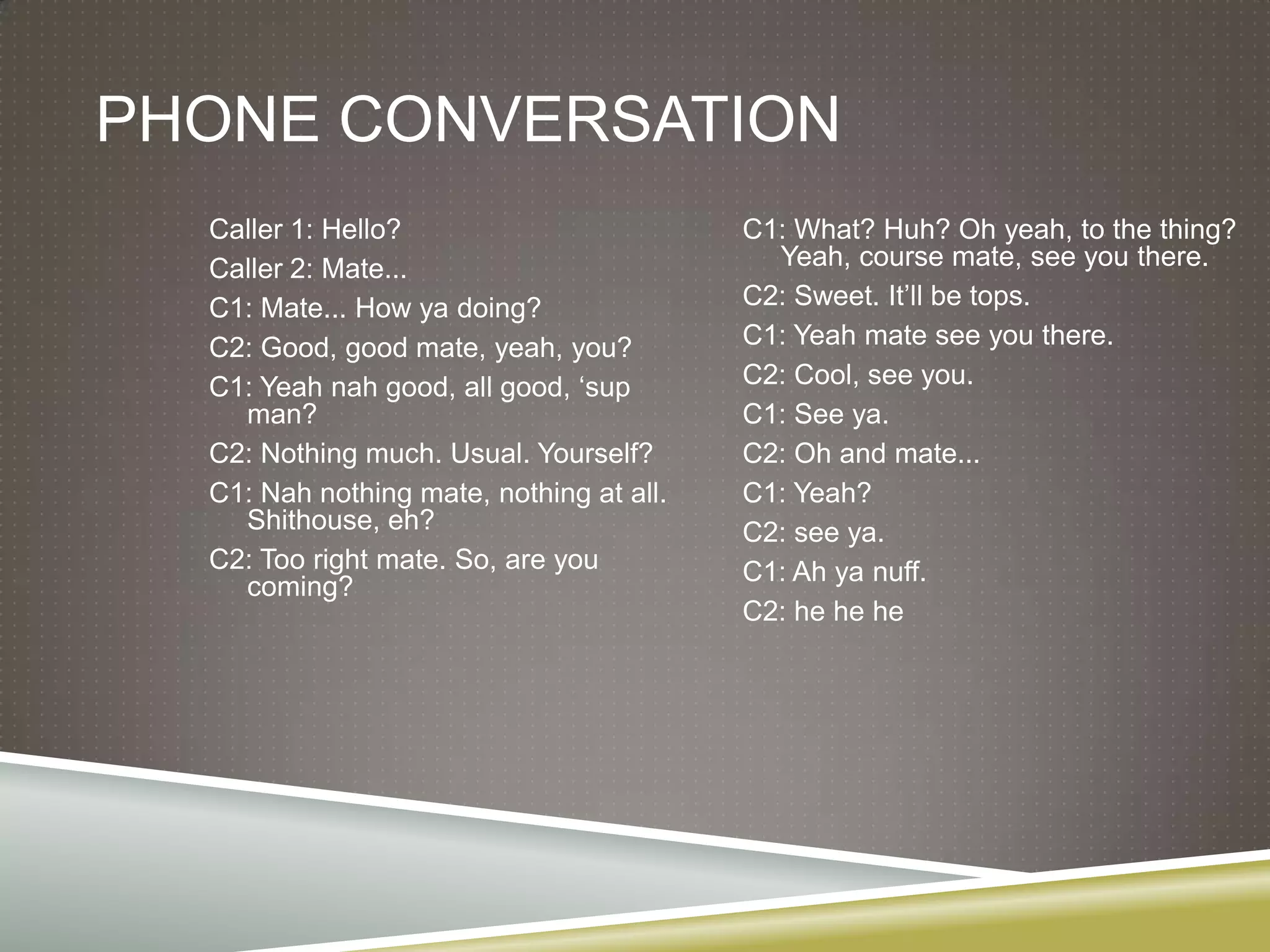
Phone conversationCaller 1: Hello?Caller 2: Mate...C1: Mate... How ya doing?C2: Good, good mate, yeah, you?C1: Yeah nah good, all good, ‘sup man?C2: Nothing much. Usual. Yourself?C1: Nah nothing mate, nothing at all. Shithouse, eh?C2: Too right mate. So, are you coming?C1: What? Huh? Oh yeah, to the thing? Yeah, course mate, see you there.C2: Sweet. It’ll be tops.C1: Yeah mate see you there.C2: Cool, see you.C1: See ya.C2: Oh and mate...C1: Yeah?C2: see ya.C1: Ah yanuff.C2: he hehe
Wilbur Schramm (1954)The notion of sender and receiver designates particular communicative functions rather than discreet individuals.
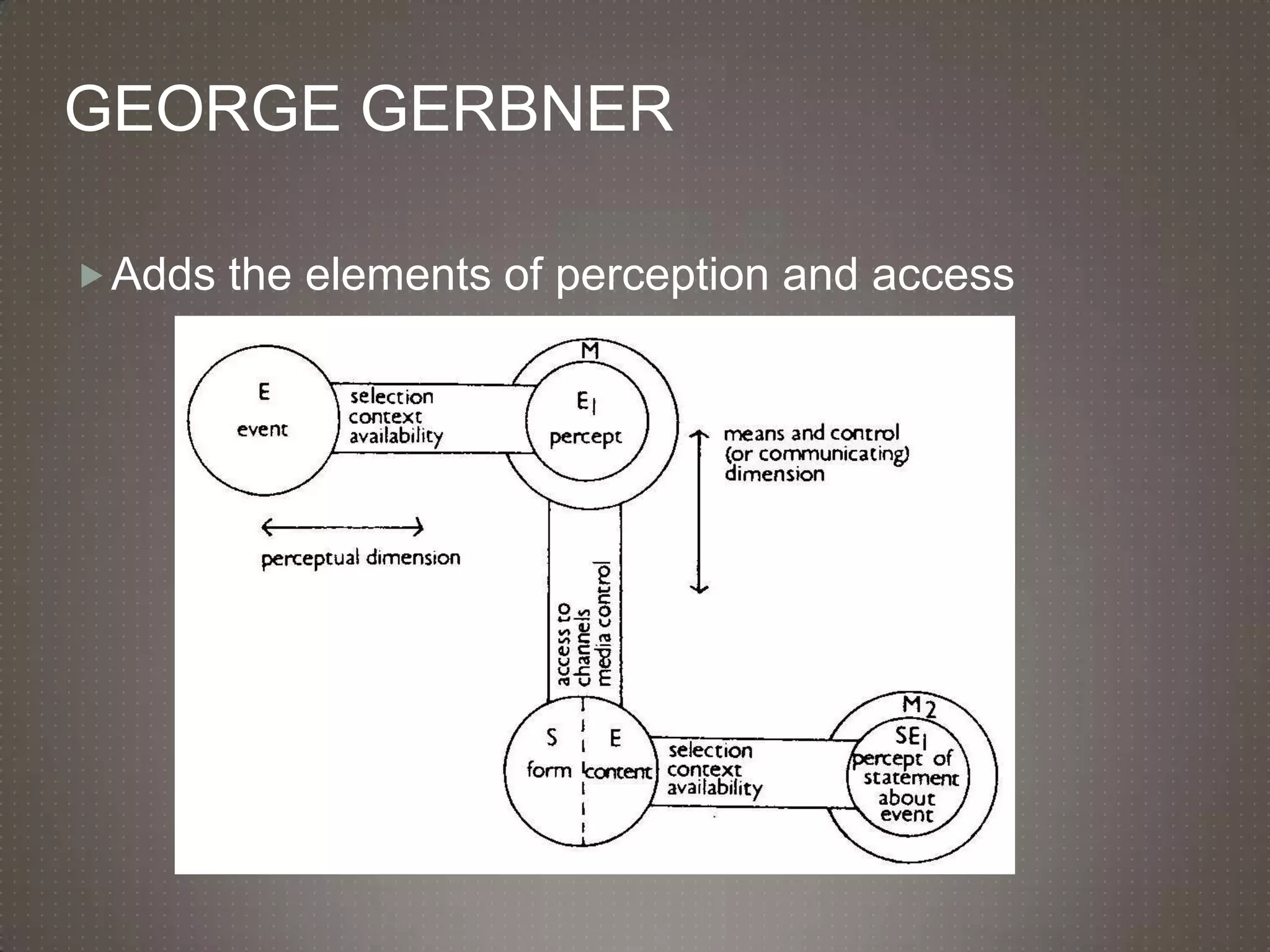
George GerbnerAdds the elements of perception and access
CritiquesWorks out of an atomistic-scientific understanding of realityTakes little account of contextual or structural factors on communicationDominant effect is a linear cause and effect paradigmFramework is a liberal democratic oneAssumption there is an external reality, packaged by one person & received by another

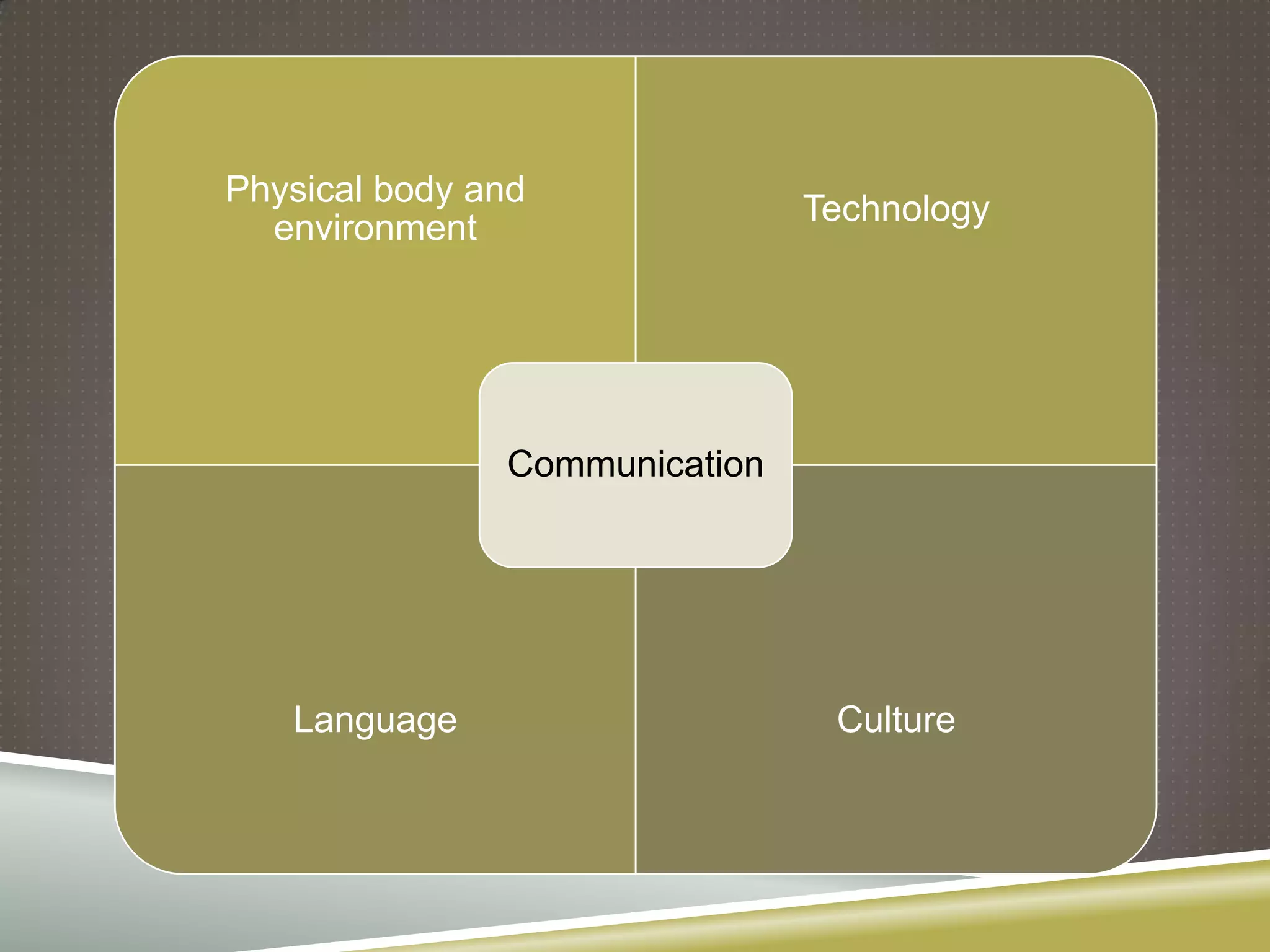
1 a human communication

  • 1.
    Introduction to communicationtheoryPaul Emerson TeusnerAugust 2011
  • 2.
    AimsUnderstand some majortheories about communicationHave skills in reading, comprehending and making an opinion about different theoriesBe able to ask questions about different forms and sites of communication and their impact on people
  • 3.
    componentsTheories of humancommunicationMedia, space and timeMedia, language and powerProduction, consumption, interaction and identity
  • 4.
  • 5.
    CommunicationFrom Latin meaningto be in commonHappy tension betweenCommonalityDifferenceThrough communication, humans place their position among others and in the world
  • 6.
    PrinciplesCommunication is culturalCommunicationis dynamicEverything does and must communicateCommunication is contextualCommunication is power
  • 7.
    What is atheory?An ideaBased on observable facts to describe or explain their presence, relationships to other knowledgeTheory can predict and control, reform and change
  • 8.
    What makes agood theory?Scope – can the theory explain and describe many events or situations?Testability – can it be validated?Parsimony – is it consistent among many situations?Utility – is it useful?Heurism – does it generate new insight?Power – whose interests does it serve?
  • 10.
    Considering theoryWhat arewe thinking about when exploring and evaluating theory?What are its concerns?The act or process of communicationText and meaningTools and technologiesPeople and relationships (e.g. Power, class, gender, ethnicity)Production and consumptionWhat assumptions does it make (about, say, any of the above)?What assertions does it make?What questions arise for you (for further investigation)?
  • 11.
    ModelRepresentation of atheorySimplification of pattern of events in the real worldLens through which we see the world
  • 12.
    Shannon and Weaver(1949)The process or instrumental theory of communication
  • 13.
    ConceptsEntropya measure ofthe amount of uncertainty in the message – i.e. those elements new to the person receiving itRedundancyA measure of repetition - the elements in a message that add no new information, but simply repeat what is known.Effectiveness of communication comes from finding a balance between the unexpected and the predictable.Noise: Any additional signal that interferes with the reception of information.Channel capacity: The upper limit of information that any communication system can handle at a given time.
  • 14.
    BenefitsSimplicity and eleganceHighrelevance Reflected scientific theory – quantifiable and measurableHeuristic value
  • 15.
    LimitationsVery mechanisticConcern withtechnical functioning ignores semantic meaning and cultural contextsRelatively static and linearinadequate for handling the complexity of communication. Focus on communication as discrete and intentional acts
  • 17.
    Phone conversationCaller 1:Hello?Caller 2: Mate...C1: Mate... How ya doing?C2: Good, good mate, yeah, you?C1: Yeah nah good, all good, ‘sup man?C2: Nothing much. Usual. Yourself?C1: Nah nothing mate, nothing at all. Shithouse, eh?C2: Too right mate. So, are you coming?C1: What? Huh? Oh yeah, to the thing? Yeah, course mate, see you there.C2: Sweet. It’ll be tops.C1: Yeah mate see you there.C2: Cool, see you.C1: See ya.C2: Oh and mate...C1: Yeah?C2: see ya.C1: Ah yanuff.C2: he hehe
  • 18.
    Wilbur Schramm (1954)Thenotion of sender and receiver designates particular communicative functions rather than discreet individuals.
  • 19.
    George GerbnerAdds theelements of perception and access
  • 20.
    CritiquesWorks out ofan atomistic-scientific understanding of realityTakes little account of contextual or structural factors on communicationDominant effect is a linear cause and effect paradigmFramework is a liberal democratic oneAssumption there is an external reality, packaged by one person & received by another

Editor's Notes

  • #2 Intro: name, what brought us here, what we want to get out of this course, what are we giving up to be here
  • #3 Class is how we think about media, rather than media itself.We are here because in our own way we are religious practitioners, which necessarily means we are communication practitioners. Religion itself is a communication, a mediation of sacred, making ineffable into effable. Religious practice is a communicative practice.
  • #5 Why do we communicate?
  • #8 So a theory can determine how we seek out new knowledge, by framing research and perspectives.