Introduction to
Communication
Julie Amara J. Mostoles
Instructor 1
Central Bicol State University of Agriculture
San Jose, Pili, Camarines Sur
Write down as many
forms as
communication that
you can find in the
video clip
Can you think of an activity
which does not require you to
communicate?
It is quite vital to our
everyday lives.
Communication
•is an art,
•a science,
•a process, and
•a technique
Communication
• Human beings have a
tendency to share/impart
thoughts, impart
information, persuade
others in our beliefs, and
show our love and
affection.
According to Wood (2004)
• Communication is a
systematic process in which
individuals interact with and
through symbols to create
and interpret meanings.
• Wood’s definition suggest the
qualities that are inherent in
communication.
Qualities inherent/natural in communication
• Communication is a process
• Communication is systemic
• Communication is symbolic
• Communication involves
meaning
Qualities inherent/natural in communication
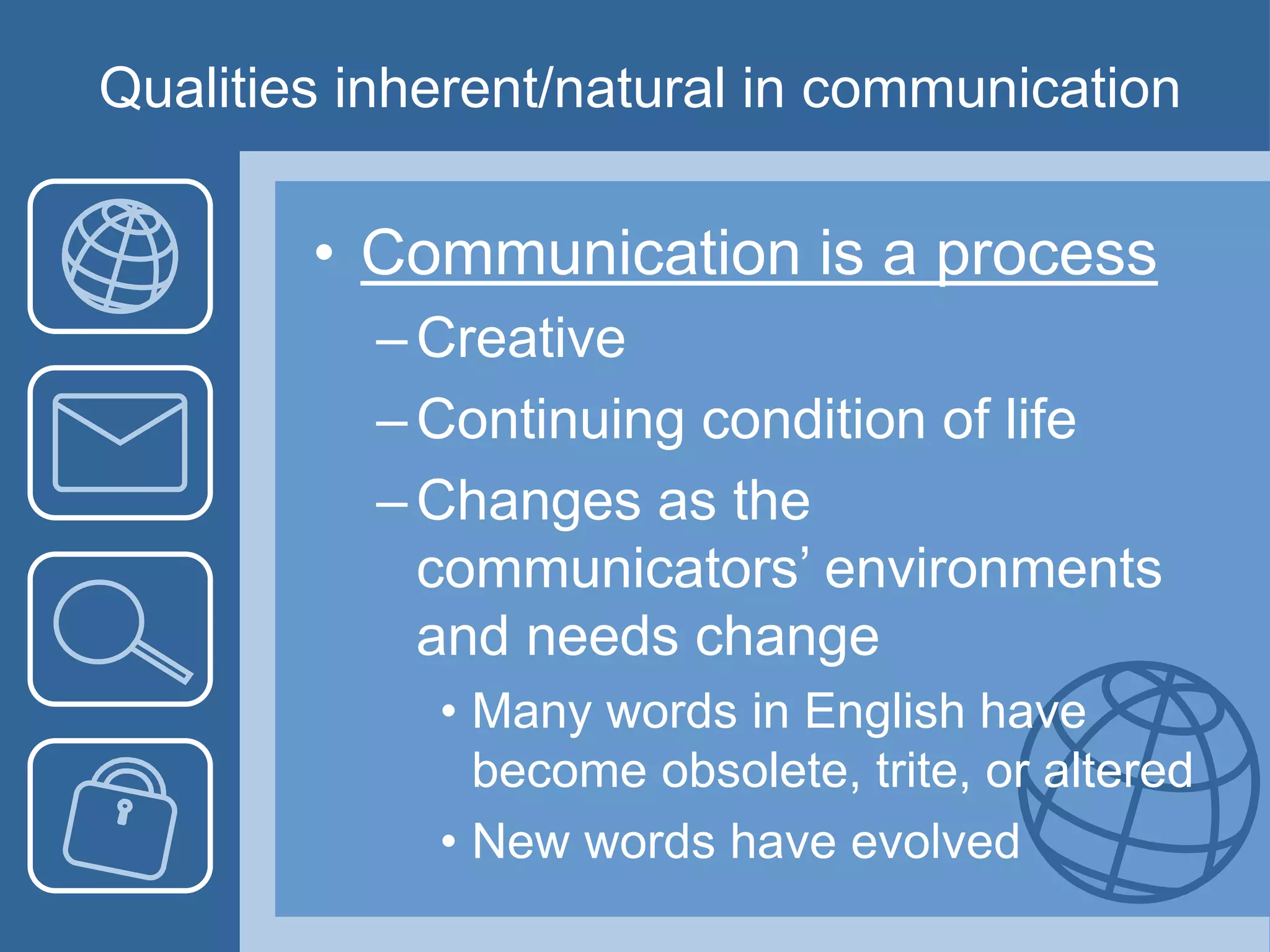
• Communication is a process
–Creative
–Continuing condition of life
–Changes as the
communicators’ environments
and needs change
• Many words in English have
become obsolete, trite, or altered
• New words have evolved
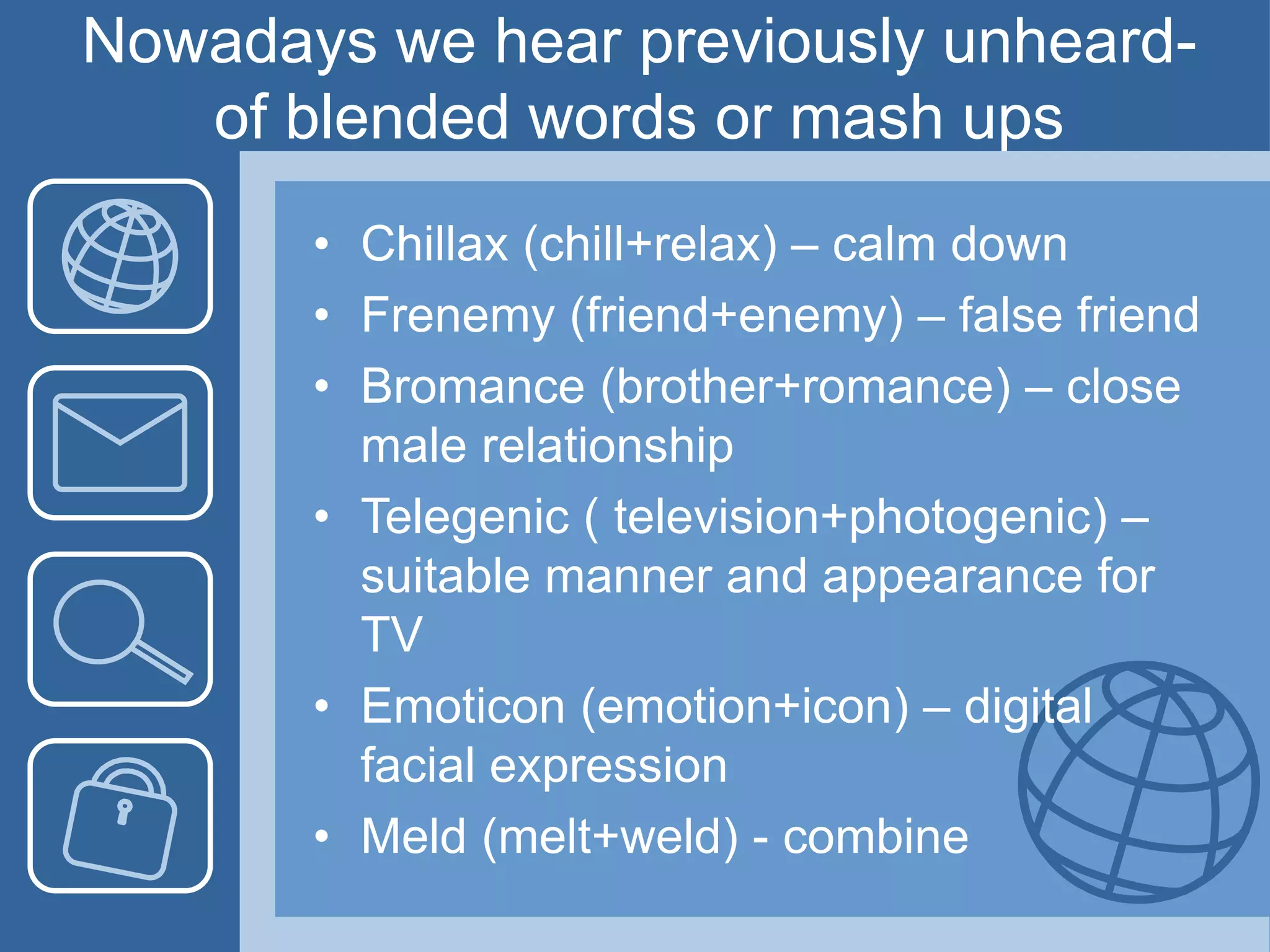
Nowadays we hear previously unheard-
of blended words or mash ups
• Chillax (chill+relax) – calm down
• Frenemy (friend+enemy) – false friend
• Bromance (brother+romance) – close
male relationship
• Telegenic ( television+photogenic) –
suitable manner and appearance for
TV
• Emoticon (emotion+icon) – digital
facial expression
• Meld (melt+weld) - combine
Qualities inherent/natural in communication
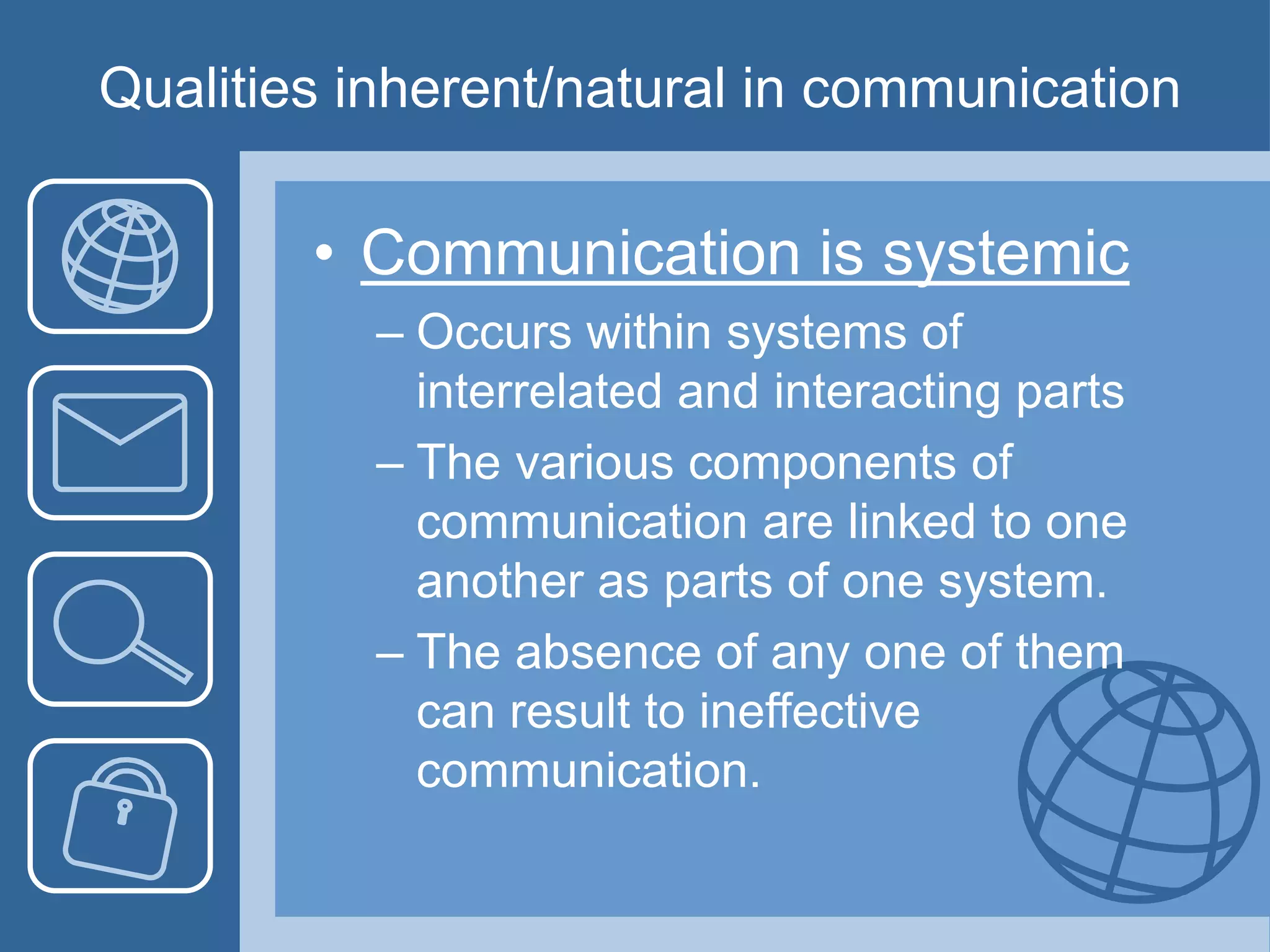
• Communication is systemic
– Occurs within systems of
interrelated and interacting parts
– The various components of
communication are linked to one
another as parts of one system.
– The absence of any one of them
can result to ineffective
communication.
Qualities inherent/natural in communication
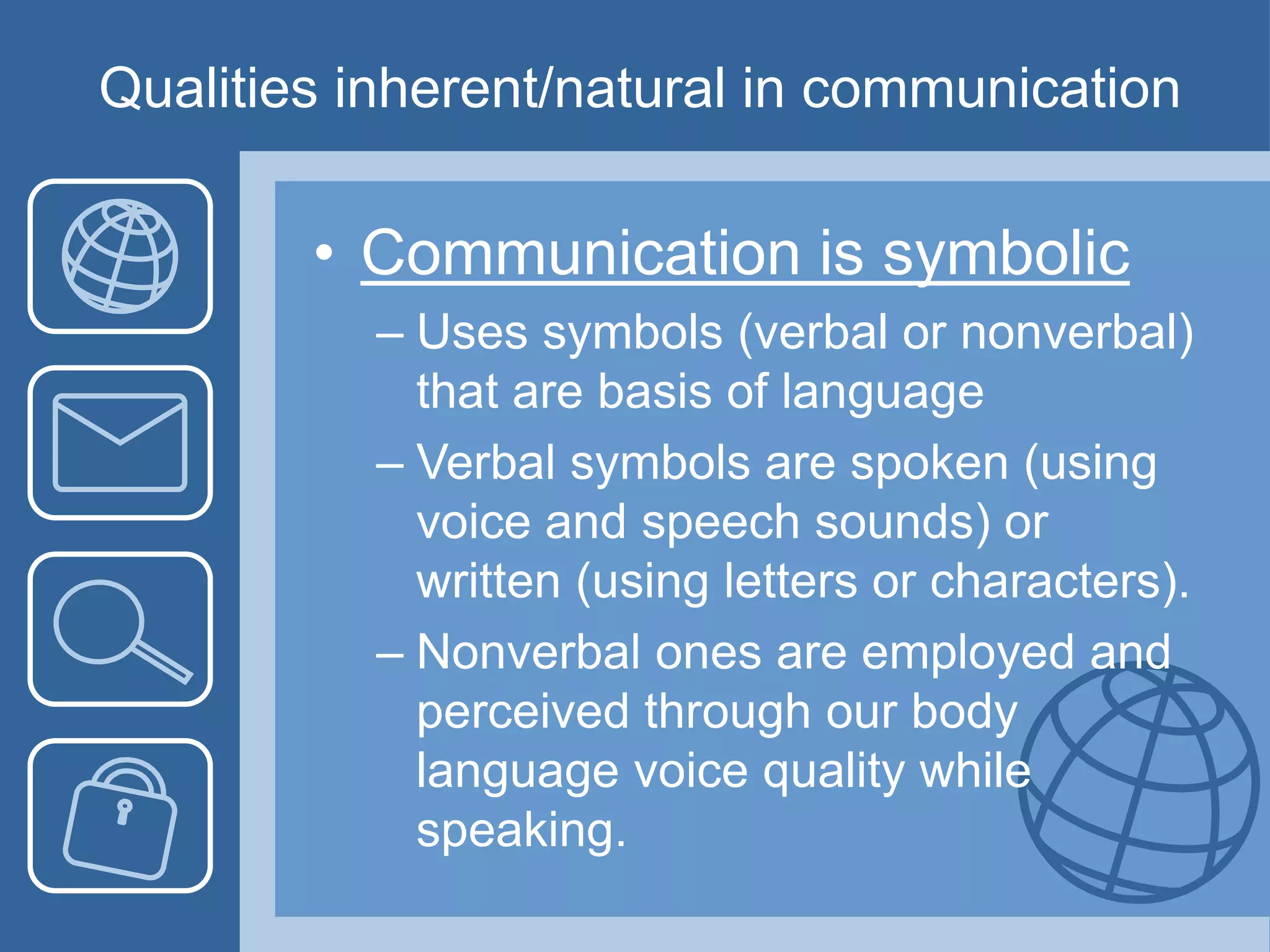
• Communication is symbolic
– Uses symbols (verbal or nonverbal)
that are basis of language
– Verbal symbols are spoken (using
voice and speech sounds) or
written (using letters or characters).
– Nonverbal ones are employed and
perceived through our body
language voice quality while
speaking.
Qualities inherent/natural in communication
• Body Language
–gestures, facial expressions,
eye contact, posture, or touch
• Quality of voice
–Tone, pitch, rate, volume, and
emphasis
Qualities inherent/natural in communication
• Communication involves
meaning
– Meanings are assigned, given, or
invented, not received
– Ex. Flags, crowns, crosses, and traffic
signals (don’t contain meanings but
their meanings are assigned to them)
– Physical and social environments can
be given different meanings
depending on our frame of reference.
Communication
• We invent meanings in countless
social situations when we talk
with people who share or oppose
our purposes.
• But no matter what the context is,
it is the production of meaning
rather than the production of
messages that identifies
communication.
The Process of
Communication
Communication
• Is made up of several
components
• Its process is best
understood if you know how
these various components
come into play in the stages
of any communication
situation.
Stage 1: Sending the Message
• Speaker/sender
–Source of the message that is
encoded into symbols
• Message
–Any information or anything the
sender wants to communicate
by using a medium
Stage 1: Sending the Message
• Medium
–The form in which the
speaker/sender conveys
the message
–(speech, conversation,
letter, email, blog,
newspaper, book etc.
through a channel)
Stage 1: Sending the Message
• Channel
–Mode, method, or means of
sending or expressing the
message (through any of
the five senses – sight,
hearing, tuch, smell, taste)
Stage 1: Sending the Message
• Channel
–may also be
• A sound and light waves in a
face-to-face, in person
speaking situation
• Digital audio and video signals
in a mediated, with-a-remote-
audience speaking situation
Stage 2: Receiving the Message
• Listener/receiver
–Gets and decodes the
message
• Feedback
–Receiver’s response
–Affected by one’s frame of
reference
–Varies from person to person
Stage 2: Receiving the Message
• Feedback
–Silence is considered a
feedback
• Can be interpreted in many
ways
• There is no such thing as
“zero feedback.”
Stage 2: Receiving the Message
• Context
–Situation or environment
–Includes time, place, event,
sender’s ad receiver’s
feelings, perceptions,
beliefs, attitudes and
relationships
Stage 2: Receiving the Message
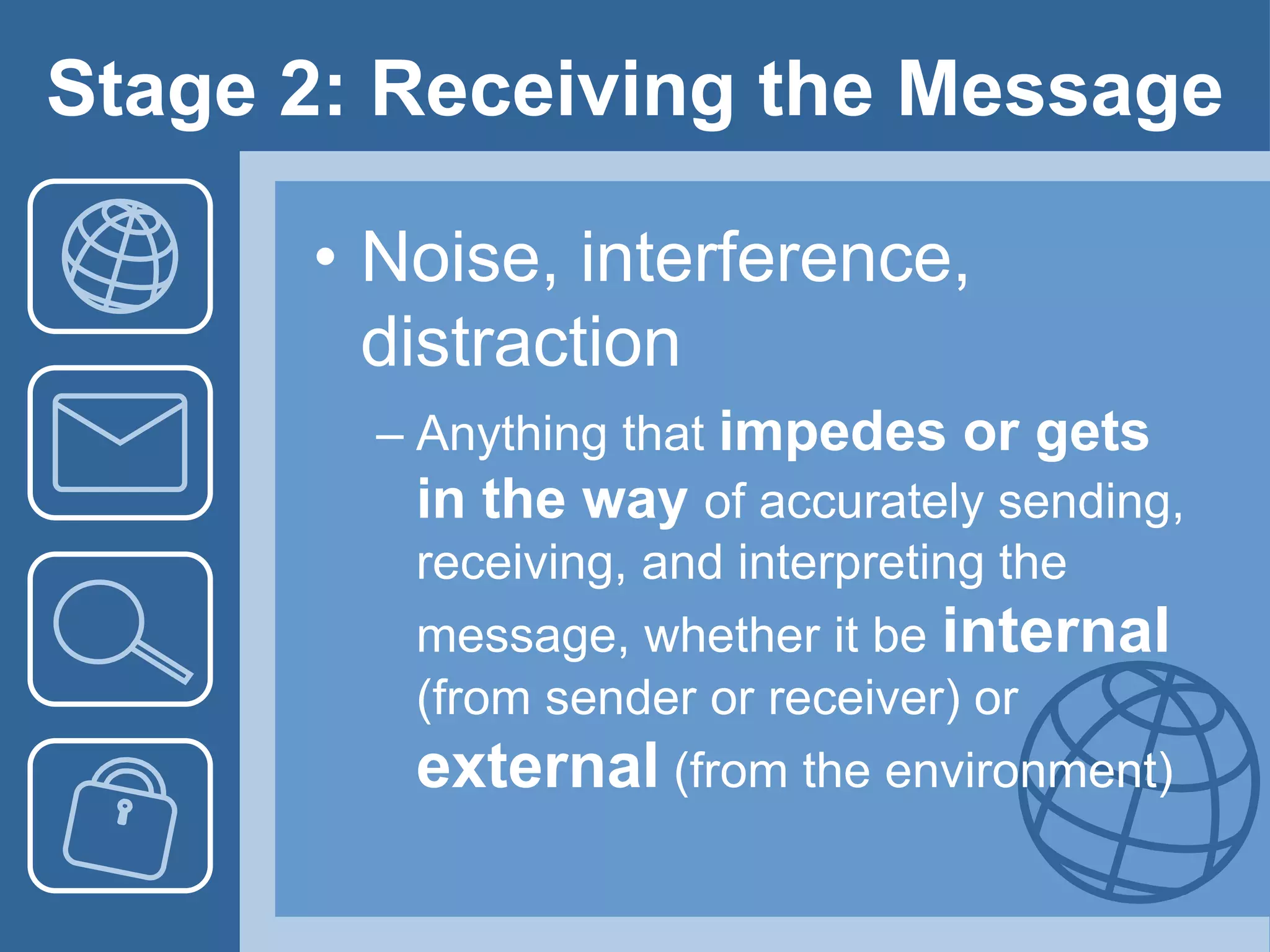
• Noise, interference,
distraction
– Anything that impedes or gets
in the way of accurately sending,
receiving, and interpreting the
message, whether it be internal
(from sender or receiver) or
external (from the environment)
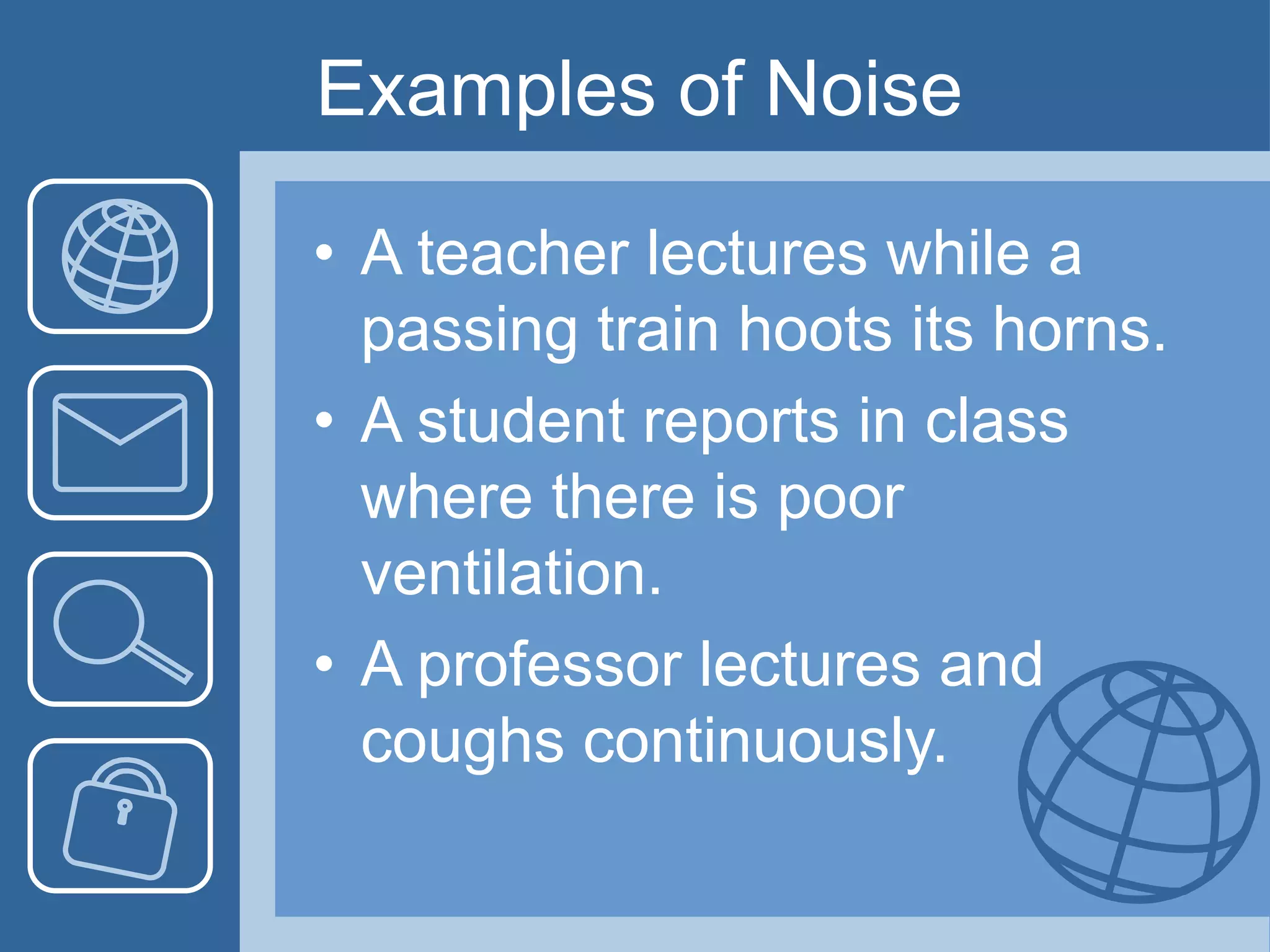
Examples of Noise
• A teacher lectures while a
passing train hoots its horns.
• A student reports in class
where there is poor
ventilation.
• A professor lectures and
coughs continuously.
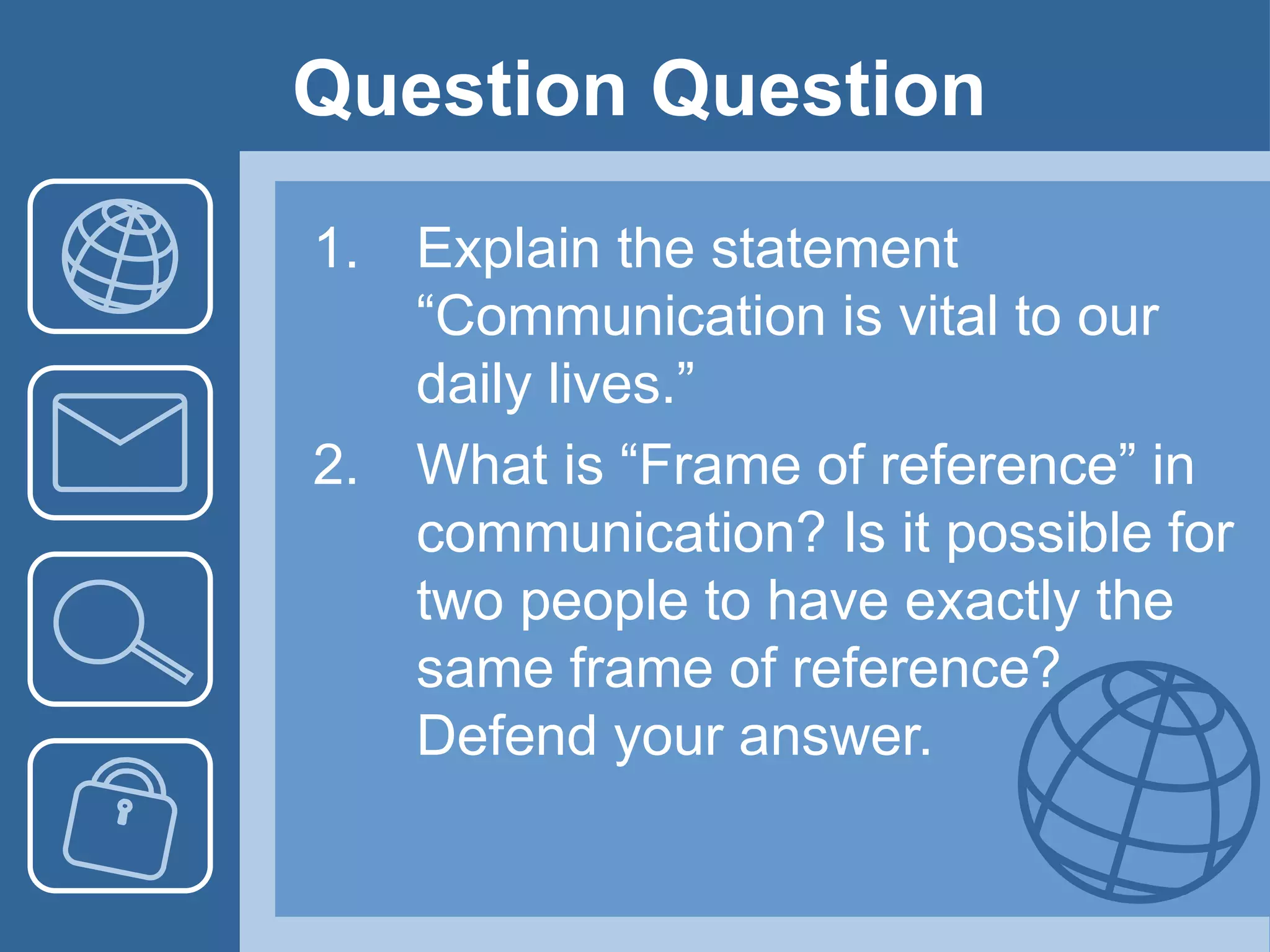
Question Question
1. Explain the statement
“Communication is vital to our
daily lives.”
2. What is “Frame of reference” in
communication? Is it possible for
two people to have exactly the
same frame of reference?
Defend your answer.
Question Question
3. Why is silence considered
feedback? Do you agree that “there
is no such thing as zero feedback?”
Explain your answer.
4. We often hear people blurting out
that a certain person’s message is
“out of context.” Cite some instances
where what is being mentioned in a
conversation is “out of context.”
Identify the noise (external/internal)
1. A student thinks about a quiz
he has to take in the next
class.
2. A child busily plays with his
tablet while his mom is giving
him instructions
3. A speaker in a seminar
explains a certain product
when a cellular phone rings.
Identify the noise (external/internal)
4. A student cannot concentrate
on what the teacher is saying
because he is suffering from
migraine.
5. A student reports in class
where there is poor ventilation.
Communication
Models
1. Claude Shannon and Warren Weaver’s Model (1948)
2. Weiner’s Interactive Model
3. Wilbur Schramm’s Communication Model (1955),
considered the Father of Mass Communication
4. Intermediary/ Gatekeeper Model
Models of Communication
• are diagrams that make
you understand the
process at a glance
• Guide you in
understanding how
communication works in
different settings
Models of Communication
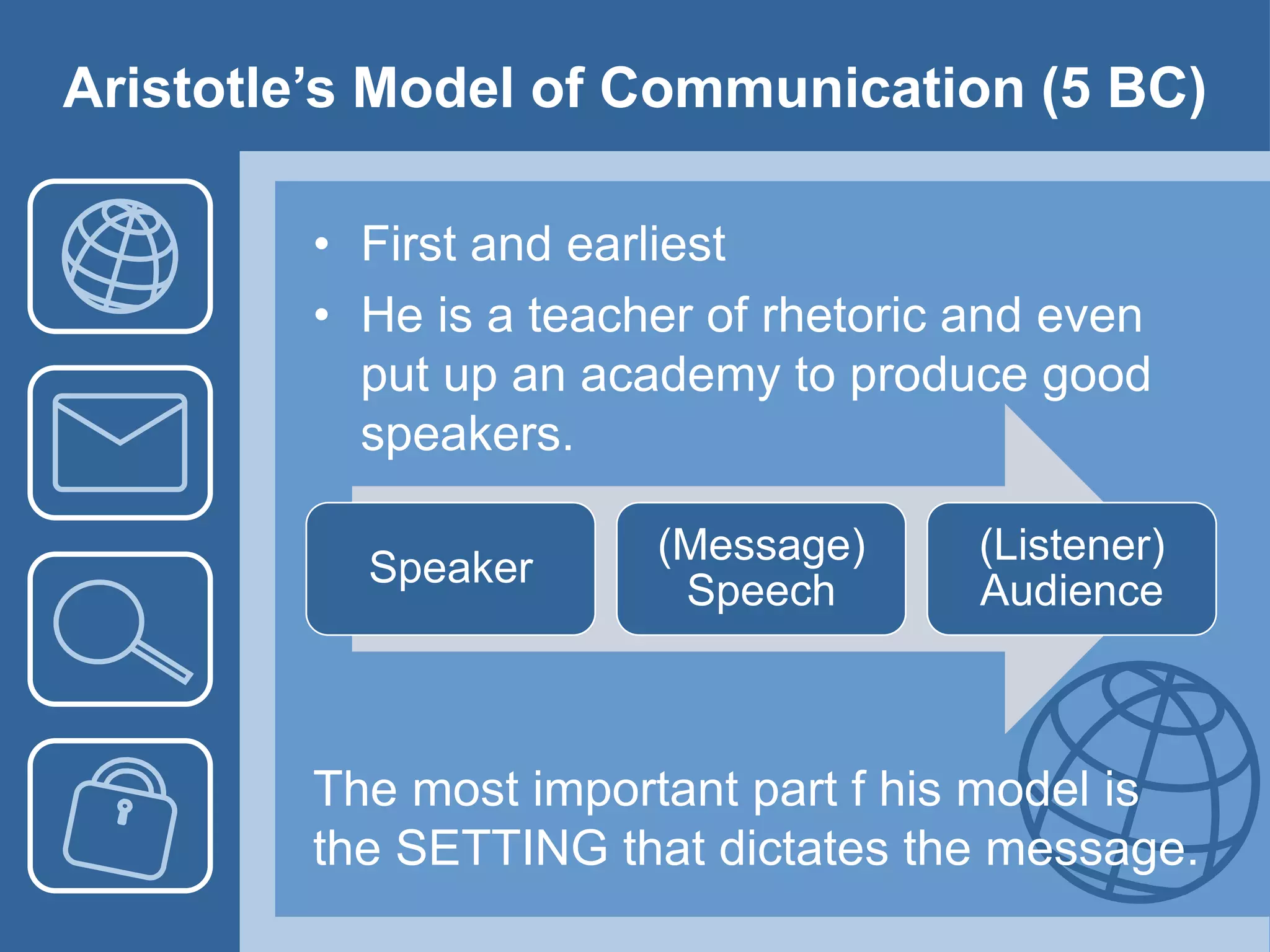
• The best way to
understand
communication is to see
it graphically.
Aristotle’s Model of Communication (5 BC)
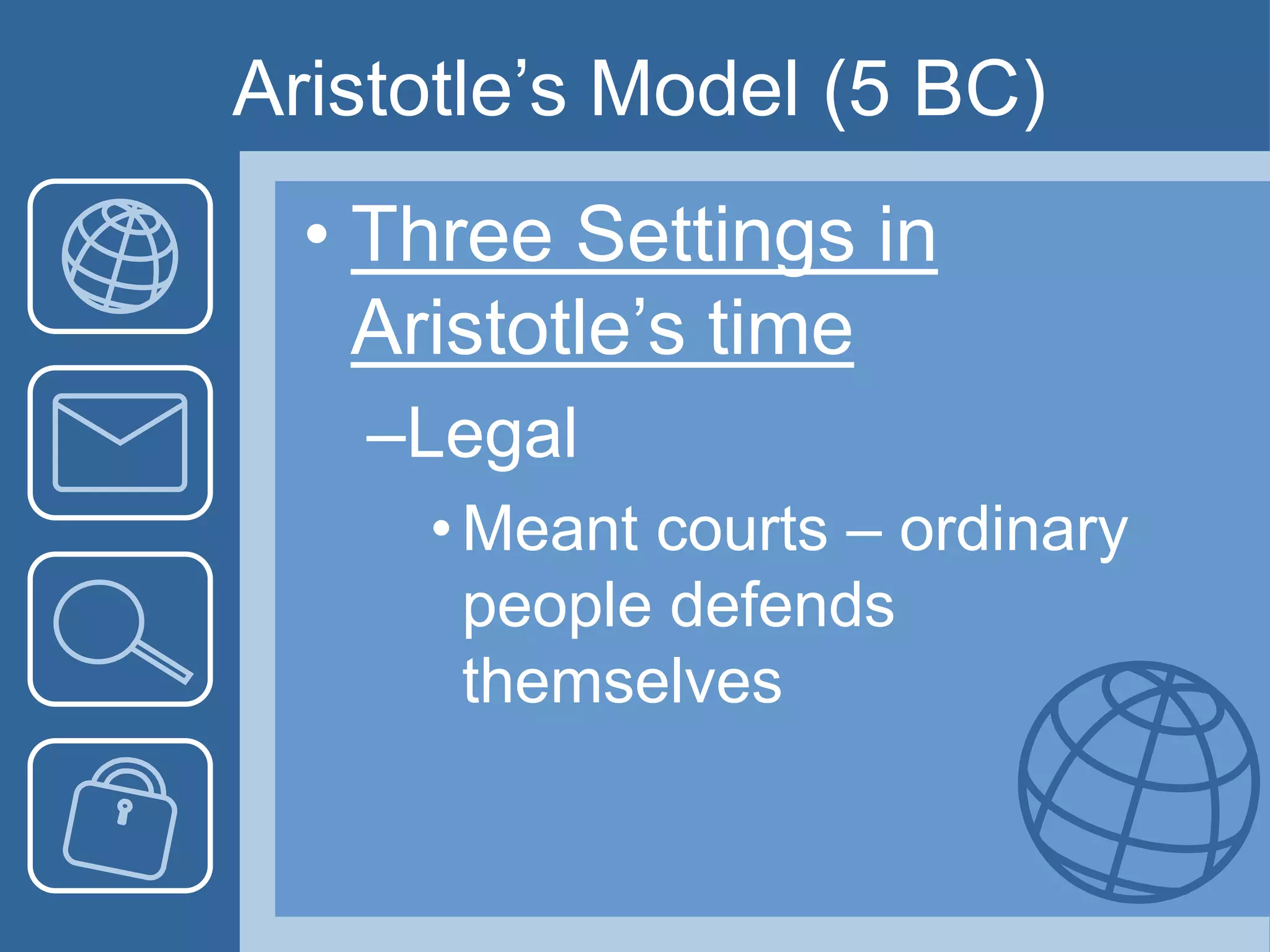
• First and earliest
• He is a teacher of rhetoric and even
put up an academy to produce good
speakers.
The most important part f his model is
the SETTING that dictates the message.
Speaker
(Message)
Speech
(Listener)
Audience
Aristotle’s Model (5 BC)
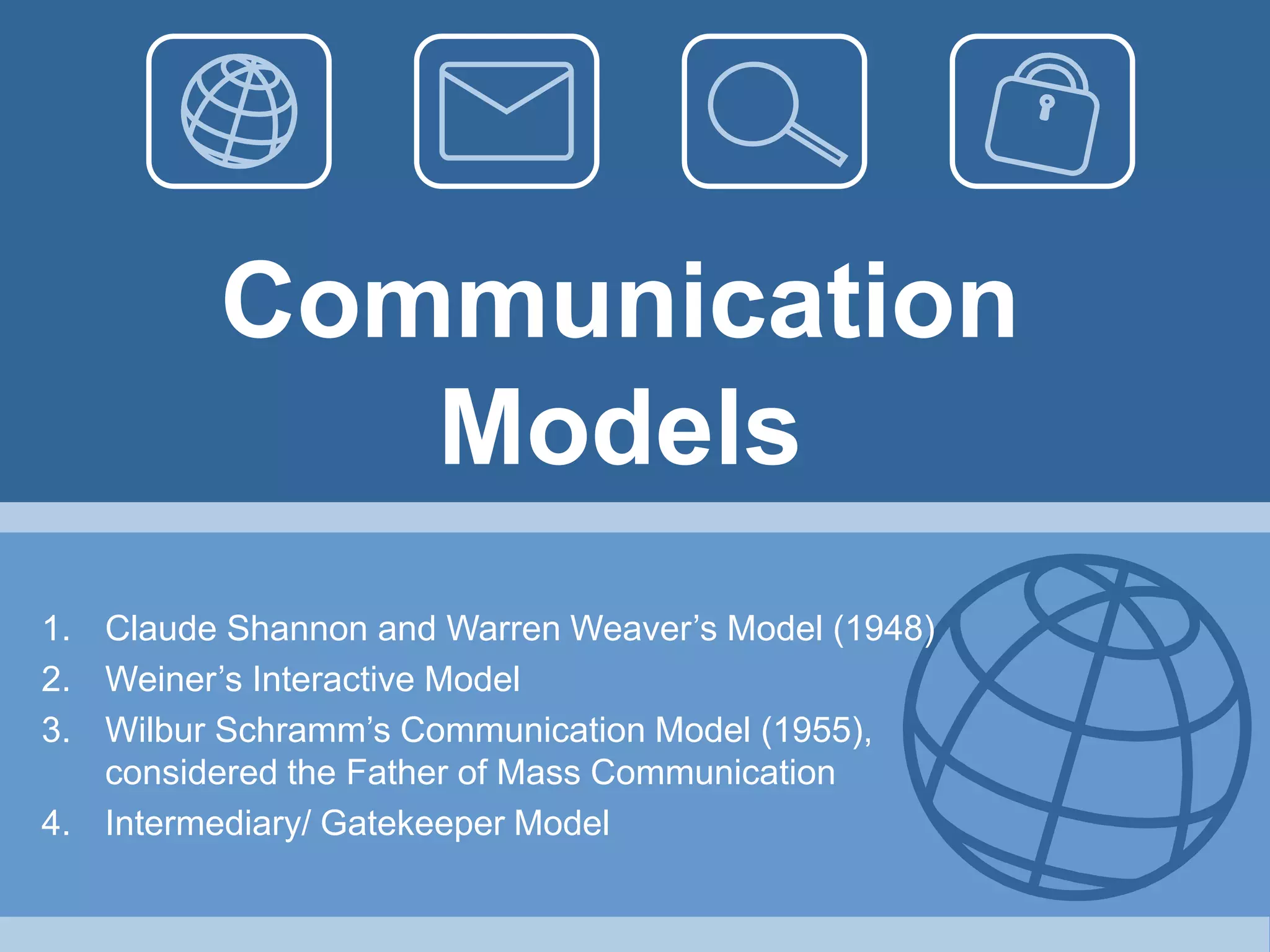
• Three Settings in
Aristotle’s time
–Legal
•Meant courts – ordinary
people defends
themselves
Aristotle’s Model (5 BC)
–Deliberative
•Meant the political
assemblies, the highest
of which was the Roman
Senate
Aristotle’s Model (5 BC)
–Ceremonial
•Meant the celebrations,
occasions that call for
speeches of welcome,
poems of tribute or of
eulogies, and poems of
lament
Communication
Models
1. Claude Shannon and Warren Weaver’s Model (1948)
2. Weiner’s Interactive Model
3. Wilbur Schramm’s Communication Model (1955),
considered the Father of Mass Communication
4. Intermediary/ Gatekeeper Model
Functions of Communication in an
Organization
• Inform
• Instruct
• Sharing of information
• Motivating Workers
• Leading the Organization
• Control
• Management
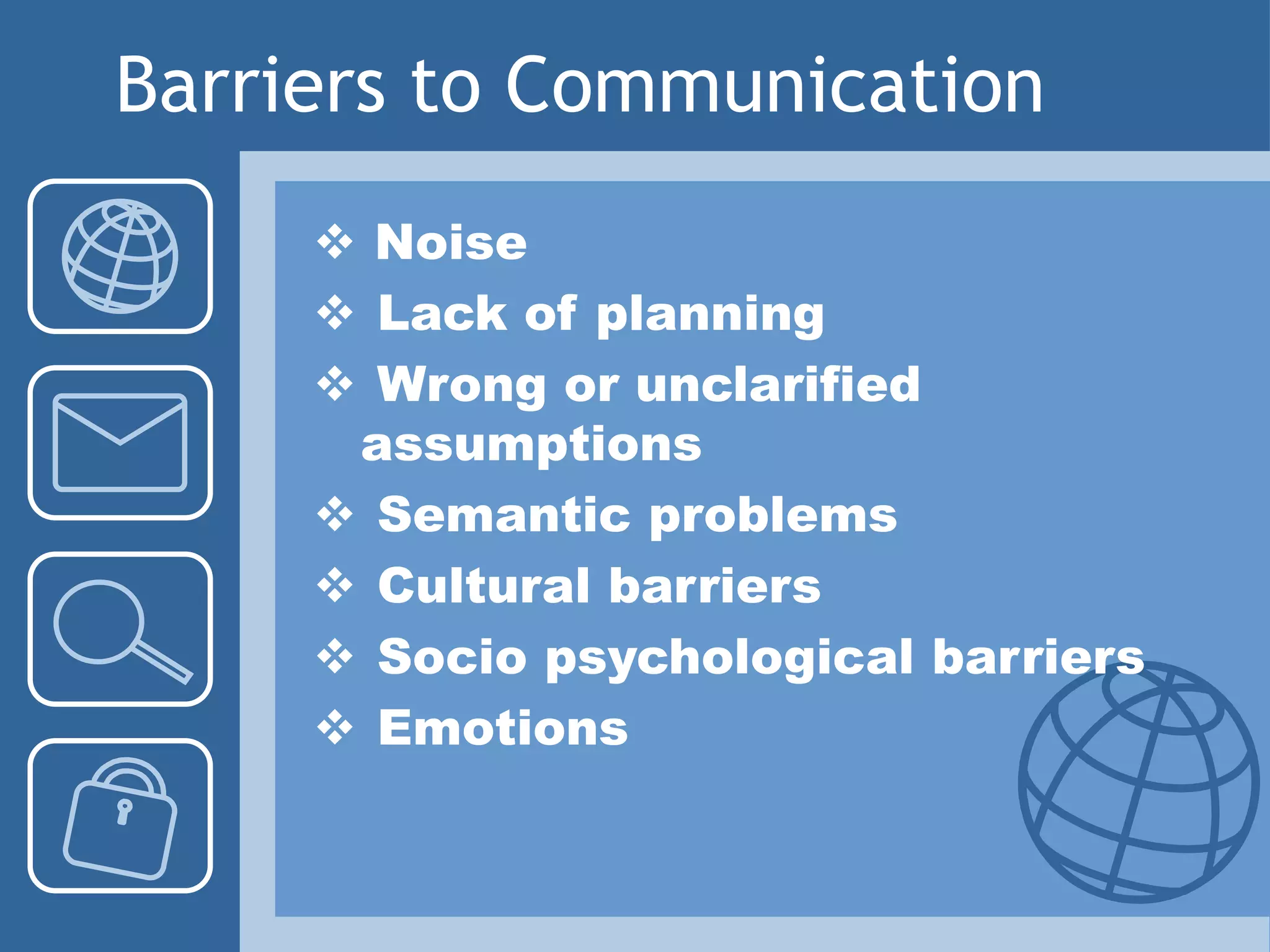
Barriers to Communication
 Noise
 Lack of planning
 Wrong or unclarified
assumptions
 Semantic problems
 Cultural barriers
 Socio psychological barriers
 Emotions
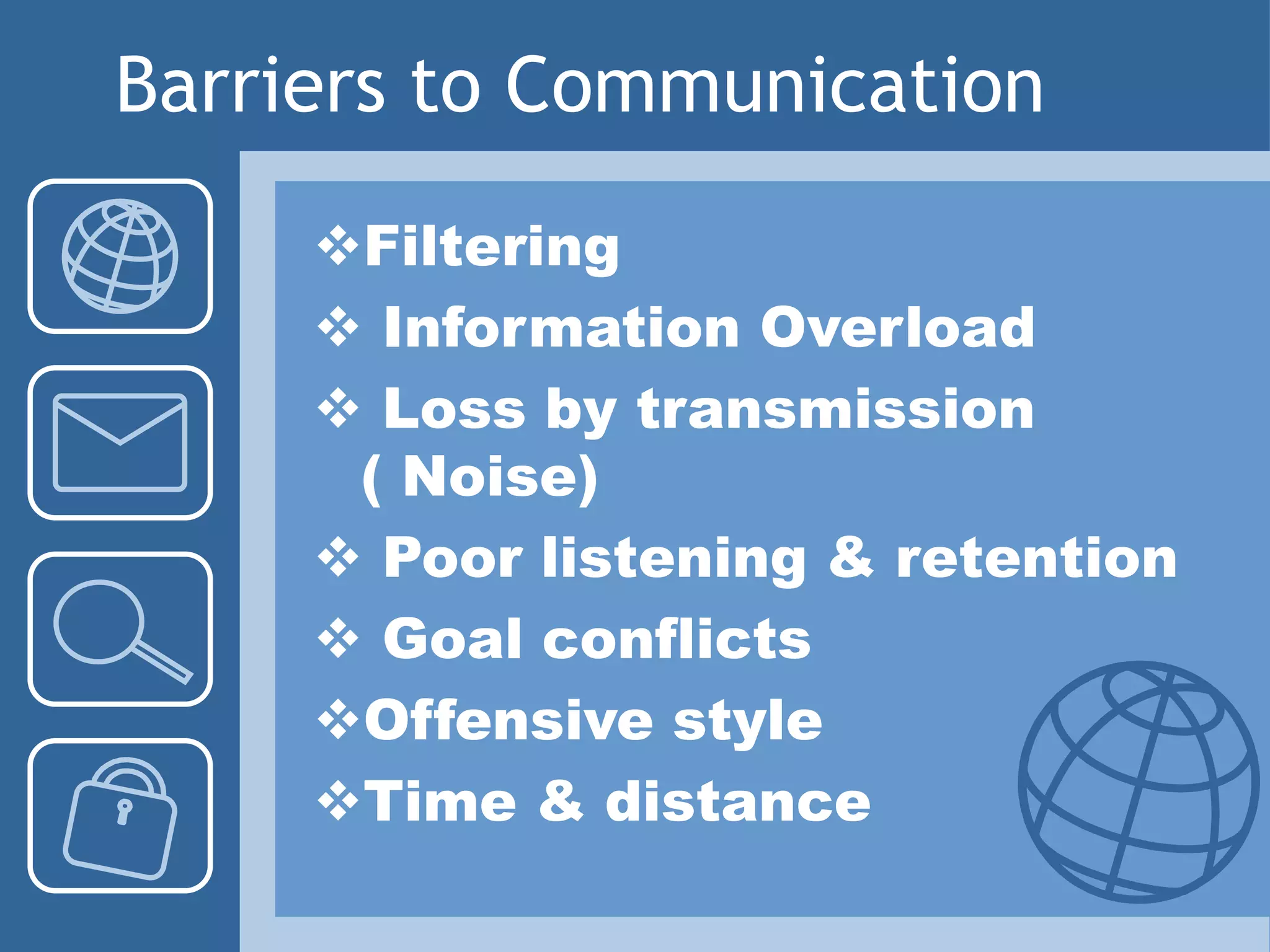
Barriers to Communication
Filtering
 Information Overload
 Loss by transmission
( Noise)
 Poor listening & retention
 Goal conflicts
Offensive style
Time & distance
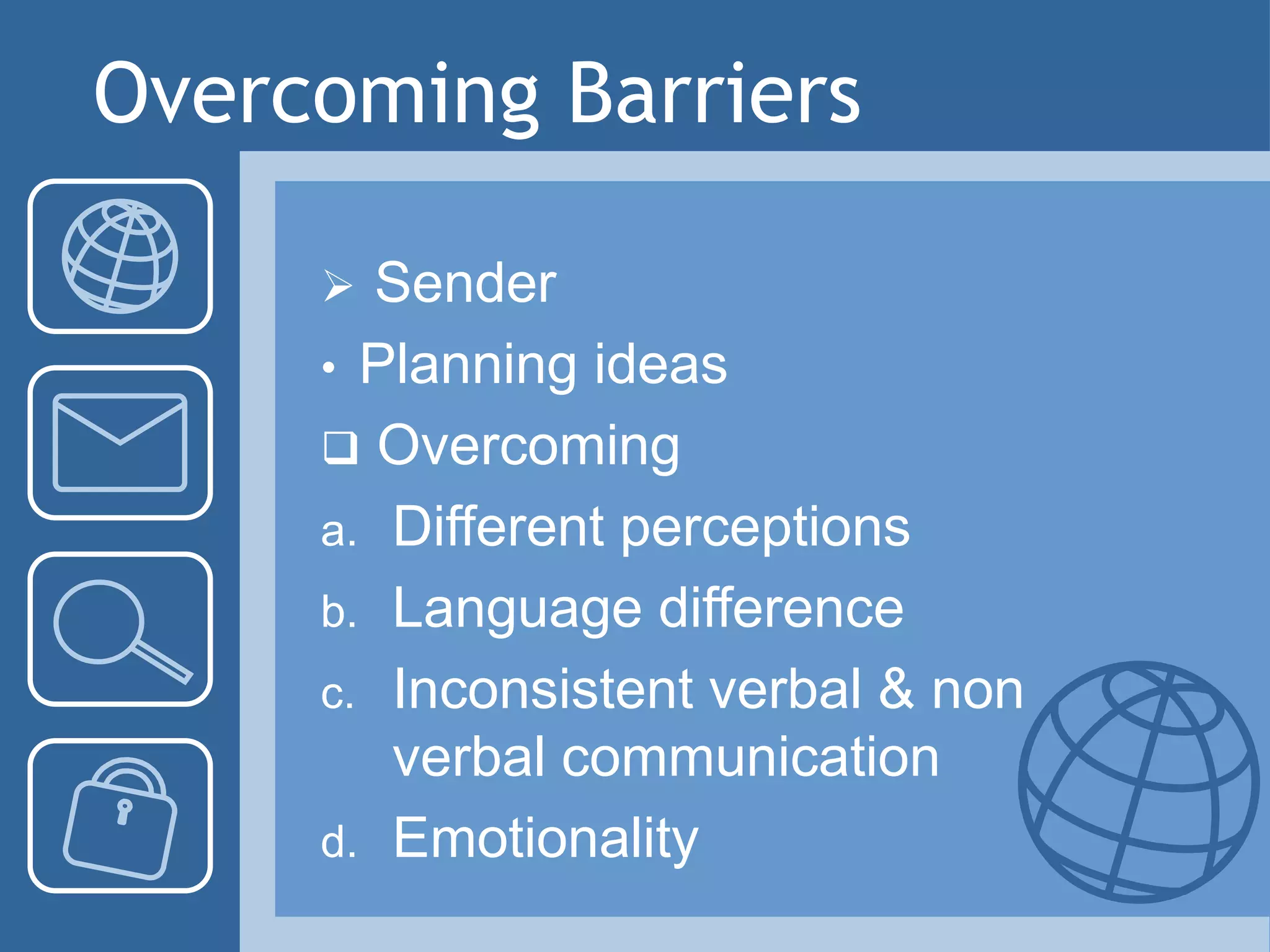
Overcoming Barriers
 Sender
• Planning ideas
 Overcoming
a. Different perceptions
b. Language difference
c. Inconsistent verbal & non
verbal communication
d. Emotionality
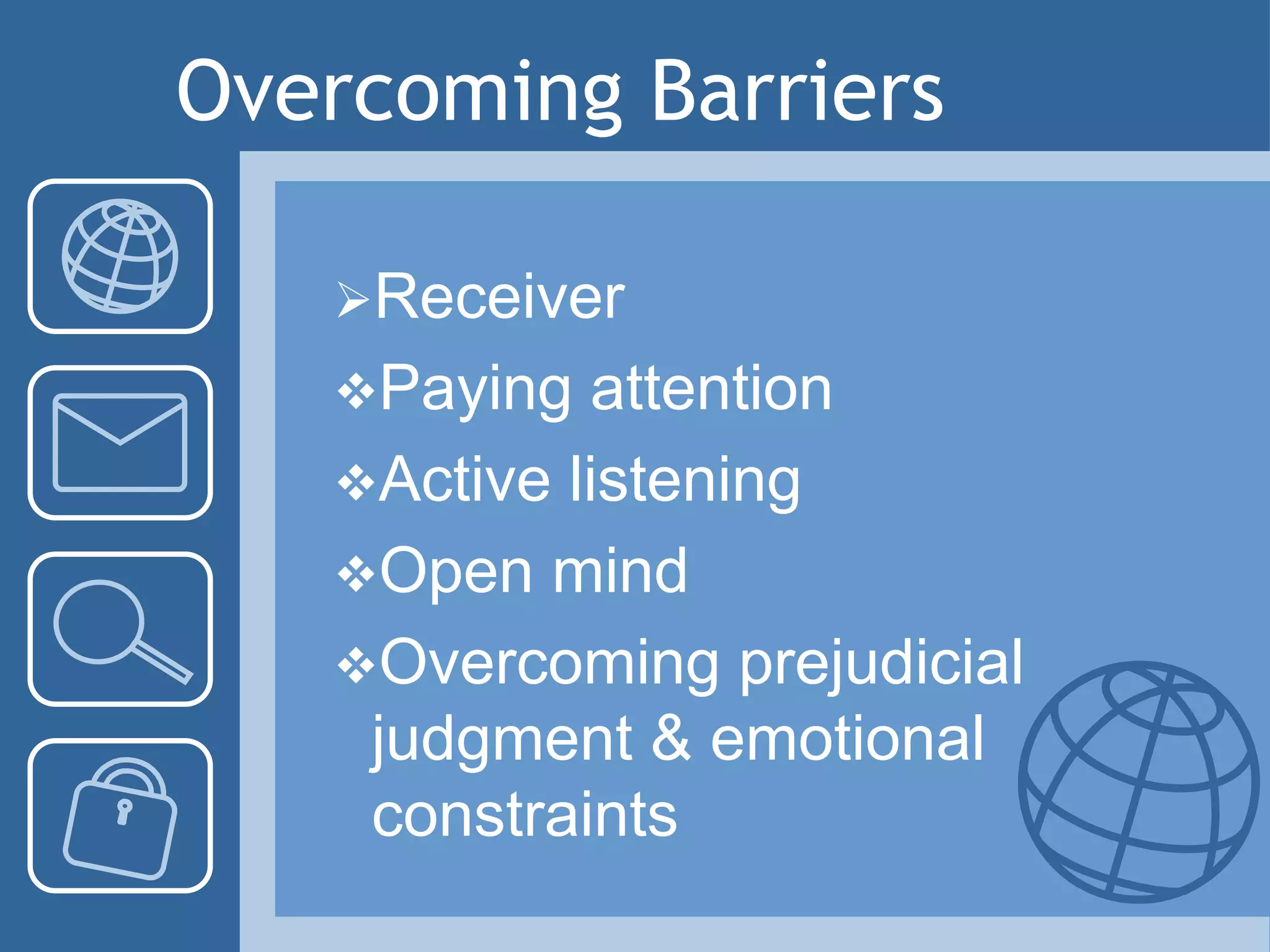
Overcoming Barriers
Receiver
Paying attention
Active listening
Open mind
Overcoming prejudicial
judgment & emotional
constraints
Assignment
• Group activity (next meeting)
• Bring:
– whole black Cartolina
–Cut out pictures showing verbal
and non verbal
communications
–Glue
–Markers

Lesson 1 Communication

  • 1.
    Introduction to Communication Julie AmaraJ. Mostoles Instructor 1 Central Bicol State University of Agriculture San Jose, Pili, Camarines Sur
  • 2.
    Write down asmany forms as communication that you can find in the video clip
  • 5.
    Can you thinkof an activity which does not require you to communicate? It is quite vital to our everyday lives.
  • 6.
    Communication •is an art, •ascience, •a process, and •a technique
  • 7.
    Communication • Human beingshave a tendency to share/impart thoughts, impart information, persuade others in our beliefs, and show our love and affection.
  • 8.
    According to Wood(2004) • Communication is a systematic process in which individuals interact with and through symbols to create and interpret meanings. • Wood’s definition suggest the qualities that are inherent in communication.
  • 9.
    Qualities inherent/natural incommunication • Communication is a process • Communication is systemic • Communication is symbolic • Communication involves meaning
  • 10.
    Qualities inherent/natural incommunication • Communication is a process –Creative –Continuing condition of life –Changes as the communicators’ environments and needs change • Many words in English have become obsolete, trite, or altered • New words have evolved
  • 11.
    Nowadays we hearpreviously unheard- of blended words or mash ups • Chillax (chill+relax) – calm down • Frenemy (friend+enemy) – false friend • Bromance (brother+romance) – close male relationship • Telegenic ( television+photogenic) – suitable manner and appearance for TV • Emoticon (emotion+icon) – digital facial expression • Meld (melt+weld) - combine
  • 12.
    Qualities inherent/natural incommunication • Communication is systemic – Occurs within systems of interrelated and interacting parts – The various components of communication are linked to one another as parts of one system. – The absence of any one of them can result to ineffective communication.
  • 13.
    Qualities inherent/natural incommunication • Communication is symbolic – Uses symbols (verbal or nonverbal) that are basis of language – Verbal symbols are spoken (using voice and speech sounds) or written (using letters or characters). – Nonverbal ones are employed and perceived through our body language voice quality while speaking.
  • 14.
    Qualities inherent/natural incommunication • Body Language –gestures, facial expressions, eye contact, posture, or touch • Quality of voice –Tone, pitch, rate, volume, and emphasis
  • 15.
    Qualities inherent/natural incommunication • Communication involves meaning – Meanings are assigned, given, or invented, not received – Ex. Flags, crowns, crosses, and traffic signals (don’t contain meanings but their meanings are assigned to them) – Physical and social environments can be given different meanings depending on our frame of reference.
  • 16.
    Communication • We inventmeanings in countless social situations when we talk with people who share or oppose our purposes. • But no matter what the context is, it is the production of meaning rather than the production of messages that identifies communication.
  • 17.
  • 18.
    Communication • Is madeup of several components • Its process is best understood if you know how these various components come into play in the stages of any communication situation.
  • 19.
    Stage 1: Sendingthe Message • Speaker/sender –Source of the message that is encoded into symbols • Message –Any information or anything the sender wants to communicate by using a medium
  • 20.
    Stage 1: Sendingthe Message • Medium –The form in which the speaker/sender conveys the message –(speech, conversation, letter, email, blog, newspaper, book etc. through a channel)
  • 21.
    Stage 1: Sendingthe Message • Channel –Mode, method, or means of sending or expressing the message (through any of the five senses – sight, hearing, tuch, smell, taste)
  • 22.
    Stage 1: Sendingthe Message • Channel –may also be • A sound and light waves in a face-to-face, in person speaking situation • Digital audio and video signals in a mediated, with-a-remote- audience speaking situation
  • 23.
    Stage 2: Receivingthe Message • Listener/receiver –Gets and decodes the message • Feedback –Receiver’s response –Affected by one’s frame of reference –Varies from person to person
  • 24.
    Stage 2: Receivingthe Message • Feedback –Silence is considered a feedback • Can be interpreted in many ways • There is no such thing as “zero feedback.”
  • 25.
    Stage 2: Receivingthe Message • Context –Situation or environment –Includes time, place, event, sender’s ad receiver’s feelings, perceptions, beliefs, attitudes and relationships
  • 26.
    Stage 2: Receivingthe Message • Noise, interference, distraction – Anything that impedes or gets in the way of accurately sending, receiving, and interpreting the message, whether it be internal (from sender or receiver) or external (from the environment)
  • 27.
    Examples of Noise •A teacher lectures while a passing train hoots its horns. • A student reports in class where there is poor ventilation. • A professor lectures and coughs continuously.
  • 28.
    Question Question 1. Explainthe statement “Communication is vital to our daily lives.” 2. What is “Frame of reference” in communication? Is it possible for two people to have exactly the same frame of reference? Defend your answer.
  • 29.
    Question Question 3. Whyis silence considered feedback? Do you agree that “there is no such thing as zero feedback?” Explain your answer. 4. We often hear people blurting out that a certain person’s message is “out of context.” Cite some instances where what is being mentioned in a conversation is “out of context.”
  • 30.
    Identify the noise(external/internal) 1. A student thinks about a quiz he has to take in the next class. 2. A child busily plays with his tablet while his mom is giving him instructions 3. A speaker in a seminar explains a certain product when a cellular phone rings.
  • 31.
    Identify the noise(external/internal) 4. A student cannot concentrate on what the teacher is saying because he is suffering from migraine. 5. A student reports in class where there is poor ventilation.
  • 32.
    Communication Models 1. Claude Shannonand Warren Weaver’s Model (1948) 2. Weiner’s Interactive Model 3. Wilbur Schramm’s Communication Model (1955), considered the Father of Mass Communication 4. Intermediary/ Gatekeeper Model
  • 33.
    Models of Communication •are diagrams that make you understand the process at a glance • Guide you in understanding how communication works in different settings
  • 34.
    Models of Communication •The best way to understand communication is to see it graphically.
  • 35.
    Aristotle’s Model ofCommunication (5 BC) • First and earliest • He is a teacher of rhetoric and even put up an academy to produce good speakers. The most important part f his model is the SETTING that dictates the message. Speaker (Message) Speech (Listener) Audience
  • 36.
    Aristotle’s Model (5BC) • Three Settings in Aristotle’s time –Legal •Meant courts – ordinary people defends themselves
  • 37.
    Aristotle’s Model (5BC) –Deliberative •Meant the political assemblies, the highest of which was the Roman Senate
  • 38.
    Aristotle’s Model (5BC) –Ceremonial •Meant the celebrations, occasions that call for speeches of welcome, poems of tribute or of eulogies, and poems of lament
  • 39.
    Communication Models 1. Claude Shannonand Warren Weaver’s Model (1948) 2. Weiner’s Interactive Model 3. Wilbur Schramm’s Communication Model (1955), considered the Father of Mass Communication 4. Intermediary/ Gatekeeper Model
  • 40.
    Functions of Communicationin an Organization • Inform • Instruct • Sharing of information • Motivating Workers • Leading the Organization • Control • Management
  • 41.
    Barriers to Communication Noise  Lack of planning  Wrong or unclarified assumptions  Semantic problems  Cultural barriers  Socio psychological barriers  Emotions
  • 42.
    Barriers to Communication Filtering Information Overload  Loss by transmission ( Noise)  Poor listening & retention  Goal conflicts Offensive style Time & distance
  • 43.
    Overcoming Barriers  Sender •Planning ideas  Overcoming a. Different perceptions b. Language difference c. Inconsistent verbal & non verbal communication d. Emotionality
  • 44.
    Overcoming Barriers Receiver Paying attention Activelistening Open mind Overcoming prejudicial judgment & emotional constraints
  • 45.
    Assignment • Group activity(next meeting) • Bring: – whole black Cartolina –Cut out pictures showing verbal and non verbal communications –Glue –Markers