1
Transhumanism and the State of Worldwide
Law on Human Technological
Enhancement
Sander Rabin MD JD
The Center for Transhuman Jurisprudence, Inc.
21st Annual World Congress on Medical Law
Coimbra, Portugal
August 2 – 6, 2015
2
What is human enhancement?
3
What is human enhancement
enabling technology (“HEET”)?
4
What are the goals of HEET?
5
What’s driving human enhancement?
6
Medical Technology
7
Digital Culture
8
What’s the trend?
9
Where are we headed?
10
Haven’t we been enhancing all along?
11
What’s different now?
12
What’s the Problem?
13
What is …?
MORPHOLOGICAL
FREEDOM
PARTICIPANT
EVOLUTION
PROCREATIVE
LIBERTY
COGNITIVE
LIBERTY
14
TECHNOLOGICAL SELF DETERMINATION
RADICAL LIFE EXTENSION
Transhuman Jurisprudence
Personhood: Robotic & Enhanced
Intention, Responsibility, Liability
Competence, Capacity
Free Agency
Justice and Fairness
15
1
2
3
4
5
What are the major challenges for law?
16
What if the rule of law doesn’t keep up
with the rate of change?
17
Why should we care?
18
What can we do?
19
The Center for Transhuman Jurisprudence
Sander Rabin MD JD
sander.rabin@gmail.com
+1 518.867.7296

08.06.15.H+WAML15

Editor's Notes

  • #2 Slide 01. INTRODUCTION   ☛ My name is Sander Rabin and I want to welcome you here this afternoon and thank you for your interest in my presentation on   Transhumanism and the State of Worldwide Law on Human Enhancement.   ☛ Very few people I meet have ever heard of human enhancement or transhumanism, so your interest in something that may still be somewhat puzzling to you only deepens my gratitude for your presence.   ☛ I’d like to start by asking if anyone in the audience has heard of human enhancement or transhumanism.   ☛ I will of course tell you something about human enhancement and Transhumanism and their relationship to law. But before doing that, I ask that you consider two somewhat radical questions that do not take for granted that legal systems as we know them will remain relevant to the kinds of technology that are making human enhancement possible.   ☛ I ask that you stand in these questions with me throughout this brief presentation. The two questions are:   1. WHAT DO WE DO WHEN THE RULE OF LAW CAN NO LONGER KEEP UP WITH THE RATE OF TECHNOLOGICAL CHANGE?   2. HOW DO WE GOVERN OUR OWN EVOLUTION?   ☛ Now lets look at how human enhancement and transhumanism will challenge our prevailing systems of law from within . We begin by asking …
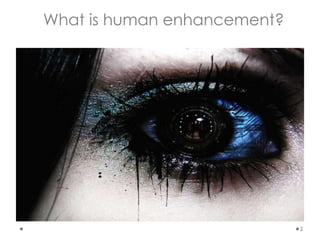
  • #3 Slide 02. WHAT IS HUMAN ENHANCEMENT   ☛ We’re all familiar with medical technology that’s used to: • manage or cure disease; and, • replace or repair damaged body parts.   ☛ Human enhancement refers to the use of any technology to: • extend the human lifespan; and • boost human physical and mental capabilities beyond their inherent biological limitations, in an effort to: • change the nature of human nature; and, • improve the human condition.
  • #4 Slide 03. WHAT IS HUMAN ENHANCEMENT ENABLING TECHNOLOGY   ☛ Human enhancement enabling technology (“HEET”) is a set of emerging technologies designed to extend the human lifespan, or augment human physical and mental capabilities and includes: • drugs • bionic implants • smart prostheses • brain-machine interfaces, etc.
  • #5 Slide 04. WHAT ARE THE GOALS OF HEET?   ☛ Refer to slide.
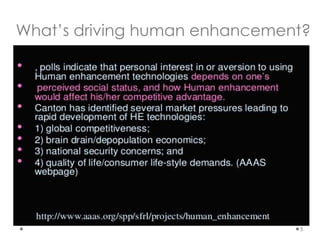
  • #6 Slide 05. WHAT’S DRIVING HUMAN ENHANCEMENT?   ☛ The major human motivators – the very attributes of human nature are 5 P’s: • Permanency (self-preservation, immortality) • Power • Profit • Pleasure • Pride (vanity)  strongly pull for human enhancement.
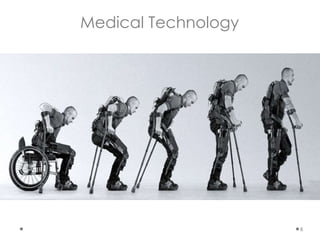
  • #7 Slide 06. MEDICAL TECHNOLOGY AS A DRIVER OF HUMAN ENHANCEMENT   • Regenerative medicine, stem cell technology and genetic engineering (such as 3-Parent IVF) are blurring the line that divides healing and restoration from enhancement and augmentation. • Prevention blurs into enhancement with immunization. • The unspoken goal of regenerative medicine is radical life extension.
  • #8 Slide 07. DIGITAL CULTURE AS A DRIVER OF HUMAN ENHANCMENT   ☛ The digital culture is generating an unprecedented demand for information relating to fitness and well-being. • Grass roots movements such as biohacking and neurohacking seek physiological and neurological data as outputs from the body to improve physical and mental performance. • Grinders are people who are self-implanting digital devices into their bodies. • • Biohacking and neurohacking foreshadow human enhancement.
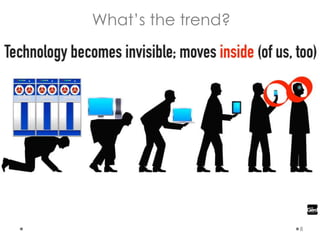
  • #9  Slide 08. WHAT’S THE TREND?   ☛ Fixed ⇰ Portable ⇰ Wearable ⇰Applicable ⇰ Embeddable ⇰ Implantable Our bodies are becoming less distinguishable from the material products used to enhance them. The popularity of wearable technology points to the coming seamless integration of bodily and technological functions and suggests not a trend but an emerging way of life. Benjamin Wittes and Jane Chong, Our Cyborg Future: Law and Policy Implications (September 2014).Available at http://www.brookings.edu/research/reports2/2014/09/cyborg-future-law-policy-implications (last visited January 21, 2015).
  • #10 Slide 09. WHERE ARE WE HEADED?   ☛ We appear to by headed to symbiotic merger.
  • #11 Slide 10. HAVEN’T WE BEEN ENHANCING ALL ALONG?   • Our ancestors used stone tools for pounding, cutting, and other purposes; • Tools allow us to eat better, be stronger, move faster, communicate over greater distances, and generally to do more. • Tool-making is enhancement. Image: Prosthetic Toe from Ancient Egypt http://en.wikipedia.org/wiki/Prosthesis#History Tools, defined broadly, enormously enhance our abilities over those of humans in a “state of nature”. Tools allow us to eat better, be stronger, move faster, communicate over greater distances, and generally to do more. Over its history, Homo sapiens has enhanced the quality and quantity of its lives mainly through the use of tools. Our species’ hominid ancestors used stone tools for pounding, cutting, and other purposes; our species’ innovations range from clothing and controlled fire to personal computers and the electric tootHbrush.  “Man is a tool-using Animal . . . . Nowhere do you find him without Tools; without tools he is nothing, with tools he is all.” THOMAS CARLYLE, SARTOR RESARTUS 31 (Univ. of Cal. Press 2000) (1831).
  • #12 Slide 11. WHAT’S DIFFERENT NOW?   ☛ The pivotal ethical issue in human enhancement concerns human manipulation of human evolution. • We are usurping the role of natural selection in evolution.   • One might say that the context for ethics is human nature. • How do reach an ethical decision about altering human nature when to do so is change the very context within which the decision is arises? • It’s as if the wisdom of such a decision can only be assessed from the new context for humanity that it generates. • Only butterflies can explain how caterpillars came to fly. • And only transhumans will be able to explain the ethical wisdom of how humans came to be more than human. • The question is dare we generate a new context for the being of human being … for what’s possible for human beings?
  • #13 Slide 12. WHAT’S THE PROBLEM?   • Reduction of the body to a machine. All of modern scientific medicine is based on the very assumption of the body as a mechanism that opponents of human enhance find so offensive. • Tampering with a Human Essence. “Human essence” is a concept with no corresponding biological correlate in reality. • Playing God and Punishable hubris. Actions given by arrogance are deemed worthy of punishment. The ultimate in arrogance is “playing God.” But what exactly does that mean?
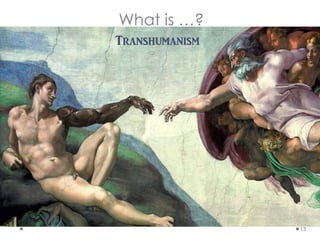
  • #14 Slide 13. WHAT IS TRANSHUMANISM?   ☛ Transhumanism is a philosophy that supports • freedom of choice and • freedom from coercion in the use of HEET consistently with the maintenance of a stable democratic society.   ☛ With the first transhumanist running for president in the U.S., transhumanism is morphing into a still incoherent political ideology.
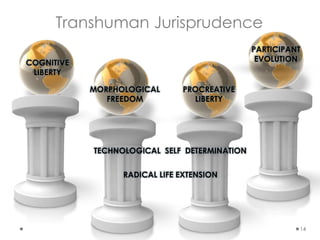
  • #15 Slide 14. TRANSHUMAN JURISPRUDENCE   ☛ Transhumanism stands on four human or civil “rights”: (1) "morphological freedom:” a right to amplify human physical abilities and lifespan;  (2) "cognitive liberty:” a right of privacy for thoughts and feelings where they show up within the brain and a right to amplify human mental abilities;  (3) "procreative liberty:” a right to produce genetically enhanced children; and,  (4) "participant evolution:” a right to genetically modify forms of life and to bring new forms of life into existence.   ☛ As of 2015, there are no laws anywhere about human enhancement.
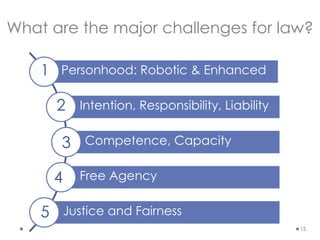
  • #16 Slide 14. WHAT ARE THE MAJOR LEGAL CHALLENGES   ☛ Refer to slide for content. to slide for content.
  • #17 Slide 15. WHAT IF THE RULE OF LAW CAN’T KEEP UP WITH THE RATE OF CHANGE?   ☛ The premise of the TV series “Almost Human” is that HEET and AI have so rapidly outpaced the law, that all attempts to regulate them have been abandoned.   • The outcome is a laissez faire, free-for-all, productive of near-nihilistic society with organized crime as one of the major end-users of HEET and AI. • The issue of eugenic conflict between the enhanced and the unenhanced is dramatized as a “racial” tension between enhanced robotic police officers and unenhanced human police.
  • #18 Slide 16. WHY SHOULD WE CARE?   • The legal issues of personhood, intention, responsibility, liability, competence, and capacity give rise to issues relevant to all specialized areas of legal practice, such as criminal law, tort law, family law, health care law, and the law of trusts and estates.   • If the law in regard to human enhancement remains silent, HEET will be driven almost exclusively by the profit motive in an unregulated market and opaque national security institutions.   • As a global enterprise, the disruptive impacts of HEET cannot be adequately controlled by the legal system of any individual nation.   • As HEET is deployed, black markets for its applications will arise and bans will be unworkable.   ☛ With it’s reliance on: • treaties that are not always honored; • customs, traditions, and values that are not universally respected; and • international courts weakened by national sovereignty, the effectiveness of law in governing HEET is doubtful.   • The scenario of “Almost Human” becomes a credible default future.
  • #19 Slide 17. WHAT CAN WE DO?     • Presently no laws dealing with HE.   ☛ However: • HE has ramifications for human dignity & human rights in that biotech inequalities deepen along pre-existing lines of socioeconomic & national division • HE has ramifications for global security int’l military enhancement arms race already underway.   ☛ So prudent, if not essential, to deal with issues raised by HE   ☛ 3 POSSIBILITIES: • no restrictions or regs; • moratorium or full ban; • some restrictions or regs.   ☛ NO RESTRICS/REGS • reckless, given risks to safety   ☛ BAN/MORATORIUM: also unrealistic. • No worldwide moratorium on anything proven to work.   ☛ Given appeal of human enhancement, SOME REG is least worst situation.  
  • #20 Slide 18. ☛ At beginning presentation, asked you to consider two questions:   1. WHAT DO WE DO WHEN THE RULE OF LAW CAN NO LONGER KEEP UP WITH THE RATE OF TECHNOLOGICAL CHANGE?   2. HOW DO WE GOVERN OUR OWN EVOLUTION?   ☛ I ask you to consider that the rule of law is will struggle to be relevant to the global deployment of disruptive technologies, such as: • human genetic engineering; and, • artificial intelligence, because the rule of law will be : • ineffective in regulating that deployment; and, • ineffective in governing its impacts; chief among which is the • management of our own evolution.   ☛ I don’t have answers to these questions; and, I expect it will take the effort of many people to generate a context capable of providing those answers. That is why I founded the nonprofit CTJ.   If you agree that it’s important that we answer these questions, I would love to speak to further about co-creating a system of governance that can bind and equitably sustain the a biotechnical civilization with pervasively disseminated AI