LIPIDS
Gemalyn B. Ingaran
Instructor
All cells are surrounded by a membrane that confines their contents.
Up to 80% of the mass of a cell membrane can be lipid materials; the rest is
primarily protein. It is membranes that give cells their individuality by
separating them from their environment.
Phospholipids are the most abundant type of membrane lipid.
A phospholipid is a lipid that contains one or more fatty acids, a
phosphate group, a platform molecule to which the fatty acid(s)
and the phosphate group are attached, and an alcohol that is
attached to the phosphate group. The platform molecule on which
a phospholipid is built may be the 3-carbon alcohol glycerol or a
more complex C18 aminodialcohol called sphingosine.
Glycerol-based phospholipids are called glycerophospholipids, and
those based on sphingosine are called sphingophospholipids
The general block diagrams for a glycerophospholipid
and a sphingophospholipid are as follows:
A glycerophospholipid is a lipid that contains two fatty acids
and a phosphate group esterified to a glycerol molecule and an
alcohol esterified to the phosphate group.
All attachments (bonds) between groups in a glycerophospholipid
are ester linkages, a situation similar to that in triacylglycerols.
Because of the ester linkages present, glycerophospholipids
undergo hydrolysis and saponification reactions in a manner similar
to that for triacylglycerols. There will be five reaction products,
however, instead of the four for triacylglycerols.
Phosphoric acid is the parent source for the minus one charged
phosphate group used in the formation of glycerophospholipids.
The structures of these two entities are
The alcohol attached to the phosphate group in a
glycerophospholipid is usually one of three amino alcohols: choline,
ethanolamine, or serine.
The structures of these three amino alcohols, given in terms of the
charged forms that they adopt in neutral solution, are:
Eg.: Structural formula for the glycerophospholipid that produces, upon
hydrolysis, equimolar amounts of glycerol, phosphoric acid, and
ethanolamine, and twice that molar amount of stearic acid, the 18:0 fatty
acid.
There are two important things to notice about this model:
(1) There is a “head” part, the choline and phosphate and (2)
there are two “tails,” the two fatty acid carbon chains. The
head part is polar. The two tails, the carbon chains, are
nonpolar.
• Egg yolks and soybeans are good dietary sources of these lipids.
Within the body, phosphatidylcholines (lecithins) are prevalent
in cell membranes.
• Mayonnaise, ice cream, and custards are some of the products
they are found in. It is the polar–nonpolar (head–tail) structure of
phosphatidylcholines that enables them to function as
emulsifiers.
• Phosphatidylethanolamines and phosphatidylserines are also
known as cephalins. These compounds are found in heart and
liver tissue and in high concentrations in the brain. They are
important in blood clotting.
ACTIVITY 6
Draw the structure formula for the
glycerophospholipid that produces,
upon hydrolysis, equimolar amounts of
glycerol, phosphoric acid, and choline,
and twice that molar amount of lauric
acid, the 12:0 fatty acid.
SPHINGOPHOSPHOLIPIDS
SPHINGOPHOSPHOLIPIDS have structures based on
the 18-carbon monounsaturated aminodialcohol
sphingosine.
A sphingophospholipid is a lipid that contains one
fatty acid and one phosphate group attached to a
sphingosine molecule and an alcohol attached to the
phosphate group.
SPHINGOPHOSPHOLIPIDS
All phospholipids derived from sphingosine have (1) the fatty
acid attached to the sphingosine -NH2 group via an amide linkage (2)
the phosphate group attached to the sphingosine terminal -OH
group via an ester linkage and (3) an additional alcohol esterified to
the phosphate group.
SPHINGOPHOSPHOLIPIDS
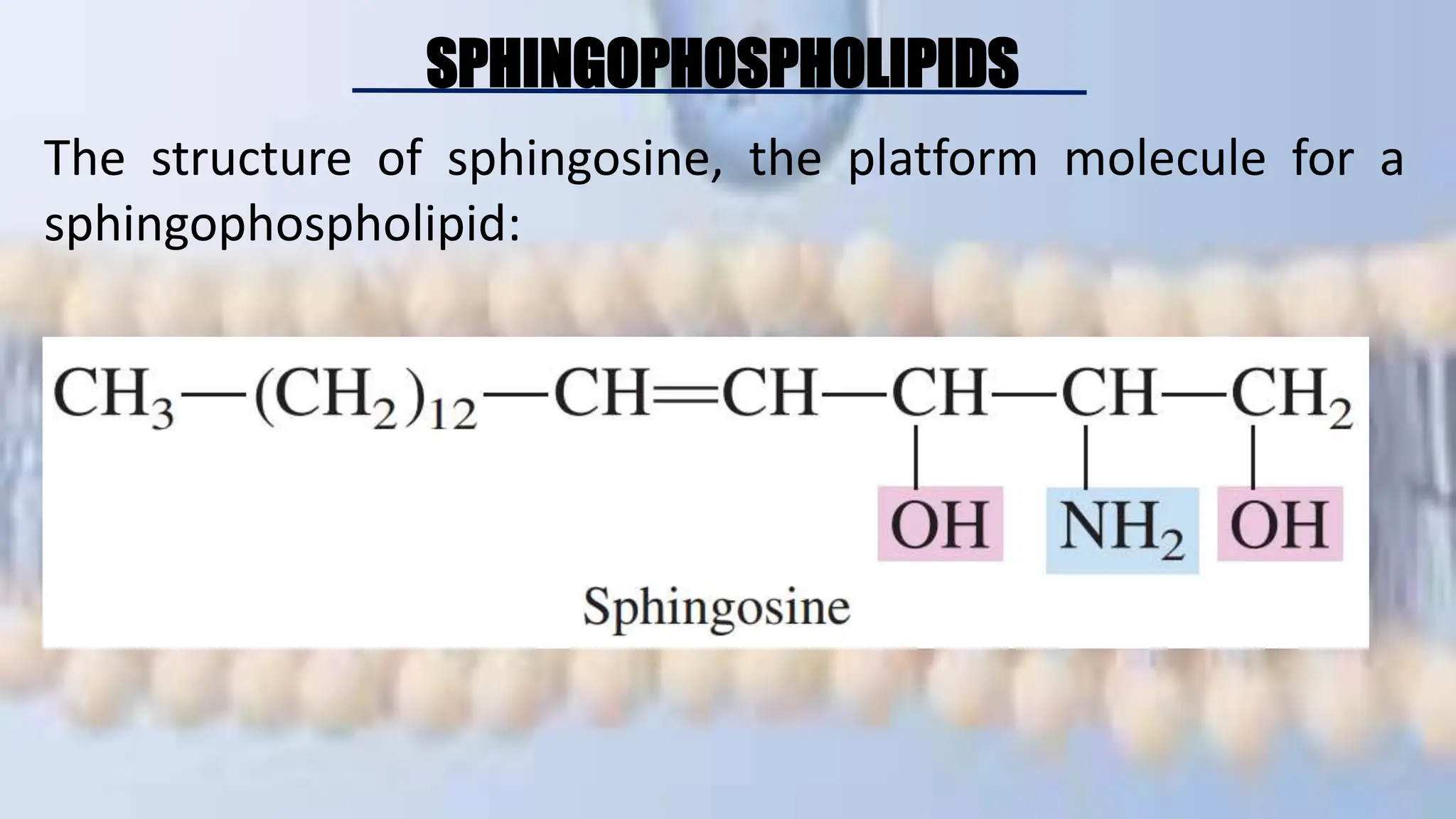
The structure of sphingosine, the platform molecule for a
sphingophospholipid:
SPHINGOPHOSPHOLIPIDS
• Like glycerophospholipids, sphingophospholipids
participate in hydrolysis and saponification reactions.
• Sphingophospholipids in which the alcohol esterified
to the phosphate group is choline are called
sphingomyelins. Sphingomyelins are found in all cell
membranes and are important structural components
of the myelin sheath, the protective and insulating
coating that surrounds nerves.
SPHINGOPHOSPHOLIPIDS
The structural formula for a sphingomyelin in which stearic acid
(18:0) is the fatty acid is
MEMBRANE
LIPIDS:
SPHINGOGLYCOLIPIDS
SPHINGOGLYCOLIPIDS
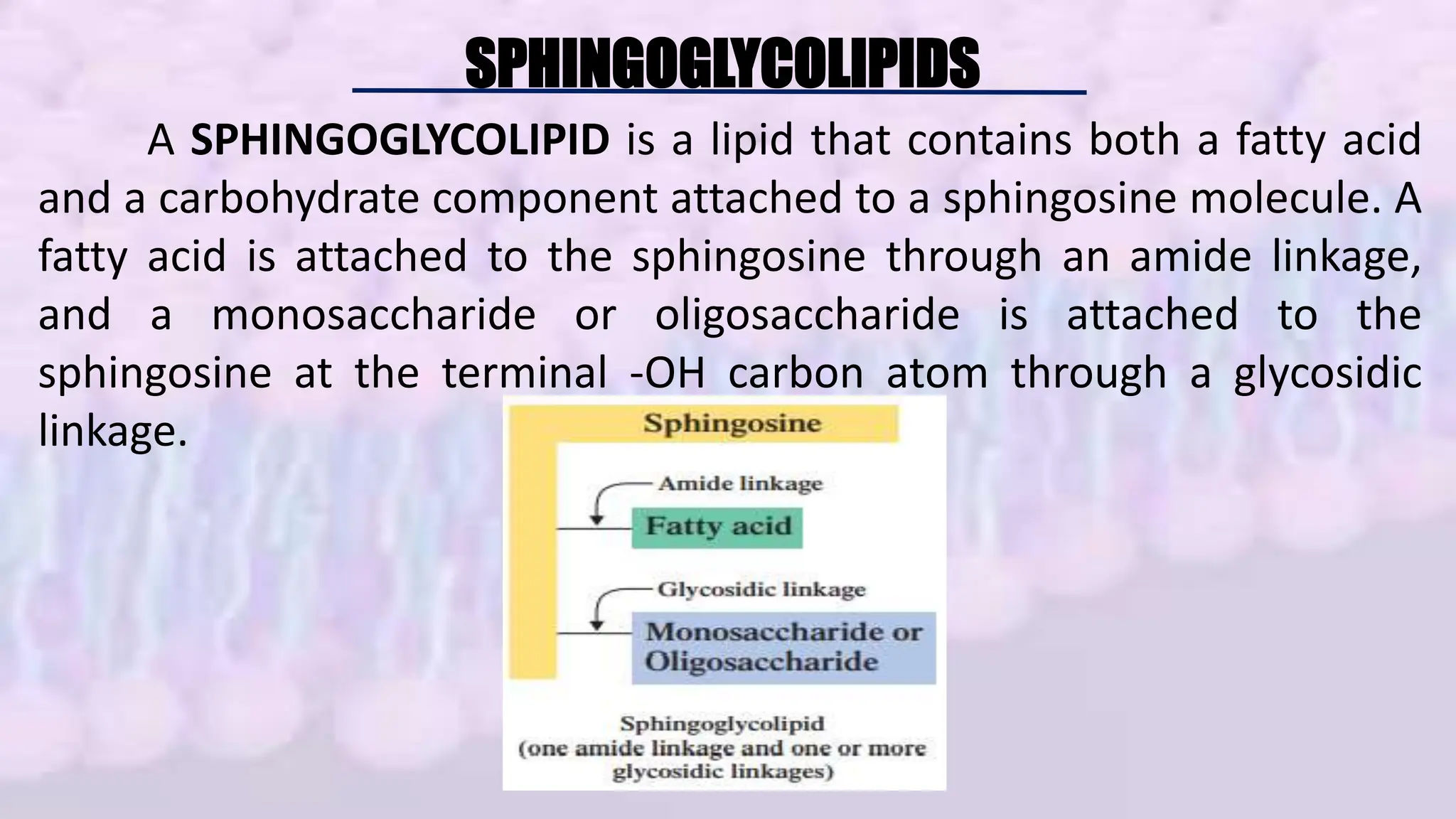
A SPHINGOGLYCOLIPID is a lipid that contains both a fatty acid
and a carbohydrate component attached to a sphingosine molecule. A
fatty acid is attached to the sphingosine through an amide linkage,
and a monosaccharide or oligosaccharide is attached to the
sphingosine at the terminal -OH carbon atom through a glycosidic
linkage.
SPHINGOGLYCOLIPIDS
Like glycerophospholipids and sphingophospholipids,
sphingoglycolipids have a “head and two tail” structure.
Sphingoglycolipids and sphingophospholipids have similar
“tails,” but their polar “heads” differ in the constituents
present (mono- or oligosaccharide versus phosphate-
alcohol).
SPHINGOCLYCOLIPIDS
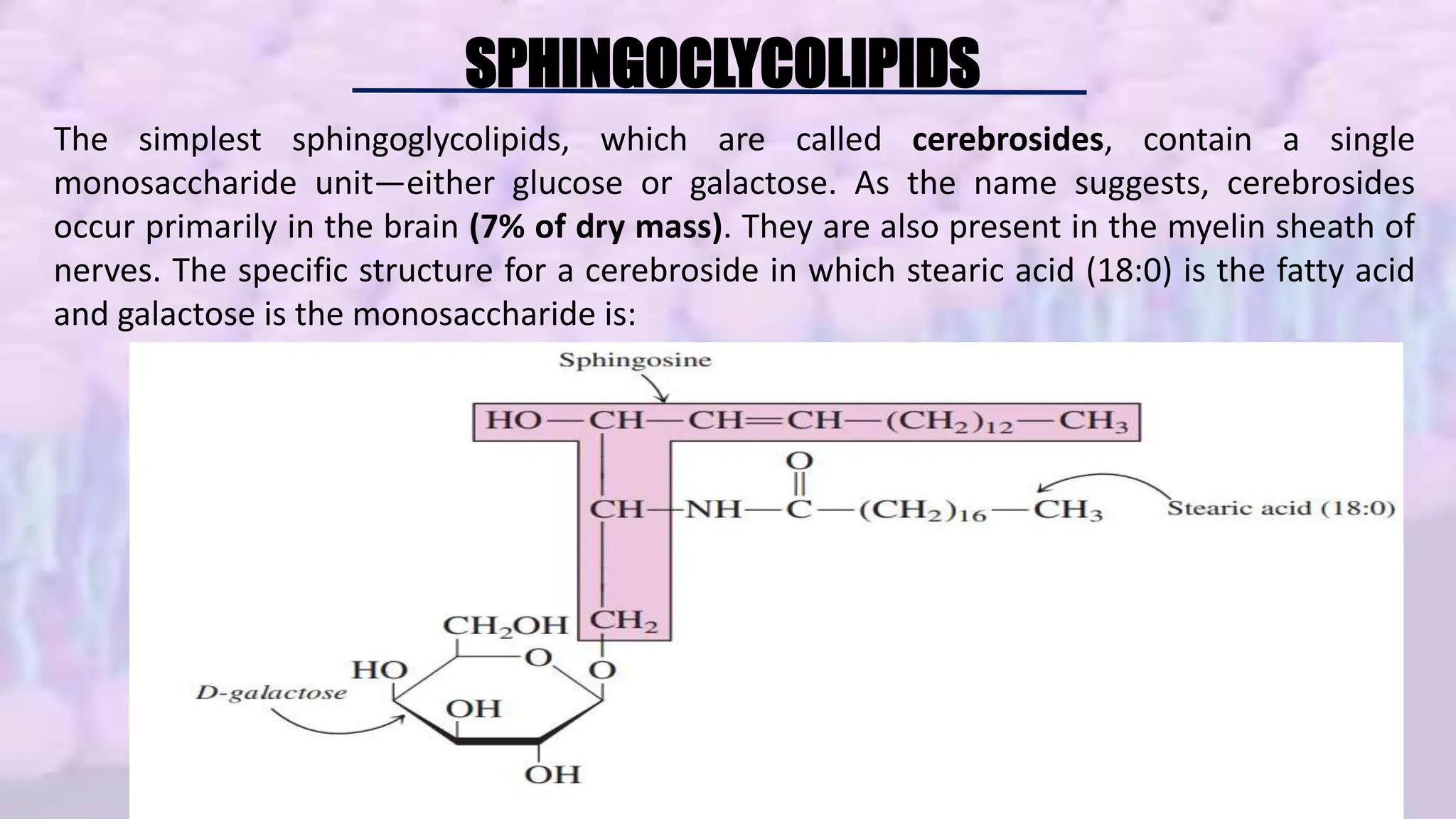
The simplest sphingoglycolipids, which are called cerebrosides, contain a single
monosaccharide unit—either glucose or galactose. As the name suggests, cerebrosides
occur primarily in the brain (7% of dry mass). They are also present in the myelin sheath of
nerves. The specific structure for a cerebroside in which stearic acid (18:0) is the fatty acid
and galactose is the monosaccharide is:
SPHINGOCLYCOLIPIDS
More complex sphingoglycolipids, called gangliosides,
contain a branched chain of up to seven monosaccharide
residues. These substances occur in the gray matter of the
brain as well as in the myelin sheath.
Terminology for and Structural Relationships Among Various Types of Fatty-Acid-Containing Lipids
MEMBRANE
LIPIDS:
CHOLESTEROL
CHOLESTEROL
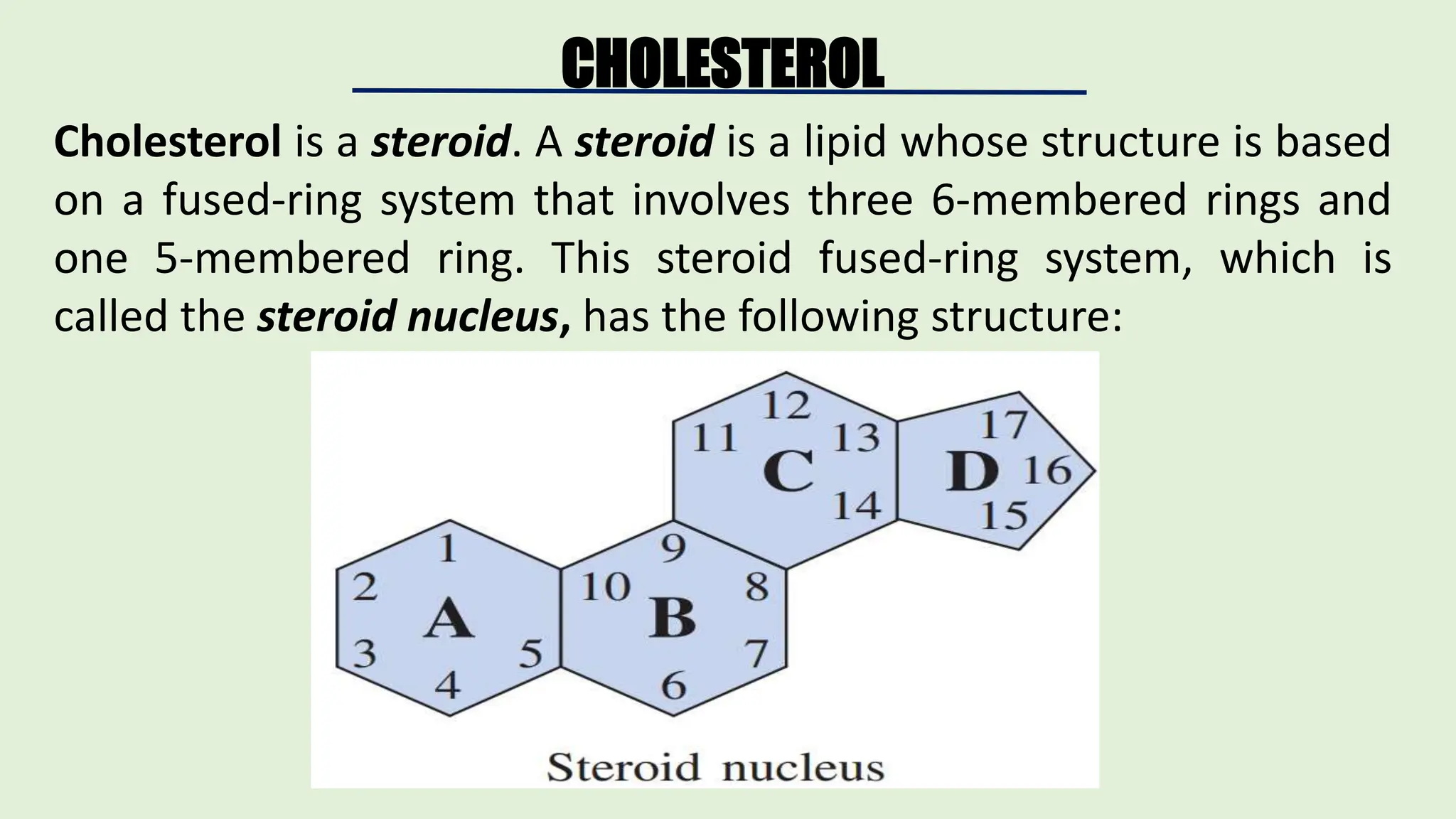
Cholesterol is a steroid. A steroid is a lipid whose structure is based
on a fused-ring system that involves three 6-membered rings and
one 5-membered ring. This steroid fused-ring system, which is
called the steroid nucleus, has the following structure:
CHOLESTEROL
Remember:
Cholesterol’s structure differs markedly from
that of other membrane lipids in that
(1)There are no fatty acid residues present
and;
(2)Neither glycerol nor sphingosine is
present as the platform molecule.
CHOLESTEROL
CHOLESTEROL is a C27 steroid molecule that is
a component of cell membranes and a precursor
for other steroid-based lipids. It is the most
abundant steroid in the human body.
The -ol ending in the name cholesterol
conveys the information that an alcohol
functional group is present in this molecule; it is
located on carbon 3 of the steroid nucleus.
CHOLESTEROL
CHOLESTEROL
Within the human body, cholesterol is found in cell
membranes (up to 25% by mass), in nerve tissue, in
brain tissue (about 10% by dry mass), and in virtually
all fluids. Every 100 mL of human blood plasma
contains about 50 mg of free cholesterol and about
170 mg of cholesterol esterified with various fatty
acids
CHOLESTEROL
• Although a portion of the body’s cholesterol is obtained
from dietary intake, most of it is biosynthesized by the
liver and (to a lesser extent) the intestine.
• Typically, 800–1000 mg are biosynthesized each day.
Ingested cholesterol decreases biosynthetic cholesterol
production.
• However, the reduction is less than the amount ingested.
Therefore, total body cholesterol levels increase with
increased dietary intake of cholesterol.
CHOLESTEROL
• The lipoproteins that carry cholesterol from the liver to various
tissues are called LDLs (low-density lipoproteins), and those
that carry excess cholesterol from tissues back to the liver are
called HDLs (high-density lipoproteins). If too much cholesterol
is being transported by LDLs or too little by HDLs, the imbalance
results in an increase in blood cholesterol levels.
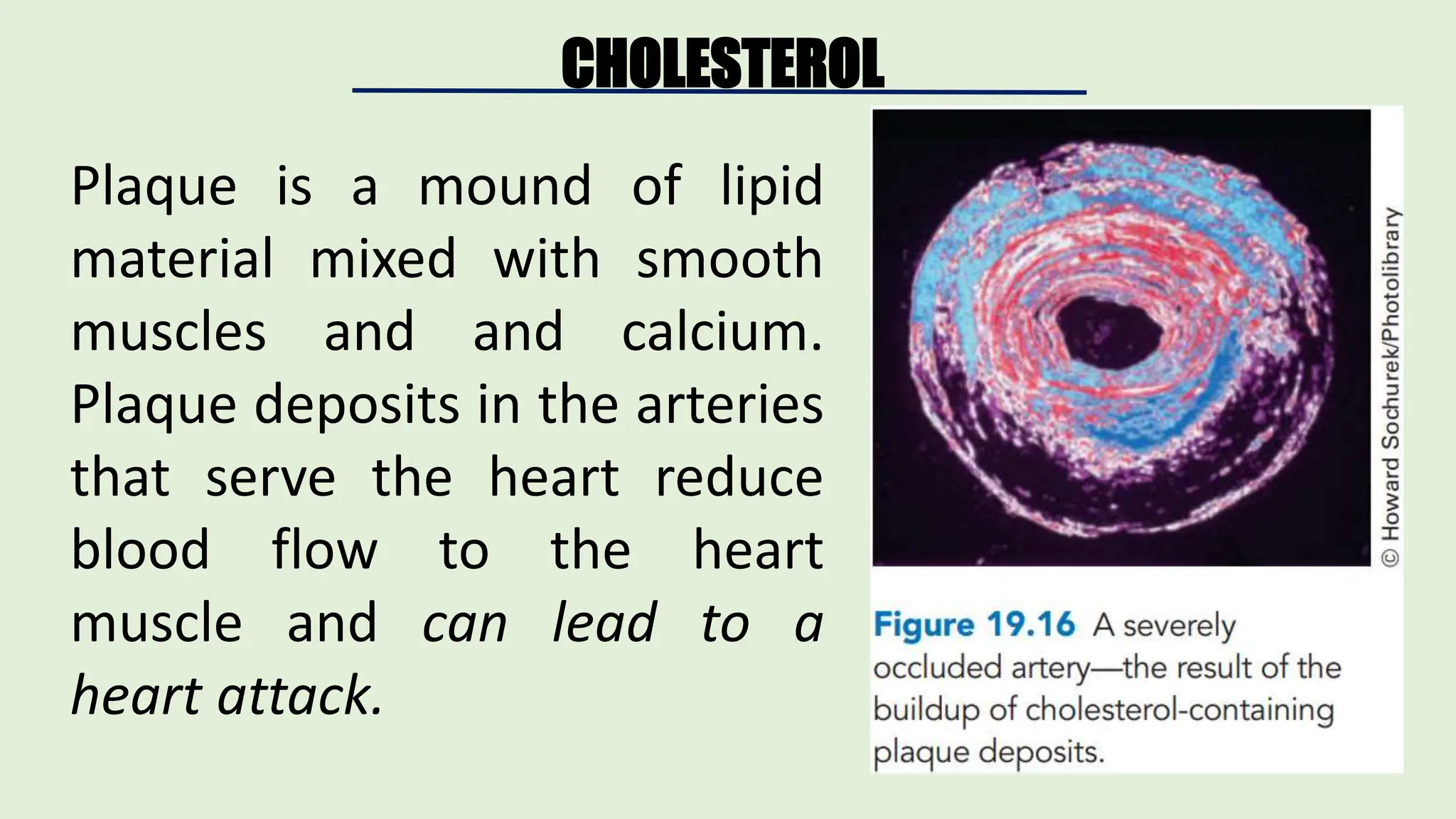
• High blood cholesterol levels contribute to atherosclerosis, a
form of cardiovascular disease characterized by the buildup of
plaque along the inner walls of arteries.
CHOLESTEROL
Plaque is a mound of lipid
material mixed with smooth
muscles and and calcium.
Plaque deposits in the arteries
that serve the heart reduce
blood flow to the heart
muscle and can lead to a
heart attack.
CHOLESTEROL
People who want to reduce
dietary cholesterol intake
should reduce the amount
of animal products they eat
(meat, dairy products, etc.)
and eat more fruit and
vegetables. Plant foods
contain negligible amounts
of cholesterol; cholesterol
is found primarily in foods
of animal origin.
CHOLESTEROL
• The cholesterol associated with LDLs is often called “bad
cholesterol” because it can contribute to increased blood
cholesterol levels.
• The cholesterol associated with HDLs is often called “good
cholesterol” because it reduced blood cholesterol levels.

08-Membrane-Lipids.pptx powerpoint presentation

  • 1.
  • 3.
    All cells aresurrounded by a membrane that confines their contents. Up to 80% of the mass of a cell membrane can be lipid materials; the rest is primarily protein. It is membranes that give cells their individuality by separating them from their environment.
  • 4.
    Phospholipids are themost abundant type of membrane lipid. A phospholipid is a lipid that contains one or more fatty acids, a phosphate group, a platform molecule to which the fatty acid(s) and the phosphate group are attached, and an alcohol that is attached to the phosphate group. The platform molecule on which a phospholipid is built may be the 3-carbon alcohol glycerol or a more complex C18 aminodialcohol called sphingosine. Glycerol-based phospholipids are called glycerophospholipids, and those based on sphingosine are called sphingophospholipids
  • 5.
    The general blockdiagrams for a glycerophospholipid and a sphingophospholipid are as follows:
  • 7.
    A glycerophospholipid isa lipid that contains two fatty acids and a phosphate group esterified to a glycerol molecule and an alcohol esterified to the phosphate group. All attachments (bonds) between groups in a glycerophospholipid are ester linkages, a situation similar to that in triacylglycerols.
  • 8.
    Because of theester linkages present, glycerophospholipids undergo hydrolysis and saponification reactions in a manner similar to that for triacylglycerols. There will be five reaction products, however, instead of the four for triacylglycerols.
  • 9.
    Phosphoric acid isthe parent source for the minus one charged phosphate group used in the formation of glycerophospholipids. The structures of these two entities are
  • 10.
    The alcohol attachedto the phosphate group in a glycerophospholipid is usually one of three amino alcohols: choline, ethanolamine, or serine. The structures of these three amino alcohols, given in terms of the charged forms that they adopt in neutral solution, are:
  • 11.
    Eg.: Structural formulafor the glycerophospholipid that produces, upon hydrolysis, equimolar amounts of glycerol, phosphoric acid, and ethanolamine, and twice that molar amount of stearic acid, the 18:0 fatty acid.
  • 14.
    There are twoimportant things to notice about this model: (1) There is a “head” part, the choline and phosphate and (2) there are two “tails,” the two fatty acid carbon chains. The head part is polar. The two tails, the carbon chains, are nonpolar.
  • 15.
    • Egg yolksand soybeans are good dietary sources of these lipids. Within the body, phosphatidylcholines (lecithins) are prevalent in cell membranes. • Mayonnaise, ice cream, and custards are some of the products they are found in. It is the polar–nonpolar (head–tail) structure of phosphatidylcholines that enables them to function as emulsifiers. • Phosphatidylethanolamines and phosphatidylserines are also known as cephalins. These compounds are found in heart and liver tissue and in high concentrations in the brain. They are important in blood clotting.
  • 16.
    ACTIVITY 6 Draw thestructure formula for the glycerophospholipid that produces, upon hydrolysis, equimolar amounts of glycerol, phosphoric acid, and choline, and twice that molar amount of lauric acid, the 12:0 fatty acid.
  • 17.
  • 18.
    SPHINGOPHOSPHOLIPIDS SPHINGOPHOSPHOLIPIDS have structuresbased on the 18-carbon monounsaturated aminodialcohol sphingosine. A sphingophospholipid is a lipid that contains one fatty acid and one phosphate group attached to a sphingosine molecule and an alcohol attached to the phosphate group.
  • 19.
    SPHINGOPHOSPHOLIPIDS All phospholipids derivedfrom sphingosine have (1) the fatty acid attached to the sphingosine -NH2 group via an amide linkage (2) the phosphate group attached to the sphingosine terminal -OH group via an ester linkage and (3) an additional alcohol esterified to the phosphate group.
  • 20.
    SPHINGOPHOSPHOLIPIDS The structure ofsphingosine, the platform molecule for a sphingophospholipid:
  • 21.
  • 22.
    SPHINGOPHOSPHOLIPIDS • Like glycerophospholipids,sphingophospholipids participate in hydrolysis and saponification reactions. • Sphingophospholipids in which the alcohol esterified to the phosphate group is choline are called sphingomyelins. Sphingomyelins are found in all cell membranes and are important structural components of the myelin sheath, the protective and insulating coating that surrounds nerves.
  • 23.
    SPHINGOPHOSPHOLIPIDS The structural formulafor a sphingomyelin in which stearic acid (18:0) is the fatty acid is
  • 24.
  • 25.
    SPHINGOGLYCOLIPIDS A SPHINGOGLYCOLIPID isa lipid that contains both a fatty acid and a carbohydrate component attached to a sphingosine molecule. A fatty acid is attached to the sphingosine through an amide linkage, and a monosaccharide or oligosaccharide is attached to the sphingosine at the terminal -OH carbon atom through a glycosidic linkage.
  • 26.
    SPHINGOGLYCOLIPIDS Like glycerophospholipids andsphingophospholipids, sphingoglycolipids have a “head and two tail” structure. Sphingoglycolipids and sphingophospholipids have similar “tails,” but their polar “heads” differ in the constituents present (mono- or oligosaccharide versus phosphate- alcohol).
  • 27.
    SPHINGOCLYCOLIPIDS The simplest sphingoglycolipids,which are called cerebrosides, contain a single monosaccharide unit—either glucose or galactose. As the name suggests, cerebrosides occur primarily in the brain (7% of dry mass). They are also present in the myelin sheath of nerves. The specific structure for a cerebroside in which stearic acid (18:0) is the fatty acid and galactose is the monosaccharide is:
  • 28.
    SPHINGOCLYCOLIPIDS More complex sphingoglycolipids,called gangliosides, contain a branched chain of up to seven monosaccharide residues. These substances occur in the gray matter of the brain as well as in the myelin sheath.
  • 29.
    Terminology for andStructural Relationships Among Various Types of Fatty-Acid-Containing Lipids
  • 30.
  • 31.
    CHOLESTEROL Cholesterol is asteroid. A steroid is a lipid whose structure is based on a fused-ring system that involves three 6-membered rings and one 5-membered ring. This steroid fused-ring system, which is called the steroid nucleus, has the following structure:
  • 32.
    CHOLESTEROL Remember: Cholesterol’s structure differsmarkedly from that of other membrane lipids in that (1)There are no fatty acid residues present and; (2)Neither glycerol nor sphingosine is present as the platform molecule.
  • 33.
    CHOLESTEROL CHOLESTEROL is aC27 steroid molecule that is a component of cell membranes and a precursor for other steroid-based lipids. It is the most abundant steroid in the human body. The -ol ending in the name cholesterol conveys the information that an alcohol functional group is present in this molecule; it is located on carbon 3 of the steroid nucleus.
  • 34.
  • 35.
    CHOLESTEROL Within the humanbody, cholesterol is found in cell membranes (up to 25% by mass), in nerve tissue, in brain tissue (about 10% by dry mass), and in virtually all fluids. Every 100 mL of human blood plasma contains about 50 mg of free cholesterol and about 170 mg of cholesterol esterified with various fatty acids
  • 36.
    CHOLESTEROL • Although aportion of the body’s cholesterol is obtained from dietary intake, most of it is biosynthesized by the liver and (to a lesser extent) the intestine. • Typically, 800–1000 mg are biosynthesized each day. Ingested cholesterol decreases biosynthetic cholesterol production. • However, the reduction is less than the amount ingested. Therefore, total body cholesterol levels increase with increased dietary intake of cholesterol.
  • 37.
    CHOLESTEROL • The lipoproteinsthat carry cholesterol from the liver to various tissues are called LDLs (low-density lipoproteins), and those that carry excess cholesterol from tissues back to the liver are called HDLs (high-density lipoproteins). If too much cholesterol is being transported by LDLs or too little by HDLs, the imbalance results in an increase in blood cholesterol levels. • High blood cholesterol levels contribute to atherosclerosis, a form of cardiovascular disease characterized by the buildup of plaque along the inner walls of arteries.
  • 38.
    CHOLESTEROL Plaque is amound of lipid material mixed with smooth muscles and and calcium. Plaque deposits in the arteries that serve the heart reduce blood flow to the heart muscle and can lead to a heart attack.
  • 39.
    CHOLESTEROL People who wantto reduce dietary cholesterol intake should reduce the amount of animal products they eat (meat, dairy products, etc.) and eat more fruit and vegetables. Plant foods contain negligible amounts of cholesterol; cholesterol is found primarily in foods of animal origin.
  • 40.
    CHOLESTEROL • The cholesterolassociated with LDLs is often called “bad cholesterol” because it can contribute to increased blood cholesterol levels. • The cholesterol associated with HDLs is often called “good cholesterol” because it reduced blood cholesterol levels.