Loops
Repeating Code Multiple Times
Svetlin Nakov
Technical Trainer
www.nakov.com
Software University
http://softuni.bg
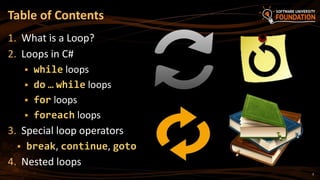
Table of Contents
1. What is a Loop?
2. Loops in C#
ď‚§ while loops
 do … while loops
ď‚§ for loops
ď‚§ foreach loops
3. Special loop operators
ď‚§ break, continue, goto
4. Nested loops
2
Loop: Definition
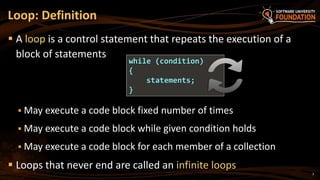
ď‚§ A loop is a control statement that repeats the execution of a
block of statements
ď‚§ May execute a code block fixed number of times
ď‚§ May execute a code block while given condition holds
ď‚§ May execute a code block for each member of a collection
ď‚§ Loops that never end are called an infinite loops
while (condition)
{
statements;
}
3
Using while(…) Loop
Repeating a Statement While
Certain Condition Holds
How To Use While Loop?
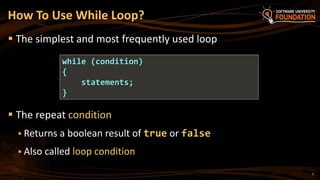
ď‚§ The simplest and most frequently used loop
ď‚§ The repeat condition
ď‚§ Returns a boolean result of true or false
ď‚§ Also called loop condition
while (condition)
{
statements;
}
5
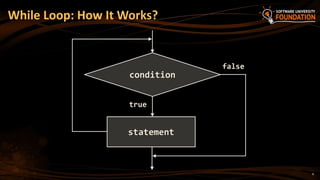
While Loop: How It Works?
true
statement
false
condition
6
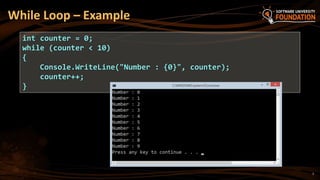
While Loop – Example
int counter = 0;
while (counter < 10)
{
Console.WriteLine("Number : {0}", counter);
counter++;
}
7
while(…) Loop
Examples
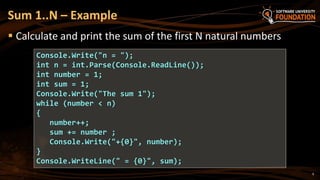
ď‚§ Calculate and print the sum of the first N natural numbers
Sum 1..N – Example
Console.Write("n = ");
int n = int.Parse(Console.ReadLine());
int number = 1;
int sum = 1;
Console.Write("The sum 1");
while (number < n)
{
number++;
sum += number ;
Console.Write("+{0}", number);
}
Console.WriteLine(" = {0}", sum);
9
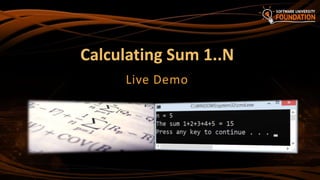
Calculating Sum 1..N
Live Demo
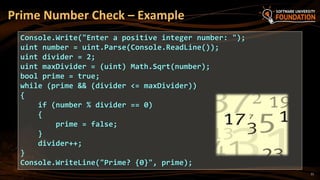
Prime Number Check – Example
Console.Write("Enter a positive integer number: ");
uint number = uint.Parse(Console.ReadLine());
uint divider = 2;
uint maxDivider = (uint) Math.Sqrt(number);
bool prime = true;
while (prime && (divider <= maxDivider))
{
if (number % divider == 0)
{
prime = false;
}
divider++;
}
Console.WriteLine("Prime? {0}", prime);
11
Checking Whether a
Number Is Prime
Live Demo
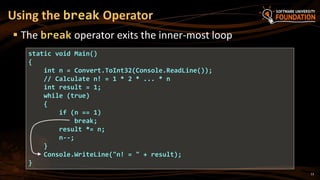
Using the break Operator
ď‚§ The break operator exits the inner-most loop
static void Main()
{
int n = Convert.ToInt32(Console.ReadLine());
// Calculate n! = 1 * 2 * ... * n
int result = 1;
while (true)
{
if (n == 1)
break;
result *= n;
n--;
}
Console.WriteLine("n! = " + result);
}
13
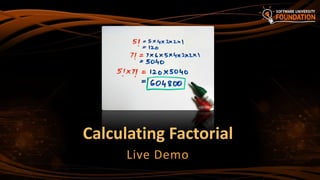
Calculating Factorial
Live Demo
do { … }
while (…)
Loop
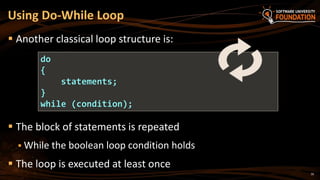
Using Do-While Loop
ď‚§ Another classical loop structure is:
ď‚§ The block of statements is repeated
ď‚§ While the boolean loop condition holds
ď‚§ The loop is executed at least once
do
{
statements;
}
while (condition);
16
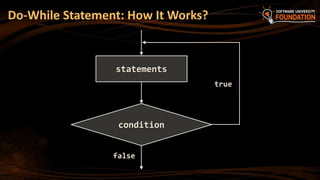
Do-While Statement: How It Works?
true
condition
statements
false
do { … }
while (…)
Examples
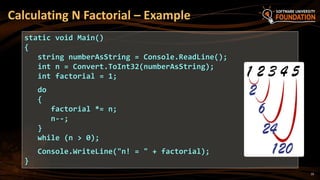
Calculating N Factorial – Example
static void Main()
{
string numberAsString = Console.ReadLine();
int n = Convert.ToInt32(numberAsString);
int factorial = 1;
do
{
factorial *= n;
n--;
}
while (n > 0);
Console.WriteLine("n! = " + factorial);
}
19
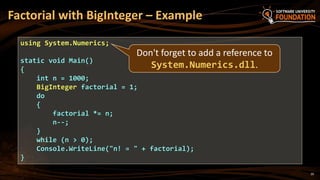
using System.Numerics;
static void Main()
{
int n = 1000;
BigInteger factorial = 1;
do
{
factorial *= n;
n--;
}
while (n > 0);
Console.WriteLine("n! = " + factorial);
}
Don't forget to add a reference to
System.Numerics.dll.
Factorial with BigInteger – Example
20
Factorial (do ... while)
Live Demo
22
ď‚§ Calculating the product of all numbers in the interval [n..m]:
Product of Numbers [N..M] – Example
int n = int.Parse(Console.ReadLine());
int m = int.Parse(Console.ReadLine());
int number = n;
decimal product = 1;
do
{
product *= number;
number++;
}
while (number <= m);
Console.WriteLine("product[{0}..{1}] = {2}", n, m, product);
Product of the Numbers
in the Interval [n..m]
Live Demo
for Loops
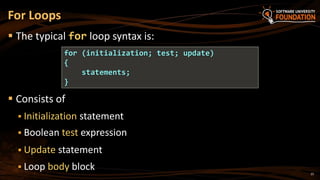
ď‚§ The typical for loop syntax is:
ď‚§ Consists of
ď‚§ Initialization statement
ď‚§ Boolean test expression
ď‚§ Update statement
ď‚§ Loop body block
For Loops
for (initialization; test; update)
{
statements;
}
25
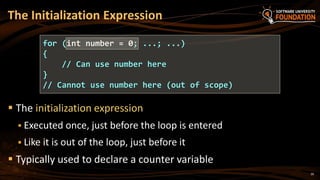
ď‚§ The initialization expression
ď‚§ Executed once, just before the loop is entered
ď‚§ Like it is out of the loop, just before it
ď‚§ Typically used to declare a counter variable
The Initialization Expression
for (int number = 0; ...; ...)
{
// Can use number here
}
// Cannot use number here (out of scope)
26
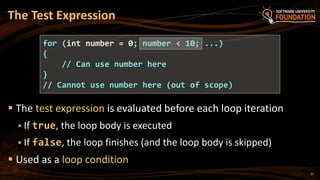
ď‚§ The test expression is evaluated before each loop iteration
ď‚§ If true, the loop body is executed
ď‚§ If false, the loop finishes (and the loop body is skipped)
ď‚§ Used as a loop condition
The Test Expression
for (int number = 0; number < 10; ...)
{
// Can use number here
}
// Cannot use number here (out of scope)
27
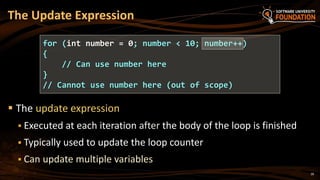
ď‚§ The update expression
ď‚§ Executed at each iteration after the body of the loop is finished
ď‚§ Typically used to update the loop counter
ď‚§ Can update multiple variables
The Update Expression
for (int number = 0; number < 10; number++)
{
// Can use number here
}
// Cannot use number here (out of scope)
28
for Loop
Examples
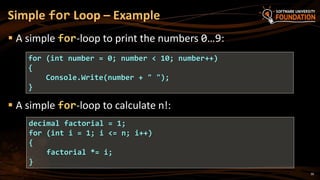
 A simple for-loop to print the numbers 0…9:
Simple for Loop – Example
for (int number = 0; number < 10; number++)
{
Console.Write(number + " ");
}
ď‚§ A simple for-loop to calculate n!:
decimal factorial = 1;
for (int i = 1; i <= n; i++)
{
factorial *= i;
}
30
31
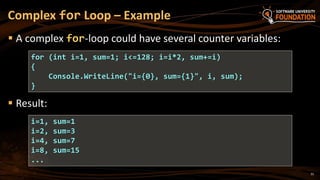
ď‚§ A complex for-loop could have several counter variables:
Complex for Loop – Example
for (int i=1, sum=1; i<=128; i=i*2, sum+=i)
{
Console.WriteLine("i={0}, sum={1}", i, sum);
}
i=1, sum=1
i=2, sum=3
i=4, sum=7
i=8, sum=15
...
ď‚§ Result:
For Loops
Live Demo
N^M – Example
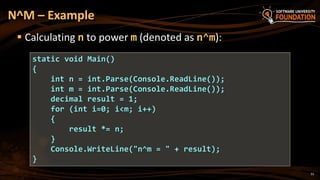
ď‚§ Calculating n to power m (denoted as n^m):
static void Main()
{
int n = int.Parse(Console.ReadLine());
int m = int.Parse(Console.ReadLine());
decimal result = 1;
for (int i=0; i<m; i++)
{
result *= n;
}
Console.WriteLine("n^m = " + result);
}
33
Calculating N^M
Live Demo
ď‚§ continue bypasses the iteration of the inner-most loop
 Example: sum all odd numbers in [1…n], not divisors of 7:
Using the continue Operator
int n = int.Parse(Console.ReadLine());
int sum = 0;
for (int i = 1; i <= n; i += 2)
{
if (i % 7 == 0)
{
continue;
}
sum += i;
}
Console.WriteLine("sum = {0}", sum);
35
Using the continue Operator
Live Demo
foreach Loop
Iterating over a Collection
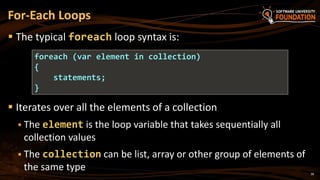
ď‚§ The typical foreach loop syntax is:
ď‚§ Iterates over all the elements of a collection
ď‚§ The element is the loop variable that takes sequentially all
collection values
ď‚§ The collection can be list, array or other group of elements of
the same type
For-Each Loops
foreach (var element in collection)
{
statements;
}
38
ď‚§ Example of foreach loop:
ď‚§ The loop iterates over the array of day names
ď‚§ The variable day takes all its values
ď‚§ Inside a foreach loop we cannot modify the current item
foreach Loop – Example
string[] days = {
"Monday", "Tuesday", "Wednesday", "Thursday",
"Friday", "Saturday", "Sunday" };
foreach (var day in days)
{
Console.WriteLine(day);
}
39
foreach Loop
Live Demo
Nested Loops
Using a Loop Inside a Loop
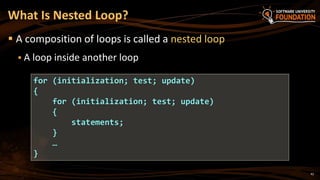
ď‚§ A composition of loops is called a nested loop
ď‚§ A loop inside another loop
What Is Nested Loop?
for (initialization; test; update)
{
for (initialization; test; update)
{
statements;
}
…
}
42
Nested Loops
Examples
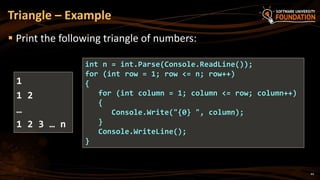
ď‚§ Print the following triangle of numbers:
Triangle – Example
int n = int.Parse(Console.ReadLine());
for (int row = 1; row <= n; row++)
{
for (int column = 1; column <= row; column++)
{
Console.Write("{0} ", column);
}
Console.WriteLine();
}
1
1 2
…
1 2 3 … n
44
Triangle of Numbers
Live Demo
Primes in the Range [N … M] – Example
int n = int.Parse(Console.ReadLine());
int m = int.Parse(Console.ReadLine());
for (int number = n; number <= m; number++)
{
bool prime = true;
int divider = 2;
int maxDivider = Math.Sqrt(number);
while (divider <= maxDivider)
{
if (number % divider == 0)
{
prime = false;
break;
}
divider++;
}
if (prime)
Console.Write("{0} ", number);
}
46
Primes in the Range [n, m]
Live Demo
C# Jump Statements
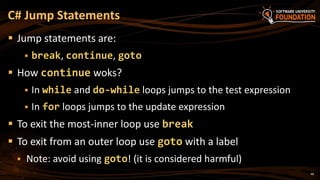
ď‚§ Jump statements are:
ď‚§ break, continue, goto
ď‚§ How continue woks?
ď‚§ In while and do-while loops jumps to the test expression
ď‚§ In for loops jumps to the update expression
ď‚§ To exit the most-inner loop use break
ď‚§ To exit from an outer loop use goto with a label
ď‚§ Note: avoid using goto! (it is considered harmful)
48
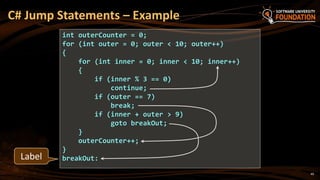
C# Jump Statements – Example
int outerCounter = 0;
for (int outer = 0; outer < 10; outer++)
{
for (int inner = 0; inner < 10; inner++)
{
if (inner % 3 == 0)
continue;
if (outer == 7)
break;
if (inner + outer > 9)
goto breakOut;
}
outerCounter++;
}
breakOut:Label
49
Loops: More Examples
Nested Loops – Examples
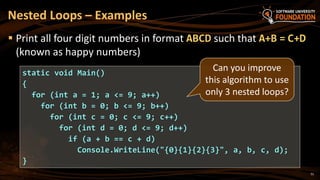
ď‚§ Print all four digit numbers in format ABCD such that A+B = C+D
(known as happy numbers)
static void Main()
{
for (int a = 1; a <= 9; a++)
for (int b = 0; b <= 9; b++)
for (int c = 0; c <= 9; c++)
for (int d = 0; d <= 9; d++)
if (a + b == c + d)
Console.WriteLine("{0}{1}{2}{3}", a, b, c, d);
}
Can you improve
this algorithm to use
only 3 nested loops?
51
Happy Numbers
Live Demo
Nested Loops – Examples
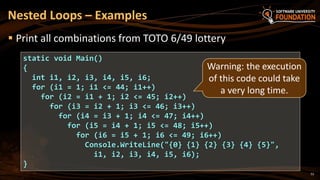
ď‚§ Print all combinations from TOTO 6/49 lottery
static void Main()
{
int i1, i2, i3, i4, i5, i6;
for (i1 = 1; i1 <= 44; i1++)
for (i2 = i1 + 1; i2 <= 45; i2++)
for (i3 = i2 + 1; i3 <= 46; i3++)
for (i4 = i3 + 1; i4 <= 47; i4++)
for (i5 = i4 + 1; i5 <= 48; i5++)
for (i6 = i5 + 1; i6 <= 49; i6++)
Console.WriteLine("{0} {1} {2} {3} {4} {5}",
i1, i2, i3, i4, i5, i6);
}
Warning: the execution
of this code could take
a very long time.
53
TOTO 6/49
Live Demo
55
ď‚§ C# supports four types of loops:
ď‚§ while loops
ď‚§ do-while loops
ď‚§ for loops
ď‚§ foreach loops
ď‚§ Nested loops are used to implement more complex logic
ď‚§ The operators continue, break & goto can change the
default loop execution behavior
Summary
?
http://softuni.bg/courses/csharp-basics/
Loops: Repeating Code Multiple Times
License
ď‚§ This course (slides, examples, demos, videos, homework, etc.)
is licensed under the "Creative Commons Attribution-
NonCommercial-ShareAlike 4.0 International" license
57
ď‚§ Attribution: this work may contain portions from
ď‚§ "Fundamentals of Computer Programming with C#" book by Svetlin Nakov & Co. under CC-BY-SA license
ď‚§ "C# Part I" course by Telerik Academy under CC-BY-NC-SA license
Free Trainings @ Software University
 Software University Foundation – softuni.org
 Software University – High-Quality Education,
Profession and Job for Software Developers
ď‚§ softuni.bg
ď‚§ Software University @ Facebook
ď‚§ facebook.com/SoftwareUniversity
ď‚§ Software University @ YouTube
ď‚§ youtube.com/SoftwareUniversity
 Software University Forums – forum.softuni.bg

06.Loops

  • 1.
    Loops Repeating Code MultipleTimes Svetlin Nakov Technical Trainer www.nakov.com Software University http://softuni.bg
  • 2.
    Table of Contents 1.What is a Loop? 2. Loops in C#  while loops  do … while loops  for loops  foreach loops 3. Special loop operators  break, continue, goto 4. Nested loops 2
  • 3.
    Loop: Definition ď‚§ Aloop is a control statement that repeats the execution of a block of statements ď‚§ May execute a code block fixed number of times ď‚§ May execute a code block while given condition holds ď‚§ May execute a code block for each member of a collection ď‚§ Loops that never end are called an infinite loops while (condition) { statements; } 3
  • 4.
    Using while(…) Loop Repeatinga Statement While Certain Condition Holds
  • 5.
    How To UseWhile Loop? ď‚§ The simplest and most frequently used loop ď‚§ The repeat condition ď‚§ Returns a boolean result of true or false ď‚§ Also called loop condition while (condition) { statements; } 5
  • 6.
    While Loop: HowIt Works? true statement false condition 6
  • 7.
    While Loop –Example int counter = 0; while (counter < 10) { Console.WriteLine("Number : {0}", counter); counter++; } 7
  • 8.
  • 9.
     Calculate andprint the sum of the first N natural numbers Sum 1..N – Example Console.Write("n = "); int n = int.Parse(Console.ReadLine()); int number = 1; int sum = 1; Console.Write("The sum 1"); while (number < n) { number++; sum += number ; Console.Write("+{0}", number); } Console.WriteLine(" = {0}", sum); 9
  • 10.
  • 11.
    Prime Number Check– Example Console.Write("Enter a positive integer number: "); uint number = uint.Parse(Console.ReadLine()); uint divider = 2; uint maxDivider = (uint) Math.Sqrt(number); bool prime = true; while (prime && (divider <= maxDivider)) { if (number % divider == 0) { prime = false; } divider++; } Console.WriteLine("Prime? {0}", prime); 11
  • 12.
    Checking Whether a NumberIs Prime Live Demo
  • 13.
    Using the breakOperator ď‚§ The break operator exits the inner-most loop static void Main() { int n = Convert.ToInt32(Console.ReadLine()); // Calculate n! = 1 * 2 * ... * n int result = 1; while (true) { if (n == 1) break; result *= n; n--; } Console.WriteLine("n! = " + result); } 13
  • 14.
  • 15.
    do { …} while (…) Loop
  • 16.
    Using Do-While Loop ď‚§Another classical loop structure is: ď‚§ The block of statements is repeated ď‚§ While the boolean loop condition holds ď‚§ The loop is executed at least once do { statements; } while (condition); 16
  • 17.
    Do-While Statement: HowIt Works? true condition statements false
  • 18.
    do { …} while (…) Examples
  • 19.
    Calculating N Factorial– Example static void Main() { string numberAsString = Console.ReadLine(); int n = Convert.ToInt32(numberAsString); int factorial = 1; do { factorial *= n; n--; } while (n > 0); Console.WriteLine("n! = " + factorial); } 19
  • 20.
    using System.Numerics; static voidMain() { int n = 1000; BigInteger factorial = 1; do { factorial *= n; n--; } while (n > 0); Console.WriteLine("n! = " + factorial); } Don't forget to add a reference to System.Numerics.dll. Factorial with BigInteger – Example 20
  • 21.
    Factorial (do ...while) Live Demo
  • 22.
    22  Calculating theproduct of all numbers in the interval [n..m]: Product of Numbers [N..M] – Example int n = int.Parse(Console.ReadLine()); int m = int.Parse(Console.ReadLine()); int number = n; decimal product = 1; do { product *= number; number++; } while (number <= m); Console.WriteLine("product[{0}..{1}] = {2}", n, m, product);
  • 23.
    Product of theNumbers in the Interval [n..m] Live Demo
  • 24.
  • 25.
    ď‚§ The typicalfor loop syntax is: ď‚§ Consists of ď‚§ Initialization statement ď‚§ Boolean test expression ď‚§ Update statement ď‚§ Loop body block For Loops for (initialization; test; update) { statements; } 25
  • 26.
    ď‚§ The initializationexpression ď‚§ Executed once, just before the loop is entered ď‚§ Like it is out of the loop, just before it ď‚§ Typically used to declare a counter variable The Initialization Expression for (int number = 0; ...; ...) { // Can use number here } // Cannot use number here (out of scope) 26
  • 27.
    ď‚§ The testexpression is evaluated before each loop iteration ď‚§ If true, the loop body is executed ď‚§ If false, the loop finishes (and the loop body is skipped) ď‚§ Used as a loop condition The Test Expression for (int number = 0; number < 10; ...) { // Can use number here } // Cannot use number here (out of scope) 27
  • 28.
    ď‚§ The updateexpression ď‚§ Executed at each iteration after the body of the loop is finished ď‚§ Typically used to update the loop counter ď‚§ Can update multiple variables The Update Expression for (int number = 0; number < 10; number++) { // Can use number here } // Cannot use number here (out of scope) 28
  • 29.
  • 30.
     A simplefor-loop to print the numbers 0…9: Simple for Loop – Example for (int number = 0; number < 10; number++) { Console.Write(number + " "); }  A simple for-loop to calculate n!: decimal factorial = 1; for (int i = 1; i <= n; i++) { factorial *= i; } 30
  • 31.
    31  A complexfor-loop could have several counter variables: Complex for Loop – Example for (int i=1, sum=1; i<=128; i=i*2, sum+=i) { Console.WriteLine("i={0}, sum={1}", i, sum); } i=1, sum=1 i=2, sum=3 i=4, sum=7 i=8, sum=15 ...  Result:
  • 32.
  • 33.
    N^M – Example Calculating n to power m (denoted as n^m): static void Main() { int n = int.Parse(Console.ReadLine()); int m = int.Parse(Console.ReadLine()); decimal result = 1; for (int i=0; i<m; i++) { result *= n; } Console.WriteLine("n^m = " + result); } 33
  • 34.
  • 35.
     continue bypassesthe iteration of the inner-most loop  Example: sum all odd numbers in [1…n], not divisors of 7: Using the continue Operator int n = int.Parse(Console.ReadLine()); int sum = 0; for (int i = 1; i <= n; i += 2) { if (i % 7 == 0) { continue; } sum += i; } Console.WriteLine("sum = {0}", sum); 35
  • 36.
    Using the continueOperator Live Demo
  • 37.
  • 38.
    ď‚§ The typicalforeach loop syntax is: ď‚§ Iterates over all the elements of a collection ď‚§ The element is the loop variable that takes sequentially all collection values ď‚§ The collection can be list, array or other group of elements of the same type For-Each Loops foreach (var element in collection) { statements; } 38
  • 39.
     Example offoreach loop:  The loop iterates over the array of day names  The variable day takes all its values  Inside a foreach loop we cannot modify the current item foreach Loop – Example string[] days = { "Monday", "Tuesday", "Wednesday", "Thursday", "Friday", "Saturday", "Sunday" }; foreach (var day in days) { Console.WriteLine(day); } 39
  • 40.
  • 41.
    Nested Loops Using aLoop Inside a Loop
  • 42.
     A compositionof loops is called a nested loop  A loop inside another loop What Is Nested Loop? for (initialization; test; update) { for (initialization; test; update) { statements; } … } 42
  • 43.
  • 44.
     Print thefollowing triangle of numbers: Triangle – Example int n = int.Parse(Console.ReadLine()); for (int row = 1; row <= n; row++) { for (int column = 1; column <= row; column++) { Console.Write("{0} ", column); } Console.WriteLine(); } 1 1 2 … 1 2 3 … n 44
  • 45.
  • 46.
    Primes in theRange [N … M] – Example int n = int.Parse(Console.ReadLine()); int m = int.Parse(Console.ReadLine()); for (int number = n; number <= m; number++) { bool prime = true; int divider = 2; int maxDivider = Math.Sqrt(number); while (divider <= maxDivider) { if (number % divider == 0) { prime = false; break; } divider++; } if (prime) Console.Write("{0} ", number); } 46
  • 47.
    Primes in theRange [n, m] Live Demo
  • 48.
    C# Jump Statements ď‚§Jump statements are: ď‚§ break, continue, goto ď‚§ How continue woks? ď‚§ In while and do-while loops jumps to the test expression ď‚§ In for loops jumps to the update expression ď‚§ To exit the most-inner loop use break ď‚§ To exit from an outer loop use goto with a label ď‚§ Note: avoid using goto! (it is considered harmful) 48
  • 49.
    C# Jump Statements– Example int outerCounter = 0; for (int outer = 0; outer < 10; outer++) { for (int inner = 0; inner < 10; inner++) { if (inner % 3 == 0) continue; if (outer == 7) break; if (inner + outer > 9) goto breakOut; } outerCounter++; } breakOut:Label 49
  • 50.
  • 51.
    Nested Loops –Examples  Print all four digit numbers in format ABCD such that A+B = C+D (known as happy numbers) static void Main() { for (int a = 1; a <= 9; a++) for (int b = 0; b <= 9; b++) for (int c = 0; c <= 9; c++) for (int d = 0; d <= 9; d++) if (a + b == c + d) Console.WriteLine("{0}{1}{2}{3}", a, b, c, d); } Can you improve this algorithm to use only 3 nested loops? 51
  • 52.
  • 53.
    Nested Loops –Examples  Print all combinations from TOTO 6/49 lottery static void Main() { int i1, i2, i3, i4, i5, i6; for (i1 = 1; i1 <= 44; i1++) for (i2 = i1 + 1; i2 <= 45; i2++) for (i3 = i2 + 1; i3 <= 46; i3++) for (i4 = i3 + 1; i4 <= 47; i4++) for (i5 = i4 + 1; i5 <= 48; i5++) for (i6 = i5 + 1; i6 <= 49; i6++) Console.WriteLine("{0} {1} {2} {3} {4} {5}", i1, i2, i3, i4, i5, i6); } Warning: the execution of this code could take a very long time. 53
  • 54.
  • 55.
    55 ď‚§ C# supportsfour types of loops: ď‚§ while loops ď‚§ do-while loops ď‚§ for loops ď‚§ foreach loops ď‚§ Nested loops are used to implement more complex logic ď‚§ The operators continue, break & goto can change the default loop execution behavior Summary
  • 56.
  • 57.
    License ď‚§ This course(slides, examples, demos, videos, homework, etc.) is licensed under the "Creative Commons Attribution- NonCommercial-ShareAlike 4.0 International" license 57 ď‚§ Attribution: this work may contain portions from ď‚§ "Fundamentals of Computer Programming with C#" book by Svetlin Nakov & Co. under CC-BY-SA license ď‚§ "C# Part I" course by Telerik Academy under CC-BY-NC-SA license
  • 58.
    Free Trainings @Software University  Software University Foundation – softuni.org  Software University – High-Quality Education, Profession and Job for Software Developers  softuni.bg  Software University @ Facebook  facebook.com/SoftwareUniversity  Software University @ YouTube  youtube.com/SoftwareUniversity  Software University Forums – forum.softuni.bg

Editor's Notes

  • #5 (c) 2007 National Academy for Software Development - http://academy.devbg.org. All rights reserved. Unauthorized copying or re-distribution is strictly prohibited.*
  • #9 (c) 2007 National Academy for Software Development - http://academy.devbg.org. All rights reserved. Unauthorized copying or re-distribution is strictly prohibited.*
  • #11 (c) 2007 National Academy for Software Development - http://academy.devbg.org. All rights reserved. Unauthorized copying or re-distribution is strictly prohibited.*
  • #13 (c) 2007 National Academy for Software Development - http://academy.devbg.org. All rights reserved. Unauthorized copying or re-distribution is strictly prohibited.*
  • #15 (c) 2007 National Academy for Software Development - http://academy.devbg.org. All rights reserved. Unauthorized copying or re-distribution is strictly prohibited.*
  • #16 (c) 2007 National Academy for Software Development - http://academy.devbg.org. All rights reserved. Unauthorized copying or re-distribution is strictly prohibited.*
  • #19 (c) 2007 National Academy for Software Development - http://academy.devbg.org. All rights reserved. Unauthorized copying or re-distribution is strictly prohibited.*
  • #22 (c) 2007 National Academy for Software Development - http://academy.devbg.org. All rights reserved. Unauthorized copying or re-distribution is strictly prohibited.*
  • #24 (c) 2007 National Academy for Software Development - http://academy.devbg.org. All rights reserved. Unauthorized copying or re-distribution is strictly prohibited.*
  • #25 (c) 2007 National Academy for Software Development - http://academy.devbg.org. All rights reserved. Unauthorized copying or re-distribution is strictly prohibited.*
  • #30 (c) 2007 National Academy for Software Development - http://academy.devbg.org. All rights reserved. Unauthorized copying or re-distribution is strictly prohibited.*
  • #33 (c) 2007 National Academy for Software Development - http://academy.devbg.org. All rights reserved. Unauthorized copying or re-distribution is strictly prohibited.*
  • #35 (c) 2007 National Academy for Software Development - http://academy.devbg.org. All rights reserved. Unauthorized copying or re-distribution is strictly prohibited.*
  • #37 (c) 2007 National Academy for Software Development - http://academy.devbg.org. All rights reserved. Unauthorized copying or re-distribution is strictly prohibited.*
  • #38 (c) 2007 National Academy for Software Development - http://academy.devbg.org. All rights reserved. Unauthorized copying or re-distribution is strictly prohibited.*
  • #41 (c) 2007 National Academy for Software Development - http://academy.devbg.org. All rights reserved. Unauthorized copying or re-distribution is strictly prohibited.*
  • #42 (c) 2007 National Academy for Software Development - http://academy.devbg.org. All rights reserved. Unauthorized copying or re-distribution is strictly prohibited.*
  • #44 (c) 2007 National Academy for Software Development - http://academy.devbg.org. All rights reserved. Unauthorized copying or re-distribution is strictly prohibited.*
  • #46 (c) 2007 National Academy for Software Development - http://academy.devbg.org. All rights reserved. Unauthorized copying or re-distribution is strictly prohibited.*
  • #48 (c) 2007 National Academy for Software Development - http://academy.devbg.org. All rights reserved. Unauthorized copying or re-distribution is strictly prohibited.*
  • #51 (c) 2007 National Academy for Software Development - http://academy.devbg.org. All rights reserved. Unauthorized copying or re-distribution is strictly prohibited.*
  • #53 (c) 2007 National Academy for Software Development - http://academy.devbg.org. All rights reserved. Unauthorized copying or re-distribution is strictly prohibited.*
  • #55 (c) 2007 National Academy for Software Development - http://academy.devbg.org. All rights reserved. Unauthorized copying or re-distribution is strictly prohibited.*