Financial Accounting
Module 2: Accounting Principles
Module Learning Outcomes
Explain the basic principles of accounting
2.1: Describe organizations and rules that govern accounting
2.2: Identify fundamental concepts of Generally Accepted Accou
nting Principles
2.3: Identify fundamental principles of accrual based accounting
2.4: Explain the relationship between the US and international acc
ounting standards
Financial Accounting Standards in the
United States
Learning Outcomes: Financial Accounting
Standards in the United States
2.1: Describe organizations and rules that govern accounting
2.1.1: Describe the role of the FASB in setting accounting standards
2.1.2: Explain the process of creating Generally Accepted Accounting
Principles
2.1.3: Differentiate between big GAAP and little GAAP
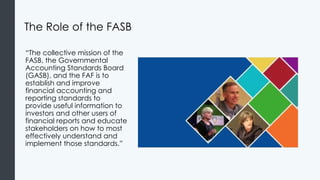
The Role of the FASB
“The collective mission of the
FASB, the Governmental
Accounting Standards Board
(GASB), and the FAF is to
establish and improve
financial accounting and
reporting standards to
provide useful information to
investors and other users of
financial reports and educate
stakeholders on how to most
effectively understand and
implement those standards.”
Generally Accepted Accounting Principles
The FASB develops GAAP using a well-developed process:
1. Identification. The FASB Emerging Issues Task Force identifies and prioritizes a
relevant topic.
2. Pre-agenda Research. FASB technical staff conducts research.
3. Agenda decision. The Task Force adds the topic to the agenda or postpones it.
4. Public meeting. Public meetings are held to debate the issue.
5. Discussion Memorandum (DM). A detailed memorandum is issued, outlining
solution alternatives
6. Stakeholder input. FASB collects and analyzes all responses and suggestions
from the SEC, the AICPA, the American Accounting Association (AAA), public
accounting firms, and other involved parties.
Generally Accepted Accounting Principles (cont.)
7. Re-deliberation. Re-deliberation based on public comment and input.
8. Exposure draft (ED). A preliminary version of a proposed statement—an
Exposure Draft—is issued, detailing the proposed solution.
9. Public responses. FASB obtains responses to the exposure draft from the SEC,
the AICPA, the AAA, public accounting firms, and other involved parties. The ED
is revised as necessary.
10. Final Statement of Principle. If four out of seven FASB members support the
revisions to the ED, a Statement of Financial Accounting Standards (SFAS) is
issued.
11. Education. The FASB issues education to accountants on how to apply the new
standard.
12. Implementation. FASB provides technical assistance in implementing the new
standard.
The Argument for Little GAAP
• There is an argument for a simpler
version of GAAP. Some argue that
current rules are too complex and
burdensome for many private
companies, which are not required
by law to follow them.
• The main argument against having
a “Big GAAP” and a “Little GAAP”
is that having two separate
standards could lead to confusion
and the possibility of financial
statements being assembled to
“lesser” standards.
Fundamental Concepts of U.S. Accounting
Standards
Learning Outcomes: Fundamental Concepts of US
Accounting Standards
2.2: Identify fundamental concepts of Generally Accepted
Accounting Principles
2.2.1: Describe the monetary unit assumption
2.2.2: Describe the historical cost principle
2.2.3: Explain the economic entity assumption
2.2.4: Explain the going concern assumption
2.2.5: Describe the full disclosure principle
2.2.6: Identify other guiding principles of GAAP
Monetary and Cost Considerations
• Monetary Unit Assumption: A
business’s financial reports represent
quantifiable transactions, like buying
and selling things.
• Historical Cost Principle: Companies
are required to record assets and
liabilities for the amount paid, rather
than what they may be worth.
Economic Assumptions
• Economic Entity Assumption: A
business is an economic entity
separate from the owner or owners,
and so business records have to be
kept separate from those of the
owner(s) and of any other business.
• Going Concern Assumption: Financial
statements are normally prepared
under the assumption that the
company will remain in business
indefinitely. If a company is going out
of business, the financials have to
disclose that fact.
Full Disclosure
• Full Disclosure Principle: Requires that all situations, circumstances, and
events that are relevant to financial statement users have to be disclosed. In
other words, all of a company’s financial records and transactions have to
be available for viewing.
Other Guiding Principles
• Relevance: Is the change useful to existing and potential investors, creditors,
and other users in making rational investment, credit, and similar decisions?
• Reliability: The company financial statements provided by the accountants
should be based on objective evidence (like historical cost instead of fair
market value).
• Consistency: The company uses the same accounting principles and
methods from period to period.
• Conservatism: When choosing between two solutions, the solution that has a
less favorable outcome is the solution that should be chosen.
• Materiality: The significance of an item should be considered when it is
reported. An item is considered significant when it would affect the decision
of a reasonable individual.
Practice Question 1
Malik stated two business selling services. The Dinglepop company is where he
paints customers’ skateboards, surf boards or stand up paddle boards. The Boogie
snap company sells a colorful ankle leash for surfers, snowboarders and stand-up
paddle boarders so they won’t lose their boards when they fall. He has been very
busy since day one, and hasn’t had time to separate the businesses’ revenues and
expenses from his personal funds and expenses. What basic GAAP principle or
guideline is Malik ignoring?
A. Conservatism Principle
B. Economic Entity Assumption
C. Consistency Principle
D. Historical Cost Principle
Accrual Basis Accounting
Learning Outcomes: Accrual Basis Accounting
2.3: Identify fundamental principles of accrual based accounting
2.3.1: Differentiate between accrual basis and cash basis of accounting
2.3.2: Explain revenue recognition
2.3.3: Explain the matching principle
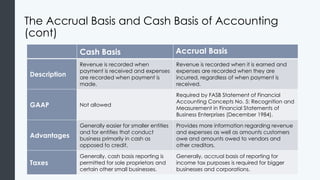
The Accrual Basis and Cash Basis of Accounting
• Many small businesses use cash basis accounting. It’s simpler and it mimics
the way people handle their personal finances.
• As a business grows, it often becomes necessary to switch to accrual basis
accounting.
• GAAP require accrual accounting because it presents a more accurate
picture of a company’s financial condition.
The Accrual Basis and Cash Basis of Accounting
(cont)
Cash Basis Accrual Basis
Description
Revenue is recorded when
payment is received and expenses
are recorded when payment is
made.
Revenue is recorded when it is earned and
expenses are recorded when they are
incurred, regardless of when payment is
received.
GAAP Not allowed
Required by FASB Statement of Financial
Accounting Concepts No. 5: Recognition and
Measurement in Financial Statements of
Business Enterprises (December 1984).
Advantages
Generally easier for smaller entities
and for entities that conduct
business primarily in cash as
opposed to credit.
Provides more information regarding revenue
and expenses as well as amounts customers
owe and amounts owed to vendors and
other creditors.
Taxes
Generally, cash basis reporting is
permitted for sole proprietors and
certain other small businesses.
Generally, accrual basis of reporting for
income tax purposes is required for bigger
businesses and corporations.
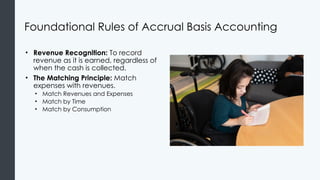
Foundational Rules of Accrual Basis Accounting
• Revenue Recognition: To record
revenue as it is earned, regardless of
when the cash is collected.
• The Matching Principle: Match
expenses with revenues.
• Match Revenues and Expenses
• Match by Time
• Match by Consumption
International Financial Reporting Standards
Learning Outcomes: International Financial
Reporting Standards
2.4: Explain the relationship between the US and international
accounting standards
2.4.1: Describe the role of the IASB in establishing accounting standards
2.4.2: Compare and contrast IFRS and GAAP
2.4.3: Explain the convergence movement
International Accounting Standards
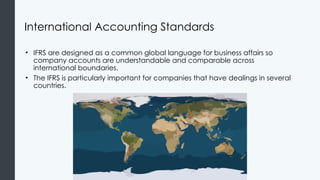
• IFRS are designed as a common global language for business affairs so
company accounts are understandable and comparable across
international boundaries.
• The IFRS is particularly important for companies that have dealings in several
countries.
IFRS vs GAAP
• GAAP is rule based, whereas IFRS is principle based.
• Examples of differences between IFRS and GAAP:
• Consolidation: IFRS favors a control model whereas GAAP prefers a risks-and-rewards
model. Some entities consolidated in accordance with FIN 46(R) may have to be
shown separately under IFRS.
• Statement of Income: Under IFRS, extraordinary items are not segregated in the income
statement. With GAAP, they are shown below the net income.
• Inventory: Under IFRS, Last In, First Out (LIFO) cannot be used; whereas under GAAP,
companies have the choice between LIFO and FIFO.
• Earning-per-Share: Under IFRS, the earnings-per-share calculation does not average
the individual interim period calculations; whereas under GAAP the computation
averages the individual interim period incremental shares.
• Development costs: These costs can be capitalized under IFRS if certain criteria are
met, while it is considered as “expenses” under GAAP.
Convergence
• The convergence of accounting standards refers to the goal of establishing
a single set of accounting standards that will be used internationally.
• In particular, to reduce the differences between the GAAP, and the IFRS.
• Convergence in some form has been taking place for several decades, and
efforts today include projects that aim to reduce the differences between
accounting standards.
• As of early 2020, 166 countries were using IFRS and only one (the United
States) was using GAAP.
Practice Question 2
The U.S. uses accounting standards from GAAP and most of the other countries
around the world align their accounting using IFRS standards. What is the
difference between GAAP and IFRS when it comes to inventory?
A. GAAP inventory is more rules based and IFRS inventory is more principle
based.
B. IFRS uses cash basis to account for inventory; while GAAP uses the
accrual method.
C. GAAP considers inventory and expense while IFRS says inventory can be
capitalized.
D. IFRS companies can not use LIFO; whereas GAAP companies can use
LIFO and FIFO.
Quick Review
• Describe the role of the FASB in setting accounting standards.
• What is the process of creating Generally Accepted Accounting
Principles?
• What is different between big GAAP and little GAAP?
• What does the monetary unit assumption mean?
• What is the historical cost principle?
• What is the economic entity assumption?
• How do you explain the going concern assumption?
• What is the full disclosure principle?
• What are the other guiding principles of GAAP?
More Quick Review
• How can you tell when it is accrual basis or cash basis
accounting?
• Explain what revenue recognition means.
• What is the matching principle?
• What is the role of the IASB in establishing accounting standards?
• What are the differences and similarities between IFRS and GAAP?
• What is the convergence movement?

02_AccountingPrinciples_FinancialAccounting.pptx

  • 1.
    Financial Accounting Module 2:Accounting Principles
  • 2.
    Module Learning Outcomes Explainthe basic principles of accounting 2.1: Describe organizations and rules that govern accounting 2.2: Identify fundamental concepts of Generally Accepted Accou nting Principles 2.3: Identify fundamental principles of accrual based accounting 2.4: Explain the relationship between the US and international acc ounting standards
  • 3.
    Financial Accounting Standardsin the United States
  • 4.
    Learning Outcomes: FinancialAccounting Standards in the United States 2.1: Describe organizations and rules that govern accounting 2.1.1: Describe the role of the FASB in setting accounting standards 2.1.2: Explain the process of creating Generally Accepted Accounting Principles 2.1.3: Differentiate between big GAAP and little GAAP
  • 5.
    The Role ofthe FASB “The collective mission of the FASB, the Governmental Accounting Standards Board (GASB), and the FAF is to establish and improve financial accounting and reporting standards to provide useful information to investors and other users of financial reports and educate stakeholders on how to most effectively understand and implement those standards.”
  • 6.
    Generally Accepted AccountingPrinciples The FASB develops GAAP using a well-developed process: 1. Identification. The FASB Emerging Issues Task Force identifies and prioritizes a relevant topic. 2. Pre-agenda Research. FASB technical staff conducts research. 3. Agenda decision. The Task Force adds the topic to the agenda or postpones it. 4. Public meeting. Public meetings are held to debate the issue. 5. Discussion Memorandum (DM). A detailed memorandum is issued, outlining solution alternatives 6. Stakeholder input. FASB collects and analyzes all responses and suggestions from the SEC, the AICPA, the American Accounting Association (AAA), public accounting firms, and other involved parties.
  • 7.
    Generally Accepted AccountingPrinciples (cont.) 7. Re-deliberation. Re-deliberation based on public comment and input. 8. Exposure draft (ED). A preliminary version of a proposed statement—an Exposure Draft—is issued, detailing the proposed solution. 9. Public responses. FASB obtains responses to the exposure draft from the SEC, the AICPA, the AAA, public accounting firms, and other involved parties. The ED is revised as necessary. 10. Final Statement of Principle. If four out of seven FASB members support the revisions to the ED, a Statement of Financial Accounting Standards (SFAS) is issued. 11. Education. The FASB issues education to accountants on how to apply the new standard. 12. Implementation. FASB provides technical assistance in implementing the new standard.
  • 8.
    The Argument forLittle GAAP • There is an argument for a simpler version of GAAP. Some argue that current rules are too complex and burdensome for many private companies, which are not required by law to follow them. • The main argument against having a “Big GAAP” and a “Little GAAP” is that having two separate standards could lead to confusion and the possibility of financial statements being assembled to “lesser” standards.
  • 9.
    Fundamental Concepts ofU.S. Accounting Standards
  • 10.
    Learning Outcomes: FundamentalConcepts of US Accounting Standards 2.2: Identify fundamental concepts of Generally Accepted Accounting Principles 2.2.1: Describe the monetary unit assumption 2.2.2: Describe the historical cost principle 2.2.3: Explain the economic entity assumption 2.2.4: Explain the going concern assumption 2.2.5: Describe the full disclosure principle 2.2.6: Identify other guiding principles of GAAP
  • 11.
    Monetary and CostConsiderations • Monetary Unit Assumption: A business’s financial reports represent quantifiable transactions, like buying and selling things. • Historical Cost Principle: Companies are required to record assets and liabilities for the amount paid, rather than what they may be worth.
  • 12.
    Economic Assumptions • EconomicEntity Assumption: A business is an economic entity separate from the owner or owners, and so business records have to be kept separate from those of the owner(s) and of any other business. • Going Concern Assumption: Financial statements are normally prepared under the assumption that the company will remain in business indefinitely. If a company is going out of business, the financials have to disclose that fact.
  • 13.
    Full Disclosure • FullDisclosure Principle: Requires that all situations, circumstances, and events that are relevant to financial statement users have to be disclosed. In other words, all of a company’s financial records and transactions have to be available for viewing.
  • 14.
    Other Guiding Principles •Relevance: Is the change useful to existing and potential investors, creditors, and other users in making rational investment, credit, and similar decisions? • Reliability: The company financial statements provided by the accountants should be based on objective evidence (like historical cost instead of fair market value). • Consistency: The company uses the same accounting principles and methods from period to period. • Conservatism: When choosing between two solutions, the solution that has a less favorable outcome is the solution that should be chosen. • Materiality: The significance of an item should be considered when it is reported. An item is considered significant when it would affect the decision of a reasonable individual.
  • 15.
    Practice Question 1 Malikstated two business selling services. The Dinglepop company is where he paints customers’ skateboards, surf boards or stand up paddle boards. The Boogie snap company sells a colorful ankle leash for surfers, snowboarders and stand-up paddle boarders so they won’t lose their boards when they fall. He has been very busy since day one, and hasn’t had time to separate the businesses’ revenues and expenses from his personal funds and expenses. What basic GAAP principle or guideline is Malik ignoring? A. Conservatism Principle B. Economic Entity Assumption C. Consistency Principle D. Historical Cost Principle
  • 16.
  • 17.
    Learning Outcomes: AccrualBasis Accounting 2.3: Identify fundamental principles of accrual based accounting 2.3.1: Differentiate between accrual basis and cash basis of accounting 2.3.2: Explain revenue recognition 2.3.3: Explain the matching principle
  • 18.
    The Accrual Basisand Cash Basis of Accounting • Many small businesses use cash basis accounting. It’s simpler and it mimics the way people handle their personal finances. • As a business grows, it often becomes necessary to switch to accrual basis accounting. • GAAP require accrual accounting because it presents a more accurate picture of a company’s financial condition.
  • 19.
    The Accrual Basisand Cash Basis of Accounting (cont) Cash Basis Accrual Basis Description Revenue is recorded when payment is received and expenses are recorded when payment is made. Revenue is recorded when it is earned and expenses are recorded when they are incurred, regardless of when payment is received. GAAP Not allowed Required by FASB Statement of Financial Accounting Concepts No. 5: Recognition and Measurement in Financial Statements of Business Enterprises (December 1984). Advantages Generally easier for smaller entities and for entities that conduct business primarily in cash as opposed to credit. Provides more information regarding revenue and expenses as well as amounts customers owe and amounts owed to vendors and other creditors. Taxes Generally, cash basis reporting is permitted for sole proprietors and certain other small businesses. Generally, accrual basis of reporting for income tax purposes is required for bigger businesses and corporations.
  • 20.
    Foundational Rules ofAccrual Basis Accounting • Revenue Recognition: To record revenue as it is earned, regardless of when the cash is collected. • The Matching Principle: Match expenses with revenues. • Match Revenues and Expenses • Match by Time • Match by Consumption
  • 21.
  • 22.
    Learning Outcomes: InternationalFinancial Reporting Standards 2.4: Explain the relationship between the US and international accounting standards 2.4.1: Describe the role of the IASB in establishing accounting standards 2.4.2: Compare and contrast IFRS and GAAP 2.4.3: Explain the convergence movement
  • 23.
    International Accounting Standards •IFRS are designed as a common global language for business affairs so company accounts are understandable and comparable across international boundaries. • The IFRS is particularly important for companies that have dealings in several countries.
  • 24.
    IFRS vs GAAP •GAAP is rule based, whereas IFRS is principle based. • Examples of differences between IFRS and GAAP: • Consolidation: IFRS favors a control model whereas GAAP prefers a risks-and-rewards model. Some entities consolidated in accordance with FIN 46(R) may have to be shown separately under IFRS. • Statement of Income: Under IFRS, extraordinary items are not segregated in the income statement. With GAAP, they are shown below the net income. • Inventory: Under IFRS, Last In, First Out (LIFO) cannot be used; whereas under GAAP, companies have the choice between LIFO and FIFO. • Earning-per-Share: Under IFRS, the earnings-per-share calculation does not average the individual interim period calculations; whereas under GAAP the computation averages the individual interim period incremental shares. • Development costs: These costs can be capitalized under IFRS if certain criteria are met, while it is considered as “expenses” under GAAP.
  • 25.
    Convergence • The convergenceof accounting standards refers to the goal of establishing a single set of accounting standards that will be used internationally. • In particular, to reduce the differences between the GAAP, and the IFRS. • Convergence in some form has been taking place for several decades, and efforts today include projects that aim to reduce the differences between accounting standards. • As of early 2020, 166 countries were using IFRS and only one (the United States) was using GAAP.
  • 26.
    Practice Question 2 TheU.S. uses accounting standards from GAAP and most of the other countries around the world align their accounting using IFRS standards. What is the difference between GAAP and IFRS when it comes to inventory? A. GAAP inventory is more rules based and IFRS inventory is more principle based. B. IFRS uses cash basis to account for inventory; while GAAP uses the accrual method. C. GAAP considers inventory and expense while IFRS says inventory can be capitalized. D. IFRS companies can not use LIFO; whereas GAAP companies can use LIFO and FIFO.
  • 27.
    Quick Review • Describethe role of the FASB in setting accounting standards. • What is the process of creating Generally Accepted Accounting Principles? • What is different between big GAAP and little GAAP? • What does the monetary unit assumption mean? • What is the historical cost principle? • What is the economic entity assumption? • How do you explain the going concern assumption? • What is the full disclosure principle? • What are the other guiding principles of GAAP?
  • 28.
    More Quick Review •How can you tell when it is accrual basis or cash basis accounting? • Explain what revenue recognition means. • What is the matching principle? • What is the role of the IASB in establishing accounting standards? • What are the differences and similarities between IFRS and GAAP? • What is the convergence movement?

Editor's Notes

  • #1 Cover Image: "White Canon Cash Register." Authored by: StellrWeb. Provided by: Unsplash. Located at: https://unsplash.com/photos/djb1whucfBY. Content Type: CC Licensed Content, Shared Previously. License: CC0: No Rights Reserved. License Terms: Unsplash License. All text in these slides is taken from https://courses.lumenlearning.com/wm-financialaccounting/ where it is published under one or more open licenses. All images in these slides are attributed in the notes of the slide on which they appear and licensed as indicated.
  • #5 Quote retrieved from: https://www.fasb.org/facts/index.shtml
  • #13 wocintech (microsoft) - 152. Authored by: WOCinTech Chat. Located at: https://flic.kr/p/FsLAtL. License: CC BY: Attribution
  • #15 Correct answer: B —The economic entity assumption requires business records be kept separate from those of the owner(s) and of any other business.
  • #26 Correct answer: D — Under IFRS, Last In, First Out (LIFO) cannot be used; whereas under GAAP, companies have the choice between LIFO and FIFO.