Pearson Business Reference and Writer’s Handbook Section Four Numbers, Abbreviations, and Symbols
This section provides A review of the “mechanics” of writing .  These items might be referred to as the “icing on the cake.”  They are necessary to the accuracy of the final product.  Consistency in their usage is the most important element. Using standard forms of these items also adds to the understanding of the text.
Objectives Apply a consistent style to numbers, abbreviations, and symbols when writing a document Demonstrate correct usage of figures versus. words in written text Apply standard abbreviations Limit the use of abbreviations and symbols unless they are essential to clarity
Expressing Numbers Readers expect to see numbers expressed in a standard way. Using established conventions for writing numbers in words and figures ensures clarity and avoids confusion.
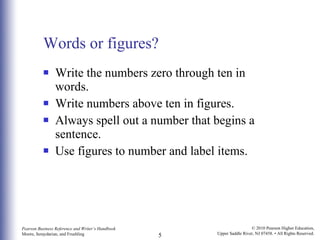
Words or figures? Write the numbers zero through ten in words. Write numbers above ten in figures. Always spell out a number that begins a sentence. Use figures to number and label items.
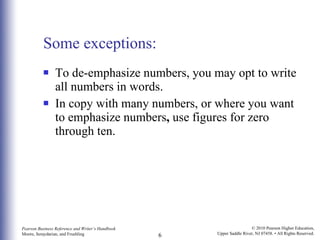
Some exceptions: To de-emphasize numbers, you may opt to write all numbers in words. In copy with many numbers, or where you want to emphasize numbers ,  use figures for zero through ten.
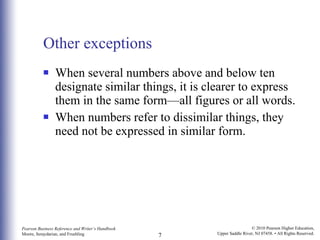
Other exceptions When several numbers above and below ten designate similar things, it is clearer to express them in the same form—all figures or all words.  When numbers refer to dissimilar things, they need not be expressed in similar form.
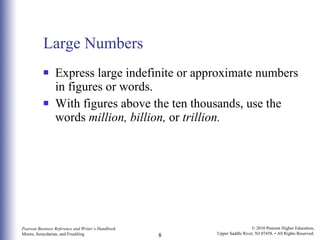
Large Numbers Express large indefinite or approximate numbers in figures or words. With figures above the ten thousands, use the words  million, billion,  or  trillion.
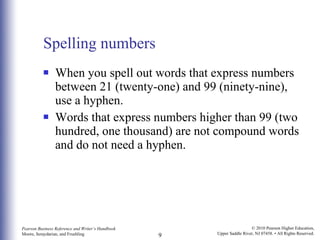
Spelling numbers When you spell out words that express numbers between 21 (twenty-one) and 99 (ninety-nine), use a hyphen. Words that express numbers higher than 99 (two hundred, one thousand) are not compound words and do not need a hyphen.
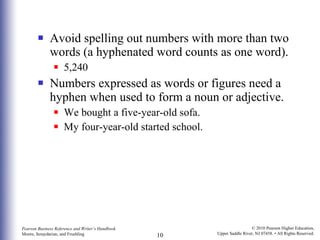
Avoid spelling out numbers with more than two words (a hyphenated word counts as one word). 5,240 Numbers expressed as words or figures need a hyphen when used to form a noun or adjective. We bought a five-year-old sofa. My four-year-old started school.
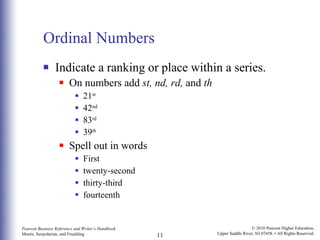
Ordinal Numbers Indicate a ranking or place within a series.  On numbers add  st, nd, rd,  and  th 21 st   42 nd   83 rd   39 th Spell out in words First twenty-second thirty-third fourteenth
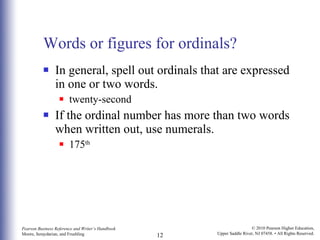
Words or figures for ordinals? In general, spell out ordinals that are expressed in one or two words. twenty-second If the ordinal number has more than two words when written out, use numerals. 175 th
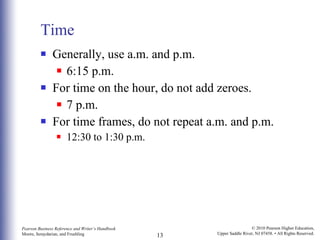
Time Generally, use a.m. and p.m.  6:15 p.m. For time on the hour, do not add zeroes. 7 p.m. For time frames, do not repeat a.m. and p.m. 12:30 to 1:30 p.m.
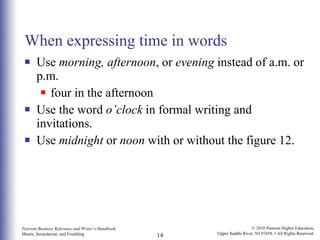
When expressing time in words Use  morning, afternoon , or  evening  instead of a.m. or p.m.  four in the afternoon Use the word  o’clock  in formal writing and invitations. Use  midnight  or  noon  with or without the figure 12.
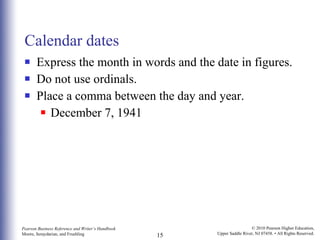
Calendar dates Express the month in words and the date in figures.  Do not use ordinals. Place a comma between the day and year. December 7, 1941
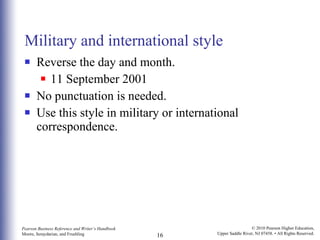
Military and international style Reverse the day and month.  11 September 2001 No punctuation is needed.  Use this style in military or international correspondence.
Money Use figures to express amounts of money in running text. Write whole numbers without decimals or zeroes. $20 Use the word cents for amounts under $1. 20 cents
Abbreviations Spell out most words.  Do not use texting abbreviations. Abbreviate proper names of organizations, products, and so on when used frequently or if that is the standard spelling: GE for General Electric Corp.
Abbreviate proper names Of organizations, products, projects, and so on when used frequently  Or if an abbreviation is the standard spelling, e.g., GE for General Electric Corp.
Explain abbreviations Spell out the name on first use and put the abbreviation in parentheses immediately after it. Except with shortened forms of words in general usage that do not need explanation TV, ad, SUV
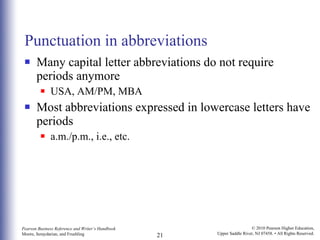
Punctuation in abbreviations Many capital letter abbreviations do not require periods anymore USA, AM/PM, MBA Most abbreviations expressed in lowercase letters have periods a.m./p.m., i.e., etc.
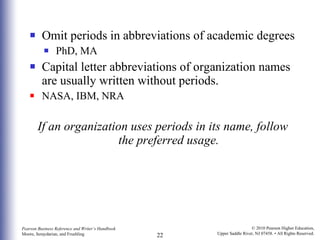
Omit periods in abbreviations of academic degrees PhD, MA Capital letter abbreviations of organization names are usually written without periods. NASA, IBM, NRA If an organization uses periods in its name, follow the preferred usage.
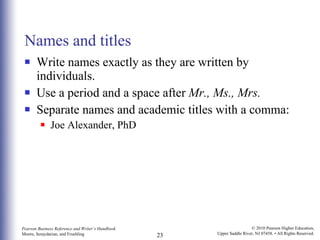
Names and titles Write names exactly as they are written by individuals. Use a period and a space after  Mr., Ms., Mrs. Separate names and academic titles with a comma: Joe Alexander, PhD
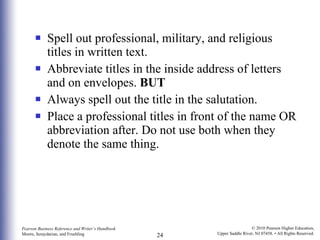
Spell out professional, military, and religious titles in written text. Abbreviate titles in the inside address of letters and on envelopes.  BUT Always spell out the title in the salutation. Place a professional titles in front of the name OR abbreviation after. Do not use both when they denote the same thing.
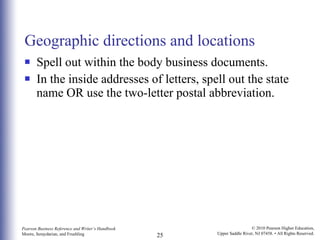
Geographic directions and locations Spell out within the body business documents. In the inside addresses of letters, spell out the state name OR use the two-letter postal abbreviation.
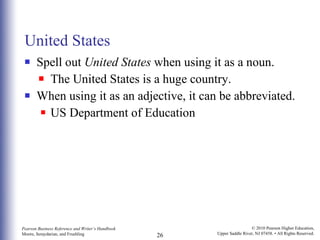
United States Spell out  United States  when using it as a noun.  The United States is a huge country. When using it as an adjective, it can be abbreviated. US Department of Education
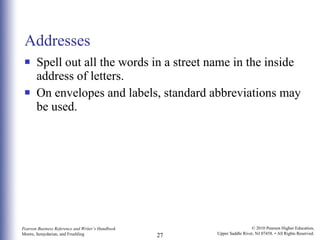
Addresses Spell out all the words in a street name in the inside address of letters. On envelopes and labels, standard abbreviations may be used.
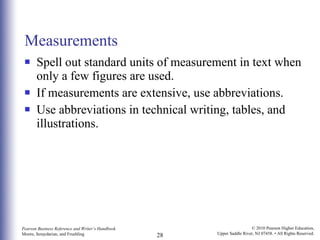
Measurements Spell out standard units of measurement in text when only a few figures are used.  If measurements are extensive, use abbreviations. Use abbreviations in technical writing, tables, and illustrations.
Symbols Use words for  dollar  and  percent  in text with few numbers. Use symbols in heavily numeric text, technical writing, tables, and forms. In measurements use either symbols or words; repeat the symbol after each number.
Numbers, Abbreviations, and Symbols Must be consistently styled in each document. Check accuracy and style in the final stage of proofreading.

0135140560 pp4a

  • 1.
    Pearson Business Referenceand Writer’s Handbook Section Four Numbers, Abbreviations, and Symbols
  • 2.
    This section providesA review of the “mechanics” of writing . These items might be referred to as the “icing on the cake.” They are necessary to the accuracy of the final product. Consistency in their usage is the most important element. Using standard forms of these items also adds to the understanding of the text.
  • 3.
    Objectives Apply aconsistent style to numbers, abbreviations, and symbols when writing a document Demonstrate correct usage of figures versus. words in written text Apply standard abbreviations Limit the use of abbreviations and symbols unless they are essential to clarity
  • 4.
    Expressing Numbers Readersexpect to see numbers expressed in a standard way. Using established conventions for writing numbers in words and figures ensures clarity and avoids confusion.
  • 5.
    Words or figures?Write the numbers zero through ten in words. Write numbers above ten in figures. Always spell out a number that begins a sentence. Use figures to number and label items.
  • 6.
    Some exceptions: Tode-emphasize numbers, you may opt to write all numbers in words. In copy with many numbers, or where you want to emphasize numbers , use figures for zero through ten.
  • 7.
    Other exceptions Whenseveral numbers above and below ten designate similar things, it is clearer to express them in the same form—all figures or all words. When numbers refer to dissimilar things, they need not be expressed in similar form.
  • 8.
    Large Numbers Expresslarge indefinite or approximate numbers in figures or words. With figures above the ten thousands, use the words million, billion, or trillion.
  • 9.
    Spelling numbers Whenyou spell out words that express numbers between 21 (twenty-one) and 99 (ninety-nine), use a hyphen. Words that express numbers higher than 99 (two hundred, one thousand) are not compound words and do not need a hyphen.
  • 10.
    Avoid spelling outnumbers with more than two words (a hyphenated word counts as one word). 5,240 Numbers expressed as words or figures need a hyphen when used to form a noun or adjective. We bought a five-year-old sofa. My four-year-old started school.
  • 11.
    Ordinal Numbers Indicatea ranking or place within a series. On numbers add st, nd, rd, and th 21 st 42 nd 83 rd 39 th Spell out in words First twenty-second thirty-third fourteenth
  • 12.
    Words or figuresfor ordinals? In general, spell out ordinals that are expressed in one or two words. twenty-second If the ordinal number has more than two words when written out, use numerals. 175 th
  • 13.
    Time Generally, usea.m. and p.m. 6:15 p.m. For time on the hour, do not add zeroes. 7 p.m. For time frames, do not repeat a.m. and p.m. 12:30 to 1:30 p.m.
  • 14.
    When expressing timein words Use morning, afternoon , or evening instead of a.m. or p.m. four in the afternoon Use the word o’clock in formal writing and invitations. Use midnight or noon with or without the figure 12.
  • 15.
    Calendar dates Expressthe month in words and the date in figures. Do not use ordinals. Place a comma between the day and year. December 7, 1941
  • 16.
    Military and internationalstyle Reverse the day and month. 11 September 2001 No punctuation is needed. Use this style in military or international correspondence.
  • 17.
    Money Use figuresto express amounts of money in running text. Write whole numbers without decimals or zeroes. $20 Use the word cents for amounts under $1. 20 cents
  • 18.
    Abbreviations Spell outmost words. Do not use texting abbreviations. Abbreviate proper names of organizations, products, and so on when used frequently or if that is the standard spelling: GE for General Electric Corp.
  • 19.
    Abbreviate proper namesOf organizations, products, projects, and so on when used frequently Or if an abbreviation is the standard spelling, e.g., GE for General Electric Corp.
  • 20.
    Explain abbreviations Spellout the name on first use and put the abbreviation in parentheses immediately after it. Except with shortened forms of words in general usage that do not need explanation TV, ad, SUV
  • 21.
    Punctuation in abbreviationsMany capital letter abbreviations do not require periods anymore USA, AM/PM, MBA Most abbreviations expressed in lowercase letters have periods a.m./p.m., i.e., etc.
  • 22.
    Omit periods inabbreviations of academic degrees PhD, MA Capital letter abbreviations of organization names are usually written without periods. NASA, IBM, NRA If an organization uses periods in its name, follow the preferred usage.
  • 23.
    Names and titlesWrite names exactly as they are written by individuals. Use a period and a space after Mr., Ms., Mrs. Separate names and academic titles with a comma: Joe Alexander, PhD
  • 24.
    Spell out professional,military, and religious titles in written text. Abbreviate titles in the inside address of letters and on envelopes. BUT Always spell out the title in the salutation. Place a professional titles in front of the name OR abbreviation after. Do not use both when they denote the same thing.
  • 25.
    Geographic directions andlocations Spell out within the body business documents. In the inside addresses of letters, spell out the state name OR use the two-letter postal abbreviation.
  • 26.
    United States Spellout United States when using it as a noun. The United States is a huge country. When using it as an adjective, it can be abbreviated. US Department of Education
  • 27.
    Addresses Spell outall the words in a street name in the inside address of letters. On envelopes and labels, standard abbreviations may be used.
  • 28.
    Measurements Spell outstandard units of measurement in text when only a few figures are used. If measurements are extensive, use abbreviations. Use abbreviations in technical writing, tables, and illustrations.
  • 29.
    Symbols Use wordsfor dollar and percent in text with few numbers. Use symbols in heavily numeric text, technical writing, tables, and forms. In measurements use either symbols or words; repeat the symbol after each number.
  • 30.
    Numbers, Abbreviations, andSymbols Must be consistently styled in each document. Check accuracy and style in the final stage of proofreading.