Database Engines
History and comparisons
husseinnasser.com
Agenda
● What is a Database Engine?
● MyISAM
● Aria
● InnoDB
● XtraDB
● LevelDB
● RocksDB
● SQLite
● Berkeley DB
● Demo (Switching Engines with MySQL)
Database Engine
● Library that takes care of the on disk storage and CRUD
○ Can be as simple as key-value store
○ Or as rich and complex as full support ACID and transactions with foreign
keys
● DBMS can use the database engine and build features on top (server,
replication, isolation, stored procedures, etc..)
● Want to write a new database? Don’t start from scratch use an engine.
● Sometimes referred as Storage Engine or embedded database
Database Engines
● Some DBMS gives you the flexibility to switch engines like MySQL & MariaDB
● Some DBMS comes with a built-in engine that you can’t change (Postgres)
MyISAM
● Stands for Indexed sequential access method
● B-tree (Balanced tree) indexes point to the rows directly
● No Transaction support
● Open Source & Owned by Oracle
● Inserts are fast, updates and deletes are problematic (fragments)
● Database Crashes corrupts tables (have to manually repair)
● Table level locking
● MySQL, MariaDB, Percona (MySQL forks) supports MyISAM
● Used to be default engine for MySQL
Aria
● Created by Michael Widenius
● Very similar to MyISAM
● Crash-safe unlike MyISAM
● Not owned by Oracle
● Designed specifically for MariaDB (mySQL Fork)
● In MariaDB 10.4 all system tables are Aria
InnoDB
● B+tree - with indexes point to the primary key and the PK points to the row
● Replaces MyISAM
● Default for MySQL & MariaDB
● ACID compliant transactions support
● Foreign keys
● Tablespaces
● Row level locking
● Spatial operations
● Owned by Oracle
XtraDB
● Fork of InnoDB
● Was the default for MariaDB until 10.1
● In MariaDB 10.2 switched the default for InnoDB
● “XtraDB couldn’t be kept up to date with the latest features of InnoDB and
cannot be used.” (link)
● System tables in MariaDB starting with 10.4 are all Aria
LevelDB
● Written by Jeff and Sanjay from Google in 2011
● Log structured merge tree (LSM) (great for high insert and SSD)
● No transactions
● Inspired by Google BigTable
● Levels of files
○ Memtable
○ Level 0 (young level)
○ Level 1 - 6
● As files grow large levels are merged
● Used in bitcoin core blockchain, AutoCad, Minecraft
RocksDB
● Facebook forked LevelDB in 2012 to become RocksDB
● Transactional
● High Performance, Multi-threaded compaction
● Many features not in LevelDB
● MyRocks for MySQL, MariaDB and Percona
● MongoRocks for MongoDB
● Many many more use it!
SQLite
● Designed by D. Richard Hipp in 2000
● Very populate embedded database for local data
● B-Tree (LSM as extension)
● Postgres-like syntax
● Full ACID & table locking
● Concurrent read & writes
● Web SQL in browsers uses it
● Included in many operating systems by default
Berkeley DB
● Developed by Sleepycat Software in 1994 (owned by Oracle)
● Key-value embedded database
● Supports ACID transactions, locks, replications etc..
● Used to be used in bitcoin core (switched to LevelDB)
● Used MemcacheDB
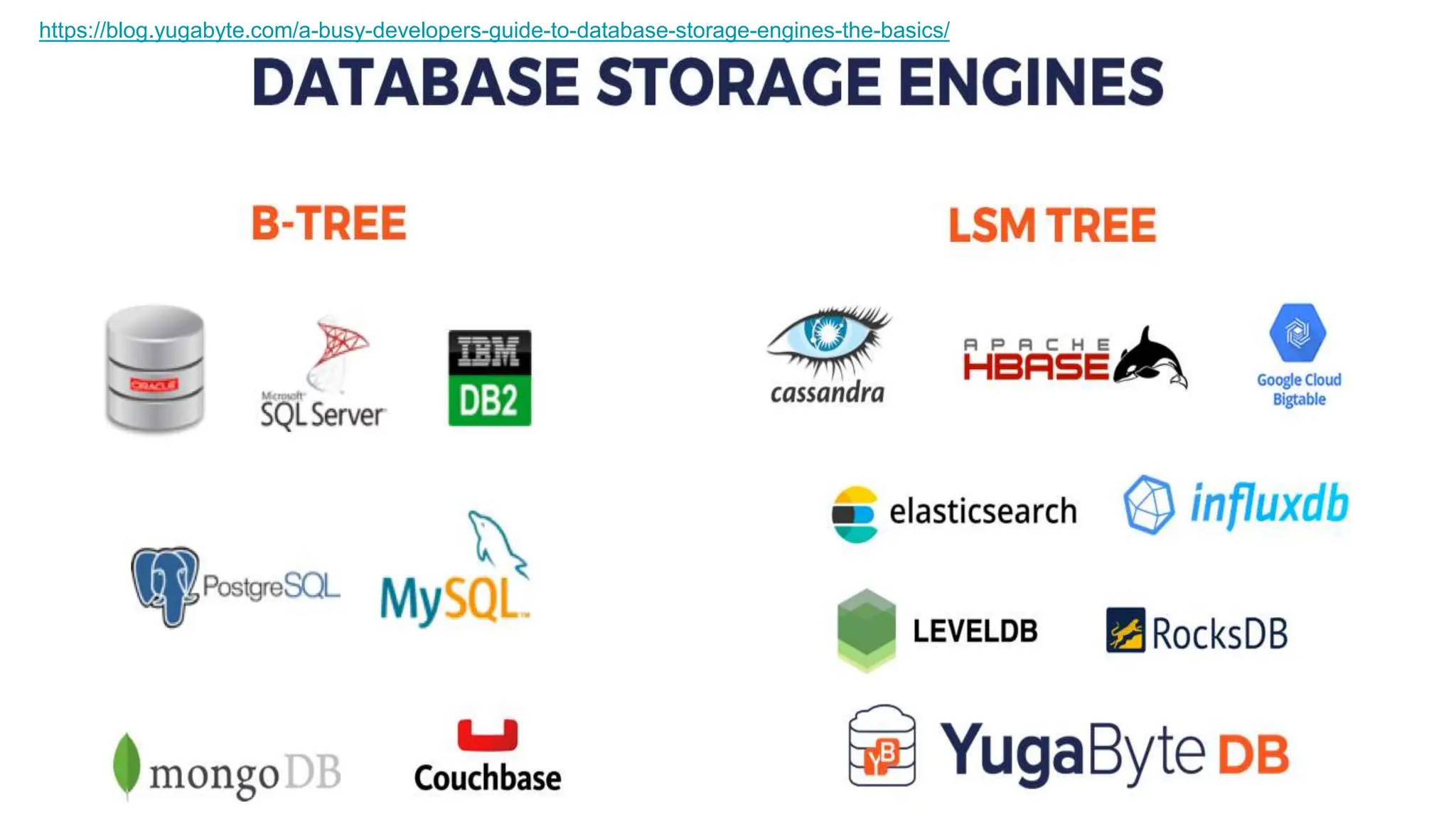
https://blog.yugabyte.com/a-busy-developers-guide-to-database-storage-engines-the-basics/
Demo mySQL
● Spin up a mySQL docker container
● Create a table myISAM
● Create a table innoDB
● Connect to the database with Javascript
● See how transactions behave on myISAM vs innoDB
Summary
● What is a Database Engine?
● MyISAM
● Aria
● InnoDB
● XtraDB
● LevelDB
● RocksDB
● SQLite
● Berkeley DB
● Demo (Switching Engines with MySQL)

002 Database-Engines.pptx

  • 1.
    Database Engines History andcomparisons husseinnasser.com
  • 2.
    Agenda ● What isa Database Engine? ● MyISAM ● Aria ● InnoDB ● XtraDB ● LevelDB ● RocksDB ● SQLite ● Berkeley DB ● Demo (Switching Engines with MySQL)
  • 3.
    Database Engine ● Librarythat takes care of the on disk storage and CRUD ○ Can be as simple as key-value store ○ Or as rich and complex as full support ACID and transactions with foreign keys ● DBMS can use the database engine and build features on top (server, replication, isolation, stored procedures, etc..) ● Want to write a new database? Don’t start from scratch use an engine. ● Sometimes referred as Storage Engine or embedded database
  • 4.
    Database Engines ● SomeDBMS gives you the flexibility to switch engines like MySQL & MariaDB ● Some DBMS comes with a built-in engine that you can’t change (Postgres)
  • 5.
    MyISAM ● Stands forIndexed sequential access method ● B-tree (Balanced tree) indexes point to the rows directly ● No Transaction support ● Open Source & Owned by Oracle ● Inserts are fast, updates and deletes are problematic (fragments) ● Database Crashes corrupts tables (have to manually repair) ● Table level locking ● MySQL, MariaDB, Percona (MySQL forks) supports MyISAM ● Used to be default engine for MySQL
  • 6.
    Aria ● Created byMichael Widenius ● Very similar to MyISAM ● Crash-safe unlike MyISAM ● Not owned by Oracle ● Designed specifically for MariaDB (mySQL Fork) ● In MariaDB 10.4 all system tables are Aria
  • 7.
    InnoDB ● B+tree -with indexes point to the primary key and the PK points to the row ● Replaces MyISAM ● Default for MySQL & MariaDB ● ACID compliant transactions support ● Foreign keys ● Tablespaces ● Row level locking ● Spatial operations ● Owned by Oracle
  • 8.
    XtraDB ● Fork ofInnoDB ● Was the default for MariaDB until 10.1 ● In MariaDB 10.2 switched the default for InnoDB ● “XtraDB couldn’t be kept up to date with the latest features of InnoDB and cannot be used.” (link) ● System tables in MariaDB starting with 10.4 are all Aria
  • 9.
    LevelDB ● Written byJeff and Sanjay from Google in 2011 ● Log structured merge tree (LSM) (great for high insert and SSD) ● No transactions ● Inspired by Google BigTable ● Levels of files ○ Memtable ○ Level 0 (young level) ○ Level 1 - 6 ● As files grow large levels are merged ● Used in bitcoin core blockchain, AutoCad, Minecraft
  • 10.
    RocksDB ● Facebook forkedLevelDB in 2012 to become RocksDB ● Transactional ● High Performance, Multi-threaded compaction ● Many features not in LevelDB ● MyRocks for MySQL, MariaDB and Percona ● MongoRocks for MongoDB ● Many many more use it!
  • 11.
    SQLite ● Designed byD. Richard Hipp in 2000 ● Very populate embedded database for local data ● B-Tree (LSM as extension) ● Postgres-like syntax ● Full ACID & table locking ● Concurrent read & writes ● Web SQL in browsers uses it ● Included in many operating systems by default
  • 12.
    Berkeley DB ● Developedby Sleepycat Software in 1994 (owned by Oracle) ● Key-value embedded database ● Supports ACID transactions, locks, replications etc.. ● Used to be used in bitcoin core (switched to LevelDB) ● Used MemcacheDB
  • 13.
  • 14.
    Demo mySQL ● Spinup a mySQL docker container ● Create a table myISAM ● Create a table innoDB ● Connect to the database with Javascript ● See how transactions behave on myISAM vs innoDB
  • 15.
    Summary ● What isa Database Engine? ● MyISAM ● Aria ● InnoDB ● XtraDB ● LevelDB ● RocksDB ● SQLite ● Berkeley DB ● Demo (Switching Engines with MySQL)