Follow us, like us, share, tweet, subscribe to the blog and
contribute on your platform of choice.
*Statistics from http://www.birchwoodenterprises.com/a2bnews/A2B_Barcode_TimelineHiRes_withlinks.pdf
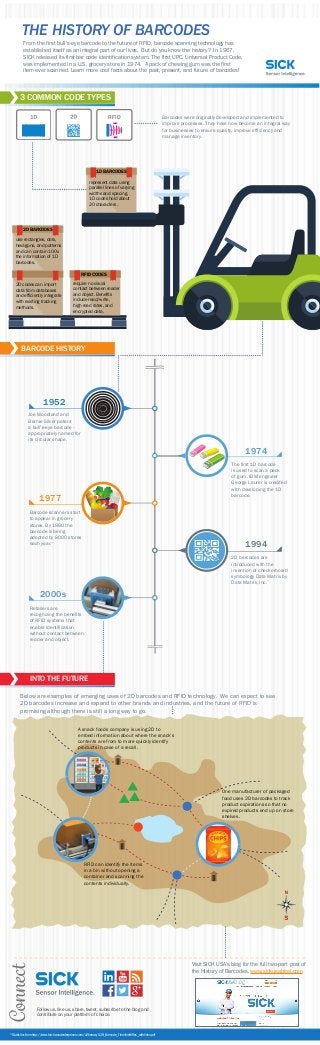
THE HISTORY OF BARCODES
From the first bull’s-eye barcode to the future of RFID, barcode scanning technology has
established itself as an integral part of our lives. But do you know the history? In 1967,
SICK released its first bar code identification system. The first UPC, Universal Product Code,
was implemented in a U.S. grocery store in 1974. A pack of chewing gum was the first
item ever scanned. Learn more cool facts about the past, present, and future of barcodes!
Barcodes were originally developed and implemented to
improve processes. They have now become an integral way
for businesses to ensure quality, improve efficiency and
manage inventory.
Below are examples of emerging uses of 2D barcodes and RFID technology. We can expect to see
2D barcodes increase and expand to other brands and industries, and the future of RFID is
promising although there is still a long way to go.
One manufacturer of packaged
food uses 2D barcodes to track
product expirations so that no
expired products end up on store
shelves.
RFID can identify the items
in a bin without opening a
container and scanning the
contents individually.
A snack foods company is using 2D to
embed information about where the snack’s
contents are from to more quickly identify
products in case of a recall.
Visit SICK USA’s blog for the full two-part post of
the History of Barcodes, www.sickusablog.com
RFID
1952
Joe Woodland and
Bernie Silver patent
a bull’s-eye barcode -
appropriately named for
its circular shape.
1974
The first 1D barcode
is used to scan a pack
of gum. IBM engineer
George Laurer is credited
with developing the 1D
barcode.
1977
Barcode scanners start
to appear in grocery
stores. By 1980 the
barcode is being
adopted by 8000 stores
each year.*
1994
2000s
Retailers are
recognizing the benefits
of RFID systems that
enable identification
without contact between
reader and object.
.
2D barcodes are
introduced with the
invention of checkerboard
symbology Data Matrix by
Data Matrix, Inc.*
represent data using
parallel lines of varying
widths and spacing.
1D codes hold about
20 characters.
1D BARCODES
use rectangles, dots,
hexagons, and patterns
and can contain 100x
the information of 1D
barcodes.
2D codes can import
data from databases
and efficiently integrate
with existing tracking
methods.
require no visual
contact between reader
and object. Benefits
include read/write,
high read rates, and
encrypted data.
2D BARCODES
RFID CODES
3 COMMON CODE TYPES
BARCODE HISTORY
INTO THE FUTURE

[Infographic] The History of Barcodes - Ringing Up Sales Past, Present, and Future

  • 1.
    Follow us, likeus, share, tweet, subscribe to the blog and contribute on your platform of choice. *Statistics from http://www.birchwoodenterprises.com/a2bnews/A2B_Barcode_TimelineHiRes_withlinks.pdf THE HISTORY OF BARCODES From the first bull’s-eye barcode to the future of RFID, barcode scanning technology has established itself as an integral part of our lives. But do you know the history? In 1967, SICK released its first bar code identification system. The first UPC, Universal Product Code, was implemented in a U.S. grocery store in 1974. A pack of chewing gum was the first item ever scanned. Learn more cool facts about the past, present, and future of barcodes! Barcodes were originally developed and implemented to improve processes. They have now become an integral way for businesses to ensure quality, improve efficiency and manage inventory. Below are examples of emerging uses of 2D barcodes and RFID technology. We can expect to see 2D barcodes increase and expand to other brands and industries, and the future of RFID is promising although there is still a long way to go. One manufacturer of packaged food uses 2D barcodes to track product expirations so that no expired products end up on store shelves. RFID can identify the items in a bin without opening a container and scanning the contents individually. A snack foods company is using 2D to embed information about where the snack’s contents are from to more quickly identify products in case of a recall. Visit SICK USA’s blog for the full two-part post of the History of Barcodes, www.sickusablog.com RFID 1952 Joe Woodland and Bernie Silver patent a bull’s-eye barcode - appropriately named for its circular shape. 1974 The first 1D barcode is used to scan a pack of gum. IBM engineer George Laurer is credited with developing the 1D barcode. 1977 Barcode scanners start to appear in grocery stores. By 1980 the barcode is being adopted by 8000 stores each year.* 1994 2000s Retailers are recognizing the benefits of RFID systems that enable identification without contact between reader and object. . 2D barcodes are introduced with the invention of checkerboard symbology Data Matrix by Data Matrix, Inc.* represent data using parallel lines of varying widths and spacing. 1D codes hold about 20 characters. 1D BARCODES use rectangles, dots, hexagons, and patterns and can contain 100x the information of 1D barcodes. 2D codes can import data from databases and efficiently integrate with existing tracking methods. require no visual contact between reader and object. Benefits include read/write, high read rates, and encrypted data. 2D BARCODES RFID CODES 3 COMMON CODE TYPES BARCODE HISTORY INTO THE FUTURE