Prof Sir Stephen Holgate,
MRC Clinical Professor of Immunopharmacology, UKRI Clean Air
Champion and Special Advisor to the RCP on Air Quality
There’s something in the air -
The pervasive and serious effects of
air pollution on human health
October 22nd, 2024
Life depends upon every breath we take
The devastating impact of COVID-19
shone a light on how important
our lungs are.
Put simply, the diseases poor air quality creates, are quietly occurring out of
sight until it becomes too late. There are no pain receptors that shout HELP!
The “breathed environment”
Chemical pollutants
Allergens
Microorganisms (viruses, bacteria
& fungi
Children are most exposed
Air pollution is not new: The Great London Smog of December
1952: 12,000 people died, and created a lifetime legacy
Early-Life Exposure to the Great Smog of
1952 and the Development of Asthma.
The sources of Air Pollution are changing
Estimates of life expectancy decrements for air pollution and selected other risk
factors and causes of death
Particles of Truth. Pope CA, Dockery D. 2025
This year, air pollution has
officially overtaken high blood
pressure and smoking as the
leading contributor to global
disease.
RCPCH Sept 19th 2024
According to the World Health
Organization (WHO), air
pollution is now the greatest
environmental risk to human
health.
While the pollutant
components continue to
change, it is the greater
scientific understanding that
has uncovered this new
understanding
Worldwide, accounts for 7 million premature deaths/yr
UK: 43,000 deaths/yr
Air pollutant particles (PM2.5 and PM0.1) become systemically bioavailable
Air pollution and mortality in the Medicare population
Di Q, et al. N Engl J Med. 2017; 376: 2513-22
PM2.5 Ozone, O3
An open cohort of all US Medicare beneficiaries (60,925,443, 65 yrs or older).
There are NO safe levels of air pollution
The epithelial barrier theory and its associated diseases.
Sun N, et al. Allergy. 2024 Oct 7. doi: 10.1111/all.16318.
oxidative stress
oxidative stress
Exposure to air pollution has detrimental effects throughout the body that impairs
the functioning of organs and promotes disease.
Small particles with along with their
pollutant chemical “cargo” circulate
both freely and inside blood cells and
deposit in all tissues.
Three key biological mechanisms linking inhalation of pollutants to effects in
systemic organs.
A 2h exposure to 300 μg/m3 DE in patients with
ischemic heart caused a 2-fold increase in S-T
segment depression induced in an exercise test.
ST depression represents myocardial ischemia
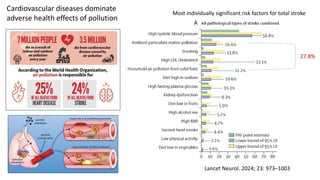
Lancet Neurol. 2024; 23: 973–1003
Most individually significant risk factors for total stroke
27.8%
Cardiovascular diseases dominate
adverse health effects of pollution
The lung tissue is damaged so there
is less pull on the airways.
Mucus blocks part of the airway
The airway lining becomes inflamed
and swollen.
Frequent exacerbations, especially
in winter.
Chronic Obstructive Pulmonary Disease
(COPD – chronic bronchitis + emphysema)
COPD affects about 3 million people in the UK,
but around 2 million of them are undiagnosed
(Emphysema)
(Chronic
Bronchitis)
The effects of exposure to NO2, PM2.5 and PM10 on health service attendances
with respiratory illnesses: A time-series analysis.
Mebrahtu TF, et al. Environ Pollut. 2023; 333: 122123.
• Retrospective cohort study (Born in Bradford) using linked routine health and pollution
data collected between January 2018 and December 2021. Participants visiting GP or
A&E for respiratory illness. Time-series analysis, distributed lagged models, was used to
address the potential non-linearity and delayed effects of exposure.
• High levels of exposure above the WHO 24-hr mean thresholds increased pressure on
health care services persisting up to 100 days after an exposure event.
• Up to 50% of emergency and 35% of GP respiratory illness visits may be caused by high
levels of pollution, leading to a substantial financial burden to healthcare providers.
• Given the substantial health and societal impact of pollution the implementation of
policies at a city scale to reduce air pollution are warranted.
Professor Rosie McEachan, Director of the Born in Bradford study
• For non-smokers aged 40-79, more women than men are at risk for
lung cancer.
• One in every ten cases of the disease is attributed, not to smoking
but, to air pollution.
• Researchers at the Crick Institute have shown that PM2·5 particles
trigger an alarm response in the lungs, causing inflammation and
activation of dormant cells carrying cancer-causing Epidermal
Growth Factor mutations (EGFRm).
Lung adenocarcinoma promotion by air pollutants.
Hill W., et al. Nature. 2023; 616: 159-67
Air pollution alters brain development and accelerates loss of cognition
D’Angiulli A. Front. Public Health 2018; 6: 95.
Traffic-related air pollution and
genetic risk factors for Alzheimer
Dementia (specifically APOε4)
synergistically promotes
neurodegeneration
Highly oxidative, magnetic, abundant, metal-rich nanoparticles (NPs)
emitted into the urban atmosphere (Mexico City) deposited in the brain
Environ. Res. 2020; 191: 110139
Aluminium Iron (magnetite) Titanium
Aluminium
Metal-rich NPs around a mitochondrion in Substantia Nigra tissue in a 32yr old subject
The substantia nigra is a small part of the
midbrain that plays key role in regulating
movement, reward, and cognition
Nano-plastics ‘hijack’ their way into the brain.
Campen M, et al. Res Sq. 2024: May 6: rs.3.rs - 4345687.
Fine Particulate Matter and Parkinson Disease Risk
Among Medicare Beneficiaries. (n = 21,639,190 of which
89,390 had incident PD)
Krzyzanowski B, et al. Neurology. 2023. PMID: 37903644
Presence of intra-tissue black carbon particles foetal
tissues, gestational age 7-20 weeks
Liver Lung
Brain Placenta
Maternal exposure to ambient black carbon particles and their presence in maternal and foetal
circulation and organs
Bongaerts E, et al. Lancet Planet Health. 2022; 6: e804-e811
Maternal-perinatal black carbon load and residential black
carbon exposure during pregnancy
Gene by environmental interactions (EPIGENETCS) influences the growth and
maturation of the developing foetus.
Large literature supporting the link
between air pollution exposure and
adverse effects on children’s lung
function and development of asthma.
UK BIOBANK (n=200,000, 8-year follow-up).
Effects of PM2.5 or NO2 on lung function
account for up to 30% of the association
between these pollutants and all-cause
mortality and incident CVD.
ERJ Open Res. 2024; 10: 00093-2024.
Gene expression modified by epigenetics
Children from low-
income households
more likely to live in
area with high air
pollution
20
Current air quality limit values in the UK are far in excess of those
for health set by the WHO in 2022
99% of Londoners live in areas that exceed the WHO's recommended guidelines for PM2.5
WINTER
SUMMER
Ella Roberta Kissi-Debrah 2004-2013
Between 2010 and 2013 had over 30
emergency hospital admissions between
first diagnosis of asthma and her death
In a landmark case, H.M. Assistant Coroner for Inner South London, Philip Barlow,
has found that air pollution was a contributory cause of illness and death.
This finding will have far-reaching consequences “for other people and other cases”
as acknowledged by the Coroner, and once again highlights the need for further
action from governments around the world to reduce dangerous levels of air
pollution. Issued a Prevention of Future Deaths Report.
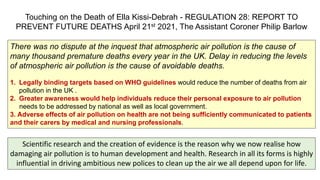
Touching on the Death of Ella Kissi-Debrah - REGULATION 28: REPORT TO
PREVENT FUTURE DEATHS April 21st 2021, The Assistant Coroner Philip Barlow
There was no dispute at the inquest that atmospheric air pollution is the cause of
many thousand premature deaths every year in the UK. Delay in reducing the levels
of atmospheric air pollution is the cause of avoidable deaths.
1. Legally binding targets based on WHO guidelines would reduce the number of deaths from air
pollution in the UK .
2. Greater awareness would help individuals reduce their personal exposure to air pollution
needs to be addressed by national as well as local government.
3. Adverse effects of air pollution on health are not being sufficiently communicated to patients
and their carers by medical and nursing professionals.
Scientific research and the creation of evidence is the reason why we now realise how
damaging air pollution is to human development and health. Research in all its forms is highly
influential in driving ambitious new polices to clean up the air we all depend upon for life.
2024 Clean Air Conference
Analysis and solutions: Responding to the clean air challenge.
UKRI/Met Office
Clean Air Champions
Thank you

13:55 Keynote Presentation - The Pervasive and Serious Effects of Air Pollution on Human Health (Sir Stephen Holgate)

  • 1.
    Prof Sir StephenHolgate, MRC Clinical Professor of Immunopharmacology, UKRI Clean Air Champion and Special Advisor to the RCP on Air Quality There’s something in the air - The pervasive and serious effects of air pollution on human health October 22nd, 2024
  • 2.
    Life depends uponevery breath we take The devastating impact of COVID-19 shone a light on how important our lungs are.
  • 3.
    Put simply, thediseases poor air quality creates, are quietly occurring out of sight until it becomes too late. There are no pain receptors that shout HELP! The “breathed environment” Chemical pollutants Allergens Microorganisms (viruses, bacteria & fungi Children are most exposed
  • 4.
    Air pollution isnot new: The Great London Smog of December 1952: 12,000 people died, and created a lifetime legacy Early-Life Exposure to the Great Smog of 1952 and the Development of Asthma.
  • 5.
    The sources ofAir Pollution are changing
  • 6.
    Estimates of lifeexpectancy decrements for air pollution and selected other risk factors and causes of death Particles of Truth. Pope CA, Dockery D. 2025 This year, air pollution has officially overtaken high blood pressure and smoking as the leading contributor to global disease. RCPCH Sept 19th 2024 According to the World Health Organization (WHO), air pollution is now the greatest environmental risk to human health. While the pollutant components continue to change, it is the greater scientific understanding that has uncovered this new understanding Worldwide, accounts for 7 million premature deaths/yr UK: 43,000 deaths/yr
  • 7.
    Air pollutant particles(PM2.5 and PM0.1) become systemically bioavailable
  • 8.
    Air pollution andmortality in the Medicare population Di Q, et al. N Engl J Med. 2017; 376: 2513-22 PM2.5 Ozone, O3 An open cohort of all US Medicare beneficiaries (60,925,443, 65 yrs or older). There are NO safe levels of air pollution
  • 9.
    The epithelial barriertheory and its associated diseases. Sun N, et al. Allergy. 2024 Oct 7. doi: 10.1111/all.16318. oxidative stress oxidative stress
  • 10.
    Exposure to airpollution has detrimental effects throughout the body that impairs the functioning of organs and promotes disease. Small particles with along with their pollutant chemical “cargo” circulate both freely and inside blood cells and deposit in all tissues.
  • 11.
    Three key biologicalmechanisms linking inhalation of pollutants to effects in systemic organs. A 2h exposure to 300 μg/m3 DE in patients with ischemic heart caused a 2-fold increase in S-T segment depression induced in an exercise test. ST depression represents myocardial ischemia
  • 12.
    Lancet Neurol. 2024;23: 973–1003 Most individually significant risk factors for total stroke 27.8% Cardiovascular diseases dominate adverse health effects of pollution
  • 13.
    The lung tissueis damaged so there is less pull on the airways. Mucus blocks part of the airway The airway lining becomes inflamed and swollen. Frequent exacerbations, especially in winter. Chronic Obstructive Pulmonary Disease (COPD – chronic bronchitis + emphysema) COPD affects about 3 million people in the UK, but around 2 million of them are undiagnosed (Emphysema) (Chronic Bronchitis)
  • 14.
    The effects ofexposure to NO2, PM2.5 and PM10 on health service attendances with respiratory illnesses: A time-series analysis. Mebrahtu TF, et al. Environ Pollut. 2023; 333: 122123. • Retrospective cohort study (Born in Bradford) using linked routine health and pollution data collected between January 2018 and December 2021. Participants visiting GP or A&E for respiratory illness. Time-series analysis, distributed lagged models, was used to address the potential non-linearity and delayed effects of exposure. • High levels of exposure above the WHO 24-hr mean thresholds increased pressure on health care services persisting up to 100 days after an exposure event. • Up to 50% of emergency and 35% of GP respiratory illness visits may be caused by high levels of pollution, leading to a substantial financial burden to healthcare providers. • Given the substantial health and societal impact of pollution the implementation of policies at a city scale to reduce air pollution are warranted. Professor Rosie McEachan, Director of the Born in Bradford study
  • 15.
    • For non-smokersaged 40-79, more women than men are at risk for lung cancer. • One in every ten cases of the disease is attributed, not to smoking but, to air pollution. • Researchers at the Crick Institute have shown that PM2·5 particles trigger an alarm response in the lungs, causing inflammation and activation of dormant cells carrying cancer-causing Epidermal Growth Factor mutations (EGFRm). Lung adenocarcinoma promotion by air pollutants. Hill W., et al. Nature. 2023; 616: 159-67
  • 16.
    Air pollution altersbrain development and accelerates loss of cognition D’Angiulli A. Front. Public Health 2018; 6: 95. Traffic-related air pollution and genetic risk factors for Alzheimer Dementia (specifically APOε4) synergistically promotes neurodegeneration
  • 17.
    Highly oxidative, magnetic,abundant, metal-rich nanoparticles (NPs) emitted into the urban atmosphere (Mexico City) deposited in the brain Environ. Res. 2020; 191: 110139 Aluminium Iron (magnetite) Titanium Aluminium Metal-rich NPs around a mitochondrion in Substantia Nigra tissue in a 32yr old subject The substantia nigra is a small part of the midbrain that plays key role in regulating movement, reward, and cognition Nano-plastics ‘hijack’ their way into the brain. Campen M, et al. Res Sq. 2024: May 6: rs.3.rs - 4345687. Fine Particulate Matter and Parkinson Disease Risk Among Medicare Beneficiaries. (n = 21,639,190 of which 89,390 had incident PD) Krzyzanowski B, et al. Neurology. 2023. PMID: 37903644
  • 18.
    Presence of intra-tissueblack carbon particles foetal tissues, gestational age 7-20 weeks Liver Lung Brain Placenta Maternal exposure to ambient black carbon particles and their presence in maternal and foetal circulation and organs Bongaerts E, et al. Lancet Planet Health. 2022; 6: e804-e811 Maternal-perinatal black carbon load and residential black carbon exposure during pregnancy
  • 19.
    Gene by environmentalinteractions (EPIGENETCS) influences the growth and maturation of the developing foetus. Large literature supporting the link between air pollution exposure and adverse effects on children’s lung function and development of asthma. UK BIOBANK (n=200,000, 8-year follow-up). Effects of PM2.5 or NO2 on lung function account for up to 30% of the association between these pollutants and all-cause mortality and incident CVD. ERJ Open Res. 2024; 10: 00093-2024. Gene expression modified by epigenetics
  • 20.
    Children from low- incomehouseholds more likely to live in area with high air pollution 20
  • 21.
    Current air qualitylimit values in the UK are far in excess of those for health set by the WHO in 2022 99% of Londoners live in areas that exceed the WHO's recommended guidelines for PM2.5
  • 22.
    WINTER SUMMER Ella Roberta Kissi-Debrah2004-2013 Between 2010 and 2013 had over 30 emergency hospital admissions between first diagnosis of asthma and her death
  • 23.
    In a landmarkcase, H.M. Assistant Coroner for Inner South London, Philip Barlow, has found that air pollution was a contributory cause of illness and death. This finding will have far-reaching consequences “for other people and other cases” as acknowledged by the Coroner, and once again highlights the need for further action from governments around the world to reduce dangerous levels of air pollution. Issued a Prevention of Future Deaths Report.
  • 24.
    Touching on theDeath of Ella Kissi-Debrah - REGULATION 28: REPORT TO PREVENT FUTURE DEATHS April 21st 2021, The Assistant Coroner Philip Barlow There was no dispute at the inquest that atmospheric air pollution is the cause of many thousand premature deaths every year in the UK. Delay in reducing the levels of atmospheric air pollution is the cause of avoidable deaths. 1. Legally binding targets based on WHO guidelines would reduce the number of deaths from air pollution in the UK . 2. Greater awareness would help individuals reduce their personal exposure to air pollution needs to be addressed by national as well as local government. 3. Adverse effects of air pollution on health are not being sufficiently communicated to patients and their carers by medical and nursing professionals. Scientific research and the creation of evidence is the reason why we now realise how damaging air pollution is to human development and health. Research in all its forms is highly influential in driving ambitious new polices to clean up the air we all depend upon for life.
  • 25.
    2024 Clean AirConference Analysis and solutions: Responding to the clean air challenge. UKRI/Met Office Clean Air Champions
  • 28.