IAQM Update
Silver Bronze
About the IAQM
The IAQM is the professional body for ambient and indoor air quality professionals.
The IAQM acts as the voice for air quality by producing useful and timely guidance on
matters affecting air quality professionals and by responding to Government consultations.
The IAQM is committed to maintaining, enhancing and promoting the highest standards of
working practices in the field and supports the development of professionals working in the
sector.
With currently over 690 members, the IAQM is the largest membership organisation for air
quality professionals in the UK with members spanning consultancy, academia, public/civil
bodies and industry. We have members with expertise spanning topics relevant to both
ambient and indoor air quality and have published professional guidance in a range of
topics to support work in this area.
IAQM governance
The IAQM is governed by an elected Committee
•Oversees the strategic and technical work of the IAQM – sets and approves
work
•Committee officers include: President, Chair, Vice Chair(s), Subcommittee
Chairs, Secretary (ex officio)
IAQM Committee
•Standing subcommittees which lead on specific areas of IAQM work.
Include: Membership, Consultation & Engagement, Early Careers
Network, Climate Change
•Chaired by a member of the Committee, can have non-Committee
members
IAQM
Subcommittees
•Time-limited task and finish groups set up by the IAQM Committee to
deliver a specific piece of work, such as developing or updating guidance.
•Chaired by an IAQM member with relevant expertise, at least one
member of the WG must be a Committee member
Working Groups
(WG)
IAQM governance
Current IAQM Committee Members:
President:
Claire
Holman
Chair:
Chris Rush
Vice Chair:
Kieran Laxen
Vice Chair:
Xiangyu
Sheng
ECN Chair:
Honor Puciato
Secretary:
Ethny Childs
Climate
Change Chair:
Jamie Clayton
Carl
Hawkings
Annie
Danskin
Sarah
Horrocks
Christine
McHugh
Daniel Marsh Mark Nichols Davide
Pascarella
Past
President:
Bernard
Fisher
IAQM strategic priorities
• Increasing connections with indoor air quality professionals and academia
• Increasing IAQM influence with government bodies and stakeholder
groups
• Engaging the wider IAQM membership in the work of the IAQM
• Developing guidance and training in emerging areas
IAQM activities 2024
• A number of active working groups updating and drafting new technical guidance (see next
slide)
• A busy events calendar
• DMUG Conference in April
• 2 AirTime events, one in Manchester and one in Bristol
• 6 webinars attracting an avg of 150 attendees
• 2 joint in-person events on low-cost sensors and atmospheric dispersion modelling
• 2 dedicated Early Careers Network events, incl. a field trip to the Met Office
• Engaging with stakeholders across the sector, including working with the Clean Air
Champions on a proposal for a new Clean Air Community
• Developing a Competency Framework and a new aligned membership application process
Get involved!
• Don’t forget to submit your votes in the current Committee election –
deadline for votes is the 15th November!
• Join a working group/subcommittee
• Respond to member consultations
• Present a webinar
• Let us know what you would like to see from the IAQM
New competency framework and
membership application process
Introduced by IAQM Membership Sub-Committee Chair: Dr Xiangyu Sheng
Background
• Review of our membership application process in 2023
• Developed by the IAQM Membership Sub-Committee
• Has been through consultation with IAQM Committee members.
Aim
• More structured and consistent approach to membership applications
• More guidance and support on the application process
• Competencies expected at different membership levels
• Improve transparency around how membership applications are assessed
New competency framework and
membership application process
Membership levels
•Affiliate;
•Associate;
•Full Member; and
•Fellow
Key Changes
• An additional year of work experience (or equivalent) for Associate and Full
Members
• Submission of further information to support applications for membership
aligned with the Competency Framework, a scoring system
• Motivation and reasons for wanting to join the IAQM
• Members and Fellows confirm that CPD records are up-to-date
New competency framework and
membership application process
HOW WILL THIS AFFECT YOU?
• Regrade your membership
NEXT STEPS
• Effective from 1st January 2025
• First applications to be reviewed from 1 April 2025
• Additional support and feedback on applications made in the first six months.
• Official launch at the IAQM AGM 26th November 2024
A I R P O L L U T I O N
S E R V I C E S
T H E C L I M A T E
C O N S U L T A N T S
E N V I R O D A T A
S E R V I C E S
I A Q
C O N S U L T A N T S
O D O U R
C O N S U L T A N T S
B I O A E R O S O L
C O N S U L T A N T S
RTCA – IAQM’s future
Kieran Laxen – Vice Chair IAQM
23th October 2024
Update
• Guidance – new and updating
• Community for Clean Air
• Brand
• Defra engagement
• PM2.5 guidance (AMCT and PERT)
• Pollutants - standards
Guidance
• New Modelling guidance – exposure draft out, being updated - Q1 2025 to members
• New Air Quality Neutral guidance – H1 2025 to members
• New IAQM/ Land Condition good practice guide to air quality monitoring surveys on brownfield
sites – led by Sarah Horrocks
• Land-use planning guidance – a full update, major review of air quality assessment approach –
H1 2025 to members
• GHG assessment guidance – exposure draft ready in Nov 2024 – Q1 2025 to members
• Mineral Dust guidance – being updated – H1 2025 to members
• Odour guidance – major update – committee reviewing Nov, Q4 2024 / Q1 2025 to members
• New VOCs from Construction Site guidance - committee reviewing Nov, Q4 2024 / Q1 2025 to
members
• Habitats guidance – working group will start reviewing if update needed
• The IES Environmental Policy Implementation Community (EPIC) have also published guidance:
Integrating Action on Air Quality & Climate Change: A Guide for Local Authorities
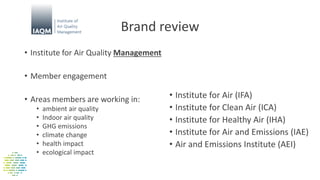
Brand review
• Institute for Air Quality Management
• Member engagement
• Areas members are working in:
• ambient air quality
• Indoor air quality
• GHG emissions
• climate change
• health impact
• ecological impact
• Institute for Air (IFA)
• Institute for Clean Air (ICA)
• Institute for Healthy Air (IHA)
• Institute for Air and Emissions (IAE)
• Air and Emissions Institute (AEI)
Meteorology data
Representative met data for ADMS or AERMOD
New free to use tool launching next week
www.envirodataservices.co.uk/get-nwp-data
XXXX
Reflections on 50 years of Air Quality
Dr Claire Holman
IAQM President
Routes to Clean Air 2024
What I was asked to talk about:
1. Highlights of a Long Air Quality Career
2. Reflections on Air Quality past, present and future
My career: Three Phases
1. Technical studies to influence policy
2. Focus on Road Transport and planning
3. Litigation
Road transport emissions forecasting
PhD Lancaster 1980
Long range transport of tropospheric
ozone
Friends of the Earth
Molecular Sciences (chemistry) degree,
Warwick 1976
Post doc Edinburgh
Attended EC’s Motor Vehicle Emissions Group
representing European Environmental Bureau
1970s & 1980s
Started freelance consultancy
mainly for Environmental NGOs
University Public Relations
CHILDREN
London Smog Acid Rain
“Air pollution” not “Air quality”
Development of UFP emission tests for vehicle/HDV engine
emission test procedures
China – advising on the introduction of EU vehicle emission legislation
European Auto Oil Programme
Road transport emission modelling/ forecasting
including for DfT
DoE’s Quality of Urban Air Review Group (QUARG)
Friends of the Earth
Established SENCO Freelance Environmental Consultant
University Public Relations
Attended EC’s Motor Vehicle Emissions Group representing European
Environmental Bureau
1990s & 2000s
Advisor to Royal Commission on Environmental Pollution
transport investigations
Forecast EU emissions from all economic sectors for the European Environment Agency
Adviser to the Japanese Clear air Programme
Chair International Institute for Energy Conservation
Peter Brett Associates
(now Stantec)
Chair CIWEMs Air Panel
NO2 + PM from traffic
CHILDREN
Learnt a lot about the
planning system
Air quality monitoring, modelling, AQ improvement plan for Jeddah Saudia Arabia
Modelling AQ impacts of CHP in Urban Areas
Expert witness coroner’s court investigating
death of Ella Abdoo Kissi-Debrah
Expert witness for Client Earth’s
legal challenge to Defra’s AQ Plan
ENVIRON (now part of Ramboll)
Chair IAQM
2010s & 2020s
Chair Welsh NO2 Compliance Panel
NO2 from traffic
President IAQM
TIME OUT!
Brook Cottage Consultants
Lead IAQM guidance on dust, minerals, habitats and indoor air quality
Air Pollution Service/Kalaco
Dust and odour litigation
Selecting dispersion modelling for
JNCC’s APAS tool
Planning /permitting
RETIREMENT
SOON!
Indoor Air Quality research
Wealden Local Plan –
HRA Rejected
Climate change adaptation and resilience
Greenhouse Gas
Assessments
Ammonia Monitoring Plan
Opposing airport expansion –
Heathrow, Stanstead,
Gatwick
Few thoughts
• Travel – Lucky to have had many
work opportunities – China,
Japan, South Africa, Saudia
Arabia, United Arab Emirates,
USA + most of Europe
• Networking – you never know
when you might need help from
someone –getting a new
job/solving a problem/learning
from others
• Volunteering - e.g. with IAQM
ECN or IAQM Committee. Means
working beyond your day job but
great for profile, networking and
gaining knowledge. It is
rewarding.
• Continuous improvement –
always learning new things
Reflections on the future challenges
Ammonia
• Controlling ammonia has proved difficult
• Government introduced voluntary schemes to control agricultural
emissions
• Large number of sources in a vital sector of the economy
(agriculture) that has historically been resistance to outside influence.
Will the new Government be prepared to adequately address this
issue?
Agreed 14 October 2024
Will England* Adopt New Standards in this Parliament?
Member states have 2 years to transpose new directive
(and meet 2008 standards)
*Air quality is a devolved responsibility
UFP (PM0.1)
• WHO 2021 AQGs – good practice only, not guidelines
• Insufficient epidemiological evidence to formulate guidelines
• But is an UFP the long-term solution?
• Diesel Engine emissions include UPF emission limit because particle
number can be measured at much lower concentrations than a
particle mass (not set to explicitly to control UFP emissions)
• Concerns re. robustness of a AQ standard lower than 10 µg/m3due to
measurement uncertainties. A particle number standard would
overcome this. But would need more evidence on the medical
effects.
Very few exceedances
• AQ standards should drive improvement
• If they don’t what is the point?
Any exceedances?
• A lot of public money has been spent on
developing CAZ? Have they achieved
much?
How will climate change and Net Zero Change Air Quality
Climate change
• Changing weather will impact on air pollution
• Transport/dilution (more stagnation in summer-time, higher winter
winds, some intense storms)
• Chemistry/formation of secondary pollutants (hotter summers and
more solar radiation, higher humidity)
• Concentrations will increase and decrease, but lots of unknowns
Net zero
Net zero will affect emissions:
• of traditional pollutants e.g. NOx
• new pollutants will emerge e.g. amines or become more important
e.g. microplastics
Ground level annual mean concentrations
Royal Society’s 2021 Report on Air
Quality & Climate Change
But summer ozone could increase
Thank you for listening!
Ian McCrae Award winner –
Sophie Brough!
Silver Bronze

15:20 IAQM Update – IAQM guidance announcements, changing membership requirements, and the future of IAQM

  • 1.
  • 2.
    About the IAQM TheIAQM is the professional body for ambient and indoor air quality professionals. The IAQM acts as the voice for air quality by producing useful and timely guidance on matters affecting air quality professionals and by responding to Government consultations. The IAQM is committed to maintaining, enhancing and promoting the highest standards of working practices in the field and supports the development of professionals working in the sector. With currently over 690 members, the IAQM is the largest membership organisation for air quality professionals in the UK with members spanning consultancy, academia, public/civil bodies and industry. We have members with expertise spanning topics relevant to both ambient and indoor air quality and have published professional guidance in a range of topics to support work in this area.
  • 3.
    IAQM governance The IAQMis governed by an elected Committee •Oversees the strategic and technical work of the IAQM – sets and approves work •Committee officers include: President, Chair, Vice Chair(s), Subcommittee Chairs, Secretary (ex officio) IAQM Committee •Standing subcommittees which lead on specific areas of IAQM work. Include: Membership, Consultation & Engagement, Early Careers Network, Climate Change •Chaired by a member of the Committee, can have non-Committee members IAQM Subcommittees •Time-limited task and finish groups set up by the IAQM Committee to deliver a specific piece of work, such as developing or updating guidance. •Chaired by an IAQM member with relevant expertise, at least one member of the WG must be a Committee member Working Groups (WG)
  • 4.
    IAQM governance Current IAQMCommittee Members: President: Claire Holman Chair: Chris Rush Vice Chair: Kieran Laxen Vice Chair: Xiangyu Sheng ECN Chair: Honor Puciato Secretary: Ethny Childs Climate Change Chair: Jamie Clayton Carl Hawkings Annie Danskin Sarah Horrocks Christine McHugh Daniel Marsh Mark Nichols Davide Pascarella Past President: Bernard Fisher
  • 5.
    IAQM strategic priorities •Increasing connections with indoor air quality professionals and academia • Increasing IAQM influence with government bodies and stakeholder groups • Engaging the wider IAQM membership in the work of the IAQM • Developing guidance and training in emerging areas
  • 6.
    IAQM activities 2024 •A number of active working groups updating and drafting new technical guidance (see next slide) • A busy events calendar • DMUG Conference in April • 2 AirTime events, one in Manchester and one in Bristol • 6 webinars attracting an avg of 150 attendees • 2 joint in-person events on low-cost sensors and atmospheric dispersion modelling • 2 dedicated Early Careers Network events, incl. a field trip to the Met Office • Engaging with stakeholders across the sector, including working with the Clean Air Champions on a proposal for a new Clean Air Community • Developing a Competency Framework and a new aligned membership application process
  • 7.
    Get involved! • Don’tforget to submit your votes in the current Committee election – deadline for votes is the 15th November! • Join a working group/subcommittee • Respond to member consultations • Present a webinar • Let us know what you would like to see from the IAQM
  • 8.
    New competency frameworkand membership application process Introduced by IAQM Membership Sub-Committee Chair: Dr Xiangyu Sheng Background • Review of our membership application process in 2023 • Developed by the IAQM Membership Sub-Committee • Has been through consultation with IAQM Committee members. Aim • More structured and consistent approach to membership applications • More guidance and support on the application process • Competencies expected at different membership levels • Improve transparency around how membership applications are assessed
  • 9.
    New competency frameworkand membership application process Membership levels •Affiliate; •Associate; •Full Member; and •Fellow Key Changes • An additional year of work experience (or equivalent) for Associate and Full Members • Submission of further information to support applications for membership aligned with the Competency Framework, a scoring system • Motivation and reasons for wanting to join the IAQM • Members and Fellows confirm that CPD records are up-to-date
  • 10.
    New competency frameworkand membership application process HOW WILL THIS AFFECT YOU? • Regrade your membership NEXT STEPS • Effective from 1st January 2025 • First applications to be reviewed from 1 April 2025 • Additional support and feedback on applications made in the first six months. • Official launch at the IAQM AGM 26th November 2024
  • 11.
    A I RP O L L U T I O N S E R V I C E S T H E C L I M A T E C O N S U L T A N T S E N V I R O D A T A S E R V I C E S I A Q C O N S U L T A N T S O D O U R C O N S U L T A N T S B I O A E R O S O L C O N S U L T A N T S RTCA – IAQM’s future Kieran Laxen – Vice Chair IAQM 23th October 2024
  • 12.
    Update • Guidance –new and updating • Community for Clean Air • Brand • Defra engagement • PM2.5 guidance (AMCT and PERT) • Pollutants - standards
  • 13.
    Guidance • New Modellingguidance – exposure draft out, being updated - Q1 2025 to members • New Air Quality Neutral guidance – H1 2025 to members • New IAQM/ Land Condition good practice guide to air quality monitoring surveys on brownfield sites – led by Sarah Horrocks • Land-use planning guidance – a full update, major review of air quality assessment approach – H1 2025 to members • GHG assessment guidance – exposure draft ready in Nov 2024 – Q1 2025 to members • Mineral Dust guidance – being updated – H1 2025 to members • Odour guidance – major update – committee reviewing Nov, Q4 2024 / Q1 2025 to members • New VOCs from Construction Site guidance - committee reviewing Nov, Q4 2024 / Q1 2025 to members • Habitats guidance – working group will start reviewing if update needed • The IES Environmental Policy Implementation Community (EPIC) have also published guidance: Integrating Action on Air Quality & Climate Change: A Guide for Local Authorities
  • 16.
    Brand review • Institutefor Air Quality Management • Member engagement • Areas members are working in: • ambient air quality • Indoor air quality • GHG emissions • climate change • health impact • ecological impact • Institute for Air (IFA) • Institute for Clean Air (ICA) • Institute for Healthy Air (IHA) • Institute for Air and Emissions (IAE) • Air and Emissions Institute (AEI)
  • 17.
    Meteorology data Representative metdata for ADMS or AERMOD New free to use tool launching next week www.envirodataservices.co.uk/get-nwp-data
  • 19.
    XXXX Reflections on 50years of Air Quality Dr Claire Holman IAQM President Routes to Clean Air 2024
  • 20.
    What I wasasked to talk about: 1. Highlights of a Long Air Quality Career 2. Reflections on Air Quality past, present and future
  • 21.
    My career: ThreePhases 1. Technical studies to influence policy 2. Focus on Road Transport and planning 3. Litigation
  • 22.
    Road transport emissionsforecasting PhD Lancaster 1980 Long range transport of tropospheric ozone Friends of the Earth Molecular Sciences (chemistry) degree, Warwick 1976 Post doc Edinburgh Attended EC’s Motor Vehicle Emissions Group representing European Environmental Bureau 1970s & 1980s Started freelance consultancy mainly for Environmental NGOs University Public Relations CHILDREN London Smog Acid Rain “Air pollution” not “Air quality”
  • 23.
    Development of UFPemission tests for vehicle/HDV engine emission test procedures China – advising on the introduction of EU vehicle emission legislation European Auto Oil Programme Road transport emission modelling/ forecasting including for DfT DoE’s Quality of Urban Air Review Group (QUARG) Friends of the Earth Established SENCO Freelance Environmental Consultant University Public Relations Attended EC’s Motor Vehicle Emissions Group representing European Environmental Bureau 1990s & 2000s Advisor to Royal Commission on Environmental Pollution transport investigations Forecast EU emissions from all economic sectors for the European Environment Agency Adviser to the Japanese Clear air Programme Chair International Institute for Energy Conservation Peter Brett Associates (now Stantec) Chair CIWEMs Air Panel NO2 + PM from traffic CHILDREN Learnt a lot about the planning system
  • 24.
    Air quality monitoring,modelling, AQ improvement plan for Jeddah Saudia Arabia Modelling AQ impacts of CHP in Urban Areas Expert witness coroner’s court investigating death of Ella Abdoo Kissi-Debrah Expert witness for Client Earth’s legal challenge to Defra’s AQ Plan ENVIRON (now part of Ramboll) Chair IAQM 2010s & 2020s Chair Welsh NO2 Compliance Panel NO2 from traffic President IAQM TIME OUT! Brook Cottage Consultants Lead IAQM guidance on dust, minerals, habitats and indoor air quality Air Pollution Service/Kalaco Dust and odour litigation Selecting dispersion modelling for JNCC’s APAS tool Planning /permitting RETIREMENT SOON! Indoor Air Quality research Wealden Local Plan – HRA Rejected Climate change adaptation and resilience Greenhouse Gas Assessments Ammonia Monitoring Plan Opposing airport expansion – Heathrow, Stanstead, Gatwick
  • 25.
    Few thoughts • Travel– Lucky to have had many work opportunities – China, Japan, South Africa, Saudia Arabia, United Arab Emirates, USA + most of Europe • Networking – you never know when you might need help from someone –getting a new job/solving a problem/learning from others • Volunteering - e.g. with IAQM ECN or IAQM Committee. Means working beyond your day job but great for profile, networking and gaining knowledge. It is rewarding. • Continuous improvement – always learning new things
  • 26.
    Reflections on thefuture challenges
  • 27.
    Ammonia • Controlling ammoniahas proved difficult • Government introduced voluntary schemes to control agricultural emissions • Large number of sources in a vital sector of the economy (agriculture) that has historically been resistance to outside influence.
  • 28.
    Will the newGovernment be prepared to adequately address this issue?
  • 29.
  • 30.
    Will England* AdoptNew Standards in this Parliament? Member states have 2 years to transpose new directive (and meet 2008 standards) *Air quality is a devolved responsibility
  • 31.
    UFP (PM0.1) • WHO2021 AQGs – good practice only, not guidelines • Insufficient epidemiological evidence to formulate guidelines • But is an UFP the long-term solution? • Diesel Engine emissions include UPF emission limit because particle number can be measured at much lower concentrations than a particle mass (not set to explicitly to control UFP emissions) • Concerns re. robustness of a AQ standard lower than 10 µg/m3due to measurement uncertainties. A particle number standard would overcome this. But would need more evidence on the medical effects.
  • 32.
  • 33.
    • AQ standardsshould drive improvement • If they don’t what is the point? Any exceedances? • A lot of public money has been spent on developing CAZ? Have they achieved much?
  • 34.
    How will climatechange and Net Zero Change Air Quality
  • 35.
    Climate change • Changingweather will impact on air pollution • Transport/dilution (more stagnation in summer-time, higher winter winds, some intense storms) • Chemistry/formation of secondary pollutants (hotter summers and more solar radiation, higher humidity) • Concentrations will increase and decrease, but lots of unknowns
  • 36.
    Net zero Net zerowill affect emissions: • of traditional pollutants e.g. NOx • new pollutants will emerge e.g. amines or become more important e.g. microplastics
  • 37.
    Ground level annualmean concentrations Royal Society’s 2021 Report on Air Quality & Climate Change But summer ozone could increase
  • 38.
    Thank you forlistening!
  • 40.
    Ian McCrae Awardwinner – Sophie Brough! Silver Bronze