Republic	of	Lebanon	
Country info
Country Lebanon
Capital Beirut
Population 6 Million (2016)
Population growth 2.6 % (2016)
Geographical area 10,452 km2
Facts about Lebanon:
• Lebanon is the only Middle Eastern
country that doesn’t have a desert
• Beirut was named “World Book
Capital” in 2009
• The first alphabet was created in
Byblos, Lebanon.
Waste in Lebanon
Yearly MSW generation: 2 Million tons/year
Daily MSW generation: 1.05 kg/capita/day
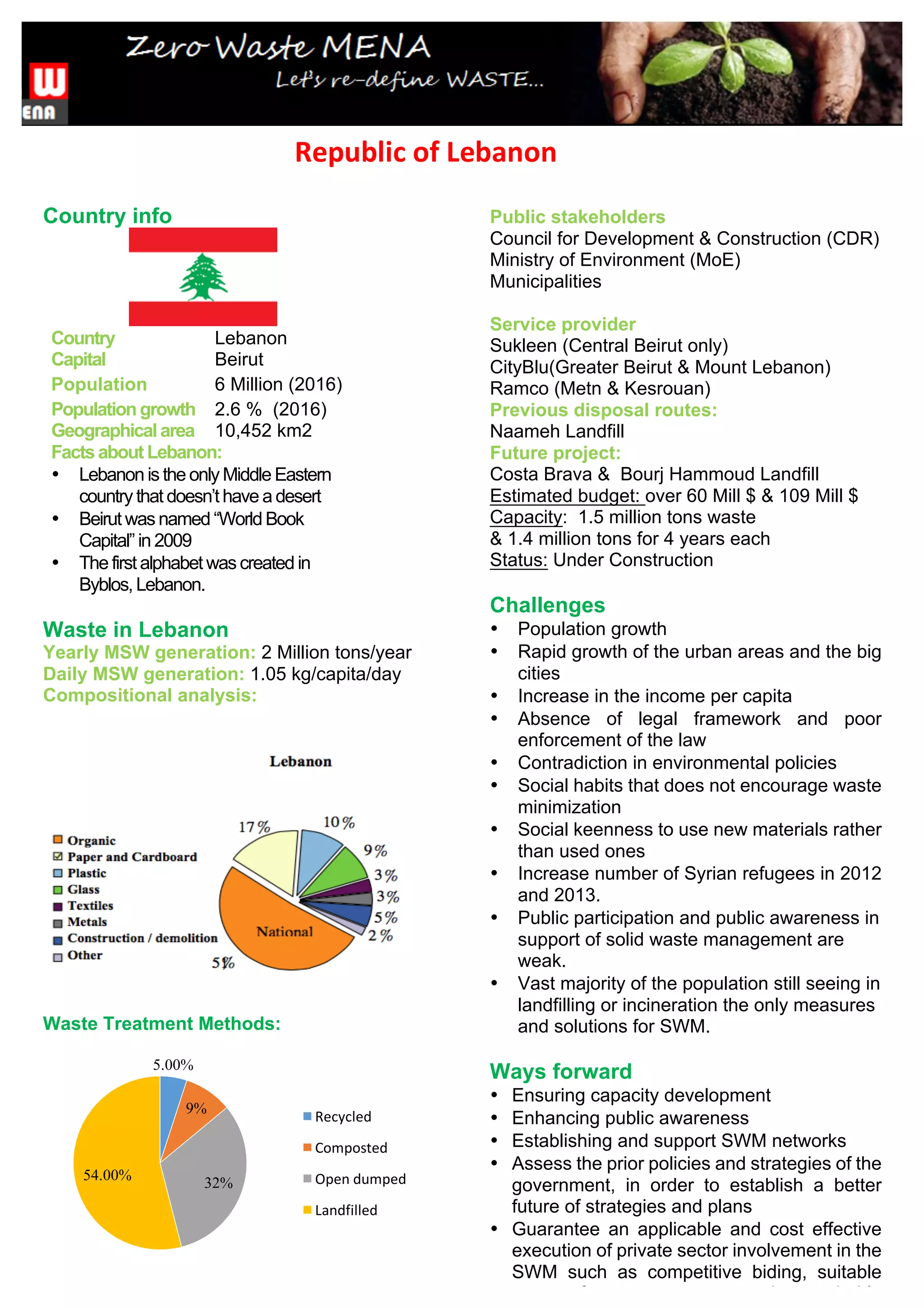
Compositional analysis:
Waste Treatment Methods:
Current status
Public stakeholders
Council for Development & Construction (CDR)
Ministry of Environment (MoE)
Municipalities
Service provider
Sukleen (Central Beirut only)
CityBlu(Greater Beirut & Mount Lebanon)
Ramco (Metn & Kesrouan)
Previous disposal routes:
Naameh Landfill
Future project:
Costa Brava & Bourj Hammoud Landfill
Estimated budget: over 60 Mill $ & 109 Mill $
Capacity: 1.5 million tons waste
& 1.4 million tons for 4 years each
Status: Under Construction
Challenges
• Population growth	
• Rapid growth of the urban areas and the big
cities
• Increase in the income per capita
• Absence of legal framework and poor
enforcement of the law
• Contradiction in environmental policies
• Social habits that does not encourage waste
minimization
• Social keenness to use new materials rather
than used ones
• Increase number of Syrian refugees in 2012
and 2013.
• Public participation and public awareness in
support of solid waste management are
weak.
• Vast majority of the population still seeing in
landfilling or incineration the only measures
and solutions for SWM.
Ways forward
• Ensuring capacity development
• Enhancing public awareness
• Establishing and support SWM networks
• Assess the prior policies and strategies of the
government, in order to establish a better
future of strategies and plans
• Guarantee an applicable and cost effective
execution of private sector involvement in the
SWM such as competitive biding, suitable
types of contracts guaranteeing probable
5.00%
9%
32%54.00%
Recycled
Composted
Open	dumped
Landfilled

Solid Waste Management in Lebanon: factsheet

  • 1.
    Republic of Lebanon Country info Country Lebanon CapitalBeirut Population 6 Million (2016) Population growth 2.6 % (2016) Geographical area 10,452 km2 Facts about Lebanon: • Lebanon is the only Middle Eastern country that doesn’t have a desert • Beirut was named “World Book Capital” in 2009 • The first alphabet was created in Byblos, Lebanon. Waste in Lebanon Yearly MSW generation: 2 Million tons/year Daily MSW generation: 1.05 kg/capita/day Compositional analysis: Waste Treatment Methods: Current status Public stakeholders Council for Development & Construction (CDR) Ministry of Environment (MoE) Municipalities Service provider Sukleen (Central Beirut only) CityBlu(Greater Beirut & Mount Lebanon) Ramco (Metn & Kesrouan) Previous disposal routes: Naameh Landfill Future project: Costa Brava & Bourj Hammoud Landfill Estimated budget: over 60 Mill $ & 109 Mill $ Capacity: 1.5 million tons waste & 1.4 million tons for 4 years each Status: Under Construction Challenges • Population growth • Rapid growth of the urban areas and the big cities • Increase in the income per capita • Absence of legal framework and poor enforcement of the law • Contradiction in environmental policies • Social habits that does not encourage waste minimization • Social keenness to use new materials rather than used ones • Increase number of Syrian refugees in 2012 and 2013. • Public participation and public awareness in support of solid waste management are weak. • Vast majority of the population still seeing in landfilling or incineration the only measures and solutions for SWM. Ways forward • Ensuring capacity development • Enhancing public awareness • Establishing and support SWM networks • Assess the prior policies and strategies of the government, in order to establish a better future of strategies and plans • Guarantee an applicable and cost effective execution of private sector involvement in the SWM such as competitive biding, suitable types of contracts guaranteeing probable 5.00% 9% 32%54.00% Recycled Composted Open dumped Landfilled