Aligning Culture Change Values With Relational Theory
Aligning Dementia Care Practices with Relational Theory:
Examples from the Partnership in Dementia Care (PiDC) Alliance
Sherry L. Dupuis1, Carrie McAiney2, Susan Brown3, Jennifer Carson4, Lorna de Witt5, Darla Fortune6,
Sian Lockwood6, Kimberly J. Lopez4, Janet McKeown6, Jenny Ploeg7, & Kristie Wiedenfeld8
Background
The Partnerships in Dementia Care (PiDC) Alliance is a culture change (CC) initiative
based in Canada. Guided by the philosophical underpinnings of the Alzheimer
Disease and Related Dementias Framework, authentic partnerships, participatory
action research, and Appreciative Inquiry, the PiDC Alliance is facilitating a CC
process focused on aligning care practices with relational theory.
Working within five diverse long-term care (LTC) homes (Bloomington Cove,
The Royal Oak, The Village of Wentworth Heights, The Willowgrove, Yee Hong
Centre for Geriatric Care) and one community dementia care setting (Huron
County), the ultimate goal is to enhance the dementia care experience for all within
LTC homes and community care. Our CC processes at each research site are
informed by persons with dementia, family members, staff at all levels, and
community partners. This poster shares learnings from our CC process.
1Recreation and Leisure Studies, University of Waterloo, Waterloo, 2Dept of Psychiatry & Behavioural Neurosciences, McMaster University,
Hamilton, 3Schlegel-University of Waterloo Research Institute for Aging, 4Aging, Health and Well-Being Collaborative PhD Program,
University of Waterloo, Waterloo, 5Faculty of Nursing, University of Windsor, Windsor, 6Partnerships in Dementia Care Alliance, University of
Waterloo, Waterloo, 7School of Nursing, McMaster University, 8Wentworth Heights, Schlegel Villages, Hamilton, Canada
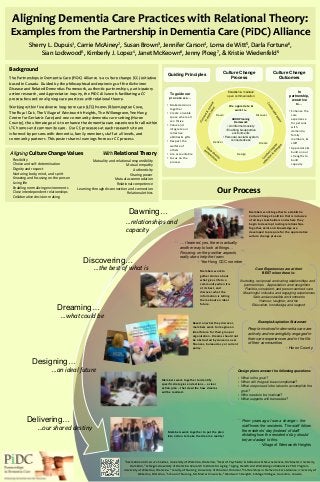
Our Process
Guiding Principles
Culture Change
Process
Culture Change
Outcomes
To guide our
process we…
• Make decisions
together
• Create a livable
space where all
can thrive
• Value and
integrate our
collective
abilities & gifts
• Respect the
welfare of
others
• Are accountable
• Focus on the
process
In
partnership,
we strive
to…
• Enhance the
care
experience
for persons
with
dementia,
family
members, &
staff
• Appreciate &
build on our
strengths to
build
capacity
Establish & maintain
open communication
Dawn
DreamDeliver
Design
Discover
We appreciate &
work to…
Discovering…
Dawning…
Dreaming…
Designing…
Delivering…
…what could be
…the best of what is
…relationships and
capacity
…an ideal future
…our shared destiny
“
Members work together to establish a
Culture Change Coalition that is inclusive
of all key stakeholders and where they
begin to develop trusting relationships.
Together, skills and knowledge are
developed to prepare for the appreciative
culture change process.
Members work to
gather stories about
what gives life to a
community when it is
at its best, and
discover what the
information is telling
them about an ideal
future.
Based on what they discover,
members work to imagine an
ideal future for their group or
organization. Dreams should not
be obstructed by concerns over
finances, bureaucracy or current
policy.
Members work together to identify
specific strategies and actions – a clear
action plan – that describe how dreams
will be realized.
Members work together to put the plan
into action to make the dream a reality!
… I learned, yes, there is actually
another way to look at things…
Focusing on the positive aspects
really does help the team.
- Yee Hong CCC member
“From years ago I see a change – the
staff know the residents. The staff follow
the residents’ day (instead of staff
dictating how the residents’ day should
be) and adapt to this.
- Village of Wentworth Heights
”
Design plans answer the following questions:
• What is the goal?
• When will the goal be accomplished?
• What steps need to be taken to accomplish the
goal?
• Who needs to be involved?
• What supports will be needed?
Flexibility
Choice and self-determination
Dignity and respect
Nurturing body, mind, and spirit
Knowing and focusing on the person
Living life
Enabling normalizing environments
Close interdependent relationships
Collaborative decision-making
Care Experiences are at their
BEST when there is:
Nurturing, reciprocal and caring relationships and
partnerships  Appreciation and recognition
 Flexible, consistent, and person-centred care
 Meaningful inclusive and engaging experiences
 Safe and accessible environments
 Humour, laughter, and fun
 Education, knowledge, and support
Mutuality and relational responsibility
Mutual empathy
Authenticity
Sharing power
Mutual accommodation
Relational competence
Learning through disconnection and connection
Relational ethics
ADRD Planning
Framework
• An informed society
• Enabling & supportive
environments
• Personal, social & system
connectedness
People involved in dementia care are
actively and meaningfully engaged in
their care experiences and in the life
of their communities
- Huron County
Example Aspiration Statement
”

On Aligning Dementia Care Practices with Relational Theory: Examples from the Partnerships in Dementia Care (PiDC) Alliance.

  • 1.
    Aligning Culture ChangeValues With Relational Theory Aligning Dementia Care Practices with Relational Theory: Examples from the Partnership in Dementia Care (PiDC) Alliance Sherry L. Dupuis1, Carrie McAiney2, Susan Brown3, Jennifer Carson4, Lorna de Witt5, Darla Fortune6, Sian Lockwood6, Kimberly J. Lopez4, Janet McKeown6, Jenny Ploeg7, & Kristie Wiedenfeld8 Background The Partnerships in Dementia Care (PiDC) Alliance is a culture change (CC) initiative based in Canada. Guided by the philosophical underpinnings of the Alzheimer Disease and Related Dementias Framework, authentic partnerships, participatory action research, and Appreciative Inquiry, the PiDC Alliance is facilitating a CC process focused on aligning care practices with relational theory. Working within five diverse long-term care (LTC) homes (Bloomington Cove, The Royal Oak, The Village of Wentworth Heights, The Willowgrove, Yee Hong Centre for Geriatric Care) and one community dementia care setting (Huron County), the ultimate goal is to enhance the dementia care experience for all within LTC homes and community care. Our CC processes at each research site are informed by persons with dementia, family members, staff at all levels, and community partners. This poster shares learnings from our CC process. 1Recreation and Leisure Studies, University of Waterloo, Waterloo, 2Dept of Psychiatry & Behavioural Neurosciences, McMaster University, Hamilton, 3Schlegel-University of Waterloo Research Institute for Aging, 4Aging, Health and Well-Being Collaborative PhD Program, University of Waterloo, Waterloo, 5Faculty of Nursing, University of Windsor, Windsor, 6Partnerships in Dementia Care Alliance, University of Waterloo, Waterloo, 7School of Nursing, McMaster University, 8Wentworth Heights, Schlegel Villages, Hamilton, Canada Our Process Guiding Principles Culture Change Process Culture Change Outcomes To guide our process we… • Make decisions together • Create a livable space where all can thrive • Value and integrate our collective abilities & gifts • Respect the welfare of others • Are accountable • Focus on the process In partnership, we strive to… • Enhance the care experience for persons with dementia, family members, & staff • Appreciate & build on our strengths to build capacity Establish & maintain open communication Dawn DreamDeliver Design Discover We appreciate & work to… Discovering… Dawning… Dreaming… Designing… Delivering… …what could be …the best of what is …relationships and capacity …an ideal future …our shared destiny “ Members work together to establish a Culture Change Coalition that is inclusive of all key stakeholders and where they begin to develop trusting relationships. Together, skills and knowledge are developed to prepare for the appreciative culture change process. Members work to gather stories about what gives life to a community when it is at its best, and discover what the information is telling them about an ideal future. Based on what they discover, members work to imagine an ideal future for their group or organization. Dreams should not be obstructed by concerns over finances, bureaucracy or current policy. Members work together to identify specific strategies and actions – a clear action plan – that describe how dreams will be realized. Members work together to put the plan into action to make the dream a reality! … I learned, yes, there is actually another way to look at things… Focusing on the positive aspects really does help the team. - Yee Hong CCC member “From years ago I see a change – the staff know the residents. The staff follow the residents’ day (instead of staff dictating how the residents’ day should be) and adapt to this. - Village of Wentworth Heights ” Design plans answer the following questions: • What is the goal? • When will the goal be accomplished? • What steps need to be taken to accomplish the goal? • Who needs to be involved? • What supports will be needed? Flexibility Choice and self-determination Dignity and respect Nurturing body, mind, and spirit Knowing and focusing on the person Living life Enabling normalizing environments Close interdependent relationships Collaborative decision-making Care Experiences are at their BEST when there is: Nurturing, reciprocal and caring relationships and partnerships  Appreciation and recognition  Flexible, consistent, and person-centred care  Meaningful inclusive and engaging experiences  Safe and accessible environments  Humour, laughter, and fun  Education, knowledge, and support Mutuality and relational responsibility Mutual empathy Authenticity Sharing power Mutual accommodation Relational competence Learning through disconnection and connection Relational ethics ADRD Planning Framework • An informed society • Enabling & supportive environments • Personal, social & system connectedness People involved in dementia care are actively and meaningfully engaged in their care experiences and in the life of their communities - Huron County Example Aspiration Statement ”