By Luis Majano
ORM
Battlefield
@lmajano
@ortussolutions
• Salvadorean Born!
• Imported to the USA
• On-loan to Spain!
• Computer Engineering
• CEO of Ortus Solutions
MAJANO
LUIS
CFCASTS
by Ortus Solutions
Learn from the makers of Coldbox, TestBox, and CommandBox through bite-size video tutorials on everything
you need to modernize your CFML development.
Become a CFML master!
Learning
Paths
Real-World
Examples
Engaging and
Interactive
Regularly
Updated Content
Flexible
Learning
Extensive
Course Library:
Watch all new series as they
are released
Access to the entire back catalog
You get 1 month for FREE
YEARLY
$275
Buy series a-la-carte
Access to free videos
Upgrade easily at any time
COMMUNITY
FREE
Watch all new series as they
are released
Access to the entire back catalog
Support Open Source Software
MONTHLY
$25
Why Choose CFCasts?
https://github.com/coldbox-samples/Pink-Unicorns-Do-Exist
Examples
➡ How to use ORM
➡ When to use ORM
➡ Tips & Trips to master Hibernate ORM
➡ Pitfalls to avoid
➡ Architectural overviews of ORM
➡ Extend ORM
Agenda
➡ Object Relational Mapper
➡ Maps:
- Objects to tables
- Properties to columns
- Relationships to foreign keys and tables
➡ An easier way to persist data vs. boring CRUD SQL
➡ Focus on objects instead of data
➡ ColdFusion ORM (Abstraction to Hibernate/JPA)
➡ Almost Everything in Hibernate works in CF
ORM
What is
?
➡ Write less boilerplate boring SQL
➡ Increase in productivity
➡ Rich Object Models
➡ Increased Flexibility
➡ Database vendor abstraction
➡ OO instead of query-based
➡ but…..
BENEFITS
Is it a Silver Bullet?
➡ Just another tool
➡ Times you need the power of the database: reports, legacy, sp, etc.
➡ Mix and Match
➡ There is a learning curve, but it is worth the investment
➡ What if you wanted an array of structs, list queries, or data arrays?
Use it Wisely!
coldfusionormbook.com
Enhance yourself!
coldbox-orm.ortusbooks.com
orm-extension.ortusbooks.com
Database(s)
ORM
CFML Application
Persisted Entities
CFML
Engine
Config Mappings
ORM+
Architecture Qb/CF
SQL
➡ Enabled + Configured via Application.cfc
➡ this.ormEnabled = true;
➡ this.datasource = “MyDatasource”;
➡ this.ormSettings = {}
➡ https://cfdocs.org/ormsettings
ORM
Activating
ORM
Settings
BAD
DEFAULTS
BAD
DEFAULTS
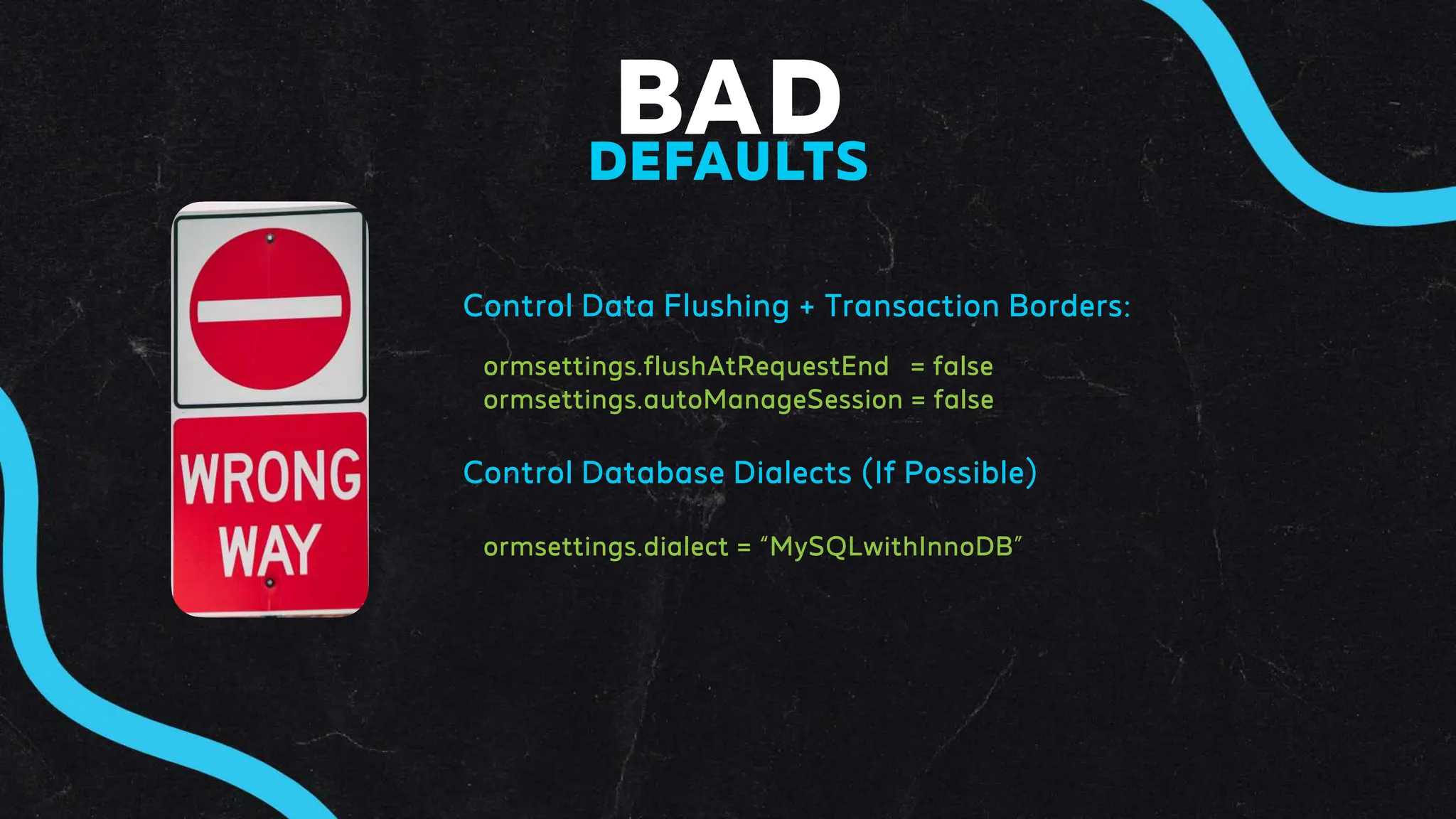
Control Data Flushing + Transaction Borders:
ormsettings.flushAtRequestEnd = false
ormsettings.autoManageSession = false
Control Database Dialects (If Possible)
ormsettings.dialect = “MySQLwithInnoDB”
BAD
DEFAULTS
Control Entity Discovery or pay the price!
ormSettings.cfclocation = [ “/models”, “/ext/entities” ]
Great for debugging, NOT for production!
ormSettings.logSql = false
Need
HELP
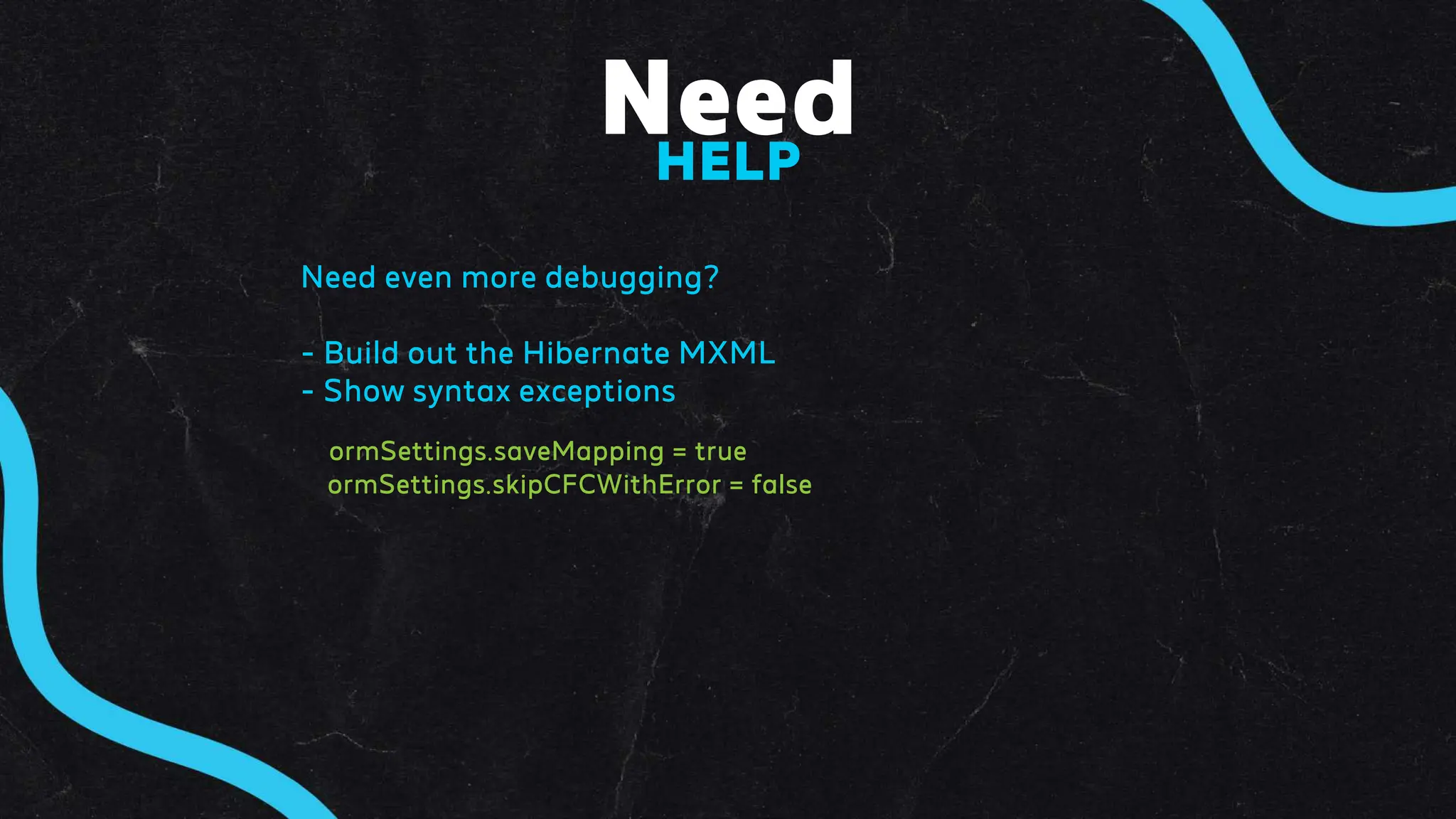
Need even more debugging?
- Build out the Hibernate MXML
- Show syntax exceptions
ormSettings.saveMapping = true
ormSettings.skipCFCWithError = false
DataBoss - github.com/coldbox-modules/databoss
$> install databoss
ORM
Entities &
Metadata
Dynamic
Administrator
Inspect, Analyze, Scaffold
Need
HELP
this.ormSettings = {
// Restrict Entity Locations
cfclocation = [ "/models" ],
// Chose the DB Dialect
dialect = "MySQLwithInnoDB",
// Don’t inspect the database
dbcreate = "none",
// Active caching if needed
secondarycacheenabled = false,
cacheProvider = "ehCache",
// Logging only in development
logSQL = env == “dev” ? false : false,
// Session Management: NEVER TRUE
flushAtRequestEnd = false,
autoManageSession = false,
// Event Handling: Yes Please!
eventHandling = true,
eventHandler = "cborm.models.EventHandler",
// Turn on/off skipping of exceptions on syntax: Maybe!
skipCFCWithError = false
};
ORM
Settings
Better
Logging is your best friend, 4EVER!
1. Application.cfc
2. ExtendedLog4j Logging
this.ormSettings = {
// Logging
logSQL = true,
};
WEB-INF/cfusion/lib/log4j.properties
LOGGING
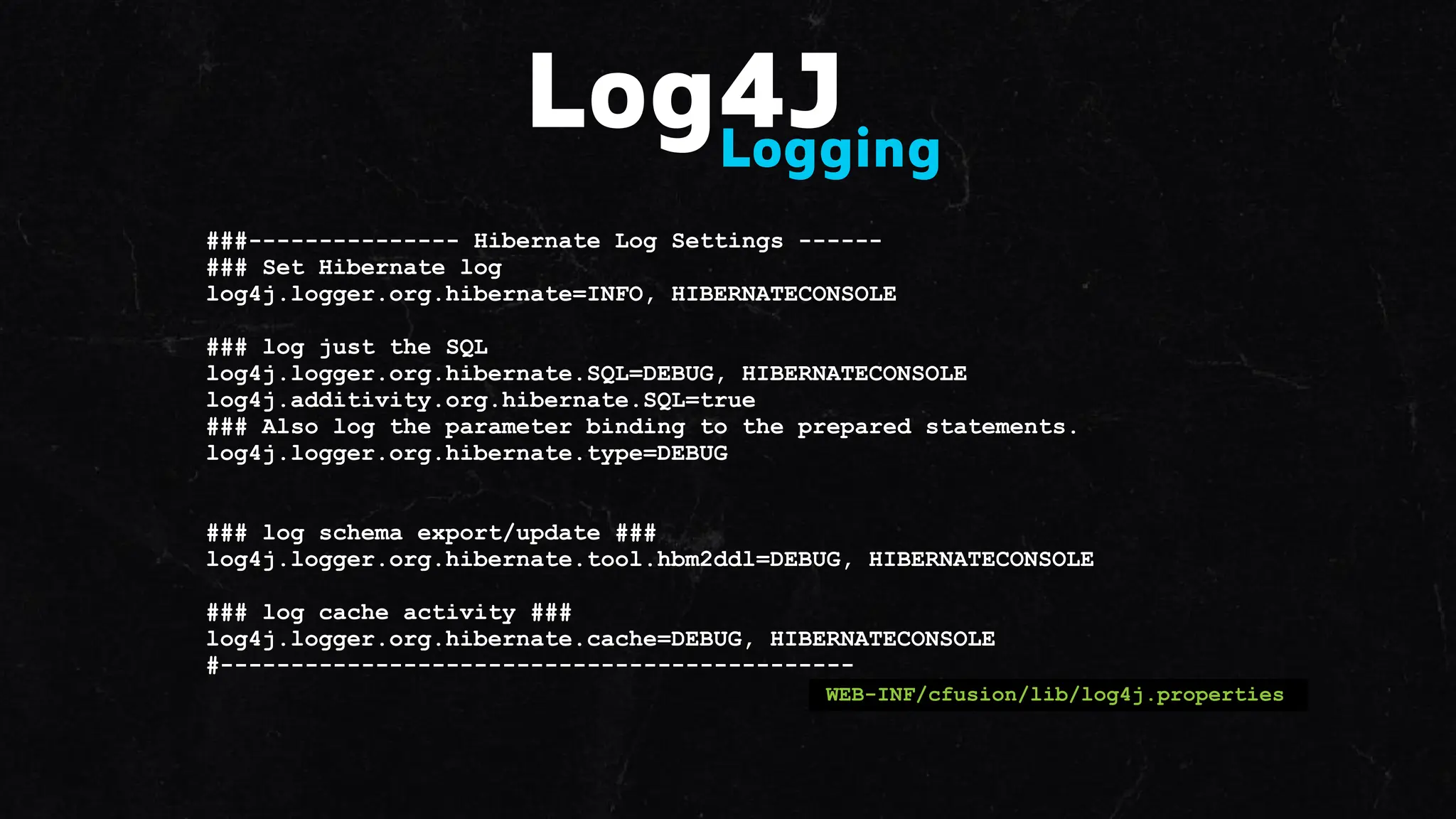
###--------------- Hibernate Log Settings ------
### Set Hibernate log
log4j.logger.org.hibernate=INFO, HIBERNATECONSOLE
### log just the SQL
log4j.logger.org.hibernate.SQL=DEBUG, HIBERNATECONSOLE
log4j.additivity.org.hibernate.SQL=true
### Also log the parameter binding to the prepared statements.
log4j.logger.org.hibernate.type=DEBUG
### log schema export/update ###
log4j.logger.org.hibernate.tool.hbm2ddl=DEBUG, HIBERNATECONSOLE
### log cache activity ###
log4j.logger.org.hibernate.cache=DEBUG, HIBERNATECONSOLE
#---------------------------------------------
WEB-INF/cfusion/lib/log4j.properties
Log4J
Logging
No Object Modeling
#1 Failure
➡ ORM relationship modeling is key
➡ OO is required
➡ UML is your best friend
➡ STOP THINKING ABOUT DATA
➡ YOU ARE NOT MODELING A DATABASE
OO Modeling is Key
OO Modeling is Key
Query Object
Data Data + Behavior
OO Modeling is Key
#2 RELATIONSHIPS
one-to-one
Student Metadata
one-to-many
Student Address
many-to-one
User Role
many-to-many
User Permissions
f
i
eldtype=“”
RELATIONSHIPS
➡ Unidirectional or Bidirectional
➡ Collections can be as arrays or structs
➡ Filtered Collections (Missed by devs)
➡ Performance Failures
➡ Control when they are loaded (lazyness)
➡ Control how many related entities are loaded
➡ Executing code on loading
➡ The hardest part of ORM
RELATIONSHIPS
➡ one-to-many, many-to-many
➡ add<relationship_property_name>(<associated_object>)
➡ boolean remove<relationship_property_name>(<associated_object>)
➡ boolean has<relationship_property_name>(<associated_object>)
➡ many-to-one, one-to-one
➡ boolean has<relationship_property_name>()
• addArts( Art art )
• removeArts( Art art )
• hasArts()
• hasArts( Art art )
property name=“arts"
fieldtype="one-to-many"
cfc="Art"
fkcolumn=“ArtistID";
GENERATED
METHODS
YOU HAVE TO BE
LAZY
➡ Immediate Fetching (Default)
➡ select with left outer join
➡ Use lazy For ALL Relationships or pay the price
YOU HAVE TO BE
LAZY
➡ Three types of laziness values:
lazy=“true”
all relationships
Loads the relationship data when the getter is called (Batches, if used)
lazy=“extra”
one-to-many, many-to-many
Loads proxy light objects with primary keys
(Event better - Batches, if used)
lazy=“proxy”
one-to-one, many-to-one
Loads proxy with primary key (Same as above)
YOU HAVE TO BE
LAZY
➡ Eager Fetching
➡ Mostly used in one-to-one and many-to-one, but applies to all
➡ Default uses 2 SQL queries, reduce to 1 Query
property name=“role” fieldtype=“many-to-one” fetch=“join”;
➡ Batch Fetching
➡ Limits the way relationships are loaded, else Hibernate tries to load all records
➡ Used on many-to-many and one-to-many collection properties:
property name=“comments” fieldtype=“one-to-many” batchsize=“10” lazy=“extra”;
➡ Used at entity level as well:
component name=“Comment” batchsize=10{}
YOU HAVE TO BE
LAZY
Oracle Tip
➡ JDBC Fetch Sizes are defaulted to 10
➡ Slow for many records or batch operations
➡ Increase the JDBC Fetch size
➡ Custom Hibernate setting
hibernate.jdbc.fetch_size=100
YOU HAVE TO BE
LAZY
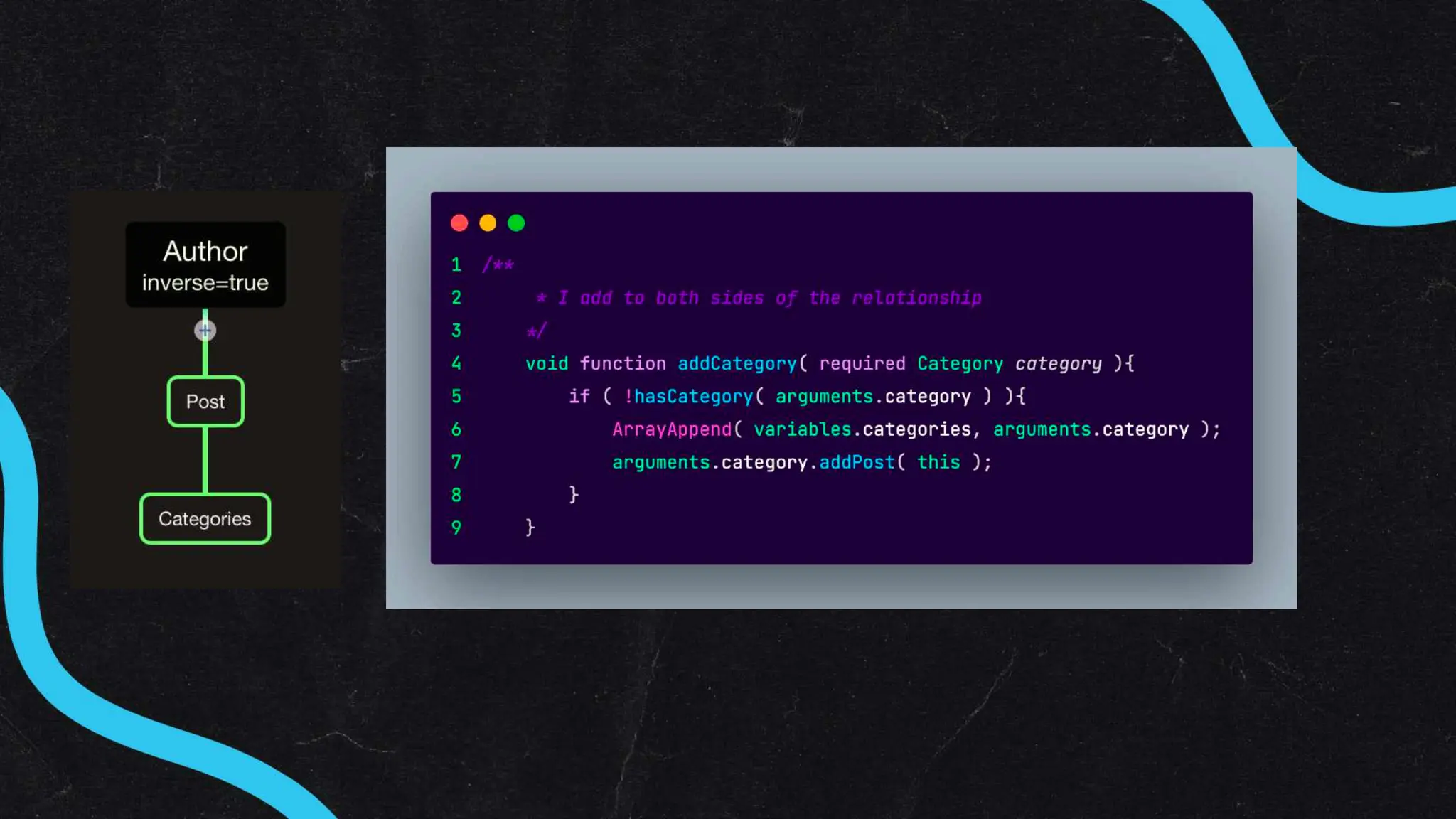
➡ They can be more of a headache
➡ Cascading Deletes are painful
➡ Choose the controlling relationship
➡ inverse=true
➡ Else double queries, inefficient queries
➡ Does it make sense?
➡ Supporting methods for bi-directional linkage
➡ Supporting methods for un-linkages
AVOID BI-DIRECTIONAL,
IF POSSIBLE!
BETTER Relationships
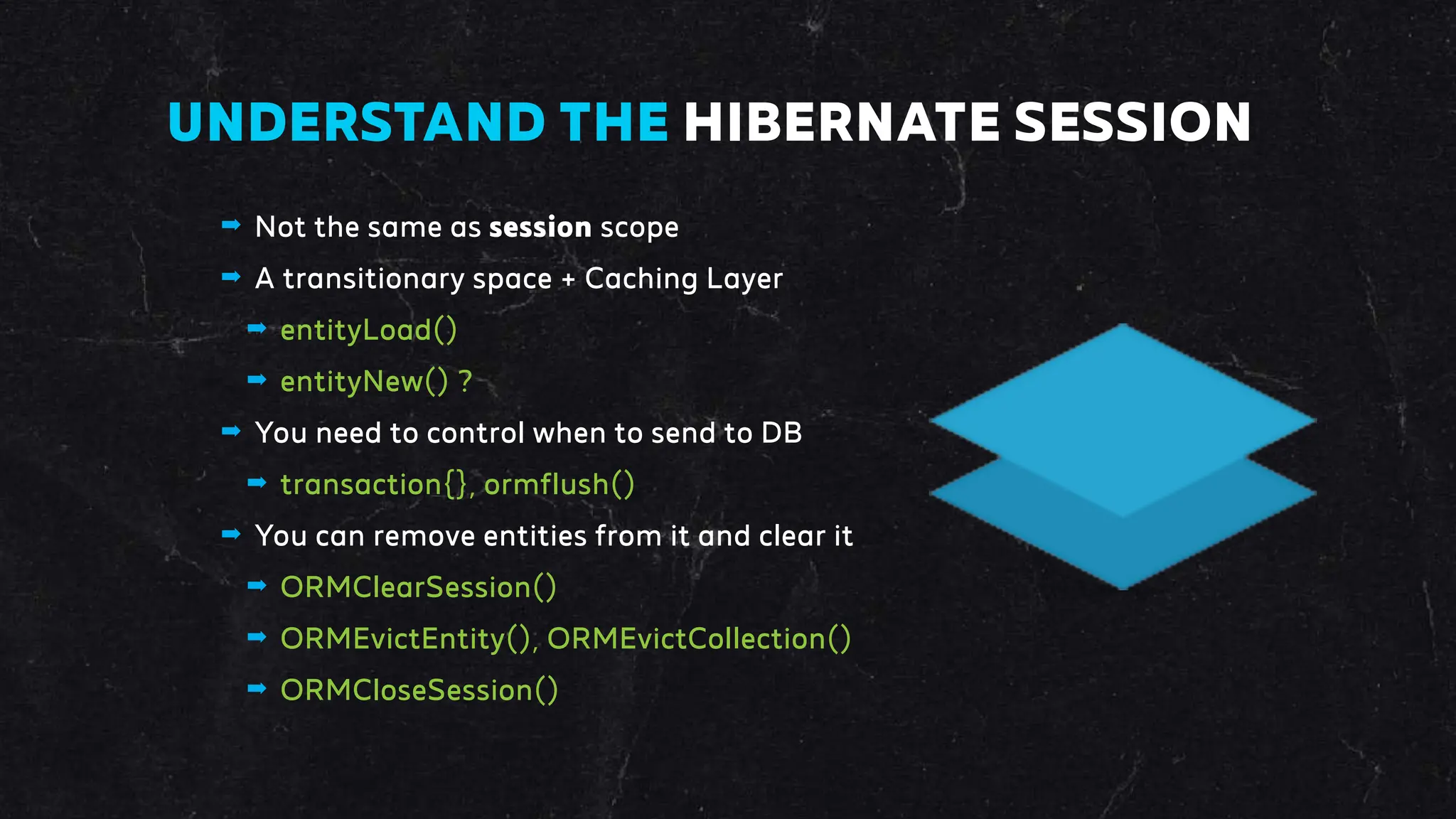
➡ Not the same as session scope
➡ A transitionary space + Caching Layer
➡ entityLoad()
➡ entityNew() ?
➡ You need to control when to send to DB
➡ transaction{}, ormflush()
➡ You can remove entities from it and clear it
➡ ORMClearSession()
➡ ORMEvictEntity(), ORMEvictCollection()
➡ ORMCloseSession()
UNDERSTAND THE HIBERNATE SESSION
Hibernate Session
(Conversation - Request)
DB
Eu
Ex Ez
Ey
Cache
ehCache/
Couchbase
Batched SQL
EntityNew()
EntityLoad()
Data (!CFCs)
Hibernate Session
Factory (application)
CRUD
When?
ORMClearSession()
UNDERSTAND THE HIBERNATE SESSION
DB
Sync
Insertions in order
updates
Collectiondeletions
collectiondeletion,updates, inserts
collectioninsertions
deletions in order
UNDERSTAND THE HIBERNATE SESSION
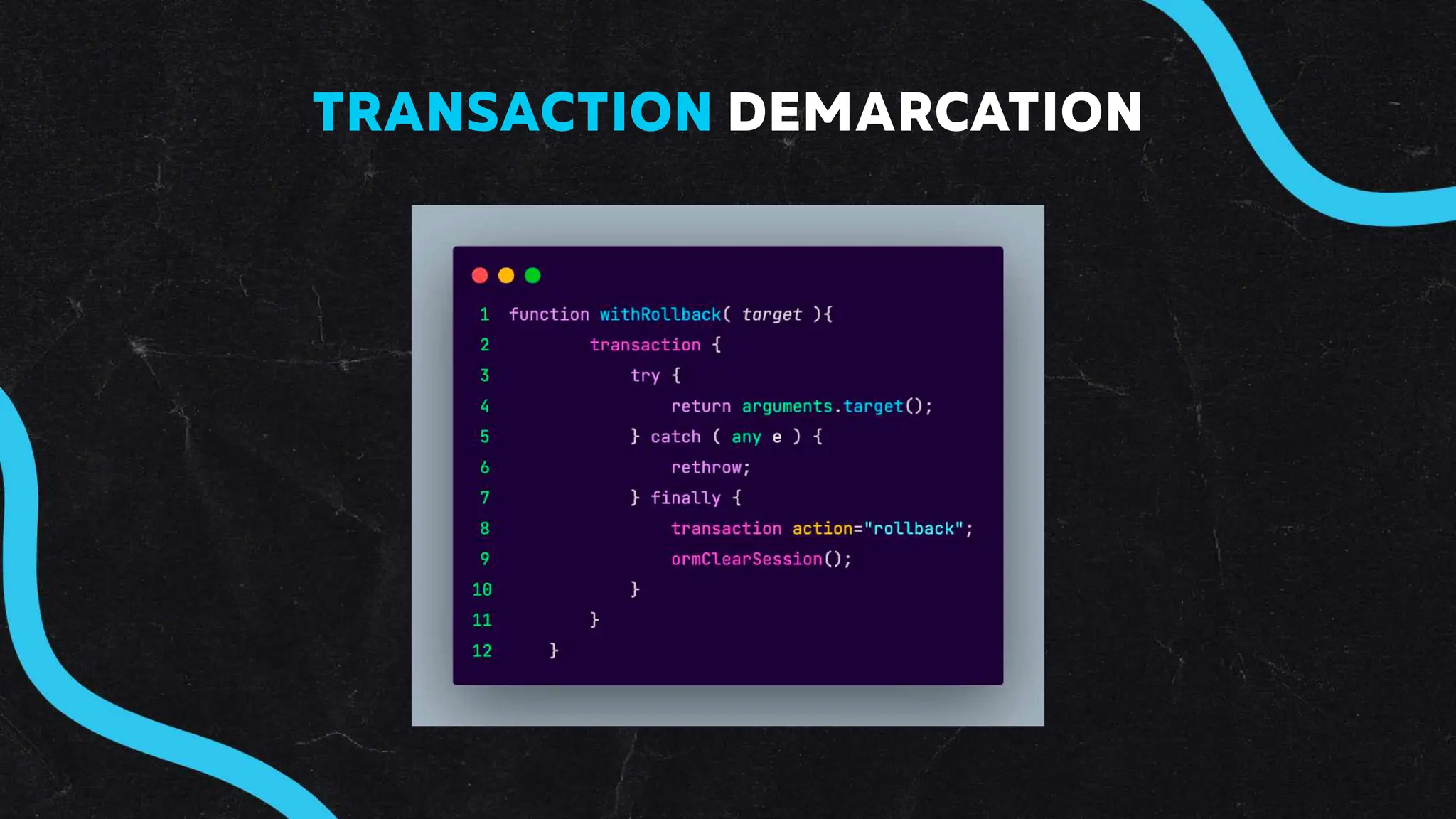
➡ Transactions demarcate SQL boundaries
➡ Important Imperative for ORM + SQL
➡ No communication to DB should occur without one
➡ Reactive programming, expect the worst
➡ cftransaction or Hibernate raw transactions
TRANSACTION DEMARCATION
➡ Transaction Theory:
➡ Any existing ORM session is flushed and reused
➡ Data can be committed or rollback
➡ ORMFlush() is ignored in transactions
➡ If commit, then flushed to database
➡ If rollback, session is cleared
TRANSACTION DEMARCATION
➡ Don’t do it!
➡ Breaks the link to the Hibernate Session
➡ Relationships will fail if not lazy loaded
➡ entityMerge()
➡ Store ID’s or data instead, then inflate the entities
AVOID SCOPING ENTITIES
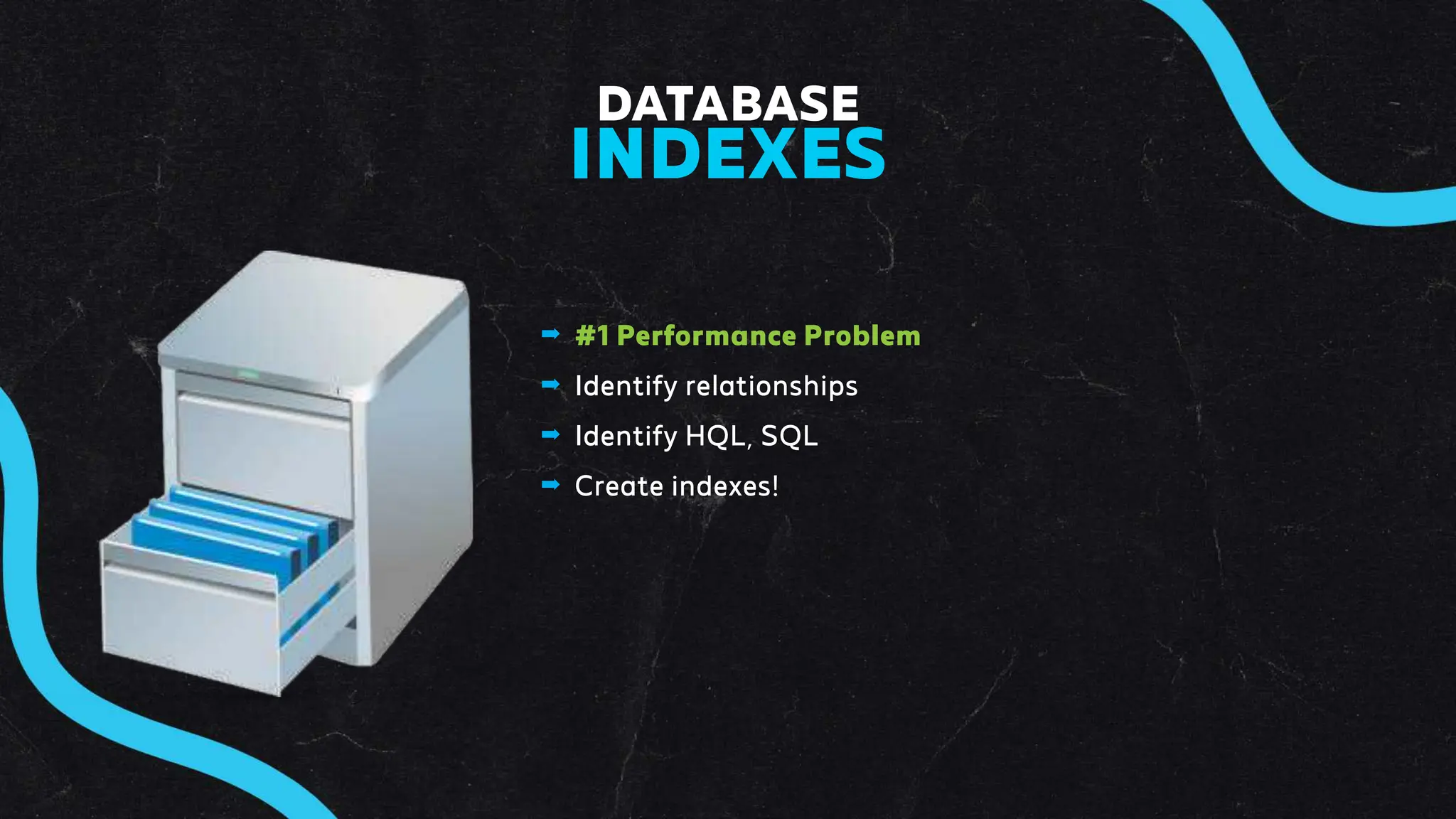
➡ #1 Performance Problem
➡ Identify relationships
➡ Identify HQL, SQL
➡ Create indexes!
DATABASE
INDEXES
➡ Don’t go cache crazy, develop a strategy
➡ Misconception: Does not store CFC
➡ Stores individual property values
➡ Use distributed caches: ehcache, couchbase, redis
➡ You can cache:
➡ Entity property data : Only caches properties data values
➡ Entity association data : Only caches primary keys
➡ Query data : HQL, ORMExecuteQuery()
➡ Evictions:
➡ ORMEvictEntity(), ORMEvictCollection()
CACHE
BOOSTING
CACHE
BOOSTING
CACHE
BOOSTING
➡ The fastest gun in the galaxy!
➡ Return array of structs
➡ Why a full ORM Object graph?
➡ Boost your APIs, stop converting queries/
array of objects to JSON
HQL
MAPS
HQL
MAPS
When is HappyBox?
ORM was fast
Extensible way to finish
the remaining 20%
CF ORM was easier to use?
80% of API Querying
OO way to query
Auto build relationships
ORM
THOUGHTS?
Base ORM Service
Virtual ORM Service
Active Entity
Entity Populators
Validation
Event Handlers
DI/AOP
OVERVIEW
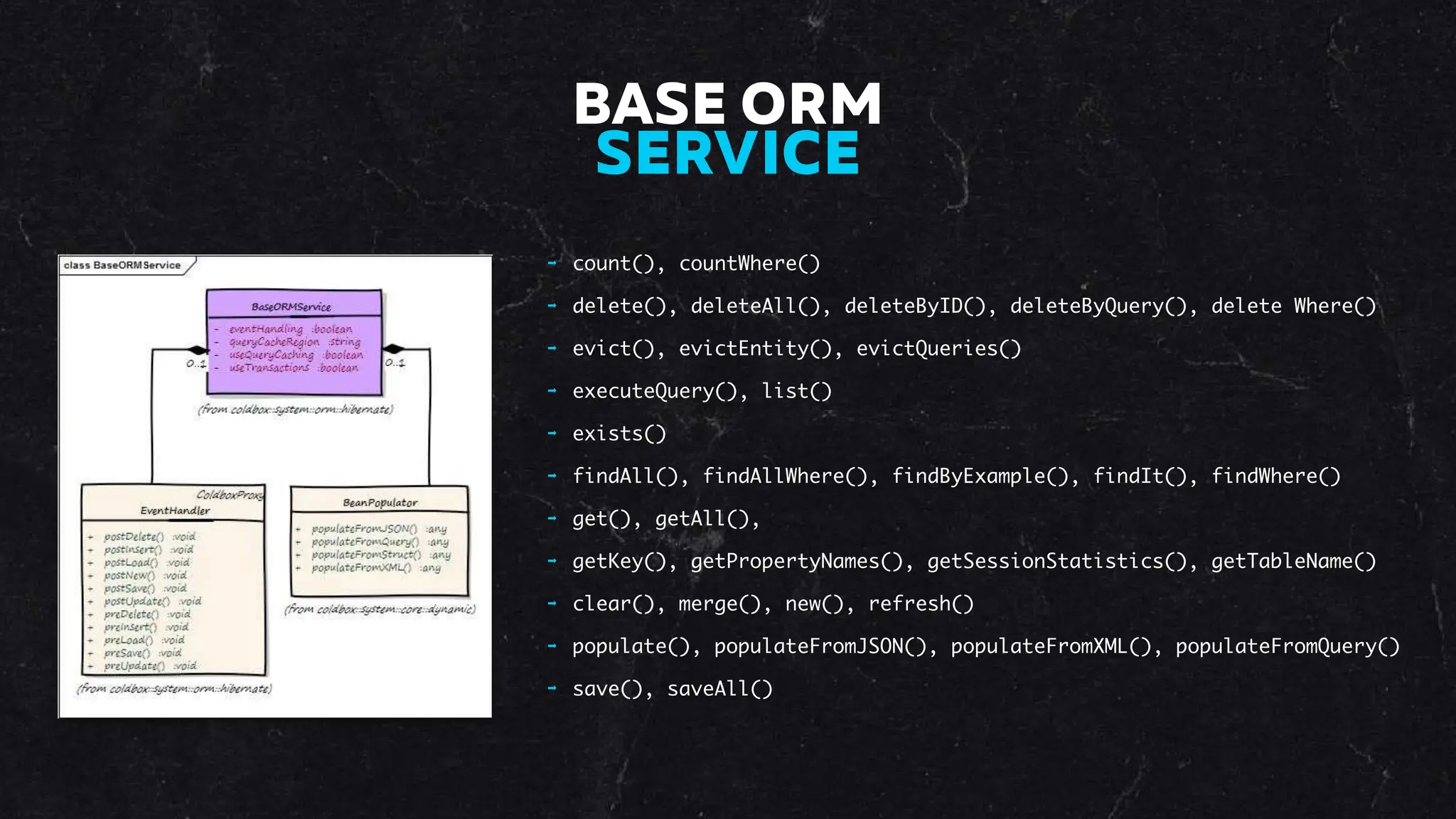
➡ Service layer for any entity
➡ OO Querying, caching, transactions
➡ Dynamic finders, getters, counters
➡ Object metadata & session management
➡ Exposes more features from Hibernate
➡ 90% Foundation
BASE ORM
SERVICE
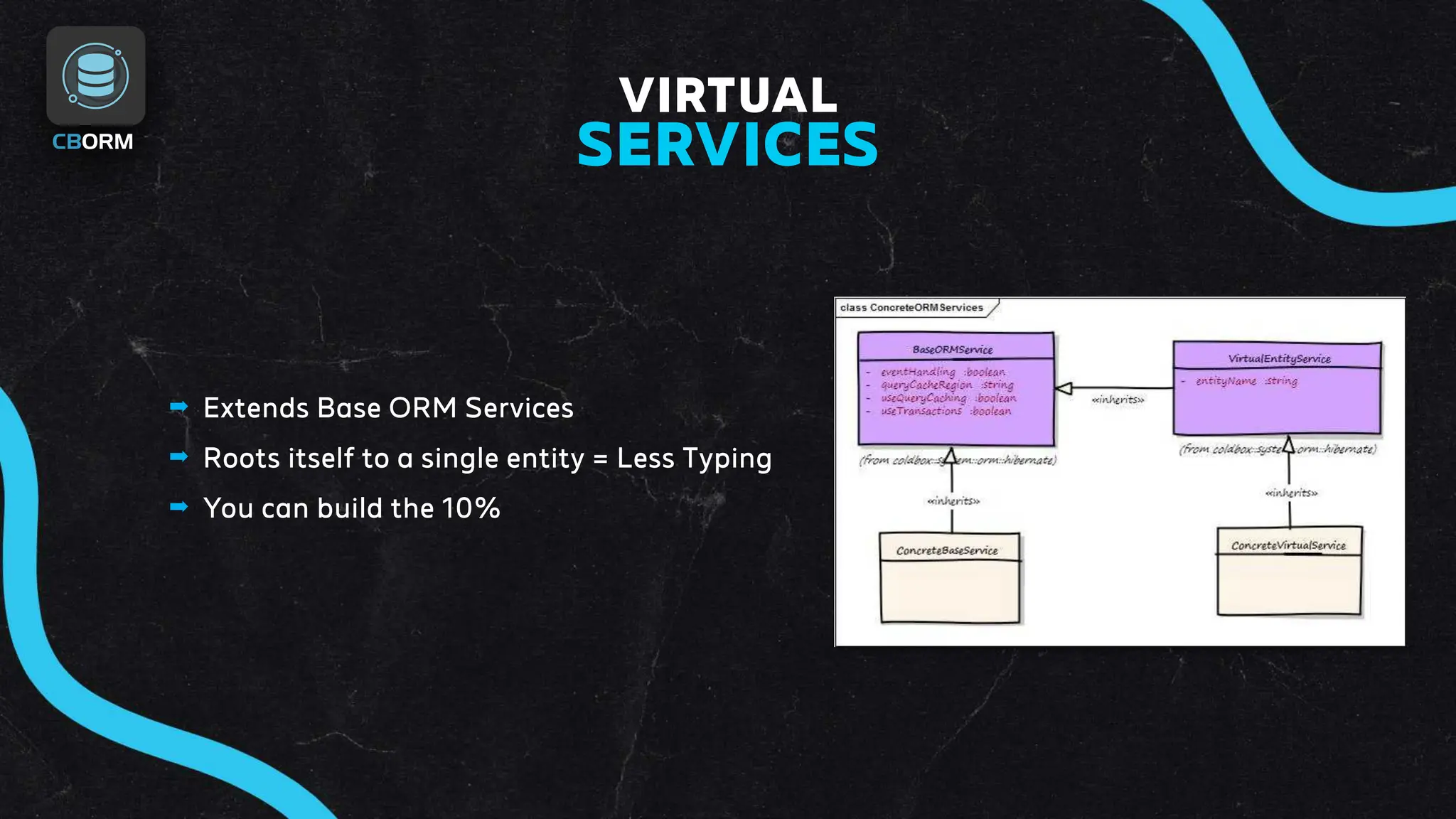
➡ Extends Base ORM Services
➡ Roots itself to a single entity = Less Typing
➡ You can build the 10%
VIRTUAL
SERVICES
➡ Active Record Pattern
➡ Sweet validation integration
➡ DI/AOP Available
ACTIVE
ENTITY
➡ Populate Entities: xml, json, queries, structs
➡ Compose relationships from simple values
➡ Null support
➡ Exclude/include fields
➡ Server-side validation
➡ Dependency Injection Listeners
➡ Custom Event-Driven Programming
Entity Populators
Validation
Event Handlers
ORM
UTILITIES
box install cartracker-demo.
ORM
SERVICES
IN ACTION
➡ count(), countWhere()
➡ delete(), deleteAll(), deleteByID(), deleteByQuery(), delete Where()
➡ evict(), evictEntity(), evictQueries()
➡ executeQuery(), list()
➡ exists()
➡ findAll(), findAllWhere(), findByExample(), findIt(), findWhere()
➡ get(), getAll(),
➡ getKey(), getPropertyNames(), getSessionStatistics(), getTableName()
➡ clear(), merge(), new(), refresh()
➡ populate(), populateFromJSON(), populateFromXML(), populateFromQuery()
➡ save(), saveAll()
BASE ORM
SERVICE
BASE ORM
SERVICE
Dynamic Finders/Counters
➡ Expressive Programming
➡ Three types of dynamic Finders/Counters
➡
fi
ndBy :
fi
nd ONE entity
➡
fi
ndAllBy :
fi
nd ALL entities
➡ countBy: Give you a count
BASE ORM
SERVICE
Dynamic Finders/Counters
➡ Conditionals
➡ LessThanEquals, LessThan
➡ GreaterThanEquals, GreaterThan
➡ Like
➡ Equal, NotEqual
➡ isNull, isNotNull
➡ Between, NotBetween
➡ inList, notInList
➡ Operators
➡ And
➡ Or
➡ Query Options
➡ ignoreCase, timeout, max, offset
➡ cacheable, cachename
AWESOME OO QUERIES
CRITERIA
BUILDER
CRITERIA
BUILDER
➡ Limitations of CF ORM:
➡ entityLoad() has limited features
➡ Some operations we always need an entity =
slow
➡ What if I want arrays, or arrays of structs
➡ Complex relationships are hard to query
➡ SQL/HQL string build is so 90’s == NOT FUN!
CRITERIA
BUILDER
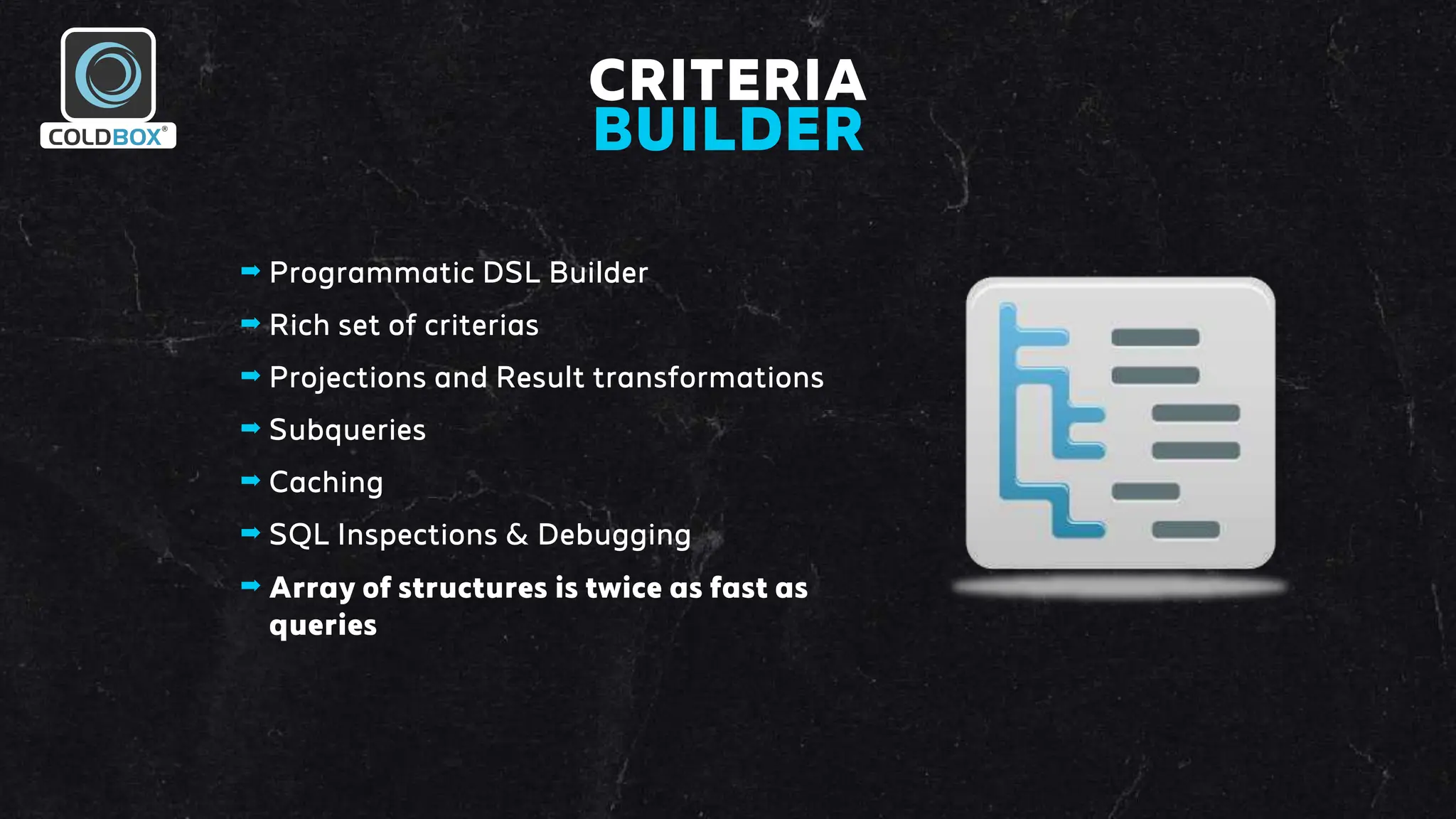
➡ Programmatic DSL Builder
➡ Rich set of criterias
➡ Projections and Result transformations
➡ Subqueries
➡ Caching
➡ SQL Inspections & Debugging
➡ Array of structures is twice as fast as
queries
CRITERIA
BUILDER
CRITERIA
BUILDER
➡ Request new criteria
➡ newCriteria()
➡ Add simple restriction(s)
➡ Find all cars sold between April and July
➡ Use between()
➡ Get results
➡ Use list( max, offset, timeout, sortOrder, ignoreCase, asQuery )
➡ Get counts
➡ Use count()
CRITERIA
BUILDER
➡ between()
➡ eq()
➡ gt()
➡ ge()
➡ gtProperty()
➡ isEmpty()
➡ isNull()
➡ ne()
➡ ilike()
➡ and()
➡ or()
➡ not()
➡ conjunction()
➡ disjunction()
➡ isTrue()
➡ isFalse()
➡ sqlRestriction()
➡ ...much more!
RESTRICTIONS
CRITERIA
BUILDER
RETRIEVALS
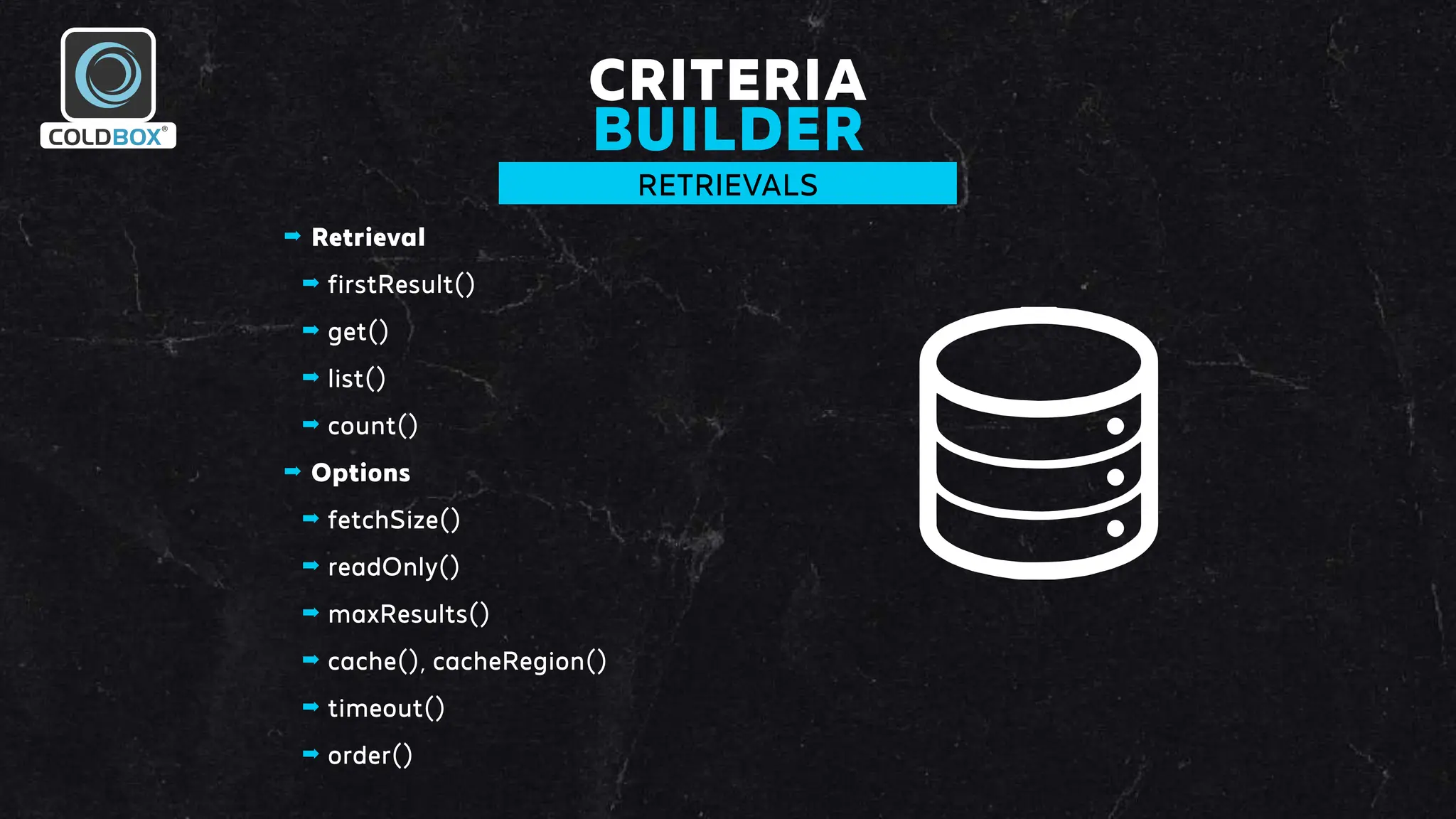
➡ Retrieval
➡ firstResult()
➡ get()
➡ list()
➡ count()
➡ Options
➡ fetchSize()
➡ readOnly()
➡ maxResults()
➡ cache(), cacheRegion()
➡ timeout()
➡ order()
CRITERIA
BUILDER
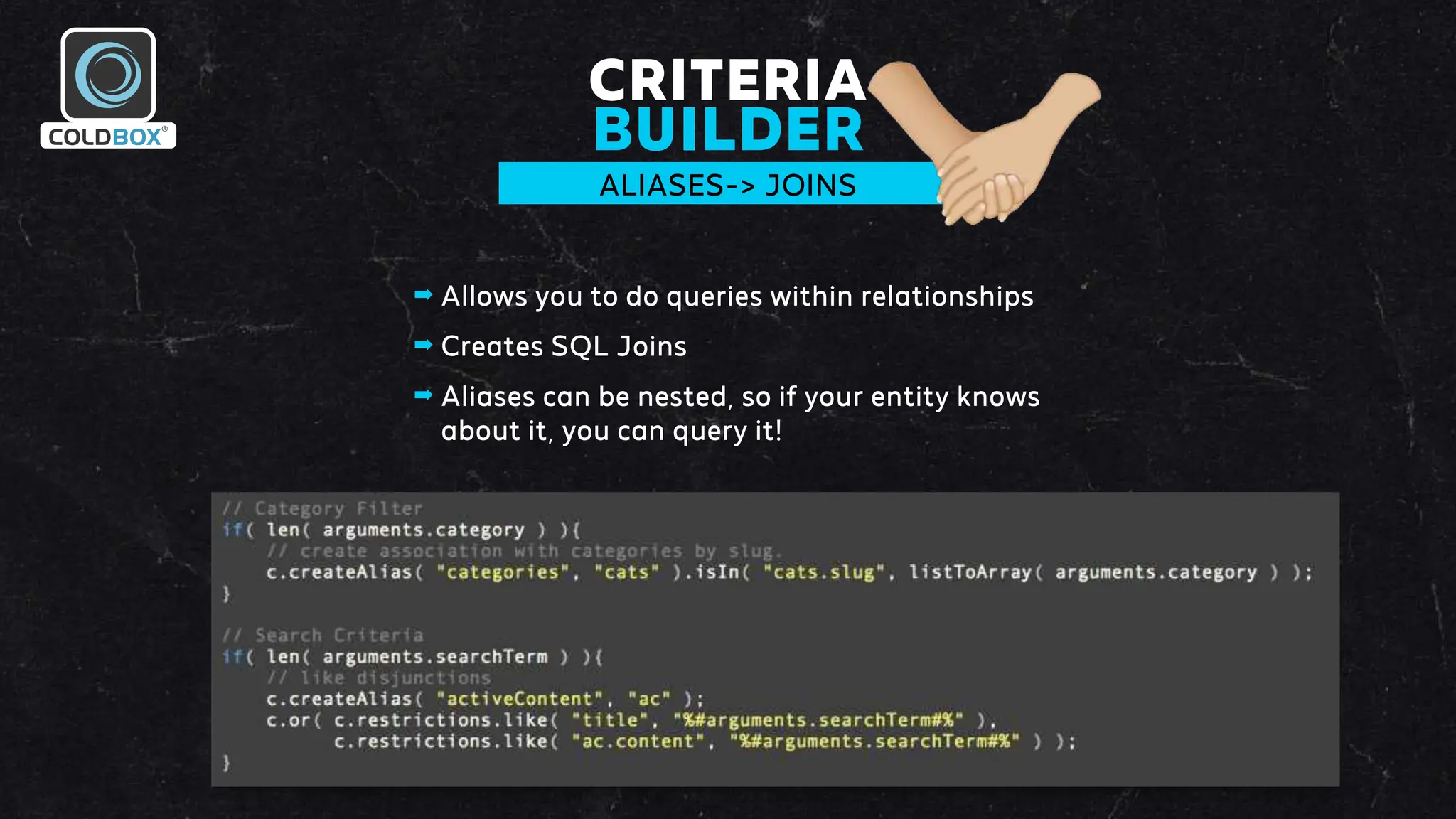
ALIASES-> JOINS
➡ Allows you to do queries within relationships
➡ Creates SQL Joins
➡ Aliases can be nested, so if your entity knows
about it, you can query it!
CRITERIA
BUILDER
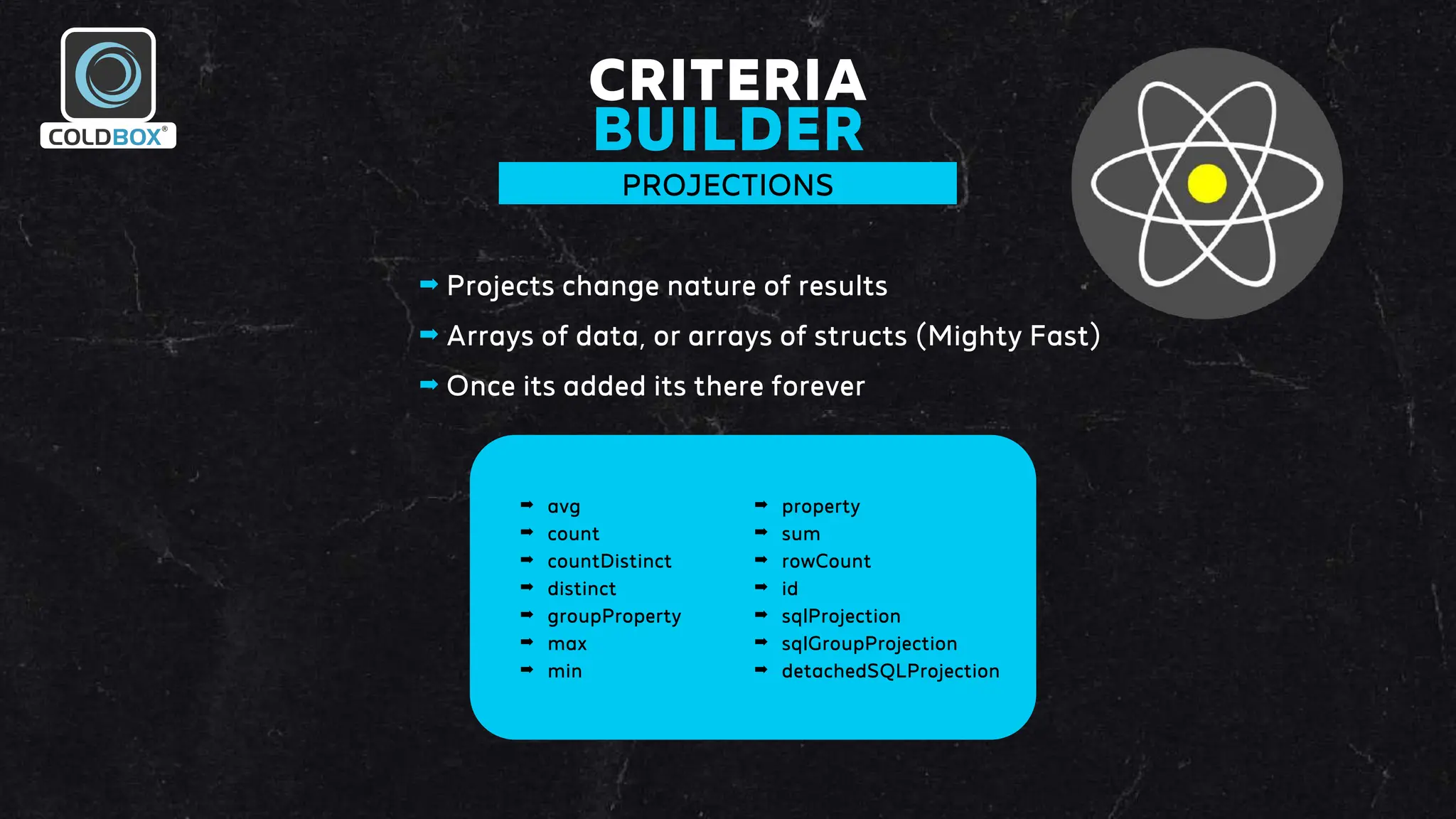
PROJECTIONS
➡ Projects change nature of results
➡ Arrays of data, or arrays of structs (Mighty Fast)
➡ Once its added its there forever
➡ avg
➡ count
➡ countDistinct
➡ distinct
➡ groupProperty
➡ max
➡ min
➡ property
➡ sum
➡ rowCount
➡ id
➡ sqlProjection
➡ sqlGroupProjection
➡ detachedSQLProjection
CRITERIA
BUILDER
DEBUGGING + LOGGING
➡ Criteria Builder SQL Inspector
➡ startSQLLog( returnExecutableSQL, formatSQL )
➡ stopSQLLog()
➡ getSQLLog()
➡ getSQL( returnExecutableSQL, formatSQL )

Luis Majano The Battlefield ORM

  • 1.
  • 2.
    @lmajano @ortussolutions • Salvadorean Born! •Imported to the USA • On-loan to Spain! • Computer Engineering • CEO of Ortus Solutions MAJANO LUIS
  • 3.
    CFCASTS by Ortus Solutions Learnfrom the makers of Coldbox, TestBox, and CommandBox through bite-size video tutorials on everything you need to modernize your CFML development. Become a CFML master! Learning Paths Real-World Examples Engaging and Interactive Regularly Updated Content Flexible Learning Extensive Course Library: Watch all new series as they are released Access to the entire back catalog You get 1 month for FREE YEARLY $275 Buy series a-la-carte Access to free videos Upgrade easily at any time COMMUNITY FREE Watch all new series as they are released Access to the entire back catalog Support Open Source Software MONTHLY $25 Why Choose CFCasts?
  • 4.
  • 5.
    ➡ How touse ORM ➡ When to use ORM ➡ Tips & Trips to master Hibernate ORM ➡ Pitfalls to avoid ➡ Architectural overviews of ORM ➡ Extend ORM Agenda
  • 6.
    ➡ Object RelationalMapper ➡ Maps: - Objects to tables - Properties to columns - Relationships to foreign keys and tables ➡ An easier way to persist data vs. boring CRUD SQL ➡ Focus on objects instead of data ➡ ColdFusion ORM (Abstraction to Hibernate/JPA) ➡ Almost Everything in Hibernate works in CF ORM What is ?
  • 7.
    ➡ Write lessboilerplate boring SQL ➡ Increase in productivity ➡ Rich Object Models ➡ Increased Flexibility ➡ Database vendor abstraction ➡ OO instead of query-based ➡ but….. BENEFITS
  • 8.
    Is it aSilver Bullet? ➡ Just another tool ➡ Times you need the power of the database: reports, legacy, sp, etc. ➡ Mix and Match ➡ There is a learning curve, but it is worth the investment ➡ What if you wanted an array of structs, list queries, or data arrays? Use it Wisely!
  • 9.
  • 10.
  • 11.
    ➡ Enabled +Configured via Application.cfc ➡ this.ormEnabled = true; ➡ this.datasource = “MyDatasource”; ➡ this.ormSettings = {} ➡ https://cfdocs.org/ormsettings ORM Activating
  • 12.
  • 13.
    BAD DEFAULTS Control Data Flushing+ Transaction Borders: ormsettings.flushAtRequestEnd = false ormsettings.autoManageSession = false Control Database Dialects (If Possible) ormsettings.dialect = “MySQLwithInnoDB”
  • 14.
    BAD DEFAULTS Control Entity Discoveryor pay the price! ormSettings.cfclocation = [ “/models”, “/ext/entities” ] Great for debugging, NOT for production! ormSettings.logSql = false
  • 15.
    Need HELP Need even moredebugging? - Build out the Hibernate MXML - Show syntax exceptions ormSettings.saveMapping = true ormSettings.skipCFCWithError = false
  • 16.
    DataBoss - github.com/coldbox-modules/databoss $>install databoss ORM Entities & Metadata Dynamic Administrator Inspect, Analyze, Scaffold Need HELP
  • 17.
    this.ormSettings = { //Restrict Entity Locations cfclocation = [ "/models" ], // Chose the DB Dialect dialect = "MySQLwithInnoDB", // Don’t inspect the database dbcreate = "none", // Active caching if needed secondarycacheenabled = false, cacheProvider = "ehCache", // Logging only in development logSQL = env == “dev” ? false : false, // Session Management: NEVER TRUE flushAtRequestEnd = false, autoManageSession = false, // Event Handling: Yes Please! eventHandling = true, eventHandler = "cborm.models.EventHandler", // Turn on/off skipping of exceptions on syntax: Maybe! skipCFCWithError = false }; ORM Settings Better
  • 18.
    Logging is yourbest friend, 4EVER!
  • 19.
    1. Application.cfc 2. ExtendedLog4jLogging this.ormSettings = { // Logging logSQL = true, }; WEB-INF/cfusion/lib/log4j.properties LOGGING
  • 20.
    ###--------------- Hibernate LogSettings ------ ### Set Hibernate log log4j.logger.org.hibernate=INFO, HIBERNATECONSOLE ### log just the SQL log4j.logger.org.hibernate.SQL=DEBUG, HIBERNATECONSOLE log4j.additivity.org.hibernate.SQL=true ### Also log the parameter binding to the prepared statements. log4j.logger.org.hibernate.type=DEBUG ### log schema export/update ### log4j.logger.org.hibernate.tool.hbm2ddl=DEBUG, HIBERNATECONSOLE ### log cache activity ### log4j.logger.org.hibernate.cache=DEBUG, HIBERNATECONSOLE #--------------------------------------------- WEB-INF/cfusion/lib/log4j.properties Log4J Logging
  • 21.
  • 22.
    ➡ ORM relationshipmodeling is key ➡ OO is required ➡ UML is your best friend ➡ STOP THINKING ABOUT DATA ➡ YOU ARE NOT MODELING A DATABASE OO Modeling is Key
  • 23.
  • 24.
    Query Object Data Data+ Behavior OO Modeling is Key
  • 25.
  • 26.
    one-to-one Student Metadata one-to-many Student Address many-to-one UserRole many-to-many User Permissions f i eldtype=“” RELATIONSHIPS
  • 27.
    ➡ Unidirectional orBidirectional ➡ Collections can be as arrays or structs ➡ Filtered Collections (Missed by devs) ➡ Performance Failures ➡ Control when they are loaded (lazyness) ➡ Control how many related entities are loaded ➡ Executing code on loading ➡ The hardest part of ORM RELATIONSHIPS
  • 28.
    ➡ one-to-many, many-to-many ➡add<relationship_property_name>(<associated_object>) ➡ boolean remove<relationship_property_name>(<associated_object>) ➡ boolean has<relationship_property_name>(<associated_object>) ➡ many-to-one, one-to-one ➡ boolean has<relationship_property_name>() • addArts( Art art ) • removeArts( Art art ) • hasArts() • hasArts( Art art ) property name=“arts" fieldtype="one-to-many" cfc="Art" fkcolumn=“ArtistID"; GENERATED METHODS
  • 29.
    YOU HAVE TOBE LAZY
  • 30.
    ➡ Immediate Fetching(Default) ➡ select with left outer join ➡ Use lazy For ALL Relationships or pay the price YOU HAVE TO BE LAZY
  • 31.
    ➡ Three typesof laziness values: lazy=“true” all relationships Loads the relationship data when the getter is called (Batches, if used) lazy=“extra” one-to-many, many-to-many Loads proxy light objects with primary keys (Event better - Batches, if used) lazy=“proxy” one-to-one, many-to-one Loads proxy with primary key (Same as above) YOU HAVE TO BE LAZY
  • 32.
    ➡ Eager Fetching ➡Mostly used in one-to-one and many-to-one, but applies to all ➡ Default uses 2 SQL queries, reduce to 1 Query property name=“role” fieldtype=“many-to-one” fetch=“join”; ➡ Batch Fetching ➡ Limits the way relationships are loaded, else Hibernate tries to load all records ➡ Used on many-to-many and one-to-many collection properties: property name=“comments” fieldtype=“one-to-many” batchsize=“10” lazy=“extra”; ➡ Used at entity level as well: component name=“Comment” batchsize=10{} YOU HAVE TO BE LAZY
  • 33.
    Oracle Tip ➡ JDBCFetch Sizes are defaulted to 10 ➡ Slow for many records or batch operations ➡ Increase the JDBC Fetch size ➡ Custom Hibernate setting hibernate.jdbc.fetch_size=100 YOU HAVE TO BE LAZY
  • 34.
    ➡ They canbe more of a headache ➡ Cascading Deletes are painful ➡ Choose the controlling relationship ➡ inverse=true ➡ Else double queries, inefficient queries ➡ Does it make sense? ➡ Supporting methods for bi-directional linkage ➡ Supporting methods for un-linkages AVOID BI-DIRECTIONAL, IF POSSIBLE!
  • 39.
  • 40.
    ➡ Not thesame as session scope ➡ A transitionary space + Caching Layer ➡ entityLoad() ➡ entityNew() ? ➡ You need to control when to send to DB ➡ transaction{}, ormflush() ➡ You can remove entities from it and clear it ➡ ORMClearSession() ➡ ORMEvictEntity(), ORMEvictCollection() ➡ ORMCloseSession() UNDERSTAND THE HIBERNATE SESSION
  • 41.
    Hibernate Session (Conversation -Request) DB Eu Ex Ez Ey Cache ehCache/ Couchbase Batched SQL EntityNew() EntityLoad() Data (!CFCs) Hibernate Session Factory (application) CRUD When? ORMClearSession() UNDERSTAND THE HIBERNATE SESSION
  • 42.
    DB Sync Insertions in order updates Collectiondeletions collectiondeletion,updates,inserts collectioninsertions deletions in order UNDERSTAND THE HIBERNATE SESSION
  • 43.
    ➡ Transactions demarcateSQL boundaries ➡ Important Imperative for ORM + SQL ➡ No communication to DB should occur without one ➡ Reactive programming, expect the worst ➡ cftransaction or Hibernate raw transactions TRANSACTION DEMARCATION
  • 44.
    ➡ Transaction Theory: ➡Any existing ORM session is flushed and reused ➡ Data can be committed or rollback ➡ ORMFlush() is ignored in transactions ➡ If commit, then flushed to database ➡ If rollback, session is cleared TRANSACTION DEMARCATION
  • 45.
  • 46.
  • 47.
    ➡ Don’t doit! ➡ Breaks the link to the Hibernate Session ➡ Relationships will fail if not lazy loaded ➡ entityMerge() ➡ Store ID’s or data instead, then inflate the entities AVOID SCOPING ENTITIES
  • 48.
    ➡ #1 PerformanceProblem ➡ Identify relationships ➡ Identify HQL, SQL ➡ Create indexes! DATABASE INDEXES
  • 49.
    ➡ Don’t gocache crazy, develop a strategy ➡ Misconception: Does not store CFC ➡ Stores individual property values ➡ Use distributed caches: ehcache, couchbase, redis ➡ You can cache: ➡ Entity property data : Only caches properties data values ➡ Entity association data : Only caches primary keys ➡ Query data : HQL, ORMExecuteQuery() ➡ Evictions: ➡ ORMEvictEntity(), ORMEvictCollection() CACHE BOOSTING
  • 50.
  • 51.
  • 52.
    ➡ The fastestgun in the galaxy! ➡ Return array of structs ➡ Why a full ORM Object graph? ➡ Boost your APIs, stop converting queries/ array of objects to JSON HQL MAPS
  • 53.
  • 55.
    When is HappyBox? ORMwas fast Extensible way to finish the remaining 20% CF ORM was easier to use? 80% of API Querying OO way to query Auto build relationships ORM THOUGHTS?
  • 56.
    Base ORM Service VirtualORM Service Active Entity Entity Populators Validation Event Handlers DI/AOP OVERVIEW
  • 57.
    ➡ Service layerfor any entity ➡ OO Querying, caching, transactions ➡ Dynamic finders, getters, counters ➡ Object metadata & session management ➡ Exposes more features from Hibernate ➡ 90% Foundation BASE ORM SERVICE
  • 58.
    ➡ Extends BaseORM Services ➡ Roots itself to a single entity = Less Typing ➡ You can build the 10% VIRTUAL SERVICES
  • 59.
    ➡ Active RecordPattern ➡ Sweet validation integration ➡ DI/AOP Available ACTIVE ENTITY
  • 60.
    ➡ Populate Entities:xml, json, queries, structs ➡ Compose relationships from simple values ➡ Null support ➡ Exclude/include fields ➡ Server-side validation ➡ Dependency Injection Listeners ➡ Custom Event-Driven Programming Entity Populators Validation Event Handlers ORM UTILITIES
  • 61.
  • 62.
    ➡ count(), countWhere() ➡delete(), deleteAll(), deleteByID(), deleteByQuery(), delete Where() ➡ evict(), evictEntity(), evictQueries() ➡ executeQuery(), list() ➡ exists() ➡ findAll(), findAllWhere(), findByExample(), findIt(), findWhere() ➡ get(), getAll(), ➡ getKey(), getPropertyNames(), getSessionStatistics(), getTableName() ➡ clear(), merge(), new(), refresh() ➡ populate(), populateFromJSON(), populateFromXML(), populateFromQuery() ➡ save(), saveAll() BASE ORM SERVICE
  • 63.
    BASE ORM SERVICE Dynamic Finders/Counters ➡Expressive Programming ➡ Three types of dynamic Finders/Counters ➡ fi ndBy : fi nd ONE entity ➡ fi ndAllBy : fi nd ALL entities ➡ countBy: Give you a count
  • 64.
    BASE ORM SERVICE Dynamic Finders/Counters ➡Conditionals ➡ LessThanEquals, LessThan ➡ GreaterThanEquals, GreaterThan ➡ Like ➡ Equal, NotEqual ➡ isNull, isNotNull ➡ Between, NotBetween ➡ inList, notInList ➡ Operators ➡ And ➡ Or ➡ Query Options ➡ ignoreCase, timeout, max, offset ➡ cacheable, cachename
  • 65.
  • 66.
    CRITERIA BUILDER ➡ Limitations ofCF ORM: ➡ entityLoad() has limited features ➡ Some operations we always need an entity = slow ➡ What if I want arrays, or arrays of structs ➡ Complex relationships are hard to query ➡ SQL/HQL string build is so 90’s == NOT FUN!
  • 67.
    CRITERIA BUILDER ➡ Programmatic DSLBuilder ➡ Rich set of criterias ➡ Projections and Result transformations ➡ Subqueries ➡ Caching ➡ SQL Inspections & Debugging ➡ Array of structures is twice as fast as queries
  • 68.
  • 69.
    CRITERIA BUILDER ➡ Request newcriteria ➡ newCriteria() ➡ Add simple restriction(s) ➡ Find all cars sold between April and July ➡ Use between() ➡ Get results ➡ Use list( max, offset, timeout, sortOrder, ignoreCase, asQuery ) ➡ Get counts ➡ Use count()
  • 70.
    CRITERIA BUILDER ➡ between() ➡ eq() ➡gt() ➡ ge() ➡ gtProperty() ➡ isEmpty() ➡ isNull() ➡ ne() ➡ ilike() ➡ and() ➡ or() ➡ not() ➡ conjunction() ➡ disjunction() ➡ isTrue() ➡ isFalse() ➡ sqlRestriction() ➡ ...much more! RESTRICTIONS
  • 71.
    CRITERIA BUILDER RETRIEVALS ➡ Retrieval ➡ firstResult() ➡get() ➡ list() ➡ count() ➡ Options ➡ fetchSize() ➡ readOnly() ➡ maxResults() ➡ cache(), cacheRegion() ➡ timeout() ➡ order()
  • 72.
    CRITERIA BUILDER ALIASES-> JOINS ➡ Allowsyou to do queries within relationships ➡ Creates SQL Joins ➡ Aliases can be nested, so if your entity knows about it, you can query it!
  • 73.
    CRITERIA BUILDER PROJECTIONS ➡ Projects changenature of results ➡ Arrays of data, or arrays of structs (Mighty Fast) ➡ Once its added its there forever ➡ avg ➡ count ➡ countDistinct ➡ distinct ➡ groupProperty ➡ max ➡ min ➡ property ➡ sum ➡ rowCount ➡ id ➡ sqlProjection ➡ sqlGroupProjection ➡ detachedSQLProjection
  • 74.
    CRITERIA BUILDER DEBUGGING + LOGGING ➡Criteria Builder SQL Inspector ➡ startSQLLog( returnExecutableSQL, formatSQL ) ➡ stopSQLLog() ➡ getSQLLog() ➡ getSQL( returnExecutableSQL, formatSQL )