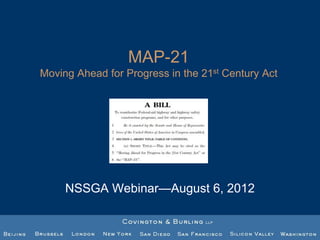
MAP-21
Moving Ahead for Progress in the 21st Century Act


     NSSGA Webinar—August 6, 2012
Presentation

• Post-Enactment Takeaways

• MAP-21
  – Funding/Financing
  – Policy


• Future


                              2
Post-Enactment Takeaways

• Lack of support
   – New members
   – Even members with history of support


• Devolution
   – More interest than ever
   – Growing concern
   – MAP-21 referred to as “devolution lite”


• Why?
                                               3
Loss of Credibility
•   Earmarks
    – Thousands of earmarks; “bridge to nowhere”


•   Enhancements
    – Museums; bike paths


•   No clear Federal mission

•   Project delivery
    – 12 to 15 years
    – States avoid using Federal dollars on complex projects


•   “There is plenty of money to meet legitimate transportation needs if
    you just stopped wasting it on bad or low priority projects”

                                                                           4
Are we……


Building America’s Future?   Handing Out Pork?


                                                 5
Financing Problems
• HTF being sustained by general fund infusions
   – $35 billion prior to MAP-21


• No appetite for user fee increase
   – Real source of the discontent?


• Opposition to further general fund bailout
   – “At time of large deficits, we cannot afford a general fund bailout”
   – “HTF should live within its means”


• Offsets
   – “Offsets, if available, should be used to reduce deficit”
   – Spending should be offset in same year—”shouldn’t use 10 years of
     offsets to pay for 2 years of spending”
                                                                            6
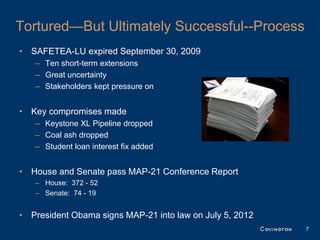
Tortured—But Ultimately Successful--Process
• SAFETEA-LU expired September 30, 2009
   – Ten short-term extensions
   – Great uncertainty
   – Stakeholders kept pressure on


• Key compromises made
   – Keystone XL Pipeline dropped
   – Coal ash dropped
   – Student loan interest fix added


• House and Senate pass MAP-21 Conference Report
   – House: 372 - 52
   – Senate: 74 - 19


• President Obama signs MAP-21 into law on July 5, 2012
                                                          7
MAP-21*


                   Funding / Financing


                              Policy


* Effective Date: 10/1/2012
                                         8
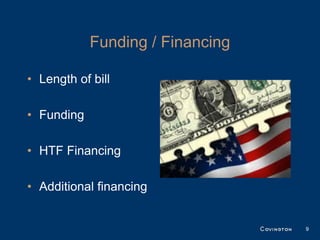
Funding / Financing

• Length of bill

• Funding

• HTF Financing

• Additional financing


                                  9
Length of Bill

• House: December 31, 2012

• Senate: September 30, 2013

• MAP-21: September 30, 2014
  – Remainder of FY 2012
  – FY 2013
  – FY 2014

                                10
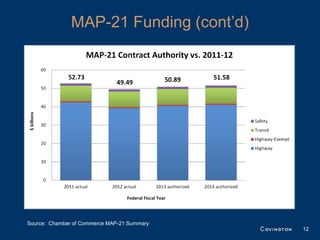
MAP-21 Funding

• MAP-21 extends funding for the remaining
  three months of FY 2012

• MAP-21 authorizes a total of about $105
  billion for highways, highway safety, and
  transit for FYs 2013 and 2014

• Funding for FY 2013 and 2014 is—
  – Slightly higher than FY 2012, BUT
  – Slightly below the SAFETEA-LU FY 2009 level
                                                  11
MAP-21 Funding (cont’d)


Source: Chamber of Commerce MAP-21 Summary
                                             12
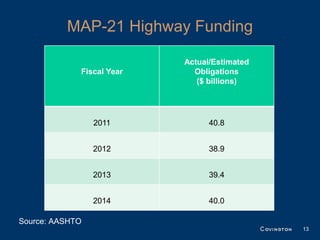
MAP-21 Highway Funding

                           Actual/Estimated
             Fiscal Year     Obligations
                              ($ billions)


                 2011            40.8


                 2012            38.9


                 2013            39.4


                 2014            40.0

Source: AASHTO
                                              13
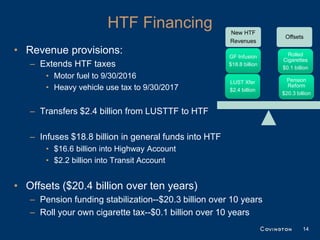
HTF Financing                  New HTF
                                                                        Offsets
                                                       Revenues
• Revenue provisions:                                  GF Infusion       Rolled
                                                                       Cigarettes
   – Extends HTF taxes                                 $18.8 billion
                                                                       $0.1 billion
       • Motor fuel to 9/30/2016                                         Pension
                                                       LUST Xfer
       • Heavy vehicle use tax to 9/30/2017            $2.4 billion
                                                                         Reform
                                                                       $20.3 billion


   – Transfers $2.4 billion from LUSTTF to HTF

   – Infuses $18.8 billion in general funds into HTF
       • $16.6 billion into Highway Account
       • $2.2 billion into Transit Account


• Offsets ($20.4 billion over ten years)
   – Pension funding stabilization--$20.3 billion over 10 years
   – Roll your own cigarette tax--$0.1 billion over 10 years
                                                                                14
Additional Resources


• Projects of National and Regional Significance

• TIFIA Program

• Expanded Interstate Tolling


                                                   15
Projects of National and Regional Significance

 • Continues SAFETEA-LU discretionary grant program, with
   modifications, for one year
    – Broadens entities eligible to apply
    – Adds congressional disapproval process


 • Authorizations from general funds:
    – FY 2013: $500 million
    – FY 2014: $0


 • No funding unless appropriated

 • DOT report in two years


                                                            16
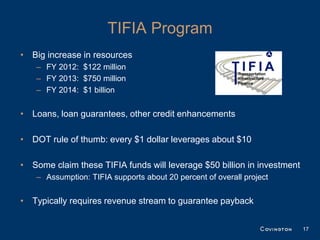
TIFIA Program
• Big increase in resources
    – FY 2012: $122 million
    – FY 2013: $750 million
    – FY 2014: $1 billion


• Loans, loan guarantees, other credit enhancements

• DOT rule of thumb: every $1 dollar leverages about $10

• Some claim these TIFIA funds will leverage $50 billion in investment
    – Assumption: TIFIA supports about 20 percent of overall project


• Typically requires revenue stream to guarantee payback


                                                                         17
Expanded Interstate Tolling

• States may now construct new toll lanes on existing
  Interstates provided that the number of toll-free lanes
  remains the same

• Authorized uses of revenue broadened
   – Troubling: “any other purpose for which Federal funds may
     be obligated by a State”


• Promotes interoperability between states


                                                                 18
Policy Reforms
• Programmatic Reform
  –   Consolidation
  –   Formulas
  –   Earmarks
  –   Enhancements
  –   Freight


• Performance Management

• Streamlining
                                19
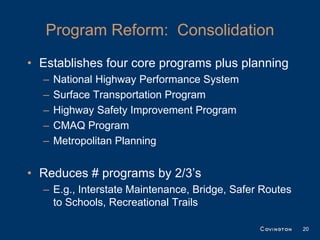
Program Reform: Consolidation
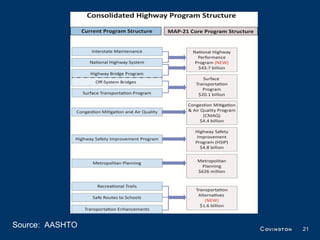
• Establishes four core programs plus planning
  –   National Highway Performance System
  –   Surface Transportation Program
  –   Highway Safety Improvement Program
  –   CMAQ Program
  –   Metropolitan Planning


• Reduces # programs by 2/3’s
  – E.g., Interstate Maintenance, Bridge, Safer Routes
    to Schools, Recreational Trails

                                                         20
Source: AASHTO   21
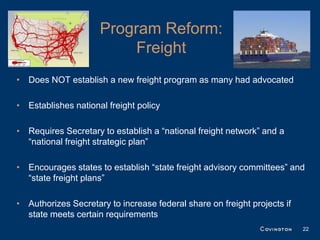
Program Reform:
                         Freight
• Does NOT establish a new freight program as many had advocated

• Establishes national freight policy

• Requires Secretary to establish a “national freight network” and a
  “national freight strategic plan”

• Encourages states to establish “state freight advisory committees” and
  “state freight plans”

• Authorizes Secretary to increase federal share on freight projects if
  state meets certain requirements
                                                                          22
Program Reform: Formulas
• 1. Authorize lump sum for core programs

• 2. Calculate each state’s share
   – FY 2013: virtually same as FY 2012
   – FY 2014: virtually same as FY 2012 except adjusted to assure 95
     percent rate of return


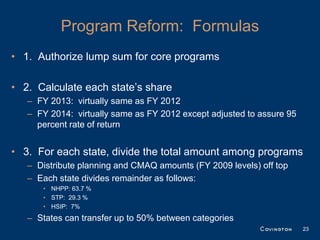
• 3. For each state, divide the total amount among programs
   – Distribute planning and CMAQ amounts (FY 2009 levels) off top
   – Each state divides remainder as follows:
      • NHPP: 63.7 %
      • STP: 29.3 %
      • HSIP: 7%
   – States can transfer up to 50% between categories
                                                                       23
Program Reform: Earmarks

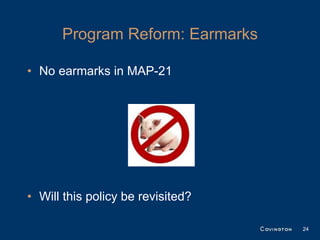
• No earmarks in MAP-21


• Will this policy be revisited?

                                   24
Reform: Transportation Enhancements

       •   “Transportation alternatives”
            – 2% set-aside
            – 50% states; 50% locals


       •   Some estimate funding reduced by 33%
           or more

       •   Reduced eligibility
            – E.g., museums, landscaping


       • New eligibility
            – E.g., safer routes to schools, overlooks


       •   Options included to allow state flexibility
           in use of these funds and opt-out
                                                         25
Reform: Performance Management
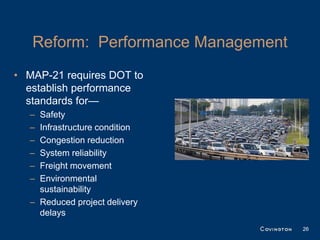
• MAP-21 requires DOT to
  establish performance
  standards for—
  – Safety
  – Infrastructure condition
  – Congestion reduction
  – System reliability
  – Freight movement
  – Environmental
    sustainability
  – Reduced project delivery
    delays
                                    26
Reform: Performance Management
• DOT must establish performance standards within 18 months
   – Must consult with states, MPOs, transit agencies, and stakeholders


• States must establish performance targets within one year after
  DOT establishes performance standards
   – Must coordinate with MPOs and transit agencies


• MPOs must establish performance targets within 180 days after
  state adopts performance targets
   – Must coordinate with state and transit agencies


• Performance measures and targets must be incorporated into
  long-range planning and short-term programming processes


                                                                          27
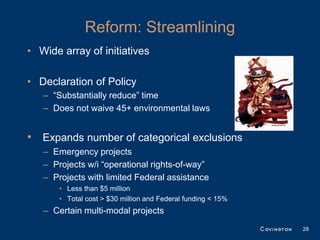
Reform: Streamlining
• Wide array of initiatives

• Declaration of Policy
   – “Substantially reduce” time
   – Does not waive 45+ environmental laws


• Expands number of categorical exclusions
   – Emergency projects
   – Projects w/i “operational rights-of-way”
   – Projects with limited Federal assistance
       • Less than $5 million
       • Total cost > $30 million and Federal funding < 15%
   – Certain multi-modal projects
                                                              28
Reform: Streamlining (cont’d)

• Expands flexibility to undertake activities prior to the
  completion of NEPA
   – Acquisition of real property
   – Design
   – Enter into CM/GC two-phased contracts


• Expanded delegation
   – Makes five-state pilot a permanent program
   – Expands to include rail, transit and multi-modal projects


                                                                 29
Reform: Streamlining (cont’d)

• Encourages programmatic approaches
  – Allows states or MPOs to develop programmatic
    mitigation plans
  – DOT must conduct rulemaking to allow
    programmatic approaches to the environmental
    review process


                                                    30
Reform: Streamlining (cont’d)
• Other Process Reforms
  – New issue resolution procedures that allow for
    elevation
  – Resource agency deadlines for review
  – Program to complete some ongoing EISs for
    complex projects within 4 years (only available for
    EISs that have been under way for at least 2 years
  – Resource agency financial penalties for failure to
    meet deadlines


                                                          31
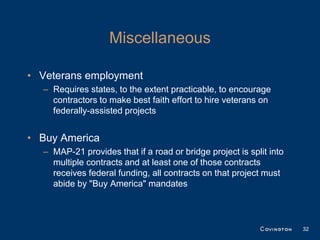
Miscellaneous

• Veterans employment
  – Requires states, to the extent practicable, to encourage
    contractors to make best faith effort to hire veterans on
    federally-assisted projects


• Buy America
  – MAP-21 provides that if a road or bridge project is split into
    multiple contracts and at least one of those contracts
    receives federal funding, all contracts on that project must
    abide by "Buy America" mandates


                                                                     32
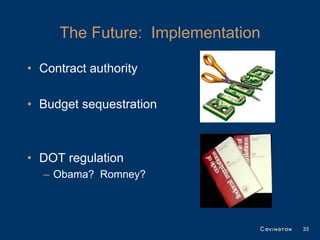
The Future: Implementation

• Contract authority

• Budget sequestration


• DOT regulation
  – Obama? Romney?


                                  33
The Future: Reauthorization

• Right around the corner……
   – Program expires September 30, 2014


• Have reforms worked?

• Significant challenges


                                          34
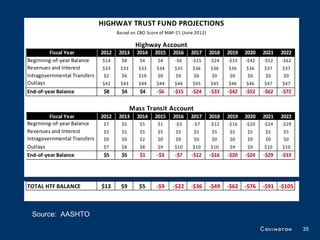
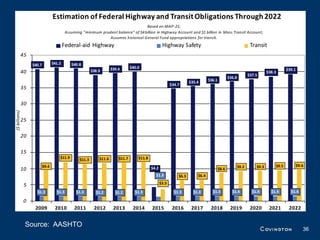
Source: AASHTO

                 35
Source: AASHTO
                 36
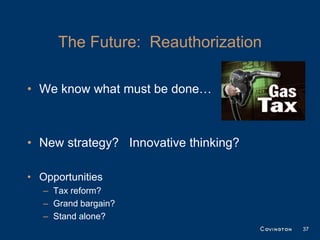
The Future: Reauthorization

• We know what must be done…


• New strategy? Innovative thinking?

• Opportunities
   – Tax reform?
   – Grand bargain?
   – Stand alone?
                                       37

MAP-21: What's in it for my business? presented by Jack Schenendorf

  • 1.
    MAP-21 Moving Ahead forProgress in the 21st Century Act NSSGA Webinar—August 6, 2012
  • 2.
    Presentation • Post-Enactment Takeaways •MAP-21 – Funding/Financing – Policy • Future 2
  • 3.
    Post-Enactment Takeaways • Lackof support – New members – Even members with history of support • Devolution – More interest than ever – Growing concern – MAP-21 referred to as “devolution lite” • Why? 3
  • 4.
    Loss of Credibility • Earmarks – Thousands of earmarks; “bridge to nowhere” • Enhancements – Museums; bike paths • No clear Federal mission • Project delivery – 12 to 15 years – States avoid using Federal dollars on complex projects • “There is plenty of money to meet legitimate transportation needs if you just stopped wasting it on bad or low priority projects” 4
  • 5.
    Are we…… Building America’sFuture? Handing Out Pork? 5
  • 6.
    Financing Problems • HTFbeing sustained by general fund infusions – $35 billion prior to MAP-21 • No appetite for user fee increase – Real source of the discontent? • Opposition to further general fund bailout – “At time of large deficits, we cannot afford a general fund bailout” – “HTF should live within its means” • Offsets – “Offsets, if available, should be used to reduce deficit” – Spending should be offset in same year—”shouldn’t use 10 years of offsets to pay for 2 years of spending” 6
  • 7.
    Tortured—But Ultimately Successful--Process •SAFETEA-LU expired September 30, 2009 – Ten short-term extensions – Great uncertainty – Stakeholders kept pressure on • Key compromises made – Keystone XL Pipeline dropped – Coal ash dropped – Student loan interest fix added • House and Senate pass MAP-21 Conference Report – House: 372 - 52 – Senate: 74 - 19 • President Obama signs MAP-21 into law on July 5, 2012 7
  • 8.
    MAP-21* Funding / Financing Policy * Effective Date: 10/1/2012 8
  • 9.
    Funding / Financing •Length of bill • Funding • HTF Financing • Additional financing 9
  • 10.
    Length of Bill •House: December 31, 2012 • Senate: September 30, 2013 • MAP-21: September 30, 2014 – Remainder of FY 2012 – FY 2013 – FY 2014 10
  • 11.
    MAP-21 Funding • MAP-21extends funding for the remaining three months of FY 2012 • MAP-21 authorizes a total of about $105 billion for highways, highway safety, and transit for FYs 2013 and 2014 • Funding for FY 2013 and 2014 is— – Slightly higher than FY 2012, BUT – Slightly below the SAFETEA-LU FY 2009 level 11
  • 12.
    MAP-21 Funding (cont’d) Source:Chamber of Commerce MAP-21 Summary 12
  • 13.
    MAP-21 Highway Funding Actual/Estimated Fiscal Year Obligations ($ billions) 2011 40.8 2012 38.9 2013 39.4 2014 40.0 Source: AASHTO 13
  • 14.
    HTF Financing New HTF Offsets Revenues • Revenue provisions: GF Infusion Rolled Cigarettes – Extends HTF taxes $18.8 billion $0.1 billion • Motor fuel to 9/30/2016 Pension LUST Xfer • Heavy vehicle use tax to 9/30/2017 $2.4 billion Reform $20.3 billion – Transfers $2.4 billion from LUSTTF to HTF – Infuses $18.8 billion in general funds into HTF • $16.6 billion into Highway Account • $2.2 billion into Transit Account • Offsets ($20.4 billion over ten years) – Pension funding stabilization--$20.3 billion over 10 years – Roll your own cigarette tax--$0.1 billion over 10 years 14
  • 15.
    Additional Resources • Projectsof National and Regional Significance • TIFIA Program • Expanded Interstate Tolling 15
  • 16.
    Projects of Nationaland Regional Significance • Continues SAFETEA-LU discretionary grant program, with modifications, for one year – Broadens entities eligible to apply – Adds congressional disapproval process • Authorizations from general funds: – FY 2013: $500 million – FY 2014: $0 • No funding unless appropriated • DOT report in two years 16
  • 17.
    TIFIA Program • Bigincrease in resources – FY 2012: $122 million – FY 2013: $750 million – FY 2014: $1 billion • Loans, loan guarantees, other credit enhancements • DOT rule of thumb: every $1 dollar leverages about $10 • Some claim these TIFIA funds will leverage $50 billion in investment – Assumption: TIFIA supports about 20 percent of overall project • Typically requires revenue stream to guarantee payback 17
  • 18.
    Expanded Interstate Tolling •States may now construct new toll lanes on existing Interstates provided that the number of toll-free lanes remains the same • Authorized uses of revenue broadened – Troubling: “any other purpose for which Federal funds may be obligated by a State” • Promotes interoperability between states 18
  • 19.
    Policy Reforms • ProgrammaticReform – Consolidation – Formulas – Earmarks – Enhancements – Freight • Performance Management • Streamlining 19
  • 20.
    Program Reform: Consolidation •Establishes four core programs plus planning – National Highway Performance System – Surface Transportation Program – Highway Safety Improvement Program – CMAQ Program – Metropolitan Planning • Reduces # programs by 2/3’s – E.g., Interstate Maintenance, Bridge, Safer Routes to Schools, Recreational Trails 20
  • 21.
  • 22.
    Program Reform: Freight • Does NOT establish a new freight program as many had advocated • Establishes national freight policy • Requires Secretary to establish a “national freight network” and a “national freight strategic plan” • Encourages states to establish “state freight advisory committees” and “state freight plans” • Authorizes Secretary to increase federal share on freight projects if state meets certain requirements 22
  • 23.
    Program Reform: Formulas •1. Authorize lump sum for core programs • 2. Calculate each state’s share – FY 2013: virtually same as FY 2012 – FY 2014: virtually same as FY 2012 except adjusted to assure 95 percent rate of return • 3. For each state, divide the total amount among programs – Distribute planning and CMAQ amounts (FY 2009 levels) off top – Each state divides remainder as follows: • NHPP: 63.7 % • STP: 29.3 % • HSIP: 7% – States can transfer up to 50% between categories 23
  • 24.
    Program Reform: Earmarks •No earmarks in MAP-21 • Will this policy be revisited? 24
  • 25.
    Reform: Transportation Enhancements • “Transportation alternatives” – 2% set-aside – 50% states; 50% locals • Some estimate funding reduced by 33% or more • Reduced eligibility – E.g., museums, landscaping • New eligibility – E.g., safer routes to schools, overlooks • Options included to allow state flexibility in use of these funds and opt-out 25
  • 26.
    Reform: Performance Management •MAP-21 requires DOT to establish performance standards for— – Safety – Infrastructure condition – Congestion reduction – System reliability – Freight movement – Environmental sustainability – Reduced project delivery delays 26
  • 27.
    Reform: Performance Management •DOT must establish performance standards within 18 months – Must consult with states, MPOs, transit agencies, and stakeholders • States must establish performance targets within one year after DOT establishes performance standards – Must coordinate with MPOs and transit agencies • MPOs must establish performance targets within 180 days after state adopts performance targets – Must coordinate with state and transit agencies • Performance measures and targets must be incorporated into long-range planning and short-term programming processes 27
  • 28.
    Reform: Streamlining • Widearray of initiatives • Declaration of Policy – “Substantially reduce” time – Does not waive 45+ environmental laws • Expands number of categorical exclusions – Emergency projects – Projects w/i “operational rights-of-way” – Projects with limited Federal assistance • Less than $5 million • Total cost > $30 million and Federal funding < 15% – Certain multi-modal projects 28
  • 29.
    Reform: Streamlining (cont’d) •Expands flexibility to undertake activities prior to the completion of NEPA – Acquisition of real property – Design – Enter into CM/GC two-phased contracts • Expanded delegation – Makes five-state pilot a permanent program – Expands to include rail, transit and multi-modal projects 29
  • 30.
    Reform: Streamlining (cont’d) •Encourages programmatic approaches – Allows states or MPOs to develop programmatic mitigation plans – DOT must conduct rulemaking to allow programmatic approaches to the environmental review process 30
  • 31.
    Reform: Streamlining (cont’d) •Other Process Reforms – New issue resolution procedures that allow for elevation – Resource agency deadlines for review – Program to complete some ongoing EISs for complex projects within 4 years (only available for EISs that have been under way for at least 2 years – Resource agency financial penalties for failure to meet deadlines 31
  • 32.
    Miscellaneous • Veterans employment – Requires states, to the extent practicable, to encourage contractors to make best faith effort to hire veterans on federally-assisted projects • Buy America – MAP-21 provides that if a road or bridge project is split into multiple contracts and at least one of those contracts receives federal funding, all contracts on that project must abide by "Buy America" mandates 32
  • 33.
    The Future: Implementation •Contract authority • Budget sequestration • DOT regulation – Obama? Romney? 33
  • 34.
    The Future: Reauthorization •Right around the corner…… – Program expires September 30, 2014 • Have reforms worked? • Significant challenges 34
  • 35.
  • 36.
  • 37.
    The Future: Reauthorization •We know what must be done… • New strategy? Innovative thinking? • Opportunities – Tax reform? – Grand bargain? – Stand alone? 37