Vijaya is a Healthcare Expert at Nalashaa and has experience in
business transformation, payer-provider integration, product
design & implementation and healthcare system evaluation &
selection. She has been actively involved in Meaningful Use,
PQRS, HHVBP, CPC+, CCM and MACRA implementations and
has extensive exposure to Clinical and Financial areas of the US
healthcare ecosystem.
Vijayalaxmi Kudekar
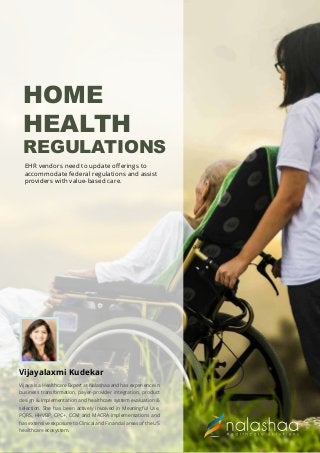
HOME
HEALTH
REGULATIONS
EHR vendors need to update offerings to
accommodate federal regulations and assist
providers with value-based care.
Overview
Starting January 1 2020, the Home Health Prospective Payment
System (HH PPS) may have a drastic change, which proposes
case-mix methodology refinements and parameters are defined
under the rule released last year for Home Health Grouping model
(HHGM).
This proposed rule; also called the Patient-Driven Groupings
Model for Medicare home health payments, primarily relies on
patient needs, rather than a therapy threshold to determine the
reimbursement. It helps advance the Trump Administration’s
Meaningful Measures initiative which represents a new approach
to quality measures that foster operational efficiencies, and
reduce costs of collection and reporting during quality measure-
ment.
As per the press release by CMS, the cost impact related to the
updated data collection processes is estimated to result in a net
$60 million in annualized cost savings to HHAs, or $5,150 in
annualized cost savings per HHA. This is because of the proposed
implementation of PDGM and the proposed changes to HH QRP
that will be effective from the beginning of the CY 2020.
Major highlights of the rule
Case-Mix Adjustment changes – including a change
in the unit of payment from a 60-day episode of care
to a 30-day episode of care.
Introduction of Home Infusion therapy - includes
“Remote Patient Monitoring” cost under Medicare
home health benefit
Changes in the Home Health Value Based Purchas-
ing (HHVBP) model
Changes in the Home Health Quality Reporting
Program (HHQRP) requirements
Promotion of Health Information Exchange
01
02
03
04
05
1 Copyright © 2018 Nalashaa
Conclusion
While technology isn’t the complete solution for problems that HHAs face, it is certainly an
important lever that can be used to overcome their challenges while staying compliant with
regulations. It’s true that HHAs know their context and business better and understand the chal-
lenges too. However, many a time in the past, several industries have solved their challenges in
unconventional ways borrowing ideas or concepts from entirely disconnected industries.
Perhaps, new standardization and compliance requirements will help HHAs with interoperability
and quality of care for patients and reduce the burden of different regulatory submissions.
If you would like to bounce off your thoughts on this,
let’s have a conversation.
Connect with
the experts!
At Nalashaa, we partner with healthcare organizations of all stages, from startups to established firms, and work with them to build
engaging user experiences that reduce organizational cost and risk. Our healthcare and technology expertise, along with our flexible
engagement models, make us a great fit for developing the quality technology while reducing time to market and engineering costs.
About Us
555 US Highway 1 South, Suite 170, Iselin, NJ 08830, USA
732-602-2560 X 200 www.nalashaahealth.com
Reach Us:

Home health E-book

  • 1.
    Vijaya is aHealthcare Expert at Nalashaa and has experience in business transformation, payer-provider integration, product design & implementation and healthcare system evaluation & selection. She has been actively involved in Meaningful Use, PQRS, HHVBP, CPC+, CCM and MACRA implementations and has extensive exposure to Clinical and Financial areas of the US healthcare ecosystem. Vijayalaxmi Kudekar HOME HEALTH REGULATIONS EHR vendors need to update offerings to accommodate federal regulations and assist providers with value-based care.
  • 2.
    Overview Starting January 12020, the Home Health Prospective Payment System (HH PPS) may have a drastic change, which proposes case-mix methodology refinements and parameters are defined under the rule released last year for Home Health Grouping model (HHGM). This proposed rule; also called the Patient-Driven Groupings Model for Medicare home health payments, primarily relies on patient needs, rather than a therapy threshold to determine the reimbursement. It helps advance the Trump Administration’s Meaningful Measures initiative which represents a new approach to quality measures that foster operational efficiencies, and reduce costs of collection and reporting during quality measure- ment. As per the press release by CMS, the cost impact related to the updated data collection processes is estimated to result in a net $60 million in annualized cost savings to HHAs, or $5,150 in annualized cost savings per HHA. This is because of the proposed implementation of PDGM and the proposed changes to HH QRP that will be effective from the beginning of the CY 2020. Major highlights of the rule Case-Mix Adjustment changes – including a change in the unit of payment from a 60-day episode of care to a 30-day episode of care. Introduction of Home Infusion therapy - includes “Remote Patient Monitoring” cost under Medicare home health benefit Changes in the Home Health Value Based Purchas- ing (HHVBP) model Changes in the Home Health Quality Reporting Program (HHQRP) requirements Promotion of Health Information Exchange 01 02 03 04 05 1 Copyright © 2018 Nalashaa
  • 3.
    Conclusion While technology isn’tthe complete solution for problems that HHAs face, it is certainly an important lever that can be used to overcome their challenges while staying compliant with regulations. It’s true that HHAs know their context and business better and understand the chal- lenges too. However, many a time in the past, several industries have solved their challenges in unconventional ways borrowing ideas or concepts from entirely disconnected industries. Perhaps, new standardization and compliance requirements will help HHAs with interoperability and quality of care for patients and reduce the burden of different regulatory submissions. If you would like to bounce off your thoughts on this, let’s have a conversation. Connect with the experts! At Nalashaa, we partner with healthcare organizations of all stages, from startups to established firms, and work with them to build engaging user experiences that reduce organizational cost and risk. Our healthcare and technology expertise, along with our flexible engagement models, make us a great fit for developing the quality technology while reducing time to market and engineering costs. About Us 555 US Highway 1 South, Suite 170, Iselin, NJ 08830, USA 732-602-2560 X 200 www.nalashaahealth.com Reach Us: