A S Y N O P S I S F R O M T H E O R I G I N A L A R T I C L E
P U B L I S H E D B Y H A R V A R D B U S I N E S S R E V I E W
P R E S E N T A T I O N © 2 0 1 0 - 2 0 1 7 H T T P : / / M I N D G A P . I N
A L L R I G H T S R E S E R V E D
MANAGING ONESELF –
Article © 1999 Harvard Business Review OnPoint
4444
Published by Peter F. Drucker March-April 1999
M A N A G I N G O N E S E L F – B Y P E T E R F D R U C K E R 2
 What are my strengths?
 How do I perform?
 What are my values?
 Where do I belong?
 What should I
contribute?
 Responsibility of
relationships
 Summary
Presentation © 2010-2017 http://blog.mindgap.in
ALL RIGHTS RESERVED
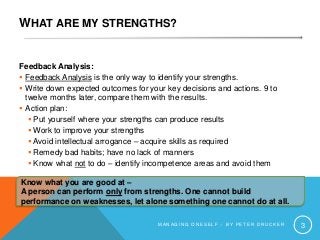
WHAT ARE MY STRENGTHS?
Feedback Analysis:
 Feedback Analysis is the only way to identify your strengths.
 Write down expected outcomes for your key decisions and actions. 9 to
twelve months later, compare them with the results.
 Action plan:
 Put yourself where your strengths can produce results
 Work to improve your strengths
 Avoid intellectual arrogance – acquire skills as required
 Remedy bad habits; have no lack of manners
 Know what not to do – identify incompetence areas and avoid them
M A N A G I N G O N E S E L F – B Y P E T E R D R U C K E R 3
Know what you are good at –
A person can perform only from strengths. One cannot build
performance on weaknesses, let alone something one cannot do at all.
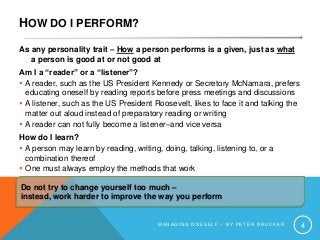
HOW DO I PERFORM?
As any personality trait – How a person performs is a given, just as what
a person is good at or not good at
Am I a “reader” or a “listener”?
 A reader, such as the US President Kennedy or Secretory McNamara, prefers
educating oneself by reading reports before press meetings and discussions
 A listener, such as the US President Roosevelt, likes to face it and talking the
matter out aloud instead of preparatory reading or writing
 A reader can not fully become a listener–and vice versa
How do I learn?
 A person may learn by reading, writing, doing, talking, listening to, or a
combination thereof
 One must always employ the methods that work
M A N A G I N G O N E S E L F – B Y P E T E R D R U C K E R 4
Do not try to change yourself too much –
instead, work harder to improve the way you perform
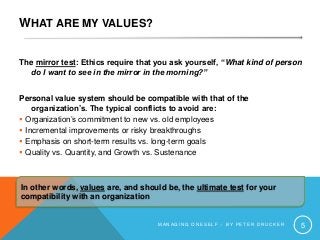
WHAT ARE MY VALUES?
The mirror test: Ethics require that you ask yourself, “What kind of person
do I want to see in the mirror in the morning?”
Personal value system should be compatible with that of the
organization’s. The typical conflicts to avoid are:
 Organization’s commitment to new vs. old employees
 Incremental improvements or risky breakthroughs
 Emphasis on short-term results vs. long-term goals
 Quality vs. Quantity, and Growth vs. Sustenance
M A N A G I N G O N E S E L F – B Y P E T E R D R U C K E R 5
In other words, values are, and should be, the ultimate test for your
compatibility with an organization
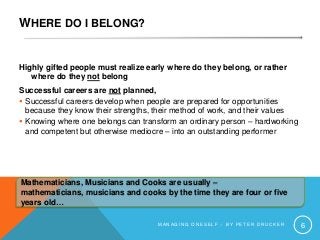
WHERE DO I BELONG?
Highly gifted people must realize early where do they belong, or rather
where do they not belong
Successful careers are not planned,
 Successful careers develop when people are prepared for opportunities
because they know their strengths, their method of work, and their values
 Knowing where one belongs can transform an ordinary person – hardworking
and competent but otherwise mediocre – into an outstanding performer
M A N A G I N G O N E S E L F – B Y P E T E R D R U C K E R 6
Mathematicians, Musicians and Cooks are usually –
mathematicians, musicians and cooks by the time they are four or five
years old…
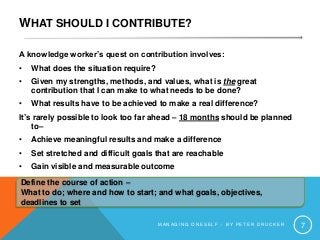
WHAT SHOULD I CONTRIBUTE?
A knowledge worker’s quest on contribution involves:
• What does the situation require?
• Given my strengths, methods, and values, what is the great
contribution that I can make to what needs to be done?
• What results have to be achieved to make a real difference?
It’s rarely possible to look too far ahead – 18 months should be planned
to–
• Achieve meaningful results and make a difference
• Set stretched and difficult goals that are reachable
• Gain visible and measurable outcome
M A N A G I N G O N E S E L F – B Y P E T E R D R U C K E R 7
Define the course of action –
What to do; where and how to start; and what goals, objectives,
deadlines to set
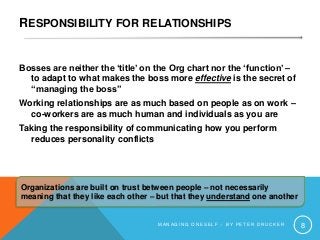
RESPONSIBILITY FOR RELATIONSHIPS
Bosses are neither the ‘title’ on the Org chart nor the ‘function’ –
to adapt to what makes the boss more effective is the secret of
“managing the boss”
Working relationships are as much based on people as on work –
co-workers are as much human and individuals as you are
Taking the responsibility of communicating how you perform
reduces personality conflicts
M A N A G I N G O N E S E L F – B Y P E T E R D R U C K E R 8
Organizations are built on trust between people – not necessarily
meaning that they like each other – but that they understand one another
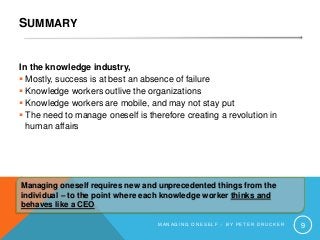
SUMMARY
In the knowledge industry,
 Mostly, success is at best an absence of failure
 Knowledge workers outlive the organizations
 Knowledge workers are mobile, and may not stay put
 The need to manage oneself is therefore creating a revolution in
human affairs
M A N A G I N G O N E S E L F – B Y P E T E R D R U C K E R 9
Managing oneself requires new and unprecedented things from the
individual – to the point where each knowledge worker thinks and
behaves like a CEO
M A N A G I N G O N E S E L F – B Y P E T E R D R U C K E R 10
Sources and further reading –
Go to the detailed article on HBR website:
Managing Oneself (HBR Paperback)
Go to Amazon.com for books by Drucker:
Author Peter F. Drucker on Amazon
More on Drucker and his active life:
Peter F. Drucker – wiki biography
Original article © 1999 Harvard Business Review
Presentation © 2010-2017 - http://blog.mindgap.in - All Rights Reserved

Peter F Drucker - Managing Oneself - a synopsis

  • 1.
    A S YN O P S I S F R O M T H E O R I G I N A L A R T I C L E P U B L I S H E D B Y H A R V A R D B U S I N E S S R E V I E W P R E S E N T A T I O N © 2 0 1 0 - 2 0 1 7 H T T P : / / M I N D G A P . I N A L L R I G H T S R E S E R V E D
  • 2.
    MANAGING ONESELF – Article© 1999 Harvard Business Review OnPoint 4444 Published by Peter F. Drucker March-April 1999 M A N A G I N G O N E S E L F – B Y P E T E R F D R U C K E R 2  What are my strengths?  How do I perform?  What are my values?  Where do I belong?  What should I contribute?  Responsibility of relationships  Summary Presentation © 2010-2017 http://blog.mindgap.in ALL RIGHTS RESERVED
  • 3.
    WHAT ARE MYSTRENGTHS? Feedback Analysis:  Feedback Analysis is the only way to identify your strengths.  Write down expected outcomes for your key decisions and actions. 9 to twelve months later, compare them with the results.  Action plan:  Put yourself where your strengths can produce results  Work to improve your strengths  Avoid intellectual arrogance – acquire skills as required  Remedy bad habits; have no lack of manners  Know what not to do – identify incompetence areas and avoid them M A N A G I N G O N E S E L F – B Y P E T E R D R U C K E R 3 Know what you are good at – A person can perform only from strengths. One cannot build performance on weaknesses, let alone something one cannot do at all.
  • 4.
    HOW DO IPERFORM? As any personality trait – How a person performs is a given, just as what a person is good at or not good at Am I a “reader” or a “listener”?  A reader, such as the US President Kennedy or Secretory McNamara, prefers educating oneself by reading reports before press meetings and discussions  A listener, such as the US President Roosevelt, likes to face it and talking the matter out aloud instead of preparatory reading or writing  A reader can not fully become a listener–and vice versa How do I learn?  A person may learn by reading, writing, doing, talking, listening to, or a combination thereof  One must always employ the methods that work M A N A G I N G O N E S E L F – B Y P E T E R D R U C K E R 4 Do not try to change yourself too much – instead, work harder to improve the way you perform
  • 5.
    WHAT ARE MYVALUES? The mirror test: Ethics require that you ask yourself, “What kind of person do I want to see in the mirror in the morning?” Personal value system should be compatible with that of the organization’s. The typical conflicts to avoid are:  Organization’s commitment to new vs. old employees  Incremental improvements or risky breakthroughs  Emphasis on short-term results vs. long-term goals  Quality vs. Quantity, and Growth vs. Sustenance M A N A G I N G O N E S E L F – B Y P E T E R D R U C K E R 5 In other words, values are, and should be, the ultimate test for your compatibility with an organization
  • 6.
    WHERE DO IBELONG? Highly gifted people must realize early where do they belong, or rather where do they not belong Successful careers are not planned,  Successful careers develop when people are prepared for opportunities because they know their strengths, their method of work, and their values  Knowing where one belongs can transform an ordinary person – hardworking and competent but otherwise mediocre – into an outstanding performer M A N A G I N G O N E S E L F – B Y P E T E R D R U C K E R 6 Mathematicians, Musicians and Cooks are usually – mathematicians, musicians and cooks by the time they are four or five years old…
  • 7.
    WHAT SHOULD ICONTRIBUTE? A knowledge worker’s quest on contribution involves: • What does the situation require? • Given my strengths, methods, and values, what is the great contribution that I can make to what needs to be done? • What results have to be achieved to make a real difference? It’s rarely possible to look too far ahead – 18 months should be planned to– • Achieve meaningful results and make a difference • Set stretched and difficult goals that are reachable • Gain visible and measurable outcome M A N A G I N G O N E S E L F – B Y P E T E R D R U C K E R 7 Define the course of action – What to do; where and how to start; and what goals, objectives, deadlines to set
  • 8.
    RESPONSIBILITY FOR RELATIONSHIPS Bossesare neither the ‘title’ on the Org chart nor the ‘function’ – to adapt to what makes the boss more effective is the secret of “managing the boss” Working relationships are as much based on people as on work – co-workers are as much human and individuals as you are Taking the responsibility of communicating how you perform reduces personality conflicts M A N A G I N G O N E S E L F – B Y P E T E R D R U C K E R 8 Organizations are built on trust between people – not necessarily meaning that they like each other – but that they understand one another
  • 9.
    SUMMARY In the knowledgeindustry,  Mostly, success is at best an absence of failure  Knowledge workers outlive the organizations  Knowledge workers are mobile, and may not stay put  The need to manage oneself is therefore creating a revolution in human affairs M A N A G I N G O N E S E L F – B Y P E T E R D R U C K E R 9 Managing oneself requires new and unprecedented things from the individual – to the point where each knowledge worker thinks and behaves like a CEO
  • 10.
    M A NA G I N G O N E S E L F – B Y P E T E R D R U C K E R 10 Sources and further reading – Go to the detailed article on HBR website: Managing Oneself (HBR Paperback) Go to Amazon.com for books by Drucker: Author Peter F. Drucker on Amazon More on Drucker and his active life: Peter F. Drucker – wiki biography Original article © 1999 Harvard Business Review Presentation © 2010-2017 - http://blog.mindgap.in - All Rights Reserved