Naked streets refers to the concept of stripping
a roadway of its signage—all of it, including
stop signs, signals, and even stripes.
Far from creating mayhem, this approach
appears to have lowered crash rates wherever
it has been tried.
Jeff Speck – Walkable Cities
term credited to Hans Monderman
what if life lives best on naked streets.
stripped of the signage/excess.
immersed in the now/uncertainty.
perhaps we’ve gotten ourselves into such a
dither/construct/pickle.. by labeling/regulating
[most always.. perhaps.. from good intention]
what if this obsession with
protecting/policing/ordering/equalizing.. is
actually doing us in.
what if what we thought we were doing – for
good – is actually becoming..
..the death of us.
The white marking seems to work as a
subliminal signal to drivers that they need to
act less cautiously - that it’s the edge of the
lane,
and not the cyclist,
that they need to worry about.
Jeff Speck – Walkable Cities
when did a white line become what we pay
attention to.
over people.
what if our need/habit to mark/control/direct
creates enough noise..
to drown out what we most need to be paying
attention to.
who we are
what we are doing
where we are going/staying/being/becoming
who we are with
what matters
silence
.
.
.
just now.
what if playing/regulating life safe..
is actually too risky.
we study/research/prove/label/credential/line
things.. in the name of safety/efficiency.
where has that gotten us?
before we start anything.. we
need a business plan, a study of
pre-assess to go with an
assumed post-assess – that will
verify/validate/measure
whether something worked or
didn’t work.
…we need a 100-page form,
signed in triplicate, notarized,
paid in full, print too small and
print too much to
afford/handle/notice the
reading of..
to be stored in a secure/safe
place in order to secure our
future safety..
in order to
validate/approve/credential our
actual being.
perhaps rules are made when
we don’t trust people to think
on their feet.
which they most likely would.. if
they weren’t so busy (and/or
annoyed/preoccupied/tired/tic
ked-off) from reading/following
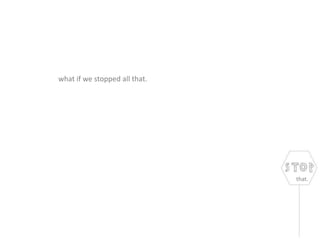
what if we stopped all that.
that.
what if it’s
the not planning
the not assessing/measuring/managing/regulating/road-signing
that will best get us to where we want to go/be.
what if it’s
the being awake/alive enough
to notice/know the real
that we ly crave/need/are.
over people.
When you don’t exactly know who has right of way,
you tend to seek eye contact
with other road users.
- Hans Monderman
what if it’s the nakededness of the street that
begs our awareness/attention/eyes/trust.. and
keeps us alive.
spaces were you just know. even if you don’t
know the thing. especially if you can’t
measure/document/communicate the thing.
you still know
the space/moment/happening .. is real.
and that’ll do it.
that’s enough.
you just know.
what if we trusted that.
In Monderman’s terms, “Chaos equals
cooperation.”
Jeff Speck – Walkable Cities
The greater the number of prescriptions, the more people’s sense of personal responsibility
dwindles.
- Hans Monderman
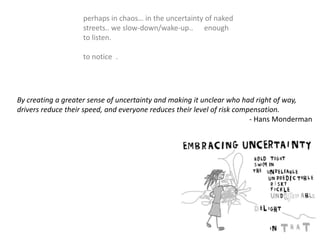
perhaps in chaos… in the uncertainty of naked
streets.. we slow-down/wake-up.. enough
to listen.
to notice .
By creating a greater sense of uncertainty and making it unclear who had right of way,
drivers reduce their speed, and everyone reduces their level of risk compensation.
- Hans Monderman
what if it’s all the prep, directions, regulations..
all the stuff that gets us feeling
observed/managed/coerced/measured/s
afe..
that keeps us from
perhaps trust breeds/spreads/multiplies when
it’s free from proving/obliging/obeying.
real trust becomes something you can’t not
share. even if you can’t articulate it. often
because you can’t articulate it.
if we plan for something.. map it all out.. road-
sign it up..
we often lose focus
of what matters.
we think little about trust.
about what it means to be human and alive.
about what makes us come alive.
we often become mindless.
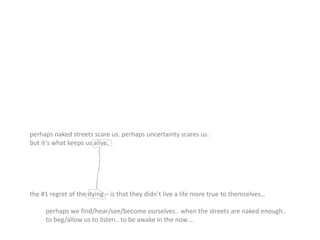
perhaps naked streets scare us. perhaps uncertainty scares us.
but it’s what keeps us alive.
the #1 regret of the dying – is that they didn’t live a life more true to themselves…
perhaps we find/hear/see/become ourselves.. when the streets are naked enough..
to beg/allow us to listen.. to be awake in the now….
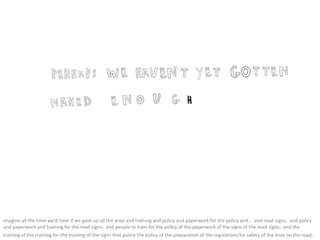
imagine all the time we’d have if we gave up all the prep and training and policy and paperwork for the policy and…. and road signs.. and policy
and paperwork and training for the road signs.. and people to train for the policy of the paperwork of the signs of the road signs.. and the
training of the training for the training of the signs that police the policy of the preparation of the regulations for safety of the lines on the road..
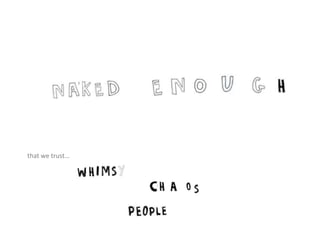
that we trust…
.. what if naked streets .. seem too simple
wrong
floofy
messy
unsophisticated
unacademic
unworthy
unmeasureable
unmarketable
chaotic
utopian
impossible
.
.
.
but….
..they keep us alive.
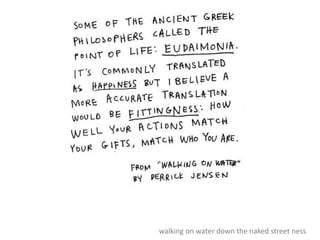
walking on water down the naked street ness
Naked streets refers to the concept of stripping
a roadway of its signage—all of it, including
stop signs, signals, and even stripes.
Far from creating mayhem, this approach
appears to have lowered crash rates wherever
it has been tried.
Jeff Speck – Walkable Cities
naked streets
naked streets

naked streets

  • 2.
    Naked streets refersto the concept of stripping a roadway of its signage—all of it, including stop signs, signals, and even stripes. Far from creating mayhem, this approach appears to have lowered crash rates wherever it has been tried. Jeff Speck – Walkable Cities term credited to Hans Monderman
  • 3.
    what if lifelives best on naked streets. stripped of the signage/excess. immersed in the now/uncertainty. perhaps we’ve gotten ourselves into such a dither/construct/pickle.. by labeling/regulating [most always.. perhaps.. from good intention]
  • 4.
    what if thisobsession with protecting/policing/ordering/equalizing.. is actually doing us in. what if what we thought we were doing – for good – is actually becoming.. ..the death of us.
  • 5.
    The white markingseems to work as a subliminal signal to drivers that they need to act less cautiously - that it’s the edge of the lane, and not the cyclist, that they need to worry about. Jeff Speck – Walkable Cities
  • 6.
    when did awhite line become what we pay attention to. over people.
  • 7.
    what if ourneed/habit to mark/control/direct creates enough noise.. to drown out what we most need to be paying attention to. who we are what we are doing where we are going/staying/being/becoming who we are with what matters silence . . . just now.
  • 8.
    what if playing/regulatinglife safe.. is actually too risky.
  • 9.
    we study/research/prove/label/credential/line things.. inthe name of safety/efficiency. where has that gotten us?
  • 10.
    before we startanything.. we need a business plan, a study of pre-assess to go with an assumed post-assess – that will verify/validate/measure whether something worked or didn’t work. …we need a 100-page form, signed in triplicate, notarized, paid in full, print too small and print too much to afford/handle/notice the reading of.. to be stored in a secure/safe place in order to secure our future safety.. in order to validate/approve/credential our actual being. perhaps rules are made when we don’t trust people to think on their feet. which they most likely would.. if they weren’t so busy (and/or annoyed/preoccupied/tired/tic ked-off) from reading/following
  • 11.
    what if westopped all that. that.
  • 12.
    what if it’s thenot planning the not assessing/measuring/managing/regulating/road-signing that will best get us to where we want to go/be.
  • 13.
    what if it’s thebeing awake/alive enough to notice/know the real that we ly crave/need/are.
  • 14.
    over people. When youdon’t exactly know who has right of way, you tend to seek eye contact with other road users. - Hans Monderman
  • 15.
    what if it’sthe nakededness of the street that begs our awareness/attention/eyes/trust.. and keeps us alive. spaces were you just know. even if you don’t know the thing. especially if you can’t measure/document/communicate the thing. you still know the space/moment/happening .. is real. and that’ll do it. that’s enough. you just know. what if we trusted that.
  • 17.
    In Monderman’s terms,“Chaos equals cooperation.” Jeff Speck – Walkable Cities The greater the number of prescriptions, the more people’s sense of personal responsibility dwindles. - Hans Monderman
  • 18.
    perhaps in chaos…in the uncertainty of naked streets.. we slow-down/wake-up.. enough to listen. to notice . By creating a greater sense of uncertainty and making it unclear who had right of way, drivers reduce their speed, and everyone reduces their level of risk compensation. - Hans Monderman
  • 19.
    what if it’sall the prep, directions, regulations.. all the stuff that gets us feeling observed/managed/coerced/measured/s afe.. that keeps us from perhaps trust breeds/spreads/multiplies when it’s free from proving/obliging/obeying. real trust becomes something you can’t not share. even if you can’t articulate it. often because you can’t articulate it.
  • 20.
    if we planfor something.. map it all out.. road- sign it up.. we often lose focus of what matters. we think little about trust. about what it means to be human and alive. about what makes us come alive. we often become mindless.
  • 22.
    perhaps naked streetsscare us. perhaps uncertainty scares us. but it’s what keeps us alive. the #1 regret of the dying – is that they didn’t live a life more true to themselves… perhaps we find/hear/see/become ourselves.. when the streets are naked enough.. to beg/allow us to listen.. to be awake in the now….
  • 23.
    imagine all thetime we’d have if we gave up all the prep and training and policy and paperwork for the policy and…. and road signs.. and policy and paperwork and training for the road signs.. and people to train for the policy of the paperwork of the signs of the road signs.. and the training of the training for the training of the signs that police the policy of the preparation of the regulations for safety of the lines on the road..
  • 24.
  • 25.
    .. what ifnaked streets .. seem too simple wrong floofy messy unsophisticated unacademic unworthy unmeasureable unmarketable chaotic utopian impossible . . . but….
  • 26.
  • 27.
    walking on waterdown the naked street ness
  • 28.
    Naked streets refersto the concept of stripping a roadway of its signage—all of it, including stop signs, signals, and even stripes. Far from creating mayhem, this approach appears to have lowered crash rates wherever it has been tried. Jeff Speck – Walkable Cities