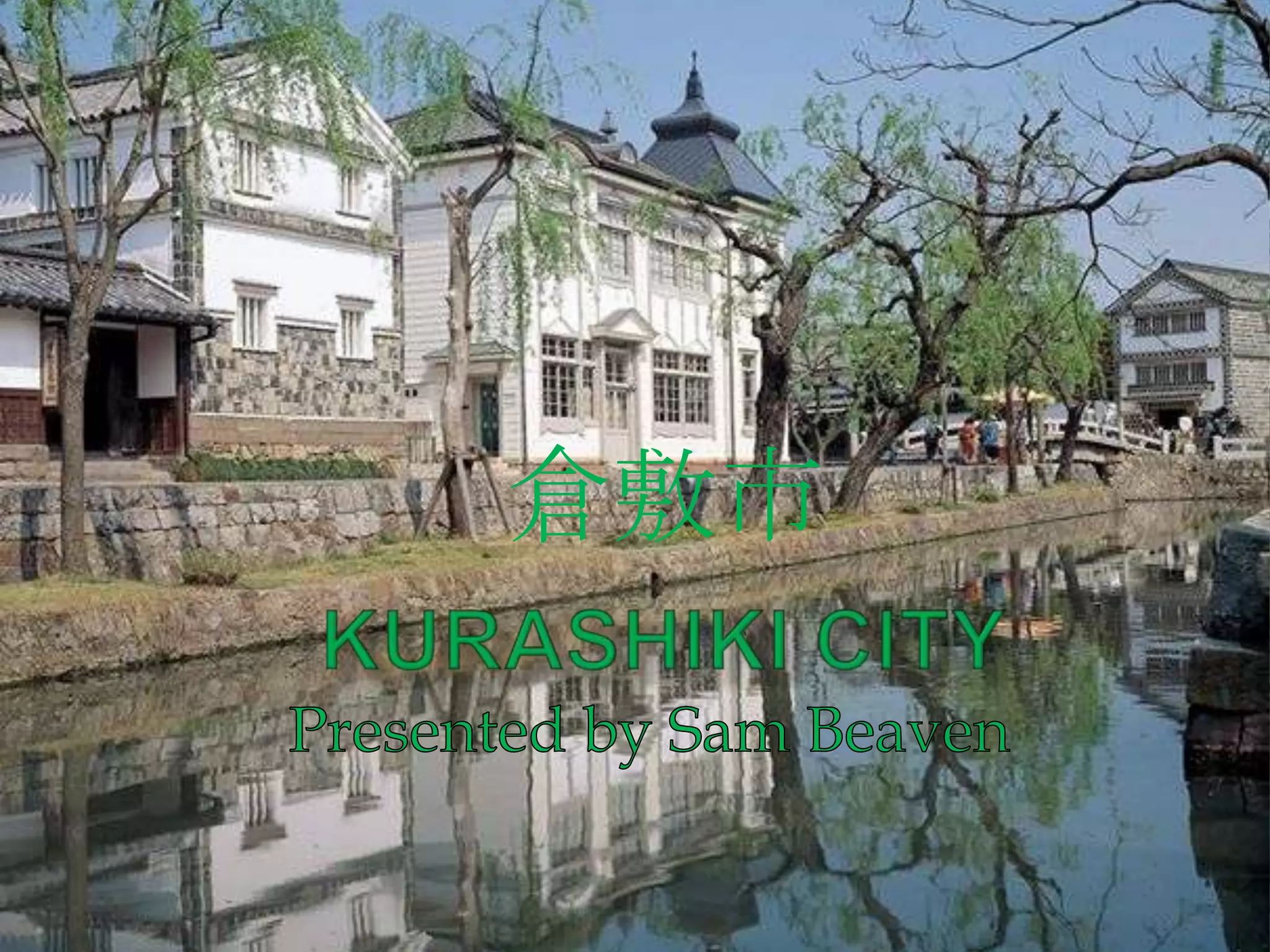
倉敷市
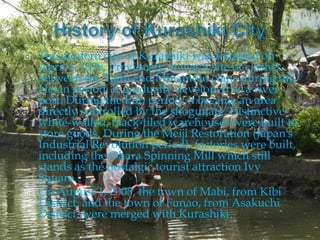
 The modern city of Kurashiki was founded on
April 1, 1928. Previously, it was a site of clashes
between the Taira and Minamoto clans during the
Heian period. It gradually developed as a river
port. During the Edo period, it became an area
directly controlled by the shogunate. Distinctive
white-walled, black-tiled warehouses were built to
store goods. During the Meiji Restoration (Japan's
Industrial Revolution period), factories were built,
including the Ohara Spinning Mill which still
stands as the nostalgic tourist attraction Ivy
Square.
 On August 1, 2005, the town of Mabi, from Kibi
District, and the town of Funao, from Asakuchi
District, were merged with Kurashiki.
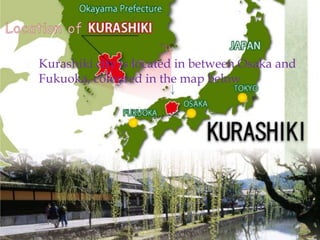
 Kurashiki city is located in between Osaka and
Fukuoka, coloured in the map below
 The Population of Kurashiki is somewhere around
475,000
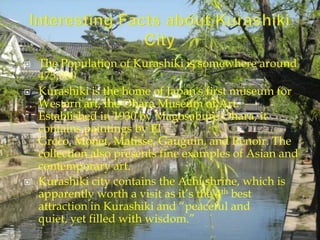
 Kurashiki is the home of Japan's first museum for
Western art, the Ohara Museum of Art.
Established in 1930 by Magosaburō Ōhara, it
contains paintings by El
Greco, Monet, Matisse, Gauguin, and Renoir. The
collection also presents fine examples of Asian and
contemporary art.
 Kurashiki city contains the Achi shrine, which is
apparently worth a visit as it’s the 4th best
attraction in Kurashiki and “peaceful and
quiet, yet filled with wisdom.”
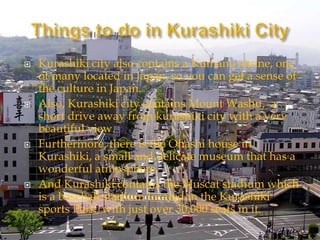
 Kurashiki city also contains a Kumano shrine, one
of many located in Japan, so you can get a sense of
the culture in Japan.
 Also, Kurashiki city contains Mount Washu, a
short drive away from kurashiki city with a very
beautiful view.
 Furthermore, there is the Ohashi house in
Kurashiki, a small and delicate museum that has a
wonderful atmosphere.
 And Kurashiki contains the Muscat stadium which
is a baseball stadium located in the Kurashiki
sports Park, with just over 30,000 seats in it.
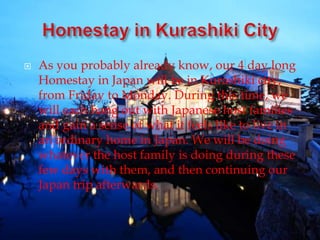
 As you probably already know, our 4 day long
Homestay in Japan will be in Kurashiki city,
from Friday to Monday. During this time, we
will each hang out with Japanese host families
and gain a sense of what it feels like to live in
an ordinary home in Japan. We will be doing
whatever the host family is doing during these
few days with them, and then continuing our
Japan trip afterwards.

Sam Beaven

  • 1.
  • 2.
     The moderncity of Kurashiki was founded on April 1, 1928. Previously, it was a site of clashes between the Taira and Minamoto clans during the Heian period. It gradually developed as a river port. During the Edo period, it became an area directly controlled by the shogunate. Distinctive white-walled, black-tiled warehouses were built to store goods. During the Meiji Restoration (Japan's Industrial Revolution period), factories were built, including the Ohara Spinning Mill which still stands as the nostalgic tourist attraction Ivy Square.  On August 1, 2005, the town of Mabi, from Kibi District, and the town of Funao, from Asakuchi District, were merged with Kurashiki.
  • 3.
     Kurashiki cityis located in between Osaka and Fukuoka, coloured in the map below
  • 4.
     The Populationof Kurashiki is somewhere around 475,000  Kurashiki is the home of Japan's first museum for Western art, the Ohara Museum of Art. Established in 1930 by Magosaburō Ōhara, it contains paintings by El Greco, Monet, Matisse, Gauguin, and Renoir. The collection also presents fine examples of Asian and contemporary art.  Kurashiki city contains the Achi shrine, which is apparently worth a visit as it’s the 4th best attraction in Kurashiki and “peaceful and quiet, yet filled with wisdom.”
  • 5.
     Kurashiki cityalso contains a Kumano shrine, one of many located in Japan, so you can get a sense of the culture in Japan.  Also, Kurashiki city contains Mount Washu, a short drive away from kurashiki city with a very beautiful view.  Furthermore, there is the Ohashi house in Kurashiki, a small and delicate museum that has a wonderful atmosphere.  And Kurashiki contains the Muscat stadium which is a baseball stadium located in the Kurashiki sports Park, with just over 30,000 seats in it.
  • 6.
     As youprobably already know, our 4 day long Homestay in Japan will be in Kurashiki city, from Friday to Monday. During this time, we will each hang out with Japanese host families and gain a sense of what it feels like to live in an ordinary home in Japan. We will be doing whatever the host family is doing during these few days with them, and then continuing our Japan trip afterwards.