Board Certification by February 2010
Why Certification? If you want to… demonstrate your in-depth knowledge and technical skills gain instant professional credibility advance your career start head and shoulders above the competition …  you need to be certified
Why Certification? signifies that the individual is board certified presents immediate credibility / demonstration of competence provides objective measurement across types of organizations and across international borders. Certification:
Stringent eligibility standards Education and/or work requirements Success on comprehensive examination* Mandatory recertification Why Certification?
Certification Benefits To Individuals Competence designation Career enhancement / Compensation Networking opportunities Skills development
Certification Benefits To Individuals (cont.) Increased value / Expertise Demonstrated commitment High professional and ethical standards Personal achievement
Certification Benefits To Employers Profile of a Certified Employee: Professionally competent High ethical standards Demonstrated expertise International networking Self-motivated and committed
Our Future The next 10-20 years: Changing structure of the workplace Increasing importance of certification Employers seeking evidence of competence Globalization of many industries Growing need for transportable skill sets
Our Future The next 10-20 years: Increased attention by federal / state governments to importance of certifying professionals Need for government intervention diminishes if industry sets competency benchmarks
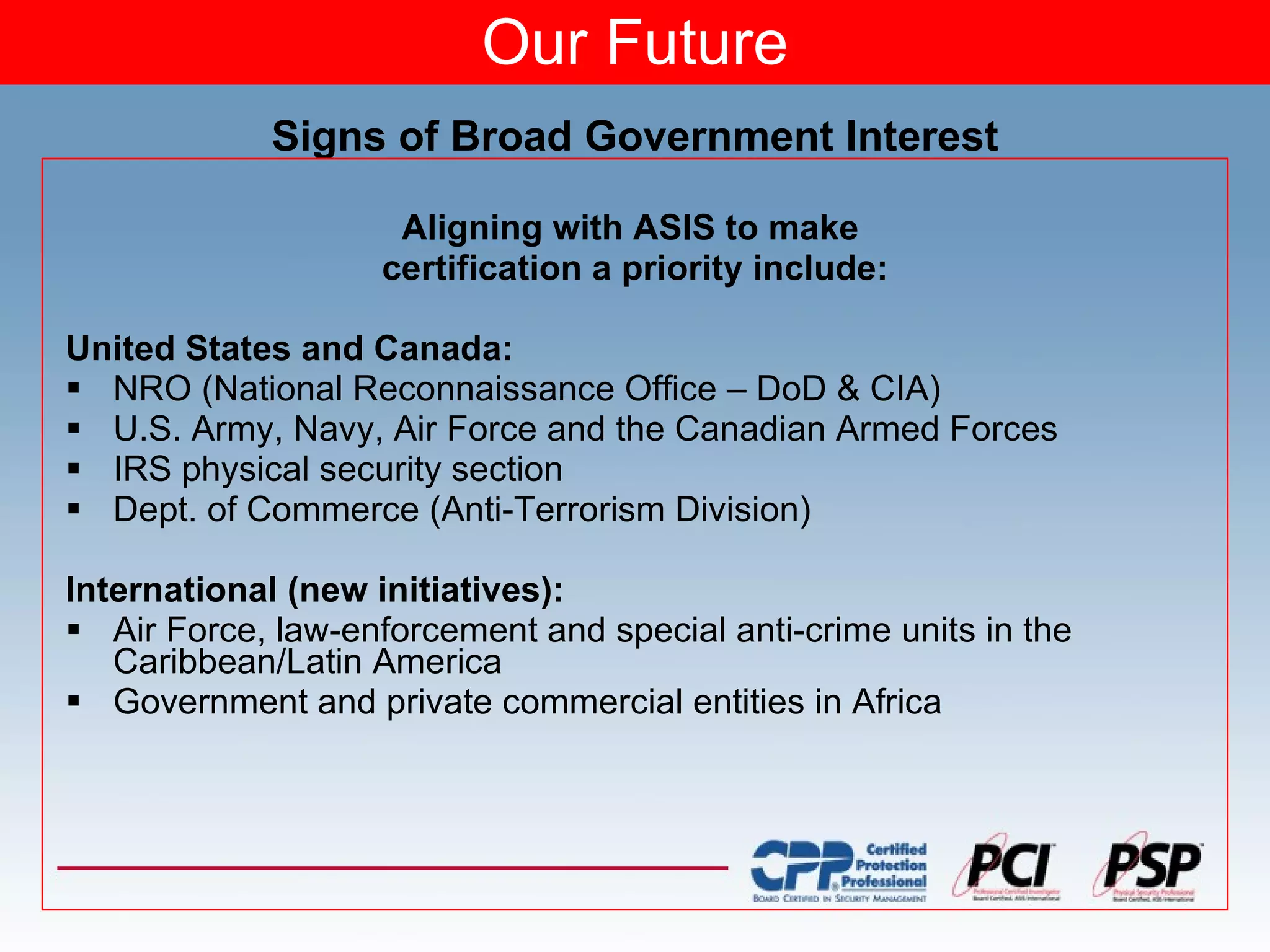
Our Future Signs of Broad Government Interest Aligning with ASIS to make  certification a priority include: United States and Canada: NRO (National Reconnaissance Office – DoD & CIA)  U.S. Army, Navy, Air Force and the Canadian Armed Forces IRS physical security section Dept. of Commerce (Anti-Terrorism Division) International (new initiatives): Air Force, law-enforcement and special anti-crime units in the Caribbean/Latin America Government and private commercial entities in Africa
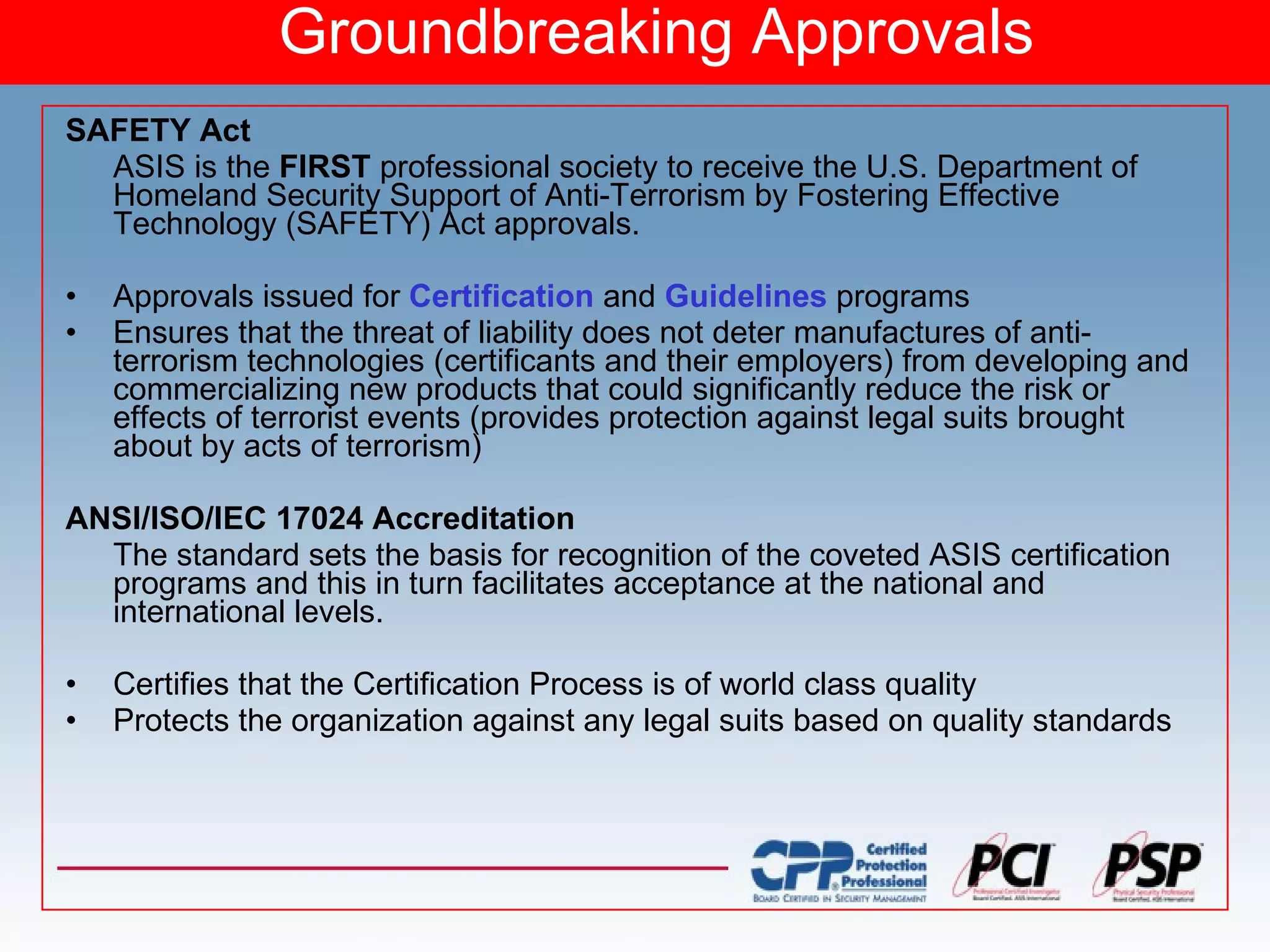
Groundbreaking Approvals SAFETY Act ASIS is the  FIRST  professional society to receive the U.S. Department of Homeland Security Support of Anti-Terrorism by Fostering Effective Technology (SAFETY) Act approvals. Approvals issued for  Certification  and  Guidelines  programs Ensures that the threat of liability does not deter manufactures of anti-terrorism technologies (certificants and their employers) from developing and commercializing new products that could significantly reduce the risk or effects of terrorist events (provides protection against legal suits brought about by acts of terrorism) ANSI/ISO/IEC 17024 Accreditation The standard sets the basis for recognition of the coveted ASIS certification programs and this in turn facilitates acceptance at the national and international levels. Certifies that the Certification Process is of world class quality  Protects the organization against any legal suits based on quality standards
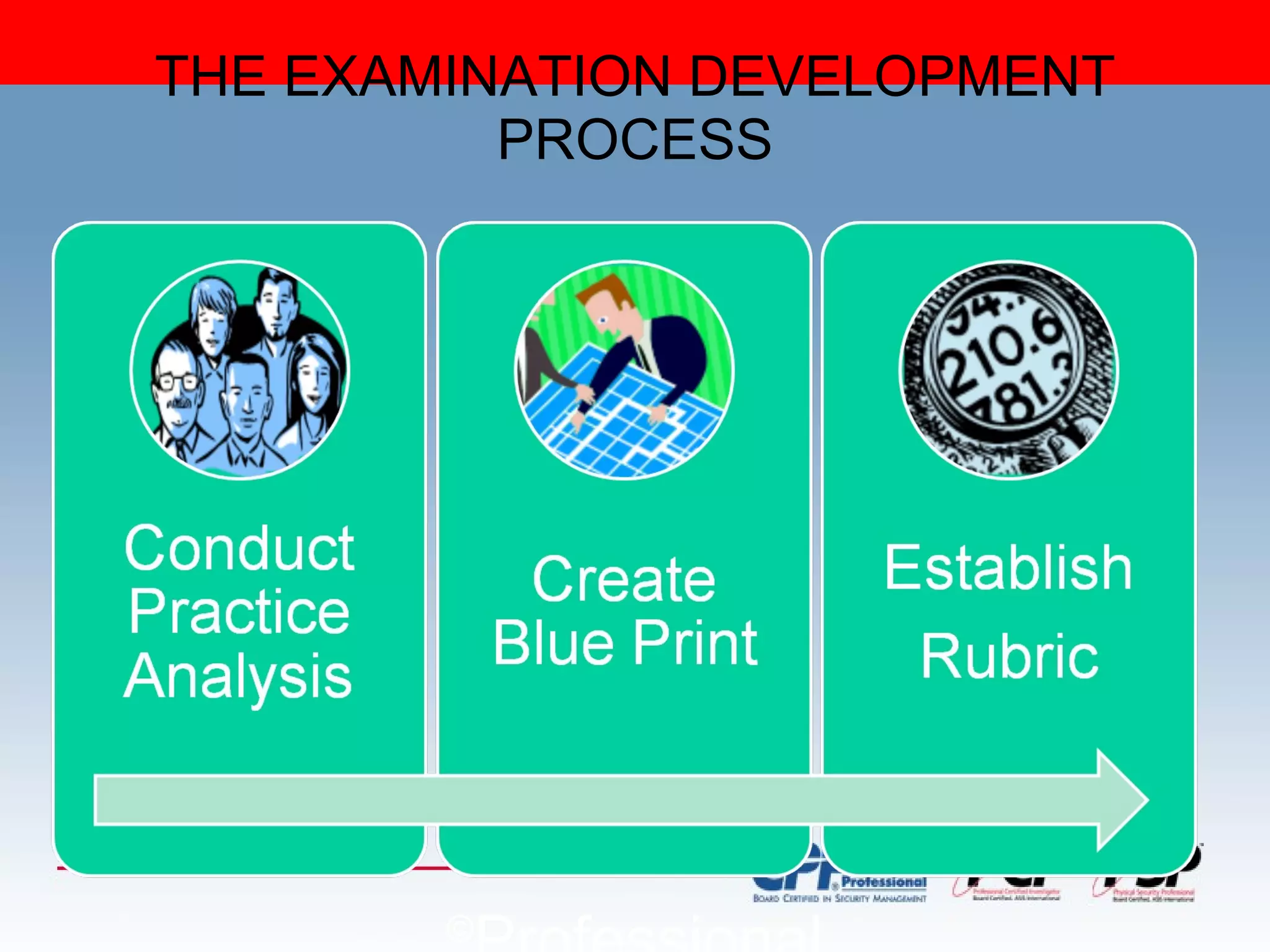
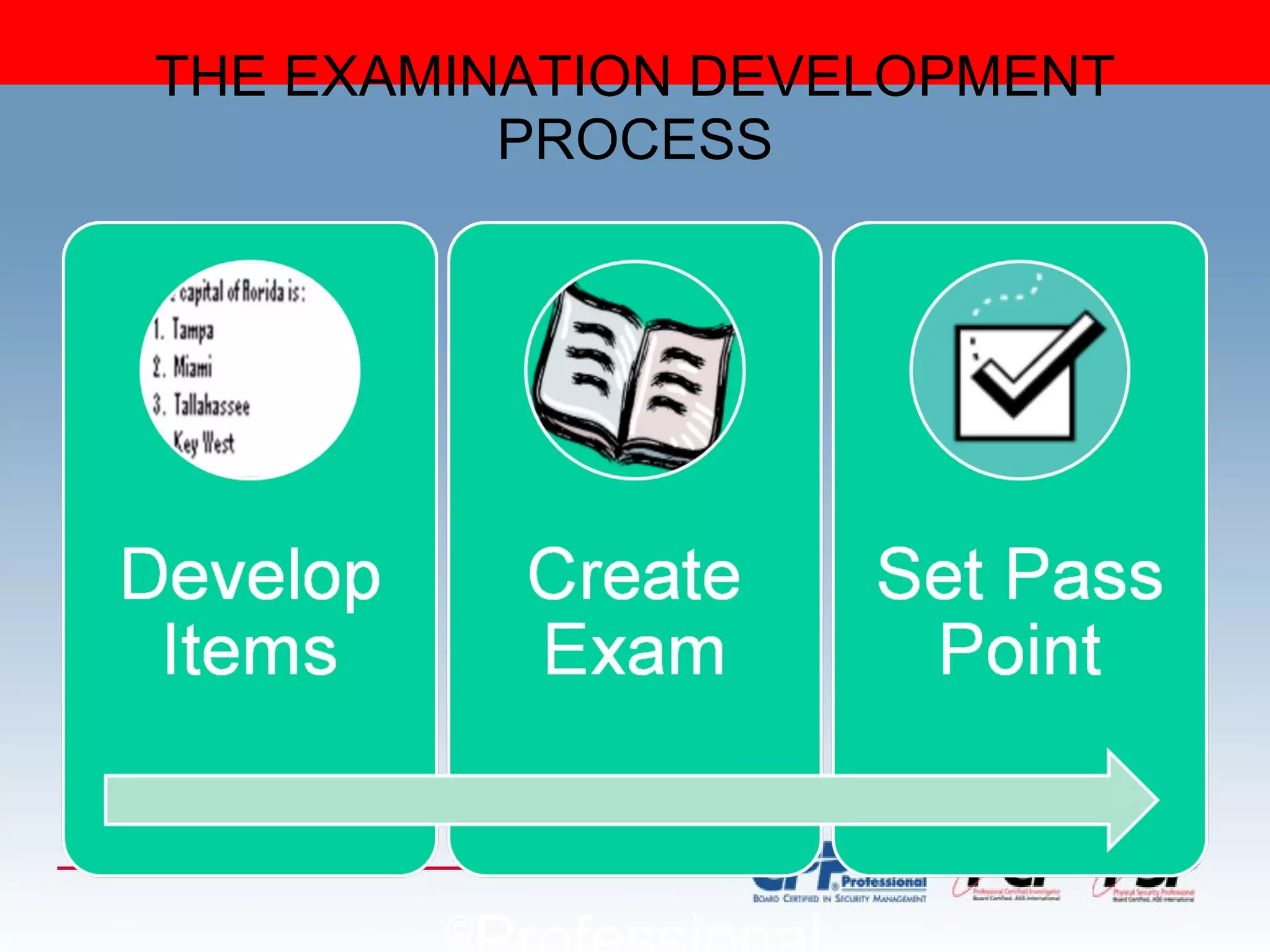
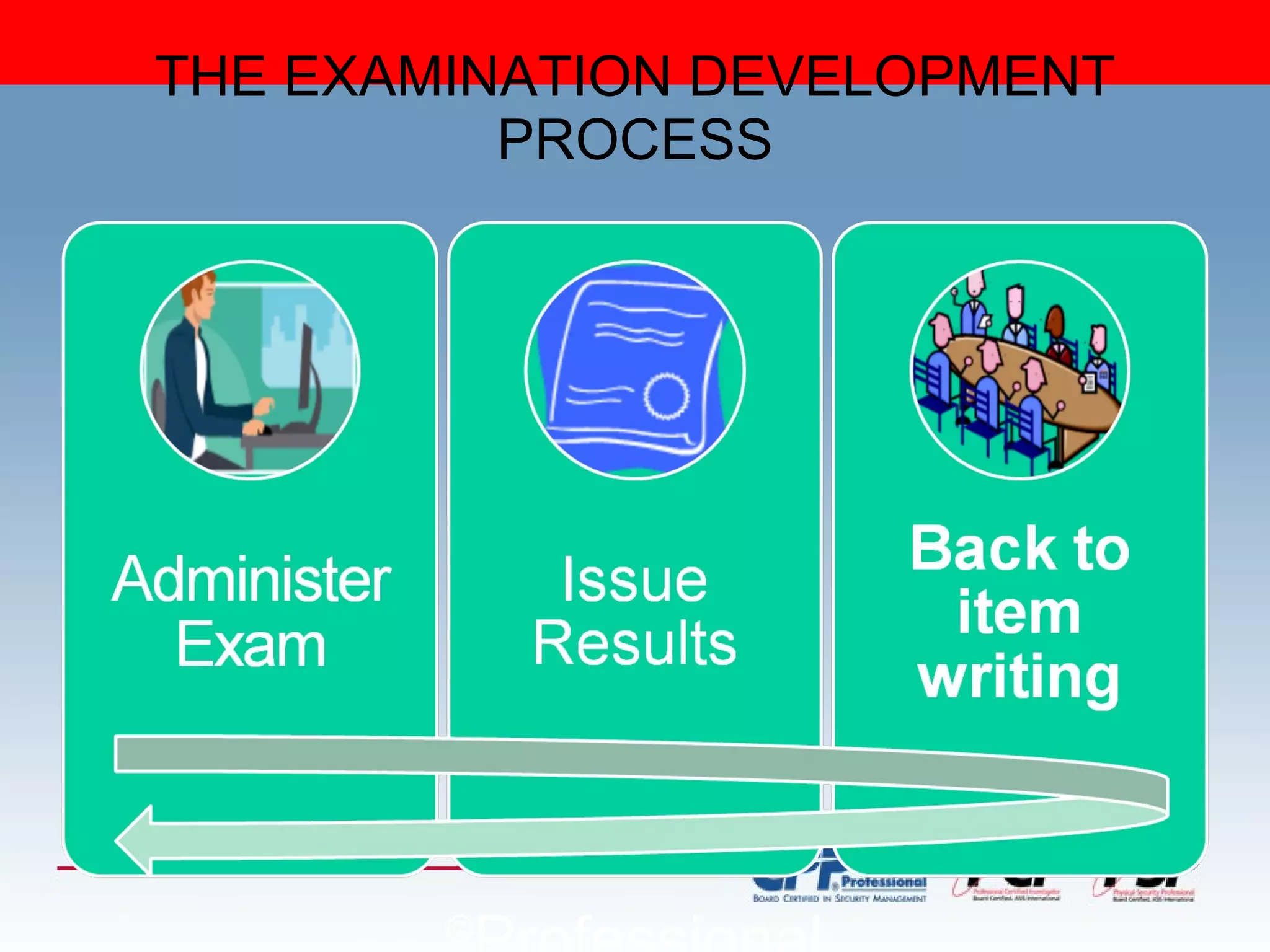
THE EXAMINATION DEVELOPMENT PROCESS © Professional  Examination Service 2010
 
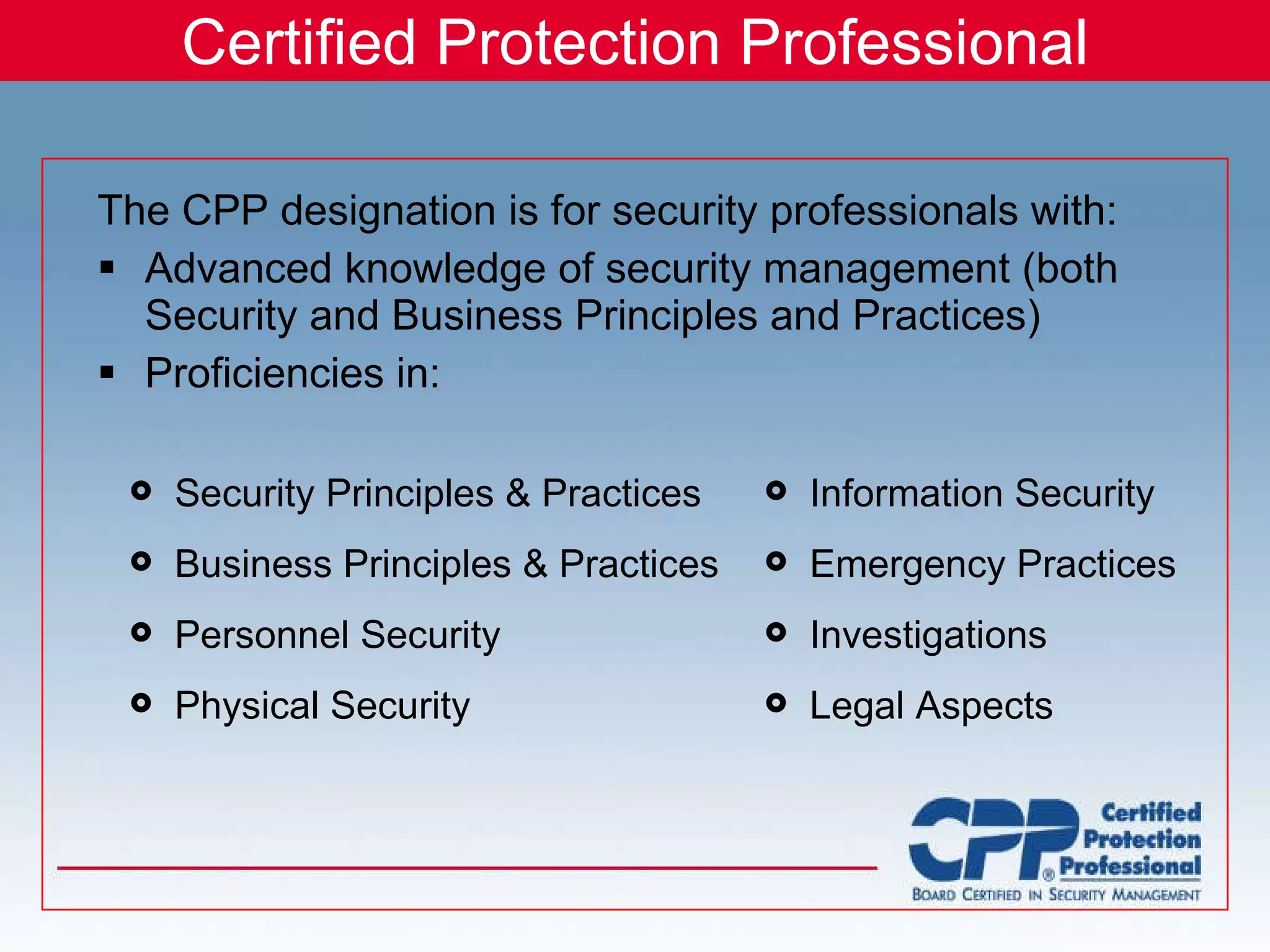
Certified Protection Professional The CPP designation is for security professionals with: Advanced knowledge of security management (both Security and Business Principles and Practices) Proficiencies in: Security Principles & Practices  Business Principles & Practices Personnel Security Physical Security Information Security Emergency Practices Investigations Legal Aspects
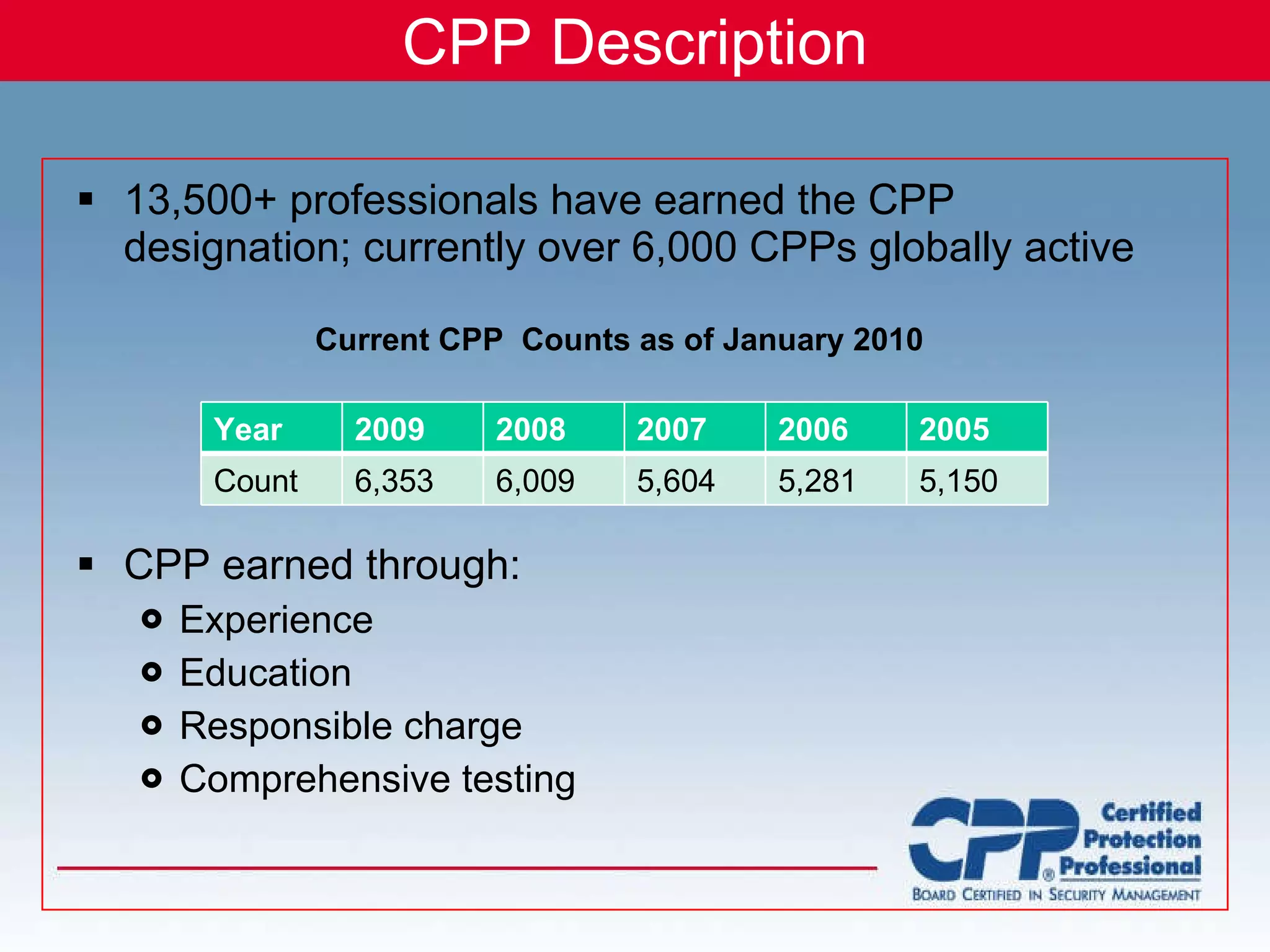
CPP Description 13,500+ professionals have earned the CPP designation; currently over 6,000 CPPs globally active Current CPP  Counts as of January 2010 CPP earned through: Experience Education Responsible charge Comprehensive testing Year 2009 2008 2007 2006 2005 Count 6,353 6,009 5,604 5,281 5,150
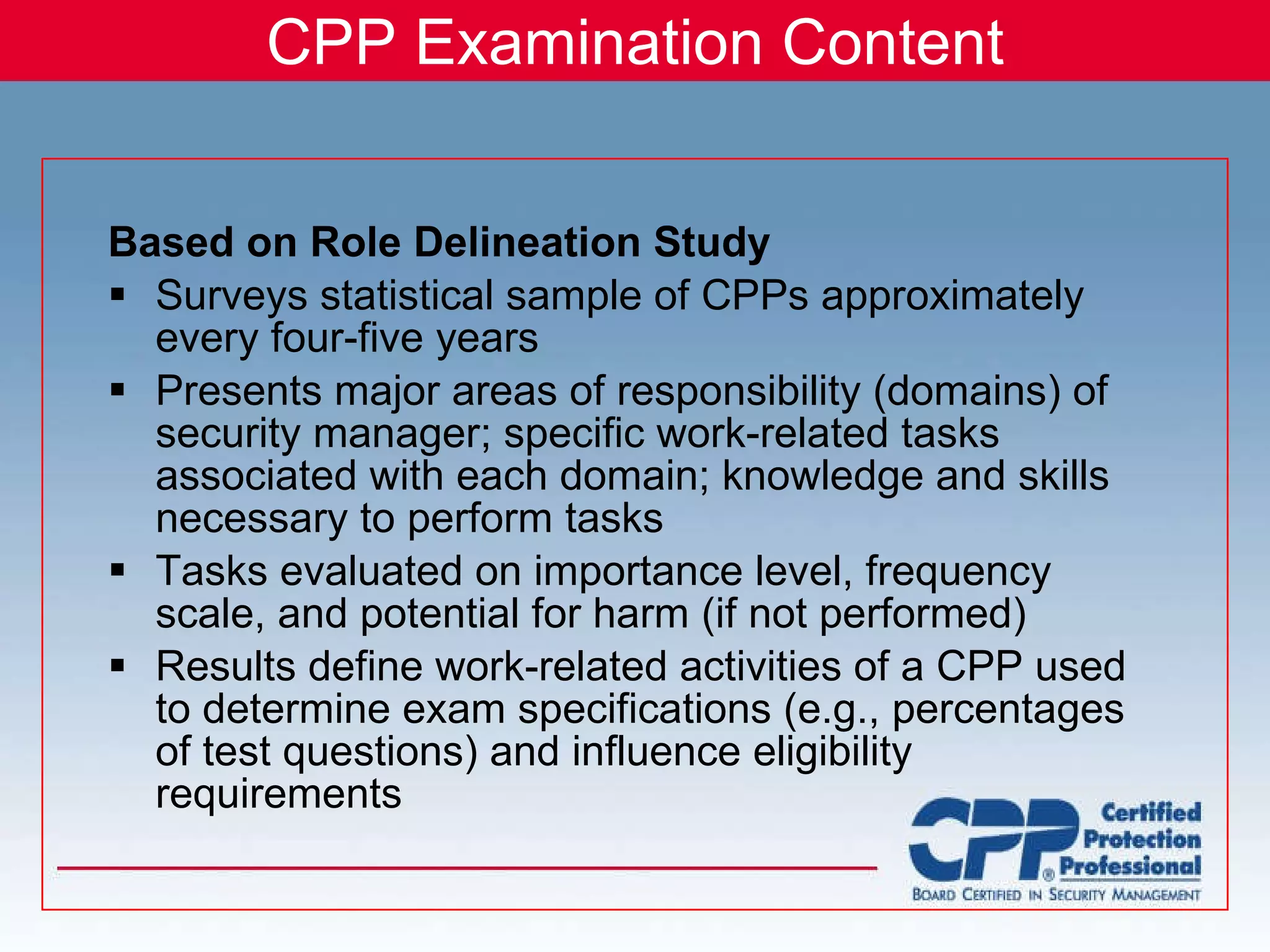
CPP Examination Content Based on Role Delineation Study Surveys statistical sample of CPPs approximately every four-five years Presents major areas of responsibility (domains) of security manager; specific work-related tasks associated with each domain; knowledge and skills necessary to perform tasks Tasks evaluated on importance level, frequency scale, and potential for harm (if not performed) Results define work-related activities of a CPP used to determine exam specifications (e.g., percentages of test questions) and influence eligibility requirements
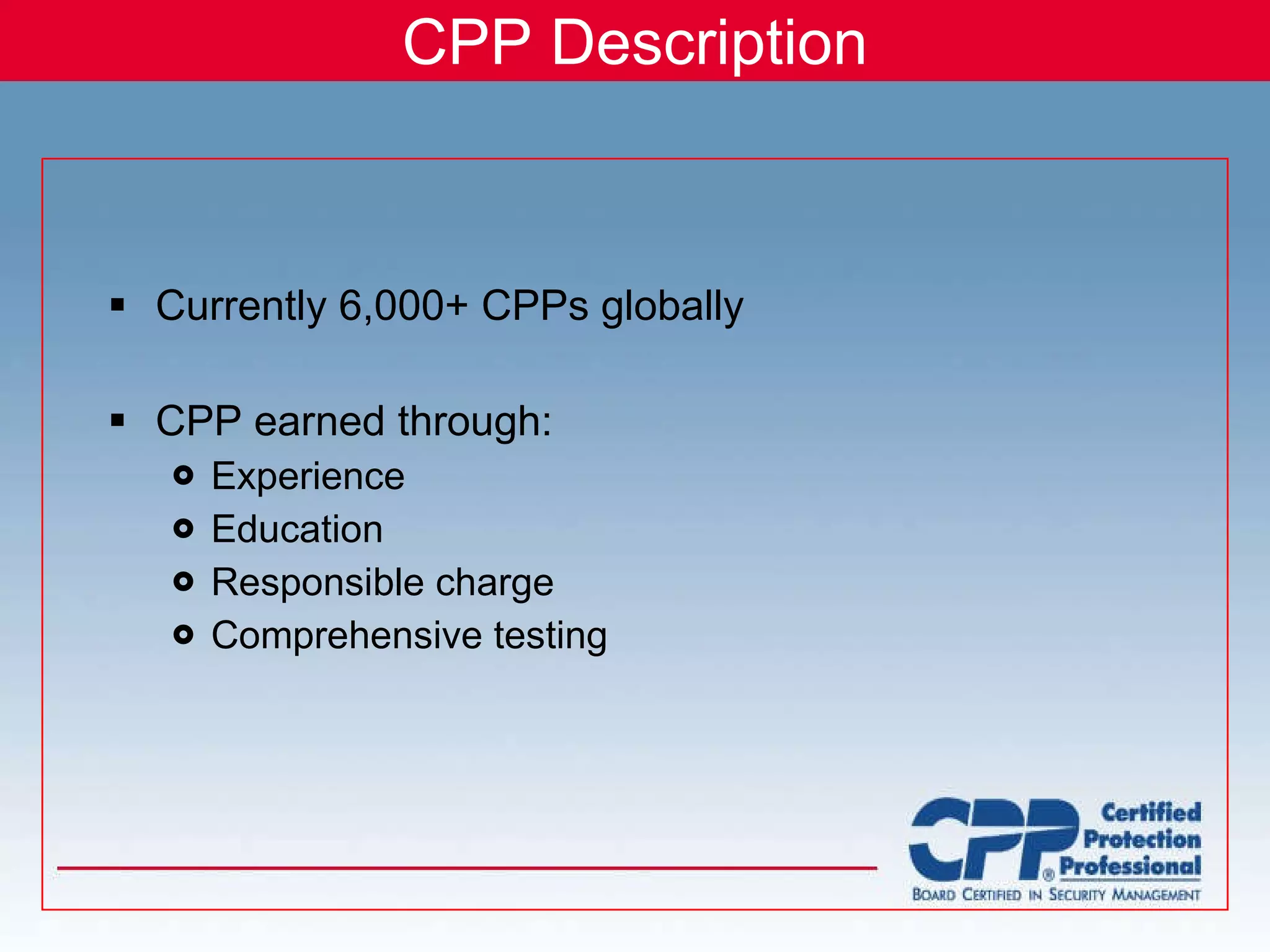
CPP Description Currently 6,000+ CPPs globally CPP earned through: Experience Education Responsible charge Comprehensive testing
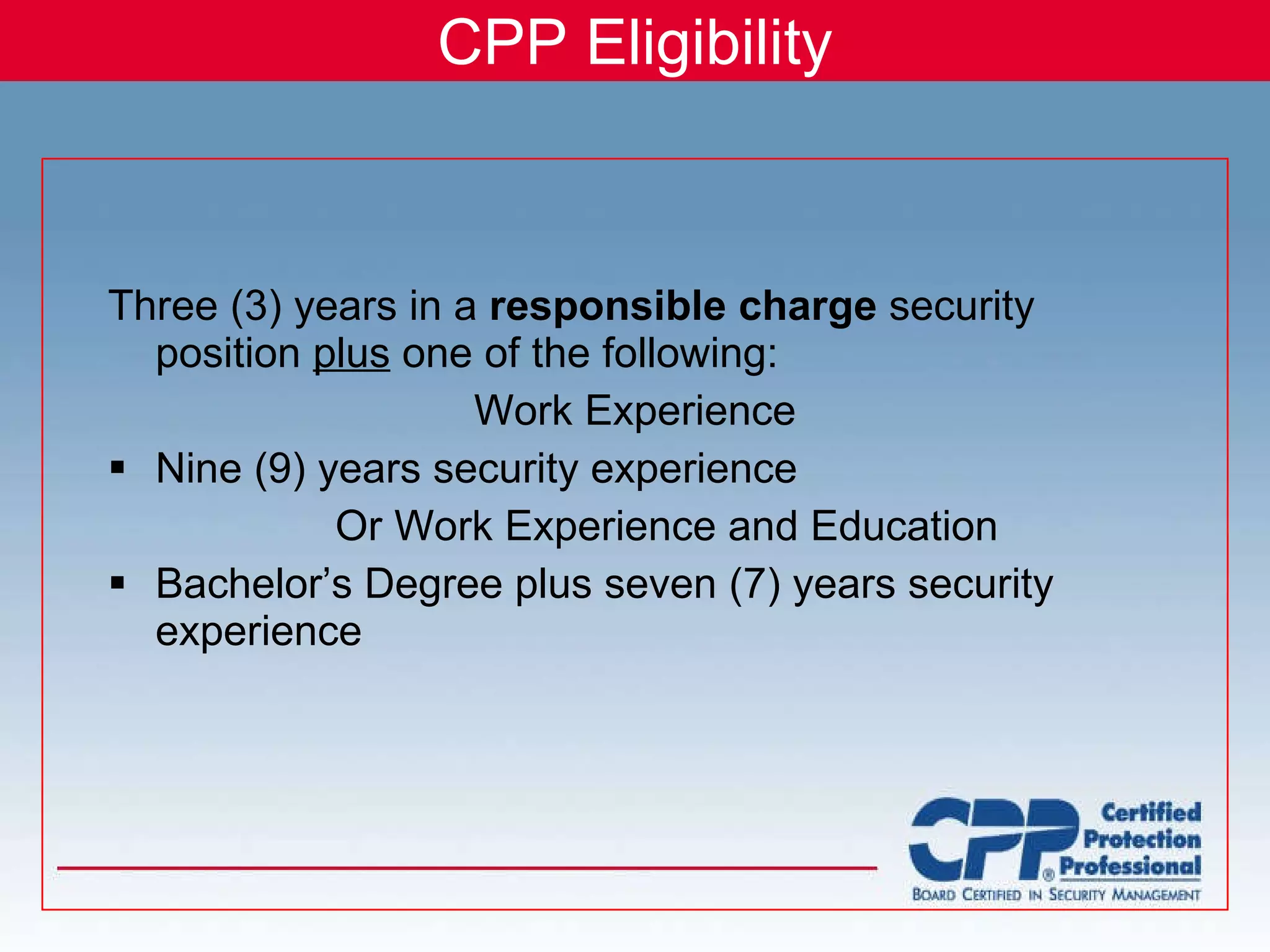
CPP Eligibility Three (3) years in a  responsible charge  security position  plus  one of the following: Work Experience Nine (9) years security experience Or Work Experience and Education Bachelor’s Degree plus seven (7) years security experience
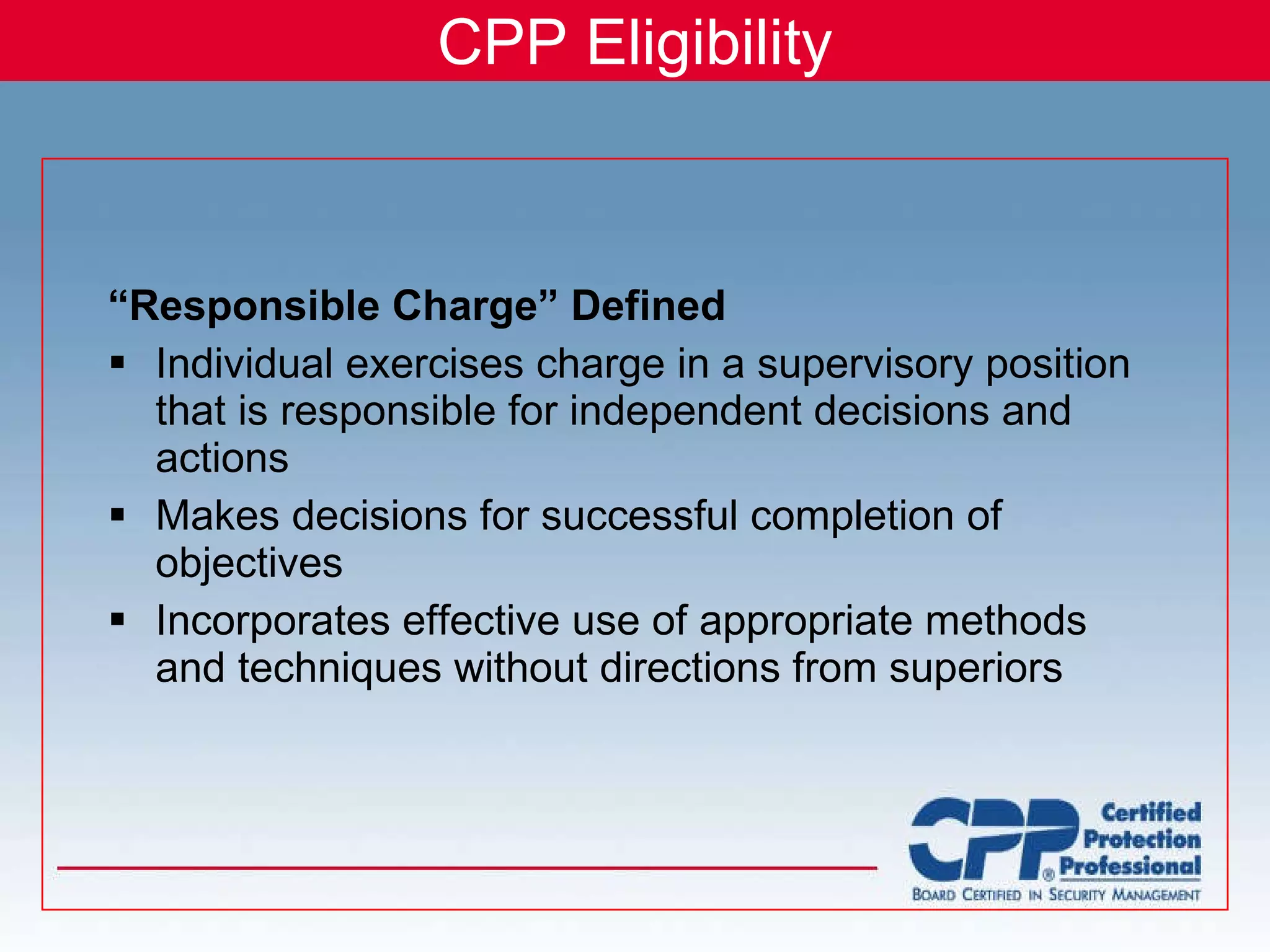
CPP Eligibility “ Responsible Charge” Defined Individual exercises charge in a supervisory position that is responsible for independent decisions and actions Makes decisions for successful completion of objectives Incorporates effective use of appropriate methods and techniques without directions from superiors
Recent and Upcoming CPP Activities Updated job analysis completed in March 2009 – a job analysis is to update knowledge and domain areas; ensure exams are current and accurately reflects job-related activities Revised exam construction in September 2009 Publish revised CPP exam in June 2010 View revised domains and content  online:   http://www.asisonline.org/certification/announcements.xml#newforms
 
Professional Certified Investigator The PCI designation is for investigators with: Advanced skills in conducting investigations Proficiencies in: Case management Evidence collection Case presentation
PCI Exam Content The PCI examination consists of multiple-choice questions covering tasks, knowledge and skills in subjects identified, by professional investigators, as the major areas involved in this field.
Eligibility Requirements Two (2) years in a  case management  investigations position  plus  one of the following: Five (5) years investigations experience A high school diploma or GED equivalent
Recent and Upcoming PCI Activities Updated job analysis completed in March 2009 – a job analysis is to update knowledge and domain areas; ensure exams are current and accurately reflects job-related activities Revised exam construction in September 2009 Publish revised PCI exam in June 2010 Refer to http://www.asisonline.org/certification/docs/pci_examstructurecontent.pdf for revised domains and content
 
Physical Security Professional The PSP designation is for professionals with: Advanced skills in conducting physical security surveys Proficiencies in: The selection and implementation of integrated physical security measures The installation, testing, and maintenance of security systems
PSP Exam Content The PSP examination consists of multiple-choice questions covering tasks, knowledge and skills in subjects identified, by physical security professionals, as the major areas involved in this field.
Eligibility Requirements Candidates wishing to take the PSP examination must first satisfy the following requirements: High school diploma or GED equivalent Five (5) years of experience in physical security
Recent and Upcoming PSP Activities Conduct a job analysis December 2009 Final report due June 2010 Exam construction late summer/early fall 2010 Publish revised PSP exam May 2011
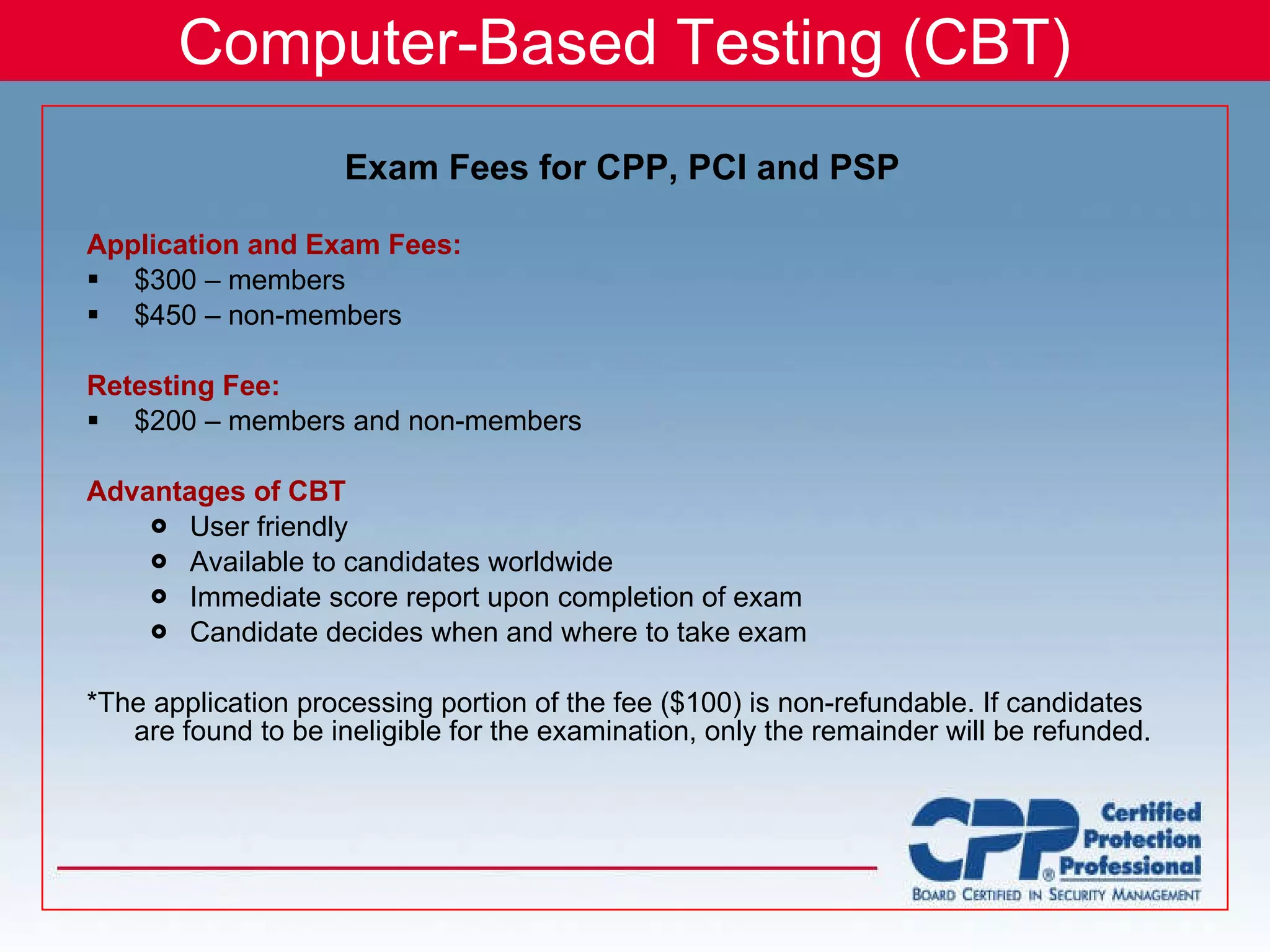
Computer-Based Testing (CBT) Application and Exam Fees: $300 – members $450 – non-members Retesting Fee: $200 – members and non-members Advantages of CBT User friendly Available to candidates worldwide Immediate score report upon completion of exam Candidate decides when and where to take exam *The application processing portion of the fee ($100) is non-refundable. If candidates are found to be ineligible for the examination, only the remainder will be refunded. Exam Fees for CPP, PCI and PSP
Recertification 3-year Recertification Term Recertification demonstrates commitment to: Continuous process of learning and professional development A method of assessing continued professional competency Maintaining proficiency and credibility ASIS Uses the Continuing Professional Education (CPE) System  The following CPEs are required for recertification: 60 for CPP and 45 for PCI and PSP Recertification fees are the same for all programs: $60 for members and $80 for non-members
Questions? Patrick C. Bishop, CPP,  President Christina M. S. Duffey, CPP,  Vice   President Kenneth Freeman, CPP Keith C. Blowe, CPP  Christina M. S. Duffey, CPP Cheryl D. Elliott, CPP, PCI  James W. Ellis, CPP, PSP  Alfredo Iturriaga, CPP Sheila D. Johnson, CPP, PSP Keith L. Kambic, CPP Richard F. Lisko, CPP  Roger B. Maslen, CPP Murray D. Mills, CPP  David J. Moitzheim, CPP, PCI, PSP  Owen J. Monaghan, CPP   Allan R. Wick, CPP, PSP  Meet the Professional Certification Board
Questions? Heather Trusty Certification Program Director Allison Barton Certification Manager Ada Ausberry Senior Certification Specialist Iris Casco Certificant Services Coordinator - Recertification Lisa Murphy Examination Services Coordinator Erica Taylor Certification Specialist To reach a certification staff member, type first and last name @asisonline.org (heather.trusty@asisonline.org) Certification Program Staff

ASIS Board Certification

  • 1.
  • 2.
    Why Certification? Ifyou want to… demonstrate your in-depth knowledge and technical skills gain instant professional credibility advance your career start head and shoulders above the competition … you need to be certified
  • 3.
    Why Certification? signifiesthat the individual is board certified presents immediate credibility / demonstration of competence provides objective measurement across types of organizations and across international borders. Certification:
  • 4.
    Stringent eligibility standardsEducation and/or work requirements Success on comprehensive examination* Mandatory recertification Why Certification?
  • 5.
    Certification Benefits ToIndividuals Competence designation Career enhancement / Compensation Networking opportunities Skills development
  • 6.
    Certification Benefits ToIndividuals (cont.) Increased value / Expertise Demonstrated commitment High professional and ethical standards Personal achievement
  • 7.
    Certification Benefits ToEmployers Profile of a Certified Employee: Professionally competent High ethical standards Demonstrated expertise International networking Self-motivated and committed
  • 8.
    Our Future Thenext 10-20 years: Changing structure of the workplace Increasing importance of certification Employers seeking evidence of competence Globalization of many industries Growing need for transportable skill sets
  • 9.
    Our Future Thenext 10-20 years: Increased attention by federal / state governments to importance of certifying professionals Need for government intervention diminishes if industry sets competency benchmarks
  • 10.
    Our Future Signsof Broad Government Interest Aligning with ASIS to make certification a priority include: United States and Canada: NRO (National Reconnaissance Office – DoD & CIA) U.S. Army, Navy, Air Force and the Canadian Armed Forces IRS physical security section Dept. of Commerce (Anti-Terrorism Division) International (new initiatives): Air Force, law-enforcement and special anti-crime units in the Caribbean/Latin America Government and private commercial entities in Africa
  • 11.
    Groundbreaking Approvals SAFETYAct ASIS is the FIRST professional society to receive the U.S. Department of Homeland Security Support of Anti-Terrorism by Fostering Effective Technology (SAFETY) Act approvals. Approvals issued for Certification and Guidelines programs Ensures that the threat of liability does not deter manufactures of anti-terrorism technologies (certificants and their employers) from developing and commercializing new products that could significantly reduce the risk or effects of terrorist events (provides protection against legal suits brought about by acts of terrorism) ANSI/ISO/IEC 17024 Accreditation The standard sets the basis for recognition of the coveted ASIS certification programs and this in turn facilitates acceptance at the national and international levels. Certifies that the Certification Process is of world class quality Protects the organization against any legal suits based on quality standards
  • 12.
    THE EXAMINATION DEVELOPMENTPROCESS © Professional Examination Service 2010
  • 13.
    THE EXAMINATION DEVELOPMENTPROCESS © Professional Examination Service 2010
  • 14.
    THE EXAMINATION DEVELOPMENTPROCESS © Professional Examination Service 2010
  • 15.
  • 16.
    Certified Protection ProfessionalThe CPP designation is for security professionals with: Advanced knowledge of security management (both Security and Business Principles and Practices) Proficiencies in: Security Principles & Practices Business Principles & Practices Personnel Security Physical Security Information Security Emergency Practices Investigations Legal Aspects
  • 17.
    CPP Description 13,500+professionals have earned the CPP designation; currently over 6,000 CPPs globally active Current CPP Counts as of January 2010 CPP earned through: Experience Education Responsible charge Comprehensive testing Year 2009 2008 2007 2006 2005 Count 6,353 6,009 5,604 5,281 5,150
  • 18.
    CPP Examination ContentBased on Role Delineation Study Surveys statistical sample of CPPs approximately every four-five years Presents major areas of responsibility (domains) of security manager; specific work-related tasks associated with each domain; knowledge and skills necessary to perform tasks Tasks evaluated on importance level, frequency scale, and potential for harm (if not performed) Results define work-related activities of a CPP used to determine exam specifications (e.g., percentages of test questions) and influence eligibility requirements
  • 19.
    CPP Description Currently6,000+ CPPs globally CPP earned through: Experience Education Responsible charge Comprehensive testing
  • 20.
    CPP Eligibility Three(3) years in a responsible charge security position plus one of the following: Work Experience Nine (9) years security experience Or Work Experience and Education Bachelor’s Degree plus seven (7) years security experience
  • 21.
    CPP Eligibility “Responsible Charge” Defined Individual exercises charge in a supervisory position that is responsible for independent decisions and actions Makes decisions for successful completion of objectives Incorporates effective use of appropriate methods and techniques without directions from superiors
  • 22.
    Recent and UpcomingCPP Activities Updated job analysis completed in March 2009 – a job analysis is to update knowledge and domain areas; ensure exams are current and accurately reflects job-related activities Revised exam construction in September 2009 Publish revised CPP exam in June 2010 View revised domains and content online: http://www.asisonline.org/certification/announcements.xml#newforms
  • 23.
  • 24.
    Professional Certified InvestigatorThe PCI designation is for investigators with: Advanced skills in conducting investigations Proficiencies in: Case management Evidence collection Case presentation
  • 25.
    PCI Exam ContentThe PCI examination consists of multiple-choice questions covering tasks, knowledge and skills in subjects identified, by professional investigators, as the major areas involved in this field.
  • 26.
    Eligibility Requirements Two(2) years in a case management investigations position plus one of the following: Five (5) years investigations experience A high school diploma or GED equivalent
  • 27.
    Recent and UpcomingPCI Activities Updated job analysis completed in March 2009 – a job analysis is to update knowledge and domain areas; ensure exams are current and accurately reflects job-related activities Revised exam construction in September 2009 Publish revised PCI exam in June 2010 Refer to http://www.asisonline.org/certification/docs/pci_examstructurecontent.pdf for revised domains and content
  • 28.
  • 29.
    Physical Security ProfessionalThe PSP designation is for professionals with: Advanced skills in conducting physical security surveys Proficiencies in: The selection and implementation of integrated physical security measures The installation, testing, and maintenance of security systems
  • 30.
    PSP Exam ContentThe PSP examination consists of multiple-choice questions covering tasks, knowledge and skills in subjects identified, by physical security professionals, as the major areas involved in this field.
  • 31.
    Eligibility Requirements Candidateswishing to take the PSP examination must first satisfy the following requirements: High school diploma or GED equivalent Five (5) years of experience in physical security
  • 32.
    Recent and UpcomingPSP Activities Conduct a job analysis December 2009 Final report due June 2010 Exam construction late summer/early fall 2010 Publish revised PSP exam May 2011
  • 33.
    Computer-Based Testing (CBT)Application and Exam Fees: $300 – members $450 – non-members Retesting Fee: $200 – members and non-members Advantages of CBT User friendly Available to candidates worldwide Immediate score report upon completion of exam Candidate decides when and where to take exam *The application processing portion of the fee ($100) is non-refundable. If candidates are found to be ineligible for the examination, only the remainder will be refunded. Exam Fees for CPP, PCI and PSP
  • 34.
    Recertification 3-year RecertificationTerm Recertification demonstrates commitment to: Continuous process of learning and professional development A method of assessing continued professional competency Maintaining proficiency and credibility ASIS Uses the Continuing Professional Education (CPE) System The following CPEs are required for recertification: 60 for CPP and 45 for PCI and PSP Recertification fees are the same for all programs: $60 for members and $80 for non-members
  • 35.
    Questions? Patrick C.Bishop, CPP, President Christina M. S. Duffey, CPP, Vice President Kenneth Freeman, CPP Keith C. Blowe, CPP Christina M. S. Duffey, CPP Cheryl D. Elliott, CPP, PCI James W. Ellis, CPP, PSP Alfredo Iturriaga, CPP Sheila D. Johnson, CPP, PSP Keith L. Kambic, CPP Richard F. Lisko, CPP Roger B. Maslen, CPP Murray D. Mills, CPP David J. Moitzheim, CPP, PCI, PSP Owen J. Monaghan, CPP Allan R. Wick, CPP, PSP Meet the Professional Certification Board
  • 36.
    Questions? Heather TrustyCertification Program Director Allison Barton Certification Manager Ada Ausberry Senior Certification Specialist Iris Casco Certificant Services Coordinator - Recertification Lisa Murphy Examination Services Coordinator Erica Taylor Certification Specialist To reach a certification staff member, type first and last name @asisonline.org (heather.trusty@asisonline.org) Certification Program Staff