METROPOLITAN REGIONS
AND SMALL AND MEDIUM-
SIZED CITIES
THE CASE OF BARCELONA
Marc Pradel Miquel
Universitat de Barcelona
SUMMARY
The context
 Barcelona metropolitan region
 Vallès Occidental
 Historical development
Strategies for economic development
 The Consortium for employment and economic development of Vallès Occidental
 Isolated strategies for growth
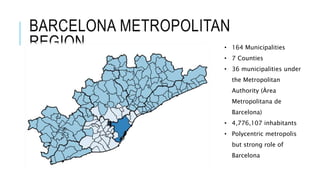
BARCELONA METROPOLITAN
REGION • 164 Municipalities
• 7 Counties
• 36 municipalities under
the Metropolitan
Authority (Àrea
Metropolitana de
Barcelona)
• 4,776,107 inhabitants
• Polycentric metropolis
but strong role of
Barcelona
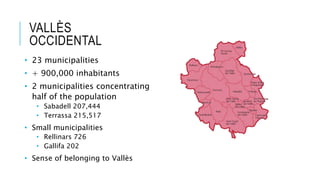
VALLÈS
OCCIDENTAL
• 23 municipalities
• + 900,000 inhabitants
• 2 municipalities concentrating
half of the population
• Sabadell 207,444
• Terrassa 215,517
• Small municipalities
• Rellinars 726
• Gallifa 202
• Sense of belonging to Vallès
HISTORICAL DEVELOPMENT
‘Failure’ of the industrial revolution in Spain
Uneven industrialisation in Spain, concentration in
Barcelona (manufactures) and Basque Country
(processing of rough materials)
Protectionist Catalan bourgeoisie aiming to control
national market
Role of textile industries in Catalonia
Emergence of a bourgeoisie from the combination of
traders and craftsmen
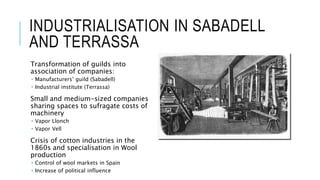
INDUSTRIALISATION IN SABADELL
AND TERRASSA
Transformation of guilds into
association of companies:
 Manufacturers’ guild (Sabadell)
 Industrial institute (Terrassa)
Small and medium-sized companies
sharing spaces to sufragate costs of
machinery
 Vapor Llonch
 Vapor Vell
Crisis of cotton industries in the
1860s and specialisation in Wool
production
 Control of wool markets in Spain
 Increase of political influence
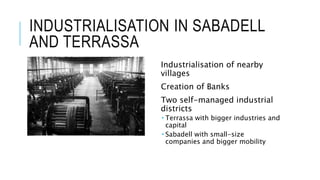
INDUSTRIALISATION IN SABADELL
AND TERRASSA
Industrialisation of nearby
villages
Creation of Banks
Two self-managed industrial
districts
 Terrassa with bigger industries and
capital
 Sabadell with small-size
companies and bigger mobility
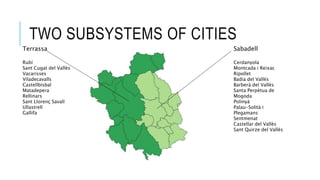
TWO SUBSYSTEMS OF CITIES
Terrassa
Rubí
Sant Cugat del Vallès
Vacarisses
Viladecavalls
Castellbisbal
Matadepera
Rellinars
Sant Llorenç Savall
Ullastrell
Gallifa
Sabadell
Cerdanyola
Montcada i Reixac
Ripollet
Badia del Vallès
Barberà del Vallès
Santa Perpètua de
Mogoda
Polinyà
Palau-Solità i
Plegamans
Sentmenat
Castellar del Vallès
Sant Quirze del Vallès
INDUSTRIALISATION IN SABADELL
AND TERRASSA: CIVIL WAR AND
DICTATORSHIP
Democratic local elections with the second spanish republic (1931´-
1936) and loss of political power by the local economic elites
After the Spanish Civil War (1936-1939) return of the economic elites
to power and economic growth due to low wages and protectionist
policies of the regime
Opening of the economy after the II World War (agreement with US)
 Growth and diversification of industry since the 1960s (automobile, chemical…)
 But crisis of the textile sectors since the 1970s due to external competiveness
ECONOMIC GROWTH AND DECLINE
Arrival of massive flows of migration from the rest of Spain to work in
the new industrial sectors
Process of delocalization of factories and population to the small
municipalities of the county and consolidation of Sabadell and
Terrassa of centres of two hinterlands with increasing urban
segregation
 Industrial municipalities with working class and factories
 Suburbanization and high class suburbs (Sant Cugat, Matadepera, Vacarisses) with
services as main economic sector
 Sabadell and Terrassa as tertiarized economies offering services to industrial
sectors
‘Centralist’ General Metropolitan Plan (1976) reinforcing the role of
Barcelona
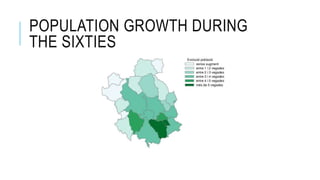
POPULATION GROWTH DURING
THE SIXTIES
DEMOCRACY AND NEW
GOVERNANCE FRAMEWORKS
Transition to democracy
 Transformation of the old guilds into democratic
entrepreneurs’ associations CECOT (Terrassa) and CIESC
(Sabadell)
 Arrival to local power of communist and socialist parties, that
largely control the county with strong support of
neighbourhood associations and trade unions
 Local municipalities trying to promote economic development
but conflicts:
 With entrepreneurs associations not willing to collaborate
 With the growing relevance of the Catalan government aiming to control such
policies
 With other municipalities of the area (competence between municipalities)
THE DEMOCRATIC GOVERNANCE
CONTEXT
Strong role of regional governments in economic development,
as they have tended to concentrate competences and resources
City councils reluctant to loose competences and trying to
develop their own policies after strong centralism of Francoism
In Catalonia, two different political projects:
 Nationalist conservatism, concentrating competenes at regional level with a
liberal project. Conservatist nationalist party controlling the catalan
government
 Progressive catalanism, aiming to give more power to municipalities in the
context of a social-democrat project. Socialist party controlling main
municipalities.
STRATEGIES FOR
ECONOMIC DEVELOPMENT
Metropolitan regions and
small and mèdium-sized
cities: the case of
Barcelona
THE CONSORTIUM FOR EMPLOYMENT
AND ECONOMIC DEVELOPMENT OF
VALLÈS OCCIDENTAL (CEDEVO, 2006-
2015)Experience since 1997 on implementation of Active Employment
Policies (Territorial Pacts for employment promoted by the EU)
Formed in 2006 to implement Active employment policies but
adopting a vision on Economic Development
 Catalan government (department of work)
 23 municipalities
 2 main trade unions CCOO and UGT
 2 main entrepreneurs’ asosciations CECOT and CIESC
FUNCTIONS OF THE CONSORTIUM
To provide training and skills to workers at the local level avoiding
duplicating services
Integrating local labour Markets at county level
Obtaining funds from other administrative levels (catalan and Spanish
governments, EU…)
Soft coordination of economic development policies
 Creating a single economic parks offer (specialisation of industrial areas)
 Coordinating local policies into a single catalogue
ISOLATED STRATEGIES FOR
GROWTH
Large municipalities (Sabadell and Terrassa):
 Adaptation of already existing industries to innovation and new sectors
 From clothing to healthcare materials
 From chemical industries to well-being
 Searching for new sectors considered strategic
 Audiovisual park of Terrassa
 Upgrading food industries
 Optics and photonics
Medium-sized municipalities
 Following strategies for large cities
 Developing their own strategies with suport of higher levels of administration
Small municipalities
 Joining others’ efforts
SOME EXAMPLES
Innovation plan of Terrassa (local plan)
 Local plan to promote new sectors and reinforce already existint ones.
Similar to Barcelona local strategy for growth
Catalonia Innovation Triangle (Consortium between three
mèdium-sized municipalities: Rubí, Sant Cugat and Cerdanyola)
 Attracting knowledge-based companies bringing added value services
 Use of universities and other infrastructures with heavy suport of the
Catalan government)
Innovation Plan of the Ripoll Basin (led by Sabadell and
involving six other industiral municipalities near the river Ripoll)
 Organizing industrial activity around two sectors
STRATEGIC SECTORS IN THE TWO
AREAS
Sabadell (and other
municipalities)
Two macro sectors to guide
actions of all other sectors
 Health
 Chemical
 Clothing
 Metallurgic
 Food industries
 Chemical
 Logistics
 …
Terrassa
Food industries
Technical clothing
Leisure and entertainment
Auxiliar industries for
industrial sectors
Optics and fotonics
Ecotechnology
Aeronautics
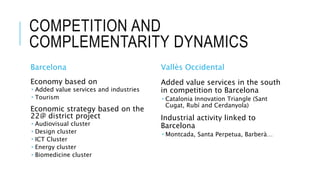
COMPETITION AND
COMPLEMENTARITY DYNAMICS
Barcelona
Economy based on
 Added value services and industries
 Tourism
Economic strategy based on the
22@ district project
 Audiovisual cluster
 Design cluster
 ICT Cluster
 Energy cluster
 Biomedicine cluster
Vallès Occidental
Added value services in the south
in competition to Barcelona
 Catalonia Innovation Triangle (Sant
Cugat, Rubí and Cerdanyola)
Industrial activity linked to
Barcelona
 Montcada, Santa Perpetua, Barberà…
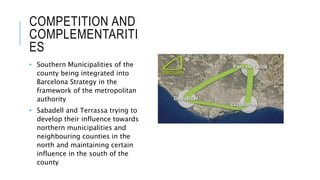
COMPETITION AND
COMPLEMENTARITI
ES
• Southern Municipalities of the
county being integrated into
Barcelona Strategy in the
framework of the metropolitan
authority
• Sabadell and Terrassa trying to
develop their influence towards
northern municipalities and
neighbouring counties in the
north and maintaining certain
influence in the south of the
county
DIFFERENT DISCOURSES AND
STRATEGIES
Discourses on the economy of knowledge: attracting
companies based on knowledge and added value
 Terrassa
 Sant Cugat
Discourses on industrial innovation: bringing
competitiveness to already existing industry through
innovation and agglomeration:
 Sabadell
 Trade Unions
 Entrepreneurs’ associations
MULTI-SCALARITY
Municipalities developing strategies at different scales:
 Local
 Supra-local (involving different municipalities of the county)
 County
 Metropolitan (for instance municipalities in the south integrated to the
Metropolitan Authority)
 Catalan
These strategies showing contraditions and competitiveness
amongst them
But strong sense of belonging and agreement capacity
CHANGES WITH THE CRISIS
Destruction of industrial activity and very relevant growth
of unemployment
Demise and changes in the political system:
 Crisis in Sabadell as the political elite is being processed for
corruption
 The case shows the strong control of Sabadell over small
surrounding municipalities
Recentralization of competences by the catalan and
national governments
 Lack of funding of the Consortium, dissolution and integration of its
functions into the County council, that assumes economic
development at county level but not active employment policies
CONCLUSIONS ON THE CASE
STUDY
•Sabadell and Terrassa pushing to maintain their role as sub-centres
in the metropolitan región
•Dynamics of collaboration and competitiveness in these efforts
•Growth of a third pole of economic relevance in the south of the
county and led by Sant Cugat del Vallès
•Integration of the south of the county into metropolitan área
stategies (36 municipalities)
•Strategies of Sabadell and Terrassa to reinforce their role towards
north of Catalonia
•Agreement on demanding public investments in infrastructures and
private investments
GENERAL CONCLUSIONS
•Strategies of local municipalities in complex multi-level governance
contexts: dynamics of competition and collaboration
•But sense of belonging bringing capacity of collaboration, specially in
front of the large city
Marc Pradel Miquel
1st March 2016
marcpradel@ub.edu

Metropolitan regions and small and medium sized cities

  • 1.
    METROPOLITAN REGIONS AND SMALLAND MEDIUM- SIZED CITIES THE CASE OF BARCELONA Marc Pradel Miquel Universitat de Barcelona
  • 2.
    SUMMARY The context  Barcelonametropolitan region  Vallès Occidental  Historical development Strategies for economic development  The Consortium for employment and economic development of Vallès Occidental  Isolated strategies for growth
  • 3.
    BARCELONA METROPOLITAN REGION •164 Municipalities • 7 Counties • 36 municipalities under the Metropolitan Authority (Àrea Metropolitana de Barcelona) • 4,776,107 inhabitants • Polycentric metropolis but strong role of Barcelona
  • 4.
    VALLÈS OCCIDENTAL • 23 municipalities •+ 900,000 inhabitants • 2 municipalities concentrating half of the population • Sabadell 207,444 • Terrassa 215,517 • Small municipalities • Rellinars 726 • Gallifa 202 • Sense of belonging to Vallès
  • 5.
    HISTORICAL DEVELOPMENT ‘Failure’ ofthe industrial revolution in Spain Uneven industrialisation in Spain, concentration in Barcelona (manufactures) and Basque Country (processing of rough materials) Protectionist Catalan bourgeoisie aiming to control national market Role of textile industries in Catalonia Emergence of a bourgeoisie from the combination of traders and craftsmen
  • 6.
    INDUSTRIALISATION IN SABADELL ANDTERRASSA Transformation of guilds into association of companies:  Manufacturers’ guild (Sabadell)  Industrial institute (Terrassa) Small and medium-sized companies sharing spaces to sufragate costs of machinery  Vapor Llonch  Vapor Vell Crisis of cotton industries in the 1860s and specialisation in Wool production  Control of wool markets in Spain  Increase of political influence
  • 7.
    INDUSTRIALISATION IN SABADELL ANDTERRASSA Industrialisation of nearby villages Creation of Banks Two self-managed industrial districts  Terrassa with bigger industries and capital  Sabadell with small-size companies and bigger mobility
  • 8.
    TWO SUBSYSTEMS OFCITIES Terrassa Rubí Sant Cugat del Vallès Vacarisses Viladecavalls Castellbisbal Matadepera Rellinars Sant Llorenç Savall Ullastrell Gallifa Sabadell Cerdanyola Montcada i Reixac Ripollet Badia del Vallès Barberà del Vallès Santa Perpètua de Mogoda Polinyà Palau-Solità i Plegamans Sentmenat Castellar del Vallès Sant Quirze del Vallès
  • 9.
    INDUSTRIALISATION IN SABADELL ANDTERRASSA: CIVIL WAR AND DICTATORSHIP Democratic local elections with the second spanish republic (1931´- 1936) and loss of political power by the local economic elites After the Spanish Civil War (1936-1939) return of the economic elites to power and economic growth due to low wages and protectionist policies of the regime Opening of the economy after the II World War (agreement with US)  Growth and diversification of industry since the 1960s (automobile, chemical…)  But crisis of the textile sectors since the 1970s due to external competiveness
  • 10.
    ECONOMIC GROWTH ANDDECLINE Arrival of massive flows of migration from the rest of Spain to work in the new industrial sectors Process of delocalization of factories and population to the small municipalities of the county and consolidation of Sabadell and Terrassa of centres of two hinterlands with increasing urban segregation  Industrial municipalities with working class and factories  Suburbanization and high class suburbs (Sant Cugat, Matadepera, Vacarisses) with services as main economic sector  Sabadell and Terrassa as tertiarized economies offering services to industrial sectors ‘Centralist’ General Metropolitan Plan (1976) reinforcing the role of Barcelona
  • 11.
  • 12.
    DEMOCRACY AND NEW GOVERNANCEFRAMEWORKS Transition to democracy  Transformation of the old guilds into democratic entrepreneurs’ associations CECOT (Terrassa) and CIESC (Sabadell)  Arrival to local power of communist and socialist parties, that largely control the county with strong support of neighbourhood associations and trade unions  Local municipalities trying to promote economic development but conflicts:  With entrepreneurs associations not willing to collaborate  With the growing relevance of the Catalan government aiming to control such policies  With other municipalities of the area (competence between municipalities)
  • 13.
    THE DEMOCRATIC GOVERNANCE CONTEXT Strongrole of regional governments in economic development, as they have tended to concentrate competences and resources City councils reluctant to loose competences and trying to develop their own policies after strong centralism of Francoism In Catalonia, two different political projects:  Nationalist conservatism, concentrating competenes at regional level with a liberal project. Conservatist nationalist party controlling the catalan government  Progressive catalanism, aiming to give more power to municipalities in the context of a social-democrat project. Socialist party controlling main municipalities.
  • 14.
    STRATEGIES FOR ECONOMIC DEVELOPMENT Metropolitanregions and small and mèdium-sized cities: the case of Barcelona
  • 15.
    THE CONSORTIUM FOREMPLOYMENT AND ECONOMIC DEVELOPMENT OF VALLÈS OCCIDENTAL (CEDEVO, 2006- 2015)Experience since 1997 on implementation of Active Employment Policies (Territorial Pacts for employment promoted by the EU) Formed in 2006 to implement Active employment policies but adopting a vision on Economic Development  Catalan government (department of work)  23 municipalities  2 main trade unions CCOO and UGT  2 main entrepreneurs’ asosciations CECOT and CIESC
  • 16.
    FUNCTIONS OF THECONSORTIUM To provide training and skills to workers at the local level avoiding duplicating services Integrating local labour Markets at county level Obtaining funds from other administrative levels (catalan and Spanish governments, EU…) Soft coordination of economic development policies  Creating a single economic parks offer (specialisation of industrial areas)  Coordinating local policies into a single catalogue
  • 17.
    ISOLATED STRATEGIES FOR GROWTH Largemunicipalities (Sabadell and Terrassa):  Adaptation of already existing industries to innovation and new sectors  From clothing to healthcare materials  From chemical industries to well-being  Searching for new sectors considered strategic  Audiovisual park of Terrassa  Upgrading food industries  Optics and photonics Medium-sized municipalities  Following strategies for large cities  Developing their own strategies with suport of higher levels of administration Small municipalities  Joining others’ efforts
  • 18.
    SOME EXAMPLES Innovation planof Terrassa (local plan)  Local plan to promote new sectors and reinforce already existint ones. Similar to Barcelona local strategy for growth Catalonia Innovation Triangle (Consortium between three mèdium-sized municipalities: Rubí, Sant Cugat and Cerdanyola)  Attracting knowledge-based companies bringing added value services  Use of universities and other infrastructures with heavy suport of the Catalan government) Innovation Plan of the Ripoll Basin (led by Sabadell and involving six other industiral municipalities near the river Ripoll)  Organizing industrial activity around two sectors
  • 19.
    STRATEGIC SECTORS INTHE TWO AREAS Sabadell (and other municipalities) Two macro sectors to guide actions of all other sectors  Health  Chemical  Clothing  Metallurgic  Food industries  Chemical  Logistics  … Terrassa Food industries Technical clothing Leisure and entertainment Auxiliar industries for industrial sectors Optics and fotonics Ecotechnology Aeronautics
  • 20.
    COMPETITION AND COMPLEMENTARITY DYNAMICS Barcelona Economybased on  Added value services and industries  Tourism Economic strategy based on the 22@ district project  Audiovisual cluster  Design cluster  ICT Cluster  Energy cluster  Biomedicine cluster Vallès Occidental Added value services in the south in competition to Barcelona  Catalonia Innovation Triangle (Sant Cugat, Rubí and Cerdanyola) Industrial activity linked to Barcelona  Montcada, Santa Perpetua, Barberà…
  • 21.
    COMPETITION AND COMPLEMENTARITI ES • SouthernMunicipalities of the county being integrated into Barcelona Strategy in the framework of the metropolitan authority • Sabadell and Terrassa trying to develop their influence towards northern municipalities and neighbouring counties in the north and maintaining certain influence in the south of the county
  • 22.
    DIFFERENT DISCOURSES AND STRATEGIES Discourseson the economy of knowledge: attracting companies based on knowledge and added value  Terrassa  Sant Cugat Discourses on industrial innovation: bringing competitiveness to already existing industry through innovation and agglomeration:  Sabadell  Trade Unions  Entrepreneurs’ associations
  • 23.
    MULTI-SCALARITY Municipalities developing strategiesat different scales:  Local  Supra-local (involving different municipalities of the county)  County  Metropolitan (for instance municipalities in the south integrated to the Metropolitan Authority)  Catalan These strategies showing contraditions and competitiveness amongst them But strong sense of belonging and agreement capacity
  • 24.
    CHANGES WITH THECRISIS Destruction of industrial activity and very relevant growth of unemployment Demise and changes in the political system:  Crisis in Sabadell as the political elite is being processed for corruption  The case shows the strong control of Sabadell over small surrounding municipalities Recentralization of competences by the catalan and national governments  Lack of funding of the Consortium, dissolution and integration of its functions into the County council, that assumes economic development at county level but not active employment policies
  • 25.
    CONCLUSIONS ON THECASE STUDY •Sabadell and Terrassa pushing to maintain their role as sub-centres in the metropolitan región •Dynamics of collaboration and competitiveness in these efforts •Growth of a third pole of economic relevance in the south of the county and led by Sant Cugat del Vallès •Integration of the south of the county into metropolitan área stategies (36 municipalities) •Strategies of Sabadell and Terrassa to reinforce their role towards north of Catalonia •Agreement on demanding public investments in infrastructures and private investments
  • 26.
    GENERAL CONCLUSIONS •Strategies oflocal municipalities in complex multi-level governance contexts: dynamics of competition and collaboration •But sense of belonging bringing capacity of collaboration, specially in front of the large city
  • 27.
    Marc Pradel Miquel 1stMarch 2016 marcpradel@ub.edu