DIGISHIFT2020
- how the digital channels shape the future of shopping
Report from Steen & StrømTrendlab 2011
DIGISHIFT 2020
2
3report from steen & strøm trendlab
Steen&StrømTrendlabiswheretheemployees,retailersandotherexpertsmeettoshare
thoughts and knowledge on future consumers, retail and shopping centres. Each Trendlab
project produces a visionary report, but for the participants the process itself is also very
valuable. It creates new strategic insights and learning.
Steen&StrømistheleadingshoppingcentrecompanyinScandinaviaandwantstoexpress
that by being perceived as the expert on retail and shopping centres. Trendlab is one of
manyeffortstoachievethatambitiousgoal.Wewanttobethecompanyourpartnerswant
to join in creating future meeting places.
When we do our trend research we start with already existing megatrends, trends and
phenomena.Wetrytofindoutwhichofthemwillremainstrongandwhichofthephenomena
are strong enough to become a future trend. History tells us that many of the elements of
the near future are things we already know. The challenge is to judge their future strength
and duration. Sometimes a phenomena is strong enough alone, but most of the time it is
depending on the growth of a number of other trends and phenomena, to become a trend
by itself.
Looking at a possible future is always holding a degree of uncertainty. But at Steen &
Strøm we think we are better prepared by listening to the qualified assumption of leading
experts in the field. In certain areas it can make us create the future, rather than being
caught by surprise.
This is the fourth Steen & Strøm Trendlab. The first three have been building on the
findings of the earlier Trendlabs, like this one as well. With this fourth book we believe
the foundations gets stronger and touch upon new areas which are important to better
understand our common society and business environment of the future.
This time we have had a closer look on how the digital channels that will shape the future
retailandfutureshoppingcentres.Theimpactofthee-shiftisobvious.Wecanseechanges
in the way we communicate in new channels.We see how e-trade gradually reshapes retail.
But how will the future look for retail and shopping places? Steen & Strøm Trendlab has
involved a number of internal and external experts to help predict the future development.
Have a good read!
Foreword
DIGISHIFT 2020
4
© Copyright Steen & Strøm 2011
Graphic Design:TIBE Drammen
Photo: Steen & Strøm, Kairos Future, istock.com
5report from steen & strøm trendlab
Contents
CHAPTER 1
Introduction	7
Background and context for the theme of Trendlab 4
CHAPTER 2
from pastto present	 25
The Digishift Timeline
CHAPTER 3
Trends & phenomena	 39
The Trends and the Phenomena prioritized shaping
the digitization of Retail.
CHAPTER 4
the experts view on the future	 89
CHAPTER 5
the likely future	 113
Looking into the year 2020
CHAPTER 6
scenarios for the future	 129
Multichannel • Showroom • Smartmart • Experience
DIGISHIFT 2020
6
Most experts point out that the coming ten to twenty years will be the
most dramatic years ever in history of mankind. The well-known futurist
Theodore Modis states that five days in 2025 will be as ”event rich” as the
whole 20th century. Even if you are not that dramtic it is important to be
aware of many of the driving forces and shifts that is under way in a higher
speed than ever.
In Kairos Futures international research on how the most successful
companies excel in turbulent times, we find that it is the companies ability
to systematically scan for future trends and changes in their business
environment and their intense efforts on making insights of the foresights
that creates what we call Future Sense in the management team. Their
understanding of different scenarios makes them innovative and prepared
for increasing turbulence and more comlex business environments.
7report from steen & strøm trendlab
introduction
chapter 1
Background and context for the theme of Trendlab 4
DIGISHIFT 2020
8
Tomorrow
belongs to
the people
who prepare
for it today.
African Proverb
9report from steen & strøm trendlab
This is the 4th research paper from Steen & Strøms TrendLab – a future workshop where
we gather leading experts within different disciplines in order to collectively improve the
possibilities to meet future challenges.
The first report focused on consumer tendencies and shopping behaviour. The second
report was trying to cover the most important shifts that will have big impact of shopping
places in the future. We identified 10 major shifts that was further explored in the third
TrendLab report which was called the Future of the moment of truth.The shifts has served
as a strategic map for Steen & Strøm and are presented here below:
•	 The Power Shift – from producer to distributor, to the consumer power. Increasing
flow of information in an ongoing explosion of mediachannels makes traditional
marketing less effective and the critical and advertising-weary consumers are arming
themselves with new technology. With blogs, social networks and mobile phones they
are acquiring greater power as they take over a number of media and sales channels
•	 Anti-Age shift – from ages to life cycles. In a population that is growing older the
conceptanddefinitionochyouthisslowlychanging.Seniorcitizenstodayareredefining
the life ladder while experiencing a second period of freedom with time and money to
spend.Youthhasgonefrombeingrelatedtoacertainageandbecomesastateofmind
•	 Value shift – from indiviualism to dividualism (multiple and temporary identities).
Postmaterialistic values and individual strife for life maximalization in a economy
that is shifting from needs to desires, leads to a hectic hunt for experiences
and satisfaction. A complete norm collaps in the society makes people focus
on inventing their identity-projects. In our hectic world, more people develop
mental agility. Life offers fewer stable relations, but a growing array of temporary
acquaintances and encounters. This mental agility leads to a serious play with
more identities and roles than ever before. The future belongs to the dividualists.
•	 Convenience shift – from “what?” and “how much?” to “where?” and “When?”
(Superconvinience and Just-in time living). Increased prosperity and a perceived
lack of time for a growing number of consumers in combination with increased lack of
energy creates a desire for superconvinience retail – that can help me live a no friction
life.
•	 Form shift – from function to form (Democratization of design and luxury and
emergence of mass-clusivity). More aesthetics, appearance and finish will become
increasingly important for the shopping culture of the future as consumers search
for a more designed existence, devoting more energy to choosing attributes that can
work as extensions of their selves.
A series of research papers since 2007
DIGISHIFT 2020
10
•	 E-shift – from physical limitation to multichannel opportunity (E-tailing, Mixed
reality and immersive shopping experiences). E-commerce is growing stronger
than ever. In most fields e-commerce is making inroads in relation to more traditional
methods. E-tailing concepts becomes part of multichannelstrategies to create better
relationships with consumers where ever they are, creating problems knowing what
actually is sold and what is not in ordinary shops and shopping places.
•	 Concept shift –from products to store and marketplace concepts. In the past the
products themselves accounted for a large part of the brand and the concept. As
quality convergence and globalization increase, the products become less important
and the packaging of the product and the surrounding shopping experience becomes
more in focus. Format is playing a larger role as stores attempt to differentiate and
renew themselves in a faster and faster pace.
•	 Metropolitan shift – from countryside vs urban challenge to metropolitan growth
and Urbanity as the way for the future. The city previously viewed as a dirty problem
is now seen as an engine for growth. Development of sustainable metropolitan areas
is increasingly part of the solution and the search for new forms to unite classic citiy’s
integration of work, home and shop with the new demands for accessibility, healthy
environment and effective land use. Shopping places will be more integrated with the
city and receive a far more versatile content than the previously discussed “boxes out
on a field”.
•	 Environment shift – from Eco-luxury and Eco-Chic to Survival (Sustainability rules,
Small Scale and Local Heroes, Eco-smart shopping). We will se a peek of everything
in not so far distant future. Energy, food, water and raw-materials are becoming
scarcities for a growing global population. Consumers will be ever more critical of
businesses and brands that behave irresponsible. Sustainability will be the driving
force and focus in the efforts to create eco-smart production and consumption.
•	 Class Shift – from Stable Socio-economic classes to Division of Multidimensional
classes (Downward mobility, the minorities on the rise and creation of a new class
society). Over the past few decades we have seen income differences increase as a
new form of class society takes over where the class markers such as education and
networking are becoming more multifaceted. Once again, the wealthy are becoming
wealthier. Inequality today is not just a matter of money, but of a number of variables
such as education, language skills, connections, access to media and networks. The
most vulnerable today are unemployed young people and many immigrant groups.
The continous work and updates of the trendshifts on a regular basis has given further
understanding of what the future may bring. For the past years it has also been recognized
that the strongest signals for change in retail and shopping places is coming from a wider
perspective of the E-shift, digitization in general.
11report from steen & strøm trendlab
“Bits, the DNA of
information, are
rapidly replacing
atoms as the
basic commodity
of the human
interactiony.”
Nicholas Negroponte
DIGISHIFT 2020
12
–The purpose of for this year’s report isto explore how
the digital channels will shapethe future of shopping.
Nicholas Negroponte, who gave the statement in his book Being Digital in 1995, referred
to a belief that every object or product which can be digitized will become digitized in the
future.
During the 15 years that has passed since he wrote this, we have witnessed a total
information- and communication revolution in society that still only is in its beginning.
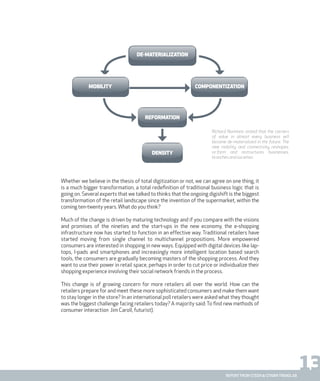
RichardNormann,afamousSwedishmanagementthinkerandwriterstatedinhislastbook
that because of the digitization, the carriers of value in almost every business will become
de-materialized in the future. Symbols, brands, information, knowledge, relationships
are all examples of value that now are becoming digitized and fluid. The new mobility and
connectivityreshapes,re-formandrestructuresbusinesses,branchesandsocieties. Look
at what is happening in the middle east right now. The new connectivity and the fact that
more an more products have been transformed to bits rather than atoms, creates a new
type of density in the market where everything is reachable from the palm of your hands,
from your computer, your mobile, your car, your Nintendo or Flatscreen. You’re closer to
your co-workers or customers through Skype. You’re friends and family are almost always
with you via Facebook, Twitter, Go-Walla or Foursquare, Your records and every record
ever produced is near you through Spotify or Itunes. Even your money and savings are in
the reach every second of the day.
“If one believes in the digitization thesis than we have to realize that many of the prod-
ucts in physical shops will be digitized during the coming ten year period. If more and
more people will have a 3-D printer at home which is printing out the productbase then
Ingvar Kamprad will be happy to skip the flat boxes. We will buy bits, ones and zeros, that
represents the reading lamp Emma instead of the real thing. Ikea has the CAD-drawings
already so they could start creating a shop that would sell in this new way in order to pre-
vent ending up where the record companies did with free illegal down loading, or in this
case, a Pirate bay of things.”
Martin Törnqvist (Expert panel) trend analyst Media Evolution.
The Digishift
“Bits, the DNA of information, are rapidly replacing atoms as the basic commodity of the
human interactiony.”
Nicholas Negroponte
13report from steen & strøm trendlab
Whether we believe in the thesis of total digitization or not, we can agree on one thing, it
is a much bigger transformation, a total redefinition of traditional business logic that is
going on. Several experts that we talked to thinks that the ongoing digishift is the biggest
transformation of the retail landscape since the invention of the supermarket, within the
coming ten-twenty years.What do you think?
Much of the change is driven by maturing technology and if you compare with the visions
and promises of the nineties and the start-ups in the new economy, the e-shopping
infrastructure now has started to function in an effective way. Traditional retailers have
started moving from single channel to multichannel propositions. More empowered
consumers are interested in shopping in new ways. Equipped with digital devices like lap-
tops, I-pads and smartphones and increasingly more intelligent location based search
tools, the consumers are gradually becoming masters of the shopping process. And they
want to use their power in retail space, perhaps in order to cut price or individualize their
shopping experience involving their social network friends in the process.
This change is of growing concern for more retailers all over the world. How can the
retailers prepare for and meet these more sophisticated consumers and make them want
to stay longer in the store? In an international poll retailers were asked what they thought
was the biggest challenge facing retailers today? A majority said: To find new methods of
consumer interaction Jim Caroll, futurist).
Richard Normann stated that the carriers
of value in almost every business will
become de-materialized in the future. The
new mobility and connectivity reshapes,
re-form and restructures businesses,
branches and societies.
De-materialization
reformation
density
componentizationmobility
DIGISHIFT 2020
14
Cross-selling, F-shopping (Facebook), App-tailing, M-shopping (mobile), Blog-tailing, Flash
sales, invincible pop-up retail, preview shopping, Crowd shopping are all relatively new
terms that we find in a more experimental retail scene. In this report we will explore how
the digital channels will change and form the future of shopping places and there are many
interesting questions to ask:
•	 Which are the most important trends within the digital field, e-shopping,
m-shopping and multichannel that will have an impact on the shopping process?
•	 What are the consequences for retail and shopping places?
•	 How will physical and net-shopping cooperate and compete in the future?
•	 Which and how integrated are the platforms that consumers will shop from in the
future?
•	 What retail categories will suffer much because of the ongoing Digishift? Which
categories will disappear from the physical shopping arena?
•	 Will E-shopping create a development of smaller or shrinking physical stores in
shopping places?
•	 How will shopping places of the future change in order to utilize the new mixed
reality, the new hybrids of physical and virtual word?
These are some of the questions that we had in mind while doing this project and we have
tried to have a holistic view in the search for the future of shopping experience across the
retail landscape.
15report from steen & strøm trendlab
”Plan for the future because
that’s where you are going to
spend the rest of your life.”
MarkTwain
DIGISHIFT 2020
16
Howwasthe information forthis report gathered?
To try to catch the future is a guess work and you need some tools to qualify the guessing
as much as possible. The project has been runned by Kairos Future and a small analyst
group from Steen & Strøms Scandinavian offices with the following participants:
•	 Harald Nilsen, Research manager
•	 Annemette Wørmer, Marketing manager
•	 Kajsa Rahlén, Research manager
Together we have used four interlinked methods to create a possible scenario for the
future.
•	 International Trendwatch-study
•	 Indepth-interviews
•	 Delphi study with a panel of experts
•	 Future Hearing Day
InternationalTrendWatch-study
During this phase Kairos Future consultants and its international research partners
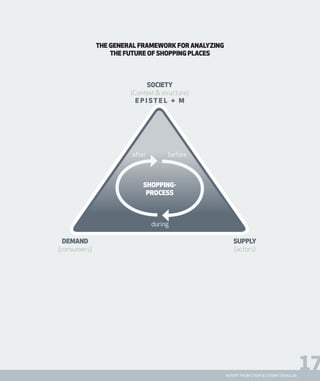
carried out an international trendscanning. The model below illustrates different search
areas that was covered.
In order to find contextual and structural drivers and changes we used a framework called
E P I S T E L + M, which stands for Economics, Politics, Institutional changes, Social,
Technological, Ecological and Media/Market changes. Further more we searched after
trends related to a demand and supply-based structure and finally we tried to cover the
specifics related to a changing shopping process. There the changes can appear in how
consumer behave before, during and after the shopping activity takes place. This work
resultedinaround100trendsondifferentlevelsandwithdifferentperspectiveandscope.
17report from steen & strøm trendlab
Society
(Context & structure)
e pist e l + m
demand
(consumers)
supply
(actors)
beforeafter
during
shopping-
process
the general framework for analyzing
the future of shopping places
DIGISHIFT 2020
In-depth interviews
The following experts where interviewed:
•	 Rune Glasø, innovator, Gyro
•	 Johan Ronnestam, consultant, advisor and writer about digital media and future
branding. Runs a famous blog; www.ronnestam.com
•	 Ole Petter Nyhaug. speaker and blogger on consumer trends, marketing innovations,
Partner and managing director, OnLive Research
•	 Lars Tong Strömberg, Head of Internet at Aller Media. Writing a blog about strategy,
marketing and all things digital in between
•	 MartinTörnqvist,Trend analyst, Media Evolution
•	 Ola Stavhammar, Sales & Sponsoring, Svenska E-sportföreningen
•	 Michael Cronholm, Research Specialist at Inter Ikea Centre Group
•	 David Jansson, Journalist at the nordic magazine Market
•	 Moon-Suck Song, expert in mobile commerce, Managing Director Panagora Room AB
•	 Mikaela Dyhlén,Trend analyst, BlikTrends & Insigts
•	 Dan Ouchterlony, Investment Manager, SchibstedTillväxtmedier
report from steen & strøm trendlab
Delphi-study
The Delphi method is widely spread and structured communication technique, originally
developed as a systematic, interactive forecasting method which relies on a panel of
experts. Delphi is based on the principle that forecasts from a structured group of indi-
viduals,skcollectiveintelligence,aremoreaccuratethanthosefromunstructuredgroups.
The Delphi method gives us a broader sense of how the digital channels will develop in the
near future and it gives us a structured idea of how the new marketplace will evolve.
Kairos Futures research team carried out a webbased questionnaire with future state-
ments that each expert had to answer. In total we had 40 international experts answering
what they thought about the digitization and the future of shopping places. The results
were revised and analysed together with Steen & Strøm analyst team.
You can read more
about the results
on page 94 to 102
click here!
DIGISHIFT 2020
Future Hearing Day
The Future Hearing day was a one day meeting with internal key persons and experts from
Steen & Strøm. During the hearing we presented the trends and Delphi-results. In this
workshop we prioritized the most important trends for the future. We created a base sce-
nario 2020 and based on the facts, trends and forecasts we created so called Future Snap
shots of possible retail landscapes 2020.
The following participants took part in the Future Hearing Day:
•	 Karl Fredrik Lund
•	 Tove Lise Foss
•	 Charlotte Christensen
•	 Lise Gård
•	 KatrineVelter
•	 ClausTüchsen
•	 Søren Soelberg
•	 Mark Rendbæk
•	 Anders Bojer Nielsen
•	 Charles Larsson
•	 Anna Christenson Åberg
•	 Kenneth Jävervall
•	 The analyst team
21report from steen & strøm trendlab
DIGISHIFT 2020
22
Authors
The report is produced in a collaboration between Kairos Future and Steen & Strøm ana-
lyst team. The thoughts, ideas and suggestions that the analyst team and both internal
and external experts drew up were added to, explored further and analysed in more depth
by Kairos Future. The final shape that the material takes in this book is essentially based
on the results of this process. The following futurists were involved in the writing of this
report:
Magnus Kempe, Director of Retail and Finance
Magnus has written several books and reports about the consumers of the future, as well
as retail and financial markets. He wrote a well recognized report “after the credit party”
about the coming loan crisis in USA already in 2006, two years before the actual finan-
cial collaps. He has been the project manager for several of Kairos Futures major studies
includingThe Ridderheims report and Urban families food lifestyles.
Jörgen Jedbratt, Senior Partner, strategic advisor and writer
Hehaswrittenaserieofmanagementbooksovertheyears,mainlyaboutmarketing,media
and consumer behavior.Together with Magnus he has mastered many of Kairos consumer
reports such as the Ridderheims report and Tomorrows Advertising market and Beyond
Mobile. Already in 1994 together with Per Florén and Peter Gustafsson he wrote a book
about how Internet would revolutionize the business world.
Kajsa Ahlgren, market manager USA
Located in New York she provides Kairos Future with an American perspective in global
research projects. Her focus is innovation, especially sustainable social- and business
development. Recent projects were within foodtrends, innovation and design.
Jorge López Quinones, researcher.
Jorge focuses on international research and trendscanning within a wide area of knowl-
edge areas. His specializes in future technology and consumer behavior.
Jonas Thulin, researcher and analyst
JonasThulin works as an analyst at Kairos Future. He has two Master’s degrees in in politi-
calscienceandineconomics,includingstatistics.Jonashasaspecialinterestinphilosophy
and in history of ideas.
2
64 % according to Jim Carrol, Location is the New Intelligence: Customer interaction in the Era of pervasive mobile
The best way to predict the
future is to create it.
Peter Drucker
DIGISHIFT 2020
24
The longer you
look back, the
farther you can
look forward.
Winston Churchill
25report from steen & strøm trendlab
From past
chapter 2
to present
The Digishift Timeline
DIGISHIFT 2020
26
1990
2000
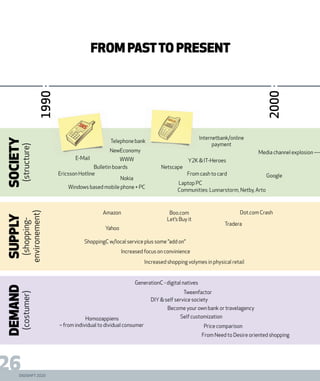
FROM PASTTO PRESENT
SOCIETY
(structure)
Telephone bank
Dot.com Crash
GenerationC - digital natives
E-Mail
Amazon
Ericsson Hotline
Yahoo
Windows based mobile phone + PC
ShoppingC w/local service plus some ”add on”
Homozappiens
– from individual to dividual consumer
Bulletin boards
Increased focus on convinience
Become your own bank or travelagency
Self customization
Price comparison
DIY& self service society
NewEconomy
Tradera
Tweenfactor
Netscape
From cash to card
Y2K & IT-Heroes
Media channel explosion –--
Laptop PC
Communities: Lunnarstorm, Netby, Arto
Google
WWW
Boo.com
Let’s Buy it
Nokia
Increased shopping volymes in physical retail
From Need to Desire oriented shopping
Internetbank/online
payment
SUPPLY
(shopping-
environement)
DEMAND
(costumer)
1990
Telephone bank
NewEconomy
Telephone bank
27REPORT FROM STEEN & STRØM TRENDLAB
2001
2011
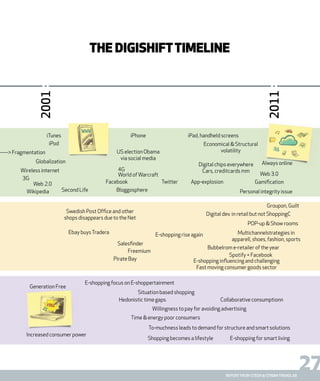
THE DIGISHIFTTIMELINE
E-shopping focus on E-shoppertainment
Willingness to pay for avoiding advertising
Increased consumer power
Time & energy poor consumers
Shopping becomes a lifestyle E-shopping for smart living
Hedonistic time gaps Collaborative consumptionn
Situation based shopping
Generation Free
------> Fragmentation
Globalization
Ebay buysTradera
3G
Pirate Bay
Web 2.0
Wikipedia Second Life
Wireless internet
Freemium
Salesfinder
To-muchness leads to demand for structure and smart solutions
iTunes
Swedish Post Office and other
shops disappears due to the Net
iPhone
US election Obama
via social media
4G
World ofWarcraft
Facebook Twitter App-explosion
Web 3.0
Gamification
Personal integrity issueBloggosphere
iPad, handheld screens
Economical & Structural
volatility
Always onlineDigital chips everywhere
Cars, creditcards mm
iPod
E-shopping rise again
Bubbelrom e-retailer of the year
Multichannelstrategies in
apparell, shoes, fashion, sports
POP-up & Show rooms
Digital dev. in retail but not ShoppingC
Groupon, Guilt
E-shopping influencing and challenging
Fast moving consumer goods sector
Spotify + Facebook
Increased consumer power
Generation Free
Always onlineGlobalization
DIGISHIFT 2020
28
history and driving forces
A brief history of e-commerce
1990 - 2000The sky is the limit –the mental platform
The 1990s was for many the time with the most inspiring thoughts of what the Internet
might bring to the world. Traditional individuals did not last long either on stage or in re-
cruiting. The world had discovered a new sphere: the virtual world with which one had to
engage to be part of the future.
To some extent both the problem and the blessing was that they were mostly ideas. While
many of the notions of what the Internet might bring were discussed, they weren’t imple-
mented. Apple launched the Newton, the new reading device, in 1993 and it did not imme-
diatelybecomeagreatsuccess.ThePalmwasthefutureofcalendars,butafterawhilethe
growth in use started to decline. Fewer individuals were seen writing with that small pen,
which had been said to be the future. By the end of the decade the amazing mobile phones
with Internet connection came on the market. It was said that the WAP, the new standard
for the mobile Internet would prove extraordinary. Electrolux and Ericsson launched the
project E2 a flagship project for how appliances, and the entire food distribution would be
used in the future. Specially built flats, which were adapted to this new form of distribu-
tion, were built.
Some of today’s giants were founded during that decade including Amazon, eBay and by
the end of it, Google. For the most part, however, most ideas cost a lot of money and hope
withlittleresultinbusinessvalue.Thisperiodneverthelessprovedveryvaluableforestab-
lishing people’s mindset. In some sense, both the mental and the physical infrastructures
benefited from the hype and the visionary thinking. The buildup of 3G networks and fiber
cables underground benefited greatly from the money flowing into the industry.
More importantly, people and businesses started to imagine the world when it finally hap-
pened and what the new business models might look like. Today’s superstars the iPhone,
Facebook and the iPad were created mentally back then. In both Norway and Sweden so-
cial networks such as Lunarstorm experienced tremendous success. In 2001, the site had
600 000 members; a fairly large number given that mostly young people were using the
site.
Sites like the cluetrain manifesto actually outlined the main thoughts of the future.We got
toknowtheconceptvirtualrealityevenifweneverexperiencedit.However,forthoseofus
who had the chance to create a visionary future for banking, payments, virtual reality, new
intermediaries or experiences it had a purpose beyond being fun.
29report from steen & strøm trendlab
2000-2010The crash ofthe hype andthe rise ofthe periphery
While the crash made mainstream media, consultants and managers consider more down
to earth issues, some of the entrepreneurs continued to play on the Internet. Interestingly,
their success didn’t make society change its perception fundamentally until recently. At
least not in Europe, whose online retail and mobile phone usage lagged the development in
the USA, Japan and South Korea.The 2008,TrendLab book described the doughnut-based
theory of electronic commerce from 2004. According to most people, e-commerce only
applied to goods on the periphery. After the hype, people began saying that e-commerce
was of interest to
…books, only financial services, only travel and tickets, only CDs, music
and video, only business to business, only price comparisons, only home electronics,
only mail order customers, only Christmas shopping…
But “only” very soon covered everything, leaving no periphery – just like
doughnuts, which surround an empty hole, the periphery that e-commerce
appears to eat into soon covers all segments. No sector is left untouched.
At that point in time the “only” syndrome continued it included
… only shopping before major holidays
… only the basics (while people “top up” on perishables locally)
… only non-basics that people can’t find elsewhere (the long tail)
… only busy families with children in metropolitan areas
… only people in rural areas with no local stores
… only heavy goods that can’t be carried home
… only low-risk inexpensive goods
… only high value items with a greater benefit of lower price
… only a special type of customer who, just like the mail order customer, is a small part
of the market, which eventually stops growing.
Actually,wehavecomeacrossthistypeofargumentsinthisstudytoo.E-commerceisonly
forshoemanufacturerswhocanmaintainacertainsizefortheend-user(sotheydon’thave
to try it). E-commerce works only or primarily when stores are not open.
As the core segments of FMCG and apparel have had a rather slow start people have con-
tinued to believe that while e-commerce will grow the main retail categories will remain
much the same for at least a decade.
DIGISHIFT 2020
30
Surprisingly, during the past decade e-commerce has not experienced a large change. The
sites look mostly the same. ” I agree. Isn’t it really boring?” Michalea Dyhlén pointed out.
While innovation in social media has been intense with the launch of new sites like netby
in Norway, Playahead in Sweden, Twitter, LinkedIn, FaceBook, Flickr etc. e-commerce has
seen almost no innovation.
For the past decade, e-commerce has proliferated primarily in niche areas on which most
businesses other than the media sector did not focus. Even a digital sector like financial
services has remained largely unaffected: while the big players remain the same, their way
of operating has changed to allow consumers do more of the job on the Internet.There are
no dominant Internet only companies, except for in particular niches.
Markets are
conversations.
First thesis of
the Cluetrain manifesto
31report from steen & strøm trendlab
2011 - looking intothe future
“Online growth would be bigger if the incumbents started.”
Moon-Suck Song Managing Director Panagora
Now, we see something different. Big global players such asWal-Mart,Tesco, Metro, H&M,
Zara are investing heavily in e-commerce. Online retail growth is currently generated from
the bricks and mortar companies rather than from the Internet-only players. The Internet
economy is returning to the boardrooms and the catwalks. According to Forrester, food is
now the largest e-commerce segment in UK in terms of value; in France it is apparel. Cat-
egories which were said to be difficult or very slow growing on the Internet are finding a
growing number of viable business models. Sometimes, they remain niche segments but
niches in terms of everything, payment method, delivery options, target customers, sales
channel, product size etc.
Social media, user interfaces, word of mouth, customer driven innovation, location based
services, smart phones, NFC, and self checkouts are now part of the incumbents’ core
strategies.
This new area also includes retail categories for which online retail had the greatest influ-
enceinthepastdecade.Musicretailisacategoryinwhichmostinvestorswouldavoidput-
tingtheirmoney.TheheadofUniversalMusicrecentlygaveaspeechaboutthedepressing
times: about cutting staff and losing revenue during the past ten years. In October 2008,
however, Spotify launched their first payment solution to their music streaming service.
This year 55% of sales by Universal Music are expected to come from digital channels,
80% of which comes from Spotify alone. In less than three years a whole new distribution
method and customer is projected to account for 50% of revenue. Sony has now launched
Music Unlimited in many countries; it competes with Spotify and offers a majority of all
music available today. In the US, there are many services for streaming video as well.
Lesson learned: change will come, but if embraced, it may become a rather attractive fu-
ture.
Or as Paco Underhill put it in the Trendlab book of 2008:
“I think the concept of convergence and the cross between the online world, the mobile
world and the bricks and mortar world are going to be very, very, very much a part of our
future. Consequently, just as we engineer cost out of the supply chain, we’re also going to
be engineering cost out of the distribution network. That means stores are going to get
smaller rather than bigger. We’ll see a very radical shift in terms of what our shopping fu-
ture is. Stores will change more over the next twelve years than they have over the past
fifty years.”
DIGISHIFT 2020
32
This report focuses on digitization’s impact on retail.The context within which this impact
plays a role is of course greater. Some of the fundamental changes in society and in the
marketplace in general establish a context within which digitization is a crucial part and
for which it has consequences.The macroeconomic drivers are normally rather stable and
have remained constant for a long time. At this point, we have to acknowledge that few in-
dividuals, including us, feel certain about this. Society’s current main drivers may be some-
whatdifferentthanthoseofthepast40years.Thefollowingsectionoffersafewthoughts
on the fundamentals in society of the coming decade.
Financial burden
Europe’sfinancialdifficultieswillcontinuetodrivedevelopmentsintheretailsectorandin
society as a whole. One banker, who is frequently quoted in the Nordic countries, recently
claimed that the positive scenario was that a few countries wrote off some of their debt
and that many banks failed, possibly including his own.
Whether or not this actually happens, we may certainly conclude that the debt of many
Western countries will either take long to pay off or be written off in a shorter time with a
greater loss to banks and pension assets and a likely crisis as a result.
Paying back the debt at 2% of GDP annually will take long: 45 years, in cases in which the
debt ratio is 90% of GDP. Luckily, this applies only if the GDP remains flat. At a moderate
growth rate of 2%, it may take only 30 years. In addition, all debt might not need to be
paid to be under control, which may reduce the number to 15 years. In any case, losses
in pensions in the form of low returns and high inflation or write downs will be difficult to
avoid. In addition, the demographic situation makes the situation worse. Pensions will be
either smaller, later or both. Many people are now expecting ”turbulent teens”: a decade of
uncertainty and turbulence.
Uncertainty and questioning of institutions
As a result of the uncertainty regarding the economic environment, key megatrends like
post-modern values, globalization, multiple choice, and distributed power are less certain.
Analyzing the surrounding world requires an open mindset.To some extent, this applies to
society as well. We tend to question things like never before in the last 50 years including
central banks, capitalism, democracy (at least in some countries), human rights (in the UK
after the riots), EU, journalism, artists. In reality, most of society’s institutions are ques-
tioned, but unlike the 1970s there are few demonstrations.While today, people know that
something has gone wrong, they don’t know what they want instead. We have things to
demonstrate against but don’t know what to demonstrate for.
Drivers in society
33report from steen & strøm trendlab
Cycles coming back
Much of the development may be understood in the context of cycles combined with
trends. Some key developments in society are now changing.
The report, Allt går igen – och ändå inte (History Repeats Itself – But not quite), provides
an interesting model. It was partially inspired by Howe & Strauss who described the values
of generations in four different phases.
According to the model, we live in a cyclical world in which each generation fulfills its mis-
sion to change the world in the best direction according to the values of the current period
of time.What is considered best, however, varies considerably.
Each era leaves an imprint on the following generation. Its birth year and most common
names are located in the innermost circle, surrounded by society in general. The belief in
the future by the long economic spring (right side of the figure) influence self-confident
moralidealists(Prophets)whostronglywanttochangesociety,teardownrigidinstitutions
andsavetheworld. Theiractionsinfluencethefollowingperiod.TheintegratingDiplomats
who control society are caught up; the project of building the society is brought to comple-
tion which involves expanding responsibilities. For example, the modern welfare state was
The perfection
quite
diplomats
constructive
pragmatics
Cynical culture Cynical
nomades
The re-take
Autumn
Short-term
The Entrepeneur
The Marked Buildup
Action Winter Practical culture
CHANGE
The strong leader
1945
2020
2005
1985 1965
Long-term
Distributed Power
Strong individual
“Anything goes”
Power concentration
Strong society
Strong opinions
The EngineerSpring
Summer
The Social Worker Passionate culture
The building of society
confident
prophets
we are here
DIGISHIFT 2020
34
built in Scandinavia during this period in time. Meanwhile, the economic growth stagnates.
Inflation rises, and the economic times worsen. A new, less protected, generation of root-
less Nomads is born into a passionate culture of laissez-faire, in which the importance of
the family as a societal institution is reduced.
The cynicism of the Nomads influences not only the youth culture, but society at large,
when the generation of Pragmatics is born. Economic growth has stagnated and the capi-
tal, which has been accumulated during the long period of growth, needs financial returns.
The price of real estate, art and other areas of financial speculation increases. Hopes of
a new economy attract capital to the next wave of technology which has already begun,
but does not yet have sufficient power to support society, which is confirmed by the com-
pletion of deregulation. The deregulation of markets, sale of government monopolies,
free trade and new financial instruments provide new opportunities for large returns. The
searchforthenewproducesnewheroes:theentrepreneurandthespeculator.Newheroes
areborn.Withintheframeworkforthenextwave,companiesgrowfromnothingtostarsat
the stock exchange. Examples from the 1920s include companies such as GM which made
purchases throughout Europe and Australia after it was bailed out after the automobile
crisis of the 1920s. Companies such as Microsoft, Intel and Nokia are additional examples
from the 1990s.
AgenerationofconstructivePragmaticsgrowsupduringthisperiod.Theyknowthatnoth-
ing is free; individuals can become anything they want as long as they want to and work
hard. Nothing, however, is free. Unlike the Prophets, they know that the individual’s peace
of mind is not the most important issue facing society, but the world around them. While
there are challenges, the innovations that are created during summer and fall and which
will generate the next wave, require support in the form of long-term investments with un-
certain returns. Long-term rules are required to encourage private investment.
Von Rosén’s attempt to build a privately financed network of railroads came to an abrupt
endinthebeginningofthe1850safterBritishrailroadspeculatorswithdrewasaresultof
thefinancialcrisis.Apublicrailroadfinancedbythestatewasthesolution.Theautomotive
industry required the same government assistance to succeed in the form of investments
in infrastructure.
Getting from fall to a new spring thus requires an effort which removes old, obstructive
structures while new ones have to be built. Winter thus becomes a period of anxiety and
strong leaders; political radicalism and simple solutions. During this period, new visions
are born, a new consensus is founded, and the new heroes are the strong leaders who are
to bring the people from the darkness into the light.
Longing for structure
We are now in a phase which longs for strong opinions and leaders. Young people are more
likely to demand strong leaders who do not care about elections surveys say. We want an
authority who can provide structure when our environment is less transparent and chang-
35report from steen & strøm trendlab
es too rapidly.
Somebody somewhere will hold a speech, which in the case of Sweden, corresponds to Per
Albin’sWelfare state speech of 1928 or Roosevelt’s New Deal of 1932. Until we know the
content of the speech – and we might not know until afterwards- we remain in a turbulent
and probing time during which we question everything.
TheTrendLab book,The Future of Shopping Places, discussed the emerging neo tradition-
alism among the youth, which may now be confirmed by more data. Studies like the World
Values Survey, Kairos Future’s Drömsamhället and other studies and examples confirm
these tendencies. In the Western world, individuals born after 1980 – 1985 depending
on the researcher and the country are more conservative than previous generations. The
tendency of an increasing number of post-modern values has come to an end or has been
declining for some time.
The longing for structure may also be found in the marketplace. Choice is a less sought
after value, as the importance of tradition and authenticity grows. We used to say that we
want to decide when to choose, and when not to. While this ambition still holds we opt not
to choose in a growing number of situations. We ask for other people’s opinion and advice.
While we don’t trust the authorities, we want more authorities than only ourselves. The
most successful mobile phone company Nokia launched almost 60 models of phones in
2008. Giving consumers options was a key success factor. Today, Apple has become the
highest valued company by launching one model per year. We give away credit card num-
Generation
x & y
1965-84
own products
Use products &
service
saving for
security
generation
order/millenials
1985-04
veterans
1925-44
boomers & jones
1945-64
borrowing for
opportunity
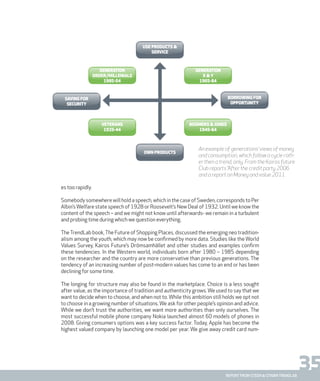
An example of generations’ views of money
and consumption, which follow a cycle rath-
er then a trend, only. From the Kairos future
Club reports ”After the credit party 2006
and a report on Money and value 2011.
DIGISHIFT 2020
36
bers and join the Apple eco-system because we prefer order and simplicity over choice.
Theproliferationoffood-bagswouldprobablynothavebeenpossibleadecadeago.Allow-
ing someone else to decide the recipes and ingredients with which we are to cook is only
acceptable now that we are overwhelmed with choices, and ask to be freed from making
them.
Internetwith borders
The most open and accessible years may already be behind the Internet. Google is now
adapting their searches to previous ones and Amazon is targeting its offers to the needs
of the individual.The same information is not given to everyone; we are instead actively
directed to groups to which individuals may feel they belong and which confirm their
previous standpoints and preferences.The open Internet is now increasingly locked into
systems and structures like Apple, which for better and worse, also try to create bounda-
ries to other systems.
Even the entire Internet may not be as accessible to everyone in the future. In America a
flat rate has been a driver behind smart phone sales.Telecom operators now seem to re-
duce the focus on this payment model.The emergence of streaming video has increased
traffic on the Internet substantially and capacity may be a limit. Operators are now asking
TV-channels which create a lot of traffic to pay.They want the content providers to pay
for providing information through their channels.While the Internet and the new technol-
ogy will be more dominant parts of the future, they may not be only focus on openness
and equality.
Technologywith a humantouch
In the book Megatrends from 1982, John Naisbitt explained the HighTech HighTouch
symbiosis. As technology becomes more common in society people ask for more human
touches.Technology is now moving into an era of expanding human development. Instead
of technical focus there is more focus on human interaction with technology. Individuals
are becoming more tech-savvy and tolerant.
37report from steen & strøm trendlab
Shiftinthe Environment
While many of the developments described previously apply to theWestern countries
they may not be true for developing countries. On a global level the economic situation is
moving in a positive direction for most people.The accelerating speed of change creates
a drive to control the “small world” of friends, family and community as well.The search
for authority and structure may, however, not be the same.The demands of the grow-
ing economies known as BRIC, N11 etc. will have a great impact on society and global
consumption.The use or resources and environmental impact of our way of living today
will be constrained.This is another reason for believing that choice is going to be less of a
driver in society.
Conclusions
•	 Megatrends can no longer be taken for granted in society.
•	 Financial pressure will remain substantial in the Western world for the coming
decade.
•	 The increased turbulence in society leaves people searching more for authenticity,
authorities and structure.
•	 While the old people of the coming decade are the youngest since ever, the young
are the oldest since many decades.
•	 While information technology will be more dominant in society as a whole, consum-
ers will also be asking for more high touch
•	 Distrust in society’s dominating institutions leaves room for new ones to take their
place. The formerly good may not be good and the formerly bad may not be bad.
Business enterprises may be taking social responsibility to a new level.
•	 The demand from the developing countries will put pressure on global resource
use for the coming decades
”I can’t think of anything
less trendy, than being
trendy.”
Focus group participant
in Kairos Future youth study
trends
chapter 3
and Phenomena
The Trends and the Phenomena prioritized
shaping the digitization of Retail.
In this chapter we describe a number of external changes within the area of
digitization that will mean something for retail trade and shopping places. Our
international researchers have identified trends and phenomena in Scandinavia
as well as in the rest of the world in order to pick up signals that could mean
something for the future. The material was then structured by the analyst
group and presented to a bigger group of key persons at a Future Hearing Day
in September. Here the material was prioritized and narrowed down to the
19 trends and phenomena in the list below. Each of these changes is full of
interesting and important challenges and opportunities for the retail sector in
the coming decade.
Our suggestion is that you and your colleagues goes through the presentation
trend by trend and after each trend you ask your self what it could mean in
terms of possibilities and threats to your business. We can guarantee that you
will have a rewarding discussion. And perhaps you want to share your findings in
discussions with Steen & Strøm.
trends
”When you do this for five years
in a row, its no longer luck.
It’s a trend line.”
Hugh Grant
1. VALUE CHAIN BLUR
2. Superlocal
3. ALTERNATIVE PAYMENTS
4. MOBILITY COMMERCE
5. NETIZEN CONSUMERS
6.TEMPORARITY
7. ME-TAILING CUSTOMIZATION
8. PURE PLAYTO BRICKS’N CLICK
9. DELIVERY REINVENTED
10. SOCIAL COMMERCE
DIGISHIFT 2020
44
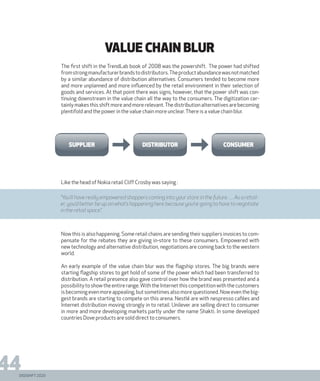
VALUE CHAIN BLUR
The first shift in the TrendLab book of 2008 was the powershift. The power had shifted
fromstrongmanufacturerbrandstodistributors.Theproductabundancewasnotmatched
by a similar abundance of distribution alternatives. Consumers tended to become more
and more unplanned and more influenced by the retail environment in their selection of
goods and services. At that point there was signs, however, that the power shift was con-
tinuing downstream in the value chain all the way to the consumers. The digitization cer-
tainly makes this shift more and more relevant.The distribution alternatives are becoming
plentifold and the power in the value chain more unclear.There is a value chain blur.
Like the head of Nokia retail Cliff Crosby was saying :
Now this is also happening. Some retail chains are sending their suppliers invoices to com-
pensate for the rebates they are giving in-store to these consumers. Empowered with
new technology and alternative distribution, negotiations are coming back to the western
world.
An early example of the value chain blur was the flagship stores. The big brands were
starting flagship stores to get hold of some of the power which had been transferred to
distribution. A retail presence also gave control over how the brand was presented and a
possibilitytoshowtheentirerange.WiththeInternetthiscompetitionwiththecustomers
is becoming even more appealing, but sometimes also more questioned. Now even the big-
gest brands are starting to compete on this arena. Nestlé are with nespresso cafées and
Internet distribution moving strongly in to retail. Unilever are selling direct to consumer
in more and more developing markets partly under the name Shakti. In some developed
countries Dove products are sold direct to consumers.
supplier distributor consumer
“You’ll have really empowered shoppers coming into your store in the future. .... As a retail-
er, you’d better be up on what’s happening here because you‘re going to have to negotiate
in the retail space.”
45report from steen & strøm trendlab
1
When brands are selling direct to consumers it has been said that warehouses and middle-
men are going to be cut out of the value chain. On the other hand there are also agents and
wholesalers who can become retailers on their own. In some markets there are plans to go
directly to consumers by wholesalers. Some Internet retailers are also behaving a little bit
likewholesalerswithamainstorageunitwherepeoplecanpickupitemsiftheyliketosave
some Euros relative to home delivery.
Mediacompanieswhichusedtowriteaboutthingsarenowengagedinsellingthemaswell.
“You can buy everything on the front page” is now the message. Interior design magazine
Elle has partnered with the interior design brand Linum to sell an Elle-branded collection in
11countries.AlsoshoppingcenterslikeWestfieldarebecomingretailersand sellingtheir
retailers and products to consumers.
All in all who is the customer and who is the competitor may not be very clear anymore.
More and more businesses seem to be heading towards the consumers.
DIGISHIFT 2020
46
Superlocal
New technology like positioning and gyros makes peoples location and attention possible
to track and adapt to. Consumers are increasingly well informed, making them experts and
curators of products and services that they use.Their knowledge and feedback is valuable
information for both stores and other consumers. As more people carry around online ac-
cess on mobile devices, they demand the right information at the right time. In return they
are willing to contribute with their expertise on a specific product or service.
Making the information as local as possible is one way of providing “the right information”.
An emerging trend is location-based services. By checking in and sharing their location on
amobileapp,customersarerewardedorgivenlocation-basedinformationaboutproducts
and services. Local companies join to reach potential customers in an untraditional way.
Foursquare is an app through which users check in to get discounts in stores. As soon
as they check in, their location is posted on Facebook for friends to see, and perhaps be
temped to visit the same store or restaurant. According to its CEO, the future of Four-
square is to focus on what the consumers are going to do in the near future, instead of
what they are doing. Using collected data on consumer’s real-time movements, Four-
square’s Explore tab recommends consumers where to go next. By asking what they are
looking for - be it a restaurant, movie theatre or store – the app will help the consumer find
the closest alternative.
Even brands are benefitting from the real-time customer access that mobile devices pro-
vide. Using location-based services they can interact with consumers when they are close
to or inside a store. GAP in Japan sends digital coupons to customers that are nearby. It
is an effective way for marketers and retailers to reach the consumer at the right time,
andinreturncustomersreceivegreatdealsandasenseofengagementfromtheirfavorite
brands.
Another example of location-based services is the app Checkpoint. Its users are rewarded
with points for checking in at a store, scanning product barcodes, or recommending some-
thingonFacebookorTwitter.Thepointscanbeexchangedforgiftcards,Facebookcredits,
or gadgets.
One way for stores to get closer to consumers is to be located where consumers are. Big-
boxretailers,suchasBestBuy,PetSmart andToys ‘R’ Ushavetraditionallybeeninterested
in power and community centers. To get closer to the consumer, and benefit from the mall
traffic, they are now seeking spaces enclosed to malls. Wal-Mart has taken an initiative to
open smaller “neighborhood market” stores, as part of their strategy to enter the urban
market and be closer to the consumer.The Chinese giant and home appliances brand Haier
has taken the store to its customers by touring around the US with a truck showcasing
products and their functionalities.
2
People demand the
right information at
the right time.
In return they are
willing to contribute
with their expertise
on a specific product
or service.
DIGISHIFT 2020
48
ALTERNATIVE PAYMENts
One emerging trend is the increasing number of payment alternatives that are available
to consumers. Advances in mobile technologies, the ubiquity of smartphones, digitization
of society and consumers’ search for convenience are the driving forces behind this trend.
To some extent this is a trend of increased digitization where new technologies enable
NFC or near field communication payments but it also involves new types of money. Vir-
tual money has emerged in the digital world. A bookstore within eBay ”Qugelmatic” is ac-
cepting Bitcoins (a virtual currency created by a company) as a form of payment. Another
well-known online player, Facebook, allows users to pay for their virtual products and ser-
vices using their own virtual currency or Facebook credits. The old-school loyalty points
likeEurobonusarebeingchallengedbymoreandmoredigitalalternatives.ForScandinavi-
ans may find it strange that people would want to use other currencies than those of their
central banks. However, the trust in central banks is very low in countries that have been
hit by the crisis.
The impact of PayPal and other micropayment solutions may also be misinterpreted in
Scandinavian countries. In Denmark, Norway and Sweden these payments represent 3%,
10% and 4% respectively of total e-commerce payments. In the UK, Spain, and Germany,
thesefiguresare23%,22%and26%1
.Theemergenceofmicropaymentsolutionsalsoal-
lows new business models to come up. Companies creating games and other services now
pop-up out of nowhere and make a lot of money. The Finnish company that started Angry
bird, now valued in billions, and the person behind Wordfeud (the online copy of Scrabble)
are two examples. This creates a new business landscape where new companies and ser-
vices are created –which were not possible before micropayments, and certainly not prior
to digitization.
The availability of alternative payment options is not exclusive to the digital world but
it can also be seen on popular high street stores. Many retailers have implemented pay-
ment terminals that transform smartphones into mobile wallets. In their effort to reduce
in-store queues and to speed up the check-out process, retailers are accepting mobile al-
ternatives. Starbucks has installed approximatelly 6,800 mobile payment systems at its
stores across the US. Customers only need to download the Starbucks mobile app and
hold the smartphone against the barcode scanner to complete their transactions. Similar-
ly,McDonald´sinJapanhasinstalledcontactlessmobilewalletterminalsinapproximately
400 stores.
49report from steen & strøm trendlab
3
Banks are also jumping onto the trend and are developing services that simplify consum-
ers’ shopping process. New NFC-solutions are arriving at stores. Fulfilling consumers’
search for convenience and secure payment options, The Danske Bank has launched a
service that allows its customers to pay their bills by taking a picture. Insteadofcompro-
misingcreditcardinformationwhenpayingwiththeirsmartphones,itscustomerscanfeel
safe when using their mobile banking option. Another company providing payments via
pictures is an online American start-up company called Jumio. The company has released
”Netswipe” which is a technology claiming to turn a webcam into a secure credit card
reader. Users can make purchases by holding their credit cards in front of a webcam which
uses video streaming technology to verify account details.
Alternative payments may also include subscriptions such as Amazon´s delivery sevice
called ”Subscribe & Save”, available in the US, UK and Germany. The service allows users
to streamline their shopping baskets. Food and cleaning supplies that are always a part
of the shopping basket may be automatically re-ordered and delivered. Targeting busy
customersinsearchforconvenience,Amazonhasdevelopeddiffferentsubscriptionpack-
ages allowing customers to sign up for monthly, bi-monthly, or quarterly deliveries.
1
DIBS e-handelsindex 2010
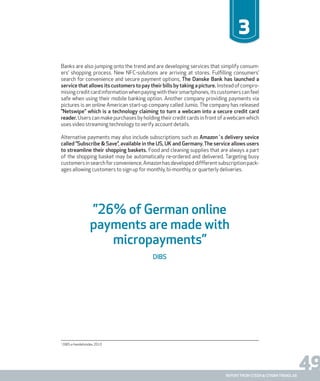
”26% of German online
payments are made with
micropayments”
DIBS
DIGISHIFT 2020
50
MOBILITY COMMERce
In these changing times many players try to define the world, but it is also an ever chang-
ing maketplace. Forrester, Verdict, Posten Norden all define the e-commerce market dif-
ferently. IMRG Capgemini deliberately states that it includes sales completed in-store as
long as they are made using any interactive channel. It is important to stress that while
m-commerce is a trend in which the device (usually a smartphone) is crucial, a key aspect is
that the purchase is made while on-the-go from any location. Mobility commerce might be
more common from smaller laptops, tablets or bigger phones. The trend might of course
be called something different in a few years. We may end up talking about s-commerce as
one type of retailing just like the oldTVchanged its name to Flat-TV.
The combination of improvements in near-field-communication technologies and mobile
tags together with the ubiquity of mobile apps and smartphones are driving the mobile
commerce trend. In addition, increased consumer mobility is prompting companies to de-
velop services that offer consumers the possibility of buying products and services while
on-the-go.
The rising number of purchases done via mobile devices during the past years seem to
indicate that consumers are finally becoming more comfortable using their smartphones
to make transactions. In the US, Pay Pal has experienced a rapid growth in the volume
of mobile payments between 2008 and 2010. The company reported a volume of $750
million in 2010 up from $25 million in 2008 and expects to reach a volume of $7.5 bil-
lion by 2013. PayPal´s numbers are a testimony that mobile devices and applications
are becoming an important sales channel. In fact, buying products and services via mobile
applications has been called app-tailing. The following are examples of recently launched
mobileapplicationthatallowconsumerstotransformtheirmobiledevicesintoalternative
retail channels:
Since March 2011, The Wall Street Journal is selling daily digital issues through its up-
dated iPad app. Until then, digital versions were only available to subscribers and daily
issues were not available for purchase. The mobile app ”Pago” is a new app launched in
August 2011 in California that allows users to shop goods directly from their smart-
phones. Regardless of their location, users can remotely (via the app) search for, make
orders and pay for products at over 50 participant stores. The mobility commerce trend
M-commerce is a stupid name
- are we going to call it TV-commerce,
iPad-commerce too?
Expert inteview
51report from steen & strøm trendlab
4
is not exclusive to buyers, however, as mobile solutions such as ”Square” and ”Intuit” al-
low merchants to do their business while on the go. By installing the solutions and their
correspondingappsintheirsmartphones,merchantscanprocesspaymentsanywhereand
anytime
Retail chains are becoming involved in the mobility commerce trend by launching mo-
bile applications that enable customers to search for information and shop directly from
their mobile devices. Best Buy in Canada has launched a mobile app that empowers cus-
tomers beyond scanning barcodes to get additional product information while in-stores.
The app allows Best Buy customers to check for product inventory at a particular store
and place orders to be picked up at any location. Since July 2011, online retailer eBay
has decided to capitalize on the trend by launching its ”eBay Fashion” and ”Fashion Vault”
apps. The apps allow users to have access to designer clothes at low prices while allowing
brands to reach consumers directly.
Besides buying via mobile apps, consumers are also making purchases by scanning tags
or barcodes or by taking pictures. Thanks to embedded NFC and barcode technologies,
smartphones are being transformed into mobile wallets enabling users to make purchases
by a single tap. In South Korea, the national telecommunications company SK opened a
high-tech retail outlet in Seoul where consumers can buy almost every product via their
smartphones. Barcodes placed on product’s price tags are scanned every time a consum-
ers wants to place an order. To encourage consumers to use their smartphones, stores
provide a 10% to 40% discount and offer home delivery.
IOn the European market, British consumers have also been able to use their smartphones
aswalletssinceMay2011.”QuickTap”,UK’sfirstcontactlessmobilepaymentsservicehas
been implemented in a total of 50,000 stores in a collaborative effort between Orange
and Barclaycard.ac Popular chains allowing Briton to use their mobile wallets are: Subway,
McDonalds and Wilkinsons. One major event in the mobile commerce field is the recently
launch of Googles own version of the mobile wallet in the US. Since September 2011,
consumers in New york and San Francisco are able to pay with their Google Nexus S ena-
bled devices. The only requirements are to load a credit card onto the wallet app and to
have a Sprint wireless account. The entrance of a major Internet player into the mobile
commerce market highlights the importance of this trend.
1
Internet Retailer May 20, 2011
DIGISHIFT 2020
52
THE COMING ERA OF
THE NETIZEN CONSUMER
In the 1960’s, Marshall McLuhan, a well-known media theorist, presented new insights
into the way in which cultures were formed and reformed by media techniques that were
developed and introduced into society. He coined the well-known phrase: “The medium is
the message”. By this he meant that a medium affects the society in which it plays a role
not by the content delivered over the medium but by the characteristics of the medium
itself. When the electronic screens on television sets and later on the computers entered
the society, Marshall McLuhan identified an important shift from “light on” media to “light
through” media. He believed that the TV made consumers that the world came to them.
The world became a global village within our reach. Today we experience that the quote in
the beginning of this text is about to become real. Social media, smartphones, new mixed
reality techniques, 3D- screens, holographic projections etc. make us experience a shift
which allows us to interact with the world and media in new ways. We slowly move from a
culture characterized by “light through” media to a culture where people partly or totally
“live through” media. Media and the web in particular, are becoming extensions of our bod-
ies and minds in a constant digital flow of information.
Among young Europeans, 52% say that they feel disconnected from the world without
their mobile phones. 91 % of all mobile users always have their mobile phone within reach
regardless of whether they are awake or asleep.
Eight out of ten use Google to find answers to questions about health and medicine. Half
of all Swedes are members in social networks. For young people the big leap was between
2005 och 2007. For somewhat older individuals, the interest in taking part in social net-
works has increased over the last years. The increase was dramatic among individuals
above 45 years. The share of individuals who visited social networks last year has more
than doubled. 1.5 million individuals comment on what others have written online and just
as many update their status. A half million Swedes upload pictures online every week .The
pattern is similar in all of Scandinavia.
1.
Olle Findahl, Svenskarna och Internet 2010
“In this electronic age we see ourselves being translated more and more
into the form of information, moving toward the technological extension
of consciousness.”
Marshall McLuhan
DIGISHIFT 2020
53report from steen & strøm trendlab
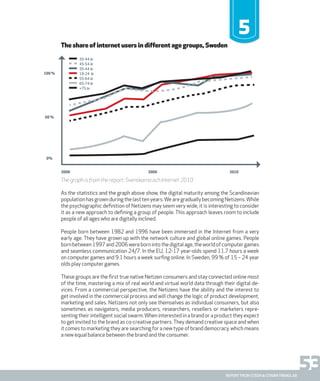
The share of internet users in different age groups, Sweden
5
The graph is from the report: Svenskarna och Internet 2010
As the statistics and the graph above show, the digital maturity among the Scandinavian
population has grown during the last ten years.We are gradually becoming Netizens.While
the psychographic definition of Netizens may seem very wide, it is interesting to consider
it as a new approach to defining a group of people. This approach leaves room to include
people of all ages who are digitally inclined.
People born between 1982 and 1996 have been immersed in the Internet from a very
early age. They have grown up with the network culture and global online games. People
bornbetween1997and2006werebornintothedigitalage,theworldofcomputergames
and seamless communication 24/7. In the EU, 12-17 year-olds spend 11.7 hours a week
on computer games and 9.1 hours a week surfing online. In Sweden, 99 % of 15 – 24 year
olds play computer games.
These groups are the first true native Netizen consumers and stay connected online most
of the time, mastering a mix of real world and virtual world data through their digital de-
vices. From a commercial perspective, the Netizens have the ability and the interest to
get involved in the commercial process and will change the logic of product development,
marketing and sales. Netizens not only see themselves as individual consumers, but also
sometimes as navigators, media producers, researchers, resellers or marketers repre-
senting their intelligent social swarm.When interested in a brand or a product they expect
to get invited to the brand as co-creative partners. They demand creative space and when
it comes to marketing they are searching for a new type of brand democracy, which means
a new equal balance between the brand and the consumer.
2000 2005 2010
50 %
0%
100 %
35-44 år
45-54 år
35-44 år
19-24 år
55-64 år
65-74 år
+75 år
DIGISHIFT 2020
54
“If I tell my Facebook friends about your brand it’s not because I like your brand, but rather
because I like my Friends”.
So in fact it is a new power relationship where the consumers are realizing the commercial
value of spreading the word or taking part in the buzz. Status among the Netizens is more
about stories than products. Netizens who supply their swarm with the most interesting
information win. It is a trade of stories in which I can tell my story including the brand if the
brand will tell mine.
The Netizens are developing a netnocentric worldview which means that their digital iden-
tity becomes more important for whom they are but that a majority of the activities online
are used for a constant search for ways to create togetherness, real meaning and experi-
ences offline. The economy of presence is very important and The Netizens “use online to
facilitate offline interaction. Their preferred method of communication is face-to-face…
They will take mobile with them all the time but their goal is face time with friends…”1
.
This is a significant insight for developers of physical meetings and shopping places to un-
derstand. It shows how important it is to create social spaces and to develop social shop-
ping both online and IRL (In Real Life).
“Shops are meeting places. It becomes more important to help people choose the right
place to visit and to facilitate friends to come to the same store at the same time and
to create togetherness – a uniqe shopping experience together. The meeting probably
starts online where they discuss lifestyles and the look of the products and ends in the
shop, where they can test and try the real things.”
MartinTörnkvist, Media Evolution
1.
Graham Brown et al, Youth Marketing Handbook
DIGISHIFT 2020
“If I tell my Facebook
friends about your brand
it’s not because I like your
brand, but rather because
I like my Friends”
Mike Arauz, Advertising Lab
DIGISHIFT 2020
56
TEMPORARITY
In search for experiences, consumers are drawn to what is new and cool. The novelty of
new concepts no longer lasts for long, and an increased competition for attention forces
retailers to constantly change in order to stand out. Companies like GAP, Zara and H&M
have recognized that the turnover of the inventory is strongly correlated with the number
of visits per consumer of the inventory is strongly correlated with the number of visits per
consumer. A store which changes the inventory 20 times a year gets the customers in to
thestore20timesayear.Ase-tailersenterthemarketplaceofferagreaterchallenge.One
way to stick out is to offer a concept, product or service for a limited period of time. Vari-
oustemporaryofferscreatebuzz,attractcustomers,andprovidetheexcitingexperiences
they are looking for.
A growing number of brands use pop-up stores to follow consumer crowdsThe in-creased
mobility of people, combined with their lack of time, requires stores to be where consum-
ers are. All types of retailers, from clothing brands and bookstores to shoe manufacturers,
want to be part of the pop-up mania. With a fresh feel and surprise aspect, pop-up stores
have proved appealing to consumers. Bigger, better and more extreme pop-up stores
come at the order of the day.
In May 2011, Tommy Hilfiger opened its preppy World Pop-up store, which was designed
to look like an authentic East Coast beach cabin. Planning to travel across the world, the
store appeals to the preppy and style-conscious consumer. In London, shipping containers
are used to create a pop-up mall. Made of no less than 60 shipping containers, Boxpark
opened summer 2011 and will be “invitation only”. Hand-selected small and independent
brands will be open for sale.
Swedish appliance manufacturer, Electrolux, has launched a pop-up restaurant in collabo-
rationwithItalianarchitectsParkAssociati.TheCubewilltravelacrossEuropethroughout
2011, staying three months at each location.
Thepop-uptrendhasalsoshoweduponline.InAugust2010,thebrandRachelRoylaunched
a pop-up store on Facebook. During three days, fans were given early access to Roy’s new
jewelry line.The brand’s fan base had boosted by 100% by the end of the campaign.
“Flash sales” is another form of temporary offer on the rise. Groupon was among the first
companies to provide daily deals online. Once a day a “group coupon” from a local store
or restaurant is sent to Groupon followers by email. If enough people sign up, the deal is
on. One Kings Lane is a site with good deals on furniture, interior design, clothes etc., but
only for a very limited period of time. The site Jasmere handpicks lesser-known specialty
retailers to feature, and offers its visitors exclusive discounts. The more people that buy,
the lower the price.
DIGISHIFT 2020
57report from steen & strøm trendlab
Temporary offers of various
kinds create buzz, attract
customers and provide the
exciting experiences they
are looking for.
6
A marketplace in constant change also leads to temporary pricing in general. Online auc-
tions, price comparing sites and flash sales have made consumers aware that prices are
not fixed, and new business models keep evolving accordingly.
The highly successful retailer Gina Tricot may, however, have taken this a bit to far promis-
ing “New fashion every day” on its posters. At some point in time consumers may be over-
whelmed and not come at all.
report from steen & strøm trendlab
DIGISHIFT 2020
58
ME-TAILING CUSTOMIZATION
Our time is characterized by more demanding, knowledgeable, and individually oriented
consumers. Feeling like experts they no longer want to be passive, accepting products and
services for what they are.They want to personalize things, because they can and because
it is part of building a personal style. For retailers to attract customers it is essential to
make them feel involved, engaged and able to influence.
The trend to customize products and services, me-tailing, is part of a socioeconomic
change. In their book “The experience economy”, Pine and James talk about the transfor-
mation economy as the stage following the experience economy.We can now see that con-
sumersseekconsumptionbeyondexperience.Whenbuyingaproductorservicetheywant
to develop as a person, they want the purchase to transform them. By allowing consumers
to be part of product development, production and even sales, they get to use their own
skills as well as develop new ones; they transform themselves.
Mackmyra was one of the first to allow customers to be part of the production of whisky.
When ordering a bottle, they got to determine storage time and label of the whisky. At the
Waterhead Hotel, located in the English Lake District, visitors get to customize their stay.
Invariousways,gueststailortheroomtoreflecttheirowntasteandstyle.Choiceofarrival
drink, room artwork, fruit plate selection and toiletries are some of the things that make
the atmosphere more individual.
Blogs and social networks have contributed to a larger acceptance of, and willingness to
express yourself and your personal style online. Threadless and Zazzle are two examples
of websites that engage consumers to be part of the creation of new products. Within the
threadless community, members submit and score T-shirt and sweater designs, that later
become available for purchase if popular. Zazzle.com is a website for consumers to give
their own personal touch on products such as clothing, office supplies, accessories, gadg-
ets etc.
One driving force behind customization is of course to individualize products and services;
another is to be recognized for creative abilities. Forums, communities and blogs shine
light on those creators whose contributions are sold, read or viewed. All to boost their
egos, and keep the dream of being recognized alive among the rest.
Weather online or in-store, creating a dynamic environment in shopping malls and stores,
where consumer can interact, get involved and influence will be crucial to attract people in
the future.
59report from steen & strøm trendlab
7
Buying furniture at IKEA, is an example of consumers being part of the produc-tion, since
they do the last part of assembling the furniture. On the website bemz.com, consumers
can involve in product development. By choosing a new fabric to the slipcover of couches,
cushions, armchairs etc., they rejuvenate and personalize old IKEA furniture.
Part of the attraction for retailers and manufacturers is also that consumers start doing
more of the job. Assembling, transporting, making the transactions on Internet sites for
travel agents and financial services firms lower the cost. Sometimes doing more of the job
is part of the satisfaction. Sometimes chopping wood, running a Marathon or painting the
wall is life satisfaction – or at least sometimes afterwards.
DIGISHIFT 2020
60
FROM PURE PLAY
TO BRICKS’N CLICK RETAIL
The digitization of society, the rise of online sales and consumer expectations to access
anything, anytime and anywhere have been driving a trend among retailers whereby they
arestartingtosellproductsandservicesovermultiplechannels.Thepastdecadehasbeen
the klondyke of players in the periphery. Companies like eBay, Skype, FaceBook and Goog-
le have not primarily taken market shares away from big Fortune 500 companies, but have
rather created new markets on the periphery. Now the big traditional players are entering
the field one by one with ambitious take-overs and establishments.
The need to sell products and services across multiple channels (physical and digital) has
been recognized by well-known traditional brick and mortar and pure-play retailers.
Although the following retailers have different strategies, they are all becoming ”brick and
clicks”.
Well-known traditional brick and mortar apparel retail chains such as GAP Inc., H&M and
Zara began launching their first online shops in 2010 in order to capture a share of the
total online sales within their product categories. They recognized the need for a digital
sales channel after seeing a decline in their in-store sales and a rise in online sales.
In the ”Do-It-Yourself ” product category, retailers of building materials begun selling on-
line since the beginning of 2011. Swedish Byggmax and German Bauhaus launched their
online stores to serve the internet-savvy consumers in Sweden and other Nordic coun-
tries. Lagerhaus isanotherretailchainservingtheNordiccountriesthatdecidedtolaunch
an online store althought not until June 2011. The retailer started its digital journey by
selling its products over a blog but after noticing consumers positive responses it de-
cided to launch its own online store.
“Best Buy finds that multichannel customers spend 95 percent more than single-channel
shoppers and generate 80 percent more profit margin.
Target reports that its multichannel customers spend $1,000 per year, versus $551 per
year for its store-only shoppers and $94 for online-only customers. In general, most re-
tailersfindthattheirmultichannelcustomersaremoreprofitablethananysingle-channel
shoppers, as they are comfortable crossing channels and often end up with larger baskets
that tend to be higher-margin.”
Anne Zybowski Retail Insights Director at Kantar Retail.
Source: ICSC Shopping CentersToday June 2011
61report from steen & strøm trendlab
8
To differentiate from competititors, certain multi-channel retailers offer consumers the
chance to order online and pick up the items at the nearest brick and mortar store. ”Click
and collect” helps consumers to avoid waiting at home for product deliveries and provides
retailers with the opportunity to drive traffic into their physical stores. Retailers such as
Best Buy and Nordstrom in the US, Media Market in Spain and Tesco, Asda and Sainsbury
in the UK are leveraging on the digital and physical channels to provide customers with
click and collect services.
Brickandmortarretailersarenotaloneintheirmulti-channeltransformation.Pure-playre-
tailers are slowly venturing into the physical arena capitalizing on their brand recognition,
low prices and diverse inventories. PowerTools Direct and Figleaves are two pure-play re-
tailers that ventured into physical stores in 2010 as a response to consumers’ demand to
feel and touch their products. In the US, Power Tools Direct decided to open a traditional
brick & mortar store right next to its competitors: Home Depot, Sears and Lowes. Using
a consession inside Allder’s Croydon department store, the UK lingerie retailer Figleaves
decided to test the market before further expansion.
Finally, other pure-play retailers could be soon entering partnerships with brick and mor-
tars in order to leverage on each other´s unique capabilities. Internet-based retailer Ama-
zon has recently launched a pilot locker system in Seattle in cooperation with 7-eleven.
Amazon is allowing customers to pick up packages from Amazon lockers installed at the
convenience stores. Customers can select to have their packages dropped off at a nearby
locker at a 7-eleven which may be opened via a confirmation barcode received by email. If
the service proves to be successful in the US, it might be re-launched in the UK; it might
thus be Amazon’s first steps into becoming a multichannel retailer.
DIGISHIFT 2020
62
DELIVERY REINVENTED
Traditional retail was a merger between consumers and products. Consumers got the
products from the retail environment.With mail-ordering the delivery was separated from
the purchase location. Today, as the purchasing process is impacted by digitization, deliv-
ery has become a crucial part for further innovation. As multichannel retailing evolves, a
variety of customer-convenient delivery options develop. Delivery is being reinvented.
Online order + home delivery has been around for a while. Increasing competition, howev-
er, has forced retailers to lower shipping prices or even ship products for free. Fresh direct
is an online-only supermarket, with free home delivery. As online shopping becomes user
friendlier, detailed purchases such as groceries, can be made online. Trunk Club, an online
retailer for men’s clothing, accepts orders online or over the phone. The clothes are deliv-
ered for free to wherever it may seem convenient: at the office, at home, at a girlfriend’s
place etc. If you don’t like the products you send them back with the trunk. In our Delphi
study, some experts claimed that the solution to the touch and feel part of retail was al-
ready in place as customers can return the products for free; they can try products and
send them back if they don’t like them.
The American chain J.Crew is a successful multichannel retailer. Online purchases are de-
livered at home and can be returned in-store, to avoid extra shipping costs. They also of-
fer in-store purchases for home delivery. Department stores like Saks Fifth Avenue and
Bloomingdales collaborate with UBS or FedEx to offer home delivery for customers that
don’t want to carry their shopping bags home. Whole Foods, a chain of food stores, offers
home delivery of in-store purchased groceries for a very low price.
Homedeliveryisinconvenientforsomecustomers,assomeonehastobeathomeataspe-
cific time. Order online + pick up in-store has proven successful in the UK. Retailers such
as Tesco, Asda, and Sainsbury offer so-called collection services to their customers. An
onlineorderisputtogetherbyin-storestaff,tobereadyforcustomerpick-upatanagreed
upon time. The Pago app recently launched in California, allows users browse, order and
pay for goods and services before collecting them in local stores. Currently, 50 companies
have partnered and users can locate dry cleaners, flower shops, coffee shops and restau-
rants. The practice of car manufacturers to use the same logistic providers to create dis-
tribution efficiencies has now spread into retail. The last mile problem is increasingly the
focus of logistics. In the coming decade, we will likely see many more alternative solutions
to the distribution part of the retail value chain.
Home delivery of food bags is successful in Sweden and its growing in Denmark. Getting
five dishes for four people to the door is now comme il faut among Swedish urban parents.
While compromising with choice, parents get recipes and food delivered to their door. If a
large share of the population is willing to give up choosing their meals, food distribution
will certainly be cheaper overall.
DIGISHIFT 2020
Some experts claimed that
solving the touch and feel part
of online retail was already
handled – since you can return
the products for free
9
DIGISHIFT 2020
64
SOCIAL COMMERCE
Today’sconsumersarewellinformedandhaveknowledgeabouttheproductsandservices
they purchase. Retailers, brands and store merchants are no longer the experts they ask
for advice. Instead, they turn to friends and people sharing the same taste and interest, to
get their point of view on the product they are thinking about buying. The problem is that
potential consumers are not always with their friends when shopping, in-store or online.
Social networks sites are one place where friends are always together. As ecommerce
evolves, retailers are tapping into the opportunities of selling their products and services
directly on social networks. Companies are present where consumers and their friends
are. Social commerce lets consumers browse, recommend, get opinions, and buy without
leaving the social network website.
With its 600 million users, Facebook is an important “social market”. Most companies al-
ready have a Facebook page that fans can follow, like and share with friends. However, the
developmentindicatesFacebookwillbemuchmorethananetworkconnectingpeopleand
companies. F-commerce has become the name for ecommerce on Facebook.
Besides the benefit of having many consumers at the same place, there are two other
factors behind this development. By introducing its own currency, Facebook credits, the
Facebook team clearly shows where they want to take the platform. Secondly, tech-com-
panies have started to develop social commerce software and applications supporting
F-commerce. By using applications like Payvment, companies can easily set up small to
medium sized stores. The free software allows retailers to create a Facebook storefront
that accepts payments via credit cards or PayPal.
Forbiggercompanies,itisimportanttoteamupwithane-retailsoftwareproviderthatcan
bring the business to social network sites. About a year ago, retailer Ulla Popken decided
to team up with MarketLive when building a better e-commerce site. Today, consumers
can make purchases directly on the retailer’s Facebook page, by using MarketLive’s Social
Store software. By collaborating with software companies, Facebook is introducing fol-
lowers to pressing the “buy button” instead of the “like button”.
Service retailers are also grasping the opportunities of F-commerce. Mark Pincus has be-
come one of the seven “Facebook billionaires” thanks to his Zynga, the company behind
Facebook games like FarmVille, CityVille and ZyngaPoker. Attractive to people’s search
for play and fun, as well as a way to relax, these games have become amazingly popular. So
popular, users are willing to spend money inside the virtual world of the games.
Another example is Delta Airlines, that in September 2010 launched a ticket window on
its Facebook page, allowing visitors to buy tickets without leaving the website. Second
Porch is a Facebook service app letting users list and rent vacation homes. After the 30-
day free trial it costs $10/month to be part of the community.
65report from steen & strøm trendlab
10
However, social commerce is not limited to storefronts on Facebook. Several brands are
linking their websites to social media in order to attract more visitors. Levi’s has incorpo-
ratedaFriend Storeontheirwebsite,enablingvisitorstopostproductsontheirFacebook
profiletogetfriends’feedbackbeforebuyingsomething.TheEuropeanretailerElloshasa
FriendStoreintegratedwithFacebook,wherecustomersshareideasandreviewsofprod-
ucts and services.
These are both examples of companies understanding the importance of remaining social
when entering the social network marketplace. Before converting social into sales, they
focus on interacting with consumers and watching them interacting with each other.
Yet another aspect of social commerce is the introduction of social media in physical
stores. Retailers have realized the consumer value of asking friends online what they think
about the clothes they are trying on in the fitting room. In Spain, Diesel has linked in-store
cameras to Facebook, so that customers can post photos of themselves for instant feed-
back from Facebook friends. Macy’s Magic Fitting Rooms toured from one department
store to another, allowing customers to virtually try on clothes via an augmented reality
mirror and share their outfit via Facebook, text messaging or email. ”Go try it on” is an
online community for sharing and getting feedback on what members are wearing at a par-
ticular time. Its mobile app allows members to get feedback on outfits when shopping.
These are small or emerging patterns of observations. We believe they have
fundamentaldriversandwillbemoreimportantinthefuturemarketplace.Their
direction, timing and impact is more uncertain.
We have chosen to highlight some of the most interesting phenomena and to
speculate about their potential for the future, and we look forward to follow the
developments of them in to the future.
PHENOMENA
1. GAMIFICATION OF LIFE
2. VIRTUAL SHOPPING PLACES
3. reinforced REALITY
4.TAGOMANIA
5. FROM COMMERCETO RECOMMERCE
6. NEWWINDOWSHOPPING
7. IN-STORETECH FRENZY
8. COLLABORATIVE CONSUMPTION
9.the coming of big data
DIGISHIFT 2020
70
gamification of life
Gamification was one of the trends where the experts in the Delphi study expected early
breakthrouginthemarket.Withinthreetofiveyearsthiswillcertainlybemoreintertwined
with retail. Gartner group also ranks gamification as one of its coming hypes in a report
from July. On the other hand Gartners estimate assumes that the media and buzz hype will
peak in perhaps half a year and then drop while adaptation in to business will take some
more years. Many people enjoy play and fun, as a contrast to the seriousness of life. The
explosion and popularity of gaming apps on mobile devices proves that, no matter age we
love the excitement of playing games. By using technology, an increasing number of com-
panies are bringing an aspect of play into consumers’ everyday life. During the last year we
have seen a cascade of apps and websites contributing to the gamification of life.
Gaming has been brought into daily chores, public transportation, eating habits, and even
recruiting. But, these apps and sites do not serve the simple purpose of spicing up people’s
everyday life. Gamification of things also creates an opportunity for companies to engage
consumers and tie them closer to a brand, store of service.
UK -based company Epicwin provides an iPhone app turning a to-do-list into a game. After
completing a task on the list, users collect gold and other rewards, allowing them to move
on to the next level. The game serves as a motivator to get things done. The Foodzy app
keeps track on what you eat during the day, rewarding a healthy and varied diet.
The UK public transportation system wants to engage travelers through the Chromaroma
app. It rewards passengers with points for each trip, maps out where they have travelled
and recommends new areas to go to, as well as things to do there.
Gamification is also a way to benefit from consumers’ knowledge and time. In its effort
to index its digital collection of books, the Finish library launched an online game, allow-
ing players to help correct mistakes in the indexing while having fun. More than 20,000
people have already visited the site and more than 85,000 voluntary minutes have been
contributed.
According to salesforce.com’s Chief Scientist gamification is a trend that will continue, es-
peciallyamongyoungergenerations.Mr.Rangaswamimeansitwillformthefutureofwork
and be a crucial aspect in attracting talent.
An already existing example of this is the Facebook game provided by the hospitality gi-
ant Marriott International.With the aim to make more young people interested in a career
withinhospitality,thegameallowstheplayertotryoutmanagingdifferentpartsofahotel.
The Internet of things brings yet another aspect to gamification of life. GreenGoose uses
RFID-tags to track how much different things are being used in a home. Users are reward-
ed every time a desirable activity is performed.
DIGISHIFT 2020
Gaming has been brought
into daily chores, public
transportation, eating habits,
and even recruiting
1
DIGISHIFT 2020
72
virtual shopping places
Just like the entire e-commerce hype in the late 1990s is now becoming a reality, the same
might happen in the future with things currently on hype.Virtual reality may actually prove
to be interesting again. The rise and fall of things like Second Life may also return. Virtual
worlds like World of Warcraft and EVE online attracts hundreds of thousands and some-
times millions of engaged people. The players of EVE-online have created their own radio
station, TV-station and even a quarterly economic outlook that is presented by its chief
economist. There were 60 candidates in the presidential election and 18% of the online
population of 500 thousand participated in it. Their vision remains to create something
better then IRL.
Hype or not, it is undeniable that the increased digitization of society and the amount of
time consumers are spending online are driving a phenomena whereby the digital world
is gradually becoming a bordeless marketplace. The number of buyers and sellers in the
virtual world continues to rise as small online retailers are no longer alone. Entire shopping
malls and outlets are moving online creating virtual or cyber malls. At the same time, big
traditional online retailers are capitalizing on their online brand awareness to deliver new
services.
The shopping center Westfield has ventured into the virtual marketplace in Australia
by developing an entire virtual version of its mall. Without floor space limitations, the
Westfield online mall features 150,000 products, 3000 brands and 50 retailers. The on-
line platform manages sales orders from its multiple retailers through a single checkout
point.OnlineretailereBayhasdevelopedavirtualoutletmallprovidingbrandsanddesign-
ers with a platform where to directly sell their excess inventory. Already servicing the UK
and Germany, eBay decided to open its platform to US consumers since September 2011.
Payvmentisanothervirtualshoppingmallplatformwithmotrethan50,000retailersinits
network. Payvment uses the facebook´s social platform to create a unique social market-
place.
This trend in not exclusve to the US or Europe, after all the largest online mall in the world
is located in China. The Tao Bao mall has over 370 million register customers and offers
800 million product listings from more than 30,000 local and global brands. Owned by the
e-commerce giant Alibaba,TheTao Bao mall sells everything from food to technology.
DIGISHIFT 2020
”Our vision is to create
something better than
real life.”
Thor Gunnarsson head of business
development CCP Games (EVE online)
2
DIGISHIFT 2020
74
reinforced reality
Technologies reducing the differences between the virtual and the physical world are con-
tinuouslyemergingindifferentaspectsofconsumers’life.Augmentedrealityallowsanen-
hanced interaction with products, services and places. Web shops and websites in general
might incorporate augmented reality in their attempt to replicate tactical experiences in-
herent in physical stores. On the other hand, physical stores might incorporate augmented
reality capabilities to add extra information that might engage visitors in a unique way. No
matter if the consumer is at the store, at home, or on the streets, augmented realty gives
them the chance to interact with the physical and virtual environment like never before.
Online stores are incorporating augmented reality technologies into stores so consumers
can “try on” their items before making a purchase.Well-known brands such as Ray Ban and
JC Penny have implemented online stores with virtual mirrors.
One key aspect of the connection of the virtual world with the real world is the location-
based technologies. The virtual world is now connected to its specific location. A virtual
Nike store is found in a particular location IRL and can only be seen in the virtual (augment-
ed) reality. By connecting the location to the virtual environment a whole new set of rel-
evance can be attributed to information and the virtual world. All the things that have been
written about a place are becoming relevant. In media it is referred to as new relevance.
Thehistoryoftheplaceismorerelevantatthetimewhenyouarethere.However,whathas
been said about a place in the virtual world becomes more relevant. The ratings of restau-
rants in the neighbourhood, the most read articles of this place, the most popular music,
etc. In this sense, reality becomes truly augmented by linking together the physical with
the virtual place.
DIGISHIFT 2020
Online stores are incorporating
augmented reality technologies
into stores so consumers can
“try on” their items before making
a purchase
3
DIGISHIFT 2020
76
tagomania
Consumers demand for quick access to deeper information about products and services
and the desire of companies to engage consumers with personalized experiences are driv-
ing the tagomania trend. The rising number of QR codes, barcodes and tags embeeded in
everything from print media to products on the shelves of retail stores are a testament to
this trend. Advances in technology are allowing marketers, brands and retailers to en-
code multimedia information that consumers can later decode via their smartphones.
As a consequence, consumers are interacting with brands and products in innovative and
personalized ways as tags and barcodes are acting as a bridge connecting the off-line with
the on-line world.
Mobile tags are being used to re-direct users to a webpage with interactive infor-mation
about a product or service, thus, enabling brands to tell the story behind every product.
Tags and barcodes are entering more aspects as consumers’ life and can bee now seen in
shopping and public places, print media and even in product packaging.The following are a
few worldwide examples which help to illutsrate this tagomania trend:
The South Korean government in close collaboration with the telecomunication company
SK is planning to launch mobile RFID zones inside movie theaters. Although currently a pi-
lot program, Korean consumers can watch movie trailers, make reservations or buy movie
tickets by scanning the tags embedded in the posters. Similar technology can be seen in
the country’s retail spaces. Two big players have incorporated QR codes and NFC tags in
its stores. E-mart, one of the major supermarket chains in South Korea, provides its visi-
tors with a unique experience via its barcode enabled shelves. Customers can compare
prices and read product reviews by using mobile apps such as Scan Search and Eggmon
before making a purchase. A high-tech retail outlet in Seoul named the Q-Store has gone
one step further and is allowing customers to buy products by scanning barcodes placed
on price tags.
In the US, retailers Home Depot, Banana Republic and the department store Bloom-
ingdales, have rolled out promotional campaigns using catalogs and outdoor and in-store
advertising materials that contain embedded barcodes. After scanning the barcodes, con-
sumers are immediately promted with either informational videos with discount or prod-
uct information or links to a menu full of products readily availbale for purchase. Another
US retailer, Target has added a barcode scanning feature to its iPhone app in 2010 with
thegoalofenablingcustomerstomanagetheirshoppinglistswhileatthestore.Moroever,
through the Target app customers can scan tags and quickly access product information
without having to talk to a salesperson.
77report from steen & strøm trendlab
4
Mobile tags are being used to enable a two-way communication between compa-nies and
consumers. Recommendi is a mobile tag service that prompts users to an online custom-
er feedback form so they can share their experiences. Respondents benefit by receiving
coupons and discounts upon submission and companies benefit from gathering customer
feedback. The Recommendi tag can be located in places such as dinning tables, store win-
dows or the receipts.
The continous improvement of mobile tags and barcode technology could in the near fu-
ture unlock the door to viewing the world as a retail store. As of June 2011, companies
such as Pixazza, Pipeline and Stipple are working on solutions that will allow consumers
to buy an item that has been tagged in a picture published on Facebook and other social
networking sites. By clicking on the tagged item, the solutions would reveal product infor-
mation and enable instant purchases.
DIGISHIFT 2020
78
from commerceto recommerce
While the environmental issue remains important the main source and direction of how it
is seen in society is different.
20 years ago the main focus was on policies from leading politicians such as Gro Harlem
Bruntland and sustainable development movement. Other highly educated influencers
were activists like Greenpeace.
Tenyearsagothetrendstartedtobecomedominantamongleadingconsumersandbrands.
Ecological consumption became very trendy among brand aware consumers.
Sincethefinancialcrisisstartedtheshiftisnotowardsresourcecare–howtomakeuseof
resources more efficiently.
This trend has primarily been focused on production. How to use fewer resources in pro-
duction. More recently the focus has shifted to efficient consumption. Rather than owning
products that lie in cellars and wardrobes until they are to old and thrown away consumers
try to use things but then let them be used by others.Temporary use is the norm.
Instead of buying new, consumers are engaging in alternative ways to satisfy their con-
sumption needs. As a consequence, the well-known behavior of buying second hand is
showing up in new, innovative forms.
Car pools enable consumers to use cars when they are needed rather than having them
parked most of the day. Owning a car is becoming less and less of a status symbol. Re-
searchers Frost and Sullivan expects 9.8 million consumers using a car sharing service by
2016 worldwide. Even manufacturers like BMW, PSA/Peugot Citroen, Daimler and rental
firms are seeing the potential in temporary use and launching their own distribution. Bike
sharing programs is growing in many cities throughout Europe.
Markets for peer-to peer sales like Finn.no, Blocket.se, eBay etc are some of the strongest
players on the e-commerce arena. In September 2010, Swedish retailer IKEA launched
Livet Hemma, an online second hand shop. Registered members are given the opportu-
nity to sell their old IKEA furniture and give them a new home, as well as buy the second
hand IKEA furniture that other members want to get rid of. On the same token, there is a
second hand store in Stockholm that only sells clothes from the designer Filippa K. Even
famous designers, such as Nicole Fahri, have chosen to carry second hand pieces in their
brand stores.
politics/
activism
Eco-chic resource
care
79report from steen & strøm trendlab
5
The American online retailer Murfie, has created a member platform for buying and selling
music. Members can send in their old CDs, and either sell them or trade them for new mu-
sic.They can also get their own music back, but in digital format instead of on a CD.
Garage sales have taken a new proportion in Australia. Under the name The Garage Sale
Trail, 126 simultaneous garage sales took place in Bondi Beach in 2010. Aiming to scale
the idea nationally in 2011, the Garage Sale Trail team partnered with 24 local councils
across Australia. On April 10, a staggering 1608 garage sales were held simultaneously
around the country.
DIGISHIFT 2020
80
newwindowshopping
When combining the new techniques that we talked about in this report such as smart
phones, time and place sensitive services, search engines, augmented reality, QR-codes,
digital displays, pop-up shops etc we will see a reinvention of shopping spaces and a new
typeofwindowshoppingwillbecomeapossibily.Awindowshoppingthatactuallycontains
immediate and spontaneous shopping with out ever entering a store (online or physical).
InSouthKoreaTescoHomeplusVirtualSubwayStorehaveexpandedtheirmarketthrough
a brilliant idea that reinvents the meaning of window shopping. QR-codes allows the cus-
tomerstoshopatmorelocationsperhapsmoreconvenientthantakingthetraditionaltour
to the grocery store. The idea is to bring stores closer to where consumers are and let-
ting busy Koreans window shop on big window walls that resemble aisles and shelves with
products in natural size in traditional stores located conveniently on their way to or from
workinsubwaysormetrostations.Whentheshopperhasscannedalltheproductshepays
using his phone and the groceries are delivered home.The uniqe thing is that customer can
stroll down “the aisles” while waiting for a train or to visually make their choices. One might
wonderwhatwouldhappenifthetraincomesearlierthanexpected.Inthefuture,however,
there are no limitations; customers may probably continue shopping through their mobile
phones while on the train or when they exit at the next station.
If retail store planners concentrate on the fact that a new window shopping behavior is
on its way and ignore discussions about which technique will succeed, they may be able
to draw meaning insights. For some retailers and shopping places it could mean that the
physical shop could turn to a 24 hour sales channel. In the shopping window they can dis-
play the products on much bigger screens with bigger impact than at home. In combination
withothertechniqueslikescan-your-bodyapplicationstheycouldbeabletotesttheprod-
ucts in real sizes and pay for the goods that could be delivered home.
For e-tailors, the phenomenon might mean new ways of entering the physical world with-
out having to pay for rent. Just find a big enough wall in the city at a high traffic location
and off you go. Ocado, a big virtual supermarket is trying this interactive window shopping
experience in UK. By wallpapering window frontages in London’s One New Change shop-
ping centre, they created an Ocado on- the-go experience which allowed people to make
purchases via their smartphones.
The Swiss Watchmaker Tissot is launching its outdoor virtual reality try-on experience
in exclusive shopping windows around the world. Shoppers are invited to try on virtual
watches and 24/7.
81report from steen & strøm trendlab
6
Nike has turned city parks and beaches into invisible pop-up stores when promoting the
return of their Air walk Jim’ shoe.TheVenice Beach skate area and theWashington Square
Park in New York were carefully selected because their locations were in line with the
brand’s origin and style.. “The product Jim was forst launched in the early 1990s as an ode
to the most loved/hated school activities of all time, gym class. It’s an anti-gym shoe worn
by students who skip gym and instead go to skate parks”1
.
When discussing with the experts during the Future Hearing day, it was clear that we have
justseenthebeginningofthisdevelopment.Itisyetunclearwhatformatsofwindowshop-
ping will succeed and what will be their impact on the retail sector. In a broader sense it
will, however, have a big impact on the ways in which people and business actors will de-
fine public space. Will this development entail that the commoditization of reality takes
another step forward and that public space, which has become a branded space and media
channel, will become a sales channel? Will everything in the physical world not only send
signals but also have a sales pitch?Will air not be free anymore?Will Shopping Centers be
abletousealloftheirspaceaspotentialshoppingspaceincludingofferingtheairforrent?
1.
TUSK the four letter word
DIGISHIFT 2020
82
in-storetech frenzy
In the overwhelming product abundance and the information overload of todays shopping
environment, everyday buying decisions have become increasingly complex. More and
moreproductsarelaunchedandconsumers’abilitytonavigateintheoverflowisaslimited
asitwasintheStoneage.Thischoiceoverloadhasbeenprovendetrimentaltoourpsycho-
logical and emotional wellbeing. We are literary drowning in choices and our brains way to
cope is to let our sub-conscious mind do the job of selecting in the information overflow. In
other words you could say that we put our selves in a shopping coma in order to survive in
modern shopping environments. The challenge for brands and retailers is to better under-
standthemechanismsandthefactorsaffectingourconsciousandsubconsciousdecision-
making process in order to create more efficient shopping environments.
At the same time consumers are getting used to the convenience, easy access and person-
alized offerings from e-shops like Amazon.This is in many ways changing the attitudes and
expectations towards ordinary physical retail.The future consumers will expect the same
shopping efficiency from physical stores as they can get from e-shopping sites.
Retailers and brands are experimenting more than ever with innovative in-store solutions
and new concepts in order to better meet the demands of a more complex buying decision
process. Physical stores are improving their in-store offerings by integrating the latest
technology for the benefit of consumers. There is an in-store technological Frenzy going
on where everyone is hoping that technology will enhance the shopping process and cre-
ate a vibrant atmosphere at the shopping environment. Physical stores try to merge the
online with the offline world in order to enhance consumers shopping experiences, pre-
sent retail goods in an augmented way and to engage in two-way communications. New
digital solutions integrate customer recognition techniques into the store environments
so that highly tailored recommendations and more individual treatment can be provided.
New technologies are also used to help the retailers’ staff by providing them with instant
information and digital tools or by streaming store-based services straight to the shop-
per’s phone1
. More retailers and brands are also investing in social media solutions to cre-
ate a more exciting shopping experience and a social meeting place for connected friends.
Examples of applications in retail spaces are among others: augmented reality, mobile
tags, and virtual fitting rooms connecting consumers with social networking sites. Sony
Ericsson has developed a Smart AR (Augmented Reality) system that does not need any
barcode for activation resulting in a faster response time. Users can have more instant
connections and easier access to related product stories or other engaging information
about the products in-store.
Since consumers are already accustomed to online shopping and to interact with their
smartphones, it is vital to be able to deliver positive integrated experiences. Home Depot
has specially trained personnel, called social media store associates, who spend part of
their week at the physical store and the remaining part on online communities. The goal is
to engage and educate customers and share expertise regardless if they are visiting the
physical or the online retail space.
1
PSFK/future of retail 2011
83report from steen & strøm trendlab
7
Diesel stores in Spain, and Macy’s flagship store in NewYork are providing customers with
virtual fitting rooms allowing them to shop with their friends even if there are not physi-
cally present. Because the in-store virtual fitting rooms are connected to Facebook, con-
sumers can post pictures and ask for product comments and shopping advices. Social net-
working platforms embedded in in-store infrastructure are allowing consumers to ask for
peer reviews before making a purchase decision.
In-store personnel are also are being empowered with mobile technologies such as iPads.
Best buy, Mercedesn benz, JP Morgan bank are a few examples of a fast rising trend (hype)
towards improve service and work efficiency among store personnel. Sainsbury in London
has iPads in customer shopping carts as well.
The identityMine store concept is an app which helps customers to browse through in-
ventories and create shopping lists before visiting a store. The app can also be used by
in-store staff when providing services and answering customers’ questions. The staff is
alerted when a customer checks-in to browse through deals or update the shopping lists.
While inside the store, the user can interact with digital signs and digital kiosks that show
digital content on a bigger scale. Staff members can communicate with each other and in-
teract via the intra app messages2
.
Digital signage or real-time advertising billboards have been implemented in shopping
center in Japan since 2008. NEC, Fujitsu and Panasonic have been offering digital signage
that work with mobile phones through RFID inside retail stores. NEC had its ”Eye Flavor”
billboard installed at the Granduo shopping center in Tachikawa for 3 weeks in order to
test the system. Using embedded cameras the technology was able to gather demograph-
ic information and measures how well particular advertisements affect those that see
them.The”EyeFlavor”couldrecognizewhetherviewersstopped,ignoredorglancedatthe
screen. Japanese clothing brand Uniqlo plans to promote the launch of its Autumn 2011
collection in its new store at Westfield Stratford City mall by using digital signage bill-
boards installed inside the Stratford Corrdiro Gateway. Another place in England planning
to use digital signage billboard is the Euston Station. Network Rail has invested around
1.3 million pounds to interlink several billboards in order to provide advertisers with the
ability to streamline up to date content across screens.
American Eagle’s flagship store in Times Squares allows consumers to have their picture
taken and then be displayed in one of the store’s Time Square billboards together with a
customized message. Excited by having their faces display for 15 minutes, the technology
hasbroughtinincreaseintrafficbringingeventouristthathappenedtobewalkingby.Offi-
cials of the same city (New York) shave launched interactive map and digital signage video
walls at its information center. The interactive tables provide visitor an enhanced interac-
tion through its touch and object recognition technologies. Visitors cannot only retrieve
customized information but they can do it in a fun way.
2
PSFK, www.identitymine.com
DIGISHIFT 2020
84
collaborative consumption
A more volatile economic landscape, increased awareness about environmental issues,
intensified urbanisation and changing lifestyles towards leaner living are some of the driv-
ing forces behind a new consumer movement. On the web and in social media channels we
see an explosion of new collaborative services created upon the same philosophy of shar-
ing and networking. Wikipedia, Twitter and peer-to-peer marketplaces such as eBay and
Craigslist are some examples of collaborative services.
Rachel Botsman believes that we will go from “Hyper-consumption” triggered by advertis-
ing (where status is built upon materialism and individual ownership) towards a “Collab-
orative-consumption” triggered by community-based recommendations (where status is
built upon reputation and shared access). Sharing, bartering, lending, trading, renting, gift-
ingandswappingwillchangeoldbusinessmodelsandwillreinventourshoppingbehaviors.
This is a diverse movement with examples found in many fields. It is intertwined with the
open source innovation trend where creative Netizens act as developers and inventors.
However, it is developing at a rapid pace. While these lines are being written, technology
magazines such as Wired are arranging exiting seminars and conferences in London, Paris
and New York. Further examples can be found on the web and social media. Botsman basi-
cally structures the different services in three categories.
“Collaborative Consumption…with benefits ranging from reduced personal burden and
cost to lower environmental impact…enable people to save money, time, and space; build
closer relationships; and move from passive consumers to active collaborators..”
Rachel Botsman
85report from steen & strøm trendlab
8
Product service systems
In this category, the consumer does not need to own a product as he or she pays for the
use of its when it is needed. Tool renting services are an example. Million of homes have a
drilling machine that only gets used a couple of times throughout its whole lifetime. Other
examples of services renting include: Car sharing, Bike sharing, Ride sharing, Solar Power,
Toy rental,Textbook rental, Fashion rental and Neighborhood rental.
Redistribution markets
This is one of the more obvious services that is already succeeding on the net. It is about
redistribute used or pre-owned goods to new owners in need. Blocket, eBay, to certain
extend Amazon are all examples where redistribution have changed consumer behaviors.
Other examples you find Freecycle, GiftFlow (Free/Gift Exchanges), Gazelle, Apple Recy-
cling Program (Used Electronics), BookHopper, Papenbackswap (Swapsites for books),
Swapastyle, Clothing Exchange, 99 Dresses (Clothing swaps), Toyswap, thredUp, Swapit-
baby (Baby goods swaps), Egg Cartel, Zaarly, Garage Sale (Neighborhood Marketplaces)
Collaborative Lifestyles
Onetypeofcollaborativeconsumptionisnotaboutphysicalgoodsbutratherhowtoshare
and exchange of less tangible assets like time, space, skills, money etc. Examples New-
WorkCity, Hub Culture (Coworking Spaces), Zopa. Prosper,The Lending Club (Social Lend-
ing), Ven, Quid, TimeBanks (Social Currencies), CouchSurfing, Airbnb, Roomorama (Peer-
to-peer Travel), Barterquest, OurGoods, Bartercard (Bartering), IndieGoGo, Kickstarter
(Crowdfunding), Ur-banGardenShare, SharedEarth (Gardens), TeachStreet, Skillshare,
WeTeachMe (Skill sharing), ParkAtMyHouse, ParkCirca (Parking spots). WeCommune,
Share Some Sugar, ToolszDo (Neighborhood Support), Taskrabbit, YourJobDone, AirRun
(Errand & Task Networks), Vayable, Gidsy (Unique Experience Marketplaces), Gobble,
EatWithMe, Wok’nWine (Social Food Networks), StorPod, ShareMyStorage (Storage Net-
works)
Every month you find even more examples of collaborative consumption. The Scandinavi-
ansocietyisbuilduponoverabundanceandoverconsumption.Inthelongterm,thesociety
faces big challenges. Our society is also build upon old collective structures and planning.
Will Netizens reinvent the future collective structures? The Page retail sector and shop-
ping places need to figure out how to capitalize on the opportunities that emerge from
this reinvention by perhaps integrating it in the commercial projects and in the process of
place making.
DIGISHIFT 2020
86
THE COMING OF BIG DATA
As the old saying goes, knowledge is power. For companies however, perhaps profit is a
betterword.KnowingwhatcharacteristicsthatseparatethetypicalpurchasersofbrandA
from those of brand B might help a retailer come up with a market segmentation to boost
its advertising effectiveness; knowing how customers feel and think about a brand might
help a company develop better marketing strategies; knowing early on what the latest
hype is all about can help retailers to adjust their inventories accordingly.
Up until recently, little had changed in the way in which answers to questions like these
were sought; companies relied on traditional BI-software to mine information from their
CRM-records or used focus groups to try and pick the brains of potential consumers.
However, twenty or so years of decreasing prices of computational power and digital
storage, coupled with the continuing expansion of Internet and the Internet of things, has
brought us to the threshold of a new era. In what has been dubbed ‘the era of Big Data’,
more and more companies will increasingly start to look for valuable information concern-
ing consumers and the marketplace in the vast amount of digital information created eve-
ryday, both by the companies themselves and by the consumers.
Already, major Telecom companies such India’s Bharti Airtel or Scandinavian Telenor have
begun to use sophisticated network-analysis software on the vast amount of data gener-
ated by their customers everyday. Bharti Airtel, Indias largest mobile operator which han-
dlesoverthreebilliontelephonecallsaday,usedtheCDR:s–digitallogsgeneratedassoon
as a call or SMS is made – to identify key influencer, that is persons who, once they decide
to switch operator, tend to persuade their friend to do the same. By keeping these influ-
encers satisfied, the company was able to reduce its customer defection rate. By relying
on similar techniques, Telenor was able to study how early adopters of Iphone influenced
the purchasing intents of friends in their immediate network. And this is only the tip of
the iceberg. Within the next couple of years, many Telecom companies expect to be able
profit from analyzing and selling information on the real-time geographical positions of its
customers. Knowledge of crowd flows can provide a company with valuable information
on where to best place a new shopping mall or train station or what to charge for billboard
advertising.
But a company does not have to generate or own the big data in order to profit from it. In
april of 2011 Walmart announced it was buying Kosmix, a small social-media startup, in
order to strengthen its e-commerce business.The division is called @WalmartLabs and its
tagline is the three words “social + mobile + retail”. Using technologies developed by Kos-
mix, @WalmartLabs hopes to be able to, among other things, sift through huge amounts
of social media data such as twitter and Facebook to track the interests of people living
near Walmart-stores in order to optimize its assortments. @WalmartLabs also hopes to
be able to use insights such as these to enhance the physical shopping experience of its
smartphone-using customers, for instance by helping them to decide between two com-
petingsetsoftelevisionsbylettingthemknowwhatpeopleintheirsocialnetworkthought
about the products.
87report from steen & strøm trendlab
9
Other well-known pioneers in the field of Big Data are digital retailers Amazon and Netflix.
Utilizing their vast database of consumer purchasing histories, these companies, based
on the items that you express an interest in, are able to instantaneously come up with very
accurate suggestions for other similar products that might be of interest to you. This is
achieved through a technique known as collaborative filtering, which basically compares
your purchasing history with those of every other customer in order to predict what other
itemsyouarealsolikelytoenjoy. AccordingtoAmazon,30%ofitssalesareadirectresult
of this recommendation system.
Improved search engines and more sophisticated ways to analyze big data will change the
marketplaceinthefuture.Incombinationwithsmarterphones,smarterappsandgeoposi-
tion services it will create possibility for retailers and shopping places to be able to indi-
vidualize services and shopping experiences as well as the products itself.
In future E-& M-shops, we will see more advanced search engines that analyze every click.
Customers’ digital fingerprints left behind after visiting a website are giving e-tailers a
clearer understanding of customers ‘behavior. As the system learns more about the cus-
tomer, it can adjust the product and offer better. If the customer is using a smartphone,
its is easier for the system to analyze the context based on the customer’s surrounding.
The key technique here is collecting big data and self-learning algorithms that understand
human behavior.
Google has developed a s c prediction API which is able to use historical data and turn it
into real time predictions for the future. It is used in the car industry where Ford is devel-
oping smarter cars that will predict where the driver is headed. Buddy finding services will
soon have the ability not only to tell where you friends are now but where they most prob-
ably will be in the near future. This knowledge could be very useful for a shopping place
that in different ways could prepare for making your visit more relevant and personalized.
One other example of smarter smart phones is the proactive mobile rearch app Siri. It is
your new guide with the promising tag line: Your wish is its command. It lets you use your
voice to send messages, schedule meetings, place phone calls. Ask Siri to do things just
by the way you talk and it talks back. “Siri not only understands what you say, it’s smart
enough to know what you mean. And Siri is proactive, so it will question you until it finds
what you’re looking for”.
Whataboutpersonalintegrity?Thissubjectishardertopredict.Howfarwillweletthisde-
velopmentgo?Willtherebebacklashes?Theindustrytalksabouttheimportanceoftrans-
parency and consumer choice.We and the people at the Steen & Strøm Future hearing day
were not totally certain about how far we, as members in society, will let it go.
DIGISHIFT 2020
88
“The human being
is the only animal that
thinks about the future”
Daniel Gilbert in Stumbling on happiness
89report from steen & strøm trendlab
the experts view
chapter 4
onthe future
DIGISHIFT 2020
90
accordingtothe experts
We may say the future is difficult to know, yet we are so interested in it. Actually it is very
human to think of the future. Few of us would live very long if we had no idea of what will
happen in the future. In understanding the future we must still keep in mind that the future
will rarely be exactly as we believe. Some of the developments are more likely and some
are uncertain. We have tried in several ways to understand what we believe are the more
likely developments and the uncertainties going forward. We have asked the experts and
we have read the most qualified research and forecasts, and added some thoughts to bet-
ter come to understand the future.
DELPHI STUDY
As part of the project a Delphi study has been carried out. The Delphi study is a way to
qualifyanswerstohypothesiswithagroupofexperts.Someexpertshasbeeninterviewed
before the study and some afterwards to quality check the questions and answers. By this
we have gotten a better understanding of the likely future development.
Participate and ask yourself
the questions!
Many of the experts have given us the
feedback that the questions are thoughtful
and interesting.To view all the questions
and, if you like, fill in the survey, please
follow the link below.
click here!
91report from steen & strøm trendlab
expert panel
Name Title Company
Johan Ronnestam Futurist www.ronnestam.com
LarsTong Strömberg Digital Media Manager Aller Media
Filip Francke Managing Director BeNeLux Electrolux
Sören Karlsson Head of New Media Helsingborgs Dagblad Nya Medier
Hans Althin Director of Business Dev. Aller Media
JamesTenser Principal VNS Strategies
Moon-SuckSong Managing Director Panagora Panagora
Agneta Uhrstedt Secr. General NCSC Nordic Council of Shopping Center
Mikaela Dyhlén Trend Analyst BlikTrends & Insights
EricWallin CEO DIBS Payment Services AB
Michael Cronholm Research Specialist Inter IKEA Centre Group
Rune Glasø Adviser Gyro AS
Lise Henning CEO People in Store
Dan Ouchterlony Investment Manager SchibstedTillväxtmedier
MartinThörnkvist Media Market Analyst Media Evolution
MarkusThorstvedt CTO Jesta Digital
Denis Gagnon Dir. Multi-channel ITStrat Aldo Group inc.
Lena Larsson CEO HUI Research
Anki Kalmlund CRM Mgmt Consultant Unitail AB
Mats Lindquist Leissmer Business Intelligence Svenska Spel
Peter Sjölin Business Developer Svenska Spel
Martin Öberg Lecturer Handelshögskolan Göteborg
Lotta Axelsson Global Insight Analyst Sony Ericsson
Leif Börjesson Marketing Manager / CEO Spendrups / Brutal Brewing
Ole Petter Nyhaug Managing Director OnLive Research
HenrietteWeber Founder & SocialWeb RocknrollChick ToothlessTiger
Lars Ohlin General Manager Ridderheims & Falbygdens
Trond Herberg Center Director Vital Eiendom AS
ClausTüchsen Marketing Director Steen & Strøm Danmark
Charles Larsson Marketing Director Steen & Ström Sverige
JohanTibell Software Engineer Google (San Fransisco , USA)
David Jansson Editor, Market Forma Magazines AB
Karl Fredrik Lund Marketing Director Steen & Strøm
DIGISHIFT 2020
92
2011
2012
2013
2014
2015
Bodyscanning to create
shopping avatar comes
to Scandinavia
Era of On-life ubiquitous and
seamless connectivity at no
incremental cost or effort (*)
Era of smart Clouds starts –
remote data storage, software
as service, distributed comput-
ing (*)
25 billion things/devices
connected to Internet
M-shopping has a break
through in the market
The world fully modeled in
3-D (*)
Bodyscanner-kiosks in the
first Scandinavian physical
stores or Shoppingcenters
Advertising in paperbased newspapers and
magazines has dropped by 30 % compared to
2010 in Scandinavia
Worldwide seamless
mobile communication
M2M interfaces standart
In new cars
Value added services constitute 20 % of
the sales in sports, apparell of furnitureConsumer ambassadors
and word of mouth are
more important
Timeline
Some of these questions were quantified by year in to a timeline of the future. Below you
find the developments described, a few of which has come from other sources as well.This
is the collective guess of the experts. Of course it is not the truth but a more likely truth
than pure guessing.
In general we can see that quite a lot of change is expected to happen. Some early changes
are expected in the impact from mobile technology as well as new payment technologies.
M-shopping will have a break through in about two years time. QR-codes and the like will
be used frequently in a few years time and the mobile used as a wallet by many of con-
sumers in 2015 The fall of paperbased media in terms of revenue also comes quite early.
Around 2015 revenues from advertisement is expected to be 30% less than 2010. Along
the timeline we see a development of show room functionality among more stores at the
same time as service, advice, education , and other new sources of revenue are expected
to increase.
Web 3.0 fully launched/
Internet of things create
possibilities for products
to communicate with each
other.
Many stores re-focusing on
showroom-functions with
less storage capacity
Era of Sensor Economy–
environment-aware devices,
location-aware services (*)
Mobile phone is used for
product-information (for
example with QR-codes)
by more than 20 % of
consumers
Social media presens and under-
standing is key successfactor
RFID-tag on 50 % of
products above 50 euro
Mobile become our electronic
Wallet
* = Generation C
Implications for theWorld of 2020
Booz & CO 2011
93report from steen & strøm trendlab
3-D-printers appear several
store categories
AVirtual shopping has
larger turnover than the
largest physical shopping-
center
Gamification will be a cruicial part
of the shopping experience
30 % of Scandinavians use elec-
tronic personal shoppers in their
mobiles and computers
Product-sales less than 50 % of
revenue in shoppingcenters
Entire generation will have grown
up in a primarily digital world.
Being connected 24/7 the norm/
prerequisite for partticipation in
soceiety 2020
30% pay more attention
to digital screens than
sorroundings, 2022
Number of mobile users 6
billion (Booz & Co)
It exist shopping
centers that have no
product to take home
Shoppingcenters have taken the
role as mediachannels earning
money from customer flow, ser-
vice, showrooms and events
Showrooms with no cashier is 10
% of apparell stores
Mixed Reality solutions (for ex
Augmented Reality) is an impor-
tant part of the shopping process
2016
2017
2020
2025
2019
2018
A fall in the use of space per store is expected, by those who guessed a reduction of 25%
is forecasted. New technology will enter the stores more and more. By 2017 several store
categories has tested 3D printing in store.The front runners in this field are already print-
ing human organs so printing tools and toys should be fairly soon in the market.
More and more of the products will be using identification tags and more and more things
are now on the Internet. According to Cisco things connected to the Internet surpassed
thehumanInternetpopulationmorearoundsixyearsagoandtheirnumberwillcontinueto
surpass the population by far during the coming decade.
The impact from digitization
Some of the most important developments driven by digitization are summarized in the
diagrams below. Physical stores will change, perhaps more in the coming decade than in
many decades before this one.
Average stor space is reduced by
approximately 12 %
Physical shops successfully
charge for showrooms, service,
advice and education
DIGISHIFT 2020
94
Share of experts who agree with each statement
IN 2020 PHYSICAL STORES WILL FOCUS ON ENTERTAINMENT
AND WILL FUNCTION AS SHOWROOMS
in 2020, digitization will have led to physical stores having ...
Fig1. Changes in physical stores as a result of digitization by 2020
A significant share of experts believe that by 2020 physical stores will reduce its storage
capacity and will focus more on delivering entertainment and on being a showroom for its
visitors. Based on the large share of experts who believe this will happen by 2020, we can
besurethatretailersandshoppingplaceswilldedicatemoreresourcesindeliveringenter-
tainment and less on increasing their retail physical space or product ranges. This insight
should be taken into consideration when making strategic decisions as it directly impacts
the business. Big retail spaces may not be as important to retailers by 2020 or the use
of this space may be considerably different. Some stores may act as marketplaces in the
marketplace. Carrefour in France which have had problems with the hypermarkets being
too big have gotten suggestions to sell or rent space to others.
Whilespaceisexpectedtobereducedthisisnotsoclearamongtheexpertswhenitcomes
to product ranges. We might actually see a smaller range in terms of SKU according to al-
most half the experts. Another possibility is that the number of items per SKU might be
reduced. Out of stocks can for example be delivered to the home directly from a central
warehouse.
DIGISHIFT 2020
95report from steen & strøm trendlab
RECOMMENDATIONS AND PAYMENTS WILL RECEIVETHE MOSTIMPACT
Fig. 2 Components of the purchasing process impacted by digitization in the future
According to most experts, the impact of digitization is widespread throughout the whole
purchasing process. Almost all experts believe that the digitization of society will have a
very large effect on product and brand recommendations as well as on payments, but also
branding, inspiration, cross selling and price comparisons. The touch and feel component
of the shopping process is regarded as a less affected area. Retailers located in shopping
centers should be aware of the most affected components and act accordingly. Payment
alternativesandin-storemobiletechnologymaybeimplementedtoencouragecustomers
to interact with the digital world while inside stores. Both converging the bricks & mortar
world with the digital as well as reinforcing the more unique parts of the process will be
crucial in the future.This holds for both retailers and shopping places.
In your opinion, how much impactwill digitization have on the
following components of the purchasing process in the future?
Share of experts who believe that digitalization will have a significant / very
significant impact
DIGISHIFT 2020
96
CONSUMERS ARETHE NEXTSALESFORCE
Fig. 3 Features that could be part of the future retail landscape by 2020.
While the experts agreed on the widespread impact on the purchasing process, their
statements in the previous diagram were less certain. Over half of the experts believe that
some organizations will use consumers as the only sales force resource.The equivalent of
the retail showroom is less certain on the level of the shopping; almost half of the experts
believethatfullshoppingcenterswithoutproductstotakehomeisstillarealisticscenario
within a relatively short period of time. Not many experts anticipate automatic shopping
carts, which add products that the consumers did not choose. Others, however, believe
that automatic personal shoppers will be a reality fairly soon; by2018 they will be used by
30% of Scandinavians.
Some sort of automatic partner suggesting items to the shopping cart is expected, even if
they will not be added to the basket without the customer’s approval. Aside from the tra-
ditional channels, products and services should also be promoted and sold through what is
sometimes referred to as ”hauling” or brand ambassadors. A trend among shopping cent-
ers has been the “from malls to have-it- alls”. Shopping centers include offices, parks, pub-
lic health care, libraries, cinemas etc. While this development is quite widespread among
owners of shopping places, experts believe that shopping centers are more likely to be
viewed as amusement parks rather than cities.
Share of experts who believed the feature could be part of the 2020 landscape
which of the following features do you believe could be part of
the future retail landscape in 2020?
97report from steen & strøm trendlab
A BIG MAJORITY OF EXPERTS BELIEVE ONLINE AUTOMATED FULLFILLMENT
SERVICES WILL SOMEWHATAFFECTTRADI-TIONAL RETAILING BY 2020
Fig. 4Trend development and effect of automated delivery services on traditional shop-
ping
Moving into the digital world with subscription-based services might drive traffic as
some of the leading grocery chains are testing today.
It has not taken off in ten years time (0%)
It has developed into a small nische-
market (12%)
It has had some effect on traditional
retailing (65%)
It has dramatically changed the game of
traditional shopping (29%)
DIGISHIFT 2020
98
INDIVIDUAL INTEGRITY ANDTRANSPARENCY DISCUSSIONS
NOTSO LIKELYTO EMERGE OVERTHE INTERNET
Fig 5 Future estimates about the emergence of huge individual integrity and transpar-
ency discussions over the Internet by 2020.
By a slight margin, experts believe that issues of individual integrity and transparency of
the online world will not emerge as an important topic of discussion by 2020: approxi-
mately 3 out of 5 experts consider it a realistic scenario. On the other hand, the remain-
ing 2 out of 5experts believe the scenario to be realistic and that important discussions
about the Internet will take place by 2020.The narrow difference in opinions between
both groups (those who think it’s realistic and those who do not) is evidence of the com-
plexity of estimating the development of this particular scenario. In turn, it signals a need
to follow the question’s future development.
Yes, I think that this is a realistic
scenario (42%)
No, I do not think that this is a
realistic scenario (58%)
99report from steen & strøm trendlab
ApproximatelyTHREE QUARTERS BELIEVE REAL-TIME ADVERTISING
WILL BE A PARTOFTHE RETAIL LANDSCAPE IN 2020
Fig 6 Future estimates about the use of real-time advertising by 2020
Approximately three quarters of the members of the expert panel believe that real-time
advertising will be part of the retail landscape in 2020.The answers, allow us to conclude
that consumers will interact daily with real-time advertising. Retailers need to develop a
strategy for capitalizing on real-time advertising in the future. As retailers and shopping
places gather a huge number of consumers, they offer a perfect opportunity for adver-
tising professionals.They are not only able to reach consumers, but they may also to try
to influence their shopping decisions at the moment of truth discussed in theTrendlab
2009. By the end of the decade these real time advertisements may also be targeted
toward individuals who pass a digital screen or look into a store window, shelf or a place
in general. Face recognition may allow this to happen automatically as well. As a result,
shopping places may offer a platform with which real-time advertisers may work as well
as offer them access to a large pool of consumers who might be willing to spend money.
Yes, I think that this is a realistic
scenario (73%)
No, I do not think that this is a
realistic scenario (27%)
DIGISHIFT 2020
100
CHECKING IN AND OUTOF PLACES
WILL BE PARTOF RETAILING BY 2020
Fig. 7 Future estimates of checking in and out of places to earn point and receive coupons
by 2020.
Abigshareofexpertsbelievescheckinginandoutofplaceswillbeadailypartofshopping
by 2020. While consumers are currently instinctively checking into places, they will do so
automatically, it in the future. Over 7 of 10 experts think retailers in the future will be able
toautomaticallysendcouponstostorevisitorsforthemtoredeem.Controllingthecheck-
in services could be considered an important platform for business of the future of retail.
Yes, I think that this is a realistic
scenario (71%)
No, I do not think that this is a
realistic scenario (29%)
101report from steen & strøm trendlab
THE MAJORITY OF EXPERTS BELIEVE SUCCESSFUL POP-UP MOBILE
SHOPPING CENTERS WILL BE A PARTOF RETAIL IN 2020
Fig. 8 Future estimates about the existence of successful mobile shopping centers
We asked experts to estimate whether there will be a greater number of successful pop-
up shopping centers like the one in Shoreditch, UK, which has 60 containers instead of the
more common single pop–up stores. The experts found it difficult to reach a consensus
as shown by the even results. In the end, however, a slightly higher number of experts,
53%,think that successful mobile shopping centers may be on the market by2020. Again,
the even distribution of opinions is evidence of the need to carefully analyze the opportu-
nities and threats emerging from this and other scenarios. Although the future of this sce-
nario is not as clear, a strategy needs to be developed to be ready for any sudden threats.
We may see retailers consider mobile pop-up concepts and launch pilot programs to test
them in the market.
Yes, I think that this is a realistic
scenario (53%)
No, I do not think that this is a
realistic scenario (47%)
DIGISHIFT 2020
SHOPPING CENTERS WILL EARN MONEY FROM NEWREVENUE STREAMS
RATHERTHAN FROMTHETRADITIONAL - RENTS AND SALES
Fig 9. Future estimates about shopping centers becoming more like media channels
whereby they earn money from customer traffic, service, showrooms and events instead
of the traditional rent and sales.
Estimatesregardingwhethershoppingcenterwillearnmoneyfromothersourcesthanthe
traditional rent and sales or not were evenly distributed. Overall, a bigger share of experts
(57%) believe by 2020 shopping centers will become more like media channels earning
their money via customer traffic, services and events. A smaller share (43%) thinks that
is an unrealistic scenario. For some experts, however, the main concern is not the develop-
ment, but the timeline. While many believe this will be the direction of the future, the pace
and magnitude of this development is very uncertain. Neither the physical space, nor per-
haps the business model, moves equally fast.
102
Yes, I think that this is a realistic
scenario (57%)
No, I do not think that this is a
realistic scenario (43%)
3 out of 4 experts believe real-time
advertising will be a part of the retail
landscape in 2020
DIGISHIFT 2020
104
In order to assess the future of digitization it is important to understand the past, the pre-
sent, and the future of online retail. For this we have consulted a wide range of sources and
selected some of the more renowned research institutes. The following are a few of the
most important findings and sources.
THE GROWTH IN ONLINE RETAIL OVERALL
ThereisnodoubtthatonlineretailisgrowingintheWesternworld.Despitethisconsensus,
there is a widespread inconsistency in reporting the amount of online retail and the share
of online retail relative to the total. Part of this difference is coming from the inconsistent
definitions used and what is included in online retail.
DIFFERENTDEFINITIONS OF WHATCONSTITUTES ONLINE RETAIL
Before going into detail about e-commerce statistics in specific markets, it is important to
highlightthatacountry’shareofonlineretailrelativetototalretailmaynotbeequalacross
differentsources.Thevariationcanbeattributedtotheunstandardizeddefinitionofwhat
constitutes online retail across different research studies. For example, the UK’s Centre
for Retail Research (CRR) includes software downloads and any related services into the
e-commerce equation while other sources do not. Similarly, most sources like the Danish
& Swedish Post now PostNord exclude purchases of travel, event tickets, music and vid-
eos while Forrester Research includes event tickets and music but it excludes travel and
financial services in its calculations and Datamonitor includes books, music and video but
excludes online ticket bookings as well as corporate purchases and online auctions. In its
2010 E-commerce survey DIBS included sales of travel, hotel bookings and tickets as well
as software and music download as e-commerce transactions. Interactive Media Retail
Group (IMRG) and Capgemini are making a joint report which considers online purchases
inside stores as online retail.
Perhapsthemanyefforttodefinewhatonlineretailincludesisasigninitself.Thereismuch
interest in the field but the changing developments also makes new definitions emerge
over time. The company’s report, which forecasts online retail sales between 2010 and
2015, did not use the same definition of online retail sales as in its previous forecast re-
port between 2005 and 2010. In the 2005 forecast, the travel category was included in
the definition but it decided to exclude the travel as well as the financial services category
in its 2011 report. Using different definitions across forecasts had such a significant im-
pact on the sales figures, that they remained nearly unchanged even after five years. With
travel and financial services out of the equation, online retail sales in the US were $172
billions in 2010. However, the same sales figures were reported in 2005 when travel was
included.
ONLINE RETAIL and facts
abouttoday andtomorrow
105report from steen & strøm trendlab
Similarly, the market was expected to reach $329 billion in 2010 but after excluding the
travel and financial services categories for the 2015 forecast, sales were expected to
reach $250 billion by 2015. Therefore, the definitions chosen over time across studies
can significantly change the online retail sales figures. Here we try to grasp the essence of
the collective conclusions from these reports and researchers.
ONLINE SALES GROWFASTERTHANTRADITIONAL SALES
Over the years, this increase has raised awareness about the online market among tra-
ditional retailers. The rise of Internet sales could be attributed to the more widespread
access to broadband Internet, the availability of online stores, to online stores improving
its services or to consumers’ changing behaviour towards online transactions. Regardless
of the reasons, Internet sales have grown faster than sales on high-street stores in many
markets. According to the UK’s Centre for Retail Research, in the UK, “internet sales have
grown many times faster than retail sales through physical stores, with sales growing by
30% on average from 2008 to 2010 alone”. UK estimates for the year 2011 indicate that
traditional retail sales will grow by an average of 1,4% while online sales will grow by 14%.
In Sweden, as of the second quarter of 2011, online retail has grown by 8,5% while tradi-
tionalretailgrewby1,1%comparedtothesamequarterin2010.1
TheUKandSwedenare
no exception to the rule. Buyers in the US, Europe and Scandinavia (markets with digitally
mature consumers) have also been increasing their online spending, and thus, their per-
centage of online spending relative to their total retail spending.
DENMARK HASTHE HIGHESTONLINE SHARE OF RETAIL IN
SCANDINAVIA
AccordingtoastudyfromPostNordandtheRetailResearchInstitute(HUI)inSweden,the
share of e-commerce relative to total retail has been approximately 4,6% in 2010.2
The
UK’s Centre for Retail Research, however indicated Sweden had a share of 5,8% during
2010 (7th place right behind France with a 6,0%). Denmark had the highest share among
Scandinavian countries with online sales representing 7,0% of retail followed by Norway
with a 6,8% share in 2010.3
Posten Norway reported a much lower share of online spend-
ing in 2009 stating it accounted for circa 3,5% of total Norwegian retail spending.4
1.
Posten Sverige. E-barometer Q2 2011
2.
Postens & HUI e-barometern 2011, e-commerce is defined as product purchases through the internet. Purchases of services such as
tickets and hotell bookings and music, films and software downloads are NOTincluded as e-commerce.
3.
Report by the UK’s Centre for Retail Research commissioned by Kelkoo 2010. In the report online retailing deals with sale or transfer of
merchandise (including software) and any related services such as shipment or installment purchased over the Internet by the final con-
sumer. The definition used takes into account and is consistent with the new Global eCommerce Measurement Standard, agreed in 2010.
The report deals with retail spending (as defined in the new standard) and excludes online spending on tickets, travel, cars, fuel, pornogra-
phy, insurance and financial services
4.
Distanshandel Norge og Posten Norge 2009
DIGISHIFT 2020
106
THE US ONLINE MARKETACCOUNTS FOR APPROX
40 % OF GLOBAL ONLINE RETAIL.
According to Datamonitor1
, the US is the biggest online retail market in the world account-
ing for approx. 40% of the global online retail market value. The latest data from a press
release by the US Census Bureau indicated that US e-commerce sales in the second quar-
ter of 2011 accounted for 4,6% of total retail up from 4,2% during 2010’s second quar-
ter2
.
THE UK & GERMANY ARETHETWO LEADING ONLINE RETAIL
MARKETS IN EUROPE
Across all sources there is a general consensus that the UK is the leading online retail mar-
ket. Forrester Research, Datamonitor and CRR recognized the UK as the biggest online
retail market in Europe. Forrester Research further believes the “UK is by far the largest
eCommerce market, almost as big as Germany and France combined – respectively the
second and third biggest online markets”. In 2010, The Boston Consulting Group stated
the “UK is now the leading country for e-commerce and a net exporter of e-commerce
goods and services exporting £2.8 for every £1 imported”3
.This also means that the UK´s
onlineretailisnowseenasanimportantexportindustrywithlargepotentialforthefuture.
WhileconsensusovertherelativepositionoftheUKisclear,thenumberswithintheUKare
far from equal. UK online retail shares have been reported by sources such as Verdict Re-
search and Interactive Media Retail Group (IMRG)- Capgemini. The former reported that
British consumers spent 8% of their total retail online during 2010 up from 3% in 20034
.
The latter, in its e-Retail Sales Index5
, reported that online retail accounted for 14.1% of
UK’s retail in 2010.
Online retail is the majority of remote sales
While phones and catalogues have been around for quite some time, there is no doubt that
consumers are increasingly choosing online retail for remote purchases..Verdict Research
estimates online retail will reach 85% of the total UK remote sales in 2011 up from circa
80% in 20106
. Across the Nordic countries, online retail represents on average 80 per-
centoftotalremotesales.Inmoredetail,onlinesalesrepresent89,83,82and78percent
of total remote sales in Denmark, Norway, Finland and Sweden respectively7
.
1.
Datamonitor. Online Retail in the United States 2010
2.
US Census Bureau News August 2011. E-commerce sales are sales of goods and services where an order is placed by the buyer or price
and terms of sale are negotiated over an Internet, extranet, Electronic Data Interchange (EDI) network, electronic mail, or other online
system. Payment may or may not be made online.
3.
The Boston Consulting Group.The Connected Kingdom. How the Internet isTransforming the UK Economy 2010
4.
Verdict Research UK e-Retail May 2011. Verdict’s e-retail market definition includes all online spending on goods by consumers and
therefore excludes spending on services (including flights, tickets and insurance) and business expenditure.
5.
IMRG & Capgemini e-Retail Sales Index. Online sales is defined as transactions completed fully, including payment, via interactive chan-
nelsfromanylocationincludingin-store.Thesesalesarepredominantlyinternet-basedtodaybuttheIndexremainsreadytorecorde-retail
sales conducted via whatever interactive channels the market may embrace in the future.
6.
Verdict Research UK Remote Shopping 2011. Remote sales is define as all retail sales through the following non-physical store channels:
non-store sales of physical retailers, pureplay online; mail order (direct), mail order (agency), door-to-door; andTVshopping
7.
Postens Norden 2010. Remote Sales include purchases of products via internet, catalog, telephone andTV. Buyer and seller do not physi-
cally meet.
107report from steen & strøm trendlab
THE ONLINE RETAIL MARKETIS EXPECTEDTO CONTINUETO GROW
ALBEITA SLOWER RATE of around 10 percent
Although online retail represents a relatively small share of the total retail market, it is
expected to grow over the years. The European online retail market as a whole is expect-
ed to grow at a 10% CAGR between 2010-2015 according to Forrester Research while
Datamonitor1
predicts a CAGR of 10,5% between 2009-2014 – a much slower growth
compared to the 23,7% CAGR between 2004-2009. Growth in the US is forecast by Da-
tamonitor at a CAGR of 10,5% between 2009 -2014 which is also a slower growth rate
when compared to the previous 11,5% CAGR between 2005-2009.
ONLYTHE UK WILL ACHIEVE A DOUBLE-DIGITSHARE OF
ONLINE RETAIL SPENDING before 2015
Regarding individual country growth, Forrester Research and the UK’s Centre for Retail
Research believe the UK will grow at a CAGR of 10% between 2010-2015 being the
only European country to achieve online sales representing over 10% of total retail. The
country will reach an online retail market share of 11,5% by 2015. Verdict also predicts a
double-digit share by 2015 at 12.1%2
. Datamonitor, however, estimates the UK´s CAGR
between 2009 and 2014 to be slightly below the double-digits at 9.7%.
The second biggest online market in Europe (Germany) is expected to have a CAGR of 9%
between 2010-2015 (Forrester estimate) or a CAGR of 6,9% be-tween 2009-2014 (Da-
tamonitor estimate). France (the third largest market according to Forrester Research)
will have the same CAGR as Sweden at 11% between 2010-2015. In addition, the Swed-
ish online retail is expected to grow by over 9% during 2011 as it reported a growth of
8,5%inQ22011fromtothesamequarterin20103
.Swedishconsumersarethemostop-
timistic among the Nordic countries as 91 of Swedes expect to increase or maintain their
online spending during 2011 compared to 87, 85 and 84 percent in Finland, Denmark and
Norway respectively4
. In general, almost all markets mentioned are forecasted to grow at
a CAGR of more or less 10%.
1.
DataMonitor. Online Retail in Europe 2010. In this report, the online retail market consists of the total revenues generated through the
sale of retail goods via online channels, valued at retail selling price.The market values exclude travel and ticket bookings, online corporate
purchasing, and online auction transactions
2.
Forrester Research. European Online Retail Forecast. February 2011
3.
Posten Sverige: e-barometer Q2 2011
4.
DIBS E-commerce Survey Europe 2010
DIGISHIFT 2020
108
ELECTRONICS, CLOTHING AND MEDIA & ENTERTAINMENT(BOOKS,
MUSIC & VIDEOS) ARETHE LARGESTCATEGORIES INTERMS OF VALUE
Despite differences between the US and the European markets, they share one thing:
online retail markets are dominated by three product categories: electronics, clothing
(apparel, accessories and shoes) and media and entertainment (books, music and video).
These categories are the largest in each online retail market in terms of market share val-
ue. In the US, electronics, clothing and books,music and videos account for 23.7, 16.5 and
8.7 percent of the total value of the online retail market respectively1
. In Europe, the cor-
respondingnumbersare22.1,18,3and16.2forthesamecategories2
.Thenumbers,imply
that the European online retail market is more evenly distributed than the US online retail
market. Forrester Research and DIBS also mention electronics as thecategory with larg-
estmarketshareinEuropefollowedbyclothing.Researchsourcesclearlyindicatethatthe
product category electronics has the highest market share value followed by clothing and
books, music and videos.
THE UK HAS A BIG SHARE IN FOOD & GROCERIES
Forrester Research and DIBS also mention electronics as the category with largest mar-
ket share in Europe followed by clothing. Verdict, on the other hand, ranks food & grocery
as the second largest category by online spending after electronics but before clothing
and footwear and music and video. Regardless of the position, the top product categories
in the UK in terms of online spending are: electronics, food and groceries, clothing and mu-
sic and video. Moreover, the health and beauty category is the fastest growing in terms of
volume at a rate of around 21% in 2009 and 2010.
DANISH CONSUMERS SPENDTHE MOSTINTHE HOME AND HOUSE-
HOLD CATEGORIES WHEN COMPAREDTO SWEDISH AND NORWEIGAN
In terms of sales volume clothing, electronic and media/entertainment are the most popu-
lar product categories bought via the Internet3
. However, electronic, home & household
productsandmedia/entertainmentarethethreebiggestcategoriesbymarketsharevalue
in the Danish online retail market with 16, 13 and 9 percent respectively. Among the Scan-
dinavian countries, Denmark spends the most in the home category relative to total online
spending accounting for 8% and a total of 13% if combined with the household products
category4
. If it were one category, it would be the second largest after electronics. In the
UK, Germany and France (3 biggest online markets in Europe) however, the combined cat-
egory is the largest one in terms of market share value followed by electronics.
KEY ONLINE PRODUCT CATEGORIES
1.
Datamonitor. Online Retail in the United States 2010.
2.
Datamonitor. Online Retail in Europe 2010
3.
E-Handel i Norden 2010 & FDIHThe Danish Distance Selling and eBusiness Associaation..Dansk e-handelanalyseQ1 2011.
4.
DIBS E-commerce survey 2010
109report from steen & strøm trendlab
NORWEGIANS PLANTO BUY MORE SPORTS EQUIPMENT
AND FOOD & BEVERAGES ONLINE
Similarly to the other Scandinavian markets, clothing, electronic and media/entertain-
ment are the most popular categories bought via the Internet. In terms of market share
value, electronic, media/entertainment and clothing account for the biggest market share
at 18, 9 and 7 percent respectively. Sports equipment and pharmacy followed by food &
beverages are some categories, outside the largest ones, consumers expect to increase
their online consumption in the coming years.
CLOTHING GROWS STRONGER IN SWEDEN
The three biggest product categories in the Swedish online retail market are electronics,
clothing and books and media in that particular order1
. Posten Sverige reported the fol-
lowing market share for the categories: 24, 22 and 12 percent respectively while DIBS
reported market shares of 19, 10 and 9 percent for the same categories. The clothing
category reported the highest growth in Q2 2011 (13%) when compared to Q2 2010. In
fact, according to DIBS, Sweden’s share of online spending on clothing relative to its total
onlinespendingishigherthanthatofDenmarkandNorway.FranceandFinlandaretheonly
EU countries with higher shares of online spending in the clothing category. Outside the
largest categories, Swedes expect to increase online purchases of food & beverages and
household appliances followed by pharmacy products.
1. E-Handel i Norden 2011
DIGISHIFT 2020
110
Online retail is clearly set for growth. It is, however, also clear that the rate of growth is
expected to decline.The annual growth rates of above 20%, seen in the first decade of the
21st century, seem to be over. Most researchers expect a growth rate of around 10% in
developed countries.
The growth of online retail will not severely impact the volume of traditional retail. David
Jansson editor at the magazine Market gave the following example. If Swedish retail is
500 billion SEK and the growth is 3%, the growth in value is 15 billion SEK. If online retail
is 30 billion and grows by 10% this is still only 3 billion SEK. 20% of growth comes from
online retail. For the coming five years, the growth in retail is more dependent on the gen-
eral rather than the online retail growth. Beyond this time frame, other developments have
to be considered.
The most important change in the online retail landscape is the growing number of cat-
egories available online. According to Forrester Research, the category “groceries” is the
largestoneintheUKandclothingthebiggestoneinFrance.Notlongago,thesecategories
were believed to be very difficult to sell via the Internet.
To some extent, the impact from online retail may be different from taking market share.
Looking at the financial services sector, we can see that brokerage has been affected, but
primarily the effect was seen early on profit margins and automation of transactions and
processes. Our belief is that the impact from digitization on pricing and the purchasing
processes may be larger on high street retail than the impact on market share.
CONCLUSIONS on online retail
DIGISHIFT 2020
May you live in interesting times.
May you come to attention.
of those in authority
May you find what you are looking for.
Chinese proverb
DIGISHIFT 2020
112
Shopping centre is an
ideal venue to make
the kind of ecosystem
which help customers
to create
113report from steen & strøm trendlab
the likely
chapter 5
future
Looking into the year 2020
DIGISHIFT 2020
114
Summing up the research and constantly changing environment of digishift is not an easy
task. In this chapter, we aim to present the main conclusions about the structural changes
andideasandtosetthestageforourthinkingaboutthefutureofthedigishiftanddigisoci-
ety.We then aim to summarize the most important conclusions along with the main frame-
work of changes presented in the triangle during the introduction.
•	 Supply (Retail)
•	 Demand (Consumers)
•	 Society (Context)
•	 Shopping process
The general environment ofthe future of online retail
Inertia or change
Our view is that inertia will be very dominant when it comes to market share changes at
leastforthecomingfiveyearsandforthemostpartuntil2020.Theriseoftheonlinecom-
merce is constrained by people’s behavior and physical limitations, contracts etc.The suc-
cess of online commerce is still a small part of the total retail. Traditional retail sales will
dependmoreongeneralconsumerdemandthanonthegrowthofonlineretail.Evenchang-
es in the household consumption categories play an important role. In Denmark, home ex-
penses (interest, heating, rent) have risen from 25% to 29% of consumption since 1980.
In a long term perspective the change is even larger in all the Scandinavian countries.
Despite this inertia there are a couple of reasons to prepare for the future already today.
1.	 Profitability may be much more difficult to maintain than market share. Already today
retailers are asking manufacturers for compensation for rebates negotiated by con-
sumers. Market share may be a bad guide for value, like for Apple’s iPhone.
2.	 There is a first-mover advantage, which will be valuable over time. Global stars like
Google are sometimes having difficulties in markets where they were not the first.
Amazon and eBay remain as very important actors in the retail landscape, especially
now when the integration of the online and the physical world is about to fully take
place. It will be even more difficult for a follower to challenge the leaders. In 2020 on-
line retail may be 15% of sales in most categories, but the train has left for many of
the traditional retailers.
3.	 Early exposure to the new business environment may make you better prepared for
the future. Brittish Aiways had early problems with Ryanair and got to learn faster
than other companies like SAS. Universal studios tried to prevent music streaming
but it is now making more than 40% of its revenues from Spotify- which was launched
three years ago. It seems to be difficult to learn from other countries and industries
experiences; it is almost as one has to be there.
The future shopping environment
115report from steen & strøm trendlab
The liquid shopping experience
Through time, while the number of retail stores has decreased, its sizes have increased
resulting now in fewer but bigger stores. Small city centers and suburbs have either grown
bigger or disappeared. Grocery stores have been reduced by over 90% over the past 50
years. The rise of category killers like big box electronic retailers and DIY stores has been
remarkable over the past 20 years.
With digitization this development has changed somewhat. We have seen the growing
number of alternative retail channels. At the beginning, the alternative channels were not
digital (TV-shopping and mail order) but rather new forms of distribution. Alternative dis-
tribution channels are now more common as we increased our digital maturity. New chan-
nels and new ways of using the channels are constantly entering the market. We now have
m-shopping, social shopping, tablet shopping, crowd shopping along with the more tradi-
tional forms.
What we foresee for the future of shopping is similar to what we have seen in the media
industry. Ten years ago we started to call people Homo Zappiens. People started zapping
more frequently between identities and contexts and became better at it. We had “more
identities than we know what to do with” asWalterTruett Andersson said.The word Homo
Zappiens came from the action of using the remote control to zap between TV channels.
Media was the origin of the description of consumers, however, media companies are not
talking about zapping between channels anymore but about a constant flow of media.The
public space has become a communication environment in itself as consumers are always
on.
In the 1960’s media icon Marshall McLuhan started talking of the shift from “light on” me-
dia to “light through” media. The TV made us feel the world actually came to us. The world
became a global village within our reach.Today, with the Web, social media, augmented re-
ality, holograms, and other new technologies, we experience a shift to “live through” media,
a constant flow of information of virtual and real reality, which allows us to enter this real-
ity and act within it.
“I use to refer to shopping centers as an analogy to our business. We have media which at-
tract customers and some where they end up buying.”
Dan Ouchterlony Investment manager Schibsted
DIGISHIFT 2020
116
This development is soon to become a reality for retail and shopping centers as well. Con-
sumers will not be in and out of stores, stores will be ever present and consumers will live
in a Liquid shopping experience as described in the model.The entire physical and virtual
space will be always on and we will be in the shopping process as well as in the media flow
all the time. Every surface communicates and is a potential store.
Whatisthe retail environment?
Historically the different parts in the shopping process have been separated.When enter-
ing into this liquid shopping experience these boundaries are not clear anymore.
liquid
shopping
experience
channel width
digitalmaturity
The entire
physical and
virtual environe-
ment is a store
Tablet shopping
S-shopping
(Social network)
M-shopping
E-shopping
Blogg-tailing
TV-shopping
Mail order
Physical shopping
M-shopping
E-shopping
TV-shopping
Mail order
Physical shopping
E-shopping
TV-shopping
Mail order
Physical shoppingTV-shopping
Mail order
Physical shopping
Physical shopping
+
-
- +
manufacturer retailer marketplace media consumer
117report from steen & strøm trendlab
Shopping in 1990
Alreadytodayweareseeingthisdevelopmentinthevaluechainblurtrend.Amazonismak-
ing their own products like the Kindle, selling it in other retail channels as well, they are
becoming a media and event place for author meetings, media companies like Google are
moving in to hardware like mobiles, Google is setting up stores, Media companies are en-
tering into making brands with products for sale like Elle, brand owners like Unilever with
Dove and Nestlé with Nespresso are setting up retail online or even stores. Retailers are
inviting other brands to be part of their concept with shop in shops, new brands, and of
course launching their own private label, brands and products. Even consumers are now
part of the process much more.
Consumers have become the media, the researchers, resellers and producers; today they
have the possibility to influence and create the products being delivered. Distributed busi-
ness models and open innovation are examples of this movement. Companies like Procter
& Gamble, Apple and H&M work in this direction. P&G has created open Innovation known
as Connect and Develop. Whoever can help provide solutions to the issues they are trying
to solve will actually get paid for it. Apple’s success with its app store depends on the prin-
ciple of distributed business models. All the effort other people are putting in to making
apps creates value for Apple.
retailer
producer
marketplace
mediaconsumer
The value chain blur
DIGISHIFT 2020
118
we-making coming back
In the book The Future of Shopping Places a model describing the retail sector in Pine &
Gilmores context of the experience economy was presented. Interestingly some stud-
ies have now found that a level after the creation of transformation Me-making there is a
levek we call we-making.The greatest experiences consumers encounter are very depend-
ent on the relationship with others. Sharing the experience with others is a key success
factor. This also holds for consumption of products. A study about the positive aspects
of consumption showed an overrepresented number of participants believing that shar-
ing thoughts with others influenced a positive consumption experience.We want others to
corroborate our consumption.
Researchers have actually made a revised version of Maslow’s hierarchy of needs. On top
inthepyramidismateacquisitionandmateretention.Thismayseemoddtomostofusbut
it can also represent a cyclical development. The development may actually not be linear
with a new level on top of the other. At a certain point in time society may have delivered
to an extent that is difficult to top. On an individual level there are of course examples of
people who have accomplished the self fulfillment to an extent that more is not needed.
Growing others is then more motivating than growing oneself. Like successful business
leaders or everyday parents.
We also see that a more and more important role of the shopping places is to get back to
the creation of the classic Greek Agora. The square where people meet and discuss, shop
and eat.The expression that malls have it all represents its new role of creating a commu-
nity of and a feeling of belonging.To some extent this can also be similar to the community
of the media audience. Readers of a particular newspaper feel they are part of a commu-
nity, like the neighborhood.
competitive situation
Meta Differentiation
Traditional
Undifferentiated
Postmodern
consumer
values
Extract
Commodites
Country shop &
Markets
Make
Goods
Supermarket
Deliver
Service
One Stop Shopping
Stage
Experiences
Place Making
Create
TRANSFORMATION
Me-making
Enable
Togetherness
We-making
Enable
Togetherness
We-making
119report from steen & strøm trendlab
The Urban village
The trend towards locally produced food may represent a stronger longing for a small
community in a turbulent world. Urban farming is also a trend where city people want to
have the feeling of the countryside in the urban environment. We believe creating the ur-
ban village within the urban environment will be a strong force in society of tomorrow. Part
of this can be seen on parks on shopping centers like Emporia in Malmö. Over the coming
decade this will most likely include the digital environment of the future.Today’s high tech
well be the everyday low tech for tomorrows Netizens populating the cities.
How the urban village will be created will therefore most certainly be dependent on tech-
nology. Connecting the virtual with the physical world may create the feeling of a village.
People’s new nearby world, their urban village, will be dependent on interests, place of
birth, local contemporary culture, family and friends. Moreover, the connection and the
bonds will most surely include the digital dimension.
Creatingthe Ecosystems
Attheriskoflosingouttodigital,it’simportantthatretailersandshoppingcentersexpand
beyond their current model and try to integrate this powerful movement into their own
businesses.
Words like me-making and we-making express the consumer’s desire to be a part of the
creative process and a context their urban village. The physical environment is one essen-
tial part of this ecosystem. Shopping centre is an ideal venue to create this kind of eco-
system that provides solutions and opportunities which customers themselves help to
create. With online sites, augmented reality, multichannel and a physical context shopping
centers and retailers have a powerful means to communicate with their consumers about
ideas for new outlets, preferred promotions and even design elements. By actively inviting
users to be a part of development, sales etc. they create an ecosystem. They are not only
getting to know them better, they are also enhancing their user’s experience and building a
structure consumers desire and are loyal to.
DIGISHIFT 2020
120
Conclusions forthe shopping arena
Society
T-society
Digitization will be integrated in all aspects of society.TheT-society is about to come true.
Thought workers, Transparency, Trust, Temporarity, Technology, will be fundamental. A
main challenge and opportunity is in thought worker productivity. We have to make ser-
vice and knowledge worker productivity increase, just as manual worker productivity has
increased over the past century.
Internet of things
The Internet of things will become a reality, people, products and processes will be con-
nected online. The rate of connected products will accelerate while the connections with
people slow down.
Global competition for tax revenue and legal power
Globalization will make a challenge to the system with nations and states. Lower taxation
is now a main driver of online retail. Servers are put up in the country and state with the
lowest taxes in what can be seen as unfair competition. When traditional retailers are be-
ing under pressure the lobby for this to change will be more visible.
Big data will challenge personal integrity
More and more organizations and people will know more of us than we thought was pos-
sible. Our imagination is not enough to capture the new services and targeted offers that
will be seen in the market place. Some of this will challenge integrity as we know it. Even
intimacy will be reduced.
Urbanization will be the solution and challenge to sustainability
Theurbanizationismoreandmoreseenasapossibilitytosolveresourceandenvironment
constraints. The lower use of resources in densely populated cities like Tokyo and Hong
Kong will be targeted among more cities and regions. Distribution will be a main challenge
and opportunity in the future society.
See the triangle
framework on
page 17
click here!
121report from steen & strøm trendlab
Supply
“It looks like traditional retailers can not compete with online when it comes to range and
price”
David Jansson, editor Market
New dimensions
Physical stores will have to offer more than price and product range in-store.The success-
ful stores will increase their product range by connecting with online offers, they will sell
more service and knowledge they will offer a community for their consumers and be more
focused on entertainment. Everyone will not do everything and everyone doesn’t have to
change, but the role of retail beyond price and product will be crucial.
More focus on personnel
Some retailers will work like the leading Swedish book store Akademibokhandeln and suc-
cessfullyreducerangein-storeandputmorefocusonthepersonnel.Bytheendofthedec-
ade successful retailers will, however, also have integrated their part of online presence
and not run it as a separate low key-brand side business. In-store personnel will be more
technically supported enabling them to be more qualified, and this will be needed since
consumers will be much more empowered with information.
Valuable information
“Ialmostdon’tdaretogointoAmazonbecausetherecommendationsIgetaresounbeliev-
ably precise and targeted to my needs and desires. I become sitting there for hours. In 15
years shopping centers will be just as attractive.”
Ole Petter Nyhaug
CRM will turn in to Big Data. More and more organizations and people will have access
to big amounts of information and the interpretation of this information. Online retailers
today benefit a lot from their much more advanced tracking of consumer behavior. This
knowledgegapwillbemoreimportantforbricksandmortarretailerstocloseandimprove
beyond the pure play online retailers.
Value chain de-materialization
The value-chain will be de-materialized. Products may be separated from presentation of
products, prices of products, history of products, touch and feel of products, delivery of
products, brands of products, adaptation of products, services, knowledge etc. There will
be many experiments and far from all successful but all in all de-materialization will have
more and more impact.
DIGISHIFT 2020
122
New store formats
Store formats will be of a much wider range of alternatives. Check-out terminals, show-
rooms, show walls, Augmented reality stores, home delivery, self-checkouts, temporary
stores,storeswhichactlikemarketplaces,storeswhichcombineworkandfood,workand
shopping,brandstores,servicestores…areafewexamplesofformatswhichwewilllikely
be seeing more of in the future.
Conversion of IRL and VR
The world IRL will be closer connected to theVR virtual reality. More and more techniques
will be location based and connect the world IRL andVR.This world will be perceived as an
integrated world, by most of us better than the previous.
Brand and product power increase
Technologygivesbrandsanewwaytogetaccesstotheconsumers,reducingtheirdepend-
ency on traditional retail, but sometimes being more dependent on a few digital. Those
who have a good product or a strong brand have easier to get to the market.
Being relevant
Being relevant to consumers will be increasingly important for online and offline retailers.
Simply being in a place is not enough to get consumers’ attention, now retailers need to
offer what consumers are looking for.
New paymenttechnologies
NFC and mobile commerce will be more common. New business models will be based on
this and facilitated by the new forms of payment. Micropayment which was a buzz ten
years ago now makes a difference in many markets.
”Online retailers development
from trying the mix of brands
to owning retailer brands is
not very different - it is just
much faster.”
Moon-Suck Song Managing Director Panagora
123report from steen & strøm trendlab
Demand
Technology will be everyday for netizens
“Technology is the things which weren’t there when you were born”
For people who grew up with the Internet its not more exciting than cars for a 40-some-
thing today. Big cultural changes begin when humans start seeing beyond the “technical
side” of new innovative technology. If the technology, on top of that, becomes more user
friendly and the applications add a more human touch, we stop thinking about it as tech-
nology and start to integrate it in our every day life. By the year 2020 we will have entire
generations that have grown up in a more or less digital world for them this will be every-
day life.These Netizens will live big parts of their lives through digital media in a variety of
channels and this will transform how we work, socialize and consume.
No boundaries in life
Perhaps mobiles and laptops have not yet given us the “paper less office”, which was the
visionofthemillennium.However,ithasgivenusthe“office-lesspaper”andpeoplearenot
stucked to a desk at the office any more.This gives us more freedom to choose how, when
and where we want to work, eat, sleep, and enjoy life. It creates possibilities to mix work
andpleasureinnewways.Moreshoppingistakingplaceduringworkandmoreworkistak-
ing place in public meeting places or in shopping areas.The 24/7 society has given us less
boundaries of when & where most things in life can take place.
Attention currency
“We are expecting youth to pay attention to our marketing messages. Think about it for a
minute – Pay attention. We are expecting youth to pay to listen to us. When attention be-
comes an increasingly scarcer commodity our assumptions become increasingly broken”
Tomorrow’s consumers will know when to get paid and when to pay. Sometimes they will
pay to test new things and sometimes they will be paid to do basically the same thing.
Knowing the attention currency will become more important.
From mass marketing to social filter
Netizens are likely to have developed a netographic worldview in 2020. In the intensified
war on attention consumers are using technical filters and tools to avoid the information
they have not asked for. Since they are always connected, more and more of their informa-
tion flow and interpretations of the world are supplied by, or at least colored by, trusted
relationships with friends or favorite blog experts or interesting fans in brand tribes or
micro cultures online.
Perhaps they like the famous 12 year oldTrevor Moran or iTrevor as he calls himself when
he is making his youtube clips with crazy in-store dances in different Apple stores, where
grumpy store staff is ask him to shut it off. The future consumers are more cautious and
informal when open social networks like Facebook and similar networks gets invaded by
infiltrating marketeers and intrusive brands who has not understood that you cannot steal
consumers attention but have to earn it in new innovative ways. They create discrete net-
works that shut out the marketers and becoming masters of their own private information
space.
DIGISHIFT 2020
124
Trusted think pool
In the future consumers will put more and more of their personal information, profiles and
personal services in to what we callTrusted think-pools, or smart clouds, that will nurture a
increasingly complex “digital identity” that is connected to almost every activity in life. As
we mentioned in the trend chapter, the digital identity becomes more important for who
weare.Weuseonlineservicestofacilitateourofflinesocialmeetingsandshoppingexperi-
ences. Through a more intelligent web (Internet of things), the digital identity will become
able to use different tools and applications for helping consumers micro-coordinating
their lives in more efficient ways.
Play, learn & work
Netizens will be 20-something in year 2020. Having played computer games and consoles
all their life, they now bring the gaming behaviors in to the ordinary life of school, work and
shopping. A “gamification of reality” is likely to become an important part of the commer-
cial culture of the future. Brands, stores and shopping places will be able to embed play-
oriented ingredients in the ordinary shopping experience. You will earn points in ways that
could not dream about ten years earlier.
Structure to handle pressure
In 2020 stress, pressure and lack of energy in an increasingly complex society will create
greater interest for developing a smarter way of living. this will probably mean that we
will see more of neo-structural consumption, where someone else is structuring your life,
choosing and combining the right solutions for you and distributes services or products
conveniently to your home. At the same time the netizens have become better aware of
their growing potential as professional consumers, producers, media actors and innova-
tors. This could mean a shift towards more collaborative consumption. Time-, product and
service-sharing services through clever online communities might save us time, money or
energy and partly change our consumer behavior away from the traditional overconsump-
tion that the global economy used to rely on.
125report from steen & strøm trendlab
Shopping process
Revolution in the moment of truth
The focus of TrendLab 3, The Moment of Truth in the buying process has grown in impor-
tance over the last 20 years. This moment of truth will now be revolutionized and more
intense. A digitally enhanced moment of truth will make this completely different. In 2020
consumers will be digital empowered to navigate seamlessly between channels in a mixed
reality world. The moment of truth will be connected to agents, sources and advice. Con-
sumers will have much more power and tools to effectively negotiate price or offers in the
physical retail space.
Empowered personnel
In physical stores we will se digitally enhanced sales staff and much more advanced in-
store tech evolving that enables retail to create a more efficient, richer and more tailored
shopping experience. In 2011 we see a wide range of experiments going on around the
world that, if they succeed, will change the shopping process in different ways.
Always on shopping
We have mentioned new window-shopping in UK and South Korea. We will see how retail
stores integrates mobile phones for in-store purchases and the mobile is becoming the
wallet. Retail is never more than arms length away. Everything will be part of sales and
communication. More people will most likely subscribe in total solutions online in order to
get rid of the time consuming shopping process. More showrooms and social retail spaces
integratedinpublicmeetingplaces.Pop-up-shopsandmalls,bothphysicalandvirtual,that
is easy can follow the crowd and reach out and sell to consumers when they least expect it.
E-shoppertainment
E-shoppertainment will be more developed when techniques like augmented reality will
enhance the ability online to resemble the physical shopping experience. In ten years time
a lot will have happened with what today is small experiments with tags, QR-codes and
services where you can try on clothes online, with techniques like TOBI or furniture your
home online through Ikeas AR-app.
Automatic shopping hardware & software
Robot shopping environments and smart supermarket kiosks will be more common. This
enables for both e-tailers and traditional retailers to reach out in new ways, shapes and
forms. Facial recognition technology makes the vending machines and robot shops smart-
er and more able to customize offerings. Intel and Kraft Foods are experimenting with s c
Meal Planning Solutions where sensors and analytic software can determine which recip-
ies that would fit just you
DIGISHIFT 2020
126
NewversionsofDigitalsignageandcombinationsofmobileappsandnewbehaviorswhere
consumers check in when heading to a store or entering stores will support contextual ad-
vertising and intelligent offerings that, if they are tailored enough and interesting enough
makes it hard for us not to buy.
LIVE
The LIVE-factor that we wrote about in an earlier report, will grow in importance (Live, Im-
mersive,Vibrant and Entertaining) in times of emerging virtualization. In a world where we
blend work and play more in our own pace, people want to be able to easily switch between
anefficiencymodewhereshoppingefficiencyisofmostimportanceandexperiencemode
when we want to meet and socialize.
DIGISHIFT 2020
It is said that the present is pregnant
with the future.
Voltaire
DIGISHIFT 2020
128
Scenarios are snapshots of the future that are challenging but still suffici-
ently credible. In this section, we present a number of “what if ” scenarios
illustrating what could happen if current trends are taken to an extreme
without becoming too unrealistic. These scenarios focus on four trend the-
mes, which are very likely to figure strongly in the future. One of the future
snapshots of the Trendlab two, the Smart Mart, felt relevant this year too
and has been revisited. Right before the final version of the Digishift book
a top grocery retailer Casino in France opened something in this direction.
The four scenarios are:
1. Multichannel 2020
2. Smart Mart 2020
3. Showroom 2020
4. Experience 2020
129report from steen & strøm trendlab
scenarios
chapter 6
forthe future
Multichannel • Showroom • Smartmart • Experience
1. Multichannel 2020
2. SmartMart 2020
3. Showroom Snapshot
4. Experience Shopping Centre
- justlike you prefer
– keep itsimple
– flagship shopping centre 2020
– experiencetogether
DIGISHIFT 2020
132
Multichannel 2020
- justlike you prefer
133report from steen & strøm trendlab
By the end of the first decade of the 21st century the media landscape was increasingly
decribed as a flow. We had moved from large mass media and few channels to an ever in-
creasing range of alternatives, so many that it didn’t make sense to talk about channels
and swithching. Now we see this in other parts of society as well – in particular shopping.
The Multichannel Marketplace makes it possible for customers to choose exactly the way,
theyprefertodotheirshopping.Consumerbuyingbehaviorisgettingmoreandmorecom-
plex and customers demand increased flexibility in the way they do their shopping. How
they want to shop depends of the specific situation and the time available. Some happens
automatically, some is chosen instantly and some is planned, shopping is now part of the
constant flow of information and opportunities.
Insomesituationsshoppingisanenjoyablesparetimeactivity,wherecustomersjustwant
to drift though a shopping center to get inspired by all the shops and feeling the relaxing
atmosphere,andatothertimesit’sjustapracticaljobtobedoneasquicklyandconvenient
as possible. In all circumstances this is ever present. You don’t have to think of whether to
shop, be entertained, work or be with friends it is all possible at all time.
The most successful Multichannel Shopping Center of today offers exactly this flexibility
as stated on its brand promise:
Everything in every way
… and a little more!
1
DIGISHIFT 2020
134
choose between a variety of retail channels
The Multichannel Shoppingcenter combines a variety of retail channels and ways of doing
shopping. It offers both the traditional retail stores, showrooms with no storage capac-
ity but where the whole assortment is displayed, Pop-Up stores which constantly changes
and thereby introducing new brands and products, an all-in-one E-shop covering all stores
in the center and with digital facilities placed in the center, so that the E-shop not only can
be accessed from at home but also when visiting the shoppingcenter. The purchasing pro-
cess has become increasingly flexible, and purchasing decisions, delivery options, deals
offered at the location or in time accessible constantly.
As an important element the Multichannel Shoppingcenter also has a gigantic warehouse
facility, so that customers easily can pick up all the purchased goods, whether bought in-
stantly in the center or ordered online at home or via the mobile, and just put them in the
car and drive home. As an extra service customers can also have goods purchased from
external suppliers delivered to this warehouse, so that they can pick up these goods to-
gether with the ones bought in the shoppingcenter. The availability of the increased range
also increase the geography of the consumers.
The variety of retail channels and shopping possibilities creates a unique and differenti-
ated retail space and shopping environment, and customers choose themselves whether
they prefer self service or full service. And should there by anything, that customers can’t
buy in the center, then this can be ordered too!
No physical or digital boundaries
Alsoinregardstotheserviceandcommunicationthereexistnophysicalanddigitalbound-
aries.The Multichannel Shoppingcenter offers all kind of services, eg. an advanced Center
Appofferingallkindofinformationandcustomizedservicescustomersneedwhilevisiting
the center or the E-shop, and also containing an electronic payment facility, so that every
transaction can be done with the selected purchasing method, micropayment providers,
telecom operator, cards or bank transfer are all handled with most portable devices.
135REPORT FROM STEEN & STRØM TRENDLAB
SERVICE
• Center App
• Self service -> Full service
• Customized customer
service
• If we don’t have it - we get
it! ... and a little more!
COMMUNICATION
• Branding
• Online/digitalt
• Relationship marketing /
Social media / Direct marketing
• Mobile!
BRAND
Everything in every
way ... and a little
more!
SHOP-MIX
• Traditional retail stores
• Showrooms
• Pop-Ups
• E-shop
• Gigantic warehouse facility
FORMAT
• Differentiated retail
space & environement
• Physical stores as well as
digital shop facilites
• AR-service
DIGISHIFT 2020
136
SmartMart 2020
– keep itsimple
137report from steen & strøm trendlab
The Smart Mart was developed based on the increased lack of time and energy among
many consumers. It is the efficient and practical way to get your daily shopping done. Lo-
cated close to your home, you can just drive by in your car, by bus or on your bike, pick up
your goods and continue home.
We all feel that there are not enough hours in the day - we want to spend more time with
family, on sports, hobbies and all kinds of interesting activities that adds quality to our life.
The people who are using the Smart Mart today get the time that allows them to spend
more time doing what they really enjoy, which can include shopping but usually not all kinds
of shopping.
How do I getthe most advantage of my shopping at Smart Mart?
Simply order what you need online on any platform or device, such as you mobile phone.
The goods will be ready for you in the assigned lane, and you just choose what time you
wanttopickitup.PaymentmethodisofyourchoicebutmostaremanagedviatheInternet
platform. You don’t even have to get out of your car. However, due to the attractive cus-
tomer flow many retailers and manufacturers are giving good rebates on a few temporary
itemsin-storetogetherwiththesmalltreatsandgiftssomanypeoplechoosetogetinside
on the way home.
The early days of subscription based shopping of FMCG, like foodbags and washing pow-
der, as well as underwear was a starting point for innovation. Today most people have a
standardsetofdailygoodsthattheybuyeveryweeklikemilkandbread.Manypeoplealso
have products they buy less frequently but still regularly, like washing powder, toilet paper
andsalt.Nomatterthefrequencyyoucansubscribeforyouownpersonalstandardpackof
goods,withthefrequencyyouwant.Thenewdigitalenvironmentiscloselyconnectedwith
the smartmart network and other shopping and leisure and business activities. There are
reminderservicesforyougoodsthattellsyouforinstancethatitistimetobuytoothpaste
– of course the suggested product will be your regular brand. If you feel your subscriptions
are running out of variability you are offered a possibility to get randomized alternatives
suggestedinparticularproductcategories,fooddishesetcbasedonpersonalprofile,spe-
cial offers or popular items.
You can also choose to get your car washed and cleaned and filled up with gas while you
shop in our shopping center. Each store has screens where you can order what you want,
and all goods will be collected automatically from all the stores and then you can pay and
pick up all the goods at one pick up point in center. When your shopping is done the car is
freshly cleaned and waiting for you.
2
DIGISHIFT 2020
138
Makingboringthingsmorefunisaleadingprinciple.Thedumpingofrecyclingwasteishan-
dled more efficiently.Ten years ago people spent time at their houses sorting the waste by
glass, paper, batteries, and old clothes and then allocating them inside the right recycling
containers. Today, by using Smart Mart, you can skip the sorting part of recycling. Smart
Mart can receive your recycling waste bags and sort them into the right recycling contain-
ers.
Club Smart Mart
Most people who start using the Smart Mart also join the Club Smart Mart. Instead of
poorly adapted special offers, holidays to win, exclusive VIP nights – the Club Smart Mart
is the best solution for your preferences and finances. Based on the knowledge of your
preferences and habits an amazing personalization of the concept has come true. Most
special offers for you are for products and services that are adapted to your lifestyle and
preferences. Integrity has been lost but given that its primarily the most boring part of life
that is understood by the integrated digital and physical concept consumers are happy to
give it away in order to improve their life. Time management has become a little bit of a
status symbol, and the tools which provides the solutions a close partner.
139REPORT FROM STEEN & STRØM TRENDLAB
FORMAT
• Digital storing
• Robotservice
• D.T. (Drive through)
+ parking
• Bike lane
• Pedestrians can shop on
screen from the different
stores.The goods will be
packed automaticly and
paid when departuring.
BRAND
• One Stop
• Fast
• Inexpensive
• Convinient
COMMUNICATION
• Subscribtion
• Offers
• Club
• On-line
• Excellent signage
SERVICE
• Recycling station
• Car cleaning
• Cleansing & tailoring
• Shoe repair
• Bike repair
• Pick up point
SHOP-MIX
• Groceries
• Pharmacy
• Take away
• Kiosk
• Ordering by mobile or
internet
DIGISHIFT 2020
140
Showroom Snapshot
– flagship shopping centRE in 2020
141report from steen & strøm trendlab
I’m on my way to Segécés new flagship shopping center in Sweden. While it is not new, it
has been rebuilt and updated with the latest technology. In recent years, all the shopping
centers within the corporation, have added Segécé to their names, to harmonize with their
common digital shopping center platform.
The outside looks life before: a few entrances, which provide access to public transporta-
tion and parking. A large grocery store with its own entrance is located on the basement
floor. I use the main entrance and arrive into a large open space which resembles an am-
phitheater. There are large steps on which visitors can sit or stand to watch the ongoing
events. The steps also include a café as well as snacks and seating areas which allow visi-
tors to eat and drink with a view of other visitors and the goings on in the shopping center.
The kitchen is the theme for this month, which is clear from the open area dedicated to
events. It currently includes everything from cooking, demonstrations of kitchen appli-
ances,andexhibitsofdifferentkindsofkitchens.Theeventarea’scuttingedgetechnology
is the most visible in the kitchen exhibits: the kitchens are not shown physically, but in ho-
lographic projections. While visitors able to see three dimensional kitchens, when they try
to touch them their hands go penetrate the surface! Various kitchens, including different
designs, are thus shown in a small area.
The open area includes a check-out, registers, and an information area at each exit, which
offers the same customer service as the staff in the shopping center: customer assis-
tance, gift card purchasing, ordering and returning products as well as other services and
information. I was meeting the shopping center’s manager, Fatima Al-Awwal, who worked
in the building prior to the reconstruction. She tells me that the stores and the products
have partially dictated the themes of the current events.
•	 As we began to plan the new center we started with the idea that there should be no
permanent stores. However, that was going too far, at least in the beginning. We real-
ized that the reason for visiting the shopping center would disappear unless clients
could be certain that they would find what they were looking for, but would have to
order the product and wait for it for a couple of days. The shopping center has to be a
bit like a traditional department store: it has to offer all the products that customers
might want to buy.
The shopping center thus includes a number of permanent stores, to which Segécé and
the retail partners refer to as anchor stores. However, the focus of their product lines may
varyslightlyovertime.Duringtimeswhenthestoresmightbepartsofthatmonth’stheme,
they might have increased space which allows them to provide exposure to the products
within the theme. The space within the shopping center is thus flexible and part of it does
not have a permanent tenant.The content varies over time.
3
DIGISHIFT 2020
142
Segécé offers the same products in all its 450 shopping centers all over Europe. There is
obviously not room for all stores in the same shopping center at the same time. As a result,
the company invested in an idea based on showrooms. All stores have the opportunity to
show their products from periodically.
•	 To switch the stores and their products involves an enormous logistical process. The
retailers would never have agreed unless the logistics problems were solved, Fatima
Al-Awwal says. Segécé organizes a number of events or themes based on the stores’
products which tour the corporation’s shopping centers throughout Europe. In addi-
tion,employeesreceiveregulartrainingtoremainupdatedonallthemerchandise.The
portable terminals, which the employees use within the shopping center, constitute a
powerful tool. Some of the retail chains nevertheless send a key manager and their
own event persons to launch new themes to ensure quality and branding.
The digital fitting rooms have received the most attention. Customers try on clothes that
are not physically there. The customer’s body is scanned. Then, a holographic image indi-
cates the way in which the clothes fit. The program automatically selects the right size
based on which the customer can try a smaller or larger size.
•	 While this technology was originally developed for the retail industry, it is now a way
for us to be competitive regarding the range of products that we offer. In addition, we
try to connect digital and physical retail. Joining our customer club provides access to
the digital shopper here as well as at home.
It seems like you have thought about everything. Being here and trying all the merchandise
is very exciting and fun. However, as the product you are looking at can be purchased digi-
tally, how do you make money?
•	 You hit your head on the nail: establishing the business model was by far the great-
est challenge. The customers can’t see it, but it is crucial for our decision to invest in
a new type of shopping center. We used to charge rent based on sales. That doesn’t
work when customers can buy products anywhere, but also want actually to touch and
feeltheproductphysically. Wesimplyhadtoimitatethedigitalmarketandchargethe
traffic that we generate. We use digital tags for all our products, which makes it easy
to know when somebody has touched the product or clicked on a screen. Our business
model thus works exactly as digital retail.
On the way home, I reflected over the way in which shopping has become much easier and
more fun over the last few years. Digital technology has paved the way for large changes in
the physical world as well.
143REPORT FROM STEEN & STRØM TRENDLAB
FORMAT
• More open spaces
• flexible spaces
• Social meeting areas
SHOP-MIX
Access to the concepts of all
the European stores.
• Trying on apparel digitally;
it is not physically present
• Opportunity to order pick
up, and return
• Periodic events with differ-
ent themes such as televi-
sion, children etc.
• -> Entertainment
BRAND
Will our shopping
centers have the
same names/
brands in Scandi-
navia or Europe
or will the names
at each center
remain different?
SERVICE
• Employees move around
the stores, are available,
demonstrate and order
merchandise
• Products are demonstrated
both physically and as
holographic images
• Digital personal shoppers
COMMUNICATION
• Themes and events affect the
center’s communication and
the events which are based
on different groups of
merchandise
• Connect with customers who
like the shopping center’s
customer club
DIGISHIFT 2020
144
The Experience Shopping Centre
– where people experiencetogether
145report from steen & strøm trendlab
This is the centre where we want to spend our time – a lot of time. And we want to spend
it together with others. It is the centre we look forward to visit, we enjoy the visit and we
can`t wait to tell friends and family about it.
Already today the experience economy grow at a faster pace the consumption of goods.
In the future the shopping centres will have to compete more on the consumer’s time. If
we win their time, they will also spend their money in this centre. When a centre of today
should adapt to this, it will have to change on most areas. In this change the use of digital
channels will be a major factor.
What people experience together would be most important in the Experience Shopping
Centre and technology will supporting this is several ways. It will itself provide entertain-
ing and experiences. It will be the memory of the centre enabling it to give tailored per-
sonal experiences, offers and communicate it to each individual visitor.
The design of the shopping centre will be an experience in itself. The design of the centre
will be flexible so the centre can change throughout the day and the week. The flexibility
will also allow popup shops and activity concepts staying in the centre for different time-
frames.
Before we enter our car or bicycle will be taken care of by automated valet parking at the
entrance.Wearewelcomedbyaconcierge,whowillgiveuspersonalizedoffersandrecom-
mendations. Those recommendations are based on our preferences and history. He will
giveusourpersonaldigitalshopper,whowillguideusthroughtoday’sspecialactivitiesand
give us advice on what to buy. Based on things we bought or did before.
In the Experience Shopping centre we will have a wide array of shops and activities to
choose from.
The staff is all expert in their fields. They give advice on what to buy and how or where to
use it.With our personal profiles stored they can give precise tips regarding style, size and
use.
The activities will appeal to us in different ways. Some will be merely entertainment, as
concerts or cinemas; some will be involving like cooking or climbing courses and training.
The restaurants are facilitates for meals and interaction. There will be offers well suited
for me. Either I go with friends, colleagues or with my family.
At the end of my visit to the experience Shopping Center I will check out and collect the
things I bought. At the outside my car, or bike, will arrive, clean and shining. At home again
I receive a couple of photos as a memory, tips for my next visit and receipts for my book-
keeping.
 
4
DIGISHIFT 2020
146
FORMAT
• More flexible format; both in
shop area and in public areas
• Public areas will grow and will
be used for a range of different
purposes
• Average store size will be smaller
• Use of scenography and lighting
to change atmosphere and pace
throughout the day
SERVICE
• “Check in”
• Personal and
individualized
service for my
needs delivered
by people and
made possible
with the use of
technology
• Competence
and flexibility
• ITand personal
conact hand in
hand
SHOP-MIX
• Wide offering
• Showrooms
• Activities for experience and
participation
• A mix of physical + virtual shops
• A mix of fixed + temporary shops
• Social meeting spaces and
activities
• Less routine, more WOW!
• Competence and cooperation
COMMUNICATION
• The Shopping centre turns into a
cloud itself
• Real one-to-one communication
• Context based offers and
communication
• Deeper insights in consumer
needs and behaviour
• Personal media
BRAND
• Spend time and
experience together
• Use technology in
enchance and create
real life meetings and
common experiences
• Where people want to
spend their time with
the family and friends
We become what we behold.
We shape our tools and then our tools
shape us.
Marshall McLuhan
DIGISHIFT 2020
148
Kairos Future AB
Kairos Future helps companies and organisations understand and shape the
future through:
•	 Research-based foresight
•	 Future-based business development and innovation
•	 Strategy enforcement
We combine a think tank’s and research company’s ability to generate new
insights and ideas with a consulting agency’s focus on what works in practice.
Our work is based on our own skills development along with advanced strategy
development, change processes and analysis methods designed in-house.
We often work in close collaboration with our clients.
For more information, visit our website www.kairosfuture.com
or contact us at:
Kairos Future
Box 804
(Street address:Vasagatan 40)
101 36 Stockholm, Sweden
Tel: +46-(0)8-545 225 00
Fax: +46-(0)8-545 225 01
Email: info@kairosfuture.com
Website: www.kairosfuture.com
Participating organisations
149report from steen & strøm trendlab
Steen & Strøm
We create future meeting places
Steen & Strøm is devoted to future development. Each year we invest billions in
refurbishing our shopping centers and in creating powerful new shopping destinations.
We enrich modern shopping
Scandinavia’s leading shopping center company.
•	 42 shopping centers in Norway, Sweden and Denmark
•	 160 million visitors annually
•	 3 000 tenants
Steen & Strøm AS
PO Box 1593Vika
0118 Oslo, Norway
Tel: +47 23 21 35 00
Fax: +47 23 21 35 80
Email: firmapost@steenstrom.com
Website: www.steenstrom.com
www.steenstrom.com

how_the_digitalchannels_shape_the_future_of_shopping

  • 1.
    DIGISHIFT2020 - how thedigital channels shape the future of shopping Report from Steen & StrømTrendlab 2011
  • 2.
  • 3.
    3report from steen& strøm trendlab Steen&StrømTrendlabiswheretheemployees,retailersandotherexpertsmeettoshare thoughts and knowledge on future consumers, retail and shopping centres. Each Trendlab project produces a visionary report, but for the participants the process itself is also very valuable. It creates new strategic insights and learning. Steen&StrømistheleadingshoppingcentrecompanyinScandinaviaandwantstoexpress that by being perceived as the expert on retail and shopping centres. Trendlab is one of manyeffortstoachievethatambitiousgoal.Wewanttobethecompanyourpartnerswant to join in creating future meeting places. When we do our trend research we start with already existing megatrends, trends and phenomena.Wetrytofindoutwhichofthemwillremainstrongandwhichofthephenomena are strong enough to become a future trend. History tells us that many of the elements of the near future are things we already know. The challenge is to judge their future strength and duration. Sometimes a phenomena is strong enough alone, but most of the time it is depending on the growth of a number of other trends and phenomena, to become a trend by itself. Looking at a possible future is always holding a degree of uncertainty. But at Steen & Strøm we think we are better prepared by listening to the qualified assumption of leading experts in the field. In certain areas it can make us create the future, rather than being caught by surprise. This is the fourth Steen & Strøm Trendlab. The first three have been building on the findings of the earlier Trendlabs, like this one as well. With this fourth book we believe the foundations gets stronger and touch upon new areas which are important to better understand our common society and business environment of the future. This time we have had a closer look on how the digital channels that will shape the future retailandfutureshoppingcentres.Theimpactofthee-shiftisobvious.Wecanseechanges in the way we communicate in new channels.We see how e-trade gradually reshapes retail. But how will the future look for retail and shopping places? Steen & Strøm Trendlab has involved a number of internal and external experts to help predict the future development. Have a good read! Foreword
  • 4.
    DIGISHIFT 2020 4 © CopyrightSteen & Strøm 2011 Graphic Design:TIBE Drammen Photo: Steen & Strøm, Kairos Future, istock.com
  • 5.
    5report from steen& strøm trendlab Contents CHAPTER 1 Introduction 7 Background and context for the theme of Trendlab 4 CHAPTER 2 from pastto present 25 The Digishift Timeline CHAPTER 3 Trends & phenomena 39 The Trends and the Phenomena prioritized shaping the digitization of Retail. CHAPTER 4 the experts view on the future 89 CHAPTER 5 the likely future 113 Looking into the year 2020 CHAPTER 6 scenarios for the future 129 Multichannel • Showroom • Smartmart • Experience
  • 6.
    DIGISHIFT 2020 6 Most expertspoint out that the coming ten to twenty years will be the most dramatic years ever in history of mankind. The well-known futurist Theodore Modis states that five days in 2025 will be as ”event rich” as the whole 20th century. Even if you are not that dramtic it is important to be aware of many of the driving forces and shifts that is under way in a higher speed than ever. In Kairos Futures international research on how the most successful companies excel in turbulent times, we find that it is the companies ability to systematically scan for future trends and changes in their business environment and their intense efforts on making insights of the foresights that creates what we call Future Sense in the management team. Their understanding of different scenarios makes them innovative and prepared for increasing turbulence and more comlex business environments.
  • 7.
    7report from steen& strøm trendlab introduction chapter 1 Background and context for the theme of Trendlab 4
  • 8.
    DIGISHIFT 2020 8 Tomorrow belongs to thepeople who prepare for it today. African Proverb
  • 9.
    9report from steen& strøm trendlab This is the 4th research paper from Steen & Strøms TrendLab – a future workshop where we gather leading experts within different disciplines in order to collectively improve the possibilities to meet future challenges. The first report focused on consumer tendencies and shopping behaviour. The second report was trying to cover the most important shifts that will have big impact of shopping places in the future. We identified 10 major shifts that was further explored in the third TrendLab report which was called the Future of the moment of truth.The shifts has served as a strategic map for Steen & Strøm and are presented here below: • The Power Shift – from producer to distributor, to the consumer power. Increasing flow of information in an ongoing explosion of mediachannels makes traditional marketing less effective and the critical and advertising-weary consumers are arming themselves with new technology. With blogs, social networks and mobile phones they are acquiring greater power as they take over a number of media and sales channels • Anti-Age shift – from ages to life cycles. In a population that is growing older the conceptanddefinitionochyouthisslowlychanging.Seniorcitizenstodayareredefining the life ladder while experiencing a second period of freedom with time and money to spend.Youthhasgonefrombeingrelatedtoacertainageandbecomesastateofmind • Value shift – from indiviualism to dividualism (multiple and temporary identities). Postmaterialistic values and individual strife for life maximalization in a economy that is shifting from needs to desires, leads to a hectic hunt for experiences and satisfaction. A complete norm collaps in the society makes people focus on inventing their identity-projects. In our hectic world, more people develop mental agility. Life offers fewer stable relations, but a growing array of temporary acquaintances and encounters. This mental agility leads to a serious play with more identities and roles than ever before. The future belongs to the dividualists. • Convenience shift – from “what?” and “how much?” to “where?” and “When?” (Superconvinience and Just-in time living). Increased prosperity and a perceived lack of time for a growing number of consumers in combination with increased lack of energy creates a desire for superconvinience retail – that can help me live a no friction life. • Form shift – from function to form (Democratization of design and luxury and emergence of mass-clusivity). More aesthetics, appearance and finish will become increasingly important for the shopping culture of the future as consumers search for a more designed existence, devoting more energy to choosing attributes that can work as extensions of their selves. A series of research papers since 2007
  • 10.
    DIGISHIFT 2020 10 • E-shift– from physical limitation to multichannel opportunity (E-tailing, Mixed reality and immersive shopping experiences). E-commerce is growing stronger than ever. In most fields e-commerce is making inroads in relation to more traditional methods. E-tailing concepts becomes part of multichannelstrategies to create better relationships with consumers where ever they are, creating problems knowing what actually is sold and what is not in ordinary shops and shopping places. • Concept shift –from products to store and marketplace concepts. In the past the products themselves accounted for a large part of the brand and the concept. As quality convergence and globalization increase, the products become less important and the packaging of the product and the surrounding shopping experience becomes more in focus. Format is playing a larger role as stores attempt to differentiate and renew themselves in a faster and faster pace. • Metropolitan shift – from countryside vs urban challenge to metropolitan growth and Urbanity as the way for the future. The city previously viewed as a dirty problem is now seen as an engine for growth. Development of sustainable metropolitan areas is increasingly part of the solution and the search for new forms to unite classic citiy’s integration of work, home and shop with the new demands for accessibility, healthy environment and effective land use. Shopping places will be more integrated with the city and receive a far more versatile content than the previously discussed “boxes out on a field”. • Environment shift – from Eco-luxury and Eco-Chic to Survival (Sustainability rules, Small Scale and Local Heroes, Eco-smart shopping). We will se a peek of everything in not so far distant future. Energy, food, water and raw-materials are becoming scarcities for a growing global population. Consumers will be ever more critical of businesses and brands that behave irresponsible. Sustainability will be the driving force and focus in the efforts to create eco-smart production and consumption. • Class Shift – from Stable Socio-economic classes to Division of Multidimensional classes (Downward mobility, the minorities on the rise and creation of a new class society). Over the past few decades we have seen income differences increase as a new form of class society takes over where the class markers such as education and networking are becoming more multifaceted. Once again, the wealthy are becoming wealthier. Inequality today is not just a matter of money, but of a number of variables such as education, language skills, connections, access to media and networks. The most vulnerable today are unemployed young people and many immigrant groups. The continous work and updates of the trendshifts on a regular basis has given further understanding of what the future may bring. For the past years it has also been recognized that the strongest signals for change in retail and shopping places is coming from a wider perspective of the E-shift, digitization in general.
  • 11.
    11report from steen& strøm trendlab “Bits, the DNA of information, are rapidly replacing atoms as the basic commodity of the human interactiony.” Nicholas Negroponte
  • 12.
    DIGISHIFT 2020 12 –The purposeof for this year’s report isto explore how the digital channels will shapethe future of shopping. Nicholas Negroponte, who gave the statement in his book Being Digital in 1995, referred to a belief that every object or product which can be digitized will become digitized in the future. During the 15 years that has passed since he wrote this, we have witnessed a total information- and communication revolution in society that still only is in its beginning. RichardNormann,afamousSwedishmanagementthinkerandwriterstatedinhislastbook that because of the digitization, the carriers of value in almost every business will become de-materialized in the future. Symbols, brands, information, knowledge, relationships are all examples of value that now are becoming digitized and fluid. The new mobility and connectivityreshapes,re-formandrestructuresbusinesses,branchesandsocieties. Look at what is happening in the middle east right now. The new connectivity and the fact that more an more products have been transformed to bits rather than atoms, creates a new type of density in the market where everything is reachable from the palm of your hands, from your computer, your mobile, your car, your Nintendo or Flatscreen. You’re closer to your co-workers or customers through Skype. You’re friends and family are almost always with you via Facebook, Twitter, Go-Walla or Foursquare, Your records and every record ever produced is near you through Spotify or Itunes. Even your money and savings are in the reach every second of the day. “If one believes in the digitization thesis than we have to realize that many of the prod- ucts in physical shops will be digitized during the coming ten year period. If more and more people will have a 3-D printer at home which is printing out the productbase then Ingvar Kamprad will be happy to skip the flat boxes. We will buy bits, ones and zeros, that represents the reading lamp Emma instead of the real thing. Ikea has the CAD-drawings already so they could start creating a shop that would sell in this new way in order to pre- vent ending up where the record companies did with free illegal down loading, or in this case, a Pirate bay of things.” Martin Törnqvist (Expert panel) trend analyst Media Evolution. The Digishift “Bits, the DNA of information, are rapidly replacing atoms as the basic commodity of the human interactiony.” Nicholas Negroponte
  • 13.
    13report from steen& strøm trendlab Whether we believe in the thesis of total digitization or not, we can agree on one thing, it is a much bigger transformation, a total redefinition of traditional business logic that is going on. Several experts that we talked to thinks that the ongoing digishift is the biggest transformation of the retail landscape since the invention of the supermarket, within the coming ten-twenty years.What do you think? Much of the change is driven by maturing technology and if you compare with the visions and promises of the nineties and the start-ups in the new economy, the e-shopping infrastructure now has started to function in an effective way. Traditional retailers have started moving from single channel to multichannel propositions. More empowered consumers are interested in shopping in new ways. Equipped with digital devices like lap- tops, I-pads and smartphones and increasingly more intelligent location based search tools, the consumers are gradually becoming masters of the shopping process. And they want to use their power in retail space, perhaps in order to cut price or individualize their shopping experience involving their social network friends in the process. This change is of growing concern for more retailers all over the world. How can the retailers prepare for and meet these more sophisticated consumers and make them want to stay longer in the store? In an international poll retailers were asked what they thought was the biggest challenge facing retailers today? A majority said: To find new methods of consumer interaction Jim Caroll, futurist). Richard Normann stated that the carriers of value in almost every business will become de-materialized in the future. The new mobility and connectivity reshapes, re-form and restructures businesses, branches and societies. De-materialization reformation density componentizationmobility
  • 14.
    DIGISHIFT 2020 14 Cross-selling, F-shopping(Facebook), App-tailing, M-shopping (mobile), Blog-tailing, Flash sales, invincible pop-up retail, preview shopping, Crowd shopping are all relatively new terms that we find in a more experimental retail scene. In this report we will explore how the digital channels will change and form the future of shopping places and there are many interesting questions to ask: • Which are the most important trends within the digital field, e-shopping, m-shopping and multichannel that will have an impact on the shopping process? • What are the consequences for retail and shopping places? • How will physical and net-shopping cooperate and compete in the future? • Which and how integrated are the platforms that consumers will shop from in the future? • What retail categories will suffer much because of the ongoing Digishift? Which categories will disappear from the physical shopping arena? • Will E-shopping create a development of smaller or shrinking physical stores in shopping places? • How will shopping places of the future change in order to utilize the new mixed reality, the new hybrids of physical and virtual word? These are some of the questions that we had in mind while doing this project and we have tried to have a holistic view in the search for the future of shopping experience across the retail landscape.
  • 15.
    15report from steen& strøm trendlab ”Plan for the future because that’s where you are going to spend the rest of your life.” MarkTwain
  • 16.
    DIGISHIFT 2020 16 Howwasthe informationforthis report gathered? To try to catch the future is a guess work and you need some tools to qualify the guessing as much as possible. The project has been runned by Kairos Future and a small analyst group from Steen & Strøms Scandinavian offices with the following participants: • Harald Nilsen, Research manager • Annemette Wørmer, Marketing manager • Kajsa Rahlén, Research manager Together we have used four interlinked methods to create a possible scenario for the future. • International Trendwatch-study • Indepth-interviews • Delphi study with a panel of experts • Future Hearing Day InternationalTrendWatch-study During this phase Kairos Future consultants and its international research partners carried out an international trendscanning. The model below illustrates different search areas that was covered. In order to find contextual and structural drivers and changes we used a framework called E P I S T E L + M, which stands for Economics, Politics, Institutional changes, Social, Technological, Ecological and Media/Market changes. Further more we searched after trends related to a demand and supply-based structure and finally we tried to cover the specifics related to a changing shopping process. There the changes can appear in how consumer behave before, during and after the shopping activity takes place. This work resultedinaround100trendsondifferentlevelsandwithdifferentperspectiveandscope.
  • 17.
    17report from steen& strøm trendlab Society (Context & structure) e pist e l + m demand (consumers) supply (actors) beforeafter during shopping- process the general framework for analyzing the future of shopping places
  • 18.
    DIGISHIFT 2020 In-depth interviews Thefollowing experts where interviewed: • Rune Glasø, innovator, Gyro • Johan Ronnestam, consultant, advisor and writer about digital media and future branding. Runs a famous blog; www.ronnestam.com • Ole Petter Nyhaug. speaker and blogger on consumer trends, marketing innovations, Partner and managing director, OnLive Research • Lars Tong Strömberg, Head of Internet at Aller Media. Writing a blog about strategy, marketing and all things digital in between • MartinTörnqvist,Trend analyst, Media Evolution • Ola Stavhammar, Sales & Sponsoring, Svenska E-sportföreningen • Michael Cronholm, Research Specialist at Inter Ikea Centre Group • David Jansson, Journalist at the nordic magazine Market • Moon-Suck Song, expert in mobile commerce, Managing Director Panagora Room AB • Mikaela Dyhlén,Trend analyst, BlikTrends & Insigts • Dan Ouchterlony, Investment Manager, SchibstedTillväxtmedier
  • 19.
    report from steen& strøm trendlab Delphi-study The Delphi method is widely spread and structured communication technique, originally developed as a systematic, interactive forecasting method which relies on a panel of experts. Delphi is based on the principle that forecasts from a structured group of indi- viduals,skcollectiveintelligence,aremoreaccuratethanthosefromunstructuredgroups. The Delphi method gives us a broader sense of how the digital channels will develop in the near future and it gives us a structured idea of how the new marketplace will evolve. Kairos Futures research team carried out a webbased questionnaire with future state- ments that each expert had to answer. In total we had 40 international experts answering what they thought about the digitization and the future of shopping places. The results were revised and analysed together with Steen & Strøm analyst team. You can read more about the results on page 94 to 102 click here!
  • 20.
    DIGISHIFT 2020 Future HearingDay The Future Hearing day was a one day meeting with internal key persons and experts from Steen & Strøm. During the hearing we presented the trends and Delphi-results. In this workshop we prioritized the most important trends for the future. We created a base sce- nario 2020 and based on the facts, trends and forecasts we created so called Future Snap shots of possible retail landscapes 2020. The following participants took part in the Future Hearing Day: • Karl Fredrik Lund • Tove Lise Foss • Charlotte Christensen • Lise Gård • KatrineVelter • ClausTüchsen • Søren Soelberg • Mark Rendbæk • Anders Bojer Nielsen • Charles Larsson • Anna Christenson Åberg • Kenneth Jävervall • The analyst team
  • 21.
    21report from steen& strøm trendlab
  • 22.
    DIGISHIFT 2020 22 Authors The reportis produced in a collaboration between Kairos Future and Steen & Strøm ana- lyst team. The thoughts, ideas and suggestions that the analyst team and both internal and external experts drew up were added to, explored further and analysed in more depth by Kairos Future. The final shape that the material takes in this book is essentially based on the results of this process. The following futurists were involved in the writing of this report: Magnus Kempe, Director of Retail and Finance Magnus has written several books and reports about the consumers of the future, as well as retail and financial markets. He wrote a well recognized report “after the credit party” about the coming loan crisis in USA already in 2006, two years before the actual finan- cial collaps. He has been the project manager for several of Kairos Futures major studies includingThe Ridderheims report and Urban families food lifestyles. Jörgen Jedbratt, Senior Partner, strategic advisor and writer Hehaswrittenaserieofmanagementbooksovertheyears,mainlyaboutmarketing,media and consumer behavior.Together with Magnus he has mastered many of Kairos consumer reports such as the Ridderheims report and Tomorrows Advertising market and Beyond Mobile. Already in 1994 together with Per Florén and Peter Gustafsson he wrote a book about how Internet would revolutionize the business world. Kajsa Ahlgren, market manager USA Located in New York she provides Kairos Future with an American perspective in global research projects. Her focus is innovation, especially sustainable social- and business development. Recent projects were within foodtrends, innovation and design. Jorge López Quinones, researcher. Jorge focuses on international research and trendscanning within a wide area of knowl- edge areas. His specializes in future technology and consumer behavior. Jonas Thulin, researcher and analyst JonasThulin works as an analyst at Kairos Future. He has two Master’s degrees in in politi- calscienceandineconomics,includingstatistics.Jonashasaspecialinterestinphilosophy and in history of ideas. 2 64 % according to Jim Carrol, Location is the New Intelligence: Customer interaction in the Era of pervasive mobile
  • 23.
    The best wayto predict the future is to create it. Peter Drucker
  • 24.
    DIGISHIFT 2020 24 The longeryou look back, the farther you can look forward. Winston Churchill
  • 25.
    25report from steen& strøm trendlab From past chapter 2 to present The Digishift Timeline
  • 26.
    DIGISHIFT 2020 26 1990 2000 FROM PASTTOPRESENT SOCIETY (structure) Telephone bank Dot.com Crash GenerationC - digital natives E-Mail Amazon Ericsson Hotline Yahoo Windows based mobile phone + PC ShoppingC w/local service plus some ”add on” Homozappiens – from individual to dividual consumer Bulletin boards Increased focus on convinience Become your own bank or travelagency Self customization Price comparison DIY& self service society NewEconomy Tradera Tweenfactor Netscape From cash to card Y2K & IT-Heroes Media channel explosion –-- Laptop PC Communities: Lunnarstorm, Netby, Arto Google WWW Boo.com Let’s Buy it Nokia Increased shopping volymes in physical retail From Need to Desire oriented shopping Internetbank/online payment SUPPLY (shopping- environement) DEMAND (costumer) 1990 Telephone bank NewEconomy Telephone bank
  • 27.
    27REPORT FROM STEEN& STRØM TRENDLAB 2001 2011 THE DIGISHIFTTIMELINE E-shopping focus on E-shoppertainment Willingness to pay for avoiding advertising Increased consumer power Time & energy poor consumers Shopping becomes a lifestyle E-shopping for smart living Hedonistic time gaps Collaborative consumptionn Situation based shopping Generation Free ------> Fragmentation Globalization Ebay buysTradera 3G Pirate Bay Web 2.0 Wikipedia Second Life Wireless internet Freemium Salesfinder To-muchness leads to demand for structure and smart solutions iTunes Swedish Post Office and other shops disappears due to the Net iPhone US election Obama via social media 4G World ofWarcraft Facebook Twitter App-explosion Web 3.0 Gamification Personal integrity issueBloggosphere iPad, handheld screens Economical & Structural volatility Always onlineDigital chips everywhere Cars, creditcards mm iPod E-shopping rise again Bubbelrom e-retailer of the year Multichannelstrategies in apparell, shoes, fashion, sports POP-up & Show rooms Digital dev. in retail but not ShoppingC Groupon, Guilt E-shopping influencing and challenging Fast moving consumer goods sector Spotify + Facebook Increased consumer power Generation Free Always onlineGlobalization
  • 28.
    DIGISHIFT 2020 28 history anddriving forces A brief history of e-commerce 1990 - 2000The sky is the limit –the mental platform The 1990s was for many the time with the most inspiring thoughts of what the Internet might bring to the world. Traditional individuals did not last long either on stage or in re- cruiting. The world had discovered a new sphere: the virtual world with which one had to engage to be part of the future. To some extent both the problem and the blessing was that they were mostly ideas. While many of the notions of what the Internet might bring were discussed, they weren’t imple- mented. Apple launched the Newton, the new reading device, in 1993 and it did not imme- diatelybecomeagreatsuccess.ThePalmwasthefutureofcalendars,butafterawhilethe growth in use started to decline. Fewer individuals were seen writing with that small pen, which had been said to be the future. By the end of the decade the amazing mobile phones with Internet connection came on the market. It was said that the WAP, the new standard for the mobile Internet would prove extraordinary. Electrolux and Ericsson launched the project E2 a flagship project for how appliances, and the entire food distribution would be used in the future. Specially built flats, which were adapted to this new form of distribu- tion, were built. Some of today’s giants were founded during that decade including Amazon, eBay and by the end of it, Google. For the most part, however, most ideas cost a lot of money and hope withlittleresultinbusinessvalue.Thisperiodneverthelessprovedveryvaluableforestab- lishing people’s mindset. In some sense, both the mental and the physical infrastructures benefited from the hype and the visionary thinking. The buildup of 3G networks and fiber cables underground benefited greatly from the money flowing into the industry. More importantly, people and businesses started to imagine the world when it finally hap- pened and what the new business models might look like. Today’s superstars the iPhone, Facebook and the iPad were created mentally back then. In both Norway and Sweden so- cial networks such as Lunarstorm experienced tremendous success. In 2001, the site had 600 000 members; a fairly large number given that mostly young people were using the site. Sites like the cluetrain manifesto actually outlined the main thoughts of the future.We got toknowtheconceptvirtualrealityevenifweneverexperiencedit.However,forthoseofus who had the chance to create a visionary future for banking, payments, virtual reality, new intermediaries or experiences it had a purpose beyond being fun.
  • 29.
    29report from steen& strøm trendlab 2000-2010The crash ofthe hype andthe rise ofthe periphery While the crash made mainstream media, consultants and managers consider more down to earth issues, some of the entrepreneurs continued to play on the Internet. Interestingly, their success didn’t make society change its perception fundamentally until recently. At least not in Europe, whose online retail and mobile phone usage lagged the development in the USA, Japan and South Korea.The 2008,TrendLab book described the doughnut-based theory of electronic commerce from 2004. According to most people, e-commerce only applied to goods on the periphery. After the hype, people began saying that e-commerce was of interest to …books, only financial services, only travel and tickets, only CDs, music and video, only business to business, only price comparisons, only home electronics, only mail order customers, only Christmas shopping… But “only” very soon covered everything, leaving no periphery – just like doughnuts, which surround an empty hole, the periphery that e-commerce appears to eat into soon covers all segments. No sector is left untouched. At that point in time the “only” syndrome continued it included … only shopping before major holidays … only the basics (while people “top up” on perishables locally) … only non-basics that people can’t find elsewhere (the long tail) … only busy families with children in metropolitan areas … only people in rural areas with no local stores … only heavy goods that can’t be carried home … only low-risk inexpensive goods … only high value items with a greater benefit of lower price … only a special type of customer who, just like the mail order customer, is a small part of the market, which eventually stops growing. Actually,wehavecomeacrossthistypeofargumentsinthisstudytoo.E-commerceisonly forshoemanufacturerswhocanmaintainacertainsizefortheend-user(sotheydon’thave to try it). E-commerce works only or primarily when stores are not open. As the core segments of FMCG and apparel have had a rather slow start people have con- tinued to believe that while e-commerce will grow the main retail categories will remain much the same for at least a decade.
  • 30.
    DIGISHIFT 2020 30 Surprisingly, duringthe past decade e-commerce has not experienced a large change. The sites look mostly the same. ” I agree. Isn’t it really boring?” Michalea Dyhlén pointed out. While innovation in social media has been intense with the launch of new sites like netby in Norway, Playahead in Sweden, Twitter, LinkedIn, FaceBook, Flickr etc. e-commerce has seen almost no innovation. For the past decade, e-commerce has proliferated primarily in niche areas on which most businesses other than the media sector did not focus. Even a digital sector like financial services has remained largely unaffected: while the big players remain the same, their way of operating has changed to allow consumers do more of the job on the Internet.There are no dominant Internet only companies, except for in particular niches. Markets are conversations. First thesis of the Cluetrain manifesto
  • 31.
    31report from steen& strøm trendlab 2011 - looking intothe future “Online growth would be bigger if the incumbents started.” Moon-Suck Song Managing Director Panagora Now, we see something different. Big global players such asWal-Mart,Tesco, Metro, H&M, Zara are investing heavily in e-commerce. Online retail growth is currently generated from the bricks and mortar companies rather than from the Internet-only players. The Internet economy is returning to the boardrooms and the catwalks. According to Forrester, food is now the largest e-commerce segment in UK in terms of value; in France it is apparel. Cat- egories which were said to be difficult or very slow growing on the Internet are finding a growing number of viable business models. Sometimes, they remain niche segments but niches in terms of everything, payment method, delivery options, target customers, sales channel, product size etc. Social media, user interfaces, word of mouth, customer driven innovation, location based services, smart phones, NFC, and self checkouts are now part of the incumbents’ core strategies. This new area also includes retail categories for which online retail had the greatest influ- enceinthepastdecade.Musicretailisacategoryinwhichmostinvestorswouldavoidput- tingtheirmoney.TheheadofUniversalMusicrecentlygaveaspeechaboutthedepressing times: about cutting staff and losing revenue during the past ten years. In October 2008, however, Spotify launched their first payment solution to their music streaming service. This year 55% of sales by Universal Music are expected to come from digital channels, 80% of which comes from Spotify alone. In less than three years a whole new distribution method and customer is projected to account for 50% of revenue. Sony has now launched Music Unlimited in many countries; it competes with Spotify and offers a majority of all music available today. In the US, there are many services for streaming video as well. Lesson learned: change will come, but if embraced, it may become a rather attractive fu- ture. Or as Paco Underhill put it in the Trendlab book of 2008: “I think the concept of convergence and the cross between the online world, the mobile world and the bricks and mortar world are going to be very, very, very much a part of our future. Consequently, just as we engineer cost out of the supply chain, we’re also going to be engineering cost out of the distribution network. That means stores are going to get smaller rather than bigger. We’ll see a very radical shift in terms of what our shopping fu- ture is. Stores will change more over the next twelve years than they have over the past fifty years.”
  • 32.
    DIGISHIFT 2020 32 This reportfocuses on digitization’s impact on retail.The context within which this impact plays a role is of course greater. Some of the fundamental changes in society and in the marketplace in general establish a context within which digitization is a crucial part and for which it has consequences.The macroeconomic drivers are normally rather stable and have remained constant for a long time. At this point, we have to acknowledge that few in- dividuals, including us, feel certain about this. Society’s current main drivers may be some- whatdifferentthanthoseofthepast40years.Thefollowingsectionoffersafewthoughts on the fundamentals in society of the coming decade. Financial burden Europe’sfinancialdifficultieswillcontinuetodrivedevelopmentsintheretailsectorandin society as a whole. One banker, who is frequently quoted in the Nordic countries, recently claimed that the positive scenario was that a few countries wrote off some of their debt and that many banks failed, possibly including his own. Whether or not this actually happens, we may certainly conclude that the debt of many Western countries will either take long to pay off or be written off in a shorter time with a greater loss to banks and pension assets and a likely crisis as a result. Paying back the debt at 2% of GDP annually will take long: 45 years, in cases in which the debt ratio is 90% of GDP. Luckily, this applies only if the GDP remains flat. At a moderate growth rate of 2%, it may take only 30 years. In addition, all debt might not need to be paid to be under control, which may reduce the number to 15 years. In any case, losses in pensions in the form of low returns and high inflation or write downs will be difficult to avoid. In addition, the demographic situation makes the situation worse. Pensions will be either smaller, later or both. Many people are now expecting ”turbulent teens”: a decade of uncertainty and turbulence. Uncertainty and questioning of institutions As a result of the uncertainty regarding the economic environment, key megatrends like post-modern values, globalization, multiple choice, and distributed power are less certain. Analyzing the surrounding world requires an open mindset.To some extent, this applies to society as well. We tend to question things like never before in the last 50 years including central banks, capitalism, democracy (at least in some countries), human rights (in the UK after the riots), EU, journalism, artists. In reality, most of society’s institutions are ques- tioned, but unlike the 1970s there are few demonstrations.While today, people know that something has gone wrong, they don’t know what they want instead. We have things to demonstrate against but don’t know what to demonstrate for. Drivers in society
  • 33.
    33report from steen& strøm trendlab Cycles coming back Much of the development may be understood in the context of cycles combined with trends. Some key developments in society are now changing. The report, Allt går igen – och ändå inte (History Repeats Itself – But not quite), provides an interesting model. It was partially inspired by Howe & Strauss who described the values of generations in four different phases. According to the model, we live in a cyclical world in which each generation fulfills its mis- sion to change the world in the best direction according to the values of the current period of time.What is considered best, however, varies considerably. Each era leaves an imprint on the following generation. Its birth year and most common names are located in the innermost circle, surrounded by society in general. The belief in the future by the long economic spring (right side of the figure) influence self-confident moralidealists(Prophets)whostronglywanttochangesociety,teardownrigidinstitutions andsavetheworld. Theiractionsinfluencethefollowingperiod.TheintegratingDiplomats who control society are caught up; the project of building the society is brought to comple- tion which involves expanding responsibilities. For example, the modern welfare state was The perfection quite diplomats constructive pragmatics Cynical culture Cynical nomades The re-take Autumn Short-term The Entrepeneur The Marked Buildup Action Winter Practical culture CHANGE The strong leader 1945 2020 2005 1985 1965 Long-term Distributed Power Strong individual “Anything goes” Power concentration Strong society Strong opinions The EngineerSpring Summer The Social Worker Passionate culture The building of society confident prophets we are here
  • 34.
    DIGISHIFT 2020 34 built inScandinavia during this period in time. Meanwhile, the economic growth stagnates. Inflation rises, and the economic times worsen. A new, less protected, generation of root- less Nomads is born into a passionate culture of laissez-faire, in which the importance of the family as a societal institution is reduced. The cynicism of the Nomads influences not only the youth culture, but society at large, when the generation of Pragmatics is born. Economic growth has stagnated and the capi- tal, which has been accumulated during the long period of growth, needs financial returns. The price of real estate, art and other areas of financial speculation increases. Hopes of a new economy attract capital to the next wave of technology which has already begun, but does not yet have sufficient power to support society, which is confirmed by the com- pletion of deregulation. The deregulation of markets, sale of government monopolies, free trade and new financial instruments provide new opportunities for large returns. The searchforthenewproducesnewheroes:theentrepreneurandthespeculator.Newheroes areborn.Withintheframeworkforthenextwave,companiesgrowfromnothingtostarsat the stock exchange. Examples from the 1920s include companies such as GM which made purchases throughout Europe and Australia after it was bailed out after the automobile crisis of the 1920s. Companies such as Microsoft, Intel and Nokia are additional examples from the 1990s. AgenerationofconstructivePragmaticsgrowsupduringthisperiod.Theyknowthatnoth- ing is free; individuals can become anything they want as long as they want to and work hard. Nothing, however, is free. Unlike the Prophets, they know that the individual’s peace of mind is not the most important issue facing society, but the world around them. While there are challenges, the innovations that are created during summer and fall and which will generate the next wave, require support in the form of long-term investments with un- certain returns. Long-term rules are required to encourage private investment. Von Rosén’s attempt to build a privately financed network of railroads came to an abrupt endinthebeginningofthe1850safterBritishrailroadspeculatorswithdrewasaresultof thefinancialcrisis.Apublicrailroadfinancedbythestatewasthesolution.Theautomotive industry required the same government assistance to succeed in the form of investments in infrastructure. Getting from fall to a new spring thus requires an effort which removes old, obstructive structures while new ones have to be built. Winter thus becomes a period of anxiety and strong leaders; political radicalism and simple solutions. During this period, new visions are born, a new consensus is founded, and the new heroes are the strong leaders who are to bring the people from the darkness into the light. Longing for structure We are now in a phase which longs for strong opinions and leaders. Young people are more likely to demand strong leaders who do not care about elections surveys say. We want an authority who can provide structure when our environment is less transparent and chang-
  • 35.
    35report from steen& strøm trendlab es too rapidly. Somebody somewhere will hold a speech, which in the case of Sweden, corresponds to Per Albin’sWelfare state speech of 1928 or Roosevelt’s New Deal of 1932. Until we know the content of the speech – and we might not know until afterwards- we remain in a turbulent and probing time during which we question everything. TheTrendLab book,The Future of Shopping Places, discussed the emerging neo tradition- alism among the youth, which may now be confirmed by more data. Studies like the World Values Survey, Kairos Future’s Drömsamhället and other studies and examples confirm these tendencies. In the Western world, individuals born after 1980 – 1985 depending on the researcher and the country are more conservative than previous generations. The tendency of an increasing number of post-modern values has come to an end or has been declining for some time. The longing for structure may also be found in the marketplace. Choice is a less sought after value, as the importance of tradition and authenticity grows. We used to say that we want to decide when to choose, and when not to. While this ambition still holds we opt not to choose in a growing number of situations. We ask for other people’s opinion and advice. While we don’t trust the authorities, we want more authorities than only ourselves. The most successful mobile phone company Nokia launched almost 60 models of phones in 2008. Giving consumers options was a key success factor. Today, Apple has become the highest valued company by launching one model per year. We give away credit card num- Generation x & y 1965-84 own products Use products & service saving for security generation order/millenials 1985-04 veterans 1925-44 boomers & jones 1945-64 borrowing for opportunity An example of generations’ views of money and consumption, which follow a cycle rath- er then a trend, only. From the Kairos future Club reports ”After the credit party 2006 and a report on Money and value 2011.
  • 36.
    DIGISHIFT 2020 36 bers andjoin the Apple eco-system because we prefer order and simplicity over choice. Theproliferationoffood-bagswouldprobablynothavebeenpossibleadecadeago.Allow- ing someone else to decide the recipes and ingredients with which we are to cook is only acceptable now that we are overwhelmed with choices, and ask to be freed from making them. Internetwith borders The most open and accessible years may already be behind the Internet. Google is now adapting their searches to previous ones and Amazon is targeting its offers to the needs of the individual.The same information is not given to everyone; we are instead actively directed to groups to which individuals may feel they belong and which confirm their previous standpoints and preferences.The open Internet is now increasingly locked into systems and structures like Apple, which for better and worse, also try to create bounda- ries to other systems. Even the entire Internet may not be as accessible to everyone in the future. In America a flat rate has been a driver behind smart phone sales.Telecom operators now seem to re- duce the focus on this payment model.The emergence of streaming video has increased traffic on the Internet substantially and capacity may be a limit. Operators are now asking TV-channels which create a lot of traffic to pay.They want the content providers to pay for providing information through their channels.While the Internet and the new technol- ogy will be more dominant parts of the future, they may not be only focus on openness and equality. Technologywith a humantouch In the book Megatrends from 1982, John Naisbitt explained the HighTech HighTouch symbiosis. As technology becomes more common in society people ask for more human touches.Technology is now moving into an era of expanding human development. Instead of technical focus there is more focus on human interaction with technology. Individuals are becoming more tech-savvy and tolerant.
  • 37.
    37report from steen& strøm trendlab Shiftinthe Environment While many of the developments described previously apply to theWestern countries they may not be true for developing countries. On a global level the economic situation is moving in a positive direction for most people.The accelerating speed of change creates a drive to control the “small world” of friends, family and community as well.The search for authority and structure may, however, not be the same.The demands of the grow- ing economies known as BRIC, N11 etc. will have a great impact on society and global consumption.The use or resources and environmental impact of our way of living today will be constrained.This is another reason for believing that choice is going to be less of a driver in society. Conclusions • Megatrends can no longer be taken for granted in society. • Financial pressure will remain substantial in the Western world for the coming decade. • The increased turbulence in society leaves people searching more for authenticity, authorities and structure. • While the old people of the coming decade are the youngest since ever, the young are the oldest since many decades. • While information technology will be more dominant in society as a whole, consum- ers will also be asking for more high touch • Distrust in society’s dominating institutions leaves room for new ones to take their place. The formerly good may not be good and the formerly bad may not be bad. Business enterprises may be taking social responsibility to a new level. • The demand from the developing countries will put pressure on global resource use for the coming decades
  • 38.
    ”I can’t thinkof anything less trendy, than being trendy.” Focus group participant in Kairos Future youth study
  • 39.
    trends chapter 3 and Phenomena TheTrends and the Phenomena prioritized shaping the digitization of Retail.
  • 40.
    In this chapterwe describe a number of external changes within the area of digitization that will mean something for retail trade and shopping places. Our international researchers have identified trends and phenomena in Scandinavia as well as in the rest of the world in order to pick up signals that could mean something for the future. The material was then structured by the analyst group and presented to a bigger group of key persons at a Future Hearing Day in September. Here the material was prioritized and narrowed down to the 19 trends and phenomena in the list below. Each of these changes is full of interesting and important challenges and opportunities for the retail sector in the coming decade. Our suggestion is that you and your colleagues goes through the presentation trend by trend and after each trend you ask your self what it could mean in terms of possibilities and threats to your business. We can guarantee that you will have a rewarding discussion. And perhaps you want to share your findings in discussions with Steen & Strøm.
  • 41.
    trends ”When you dothis for five years in a row, its no longer luck. It’s a trend line.” Hugh Grant
  • 42.
    1. VALUE CHAINBLUR 2. Superlocal 3. ALTERNATIVE PAYMENTS 4. MOBILITY COMMERCE 5. NETIZEN CONSUMERS
  • 43.
    6.TEMPORARITY 7. ME-TAILING CUSTOMIZATION 8.PURE PLAYTO BRICKS’N CLICK 9. DELIVERY REINVENTED 10. SOCIAL COMMERCE
  • 44.
    DIGISHIFT 2020 44 VALUE CHAINBLUR The first shift in the TrendLab book of 2008 was the powershift. The power had shifted fromstrongmanufacturerbrandstodistributors.Theproductabundancewasnotmatched by a similar abundance of distribution alternatives. Consumers tended to become more and more unplanned and more influenced by the retail environment in their selection of goods and services. At that point there was signs, however, that the power shift was con- tinuing downstream in the value chain all the way to the consumers. The digitization cer- tainly makes this shift more and more relevant.The distribution alternatives are becoming plentifold and the power in the value chain more unclear.There is a value chain blur. Like the head of Nokia retail Cliff Crosby was saying : Now this is also happening. Some retail chains are sending their suppliers invoices to com- pensate for the rebates they are giving in-store to these consumers. Empowered with new technology and alternative distribution, negotiations are coming back to the western world. An early example of the value chain blur was the flagship stores. The big brands were starting flagship stores to get hold of some of the power which had been transferred to distribution. A retail presence also gave control over how the brand was presented and a possibilitytoshowtheentirerange.WiththeInternetthiscompetitionwiththecustomers is becoming even more appealing, but sometimes also more questioned. Now even the big- gest brands are starting to compete on this arena. Nestlé are with nespresso cafées and Internet distribution moving strongly in to retail. Unilever are selling direct to consumer in more and more developing markets partly under the name Shakti. In some developed countries Dove products are sold direct to consumers. supplier distributor consumer “You’ll have really empowered shoppers coming into your store in the future. .... As a retail- er, you’d better be up on what’s happening here because you‘re going to have to negotiate in the retail space.”
  • 45.
    45report from steen& strøm trendlab 1 When brands are selling direct to consumers it has been said that warehouses and middle- men are going to be cut out of the value chain. On the other hand there are also agents and wholesalers who can become retailers on their own. In some markets there are plans to go directly to consumers by wholesalers. Some Internet retailers are also behaving a little bit likewholesalerswithamainstorageunitwherepeoplecanpickupitemsiftheyliketosave some Euros relative to home delivery. Mediacompanieswhichusedtowriteaboutthingsarenowengagedinsellingthemaswell. “You can buy everything on the front page” is now the message. Interior design magazine Elle has partnered with the interior design brand Linum to sell an Elle-branded collection in 11countries.AlsoshoppingcenterslikeWestfieldarebecomingretailersand sellingtheir retailers and products to consumers. All in all who is the customer and who is the competitor may not be very clear anymore. More and more businesses seem to be heading towards the consumers.
  • 46.
    DIGISHIFT 2020 46 Superlocal New technologylike positioning and gyros makes peoples location and attention possible to track and adapt to. Consumers are increasingly well informed, making them experts and curators of products and services that they use.Their knowledge and feedback is valuable information for both stores and other consumers. As more people carry around online ac- cess on mobile devices, they demand the right information at the right time. In return they are willing to contribute with their expertise on a specific product or service. Making the information as local as possible is one way of providing “the right information”. An emerging trend is location-based services. By checking in and sharing their location on amobileapp,customersarerewardedorgivenlocation-basedinformationaboutproducts and services. Local companies join to reach potential customers in an untraditional way. Foursquare is an app through which users check in to get discounts in stores. As soon as they check in, their location is posted on Facebook for friends to see, and perhaps be temped to visit the same store or restaurant. According to its CEO, the future of Four- square is to focus on what the consumers are going to do in the near future, instead of what they are doing. Using collected data on consumer’s real-time movements, Four- square’s Explore tab recommends consumers where to go next. By asking what they are looking for - be it a restaurant, movie theatre or store – the app will help the consumer find the closest alternative. Even brands are benefitting from the real-time customer access that mobile devices pro- vide. Using location-based services they can interact with consumers when they are close to or inside a store. GAP in Japan sends digital coupons to customers that are nearby. It is an effective way for marketers and retailers to reach the consumer at the right time, andinreturncustomersreceivegreatdealsandasenseofengagementfromtheirfavorite brands. Another example of location-based services is the app Checkpoint. Its users are rewarded with points for checking in at a store, scanning product barcodes, or recommending some- thingonFacebookorTwitter.Thepointscanbeexchangedforgiftcards,Facebookcredits, or gadgets. One way for stores to get closer to consumers is to be located where consumers are. Big- boxretailers,suchasBestBuy,PetSmart andToys ‘R’ Ushavetraditionallybeeninterested in power and community centers. To get closer to the consumer, and benefit from the mall traffic, they are now seeking spaces enclosed to malls. Wal-Mart has taken an initiative to open smaller “neighborhood market” stores, as part of their strategy to enter the urban market and be closer to the consumer.The Chinese giant and home appliances brand Haier has taken the store to its customers by touring around the US with a truck showcasing products and their functionalities.
  • 47.
    2 People demand the rightinformation at the right time. In return they are willing to contribute with their expertise on a specific product or service.
  • 48.
    DIGISHIFT 2020 48 ALTERNATIVE PAYMENts Oneemerging trend is the increasing number of payment alternatives that are available to consumers. Advances in mobile technologies, the ubiquity of smartphones, digitization of society and consumers’ search for convenience are the driving forces behind this trend. To some extent this is a trend of increased digitization where new technologies enable NFC or near field communication payments but it also involves new types of money. Vir- tual money has emerged in the digital world. A bookstore within eBay ”Qugelmatic” is ac- cepting Bitcoins (a virtual currency created by a company) as a form of payment. Another well-known online player, Facebook, allows users to pay for their virtual products and ser- vices using their own virtual currency or Facebook credits. The old-school loyalty points likeEurobonusarebeingchallengedbymoreandmoredigitalalternatives.ForScandinavi- ans may find it strange that people would want to use other currencies than those of their central banks. However, the trust in central banks is very low in countries that have been hit by the crisis. The impact of PayPal and other micropayment solutions may also be misinterpreted in Scandinavian countries. In Denmark, Norway and Sweden these payments represent 3%, 10% and 4% respectively of total e-commerce payments. In the UK, Spain, and Germany, thesefiguresare23%,22%and26%1 .Theemergenceofmicropaymentsolutionsalsoal- lows new business models to come up. Companies creating games and other services now pop-up out of nowhere and make a lot of money. The Finnish company that started Angry bird, now valued in billions, and the person behind Wordfeud (the online copy of Scrabble) are two examples. This creates a new business landscape where new companies and ser- vices are created –which were not possible before micropayments, and certainly not prior to digitization. The availability of alternative payment options is not exclusive to the digital world but it can also be seen on popular high street stores. Many retailers have implemented pay- ment terminals that transform smartphones into mobile wallets. In their effort to reduce in-store queues and to speed up the check-out process, retailers are accepting mobile al- ternatives. Starbucks has installed approximatelly 6,800 mobile payment systems at its stores across the US. Customers only need to download the Starbucks mobile app and hold the smartphone against the barcode scanner to complete their transactions. Similar- ly,McDonald´sinJapanhasinstalledcontactlessmobilewalletterminalsinapproximately 400 stores.
  • 49.
    49report from steen& strøm trendlab 3 Banks are also jumping onto the trend and are developing services that simplify consum- ers’ shopping process. New NFC-solutions are arriving at stores. Fulfilling consumers’ search for convenience and secure payment options, The Danske Bank has launched a service that allows its customers to pay their bills by taking a picture. Insteadofcompro- misingcreditcardinformationwhenpayingwiththeirsmartphones,itscustomerscanfeel safe when using their mobile banking option. Another company providing payments via pictures is an online American start-up company called Jumio. The company has released ”Netswipe” which is a technology claiming to turn a webcam into a secure credit card reader. Users can make purchases by holding their credit cards in front of a webcam which uses video streaming technology to verify account details. Alternative payments may also include subscriptions such as Amazon´s delivery sevice called ”Subscribe & Save”, available in the US, UK and Germany. The service allows users to streamline their shopping baskets. Food and cleaning supplies that are always a part of the shopping basket may be automatically re-ordered and delivered. Targeting busy customersinsearchforconvenience,Amazonhasdevelopeddiffferentsubscriptionpack- ages allowing customers to sign up for monthly, bi-monthly, or quarterly deliveries. 1 DIBS e-handelsindex 2010 ”26% of German online payments are made with micropayments” DIBS
  • 50.
    DIGISHIFT 2020 50 MOBILITY COMMERce Inthese changing times many players try to define the world, but it is also an ever chang- ing maketplace. Forrester, Verdict, Posten Norden all define the e-commerce market dif- ferently. IMRG Capgemini deliberately states that it includes sales completed in-store as long as they are made using any interactive channel. It is important to stress that while m-commerce is a trend in which the device (usually a smartphone) is crucial, a key aspect is that the purchase is made while on-the-go from any location. Mobility commerce might be more common from smaller laptops, tablets or bigger phones. The trend might of course be called something different in a few years. We may end up talking about s-commerce as one type of retailing just like the oldTVchanged its name to Flat-TV. The combination of improvements in near-field-communication technologies and mobile tags together with the ubiquity of mobile apps and smartphones are driving the mobile commerce trend. In addition, increased consumer mobility is prompting companies to de- velop services that offer consumers the possibility of buying products and services while on-the-go. The rising number of purchases done via mobile devices during the past years seem to indicate that consumers are finally becoming more comfortable using their smartphones to make transactions. In the US, Pay Pal has experienced a rapid growth in the volume of mobile payments between 2008 and 2010. The company reported a volume of $750 million in 2010 up from $25 million in 2008 and expects to reach a volume of $7.5 bil- lion by 2013. PayPal´s numbers are a testimony that mobile devices and applications are becoming an important sales channel. In fact, buying products and services via mobile applications has been called app-tailing. The following are examples of recently launched mobileapplicationthatallowconsumerstotransformtheirmobiledevicesintoalternative retail channels: Since March 2011, The Wall Street Journal is selling daily digital issues through its up- dated iPad app. Until then, digital versions were only available to subscribers and daily issues were not available for purchase. The mobile app ”Pago” is a new app launched in August 2011 in California that allows users to shop goods directly from their smart- phones. Regardless of their location, users can remotely (via the app) search for, make orders and pay for products at over 50 participant stores. The mobility commerce trend M-commerce is a stupid name - are we going to call it TV-commerce, iPad-commerce too? Expert inteview
  • 51.
    51report from steen& strøm trendlab 4 is not exclusive to buyers, however, as mobile solutions such as ”Square” and ”Intuit” al- low merchants to do their business while on the go. By installing the solutions and their correspondingappsintheirsmartphones,merchantscanprocesspaymentsanywhereand anytime Retail chains are becoming involved in the mobility commerce trend by launching mo- bile applications that enable customers to search for information and shop directly from their mobile devices. Best Buy in Canada has launched a mobile app that empowers cus- tomers beyond scanning barcodes to get additional product information while in-stores. The app allows Best Buy customers to check for product inventory at a particular store and place orders to be picked up at any location. Since July 2011, online retailer eBay has decided to capitalize on the trend by launching its ”eBay Fashion” and ”Fashion Vault” apps. The apps allow users to have access to designer clothes at low prices while allowing brands to reach consumers directly. Besides buying via mobile apps, consumers are also making purchases by scanning tags or barcodes or by taking pictures. Thanks to embedded NFC and barcode technologies, smartphones are being transformed into mobile wallets enabling users to make purchases by a single tap. In South Korea, the national telecommunications company SK opened a high-tech retail outlet in Seoul where consumers can buy almost every product via their smartphones. Barcodes placed on product’s price tags are scanned every time a consum- ers wants to place an order. To encourage consumers to use their smartphones, stores provide a 10% to 40% discount and offer home delivery. IOn the European market, British consumers have also been able to use their smartphones aswalletssinceMay2011.”QuickTap”,UK’sfirstcontactlessmobilepaymentsservicehas been implemented in a total of 50,000 stores in a collaborative effort between Orange and Barclaycard.ac Popular chains allowing Briton to use their mobile wallets are: Subway, McDonalds and Wilkinsons. One major event in the mobile commerce field is the recently launch of Googles own version of the mobile wallet in the US. Since September 2011, consumers in New york and San Francisco are able to pay with their Google Nexus S ena- bled devices. The only requirements are to load a credit card onto the wallet app and to have a Sprint wireless account. The entrance of a major Internet player into the mobile commerce market highlights the importance of this trend. 1 Internet Retailer May 20, 2011
  • 52.
    DIGISHIFT 2020 52 THE COMINGERA OF THE NETIZEN CONSUMER In the 1960’s, Marshall McLuhan, a well-known media theorist, presented new insights into the way in which cultures were formed and reformed by media techniques that were developed and introduced into society. He coined the well-known phrase: “The medium is the message”. By this he meant that a medium affects the society in which it plays a role not by the content delivered over the medium but by the characteristics of the medium itself. When the electronic screens on television sets and later on the computers entered the society, Marshall McLuhan identified an important shift from “light on” media to “light through” media. He believed that the TV made consumers that the world came to them. The world became a global village within our reach. Today we experience that the quote in the beginning of this text is about to become real. Social media, smartphones, new mixed reality techniques, 3D- screens, holographic projections etc. make us experience a shift which allows us to interact with the world and media in new ways. We slowly move from a culture characterized by “light through” media to a culture where people partly or totally “live through” media. Media and the web in particular, are becoming extensions of our bod- ies and minds in a constant digital flow of information. Among young Europeans, 52% say that they feel disconnected from the world without their mobile phones. 91 % of all mobile users always have their mobile phone within reach regardless of whether they are awake or asleep. Eight out of ten use Google to find answers to questions about health and medicine. Half of all Swedes are members in social networks. For young people the big leap was between 2005 och 2007. For somewhat older individuals, the interest in taking part in social net- works has increased over the last years. The increase was dramatic among individuals above 45 years. The share of individuals who visited social networks last year has more than doubled. 1.5 million individuals comment on what others have written online and just as many update their status. A half million Swedes upload pictures online every week .The pattern is similar in all of Scandinavia. 1. Olle Findahl, Svenskarna och Internet 2010 “In this electronic age we see ourselves being translated more and more into the form of information, moving toward the technological extension of consciousness.” Marshall McLuhan DIGISHIFT 2020
  • 53.
    53report from steen& strøm trendlab The share of internet users in different age groups, Sweden 5 The graph is from the report: Svenskarna och Internet 2010 As the statistics and the graph above show, the digital maturity among the Scandinavian population has grown during the last ten years.We are gradually becoming Netizens.While the psychographic definition of Netizens may seem very wide, it is interesting to consider it as a new approach to defining a group of people. This approach leaves room to include people of all ages who are digitally inclined. People born between 1982 and 1996 have been immersed in the Internet from a very early age. They have grown up with the network culture and global online games. People bornbetween1997and2006werebornintothedigitalage,theworldofcomputergames and seamless communication 24/7. In the EU, 12-17 year-olds spend 11.7 hours a week on computer games and 9.1 hours a week surfing online. In Sweden, 99 % of 15 – 24 year olds play computer games. These groups are the first true native Netizen consumers and stay connected online most of the time, mastering a mix of real world and virtual world data through their digital de- vices. From a commercial perspective, the Netizens have the ability and the interest to get involved in the commercial process and will change the logic of product development, marketing and sales. Netizens not only see themselves as individual consumers, but also sometimes as navigators, media producers, researchers, resellers or marketers repre- senting their intelligent social swarm.When interested in a brand or a product they expect to get invited to the brand as co-creative partners. They demand creative space and when it comes to marketing they are searching for a new type of brand democracy, which means a new equal balance between the brand and the consumer. 2000 2005 2010 50 % 0% 100 % 35-44 år 45-54 år 35-44 år 19-24 år 55-64 år 65-74 år +75 år
  • 54.
    DIGISHIFT 2020 54 “If Itell my Facebook friends about your brand it’s not because I like your brand, but rather because I like my Friends”. So in fact it is a new power relationship where the consumers are realizing the commercial value of spreading the word or taking part in the buzz. Status among the Netizens is more about stories than products. Netizens who supply their swarm with the most interesting information win. It is a trade of stories in which I can tell my story including the brand if the brand will tell mine. The Netizens are developing a netnocentric worldview which means that their digital iden- tity becomes more important for whom they are but that a majority of the activities online are used for a constant search for ways to create togetherness, real meaning and experi- ences offline. The economy of presence is very important and The Netizens “use online to facilitate offline interaction. Their preferred method of communication is face-to-face… They will take mobile with them all the time but their goal is face time with friends…”1 . This is a significant insight for developers of physical meetings and shopping places to un- derstand. It shows how important it is to create social spaces and to develop social shop- ping both online and IRL (In Real Life). “Shops are meeting places. It becomes more important to help people choose the right place to visit and to facilitate friends to come to the same store at the same time and to create togetherness – a uniqe shopping experience together. The meeting probably starts online where they discuss lifestyles and the look of the products and ends in the shop, where they can test and try the real things.” MartinTörnkvist, Media Evolution 1. Graham Brown et al, Youth Marketing Handbook DIGISHIFT 2020
  • 55.
    “If I tellmy Facebook friends about your brand it’s not because I like your brand, but rather because I like my Friends” Mike Arauz, Advertising Lab
  • 56.
    DIGISHIFT 2020 56 TEMPORARITY In searchfor experiences, consumers are drawn to what is new and cool. The novelty of new concepts no longer lasts for long, and an increased competition for attention forces retailers to constantly change in order to stand out. Companies like GAP, Zara and H&M have recognized that the turnover of the inventory is strongly correlated with the number of visits per consumer of the inventory is strongly correlated with the number of visits per consumer. A store which changes the inventory 20 times a year gets the customers in to thestore20timesayear.Ase-tailersenterthemarketplaceofferagreaterchallenge.One way to stick out is to offer a concept, product or service for a limited period of time. Vari- oustemporaryofferscreatebuzz,attractcustomers,andprovidetheexcitingexperiences they are looking for. A growing number of brands use pop-up stores to follow consumer crowdsThe in-creased mobility of people, combined with their lack of time, requires stores to be where consum- ers are. All types of retailers, from clothing brands and bookstores to shoe manufacturers, want to be part of the pop-up mania. With a fresh feel and surprise aspect, pop-up stores have proved appealing to consumers. Bigger, better and more extreme pop-up stores come at the order of the day. In May 2011, Tommy Hilfiger opened its preppy World Pop-up store, which was designed to look like an authentic East Coast beach cabin. Planning to travel across the world, the store appeals to the preppy and style-conscious consumer. In London, shipping containers are used to create a pop-up mall. Made of no less than 60 shipping containers, Boxpark opened summer 2011 and will be “invitation only”. Hand-selected small and independent brands will be open for sale. Swedish appliance manufacturer, Electrolux, has launched a pop-up restaurant in collabo- rationwithItalianarchitectsParkAssociati.TheCubewilltravelacrossEuropethroughout 2011, staying three months at each location. Thepop-uptrendhasalsoshoweduponline.InAugust2010,thebrandRachelRoylaunched a pop-up store on Facebook. During three days, fans were given early access to Roy’s new jewelry line.The brand’s fan base had boosted by 100% by the end of the campaign. “Flash sales” is another form of temporary offer on the rise. Groupon was among the first companies to provide daily deals online. Once a day a “group coupon” from a local store or restaurant is sent to Groupon followers by email. If enough people sign up, the deal is on. One Kings Lane is a site with good deals on furniture, interior design, clothes etc., but only for a very limited period of time. The site Jasmere handpicks lesser-known specialty retailers to feature, and offers its visitors exclusive discounts. The more people that buy, the lower the price. DIGISHIFT 2020
  • 57.
    57report from steen& strøm trendlab Temporary offers of various kinds create buzz, attract customers and provide the exciting experiences they are looking for. 6 A marketplace in constant change also leads to temporary pricing in general. Online auc- tions, price comparing sites and flash sales have made consumers aware that prices are not fixed, and new business models keep evolving accordingly. The highly successful retailer Gina Tricot may, however, have taken this a bit to far promis- ing “New fashion every day” on its posters. At some point in time consumers may be over- whelmed and not come at all. report from steen & strøm trendlab
  • 58.
    DIGISHIFT 2020 58 ME-TAILING CUSTOMIZATION Ourtime is characterized by more demanding, knowledgeable, and individually oriented consumers. Feeling like experts they no longer want to be passive, accepting products and services for what they are.They want to personalize things, because they can and because it is part of building a personal style. For retailers to attract customers it is essential to make them feel involved, engaged and able to influence. The trend to customize products and services, me-tailing, is part of a socioeconomic change. In their book “The experience economy”, Pine and James talk about the transfor- mation economy as the stage following the experience economy.We can now see that con- sumersseekconsumptionbeyondexperience.Whenbuyingaproductorservicetheywant to develop as a person, they want the purchase to transform them. By allowing consumers to be part of product development, production and even sales, they get to use their own skills as well as develop new ones; they transform themselves. Mackmyra was one of the first to allow customers to be part of the production of whisky. When ordering a bottle, they got to determine storage time and label of the whisky. At the Waterhead Hotel, located in the English Lake District, visitors get to customize their stay. Invariousways,gueststailortheroomtoreflecttheirowntasteandstyle.Choiceofarrival drink, room artwork, fruit plate selection and toiletries are some of the things that make the atmosphere more individual. Blogs and social networks have contributed to a larger acceptance of, and willingness to express yourself and your personal style online. Threadless and Zazzle are two examples of websites that engage consumers to be part of the creation of new products. Within the threadless community, members submit and score T-shirt and sweater designs, that later become available for purchase if popular. Zazzle.com is a website for consumers to give their own personal touch on products such as clothing, office supplies, accessories, gadg- ets etc. One driving force behind customization is of course to individualize products and services; another is to be recognized for creative abilities. Forums, communities and blogs shine light on those creators whose contributions are sold, read or viewed. All to boost their egos, and keep the dream of being recognized alive among the rest. Weather online or in-store, creating a dynamic environment in shopping malls and stores, where consumer can interact, get involved and influence will be crucial to attract people in the future.
  • 59.
    59report from steen& strøm trendlab 7 Buying furniture at IKEA, is an example of consumers being part of the produc-tion, since they do the last part of assembling the furniture. On the website bemz.com, consumers can involve in product development. By choosing a new fabric to the slipcover of couches, cushions, armchairs etc., they rejuvenate and personalize old IKEA furniture. Part of the attraction for retailers and manufacturers is also that consumers start doing more of the job. Assembling, transporting, making the transactions on Internet sites for travel agents and financial services firms lower the cost. Sometimes doing more of the job is part of the satisfaction. Sometimes chopping wood, running a Marathon or painting the wall is life satisfaction – or at least sometimes afterwards.
  • 60.
    DIGISHIFT 2020 60 FROM PUREPLAY TO BRICKS’N CLICK RETAIL The digitization of society, the rise of online sales and consumer expectations to access anything, anytime and anywhere have been driving a trend among retailers whereby they arestartingtosellproductsandservicesovermultiplechannels.Thepastdecadehasbeen the klondyke of players in the periphery. Companies like eBay, Skype, FaceBook and Goog- le have not primarily taken market shares away from big Fortune 500 companies, but have rather created new markets on the periphery. Now the big traditional players are entering the field one by one with ambitious take-overs and establishments. The need to sell products and services across multiple channels (physical and digital) has been recognized by well-known traditional brick and mortar and pure-play retailers. Although the following retailers have different strategies, they are all becoming ”brick and clicks”. Well-known traditional brick and mortar apparel retail chains such as GAP Inc., H&M and Zara began launching their first online shops in 2010 in order to capture a share of the total online sales within their product categories. They recognized the need for a digital sales channel after seeing a decline in their in-store sales and a rise in online sales. In the ”Do-It-Yourself ” product category, retailers of building materials begun selling on- line since the beginning of 2011. Swedish Byggmax and German Bauhaus launched their online stores to serve the internet-savvy consumers in Sweden and other Nordic coun- tries. Lagerhaus isanotherretailchainservingtheNordiccountriesthatdecidedtolaunch an online store althought not until June 2011. The retailer started its digital journey by selling its products over a blog but after noticing consumers positive responses it de- cided to launch its own online store. “Best Buy finds that multichannel customers spend 95 percent more than single-channel shoppers and generate 80 percent more profit margin. Target reports that its multichannel customers spend $1,000 per year, versus $551 per year for its store-only shoppers and $94 for online-only customers. In general, most re- tailersfindthattheirmultichannelcustomersaremoreprofitablethananysingle-channel shoppers, as they are comfortable crossing channels and often end up with larger baskets that tend to be higher-margin.” Anne Zybowski Retail Insights Director at Kantar Retail. Source: ICSC Shopping CentersToday June 2011
  • 61.
    61report from steen& strøm trendlab 8 To differentiate from competititors, certain multi-channel retailers offer consumers the chance to order online and pick up the items at the nearest brick and mortar store. ”Click and collect” helps consumers to avoid waiting at home for product deliveries and provides retailers with the opportunity to drive traffic into their physical stores. Retailers such as Best Buy and Nordstrom in the US, Media Market in Spain and Tesco, Asda and Sainsbury in the UK are leveraging on the digital and physical channels to provide customers with click and collect services. Brickandmortarretailersarenotaloneintheirmulti-channeltransformation.Pure-playre- tailers are slowly venturing into the physical arena capitalizing on their brand recognition, low prices and diverse inventories. PowerTools Direct and Figleaves are two pure-play re- tailers that ventured into physical stores in 2010 as a response to consumers’ demand to feel and touch their products. In the US, Power Tools Direct decided to open a traditional brick & mortar store right next to its competitors: Home Depot, Sears and Lowes. Using a consession inside Allder’s Croydon department store, the UK lingerie retailer Figleaves decided to test the market before further expansion. Finally, other pure-play retailers could be soon entering partnerships with brick and mor- tars in order to leverage on each other´s unique capabilities. Internet-based retailer Ama- zon has recently launched a pilot locker system in Seattle in cooperation with 7-eleven. Amazon is allowing customers to pick up packages from Amazon lockers installed at the convenience stores. Customers can select to have their packages dropped off at a nearby locker at a 7-eleven which may be opened via a confirmation barcode received by email. If the service proves to be successful in the US, it might be re-launched in the UK; it might thus be Amazon’s first steps into becoming a multichannel retailer.
  • 62.
    DIGISHIFT 2020 62 DELIVERY REINVENTED Traditionalretail was a merger between consumers and products. Consumers got the products from the retail environment.With mail-ordering the delivery was separated from the purchase location. Today, as the purchasing process is impacted by digitization, deliv- ery has become a crucial part for further innovation. As multichannel retailing evolves, a variety of customer-convenient delivery options develop. Delivery is being reinvented. Online order + home delivery has been around for a while. Increasing competition, howev- er, has forced retailers to lower shipping prices or even ship products for free. Fresh direct is an online-only supermarket, with free home delivery. As online shopping becomes user friendlier, detailed purchases such as groceries, can be made online. Trunk Club, an online retailer for men’s clothing, accepts orders online or over the phone. The clothes are deliv- ered for free to wherever it may seem convenient: at the office, at home, at a girlfriend’s place etc. If you don’t like the products you send them back with the trunk. In our Delphi study, some experts claimed that the solution to the touch and feel part of retail was al- ready in place as customers can return the products for free; they can try products and send them back if they don’t like them. The American chain J.Crew is a successful multichannel retailer. Online purchases are de- livered at home and can be returned in-store, to avoid extra shipping costs. They also of- fer in-store purchases for home delivery. Department stores like Saks Fifth Avenue and Bloomingdales collaborate with UBS or FedEx to offer home delivery for customers that don’t want to carry their shopping bags home. Whole Foods, a chain of food stores, offers home delivery of in-store purchased groceries for a very low price. Homedeliveryisinconvenientforsomecustomers,assomeonehastobeathomeataspe- cific time. Order online + pick up in-store has proven successful in the UK. Retailers such as Tesco, Asda, and Sainsbury offer so-called collection services to their customers. An onlineorderisputtogetherbyin-storestaff,tobereadyforcustomerpick-upatanagreed upon time. The Pago app recently launched in California, allows users browse, order and pay for goods and services before collecting them in local stores. Currently, 50 companies have partnered and users can locate dry cleaners, flower shops, coffee shops and restau- rants. The practice of car manufacturers to use the same logistic providers to create dis- tribution efficiencies has now spread into retail. The last mile problem is increasingly the focus of logistics. In the coming decade, we will likely see many more alternative solutions to the distribution part of the retail value chain. Home delivery of food bags is successful in Sweden and its growing in Denmark. Getting five dishes for four people to the door is now comme il faut among Swedish urban parents. While compromising with choice, parents get recipes and food delivered to their door. If a large share of the population is willing to give up choosing their meals, food distribution will certainly be cheaper overall. DIGISHIFT 2020
  • 63.
    Some experts claimedthat solving the touch and feel part of online retail was already handled – since you can return the products for free 9
  • 64.
    DIGISHIFT 2020 64 SOCIAL COMMERCE Today’sconsumersarewellinformedandhaveknowledgeabouttheproductsandservices theypurchase. Retailers, brands and store merchants are no longer the experts they ask for advice. Instead, they turn to friends and people sharing the same taste and interest, to get their point of view on the product they are thinking about buying. The problem is that potential consumers are not always with their friends when shopping, in-store or online. Social networks sites are one place where friends are always together. As ecommerce evolves, retailers are tapping into the opportunities of selling their products and services directly on social networks. Companies are present where consumers and their friends are. Social commerce lets consumers browse, recommend, get opinions, and buy without leaving the social network website. With its 600 million users, Facebook is an important “social market”. Most companies al- ready have a Facebook page that fans can follow, like and share with friends. However, the developmentindicatesFacebookwillbemuchmorethananetworkconnectingpeopleand companies. F-commerce has become the name for ecommerce on Facebook. Besides the benefit of having many consumers at the same place, there are two other factors behind this development. By introducing its own currency, Facebook credits, the Facebook team clearly shows where they want to take the platform. Secondly, tech-com- panies have started to develop social commerce software and applications supporting F-commerce. By using applications like Payvment, companies can easily set up small to medium sized stores. The free software allows retailers to create a Facebook storefront that accepts payments via credit cards or PayPal. Forbiggercompanies,itisimportanttoteamupwithane-retailsoftwareproviderthatcan bring the business to social network sites. About a year ago, retailer Ulla Popken decided to team up with MarketLive when building a better e-commerce site. Today, consumers can make purchases directly on the retailer’s Facebook page, by using MarketLive’s Social Store software. By collaborating with software companies, Facebook is introducing fol- lowers to pressing the “buy button” instead of the “like button”. Service retailers are also grasping the opportunities of F-commerce. Mark Pincus has be- come one of the seven “Facebook billionaires” thanks to his Zynga, the company behind Facebook games like FarmVille, CityVille and ZyngaPoker. Attractive to people’s search for play and fun, as well as a way to relax, these games have become amazingly popular. So popular, users are willing to spend money inside the virtual world of the games. Another example is Delta Airlines, that in September 2010 launched a ticket window on its Facebook page, allowing visitors to buy tickets without leaving the website. Second Porch is a Facebook service app letting users list and rent vacation homes. After the 30- day free trial it costs $10/month to be part of the community.
  • 65.
    65report from steen& strøm trendlab 10 However, social commerce is not limited to storefronts on Facebook. Several brands are linking their websites to social media in order to attract more visitors. Levi’s has incorpo- ratedaFriend Storeontheirwebsite,enablingvisitorstopostproductsontheirFacebook profiletogetfriends’feedbackbeforebuyingsomething.TheEuropeanretailerElloshasa FriendStoreintegratedwithFacebook,wherecustomersshareideasandreviewsofprod- ucts and services. These are both examples of companies understanding the importance of remaining social when entering the social network marketplace. Before converting social into sales, they focus on interacting with consumers and watching them interacting with each other. Yet another aspect of social commerce is the introduction of social media in physical stores. Retailers have realized the consumer value of asking friends online what they think about the clothes they are trying on in the fitting room. In Spain, Diesel has linked in-store cameras to Facebook, so that customers can post photos of themselves for instant feed- back from Facebook friends. Macy’s Magic Fitting Rooms toured from one department store to another, allowing customers to virtually try on clothes via an augmented reality mirror and share their outfit via Facebook, text messaging or email. ”Go try it on” is an online community for sharing and getting feedback on what members are wearing at a par- ticular time. Its mobile app allows members to get feedback on outfits when shopping.
  • 66.
    These are smallor emerging patterns of observations. We believe they have fundamentaldriversandwillbemoreimportantinthefuturemarketplace.Their direction, timing and impact is more uncertain. We have chosen to highlight some of the most interesting phenomena and to speculate about their potential for the future, and we look forward to follow the developments of them in to the future.
  • 67.
  • 68.
    1. GAMIFICATION OFLIFE 2. VIRTUAL SHOPPING PLACES 3. reinforced REALITY 4.TAGOMANIA
  • 69.
    5. FROM COMMERCETORECOMMERCE 6. NEWWINDOWSHOPPING 7. IN-STORETECH FRENZY 8. COLLABORATIVE CONSUMPTION 9.the coming of big data
  • 70.
    DIGISHIFT 2020 70 gamification oflife Gamification was one of the trends where the experts in the Delphi study expected early breakthrouginthemarket.Withinthreetofiveyearsthiswillcertainlybemoreintertwined with retail. Gartner group also ranks gamification as one of its coming hypes in a report from July. On the other hand Gartners estimate assumes that the media and buzz hype will peak in perhaps half a year and then drop while adaptation in to business will take some more years. Many people enjoy play and fun, as a contrast to the seriousness of life. The explosion and popularity of gaming apps on mobile devices proves that, no matter age we love the excitement of playing games. By using technology, an increasing number of com- panies are bringing an aspect of play into consumers’ everyday life. During the last year we have seen a cascade of apps and websites contributing to the gamification of life. Gaming has been brought into daily chores, public transportation, eating habits, and even recruiting. But, these apps and sites do not serve the simple purpose of spicing up people’s everyday life. Gamification of things also creates an opportunity for companies to engage consumers and tie them closer to a brand, store of service. UK -based company Epicwin provides an iPhone app turning a to-do-list into a game. After completing a task on the list, users collect gold and other rewards, allowing them to move on to the next level. The game serves as a motivator to get things done. The Foodzy app keeps track on what you eat during the day, rewarding a healthy and varied diet. The UK public transportation system wants to engage travelers through the Chromaroma app. It rewards passengers with points for each trip, maps out where they have travelled and recommends new areas to go to, as well as things to do there. Gamification is also a way to benefit from consumers’ knowledge and time. In its effort to index its digital collection of books, the Finish library launched an online game, allow- ing players to help correct mistakes in the indexing while having fun. More than 20,000 people have already visited the site and more than 85,000 voluntary minutes have been contributed. According to salesforce.com’s Chief Scientist gamification is a trend that will continue, es- peciallyamongyoungergenerations.Mr.Rangaswamimeansitwillformthefutureofwork and be a crucial aspect in attracting talent. An already existing example of this is the Facebook game provided by the hospitality gi- ant Marriott International.With the aim to make more young people interested in a career withinhospitality,thegameallowstheplayertotryoutmanagingdifferentpartsofahotel. The Internet of things brings yet another aspect to gamification of life. GreenGoose uses RFID-tags to track how much different things are being used in a home. Users are reward- ed every time a desirable activity is performed. DIGISHIFT 2020
  • 71.
    Gaming has beenbrought into daily chores, public transportation, eating habits, and even recruiting 1
  • 72.
    DIGISHIFT 2020 72 virtual shoppingplaces Just like the entire e-commerce hype in the late 1990s is now becoming a reality, the same might happen in the future with things currently on hype.Virtual reality may actually prove to be interesting again. The rise and fall of things like Second Life may also return. Virtual worlds like World of Warcraft and EVE online attracts hundreds of thousands and some- times millions of engaged people. The players of EVE-online have created their own radio station, TV-station and even a quarterly economic outlook that is presented by its chief economist. There were 60 candidates in the presidential election and 18% of the online population of 500 thousand participated in it. Their vision remains to create something better then IRL. Hype or not, it is undeniable that the increased digitization of society and the amount of time consumers are spending online are driving a phenomena whereby the digital world is gradually becoming a bordeless marketplace. The number of buyers and sellers in the virtual world continues to rise as small online retailers are no longer alone. Entire shopping malls and outlets are moving online creating virtual or cyber malls. At the same time, big traditional online retailers are capitalizing on their online brand awareness to deliver new services. The shopping center Westfield has ventured into the virtual marketplace in Australia by developing an entire virtual version of its mall. Without floor space limitations, the Westfield online mall features 150,000 products, 3000 brands and 50 retailers. The on- line platform manages sales orders from its multiple retailers through a single checkout point.OnlineretailereBayhasdevelopedavirtualoutletmallprovidingbrandsanddesign- ers with a platform where to directly sell their excess inventory. Already servicing the UK and Germany, eBay decided to open its platform to US consumers since September 2011. Payvmentisanothervirtualshoppingmallplatformwithmotrethan50,000retailersinits network. Payvment uses the facebook´s social platform to create a unique social market- place. This trend in not exclusve to the US or Europe, after all the largest online mall in the world is located in China. The Tao Bao mall has over 370 million register customers and offers 800 million product listings from more than 30,000 local and global brands. Owned by the e-commerce giant Alibaba,TheTao Bao mall sells everything from food to technology. DIGISHIFT 2020
  • 73.
    ”Our vision isto create something better than real life.” Thor Gunnarsson head of business development CCP Games (EVE online) 2
  • 74.
    DIGISHIFT 2020 74 reinforced reality Technologiesreducing the differences between the virtual and the physical world are con- tinuouslyemergingindifferentaspectsofconsumers’life.Augmentedrealityallowsanen- hanced interaction with products, services and places. Web shops and websites in general might incorporate augmented reality in their attempt to replicate tactical experiences in- herent in physical stores. On the other hand, physical stores might incorporate augmented reality capabilities to add extra information that might engage visitors in a unique way. No matter if the consumer is at the store, at home, or on the streets, augmented realty gives them the chance to interact with the physical and virtual environment like never before. Online stores are incorporating augmented reality technologies into stores so consumers can “try on” their items before making a purchase.Well-known brands such as Ray Ban and JC Penny have implemented online stores with virtual mirrors. One key aspect of the connection of the virtual world with the real world is the location- based technologies. The virtual world is now connected to its specific location. A virtual Nike store is found in a particular location IRL and can only be seen in the virtual (augment- ed) reality. By connecting the location to the virtual environment a whole new set of rel- evance can be attributed to information and the virtual world. All the things that have been written about a place are becoming relevant. In media it is referred to as new relevance. Thehistoryoftheplaceismorerelevantatthetimewhenyouarethere.However,whathas been said about a place in the virtual world becomes more relevant. The ratings of restau- rants in the neighbourhood, the most read articles of this place, the most popular music, etc. In this sense, reality becomes truly augmented by linking together the physical with the virtual place. DIGISHIFT 2020
  • 75.
    Online stores areincorporating augmented reality technologies into stores so consumers can “try on” their items before making a purchase 3
  • 76.
    DIGISHIFT 2020 76 tagomania Consumers demandfor quick access to deeper information about products and services and the desire of companies to engage consumers with personalized experiences are driv- ing the tagomania trend. The rising number of QR codes, barcodes and tags embeeded in everything from print media to products on the shelves of retail stores are a testament to this trend. Advances in technology are allowing marketers, brands and retailers to en- code multimedia information that consumers can later decode via their smartphones. As a consequence, consumers are interacting with brands and products in innovative and personalized ways as tags and barcodes are acting as a bridge connecting the off-line with the on-line world. Mobile tags are being used to re-direct users to a webpage with interactive infor-mation about a product or service, thus, enabling brands to tell the story behind every product. Tags and barcodes are entering more aspects as consumers’ life and can bee now seen in shopping and public places, print media and even in product packaging.The following are a few worldwide examples which help to illutsrate this tagomania trend: The South Korean government in close collaboration with the telecomunication company SK is planning to launch mobile RFID zones inside movie theaters. Although currently a pi- lot program, Korean consumers can watch movie trailers, make reservations or buy movie tickets by scanning the tags embedded in the posters. Similar technology can be seen in the country’s retail spaces. Two big players have incorporated QR codes and NFC tags in its stores. E-mart, one of the major supermarket chains in South Korea, provides its visi- tors with a unique experience via its barcode enabled shelves. Customers can compare prices and read product reviews by using mobile apps such as Scan Search and Eggmon before making a purchase. A high-tech retail outlet in Seoul named the Q-Store has gone one step further and is allowing customers to buy products by scanning barcodes placed on price tags. In the US, retailers Home Depot, Banana Republic and the department store Bloom- ingdales, have rolled out promotional campaigns using catalogs and outdoor and in-store advertising materials that contain embedded barcodes. After scanning the barcodes, con- sumers are immediately promted with either informational videos with discount or prod- uct information or links to a menu full of products readily availbale for purchase. Another US retailer, Target has added a barcode scanning feature to its iPhone app in 2010 with thegoalofenablingcustomerstomanagetheirshoppinglistswhileatthestore.Moroever, through the Target app customers can scan tags and quickly access product information without having to talk to a salesperson.
  • 77.
    77report from steen& strøm trendlab 4 Mobile tags are being used to enable a two-way communication between compa-nies and consumers. Recommendi is a mobile tag service that prompts users to an online custom- er feedback form so they can share their experiences. Respondents benefit by receiving coupons and discounts upon submission and companies benefit from gathering customer feedback. The Recommendi tag can be located in places such as dinning tables, store win- dows or the receipts. The continous improvement of mobile tags and barcode technology could in the near fu- ture unlock the door to viewing the world as a retail store. As of June 2011, companies such as Pixazza, Pipeline and Stipple are working on solutions that will allow consumers to buy an item that has been tagged in a picture published on Facebook and other social networking sites. By clicking on the tagged item, the solutions would reveal product infor- mation and enable instant purchases.
  • 78.
    DIGISHIFT 2020 78 from commercetorecommerce While the environmental issue remains important the main source and direction of how it is seen in society is different. 20 years ago the main focus was on policies from leading politicians such as Gro Harlem Bruntland and sustainable development movement. Other highly educated influencers were activists like Greenpeace. Tenyearsagothetrendstartedtobecomedominantamongleadingconsumersandbrands. Ecological consumption became very trendy among brand aware consumers. Sincethefinancialcrisisstartedtheshiftisnotowardsresourcecare–howtomakeuseof resources more efficiently. This trend has primarily been focused on production. How to use fewer resources in pro- duction. More recently the focus has shifted to efficient consumption. Rather than owning products that lie in cellars and wardrobes until they are to old and thrown away consumers try to use things but then let them be used by others.Temporary use is the norm. Instead of buying new, consumers are engaging in alternative ways to satisfy their con- sumption needs. As a consequence, the well-known behavior of buying second hand is showing up in new, innovative forms. Car pools enable consumers to use cars when they are needed rather than having them parked most of the day. Owning a car is becoming less and less of a status symbol. Re- searchers Frost and Sullivan expects 9.8 million consumers using a car sharing service by 2016 worldwide. Even manufacturers like BMW, PSA/Peugot Citroen, Daimler and rental firms are seeing the potential in temporary use and launching their own distribution. Bike sharing programs is growing in many cities throughout Europe. Markets for peer-to peer sales like Finn.no, Blocket.se, eBay etc are some of the strongest players on the e-commerce arena. In September 2010, Swedish retailer IKEA launched Livet Hemma, an online second hand shop. Registered members are given the opportu- nity to sell their old IKEA furniture and give them a new home, as well as buy the second hand IKEA furniture that other members want to get rid of. On the same token, there is a second hand store in Stockholm that only sells clothes from the designer Filippa K. Even famous designers, such as Nicole Fahri, have chosen to carry second hand pieces in their brand stores. politics/ activism Eco-chic resource care
  • 79.
    79report from steen& strøm trendlab 5 The American online retailer Murfie, has created a member platform for buying and selling music. Members can send in their old CDs, and either sell them or trade them for new mu- sic.They can also get their own music back, but in digital format instead of on a CD. Garage sales have taken a new proportion in Australia. Under the name The Garage Sale Trail, 126 simultaneous garage sales took place in Bondi Beach in 2010. Aiming to scale the idea nationally in 2011, the Garage Sale Trail team partnered with 24 local councils across Australia. On April 10, a staggering 1608 garage sales were held simultaneously around the country.
  • 80.
    DIGISHIFT 2020 80 newwindowshopping When combiningthe new techniques that we talked about in this report such as smart phones, time and place sensitive services, search engines, augmented reality, QR-codes, digital displays, pop-up shops etc we will see a reinvention of shopping spaces and a new typeofwindowshoppingwillbecomeapossibily.Awindowshoppingthatactuallycontains immediate and spontaneous shopping with out ever entering a store (online or physical). InSouthKoreaTescoHomeplusVirtualSubwayStorehaveexpandedtheirmarketthrough a brilliant idea that reinvents the meaning of window shopping. QR-codes allows the cus- tomerstoshopatmorelocationsperhapsmoreconvenientthantakingthetraditionaltour to the grocery store. The idea is to bring stores closer to where consumers are and let- ting busy Koreans window shop on big window walls that resemble aisles and shelves with products in natural size in traditional stores located conveniently on their way to or from workinsubwaysormetrostations.Whentheshopperhasscannedalltheproductshepays using his phone and the groceries are delivered home.The uniqe thing is that customer can stroll down “the aisles” while waiting for a train or to visually make their choices. One might wonderwhatwouldhappenifthetraincomesearlierthanexpected.Inthefuture,however, there are no limitations; customers may probably continue shopping through their mobile phones while on the train or when they exit at the next station. If retail store planners concentrate on the fact that a new window shopping behavior is on its way and ignore discussions about which technique will succeed, they may be able to draw meaning insights. For some retailers and shopping places it could mean that the physical shop could turn to a 24 hour sales channel. In the shopping window they can dis- play the products on much bigger screens with bigger impact than at home. In combination withothertechniqueslikescan-your-bodyapplicationstheycouldbeabletotesttheprod- ucts in real sizes and pay for the goods that could be delivered home. For e-tailors, the phenomenon might mean new ways of entering the physical world with- out having to pay for rent. Just find a big enough wall in the city at a high traffic location and off you go. Ocado, a big virtual supermarket is trying this interactive window shopping experience in UK. By wallpapering window frontages in London’s One New Change shop- ping centre, they created an Ocado on- the-go experience which allowed people to make purchases via their smartphones. The Swiss Watchmaker Tissot is launching its outdoor virtual reality try-on experience in exclusive shopping windows around the world. Shoppers are invited to try on virtual watches and 24/7.
  • 81.
    81report from steen& strøm trendlab 6 Nike has turned city parks and beaches into invisible pop-up stores when promoting the return of their Air walk Jim’ shoe.TheVenice Beach skate area and theWashington Square Park in New York were carefully selected because their locations were in line with the brand’s origin and style.. “The product Jim was forst launched in the early 1990s as an ode to the most loved/hated school activities of all time, gym class. It’s an anti-gym shoe worn by students who skip gym and instead go to skate parks”1 . When discussing with the experts during the Future Hearing day, it was clear that we have justseenthebeginningofthisdevelopment.Itisyetunclearwhatformatsofwindowshop- ping will succeed and what will be their impact on the retail sector. In a broader sense it will, however, have a big impact on the ways in which people and business actors will de- fine public space. Will this development entail that the commoditization of reality takes another step forward and that public space, which has become a branded space and media channel, will become a sales channel? Will everything in the physical world not only send signals but also have a sales pitch?Will air not be free anymore?Will Shopping Centers be abletousealloftheirspaceaspotentialshoppingspaceincludingofferingtheairforrent? 1. TUSK the four letter word
  • 82.
    DIGISHIFT 2020 82 in-storetech frenzy Inthe overwhelming product abundance and the information overload of todays shopping environment, everyday buying decisions have become increasingly complex. More and moreproductsarelaunchedandconsumers’abilitytonavigateintheoverflowisaslimited asitwasintheStoneage.Thischoiceoverloadhasbeenprovendetrimentaltoourpsycho- logical and emotional wellbeing. We are literary drowning in choices and our brains way to cope is to let our sub-conscious mind do the job of selecting in the information overflow. In other words you could say that we put our selves in a shopping coma in order to survive in modern shopping environments. The challenge for brands and retailers is to better under- standthemechanismsandthefactorsaffectingourconsciousandsubconsciousdecision- making process in order to create more efficient shopping environments. At the same time consumers are getting used to the convenience, easy access and person- alized offerings from e-shops like Amazon.This is in many ways changing the attitudes and expectations towards ordinary physical retail.The future consumers will expect the same shopping efficiency from physical stores as they can get from e-shopping sites. Retailers and brands are experimenting more than ever with innovative in-store solutions and new concepts in order to better meet the demands of a more complex buying decision process. Physical stores are improving their in-store offerings by integrating the latest technology for the benefit of consumers. There is an in-store technological Frenzy going on where everyone is hoping that technology will enhance the shopping process and cre- ate a vibrant atmosphere at the shopping environment. Physical stores try to merge the online with the offline world in order to enhance consumers shopping experiences, pre- sent retail goods in an augmented way and to engage in two-way communications. New digital solutions integrate customer recognition techniques into the store environments so that highly tailored recommendations and more individual treatment can be provided. New technologies are also used to help the retailers’ staff by providing them with instant information and digital tools or by streaming store-based services straight to the shop- per’s phone1 . More retailers and brands are also investing in social media solutions to cre- ate a more exciting shopping experience and a social meeting place for connected friends. Examples of applications in retail spaces are among others: augmented reality, mobile tags, and virtual fitting rooms connecting consumers with social networking sites. Sony Ericsson has developed a Smart AR (Augmented Reality) system that does not need any barcode for activation resulting in a faster response time. Users can have more instant connections and easier access to related product stories or other engaging information about the products in-store. Since consumers are already accustomed to online shopping and to interact with their smartphones, it is vital to be able to deliver positive integrated experiences. Home Depot has specially trained personnel, called social media store associates, who spend part of their week at the physical store and the remaining part on online communities. The goal is to engage and educate customers and share expertise regardless if they are visiting the physical or the online retail space. 1 PSFK/future of retail 2011
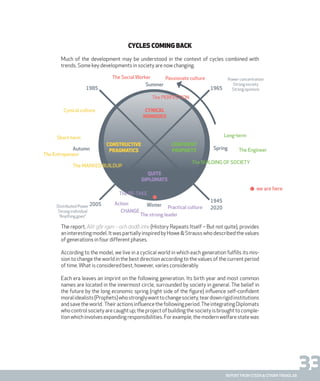
  • 83.
    83report from steen& strøm trendlab 7 Diesel stores in Spain, and Macy’s flagship store in NewYork are providing customers with virtual fitting rooms allowing them to shop with their friends even if there are not physi- cally present. Because the in-store virtual fitting rooms are connected to Facebook, con- sumers can post pictures and ask for product comments and shopping advices. Social net- working platforms embedded in in-store infrastructure are allowing consumers to ask for peer reviews before making a purchase decision. In-store personnel are also are being empowered with mobile technologies such as iPads. Best buy, Mercedesn benz, JP Morgan bank are a few examples of a fast rising trend (hype) towards improve service and work efficiency among store personnel. Sainsbury in London has iPads in customer shopping carts as well. The identityMine store concept is an app which helps customers to browse through in- ventories and create shopping lists before visiting a store. The app can also be used by in-store staff when providing services and answering customers’ questions. The staff is alerted when a customer checks-in to browse through deals or update the shopping lists. While inside the store, the user can interact with digital signs and digital kiosks that show digital content on a bigger scale. Staff members can communicate with each other and in- teract via the intra app messages2 . Digital signage or real-time advertising billboards have been implemented in shopping center in Japan since 2008. NEC, Fujitsu and Panasonic have been offering digital signage that work with mobile phones through RFID inside retail stores. NEC had its ”Eye Flavor” billboard installed at the Granduo shopping center in Tachikawa for 3 weeks in order to test the system. Using embedded cameras the technology was able to gather demograph- ic information and measures how well particular advertisements affect those that see them.The”EyeFlavor”couldrecognizewhetherviewersstopped,ignoredorglancedatthe screen. Japanese clothing brand Uniqlo plans to promote the launch of its Autumn 2011 collection in its new store at Westfield Stratford City mall by using digital signage bill- boards installed inside the Stratford Corrdiro Gateway. Another place in England planning to use digital signage billboard is the Euston Station. Network Rail has invested around 1.3 million pounds to interlink several billboards in order to provide advertisers with the ability to streamline up to date content across screens. American Eagle’s flagship store in Times Squares allows consumers to have their picture taken and then be displayed in one of the store’s Time Square billboards together with a customized message. Excited by having their faces display for 15 minutes, the technology hasbroughtinincreaseintrafficbringingeventouristthathappenedtobewalkingby.Offi- cials of the same city (New York) shave launched interactive map and digital signage video walls at its information center. The interactive tables provide visitor an enhanced interac- tion through its touch and object recognition technologies. Visitors cannot only retrieve customized information but they can do it in a fun way. 2 PSFK, www.identitymine.com
  • 84.
    DIGISHIFT 2020 84 collaborative consumption Amore volatile economic landscape, increased awareness about environmental issues, intensified urbanisation and changing lifestyles towards leaner living are some of the driv- ing forces behind a new consumer movement. On the web and in social media channels we see an explosion of new collaborative services created upon the same philosophy of shar- ing and networking. Wikipedia, Twitter and peer-to-peer marketplaces such as eBay and Craigslist are some examples of collaborative services. Rachel Botsman believes that we will go from “Hyper-consumption” triggered by advertis- ing (where status is built upon materialism and individual ownership) towards a “Collab- orative-consumption” triggered by community-based recommendations (where status is built upon reputation and shared access). Sharing, bartering, lending, trading, renting, gift- ingandswappingwillchangeoldbusinessmodelsandwillreinventourshoppingbehaviors. This is a diverse movement with examples found in many fields. It is intertwined with the open source innovation trend where creative Netizens act as developers and inventors. However, it is developing at a rapid pace. While these lines are being written, technology magazines such as Wired are arranging exiting seminars and conferences in London, Paris and New York. Further examples can be found on the web and social media. Botsman basi- cally structures the different services in three categories. “Collaborative Consumption…with benefits ranging from reduced personal burden and cost to lower environmental impact…enable people to save money, time, and space; build closer relationships; and move from passive consumers to active collaborators..” Rachel Botsman
  • 85.
    85report from steen& strøm trendlab 8 Product service systems In this category, the consumer does not need to own a product as he or she pays for the use of its when it is needed. Tool renting services are an example. Million of homes have a drilling machine that only gets used a couple of times throughout its whole lifetime. Other examples of services renting include: Car sharing, Bike sharing, Ride sharing, Solar Power, Toy rental,Textbook rental, Fashion rental and Neighborhood rental. Redistribution markets This is one of the more obvious services that is already succeeding on the net. It is about redistribute used or pre-owned goods to new owners in need. Blocket, eBay, to certain extend Amazon are all examples where redistribution have changed consumer behaviors. Other examples you find Freecycle, GiftFlow (Free/Gift Exchanges), Gazelle, Apple Recy- cling Program (Used Electronics), BookHopper, Papenbackswap (Swapsites for books), Swapastyle, Clothing Exchange, 99 Dresses (Clothing swaps), Toyswap, thredUp, Swapit- baby (Baby goods swaps), Egg Cartel, Zaarly, Garage Sale (Neighborhood Marketplaces) Collaborative Lifestyles Onetypeofcollaborativeconsumptionisnotaboutphysicalgoodsbutratherhowtoshare and exchange of less tangible assets like time, space, skills, money etc. Examples New- WorkCity, Hub Culture (Coworking Spaces), Zopa. Prosper,The Lending Club (Social Lend- ing), Ven, Quid, TimeBanks (Social Currencies), CouchSurfing, Airbnb, Roomorama (Peer- to-peer Travel), Barterquest, OurGoods, Bartercard (Bartering), IndieGoGo, Kickstarter (Crowdfunding), Ur-banGardenShare, SharedEarth (Gardens), TeachStreet, Skillshare, WeTeachMe (Skill sharing), ParkAtMyHouse, ParkCirca (Parking spots). WeCommune, Share Some Sugar, ToolszDo (Neighborhood Support), Taskrabbit, YourJobDone, AirRun (Errand & Task Networks), Vayable, Gidsy (Unique Experience Marketplaces), Gobble, EatWithMe, Wok’nWine (Social Food Networks), StorPod, ShareMyStorage (Storage Net- works) Every month you find even more examples of collaborative consumption. The Scandinavi- ansocietyisbuilduponoverabundanceandoverconsumption.Inthelongterm,thesociety faces big challenges. Our society is also build upon old collective structures and planning. Will Netizens reinvent the future collective structures? The Page retail sector and shop- ping places need to figure out how to capitalize on the opportunities that emerge from this reinvention by perhaps integrating it in the commercial projects and in the process of place making.
  • 86.
    DIGISHIFT 2020 86 THE COMINGOF BIG DATA As the old saying goes, knowledge is power. For companies however, perhaps profit is a betterword.KnowingwhatcharacteristicsthatseparatethetypicalpurchasersofbrandA from those of brand B might help a retailer come up with a market segmentation to boost its advertising effectiveness; knowing how customers feel and think about a brand might help a company develop better marketing strategies; knowing early on what the latest hype is all about can help retailers to adjust their inventories accordingly. Up until recently, little had changed in the way in which answers to questions like these were sought; companies relied on traditional BI-software to mine information from their CRM-records or used focus groups to try and pick the brains of potential consumers. However, twenty or so years of decreasing prices of computational power and digital storage, coupled with the continuing expansion of Internet and the Internet of things, has brought us to the threshold of a new era. In what has been dubbed ‘the era of Big Data’, more and more companies will increasingly start to look for valuable information concern- ing consumers and the marketplace in the vast amount of digital information created eve- ryday, both by the companies themselves and by the consumers. Already, major Telecom companies such India’s Bharti Airtel or Scandinavian Telenor have begun to use sophisticated network-analysis software on the vast amount of data gener- ated by their customers everyday. Bharti Airtel, Indias largest mobile operator which han- dlesoverthreebilliontelephonecallsaday,usedtheCDR:s–digitallogsgeneratedassoon as a call or SMS is made – to identify key influencer, that is persons who, once they decide to switch operator, tend to persuade their friend to do the same. By keeping these influ- encers satisfied, the company was able to reduce its customer defection rate. By relying on similar techniques, Telenor was able to study how early adopters of Iphone influenced the purchasing intents of friends in their immediate network. And this is only the tip of the iceberg. Within the next couple of years, many Telecom companies expect to be able profit from analyzing and selling information on the real-time geographical positions of its customers. Knowledge of crowd flows can provide a company with valuable information on where to best place a new shopping mall or train station or what to charge for billboard advertising. But a company does not have to generate or own the big data in order to profit from it. In april of 2011 Walmart announced it was buying Kosmix, a small social-media startup, in order to strengthen its e-commerce business.The division is called @WalmartLabs and its tagline is the three words “social + mobile + retail”. Using technologies developed by Kos- mix, @WalmartLabs hopes to be able to, among other things, sift through huge amounts of social media data such as twitter and Facebook to track the interests of people living near Walmart-stores in order to optimize its assortments. @WalmartLabs also hopes to be able to use insights such as these to enhance the physical shopping experience of its smartphone-using customers, for instance by helping them to decide between two com- petingsetsoftelevisionsbylettingthemknowwhatpeopleintheirsocialnetworkthought about the products.
  • 87.
    87report from steen& strøm trendlab 9 Other well-known pioneers in the field of Big Data are digital retailers Amazon and Netflix. Utilizing their vast database of consumer purchasing histories, these companies, based on the items that you express an interest in, are able to instantaneously come up with very accurate suggestions for other similar products that might be of interest to you. This is achieved through a technique known as collaborative filtering, which basically compares your purchasing history with those of every other customer in order to predict what other itemsyouarealsolikelytoenjoy. AccordingtoAmazon,30%ofitssalesareadirectresult of this recommendation system. Improved search engines and more sophisticated ways to analyze big data will change the marketplaceinthefuture.Incombinationwithsmarterphones,smarterappsandgeoposi- tion services it will create possibility for retailers and shopping places to be able to indi- vidualize services and shopping experiences as well as the products itself. In future E-& M-shops, we will see more advanced search engines that analyze every click. Customers’ digital fingerprints left behind after visiting a website are giving e-tailers a clearer understanding of customers ‘behavior. As the system learns more about the cus- tomer, it can adjust the product and offer better. If the customer is using a smartphone, its is easier for the system to analyze the context based on the customer’s surrounding. The key technique here is collecting big data and self-learning algorithms that understand human behavior. Google has developed a s c prediction API which is able to use historical data and turn it into real time predictions for the future. It is used in the car industry where Ford is devel- oping smarter cars that will predict where the driver is headed. Buddy finding services will soon have the ability not only to tell where you friends are now but where they most prob- ably will be in the near future. This knowledge could be very useful for a shopping place that in different ways could prepare for making your visit more relevant and personalized. One other example of smarter smart phones is the proactive mobile rearch app Siri. It is your new guide with the promising tag line: Your wish is its command. It lets you use your voice to send messages, schedule meetings, place phone calls. Ask Siri to do things just by the way you talk and it talks back. “Siri not only understands what you say, it’s smart enough to know what you mean. And Siri is proactive, so it will question you until it finds what you’re looking for”. Whataboutpersonalintegrity?Thissubjectishardertopredict.Howfarwillweletthisde- velopmentgo?Willtherebebacklashes?Theindustrytalksabouttheimportanceoftrans- parency and consumer choice.We and the people at the Steen & Strøm Future hearing day were not totally certain about how far we, as members in society, will let it go.
  • 88.
    DIGISHIFT 2020 88 “The humanbeing is the only animal that thinks about the future” Daniel Gilbert in Stumbling on happiness
  • 89.
    89report from steen& strøm trendlab the experts view chapter 4 onthe future
  • 90.
    DIGISHIFT 2020 90 accordingtothe experts Wemay say the future is difficult to know, yet we are so interested in it. Actually it is very human to think of the future. Few of us would live very long if we had no idea of what will happen in the future. In understanding the future we must still keep in mind that the future will rarely be exactly as we believe. Some of the developments are more likely and some are uncertain. We have tried in several ways to understand what we believe are the more likely developments and the uncertainties going forward. We have asked the experts and we have read the most qualified research and forecasts, and added some thoughts to bet- ter come to understand the future. DELPHI STUDY As part of the project a Delphi study has been carried out. The Delphi study is a way to qualifyanswerstohypothesiswithagroupofexperts.Someexpertshasbeeninterviewed before the study and some afterwards to quality check the questions and answers. By this we have gotten a better understanding of the likely future development. Participate and ask yourself the questions! Many of the experts have given us the feedback that the questions are thoughtful and interesting.To view all the questions and, if you like, fill in the survey, please follow the link below. click here!
  • 91.
    91report from steen& strøm trendlab expert panel Name Title Company Johan Ronnestam Futurist www.ronnestam.com LarsTong Strömberg Digital Media Manager Aller Media Filip Francke Managing Director BeNeLux Electrolux Sören Karlsson Head of New Media Helsingborgs Dagblad Nya Medier Hans Althin Director of Business Dev. Aller Media JamesTenser Principal VNS Strategies Moon-SuckSong Managing Director Panagora Panagora Agneta Uhrstedt Secr. General NCSC Nordic Council of Shopping Center Mikaela Dyhlén Trend Analyst BlikTrends & Insights EricWallin CEO DIBS Payment Services AB Michael Cronholm Research Specialist Inter IKEA Centre Group Rune Glasø Adviser Gyro AS Lise Henning CEO People in Store Dan Ouchterlony Investment Manager SchibstedTillväxtmedier MartinThörnkvist Media Market Analyst Media Evolution MarkusThorstvedt CTO Jesta Digital Denis Gagnon Dir. Multi-channel ITStrat Aldo Group inc. Lena Larsson CEO HUI Research Anki Kalmlund CRM Mgmt Consultant Unitail AB Mats Lindquist Leissmer Business Intelligence Svenska Spel Peter Sjölin Business Developer Svenska Spel Martin Öberg Lecturer Handelshögskolan Göteborg Lotta Axelsson Global Insight Analyst Sony Ericsson Leif Börjesson Marketing Manager / CEO Spendrups / Brutal Brewing Ole Petter Nyhaug Managing Director OnLive Research HenrietteWeber Founder & SocialWeb RocknrollChick ToothlessTiger Lars Ohlin General Manager Ridderheims & Falbygdens Trond Herberg Center Director Vital Eiendom AS ClausTüchsen Marketing Director Steen & Strøm Danmark Charles Larsson Marketing Director Steen & Ström Sverige JohanTibell Software Engineer Google (San Fransisco , USA) David Jansson Editor, Market Forma Magazines AB Karl Fredrik Lund Marketing Director Steen & Strøm
  • 92.
    DIGISHIFT 2020 92 2011 2012 2013 2014 2015 Bodyscanning tocreate shopping avatar comes to Scandinavia Era of On-life ubiquitous and seamless connectivity at no incremental cost or effort (*) Era of smart Clouds starts – remote data storage, software as service, distributed comput- ing (*) 25 billion things/devices connected to Internet M-shopping has a break through in the market The world fully modeled in 3-D (*) Bodyscanner-kiosks in the first Scandinavian physical stores or Shoppingcenters Advertising in paperbased newspapers and magazines has dropped by 30 % compared to 2010 in Scandinavia Worldwide seamless mobile communication M2M interfaces standart In new cars Value added services constitute 20 % of the sales in sports, apparell of furnitureConsumer ambassadors and word of mouth are more important Timeline Some of these questions were quantified by year in to a timeline of the future. Below you find the developments described, a few of which has come from other sources as well.This is the collective guess of the experts. Of course it is not the truth but a more likely truth than pure guessing. In general we can see that quite a lot of change is expected to happen. Some early changes are expected in the impact from mobile technology as well as new payment technologies. M-shopping will have a break through in about two years time. QR-codes and the like will be used frequently in a few years time and the mobile used as a wallet by many of con- sumers in 2015 The fall of paperbased media in terms of revenue also comes quite early. Around 2015 revenues from advertisement is expected to be 30% less than 2010. Along the timeline we see a development of show room functionality among more stores at the same time as service, advice, education , and other new sources of revenue are expected to increase. Web 3.0 fully launched/ Internet of things create possibilities for products to communicate with each other. Many stores re-focusing on showroom-functions with less storage capacity Era of Sensor Economy– environment-aware devices, location-aware services (*) Mobile phone is used for product-information (for example with QR-codes) by more than 20 % of consumers Social media presens and under- standing is key successfactor RFID-tag on 50 % of products above 50 euro Mobile become our electronic Wallet * = Generation C Implications for theWorld of 2020 Booz & CO 2011
  • 93.
    93report from steen& strøm trendlab 3-D-printers appear several store categories AVirtual shopping has larger turnover than the largest physical shopping- center Gamification will be a cruicial part of the shopping experience 30 % of Scandinavians use elec- tronic personal shoppers in their mobiles and computers Product-sales less than 50 % of revenue in shoppingcenters Entire generation will have grown up in a primarily digital world. Being connected 24/7 the norm/ prerequisite for partticipation in soceiety 2020 30% pay more attention to digital screens than sorroundings, 2022 Number of mobile users 6 billion (Booz & Co) It exist shopping centers that have no product to take home Shoppingcenters have taken the role as mediachannels earning money from customer flow, ser- vice, showrooms and events Showrooms with no cashier is 10 % of apparell stores Mixed Reality solutions (for ex Augmented Reality) is an impor- tant part of the shopping process 2016 2017 2020 2025 2019 2018 A fall in the use of space per store is expected, by those who guessed a reduction of 25% is forecasted. New technology will enter the stores more and more. By 2017 several store categories has tested 3D printing in store.The front runners in this field are already print- ing human organs so printing tools and toys should be fairly soon in the market. More and more of the products will be using identification tags and more and more things are now on the Internet. According to Cisco things connected to the Internet surpassed thehumanInternetpopulationmorearoundsixyearsagoandtheirnumberwillcontinueto surpass the population by far during the coming decade. The impact from digitization Some of the most important developments driven by digitization are summarized in the diagrams below. Physical stores will change, perhaps more in the coming decade than in many decades before this one. Average stor space is reduced by approximately 12 % Physical shops successfully charge for showrooms, service, advice and education
  • 94.
    DIGISHIFT 2020 94 Share ofexperts who agree with each statement IN 2020 PHYSICAL STORES WILL FOCUS ON ENTERTAINMENT AND WILL FUNCTION AS SHOWROOMS in 2020, digitization will have led to physical stores having ... Fig1. Changes in physical stores as a result of digitization by 2020 A significant share of experts believe that by 2020 physical stores will reduce its storage capacity and will focus more on delivering entertainment and on being a showroom for its visitors. Based on the large share of experts who believe this will happen by 2020, we can besurethatretailersandshoppingplaceswilldedicatemoreresourcesindeliveringenter- tainment and less on increasing their retail physical space or product ranges. This insight should be taken into consideration when making strategic decisions as it directly impacts the business. Big retail spaces may not be as important to retailers by 2020 or the use of this space may be considerably different. Some stores may act as marketplaces in the marketplace. Carrefour in France which have had problems with the hypermarkets being too big have gotten suggestions to sell or rent space to others. Whilespaceisexpectedtobereducedthisisnotsoclearamongtheexpertswhenitcomes to product ranges. We might actually see a smaller range in terms of SKU according to al- most half the experts. Another possibility is that the number of items per SKU might be reduced. Out of stocks can for example be delivered to the home directly from a central warehouse. DIGISHIFT 2020
  • 95.
    95report from steen& strøm trendlab RECOMMENDATIONS AND PAYMENTS WILL RECEIVETHE MOSTIMPACT Fig. 2 Components of the purchasing process impacted by digitization in the future According to most experts, the impact of digitization is widespread throughout the whole purchasing process. Almost all experts believe that the digitization of society will have a very large effect on product and brand recommendations as well as on payments, but also branding, inspiration, cross selling and price comparisons. The touch and feel component of the shopping process is regarded as a less affected area. Retailers located in shopping centers should be aware of the most affected components and act accordingly. Payment alternativesandin-storemobiletechnologymaybeimplementedtoencouragecustomers to interact with the digital world while inside stores. Both converging the bricks & mortar world with the digital as well as reinforcing the more unique parts of the process will be crucial in the future.This holds for both retailers and shopping places. In your opinion, how much impactwill digitization have on the following components of the purchasing process in the future? Share of experts who believe that digitalization will have a significant / very significant impact
  • 96.
    DIGISHIFT 2020 96 CONSUMERS ARETHENEXTSALESFORCE Fig. 3 Features that could be part of the future retail landscape by 2020. While the experts agreed on the widespread impact on the purchasing process, their statements in the previous diagram were less certain. Over half of the experts believe that some organizations will use consumers as the only sales force resource.The equivalent of the retail showroom is less certain on the level of the shopping; almost half of the experts believethatfullshoppingcenterswithoutproductstotakehomeisstillarealisticscenario within a relatively short period of time. Not many experts anticipate automatic shopping carts, which add products that the consumers did not choose. Others, however, believe that automatic personal shoppers will be a reality fairly soon; by2018 they will be used by 30% of Scandinavians. Some sort of automatic partner suggesting items to the shopping cart is expected, even if they will not be added to the basket without the customer’s approval. Aside from the tra- ditional channels, products and services should also be promoted and sold through what is sometimes referred to as ”hauling” or brand ambassadors. A trend among shopping cent- ers has been the “from malls to have-it- alls”. Shopping centers include offices, parks, pub- lic health care, libraries, cinemas etc. While this development is quite widespread among owners of shopping places, experts believe that shopping centers are more likely to be viewed as amusement parks rather than cities. Share of experts who believed the feature could be part of the 2020 landscape which of the following features do you believe could be part of the future retail landscape in 2020?
  • 97.
    97report from steen& strøm trendlab A BIG MAJORITY OF EXPERTS BELIEVE ONLINE AUTOMATED FULLFILLMENT SERVICES WILL SOMEWHATAFFECTTRADI-TIONAL RETAILING BY 2020 Fig. 4Trend development and effect of automated delivery services on traditional shop- ping Moving into the digital world with subscription-based services might drive traffic as some of the leading grocery chains are testing today. It has not taken off in ten years time (0%) It has developed into a small nische- market (12%) It has had some effect on traditional retailing (65%) It has dramatically changed the game of traditional shopping (29%)
  • 98.
    DIGISHIFT 2020 98 INDIVIDUAL INTEGRITYANDTRANSPARENCY DISCUSSIONS NOTSO LIKELYTO EMERGE OVERTHE INTERNET Fig 5 Future estimates about the emergence of huge individual integrity and transpar- ency discussions over the Internet by 2020. By a slight margin, experts believe that issues of individual integrity and transparency of the online world will not emerge as an important topic of discussion by 2020: approxi- mately 3 out of 5 experts consider it a realistic scenario. On the other hand, the remain- ing 2 out of 5experts believe the scenario to be realistic and that important discussions about the Internet will take place by 2020.The narrow difference in opinions between both groups (those who think it’s realistic and those who do not) is evidence of the com- plexity of estimating the development of this particular scenario. In turn, it signals a need to follow the question’s future development. Yes, I think that this is a realistic scenario (42%) No, I do not think that this is a realistic scenario (58%)
  • 99.
    99report from steen& strøm trendlab ApproximatelyTHREE QUARTERS BELIEVE REAL-TIME ADVERTISING WILL BE A PARTOFTHE RETAIL LANDSCAPE IN 2020 Fig 6 Future estimates about the use of real-time advertising by 2020 Approximately three quarters of the members of the expert panel believe that real-time advertising will be part of the retail landscape in 2020.The answers, allow us to conclude that consumers will interact daily with real-time advertising. Retailers need to develop a strategy for capitalizing on real-time advertising in the future. As retailers and shopping places gather a huge number of consumers, they offer a perfect opportunity for adver- tising professionals.They are not only able to reach consumers, but they may also to try to influence their shopping decisions at the moment of truth discussed in theTrendlab 2009. By the end of the decade these real time advertisements may also be targeted toward individuals who pass a digital screen or look into a store window, shelf or a place in general. Face recognition may allow this to happen automatically as well. As a result, shopping places may offer a platform with which real-time advertisers may work as well as offer them access to a large pool of consumers who might be willing to spend money. Yes, I think that this is a realistic scenario (73%) No, I do not think that this is a realistic scenario (27%)
  • 100.
    DIGISHIFT 2020 100 CHECKING INAND OUTOF PLACES WILL BE PARTOF RETAILING BY 2020 Fig. 7 Future estimates of checking in and out of places to earn point and receive coupons by 2020. Abigshareofexpertsbelievescheckinginandoutofplaceswillbeadailypartofshopping by 2020. While consumers are currently instinctively checking into places, they will do so automatically, it in the future. Over 7 of 10 experts think retailers in the future will be able toautomaticallysendcouponstostorevisitorsforthemtoredeem.Controllingthecheck- in services could be considered an important platform for business of the future of retail. Yes, I think that this is a realistic scenario (71%) No, I do not think that this is a realistic scenario (29%)
  • 101.
    101report from steen& strøm trendlab THE MAJORITY OF EXPERTS BELIEVE SUCCESSFUL POP-UP MOBILE SHOPPING CENTERS WILL BE A PARTOF RETAIL IN 2020 Fig. 8 Future estimates about the existence of successful mobile shopping centers We asked experts to estimate whether there will be a greater number of successful pop- up shopping centers like the one in Shoreditch, UK, which has 60 containers instead of the more common single pop–up stores. The experts found it difficult to reach a consensus as shown by the even results. In the end, however, a slightly higher number of experts, 53%,think that successful mobile shopping centers may be on the market by2020. Again, the even distribution of opinions is evidence of the need to carefully analyze the opportu- nities and threats emerging from this and other scenarios. Although the future of this sce- nario is not as clear, a strategy needs to be developed to be ready for any sudden threats. We may see retailers consider mobile pop-up concepts and launch pilot programs to test them in the market. Yes, I think that this is a realistic scenario (53%) No, I do not think that this is a realistic scenario (47%)
  • 102.
    DIGISHIFT 2020 SHOPPING CENTERSWILL EARN MONEY FROM NEWREVENUE STREAMS RATHERTHAN FROMTHETRADITIONAL - RENTS AND SALES Fig 9. Future estimates about shopping centers becoming more like media channels whereby they earn money from customer traffic, service, showrooms and events instead of the traditional rent and sales. Estimatesregardingwhethershoppingcenterwillearnmoneyfromothersourcesthanthe traditional rent and sales or not were evenly distributed. Overall, a bigger share of experts (57%) believe by 2020 shopping centers will become more like media channels earning their money via customer traffic, services and events. A smaller share (43%) thinks that is an unrealistic scenario. For some experts, however, the main concern is not the develop- ment, but the timeline. While many believe this will be the direction of the future, the pace and magnitude of this development is very uncertain. Neither the physical space, nor per- haps the business model, moves equally fast. 102 Yes, I think that this is a realistic scenario (57%) No, I do not think that this is a realistic scenario (43%)
  • 103.
    3 out of4 experts believe real-time advertising will be a part of the retail landscape in 2020
  • 104.
    DIGISHIFT 2020 104 In orderto assess the future of digitization it is important to understand the past, the pre- sent, and the future of online retail. For this we have consulted a wide range of sources and selected some of the more renowned research institutes. The following are a few of the most important findings and sources. THE GROWTH IN ONLINE RETAIL OVERALL ThereisnodoubtthatonlineretailisgrowingintheWesternworld.Despitethisconsensus, there is a widespread inconsistency in reporting the amount of online retail and the share of online retail relative to the total. Part of this difference is coming from the inconsistent definitions used and what is included in online retail. DIFFERENTDEFINITIONS OF WHATCONSTITUTES ONLINE RETAIL Before going into detail about e-commerce statistics in specific markets, it is important to highlightthatacountry’shareofonlineretailrelativetototalretailmaynotbeequalacross differentsources.Thevariationcanbeattributedtotheunstandardizeddefinitionofwhat constitutes online retail across different research studies. For example, the UK’s Centre for Retail Research (CRR) includes software downloads and any related services into the e-commerce equation while other sources do not. Similarly, most sources like the Danish & Swedish Post now PostNord exclude purchases of travel, event tickets, music and vid- eos while Forrester Research includes event tickets and music but it excludes travel and financial services in its calculations and Datamonitor includes books, music and video but excludes online ticket bookings as well as corporate purchases and online auctions. In its 2010 E-commerce survey DIBS included sales of travel, hotel bookings and tickets as well as software and music download as e-commerce transactions. Interactive Media Retail Group (IMRG) and Capgemini are making a joint report which considers online purchases inside stores as online retail. Perhapsthemanyefforttodefinewhatonlineretailincludesisasigninitself.Thereismuch interest in the field but the changing developments also makes new definitions emerge over time. The company’s report, which forecasts online retail sales between 2010 and 2015, did not use the same definition of online retail sales as in its previous forecast re- port between 2005 and 2010. In the 2005 forecast, the travel category was included in the definition but it decided to exclude the travel as well as the financial services category in its 2011 report. Using different definitions across forecasts had such a significant im- pact on the sales figures, that they remained nearly unchanged even after five years. With travel and financial services out of the equation, online retail sales in the US were $172 billions in 2010. However, the same sales figures were reported in 2005 when travel was included. ONLINE RETAIL and facts abouttoday andtomorrow
  • 105.
    105report from steen& strøm trendlab Similarly, the market was expected to reach $329 billion in 2010 but after excluding the travel and financial services categories for the 2015 forecast, sales were expected to reach $250 billion by 2015. Therefore, the definitions chosen over time across studies can significantly change the online retail sales figures. Here we try to grasp the essence of the collective conclusions from these reports and researchers. ONLINE SALES GROWFASTERTHANTRADITIONAL SALES Over the years, this increase has raised awareness about the online market among tra- ditional retailers. The rise of Internet sales could be attributed to the more widespread access to broadband Internet, the availability of online stores, to online stores improving its services or to consumers’ changing behaviour towards online transactions. Regardless of the reasons, Internet sales have grown faster than sales on high-street stores in many markets. According to the UK’s Centre for Retail Research, in the UK, “internet sales have grown many times faster than retail sales through physical stores, with sales growing by 30% on average from 2008 to 2010 alone”. UK estimates for the year 2011 indicate that traditional retail sales will grow by an average of 1,4% while online sales will grow by 14%. In Sweden, as of the second quarter of 2011, online retail has grown by 8,5% while tradi- tionalretailgrewby1,1%comparedtothesamequarterin2010.1 TheUKandSwedenare no exception to the rule. Buyers in the US, Europe and Scandinavia (markets with digitally mature consumers) have also been increasing their online spending, and thus, their per- centage of online spending relative to their total retail spending. DENMARK HASTHE HIGHESTONLINE SHARE OF RETAIL IN SCANDINAVIA AccordingtoastudyfromPostNordandtheRetailResearchInstitute(HUI)inSweden,the share of e-commerce relative to total retail has been approximately 4,6% in 2010.2 The UK’s Centre for Retail Research, however indicated Sweden had a share of 5,8% during 2010 (7th place right behind France with a 6,0%). Denmark had the highest share among Scandinavian countries with online sales representing 7,0% of retail followed by Norway with a 6,8% share in 2010.3 Posten Norway reported a much lower share of online spend- ing in 2009 stating it accounted for circa 3,5% of total Norwegian retail spending.4 1. Posten Sverige. E-barometer Q2 2011 2. Postens & HUI e-barometern 2011, e-commerce is defined as product purchases through the internet. Purchases of services such as tickets and hotell bookings and music, films and software downloads are NOTincluded as e-commerce. 3. Report by the UK’s Centre for Retail Research commissioned by Kelkoo 2010. In the report online retailing deals with sale or transfer of merchandise (including software) and any related services such as shipment or installment purchased over the Internet by the final con- sumer. The definition used takes into account and is consistent with the new Global eCommerce Measurement Standard, agreed in 2010. The report deals with retail spending (as defined in the new standard) and excludes online spending on tickets, travel, cars, fuel, pornogra- phy, insurance and financial services 4. Distanshandel Norge og Posten Norge 2009
  • 106.
    DIGISHIFT 2020 106 THE USONLINE MARKETACCOUNTS FOR APPROX 40 % OF GLOBAL ONLINE RETAIL. According to Datamonitor1 , the US is the biggest online retail market in the world account- ing for approx. 40% of the global online retail market value. The latest data from a press release by the US Census Bureau indicated that US e-commerce sales in the second quar- ter of 2011 accounted for 4,6% of total retail up from 4,2% during 2010’s second quar- ter2 . THE UK & GERMANY ARETHETWO LEADING ONLINE RETAIL MARKETS IN EUROPE Across all sources there is a general consensus that the UK is the leading online retail mar- ket. Forrester Research, Datamonitor and CRR recognized the UK as the biggest online retail market in Europe. Forrester Research further believes the “UK is by far the largest eCommerce market, almost as big as Germany and France combined – respectively the second and third biggest online markets”. In 2010, The Boston Consulting Group stated the “UK is now the leading country for e-commerce and a net exporter of e-commerce goods and services exporting £2.8 for every £1 imported”3 .This also means that the UK´s onlineretailisnowseenasanimportantexportindustrywithlargepotentialforthefuture. WhileconsensusovertherelativepositionoftheUKisclear,thenumberswithintheUKare far from equal. UK online retail shares have been reported by sources such as Verdict Re- search and Interactive Media Retail Group (IMRG)- Capgemini. The former reported that British consumers spent 8% of their total retail online during 2010 up from 3% in 20034 . The latter, in its e-Retail Sales Index5 , reported that online retail accounted for 14.1% of UK’s retail in 2010. Online retail is the majority of remote sales While phones and catalogues have been around for quite some time, there is no doubt that consumers are increasingly choosing online retail for remote purchases..Verdict Research estimates online retail will reach 85% of the total UK remote sales in 2011 up from circa 80% in 20106 . Across the Nordic countries, online retail represents on average 80 per- centoftotalremotesales.Inmoredetail,onlinesalesrepresent89,83,82and78percent of total remote sales in Denmark, Norway, Finland and Sweden respectively7 . 1. Datamonitor. Online Retail in the United States 2010 2. US Census Bureau News August 2011. E-commerce sales are sales of goods and services where an order is placed by the buyer or price and terms of sale are negotiated over an Internet, extranet, Electronic Data Interchange (EDI) network, electronic mail, or other online system. Payment may or may not be made online. 3. The Boston Consulting Group.The Connected Kingdom. How the Internet isTransforming the UK Economy 2010 4. Verdict Research UK e-Retail May 2011. Verdict’s e-retail market definition includes all online spending on goods by consumers and therefore excludes spending on services (including flights, tickets and insurance) and business expenditure. 5. IMRG & Capgemini e-Retail Sales Index. Online sales is defined as transactions completed fully, including payment, via interactive chan- nelsfromanylocationincludingin-store.Thesesalesarepredominantlyinternet-basedtodaybuttheIndexremainsreadytorecorde-retail sales conducted via whatever interactive channels the market may embrace in the future. 6. Verdict Research UK Remote Shopping 2011. Remote sales is define as all retail sales through the following non-physical store channels: non-store sales of physical retailers, pureplay online; mail order (direct), mail order (agency), door-to-door; andTVshopping 7. Postens Norden 2010. Remote Sales include purchases of products via internet, catalog, telephone andTV. Buyer and seller do not physi- cally meet.
  • 107.
    107report from steen& strøm trendlab THE ONLINE RETAIL MARKETIS EXPECTEDTO CONTINUETO GROW ALBEITA SLOWER RATE of around 10 percent Although online retail represents a relatively small share of the total retail market, it is expected to grow over the years. The European online retail market as a whole is expect- ed to grow at a 10% CAGR between 2010-2015 according to Forrester Research while Datamonitor1 predicts a CAGR of 10,5% between 2009-2014 – a much slower growth compared to the 23,7% CAGR between 2004-2009. Growth in the US is forecast by Da- tamonitor at a CAGR of 10,5% between 2009 -2014 which is also a slower growth rate when compared to the previous 11,5% CAGR between 2005-2009. ONLYTHE UK WILL ACHIEVE A DOUBLE-DIGITSHARE OF ONLINE RETAIL SPENDING before 2015 Regarding individual country growth, Forrester Research and the UK’s Centre for Retail Research believe the UK will grow at a CAGR of 10% between 2010-2015 being the only European country to achieve online sales representing over 10% of total retail. The country will reach an online retail market share of 11,5% by 2015. Verdict also predicts a double-digit share by 2015 at 12.1%2 . Datamonitor, however, estimates the UK´s CAGR between 2009 and 2014 to be slightly below the double-digits at 9.7%. The second biggest online market in Europe (Germany) is expected to have a CAGR of 9% between 2010-2015 (Forrester estimate) or a CAGR of 6,9% be-tween 2009-2014 (Da- tamonitor estimate). France (the third largest market according to Forrester Research) will have the same CAGR as Sweden at 11% between 2010-2015. In addition, the Swed- ish online retail is expected to grow by over 9% during 2011 as it reported a growth of 8,5%inQ22011fromtothesamequarterin20103 .Swedishconsumersarethemostop- timistic among the Nordic countries as 91 of Swedes expect to increase or maintain their online spending during 2011 compared to 87, 85 and 84 percent in Finland, Denmark and Norway respectively4 . In general, almost all markets mentioned are forecasted to grow at a CAGR of more or less 10%. 1. DataMonitor. Online Retail in Europe 2010. In this report, the online retail market consists of the total revenues generated through the sale of retail goods via online channels, valued at retail selling price.The market values exclude travel and ticket bookings, online corporate purchasing, and online auction transactions 2. Forrester Research. European Online Retail Forecast. February 2011 3. Posten Sverige: e-barometer Q2 2011 4. DIBS E-commerce Survey Europe 2010
  • 108.
    DIGISHIFT 2020 108 ELECTRONICS, CLOTHINGAND MEDIA & ENTERTAINMENT(BOOKS, MUSIC & VIDEOS) ARETHE LARGESTCATEGORIES INTERMS OF VALUE Despite differences between the US and the European markets, they share one thing: online retail markets are dominated by three product categories: electronics, clothing (apparel, accessories and shoes) and media and entertainment (books, music and video). These categories are the largest in each online retail market in terms of market share val- ue. In the US, electronics, clothing and books,music and videos account for 23.7, 16.5 and 8.7 percent of the total value of the online retail market respectively1 . In Europe, the cor- respondingnumbersare22.1,18,3and16.2forthesamecategories2 .Thenumbers,imply that the European online retail market is more evenly distributed than the US online retail market. Forrester Research and DIBS also mention electronics as thecategory with larg- estmarketshareinEuropefollowedbyclothing.Researchsourcesclearlyindicatethatthe product category electronics has the highest market share value followed by clothing and books, music and videos. THE UK HAS A BIG SHARE IN FOOD & GROCERIES Forrester Research and DIBS also mention electronics as the category with largest mar- ket share in Europe followed by clothing. Verdict, on the other hand, ranks food & grocery as the second largest category by online spending after electronics but before clothing and footwear and music and video. Regardless of the position, the top product categories in the UK in terms of online spending are: electronics, food and groceries, clothing and mu- sic and video. Moreover, the health and beauty category is the fastest growing in terms of volume at a rate of around 21% in 2009 and 2010. DANISH CONSUMERS SPENDTHE MOSTINTHE HOME AND HOUSE- HOLD CATEGORIES WHEN COMPAREDTO SWEDISH AND NORWEIGAN In terms of sales volume clothing, electronic and media/entertainment are the most popu- lar product categories bought via the Internet3 . However, electronic, home & household productsandmedia/entertainmentarethethreebiggestcategoriesbymarketsharevalue in the Danish online retail market with 16, 13 and 9 percent respectively. Among the Scan- dinavian countries, Denmark spends the most in the home category relative to total online spending accounting for 8% and a total of 13% if combined with the household products category4 . If it were one category, it would be the second largest after electronics. In the UK, Germany and France (3 biggest online markets in Europe) however, the combined cat- egory is the largest one in terms of market share value followed by electronics. KEY ONLINE PRODUCT CATEGORIES 1. Datamonitor. Online Retail in the United States 2010. 2. Datamonitor. Online Retail in Europe 2010 3. E-Handel i Norden 2010 & FDIHThe Danish Distance Selling and eBusiness Associaation..Dansk e-handelanalyseQ1 2011. 4. DIBS E-commerce survey 2010
  • 109.
    109report from steen& strøm trendlab NORWEGIANS PLANTO BUY MORE SPORTS EQUIPMENT AND FOOD & BEVERAGES ONLINE Similarly to the other Scandinavian markets, clothing, electronic and media/entertain- ment are the most popular categories bought via the Internet. In terms of market share value, electronic, media/entertainment and clothing account for the biggest market share at 18, 9 and 7 percent respectively. Sports equipment and pharmacy followed by food & beverages are some categories, outside the largest ones, consumers expect to increase their online consumption in the coming years. CLOTHING GROWS STRONGER IN SWEDEN The three biggest product categories in the Swedish online retail market are electronics, clothing and books and media in that particular order1 . Posten Sverige reported the fol- lowing market share for the categories: 24, 22 and 12 percent respectively while DIBS reported market shares of 19, 10 and 9 percent for the same categories. The clothing category reported the highest growth in Q2 2011 (13%) when compared to Q2 2010. In fact, according to DIBS, Sweden’s share of online spending on clothing relative to its total onlinespendingishigherthanthatofDenmarkandNorway.FranceandFinlandaretheonly EU countries with higher shares of online spending in the clothing category. Outside the largest categories, Swedes expect to increase online purchases of food & beverages and household appliances followed by pharmacy products. 1. E-Handel i Norden 2011
  • 110.
    DIGISHIFT 2020 110 Online retailis clearly set for growth. It is, however, also clear that the rate of growth is expected to decline.The annual growth rates of above 20%, seen in the first decade of the 21st century, seem to be over. Most researchers expect a growth rate of around 10% in developed countries. The growth of online retail will not severely impact the volume of traditional retail. David Jansson editor at the magazine Market gave the following example. If Swedish retail is 500 billion SEK and the growth is 3%, the growth in value is 15 billion SEK. If online retail is 30 billion and grows by 10% this is still only 3 billion SEK. 20% of growth comes from online retail. For the coming five years, the growth in retail is more dependent on the gen- eral rather than the online retail growth. Beyond this time frame, other developments have to be considered. The most important change in the online retail landscape is the growing number of cat- egories available online. According to Forrester Research, the category “groceries” is the largestoneintheUKandclothingthebiggestoneinFrance.Notlongago,thesecategories were believed to be very difficult to sell via the Internet. To some extent, the impact from online retail may be different from taking market share. Looking at the financial services sector, we can see that brokerage has been affected, but primarily the effect was seen early on profit margins and automation of transactions and processes. Our belief is that the impact from digitization on pricing and the purchasing processes may be larger on high street retail than the impact on market share. CONCLUSIONS on online retail DIGISHIFT 2020
  • 111.
    May you livein interesting times. May you come to attention. of those in authority May you find what you are looking for. Chinese proverb
  • 112.
    DIGISHIFT 2020 112 Shopping centreis an ideal venue to make the kind of ecosystem which help customers to create
  • 113.
    113report from steen& strøm trendlab the likely chapter 5 future Looking into the year 2020
  • 114.
    DIGISHIFT 2020 114 Summing upthe research and constantly changing environment of digishift is not an easy task. In this chapter, we aim to present the main conclusions about the structural changes andideasandtosetthestageforourthinkingaboutthefutureofthedigishiftanddigisoci- ety.We then aim to summarize the most important conclusions along with the main frame- work of changes presented in the triangle during the introduction. • Supply (Retail) • Demand (Consumers) • Society (Context) • Shopping process The general environment ofthe future of online retail Inertia or change Our view is that inertia will be very dominant when it comes to market share changes at leastforthecomingfiveyearsandforthemostpartuntil2020.Theriseoftheonlinecom- merce is constrained by people’s behavior and physical limitations, contracts etc.The suc- cess of online commerce is still a small part of the total retail. Traditional retail sales will dependmoreongeneralconsumerdemandthanonthegrowthofonlineretail.Evenchang- es in the household consumption categories play an important role. In Denmark, home ex- penses (interest, heating, rent) have risen from 25% to 29% of consumption since 1980. In a long term perspective the change is even larger in all the Scandinavian countries. Despite this inertia there are a couple of reasons to prepare for the future already today. 1. Profitability may be much more difficult to maintain than market share. Already today retailers are asking manufacturers for compensation for rebates negotiated by con- sumers. Market share may be a bad guide for value, like for Apple’s iPhone. 2. There is a first-mover advantage, which will be valuable over time. Global stars like Google are sometimes having difficulties in markets where they were not the first. Amazon and eBay remain as very important actors in the retail landscape, especially now when the integration of the online and the physical world is about to fully take place. It will be even more difficult for a follower to challenge the leaders. In 2020 on- line retail may be 15% of sales in most categories, but the train has left for many of the traditional retailers. 3. Early exposure to the new business environment may make you better prepared for the future. Brittish Aiways had early problems with Ryanair and got to learn faster than other companies like SAS. Universal studios tried to prevent music streaming but it is now making more than 40% of its revenues from Spotify- which was launched three years ago. It seems to be difficult to learn from other countries and industries experiences; it is almost as one has to be there. The future shopping environment
  • 115.
    115report from steen& strøm trendlab The liquid shopping experience Through time, while the number of retail stores has decreased, its sizes have increased resulting now in fewer but bigger stores. Small city centers and suburbs have either grown bigger or disappeared. Grocery stores have been reduced by over 90% over the past 50 years. The rise of category killers like big box electronic retailers and DIY stores has been remarkable over the past 20 years. With digitization this development has changed somewhat. We have seen the growing number of alternative retail channels. At the beginning, the alternative channels were not digital (TV-shopping and mail order) but rather new forms of distribution. Alternative dis- tribution channels are now more common as we increased our digital maturity. New chan- nels and new ways of using the channels are constantly entering the market. We now have m-shopping, social shopping, tablet shopping, crowd shopping along with the more tradi- tional forms. What we foresee for the future of shopping is similar to what we have seen in the media industry. Ten years ago we started to call people Homo Zappiens. People started zapping more frequently between identities and contexts and became better at it. We had “more identities than we know what to do with” asWalterTruett Andersson said.The word Homo Zappiens came from the action of using the remote control to zap between TV channels. Media was the origin of the description of consumers, however, media companies are not talking about zapping between channels anymore but about a constant flow of media.The public space has become a communication environment in itself as consumers are always on. In the 1960’s media icon Marshall McLuhan started talking of the shift from “light on” me- dia to “light through” media. The TV made us feel the world actually came to us. The world became a global village within our reach.Today, with the Web, social media, augmented re- ality, holograms, and other new technologies, we experience a shift to “live through” media, a constant flow of information of virtual and real reality, which allows us to enter this real- ity and act within it. “I use to refer to shopping centers as an analogy to our business. We have media which at- tract customers and some where they end up buying.” Dan Ouchterlony Investment manager Schibsted
  • 116.
    DIGISHIFT 2020 116 This developmentis soon to become a reality for retail and shopping centers as well. Con- sumers will not be in and out of stores, stores will be ever present and consumers will live in a Liquid shopping experience as described in the model.The entire physical and virtual space will be always on and we will be in the shopping process as well as in the media flow all the time. Every surface communicates and is a potential store. Whatisthe retail environment? Historically the different parts in the shopping process have been separated.When enter- ing into this liquid shopping experience these boundaries are not clear anymore. liquid shopping experience channel width digitalmaturity The entire physical and virtual environe- ment is a store Tablet shopping S-shopping (Social network) M-shopping E-shopping Blogg-tailing TV-shopping Mail order Physical shopping M-shopping E-shopping TV-shopping Mail order Physical shopping E-shopping TV-shopping Mail order Physical shoppingTV-shopping Mail order Physical shopping Physical shopping + - - + manufacturer retailer marketplace media consumer
  • 117.
    117report from steen& strøm trendlab Shopping in 1990 Alreadytodayweareseeingthisdevelopmentinthevaluechainblurtrend.Amazonismak- ing their own products like the Kindle, selling it in other retail channels as well, they are becoming a media and event place for author meetings, media companies like Google are moving in to hardware like mobiles, Google is setting up stores, Media companies are en- tering into making brands with products for sale like Elle, brand owners like Unilever with Dove and Nestlé with Nespresso are setting up retail online or even stores. Retailers are inviting other brands to be part of their concept with shop in shops, new brands, and of course launching their own private label, brands and products. Even consumers are now part of the process much more. Consumers have become the media, the researchers, resellers and producers; today they have the possibility to influence and create the products being delivered. Distributed busi- ness models and open innovation are examples of this movement. Companies like Procter & Gamble, Apple and H&M work in this direction. P&G has created open Innovation known as Connect and Develop. Whoever can help provide solutions to the issues they are trying to solve will actually get paid for it. Apple’s success with its app store depends on the prin- ciple of distributed business models. All the effort other people are putting in to making apps creates value for Apple. retailer producer marketplace mediaconsumer The value chain blur
  • 118.
    DIGISHIFT 2020 118 we-making comingback In the book The Future of Shopping Places a model describing the retail sector in Pine & Gilmores context of the experience economy was presented. Interestingly some stud- ies have now found that a level after the creation of transformation Me-making there is a levek we call we-making.The greatest experiences consumers encounter are very depend- ent on the relationship with others. Sharing the experience with others is a key success factor. This also holds for consumption of products. A study about the positive aspects of consumption showed an overrepresented number of participants believing that shar- ing thoughts with others influenced a positive consumption experience.We want others to corroborate our consumption. Researchers have actually made a revised version of Maslow’s hierarchy of needs. On top inthepyramidismateacquisitionandmateretention.Thismayseemoddtomostofusbut it can also represent a cyclical development. The development may actually not be linear with a new level on top of the other. At a certain point in time society may have delivered to an extent that is difficult to top. On an individual level there are of course examples of people who have accomplished the self fulfillment to an extent that more is not needed. Growing others is then more motivating than growing oneself. Like successful business leaders or everyday parents. We also see that a more and more important role of the shopping places is to get back to the creation of the classic Greek Agora. The square where people meet and discuss, shop and eat.The expression that malls have it all represents its new role of creating a commu- nity of and a feeling of belonging.To some extent this can also be similar to the community of the media audience. Readers of a particular newspaper feel they are part of a commu- nity, like the neighborhood. competitive situation Meta Differentiation Traditional Undifferentiated Postmodern consumer values Extract Commodites Country shop & Markets Make Goods Supermarket Deliver Service One Stop Shopping Stage Experiences Place Making Create TRANSFORMATION Me-making Enable Togetherness We-making Enable Togetherness We-making
  • 119.
    119report from steen& strøm trendlab The Urban village The trend towards locally produced food may represent a stronger longing for a small community in a turbulent world. Urban farming is also a trend where city people want to have the feeling of the countryside in the urban environment. We believe creating the ur- ban village within the urban environment will be a strong force in society of tomorrow. Part of this can be seen on parks on shopping centers like Emporia in Malmö. Over the coming decade this will most likely include the digital environment of the future.Today’s high tech well be the everyday low tech for tomorrows Netizens populating the cities. How the urban village will be created will therefore most certainly be dependent on tech- nology. Connecting the virtual with the physical world may create the feeling of a village. People’s new nearby world, their urban village, will be dependent on interests, place of birth, local contemporary culture, family and friends. Moreover, the connection and the bonds will most surely include the digital dimension. Creatingthe Ecosystems Attheriskoflosingouttodigital,it’simportantthatretailersandshoppingcentersexpand beyond their current model and try to integrate this powerful movement into their own businesses. Words like me-making and we-making express the consumer’s desire to be a part of the creative process and a context their urban village. The physical environment is one essen- tial part of this ecosystem. Shopping centre is an ideal venue to create this kind of eco- system that provides solutions and opportunities which customers themselves help to create. With online sites, augmented reality, multichannel and a physical context shopping centers and retailers have a powerful means to communicate with their consumers about ideas for new outlets, preferred promotions and even design elements. By actively inviting users to be a part of development, sales etc. they create an ecosystem. They are not only getting to know them better, they are also enhancing their user’s experience and building a structure consumers desire and are loyal to.
  • 120.
    DIGISHIFT 2020 120 Conclusions fortheshopping arena Society T-society Digitization will be integrated in all aspects of society.TheT-society is about to come true. Thought workers, Transparency, Trust, Temporarity, Technology, will be fundamental. A main challenge and opportunity is in thought worker productivity. We have to make ser- vice and knowledge worker productivity increase, just as manual worker productivity has increased over the past century. Internet of things The Internet of things will become a reality, people, products and processes will be con- nected online. The rate of connected products will accelerate while the connections with people slow down. Global competition for tax revenue and legal power Globalization will make a challenge to the system with nations and states. Lower taxation is now a main driver of online retail. Servers are put up in the country and state with the lowest taxes in what can be seen as unfair competition. When traditional retailers are be- ing under pressure the lobby for this to change will be more visible. Big data will challenge personal integrity More and more organizations and people will know more of us than we thought was pos- sible. Our imagination is not enough to capture the new services and targeted offers that will be seen in the market place. Some of this will challenge integrity as we know it. Even intimacy will be reduced. Urbanization will be the solution and challenge to sustainability Theurbanizationismoreandmoreseenasapossibilitytosolveresourceandenvironment constraints. The lower use of resources in densely populated cities like Tokyo and Hong Kong will be targeted among more cities and regions. Distribution will be a main challenge and opportunity in the future society. See the triangle framework on page 17 click here!
  • 121.
    121report from steen& strøm trendlab Supply “It looks like traditional retailers can not compete with online when it comes to range and price” David Jansson, editor Market New dimensions Physical stores will have to offer more than price and product range in-store.The success- ful stores will increase their product range by connecting with online offers, they will sell more service and knowledge they will offer a community for their consumers and be more focused on entertainment. Everyone will not do everything and everyone doesn’t have to change, but the role of retail beyond price and product will be crucial. More focus on personnel Some retailers will work like the leading Swedish book store Akademibokhandeln and suc- cessfullyreducerangein-storeandputmorefocusonthepersonnel.Bytheendofthedec- ade successful retailers will, however, also have integrated their part of online presence and not run it as a separate low key-brand side business. In-store personnel will be more technically supported enabling them to be more qualified, and this will be needed since consumers will be much more empowered with information. Valuable information “Ialmostdon’tdaretogointoAmazonbecausetherecommendationsIgetaresounbeliev- ably precise and targeted to my needs and desires. I become sitting there for hours. In 15 years shopping centers will be just as attractive.” Ole Petter Nyhaug CRM will turn in to Big Data. More and more organizations and people will have access to big amounts of information and the interpretation of this information. Online retailers today benefit a lot from their much more advanced tracking of consumer behavior. This knowledgegapwillbemoreimportantforbricksandmortarretailerstocloseandimprove beyond the pure play online retailers. Value chain de-materialization The value-chain will be de-materialized. Products may be separated from presentation of products, prices of products, history of products, touch and feel of products, delivery of products, brands of products, adaptation of products, services, knowledge etc. There will be many experiments and far from all successful but all in all de-materialization will have more and more impact.
  • 122.
    DIGISHIFT 2020 122 New storeformats Store formats will be of a much wider range of alternatives. Check-out terminals, show- rooms, show walls, Augmented reality stores, home delivery, self-checkouts, temporary stores,storeswhichactlikemarketplaces,storeswhichcombineworkandfood,workand shopping,brandstores,servicestores…areafewexamplesofformatswhichwewilllikely be seeing more of in the future. Conversion of IRL and VR The world IRL will be closer connected to theVR virtual reality. More and more techniques will be location based and connect the world IRL andVR.This world will be perceived as an integrated world, by most of us better than the previous. Brand and product power increase Technologygivesbrandsanewwaytogetaccesstotheconsumers,reducingtheirdepend- ency on traditional retail, but sometimes being more dependent on a few digital. Those who have a good product or a strong brand have easier to get to the market. Being relevant Being relevant to consumers will be increasingly important for online and offline retailers. Simply being in a place is not enough to get consumers’ attention, now retailers need to offer what consumers are looking for. New paymenttechnologies NFC and mobile commerce will be more common. New business models will be based on this and facilitated by the new forms of payment. Micropayment which was a buzz ten years ago now makes a difference in many markets. ”Online retailers development from trying the mix of brands to owning retailer brands is not very different - it is just much faster.” Moon-Suck Song Managing Director Panagora
  • 123.
    123report from steen& strøm trendlab Demand Technology will be everyday for netizens “Technology is the things which weren’t there when you were born” For people who grew up with the Internet its not more exciting than cars for a 40-some- thing today. Big cultural changes begin when humans start seeing beyond the “technical side” of new innovative technology. If the technology, on top of that, becomes more user friendly and the applications add a more human touch, we stop thinking about it as tech- nology and start to integrate it in our every day life. By the year 2020 we will have entire generations that have grown up in a more or less digital world for them this will be every- day life.These Netizens will live big parts of their lives through digital media in a variety of channels and this will transform how we work, socialize and consume. No boundaries in life Perhaps mobiles and laptops have not yet given us the “paper less office”, which was the visionofthemillennium.However,ithasgivenusthe“office-lesspaper”andpeoplearenot stucked to a desk at the office any more.This gives us more freedom to choose how, when and where we want to work, eat, sleep, and enjoy life. It creates possibilities to mix work andpleasureinnewways.Moreshoppingistakingplaceduringworkandmoreworkistak- ing place in public meeting places or in shopping areas.The 24/7 society has given us less boundaries of when & where most things in life can take place. Attention currency “We are expecting youth to pay attention to our marketing messages. Think about it for a minute – Pay attention. We are expecting youth to pay to listen to us. When attention be- comes an increasingly scarcer commodity our assumptions become increasingly broken” Tomorrow’s consumers will know when to get paid and when to pay. Sometimes they will pay to test new things and sometimes they will be paid to do basically the same thing. Knowing the attention currency will become more important. From mass marketing to social filter Netizens are likely to have developed a netographic worldview in 2020. In the intensified war on attention consumers are using technical filters and tools to avoid the information they have not asked for. Since they are always connected, more and more of their informa- tion flow and interpretations of the world are supplied by, or at least colored by, trusted relationships with friends or favorite blog experts or interesting fans in brand tribes or micro cultures online. Perhaps they like the famous 12 year oldTrevor Moran or iTrevor as he calls himself when he is making his youtube clips with crazy in-store dances in different Apple stores, where grumpy store staff is ask him to shut it off. The future consumers are more cautious and informal when open social networks like Facebook and similar networks gets invaded by infiltrating marketeers and intrusive brands who has not understood that you cannot steal consumers attention but have to earn it in new innovative ways. They create discrete net- works that shut out the marketers and becoming masters of their own private information space.
  • 124.
    DIGISHIFT 2020 124 Trusted thinkpool In the future consumers will put more and more of their personal information, profiles and personal services in to what we callTrusted think-pools, or smart clouds, that will nurture a increasingly complex “digital identity” that is connected to almost every activity in life. As we mentioned in the trend chapter, the digital identity becomes more important for who weare.Weuseonlineservicestofacilitateourofflinesocialmeetingsandshoppingexperi- ences. Through a more intelligent web (Internet of things), the digital identity will become able to use different tools and applications for helping consumers micro-coordinating their lives in more efficient ways. Play, learn & work Netizens will be 20-something in year 2020. Having played computer games and consoles all their life, they now bring the gaming behaviors in to the ordinary life of school, work and shopping. A “gamification of reality” is likely to become an important part of the commer- cial culture of the future. Brands, stores and shopping places will be able to embed play- oriented ingredients in the ordinary shopping experience. You will earn points in ways that could not dream about ten years earlier. Structure to handle pressure In 2020 stress, pressure and lack of energy in an increasingly complex society will create greater interest for developing a smarter way of living. this will probably mean that we will see more of neo-structural consumption, where someone else is structuring your life, choosing and combining the right solutions for you and distributes services or products conveniently to your home. At the same time the netizens have become better aware of their growing potential as professional consumers, producers, media actors and innova- tors. This could mean a shift towards more collaborative consumption. Time-, product and service-sharing services through clever online communities might save us time, money or energy and partly change our consumer behavior away from the traditional overconsump- tion that the global economy used to rely on.
  • 125.
    125report from steen& strøm trendlab Shopping process Revolution in the moment of truth The focus of TrendLab 3, The Moment of Truth in the buying process has grown in impor- tance over the last 20 years. This moment of truth will now be revolutionized and more intense. A digitally enhanced moment of truth will make this completely different. In 2020 consumers will be digital empowered to navigate seamlessly between channels in a mixed reality world. The moment of truth will be connected to agents, sources and advice. Con- sumers will have much more power and tools to effectively negotiate price or offers in the physical retail space. Empowered personnel In physical stores we will se digitally enhanced sales staff and much more advanced in- store tech evolving that enables retail to create a more efficient, richer and more tailored shopping experience. In 2011 we see a wide range of experiments going on around the world that, if they succeed, will change the shopping process in different ways. Always on shopping We have mentioned new window-shopping in UK and South Korea. We will see how retail stores integrates mobile phones for in-store purchases and the mobile is becoming the wallet. Retail is never more than arms length away. Everything will be part of sales and communication. More people will most likely subscribe in total solutions online in order to get rid of the time consuming shopping process. More showrooms and social retail spaces integratedinpublicmeetingplaces.Pop-up-shopsandmalls,bothphysicalandvirtual,that is easy can follow the crowd and reach out and sell to consumers when they least expect it. E-shoppertainment E-shoppertainment will be more developed when techniques like augmented reality will enhance the ability online to resemble the physical shopping experience. In ten years time a lot will have happened with what today is small experiments with tags, QR-codes and services where you can try on clothes online, with techniques like TOBI or furniture your home online through Ikeas AR-app. Automatic shopping hardware & software Robot shopping environments and smart supermarket kiosks will be more common. This enables for both e-tailers and traditional retailers to reach out in new ways, shapes and forms. Facial recognition technology makes the vending machines and robot shops smart- er and more able to customize offerings. Intel and Kraft Foods are experimenting with s c Meal Planning Solutions where sensors and analytic software can determine which recip- ies that would fit just you
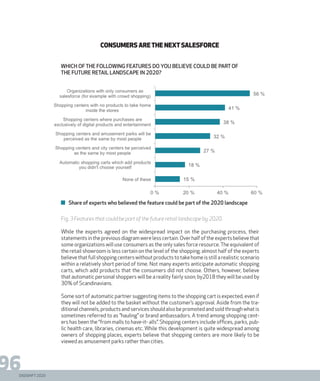
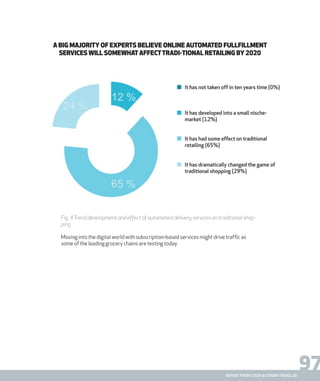
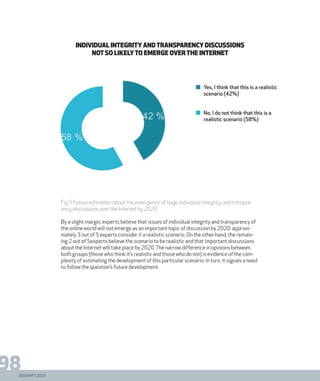
  • 126.
    DIGISHIFT 2020 126 NewversionsofDigitalsignageandcombinationsofmobileappsandnewbehaviorswhere consumers checkin when heading to a store or entering stores will support contextual ad- vertising and intelligent offerings that, if they are tailored enough and interesting enough makes it hard for us not to buy. LIVE The LIVE-factor that we wrote about in an earlier report, will grow in importance (Live, Im- mersive,Vibrant and Entertaining) in times of emerging virtualization. In a world where we blend work and play more in our own pace, people want to be able to easily switch between anefficiencymodewhereshoppingefficiencyisofmostimportanceandexperiencemode when we want to meet and socialize. DIGISHIFT 2020
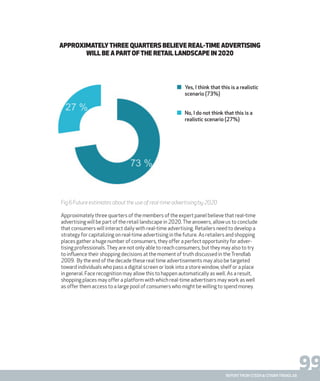
  • 127.
    It is saidthat the present is pregnant with the future. Voltaire
  • 128.
    DIGISHIFT 2020 128 Scenarios aresnapshots of the future that are challenging but still suffici- ently credible. In this section, we present a number of “what if ” scenarios illustrating what could happen if current trends are taken to an extreme without becoming too unrealistic. These scenarios focus on four trend the- mes, which are very likely to figure strongly in the future. One of the future snapshots of the Trendlab two, the Smart Mart, felt relevant this year too and has been revisited. Right before the final version of the Digishift book a top grocery retailer Casino in France opened something in this direction. The four scenarios are: 1. Multichannel 2020 2. Smart Mart 2020 3. Showroom 2020 4. Experience 2020
  • 129.
    129report from steen& strøm trendlab scenarios chapter 6 forthe future Multichannel • Showroom • Smartmart • Experience
  • 130.
    1. Multichannel 2020 2.SmartMart 2020 3. Showroom Snapshot 4. Experience Shopping Centre
  • 131.
    - justlike youprefer – keep itsimple – flagship shopping centre 2020 – experiencetogether
  • 132.
  • 133.
    133report from steen& strøm trendlab By the end of the first decade of the 21st century the media landscape was increasingly decribed as a flow. We had moved from large mass media and few channels to an ever in- creasing range of alternatives, so many that it didn’t make sense to talk about channels and swithching. Now we see this in other parts of society as well – in particular shopping. The Multichannel Marketplace makes it possible for customers to choose exactly the way, theyprefertodotheirshopping.Consumerbuyingbehaviorisgettingmoreandmorecom- plex and customers demand increased flexibility in the way they do their shopping. How they want to shop depends of the specific situation and the time available. Some happens automatically, some is chosen instantly and some is planned, shopping is now part of the constant flow of information and opportunities. Insomesituationsshoppingisanenjoyablesparetimeactivity,wherecustomersjustwant to drift though a shopping center to get inspired by all the shops and feeling the relaxing atmosphere,andatothertimesit’sjustapracticaljobtobedoneasquicklyandconvenient as possible. In all circumstances this is ever present. You don’t have to think of whether to shop, be entertained, work or be with friends it is all possible at all time. The most successful Multichannel Shopping Center of today offers exactly this flexibility as stated on its brand promise: Everything in every way … and a little more! 1
  • 134.
    DIGISHIFT 2020 134 choose betweena variety of retail channels The Multichannel Shoppingcenter combines a variety of retail channels and ways of doing shopping. It offers both the traditional retail stores, showrooms with no storage capac- ity but where the whole assortment is displayed, Pop-Up stores which constantly changes and thereby introducing new brands and products, an all-in-one E-shop covering all stores in the center and with digital facilities placed in the center, so that the E-shop not only can be accessed from at home but also when visiting the shoppingcenter. The purchasing pro- cess has become increasingly flexible, and purchasing decisions, delivery options, deals offered at the location or in time accessible constantly. As an important element the Multichannel Shoppingcenter also has a gigantic warehouse facility, so that customers easily can pick up all the purchased goods, whether bought in- stantly in the center or ordered online at home or via the mobile, and just put them in the car and drive home. As an extra service customers can also have goods purchased from external suppliers delivered to this warehouse, so that they can pick up these goods to- gether with the ones bought in the shoppingcenter. The availability of the increased range also increase the geography of the consumers. The variety of retail channels and shopping possibilities creates a unique and differenti- ated retail space and shopping environment, and customers choose themselves whether they prefer self service or full service. And should there by anything, that customers can’t buy in the center, then this can be ordered too! No physical or digital boundaries Alsoinregardstotheserviceandcommunicationthereexistnophysicalanddigitalbound- aries.The Multichannel Shoppingcenter offers all kind of services, eg. an advanced Center Appofferingallkindofinformationandcustomizedservicescustomersneedwhilevisiting the center or the E-shop, and also containing an electronic payment facility, so that every transaction can be done with the selected purchasing method, micropayment providers, telecom operator, cards or bank transfer are all handled with most portable devices.
  • 135.
    135REPORT FROM STEEN& STRØM TRENDLAB SERVICE • Center App • Self service -> Full service • Customized customer service • If we don’t have it - we get it! ... and a little more! COMMUNICATION • Branding • Online/digitalt • Relationship marketing / Social media / Direct marketing • Mobile! BRAND Everything in every way ... and a little more! SHOP-MIX • Traditional retail stores • Showrooms • Pop-Ups • E-shop • Gigantic warehouse facility FORMAT • Differentiated retail space & environement • Physical stores as well as digital shop facilites • AR-service
  • 136.
  • 137.
    137report from steen& strøm trendlab The Smart Mart was developed based on the increased lack of time and energy among many consumers. It is the efficient and practical way to get your daily shopping done. Lo- cated close to your home, you can just drive by in your car, by bus or on your bike, pick up your goods and continue home. We all feel that there are not enough hours in the day - we want to spend more time with family, on sports, hobbies and all kinds of interesting activities that adds quality to our life. The people who are using the Smart Mart today get the time that allows them to spend more time doing what they really enjoy, which can include shopping but usually not all kinds of shopping. How do I getthe most advantage of my shopping at Smart Mart? Simply order what you need online on any platform or device, such as you mobile phone. The goods will be ready for you in the assigned lane, and you just choose what time you wanttopickitup.PaymentmethodisofyourchoicebutmostaremanagedviatheInternet platform. You don’t even have to get out of your car. However, due to the attractive cus- tomer flow many retailers and manufacturers are giving good rebates on a few temporary itemsin-storetogetherwiththesmalltreatsandgiftssomanypeoplechoosetogetinside on the way home. The early days of subscription based shopping of FMCG, like foodbags and washing pow- der, as well as underwear was a starting point for innovation. Today most people have a standardsetofdailygoodsthattheybuyeveryweeklikemilkandbread.Manypeoplealso have products they buy less frequently but still regularly, like washing powder, toilet paper andsalt.Nomatterthefrequencyyoucansubscribeforyouownpersonalstandardpackof goods,withthefrequencyyouwant.Thenewdigitalenvironmentiscloselyconnectedwith the smartmart network and other shopping and leisure and business activities. There are reminderservicesforyougoodsthattellsyouforinstancethatitistimetobuytoothpaste – of course the suggested product will be your regular brand. If you feel your subscriptions are running out of variability you are offered a possibility to get randomized alternatives suggestedinparticularproductcategories,fooddishesetcbasedonpersonalprofile,spe- cial offers or popular items. You can also choose to get your car washed and cleaned and filled up with gas while you shop in our shopping center. Each store has screens where you can order what you want, and all goods will be collected automatically from all the stores and then you can pay and pick up all the goods at one pick up point in center. When your shopping is done the car is freshly cleaned and waiting for you. 2
  • 138.
    DIGISHIFT 2020 138 Makingboringthingsmorefunisaleadingprinciple.Thedumpingofrecyclingwasteishan- dled moreefficiently.Ten years ago people spent time at their houses sorting the waste by glass, paper, batteries, and old clothes and then allocating them inside the right recycling containers. Today, by using Smart Mart, you can skip the sorting part of recycling. Smart Mart can receive your recycling waste bags and sort them into the right recycling contain- ers. Club Smart Mart Most people who start using the Smart Mart also join the Club Smart Mart. Instead of poorly adapted special offers, holidays to win, exclusive VIP nights – the Club Smart Mart is the best solution for your preferences and finances. Based on the knowledge of your preferences and habits an amazing personalization of the concept has come true. Most special offers for you are for products and services that are adapted to your lifestyle and preferences. Integrity has been lost but given that its primarily the most boring part of life that is understood by the integrated digital and physical concept consumers are happy to give it away in order to improve their life. Time management has become a little bit of a status symbol, and the tools which provides the solutions a close partner.
  • 139.
    139REPORT FROM STEEN& STRØM TRENDLAB FORMAT • Digital storing • Robotservice • D.T. (Drive through) + parking • Bike lane • Pedestrians can shop on screen from the different stores.The goods will be packed automaticly and paid when departuring. BRAND • One Stop • Fast • Inexpensive • Convinient COMMUNICATION • Subscribtion • Offers • Club • On-line • Excellent signage SERVICE • Recycling station • Car cleaning • Cleansing & tailoring • Shoe repair • Bike repair • Pick up point SHOP-MIX • Groceries • Pharmacy • Take away • Kiosk • Ordering by mobile or internet
  • 140.
    DIGISHIFT 2020 140 Showroom Snapshot –flagship shopping centRE in 2020
  • 141.
    141report from steen& strøm trendlab I’m on my way to Segécés new flagship shopping center in Sweden. While it is not new, it has been rebuilt and updated with the latest technology. In recent years, all the shopping centers within the corporation, have added Segécé to their names, to harmonize with their common digital shopping center platform. The outside looks life before: a few entrances, which provide access to public transporta- tion and parking. A large grocery store with its own entrance is located on the basement floor. I use the main entrance and arrive into a large open space which resembles an am- phitheater. There are large steps on which visitors can sit or stand to watch the ongoing events. The steps also include a café as well as snacks and seating areas which allow visi- tors to eat and drink with a view of other visitors and the goings on in the shopping center. The kitchen is the theme for this month, which is clear from the open area dedicated to events. It currently includes everything from cooking, demonstrations of kitchen appli- ances,andexhibitsofdifferentkindsofkitchens.Theeventarea’scuttingedgetechnology is the most visible in the kitchen exhibits: the kitchens are not shown physically, but in ho- lographic projections. While visitors able to see three dimensional kitchens, when they try to touch them their hands go penetrate the surface! Various kitchens, including different designs, are thus shown in a small area. The open area includes a check-out, registers, and an information area at each exit, which offers the same customer service as the staff in the shopping center: customer assis- tance, gift card purchasing, ordering and returning products as well as other services and information. I was meeting the shopping center’s manager, Fatima Al-Awwal, who worked in the building prior to the reconstruction. She tells me that the stores and the products have partially dictated the themes of the current events. • As we began to plan the new center we started with the idea that there should be no permanent stores. However, that was going too far, at least in the beginning. We real- ized that the reason for visiting the shopping center would disappear unless clients could be certain that they would find what they were looking for, but would have to order the product and wait for it for a couple of days. The shopping center has to be a bit like a traditional department store: it has to offer all the products that customers might want to buy. The shopping center thus includes a number of permanent stores, to which Segécé and the retail partners refer to as anchor stores. However, the focus of their product lines may varyslightlyovertime.Duringtimeswhenthestoresmightbepartsofthatmonth’stheme, they might have increased space which allows them to provide exposure to the products within the theme. The space within the shopping center is thus flexible and part of it does not have a permanent tenant.The content varies over time. 3
  • 142.
    DIGISHIFT 2020 142 Segécé offersthe same products in all its 450 shopping centers all over Europe. There is obviously not room for all stores in the same shopping center at the same time. As a result, the company invested in an idea based on showrooms. All stores have the opportunity to show their products from periodically. • To switch the stores and their products involves an enormous logistical process. The retailers would never have agreed unless the logistics problems were solved, Fatima Al-Awwal says. Segécé organizes a number of events or themes based on the stores’ products which tour the corporation’s shopping centers throughout Europe. In addi- tion,employeesreceiveregulartrainingtoremainupdatedonallthemerchandise.The portable terminals, which the employees use within the shopping center, constitute a powerful tool. Some of the retail chains nevertheless send a key manager and their own event persons to launch new themes to ensure quality and branding. The digital fitting rooms have received the most attention. Customers try on clothes that are not physically there. The customer’s body is scanned. Then, a holographic image indi- cates the way in which the clothes fit. The program automatically selects the right size based on which the customer can try a smaller or larger size. • While this technology was originally developed for the retail industry, it is now a way for us to be competitive regarding the range of products that we offer. In addition, we try to connect digital and physical retail. Joining our customer club provides access to the digital shopper here as well as at home. It seems like you have thought about everything. Being here and trying all the merchandise is very exciting and fun. However, as the product you are looking at can be purchased digi- tally, how do you make money? • You hit your head on the nail: establishing the business model was by far the great- est challenge. The customers can’t see it, but it is crucial for our decision to invest in a new type of shopping center. We used to charge rent based on sales. That doesn’t work when customers can buy products anywhere, but also want actually to touch and feeltheproductphysically. Wesimplyhadtoimitatethedigitalmarketandchargethe traffic that we generate. We use digital tags for all our products, which makes it easy to know when somebody has touched the product or clicked on a screen. Our business model thus works exactly as digital retail. On the way home, I reflected over the way in which shopping has become much easier and more fun over the last few years. Digital technology has paved the way for large changes in the physical world as well.
  • 143.
    143REPORT FROM STEEN& STRØM TRENDLAB FORMAT • More open spaces • flexible spaces • Social meeting areas SHOP-MIX Access to the concepts of all the European stores. • Trying on apparel digitally; it is not physically present • Opportunity to order pick up, and return • Periodic events with differ- ent themes such as televi- sion, children etc. • -> Entertainment BRAND Will our shopping centers have the same names/ brands in Scandi- navia or Europe or will the names at each center remain different? SERVICE • Employees move around the stores, are available, demonstrate and order merchandise • Products are demonstrated both physically and as holographic images • Digital personal shoppers COMMUNICATION • Themes and events affect the center’s communication and the events which are based on different groups of merchandise • Connect with customers who like the shopping center’s customer club
  • 144.
    DIGISHIFT 2020 144 The ExperienceShopping Centre – where people experiencetogether
  • 145.
    145report from steen& strøm trendlab This is the centre where we want to spend our time – a lot of time. And we want to spend it together with others. It is the centre we look forward to visit, we enjoy the visit and we can`t wait to tell friends and family about it. Already today the experience economy grow at a faster pace the consumption of goods. In the future the shopping centres will have to compete more on the consumer’s time. If we win their time, they will also spend their money in this centre. When a centre of today should adapt to this, it will have to change on most areas. In this change the use of digital channels will be a major factor. What people experience together would be most important in the Experience Shopping Centre and technology will supporting this is several ways. It will itself provide entertain- ing and experiences. It will be the memory of the centre enabling it to give tailored per- sonal experiences, offers and communicate it to each individual visitor. The design of the shopping centre will be an experience in itself. The design of the centre will be flexible so the centre can change throughout the day and the week. The flexibility will also allow popup shops and activity concepts staying in the centre for different time- frames. Before we enter our car or bicycle will be taken care of by automated valet parking at the entrance.Wearewelcomedbyaconcierge,whowillgiveuspersonalizedoffersandrecom- mendations. Those recommendations are based on our preferences and history. He will giveusourpersonaldigitalshopper,whowillguideusthroughtoday’sspecialactivitiesand give us advice on what to buy. Based on things we bought or did before. In the Experience Shopping centre we will have a wide array of shops and activities to choose from. The staff is all expert in their fields. They give advice on what to buy and how or where to use it.With our personal profiles stored they can give precise tips regarding style, size and use. The activities will appeal to us in different ways. Some will be merely entertainment, as concerts or cinemas; some will be involving like cooking or climbing courses and training. The restaurants are facilitates for meals and interaction. There will be offers well suited for me. Either I go with friends, colleagues or with my family. At the end of my visit to the experience Shopping Center I will check out and collect the things I bought. At the outside my car, or bike, will arrive, clean and shining. At home again I receive a couple of photos as a memory, tips for my next visit and receipts for my book- keeping.   4
  • 146.
    DIGISHIFT 2020 146 FORMAT • Moreflexible format; both in shop area and in public areas • Public areas will grow and will be used for a range of different purposes • Average store size will be smaller • Use of scenography and lighting to change atmosphere and pace throughout the day SERVICE • “Check in” • Personal and individualized service for my needs delivered by people and made possible with the use of technology • Competence and flexibility • ITand personal conact hand in hand SHOP-MIX • Wide offering • Showrooms • Activities for experience and participation • A mix of physical + virtual shops • A mix of fixed + temporary shops • Social meeting spaces and activities • Less routine, more WOW! • Competence and cooperation COMMUNICATION • The Shopping centre turns into a cloud itself • Real one-to-one communication • Context based offers and communication • Deeper insights in consumer needs and behaviour • Personal media BRAND • Spend time and experience together • Use technology in enchance and create real life meetings and common experiences • Where people want to spend their time with the family and friends
  • 147.
    We become whatwe behold. We shape our tools and then our tools shape us. Marshall McLuhan
  • 148.
    DIGISHIFT 2020 148 Kairos FutureAB Kairos Future helps companies and organisations understand and shape the future through: • Research-based foresight • Future-based business development and innovation • Strategy enforcement We combine a think tank’s and research company’s ability to generate new insights and ideas with a consulting agency’s focus on what works in practice. Our work is based on our own skills development along with advanced strategy development, change processes and analysis methods designed in-house. We often work in close collaboration with our clients. For more information, visit our website www.kairosfuture.com or contact us at: Kairos Future Box 804 (Street address:Vasagatan 40) 101 36 Stockholm, Sweden Tel: +46-(0)8-545 225 00 Fax: +46-(0)8-545 225 01 Email: info@kairosfuture.com Website: www.kairosfuture.com Participating organisations
  • 149.
    149report from steen& strøm trendlab Steen & Strøm We create future meeting places Steen & Strøm is devoted to future development. Each year we invest billions in refurbishing our shopping centers and in creating powerful new shopping destinations. We enrich modern shopping Scandinavia’s leading shopping center company. • 42 shopping centers in Norway, Sweden and Denmark • 160 million visitors annually • 3 000 tenants Steen & Strøm AS PO Box 1593Vika 0118 Oslo, Norway Tel: +47 23 21 35 00 Fax: +47 23 21 35 80 Email: firmapost@steenstrom.com Website: www.steenstrom.com
  • 150.