1
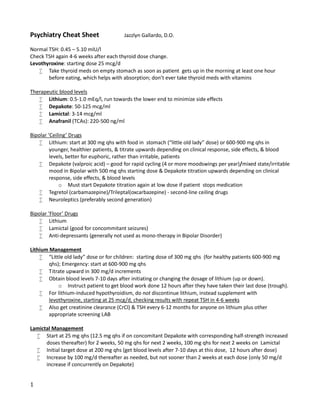
Psychiatry Cheat Sheet Jazzlyn Gallardo, D.O.
Normal TSH: 0.45 – 5.10 mIU/l
Check TSH again 4-6 weeks after each thyroid dose change.
Levothyroxine: starting dose 25 mcg/d
 Take thyroid meds on empty stomach as soon as patient gets up in the morning at least one hour
before eating, which helps with absorption; don’t ever take thyroid meds with vitamins
Therapeutic blood levels
 Lithium: 0.5-1.0 mEq/l, run towards the lower end to minimize side effects
 Depakote: 50-125 mcg/ml
 Lamictal: 3-14 mcg/ml
 Anafranil (TCAs): 220-500 ng/ml
Bipolar ‘Ceiling’ Drugs
 Lithium: start at 300 mg qhs with food in stomach (“little old lady” dose) or 600-900 mg qhs in
younger, healthier patients, & titrate upwards depending on clinical response, side effects, & blood
levels, better for euphoric, rather than irritable, patients
 Depakote (valproic acid) – good for rapid cycling (4 or more moodswings per year)/mixed state/irritable
mood in Bipolar with 500 mg qhs starting dose & Depakote titration upwards depending on clinical
response, side effects, & blood levels
o Must start Depakote titration again at low dose if patient stops medication
 Tegretol (carbamazepine)/Trileptal(oxcarbazepine) - second-line ceiling drugs
 Neuroleptics (preferably second generation)
Bipolar ‘Floor’ Drugs
 Lithium
 Lamictal (good for concommitant seizures)
 Anti-depressants (generally not used as mono-therapy in Bipolar Disorder)
Lithium Management
 “Little old lady” dose or for children: starting dose of 300 mg qhs (for healthy patients 600-900 mg
qhs); Emergency: start at 600-900 mg qhs
 Titrate upward in 300 mg/d increments
 Obtain blood levels 7-10 days after initiating or changing the dosage of lithium (up or down).
o Instruct patient to get blood work done 12 hours after they have taken their last dose (trough).
 For lithium-induced hypothyroidism, do not discontinue lithium, instead supplement with
levothyroxine, starting at 25 mcg/d, checking results with repeat TSH in 4-6 weeks
 Also get creatinine clearance (CrCl) & TSH every 6-12 months for anyone on lithium plus other
appropriate screening LAB
Lamictal Management
 Start at 25 mg qhs (12.5 mg qhs if on concomitant Depakote with corresponding half-strength increased
doses thereafter) for 2 weeks, 50 mg qhs for next 2 weeks, 100 mg qhs for next 2 weeks on Lamictal
 Initial target dose at 200 mg qhs (get blood levels after 7-10 days at this dose, 12 hours after dose)
 Increase by 100 mg/d thereafter as needed, but not sooner than 2 weeks at each dose (only 50 mg/d
increase if concurrently on Depakote)
2
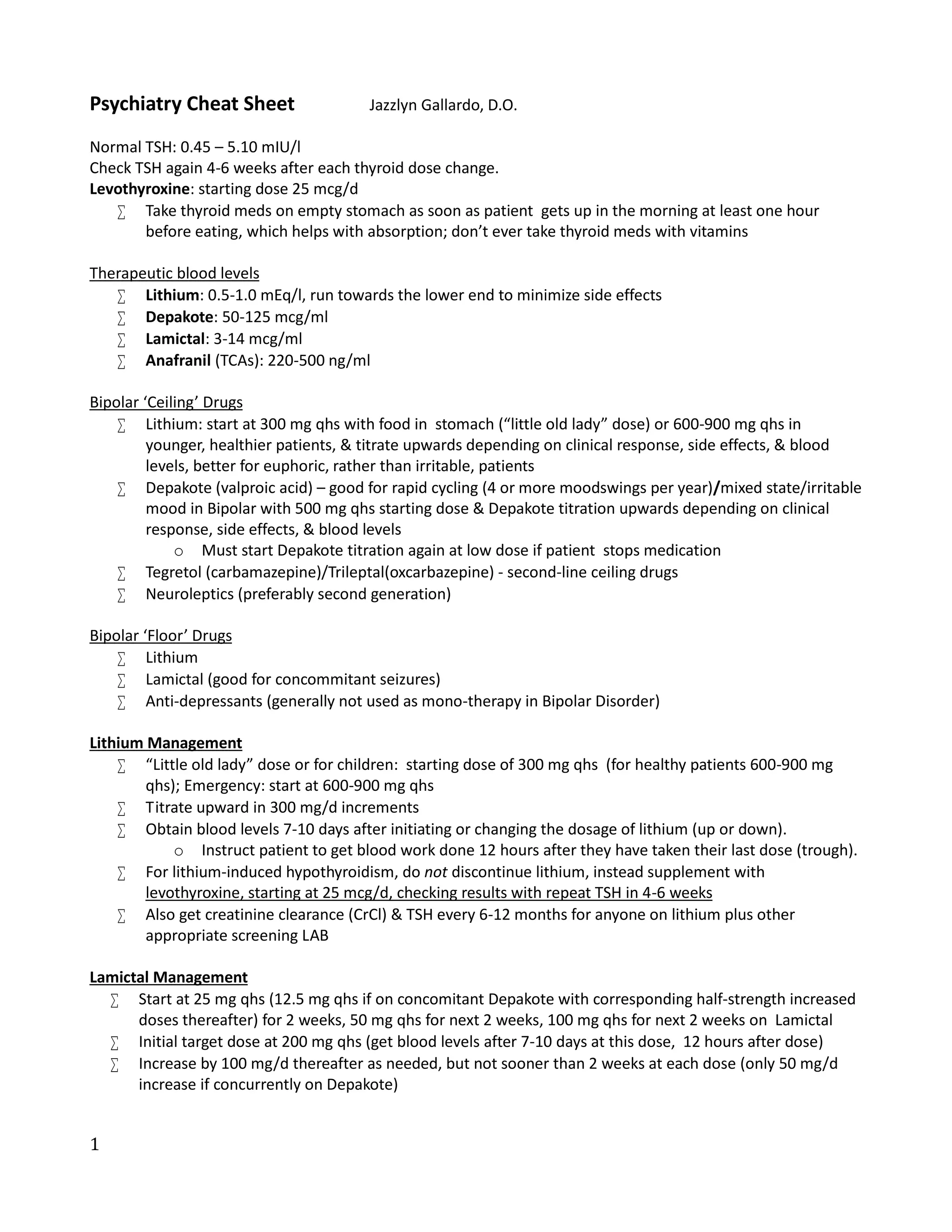
o To allow the body to get used to the drug and to avoid Stevens-Johnson Syndrome (life-
threatening rash)
o Must restart original titration protocol at 25 mg qhs if they miss Lamictal more than 3 days in a
row
 Side effects: tremor, dizziness, word-finding problems, rash
Medications that need Tapering (basically everything except LiCO3)
Medication Groups
Atypical Antipsychotics/Second-generation neuroleptics
 Abilify (aripiprazole)
 Geodon (ziprasidone)
 Seroquel (quetiapine) – start 25 mg po qhs then increase by 25-100 mg/day
 Zyprexa (olanzapine) – start 5 mg po qhs, may adjust by 5 mg/day prn
o if still cannot sleep within 3 hours of first dose, add another 5 mg
o *Seroquel and Zyprexa have the most anti-histaminic properties, and are therefore weight
gainers
OTHERS:
 Risperdal (risperidone)
 Latuda (lurasidone)
 Clozaril (clozapine)

 Serotonin-Norepinephrine Re-Uptake Inhibitors (SNRIs) for depression, OCD, panic disorder, anxiety,
chronic pain
 Effexor (venlafaxine) - cheaper than Pristiq; start at 25 mg bid (take after breakfast & after lunch, may
cause upset stomach)
 Cymbalta (duloxetine) - still more expensive than Effexor; starting dose 30-60 mg; may cause upset
stomach
 Pristiq (desvenlafaxine) - first active metabolite of venlafaxine, just more expensive
 Fetzima (levomilnacipran) – as expensive as Pristiq
 _
Selective Serotonin Re-Uptake Inhibitor (SSRIs): for depression, OCD, panic disorder, anxiety
 Prozac (fluoxetine) – preferred; long half-life (if patient misses dose, won’t go into discontinuation
syndrome); relatively weight neutral; associated with decreased libido (or other sexual dysfunction, like
delayed orgasm)
o start at 10-20 mg po qam, take with food in stomach; can go up in 10-20 mg/d increments not
more than every 2 weeks
 Zoloft (sertraline)
 Luvox (fluvoxamine)
 Lexapro (escitalopram) – not used as much due to potential QTc prolongation
 Celexa (citalopram) – not used as much due to potential QTc prolongation
 Paxil (paroxetine) – may cause severe discontinuation syndrome, weight gain

 ____________________________________________________________________________________
 Remeron (Mirtazapine) – helpful for anxious depression with insomnia, starting dose: 30 mg qhs
 α2 Antagonist (increases release of NE and serotonin) and potent 5-HT2 and 5-HT3 receptor antagonist
 sedation, weight gain
3

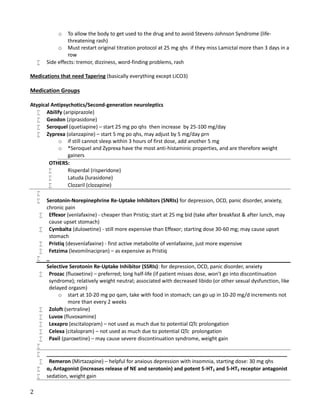
 Tri-Cyclic Antidepressants (potentially dangerous/toxic---monitor with blood levels): tertiary TCA’s
block reuptake of NE and serotonin like an SNRI; treat major depression, fibromyalgia, anxiety disorders,
enuresis, *Check patient’s pupil size for mydriasis/miosis to get a sense of their anticholinergic tone (larger
pupils with greater anti-cholinergic effect). * Can precipitate manic episodes in Bipolars
Anafranil (clomipramine) – for OCD; increase by 25 mg/d increments not more than every 2 weeks
 Elavil (amitriptyline) – tertiary TCA
 Tofranil (imipramine) – for enuresis
 ____________________________________________________________________________________
 MAO Inhibitors: increase levels of NE, serotonin, dopamine
 Parnate (tranylcypromine) – has amphetamine-like effects; used if patient has failed on multiple, other
anti-depressants
 Nardil (phenelzine) – for anxiety/depression used if patient has failed on multiple, other anti-
depressants
* Hypertensive crisis with tyramine ingestion (in many foods, such as wine and cheese and aged
protein products) and decongestants like Sudafed
 Contraindicated with SSRIs or other antidepressants.
 * Can precipitate manic episodes in Bipolars


 Benzodiazepines
 Xanax (alprazolam)
 Klonopin (clonazepam)
 Others include Ativan, Valium, Dalmane, Librium, Halcion, Serax



 CNS Stimulant
 Concerta (methylphenidate)
 Others include Ritalin, Dexedrine, Vyvanse
 ____________________________________________________________________________________
 Strattera (atomoxetine) (NE re-uptake inhibitor, like Wellbutrin), both can be used as alternative
treatments in ADHD/ADD


 Beta Blockers
 Inderol (propranolol) – reduce drug-induced tremor; start at 10 mg bid/tid; titrate up in 10 mg
increments, contraindications include asthma & diabetes
 Others include atenolol, metoprolol

 Sleeping Aids
 Melatonin - mild; good starting point; start with 3 mg one hour before bed; can be an adjunct to
Remeron or Seroquel
 trazadone
 Antihistamines
 Sedating neuroleptics: Zyprexa, Seroquel
4
 Sedating antidepressants: Remeron
 Tertiary tricyclics (potentially dangerous/toxic)

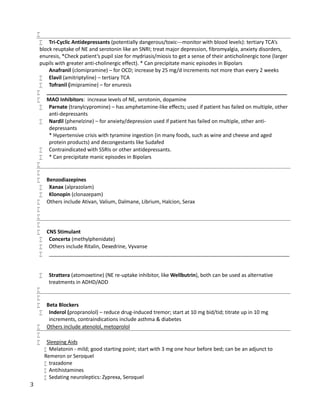
 Weight gain: Seroquel, Depakote, mirtazapine, Paxil
 Weight neutral: Prozac, Lamictal, Tegretol


 Cogentin (benztropine) – anticholinergic remedy for extrapyramidal side effects from neuroleptics; H1
antagonist
 start at 1 mg bid, titrating upwards to 2 mg bid

 Terminology
 Mixed state: feeling depressed yet manic “high” symptoms at the same time
Reduced by Depakote/ Atypical Antipsychotics (Second-generation neuroleptics)
o
 Pharmacokinetic drug-drug interaction: one drug affects the blood level of the second drug
o Example: Depakote and Lamictal
 Pharmacodynamic drug-drug interaction: two drugs accomplish the same action or side effect
o Cross-tolerance: one can be used to withdraw another
 Recurrence: new episode of symptoms after having been taken off the medicine for more than 6
months
 Relapse: old/original episode coming back less than 6 months after being taken off the medication
 Response: 50% improvement in symptoms
 Remission: PHQ-9 score of 4 or less (minimal to no depression or anxiety)
 Serotonin syndrome: occurs with any drug that increases serotonin (e.g., MAO inhibitors, SSRI’s, SNRI’s)
– hyperthermia, myoclonus, cardiovascular collapse, flushing, diarrhea (serotonin receptors activated in
GI tract), seizures.

 Pearls
 Anxiety and panic disorders generally respond to serotonergic drugs not norepinephrine ones.
 Anti-convulsants/SNRI’s have anti-pain properties (especially chronic pain).
 Generic drugs may be "porcelain clangers" (go through patient unabsorbed)
 “The dose that got them well, keeps them well.” You typically don’t reduce the dose if they’re doing
well.

 Zyprexa and Seroquel: more sedation
 Abilify, Geodon: less weight gain, more likely to cause EPS, less sedation

 Clozaril/clozapine must get CBCs each week; terrible weight gain; seizures; gold standard for refractory
psychosis with potentially less Tardive Dyskinesia (TD).

 Anticholinergic effects in tertiary TCAs
 Blind as a bat (blurred vision)
 Dry as a bone (dry mouth)
o Remedy: tart substances; sugarless candy/gum or water with unsweetened lemon juice
 Red as a beet (flushing)
 Mad as a hatter (confusion)
 Hot as a hare (hyperthermia)
5
 Can’t see (vision changes)
 Can’t pee (urinary retention)
 Can’t sh*t (constipation)

 Toxicities
 Typical Antipsychotics/Neuroleptics
o Highly lipid soluble and stored in body fat; thus, very slow to be removed from body
o Extrapyramidal system (EPS) side effects
 4 hours: acute dystonia – muscle spasm, stiffness, oculogyric crisis
 4 days: akinesia – parkinsonian symptoms
 4 weeks: akathisia (restlessness)
 4 months: tardive dyskinesia – stereotypic oral-facial movements and twisting/tapping
of the lower extremities due to long-term antipsychotic use; often irreversible
o Endocrine side effects (e.g., dopamine receptor antagonism  hyperprolactinemia 
galactorrhea)
o Side effects arising from blocking receptors
 Muscarinic – dry mouth, constipation
 Alpha adrenergic – hypotension
 Histamine – sedation
 Atypical antipsychotics
o Fewer extrapyramidal/TD side effects than traditional antipsychotics
o olanzapine/clozapine/quetiapine - significant weight gain (insulin resistance and
hyperlipidemia)
o Clozaril/clozapine – agranulocytosis (requires weekly WBC monitoring)
o Geodon/ziprasidone – QTc prolongation
o Seroquel/quetiapine – cataracts
o Risperidal/risperidone – highest risk of all atypicals for developing EPS and hyperprolactinemia

Psychiatry_Cheat_Sheet.pdf

  • 1.
    1 Psychiatry Cheat SheetJazzlyn Gallardo, D.O. Normal TSH: 0.45 – 5.10 mIU/l Check TSH again 4-6 weeks after each thyroid dose change. Levothyroxine: starting dose 25 mcg/d  Take thyroid meds on empty stomach as soon as patient gets up in the morning at least one hour before eating, which helps with absorption; don’t ever take thyroid meds with vitamins Therapeutic blood levels  Lithium: 0.5-1.0 mEq/l, run towards the lower end to minimize side effects  Depakote: 50-125 mcg/ml  Lamictal: 3-14 mcg/ml  Anafranil (TCAs): 220-500 ng/ml Bipolar ‘Ceiling’ Drugs  Lithium: start at 300 mg qhs with food in stomach (“little old lady” dose) or 600-900 mg qhs in younger, healthier patients, & titrate upwards depending on clinical response, side effects, & blood levels, better for euphoric, rather than irritable, patients  Depakote (valproic acid) – good for rapid cycling (4 or more moodswings per year)/mixed state/irritable mood in Bipolar with 500 mg qhs starting dose & Depakote titration upwards depending on clinical response, side effects, & blood levels o Must start Depakote titration again at low dose if patient stops medication  Tegretol (carbamazepine)/Trileptal(oxcarbazepine) - second-line ceiling drugs  Neuroleptics (preferably second generation) Bipolar ‘Floor’ Drugs  Lithium  Lamictal (good for concommitant seizures)  Anti-depressants (generally not used as mono-therapy in Bipolar Disorder) Lithium Management  “Little old lady” dose or for children: starting dose of 300 mg qhs (for healthy patients 600-900 mg qhs); Emergency: start at 600-900 mg qhs  Titrate upward in 300 mg/d increments  Obtain blood levels 7-10 days after initiating or changing the dosage of lithium (up or down). o Instruct patient to get blood work done 12 hours after they have taken their last dose (trough).  For lithium-induced hypothyroidism, do not discontinue lithium, instead supplement with levothyroxine, starting at 25 mcg/d, checking results with repeat TSH in 4-6 weeks  Also get creatinine clearance (CrCl) & TSH every 6-12 months for anyone on lithium plus other appropriate screening LAB Lamictal Management  Start at 25 mg qhs (12.5 mg qhs if on concomitant Depakote with corresponding half-strength increased doses thereafter) for 2 weeks, 50 mg qhs for next 2 weeks, 100 mg qhs for next 2 weeks on Lamictal  Initial target dose at 200 mg qhs (get blood levels after 7-10 days at this dose, 12 hours after dose)  Increase by 100 mg/d thereafter as needed, but not sooner than 2 weeks at each dose (only 50 mg/d increase if concurrently on Depakote)
  • 2.
    2 o To allowthe body to get used to the drug and to avoid Stevens-Johnson Syndrome (life- threatening rash) o Must restart original titration protocol at 25 mg qhs if they miss Lamictal more than 3 days in a row  Side effects: tremor, dizziness, word-finding problems, rash Medications that need Tapering (basically everything except LiCO3) Medication Groups Atypical Antipsychotics/Second-generation neuroleptics  Abilify (aripiprazole)  Geodon (ziprasidone)  Seroquel (quetiapine) – start 25 mg po qhs then increase by 25-100 mg/day  Zyprexa (olanzapine) – start 5 mg po qhs, may adjust by 5 mg/day prn o if still cannot sleep within 3 hours of first dose, add another 5 mg o *Seroquel and Zyprexa have the most anti-histaminic properties, and are therefore weight gainers OTHERS:  Risperdal (risperidone)  Latuda (lurasidone)  Clozaril (clozapine)   Serotonin-Norepinephrine Re-Uptake Inhibitors (SNRIs) for depression, OCD, panic disorder, anxiety, chronic pain  Effexor (venlafaxine) - cheaper than Pristiq; start at 25 mg bid (take after breakfast & after lunch, may cause upset stomach)  Cymbalta (duloxetine) - still more expensive than Effexor; starting dose 30-60 mg; may cause upset stomach  Pristiq (desvenlafaxine) - first active metabolite of venlafaxine, just more expensive  Fetzima (levomilnacipran) – as expensive as Pristiq  _ Selective Serotonin Re-Uptake Inhibitor (SSRIs): for depression, OCD, panic disorder, anxiety  Prozac (fluoxetine) – preferred; long half-life (if patient misses dose, won’t go into discontinuation syndrome); relatively weight neutral; associated with decreased libido (or other sexual dysfunction, like delayed orgasm) o start at 10-20 mg po qam, take with food in stomach; can go up in 10-20 mg/d increments not more than every 2 weeks  Zoloft (sertraline)  Luvox (fluvoxamine)  Lexapro (escitalopram) – not used as much due to potential QTc prolongation  Celexa (citalopram) – not used as much due to potential QTc prolongation  Paxil (paroxetine) – may cause severe discontinuation syndrome, weight gain   ____________________________________________________________________________________  Remeron (Mirtazapine) – helpful for anxious depression with insomnia, starting dose: 30 mg qhs  α2 Antagonist (increases release of NE and serotonin) and potent 5-HT2 and 5-HT3 receptor antagonist  sedation, weight gain
  • 3.
    3   Tri-Cyclic Antidepressants(potentially dangerous/toxic---monitor with blood levels): tertiary TCA’s block reuptake of NE and serotonin like an SNRI; treat major depression, fibromyalgia, anxiety disorders, enuresis, *Check patient’s pupil size for mydriasis/miosis to get a sense of their anticholinergic tone (larger pupils with greater anti-cholinergic effect). * Can precipitate manic episodes in Bipolars Anafranil (clomipramine) – for OCD; increase by 25 mg/d increments not more than every 2 weeks  Elavil (amitriptyline) – tertiary TCA  Tofranil (imipramine) – for enuresis  ____________________________________________________________________________________  MAO Inhibitors: increase levels of NE, serotonin, dopamine  Parnate (tranylcypromine) – has amphetamine-like effects; used if patient has failed on multiple, other anti-depressants  Nardil (phenelzine) – for anxiety/depression used if patient has failed on multiple, other anti- depressants * Hypertensive crisis with tyramine ingestion (in many foods, such as wine and cheese and aged protein products) and decongestants like Sudafed  Contraindicated with SSRIs or other antidepressants.  * Can precipitate manic episodes in Bipolars    Benzodiazepines  Xanax (alprazolam)  Klonopin (clonazepam)  Others include Ativan, Valium, Dalmane, Librium, Halcion, Serax     CNS Stimulant  Concerta (methylphenidate)  Others include Ritalin, Dexedrine, Vyvanse  ____________________________________________________________________________________  Strattera (atomoxetine) (NE re-uptake inhibitor, like Wellbutrin), both can be used as alternative treatments in ADHD/ADD    Beta Blockers  Inderol (propranolol) – reduce drug-induced tremor; start at 10 mg bid/tid; titrate up in 10 mg increments, contraindications include asthma & diabetes  Others include atenolol, metoprolol   Sleeping Aids  Melatonin - mild; good starting point; start with 3 mg one hour before bed; can be an adjunct to Remeron or Seroquel  trazadone  Antihistamines  Sedating neuroleptics: Zyprexa, Seroquel
  • 4.
    4  Sedating antidepressants:Remeron  Tertiary tricyclics (potentially dangerous/toxic)   Weight gain: Seroquel, Depakote, mirtazapine, Paxil  Weight neutral: Prozac, Lamictal, Tegretol    Cogentin (benztropine) – anticholinergic remedy for extrapyramidal side effects from neuroleptics; H1 antagonist  start at 1 mg bid, titrating upwards to 2 mg bid   Terminology  Mixed state: feeling depressed yet manic “high” symptoms at the same time Reduced by Depakote/ Atypical Antipsychotics (Second-generation neuroleptics) o  Pharmacokinetic drug-drug interaction: one drug affects the blood level of the second drug o Example: Depakote and Lamictal  Pharmacodynamic drug-drug interaction: two drugs accomplish the same action or side effect o Cross-tolerance: one can be used to withdraw another  Recurrence: new episode of symptoms after having been taken off the medicine for more than 6 months  Relapse: old/original episode coming back less than 6 months after being taken off the medication  Response: 50% improvement in symptoms  Remission: PHQ-9 score of 4 or less (minimal to no depression or anxiety)  Serotonin syndrome: occurs with any drug that increases serotonin (e.g., MAO inhibitors, SSRI’s, SNRI’s) – hyperthermia, myoclonus, cardiovascular collapse, flushing, diarrhea (serotonin receptors activated in GI tract), seizures.   Pearls  Anxiety and panic disorders generally respond to serotonergic drugs not norepinephrine ones.  Anti-convulsants/SNRI’s have anti-pain properties (especially chronic pain).  Generic drugs may be "porcelain clangers" (go through patient unabsorbed)  “The dose that got them well, keeps them well.” You typically don’t reduce the dose if they’re doing well.   Zyprexa and Seroquel: more sedation  Abilify, Geodon: less weight gain, more likely to cause EPS, less sedation   Clozaril/clozapine must get CBCs each week; terrible weight gain; seizures; gold standard for refractory psychosis with potentially less Tardive Dyskinesia (TD).   Anticholinergic effects in tertiary TCAs  Blind as a bat (blurred vision)  Dry as a bone (dry mouth) o Remedy: tart substances; sugarless candy/gum or water with unsweetened lemon juice  Red as a beet (flushing)  Mad as a hatter (confusion)  Hot as a hare (hyperthermia)
  • 5.
    5  Can’t see(vision changes)  Can’t pee (urinary retention)  Can’t sh*t (constipation)   Toxicities  Typical Antipsychotics/Neuroleptics o Highly lipid soluble and stored in body fat; thus, very slow to be removed from body o Extrapyramidal system (EPS) side effects  4 hours: acute dystonia – muscle spasm, stiffness, oculogyric crisis  4 days: akinesia – parkinsonian symptoms  4 weeks: akathisia (restlessness)  4 months: tardive dyskinesia – stereotypic oral-facial movements and twisting/tapping of the lower extremities due to long-term antipsychotic use; often irreversible o Endocrine side effects (e.g., dopamine receptor antagonism  hyperprolactinemia  galactorrhea) o Side effects arising from blocking receptors  Muscarinic – dry mouth, constipation  Alpha adrenergic – hypotension  Histamine – sedation  Atypical antipsychotics o Fewer extrapyramidal/TD side effects than traditional antipsychotics o olanzapine/clozapine/quetiapine - significant weight gain (insulin resistance and hyperlipidemia) o Clozaril/clozapine – agranulocytosis (requires weekly WBC monitoring) o Geodon/ziprasidone – QTc prolongation o Seroquel/quetiapine – cataracts o Risperidal/risperidone – highest risk of all atypicals for developing EPS and hyperprolactinemia