

Your Cloud. 
Your Business. 
Top 10 Reasons to Learn AngularJS 
Jeremy Likness 
Principal Architect 
@JeremyLikness
What is AngularJS? 
• https://www.angularjs.org/ 
• Self-proclaimed super-heroic JavaScript framework that teaches 
HTML5 new tricks 
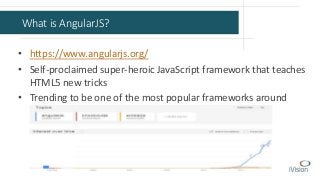
• Trending to be one of the most popular frameworks around
1. Got XAML? Come to Angular! 
• AngularJS is declarative (like XAML) 
• IValueConverter = Angular’s Filter 
• Control = Angular’s Directive 
• AngularJS Supports Two-Way Binding 
• True Design/Developer Separation
2. Less Ritual and Ceremony 
• This is an entire self-contained AngularJS app that echoes your input 
using data-binding: 
<script 
src="http://code.angularjs.org/1.2.9/angular.js"></script> 
<div ng-app><input type="text" ng-model=" 
txt"/><span>{{txt}}</span></div> 
• Here’s the proof: http://jsfiddle.net/jeremylikness/BzmfT/ 
• Dirty-tracking means less ceremony and ritual in your setup 
• One Google developer rewrote 6 months, 17,000 lines of code in 3 
weeks and shrank it down to 1,500 lines of code
3. Dependency Injection 
• Dependency Injection is provided with Angular “out of the box” 
• Includes mock objects for things like web service (HTTP) calls for 
true, easy-to-write unit tests 
• Learn more here: 
http://csharperimage.jeremylikness.com/2014/06/dependency-injection- 
explained-via.html 
and here: 
http://csharperimage.jeremylikness.com/2014/08/angularjs-lifetime- 
management-lazy.html
4. Declarative UI 
• HTML is declarative 
• Original goal of AngularJS was to allow non-developers to be 
able to set up filters, tags, and other functionality 
• Keeps presentation logic declarative and separate from the 
imperative business logic 
• This approach reduces side effects 
• Enables a cleaner developer/designer workflow
5. ‘DD … Test- and Behavior-Driven Dev 
• AngularJS has its own test suite 
• Ready to test out of the box 
• Plays well with popular frameworks like QUnit and Jasmine 
• Has its own testing framework (Protractor) 
• Data-binding makes it easier to test presentation logic independent of 
the UI/view 
• Everything is testable, including filters and directives (“controls”) 
• See tests for a 6502 emulator written in AngularJS: 
http://apps.jeremylikness.com/apps/t6502/
6. Massively Parallel Development 
• Many people complain about JavaScript in the enterprise 
because it’s not scalable and being dynamic makes it difficult to 
manage 
• Independent of AngularJS, solutions like CoffeeScript and 
TypeScript can help 
• With AngularJS the modular approach makes it really easy to 
architect the system to allow massive parallel development 
• Personally worked on project with 25+ globally distributed 
developers working on over 80,000 lines of client code
7. Designer/Developer Workflow 
• Don’t just scale within development. Scale across teams! 
• HTML and CSS hold the design for the app. 
• The app is declarative so designers don’t need to learn 
JavaScript to modify the design. 
• Data-binding provides a “design contract” – if you know you are 
working with data elements you can build functionality before 
the design is even available or ready without worrying about 
significant refactoring or rework.
8. Controls (Directives) 
• Web Components are part of ECMAScript 6 “Harmony” but not 
yet “current” for browsers 
• Polymer from Google is also a forward-looking framework 
• Directives in AngularJS are available right now 
• Have a special way to handle selection boxes, masked input, or 
other logic? Contain it in a control to reuse across modules nad 
projects. 
• Directives are testable, can be worked on in parallel, extend the 
UI declaratively and participate in dependency injection
9. State 
• HTTP is a stateless protocol 
• ASP.NET WebForms hide state using “view state” etc. 
• MVC goes “back to the basics” but some people find state 
management to be a challenge 
• Single Page Applications (SPA) address this 
• AngularJS supports SPA, HTTP, and AJAX concepts out of the 
box. Interact with services as a state of a running app and don’t 
worry about cookies or long URLs
10. Single Page Apps (SPA)! 
• Yeah, I said it 
• Not required for AngularJS but what it is best known for 
• ngRoute gives routing out of the box 
• ngView gives you a placeholder 
• ui-router gives even more control with nested views and state 
management 
• Full support for asynchronous loading of routes and resolution 
of asynchronous calls before rendering your templates
Conclusion 
• Read the full article: 
http://csharperimage.jeremylikness.com/2013/09/10-reasons-web- 
developers-should-learn.html 
• These points are based on real-world experience using 
AngularJS on large enterprise apps 
• Watch the full course to master AngularJS here: 
http://bit.ly/masterang 
• AngularJS and TypeScript are better together!
Questions? 
More Angular Projects and Examples: 
https://www.github.com/jeremylikness 
Email me to learn more: 
jlikness@ivision.com 
Jeremy Likness, Principal Architect @JeremyLikness

The Top 10 Reasons Web Developers Should Learn Angular

  • 1.
    Your Cloud. YourBusiness. Top 10 Reasons to Learn AngularJS Jeremy Likness Principal Architect @JeremyLikness
  • 2.
    What is AngularJS? • https://www.angularjs.org/ • Self-proclaimed super-heroic JavaScript framework that teaches HTML5 new tricks • Trending to be one of the most popular frameworks around
  • 3.
    1. Got XAML?Come to Angular! • AngularJS is declarative (like XAML) • IValueConverter = Angular’s Filter • Control = Angular’s Directive • AngularJS Supports Two-Way Binding • True Design/Developer Separation
  • 4.
    2. Less Ritualand Ceremony • This is an entire self-contained AngularJS app that echoes your input using data-binding: <script src="http://code.angularjs.org/1.2.9/angular.js"></script> <div ng-app><input type="text" ng-model=" txt"/><span>{{txt}}</span></div> • Here’s the proof: http://jsfiddle.net/jeremylikness/BzmfT/ • Dirty-tracking means less ceremony and ritual in your setup • One Google developer rewrote 6 months, 17,000 lines of code in 3 weeks and shrank it down to 1,500 lines of code
  • 5.
    3. Dependency Injection • Dependency Injection is provided with Angular “out of the box” • Includes mock objects for things like web service (HTTP) calls for true, easy-to-write unit tests • Learn more here: http://csharperimage.jeremylikness.com/2014/06/dependency-injection- explained-via.html and here: http://csharperimage.jeremylikness.com/2014/08/angularjs-lifetime- management-lazy.html
  • 6.
    4. Declarative UI • HTML is declarative • Original goal of AngularJS was to allow non-developers to be able to set up filters, tags, and other functionality • Keeps presentation logic declarative and separate from the imperative business logic • This approach reduces side effects • Enables a cleaner developer/designer workflow
  • 7.
    5. ‘DD …Test- and Behavior-Driven Dev • AngularJS has its own test suite • Ready to test out of the box • Plays well with popular frameworks like QUnit and Jasmine • Has its own testing framework (Protractor) • Data-binding makes it easier to test presentation logic independent of the UI/view • Everything is testable, including filters and directives (“controls”) • See tests for a 6502 emulator written in AngularJS: http://apps.jeremylikness.com/apps/t6502/
  • 8.
    6. Massively ParallelDevelopment • Many people complain about JavaScript in the enterprise because it’s not scalable and being dynamic makes it difficult to manage • Independent of AngularJS, solutions like CoffeeScript and TypeScript can help • With AngularJS the modular approach makes it really easy to architect the system to allow massive parallel development • Personally worked on project with 25+ globally distributed developers working on over 80,000 lines of client code
  • 9.
    7. Designer/Developer Workflow • Don’t just scale within development. Scale across teams! • HTML and CSS hold the design for the app. • The app is declarative so designers don’t need to learn JavaScript to modify the design. • Data-binding provides a “design contract” – if you know you are working with data elements you can build functionality before the design is even available or ready without worrying about significant refactoring or rework.
  • 10.
    8. Controls (Directives) • Web Components are part of ECMAScript 6 “Harmony” but not yet “current” for browsers • Polymer from Google is also a forward-looking framework • Directives in AngularJS are available right now • Have a special way to handle selection boxes, masked input, or other logic? Contain it in a control to reuse across modules nad projects. • Directives are testable, can be worked on in parallel, extend the UI declaratively and participate in dependency injection
  • 11.
    9. State •HTTP is a stateless protocol • ASP.NET WebForms hide state using “view state” etc. • MVC goes “back to the basics” but some people find state management to be a challenge • Single Page Applications (SPA) address this • AngularJS supports SPA, HTTP, and AJAX concepts out of the box. Interact with services as a state of a running app and don’t worry about cookies or long URLs
  • 12.
    10. Single PageApps (SPA)! • Yeah, I said it • Not required for AngularJS but what it is best known for • ngRoute gives routing out of the box • ngView gives you a placeholder • ui-router gives even more control with nested views and state management • Full support for asynchronous loading of routes and resolution of asynchronous calls before rendering your templates
  • 13.
    Conclusion • Readthe full article: http://csharperimage.jeremylikness.com/2013/09/10-reasons-web- developers-should-learn.html • These points are based on real-world experience using AngularJS on large enterprise apps • Watch the full course to master AngularJS here: http://bit.ly/masterang • AngularJS and TypeScript are better together!
  • 14.
    Questions? More AngularProjects and Examples: https://www.github.com/jeremylikness Email me to learn more: jlikness@ivision.com Jeremy Likness, Principal Architect @JeremyLikness