SCORING ON THE HOOF  (Based on Boone and Crockett Club criteria) By:  Eugene R. Fuchs Kerr Wildlife Management Area Texas Parks and Wildlife www.tpwd.state.tx.us/hillcountry
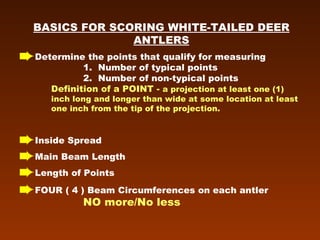
BASICS FOR SCORING WHITE-TAILED DEER ANTLERS Determine the points that qualify for measuring  1.  Number of typical points  2.  Number of non-typical points  Definition of a POINT -  a projection at least one (1)  inch long and longer than wide at some location at least  one inch from the tip of the projection. Inside Spread Main Beam Length  Length of Points FOUR ( 4 ) Beam Circumferences on each antler  NO more/No less
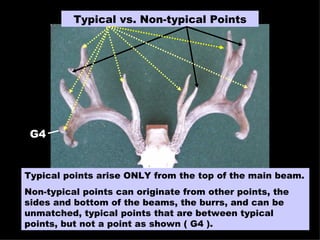
Typical vs. Non-typical Points Typical points arise ONLY from the top of the main beam. Non-typical points can originate from other points, the sides and bottom of the beams, the burrs, and can be unmatched, typical points that are between typical points, but not a point as shown ( G4 ). G4
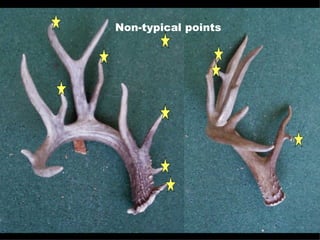
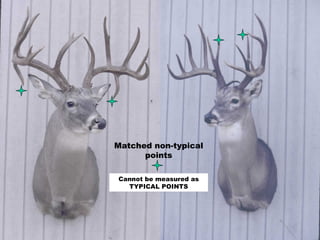
Non-typical points
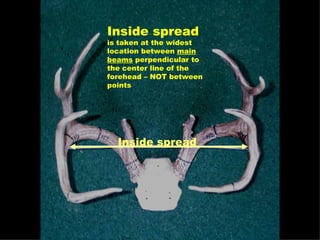
Inside spread   Inside spread  is taken at the widest location between  main beams  perpendicular to the center line of the forehead – NOT between points
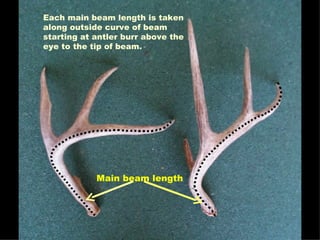
Each main beam length is taken along outside curve of beam starting at antler burr above the eye to the tip of beam. Main beam length
 
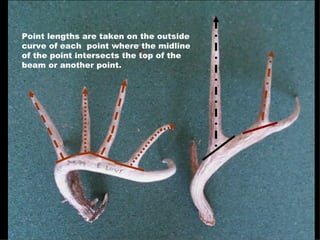
Point lengths are taken on the outside curve of each  point where the midline of the point intersects the top of the beam or another point.
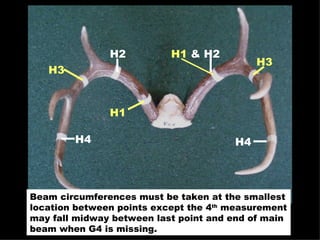
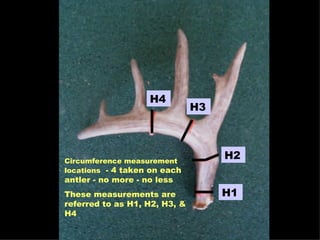
Beam circumferences must be taken at the smallest location between points except the 4 th  measurement may fall midway between last point and end of main beam when G4 is missing. H1 H2 H3 H4 H1   & H2 H3 H4
Circumference measurement locations   - 4 taken on each antler - no more - no less These measurements are referred to as H1, H2, H3, & H4 H1 H2 H3 H4
Matched non-typical points Cannot be measured as TYPICAL POINTS
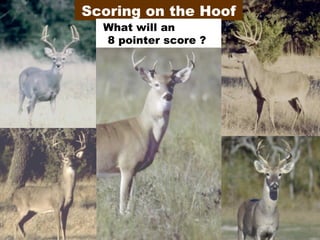
Scoring on the Hoof What will an  8 pointer score ?
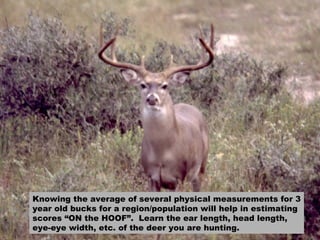
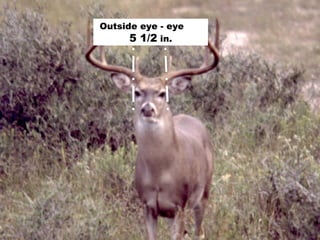
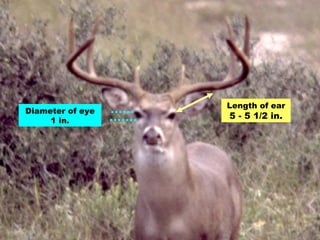
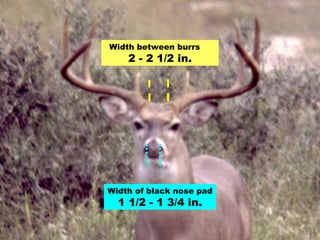
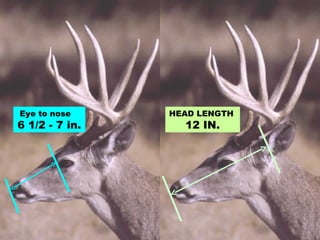
Knowing the average of several physical measurements for 3 year old bucks for a region/population will help in estimating scores “ON the HOOF”.  Learn the ear length, head length, eye-eye width, etc. of the deer you are hunting.
Outside eye - eye  5 1/2  in.
Length of ear  5 - 5 1/2 in. Diameter of eye 1 in.
Width between burrs  2 - 2 1/2 in. Width of black nose pad  1 1/2 - 1 3/4 in.
HEAD LENGTH  12 IN. Eye to nose  6 1/2 - 7 in.
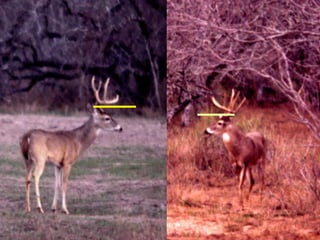
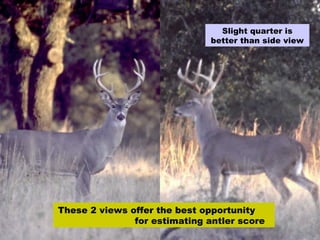
These 2 views offer the best opportunity  for estimating antler score Slight quarter is better than side view
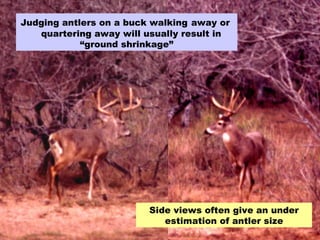
Judging antlers on a buck walking   away or  quartering away will usually result in “ground shrinkage” Side views often give an under estimation of antler size
The Tape Doesn’t Lie The following are examples of antlers that have been scored representing several gross B&C score-classes for typical 8 pointers Notice how antler shape and point length effect score
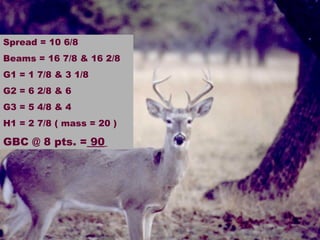
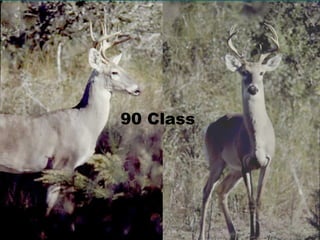
Spread = 10 6/8 Beams = 16 7/8 & 16 2/8 G1 = 1 7/8 & 3 1/8 G2 = 6 2/8 & 6 G3 = 5 4/8 & 4  H1 = 2 7/8 ( mass = 20 ) GBC @ 8 pts. =  90
90 Class
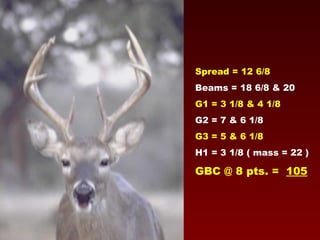
Spread = 12 6/8 Beams = 18 6/8 & 20 G1 = 3 1/8 & 4 1/8   G2 = 7 & 6 1/8 G3 = 5 & 6 1/8 H1 = 3 1/8 ( mass = 22 ) GBC @ 8 pts. =  105
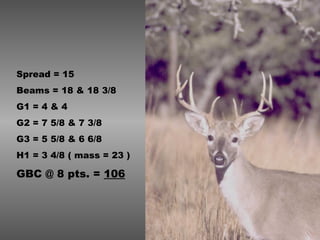
Spread = 15 Beams = 18 & 18 3/8 G1 = 4 & 4 G2 = 7 5/8 & 7 3/8 G3 = 5 5/8 & 6 6/8 H1 = 3 4/8 ( mass = 23 ) GBC @ 8 pts. =  106
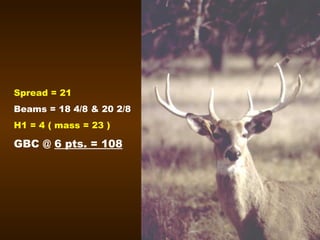
Spread = 21 Beams = 18 4/8 & 20 2/8 H1 = 4 ( mass = 23 ) GBC @  6 pts. = 108
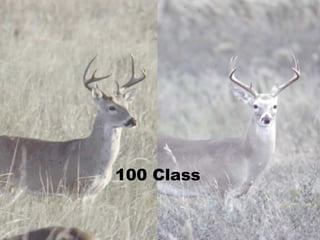
100 Class
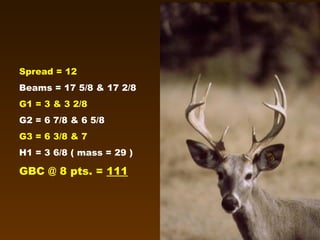
Spread = 12 Beams = 17 5/8 & 17 2/8 G1 = 3 & 3 2/8 G2 = 6 7/8 & 6 5/8 G3 = 6 3/8 & 7 H1 = 3 6/8 ( mass = 29 ) GBC @ 8 pts. =  111
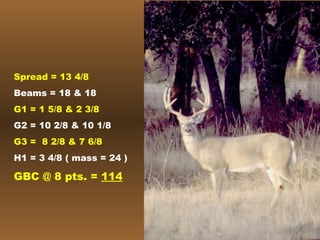
Spread = 13 4/8 Beams = 18 & 18 G1 = 1 5/8 & 2 3/8 G2 = 10 2/8 & 10 1/8 G3 =  8 2/8 & 7 6/8 H1 = 3 4/8 ( mass = 24 ) GBC @ 8 pts. =  114
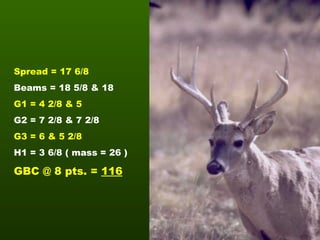
Spread = 17 6/8 Beams = 18 5/8 & 18 G1 = 4 2/8 & 5 G2 = 7 2/8 & 7 2/8 G3 = 6 & 5 2/8 H1 = 3 6/8 ( mass = 26 ) GBC @ 8 pts. =  116
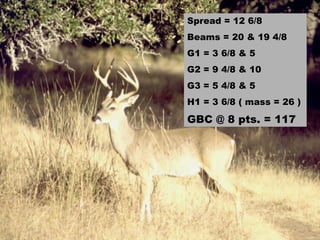
Spread = 12 6/8 Beams = 20 & 19 4/8 G1 = 3 6/8 & 5 G2 = 9 4/8 & 10 G3 = 5 4/8 & 5 H1 = 3 6/8 ( mass = 26 ) GBC @ 8 pts. = 117
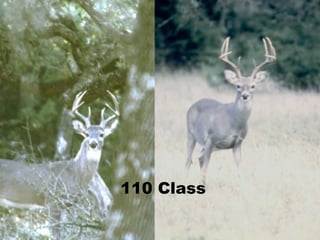
110 Class
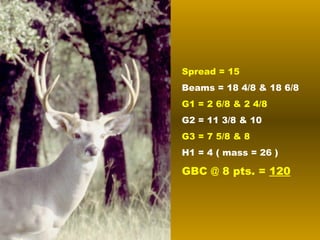
Spread = 15 Beams = 18 4/8 & 18 6/8 G1 = 2 6/8 & 2 4/8 G2 = 11 3/8 & 10 G3 = 7 5/8 & 8 H1 = 4 ( mass = 26 ) GBC @ 8 pts. =  120
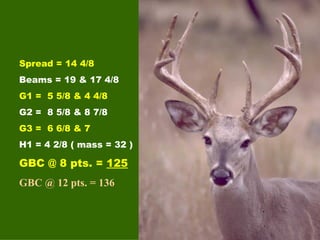
Spread = 14 4/8 Beams = 19 & 17 4/8 G1 =  5 5/8 & 4 4/8 G2 =  8 5/8 & 8 7/8 G3 =  6 6/8 & 7 H1 = 4 2/8 ( mass = 32 ) GBC @ 8 pts. =  125 GBC @ 12 pts. = 136
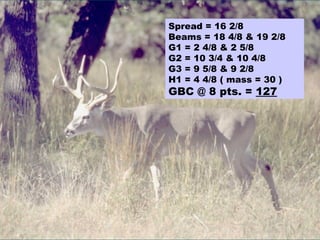
Spread = 16 2/8 Beams = 18 4/8 & 19 2/8 G1 = 2 4/8 & 2 5/8 G2 = 10 3/4 & 10 4/8 G3 = 9 5/8 & 9 2/8 H1 = 4 4/8 ( mass = 30 ) GBC @ 8 pts. =  127
120 Class
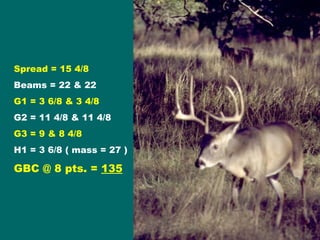
Spread = 15 4/8 Beams = 22 & 22 G1 = 3 6/8 & 3 4/8 G2 = 11 4/8 & 11 4/8 G3 = 9 & 8 4/8  H1 = 3 6/8 ( mass = 27 ) GBC @ 8 pts. =  135
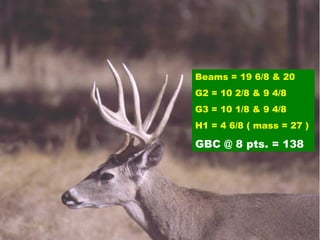
Beams = 19 6/8 & 20 G2 = 10 2/8 & 9 4/8 G3 = 10 1/8 & 9 4/8 H1 = 4 6/8 ( mass = 27 ) GBC @ 8 pts. = 138
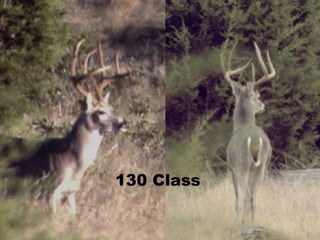
130 Class
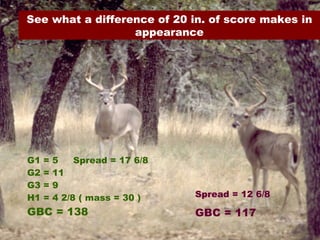
Spread = 12 6/8 GBC = 117 G1 = 5  Spread = 17 6/8 G2 = 11  G3 = 9 H1 = 4 2/8 ( mass = 30 ) GBC = 138 See what a difference of 20 in. of score makes in appearance
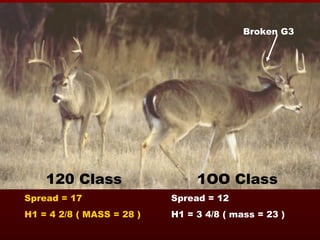
120 Class Spread = 17 H1 = 4 2/8 ( MASS = 28 ) 1OO Class Spread = 12 H1 = 3 4/8 ( mass = 23 ) Broken G3
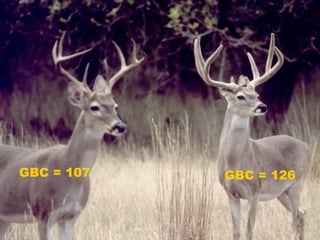
GBC = 107 GBC = 126
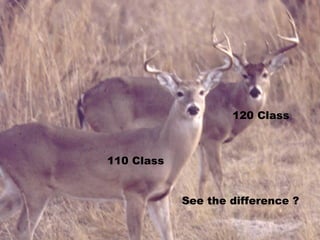
110 Class 120 Class See the difference ?
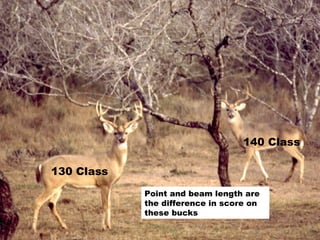
130 Class 140 Class Point and beam length are the difference in score on these bucks
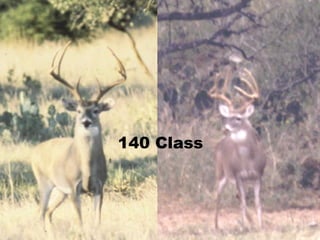
140 Class
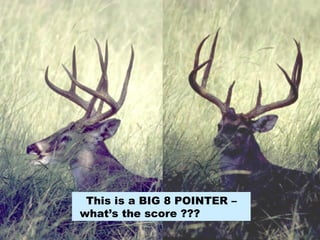
This is a BIG 8 POINTER – what’s the score ???
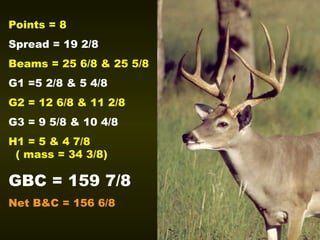
Points = 8 Spread = 19 2/8 Beams = 25 6/8 & 25 5/8 G1 =5 2/8 & 5 4/8 G2 = 12 6/8 & 11 2/8 G3 = 9 5/8 & 10 4/8 H1 = 5 & 4 7/8  ( mass = 34 3/8) GBC = 159 7/8 Net B&C = 156 6/8
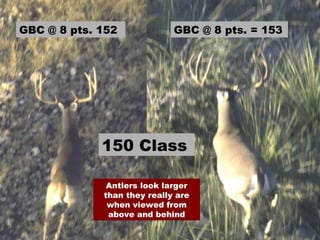
150 Class GBC @ 8 pts. 152 GBC @ 8 pts. = 153 Antlers look larger than they really are when viewed from above and behind
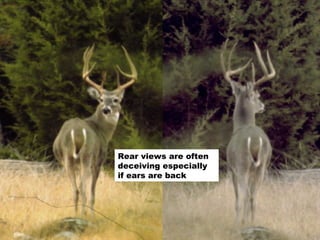
Beware of the rear view –  you get an   exaggerated impression of height and   spread –  especially with ears back.
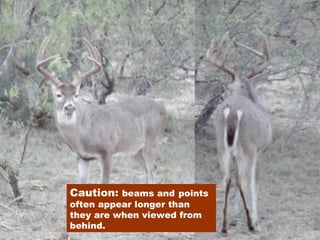
Caution:  beams and   points often appear longer than they are when viewed from behind.
Rear views are often deceiving especially if ears are back
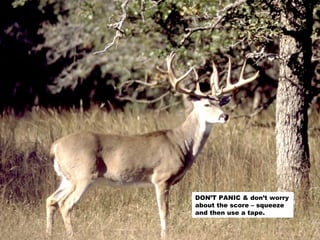
DON’T PANIC & don’t worry about the score – squeeze and then use a tape.
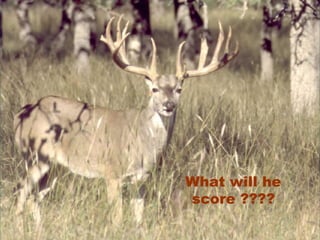
What will he score ????
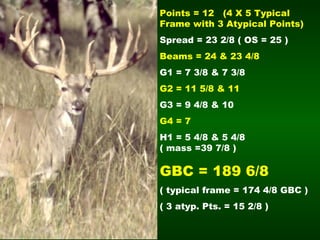
Points = 12  (4 X 5 Typical   Frame with 3 Atypical Points)   Spread = 23 2/8 ( OS = 25 ) Beams = 24 & 23 4/8 G1 = 7 3/8 & 7 3/8 G2 = 11 5/8 & 11 G3 = 9 4/8 & 10 G4 = 7  H1 = 5 4/8 & 5 4/8  ( mass =39 7/8 ) GBC = 189 6/8 ( typical frame = 174 4/8 GBC ) ( 3 atyp. Pts. = 15 2/8 )
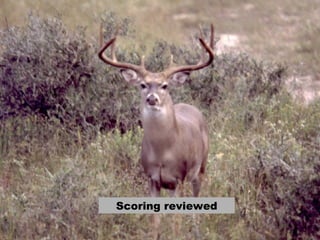
Scoring reviewed
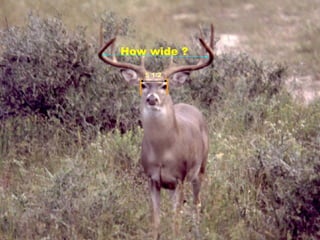
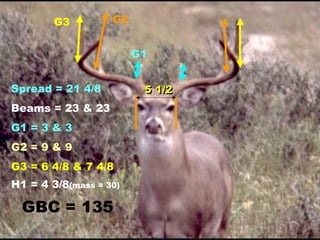
5 1/2 How wide ?
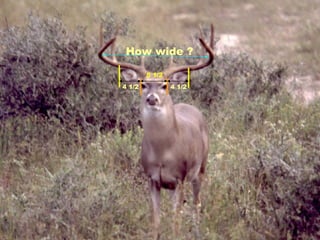
How wide ? 5 1/2 4 1/2 4 1/2
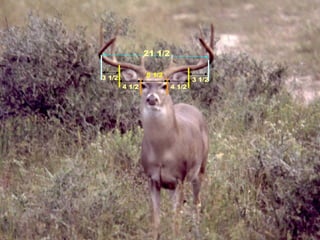
21 1/2 5 1/2 3 1/2 4 1/2 4 1/2 3 1/2
G1 G2 G3 Spread = 21 4/8 Beams = 23 & 23 G1 = 3 & 3 G2 = 9 & 9 G3 = 6 4/8 & 7 4/8 H1 = 4 3/8 (mass = 30) GBC = 135
SUMMARY The most common number of points is  8  for  bucks 3 years old and older. Score antlers as 8 pointer even when more  points exist - if time allows additional point  lengths can be added to the 8 point score. 8 point antlers that score 130 will look  BIG. Know what the average is for several physical  measurements such as ear length from  head, head length, eye - nose, eye - eye,  and diameter of eye.  ( the rule of 5 - 5 1/2  for forehead width across eyes and ear  length from head applies to most bucks)
Summary Using the width across forehead from eye to eye  can be useful for estimating spread and point  length because this measurement remains  constant as a buck is looking at you.  If the ear length from side of head is 5 1/2, the  distance of ear tip will be 4 1/2.  Example: ear  tip - ear tip will be 4 1/2 + 5 + 4 1/2 = 14 in. Points as long as eye-nose will be 6 - 7 in. and  points as long as the head will be at least 11  in. Bases that appear as big as the eye will be 4 in.  and those that appear as big as the nose will be  5 in. or more.
Summary The combination of beam length and point length  normally accounts for 60% - 70% of the total  score on most 8 pointers. Estimate the scores of mounted deer heads and  then actually measure the antlers. Practice !!!
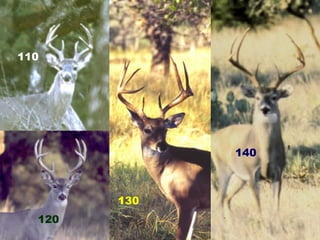
110 120 130 140
??? PRACTICE Ask a certified Texas Big Game Awards Program OR Boone and Crockett Club scorer whenever you have questions on how to measure

Boone and Crockett Scoring On the Hoof

  • 1.
    SCORING ON THEHOOF (Based on Boone and Crockett Club criteria) By: Eugene R. Fuchs Kerr Wildlife Management Area Texas Parks and Wildlife www.tpwd.state.tx.us/hillcountry
  • 2.
    BASICS FOR SCORINGWHITE-TAILED DEER ANTLERS Determine the points that qualify for measuring 1. Number of typical points 2. Number of non-typical points Definition of a POINT - a projection at least one (1) inch long and longer than wide at some location at least one inch from the tip of the projection. Inside Spread Main Beam Length Length of Points FOUR ( 4 ) Beam Circumferences on each antler NO more/No less
  • 3.
    Typical vs. Non-typicalPoints Typical points arise ONLY from the top of the main beam. Non-typical points can originate from other points, the sides and bottom of the beams, the burrs, and can be unmatched, typical points that are between typical points, but not a point as shown ( G4 ). G4
  • 4.
  • 5.
    Inside spread Inside spread is taken at the widest location between main beams perpendicular to the center line of the forehead – NOT between points
  • 6.
    Each main beamlength is taken along outside curve of beam starting at antler burr above the eye to the tip of beam. Main beam length
  • 7.
  • 8.
    Point lengths aretaken on the outside curve of each point where the midline of the point intersects the top of the beam or another point.
  • 9.
    Beam circumferences mustbe taken at the smallest location between points except the 4 th measurement may fall midway between last point and end of main beam when G4 is missing. H1 H2 H3 H4 H1 & H2 H3 H4
  • 10.
    Circumference measurement locations - 4 taken on each antler - no more - no less These measurements are referred to as H1, H2, H3, & H4 H1 H2 H3 H4
  • 11.
    Matched non-typical pointsCannot be measured as TYPICAL POINTS
  • 12.
    Scoring on theHoof What will an 8 pointer score ?
  • 13.
    Knowing the averageof several physical measurements for 3 year old bucks for a region/population will help in estimating scores “ON the HOOF”. Learn the ear length, head length, eye-eye width, etc. of the deer you are hunting.
  • 14.
    Outside eye -eye 5 1/2 in.
  • 15.
    Length of ear 5 - 5 1/2 in. Diameter of eye 1 in.
  • 16.
    Width between burrs 2 - 2 1/2 in. Width of black nose pad 1 1/2 - 1 3/4 in.
  • 17.
    HEAD LENGTH 12 IN. Eye to nose 6 1/2 - 7 in.
  • 18.
    These 2 viewsoffer the best opportunity for estimating antler score Slight quarter is better than side view
  • 19.
    Judging antlers ona buck walking away or quartering away will usually result in “ground shrinkage” Side views often give an under estimation of antler size
  • 20.
    The Tape Doesn’tLie The following are examples of antlers that have been scored representing several gross B&C score-classes for typical 8 pointers Notice how antler shape and point length effect score
  • 21.
    Spread = 106/8 Beams = 16 7/8 & 16 2/8 G1 = 1 7/8 & 3 1/8 G2 = 6 2/8 & 6 G3 = 5 4/8 & 4 H1 = 2 7/8 ( mass = 20 ) GBC @ 8 pts. = 90
  • 22.
  • 23.
    Spread = 126/8 Beams = 18 6/8 & 20 G1 = 3 1/8 & 4 1/8 G2 = 7 & 6 1/8 G3 = 5 & 6 1/8 H1 = 3 1/8 ( mass = 22 ) GBC @ 8 pts. = 105
  • 24.
    Spread = 15Beams = 18 & 18 3/8 G1 = 4 & 4 G2 = 7 5/8 & 7 3/8 G3 = 5 5/8 & 6 6/8 H1 = 3 4/8 ( mass = 23 ) GBC @ 8 pts. = 106
  • 25.
    Spread = 21Beams = 18 4/8 & 20 2/8 H1 = 4 ( mass = 23 ) GBC @ 6 pts. = 108
  • 26.
  • 27.
    Spread = 12Beams = 17 5/8 & 17 2/8 G1 = 3 & 3 2/8 G2 = 6 7/8 & 6 5/8 G3 = 6 3/8 & 7 H1 = 3 6/8 ( mass = 29 ) GBC @ 8 pts. = 111
  • 28.
    Spread = 134/8 Beams = 18 & 18 G1 = 1 5/8 & 2 3/8 G2 = 10 2/8 & 10 1/8 G3 = 8 2/8 & 7 6/8 H1 = 3 4/8 ( mass = 24 ) GBC @ 8 pts. = 114
  • 29.
    Spread = 176/8 Beams = 18 5/8 & 18 G1 = 4 2/8 & 5 G2 = 7 2/8 & 7 2/8 G3 = 6 & 5 2/8 H1 = 3 6/8 ( mass = 26 ) GBC @ 8 pts. = 116
  • 30.
    Spread = 126/8 Beams = 20 & 19 4/8 G1 = 3 6/8 & 5 G2 = 9 4/8 & 10 G3 = 5 4/8 & 5 H1 = 3 6/8 ( mass = 26 ) GBC @ 8 pts. = 117
  • 31.
  • 32.
    Spread = 15Beams = 18 4/8 & 18 6/8 G1 = 2 6/8 & 2 4/8 G2 = 11 3/8 & 10 G3 = 7 5/8 & 8 H1 = 4 ( mass = 26 ) GBC @ 8 pts. = 120
  • 33.
    Spread = 144/8 Beams = 19 & 17 4/8 G1 = 5 5/8 & 4 4/8 G2 = 8 5/8 & 8 7/8 G3 = 6 6/8 & 7 H1 = 4 2/8 ( mass = 32 ) GBC @ 8 pts. = 125 GBC @ 12 pts. = 136
  • 34.
    Spread = 162/8 Beams = 18 4/8 & 19 2/8 G1 = 2 4/8 & 2 5/8 G2 = 10 3/4 & 10 4/8 G3 = 9 5/8 & 9 2/8 H1 = 4 4/8 ( mass = 30 ) GBC @ 8 pts. = 127
  • 35.
  • 36.
    Spread = 154/8 Beams = 22 & 22 G1 = 3 6/8 & 3 4/8 G2 = 11 4/8 & 11 4/8 G3 = 9 & 8 4/8 H1 = 3 6/8 ( mass = 27 ) GBC @ 8 pts. = 135
  • 37.
    Beams = 196/8 & 20 G2 = 10 2/8 & 9 4/8 G3 = 10 1/8 & 9 4/8 H1 = 4 6/8 ( mass = 27 ) GBC @ 8 pts. = 138
  • 38.
  • 39.
    Spread = 126/8 GBC = 117 G1 = 5 Spread = 17 6/8 G2 = 11 G3 = 9 H1 = 4 2/8 ( mass = 30 ) GBC = 138 See what a difference of 20 in. of score makes in appearance
  • 40.
    120 Class Spread= 17 H1 = 4 2/8 ( MASS = 28 ) 1OO Class Spread = 12 H1 = 3 4/8 ( mass = 23 ) Broken G3
  • 41.
    GBC = 107GBC = 126
  • 42.
    110 Class 120Class See the difference ?
  • 43.
    130 Class 140Class Point and beam length are the difference in score on these bucks
  • 44.
  • 45.
    This is aBIG 8 POINTER – what’s the score ???
  • 46.
    Points = 8Spread = 19 2/8 Beams = 25 6/8 & 25 5/8 G1 =5 2/8 & 5 4/8 G2 = 12 6/8 & 11 2/8 G3 = 9 5/8 & 10 4/8 H1 = 5 & 4 7/8 ( mass = 34 3/8) GBC = 159 7/8 Net B&C = 156 6/8
  • 47.
    150 Class GBC@ 8 pts. 152 GBC @ 8 pts. = 153 Antlers look larger than they really are when viewed from above and behind
  • 48.
    Beware of therear view – you get an exaggerated impression of height and spread – especially with ears back.
  • 49.
    Caution: beamsand points often appear longer than they are when viewed from behind.
  • 50.
    Rear views areoften deceiving especially if ears are back
  • 51.
    DON’T PANIC &don’t worry about the score – squeeze and then use a tape.
  • 52.
    What will hescore ????
  • 53.
    Points = 12 (4 X 5 Typical Frame with 3 Atypical Points) Spread = 23 2/8 ( OS = 25 ) Beams = 24 & 23 4/8 G1 = 7 3/8 & 7 3/8 G2 = 11 5/8 & 11 G3 = 9 4/8 & 10 G4 = 7 H1 = 5 4/8 & 5 4/8 ( mass =39 7/8 ) GBC = 189 6/8 ( typical frame = 174 4/8 GBC ) ( 3 atyp. Pts. = 15 2/8 )
  • 54.
  • 55.
    5 1/2 Howwide ?
  • 56.
    How wide ?5 1/2 4 1/2 4 1/2
  • 57.
    21 1/2 51/2 3 1/2 4 1/2 4 1/2 3 1/2
  • 58.
    G1 G2 G3Spread = 21 4/8 Beams = 23 & 23 G1 = 3 & 3 G2 = 9 & 9 G3 = 6 4/8 & 7 4/8 H1 = 4 3/8 (mass = 30) GBC = 135
  • 59.
    SUMMARY The mostcommon number of points is 8 for bucks 3 years old and older. Score antlers as 8 pointer even when more points exist - if time allows additional point lengths can be added to the 8 point score. 8 point antlers that score 130 will look BIG. Know what the average is for several physical measurements such as ear length from head, head length, eye - nose, eye - eye, and diameter of eye. ( the rule of 5 - 5 1/2 for forehead width across eyes and ear length from head applies to most bucks)
  • 60.
    Summary Using thewidth across forehead from eye to eye can be useful for estimating spread and point length because this measurement remains constant as a buck is looking at you. If the ear length from side of head is 5 1/2, the distance of ear tip will be 4 1/2. Example: ear tip - ear tip will be 4 1/2 + 5 + 4 1/2 = 14 in. Points as long as eye-nose will be 6 - 7 in. and points as long as the head will be at least 11 in. Bases that appear as big as the eye will be 4 in. and those that appear as big as the nose will be 5 in. or more.
  • 61.
    Summary The combinationof beam length and point length normally accounts for 60% - 70% of the total score on most 8 pointers. Estimate the scores of mounted deer heads and then actually measure the antlers. Practice !!!
  • 62.
  • 63.
    ??? PRACTICE Aska certified Texas Big Game Awards Program OR Boone and Crockett Club scorer whenever you have questions on how to measure