American Culture
Webinars
For
English Language Teachers
Brought to you by :
U.S. Embassy Lima’s Public Affairs Section
WELCOME!
Our goal: to provide info on U.S. culture
AND to help you create an effective plan to use in
your classroom.
Please ask questions! That’s why we’re here.
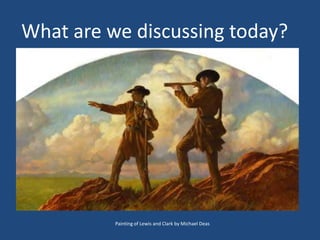
What are we discussing today?
Painting of Lewis and Clark by Michael Deas
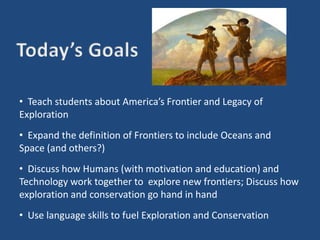
• Teach students about America’s Frontier and Legacy of
Exploration
• Expand the definition of Frontiers to include Oceans and
Space (and others?)
• Discuss how Humans (with motivation and education) and
Technology work together to explore new frontiers; Discuss how
exploration and conservation go hand in hand
• Use language skills to fuel Exploration and Conservation
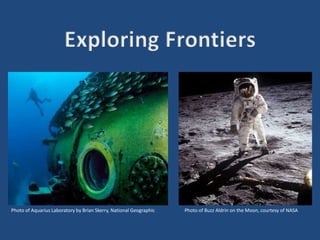
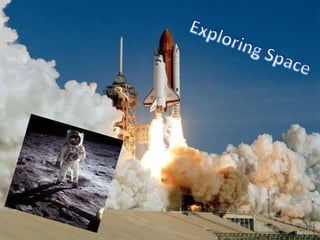
Photo of Buzz Aldrin on the Moon, courtesy of NASAPhoto of Aquarius Laboratory by Brian Skerry, National Geographic
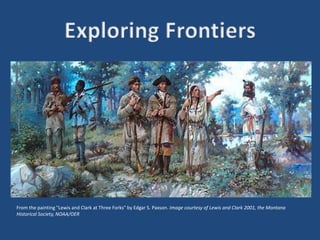
From the painting "Lewis and Clark at Three Forks" by Edgar S. Paxson. Image courtesy of Lewis and Clark 2001, the Montana
Historical Society, NOAA/OER
Exploration and Expansion
Across the American Frontier
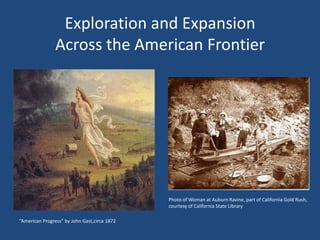
“American Progress” by John Gast,circa 1872
Photo of Woman at Auburn Ravine, part of California Gold Rush,
courtesy of California State Library
What do Frontiers Mean today?
• Frontiers are always evolving – Exploration is
not over!
• Exploration today is about Science and
Technology
• Two interesting frontiers: Oceans and Space
– Focus has changed. We must protect our
frontiers, not just expand.
– Conservation and responsible exploration.
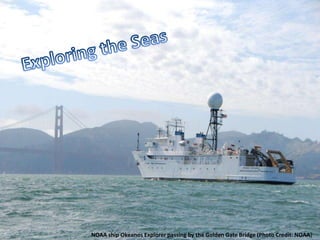
NOAA ship Okeanos Explorer passing by the Golden Gate Bridge (Photo Credit: NOAA)
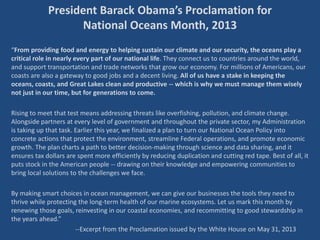
President Barack Obama’s Proclamation for
National Oceans Month, 2013
“From providing food and energy to helping sustain our climate and our security, the oceans play a
critical role in nearly every part of our national life. They connect us to countries around the world,
and support transportation and trade networks that grow our economy. For millions of Americans, our
coasts are also a gateway to good jobs and a decent living. All of us have a stake in keeping the
oceans, coasts, and Great Lakes clean and productive -- which is why we must manage them wisely
not just in our time, but for generations to come.
Rising to meet that test means addressing threats like overfishing, pollution, and climate change.
Alongside partners at every level of government and throughout the private sector, my Administration
is taking up that task. Earlier this year, we finalized a plan to turn our National Ocean Policy into
concrete actions that protect the environment, streamline Federal operations, and promote economic
growth. The plan charts a path to better decision-making through science and data sharing, and it
ensures tax dollars are spent more efficiently by reducing duplication and cutting red tape. Best of all, it
puts stock in the American people -- drawing on their knowledge and empowering communities to
bring local solutions to the challenges we face.
By making smart choices in ocean management, we can give our businesses the tools they need to
thrive while protecting the long-term health of our marine ecosystems. Let us mark this month by
renewing those goals, reinvesting in our coastal economies, and recommitting to good stewardship in
the years ahead.”
--Excerpt from the Proclamation issued by the White House on May 31, 2013
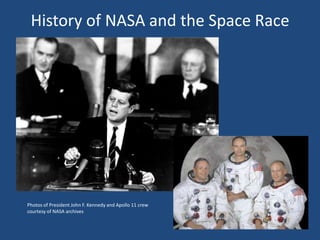
History of NASA and the Space Race
Photos of President John F. Kennedy and Apollo 11 crew
courtesy of NASA archives
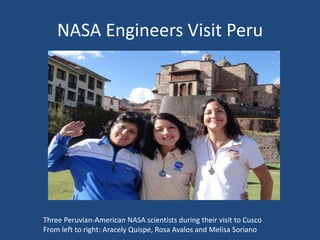
NASA Engineers Visit Peru
Three Peruvian-American NASA scientists during their visit to Cusco
From left to right: Aracely Quispe, Rosa Avalos and Melisa Soriano
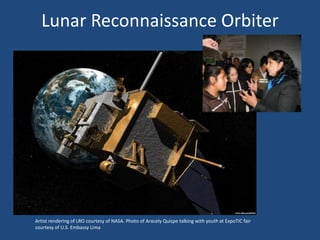
Lunar Reconnaissance Orbiter
Artist rendering of LRO courtesy of NASA. Photo of Aracely Quispe talking with youth at ExpoTIC fair
courtesy of U.S. Embassy Lima
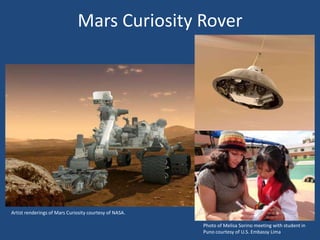
Mars Curiosity Rover
Artist renderings of Mars Curiosity courtesy of NASA.
Photo of Melisa Sorino meeting with student in
Puno courtesy of U.S. Embassy Lima
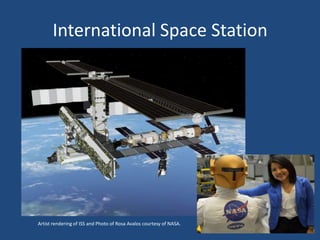
International Space Station
Artist rendering of ISS and Photo of Rosa Avalos courtesy of NASA.
Plan your Lesson Plan
1) What are your topics?
2) What kind of questions/conversations starters
will you ask?
3) What new vocabulary do you need?
4) What activities can you do with your students?
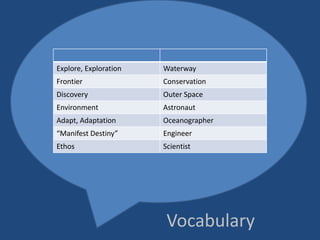
Vocabulary
Explore, Exploration Waterway
Frontier Conservation
Discovery Outer Space
Environment Astronaut
Adapt, Adaptation Oceanographer
“Manifest Destiny” Engineer
Ethos Scientist
Discussion Questions
• Would you like to be an explorer and if so, what would you
explore?
• Would you rather explore the deepest ocean or the farthest
reaches of outer space and why?
• If you were living on the frontier in the United States during
the 1800s, what do you think would be the most fun part?
The most challenging?
• Who is responsible for caring for our lakes, rivers, and
oceans? How can we take care of these waterways?
• What is the “ethos” or guiding belief or characteristic that
represents your country or community? Does one exist? If
you could create one, what would it be?
Activities
1) Activity #1 – World Oceans Day Promise
2) Activity #2 – NASA Space Station Challenge
Activity #1 – World Oceans Day: A
Promise to Keep Our Waters Clean
Make a Promise for the Ocean
http://worldoceansday.org/promise/
Discuss with students the importance of oceans and
water sources to different communities.
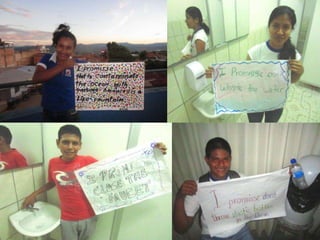
Have students make a promise - something they can do to
help protect the earth’s water and environment. It
should be something realistic (i.e. I will shut the water
off when I am brushing my teeth). Have students
create a poster of their promise.
Show the world! Take a photo of students with their
message and post on a social media site such as
Facebook and tag with #WorldOceansDay.
Activity #2 – NASA Space Station Challenge
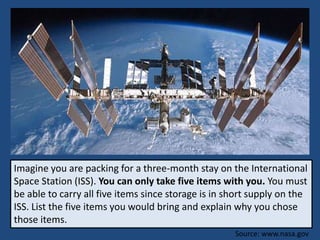
Imagine you are packing for a three-month stay on the International
Space Station (ISS). You can only take five items with you. You must
be able to carry all five items since storage is in short supply on the
ISS. List the five items you would bring and explain why you chose
those items.
Source: www.nasa.gov
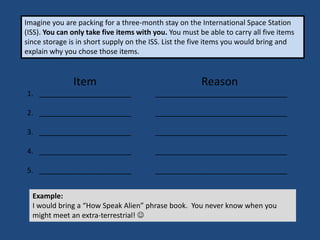
Imagine you are packing for a three-month stay on the International Space Station
(ISS). You can only take five items with you. You must be able to carry all five items
since storage is in short supply on the ISS. List the five items you would bring and
explain why you chose those items.
Item Reason
1. _______________________ _________________________________
2. _______________________ _________________________________
3. _______________________ _________________________________
4. _______________________ _________________________________
5. _______________________ _________________________________
Example:
I would bring a “How Speak Alien” phrase book. You never know when you
might meet an extra-terrestrial! 
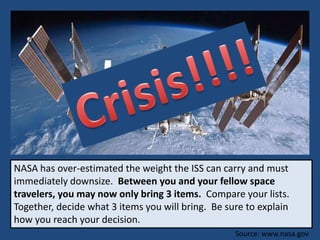
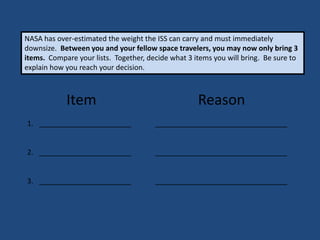
NASA has over-estimated the weight the ISS can carry and must
immediately downsize. Between you and your fellow space
travelers, you may now only bring 3 items. Compare your lists.
Together, decide what 3 items you will bring. Be sure to explain
how you reach your decision.
Source: www.nasa.gov
NASA has over-estimated the weight the ISS can carry and must immediately
downsize. Between you and your fellow space travelers, you may now only bring 3
items. Compare your lists. Together, decide what 3 items you will bring. Be sure to
explain how you reach your decision.
Item Reason
1. _______________________ _________________________________
2. _______________________ _________________________________
3. _______________________ _________________________________
What skills did you need to
effectively complete this
activity?
What other skills were needed?
Resources
American English webpage
– americanenglish.state.gov
RELO Andes webpage
– reloandes.com (link to this presentation found
here!)
Oceans and Space Websites
National Oceanic and Atmospheric Association
• http://oceanservice.noaa.gov/education/welcom
e.html
Smithsonian Institution Ocean Portal
• http://ocean.si.edu/for-educators
NASA
• http://www.nasa.gov
• http://www.nasa.gov/audience/foreducators/tea
chingfromspace/dayinthelife/index.html
QUESTIONS?
Remember:
You can check out the webinars and the
corresponding resources on the
RELO Andes blog - reloandes.com

[RELO] American Culture Series: Exploring Frontiers

  • 1.
    American Culture Webinars For English LanguageTeachers Brought to you by : U.S. Embassy Lima’s Public Affairs Section
  • 2.
    WELCOME! Our goal: toprovide info on U.S. culture AND to help you create an effective plan to use in your classroom. Please ask questions! That’s why we’re here.
  • 3.
    What are wediscussing today? Painting of Lewis and Clark by Michael Deas
  • 4.
    • Teach studentsabout America’s Frontier and Legacy of Exploration • Expand the definition of Frontiers to include Oceans and Space (and others?) • Discuss how Humans (with motivation and education) and Technology work together to explore new frontiers; Discuss how exploration and conservation go hand in hand • Use language skills to fuel Exploration and Conservation
  • 5.
    Photo of BuzzAldrin on the Moon, courtesy of NASAPhoto of Aquarius Laboratory by Brian Skerry, National Geographic
  • 6.
    From the painting"Lewis and Clark at Three Forks" by Edgar S. Paxson. Image courtesy of Lewis and Clark 2001, the Montana Historical Society, NOAA/OER
  • 7.
    Exploration and Expansion Acrossthe American Frontier “American Progress” by John Gast,circa 1872 Photo of Woman at Auburn Ravine, part of California Gold Rush, courtesy of California State Library
  • 8.
    What do FrontiersMean today? • Frontiers are always evolving – Exploration is not over! • Exploration today is about Science and Technology • Two interesting frontiers: Oceans and Space – Focus has changed. We must protect our frontiers, not just expand. – Conservation and responsible exploration.
  • 10.
    NOAA ship OkeanosExplorer passing by the Golden Gate Bridge (Photo Credit: NOAA)
  • 11.
    President Barack Obama’sProclamation for National Oceans Month, 2013 “From providing food and energy to helping sustain our climate and our security, the oceans play a critical role in nearly every part of our national life. They connect us to countries around the world, and support transportation and trade networks that grow our economy. For millions of Americans, our coasts are also a gateway to good jobs and a decent living. All of us have a stake in keeping the oceans, coasts, and Great Lakes clean and productive -- which is why we must manage them wisely not just in our time, but for generations to come. Rising to meet that test means addressing threats like overfishing, pollution, and climate change. Alongside partners at every level of government and throughout the private sector, my Administration is taking up that task. Earlier this year, we finalized a plan to turn our National Ocean Policy into concrete actions that protect the environment, streamline Federal operations, and promote economic growth. The plan charts a path to better decision-making through science and data sharing, and it ensures tax dollars are spent more efficiently by reducing duplication and cutting red tape. Best of all, it puts stock in the American people -- drawing on their knowledge and empowering communities to bring local solutions to the challenges we face. By making smart choices in ocean management, we can give our businesses the tools they need to thrive while protecting the long-term health of our marine ecosystems. Let us mark this month by renewing those goals, reinvesting in our coastal economies, and recommitting to good stewardship in the years ahead.” --Excerpt from the Proclamation issued by the White House on May 31, 2013
  • 12.
    History of NASAand the Space Race Photos of President John F. Kennedy and Apollo 11 crew courtesy of NASA archives
  • 14.
    NASA Engineers VisitPeru Three Peruvian-American NASA scientists during their visit to Cusco From left to right: Aracely Quispe, Rosa Avalos and Melisa Soriano
  • 15.
    Lunar Reconnaissance Orbiter Artistrendering of LRO courtesy of NASA. Photo of Aracely Quispe talking with youth at ExpoTIC fair courtesy of U.S. Embassy Lima
  • 16.
    Mars Curiosity Rover Artistrenderings of Mars Curiosity courtesy of NASA. Photo of Melisa Sorino meeting with student in Puno courtesy of U.S. Embassy Lima
  • 17.
    International Space Station Artistrendering of ISS and Photo of Rosa Avalos courtesy of NASA.
  • 18.
    Plan your LessonPlan 1) What are your topics? 2) What kind of questions/conversations starters will you ask? 3) What new vocabulary do you need? 4) What activities can you do with your students?
  • 19.
    Vocabulary Explore, Exploration Waterway FrontierConservation Discovery Outer Space Environment Astronaut Adapt, Adaptation Oceanographer “Manifest Destiny” Engineer Ethos Scientist
  • 20.
    Discussion Questions • Wouldyou like to be an explorer and if so, what would you explore? • Would you rather explore the deepest ocean or the farthest reaches of outer space and why? • If you were living on the frontier in the United States during the 1800s, what do you think would be the most fun part? The most challenging? • Who is responsible for caring for our lakes, rivers, and oceans? How can we take care of these waterways? • What is the “ethos” or guiding belief or characteristic that represents your country or community? Does one exist? If you could create one, what would it be?
  • 21.
    Activities 1) Activity #1– World Oceans Day Promise 2) Activity #2 – NASA Space Station Challenge
  • 22.
    Activity #1 –World Oceans Day: A Promise to Keep Our Waters Clean
  • 23.
    Make a Promisefor the Ocean http://worldoceansday.org/promise/ Discuss with students the importance of oceans and water sources to different communities. Have students make a promise - something they can do to help protect the earth’s water and environment. It should be something realistic (i.e. I will shut the water off when I am brushing my teeth). Have students create a poster of their promise. Show the world! Take a photo of students with their message and post on a social media site such as Facebook and tag with #WorldOceansDay.
  • 25.
    Activity #2 –NASA Space Station Challenge
  • 26.
    Imagine you arepacking for a three-month stay on the International Space Station (ISS). You can only take five items with you. You must be able to carry all five items since storage is in short supply on the ISS. List the five items you would bring and explain why you chose those items. Source: www.nasa.gov
  • 27.
    Imagine you arepacking for a three-month stay on the International Space Station (ISS). You can only take five items with you. You must be able to carry all five items since storage is in short supply on the ISS. List the five items you would bring and explain why you chose those items. Item Reason 1. _______________________ _________________________________ 2. _______________________ _________________________________ 3. _______________________ _________________________________ 4. _______________________ _________________________________ 5. _______________________ _________________________________ Example: I would bring a “How Speak Alien” phrase book. You never know when you might meet an extra-terrestrial! 
  • 28.
    NASA has over-estimatedthe weight the ISS can carry and must immediately downsize. Between you and your fellow space travelers, you may now only bring 3 items. Compare your lists. Together, decide what 3 items you will bring. Be sure to explain how you reach your decision. Source: www.nasa.gov
  • 29.
    NASA has over-estimatedthe weight the ISS can carry and must immediately downsize. Between you and your fellow space travelers, you may now only bring 3 items. Compare your lists. Together, decide what 3 items you will bring. Be sure to explain how you reach your decision. Item Reason 1. _______________________ _________________________________ 2. _______________________ _________________________________ 3. _______________________ _________________________________
  • 30.
    What skills didyou need to effectively complete this activity? What other skills were needed?
  • 31.
    Resources American English webpage –americanenglish.state.gov RELO Andes webpage – reloandes.com (link to this presentation found here!)
  • 32.
    Oceans and SpaceWebsites National Oceanic and Atmospheric Association • http://oceanservice.noaa.gov/education/welcom e.html Smithsonian Institution Ocean Portal • http://ocean.si.edu/for-educators NASA • http://www.nasa.gov • http://www.nasa.gov/audience/foreducators/tea chingfromspace/dayinthelife/index.html
  • 33.
    QUESTIONS? Remember: You can checkout the webinars and the corresponding resources on the RELO Andes blog - reloandes.com

Editor's Notes

  • #4 From the painting "Lewis and Clark at Three Forks" by Edgar S. Paxson. Image courtesy of Lewis and Clark 2001, the Montana Historical Society, NOAA/OER
  • #5 From the painting "Lewis and Clark at Three Forks" by Edgar S. Paxson. Image courtesy of Lewis and Clark 2001, the Montana Historical Society, NOAA/OER
  • #6 From the painting "Lewis and Clark at Three Forks" by Edgar S. Paxson. Image courtesy of Lewis and Clark 2001, the Montana Historical Society, NOAA/OER
  • #7 From the painting "Lewis and Clark at Three Forks" by Edgar S. Paxson. Image courtesy of Lewis and Clark 2001, the Montana Historical Society, NOAA/OER
  • #8 This painting (circa 1872) by John Gast called American Progress, is an allegorical representation of the modernization of the new west. Here Columbia, a personification of the United States, leads civilization westward with American settlers, stringing telegraph wire as she sweeps west; she holds a school book. The different stages of economic activity of the pioneers are highlighted and, especially, the changing forms of transportation.
  • #21 First – go over questions submitted by audience:Second – add in missing questions
  • #31 Additional Skills: Explaining, Justifying, Arguing, Negotiating, Prioritizing, Classifying