Best Practices forBest Practices for
Recovering Rocket &Recovering Rocket &
Balloon PayloadsBalloon Payloads
Stratofox Aerospace Tracking TeamStratofox Aerospace Tracking Team
Presented by Ian KluftPresented by Ian Kluft
Space Access Conference 2019Space Access Conference 2019
Fremont, CaliforniaFremont, California
Advice from Stratofox Aerospace
Tracking Team
Highlights about Stratofox…
•
Founded in 2002
•
Recovered Civilian Space Xploration Team
(CSXT) Space Shot 2004 rocket (380,000’)
•
Recovered California Near Space Project’s
CNSP-10 balloon from 2011 record 134,545’
•
You build it – we bring it back!
Payload recovery challenges
●
Usually the builder of a high altitude balloon or
rocket is too busy to consider search & recovery
●
If left to the last moment, the chance increases of
failure to locate the payload
●
Radios are needed to find the rocket or balloon
●
Minimum 1 team member for tracking & recovery
Never use a cell phone for tracking
●
Cell phones have been sources of bad news for
tracking rockets and balloons
●
Consumers are familiar with cell phones
●
But cell phones are not the right tool for this task
●
In order to succeed, it has to land in a cell
coverage area
Why cell phones are bad at tracking
●
Cell phones only communicate with cell towers
●
If your payload falls anywhere it can’t reach a
tower, game over
●
When dealing with flight, chances are too high of
coming down in non-coverage areas
●
For tracking and search, get a transmitter you
can receive directly without any infrastructure
Tracking transmitter options
●
For amateur payloads, the best option is Amateur
Radio (a.k.a. Ham Radio)
– Higher power available
– Existing APRS repeaters augment reception areas
●
Amateur Radio is not allowed for anything where
the operator receives compensation/paycheck
– Use commercial radios or low-power unlicensed bands
Stratofox encourages Ham Radio
●
Automated Position Reporting
System (APRS) is worldwide
●
Good mobile antennas also
help reception of weak signals
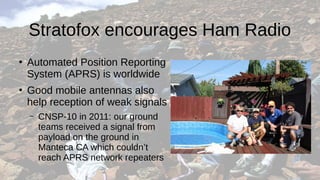
– CNSP-10 in 2011: our ground
teams received a signal from
payload on the ground in
Manteca CA which couldn’t
reach APRS network repeaters
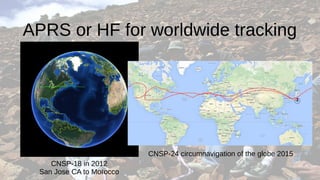
APRS or HF for worldwide tracking
CNSP-18 in 2012
San Jose CA to Morocco
CNSP-24 circumnavigation of the globe 2015
When you find it – can you get to it?
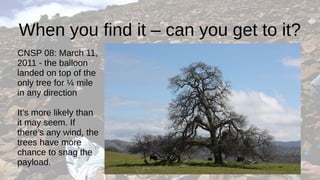
CNSP 08: March 11,
2011 - the balloon
landed on top of the
only tree for ¼ mile
in any direction
It’s more likely than
it may seem. If
there’s any wind, the
trees have more
chance to snag the
payload.
Permission to enter private property
●
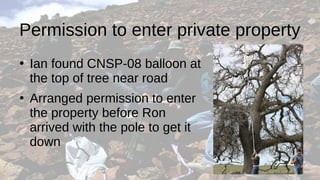
Ian found CNSP-08 balloon at
the top of tree near road
●
Arranged permission to enter
the property before Ron
arrived with the pole to get it
down
Positioning ground search teams
●
Near launch point in
case it doesn’t get far
●
Also near projected
landing area to
receive descent
telemetry
●
Transmitters can fail on
impact – descent data is
crucial to compute
impact point if needed
●
Elevated locations
increase your radio line
of sight for monitoring
Remote locations
●
Are you prepared to
travel to unexpected
places the payload
could fall down?
●
Different preparations
for urban, rural,
desert, forest, etc.
●
Where are your
people? Ham Radio is
useful for inter-vehicle
communications to
check in
●
Prepare for self-rescue
capability within your
team in case of trouble
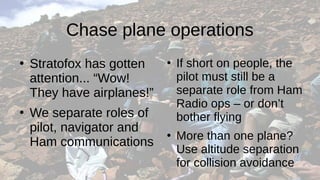
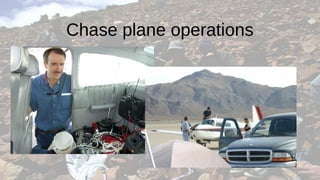
Chase plane operations
●
Stratofox has gotten
attention... “Wow!
They have airplanes!”
●
We separate roles of
pilot, navigator and
Ham communications
●
If short on people, the
pilot must still be a
separate role from Ham
Radio ops – or don’t
bother flying
●
More than one plane?
Use altitude separation
for collision avoidance
Chase plane operations
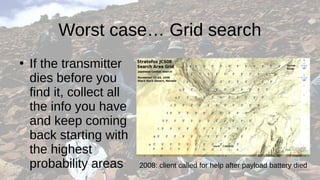
Worst case… Grid search
●
If the transmitter
dies before you
find it, collect all
the info you have
and keep coming
back starting with
the highest
probability areas 2008: client called for help after payload battery died
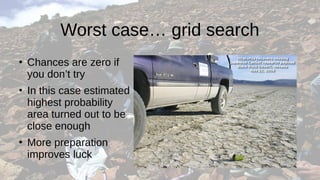
Worst case… grid search
●
Chances are zero if
you don’t try
●
In this case estimated
highest probability
area turned out to be
close enough
●
More preparation
improves luck
Who is your tracking crew?
●
If you’re near
California & Nevada,
or anywhere Stratofox
has members, invite
us to be your tracking
crew, or to add to it
●
Recruit Ham Radio
operators from your
area to establish a
tracking crew
●
Work with your
trackers ASAP on
transmitter plans
Questions?

Best Practices for Recovering Rocket & Balloon Payloads

  • 1.
    Best Practices forBestPractices for Recovering Rocket &Recovering Rocket & Balloon PayloadsBalloon Payloads Stratofox Aerospace Tracking TeamStratofox Aerospace Tracking Team Presented by Ian KluftPresented by Ian Kluft Space Access Conference 2019Space Access Conference 2019 Fremont, CaliforniaFremont, California
  • 2.
    Advice from StratofoxAerospace Tracking Team Highlights about Stratofox… • Founded in 2002 • Recovered Civilian Space Xploration Team (CSXT) Space Shot 2004 rocket (380,000’) • Recovered California Near Space Project’s CNSP-10 balloon from 2011 record 134,545’ • You build it – we bring it back!
  • 3.
    Payload recovery challenges ● Usuallythe builder of a high altitude balloon or rocket is too busy to consider search & recovery ● If left to the last moment, the chance increases of failure to locate the payload ● Radios are needed to find the rocket or balloon ● Minimum 1 team member for tracking & recovery
  • 4.
    Never use acell phone for tracking ● Cell phones have been sources of bad news for tracking rockets and balloons ● Consumers are familiar with cell phones ● But cell phones are not the right tool for this task ● In order to succeed, it has to land in a cell coverage area
  • 5.
    Why cell phonesare bad at tracking ● Cell phones only communicate with cell towers ● If your payload falls anywhere it can’t reach a tower, game over ● When dealing with flight, chances are too high of coming down in non-coverage areas ● For tracking and search, get a transmitter you can receive directly without any infrastructure
  • 6.
    Tracking transmitter options ● Foramateur payloads, the best option is Amateur Radio (a.k.a. Ham Radio) – Higher power available – Existing APRS repeaters augment reception areas ● Amateur Radio is not allowed for anything where the operator receives compensation/paycheck – Use commercial radios or low-power unlicensed bands
  • 7.
    Stratofox encourages HamRadio ● Automated Position Reporting System (APRS) is worldwide ● Good mobile antennas also help reception of weak signals – CNSP-10 in 2011: our ground teams received a signal from payload on the ground in Manteca CA which couldn’t reach APRS network repeaters
  • 8.
    APRS or HFfor worldwide tracking CNSP-18 in 2012 San Jose CA to Morocco CNSP-24 circumnavigation of the globe 2015
  • 9.
    When you findit – can you get to it? CNSP 08: March 11, 2011 - the balloon landed on top of the only tree for ¼ mile in any direction It’s more likely than it may seem. If there’s any wind, the trees have more chance to snag the payload.
  • 10.
    Permission to enterprivate property ● Ian found CNSP-08 balloon at the top of tree near road ● Arranged permission to enter the property before Ron arrived with the pole to get it down
  • 11.
    Positioning ground searchteams ● Near launch point in case it doesn’t get far ● Also near projected landing area to receive descent telemetry ● Transmitters can fail on impact – descent data is crucial to compute impact point if needed ● Elevated locations increase your radio line of sight for monitoring
  • 12.
    Remote locations ● Are youprepared to travel to unexpected places the payload could fall down? ● Different preparations for urban, rural, desert, forest, etc. ● Where are your people? Ham Radio is useful for inter-vehicle communications to check in ● Prepare for self-rescue capability within your team in case of trouble
  • 13.
    Chase plane operations ● Stratofoxhas gotten attention... “Wow! They have airplanes!” ● We separate roles of pilot, navigator and Ham communications ● If short on people, the pilot must still be a separate role from Ham Radio ops – or don’t bother flying ● More than one plane? Use altitude separation for collision avoidance
  • 14.
  • 15.
    Worst case… Gridsearch ● If the transmitter dies before you find it, collect all the info you have and keep coming back starting with the highest probability areas 2008: client called for help after payload battery died
  • 16.
    Worst case… gridsearch ● Chances are zero if you don’t try ● In this case estimated highest probability area turned out to be close enough ● More preparation improves luck
  • 17.
    Who is yourtracking crew? ● If you’re near California & Nevada, or anywhere Stratofox has members, invite us to be your tracking crew, or to add to it ● Recruit Ham Radio operators from your area to establish a tracking crew ● Work with your trackers ASAP on transmitter plans
  • 18.