No Callbacks, No Threads & Ruby 1.9async & co-operative web-serversIlya Grigorik@igrigorik
Reactor PatternReview: State of the artAsync PrimitivesCallbacks & FibersAsync Rails?
require"active_record”ActiveRecord::Base.establish_connection(  :adapter => "mysql",  :username => "root",  :database => "database",  :pool => 5)threads = []10.times do |n|   threads <<Thread.new {ActiveRecord::Base.connection_pool.with_connectiondo |conn|      res =conn.execute("select sleep(1)")end  }endthreads.each { |t| t.join }The “Experiment”vanilla everything…
require"active_record”ActiveRecord::Base.establish_connection(  :adapter => "mysql",  :username => "root",  :database => "database",  :pool => 5)threads = []10.times do |n|   threads <<Thread.new {ActiveRecord::Base.connection_pool.with_connectiondo |conn|      res =conn.execute("select sleep(1)")end  }endthreads.each { |t| t.join }5 shared connections# time ruby activerecord-pool.rb## real    0m10.663s# user    0m0.405s# sys     0m0.201s
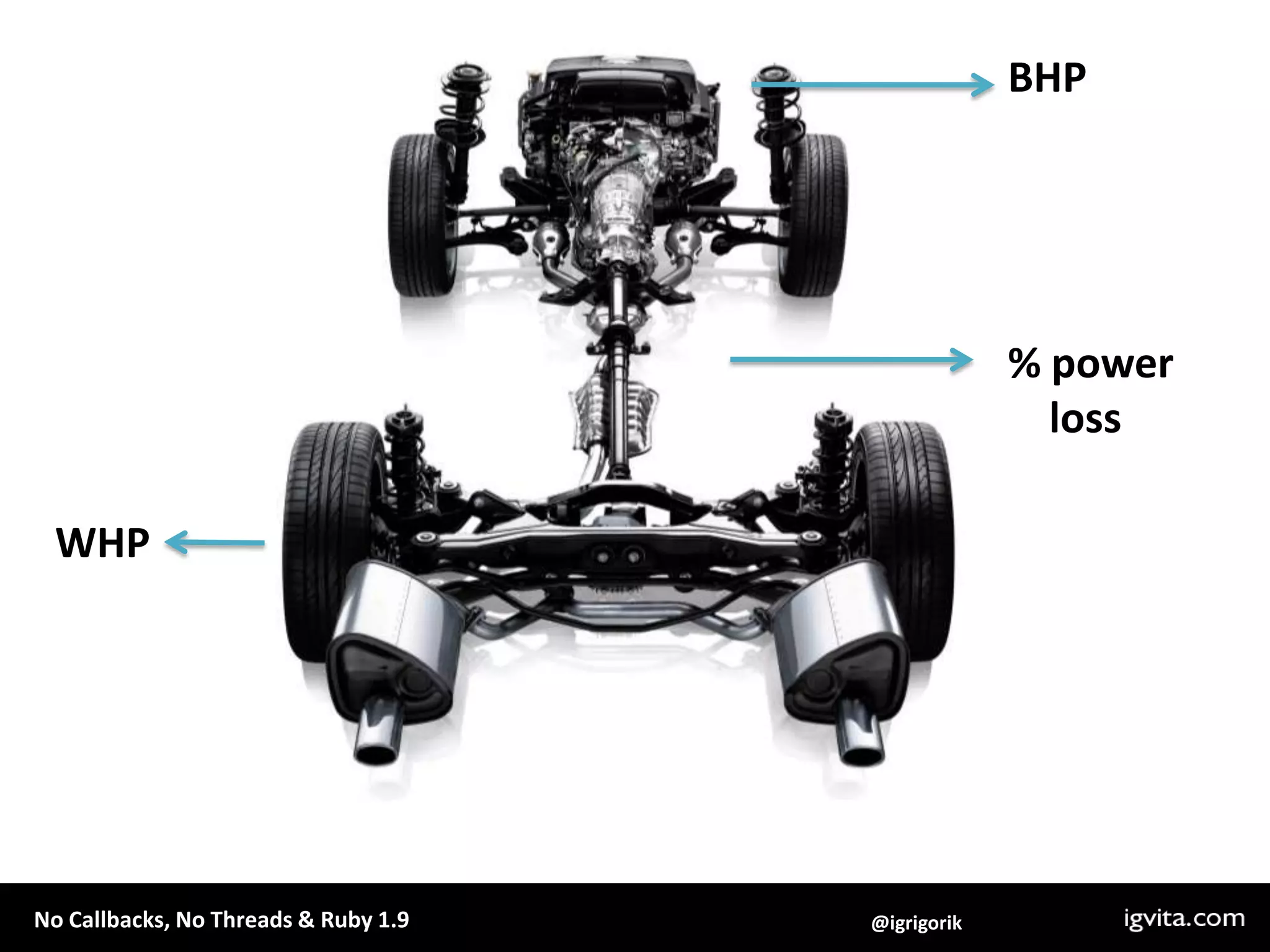
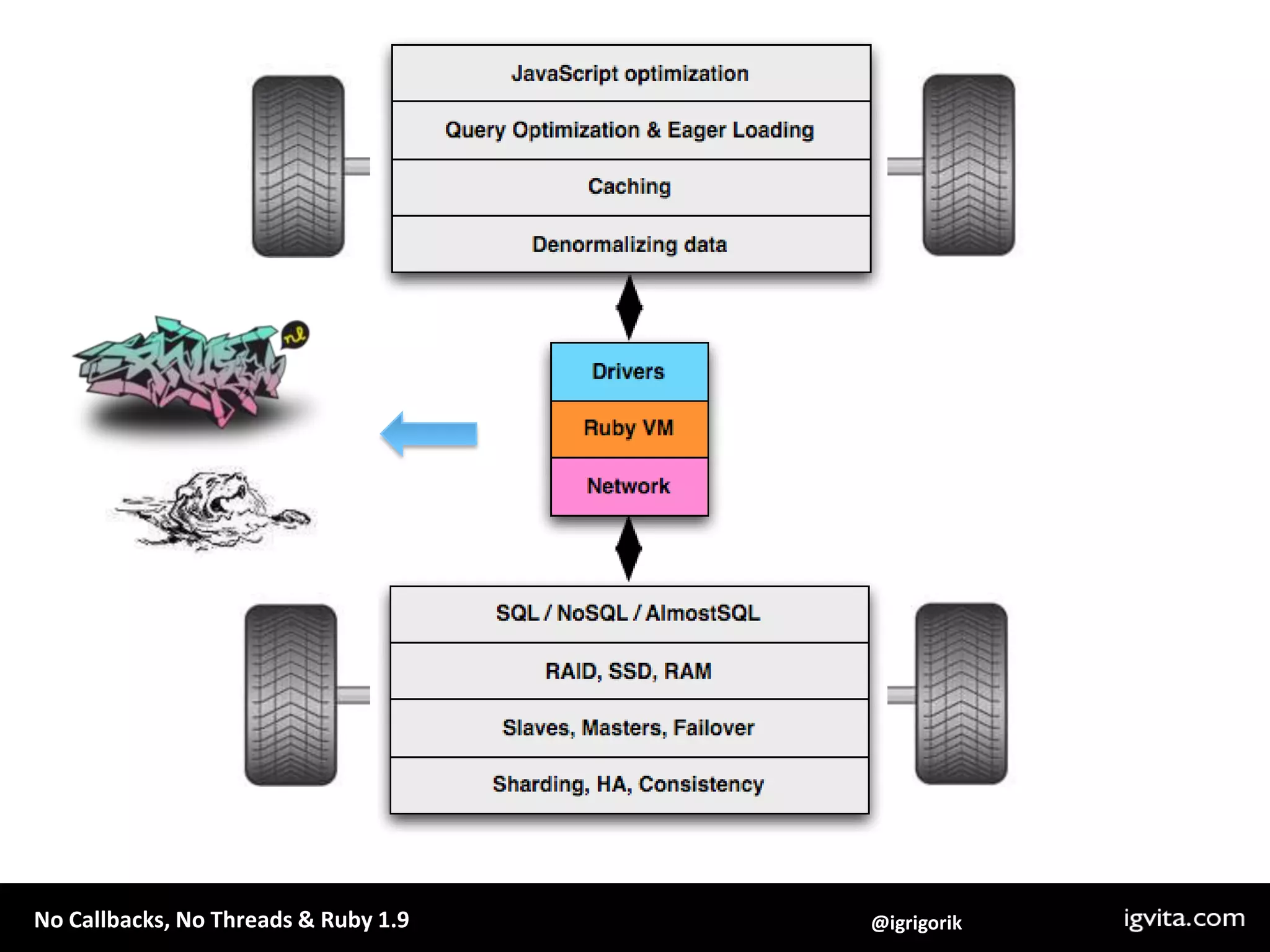
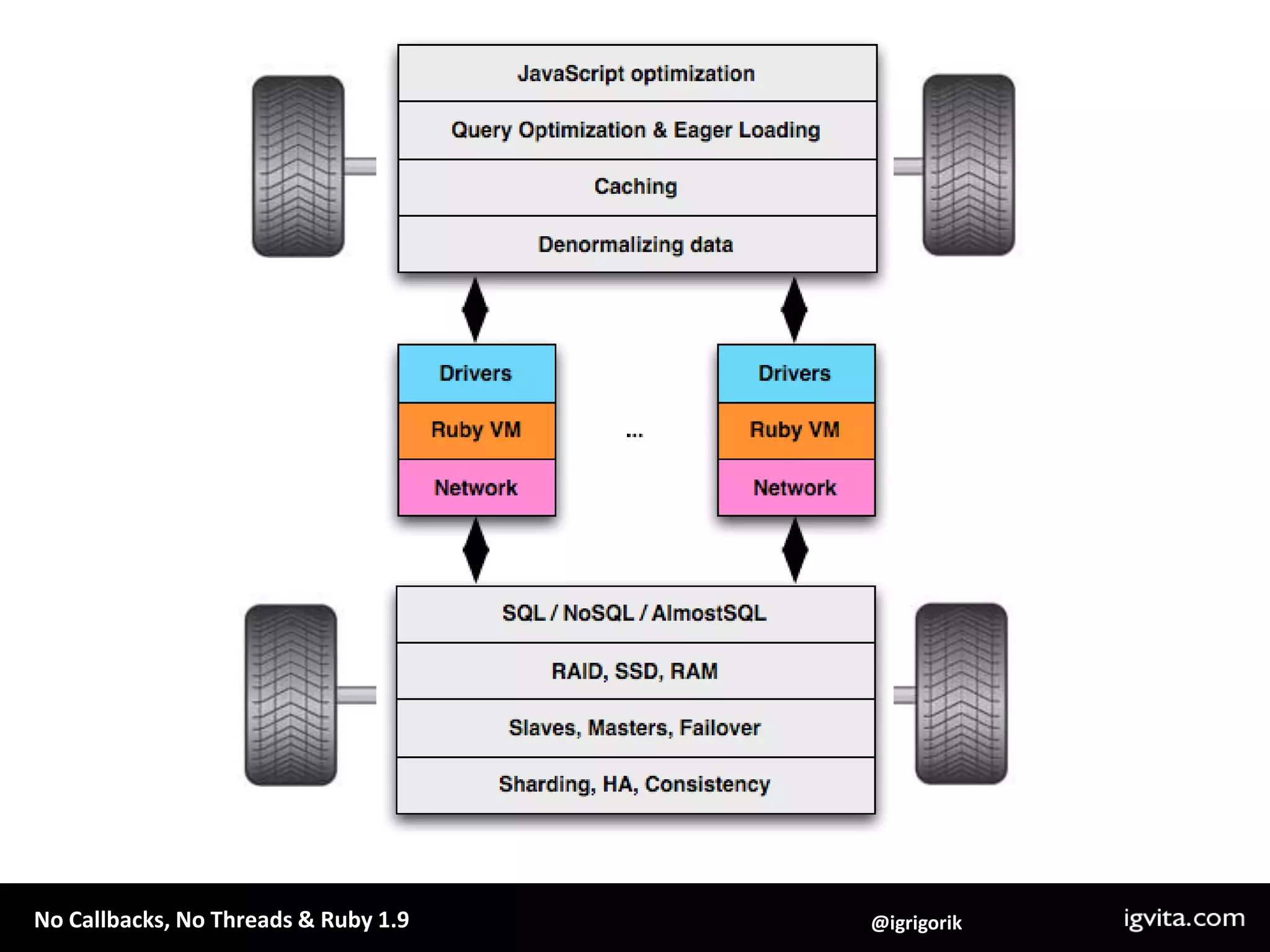
BHP% power     lossWHP
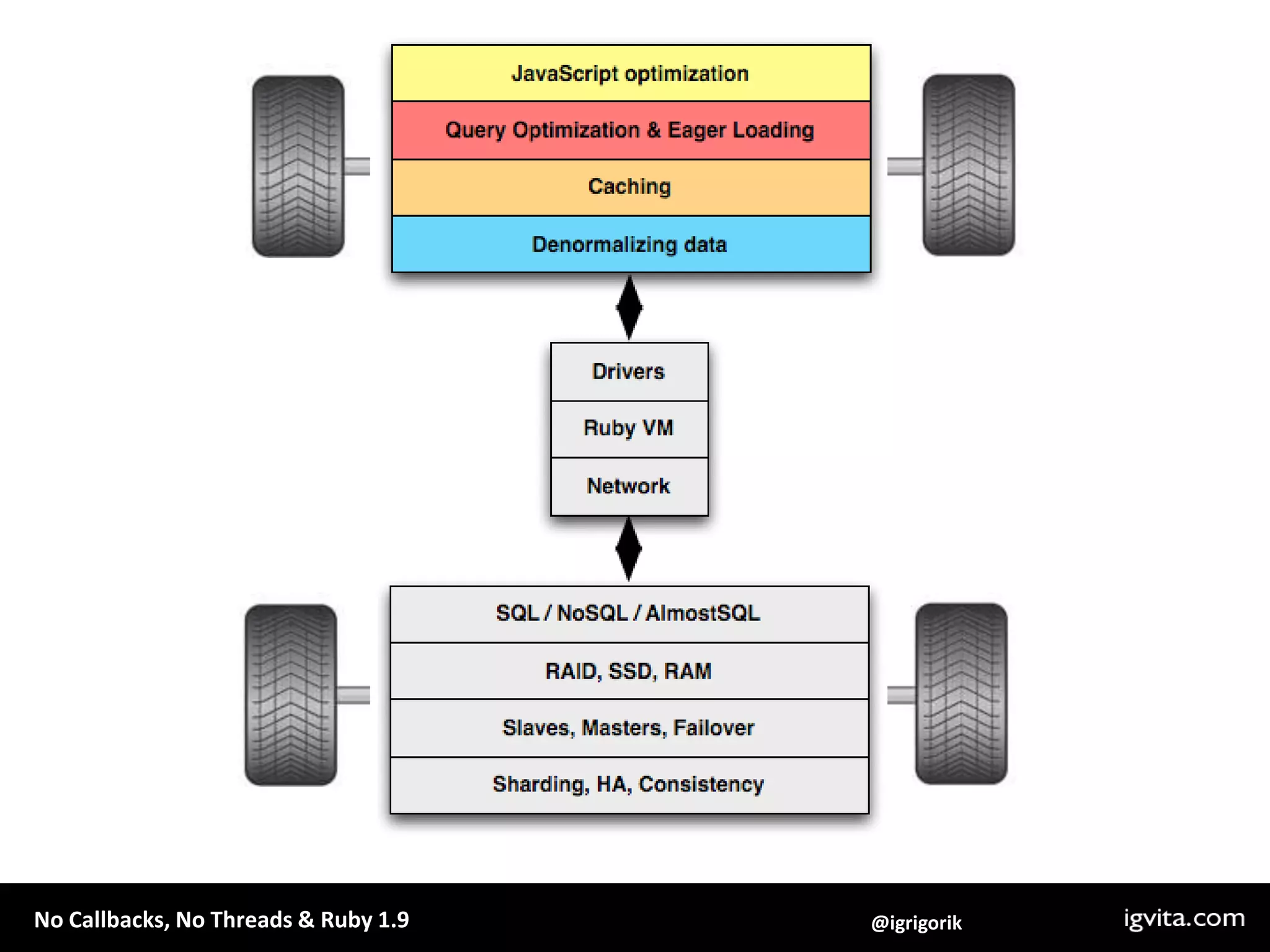
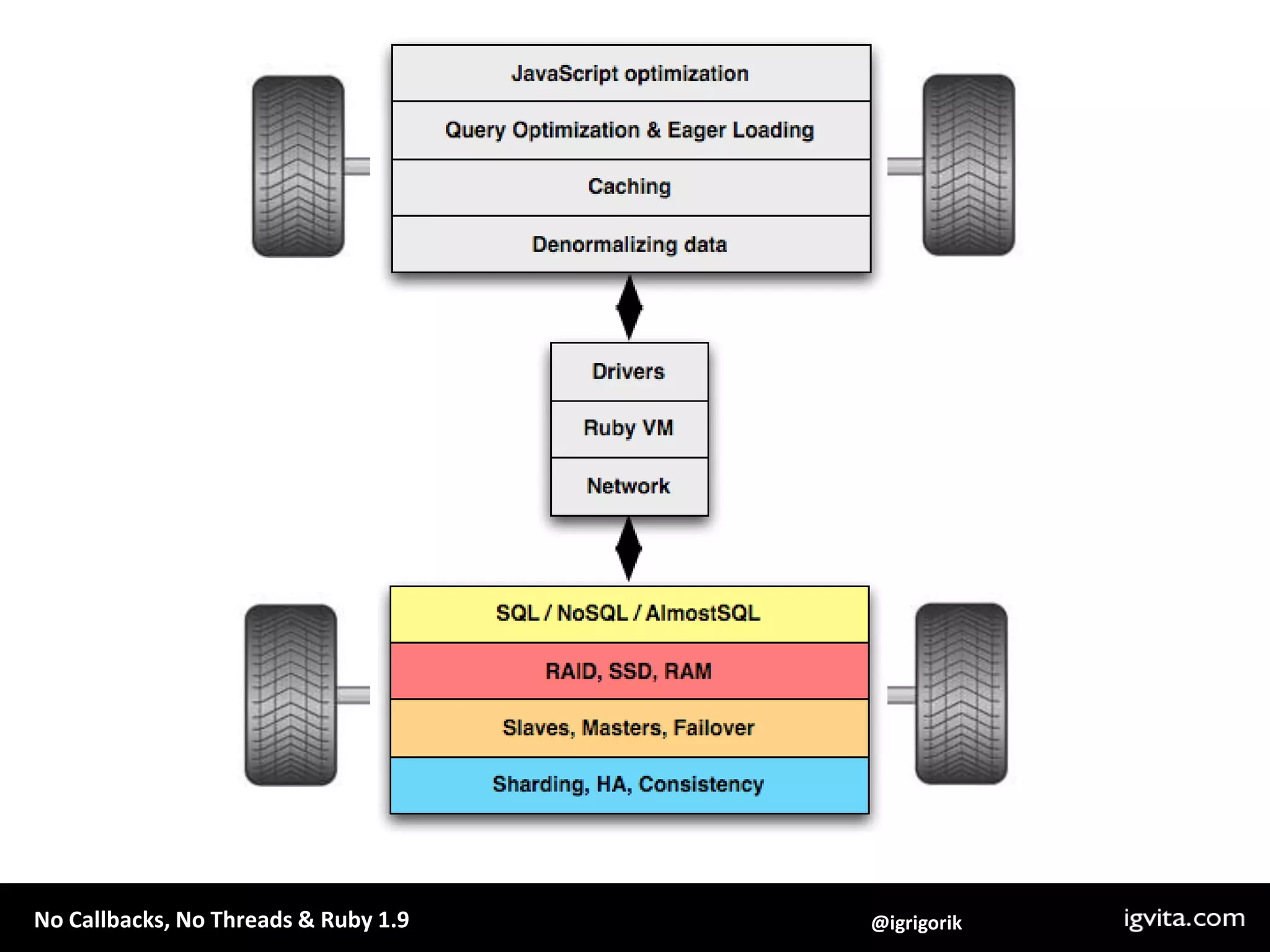
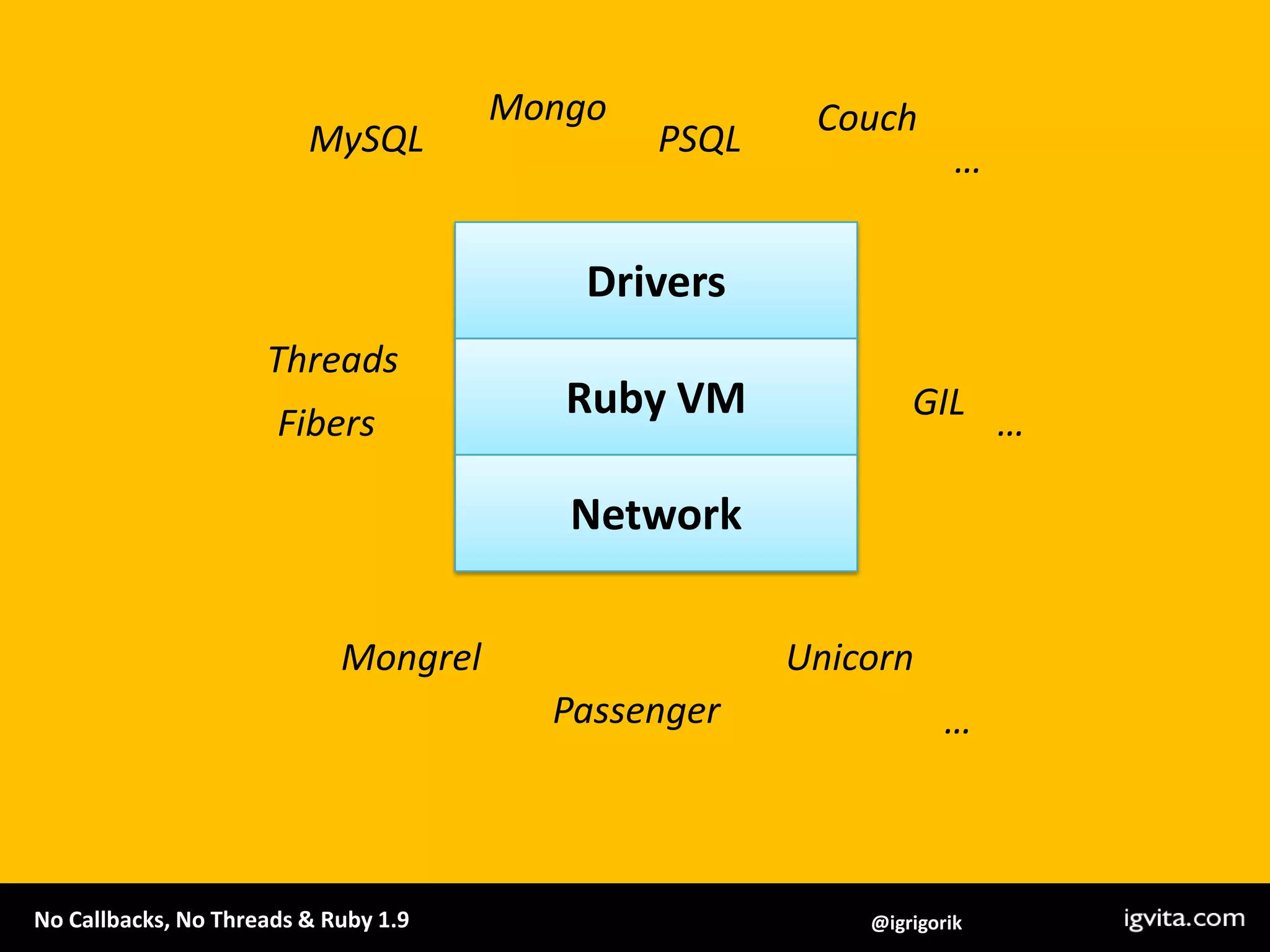
MongoCouchMySQLPSQL…DriversThreadsRuby VMGILFibers…NetworkMongrelUnicornPassenger…
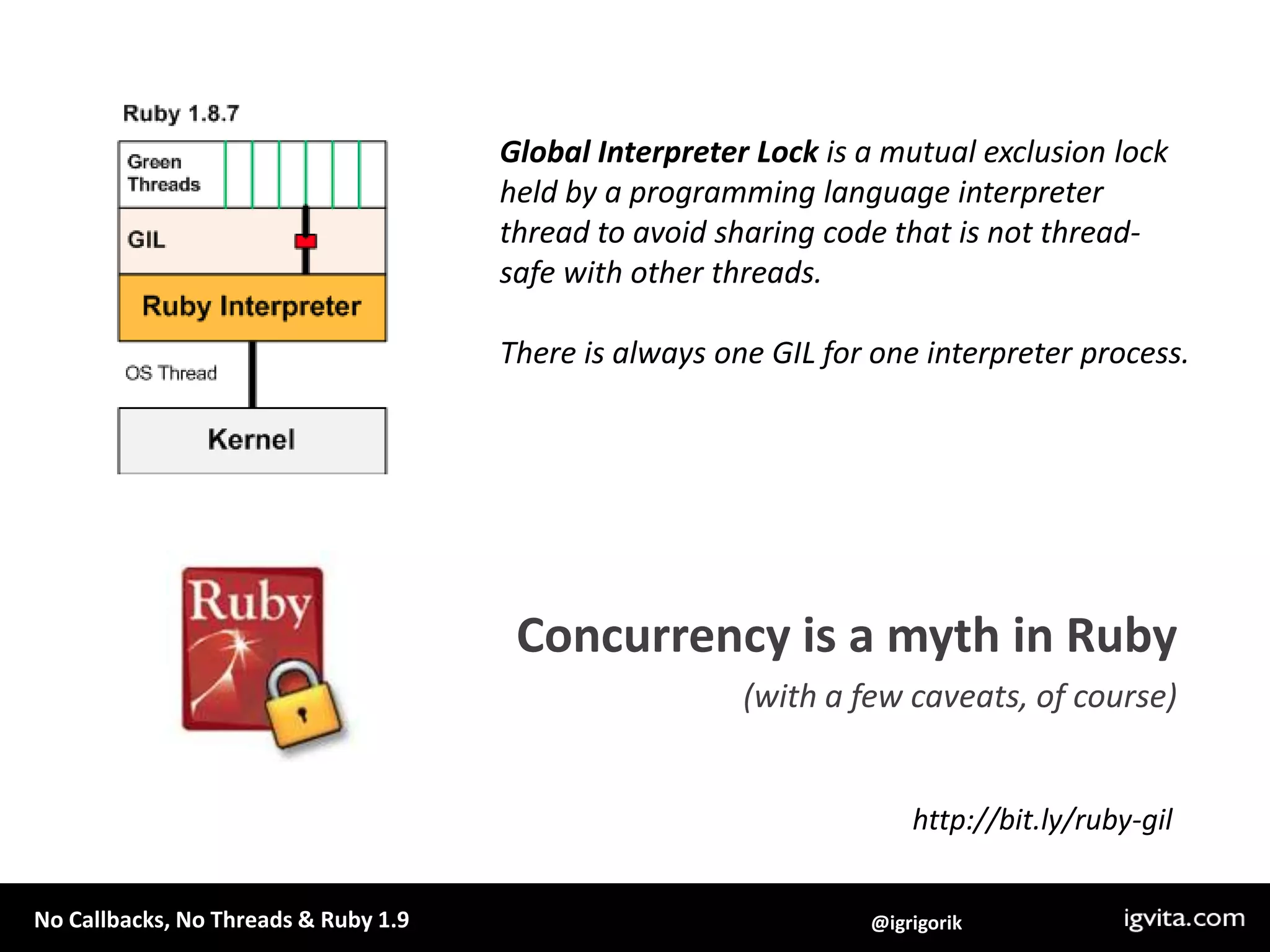
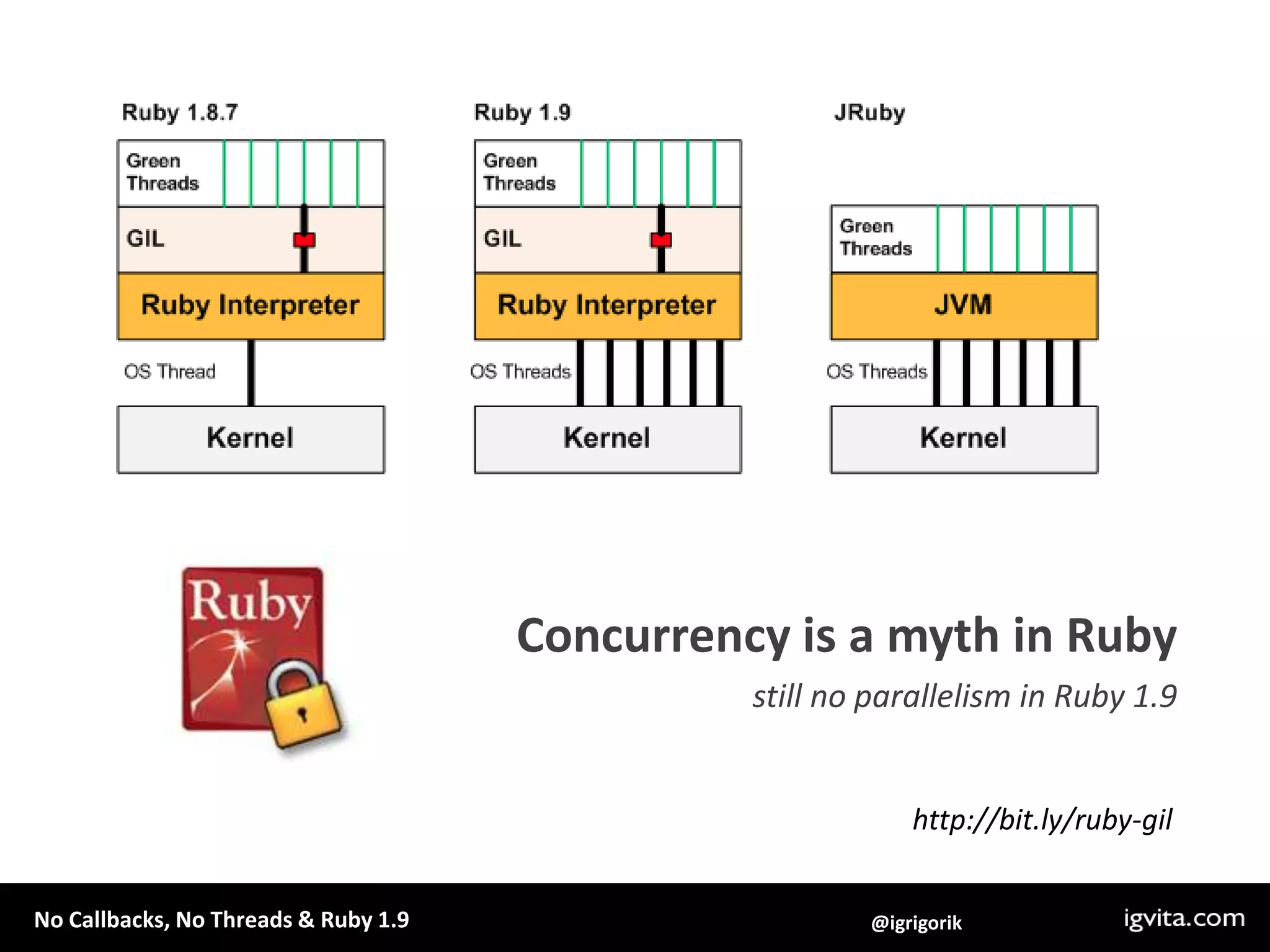
Global Interpreter Lock is a mutual exclusion lock held by a programming language interpreter thread to avoid sharing code that is not thread-safe with other threads. There is always one GIL for one interpreter process.Concurrency is a myth in Ruby(with a few caveats, of course)http://bit.ly/ruby-gil
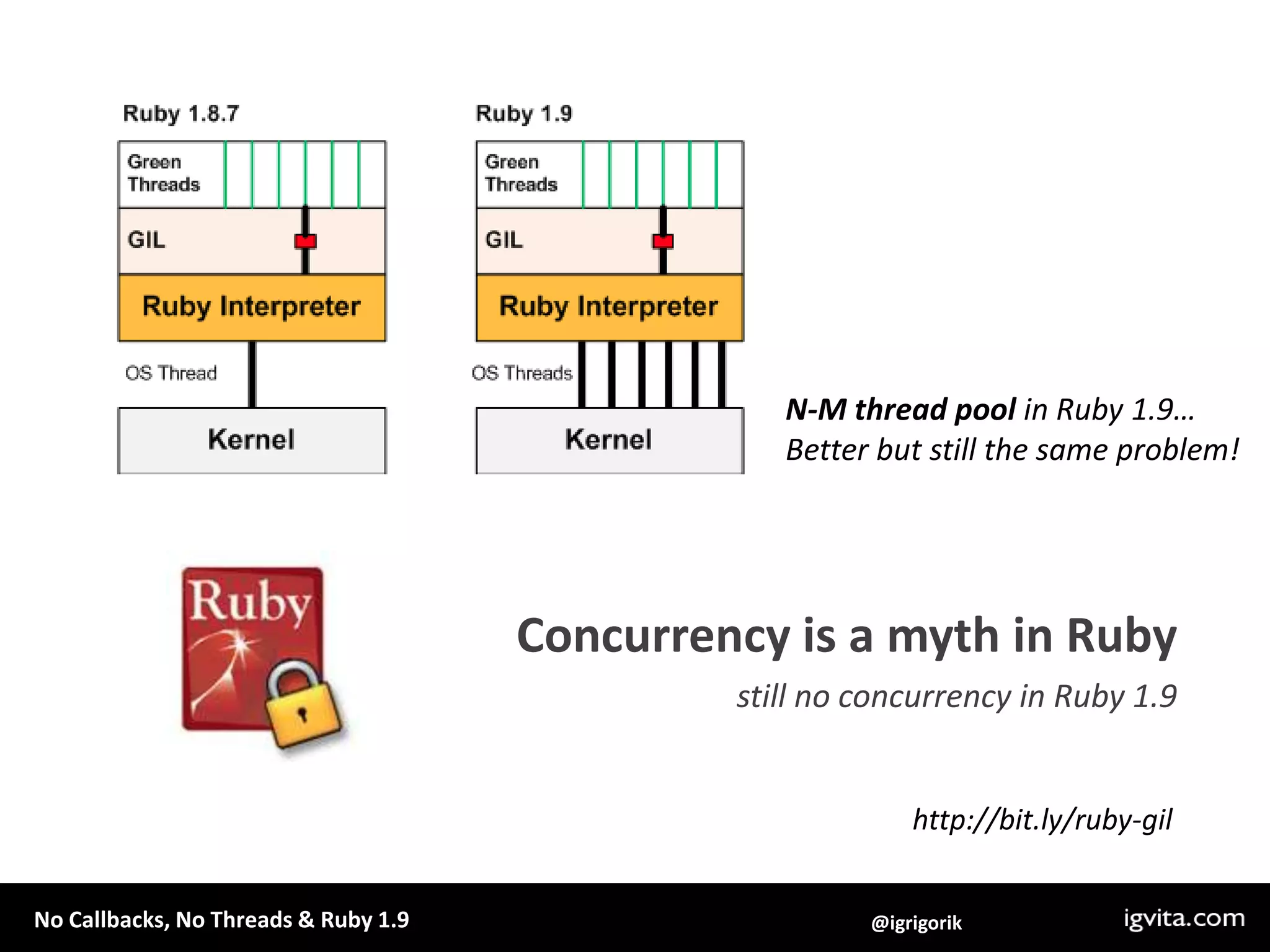
N-M thread pool in Ruby 1.9…Better but still the same problem!Concurrency is a myth in Rubystill no concurrency in Ruby 1.9http://bit.ly/ruby-gil
Concurrency is a myth in Rubystill no parallelism in Ruby 1.9http://bit.ly/ruby-gil
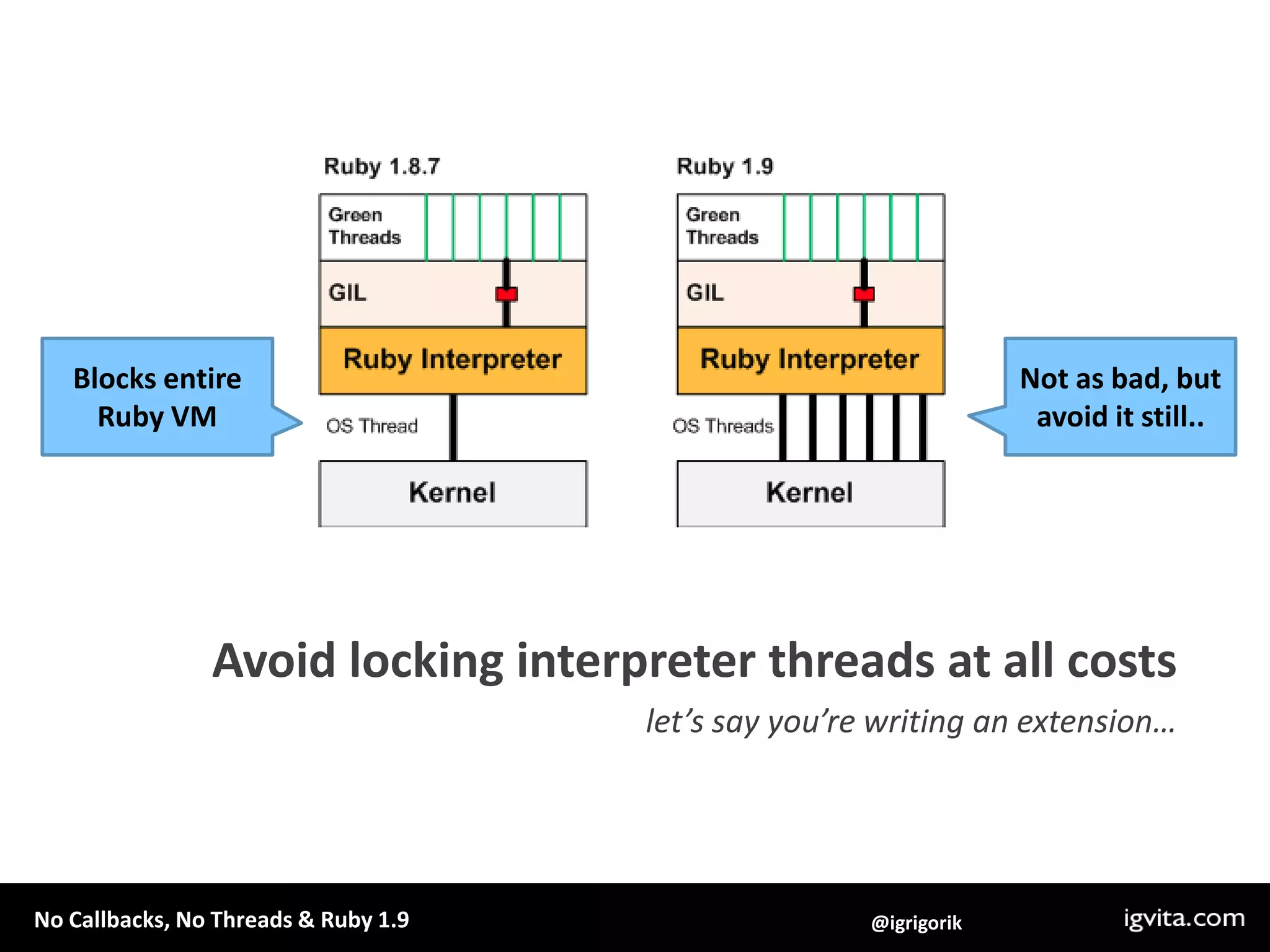
Blocks entireRuby VMNot as bad, butavoid it still..Avoid locking interpreter threads at all costslet’s say you’re writing an extension…
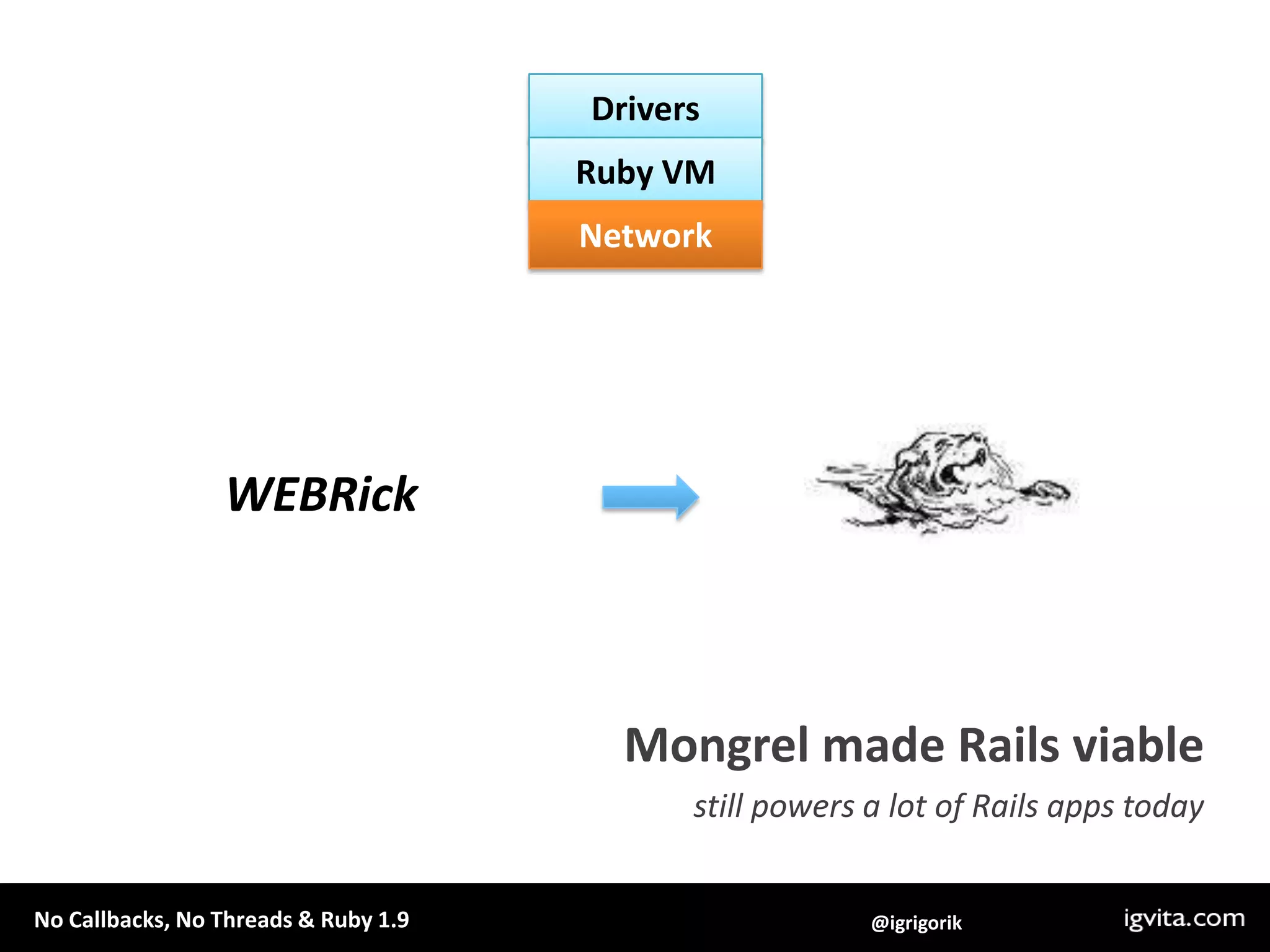
DriversRuby VMNetworkWEBRickMongrel made Rails viablestill powers a lot of Rails apps today
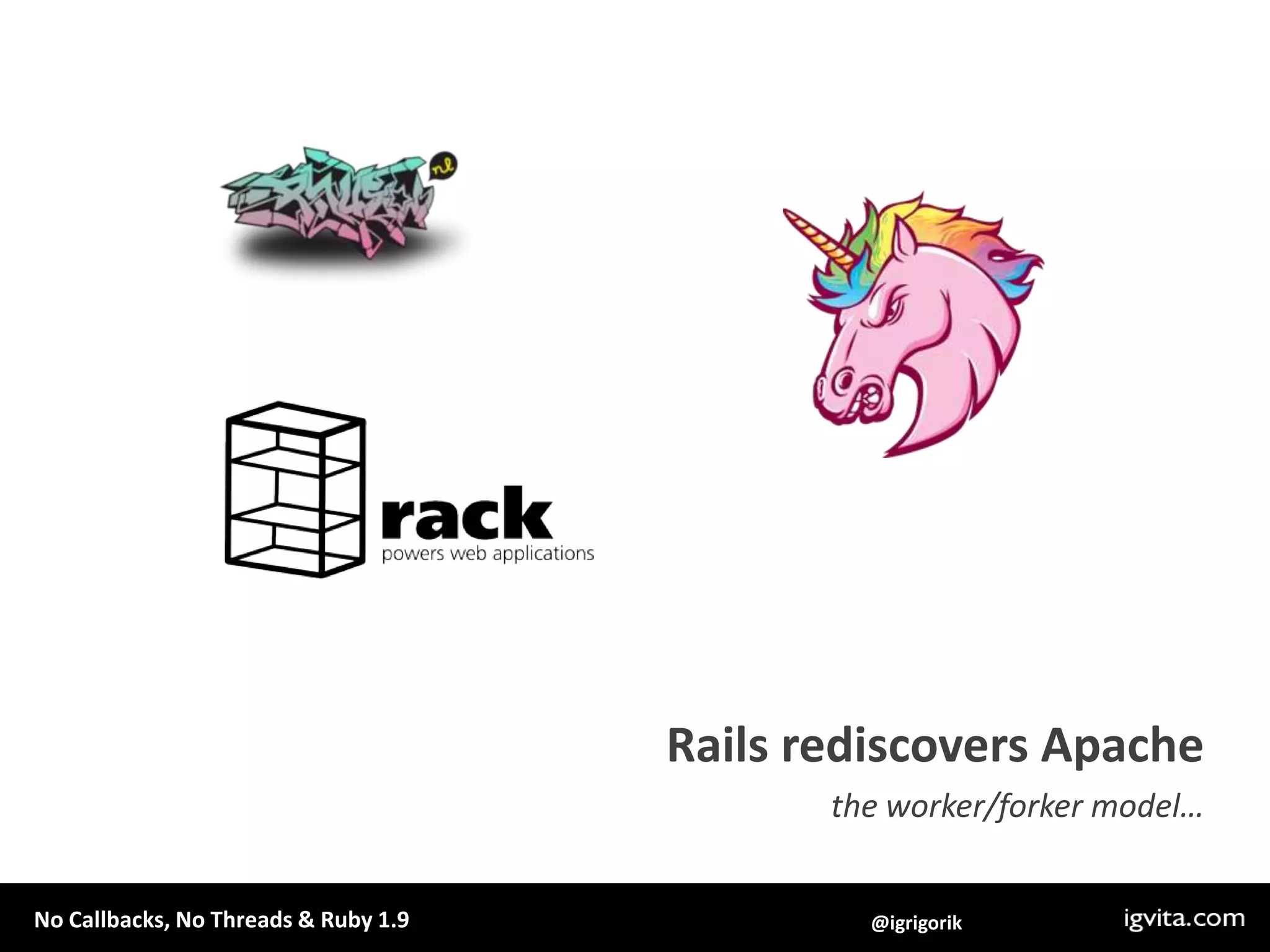
Rails rediscovers Apachethe worker/forker model…
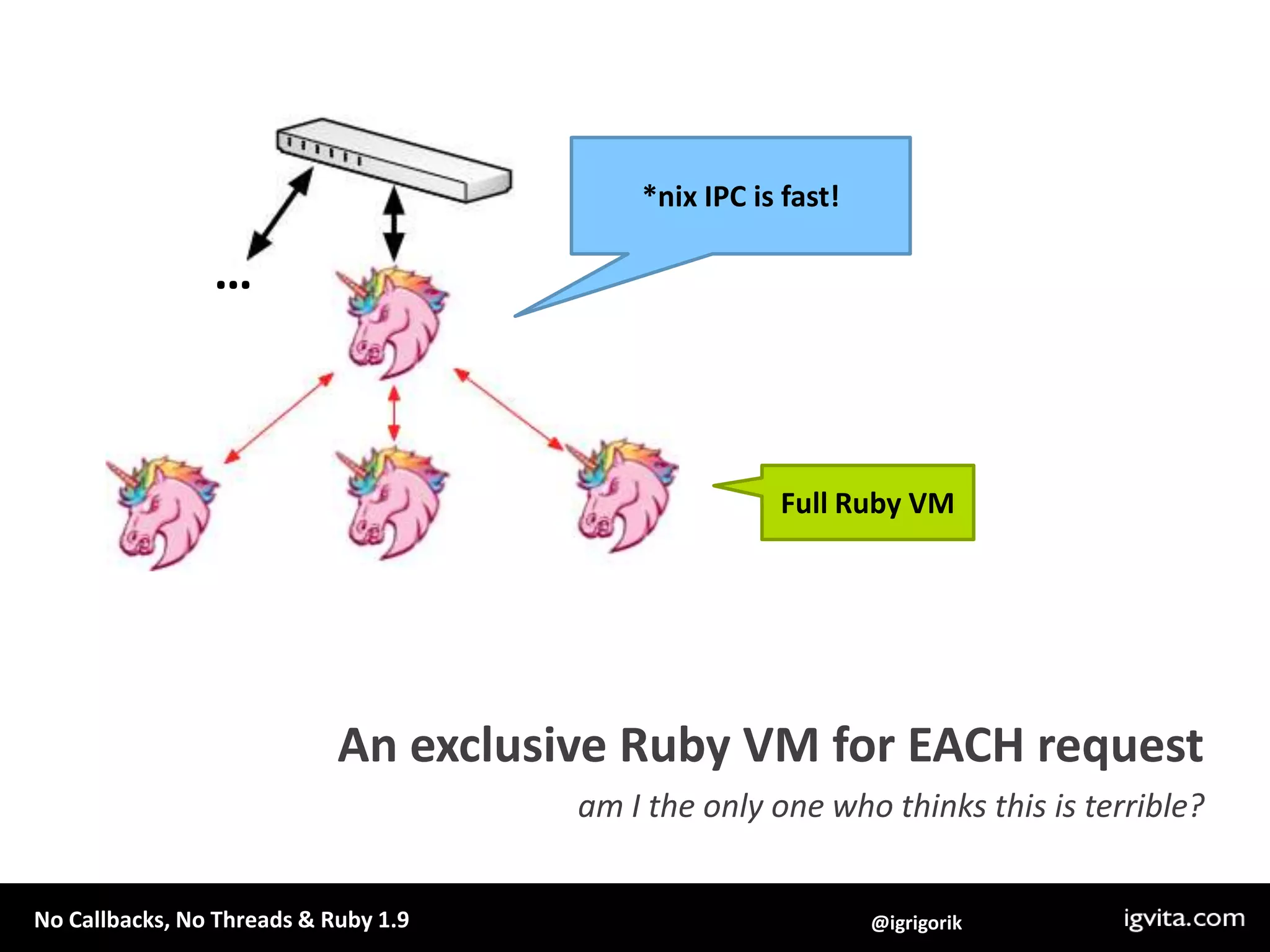
*nix IPC is fast! …Full Ruby VMAn exclusive Ruby VM for EACH requestam I the only one who thinks this is terrible?
“Does not care if your application is thread-safe or not, workers all run within their own isolated address space and only serve one client at a time for maximum robustness.”Robustness? That sounds like a bug.An exclusive Ruby VM for EACH requestam I the only one who thinks this is terrible?
…?
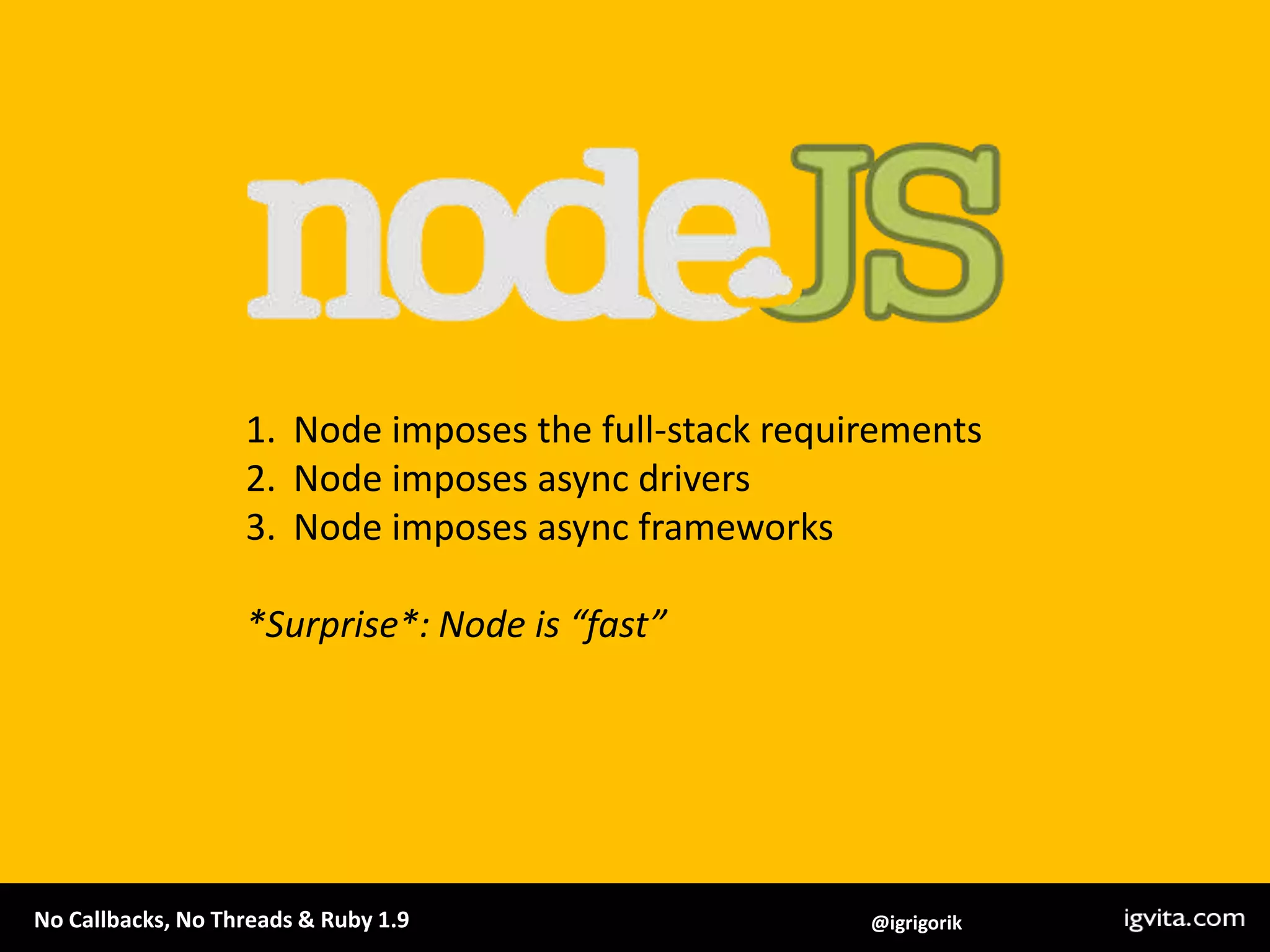
Node imposes the full-stack requirementsNode imposes async driversNode imposes async frameworks*Surprise*: Node is “fast”
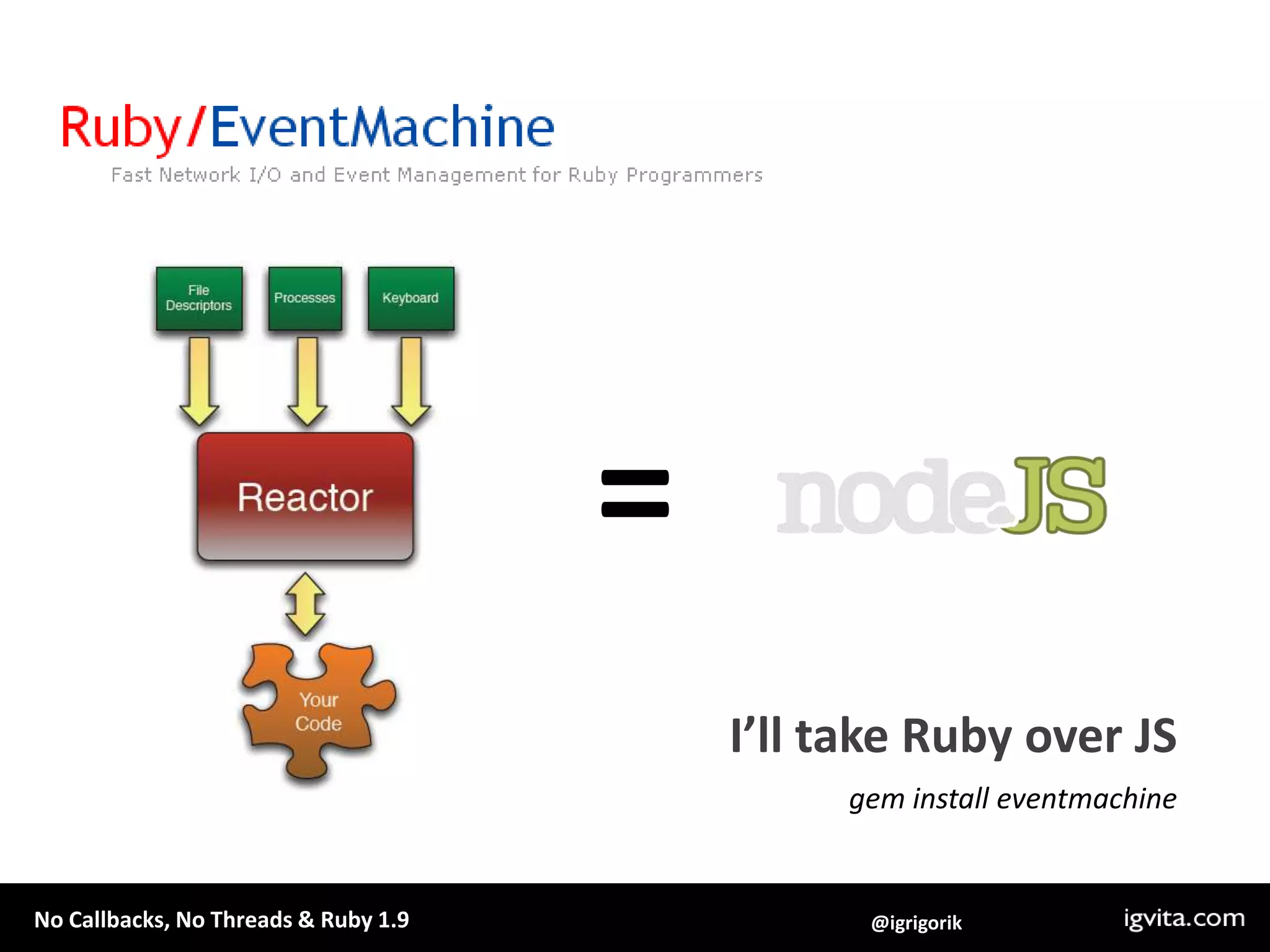
=I’ll take Ruby over JSgem install eventmachine
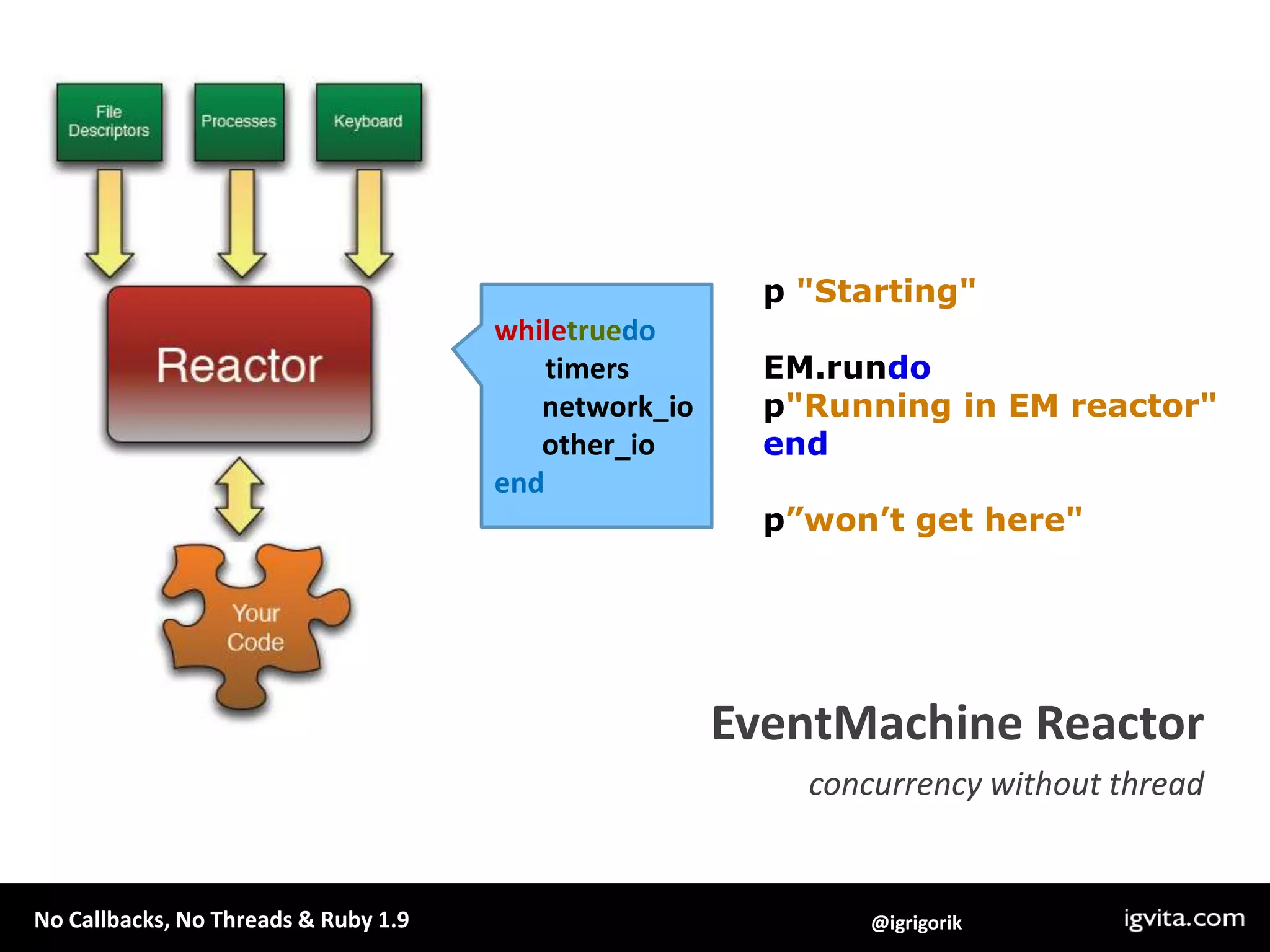
p "Starting"EM.rundop"Running in EM reactor"endp”won’t get here"whiletruedo       timersnetwork_ioother_ioendEventMachine Reactorconcurrency without thread
gem install em-mysqlplusEventMachine.rundoconn=EventMachine::MySQL.new(:host => 'localhost')  query =conn.query("select sleep(1)")query.callback { |res| pres.all_hashes }query.errback  { |res| pres.all_hashes }  puts ”executing…”endcallback fired 1s after “executing”# > ruby em-mysql-test.rb## executing…# [{"sleep(1)"=>"0"}]em-mysqlplus: exampleasyncMySQL driver
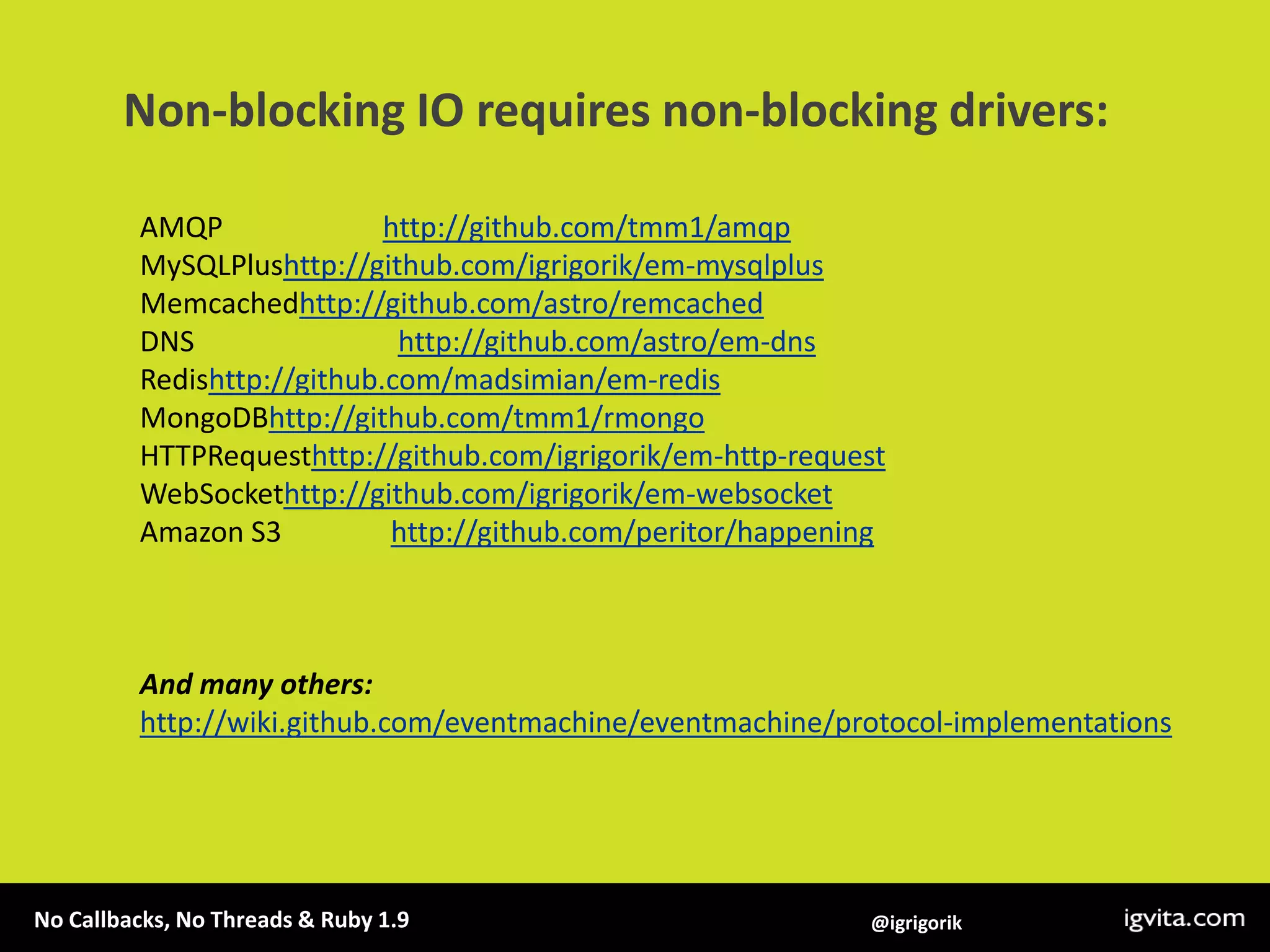
Non-blocking IO requires non-blocking drivers:AMQP                      http://github.com/tmm1/amqpMySQLPlushttp://github.com/igrigorik/em-mysqlplusMemcachedhttp://github.com/astro/remcachedDNS                            http://github.com/astro/em-dnsRedishttp://github.com/madsimian/em-redisMongoDBhttp://github.com/tmm1/rmongoHTTPRequesthttp://github.com/igrigorik/em-http-requestWebSockethttp://github.com/igrigorik/em-websocketAmazon S3               http://github.com/peritor/happeningAnd many others: http://wiki.github.com/eventmachine/eventmachine/protocol-implementations
httpA=EventMachine::HttpRequest.new(URL).gethttpA.errback {# retry logic?}httpA.callback {Memcached.set(:key => URL, :value => httpA.response) { |response|caseresponse[:status]whenMemcached::Errors::NO_ERROR# That's goodwhenMemcached::Errors::DISCONNECTED# Maybe stop filling the cache for now?else# What could've gone wrong?end  }}http =get(url)memc=save(url, http.response)ifmemc.error?# That's goodelse# Err?endaccidental complexityasync is harder to manage
and this callback goes to…
We can do better than node.jsall the benefits of evented code without the drawbacks
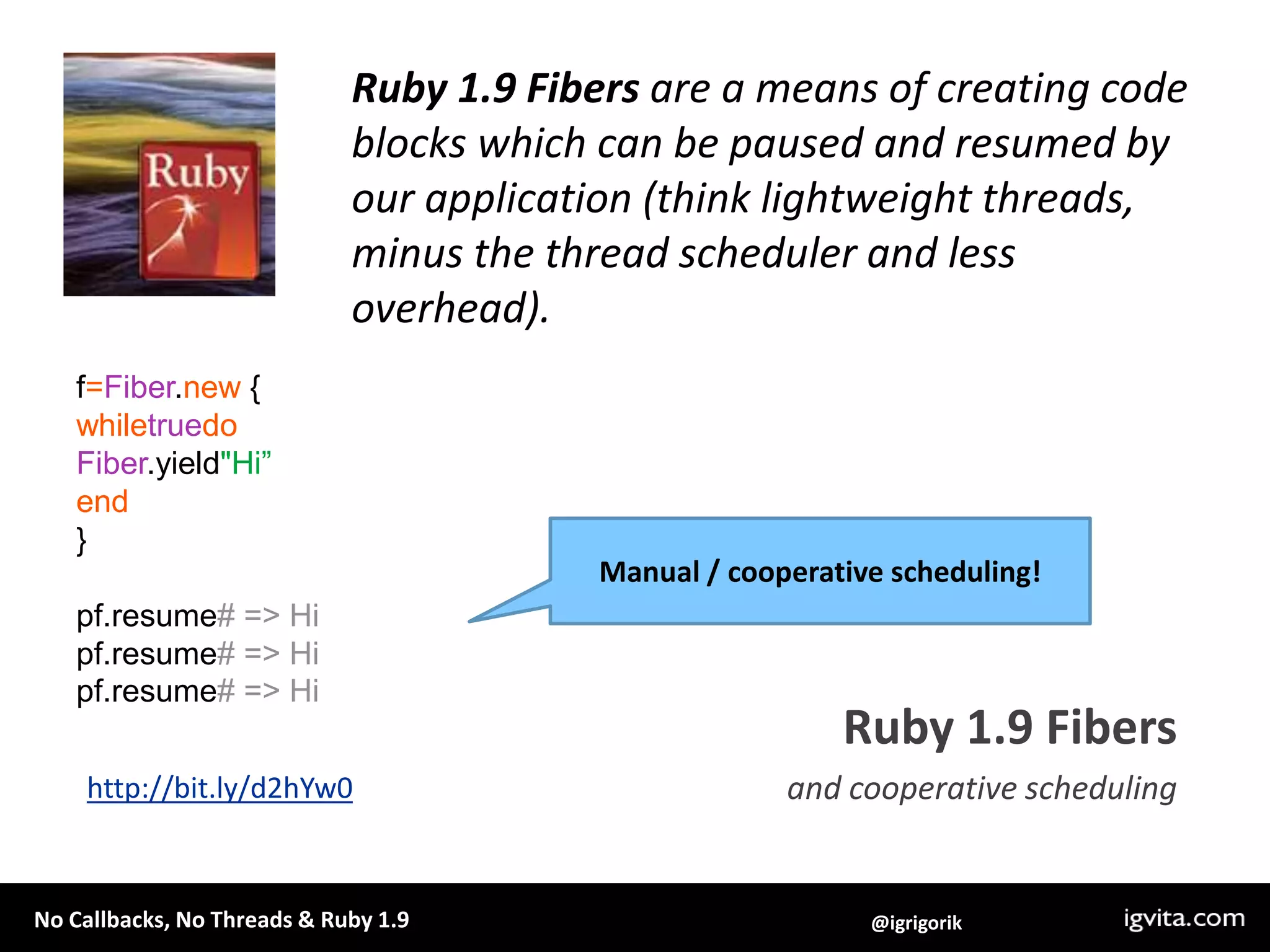
Ruby 1.9 Fibers are a means of creating code blocks which can be paused and resumed by our application (think lightweight threads, minus the thread scheduler and less overhead). f=Fiber.new {whiletruedoFiber.yield"Hi”end}pf.resume# => Hipf.resume# => Hipf.resume# => HiManual / cooperative scheduling!Ruby 1.9 Fibersand cooperative schedulinghttp://bit.ly/d2hYw0
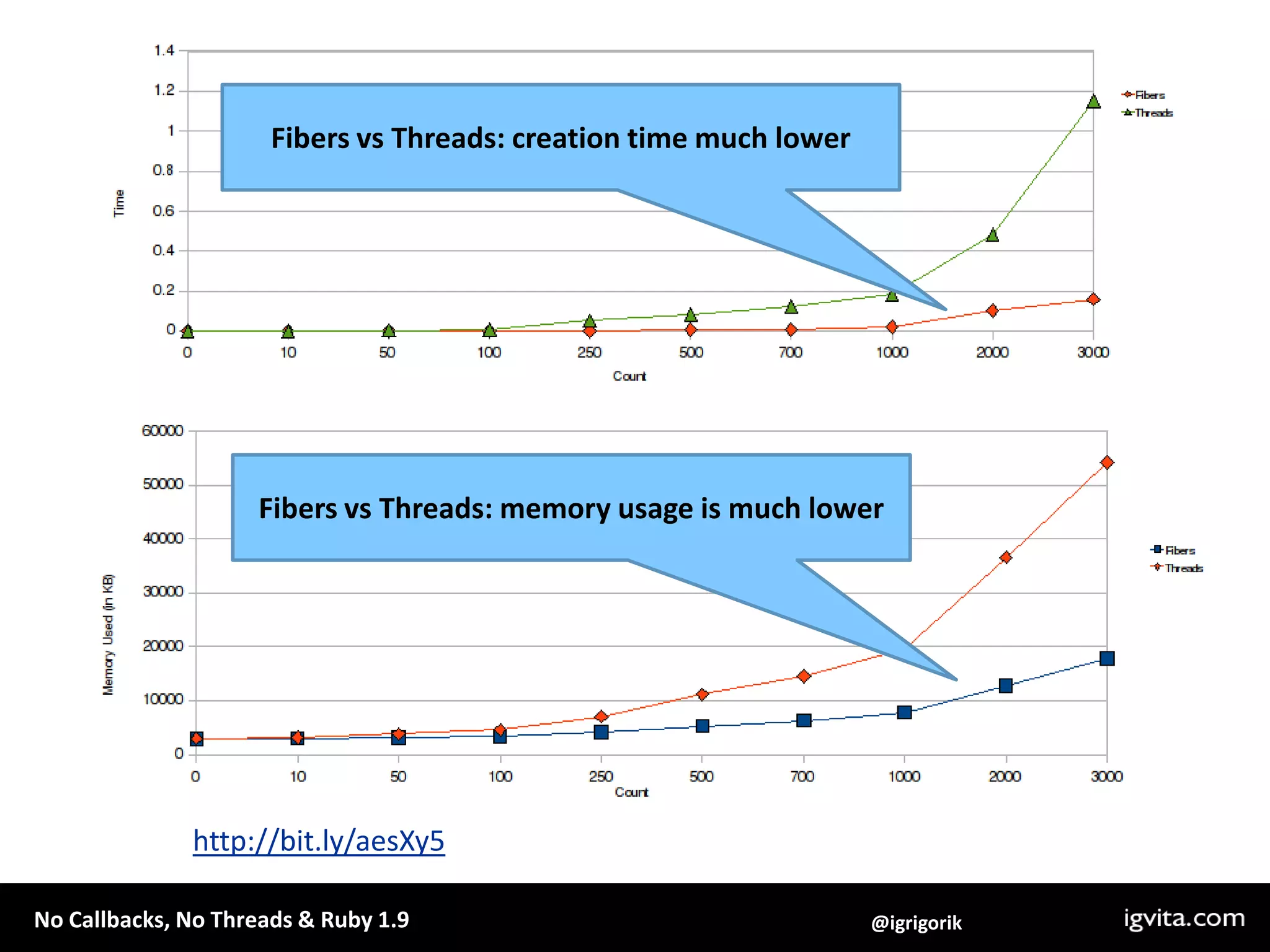
Fibers vs Threads: creation time much lowerFibers vs Threads: memory usage is much lowerRuby 1.9 Fibersand cooperative schedulinghttp://bit.ly/aesXy5
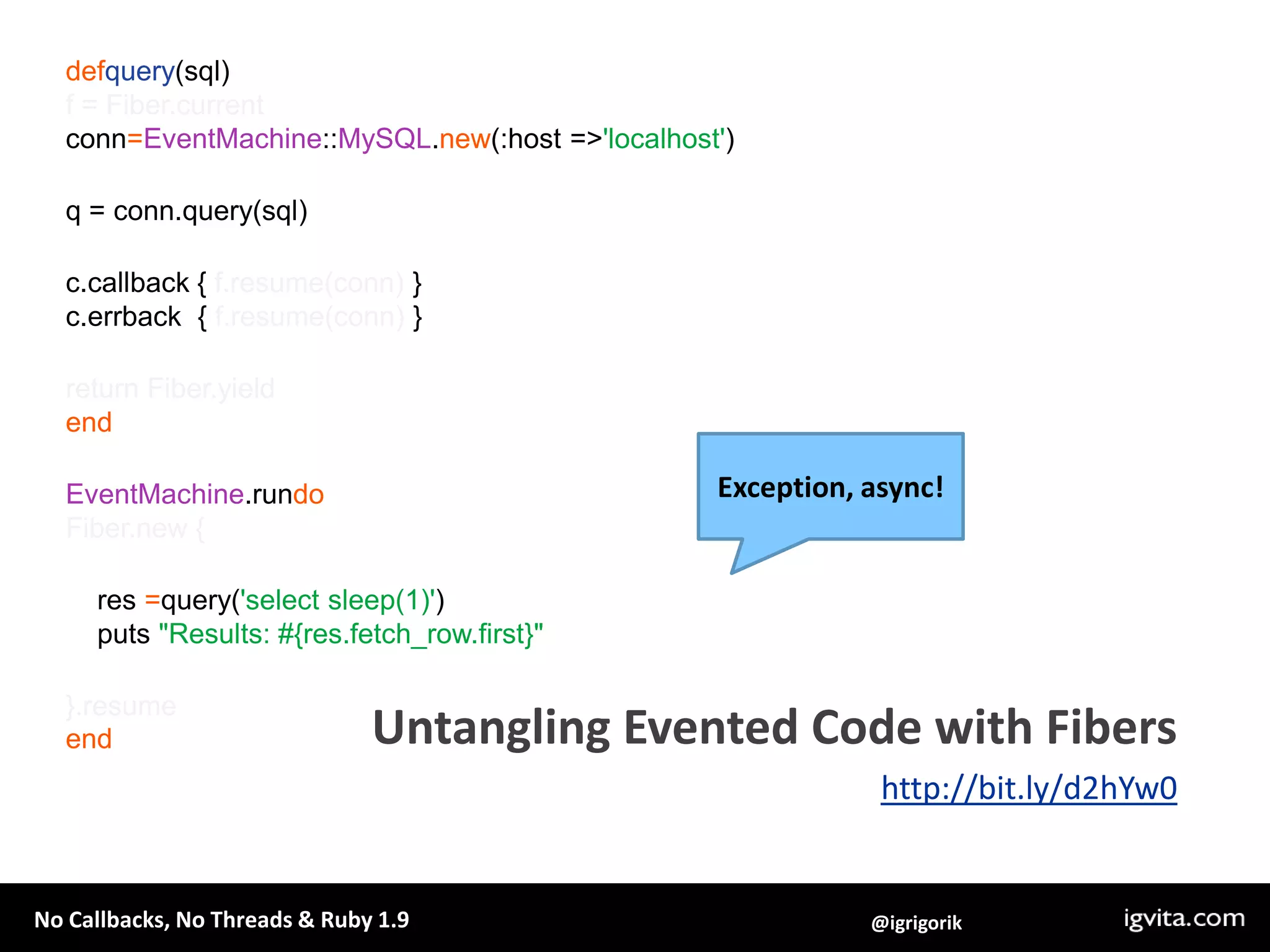
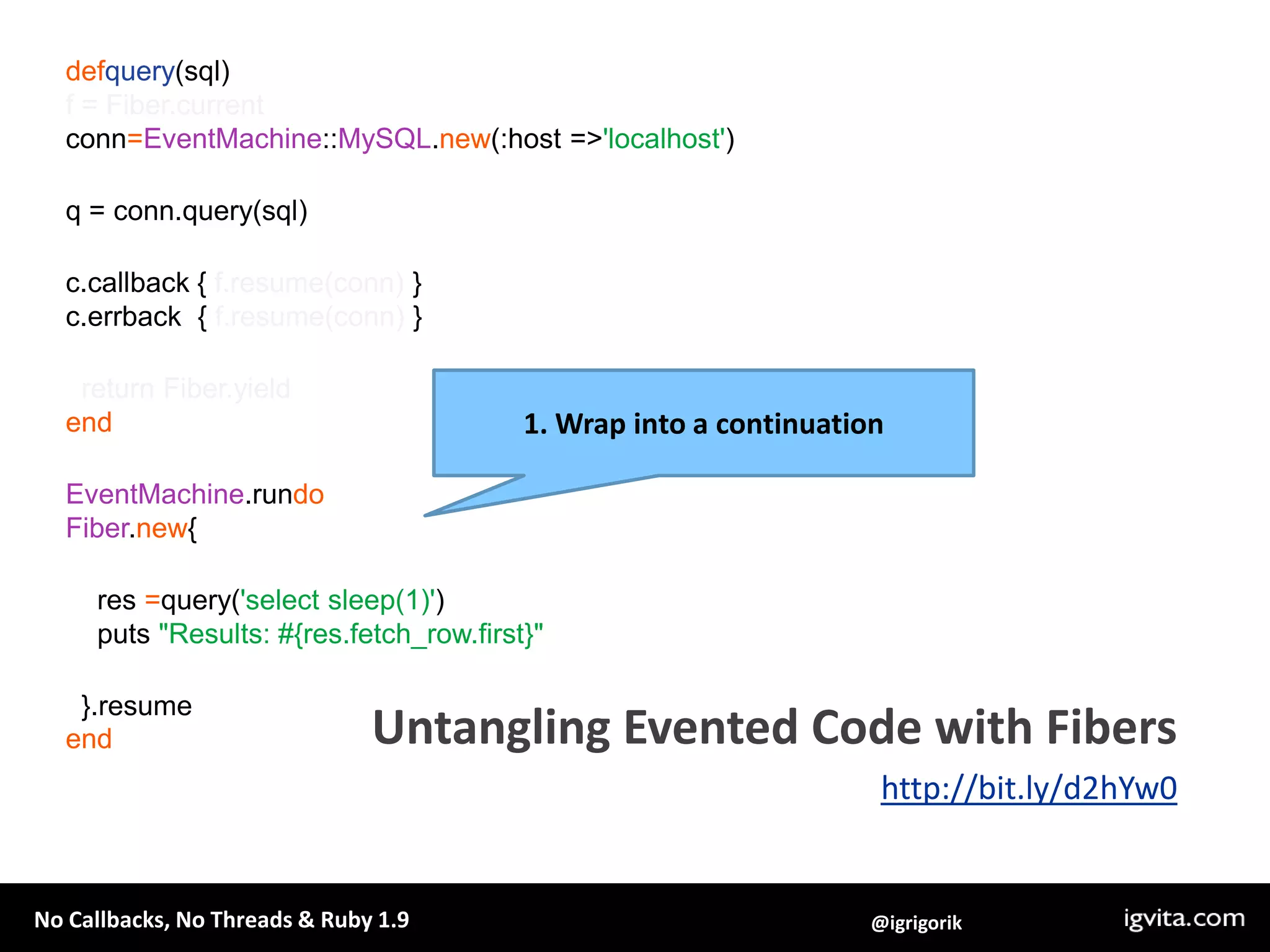
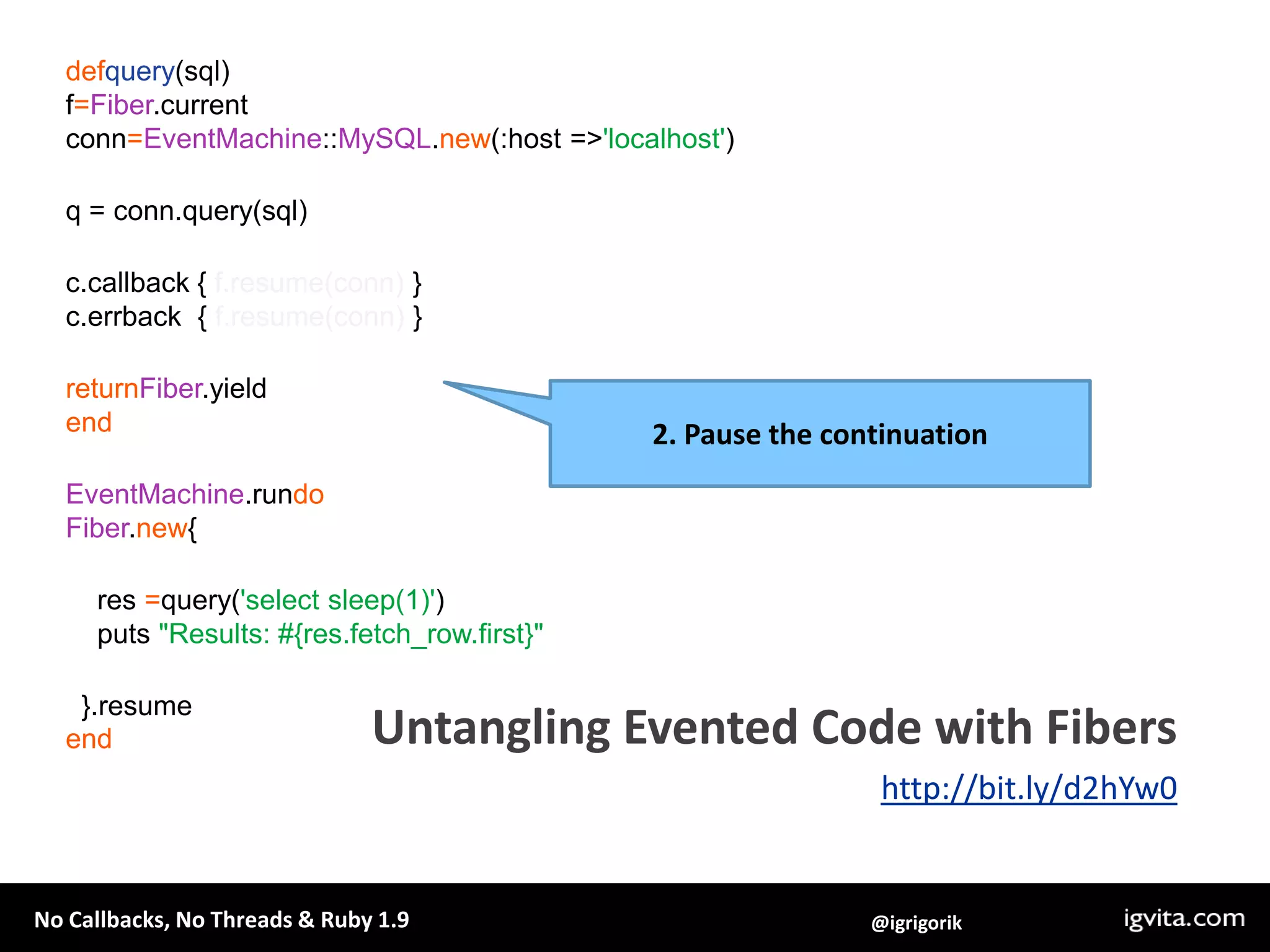
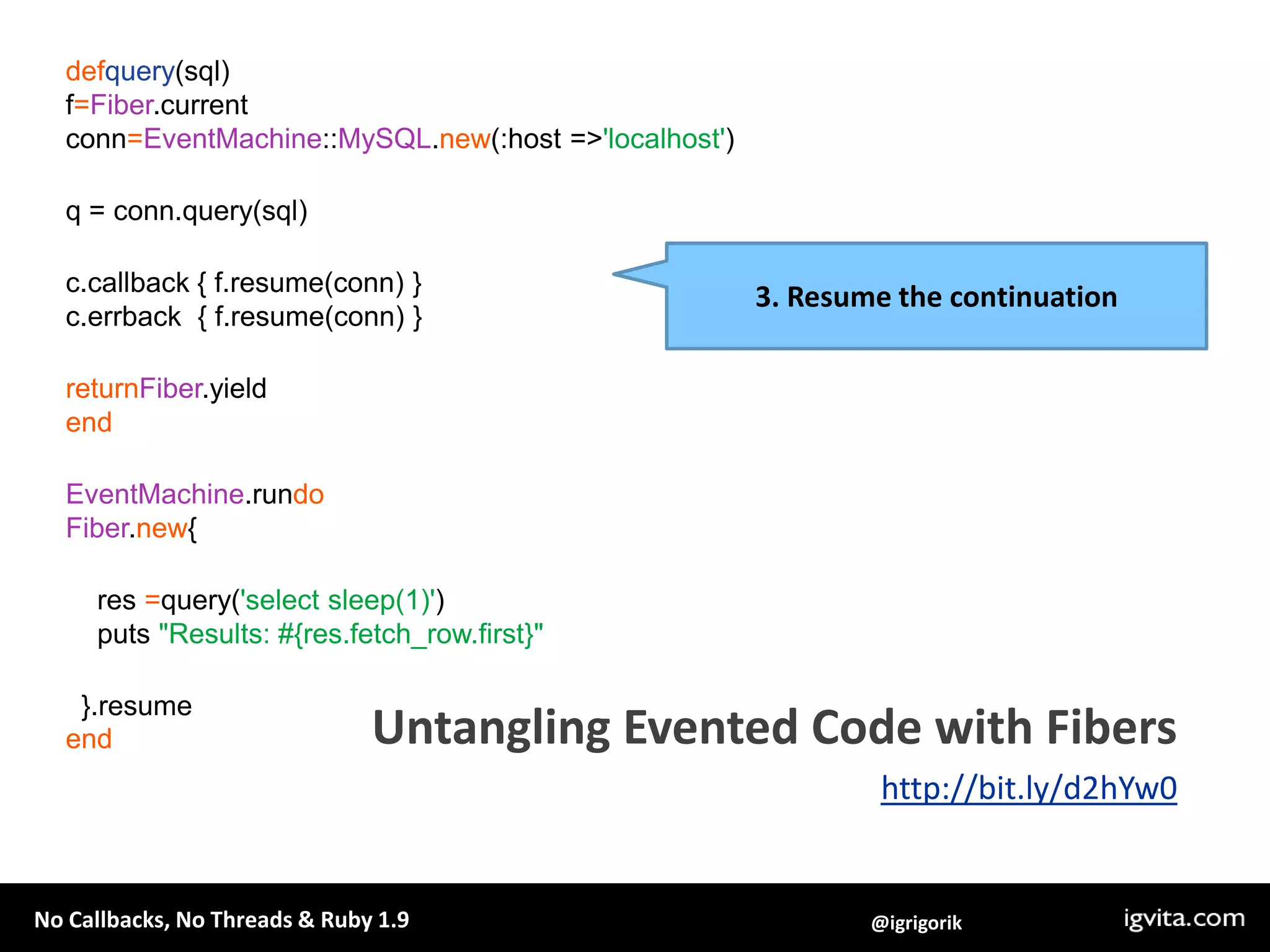
defquery(sql)f = Fiber.currentconn=EventMachine::MySQL.new(:host => 'localhost')q = conn.query(sql)c.callback { f.resume(conn) }c.errback  { f.resume(conn) }return Fiber.yieldendEventMachine.rundoFiber.new {    res =query('select sleep(1)')    puts "Results: #{res.fetch_row.first}"}.resumeendException, async!Untangling Evented Code with Fibershttp://bit.ly/d2hYw0
defquery(sql)f = Fiber.currentconn=EventMachine::MySQL.new(:host => 'localhost')q = conn.query(sql)c.callback { f.resume(conn) }c.errback  { f.resume(conn) }  return Fiber.yieldendEventMachine.rundoFiber.new{    res =query('select sleep(1)')    puts "Results: #{res.fetch_row.first}"  }.resumeend1. Wrap into a continuationUntangling Evented Code with Fibershttp://bit.ly/d2hYw0
defquery(sql)f=Fiber.currentconn=EventMachine::MySQL.new(:host => 'localhost')q = conn.query(sql)c.callback { f.resume(conn) }c.errback  { f.resume(conn) }returnFiber.yieldendEventMachine.rundoFiber.new{    res =query('select sleep(1)')    puts "Results: #{res.fetch_row.first}"  }.resumeend2. Pause the continuationUntangling Evented Code with Fibershttp://bit.ly/d2hYw0
defquery(sql)f=Fiber.currentconn=EventMachine::MySQL.new(:host => 'localhost')q = conn.query(sql)c.callback { f.resume(conn) }c.errback  { f.resume(conn) }returnFiber.yieldendEventMachine.rundoFiber.new{    res =query('select sleep(1)')    puts "Results: #{res.fetch_row.first}"  }.resumeend3. Resume the continuationUntangling Evented Code with Fibershttp://bit.ly/d2hYw0
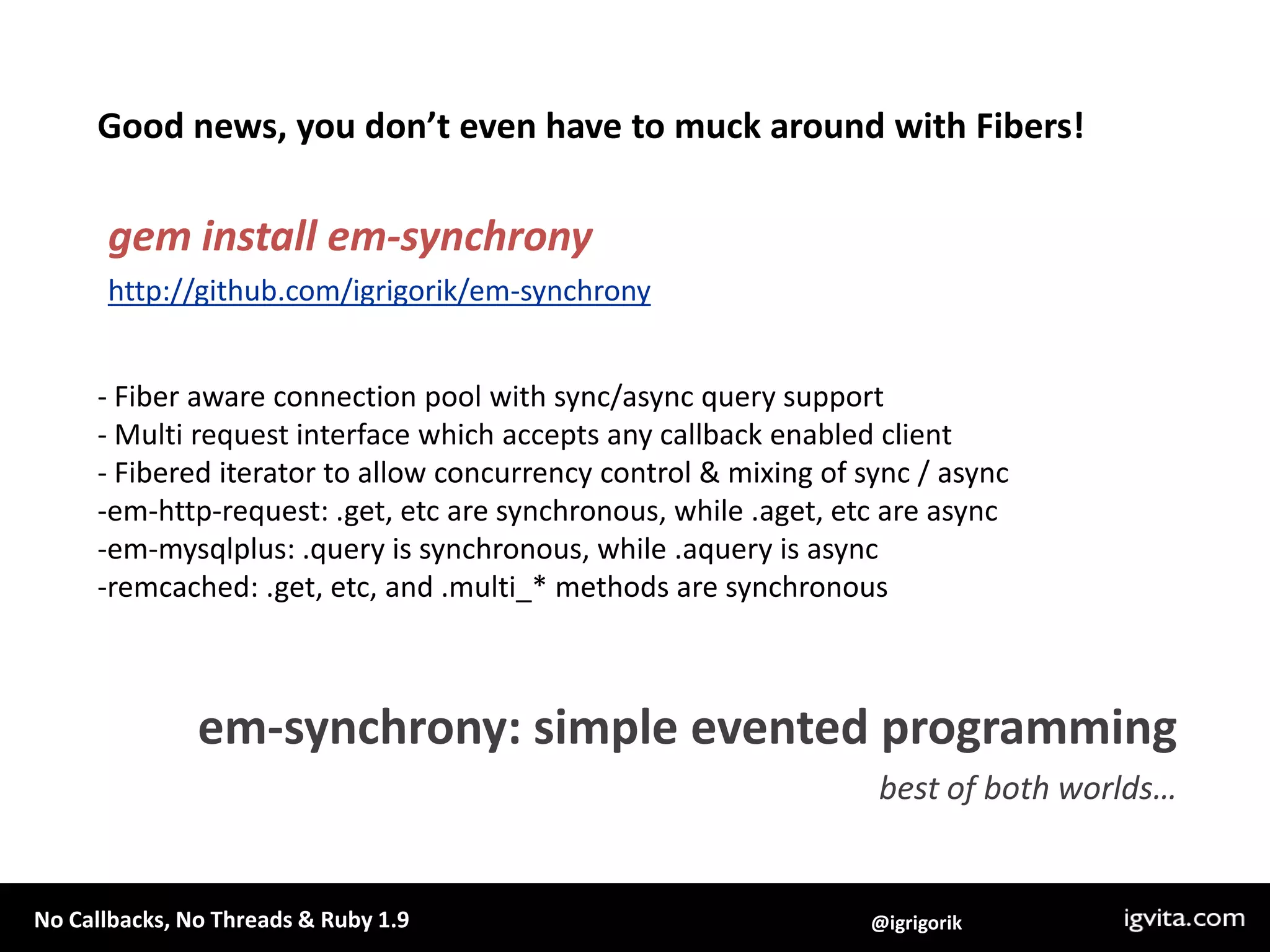
Good news, you don’t even have to muck around with Fibers!gem install em-synchronyhttp://github.com/igrigorik/em-synchrony Fiber aware connection pool with sync/async query support
 Multi request interface which accepts any callback enabled client
 Fibered iterator to allow concurrency control & mixing of sync / async
em-http-request: .get, etc are synchronous, while .aget, etc are async
em-mysqlplus: .query is synchronous, while .aquery is async
remcached: .get, etc, and .multi_* methods are synchronousem-synchrony: simple evented programmingbest of both worlds…
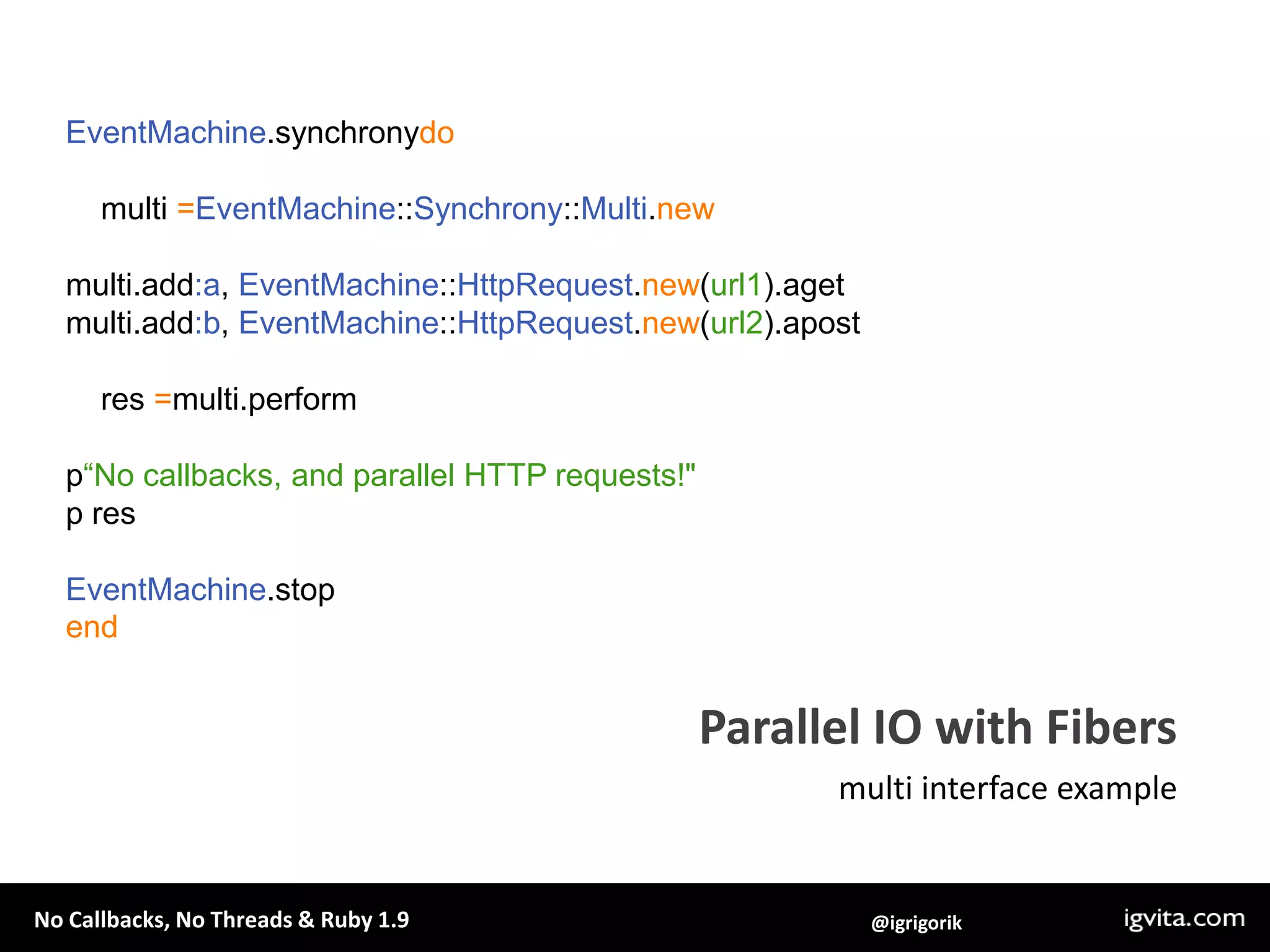
EventMachine.synchronydo    multi =EventMachine::Synchrony::Multi.newmulti.add:a, EventMachine::HttpRequest.new(url1).agetmulti.add:b, EventMachine::HttpRequest.new(url2).apost    res =multi.performp“No callbacks, and parallel HTTP requests!"p resEventMachine.stopendParallel IO with Fibersmulti interface example
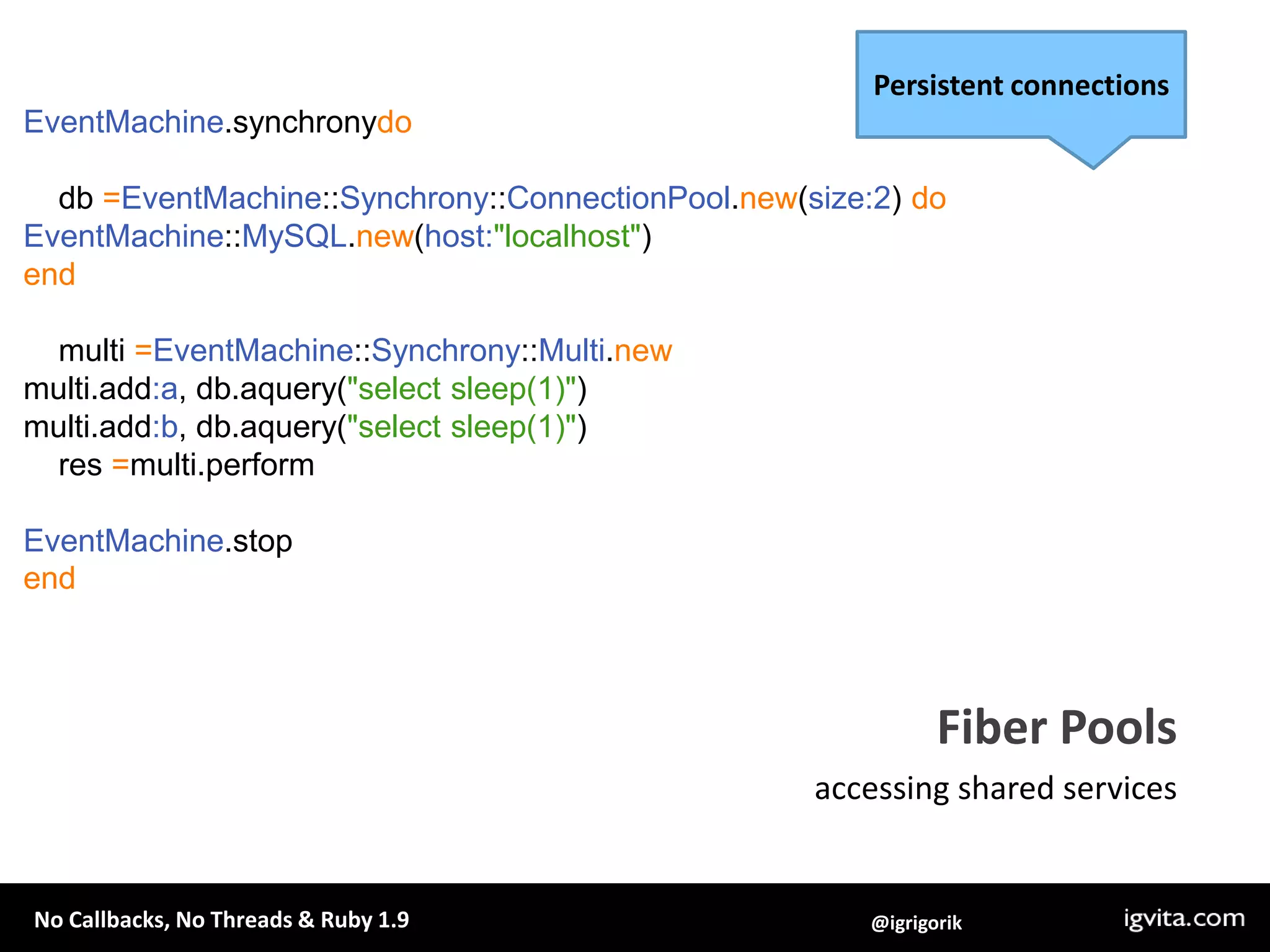
Persistent connectionsEventMachine.synchronydo    db =EventMachine::Synchrony::ConnectionPool.new(size:2) doEventMachine::MySQL.new(host:"localhost")end    multi =EventMachine::Synchrony::Multi.newmulti.add:a, db.aquery("select sleep(1)")multi.add:b, db.aquery("select sleep(1)")    res =multi.performEventMachine.stopendFiber Poolsaccessing shared services
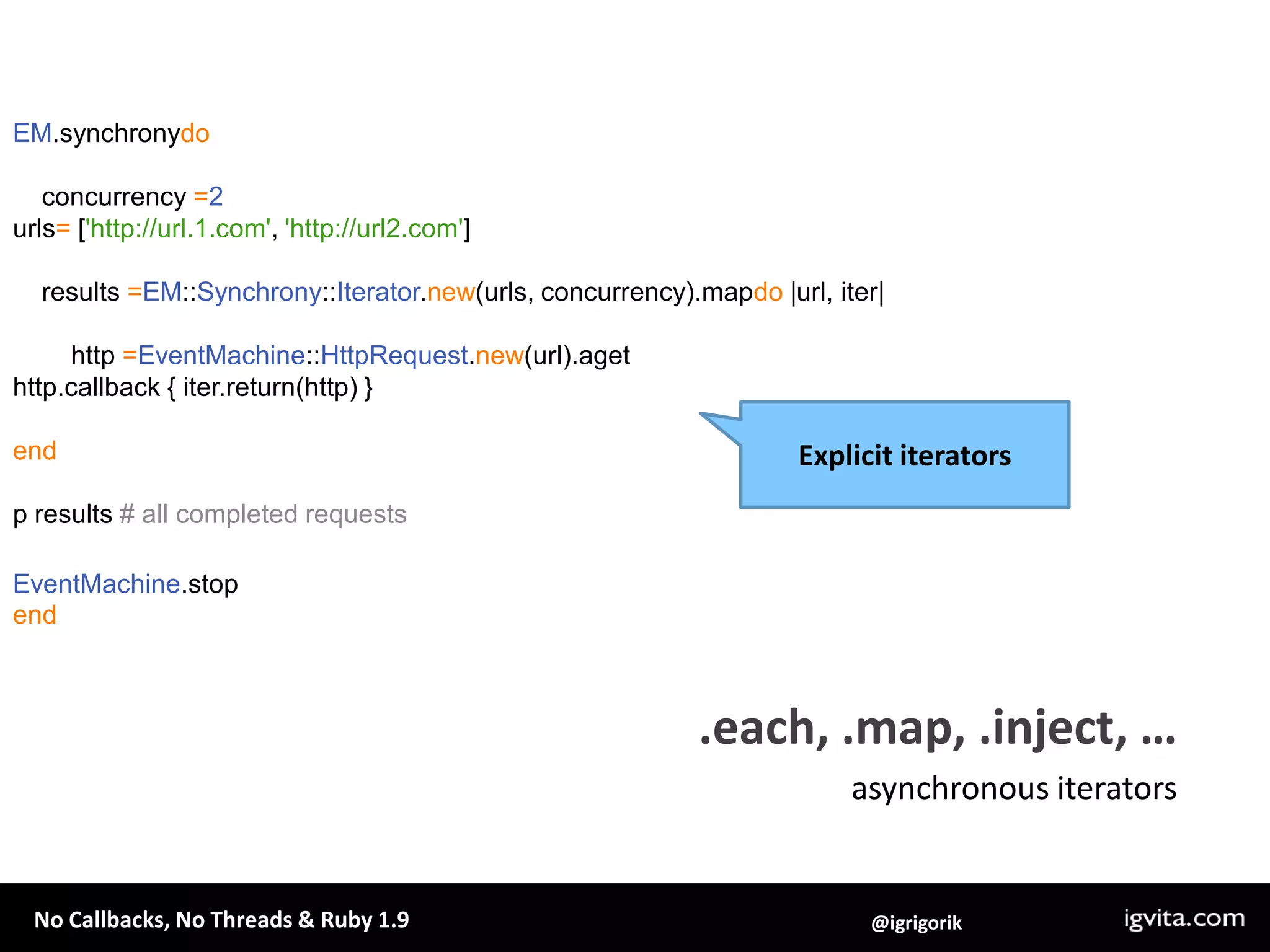
EM.synchronydo    concurrency =2urls= ['http://url.1.com', 'http://url2.com']    results =EM::Synchrony::Iterator.new(urls, concurrency).mapdo |url, iter|        http =EventMachine::HttpRequest.new(url).agethttp.callback { iter.return(http) }endp results # all completed requestsEventMachine.stopendExplicit iterators.each, .map, .inject, …asynchronous iterators
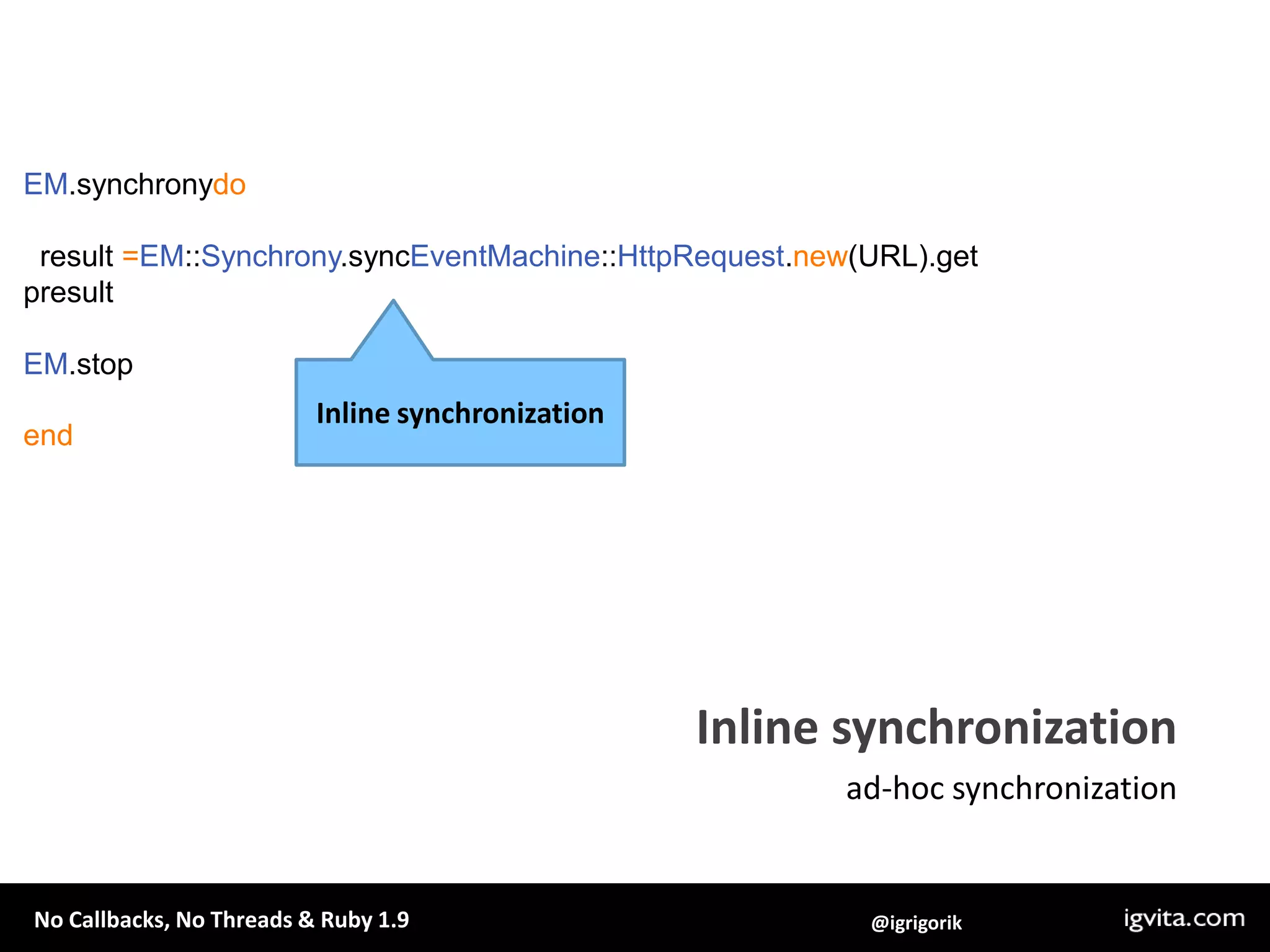
EM.synchronydo  result =EM::Synchrony.syncEventMachine::HttpRequest.new(URL).getpresultEM.stopendInline synchronizationInline synchronizationad-hoc synchronization
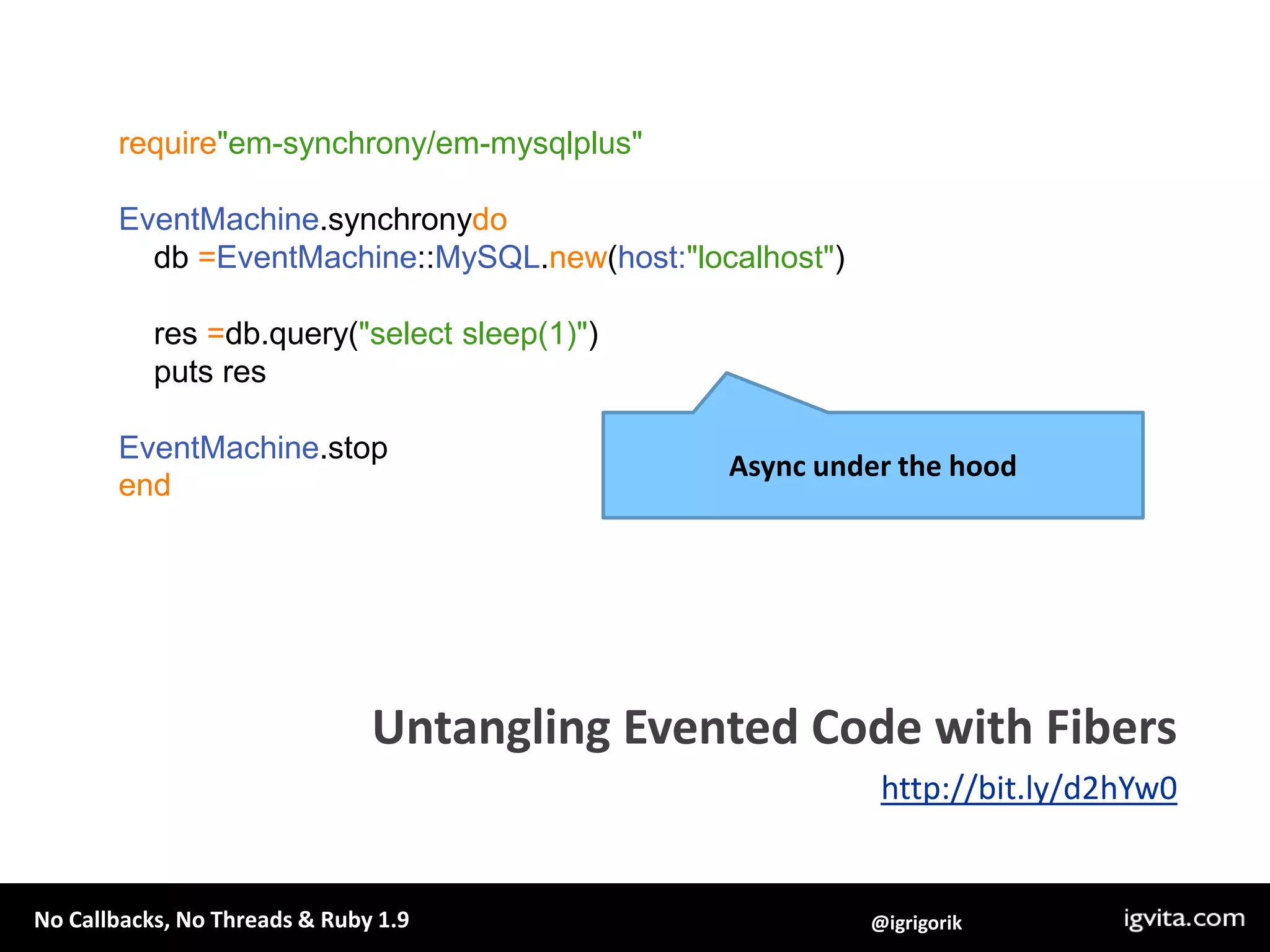
require"em-synchrony/em-mysqlplus"EventMachine.synchronydo    db =EventMachine::MySQL.new(host:"localhost")    res =db.query("select sleep(1)")    puts resEventMachine.stopendAsync under the hoodUntangling Evented Code with Fibershttp://bit.ly/d2hYw0
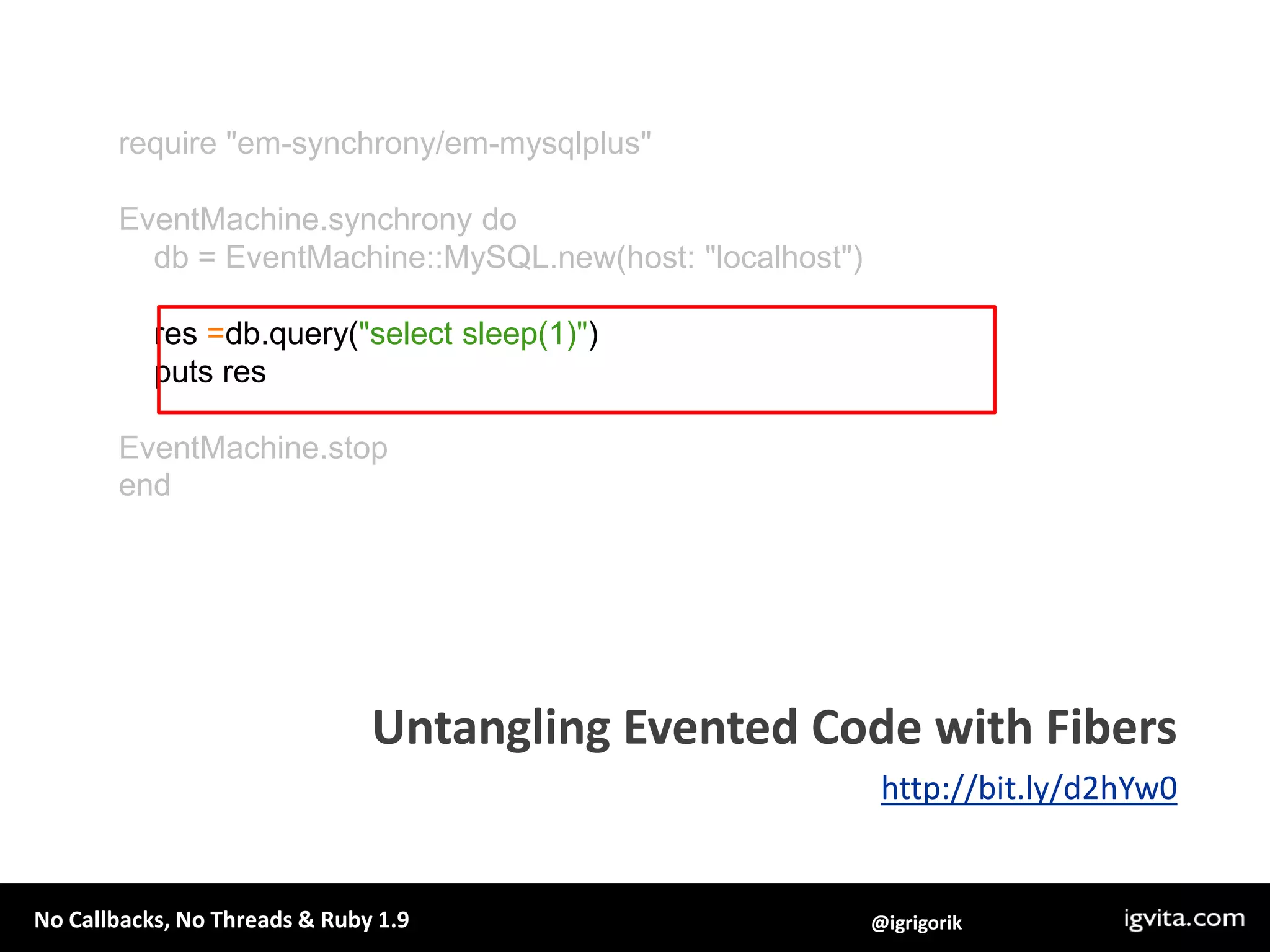
require "em-synchrony/em-mysqlplus"EventMachine.synchrony do    db = EventMachine::MySQL.new(host: "localhost")    res =db.query("select sleep(1)")    puts resEventMachine.stopendUntangling Evented Code with Fibershttp://bit.ly/d2hYw0
Async web-stack in Ruby?

No callbacks, No Threads - Cooperative web servers in Ruby 1.9

  • 1.
    No Callbacks, NoThreads & Ruby 1.9async & co-operative web-serversIlya Grigorik@igrigorik
  • 2.
    Reactor PatternReview: Stateof the artAsync PrimitivesCallbacks & FibersAsync Rails?
  • 3.
    require"active_record”ActiveRecord::Base.establish_connection( :adapter=> "mysql", :username => "root", :database => "database", :pool => 5)threads = []10.times do |n| threads <<Thread.new {ActiveRecord::Base.connection_pool.with_connectiondo |conn| res =conn.execute("select sleep(1)")end }endthreads.each { |t| t.join }The “Experiment”vanilla everything…
  • 4.
    require"active_record”ActiveRecord::Base.establish_connection( :adapter=> "mysql", :username => "root", :database => "database", :pool => 5)threads = []10.times do |n| threads <<Thread.new {ActiveRecord::Base.connection_pool.with_connectiondo |conn| res =conn.execute("select sleep(1)")end }endthreads.each { |t| t.join }5 shared connections# time ruby activerecord-pool.rb## real 0m10.663s# user 0m0.405s# sys 0m0.201s
  • 6.
  • 10.
  • 11.
    Global Interpreter Lockis a mutual exclusion lock held by a programming language interpreter thread to avoid sharing code that is not thread-safe with other threads. There is always one GIL for one interpreter process.Concurrency is a myth in Ruby(with a few caveats, of course)http://bit.ly/ruby-gil
  • 12.
    N-M thread poolin Ruby 1.9…Better but still the same problem!Concurrency is a myth in Rubystill no concurrency in Ruby 1.9http://bit.ly/ruby-gil
  • 13.
    Concurrency is amyth in Rubystill no parallelism in Ruby 1.9http://bit.ly/ruby-gil
  • 14.
    Blocks entireRuby VMNotas bad, butavoid it still..Avoid locking interpreter threads at all costslet’s say you’re writing an extension…
  • 15.
    DriversRuby VMNetworkWEBRickMongrel madeRails viablestill powers a lot of Rails apps today
  • 16.
    Rails rediscovers Apachetheworker/forker model…
  • 17.
    *nix IPC isfast! …Full Ruby VMAn exclusive Ruby VM for EACH requestam I the only one who thinks this is terrible?
  • 18.
    “Does not careif your application is thread-safe or not, workers all run within their own isolated address space and only serve one client at a time for maximum robustness.”Robustness? That sounds like a bug.An exclusive Ruby VM for EACH requestam I the only one who thinks this is terrible?
  • 20.
  • 21.
    Node imposes thefull-stack requirementsNode imposes async driversNode imposes async frameworks*Surprise*: Node is “fast”
  • 22.
    =I’ll take Rubyover JSgem install eventmachine
  • 23.
    p "Starting"EM.rundop"Running inEM reactor"endp”won’t get here"whiletruedo timersnetwork_ioother_ioendEventMachine Reactorconcurrency without thread
  • 24.
    gem install em-mysqlplusEventMachine.rundoconn=EventMachine::MySQL.new(:host=> 'localhost') query =conn.query("select sleep(1)")query.callback { |res| pres.all_hashes }query.errback { |res| pres.all_hashes } puts ”executing…”endcallback fired 1s after “executing”# > ruby em-mysql-test.rb## executing…# [{"sleep(1)"=>"0"}]em-mysqlplus: exampleasyncMySQL driver
  • 25.
    Non-blocking IO requiresnon-blocking drivers:AMQP http://github.com/tmm1/amqpMySQLPlushttp://github.com/igrigorik/em-mysqlplusMemcachedhttp://github.com/astro/remcachedDNS http://github.com/astro/em-dnsRedishttp://github.com/madsimian/em-redisMongoDBhttp://github.com/tmm1/rmongoHTTPRequesthttp://github.com/igrigorik/em-http-requestWebSockethttp://github.com/igrigorik/em-websocketAmazon S3 http://github.com/peritor/happeningAnd many others: http://wiki.github.com/eventmachine/eventmachine/protocol-implementations
  • 26.
    httpA=EventMachine::HttpRequest.new(URL).gethttpA.errback {# retrylogic?}httpA.callback {Memcached.set(:key => URL, :value => httpA.response) { |response|caseresponse[:status]whenMemcached::Errors::NO_ERROR# That's goodwhenMemcached::Errors::DISCONNECTED# Maybe stop filling the cache for now?else# What could've gone wrong?end }}http =get(url)memc=save(url, http.response)ifmemc.error?# That's goodelse# Err?endaccidental complexityasync is harder to manage
  • 27.
  • 28.
    We can dobetter than node.jsall the benefits of evented code without the drawbacks
  • 29.
    Ruby 1.9 Fibersare a means of creating code blocks which can be paused and resumed by our application (think lightweight threads, minus the thread scheduler and less overhead). f=Fiber.new {whiletruedoFiber.yield"Hi”end}pf.resume# => Hipf.resume# => Hipf.resume# => HiManual / cooperative scheduling!Ruby 1.9 Fibersand cooperative schedulinghttp://bit.ly/d2hYw0
  • 30.
    Fibers vs Threads:creation time much lowerFibers vs Threads: memory usage is much lowerRuby 1.9 Fibersand cooperative schedulinghttp://bit.ly/aesXy5
  • 31.
    defquery(sql)f = Fiber.currentconn=EventMachine::MySQL.new(:host=> 'localhost')q = conn.query(sql)c.callback { f.resume(conn) }c.errback { f.resume(conn) }return Fiber.yieldendEventMachine.rundoFiber.new { res =query('select sleep(1)') puts "Results: #{res.fetch_row.first}"}.resumeendException, async!Untangling Evented Code with Fibershttp://bit.ly/d2hYw0
  • 32.
    defquery(sql)f = Fiber.currentconn=EventMachine::MySQL.new(:host=> 'localhost')q = conn.query(sql)c.callback { f.resume(conn) }c.errback { f.resume(conn) } return Fiber.yieldendEventMachine.rundoFiber.new{ res =query('select sleep(1)') puts "Results: #{res.fetch_row.first}" }.resumeend1. Wrap into a continuationUntangling Evented Code with Fibershttp://bit.ly/d2hYw0
  • 33.
    defquery(sql)f=Fiber.currentconn=EventMachine::MySQL.new(:host => 'localhost')q= conn.query(sql)c.callback { f.resume(conn) }c.errback { f.resume(conn) }returnFiber.yieldendEventMachine.rundoFiber.new{ res =query('select sleep(1)') puts "Results: #{res.fetch_row.first}" }.resumeend2. Pause the continuationUntangling Evented Code with Fibershttp://bit.ly/d2hYw0
  • 34.
    defquery(sql)f=Fiber.currentconn=EventMachine::MySQL.new(:host => 'localhost')q= conn.query(sql)c.callback { f.resume(conn) }c.errback { f.resume(conn) }returnFiber.yieldendEventMachine.rundoFiber.new{ res =query('select sleep(1)') puts "Results: #{res.fetch_row.first}" }.resumeend3. Resume the continuationUntangling Evented Code with Fibershttp://bit.ly/d2hYw0
  • 35.
    Good news, youdon’t even have to muck around with Fibers!gem install em-synchronyhttp://github.com/igrigorik/em-synchrony Fiber aware connection pool with sync/async query support
  • 36.
    Multi requestinterface which accepts any callback enabled client
  • 37.
    Fibered iteratorto allow concurrency control & mixing of sync / async
  • 38.
    em-http-request: .get, etcare synchronous, while .aget, etc are async
  • 39.
    em-mysqlplus: .query issynchronous, while .aquery is async
  • 40.
    remcached: .get, etc,and .multi_* methods are synchronousem-synchrony: simple evented programmingbest of both worlds…
  • 41.
    EventMachine.synchronydo multi =EventMachine::Synchrony::Multi.newmulti.add:a, EventMachine::HttpRequest.new(url1).agetmulti.add:b, EventMachine::HttpRequest.new(url2).apost res =multi.performp“No callbacks, and parallel HTTP requests!"p resEventMachine.stopendParallel IO with Fibersmulti interface example
  • 42.
    Persistent connectionsEventMachine.synchronydo db =EventMachine::Synchrony::ConnectionPool.new(size:2) doEventMachine::MySQL.new(host:"localhost")end multi =EventMachine::Synchrony::Multi.newmulti.add:a, db.aquery("select sleep(1)")multi.add:b, db.aquery("select sleep(1)") res =multi.performEventMachine.stopendFiber Poolsaccessing shared services
  • 43.
    EM.synchronydo concurrency =2urls= ['http://url.1.com', 'http://url2.com'] results =EM::Synchrony::Iterator.new(urls, concurrency).mapdo |url, iter| http =EventMachine::HttpRequest.new(url).agethttp.callback { iter.return(http) }endp results # all completed requestsEventMachine.stopendExplicit iterators.each, .map, .inject, …asynchronous iterators
  • 44.
    EM.synchronydo result=EM::Synchrony.syncEventMachine::HttpRequest.new(URL).getpresultEM.stopendInline synchronizationInline synchronizationad-hoc synchronization
  • 45.
    require"em-synchrony/em-mysqlplus"EventMachine.synchronydo db =EventMachine::MySQL.new(host:"localhost") res =db.query("select sleep(1)") puts resEventMachine.stopendAsync under the hoodUntangling Evented Code with Fibershttp://bit.ly/d2hYw0
  • 46.
    require "em-synchrony/em-mysqlplus"EventMachine.synchrony do db = EventMachine::MySQL.new(host: "localhost") res =db.query("select sleep(1)") puts resEventMachine.stopendUntangling Evented Code with Fibershttp://bit.ly/d2hYw0
  • 47.
  • 48.
    em-synchrony, connection pool,iterators…Driversasync-rackRuby VMFibersNetworkThinhttp://code.macournoyer.com/thin/One VM, full concurrency, network-boundRuby 1.9, Fibers, Thin: in production!
  • 49.
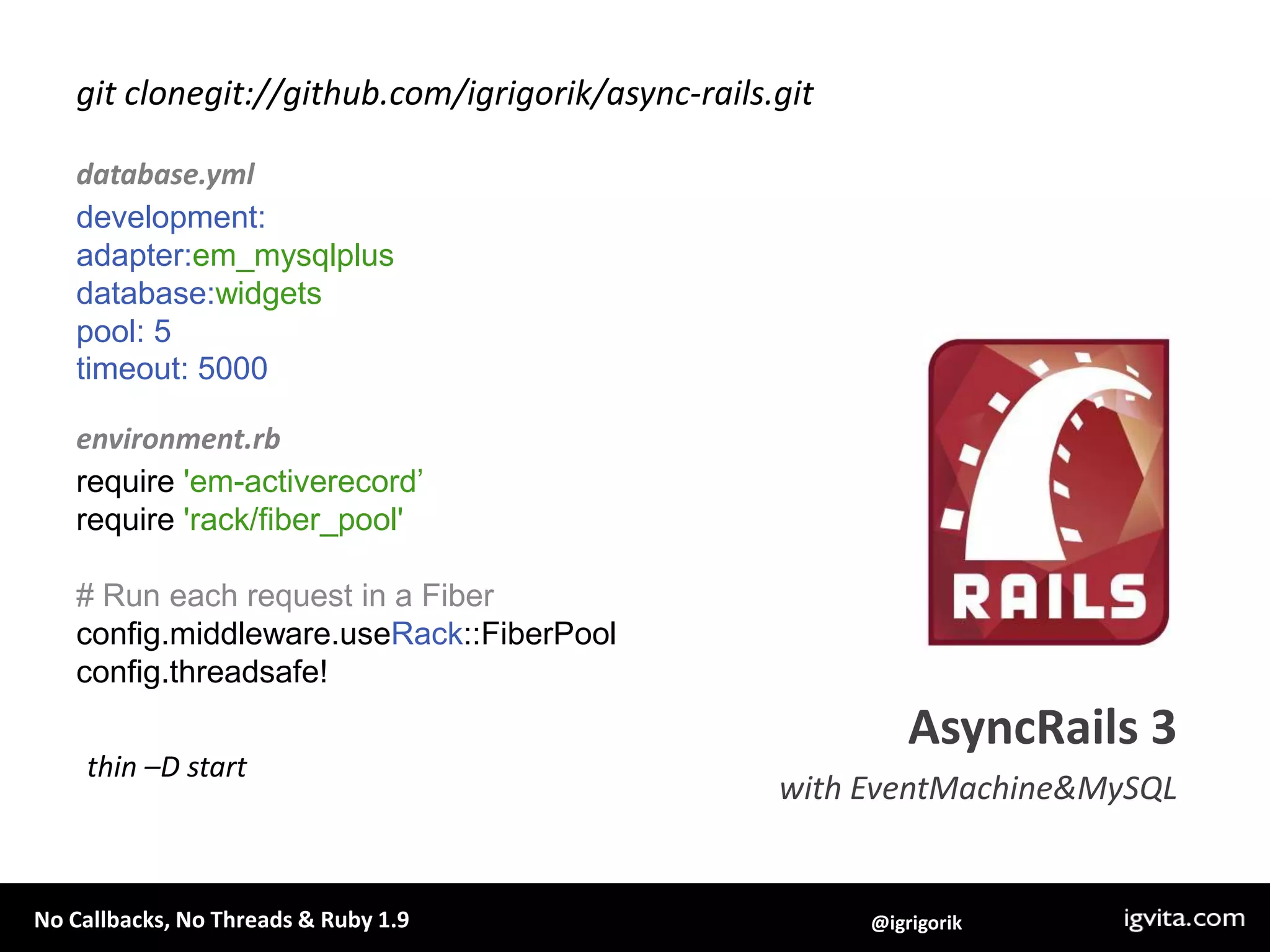
    git clonegit://github.com/igrigorik/async-rails.gitdatabase.ymldevelopment:adapter:em_mysqlplusdatabase:widgetspool: 5timeout:5000environment.rbrequire 'em-activerecord’require 'rack/fiber_pool'# Run each request in a Fiberconfig.middleware.useRack::FiberPoolconfig.threadsafe!AsyncRails 3with EventMachine & MySQLthin –D start
  • 50.
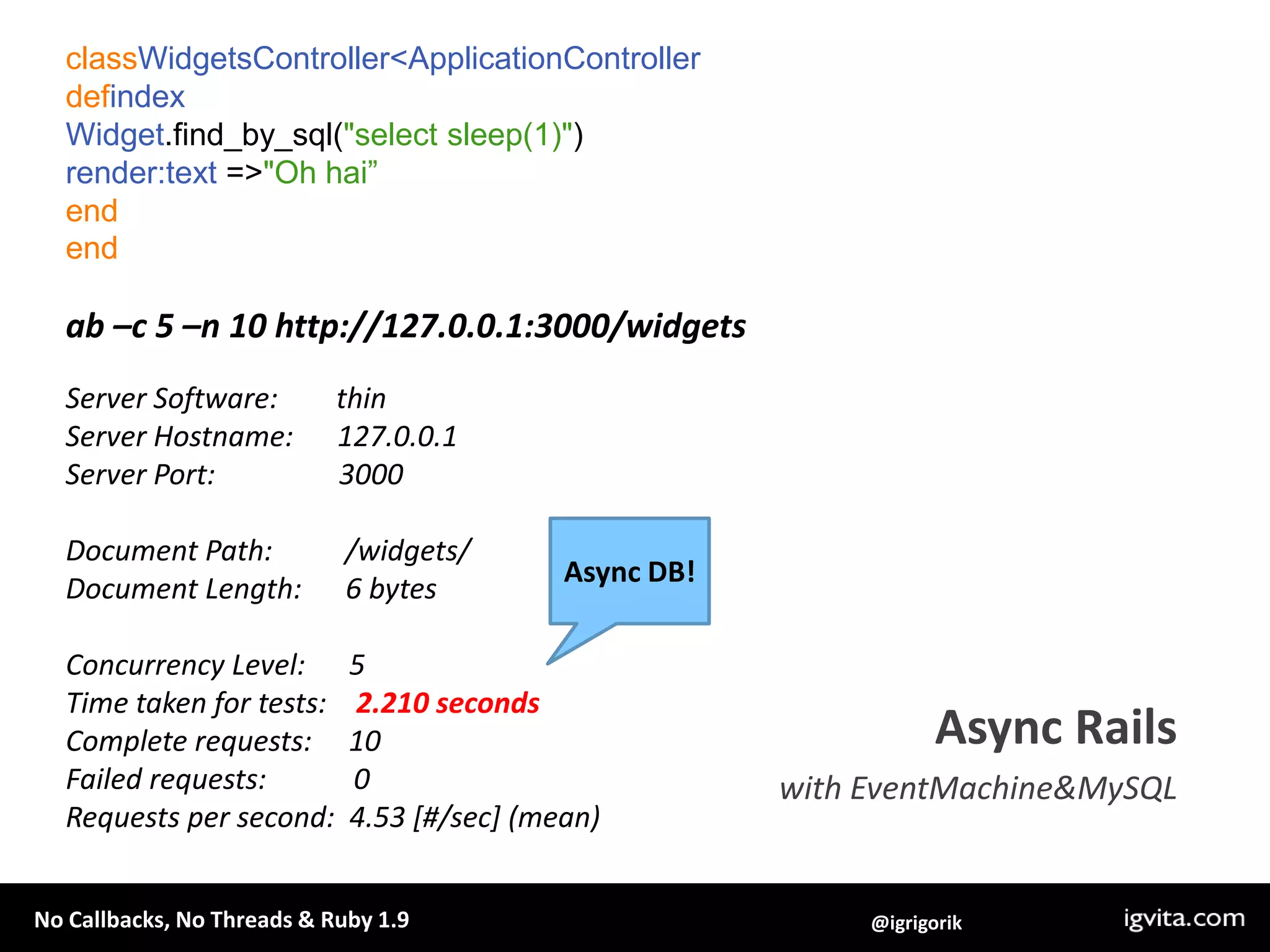
    classWidgetsController< ApplicationControllerdefindexWidget.find_by_sql("select sleep(1)")render:text=> "Oh hai”endendab –c 5 –n 10 http://127.0.0.1:3000/widgetsServer Software: thinServer Hostname: 127.0.0.1Server Port: 3000Document Path: /widgets/Document Length: 6 bytesConcurrency Level: 5Time taken for tests: 2.210 secondsComplete requests: 10Failed requests: 0Requests per second: 4.53 [#/sec] (mean)Async DB! Async Railswith EventMachine & MySQL
  • 51.
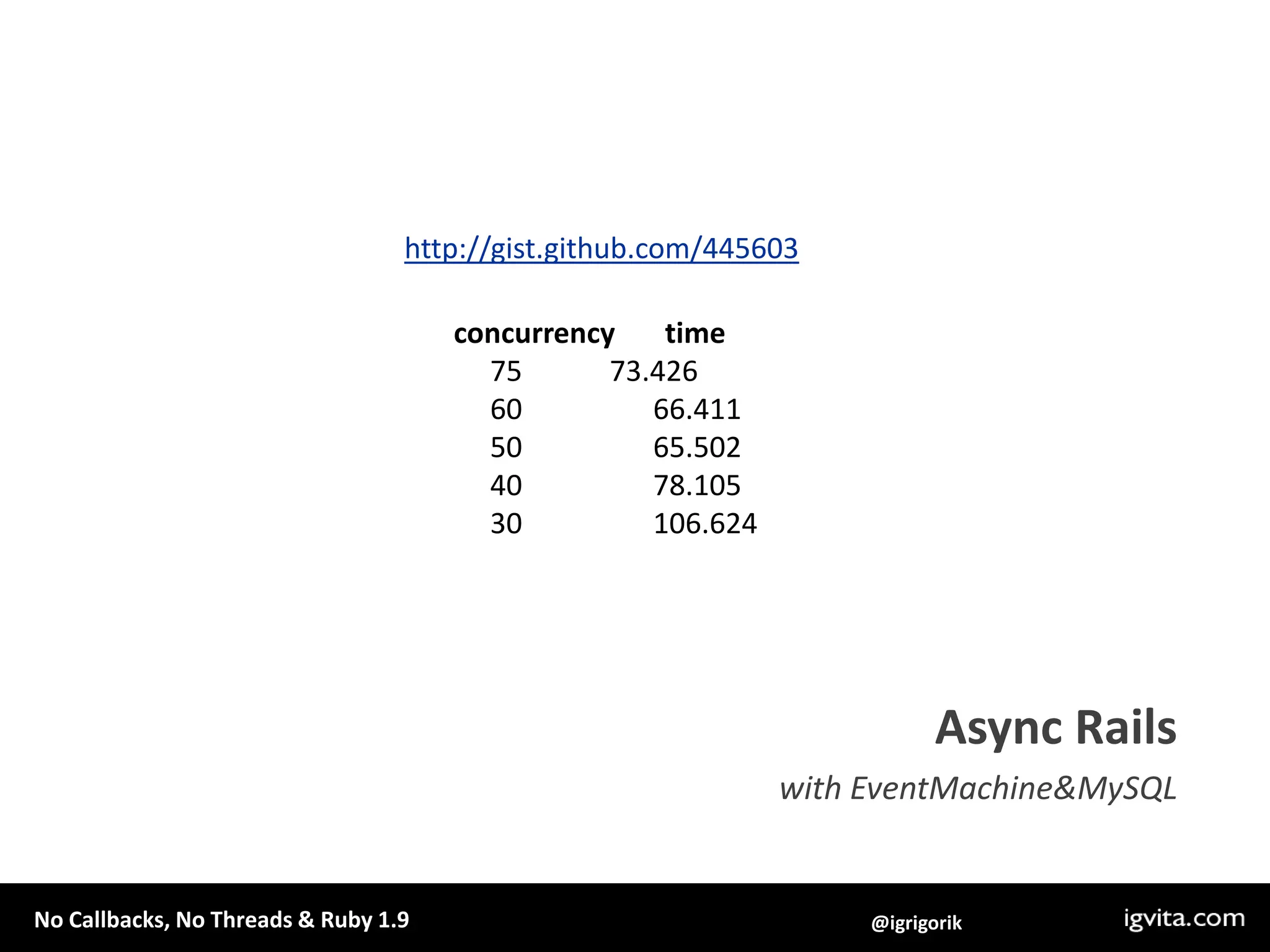
    http://gist.github.com/445603 concurrency time 75 73.426 60 66.411 50 65.502 40 78.105 30 106.624Async Railswith EventMachine & MySQL
  • 52.
    Async Rails 3demo:http://github.com/igrigorik/async-rails/Fibers & Cooperative Scheduling in Ruby:http://www.igvita.com/2009/05/13/fibers-cooperative-scheduling-in-ruby/Untangling Evented Code with Ruby Fibers:http://www.igvita.com/2010/03/22/untangling-evented-code-with-ruby-fibers/EM-Synchrony:http://github.com/igrigorik/em-synchronyWhat do you think?