Incentive separability and optimal redistribution:
A mechanism-design approach
Pawel Doligalski (Bristol & GRAPE)
Piotr Dworczak (Northwestern & GRAPE)
Joanna Krysta (SGH & PSE)
Filip Tokarski (Stanford GSB)
This project has received funding from the European Research Council (ERC) under the European Union’s Horizon
2020 research and innovation programme (ERC Starting grant IMD-101040122)
1
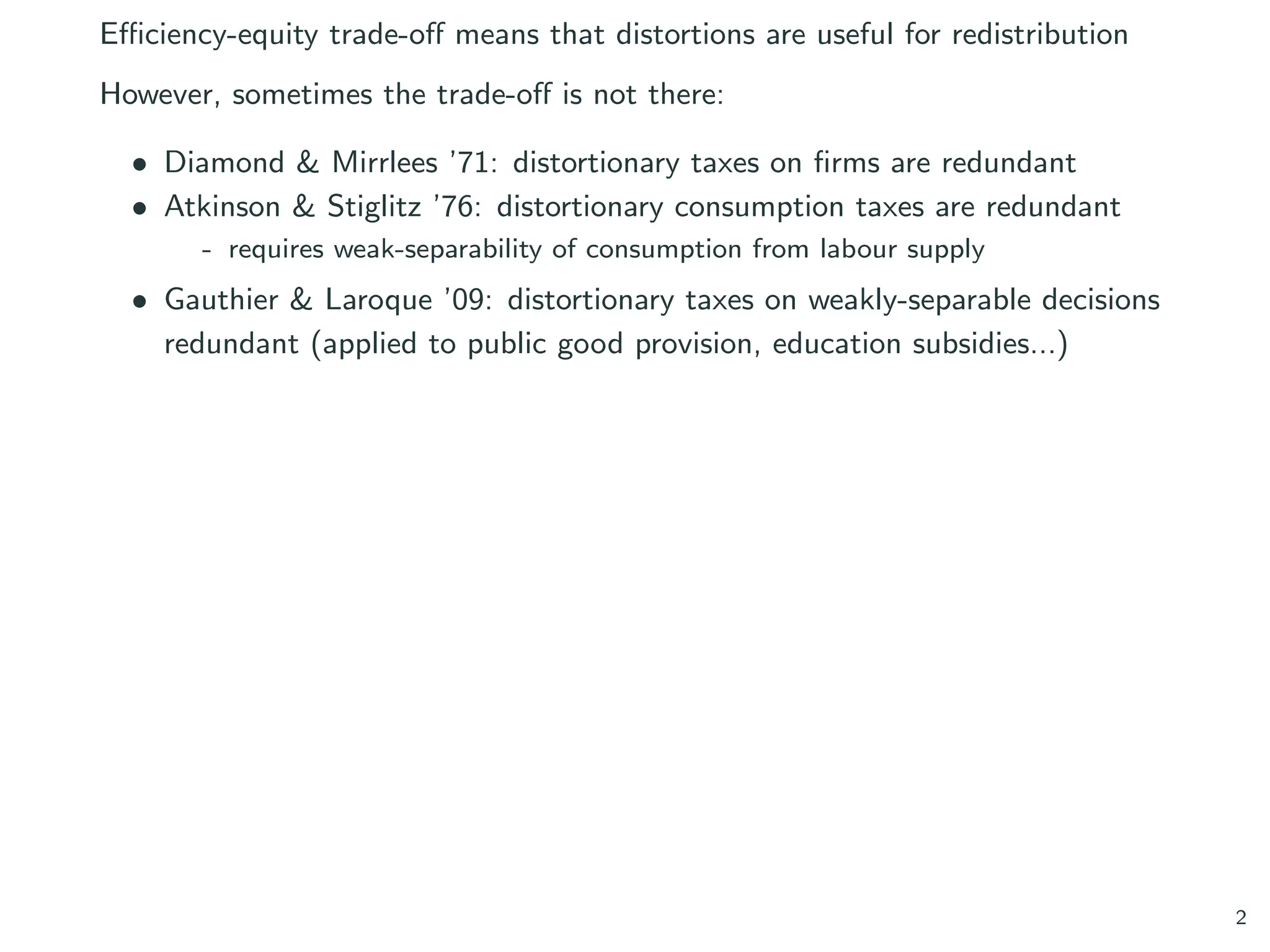
Efficiency-equity trade-off means that distortions are useful for redistribution
However, sometimes the trade-off is not there:
• Diamond & Mirrlees ’71: distortionary taxes on firms are redundant
• Atkinson & Stiglitz ’76: distortionary consumption taxes are redundant
- requires weak-separability of consumption from labour supply
• Gauthier & Laroque ’09: distortionary taxes on weakly-separable decisions
redundant (applied to public good provision, education subsidies...)
2
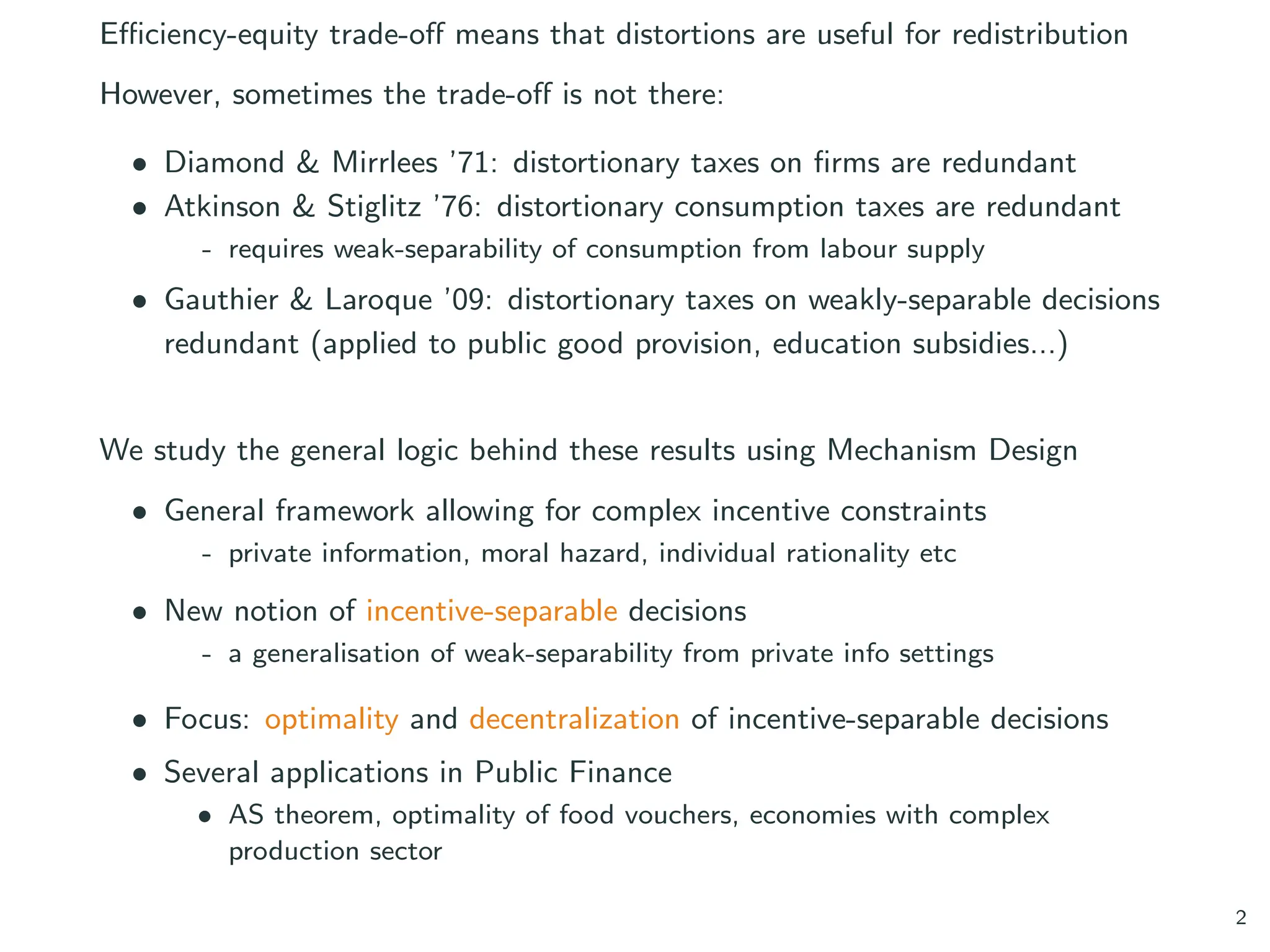
Efficiency-equity trade-off means that distortions are useful for redistribution
However, sometimes the trade-off is not there:
• Diamond & Mirrlees ’71: distortionary taxes on firms are redundant
• Atkinson & Stiglitz ’76: distortionary consumption taxes are redundant
- requires weak-separability of consumption from labour supply
• Gauthier & Laroque ’09: distortionary taxes on weakly-separable decisions
redundant (applied to public good provision, education subsidies...)
We study the general logic behind these results using Mechanism Design
• General framework allowing for complex incentive constraints
- private information, moral hazard, individual rationality etc
• New notion of incentive-separable decisions
- a generalisation of weak-separability from private info settings
• Focus: optimality and decentralization of incentive-separable decisions
• Several applications in Public Finance
• AS theorem, optimality of food vouchers, economies with complex
production sector
2
Literature review
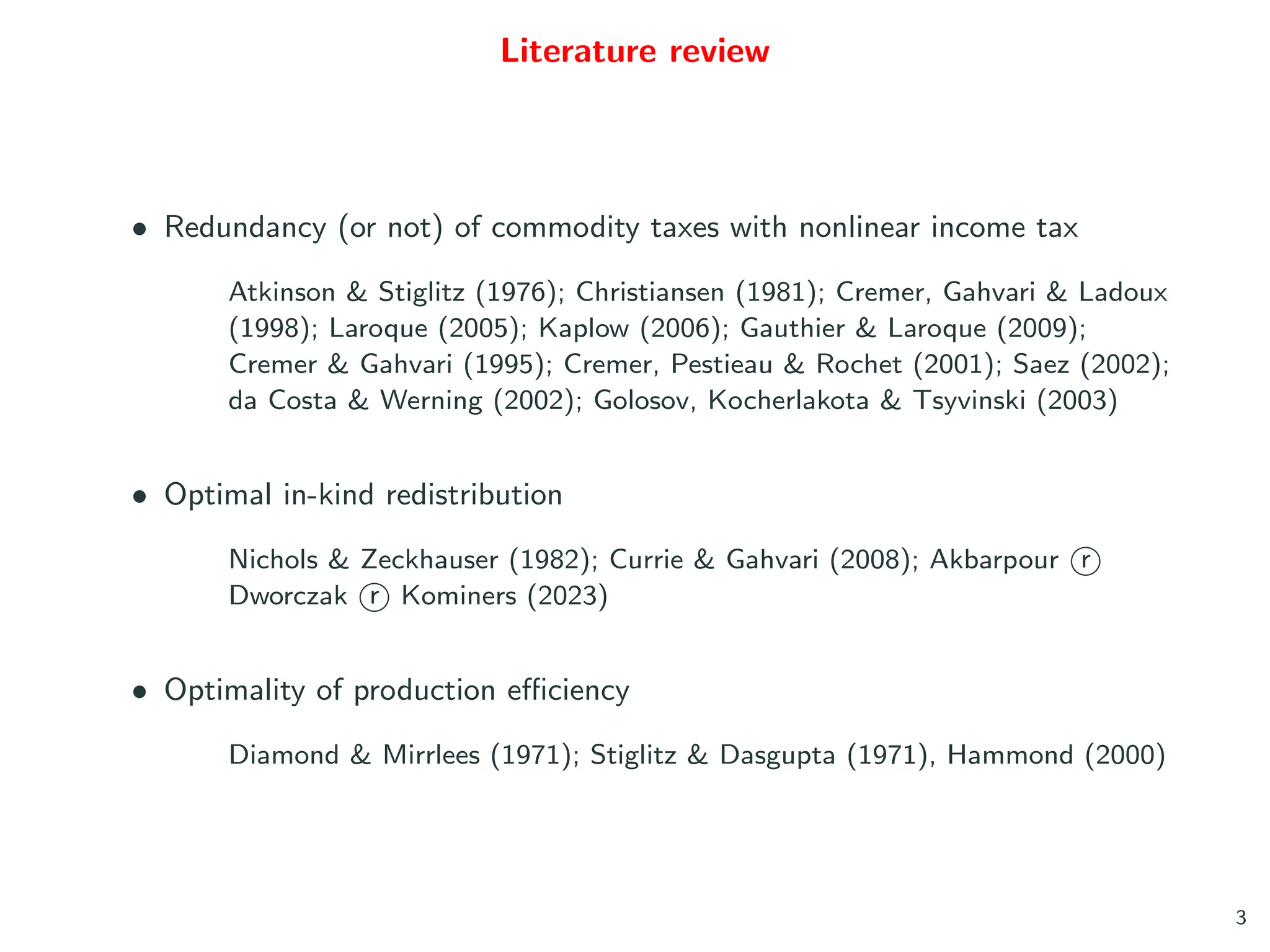
• Redundancy (or not) of commodity taxes with nonlinear income tax
Atkinson & Stiglitz (1976); Christiansen (1981); Cremer, Gahvari & Ladoux
(1998); Laroque (2005); Kaplow (2006); Gauthier & Laroque (2009);
Cremer & Gahvari (1995); Cremer, Pestieau & Rochet (2001); Saez (2002);
da Costa & Werning (2002); Golosov, Kocherlakota & Tsyvinski (2003)
• Optimal in-kind redistribution
Nichols & Zeckhauser (1982); Currie & Gahvari (2008); Akbarpour r
○
Dworczak r
○ Kominers (2023)
• Optimality of production efficiency
Diamond & Mirrlees (1971); Stiglitz & Dasgupta (1971), Hammond (2000)
3
Outline of the talk
1. Framework
2. General results
3. Applications
4
Framework
• A unit mass of agents with types θ ∈ [0, 1] ≡ Θ, uniformly distributed
• Agents’ utility over a vector of K decisions x ∈ RK
+
U (x, θ)
- U continuous in x
- x contains e.g. consumption of goods, labor supply, effort, ...
• An allocation rule x : Θ → RK
+
• associated aggregate allocation: x =
´
x(θ) dθ
• associated utility profile Ux , where Ux (θ) = U(x(θ), θ)
5
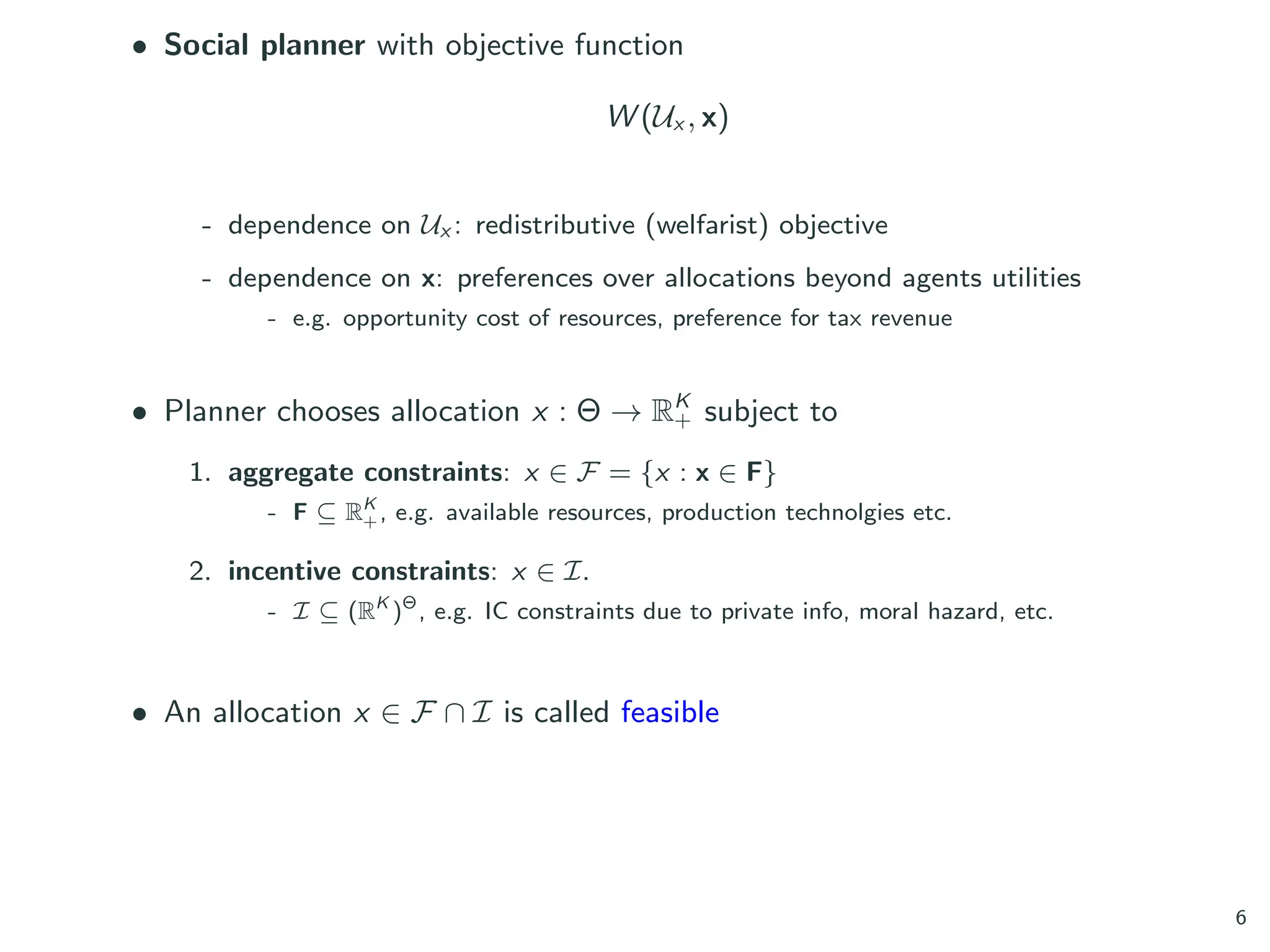
• Social planner with objective function
W (Ux , x)
- dependence on Ux : redistributive (welfarist) objective
- dependence on x: preferences over allocations beyond agents utilities
- e.g. opportunity cost of resources, preference for tax revenue
• Planner chooses allocation x : Θ → RK
+ subject to
1. aggregate constraints: x ∈ F = {x : x ∈ F}
- F ⊆ RK
+, e.g. available resources, production technolgies etc.
2. incentive constraints: x ∈ I.
- I ⊆ (RK
)Θ
, e.g. IC constraints due to private info, moral hazard, etc.
• An allocation x ∈ F ∩ I is called feasible
6
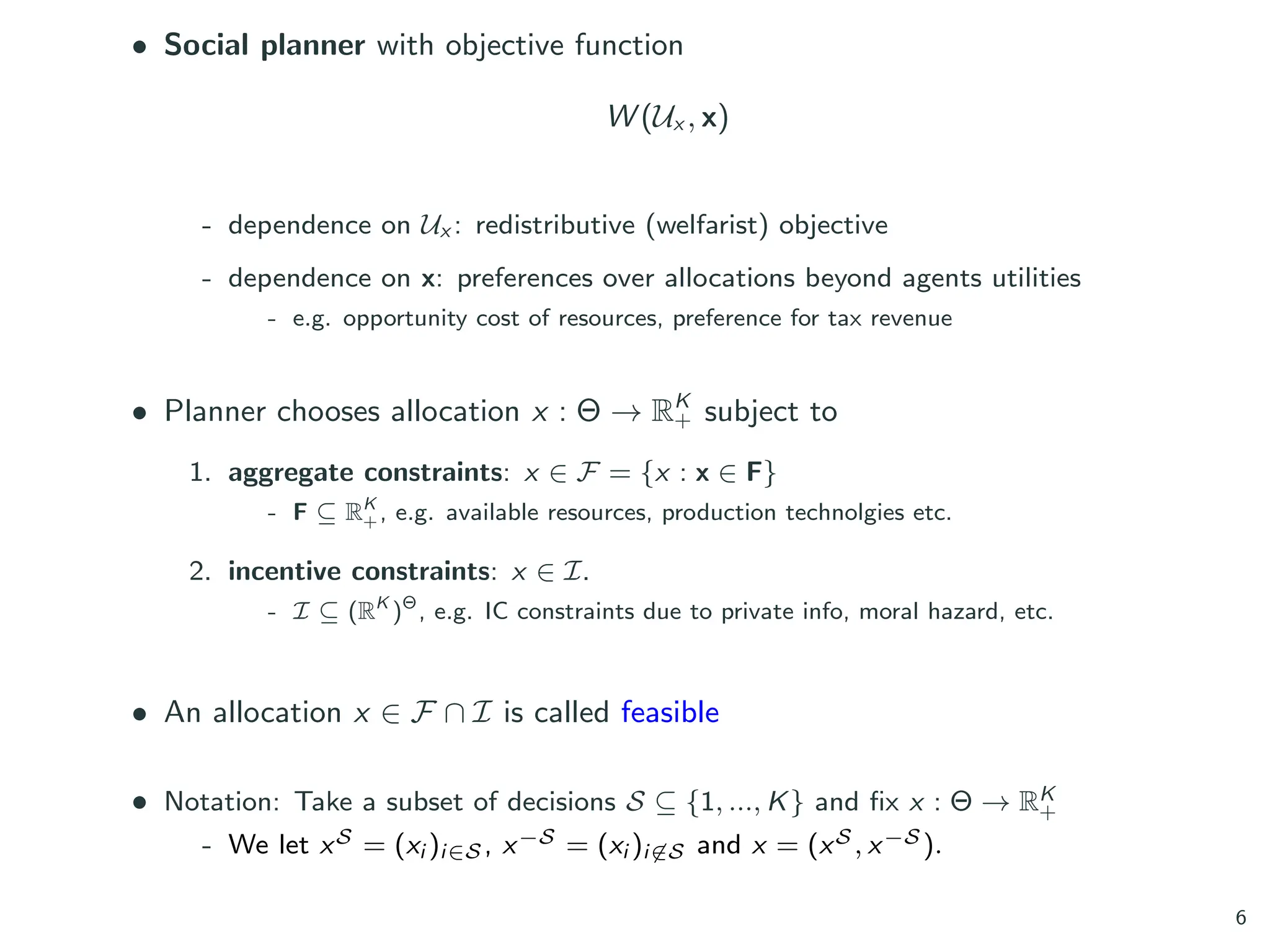
• Social planner with objective function
W (Ux , x)
- dependence on Ux : redistributive (welfarist) objective
- dependence on x: preferences over allocations beyond agents utilities
- e.g. opportunity cost of resources, preference for tax revenue
• Planner chooses allocation x : Θ → RK
+ subject to
1. aggregate constraints: x ∈ F = {x : x ∈ F}
- F ⊆ RK
+, e.g. available resources, production technolgies etc.
2. incentive constraints: x ∈ I.
- I ⊆ (RK
)Θ
, e.g. IC constraints due to private info, moral hazard, etc.
• An allocation x ∈ F ∩ I is called feasible
• Notation: Take a subset of decisions S ⊆ {1, ..., K} and fix x : Θ → RK
+
- We let xS = (xi )i∈S , x−S = (xi )i̸∈S and x = (xS , x−S ).
6
Incentive separability
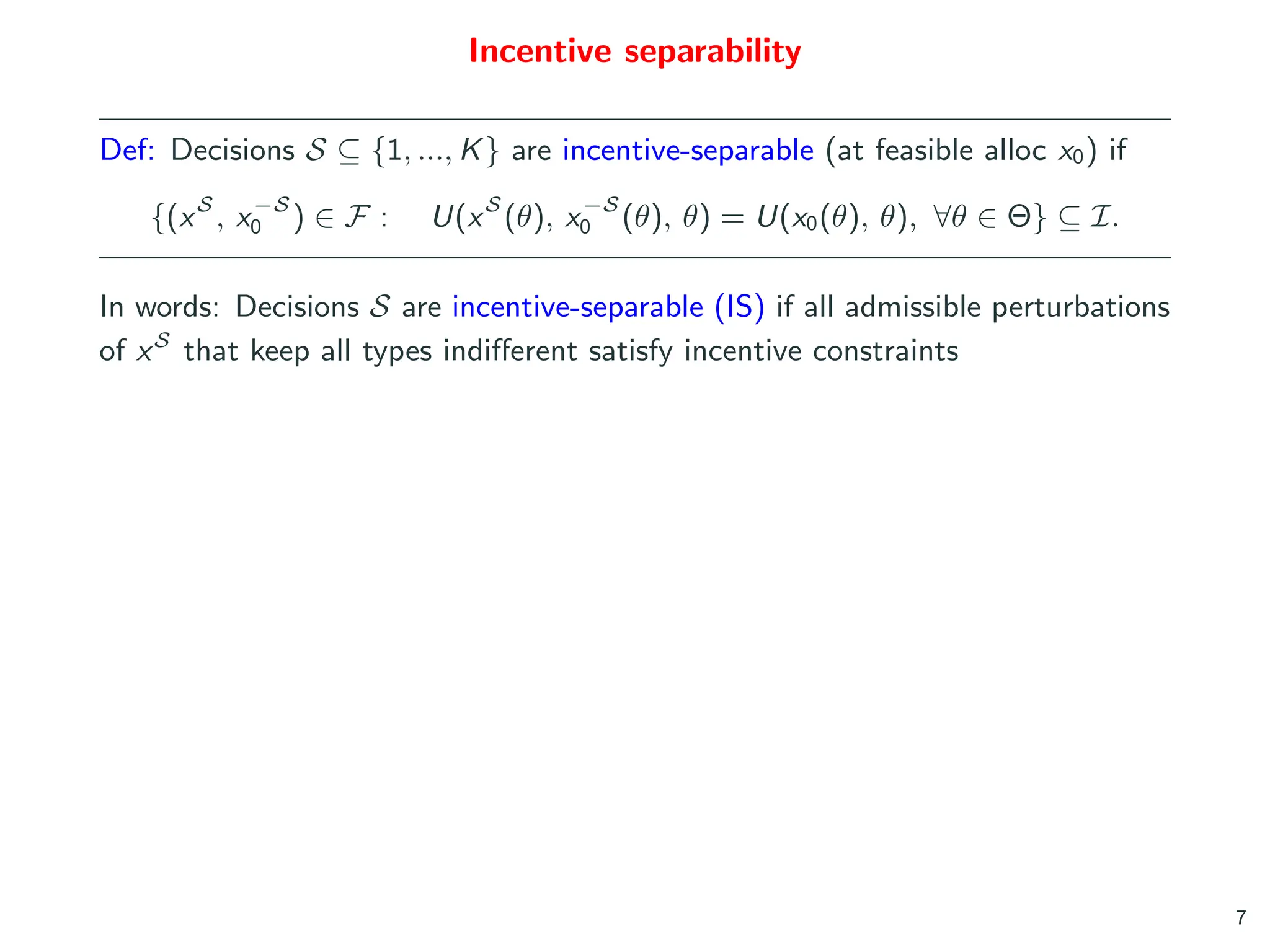
Def: Decisions S ⊆ {1, ..., K} are incentive-separable (at feasible alloc x0) if
{(xS
, x−S
0 ) ∈ F : U(xS
(θ), x−S
0 (θ), θ) = U(x0(θ), θ), ∀θ ∈ Θ} ⊆ I.
In words: Decisions S are incentive-separable (IS) if all admissible perturbations
of xS
that keep all types indifferent satisfy incentive constraints
7
Incentive separability
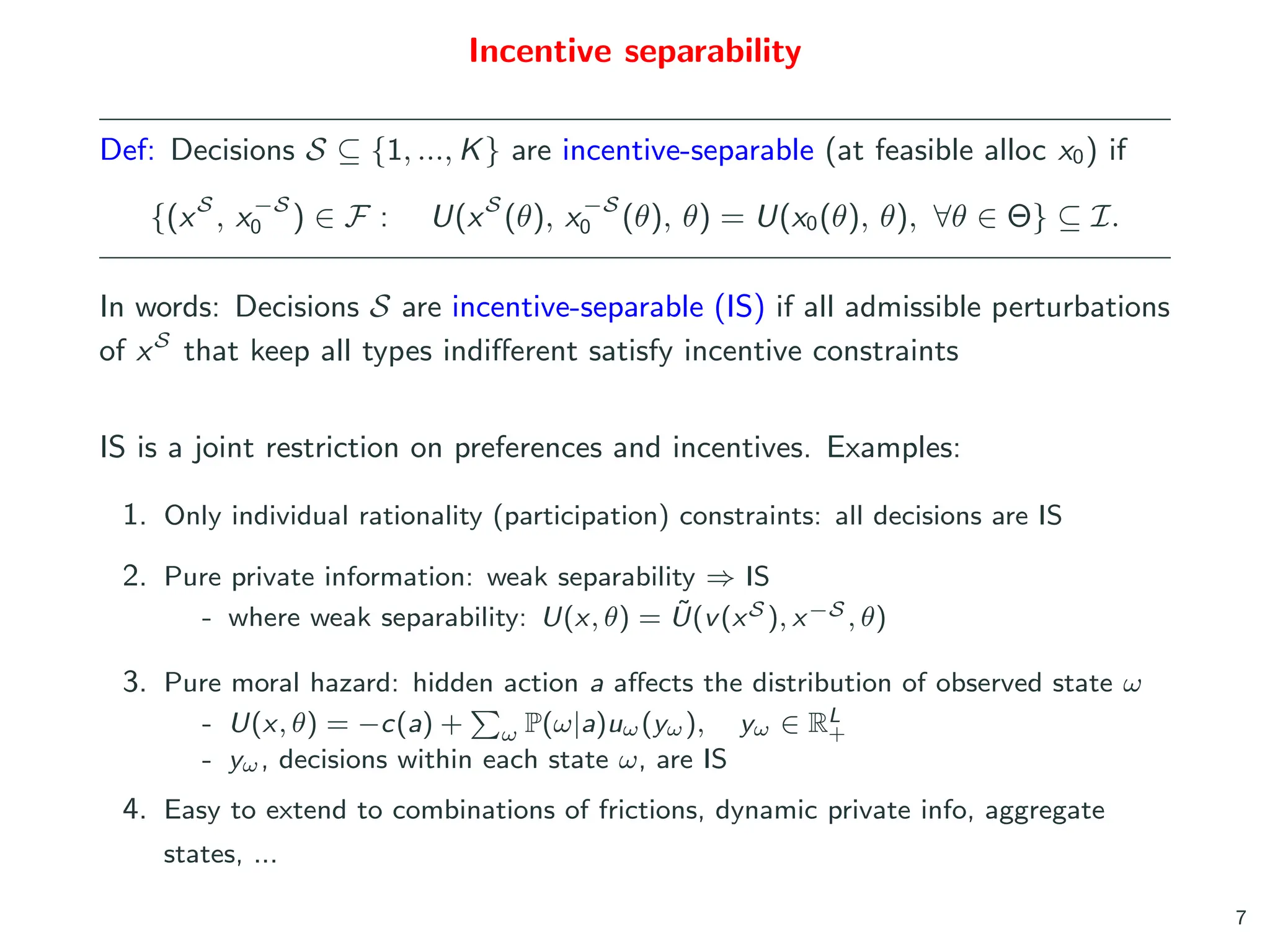
Def: Decisions S ⊆ {1, ..., K} are incentive-separable (at feasible alloc x0) if
{(xS
, x−S
0 ) ∈ F : U(xS
(θ), x−S
0 (θ), θ) = U(x0(θ), θ), ∀θ ∈ Θ} ⊆ I.
In words: Decisions S are incentive-separable (IS) if all admissible perturbations
of xS
that keep all types indifferent satisfy incentive constraints
IS is a joint restriction on preferences and incentives. Examples:
1. Only individual rationality (participation) constraints: all decisions are IS
2. Pure private information: weak separability ⇒ IS
- where weak separability: U(x, θ) = Ũ(v(xS ), x−S , θ)
3. Pure moral hazard: hidden action a affects the distribution of observed state ω
- U(x, θ) = −c(a) +
P
ω P(ω|a)uω(yω), yω ∈ RL
+
- yω, decisions within each state ω, are IS
4. Easy to extend to combinations of frictions, dynamic private info, aggregate
states, ...
7
General results
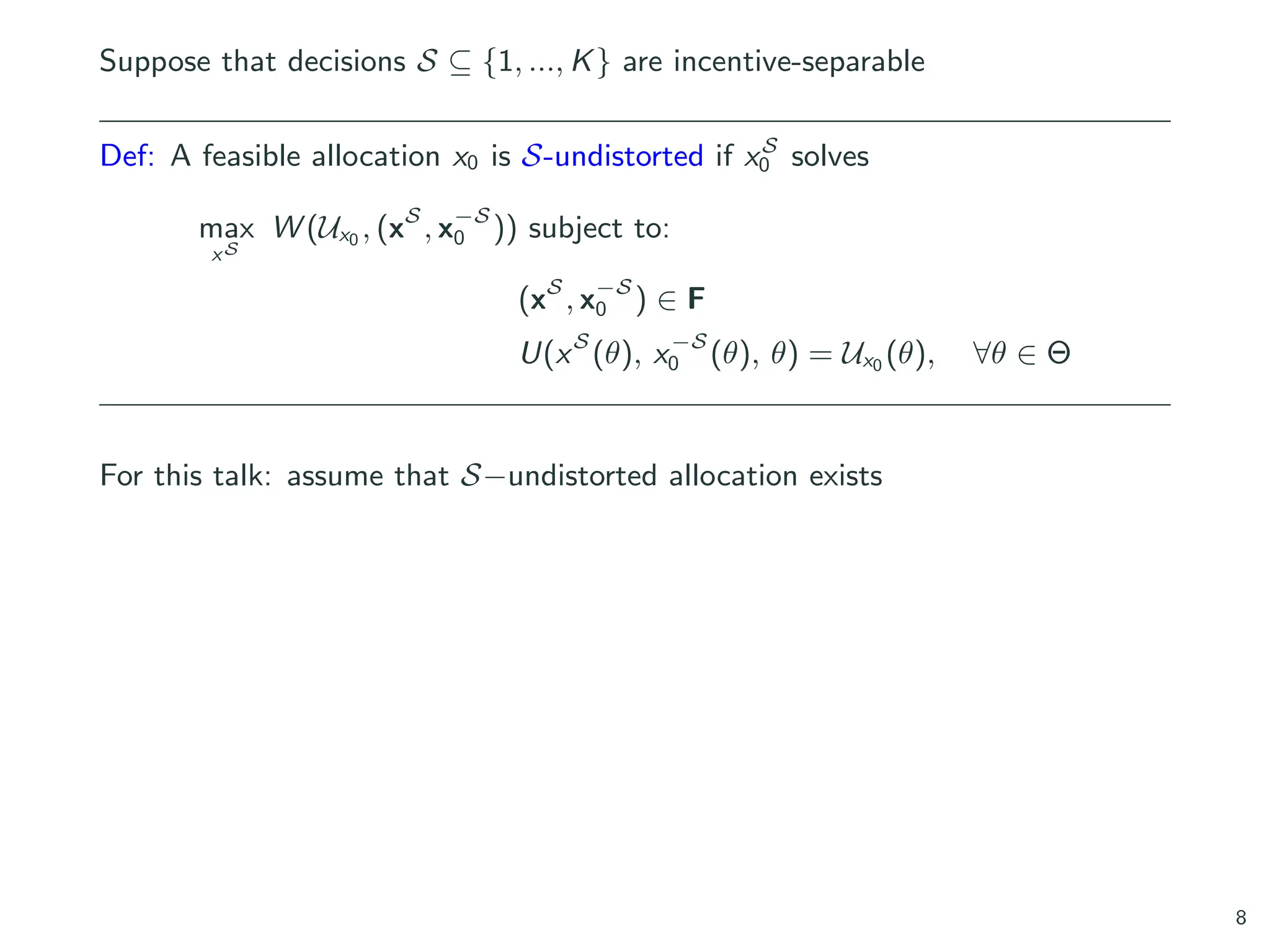
Suppose that decisions S ⊆ {1, ..., K} are incentive-separable
Def: A feasible allocation x0 is S-undistorted if xS
0 solves
max
xS
W (Ux0 , (xS
, x−S
0 )) subject to:
(xS
, x−S
0 ) ∈ F
U(xS
(θ), x−S
0 (θ), θ) = Ux0 (θ), ∀θ ∈ Θ
For this talk: assume that S−undistorted allocation exists
8
Suppose that decisions S ⊆ {1, ..., K} are incentive-separable
Def: A feasible allocation x0 is S-undistorted if xS
0 solves
max
xS
W (Ux0 , (xS
, x−S
0 )) subject to:
(xS
, x−S
0 ) ∈ F
U(xS
(θ), x−S
0 (θ), θ) = Ux0 (θ), ∀θ ∈ Θ
For this talk: assume that S−undistorted allocation exists
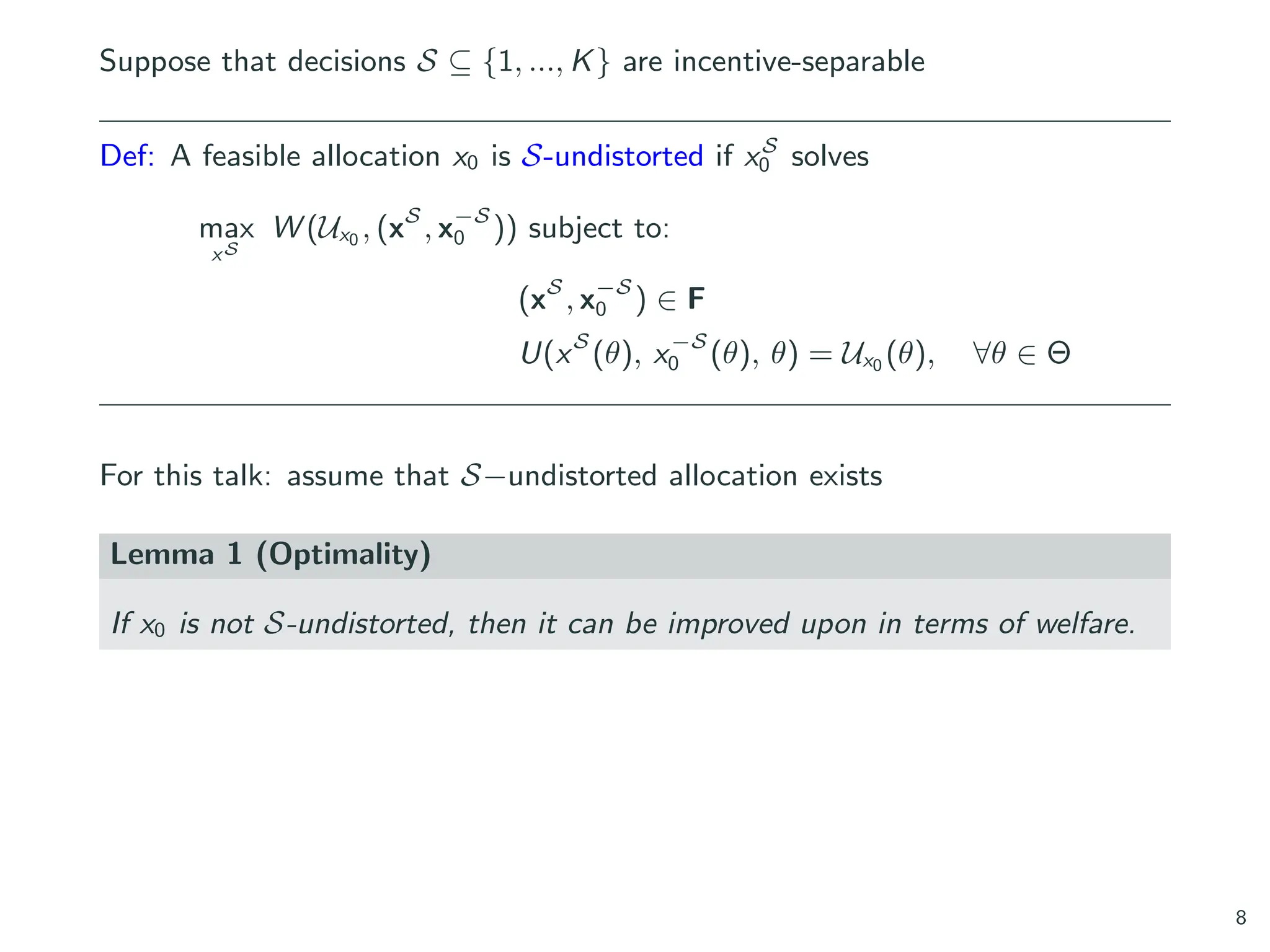
Lemma 1 (Optimality)
If x0 is not S-undistorted, then it can be improved upon in terms of welfare.
8
Suppose that decisions S ⊆ {1, ..., K} are incentive-separable
Def: A feasible allocation x0 is S-undistorted if xS
0 solves
max
xS
W (Ux0 , (xS
, x−S
0 )) subject to:
(xS
, x−S
0 ) ∈ F
U(xS
(θ), x−S
0 (θ), θ) = Ux0 (θ), ∀θ ∈ Θ
For this talk: assume that S−undistorted allocation exists
Lemma 1 (Optimality)
If x0 is not S-undistorted, then it can be improved upon in terms of welfare.
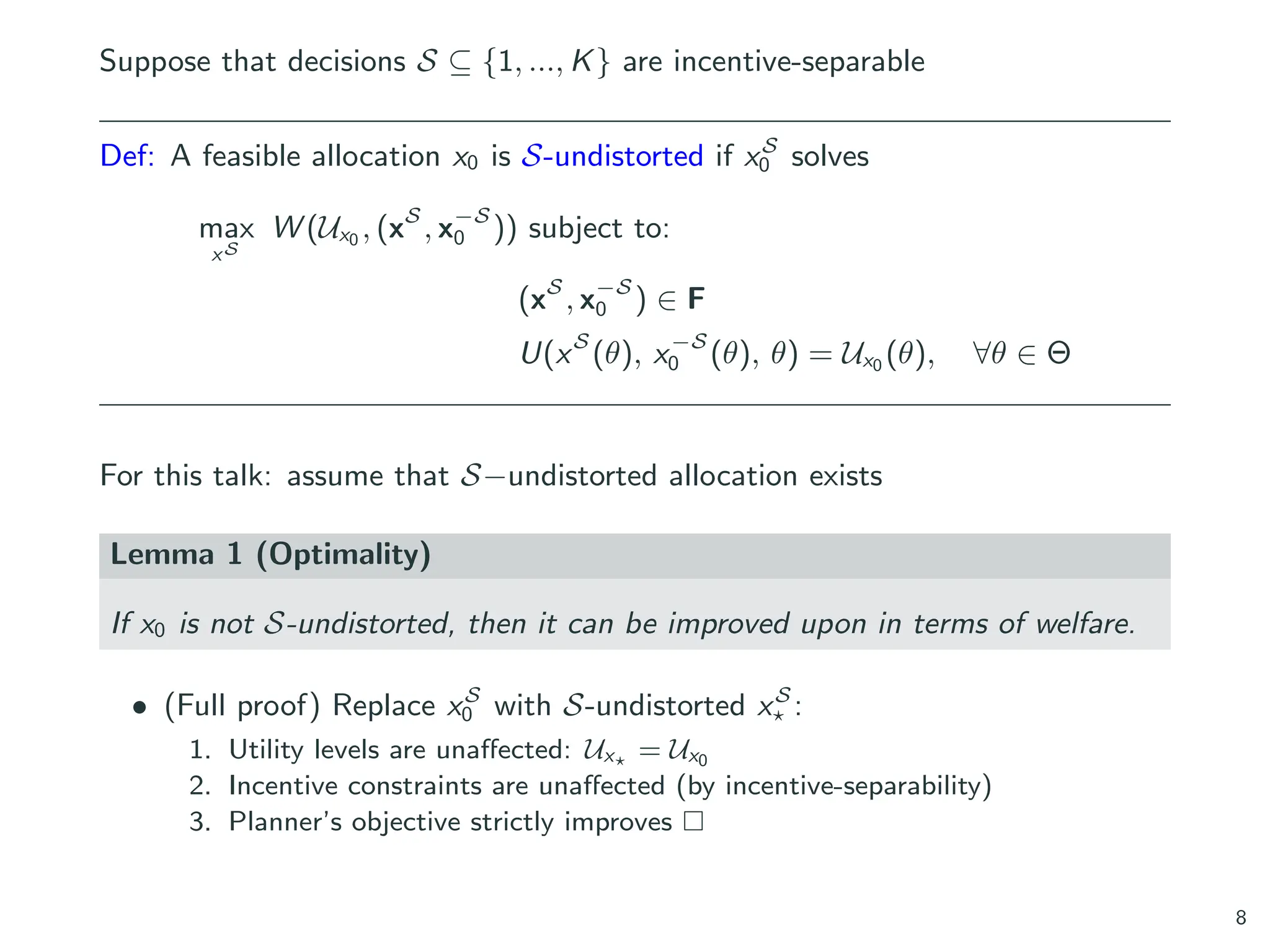
• (Full proof) Replace xS
0 with S-undistorted xS
⋆ :
1. Utility levels are unaffected: Ux⋆ = Ux0
2. Incentive constraints are unaffected (by incentive-separability)
3. Planner’s objective strictly improves □
8
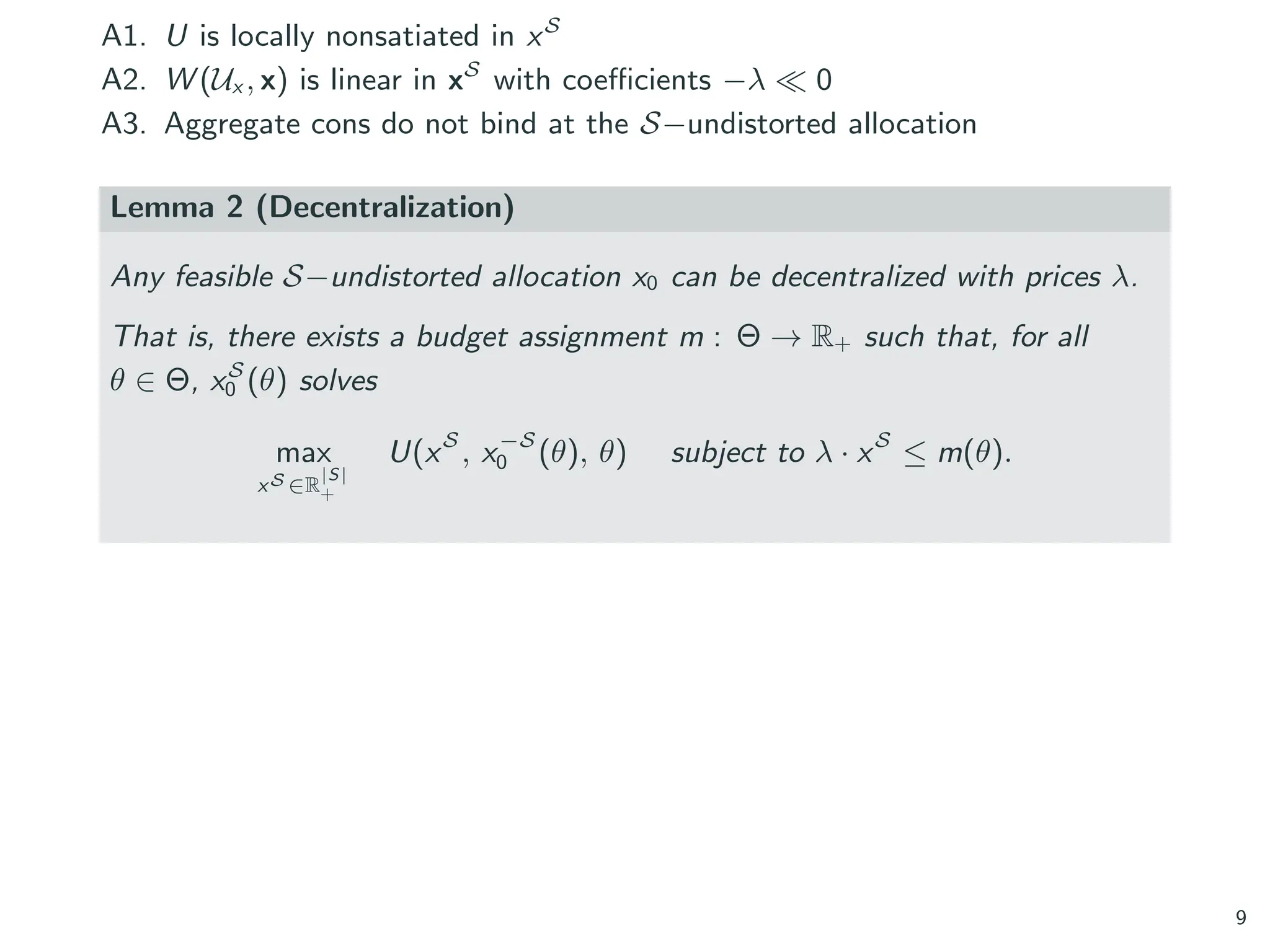
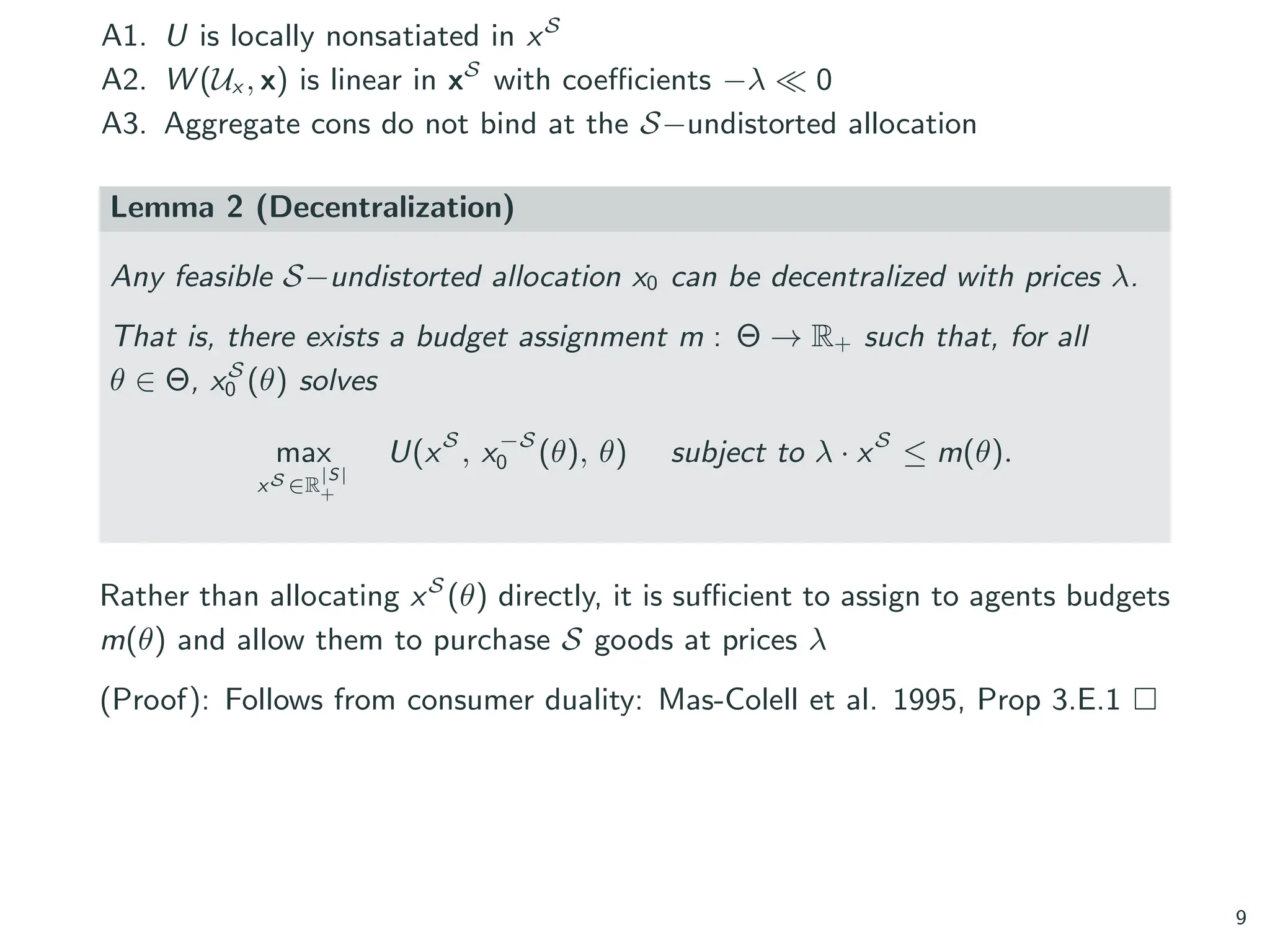
A1. U is locally nonsatiated in xS
A2. W (Ux , x) is linear in xS
with coefficients −λ ≪ 0
A3. Aggregate cons do not bind at the S−undistorted allocation
Lemma 2 (Decentralization)
Any feasible S−undistorted allocation x0 can be decentralized with prices λ.
That is, there exists a budget assignment m : Θ → R+ such that, for all
θ ∈ Θ, xS
0 (θ) solves
max
xS ∈R
|S|
+
U(xS
, x−S
0 (θ), θ) subject to λ · xS
≤ m(θ).
9
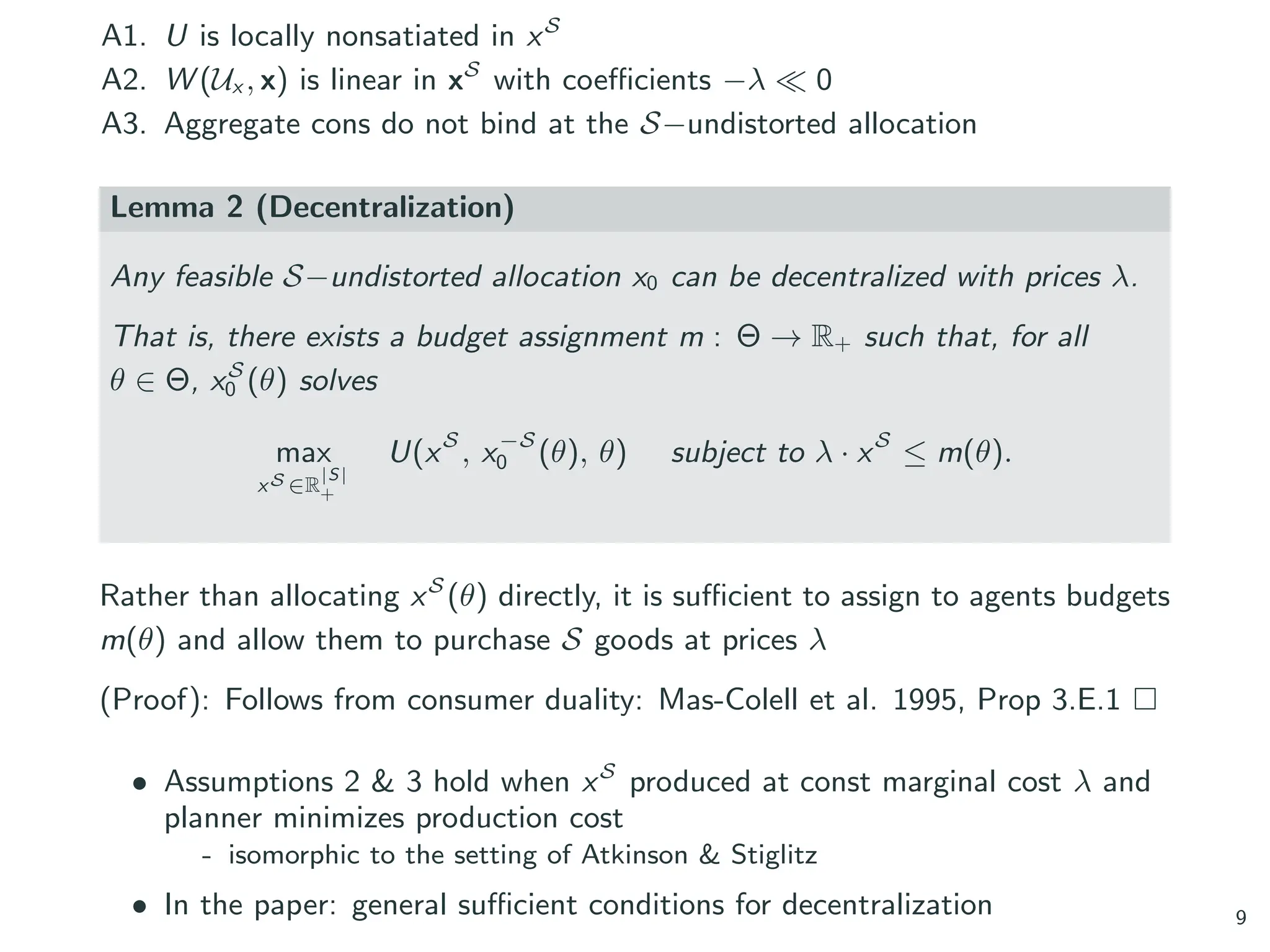
A1. U is locally nonsatiated in xS
A2. W (Ux , x) is linear in xS
with coefficients −λ ≪ 0
A3. Aggregate cons do not bind at the S−undistorted allocation
Lemma 2 (Decentralization)
Any feasible S−undistorted allocation x0 can be decentralized with prices λ.
That is, there exists a budget assignment m : Θ → R+ such that, for all
θ ∈ Θ, xS
0 (θ) solves
max
xS ∈R
|S|
+
U(xS
, x−S
0 (θ), θ) subject to λ · xS
≤ m(θ).
Rather than allocating xS
(θ) directly, it is sufficient to assign to agents budgets
m(θ) and allow them to purchase S goods at prices λ
(Proof): Follows from consumer duality: Mas-Colell et al. 1995, Prop 3.E.1 □
9
A1. U is locally nonsatiated in xS
A2. W (Ux , x) is linear in xS
with coefficients −λ ≪ 0
A3. Aggregate cons do not bind at the S−undistorted allocation
Lemma 2 (Decentralization)
Any feasible S−undistorted allocation x0 can be decentralized with prices λ.
That is, there exists a budget assignment m : Θ → R+ such that, for all
θ ∈ Θ, xS
0 (θ) solves
max
xS ∈R
|S|
+
U(xS
, x−S
0 (θ), θ) subject to λ · xS
≤ m(θ).
Rather than allocating xS
(θ) directly, it is sufficient to assign to agents budgets
m(θ) and allow them to purchase S goods at prices λ
(Proof): Follows from consumer duality: Mas-Colell et al. 1995, Prop 3.E.1 □
• Assumptions 2 & 3 hold when xS
produced at const marginal cost λ and
planner minimizes production cost
- isomorphic to the setting of Atkinson & Stiglitz
• In the paper: general sufficient conditions for decentralization 9
Applications
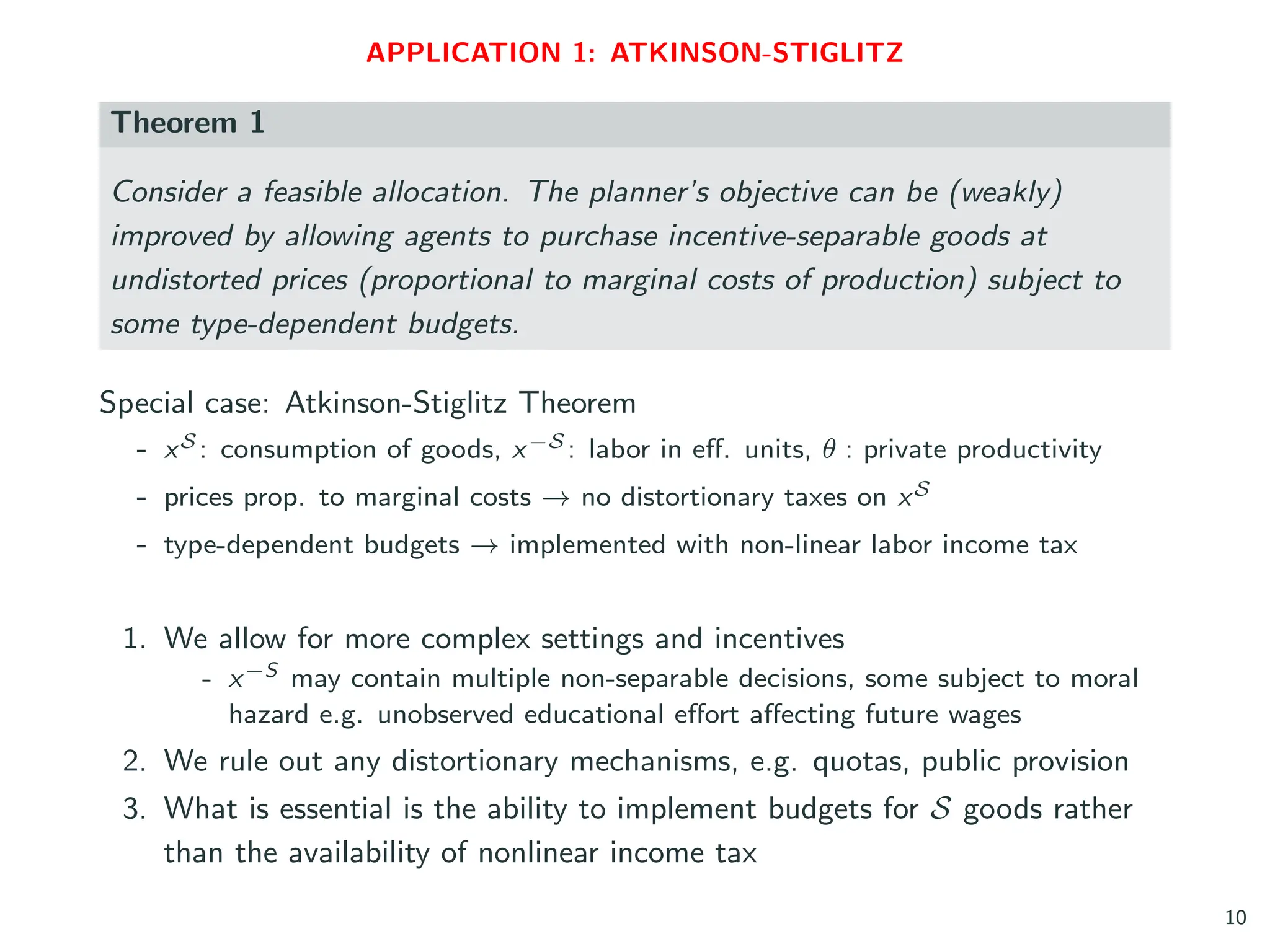
APPLICATION 1: ATKINSON-STIGLITZ
Theorem 1
Consider a feasible allocation. The planner’s objective can be (weakly)
improved by allowing agents to purchase incentive-separable goods at
undistorted prices (proportional to marginal costs of production) subject to
some type-dependent budgets.
Special case: Atkinson-Stiglitz Theorem
- xS : consumption of goods, x−S : labor in eff. units, θ : private productivity
- prices prop. to marginal costs → no distortionary taxes on xS
- type-dependent budgets → implemented with non-linear labor income tax
1. We allow for more complex settings and incentives
- x−S may contain multiple non-separable decisions, some subject to moral
hazard e.g. unobserved educational effort affecting future wages
2. We rule out any distortionary mechanisms, e.g. quotas, public provision
3. What is essential is the ability to implement budgets for S goods rather
than the availability of nonlinear income tax
10
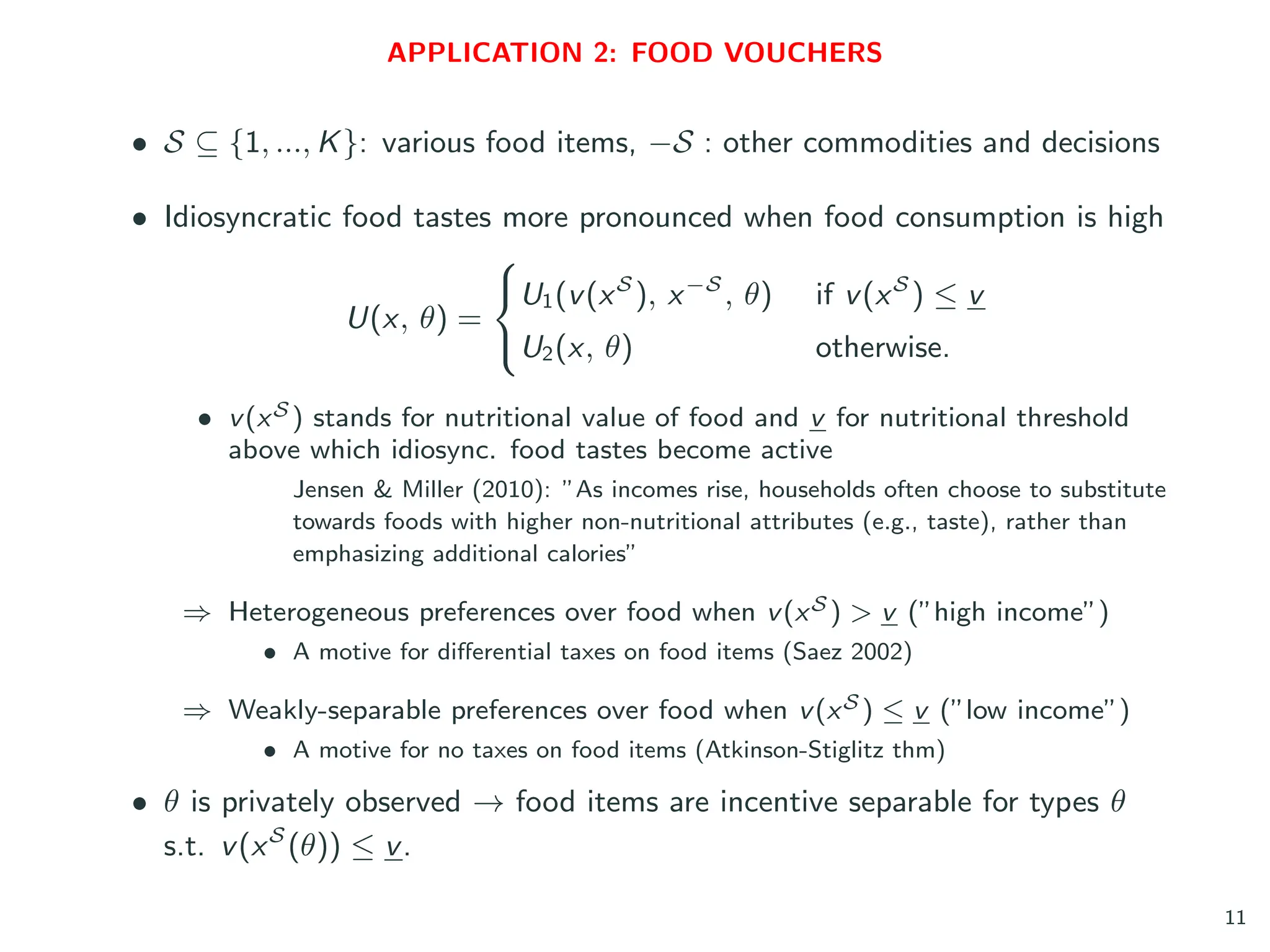
APPLICATION 2: FOOD VOUCHERS
• S ⊆ {1, ..., K}: various food items, −S : other commodities and decisions
• Idiosyncratic food tastes more pronounced when food consumption is high
U(x, θ) =



U1(v(xS
), x−S
, θ) if v(xS
) ≤ v
U2(x, θ) otherwise.
• v(xS ) stands for nutritional value of food and v for nutritional threshold
above which idiosync. food tastes become active
Jensen & Miller (2010): ”As incomes rise, households often choose to substitute
towards foods with higher non-nutritional attributes (e.g., taste), rather than
emphasizing additional calories”
⇒ Heterogeneous preferences over food when v(xS ) > v (”high income”)
• A motive for differential taxes on food items (Saez 2002)
⇒ Weakly-separable preferences over food when v(xS ) ≤ v (”low income”)
• A motive for no taxes on food items (Atkinson-Stiglitz thm)
• θ is privately observed → food items are incentive separable for types θ
s.t. v(xS
(θ)) ≤ v.
11
APPLICATION 2: FOOD VOUCHERS
Theorem 2
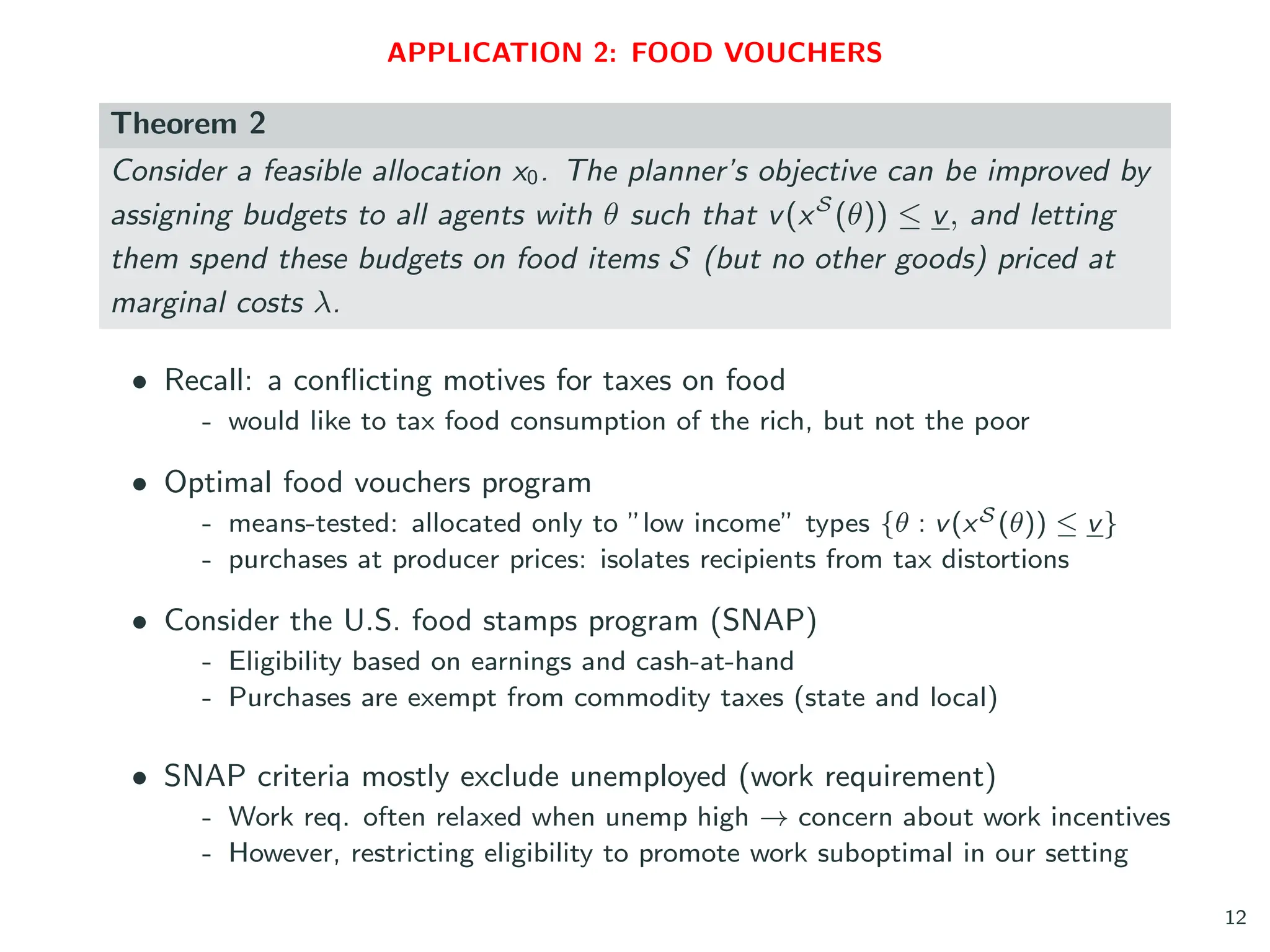
Consider a feasible allocation x0. The planner’s objective can be improved by
assigning budgets to all agents with θ such that v(xS
(θ)) ≤ v, and letting
them spend these budgets on food items S (but no other goods) priced at
marginal costs λ.
• Recall: a conflicting motives for taxes on food
- would like to tax food consumption of the rich, but not the poor
• Optimal food vouchers program
- means-tested: allocated only to ”low income” types {θ : v(xS (θ)) ≤ v}
- purchases at producer prices: isolates recipients from tax distortions
• Consider the U.S. food stamps program (SNAP)
- Eligibility based on earnings and cash-at-hand
- Purchases are exempt from commodity taxes (state and local)
• SNAP criteria mostly exclude unemployed (work requirement)
- Work req. often relaxed when unemp high → concern about work incentives
- However, restricting eligibility to promote work suboptimal in our setting
12
CONCLUSIONS
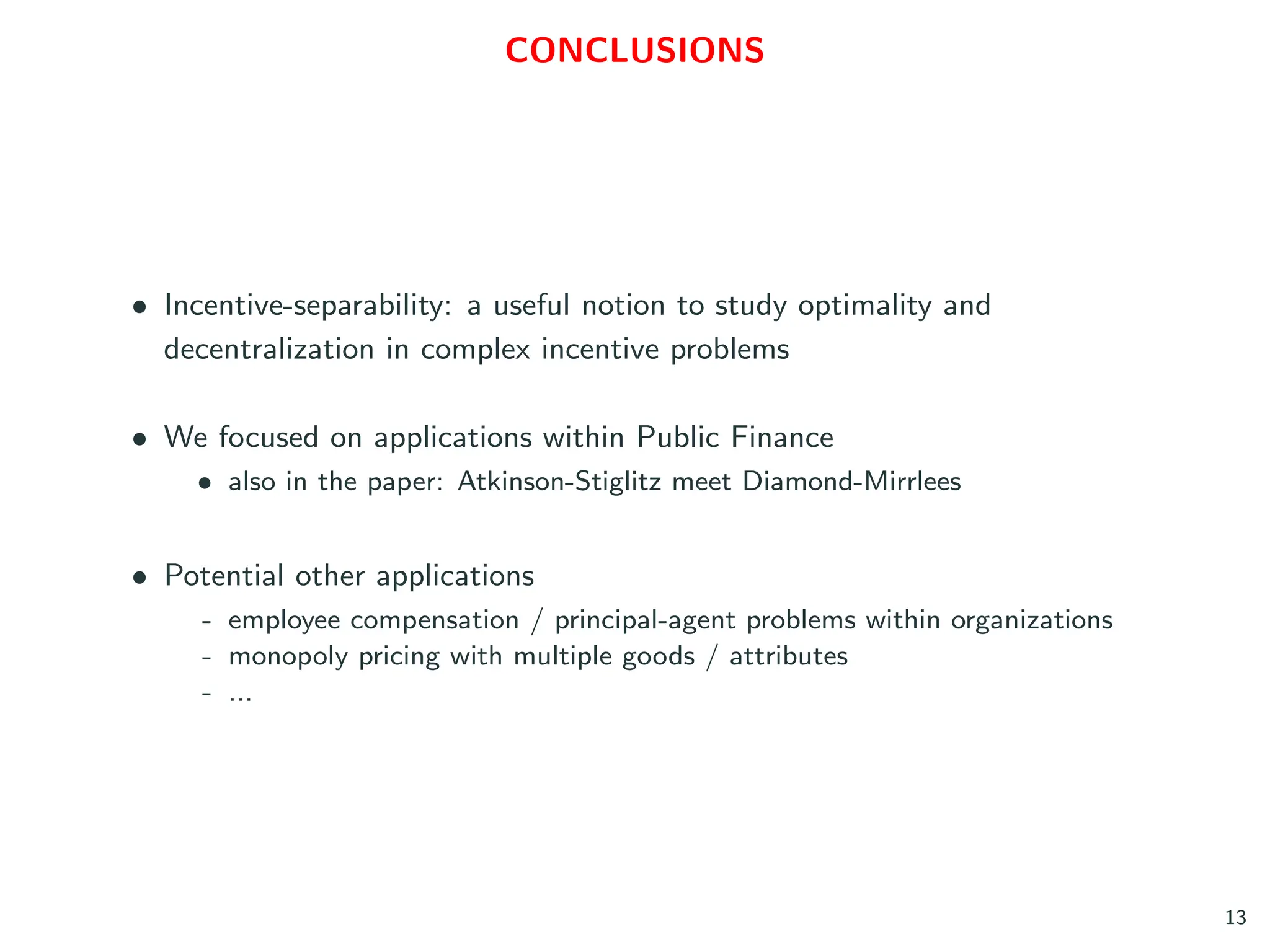
• Incentive-separability: a useful notion to study optimality and
decentralization in complex incentive problems
• We focused on applications within Public Finance
• also in the paper: Atkinson-Stiglitz meet Diamond-Mirrlees
• Potential other applications
- employee compensation / principal-agent problems within organizations
- monopoly pricing with multiple goods / attributes
- ...
13

DDKT-SAET.pdf

  • 1.
    Incentive separability andoptimal redistribution: A mechanism-design approach Pawel Doligalski (Bristol & GRAPE) Piotr Dworczak (Northwestern & GRAPE) Joanna Krysta (SGH & PSE) Filip Tokarski (Stanford GSB) This project has received funding from the European Research Council (ERC) under the European Union’s Horizon 2020 research and innovation programme (ERC Starting grant IMD-101040122) 1
  • 2.
    Efficiency-equity trade-off meansthat distortions are useful for redistribution However, sometimes the trade-off is not there: • Diamond & Mirrlees ’71: distortionary taxes on firms are redundant • Atkinson & Stiglitz ’76: distortionary consumption taxes are redundant - requires weak-separability of consumption from labour supply • Gauthier & Laroque ’09: distortionary taxes on weakly-separable decisions redundant (applied to public good provision, education subsidies...) 2
  • 3.
    Efficiency-equity trade-off meansthat distortions are useful for redistribution However, sometimes the trade-off is not there: • Diamond & Mirrlees ’71: distortionary taxes on firms are redundant • Atkinson & Stiglitz ’76: distortionary consumption taxes are redundant - requires weak-separability of consumption from labour supply • Gauthier & Laroque ’09: distortionary taxes on weakly-separable decisions redundant (applied to public good provision, education subsidies...) We study the general logic behind these results using Mechanism Design • General framework allowing for complex incentive constraints - private information, moral hazard, individual rationality etc • New notion of incentive-separable decisions - a generalisation of weak-separability from private info settings • Focus: optimality and decentralization of incentive-separable decisions • Several applications in Public Finance • AS theorem, optimality of food vouchers, economies with complex production sector 2
  • 4.
    Literature review • Redundancy(or not) of commodity taxes with nonlinear income tax Atkinson & Stiglitz (1976); Christiansen (1981); Cremer, Gahvari & Ladoux (1998); Laroque (2005); Kaplow (2006); Gauthier & Laroque (2009); Cremer & Gahvari (1995); Cremer, Pestieau & Rochet (2001); Saez (2002); da Costa & Werning (2002); Golosov, Kocherlakota & Tsyvinski (2003) • Optimal in-kind redistribution Nichols & Zeckhauser (1982); Currie & Gahvari (2008); Akbarpour r ○ Dworczak r ○ Kominers (2023) • Optimality of production efficiency Diamond & Mirrlees (1971); Stiglitz & Dasgupta (1971), Hammond (2000) 3
  • 5.
    Outline of thetalk 1. Framework 2. General results 3. Applications 4
  • 6.
  • 7.
    • A unitmass of agents with types θ ∈ [0, 1] ≡ Θ, uniformly distributed • Agents’ utility over a vector of K decisions x ∈ RK + U (x, θ) - U continuous in x - x contains e.g. consumption of goods, labor supply, effort, ... • An allocation rule x : Θ → RK + • associated aggregate allocation: x = ´ x(θ) dθ • associated utility profile Ux , where Ux (θ) = U(x(θ), θ) 5
  • 8.
    • Social plannerwith objective function W (Ux , x) - dependence on Ux : redistributive (welfarist) objective - dependence on x: preferences over allocations beyond agents utilities - e.g. opportunity cost of resources, preference for tax revenue • Planner chooses allocation x : Θ → RK + subject to 1. aggregate constraints: x ∈ F = {x : x ∈ F} - F ⊆ RK +, e.g. available resources, production technolgies etc. 2. incentive constraints: x ∈ I. - I ⊆ (RK )Θ , e.g. IC constraints due to private info, moral hazard, etc. • An allocation x ∈ F ∩ I is called feasible 6
  • 9.
    • Social plannerwith objective function W (Ux , x) - dependence on Ux : redistributive (welfarist) objective - dependence on x: preferences over allocations beyond agents utilities - e.g. opportunity cost of resources, preference for tax revenue • Planner chooses allocation x : Θ → RK + subject to 1. aggregate constraints: x ∈ F = {x : x ∈ F} - F ⊆ RK +, e.g. available resources, production technolgies etc. 2. incentive constraints: x ∈ I. - I ⊆ (RK )Θ , e.g. IC constraints due to private info, moral hazard, etc. • An allocation x ∈ F ∩ I is called feasible • Notation: Take a subset of decisions S ⊆ {1, ..., K} and fix x : Θ → RK + - We let xS = (xi )i∈S , x−S = (xi )i̸∈S and x = (xS , x−S ). 6
  • 10.
    Incentive separability Def: DecisionsS ⊆ {1, ..., K} are incentive-separable (at feasible alloc x0) if {(xS , x−S 0 ) ∈ F : U(xS (θ), x−S 0 (θ), θ) = U(x0(θ), θ), ∀θ ∈ Θ} ⊆ I. In words: Decisions S are incentive-separable (IS) if all admissible perturbations of xS that keep all types indifferent satisfy incentive constraints 7
  • 11.
    Incentive separability Def: DecisionsS ⊆ {1, ..., K} are incentive-separable (at feasible alloc x0) if {(xS , x−S 0 ) ∈ F : U(xS (θ), x−S 0 (θ), θ) = U(x0(θ), θ), ∀θ ∈ Θ} ⊆ I. In words: Decisions S are incentive-separable (IS) if all admissible perturbations of xS that keep all types indifferent satisfy incentive constraints IS is a joint restriction on preferences and incentives. Examples: 1. Only individual rationality (participation) constraints: all decisions are IS 2. Pure private information: weak separability ⇒ IS - where weak separability: U(x, θ) = Ũ(v(xS ), x−S , θ) 3. Pure moral hazard: hidden action a affects the distribution of observed state ω - U(x, θ) = −c(a) + P ω P(ω|a)uω(yω), yω ∈ RL + - yω, decisions within each state ω, are IS 4. Easy to extend to combinations of frictions, dynamic private info, aggregate states, ... 7
  • 12.
  • 13.
    Suppose that decisionsS ⊆ {1, ..., K} are incentive-separable Def: A feasible allocation x0 is S-undistorted if xS 0 solves max xS W (Ux0 , (xS , x−S 0 )) subject to: (xS , x−S 0 ) ∈ F U(xS (θ), x−S 0 (θ), θ) = Ux0 (θ), ∀θ ∈ Θ For this talk: assume that S−undistorted allocation exists 8
  • 14.
    Suppose that decisionsS ⊆ {1, ..., K} are incentive-separable Def: A feasible allocation x0 is S-undistorted if xS 0 solves max xS W (Ux0 , (xS , x−S 0 )) subject to: (xS , x−S 0 ) ∈ F U(xS (θ), x−S 0 (θ), θ) = Ux0 (θ), ∀θ ∈ Θ For this talk: assume that S−undistorted allocation exists Lemma 1 (Optimality) If x0 is not S-undistorted, then it can be improved upon in terms of welfare. 8
  • 15.
    Suppose that decisionsS ⊆ {1, ..., K} are incentive-separable Def: A feasible allocation x0 is S-undistorted if xS 0 solves max xS W (Ux0 , (xS , x−S 0 )) subject to: (xS , x−S 0 ) ∈ F U(xS (θ), x−S 0 (θ), θ) = Ux0 (θ), ∀θ ∈ Θ For this talk: assume that S−undistorted allocation exists Lemma 1 (Optimality) If x0 is not S-undistorted, then it can be improved upon in terms of welfare. • (Full proof) Replace xS 0 with S-undistorted xS ⋆ : 1. Utility levels are unaffected: Ux⋆ = Ux0 2. Incentive constraints are unaffected (by incentive-separability) 3. Planner’s objective strictly improves □ 8
  • 16.
    A1. U islocally nonsatiated in xS A2. W (Ux , x) is linear in xS with coefficients −λ ≪ 0 A3. Aggregate cons do not bind at the S−undistorted allocation Lemma 2 (Decentralization) Any feasible S−undistorted allocation x0 can be decentralized with prices λ. That is, there exists a budget assignment m : Θ → R+ such that, for all θ ∈ Θ, xS 0 (θ) solves max xS ∈R |S| + U(xS , x−S 0 (θ), θ) subject to λ · xS ≤ m(θ). 9
  • 17.
    A1. U islocally nonsatiated in xS A2. W (Ux , x) is linear in xS with coefficients −λ ≪ 0 A3. Aggregate cons do not bind at the S−undistorted allocation Lemma 2 (Decentralization) Any feasible S−undistorted allocation x0 can be decentralized with prices λ. That is, there exists a budget assignment m : Θ → R+ such that, for all θ ∈ Θ, xS 0 (θ) solves max xS ∈R |S| + U(xS , x−S 0 (θ), θ) subject to λ · xS ≤ m(θ). Rather than allocating xS (θ) directly, it is sufficient to assign to agents budgets m(θ) and allow them to purchase S goods at prices λ (Proof): Follows from consumer duality: Mas-Colell et al. 1995, Prop 3.E.1 □ 9
  • 18.
    A1. U islocally nonsatiated in xS A2. W (Ux , x) is linear in xS with coefficients −λ ≪ 0 A3. Aggregate cons do not bind at the S−undistorted allocation Lemma 2 (Decentralization) Any feasible S−undistorted allocation x0 can be decentralized with prices λ. That is, there exists a budget assignment m : Θ → R+ such that, for all θ ∈ Θ, xS 0 (θ) solves max xS ∈R |S| + U(xS , x−S 0 (θ), θ) subject to λ · xS ≤ m(θ). Rather than allocating xS (θ) directly, it is sufficient to assign to agents budgets m(θ) and allow them to purchase S goods at prices λ (Proof): Follows from consumer duality: Mas-Colell et al. 1995, Prop 3.E.1 □ • Assumptions 2 & 3 hold when xS produced at const marginal cost λ and planner minimizes production cost - isomorphic to the setting of Atkinson & Stiglitz • In the paper: general sufficient conditions for decentralization 9
  • 19.
  • 20.
    APPLICATION 1: ATKINSON-STIGLITZ Theorem1 Consider a feasible allocation. The planner’s objective can be (weakly) improved by allowing agents to purchase incentive-separable goods at undistorted prices (proportional to marginal costs of production) subject to some type-dependent budgets. Special case: Atkinson-Stiglitz Theorem - xS : consumption of goods, x−S : labor in eff. units, θ : private productivity - prices prop. to marginal costs → no distortionary taxes on xS - type-dependent budgets → implemented with non-linear labor income tax 1. We allow for more complex settings and incentives - x−S may contain multiple non-separable decisions, some subject to moral hazard e.g. unobserved educational effort affecting future wages 2. We rule out any distortionary mechanisms, e.g. quotas, public provision 3. What is essential is the ability to implement budgets for S goods rather than the availability of nonlinear income tax 10
  • 21.
    APPLICATION 2: FOODVOUCHERS • S ⊆ {1, ..., K}: various food items, −S : other commodities and decisions • Idiosyncratic food tastes more pronounced when food consumption is high U(x, θ) =    U1(v(xS ), x−S , θ) if v(xS ) ≤ v U2(x, θ) otherwise. • v(xS ) stands for nutritional value of food and v for nutritional threshold above which idiosync. food tastes become active Jensen & Miller (2010): ”As incomes rise, households often choose to substitute towards foods with higher non-nutritional attributes (e.g., taste), rather than emphasizing additional calories” ⇒ Heterogeneous preferences over food when v(xS ) > v (”high income”) • A motive for differential taxes on food items (Saez 2002) ⇒ Weakly-separable preferences over food when v(xS ) ≤ v (”low income”) • A motive for no taxes on food items (Atkinson-Stiglitz thm) • θ is privately observed → food items are incentive separable for types θ s.t. v(xS (θ)) ≤ v. 11
  • 22.
    APPLICATION 2: FOODVOUCHERS Theorem 2 Consider a feasible allocation x0. The planner’s objective can be improved by assigning budgets to all agents with θ such that v(xS (θ)) ≤ v, and letting them spend these budgets on food items S (but no other goods) priced at marginal costs λ. • Recall: a conflicting motives for taxes on food - would like to tax food consumption of the rich, but not the poor • Optimal food vouchers program - means-tested: allocated only to ”low income” types {θ : v(xS (θ)) ≤ v} - purchases at producer prices: isolates recipients from tax distortions • Consider the U.S. food stamps program (SNAP) - Eligibility based on earnings and cash-at-hand - Purchases are exempt from commodity taxes (state and local) • SNAP criteria mostly exclude unemployed (work requirement) - Work req. often relaxed when unemp high → concern about work incentives - However, restricting eligibility to promote work suboptimal in our setting 12
  • 23.
    CONCLUSIONS • Incentive-separability: auseful notion to study optimality and decentralization in complex incentive problems • We focused on applications within Public Finance • also in the paper: Atkinson-Stiglitz meet Diamond-Mirrlees • Potential other applications - employee compensation / principal-agent problems within organizations - monopoly pricing with multiple goods / attributes - ... 13