What is the difference between UN Thread Tap and ACME
Thread tap?
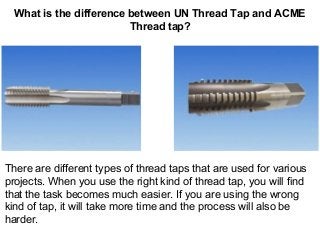
There are different types of thread taps that are used for various
projects. When you use the right kind of thread tap, you will find
that the task becomes much easier. If you are using the wrong
kind of tap, it will take more time and the process will also be
harder.
What is UN Thread Tap?
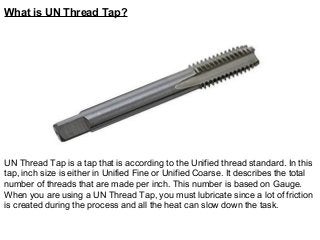
UN Thread Tap is a tap that is according to the Unified thread standard. In this
tap, inch size is either in Unified Fine or Unified Coarse. It describes the total
number of threads that are made per inch. This number is based on Gauge.
When you are using a UN Thread Tap, you must lubricate since a lot of friction
is created during the process and all the heat can slow down the task.
What is ACME Thread tap?
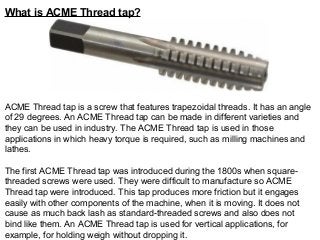
ACME Thread tap is a screw that features trapezoidal threads. It has an angle
of 29 degrees. An ACME Thread tap can be made in different varieties and
they can be used in industry. The ACME Thread tap is used in those
applications in which heavy torque is required, such as milling machines and
lathes.
The first ACME Thread tap was introduced during the 1800s when square-
threaded screws were used. They were difficult to manufacture so ACME
Thread tap were introduced. This tap produces more friction but it engages
easily with other components of the machine, when it is moving. It does not
cause as much back lash as standard-threaded screws and also does not
bind like them. An ACME Thread tap is used for vertical applications, for
example, for holding weigh without dropping it.
What to Consider when using ACME Thread tap and UN thread tap?
Whichever tap you are using, it is important to consider whether the tap you
are using is the best one for the job. The second thing to notice is the frictional
components. The friction is higher with ACME Thread tap so you must use
lubrication to make the process go smoothly. Along with that, it is important that
you use the required charts to determine the right hole for the right tap. Or, you
can use the formula for calculating the tap size that is needed for the job. When
you do things right, with steadiness, there will be lesser chances of your tap
breaking.

What is the difference between un thread tap and acme thread tap

  • 1.
    What is thedifference between UN Thread Tap and ACME Thread tap? There are different types of thread taps that are used for various projects. When you use the right kind of thread tap, you will find that the task becomes much easier. If you are using the wrong kind of tap, it will take more time and the process will also be harder.
  • 2.
    What is UNThread Tap? UN Thread Tap is a tap that is according to the Unified thread standard. In this tap, inch size is either in Unified Fine or Unified Coarse. It describes the total number of threads that are made per inch. This number is based on Gauge. When you are using a UN Thread Tap, you must lubricate since a lot of friction is created during the process and all the heat can slow down the task.
  • 3.
    What is ACMEThread tap? ACME Thread tap is a screw that features trapezoidal threads. It has an angle of 29 degrees. An ACME Thread tap can be made in different varieties and they can be used in industry. The ACME Thread tap is used in those applications in which heavy torque is required, such as milling machines and lathes. The first ACME Thread tap was introduced during the 1800s when square- threaded screws were used. They were difficult to manufacture so ACME Thread tap were introduced. This tap produces more friction but it engages easily with other components of the machine, when it is moving. It does not cause as much back lash as standard-threaded screws and also does not bind like them. An ACME Thread tap is used for vertical applications, for example, for holding weigh without dropping it.
  • 4.
    What to Considerwhen using ACME Thread tap and UN thread tap? Whichever tap you are using, it is important to consider whether the tap you are using is the best one for the job. The second thing to notice is the frictional components. The friction is higher with ACME Thread tap so you must use lubrication to make the process go smoothly. Along with that, it is important that you use the required charts to determine the right hole for the right tap. Or, you can use the formula for calculating the tap size that is needed for the job. When you do things right, with steadiness, there will be lesser chances of your tap breaking.