IS SOCIAL BUSINESS WORKING OUT??
CASE STUDY- BASF
GROUP MEMBERS
FEBA ANN C CHACKO
SHEKHA SHAJI
ZEPH 4
Photograph Of Case Study
SUMMARY
BASF is very much a knowledge-intensive company, but it was hampered by the absence of
an information system that enabled efficient global management decision making,
collaboration among professional employees, and convenient sharing of knowledge.
This impacted the company’s ability to create and deliver leading-edge chemical products
and services. It was very difficult to manage the firm on a global basis, or to bring together
teams located in distant time zones.
BASF management decided that the best solution was to deploy recently developed social
network technologies to move from a static corporate knowledge and work environment to
one in which actively engaged employees and enabled them to obtain more knowledge from
colleagues.
The company implemented IBM’s Enterprise Social Network platform as an enterprise-wide platform for
collaboration, management, knowledge acquisition, and knowledge transfer.
 It took advantage of the software’s new “social” tools to increase employee collaboration and
engagement.
 BASF now relies on its internal enterprise social network for much of employee learning and problem
solving.
BASF managers developed a management philosophy of voluntary participation in the network.
 It created an implementation team at the top and middle of the firm, and slowly spread the word to
corporate entities around the globe through webinars, learning events, and internal consulting.
QUESTIONS
1. How did using a single enterprise social network platform change
the way work was performed at BASF?
 BASF is the largest chemical company in the world. It has nearly 400 production sites
around the world, operates in 200 countries, and has just over100,000 employees.
 As a diversified chemical company, BASF supplies chemicals, plastics, catalysts,
industrial coatings, crop technology, and crude oil and gas exploration for a wide variety
of industries.
 With existing information technologies it was difficult to create a single global BASF
culture, to coordinate initiatives and employees across so many time zones, to
collaborate in real time, and to allow employees to participate in decision making.
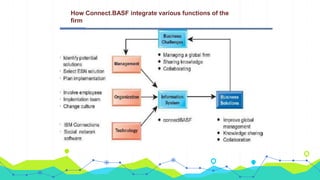
 So the company used a social business platform called connect.BASF. The platform
is based on the IBM Connections enterprise social network platform, which
operates in the IBM Cloud environment.
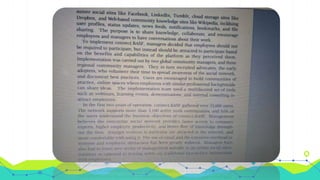
 By using this platform users are encouraged to build communities of practice, online spaces
where employees with similar professional backgrounds can share ideas. The implementation team
used a multifaceted set of tools such as to attract employees.
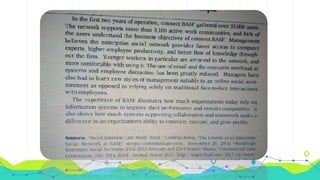
The enterprise social network provided faster access to company experts, higher employee
productivity, and better flow of knowledge through-out the firm.
Younger workers in particular are attracted to the network, and more comfortable with using it.
The use of email and the extensive overhead in systems and employee distraction has been
greatly reduced.
Managers have also had to learn new styles of management suitable to an online social
environment as opposed to relying solely on traditional face-to-face interactions with
employees.
The experience of BASF illustrates how much organizations today rely on information
systems to improve their performance and remain competitive, It also shows how
much systems supporting collaboration and teamwork make a difference in an
organization’s ability to innovate, execute, and grow profits.
How Connect.BASF integrate various functions of the
firm
2. How are collaboration and employee engagement keeping BASF
competitive?
BASF is very much a knowledge-intensive company , but it was hampered but it was
hampered by the absence of an information system that enabled efficient management decision
making, collaboration among employees and convenient sharing of knowledge.
This impacted company’s ability to create and deliver leading edge chemical products and
services.
BASF managers decided that the best solution was to deploy recently developed
technologies to move from a static corporate knowledge and work environment which actively
engaged employees and enabled them to obtain more knowledge from colleagues.
The major reason is that the company implemented IBM’s Enterprise Social Network
Platform as an enterprise wide platform for collaboration , management, knowledge acquisition
and knowledge transfer.
It took advantage of the software's new “ social” tools to increase employee collaboration
and engagement and relies on its internal enterprise social network.
BASF managers developed a management philosophy of voluntary participation in the
network .
It created an implementation team at the top and middle of the form, and slowly spread the
world to corporate entities around the globe through webinars, learning events and internal
counselling.
The experience of BASF illustrates how much organisation’s today rely on information
systems to improve their performance and remain competitive.
It also shows how much systems supporting collaboration and team work make a difference
in an organisation’s ability to innovate , execute and grow profits.
THANKS!

PPT- Is Social Business Working Out?

  • 1.
    IS SOCIAL BUSINESSWORKING OUT?? CASE STUDY- BASF GROUP MEMBERS FEBA ANN C CHACKO SHEKHA SHAJI ZEPH 4
  • 2.
  • 5.
    SUMMARY BASF is verymuch a knowledge-intensive company, but it was hampered by the absence of an information system that enabled efficient global management decision making, collaboration among professional employees, and convenient sharing of knowledge. This impacted the company’s ability to create and deliver leading-edge chemical products and services. It was very difficult to manage the firm on a global basis, or to bring together teams located in distant time zones. BASF management decided that the best solution was to deploy recently developed social network technologies to move from a static corporate knowledge and work environment to one in which actively engaged employees and enabled them to obtain more knowledge from colleagues.
  • 6.
    The company implementedIBM’s Enterprise Social Network platform as an enterprise-wide platform for collaboration, management, knowledge acquisition, and knowledge transfer.  It took advantage of the software’s new “social” tools to increase employee collaboration and engagement.  BASF now relies on its internal enterprise social network for much of employee learning and problem solving. BASF managers developed a management philosophy of voluntary participation in the network.  It created an implementation team at the top and middle of the firm, and slowly spread the word to corporate entities around the globe through webinars, learning events, and internal consulting.
  • 7.
  • 8.
    1. How didusing a single enterprise social network platform change the way work was performed at BASF?  BASF is the largest chemical company in the world. It has nearly 400 production sites around the world, operates in 200 countries, and has just over100,000 employees.  As a diversified chemical company, BASF supplies chemicals, plastics, catalysts, industrial coatings, crop technology, and crude oil and gas exploration for a wide variety of industries.  With existing information technologies it was difficult to create a single global BASF culture, to coordinate initiatives and employees across so many time zones, to collaborate in real time, and to allow employees to participate in decision making.  So the company used a social business platform called connect.BASF. The platform is based on the IBM Connections enterprise social network platform, which operates in the IBM Cloud environment.
  • 9.
     By usingthis platform users are encouraged to build communities of practice, online spaces where employees with similar professional backgrounds can share ideas. The implementation team used a multifaceted set of tools such as to attract employees. The enterprise social network provided faster access to company experts, higher employee productivity, and better flow of knowledge through-out the firm. Younger workers in particular are attracted to the network, and more comfortable with using it. The use of email and the extensive overhead in systems and employee distraction has been greatly reduced.
  • 10.
    Managers have alsohad to learn new styles of management suitable to an online social environment as opposed to relying solely on traditional face-to-face interactions with employees. The experience of BASF illustrates how much organizations today rely on information systems to improve their performance and remain competitive, It also shows how much systems supporting collaboration and teamwork make a difference in an organization’s ability to innovate, execute, and grow profits.
  • 11.
    How Connect.BASF integratevarious functions of the firm
  • 12.
    2. How arecollaboration and employee engagement keeping BASF competitive? BASF is very much a knowledge-intensive company , but it was hampered but it was hampered by the absence of an information system that enabled efficient management decision making, collaboration among employees and convenient sharing of knowledge. This impacted company’s ability to create and deliver leading edge chemical products and services. BASF managers decided that the best solution was to deploy recently developed technologies to move from a static corporate knowledge and work environment which actively engaged employees and enabled them to obtain more knowledge from colleagues.
  • 13.
    The major reasonis that the company implemented IBM’s Enterprise Social Network Platform as an enterprise wide platform for collaboration , management, knowledge acquisition and knowledge transfer. It took advantage of the software's new “ social” tools to increase employee collaboration and engagement and relies on its internal enterprise social network. BASF managers developed a management philosophy of voluntary participation in the network .
  • 14.
    It created animplementation team at the top and middle of the form, and slowly spread the world to corporate entities around the globe through webinars, learning events and internal counselling. The experience of BASF illustrates how much organisation’s today rely on information systems to improve their performance and remain competitive. It also shows how much systems supporting collaboration and team work make a difference in an organisation’s ability to innovate , execute and grow profits.
  • 15.