



Six Rules for Change
esther@estherderby.com @estherderby
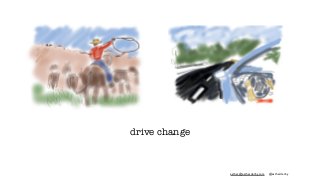
drive change
esther@estherderby.com @estherderby
install change
esther@estherderby.com @estherderby
evangelize change
esther@estherderby.com @estherderby
Nurture complex change in complex environments.
esther@estherderby.com @estherderby
Six Rules for Change
esther@estherderby.com @estherderby
Work from a stance of Congruence,
balancing the interest of self-others-
context.
1
esther@estherderby.com @estherderby
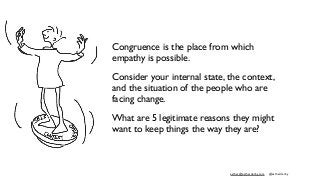
Congruence is the place from which
empathy is possible.
Consider your internal state, the context,
and the situation of the people who are
facing change.
What are 5 legitimate reasons they might
want to keep things the way they are?
esther@estherderby.com @estherderby
Honor what is valuable about the
past andwhat is working now.
Devaluing what people have been
doing makes change more difficult.
2
esther@estherderby.com @estherderby
Don’t force people to admit they’ve been wrong.
Shift your language:
• This was the best solution we had at that time.
• This served us well when….
• Up until now, this has been sufficient. Now…
• This way of working got us this far. Now…
Knowing what you want to keep is as important as
knowing what you want to change.
esther@estherderby.com @estherderby
Assess the current situation and system.
What holds the current pattern in place?
Who will gain and who will lose when
things change?
3
esther@estherderby.com @estherderby
How is the system working now?
What holds the current pattern in place? What
might shift the pattern?
What is understood, and what learning is needed?
Who may benefits from the status quo? Who will
benefit from the change?
Who will work with you?
What is possible from where you stand now?
esther@estherderby.com @estherderby
Activate Networks to diffuse new
ideas through the system. Weave
in people who are trusted and who
people turn to for advice.
4
esther@estherderby.com @estherderby
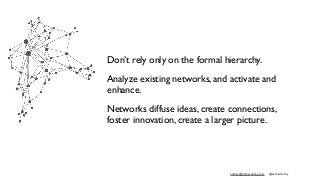
Don’t rely only on the formal hierarchy.
Analyze existing networks, and activate and
enhance.
Networks diffuse ideas, create connections,
foster innovation, create a larger picture.
esther@estherderby.com @estherderby
Guide the change.
Consider where global principles apply,
and what can evolve locally.
Work by successive approximation.
5
esther@estherderby.com @estherderby
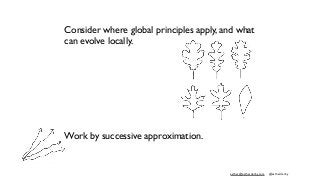
Consider where global principles apply, and what
can evolve locally.
Work by successive approximation.
esther@estherderby.com @estherderby
Big change feels like an existential
threat. Small changes allow for learning.
Design Experiments to facilitate
learning and buy-in.
6
esther@estherderby.com @estherderby
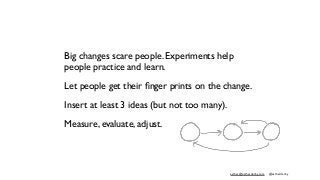
Big changes scare people. Experiments help
people practice and learn.
Let people get their finger prints on the change.
Insert at least 3 ideas (but not too many).
Measure, evaluate, adjust.
esther@estherderby.com @estherderby
1. Always come back to Congruence.
2. Honor what is valuable about the past and what is working now.
3. Assess and re-asses the current situation and system.
4. Ascertain who is trusted and who people turn to for advice, and
weave them into your Network.
5. Guide the change. Consider where global principles apply, and what
can evolve locally.
6. Design Experiments in collaboration with the people who are involved
in the change.
esther@estherderby.com @estherderby
http://www.estherderby.com/qa-teleconferences
esther@estherderby.com @estherderby
Esther Derby
esther@estherderby.co
m
+1 612.239.1214
www.estherderby.com
@estherderby
Six Rules for Change

Six Rules for Change