Leeds University Business School
Evacuation
project overview
Leeds University Business School
Evacuation Project Overview
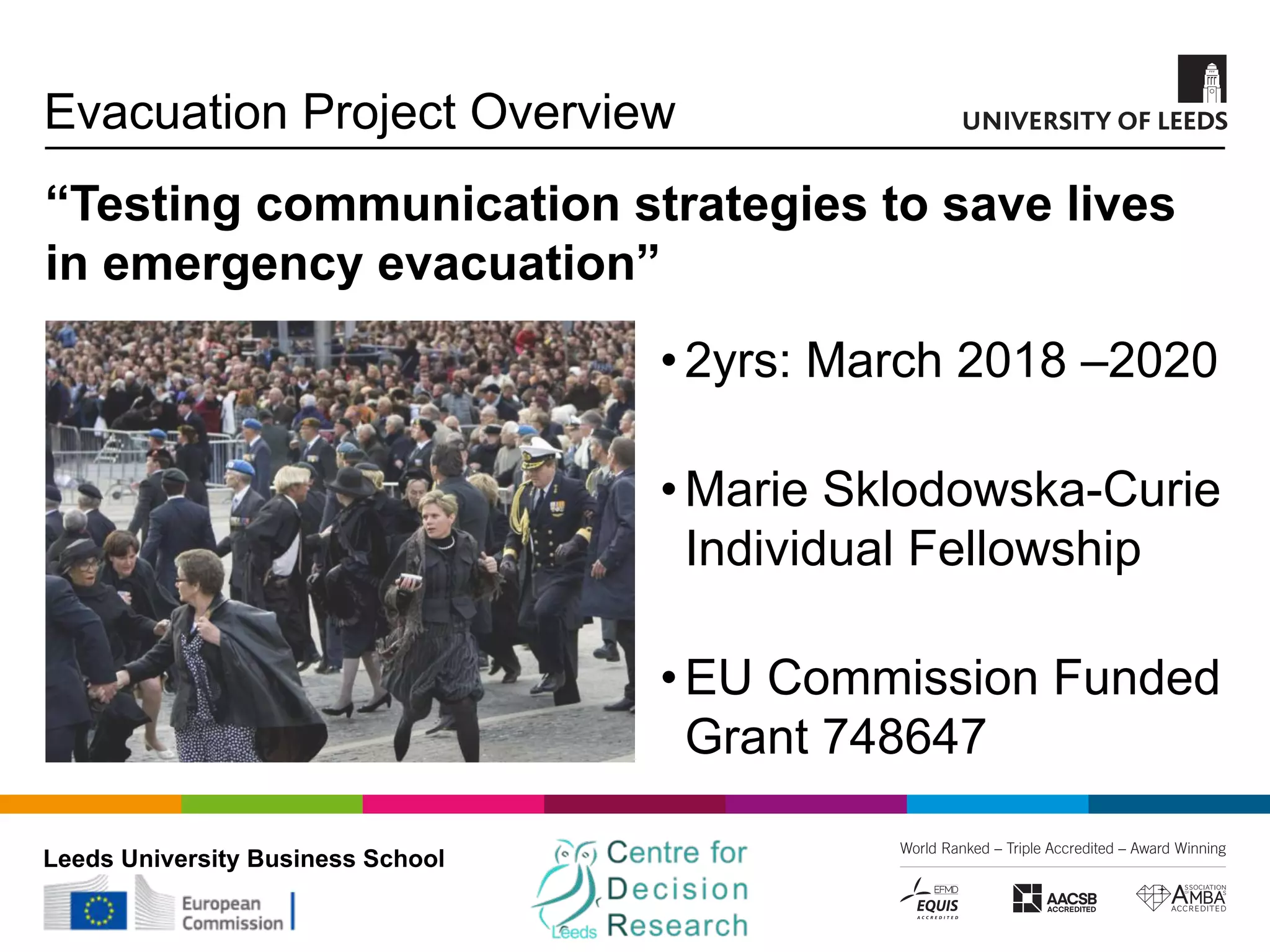
“Testing communication strategies to save lives
in emergency evacuation”
•2yrs: March 2018 –2020
•Marie Sklodowska-Curie
Individual Fellowship
•EU Commission Funded
Grant 748647
Leeds University Business School
Core Project Members
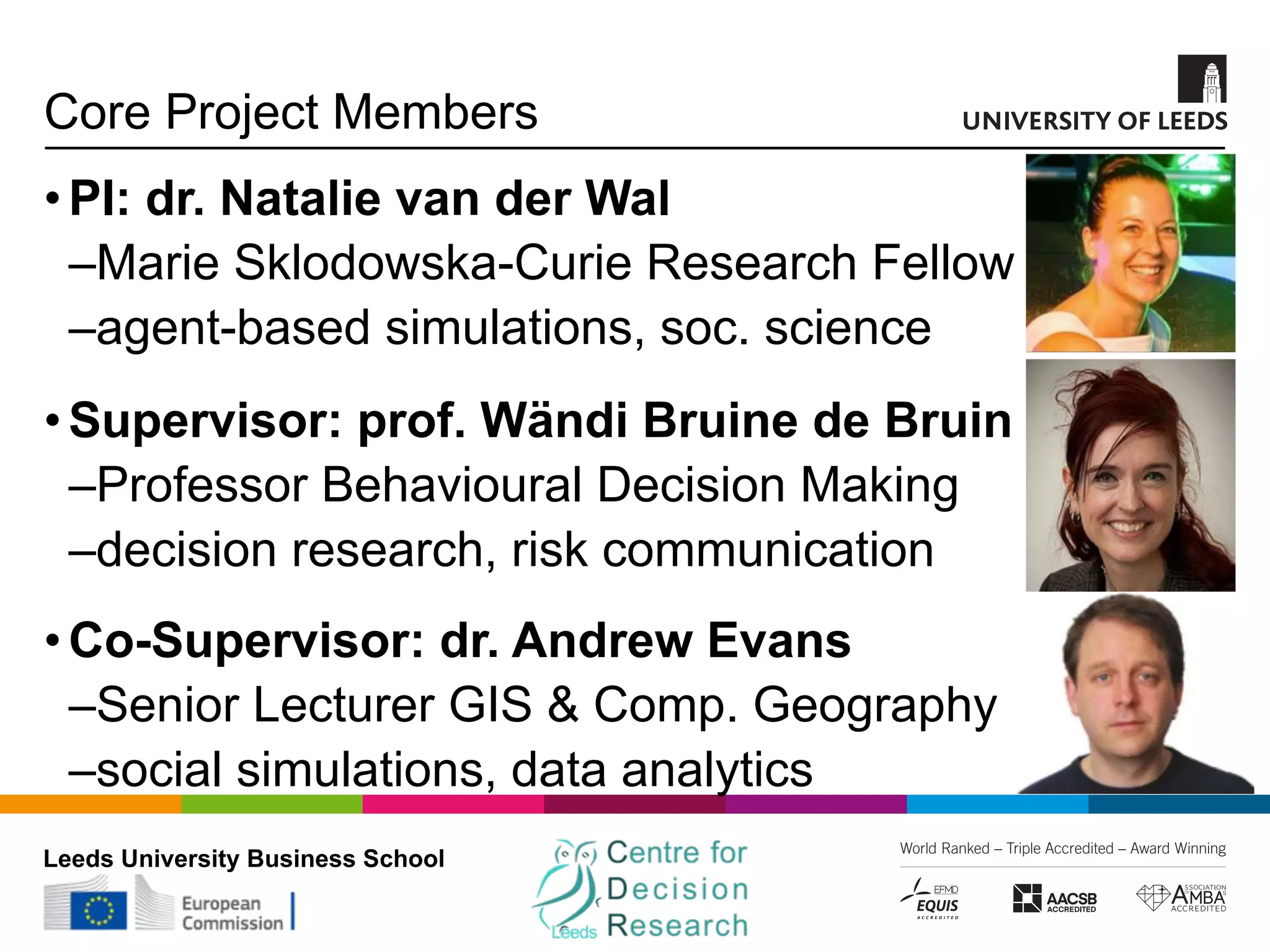
•PI: dr. Natalie van der Wal
‒Marie Sklodowska-Curie Research Fellow
‒agent-based simulations, soc. science
•Supervisor: prof. Wändi Bruine de Bruin
‒Professor Behavioural Decision Making
‒decision research, risk communication
•Co-Supervisor: dr. Andrew Evans
‒Senior Lecturer GIS & Comp. Geography
‒social simulations, data analytics
Leeds University Business School
Advisory Board Members
•Professor Keith Still
‒Professor of Crowd Science,
Manchester Metropolitan University
•Robert Pyke
‒Leeds City Council, West Yorkshire
Resilience Forum Coordinator
•Paul Townsend
‒Associative Director, Crowd Dynamics
Leeds University Business School
Advisory Board Members
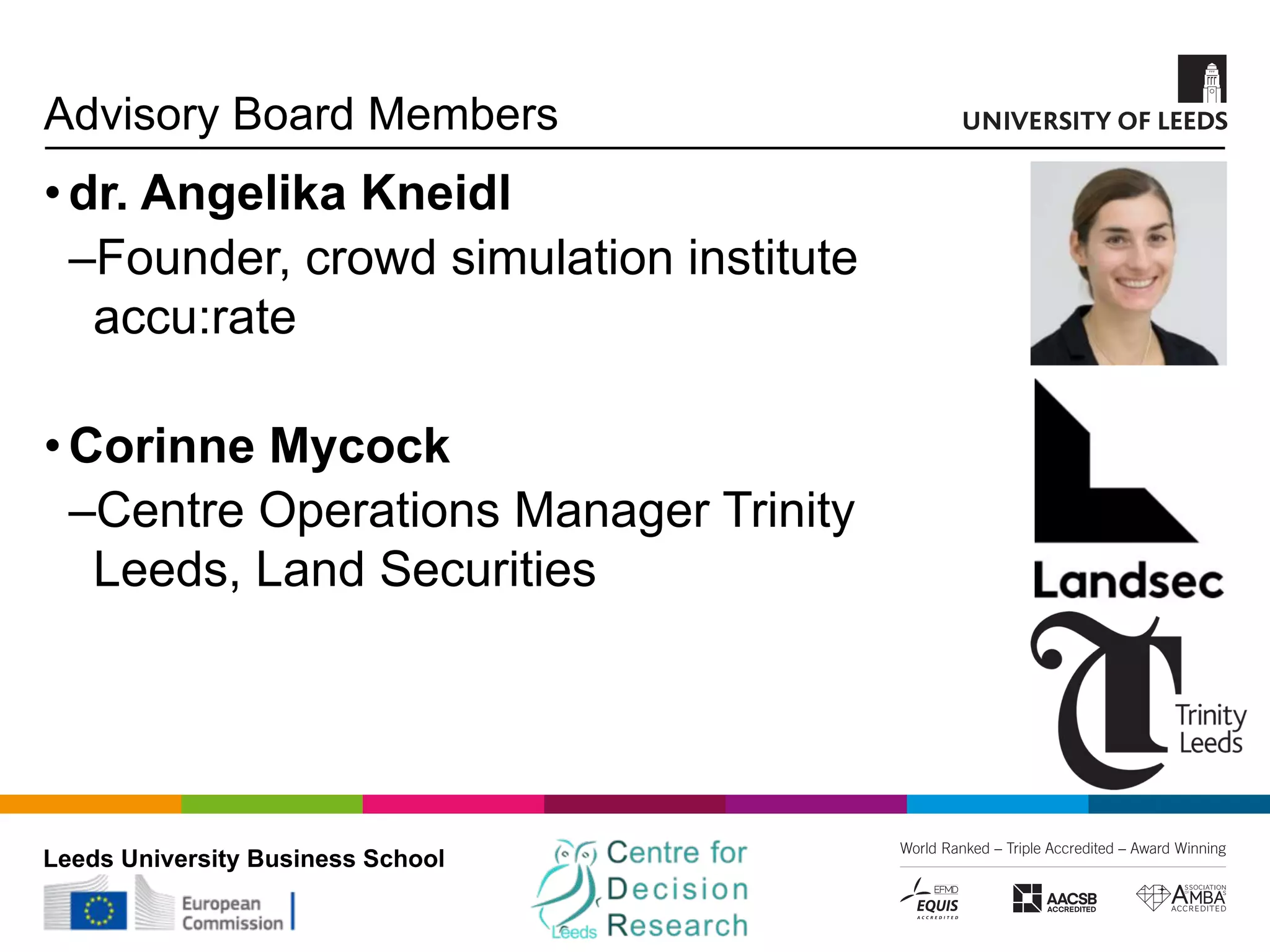
•dr. Angelika Kneidl
‒Founder, crowd simulation institute
accu:rate
•Corinne Mycock
‒Centre Operations Manager Trinity
Leeds, Land Securities
Leeds University Business School
Background
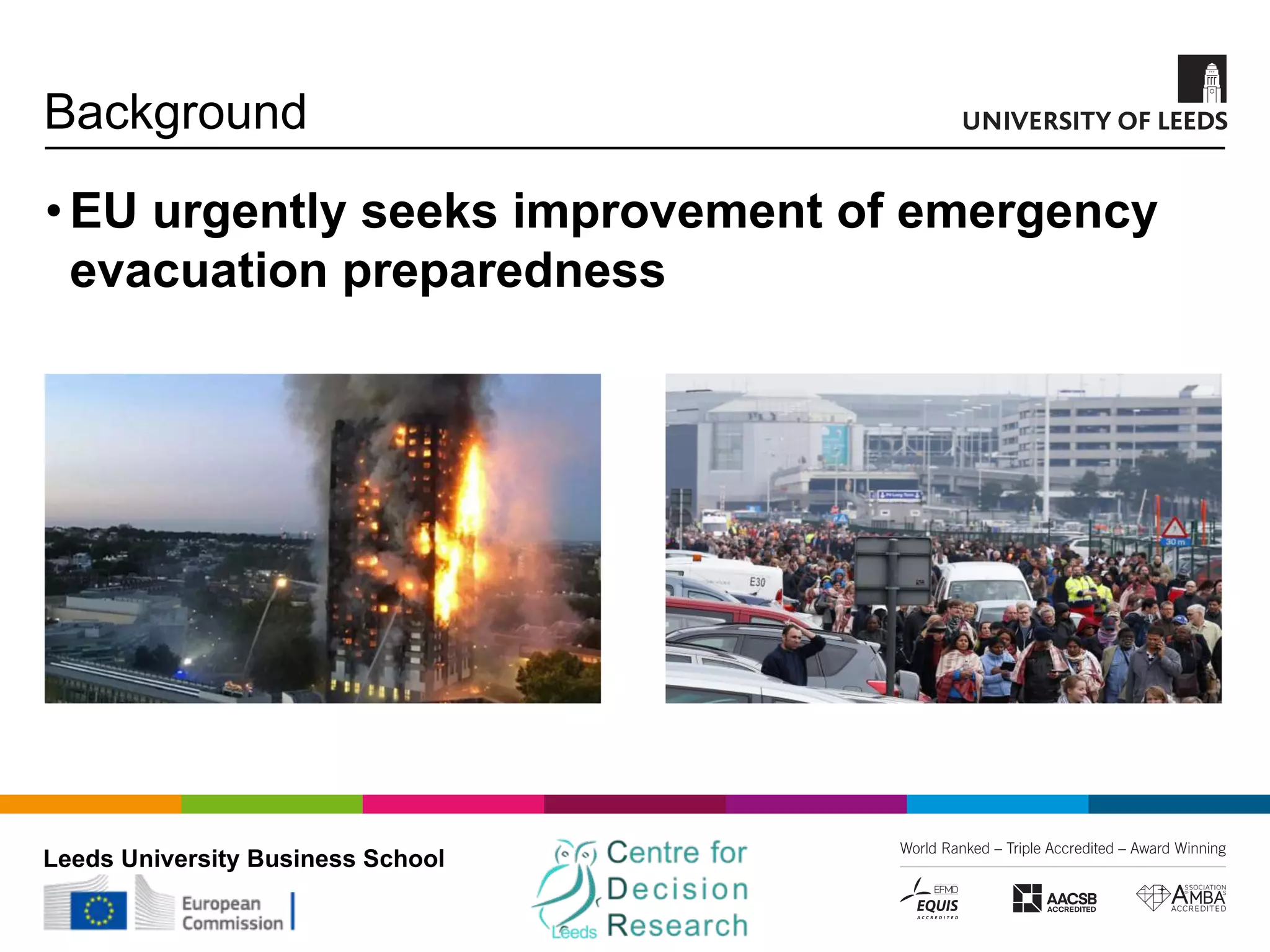
•EU urgently seeks improvement of emergency
evacuation preparedness
Leeds University Business School
Background
•EU urgently seeks improvement of emergency
evacuation preparedness
‒100.000 - 600.000 fires in the EU per year
‒100-1000 deaths due to fire per country, per year
‒Rising EU security threat (terroristic attacks)
‒Increasing populations = more crowded transport
hubs, shopping malls, public spaces
Leeds University Business School
Background
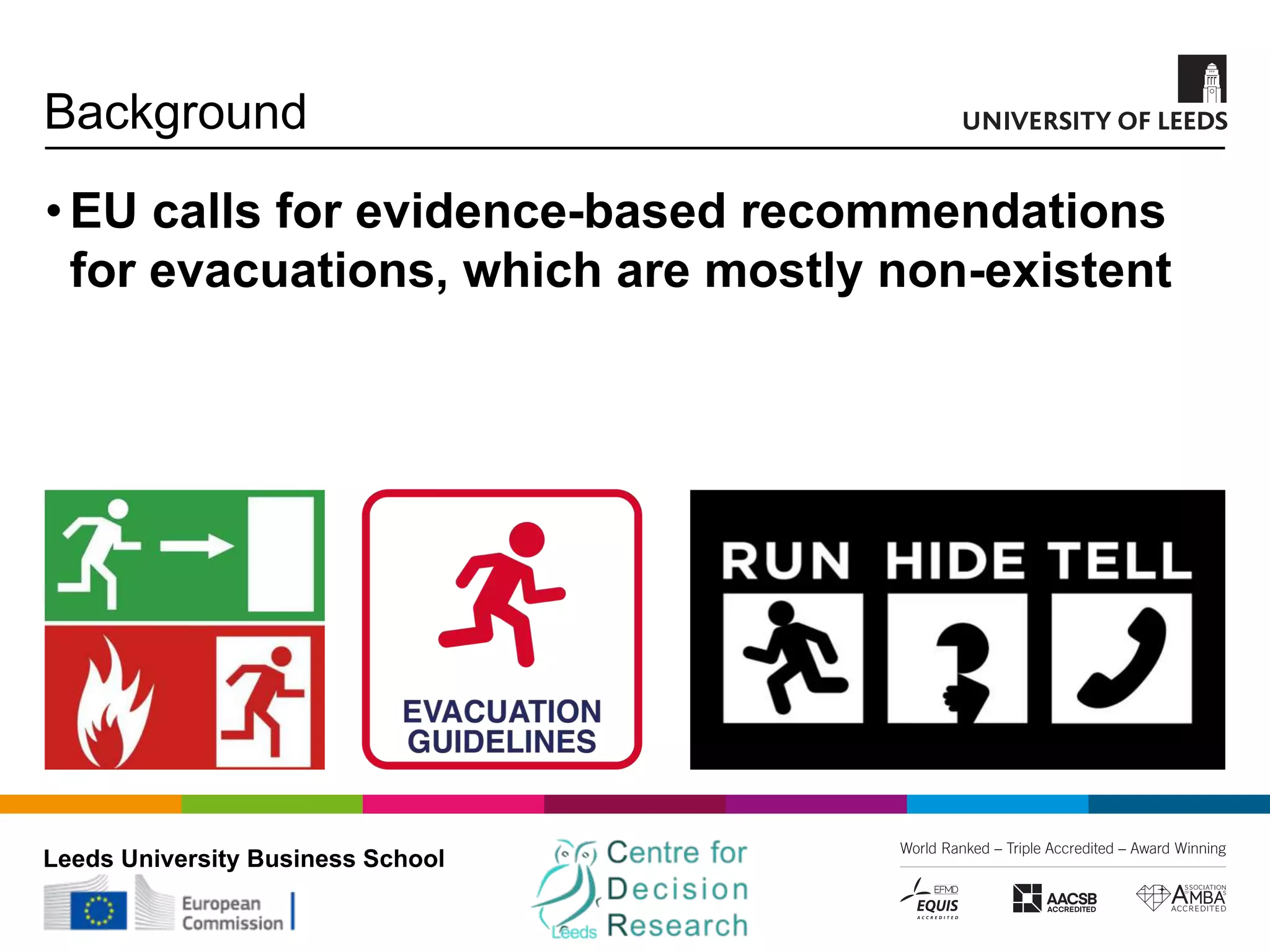
•EU calls for evidence-based recommendations
for evacuations, which are mostly non-existent
Leeds University Business School
Background
•EU calls for evidence-based recommendations
for evacuations, which are mostly non-existent
‒Existing guidelines based on restricted reports
‒These have not been systematically tested
‒These can actually slow down evacuation time by
25% (”Run than Hide”)
‒Can lack realism (ignoring slow response & taking
familiar route)
Leeds University Business School
Research Question
•How can speed and survival in emergency
evacuations be improved?
Leeds University Business School
Work Package 1 (WP1)
•Objective: Identify which risky behaviours occur in
emergency evacuations and underlying causes
•Expected Outcomes: a list of risky behaviours
observed in videos and (mis)understandings of the
emergency situation
•Method: Video observations, focus groups,
interviews, surveys
WP1
Leeds University Business School
Work Package 2 (WP2)
•Objective: Use models to identify communication
strategies that improve evacuation time and survival
•Expected Outcomes: evacuation simulation
outcomes (speed and survival) of different
communication strategies in multiple emergency
situations
•Method: Agent-based modelling, experiments in
silico
WP2
Leeds University Business School
Work Package 3 (WP3)
•Objective: Test communication strategies for
improving evacuation time and survival in
experiments
•Expected Outcomes: real life outcomes of different
communication strategies during evacuations
•Method: Human Experiments
WP3
Leeds University Business School
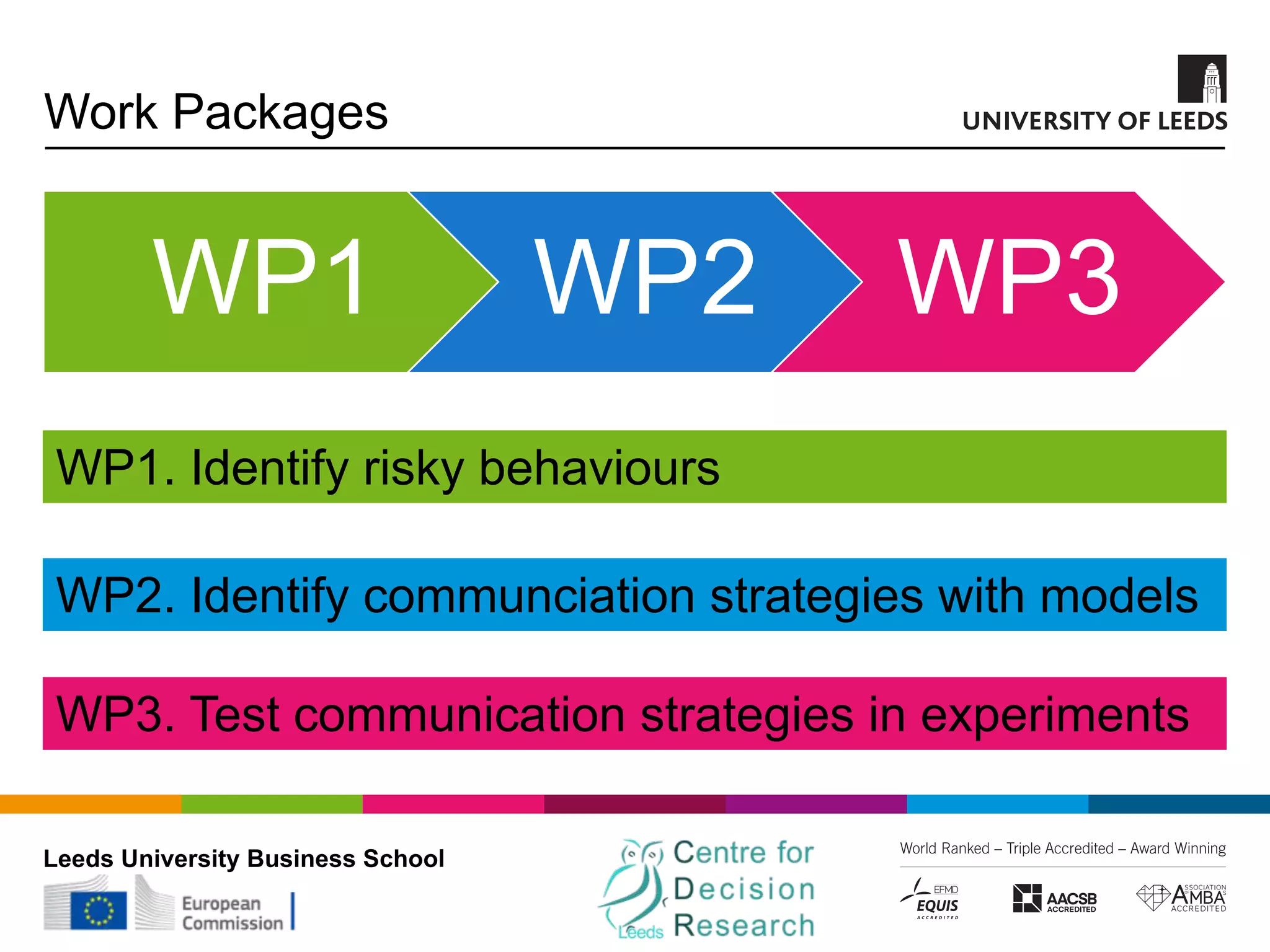
Work Packages
WP1 WP2 WP3
WP1. Identify risky behaviours
WP2. Identify communciation strategies with models
WP3. Test communication strategies in experiments
Leeds University Business School
Final Remarks
•The UK is an ideal testbed for our project aims,
but we will inform evacuations worldwide:
‒Workshops announced at project website
‒Video about research coming soon
‒Subscribe to news
•Project website:
cdr.leeds.ac.uk/project-evacuation/
•Additional Advisory Board Member place
Leeds University Business School
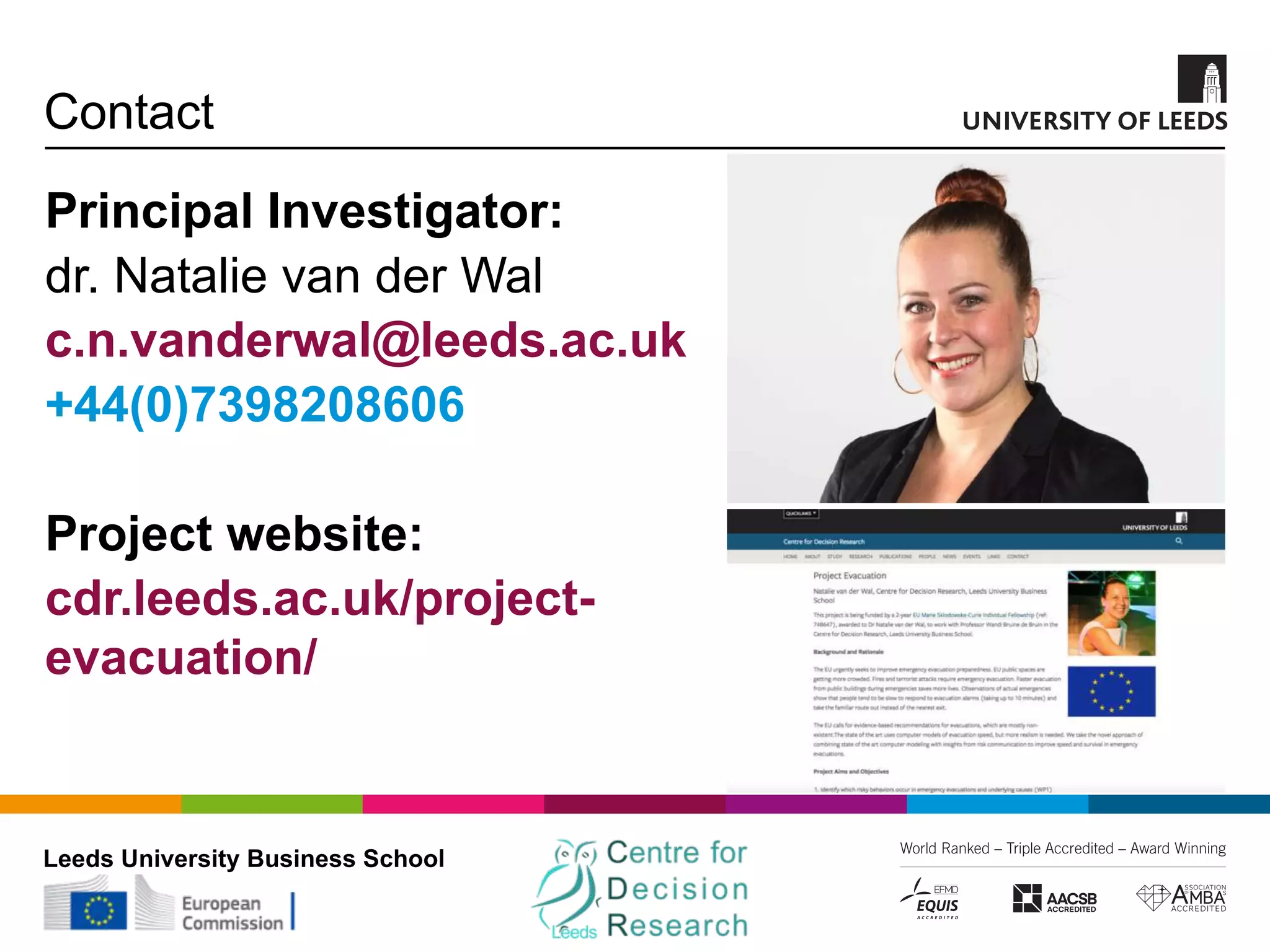
Contact
Principal Investigator:
dr. Natalie van der Wal
c.n.vanderwal@leeds.ac.uk
+44(0)7398208606
Project website:
cdr.leeds.ac.uk/project-
evacuation/

Evacuation project overview

  • 1.
    Leeds University BusinessSchool Evacuation project overview
  • 2.
    Leeds University BusinessSchool Evacuation Project Overview “Testing communication strategies to save lives in emergency evacuation” •2yrs: March 2018 –2020 •Marie Sklodowska-Curie Individual Fellowship •EU Commission Funded Grant 748647
  • 3.
    Leeds University BusinessSchool Core Project Members •PI: dr. Natalie van der Wal ‒Marie Sklodowska-Curie Research Fellow ‒agent-based simulations, soc. science •Supervisor: prof. Wändi Bruine de Bruin ‒Professor Behavioural Decision Making ‒decision research, risk communication •Co-Supervisor: dr. Andrew Evans ‒Senior Lecturer GIS & Comp. Geography ‒social simulations, data analytics
  • 4.
    Leeds University BusinessSchool Advisory Board Members •Professor Keith Still ‒Professor of Crowd Science, Manchester Metropolitan University •Robert Pyke ‒Leeds City Council, West Yorkshire Resilience Forum Coordinator •Paul Townsend ‒Associative Director, Crowd Dynamics
  • 5.
    Leeds University BusinessSchool Advisory Board Members •dr. Angelika Kneidl ‒Founder, crowd simulation institute accu:rate •Corinne Mycock ‒Centre Operations Manager Trinity Leeds, Land Securities
  • 6.
    Leeds University BusinessSchool Background •EU urgently seeks improvement of emergency evacuation preparedness
  • 7.
    Leeds University BusinessSchool Background •EU urgently seeks improvement of emergency evacuation preparedness ‒100.000 - 600.000 fires in the EU per year ‒100-1000 deaths due to fire per country, per year ‒Rising EU security threat (terroristic attacks) ‒Increasing populations = more crowded transport hubs, shopping malls, public spaces
  • 8.
    Leeds University BusinessSchool Background •EU calls for evidence-based recommendations for evacuations, which are mostly non-existent
  • 9.
    Leeds University BusinessSchool Background •EU calls for evidence-based recommendations for evacuations, which are mostly non-existent ‒Existing guidelines based on restricted reports ‒These have not been systematically tested ‒These can actually slow down evacuation time by 25% (”Run than Hide”) ‒Can lack realism (ignoring slow response & taking familiar route)
  • 10.
    Leeds University BusinessSchool Research Question •How can speed and survival in emergency evacuations be improved?
  • 11.
    Leeds University BusinessSchool Work Package 1 (WP1) •Objective: Identify which risky behaviours occur in emergency evacuations and underlying causes •Expected Outcomes: a list of risky behaviours observed in videos and (mis)understandings of the emergency situation •Method: Video observations, focus groups, interviews, surveys WP1
  • 12.
    Leeds University BusinessSchool Work Package 2 (WP2) •Objective: Use models to identify communication strategies that improve evacuation time and survival •Expected Outcomes: evacuation simulation outcomes (speed and survival) of different communication strategies in multiple emergency situations •Method: Agent-based modelling, experiments in silico WP2
  • 13.
    Leeds University BusinessSchool Work Package 3 (WP3) •Objective: Test communication strategies for improving evacuation time and survival in experiments •Expected Outcomes: real life outcomes of different communication strategies during evacuations •Method: Human Experiments WP3
  • 14.
    Leeds University BusinessSchool Work Packages WP1 WP2 WP3 WP1. Identify risky behaviours WP2. Identify communciation strategies with models WP3. Test communication strategies in experiments
  • 15.
    Leeds University BusinessSchool Final Remarks •The UK is an ideal testbed for our project aims, but we will inform evacuations worldwide: ‒Workshops announced at project website ‒Video about research coming soon ‒Subscribe to news •Project website: cdr.leeds.ac.uk/project-evacuation/ •Additional Advisory Board Member place
  • 16.
    Leeds University BusinessSchool Contact Principal Investigator: dr. Natalie van der Wal c.n.vanderwal@leeds.ac.uk +44(0)7398208606 Project website: cdr.leeds.ac.uk/project- evacuation/