Central- and
Eastern Europe
Whenit’s about industrial site selection, grants can be
the cherry on the cake. I don’t suggest to make a
decision based on grants only, but why shouldn’t
calculate with free money when some governments
provide it?
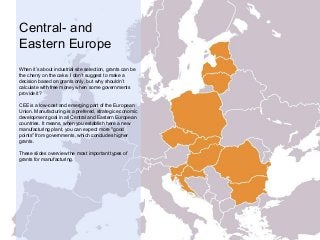
CEE is a low-cost and emerging part of the European
Union. Manufacturing is a prefered, strategic economic
development goal in all Central and Eastern European
countries. It means, when you establish here a new
manufacturing plant, you can expect more "good
points" from governments, which concludes higher
grants.
These slides overview the most important types of
grants for manufacturing.
4.
How to start
Thesubsidizing process always starts at the national
investment promotion agencies: the PAIZ in Poland,
the Hipa in Hungary, the CzechInvest in the Czech
Republic, the Sario in Slovakia.
Decision making about the government grants requires
normally 1-3 months.
Governments sign an agreement with investor, so
receiving a government grant is a contractual
connection between the company and the
government. It means, you get some money, but you
also have some obligations, e.g: for job creation
money you have to employ your staff for 1-2 years -
and when you couldn’t, you have to pay back the
grant.
Generally we can say, Eastern European
governments' threshold stimulus is around 10 million
euros investment and approx. 100 new jobs.
5.
#1 Grants for
acquisitionof
assets
Most countries do not separate the real estate and
machinery grants - they simply subsidizes investments
in "assets".
The machinery can be the main "eligible cost" of
investment projects, e.g in the Czech Republic, "A
basic condition is a minimum investment in long-term
tangible and intangible assets in the amount of CZK 50
million in Regions I, of which at least CZK 25 million
must be invested in new machinery, and CZK 100
million in Regions II, of which at least CZK 50 million
must be invested in machinery, whereas at least half
of the minimum investment amount must by fi nanced
with the investor’s own capital." (CzechInvest)
Regarding real estate development, governments
subsidize both the investments in industrial land and
the costs of building (but not the rent of an existing
building)
Investments into these assets are “eligible costs”, and
final grants also will cover some percentage of these
expenses.
6.
#2 The G-spot:job creation
The G-spot of Eastern European governments is job creation, this is the magic word you should build on.
Many countries simply provides a "head money" for each new job created. For example, if you invest 40
million Polish Zloty (approx. 10 million EUR) in Poland, AND create 250 new jobs in manufacturing, the
Polish government will grant you 800-3900 EUR per new jobs. The final job creation grant in Poland
depends on the number of new jobs created, the percentage of employees with higher education,
location, attractiveness of the products on the international markets etc. Other governments subsidize
also smaller costs (e.g: employees' commuting cost in Hungary, training costs in many countries etc), but
these are the typical schemes.
7.
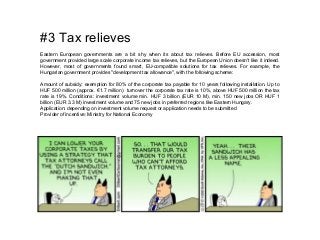
#3 Tax relieves
EasternEuropean governments are a bit shy when its about tax relieves. Before EU accession, most
government provided large scale corporate income tax relieves, but the European Union doesn't like it indeed.
However, most of governments found smart, EU-compatible solutions for tax relieves. For example, the
Hungarian government provides "development tax allowance", with the following scheme:
Amount of subsidy: exemption for 80% of the corporate tax payable for 10 years following installation. Up to
HUF 500 million (approx. €1.7 million) turnover the corporate tax rate is 10%, above HUF 500 million the tax
rate is 19%. Conditions: investment volume min. HUF 3 billion (EUR 10 M), min. 150 new jobs OR HUF 1
billion (EUR 3.3 M) investment volume and 75 new jobs in preferred regions like Eastern Hungary.
Application: depending on investment volume request or application needs to be submitted
Provider of incentive: Ministry for National Economy
8.
#4 Cash grants
Inthe love packages of Eastern European
governments there are two types of cash. All the
grants above have specific goals, preferences, and
obligations (e.g: re-training grants have to spend for
local trainings), but when you hear about "cash grants"
it means in general: you get money (normally not more
than 5% of total investment costs) as a bonus, without
specific obligations.
9.
#5 Grants by
municipalities
Tillnow we have been studying the national
governments’ grants, but there is another, a bit chaotic
but magical type of grants: provided by cities and
communities.
You cannot imagine the creativity of Eastern European
mayors when it’s about investment promotion. Some
offers a one-year entrance for all your future staff to
the matches of local basketball team (“it will support
your recruitment”). Others provide international school
development projects and family assistance to your
expat manager families.
The bravest local governments offer special deals.
E.g. the municipality of Hajduboszormeny, Hungary,
provides a free of charge industrial property for 50 new
jobs + a dedicated vice mayor to manage your
investment within the Hungarian public administration.
By the way, the location is inside the top10 best cost
effective regions of Europe (ranked by Financial
Times’ fDi Magazine), so beside basketball tickets you
can gain pretty good deals on municipal level, too.
To collect information about the jungle of municipal
grants, ask the national investment promotion
agencies’ support (listed on the slide 4).
10.
The European
sandbox
Government grants("state aid" in European jargon) are
generally prohibited by European Commission (the
"federal government of EU"), because government grants
have a negative impact on internal market competition.
However, there are some exceptions, when EU not
prohibits but supports state aids: the underdeveloped
regions of Eastern Europe can provide grants on this
way.
From July 2014, large companies can get grants for new
developments only, and there is no funding for existing
business anymore. The European Commission also can
investigate: is the state aid essential to the investment, or
the company would implement the development without
grants.
11.
How to selectyour
new manufacturing
site in Eastern
Europe
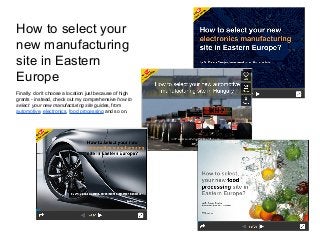
Finally: don’t choose a location just because of high
grants - instead, check out my comprehensive how to
select your new manufacturing site guides, from
automotive, electronics, food processing and so on.
12.
About us
Manufacturing HungaryBlog is an information source about the manufacturing
topics in Hungary and Eastern Europe. Our goal is to support site selection
team’s job, providing useful information.
Dr. Balazs Csorjan, investment promotion specialist, the former regional
director of Hungarian governmental investment promotion agency. Dr. Csorjan
has taken part in more hundred site selection projects - he knows your
questions.
13.
If you likedthis presentation,
please do not forget to share
it - maybe your partners will
like it, too.
Otherwise, do not hesitate to e-mail your questions: csorjan@m35businesspark.hu or download the file.
thnx a lot!
![[NOTE]
These slides are
designed not to present
but to read as a
document. Switch to
Fullscreen View, please!](https://image.slidesharecdn.com/grantsformanufacturingineasterneurope-140825041208-phpapp02/85/Grants-for-manufacturing-in-Eastern-Europe-2-320.jpg?cb=1476190747)