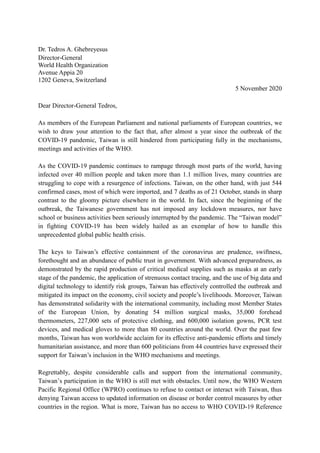
Dr. Tedros A. Ghebreyesus
Director-General
World Health Organization
Avenue Appia 20
1202 Geneva, Switzerland
5 November 2020
Dear Director-General Tedros,
As members of the European Parliament and national parliaments of European countries, we
wish to draw your attention to the fact that, after almost a year since the outbreak of the
COVID-19 pandemic, Taiwan is still hindered from participating fully in the mechanisms,
meetings and activities of the WHO.
As the COVID-19 pandemic continues to rampage through most parts of the world, having
infected over 40 million people and taken more than 1.1 million lives, many countries are
struggling to cope with a resurgence of infections. Taiwan, on the other hand, with just 544
confirmed cases, most of which were imported, and 7 deaths as of 21 October, stands in sharp
contrast to the gloomy picture elsewhere in the world. In fact, since the beginning of the
outbreak, the Taiwanese government has not imposed any lockdown measures, nor have
school or business activities been seriously interrupted by the pandemic. The “Taiwan model”
in fighting COVID-19 has been widely hailed as an exemplar of how to handle this
unprecedented global public health crisis.
The keys to Taiwan’s effective containment of the coronavirus are prudence, swiftness,
forethought and an abundance of public trust in government. With advanced preparedness, as
demonstrated by the rapid production of critical medical supplies such as masks at an early
stage of the pandemic, the application of strenuous contact tracing, and the use of big data and
digital technology to identify risk groups, Taiwan has effectively controlled the outbreak and
mitigated its impact on the economy, civil society and people’s livelihoods. Moreover, Taiwan
has demonstrated solidarity with the international community, including most Member States
of the European Union, by donating 54 million surgical masks, 35,000 forehead
thermometers, 227,000 sets of protective clothing, and 600,000 isolation gowns, PCR test
devices, and medical gloves to more than 80 countries around the world. Over the past few
months, Taiwan has won worldwide acclaim for its effective anti-pandemic efforts and timely
humanitarian assistance, and more than 600 politicians from 44 countries have expressed their
support for Taiwan’s inclusion in the WHO mechanisms and meetings.
Regrettably, despite considerable calls and support from the international community,
Taiwan’s participation in the WHO is still met with obstacles. Until now, the WHO Western
Pacific Regional Office (WPRO) continues to refuse to contact or interact with Taiwan, thus
denying Taiwan access to updated information on disease or border control measures by other
countries in the region. What is more, Taiwan has no access to WHO COVID-19 Reference
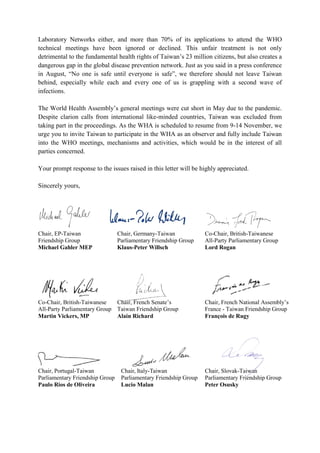
Laboratory Networks either, and more than 70% of its applications to attend the WHO
technical meetings have been ignored or declined. This unfair treatment is not only
detrimental to the fundamental health rights of Taiwan’s 23 million citizens, but also creates a
dangerous gap in the global disease prevention network. Just as you said in a press conference
in August, “No one is safe until everyone is safe”, we therefore should not leave Taiwan
behind, especially while each and every one of us is grappling with a second wave of
infections.
The World Health Assembly’s general meetings were cut short in May due to the pandemic.
Despite clarion calls from international like-minded countries, Taiwan was excluded from
taking part in the proceedings. As the WHA is scheduled to resume from 9-14 November, we
urge you to invite Taiwan to participate in the WHA as an observer and fully include Taiwan
into the WHO meetings, mechanisms and activities, which would be in the interest of all
parties concerned.
Your prompt response to the issues raised in this letter will be highly appreciated.
Sincerely yours,
Chair, EP-Taiwan
Friendship Group
Michael Gahler MEP
Chair, Germany-Taiwan
Parliamentary Friendship Group
Klaus-Peter Willsch
Co-Chair, British-Taiwanese
All-Party Parliamentary Group
Lord Rogan
Co-Chair, British-Taiwanese
All-Party Parliamentary Group
Martin Vickers, MP
Chair, French Senate’s
Taiwan Friendship Group
Alain Richard
Chair, French National Assembly’s
France - Taiwan Friendship Group
François de Rugy
Chair, Portugal-Taiwan
Parliamentary Friendship Group
Paulo Rios de Oliveira
Chair, Italy-Taiwan
Parliamentary Friendship Group
Lucio Malan
Chair, Slovak-Taiwan
Parliamentary Friendship Group
Peter Osusky
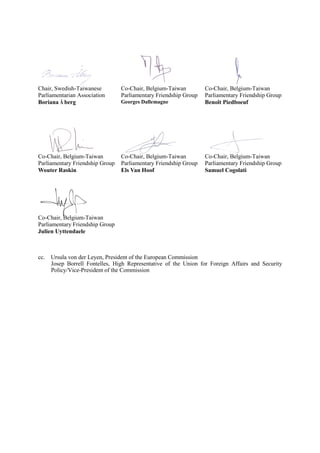
Chair, Swedish-Taiwanese
Parliamentarian Association
Boriana Å berg
Co-Chair, Belgium-Taiwan
Parliamentary Friendship Group
Georges Dallemagne
Co-Chair, Belgium-Taiwan
Parliamentary Friendship Group
Benoît Piedboeuf
Co-Chair, Belgium-Taiwan
Parliamentary Friendship Group
Wouter Raskin
Co-Chair, Belgium-Taiwan
Parliamentary Friendship Group
Els Van Hoof
Co-Chair, Belgium-Taiwan
Parliamentary Friendship Group
Samuel Cogolati
Co-Chair, Belgium-Taiwan
Parliamentary Friendship Group
Julien Uyttendaele
cc. Ursula von der Leyen, President of the European Commission
Josep Borrell Fontelles, High Representative of the Union for Foreign Affairs and Security
Policy/Vice-President of the Commission

聯名

  • 1.
    Dr. Tedros A.Ghebreyesus Director-General World Health Organization Avenue Appia 20 1202 Geneva, Switzerland 5 November 2020 Dear Director-General Tedros, As members of the European Parliament and national parliaments of European countries, we wish to draw your attention to the fact that, after almost a year since the outbreak of the COVID-19 pandemic, Taiwan is still hindered from participating fully in the mechanisms, meetings and activities of the WHO. As the COVID-19 pandemic continues to rampage through most parts of the world, having infected over 40 million people and taken more than 1.1 million lives, many countries are struggling to cope with a resurgence of infections. Taiwan, on the other hand, with just 544 confirmed cases, most of which were imported, and 7 deaths as of 21 October, stands in sharp contrast to the gloomy picture elsewhere in the world. In fact, since the beginning of the outbreak, the Taiwanese government has not imposed any lockdown measures, nor have school or business activities been seriously interrupted by the pandemic. The “Taiwan model” in fighting COVID-19 has been widely hailed as an exemplar of how to handle this unprecedented global public health crisis. The keys to Taiwan’s effective containment of the coronavirus are prudence, swiftness, forethought and an abundance of public trust in government. With advanced preparedness, as demonstrated by the rapid production of critical medical supplies such as masks at an early stage of the pandemic, the application of strenuous contact tracing, and the use of big data and digital technology to identify risk groups, Taiwan has effectively controlled the outbreak and mitigated its impact on the economy, civil society and people’s livelihoods. Moreover, Taiwan has demonstrated solidarity with the international community, including most Member States of the European Union, by donating 54 million surgical masks, 35,000 forehead thermometers, 227,000 sets of protective clothing, and 600,000 isolation gowns, PCR test devices, and medical gloves to more than 80 countries around the world. Over the past few months, Taiwan has won worldwide acclaim for its effective anti-pandemic efforts and timely humanitarian assistance, and more than 600 politicians from 44 countries have expressed their support for Taiwan’s inclusion in the WHO mechanisms and meetings. Regrettably, despite considerable calls and support from the international community, Taiwan’s participation in the WHO is still met with obstacles. Until now, the WHO Western Pacific Regional Office (WPRO) continues to refuse to contact or interact with Taiwan, thus denying Taiwan access to updated information on disease or border control measures by other countries in the region. What is more, Taiwan has no access to WHO COVID-19 Reference
  • 2.
    Laboratory Networks either,and more than 70% of its applications to attend the WHO technical meetings have been ignored or declined. This unfair treatment is not only detrimental to the fundamental health rights of Taiwan’s 23 million citizens, but also creates a dangerous gap in the global disease prevention network. Just as you said in a press conference in August, “No one is safe until everyone is safe”, we therefore should not leave Taiwan behind, especially while each and every one of us is grappling with a second wave of infections. The World Health Assembly’s general meetings were cut short in May due to the pandemic. Despite clarion calls from international like-minded countries, Taiwan was excluded from taking part in the proceedings. As the WHA is scheduled to resume from 9-14 November, we urge you to invite Taiwan to participate in the WHA as an observer and fully include Taiwan into the WHO meetings, mechanisms and activities, which would be in the interest of all parties concerned. Your prompt response to the issues raised in this letter will be highly appreciated. Sincerely yours, Chair, EP-Taiwan Friendship Group Michael Gahler MEP Chair, Germany-Taiwan Parliamentary Friendship Group Klaus-Peter Willsch Co-Chair, British-Taiwanese All-Party Parliamentary Group Lord Rogan Co-Chair, British-Taiwanese All-Party Parliamentary Group Martin Vickers, MP Chair, French Senate’s Taiwan Friendship Group Alain Richard Chair, French National Assembly’s France - Taiwan Friendship Group François de Rugy Chair, Portugal-Taiwan Parliamentary Friendship Group Paulo Rios de Oliveira Chair, Italy-Taiwan Parliamentary Friendship Group Lucio Malan Chair, Slovak-Taiwan Parliamentary Friendship Group Peter Osusky
  • 3.
    Chair, Swedish-Taiwanese Parliamentarian Association BorianaÅ berg Co-Chair, Belgium-Taiwan Parliamentary Friendship Group Georges Dallemagne Co-Chair, Belgium-Taiwan Parliamentary Friendship Group Benoît Piedboeuf Co-Chair, Belgium-Taiwan Parliamentary Friendship Group Wouter Raskin Co-Chair, Belgium-Taiwan Parliamentary Friendship Group Els Van Hoof Co-Chair, Belgium-Taiwan Parliamentary Friendship Group Samuel Cogolati Co-Chair, Belgium-Taiwan Parliamentary Friendship Group Julien Uyttendaele cc. Ursula von der Leyen, President of the European Commission Josep Borrell Fontelles, High Representative of the Union for Foreign Affairs and Security Policy/Vice-President of the Commission