SeaweedFS
Intro
2019.3
chris.lu@gmail.com
SeaweedFS Intro
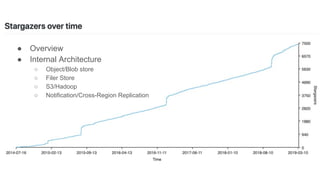
● Overview
● Internal Architecture
○ Object/Blob store
○ Filer Store
○ S3/Hadoop
○ Notification/Cross-Region Replication
SeaweedFS Intro
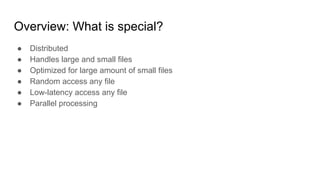
Overview: What is special?
● Distributed
● Handles large and small files
● Optimized for large amount of small files
● Random access any file
● Low-latency access any file
● Parallel processing
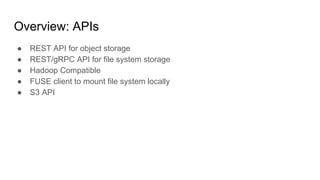
Overview: APIs
● REST API for object storage
● REST/gRPC API for file system storage
● Hadoop Compatible
● FUSE client to mount file system locally
● S3 API
Architecture
● Object Storage
● File Storage
● Interface/Client Layer
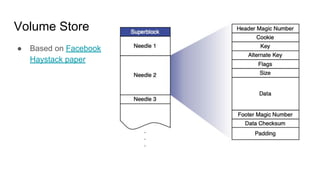
Volume Store
● Based on Facebook
Haystack paper
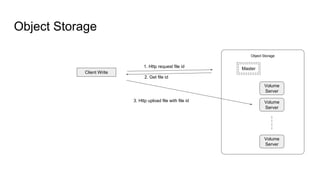
Object Storage
Object Storage
Master
Volume
Server
Volume
Server
Volume
Server
Client Write
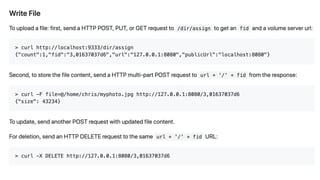
1. Http request file id
3. Http upload file with file id
2. Get file id
Object Storage
Object Storage
Master
Volume
Server
Volume
Server
Volume
Server
Client Write
1. Http request file id
3. Http upload file with file id
2. Get file id
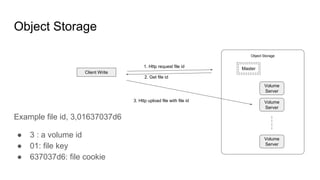
Example file id, 3,01637037d6
● 3 : a volume id
● 01: file key
● 637037d6: file cookie
Object Storage
Object Storage
Master
Volume
Server
Volume
Server
Volume
Server
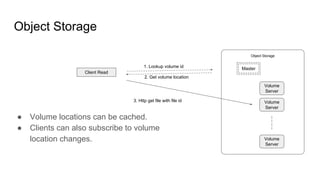
Client Read
1. Lookup volume id
3. Http get file with file id
2. Get volume location
● Volume locations can be cached.
● Clients can also subscribe to volume
location changes.
Object Storage
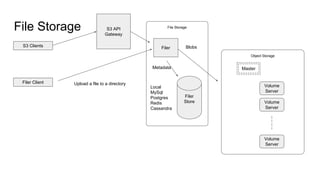
File Storage
Master
Volume
Server
Volume
Server
Volume
Server
Filer Client Upload a file to a directory
File Storage
Filer
Filer
Store
Local
MySql
Postgres
Redis
Cassandra
Metadata
Blobs
S3 API
Gateway
S3 Clients
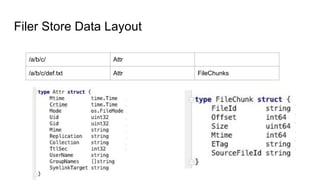
Filer Store Data Layout
/a/b/c/ Attr
/a/b/c/def.txt Attr FileChunks
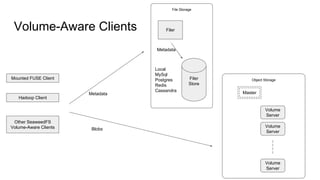
Volume-Aware Clients
Object Storage
Master
Volume
Server
Volume
Server
Volume
Server
Other SeaweedFS
Volume-Aware Clients
Metadata
File Storage
Filer
Filer
Store
Local
MySql
Postgres
Redis
Cassandra
Metadata
Blobs
Hadoop Client
Mounted FUSE Client
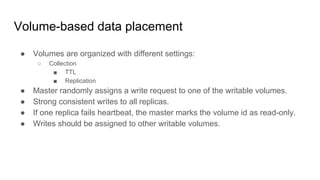
Volume-based data placement
● Volumes are organized with different settings:
○ Collection
■ TTL
■ Replication
● Master randomly assigns a write request to one of the writable volumes.
● Strong consistent writes to all replicas.
● If one replica fails heartbeat, the master marks the volume id as read-only.
● Writes should be assigned to other writable volumes.
Object Storage
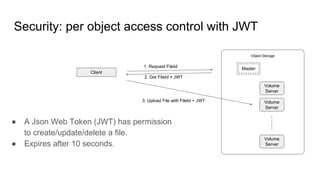
Security: per object access control with JWT
Master
Volume
Server
Volume
Server
Volume
Server
Client
1. Request FileId
3. Upload File with FileId + JWT
2. Get FileId + JWT
● A Json Web Token (JWT) has permission
to create/update/delete a file.
● Expires after 10 seconds.
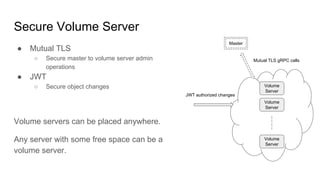
Secure Volume Server
● Mutual TLS
○ Secure master to volume server admin
operations
● JWT
○ Secure object changes
Volume servers can be placed anywhere.
Any server with some free space can be a
volume server.
Master
Volume
Server
Volume
Server
Volume
Server
Mutual TLS gRPC calls
JWT authorized changes
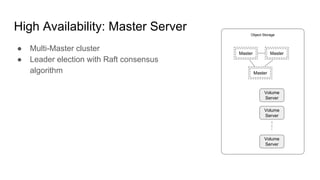
High Availability: Master Server Object Storage
Master
Volume
Server
Volume
Server
Volume
Server
Master
Master
● Multi-Master cluster
● Leader election with Raft consensus
algorithm
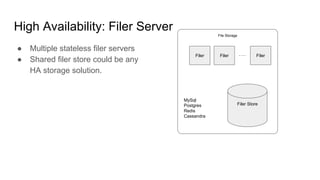
High Availability: Filer Server
● Multiple stateless filer servers
● Shared filer store could be any
HA storage solution.
File Storage
Filer
Filer Store
MySql
Postgres
Redis
Cassandra
Filer Filer
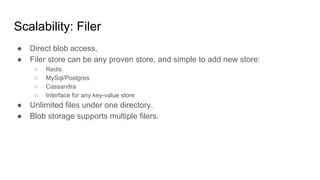
Scalability: Filer
● Direct blob access.
● Filer store can be any proven store, and simple to add new store:
○ Redis
○ MySql/Postgres
○ Cassandra
○ Interface for any key-value store
● Unlimited files under one directory.
● Blob storage supports multiple filers.
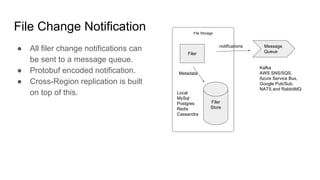
File Change Notification
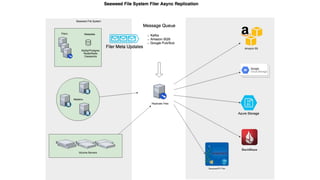
● All filer change notifications can
be sent to a message queue.
● Protobuf encoded notification.
● Cross-Region replication is built
on top of this.
File Storage
Filer
Filer
Store
Local
MySql
Postgres
Redis
Cassandra
Metadata
Message
Queue
notifications
Kafka
AWS SNS/SQS,
Azure Service Bus,
Google Pub/Sub,
NATS and RabbitMQ
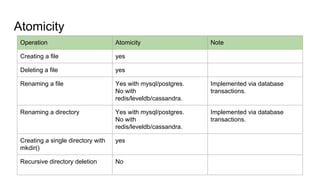
Atomicity
Operation Atomicity Note
Creating a file yes
Deleting a file yes
Renaming a file Yes with mysql/postgres.
No with
redis/leveldb/cassandra.
Implemented via database
transactions.
Renaming a directory Yes with mysql/postgres.
No with
redis/leveldb/cassandra.
Implemented via database
transactions.
Creating a single directory with
mkdir()
yes
Recursive directory deletion No
Comparing to HDFS
HDFS SeaweedFS
File Metadata Storage Single namenode Multiple stateless filers with
proven scalable filer store,
redis/cassandra/etc.
Storing small files Not recommended. Optimized for small files.
Parallel data access Yes Yes
Hadoop Compatible Yes Yes. (Atomic rename via
database transactions.)
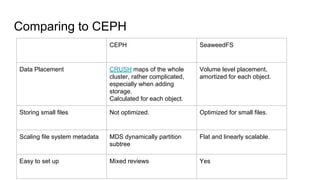
Comparing to CEPH
CEPH SeaweedFS
Data Placement CRUSH maps of the whole
cluster, rather complicated,
especially when adding
storage.
Calculated for each object.
Volume level placement,
amortized for each object.
Storing small files Not optimized. Optimized for small files.
Scaling file system metadata MDS dynamically partition
subtree
Flat and linearly scalable.
Easy to set up Mixed reviews Yes
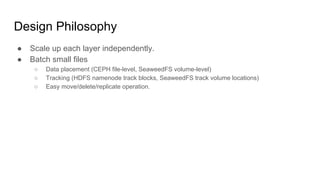
Design Philosophy
● Scale up each layer independently.
● Batch small files
○ Data placement (CEPH file-level, SeaweedFS volume-level)
○ Tracking (HDFS namenode track blocks, SeaweedFS track volume locations)
○ Easy move/delete/replicate operation.
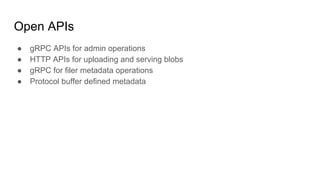
Open APIs
● gRPC APIs for admin operations
● HTTP APIs for uploading and serving blobs
● gRPC for filer metadata operations
● Protocol buffer defined metadata
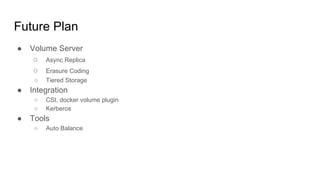
Future Plan
● Volume Server
○ Async Replica
○ Erasure Coding
○ Tiered Storage
● Integration
○ CSI, docker volume plugin
○ Kerberos
● Tools
○ Auto Balance
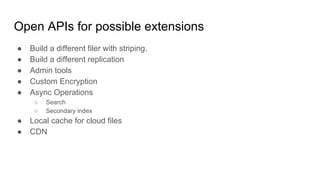
Open APIs for possible extensions
● Build a different filer with striping.
● Build a different replication
● Admin tools
● Custom Encryption
● Async Operations
○ Search
○ Secondary index
● Local cache for cloud files
● CDN

SeaweedFS introduction

  • 1.
  • 2.
    SeaweedFS Intro ● Overview ●Internal Architecture ○ Object/Blob store ○ Filer Store ○ S3/Hadoop ○ Notification/Cross-Region Replication
  • 3.
  • 5.
    Overview: What isspecial? ● Distributed ● Handles large and small files ● Optimized for large amount of small files ● Random access any file ● Low-latency access any file ● Parallel processing
  • 6.
    Overview: APIs ● RESTAPI for object storage ● REST/gRPC API for file system storage ● Hadoop Compatible ● FUSE client to mount file system locally ● S3 API
  • 7.
    Architecture ● Object Storage ●File Storage ● Interface/Client Layer
  • 8.
    Volume Store ● Basedon Facebook Haystack paper
  • 9.
    Object Storage Object Storage Master Volume Server Volume Server Volume Server ClientWrite 1. Http request file id 3. Http upload file with file id 2. Get file id
  • 10.
    Object Storage Object Storage Master Volume Server Volume Server Volume Server ClientWrite 1. Http request file id 3. Http upload file with file id 2. Get file id Example file id, 3,01637037d6 ● 3 : a volume id ● 01: file key ● 637037d6: file cookie
  • 11.
    Object Storage Object Storage Master Volume Server Volume Server Volume Server ClientRead 1. Lookup volume id 3. Http get file with file id 2. Get volume location ● Volume locations can be cached. ● Clients can also subscribe to volume location changes.
  • 12.
    Object Storage File Storage Master Volume Server Volume Server Volume Server FilerClient Upload a file to a directory File Storage Filer Filer Store Local MySql Postgres Redis Cassandra Metadata Blobs S3 API Gateway S3 Clients
  • 13.
    Filer Store DataLayout /a/b/c/ Attr /a/b/c/def.txt Attr FileChunks
  • 14.
    Volume-Aware Clients Object Storage Master Volume Server Volume Server Volume Server OtherSeaweedFS Volume-Aware Clients Metadata File Storage Filer Filer Store Local MySql Postgres Redis Cassandra Metadata Blobs Hadoop Client Mounted FUSE Client
  • 15.
    Volume-based data placement ●Volumes are organized with different settings: ○ Collection ■ TTL ■ Replication ● Master randomly assigns a write request to one of the writable volumes. ● Strong consistent writes to all replicas. ● If one replica fails heartbeat, the master marks the volume id as read-only. ● Writes should be assigned to other writable volumes.
  • 16.
    Object Storage Security: perobject access control with JWT Master Volume Server Volume Server Volume Server Client 1. Request FileId 3. Upload File with FileId + JWT 2. Get FileId + JWT ● A Json Web Token (JWT) has permission to create/update/delete a file. ● Expires after 10 seconds.
  • 17.
    Secure Volume Server ●Mutual TLS ○ Secure master to volume server admin operations ● JWT ○ Secure object changes Volume servers can be placed anywhere. Any server with some free space can be a volume server. Master Volume Server Volume Server Volume Server Mutual TLS gRPC calls JWT authorized changes
  • 18.
    High Availability: MasterServer Object Storage Master Volume Server Volume Server Volume Server Master Master ● Multi-Master cluster ● Leader election with Raft consensus algorithm
  • 19.
    High Availability: FilerServer ● Multiple stateless filer servers ● Shared filer store could be any HA storage solution. File Storage Filer Filer Store MySql Postgres Redis Cassandra Filer Filer
  • 20.
    Scalability: Filer ● Directblob access. ● Filer store can be any proven store, and simple to add new store: ○ Redis ○ MySql/Postgres ○ Cassandra ○ Interface for any key-value store ● Unlimited files under one directory. ● Blob storage supports multiple filers.
  • 21.
    File Change Notification ●All filer change notifications can be sent to a message queue. ● Protobuf encoded notification. ● Cross-Region replication is built on top of this. File Storage Filer Filer Store Local MySql Postgres Redis Cassandra Metadata Message Queue notifications Kafka AWS SNS/SQS, Azure Service Bus, Google Pub/Sub, NATS and RabbitMQ
  • 23.
    Atomicity Operation Atomicity Note Creatinga file yes Deleting a file yes Renaming a file Yes with mysql/postgres. No with redis/leveldb/cassandra. Implemented via database transactions. Renaming a directory Yes with mysql/postgres. No with redis/leveldb/cassandra. Implemented via database transactions. Creating a single directory with mkdir() yes Recursive directory deletion No
  • 24.
    Comparing to HDFS HDFSSeaweedFS File Metadata Storage Single namenode Multiple stateless filers with proven scalable filer store, redis/cassandra/etc. Storing small files Not recommended. Optimized for small files. Parallel data access Yes Yes Hadoop Compatible Yes Yes. (Atomic rename via database transactions.)
  • 25.
    Comparing to CEPH CEPHSeaweedFS Data Placement CRUSH maps of the whole cluster, rather complicated, especially when adding storage. Calculated for each object. Volume level placement, amortized for each object. Storing small files Not optimized. Optimized for small files. Scaling file system metadata MDS dynamically partition subtree Flat and linearly scalable. Easy to set up Mixed reviews Yes
  • 26.
    Design Philosophy ● Scaleup each layer independently. ● Batch small files ○ Data placement (CEPH file-level, SeaweedFS volume-level) ○ Tracking (HDFS namenode track blocks, SeaweedFS track volume locations) ○ Easy move/delete/replicate operation.
  • 27.
    Open APIs ● gRPCAPIs for admin operations ● HTTP APIs for uploading and serving blobs ● gRPC for filer metadata operations ● Protocol buffer defined metadata
  • 28.
    Future Plan ● VolumeServer ○ Async Replica ○ Erasure Coding ○ Tiered Storage ● Integration ○ CSI, docker volume plugin ○ Kerberos ● Tools ○ Auto Balance
  • 29.
    Open APIs forpossible extensions ● Build a different filer with striping. ● Build a different replication ● Admin tools ● Custom Encryption ● Async Operations ○ Search ○ Secondary index ● Local cache for cloud files ● CDN