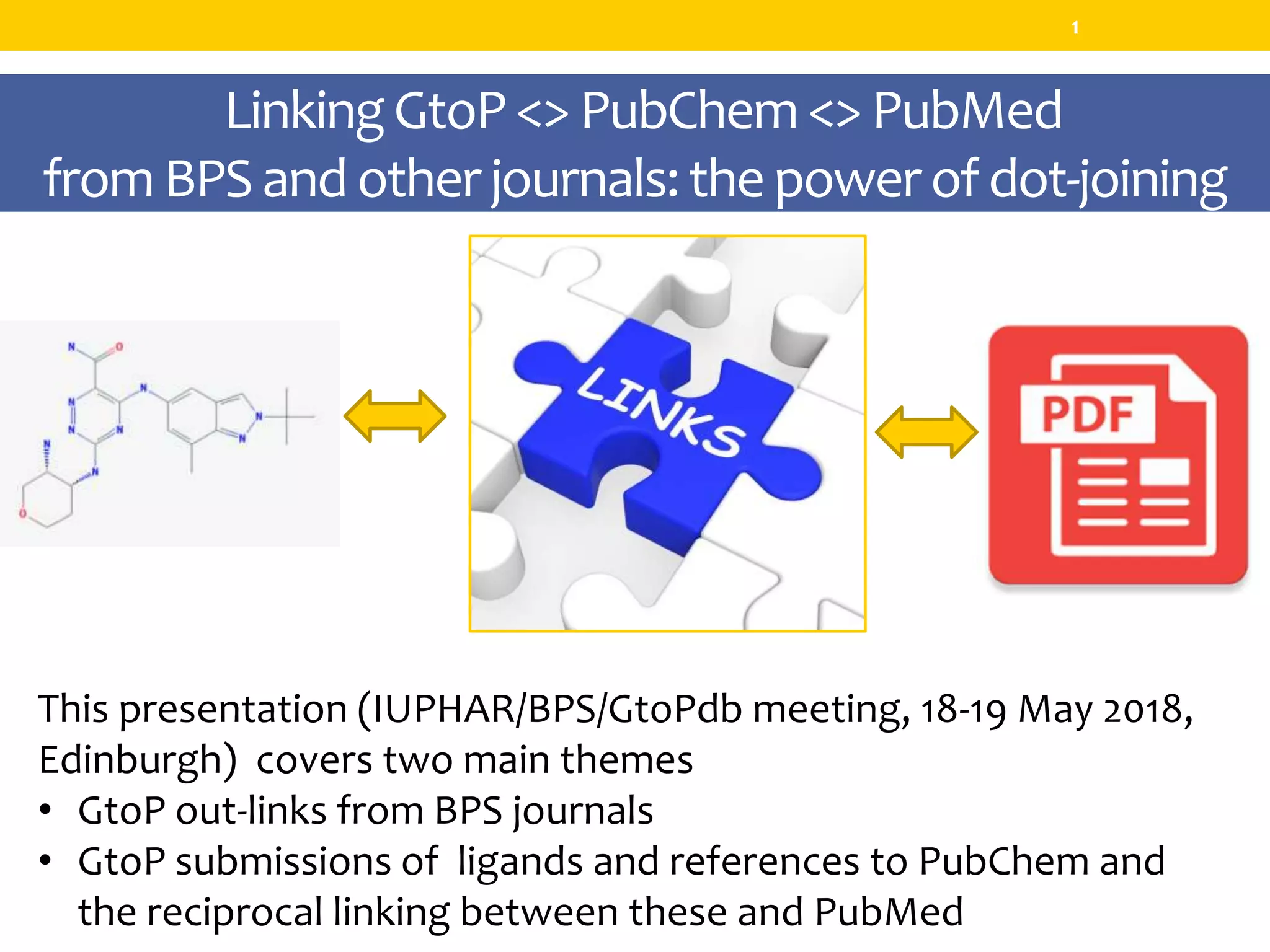
LinkingGtoP<> PubChem<> PubMed
from BPS and other journals:thepowerof dot-joining
1
This presentation (IUPHAR/BPS/GtoPdb meeting, 18-19 May 2018,
Edinburgh) covers two main themes
• GtoP out-links from BPS journals
• GtoP submissions of ligands and references to PubChem and
the reciprocal linking between these and PubMed
The Holy Heptet
2
Glossary
• GtoP = IUPHAR/BPS Guide to PHARMACOLOGY database
• BPS = British Pharmacological Society
• BJP = British Journal of Pharmacology
• BCCP = British Journal of Clinical Pharmacology
• PM = PubMed
• PC = PubChem
• SID = PubChem substance identifier
• CID = PubChem compound identifier
• ToLs = Tables of links
• Reference citations = added to every paper with GtoP links
• Link = a live URL taking users to another database
3
Theme 1
Links from BJP and BJCP out to GtoP
4
Methodology:
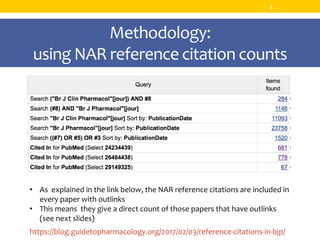
using NAR reference citation counts
5
https://blog.guidetopharmacology.org/2017/02/03/reference-citations-in-bjp/
• As explained in the link below, the NAR reference citations are included in
every paper with outlinks
• This means they give a direct count of those papers that have outlinks
(see next slides)
The BJP-to-
GtoP
initiative
6
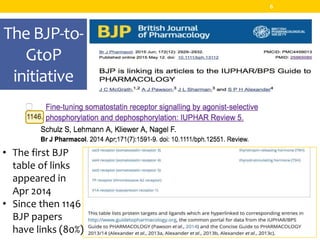
• The first BJP
table of links
appeared in
Apr 2014
• Since then 1146
BJP papers
have links (80%)
From tables to in-line out-links
7
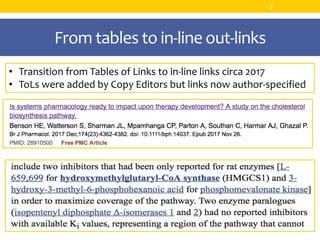
• Transition from Tables of Links to in-line links circa 2017
• ToLs were added by Copy Editors but links now author-specified
BJCP links initiated Nov 2017
8
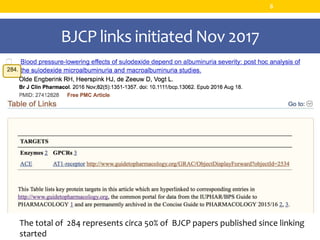
The total of 284 represents circa 50% of BJCP papers published since linking
started
Solving the “missing links” problem
• For occasional BJP papers we noted that key ligands and targets
that the reports were “about” where not in GtoP (e.g. new ones
in primary publications)
• In relevant cases we curated those papers but could not add
new out-links retrospectively
• We recently instigated a process whereby if their key entities are
not in GtoP authors notify us and send accepted manuscripts
• If within our capture remit we add these new ligands and targets
• Depending on timing, we add the authors eventual PMID as a
reference within one or two release cycles
• The authors thus gain a GtoP reference and links (see later)
9
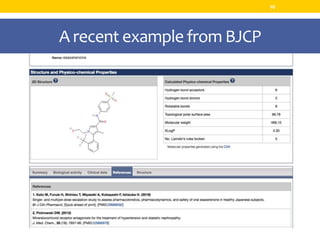
A recent example from BJCP
10
Theme 2
Reciprocal links between GtoP,
PubChem and PubMed
11
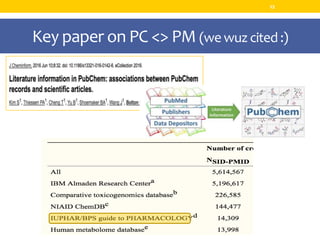
Key paper on PC <> PM (wewuzcited :)
12
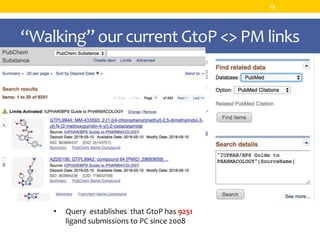
“Walking” our current GtoP <> PM links
13
• Query establishes that GtoP has 9251
ligand submissions to PC since 2008
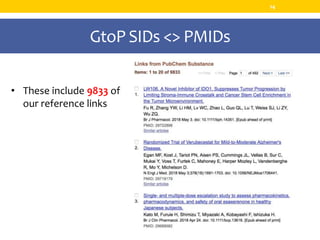
GtoP SIDs <> PMIDs
14
• These include 9833 of
our reference links
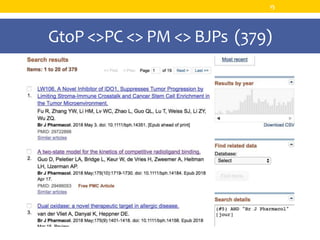
GtoP <>PC <> PM <> BJPs (379)
15
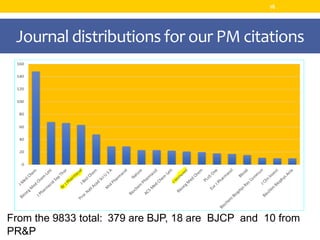
Journal distributions for our PM citations
16
From the 9833 total: 379 are BJP, 18 are BJCP and 10 from
PR&P
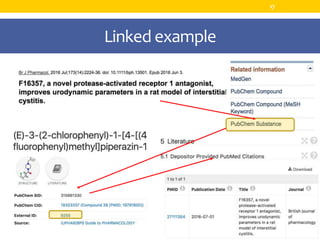
Linked example
17
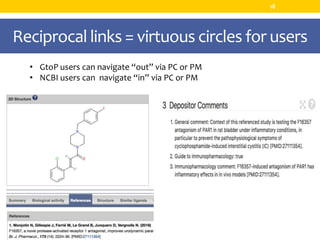
Reciprocal links = virtuous circles for users
18
• GtoP users can navigate “out” via PC or PM
• NCBI users can navigate “in” via PC or PM
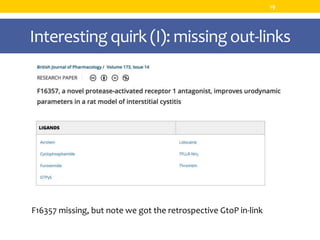
Interesting quirk (I): missing out-links
19
F16357 missing, but note we got the retrospective GtoP in-link
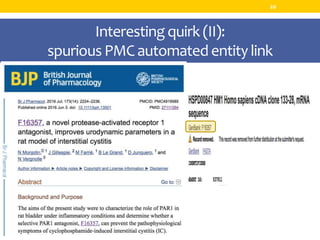
Interestingquirk (II):
spurious PMC automated entity link
20
To conclude
• The two BPS journals have joined a small but exclusive set of
author-specified Journal-to-Database linking efforts
• We have recently improved the proportion of reciprocity
• There are tangible (e.g. user traffic) and intangible benifits
(e.g. big data mining)
• Possibility of extending to third journal in the stable Pr&P
• The long-standing processes of submitting our ligands to
PubChem and the references associated with them brings
many important advantages to GtoP
• This includes tangible benefits for all the journals and
authors we add PubChem links for but need to < awareness
• Various options for optimisation can be explored, including
automated entity linking if specificity can be ensured
21
Addendum (post-meeting)
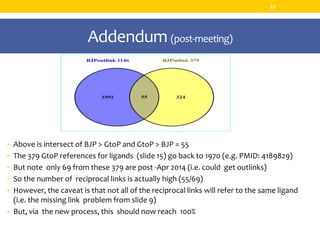
• Above is intersect of BJP > GtoP and GtoP > BJP = 55
• The 379 GtoP references for ligands (slide 15) go back to 1970 (e.g. PMID: 4189829)
• But note only 69 from these 379 are post -Apr 2014 (i.e. could get outlinks)
• So the number of reciprocal links is actually high (55/69)
• However, the caveat is that not all of the reciprocal links will refer to the same ligand
(i.e. the missing link problem from slide 9)
• But, via the new process, this should now reach 100%
22

Linking GtoP <> PubChem <> PubMed

  • 1.
    LinkingGtoP<> PubChem<> PubMed fromBPS and other journals:thepowerof dot-joining 1 This presentation (IUPHAR/BPS/GtoPdb meeting, 18-19 May 2018, Edinburgh) covers two main themes • GtoP out-links from BPS journals • GtoP submissions of ligands and references to PubChem and the reciprocal linking between these and PubMed
  • 2.
  • 3.
    Glossary • GtoP =IUPHAR/BPS Guide to PHARMACOLOGY database • BPS = British Pharmacological Society • BJP = British Journal of Pharmacology • BCCP = British Journal of Clinical Pharmacology • PM = PubMed • PC = PubChem • SID = PubChem substance identifier • CID = PubChem compound identifier • ToLs = Tables of links • Reference citations = added to every paper with GtoP links • Link = a live URL taking users to another database 3
  • 4.
    Theme 1 Links fromBJP and BJCP out to GtoP 4
  • 5.
    Methodology: using NAR referencecitation counts 5 https://blog.guidetopharmacology.org/2017/02/03/reference-citations-in-bjp/ • As explained in the link below, the NAR reference citations are included in every paper with outlinks • This means they give a direct count of those papers that have outlinks (see next slides)
  • 6.
    The BJP-to- GtoP initiative 6 • Thefirst BJP table of links appeared in Apr 2014 • Since then 1146 BJP papers have links (80%)
  • 7.
    From tables toin-line out-links 7 • Transition from Tables of Links to in-line links circa 2017 • ToLs were added by Copy Editors but links now author-specified
  • 8.
    BJCP links initiatedNov 2017 8 The total of 284 represents circa 50% of BJCP papers published since linking started
  • 9.
    Solving the “missinglinks” problem • For occasional BJP papers we noted that key ligands and targets that the reports were “about” where not in GtoP (e.g. new ones in primary publications) • In relevant cases we curated those papers but could not add new out-links retrospectively • We recently instigated a process whereby if their key entities are not in GtoP authors notify us and send accepted manuscripts • If within our capture remit we add these new ligands and targets • Depending on timing, we add the authors eventual PMID as a reference within one or two release cycles • The authors thus gain a GtoP reference and links (see later) 9
  • 10.
    A recent examplefrom BJCP 10
  • 11.
    Theme 2 Reciprocal linksbetween GtoP, PubChem and PubMed 11
  • 12.
    Key paper onPC <> PM (wewuzcited :) 12
  • 13.
    “Walking” our currentGtoP <> PM links 13 • Query establishes that GtoP has 9251 ligand submissions to PC since 2008
  • 14.
    GtoP SIDs <>PMIDs 14 • These include 9833 of our reference links
  • 15.
    GtoP <>PC <>PM <> BJPs (379) 15
  • 16.
    Journal distributions forour PM citations 16 From the 9833 total: 379 are BJP, 18 are BJCP and 10 from PR&P
  • 17.
  • 18.
    Reciprocal links =virtuous circles for users 18 • GtoP users can navigate “out” via PC or PM • NCBI users can navigate “in” via PC or PM
  • 19.
    Interesting quirk (I):missing out-links 19 F16357 missing, but note we got the retrospective GtoP in-link
  • 20.
    Interestingquirk (II): spurious PMCautomated entity link 20
  • 21.
    To conclude • Thetwo BPS journals have joined a small but exclusive set of author-specified Journal-to-Database linking efforts • We have recently improved the proportion of reciprocity • There are tangible (e.g. user traffic) and intangible benifits (e.g. big data mining) • Possibility of extending to third journal in the stable Pr&P • The long-standing processes of submitting our ligands to PubChem and the references associated with them brings many important advantages to GtoP • This includes tangible benefits for all the journals and authors we add PubChem links for but need to < awareness • Various options for optimisation can be explored, including automated entity linking if specificity can be ensured 21
  • 22.
    Addendum (post-meeting) • Aboveis intersect of BJP > GtoP and GtoP > BJP = 55 • The 379 GtoP references for ligands (slide 15) go back to 1970 (e.g. PMID: 4189829) • But note only 69 from these 379 are post -Apr 2014 (i.e. could get outlinks) • So the number of reciprocal links is actually high (55/69) • However, the caveat is that not all of the reciprocal links will refer to the same ligand (i.e. the missing link problem from slide 9) • But, via the new process, this should now reach 100% 22