The ISO Knowledge
management standard
explained
APM webinar, 10 January 2018
Judy Payne, Hemdean Consulting
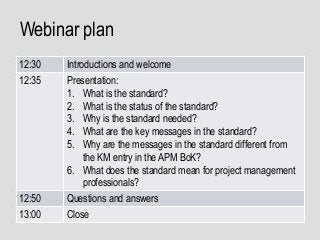
Webinar plan
12:30 Introductions and welcome
12:35 Presentation:
1. What is the standard?
2. What is the status of the standard?
3. Why is the standard needed?
4. What are the key messages in the standard?
5. Why are the messages in the standard different from
the KM entry in the APM BoK?
6. What does the standard mean for project management
professionals?
12:50 Questions and answers
13:00 Close
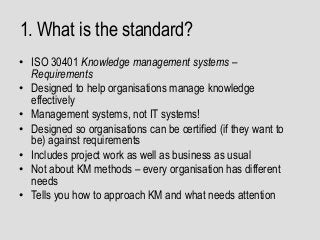
1. What is the standard?
• ISO 30401 Knowledge management systems –
Requirements
• Designed to help organisations manage knowledge
effectively
• Management systems, not IT systems!
• Designed so organisations can be certified (if they want to
be) against requirements
• Includes project work as well as business as usual
• Not about KM methods – every organisation has different
needs
• Tells you how to approach KM and what needs attention
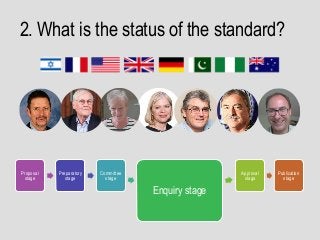
2. What is the status of the standard?
Proposal
stage
Preparatory
stage
Committee
stage
Enquiry stage
Approval
stage
Publication
stage
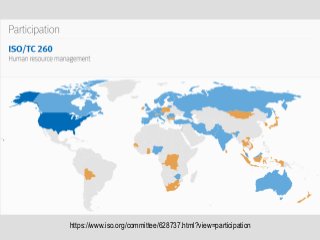
https://www.iso.org/committee/628737.html?view=participation
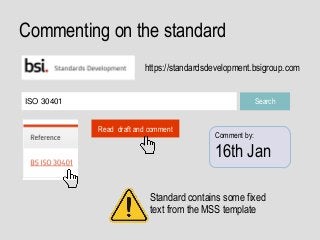
Commenting on the standard
https://standardsdevelopment.bsigroup.com
ISO 30401 Search
Read draft and comment
Standard contains some fixed
text from the MSS template
Comment by:
16th Jan
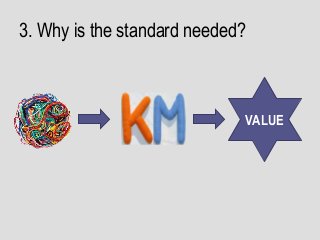
3. Why is the standard needed?
VALUE
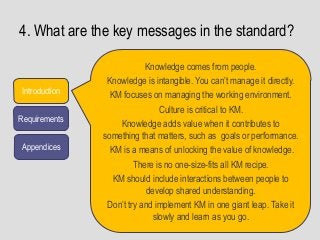
4. What are the key messages in the standard?
Introduction
Requirements
Appendices
Knowledge comes from people.
Knowledge is intangible. You can’t manage it directly.
KM focuses on managing the working environment.
Culture is critical to KM.
Knowledge adds value when it contributes to
something that matters, such as goals or performance.
KM is a means of unlocking the value of knowledge.
There is no one-size-fits all KM recipe.
KM should include interactions between people to
develop shared understanding.
Don’t try and implement KM in one giant leap. Take it
slowly and learn as you go.
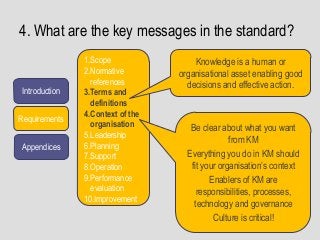
4. What are the key messages in the standard?
Introduction
Requirements
Appendices
1.Scope
2.Normative
references
3.Terms and
definitions
4.Context of the
organisation
5.Leadership
6.Planning
7.Support
8.Operation
9.Performance
evaluation
10.Improvement
Knowledge is a human or
organisational asset enabling good
decisions and effective action.
Be clear about what you want
from KM
Everything you do in KM should
fit your organisation’s context
Enablers of KM are
responsibilities, processes,
technology and governance
Culture is critical!
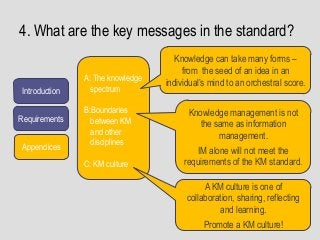
4. What are the key messages in the standard?
Introduction
Requirements
Appendices
A: The knowledge
spectrum
B:Boundaries
between KM
and other
disciplines
C: KM culture
Knowledge can take many forms –
from the seed of an idea in an
individual’s mind to an orchestral score.
Knowledge management is not
the same as information
management.
IM alone will not meet the
requirements of the KM standard.
A KM culture is one of
collaboration, sharing, reflecting
and learning.
Promote a KM culture!
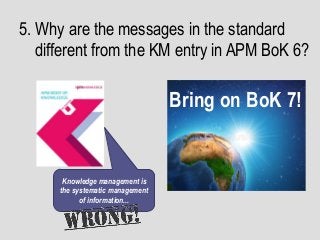
5. Why are the messages in the standard
different from the KM entry in APM BoK 6?
Bring on BoK 7!
Knowledge management is
the systematic management
of information...
6. What does the standard mean for
project management professionals?
• It’s an opportunity to find out what KM is really
about.
• It’s an opportunity to make projects and
programmes more effective and efficient.
• Certification to the standard is a way of
demonstrating to clients and other stakeholders that
you are competent at managing knowledge.
• It’s up to YOU.
End of presentation
Thank you for your attention
Time for your questions
Get involved
• Comment on the draft standard
• Join the Knowledge SIG via the APM website:
Community/Groups/SIGs
• Join the KM in Projects Community on the
‘Knowledge Hub’ (Khub.net):
https://khub.net/group/km-in-projects-community/group-home
• Watch our 10-minute Courageous Conversation
animations:
https://www.youtube.com/playlist?list=PLQzq_ylfBVzJuLDrfnIhpLjEI09XHoHj8
The ISO knowledge management standard explained webinar, 10 January 2018

  • 1.
    The ISO Knowledge managementstandard explained APM webinar, 10 January 2018 Judy Payne, Hemdean Consulting
  • 2.
    Webinar plan 12:30 Introductionsand welcome 12:35 Presentation: 1. What is the standard? 2. What is the status of the standard? 3. Why is the standard needed? 4. What are the key messages in the standard? 5. Why are the messages in the standard different from the KM entry in the APM BoK? 6. What does the standard mean for project management professionals? 12:50 Questions and answers 13:00 Close
  • 3.
    1. What isthe standard? • ISO 30401 Knowledge management systems – Requirements • Designed to help organisations manage knowledge effectively • Management systems, not IT systems! • Designed so organisations can be certified (if they want to be) against requirements • Includes project work as well as business as usual • Not about KM methods – every organisation has different needs • Tells you how to approach KM and what needs attention
  • 4.
    2. What isthe status of the standard? Proposal stage Preparatory stage Committee stage Enquiry stage Approval stage Publication stage
  • 5.
  • 6.
    Commenting on thestandard https://standardsdevelopment.bsigroup.com ISO 30401 Search Read draft and comment Standard contains some fixed text from the MSS template Comment by: 16th Jan
  • 7.
    3. Why isthe standard needed? VALUE
  • 8.
    4. What arethe key messages in the standard? Introduction Requirements Appendices Knowledge comes from people. Knowledge is intangible. You can’t manage it directly. KM focuses on managing the working environment. Culture is critical to KM. Knowledge adds value when it contributes to something that matters, such as goals or performance. KM is a means of unlocking the value of knowledge. There is no one-size-fits all KM recipe. KM should include interactions between people to develop shared understanding. Don’t try and implement KM in one giant leap. Take it slowly and learn as you go.
  • 9.
    4. What arethe key messages in the standard? Introduction Requirements Appendices 1.Scope 2.Normative references 3.Terms and definitions 4.Context of the organisation 5.Leadership 6.Planning 7.Support 8.Operation 9.Performance evaluation 10.Improvement Knowledge is a human or organisational asset enabling good decisions and effective action. Be clear about what you want from KM Everything you do in KM should fit your organisation’s context Enablers of KM are responsibilities, processes, technology and governance Culture is critical!
  • 10.
    4. What arethe key messages in the standard? Introduction Requirements Appendices A: The knowledge spectrum B:Boundaries between KM and other disciplines C: KM culture Knowledge can take many forms – from the seed of an idea in an individual’s mind to an orchestral score. Knowledge management is not the same as information management. IM alone will not meet the requirements of the KM standard. A KM culture is one of collaboration, sharing, reflecting and learning. Promote a KM culture!
  • 11.
    5. Why arethe messages in the standard different from the KM entry in APM BoK 6? Bring on BoK 7! Knowledge management is the systematic management of information...
  • 12.
    6. What doesthe standard mean for project management professionals? • It’s an opportunity to find out what KM is really about. • It’s an opportunity to make projects and programmes more effective and efficient. • Certification to the standard is a way of demonstrating to clients and other stakeholders that you are competent at managing knowledge. • It’s up to YOU.
  • 13.
    End of presentation Thankyou for your attention Time for your questions
  • 14.
    Get involved • Commenton the draft standard • Join the Knowledge SIG via the APM website: Community/Groups/SIGs • Join the KM in Projects Community on the ‘Knowledge Hub’ (Khub.net): https://khub.net/group/km-in-projects-community/group-home • Watch our 10-minute Courageous Conversation animations: https://www.youtube.com/playlist?list=PLQzq_ylfBVzJuLDrfnIhpLjEI09XHoHj8