Procuring for Collaboration
on Projects
SWWE Branch. 24 March 2021
Presented by:
Ian Heptinstall, Co-Chair, APM C&P SIG
.
Contracts and Procurement
Specific Interest Group
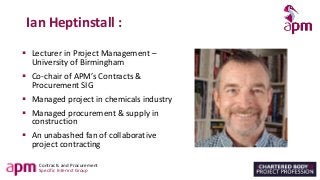
Ian Heptinstall :
▪ Lecturer in Project Management –
University of Birmingham
▪ Co-chair of APM’s Contracts &
Procurement SIG
▪ Managed project in chemicals industry
▪ Managed procurement & supply in
construction
▪ An unabashed fan of collaborative
project contracting
Contracts and Procurement
Specific Interest Group
How would you best describe your project
and procurement environment?
1. Public Sector
2. Private Sector
3. Both
4. N/A
Contracts and Procurement
Specific Interest Group
Which best describes the procurement
approach on your projects?
1. I work mostly on in-house projects with little procurement
2. We prefer fixed-price contracts
3. We prefer flexibility of simple reimbursable contracts
4. Long-term Frameworks
5. Project Alliance/IPD
6. Some other form
Contracts and Procurement
Specific Interest Group
What do you know about Project Alliances
or IPD (Integrated Project Delivery)?
1. Nothing
2. Some Awareness
3. Good Understanding, not used
4. Have worked on one
5. Have set up/managed
Contracts and Procurement
Specific Interest Group
Procuring for Collaboration
▪ Competition & Collaboration – procurement perspective
▪ Collaboration – team perspective
▪ The problem with common contract and pricing methods
▪ Collaborative Contracting – Overview
▪ Project Alliances & IPD
▪ Case Study
Contracts and Procurement
Specific Interest Group
Procuring for Collaboration: Procurement
Perspective
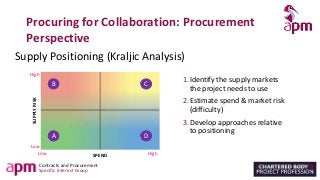
Supply Positioning (Kraljic Analysis)
1.Identify the supply markets
the project needs to use
2.Estimate spend & market risk
(difficulty)
3.Develop approaches relative
to positioning
Low
SUPPLY
RISK
High
High
SPEND
Low
B
A D
C
Contracts and Procurement
Specific Interest Group
Procuring for Collaboration: Procurement
Perspective
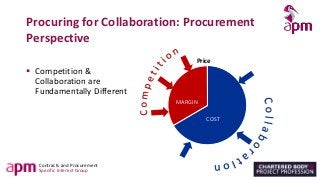
▪ Competition &
Collaboration are
Fundamentally Different
Price
MARGIN
COST
Contracts and Procurement
Specific Interest Group
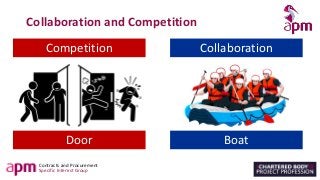
Collaboration and Competition
Collaboration
Competition
Door Boat
Contracts and Procurement
Specific Interest Group
Procuring for Collaboration: Team
Perspective
▪ A team where members freely collaborate will
–Deliver better results
▪ Quality
▪ Speed
▪ Cost
–Have fewer disagreements
–Be more creative and innovative
▪ Which in turn improves quality, reduces time, and reduces cost
–Wastes less
–And is more fun and less stressful to be a member of
Contracts and Procurement
Specific Interest Group
But
▪ The common forms of contract used on capital and construction projects are
inherently un-collaborative in nature
▪ Fixed Prices, and associated penalties for breach
– I can win, you can lose
– Add to the overall cost
– Waste time because they take longer to agree
– Incentivises conservatism and behind-the-scenes cost cutting
– Late engagement of ‘experts’
▪ Reimbursable or basic cost-plus
– Incentivises suppliers to increase billings
– Penalises suppliers who uncover savings and improvements
▪ Adding a “Partnership Charter” over the top of other contract terms adds a potential
conflict
– But it is possible, with luck and senior-level support
Contracts and Procurement
Specific Interest Group
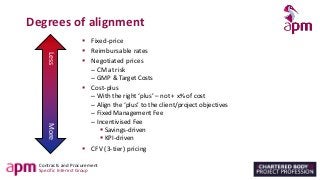
Degrees of alignment
▪ Fixed-price
▪ Reimbursable rates
▪ Negotiated prices
– CM at risk
– GMP & Target Costs
▪ Cost-plus
– With the right ‘plus’ – not + x% of cost
– Align the ‘plus’ to the client/project objectives
– Fixed Management Fee
– Incentivised Fee
▪ Savings-driven
▪ KPI-driven
▪ CFV (3-tier) pricing
Less
More
Contracts and Procurement
Specific Interest Group
Some issues with fixed prices on significant
contracts
▪ Changes & claims
▪ Extends duration
▪ Reduces quality – or puts it at risk
▪ Inhibits collaboration
▪ Risk is not pooled
▪ My simple test: Compare how we select an important supplier, with how we would
recruit the next CEO, CFO, COO or CPO
NET IMPACT:
Reduced ROI
Contracts and Procurement
Specific Interest Group
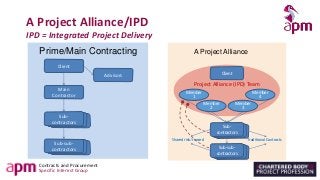
A Project Alliance/IPD
IPD = Integrated Project Delivery
Sub-
contractors
Sub-
contractors
Sub-
contractors
Main
Contractor
Client
Prime/Main Contracting
Advisors
Sub-
contractors
Sub-
contractors
Sub-sub-
contractors
Project Alliance (IPD) Team
Member
1
Member
4
Client
A Project Alliance
Member
2
Member
3
Traditional Contracts
Sub-
contractors
Sub-
contractors
Sub-
contractors
Sub-
contractors
Sub-
contractors
Sub-sub-
contractors
Shared risk/reward
Contracts and Procurement
Specific Interest Group
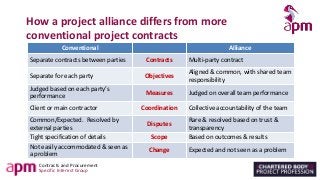
How a project alliance differs from more
conventional project contracts
Conventional Alliance
Separate contracts between parties Contracts Multi-party contract
Separate for each party Objectives
Aligned & common, with shared team
responsibility
Judged based on each party’s
performance
Measures Judged on overall team performance
Client or main contractor Coordination Collective accountability of the team
Common/Expected. Resolved by
external parties
Disputes
Rare & resolved based on trust &
transparency
Tight specification of details Scope Based on outcomes & results
Not easily accommodated & seen as
a problem
Change Expected and not seen as a problem
Contracts and Procurement
Specific Interest Group
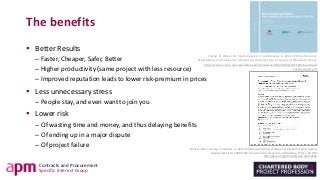
The benefits
▪ Better Results
– Faster, Cheaper, Safer, Better
– Higher productivity (same project with less resource)
– Improved reputation leads to lower risk-premium in prices
▪ Less unnecessary stress
– People stay, and even want to join you
▪ Lower risk
– Of wasting time and money, and thus delaying benefits
– Of ending up in a major dispute
– Of project failure Walker, D.H.T., Harley, J. and Mills, A., 2015. Performance of Project Alliancing: a Digest of Infrastructure
Development from 2008 to 2013, Construction Economics and Building, 15(1), 1-18. DOI:
http://dx.doi.org/10.5130/ajceb.v15i1.4186.
Cheng, R., Allison, M., Sturts-Dossick, C. and Monson, C., 2015. IPD: Performance,
Expectations, and Future Use A Report On Outcomes of a University of Minnesota Survey.
https://conservancy.umn.edu/bitstream/handle/11299/201405/20150925-ipda-ipd-
survey-report.pdf.
Contracts and Procurement
Specific Interest Group
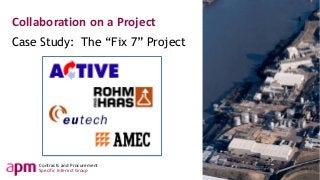
Collaboration on a Project
Case Study: The “Fix 7” Project
Contracts and Procurement
Specific Interest Group
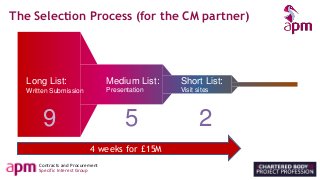
The Selection Process (for the CM partner)
Long List:
Written Submission
Medium List:
Presentation
Short List:
Visit sites
Shortlist of One
2-way due diligence
4 weeks for £15M
9 5 2
Contracts and Procurement
Specific Interest Group
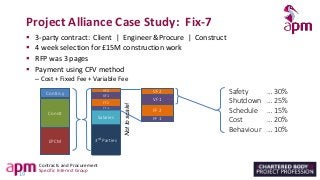
Project Alliance Case Study: Fix-7
▪ 3-party contract: Client | Engineer &Procure | Construct
▪ 4 week selection for £15M construction work
▪ RFP was 3 pages
▪ Payment using CFV method
– Cost + Fixed Fee + Variable Fee
19
Contin.y
Constr
EPCM
Cost
FF 1
VF 1
FF 2
VF 2
FF 1
VF 1
FF 2
VF 2
Safety
Shutdown
Schedule
Cost
Behaviour
… 30%
… 25%
… 15%
… 20%
… 10%
3rd Parties
Salaries
Not
to
scale!
Contracts and Procurement
Specific Interest Group
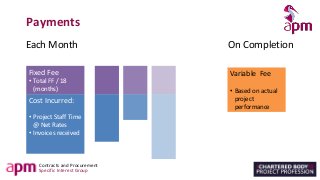
Payments
Each Month
Cost Incurred:
• Project Staff Time
@ Net Rates
• Invoices received
Fixed Fee
• Total FF / 18
(months)
On Completion
Variable Fee
• Based on actual
project
performance
Contracts and Procurement
Specific Interest Group
Variable Element of CFV
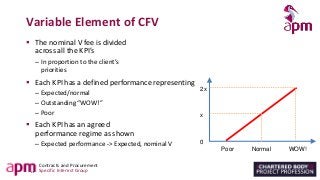
▪ The nominal V fee is divided
across all the KPI’s
– In proportion to the client’s
priorities
▪ Each KPI has a defined performance representing
– Expected/normal
– Outstanding “WOW!”
– Poor
▪ Each KPI has an agreed
performance regime as shown
– Expected performance -> Expected, nominal V
21
Normal
Poor WOW!
0
x
2x
Contracts and Procurement
Specific Interest Group
Performance Fee Breakdown
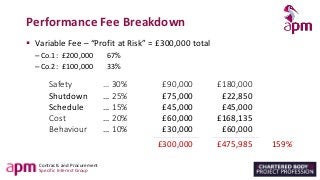
▪ Variable Fee – “Profit at Risk” = £300,000 total
–Co.1: £200,000 67%
–Co.2: £100,000 33%
Safety
Shutdown
Schedule
Cost
Behaviour
… 30%
… 25%
… 15%
… 20%
… 10%
£90,000
£75,000
£45,000
£60,000
£30,000
£300,000
£180,000
£22,850
£45,000
£168,135
£60,000
£475,985 159%
Contracts and Procurement
Specific Interest Group
Exploiting the collaborative contract
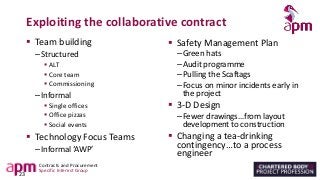
▪ Team building
–Structured
▪ ALT
▪ Core team
▪ Commissioning
–Informal
▪ Single offices
▪ Office pizzas
▪ Social events
▪ Technology Focus Teams
–Informal ‘AWP’
23
▪ Safety Management Plan
–Green hats
–Audit programme
–Pulling the Scaftags
–Focus on minor incidents early in
the project
▪ 3-D Design
–Fewer drawings…from layout
development to construction
▪ Changing a tea-drinking
contingency…to a process
engineer
Contracts and Procurement
Specific Interest Group
My takeaways
▪ A project alliance is easier & faster to set up and manage
– …providing you STOP the practices you used in other approaches
▪ If the project alliance is not expecting to cost less than a reliable fixed-price, then
something is wrong
– …alliances work because you remove unnecessary work and risk, which costs money
▪ A bespoke contract can be easier and faster to put in place
– …standard forms (even many “alliance” forms require modification & informed choices)
▪ It brings the fun and enjoyment back into projects and contracts
– The best people can now focus on the underlying project, rather than their employer’s
commercial risk
Contracts and Procurement
Specific Interest Group
Questions & Comments…
▪ Why is the Project Alliance approach still a ‘niche’ approach?
▪ Why does the Government think “while alliancing arrangements are
not always appropriate, they should be considered on more complex
programmes of work”. (The Construction Playbook, Dec 2020, p41)
▪ Why would you not use it on your next project?
Contracts and Procurement
Specific Interest Group
Ian Heptinstall :
▪ Lecturer in Project Management –
University of Birmingham
▪ Co-chair of APM’s Contracts &
Procurement SIG
▪ Managed project in chemicals industry
▪ Managed procurement & supply in
construction
▪ An unabashed fan of collaborative
project contracting

Procuring for Collaboration on Projects webinar

  • 1.
    Procuring for Collaboration onProjects SWWE Branch. 24 March 2021 Presented by: Ian Heptinstall, Co-Chair, APM C&P SIG .
  • 2.
    Contracts and Procurement SpecificInterest Group Ian Heptinstall : ▪ Lecturer in Project Management – University of Birmingham ▪ Co-chair of APM’s Contracts & Procurement SIG ▪ Managed project in chemicals industry ▪ Managed procurement & supply in construction ▪ An unabashed fan of collaborative project contracting
  • 3.
    Contracts and Procurement SpecificInterest Group How would you best describe your project and procurement environment? 1. Public Sector 2. Private Sector 3. Both 4. N/A
  • 4.
    Contracts and Procurement SpecificInterest Group Which best describes the procurement approach on your projects? 1. I work mostly on in-house projects with little procurement 2. We prefer fixed-price contracts 3. We prefer flexibility of simple reimbursable contracts 4. Long-term Frameworks 5. Project Alliance/IPD 6. Some other form
  • 5.
    Contracts and Procurement SpecificInterest Group What do you know about Project Alliances or IPD (Integrated Project Delivery)? 1. Nothing 2. Some Awareness 3. Good Understanding, not used 4. Have worked on one 5. Have set up/managed
  • 6.
    Contracts and Procurement SpecificInterest Group Procuring for Collaboration ▪ Competition & Collaboration – procurement perspective ▪ Collaboration – team perspective ▪ The problem with common contract and pricing methods ▪ Collaborative Contracting – Overview ▪ Project Alliances & IPD ▪ Case Study
  • 7.
    Contracts and Procurement SpecificInterest Group Procuring for Collaboration: Procurement Perspective Supply Positioning (Kraljic Analysis) 1.Identify the supply markets the project needs to use 2.Estimate spend & market risk (difficulty) 3.Develop approaches relative to positioning Low SUPPLY RISK High High SPEND Low B A D C
  • 8.
    Contracts and Procurement SpecificInterest Group Procuring for Collaboration: Procurement Perspective ▪ Competition & Collaboration are Fundamentally Different Price MARGIN COST
  • 9.
    Contracts and Procurement SpecificInterest Group Collaboration and Competition Collaboration Competition Door Boat
  • 10.
    Contracts and Procurement SpecificInterest Group Procuring for Collaboration: Team Perspective ▪ A team where members freely collaborate will –Deliver better results ▪ Quality ▪ Speed ▪ Cost –Have fewer disagreements –Be more creative and innovative ▪ Which in turn improves quality, reduces time, and reduces cost –Wastes less –And is more fun and less stressful to be a member of
  • 11.
    Contracts and Procurement SpecificInterest Group But ▪ The common forms of contract used on capital and construction projects are inherently un-collaborative in nature ▪ Fixed Prices, and associated penalties for breach – I can win, you can lose – Add to the overall cost – Waste time because they take longer to agree – Incentivises conservatism and behind-the-scenes cost cutting – Late engagement of ‘experts’ ▪ Reimbursable or basic cost-plus – Incentivises suppliers to increase billings – Penalises suppliers who uncover savings and improvements ▪ Adding a “Partnership Charter” over the top of other contract terms adds a potential conflict – But it is possible, with luck and senior-level support
  • 12.
    Contracts and Procurement SpecificInterest Group Degrees of alignment ▪ Fixed-price ▪ Reimbursable rates ▪ Negotiated prices – CM at risk – GMP & Target Costs ▪ Cost-plus – With the right ‘plus’ – not + x% of cost – Align the ‘plus’ to the client/project objectives – Fixed Management Fee – Incentivised Fee ▪ Savings-driven ▪ KPI-driven ▪ CFV (3-tier) pricing Less More
  • 13.
    Contracts and Procurement SpecificInterest Group Some issues with fixed prices on significant contracts ▪ Changes & claims ▪ Extends duration ▪ Reduces quality – or puts it at risk ▪ Inhibits collaboration ▪ Risk is not pooled ▪ My simple test: Compare how we select an important supplier, with how we would recruit the next CEO, CFO, COO or CPO NET IMPACT: Reduced ROI
  • 14.
    Contracts and Procurement SpecificInterest Group A Project Alliance/IPD IPD = Integrated Project Delivery Sub- contractors Sub- contractors Sub- contractors Main Contractor Client Prime/Main Contracting Advisors Sub- contractors Sub- contractors Sub-sub- contractors Project Alliance (IPD) Team Member 1 Member 4 Client A Project Alliance Member 2 Member 3 Traditional Contracts Sub- contractors Sub- contractors Sub- contractors Sub- contractors Sub- contractors Sub-sub- contractors Shared risk/reward
  • 15.
    Contracts and Procurement SpecificInterest Group How a project alliance differs from more conventional project contracts Conventional Alliance Separate contracts between parties Contracts Multi-party contract Separate for each party Objectives Aligned & common, with shared team responsibility Judged based on each party’s performance Measures Judged on overall team performance Client or main contractor Coordination Collective accountability of the team Common/Expected. Resolved by external parties Disputes Rare & resolved based on trust & transparency Tight specification of details Scope Based on outcomes & results Not easily accommodated & seen as a problem Change Expected and not seen as a problem
  • 16.
    Contracts and Procurement SpecificInterest Group The benefits ▪ Better Results – Faster, Cheaper, Safer, Better – Higher productivity (same project with less resource) – Improved reputation leads to lower risk-premium in prices ▪ Less unnecessary stress – People stay, and even want to join you ▪ Lower risk – Of wasting time and money, and thus delaying benefits – Of ending up in a major dispute – Of project failure Walker, D.H.T., Harley, J. and Mills, A., 2015. Performance of Project Alliancing: a Digest of Infrastructure Development from 2008 to 2013, Construction Economics and Building, 15(1), 1-18. DOI: http://dx.doi.org/10.5130/ajceb.v15i1.4186. Cheng, R., Allison, M., Sturts-Dossick, C. and Monson, C., 2015. IPD: Performance, Expectations, and Future Use A Report On Outcomes of a University of Minnesota Survey. https://conservancy.umn.edu/bitstream/handle/11299/201405/20150925-ipda-ipd- survey-report.pdf.
  • 17.
    Contracts and Procurement SpecificInterest Group Collaboration on a Project Case Study: The “Fix 7” Project
  • 18.
    Contracts and Procurement SpecificInterest Group The Selection Process (for the CM partner) Long List: Written Submission Medium List: Presentation Short List: Visit sites Shortlist of One 2-way due diligence 4 weeks for £15M 9 5 2
  • 19.
    Contracts and Procurement SpecificInterest Group Project Alliance Case Study: Fix-7 ▪ 3-party contract: Client | Engineer &Procure | Construct ▪ 4 week selection for £15M construction work ▪ RFP was 3 pages ▪ Payment using CFV method – Cost + Fixed Fee + Variable Fee 19 Contin.y Constr EPCM Cost FF 1 VF 1 FF 2 VF 2 FF 1 VF 1 FF 2 VF 2 Safety Shutdown Schedule Cost Behaviour … 30% … 25% … 15% … 20% … 10% 3rd Parties Salaries Not to scale!
  • 20.
    Contracts and Procurement SpecificInterest Group Payments Each Month Cost Incurred: • Project Staff Time @ Net Rates • Invoices received Fixed Fee • Total FF / 18 (months) On Completion Variable Fee • Based on actual project performance
  • 21.
    Contracts and Procurement SpecificInterest Group Variable Element of CFV ▪ The nominal V fee is divided across all the KPI’s – In proportion to the client’s priorities ▪ Each KPI has a defined performance representing – Expected/normal – Outstanding “WOW!” – Poor ▪ Each KPI has an agreed performance regime as shown – Expected performance -> Expected, nominal V 21 Normal Poor WOW! 0 x 2x
  • 22.
    Contracts and Procurement SpecificInterest Group Performance Fee Breakdown ▪ Variable Fee – “Profit at Risk” = £300,000 total –Co.1: £200,000 67% –Co.2: £100,000 33% Safety Shutdown Schedule Cost Behaviour … 30% … 25% … 15% … 20% … 10% £90,000 £75,000 £45,000 £60,000 £30,000 £300,000 £180,000 £22,850 £45,000 £168,135 £60,000 £475,985 159%
  • 23.
    Contracts and Procurement SpecificInterest Group Exploiting the collaborative contract ▪ Team building –Structured ▪ ALT ▪ Core team ▪ Commissioning –Informal ▪ Single offices ▪ Office pizzas ▪ Social events ▪ Technology Focus Teams –Informal ‘AWP’ 23 ▪ Safety Management Plan –Green hats –Audit programme –Pulling the Scaftags –Focus on minor incidents early in the project ▪ 3-D Design –Fewer drawings…from layout development to construction ▪ Changing a tea-drinking contingency…to a process engineer
  • 24.
    Contracts and Procurement SpecificInterest Group My takeaways ▪ A project alliance is easier & faster to set up and manage – …providing you STOP the practices you used in other approaches ▪ If the project alliance is not expecting to cost less than a reliable fixed-price, then something is wrong – …alliances work because you remove unnecessary work and risk, which costs money ▪ A bespoke contract can be easier and faster to put in place – …standard forms (even many “alliance” forms require modification & informed choices) ▪ It brings the fun and enjoyment back into projects and contracts – The best people can now focus on the underlying project, rather than their employer’s commercial risk
  • 25.
    Contracts and Procurement SpecificInterest Group Questions & Comments… ▪ Why is the Project Alliance approach still a ‘niche’ approach? ▪ Why does the Government think “while alliancing arrangements are not always appropriate, they should be considered on more complex programmes of work”. (The Construction Playbook, Dec 2020, p41) ▪ Why would you not use it on your next project?
  • 26.
    Contracts and Procurement SpecificInterest Group Ian Heptinstall : ▪ Lecturer in Project Management – University of Birmingham ▪ Co-chair of APM’s Contracts & Procurement SIG ▪ Managed project in chemicals industry ▪ Managed procurement & supply in construction ▪ An unabashed fan of collaborative project contracting