Effective Planning
Ankur Maheshwari
What is Planning?
Planning is looking ahead and preparing your self to focus on actions
to achieve desired results.
What is Effective Planning?
A planning done to minimize the risk of failure is effective planning.
Is it possible to eliminate failure?
May not be but when we minimize the risk of failure, we are
increasing the chances to success.
How do we minimize the risk of failure?
Good Question, lets see…
Ankur Maheshwari
Golden Rules?
For Effective planning follow these basic 7 rules:-
•Think long term, Document short term
•Keep is simple
•Plan for unexpected as well
•Do a ground reality check
•Identify and document dependencies
•Prepare yourself to accommodate improvements
•Let the plan be a living document
Ankur Maheshwari
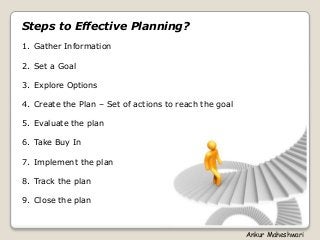
Steps to Effective Planning?
1. Gather Information
2. Set a Goal
3. Explore Options
4. Create the Plan – Set of actions to reach the goal
5. Evaluate the plan
6. Take Buy In
7. Implement the plan
8. Track the plan
9. Close the plan
Ankur Maheshwari
Realistic planning requires homework
•Read documentation
•Ask Questions
•Understand Requirements
•Recollect past experience
•Gather historical data
•Talk to people
•Take time to digest
•Consolidate gathered Information
Gather Information
Ankur Maheshwari
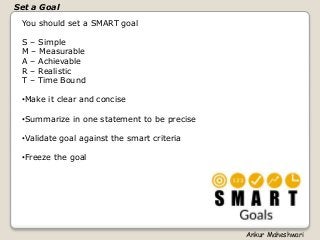
You should set a SMART goal
S – Simple
M – Measurable
A – Achievable
R – Realistic
T – Time Bound
•Make it clear and concise
•Summarize in one statement to be precise
•Validate goal against the smart criteria
•Freeze the goal
Set a Goal
Ankur Maheshwari
•Look all possible Approaches to reach the goal
•Rank them in order of importance
•Evaluate the top 3
•Select the best fit
•Review the feasibility and incorporate feedback
Explore Options
Ankur Maheshwari
•Detail out the major milestones to achieve the chosen approach
•Document activities that help achieve milestones
•Effort estimate each activity and fit the schedule
•Co-relate dependencies
•Assign resources to activities
Create the Plan
Ankur Maheshwari
Evaluate the plan on various parameters and ensure that possible
risks have clear mitigation plans. Some of the common project risks
are below:
1. Unclear roles and responsibilities
2. Scope changes
3. Effort variation
4. Lack of resource commitment
5. Delay of responses from customer
6. No buy-in from Stakeholders
7. Poor and unclear communication
Revise the plan wherever required.
Evaluate the Plan
Ankur Maheshwari
The benefits of planning depend on how well the plan is understood
by the stakeholders and how well it is executed. For both of these,
we need a buy in from the stakeholders. So, once the plan is in
place:
•Share the plan with stakeholders
•Conduct a meet and explain the plan
•Let them digest
•Seek feedbacks
•Improve the plan based on suggestions
•Seek an agreement
•Close the step by deciding owners
•Baseline the plan
Take Buy In
Ankur Maheshwari
For winning a game, it is important for the playing team to
understand its rules. Similarly for implementing the plan
successfully it is important that:
•Ground rules are clearly defined, documented and educated
•Owners are clearly identified
•Scope is managed through effective change management
•Success criteria are defined
•Un-Ambiguous information is shared
•Intermediate wins are enjoyed
•Failures provide feedback and plan revisited
Implement the plan
Ankur Maheshwari
The best way to track the plan is to be in touch
•Sync with the team as much as possible
•Keep track of key milestones
•Uses tracking techniques and tools like earned value analysis
•Use effective reporting techniques
•Prepare team for pro-actively sharing the risks and issues
•Identify roadblocks and remove them
•Empower team to deliver results
•Support the team
Track the plan
Ankur Maheshwari
Closing the plan is as important as any other step in the planning
process. Closing the plan gives the opportunity to evaluate what
went wrong and what went right in the planning.
•Get sign offs
•Identify the key success factors
•Identify the key failures
•Identify key performing resources. Appraise them.
•Share and document lessons learnt
•Share and document best practices
•Use it as a feedback for next planning
Close the plan
Ankur Maheshwari
Summary
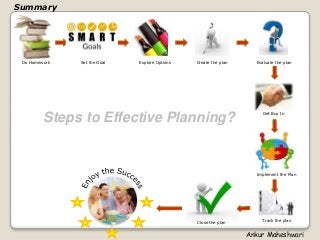
Do Homework Set the Goal Explore Options Create the plan Evaluate the plan
Get Buy In
Implement the Plan
Track the plan
Close the plan
Ankur Maheshwari
Steps to Effective Planning?
Thank You
Ankur Maheshwari
ankurmah@gmail.com
Go Green – Save Environment – Contribute your bit

Effective Planning

  • 1.
  • 2.
    What is Planning? Planningis looking ahead and preparing your self to focus on actions to achieve desired results. What is Effective Planning? A planning done to minimize the risk of failure is effective planning. Is it possible to eliminate failure? May not be but when we minimize the risk of failure, we are increasing the chances to success. How do we minimize the risk of failure? Good Question, lets see… Ankur Maheshwari
  • 3.
    Golden Rules? For Effectiveplanning follow these basic 7 rules:- •Think long term, Document short term •Keep is simple •Plan for unexpected as well •Do a ground reality check •Identify and document dependencies •Prepare yourself to accommodate improvements •Let the plan be a living document Ankur Maheshwari
  • 4.
    Steps to EffectivePlanning? 1. Gather Information 2. Set a Goal 3. Explore Options 4. Create the Plan – Set of actions to reach the goal 5. Evaluate the plan 6. Take Buy In 7. Implement the plan 8. Track the plan 9. Close the plan Ankur Maheshwari
  • 5.
    Realistic planning requireshomework •Read documentation •Ask Questions •Understand Requirements •Recollect past experience •Gather historical data •Talk to people •Take time to digest •Consolidate gathered Information Gather Information Ankur Maheshwari
  • 6.
    You should seta SMART goal S – Simple M – Measurable A – Achievable R – Realistic T – Time Bound •Make it clear and concise •Summarize in one statement to be precise •Validate goal against the smart criteria •Freeze the goal Set a Goal Ankur Maheshwari
  • 7.
    •Look all possibleApproaches to reach the goal •Rank them in order of importance •Evaluate the top 3 •Select the best fit •Review the feasibility and incorporate feedback Explore Options Ankur Maheshwari
  • 8.
    •Detail out themajor milestones to achieve the chosen approach •Document activities that help achieve milestones •Effort estimate each activity and fit the schedule •Co-relate dependencies •Assign resources to activities Create the Plan Ankur Maheshwari
  • 9.
    Evaluate the planon various parameters and ensure that possible risks have clear mitigation plans. Some of the common project risks are below: 1. Unclear roles and responsibilities 2. Scope changes 3. Effort variation 4. Lack of resource commitment 5. Delay of responses from customer 6. No buy-in from Stakeholders 7. Poor and unclear communication Revise the plan wherever required. Evaluate the Plan Ankur Maheshwari
  • 10.
    The benefits ofplanning depend on how well the plan is understood by the stakeholders and how well it is executed. For both of these, we need a buy in from the stakeholders. So, once the plan is in place: •Share the plan with stakeholders •Conduct a meet and explain the plan •Let them digest •Seek feedbacks •Improve the plan based on suggestions •Seek an agreement •Close the step by deciding owners •Baseline the plan Take Buy In Ankur Maheshwari
  • 11.
    For winning agame, it is important for the playing team to understand its rules. Similarly for implementing the plan successfully it is important that: •Ground rules are clearly defined, documented and educated •Owners are clearly identified •Scope is managed through effective change management •Success criteria are defined •Un-Ambiguous information is shared •Intermediate wins are enjoyed •Failures provide feedback and plan revisited Implement the plan Ankur Maheshwari
  • 12.
    The best wayto track the plan is to be in touch •Sync with the team as much as possible •Keep track of key milestones •Uses tracking techniques and tools like earned value analysis •Use effective reporting techniques •Prepare team for pro-actively sharing the risks and issues •Identify roadblocks and remove them •Empower team to deliver results •Support the team Track the plan Ankur Maheshwari
  • 13.
    Closing the planis as important as any other step in the planning process. Closing the plan gives the opportunity to evaluate what went wrong and what went right in the planning. •Get sign offs •Identify the key success factors •Identify the key failures •Identify key performing resources. Appraise them. •Share and document lessons learnt •Share and document best practices •Use it as a feedback for next planning Close the plan Ankur Maheshwari
  • 14.
    Summary Do Homework Setthe Goal Explore Options Create the plan Evaluate the plan Get Buy In Implement the Plan Track the plan Close the plan Ankur Maheshwari Steps to Effective Planning?
  • 15.
    Thank You Ankur Maheshwari ankurmah@gmail.com GoGreen – Save Environment – Contribute your bit