Six Thinking Hats Appoach to Brainstorming and Collaboration
The Six Thinking Hats approach to brainstorming and collaboration was created by Dr. Edward de Bono. It can also be applied to staff or team meetings, and can be adapted to virtual meetings or conference calls as well.
The "Six Hats"Approach To Executive Problem Solving 2
The “Six Hats” Approach to Executive
Problem Solving
An article published in the April, 2012 issue of Psychology Today
cited a study which found individual brainstorming was, on average,
far more productive than group brainstorming. The study built on
long-established research, which showed that individuals were able
to generate more than twice as many potential solutions to a given
problem when working on their own rather than as part of a group.
3.
The "Six Hats"Approach To Executive Problem Solving 3
Well-known business consultant Edward de Bono offers a unique
model for brainstorming and collaboration meetings, known as
the “six hats” approach, commonly known as “Six Thinking Hats.”
Organizations such as Nestle, Oracle, LinkedIn and P&G have
successfully used Six Thinking Hats to solve a variety of business
problems. McDonald’s Japan for example had their executive
team use it to solve internal issues.
4.
The "Six Hats"Approach To Executive Problem Solving 4
Less than a year after implementing Six Thinking Hats, staff
identified the following results:
• Meeting times have been cut by about 25%.
• The culture of the workplace has become more positive
by reducing the proportion of Black Hat Thinking.
• Open communication has been enhanced, due to every
staff member’s involvement in all types of thinking.
5.
The "Six Hats"Approach To Executive Problem Solving 5
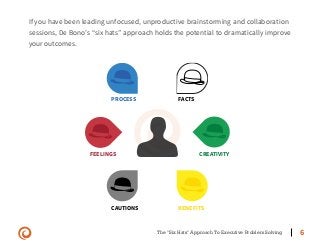
Essentially, deBono’s model divides up teams into six groups, each of which
wears a different-colored “hat:”
• The blue hat is worn by the meeting leader, who supervises brainstorming
and collects the ideas being generated for individual presentation and
consideration
• The white hat is worn by members who will apply fact- and data-based
analytical modes to the ideas under discussion
• The red hat is worn by members who rely on intuition, hunches and
emotional responses
• The green hat is worn by members who apply creativity and unconventional
thinking to generate alternatives
• The yellow hat is worn by members responsible for highlighting the positives
and potential benefits of every idea under discussion
• The black hat is worn by members responsible for playing “devil’s advocate,”
and considering the negatives and potential undesirable outcomes of every
idea under discussion
6.
The "Six Hats"Approach To Executive Problem Solving 6
If you have been leading unfocused, unproductive brainstorming and collaboration
sessions, De Bono’s “six hats” approach holds the potential to dramatically improve
your outcomes.
PROCESS
CAUTIONS BENEFITS
FEELINGS CREATIVITY
FACTS


![What Is Blockchain Technology A Simple Beginner’s Guide [2026]](https://cdn.slidesharecdn.com/ss_thumbnails/whatisblockchaintechnologyasimplebeginnersguide2026-260101112141-cf432b44-thumbnail.jpg?width=640&height=640&fit=bounds)


