55
Historical Perspective of
Neuropsychology
UNIT 4 DOMAINS OF NEUROPSYCHOLOGY
Structure
4.0 Introduction
4.1 Objectives
4.2 Areas of Neuropsychology
4.2.1 Clinical Neuropsychology
4.2.2 Expérimental Neuropsychology
4.3 Cognitive Functions
4.3.1 Attention
4.3.2 Motor Function
4.3.3 Language
4.3.4 Learning and Memory
4.3.5 Visual Perception and Constructional Ability
4.3.6 Executive Functions
4.4 NeuropsychologicalAssessment
4.5 Approaches of Neuropsychological Assessment
4.5.1 Fixed Battery Approach
4.5.2 Flexible Battery Approach
4.6 Goals of Neuropsychological Assessment
4.7 Assessment Process
4.8 Other Assessments
4.9 Let Us Sum Up
4.10 Unit End Questions
4.11 Suggested Readings
4.0 INTRODUCTION
The brain is a fascinating and enigmatic machine. It has the ability to monitor
and control our basic life support systems, to maintain our posture and direct our
movements, to receive and interpret information about the world around us, and
to store information in a readily accessible form throughout our lives. It allows
us to solve problems which range from the strictly practical to the highly abstract,
to communicate with our fellows through language, to create new ideas and
imagine things that have never existed, to feel love and happiness and
disappointment and to experience an awareness of ourselves as individuals.
Neuropsychology as one of the neurosciences has grown to be a separate field of
specialisation within psychology. Neuropsychology seeks to understand the
relationship between the brain and behaviour i.e. it attempts to explain the way
in which the activity of the brain is expressed in observable behaviour.
4.1 OBJECTIVES
After completing this unit, you will be able to:
• Define neuropsychology;
56
Neuropsychology • Describe neuropsychological functions;
• Explain the different neuropsychological functions;
• Explain the different approaches to neuropsychological assessment;
• Elucidate the goals of neuropsychological assessment; and
• Describe the various tests used for assessment.
4.2 AREAS OF NEUROPSYCHOLOGY
Neuropsychology is often divided into two main areas: clinical neuropsychology
and experimental neuropsychology.
4.2.1 Clinical Neuropsychology
This deals with patients who have lesions of the brain. These lesions may be the
effect of disease or tumours, may result from damage or trauma (such as accident)
to the brain, or be the result of some biochemical changes caused by toxic
substances.
4.2.2 Experimental Neuropsychology
The experimental neuropsychologist works with normal subjects with intact
brains. A variety of techniques are employed in the laboratory to study higher
functions in the brain. Subjects are generally required to undertake performance
tasks while their accuracy or speed of response is recorded, from which inferences
about brain organisation are made.
4.3 COGNITIVE FUNCTIONS
Neuropsychological functioning covers a wide variety of cognitive domains
subserved by different parts of the brain. In order to establish the relationship
between brain and behaviour a neuropsychologist should have a thorough
knowledge of these cognitive functions and the brain Ares responsible for these
functions. The following section briefly describes the cognitive domains.
4.3.1 Attention
Attention can be defined as “the concentration of mental effort on sensory or
mental events.Attentional processes facilitate, enhance, or inhibit other cognitive
processes.Attentional problems may manifest as either distractibility or difficulty
remaining focused on a task. Individuals with attentional dysfunction are usually
unable to allocate cognitive resources effectively to the task at hand and fails to
perform at optimal levels even though primary cognitive resources, such as
sensory registration, perception, memory, and associative functions, are intact.
There are three subsystems of attention – selective attention, sustained attention
and divided attention.
Selective or Focussed attention
This requires a capacity to focus and ‘close’ on one stimulus stream or feature,
while attenuating the distracting effect of competing information. Orbitofrontol
area (OFC) in the prefrontal cortex mediates the capacity to inhibit responding
57
Domains of
Neuropsychology
to stimuli irrelevant to the task at hand. Lesion studies have shown that damage
to this area results in distractibility.
Sustained attention
This requires ‘holding’ attention over relatively long periods of time and has
features of vigilance. Right fronto parietal network mediates sustained attention.
Imaging studies have depicted that vigilance tasks that require sustained attention
activate a network of structures in the right frontal and parietal cortices.
Divided attention
This refers to the ability to perform two or more tasks simultaneously and may
be considered as requiring the opposite operations to selective attention. For
example a subject may be presented with stimuli which vary with respect to
colour, motion and shape and monitor changes in all three dimensions.
Dorsolateral prefrontal cortex is implicated in divided attention. Overall it can
be said that frontal lobe plays an important role in all aspects of attention.
4.3.2 Motor Function
Motor function requires integration among multiple structures. The prefrontal
cortex mediates motor planning, the supplementary motor area mediates initiation
of motor acts while the premotor cortex , basal ganglia and cerebellum mediate
fine motor control
4.3.3 Language
Language functions include expressive language (e.g. naming, vocabulary,
storytelling), verbal fluency (fluency of speech, writing, reading), and receptive
language (following directions, attending to spoken language, comprehension
of information). Disorder of language occurs as aphasia.
Aphasia is a primary disturbance in the comprehension or production of speech
caused by brain damage. Mainly there are two types of aphasia:
Expressive aphasia characterised by difficulty in producing words. Patients has
difficulty using grammatical constructions, a nomia (word finding difficulty)
and articulation difficulty (mispronounce words).It is caused by lesion in the left
frontal lobe.
ReceptiveAphasia is characterised by poor speech comprehension and production
of meaningless speech.
4.3.4 Learning and Memory
These are the capacities by which an individual gains experience and retain it.
Learning is the means of acquisition of new information about the environment
and memory refers to the processes that are used to acquire, store, retain and
later retrieve information. There are three major processes involved in memory:
encoding, storage and retrieval. Both are interdependent processes. Memory can
be broadly divided into explicit memory and implicit memory.
Explicit memory
This is the conscious recollection of information such as specific facts or events
and at least in humans that can be verbally communicated. There are two subtypes
of explicit memory.
58
Neuropsychology Episodic memory
It is the retention of information about the where and when of life’s happening.
Semantic Memory
Semantic means meanings. It is a person’s knowledge about the world. It includes
general knowledge, knowledge about meanings of words famous individuals,
important places etc.
Procedural memory
It is related to unconsciously remembering skills and perceptions rather than
consciously remembering facts. Examples include skills of driving a car or typing.
Once learnt the individuals do not have to remember consciously how to drive a
car or type. The subsystems of implicit memory are:
Studies have shown the acquisition of new information is meditated by a wide
network of structures including anterior temporal cortex amygdala hippocampus
prefrontal cortex.
The left prefrontal cortex is involved in encoding episodic memory and retrieval
for semantic memory.
The right prefrontal lobe is implicated in retrieval from episodic memory. Left
temporal lobe mediates verbal memory and of the right temporal lobe mediates
visuo- spatial memory.
Memory deficits may take the form of amnesia in which there is a partial or total
loss of memory. Amnesic patients are unable to encode and consolidate verbal
and nonverbal information regardless of the modality of presentation (auditory
or visual) or the nature of the material (verbal or nonverbal). In contrast, attention
span, language functions, and reasoning are relatively preserved.Amnesic patients
show the greatest deficits on tasks of declarative memory in that they are unable
to demonstrate awareness of prior learning experiences, whereas procedural
memory (skills, habits, and classically conditioned responses) remains intact.
Amnesia may be of two types.
Anterograde amnesia (AA) refers to an inability to learn new information after
the onset of amnesia.AAis present inmost cases of amnesia. Retrograde amnesia
(RA) refers to deficient recall of events preceding the onset of amnesia.
4.3.5 Visual Perception and Constructional Ability
The evaluation of visual perception and constructional ability is a necessary
component of the comprehensive neuropsychological examination.Afocal lesion
or incipient dementia may cause a profound deficit of visuoperceptual
discrimination, visuospatia judgment, or constructional ability in an otherwise
articulate patient with normal verbal functioning and normal visual acuity.
Visual perception
It is the process through which sensory information derived from light is
interpreted for object recognition or spatial orientation. Visual perception consists
of visuoperceptual and visuospatial ability, two functionally independent
processes that have separate neuroanatomical substrates.This functional
59
Domains of
Neuropsychology
distinction is commonly referred to as “what” (visuoperceptual) verses “where”
(visuospatial).
Visuoperceptual ability
This subsumes form or pattern discrimination. Colour, shape, and other intrinsic
features are processed by the visuoperceptual system, regardless of the spatial
dimensions of an object or environment. Visuo-perceptual deficit may manifest
in the form of
a) Visual agnosia I
It is a deficit in recognition of common objects or familiar faces. Bilateral temporo-
occipital lesions damaging the visual association cortices of both hemispheres
usually leads to the manifestation of visual agnosia.
b) Deficits of form discrimination
This may be found on a variety of tasks, including the following:
i) discrimination of unfamiliar human faces;
ii) visual analysis, which involves the identification of overlapping or hidden
figures;
iii) visual synthesis, which involves the ability to mentally combine disparate
parts into an integrated whole; and
iv) identification or matching of objects obscured by excessive shadowing or
by presentation at unusual angles.
The typical neuroanatomical substrate for these deficits is a lesion in the right
temporo-occipital area. .
Visuospatial ability
It is the processing of visual orientation or location in space, regardless of the
intrinsic features of that object or environment. Depth and motion are subsumed
by this system. Visuospatial deficit may appear as
a) Balint-Holmes syndrome in which the spatial disturbance is so severe that
despite adequate visual acuity, the patients may collide with large objects in
their path and may be unable to grasp objects placed within their reach.
Balint-Holmes syndrome is associated with bilateral lesions of the superior
parietal lobule.
b) Visual neglect is pathological inattention to objects or events in the visual
space contralateral to a brain lesion. Visual neglect is due to unilateral lesions
of the parietal lobe, dorsolateral frontal lobe, putamen, cingulate gyrus and
thalamus.
c) Deficit in visuospatial judgment – In this there is deficits in judging the
position and orientation of objects due to posterior right-hemisphere disease.
Constructional ability
Constructional ability is the capacity to draw or assemble an object from
component parts, either on command or to copy a model. The concept measures
the integrative aspect of construction. Visuo constructive ability requires attention,
60
Neuropsychology visuo spatial perception, visuomotor coordination, planning and error correction
abilities. It is mediated by bilateral parietal structures predominantly right parietal
structure. The prefrontal structures mediate the planning and error correction
capacity.
4.3.6 Executive Functions
Executive functions are the capacities that enable a person to control their
behaviour and engage successfully in independent, purposive, goal-directed
activities. (Lezak, 1995). Lezak describes four components of executive functions,
each of which relies on its own set of behaviours:
a) volitional activity, which relies on self-awareness, initiation, and motivation;
b) planning and organisation;
c) carrying out purposive action; and
d) self-regulation, which relies on monitoring, shifting, inhibiting; and
selfcorrecting.
Executive functions include: planning, set shifting and response inhibition
Planning
It is the ability to set goals, to monitor performance so as to reach the goals and
to make corrections in the steps adopted, in order to ensure that the goal is attained.
Goal setting involves identification of both final goals and intermediate goals
that needs to be achieved in order to attain the final goal. Left frontal lobe is
associated with planning ability.
Cognitive flexibility/ Set Shifting
It refers to a person’s ability to switch from one topic to another. In this an
individual needs to inhibit or curtail the current behaviour and spontaneously
commence another. Test that measure these characteristics typically set up an
automatic expectancy or routine of behaviour in the patient and then require the
patient to shift from that expectancy or routine in an independent manner. It
requires strategic planning, organised searching utilising environmental feedback
to shift cognitive set directing behaviour towards the goal and modulating
impulsive response. Lesions of the dorsolateral prefrontal cortex impair set
shifting ability and increases perseverative responses.
Response inhibition
The concept refers to the suppression of actions that are inappropriate in a given
context and that interfere with goal-driven behaviour. Prefrontal areas are essential
for response inhibition.
Problems with executive function may present in many ways, such as impulsivity,
disorganisation, poor judgment, dysregulated behaviour, and amotivation.
4.4 NEUROPSYCHOLOGICALASSESSMENT
A neuropsychological assessment is the systematic administration of clearly
defined procedures (i.e., “tests”) to assess the neurocognitive, behavioural, and
emotional functioning of an individual in order to form hypotheses regarding
61
Domains of
Neuropsychology
his/her central nervous system functioning. Neuropsychological assessment
precisely identifies which functional system is impaired or to what extent it is
impaired.
4.5 APPROACHES OF NEUROPSYCHOLOGICAL
ASSESSMENT
Despite shared goals, neuropsychologists differ widely with respect to their
approach to assessment. There are two different approaches (i) Fixed battery
approach and (ii) Flexible battery approach. These two approaches are discussed
below.
4.5.1 Fixed Battery Approach
Proponents of this approach typically recommend the use of a standard or fixed
battery of tests, in which the same set of instruments is used for each individual
tested, regardless of the referral question. These batteries include tests of a wide
range of cognitive functions by utilising a standard test battery, practitioners
ensure that all significant domains are addressed, thus avoiding the possibility
of overlooking deficits that may better account for or contribute to the patient’s
presenting problem. The disadvantages of battery approach are: 1) excessive
time (fatigues patient, requires several visits); 2) include assessment measures
that might not be necessary for a given patient.
4.5.2 Flexible Battery Approach
On the other hand flexible approach emphasises the need to tailor the assessment
to the nature of particular patient’s difficulties. In this approach tests are chosen
depending on the presenting issues or suspected pathologies and are sometimes
based on a short screening battery. The disadvantages of this approach are that it
relies heavily on the skills and insights of the individual clinician. There is a risk
that certain areas of function might get neglected or that complex patterns of
functional interaction may be missed.
4.6 GOALS OF NEUROPSYCHOLOGICAL
ASSESSMENT
Neuropsychological assessment can be useful in achieving several clinical goals
with a variety of patient populations.
First the neuropsychological assessment aims to diagnose the presence of cortical
damage or dysfunction and localise (which part of the brain is damaged) it.
Second neuropsychological assessment helps to conceptualise an individual’s
overall functional abilities and his/her specific cognitive strengths and
weaknesses.
Third Neuropsychological assessment can identify the presence of mild
disturbances in cases in which other diagnostic studies have produced equivocal
results.
Fourth, it determines the baseline functioning of the individual following
traumatic exposure which serves as a means of devising a rehabilitation
62
Neuropsychology programme or offering advice as to an individual’s ability to carry out certain
tasks (for example, fitness to drive, or returning to work).
Finally serial assessments over time helps to monitor treatment effects and provide
information regarding the rate of recovery and the potential for resuming previous
lifestyle.
4.7 ASSESSMENT PROCESS
Neuropsychological assessment usually starts with a detailed history of the
pateient followed by the evaluation of general intellectual functioning as
intelligence test provide an overview of cognitive function integrity. Thereafter
assessment of specific cognitive domains is done by either using fixed of flexible
battery approach.
Intelligence Tests
UsuallyWechsler Tests of Intelligence is administered.WAIS-IV, (current version)
is composed of 10 core subtests and five supplemental subtests, with the 10 core
subtests comprising the Full Scale IQ. It provides four index scores representing
major components of intelligence:
Verbal Comprehension Index (VCI)
Perceptual Reasoning Index (PRI)
Working Memory Index (WMI)
Processing Speed Index (PSI)
Subtests
The Verbal Comprehension Index includes four tests:
i) Similarities: Abstract verbal reasoning (e.g., “In what way are an apple and
a pear alike?”)
ii) Vocabulary: The degree to which one has learned, been able to comprehend
and verbally express vocabulary (e.g., “What is a guitar?”)
iii) Information : Degree of general information acquired from culture (e.g.,
“Who is the president of Russia?”)
iv) Comprehension [Supplemental]: Ability to deal with abstract social
conventions, rules and expressions (e.g., “What does Kill 2 birds with 1
stone metaphorically mean?”)
The Perceptual Reasoning Index comprises five tests:
i) Block Design: Spatial perception, visual abstract processing and problem
solving.
ii) Matrix Reasoning: Nonverbal abstract problem solving, inductive reasoning,
spatial reasoning.
iii) Visual Puzzles: non-verbal reasoning.
iv) Picture Completion [Supplemental]:Ability to quickly perceive visual details.
v) Figure Weights [Supplemental]: quantitative and analogical reasoning.
63
Domains of
Neuropsychology
The Working Memory Index is obtained from three tests:
i) Digit span: attention, concentration, mental control (e.g., Repeat the numbers
1-2-3 in reverse sequence)
ii) Arithmetic: Concentration while manipulating mental mathematical
problems (e.g., “How many 45-cent stamps can you buy for a dollar?”)
iii) Letter-Number Sequencing [Supplemental]: attention and working memory
(e.g., Repeat the sequence Q-1-B-3-J-2, but place the numbers in numerical
order and then the letters in alphabetical order)
The Processing Speed Index includes three tests:
i) Symbol Search: Visual perception, speed
ii) Coding: Visual-motor coordination, motor and mental speed
iii) Cancellation [Supplemental]: visual-perceptual speed
Two broad scores are also generated, which can be used to summarise general
intellectual abilities:
Full Scale IQ (FSIQ), is obtained from the combined performance of the VCI,
PRI, WMI, and PSI
General Ability Index (GAI), based only on the six subtests that comprise the
VCI and PRI
The WAIS-IV measure is appropriate for use with individuals aged 16–90 years.
For individuals under 16 years, the Wechsler Intelligence Scale for Children
(WISC, 6-16 years) and the Wechsler Preschool and Primary Scale of Intelligence
(WPPSI, 2½–7 years, 3 months) are used.
Fixed Approach of Assessment
The two most widely known batteries are Halstead-Reitan Battery and Luria
Nebraska Neuropsychological Battery.
The Halstead-Reitan Battery includes:
Trails A and B (which see how quickly a patient can connect a sequence of
numbers (trail A) or numbers and letters (trail B).
Controlled Oral WordAssociation Test (COWAT, or Verbal Fluency) - a measure
of a person’s ability to make verbal associations to specified letters.
Halstead Category Test is a measure of abstract ability, including seven subtests
which form three factors:
i) a Counting factor (subtests I and II),
ii) a Spatial Positional Reasoning factor (subtests III, IV, and VII), and
iii) a Proportional Reasoning factor (subtests V, VI, and VII).)
Tactual Performance Test A form board containing ten cut-out shapes, and ten
wooden blocks matching those shapes are placed in front of a blindfolded
individual. Individuals are then instructed to use only their dominant hand to
place the blocks in their appropriate space on the form board. The same procedure
is repeated using only the non-dominant hand, and then using both hands.
64
Neuropsychology Rhythm Test: discrimination of like and unlike pairs of musical beats is required.
Speech Sounds Perception Test: It is a test of auditory acuity.
Finger Oscillation Test. In this, the subjects finger tapping speed is measured.
Luria-Nebraska Neuropsychological Battery
The Luria-Nebraska is a standardised test appropriate for people aged 13 and
older and takes between 90 and 150 minutes to complete. It consists of 269
items in the following 11 clinical scales:
Reading, writing, arithmetic, visual memory, expressive language, receptive
language, motor function, rhythm, tactile, intellectual.
Scores for three summary scales can also be calculated: pathognomonic, right
hemisphere, and left hemisphere.
Achildren’s version of the battery, called the Luria- Nebraska Neuropsychological
Battery for Children (LNNB-C), appropriate for children aged eight to 12, is
also available.
Flexible Approach of Assessment
As already stated in flexible approach of assessment neuropsychologist uses
pertinent patient information to guide test selection and chooses tests (either
from existing batteries or tests designed to assess specific deficits) that assess
cognitive functions relevant to a given patient. More than 700 tests of cognitive
functioning are available. A brief overview of few of the tests assessing various
cognitive functions is described below:
Tests forAttention
Measures of Sustained Attention
i) Colour Cancellation Test: This test Comprises of a sheet having 150 circles
in five different colours i.e. red, yellow, blue, black and gray. Subject is
required to cancel only red and yellow circles as quickly as possible. Time
taken to complete the test is recorded and error of commission (circles other
than red and yellow cancelled) and error of omission (red and yellow circles
not cancelled) is noted.
ii) Digit Span Test: Subject listen to random sequences of numbers presented
in increasing length, and immediately repeat each sequence (two trials at
each span length are presented) - maximum span is number of digits patient
can correctly repeat on at least one trial (normal 5-9 digits).
iii) Corsi Block Test: Subject is presented with nine blocks array arranged in
random order; examiner touches blocks in sequences of increasing length;
patient is required to reproduce sequence at each length.
iv) Paced Auditory Serial Addition Test (PASAT): Extremely sensitive measure
of vigilance patient listens to tape recording of digits presented one at time;
patient must add each number to one immediately preceding it (e.g. recording
presents numbers 1, 7, 5, 4 - patient adds first two numbers (1 + 7) and
responds with number 8; patient then adds second two numbers (7 + 5) and
responds with number 12; patient then adds third two numbers (5 + 4) and
responds Tests assess attention and vigilance (span tests also require working
memory).
65
Domains of
Neuropsychology
Measures of Selective Attention
i) Conners’Continuous Performance Task/Test (CPT) (Computerised version)
In CPT the respondents are required to press the space bar or click the mouse
whenever any letter except the letter ‘X’ appears on the computer screen. The
person must refrain from clicking if they see any other letter presented. The
inter-stimulus intervals (ISIs) are 1, 2 and 4 seconds with a display time of 250
milliseconds.
Four types of scores are obtained
Corrects Detection: This indicates the number of times the client responded to
the target stimulus. Higher rates of correct detections indicate better attentional
capacity.
Reaction Times: This measures the amount of time between the presentation of
the stimulus and the client’s response.
Omission errors: This indicates the number of times the target was presented,
but the subject did not respond/click the mouse. High omission rates indicate
that the subject is either not paying attention (distractibility) to stimuli or has a
sluggish response.
Commission errors: This score indicates the number of times the client responded
but no target was presented.A fast reaction time and high commission error rate
points to difficulties with impulsivity.
Measures of Divided Attention
Triads Test: It consists of verbal triads task with a actual number identification
task. The two tasks differ with reference to the stimulus modality and the nature
of stimulus processing. Both the tasks require verbal response. The verbal triads
task consists of 48 nouns grouped into 16 word triads. In each triad two words
belong to same category while the third one does not. The subject names the odd
word. In the tactual number identification task an Arabic numeral is written on
the right hand and the subject identifies it by calling it out. The subject performs
the tasks blindfolded. Number of errors committed on each task is counted.
Learning and Memory
Assessment of Various forms of declarative memory, forms a core part of memory
examination in both forms of amnesia.
Assessment of Anterograde Amnesia
The Wechsler Memory Scale (WMS) is designed to measure different memory
functions in a person. It can be used with people from age 16 through 90. The
current version is the fourth edition (WMS-IV) which was published in 2009.
WMS-IV is made up of seven subtests:
• Spatial Addition,
• Symbol Span,
• Design Memory,
• General Cognitive Screener,
66
Neuropsychology • Logical Memory,
• Verbal Paired Associates, and
• Visual Reproduction.
A person’s performance is reported as five Index Scores:
• Auditory Memory,
• Visual Memory,
• Visual Working Memory,
• Immediate Memory, and
• Delayed Memory.
Rey Auditory Learning Test (RAVLT)
RAVLT involves presentation of a list of 15 words(List A), which an examiner
reads aloud at the rate of one per second. The patient’s task is to repeat all the
words he or she can remember, in any order. This procedure is carried for five
trials. Thereafter an interference list (List b) of 15 words is presented followed
by an immediate recall of List B. After this the subject is asked to recall List A.
Immediate recall of List B and then List A provides measure of proactive/
retroactive interference.Adelayed recall of ListAis taken after 30 minutes delay
period.
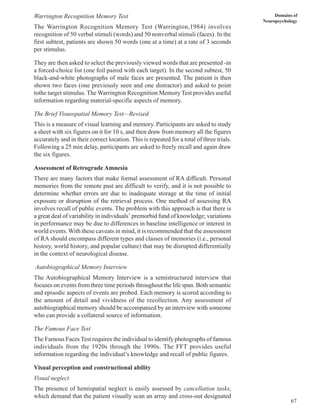
Rey-Osterrieth Complex Figure Test (ROCF)
This is a test of complex visual organisation and visual memory. Individuals are
asked to reproduce a two dimensional figure without time restrictions, first by
copying and then from memory. Scoring focuses on the accuracy of details
rendered. Initial copying is done without the knowledge that memory will be
examined. Hence initial recall is a measure of incidental learning. Delayed recall
performance is examined relevant to rate of forgetting.
• •
•
Fig.: The Rey-Osterrieth Complex (Osterrieth, 1946)
67
Domains of
Neuropsychology
Warrington Recognition Memory Test
The Warrington Recognition Memory Test (Warrington,1984) involves
recognition of 50 verbal stimuli (words) and 50 nonverbal stimuli (faces). In the
first subtest, patients are shown 50 words (one at a time) at a rate of 3 seconds
per stimulus.
They are then asked to select the previously viewed words that are presented -in
a forced-choice list (one foil paired with each target). In the second subtest, 50
black-and-white photographs of male faces are presented. The patient is then
shown two faces (one previously seen and one distractor) and asked to point
tothe target stimulus. The Warrington Recognition MemoryTest provides useful
information regarding material-specific aspects of memory.
The Brief Visuospatial Memory Test—Revised
This is a measure of visual learning and memory. Participants are asked to study
a sheet with six figures on it for 10 s, and then draw from memory all the figures
accurately and in their correct location. This is repeated for a total of three trials.
Following a 25 min delay, participants are asked to freely recall and again draw
the six figures.
Assessment of Retrograde Amnesia
There are many factors that make formal assessment of RA difficult. Personal
memories from the remote past are difficult to verify, and it is not possible to
determine whether errors are due to inadequate storage at the time of initial
exposure or disruption of the retrieval process. One method of assessing RA
involves recall of public events. The problem with this approach is that there is
a great deal of variability in individuals’ premorbid fund of knowledge; variations
in performance may be due to differences in baseline intelligence or interest in
world events. With these caveats in mind, it is recommended that the assessment
of RA should encompass different types and classes of memories (i.e., personal
history, world history, and popular culture) that may be disrupted differentially
in the context of neurological disease.
Autobiographical Memory Interview
The Autobiographical Memory Interview is a semistructured interview that
focuses on events from three time periods throughout the life span. Both semantic
and episodic aspects of events are probed. Each memory is scored according to
the amount of detail and vividness of the recollection. Any assessment of
autobiographical memory should be accompanied by an interview with someone
who can provide a collateral source of information.
The Famous Face Test
The Famous Faces Test requires the individual to identify photographs of famous
individuals from the 1920s through the 1990s. The FFT provides useful
information regarding the individual’s knowledge and recall of public figures.
Visual perception and constructional ability
Visual neglect
The presence of hemispatial neglect is easily assessed by cancellation tasks,
which demand that the patient visually scan an array and cross-out designated
68
Neuropsychology targets. Line bisection tasks, in which patients are asked to, draw a mark through
the midpoint of a horisontal line, may also be used. The patient with neglect will
fail to cross out target stimuli on one side of the cancellation task, and on line
bisection tasks his or her center mark will grossly deviate from the actual midpoint
of the line.
Visuoperceptual discrimination
Benton Test of Facial Recognition (BFRT)is a clinically useful test of
visuoperceptual discrimination. In BFRT subjects are presented with a target
face and several test faces, and they are asked to indicate which of the images
match the target face. Male and female faces are used, and the faces are
closelycropped so that no clothing and little hair are visible.
Visuospatial Judgment
Benton et al.’s (1994) Judgment of Line Orientation task is a clinically useful
test of visuospatial judgment. It consists 30 stimuli with one page with two lines
and a second page with 11 lines. Participants are asked to compare the two pages
and report which two lines on the second page point in the same direction and
are in the same location as the two lines on the first page. This measure has high
split-half reliability for adults.
Constructional Ability
The Benton Visual Retention Test (or simply Benton Test) is an individually
administered test for ages 8-adult The individual is shown 10 designs, one at a
time, and asked to reproduce each one as exactly as possible on plain paper from
memory. The test is untimed, and the results are professionally scored by form,
shape, pattern, and arrangement on the paper.
Rey-Osterreith Complex Figure (already discussed)
Block Design or Object Assembly of Weschler Adult Intelligence Scale also
provides measure of constructional ability.
Executive functions
Planning is assessed using
Tower of London. This test evaluates the subjects’ ability to plan and anticipate
the results of their actions to achieve a predetermined goal. The test consists of
two identical wooden boards with three round pegs of different sizes and two
sets of three balls painted red, green, and blue respectively.The examiner arranges
the balls in a predetermined manner (goal state) on one of the wooden boards
and instructs the subjects to move the balls on the wooden board placed before
him so that he/she achieves that goal state. Tower of London comprises of
problems with 2 moves, 3 moves 4 moves and 5 moves. Scoring yields standard
scores for the total number of moves, total initiation time, total problem-solving
time, total execution time, and the number of correct solutions (i.e., items solved
in minimum number of moves), total time violations, and total rule violations.
The Porteus Maze Test is a graded set of paper forms on which the subject traces
the way from a starting point to an exit; the subject must avoid blind alleys along
the way. There are no time limits. The mazes vary in complexity from simple
diamond shape for the average three-year-old to intricate labyrinths for adults.
69
Domains of
Neuropsychology
Set Shifting
Wisconsin Card Sorting Test (WCST)
The test uses stimulus and response cards that show different forms in various
colours and numbers. Individually administered, it requires the client to sort the
cards according to different principles (i.e., by colour, form, or number). As the
test progresses, there are unannounced shifts in the sorting principle which require
the client to alter his or her approach: however, the subject is given the feedback
whether a particular match is right or wrong. Time taken for the participant to
learn the new rules, and the mistakes made during this learning process are
analysed to arrive at a score.
Trail Making Test
This comprises two parts and consists of 25 circles distributed over a sheet of
paper. In Part A, the circles are numbered 1 – 25, and the patient should draw
lines to connect the numbers in ascending order. In Part B, the circles include
both numbers (1 – 13) and letters (A– L) and as in PartA, the patient draws lines
to connect the circles in an ascending pattern, but with the added task of alternating
between the numbers and letters (i.e., 1-A-2-B-3-C, etc.). The patient should be
instructed to connect the circles as quickly as possible, without lifting the pen or
pencil from the paper. Time taken is noted down.
Response inhibition
Stroop Test-
It comprises of three cards (D,W & C).Card D consists of 24 dots printed in
blue, green, red and yellow. Each color is used six times and arranged in a order
so that each color appear once in a row. Subjects are instructed to read the color
of the dots. Card W is similar to card D except dots are replaced by the words
and subjects are instructed to name the colour of the word in which it is printed.
In Card stimuli is the name of the colours and the instruction is to read the colour
in which the word is printed. Scoring is done in the form of the time taken and
the number of errors committed.
Language
Measure of Aphasia
Boston Diagnostic Aphasia Examination:
The tests are organised into five major sections as given below:
i) Conservational and Expossitory Speech
ii) Auditiory Comprehension
iii) Oral Expression
iv) Understanding Written Language
v) Writing
Token Test
Token Test: This test is designed to assess verbal comprehension of commands
of increasing complexity. The test employs a set of 20 plastic tokens consisting
of 5 colours, two shapes and two sizes. The test sees if an individual can follow
orally presented instructions. For example, the examiner may say, “Touch the
70
Neuropsychology red square” and then the behaviour or lack of behaviour in the individual is
observed and noted.
The Boston Naming Test
(BNT) represents a measure of object naming from line drawings that patients
with often have greater difficulties with the naming of objects. Thus, instead of
there being a simple category of anomia, naming difficulties may be rank ordered
along a continuum. It contains 60 items..
Motor Function
Motor Speed
Finger Tapping Test In Finger Tapping Test (FTT) also referred as the Finger
Oscillation Test the client is asked to initially tap his or her dominant index
finger as fast as possible for five consecutive 10- second trials. The procedure is
then repeated for the nondominant index finger. Performances are measured on
a recording device . The score is simply the average number of taps in a 10-
second interval. The two average scores (for dominant and nondominant fingers/
hands) are compared with each other to see if there are wide discrepancies.
Dexterity
It is measured by Purdue Pegboard Test. The test board consists of two parallel
rows of 25 holes each. Pins, collars and washers are located at the extreme right
hand and left hand cups at the top of the board. The procedure for administration
and scoring is as follows. Performance of the RH and LH subtests require
participants to first use their right hand (dominant) then left hand (nondominant)
to place as many pins as possible down the respective row within 30 sec. The
score for each of these subtests is the total number of pins placed by each hand in
the time allowed. The BH subtest is a bimanual test where the participants use
their right and left hand simultaneously to place as many pins as possible down
both rows in 30 sec. The score for this subtest is the total number of pairs of pins
placed in 30 sec. The assembly subtest requires that both hands work
simultaneously while performing different tasks for 60 sec. The score for this
subtest is the total number of pins, washers, and collars placed in 60 sec. It can
be administered to individuals or groups.
Strength
In order to assess the strength of the voluntary movements of the hands Hand
Dynamometer is used. The subject is required to hold the upper part of the
dynamometer in the palm of the hand and squeeze the stirrup with the fingers as
hard as possible. It is conducted on each hand respectively.
4.8 OTHER ASSESSMENTS
Along with the assessment of cognitive functions academic achievement also
needs to be assessed
Measures ofAcademicAchievement – assess standard academic skills (reading,
writing, arithmetic skills, spelling, etc.
The Wide Range Achievement Test
This is a test of basic academic skills for ages 5-adult, covering reading (word
recognition and pronunciation), written spelling, and arithmetic. The test is given
71
Domains of
Neuropsychology
at two levels: Level I (ages 5-11) and Level II (12-adult). It consists of three
paper-and-pencil subtests with 50-100 items each, arranged in order of increasing
difficulty. The Reading subtest consists of recognising and naming letters and
pronouncing printed words. The Spelling subtest includes copying marks
resembling letters, writing one’s name, and printing words, and the Arithmetic
section involves counting, reading number symbols, and oral and written
computation.
Peabody Individual Achievement Test-Revised-
This is an individual measure of academic achievement. Reading, mathematics,
and spelling are assessed in a multiple-choice format. It comprises of six subtests:
• General Information—100 verbal items assess general knowledge.
• Reading Recognition—100 items measure recognition of printed letters and
the ability to read words aloud.
• Reading Comprehension—82 items measure reading comprehension.
• Written Expression—assesses written language skills.
• Mathematics—100 multiple choice items test knowledge and application
of math concepts and facts.
• Spelling—100 multiple choice items measure recognition of correct word
spelling.
PIAT-R also provides a Written Language Composite, obtained by combining
scores on the Spelling and Written Expression subtests, and a Total Reading
score, a combination of scores from the Reading Recognition and Reading
Comprehension subtests for overall indexes for written expression.
Emotional Status and Level of Adaptive Behaviour
While measures of cognitive and behavioural abilities are important, a client’s
emotional status and relative level of adaptive behaviour are also of considerable
relevance. This information is useful for at least three types of situations. First,
clinicians might try to decide whether abnormal cognitive test results are primarily
from CNS (central nervous system) involvement or emotional factors. If emotional
functioning is relatively normal, but the individual still has cognitive deficits,
this would strongly implicate CNS involvement. Second, a clinician might need
to know the extent to which emotional reactions are complicating organic
impairment.Aclient with organically based confusion is likely to have this further
exacerbated by reactions such as depression.
Third, predictions often need to be made related to a person’s overall level of
functioning. While level of cognitive deficit is useful, personality and emotional
factors have often been found to be better predictors of psychosocial adjustment
and rehabilitation outcome.
The assessment of personality and adaptive behaviour can be accomplished
through a variety of tests.
Measure of Personality
Minnesota Multiphasic Personality Inventory (MMPI) It is a self administered
measure of personality. The revised version MMPI-2 contains 567 test items and
72
Neuropsychology takes approximately 60 to 90 minutes to complete. It comprises of following
clinical scales that are used to indicate different conditions.
Hs Hypochondriasis Concern with bodily symptoms
D Depression Depressive Symptoms
Hy Hysteria Awareness of problems and
vulnerabilities
Pd Psychopathic Deviate Conflict, struggle, anger, respect for
society’s rules
MF Masculinity/Femininity Stereotypical masculine or feminine
interests/behaviours
Pa Paranoia Level of trust, suspiciousness, sensitivity
Pt Psychasthenia Worry, Anxiety, tension, doubts,
obsessiveness
Sc Schizophrenia Odd thinking and social alienation
Ma Hypomania Level of excitability
Si Social Introversion People orientation
Thematic Apperception Test
The Thematic Apperception Test, or TAT, is a projective measure intended to
evaluate a person’s patterns of thought, attitudes, observational capacity, and
emotional responses to ambiguous test materials. In the case of the TAT, the
ambiguous materials consist of a set of cards that portray human figures in a
variety of settings and situations. The subject is asked to tell the examiner a story
about each card that includes the following elements: the event shown in the
picture; what has led up to it; what the characters in the picture are feeling and
thinking; and the outcome of the event.
Measure of Adaptive Behaviour
Vineland Adaptive Behaviour Scale (VABS)
VABS assesses the social abilities of an individual, whose age ranges from
preschool to 18 years old.
Since adaptive behaviour is a composite of various dimensions, the test measures
five domains– Communication, Daily Living Skills, Socialisation, Motor Skills,
and Maladaptive Behaviour domains.
The Communication Domain evaluates the receptive, expressive, and written
communication skills of the child.
The Daily Living Skills Domain measures personal behaviour as well as domestic
and community interaction skills.
The Socialisation Domain covers play and leisure time, interpersonal
relationships, and various coping skills.
The Motor Skills Domain measures both gross and fine motor skills.
Maladaptive Behaviour is an optional part of the assessment test. It is used to
measure obvious undesirable behaviours.
73
Domains of
Neuropsychology
4.9 LET US SUM UP
In this unit you have read
Neuropsychology is the “applied science of brain behaviour relationships”.
There are two areas of neuropsychology: Clinical and experimental
Neurppsychological functioning covers cognitive domains of – attention, motor
function, visuoperceptual and constructional ability, language, memroy, and
executive functions.
There are two approaches of Neuropsychological assessment: Fixed and Flexible.
Goals of neuropsychological assessment is to diagnose,assess strengths and
deficits and monitor recovery process.
Any neuropsychological assessment should assess the general intellectual
functioning, academic achievement and emotional and adaptive behaviour of an
individual in addition to core cognitive domains.
4.10 UNIT END QUESTIONS
1) Define Neuropsychology. Briefly explain the various domains of
neuropsychology.
2) What are the goals of neuropsychological assessment?
3) Briefly discuss the various tests used to assess the different domains of
cognitive function.
4) Why it is necessary to assess the emotional and adaptive functioning as a
part of neuropsychological assessment. Briefly describe the test used for
the assessment of emotional and adaptive behaviour.
5) What is fixed battery approach. Discuss the salient points of any one battery.
4.11 SUGGESTED READINGS
Kolb, B.& Wishaw,I.Q. (1990). Fundamentals of Human Neuropsychology.
W.H.Freeman and Company. New York
Rao,S.L.,Subbakrishna,D.K.,Gopukumar,K.(2004). Nimhans Neuropsychology
Battery. Nimhans Publication. Bangalore.
Snyder,P.J.,Nussbaum,P.D.,Robins,D.L.(2006). Clinical Neuropsychology A
Pocket Handbook for Assessment. American Psychological Association ,
Washington.
Spreen,O. & Strauss,E.(1991). A Compendium of Neuropsychological Tests.
Oxford University Press. New York.

Unit-4 Neuro Assessment.pdf

  • 1.
    55 Historical Perspective of Neuropsychology UNIT4 DOMAINS OF NEUROPSYCHOLOGY Structure 4.0 Introduction 4.1 Objectives 4.2 Areas of Neuropsychology 4.2.1 Clinical Neuropsychology 4.2.2 Expérimental Neuropsychology 4.3 Cognitive Functions 4.3.1 Attention 4.3.2 Motor Function 4.3.3 Language 4.3.4 Learning and Memory 4.3.5 Visual Perception and Constructional Ability 4.3.6 Executive Functions 4.4 NeuropsychologicalAssessment 4.5 Approaches of Neuropsychological Assessment 4.5.1 Fixed Battery Approach 4.5.2 Flexible Battery Approach 4.6 Goals of Neuropsychological Assessment 4.7 Assessment Process 4.8 Other Assessments 4.9 Let Us Sum Up 4.10 Unit End Questions 4.11 Suggested Readings 4.0 INTRODUCTION The brain is a fascinating and enigmatic machine. It has the ability to monitor and control our basic life support systems, to maintain our posture and direct our movements, to receive and interpret information about the world around us, and to store information in a readily accessible form throughout our lives. It allows us to solve problems which range from the strictly practical to the highly abstract, to communicate with our fellows through language, to create new ideas and imagine things that have never existed, to feel love and happiness and disappointment and to experience an awareness of ourselves as individuals. Neuropsychology as one of the neurosciences has grown to be a separate field of specialisation within psychology. Neuropsychology seeks to understand the relationship between the brain and behaviour i.e. it attempts to explain the way in which the activity of the brain is expressed in observable behaviour. 4.1 OBJECTIVES After completing this unit, you will be able to: • Define neuropsychology;
  • 2.
    56 Neuropsychology • Describeneuropsychological functions; • Explain the different neuropsychological functions; • Explain the different approaches to neuropsychological assessment; • Elucidate the goals of neuropsychological assessment; and • Describe the various tests used for assessment. 4.2 AREAS OF NEUROPSYCHOLOGY Neuropsychology is often divided into two main areas: clinical neuropsychology and experimental neuropsychology. 4.2.1 Clinical Neuropsychology This deals with patients who have lesions of the brain. These lesions may be the effect of disease or tumours, may result from damage or trauma (such as accident) to the brain, or be the result of some biochemical changes caused by toxic substances. 4.2.2 Experimental Neuropsychology The experimental neuropsychologist works with normal subjects with intact brains. A variety of techniques are employed in the laboratory to study higher functions in the brain. Subjects are generally required to undertake performance tasks while their accuracy or speed of response is recorded, from which inferences about brain organisation are made. 4.3 COGNITIVE FUNCTIONS Neuropsychological functioning covers a wide variety of cognitive domains subserved by different parts of the brain. In order to establish the relationship between brain and behaviour a neuropsychologist should have a thorough knowledge of these cognitive functions and the brain Ares responsible for these functions. The following section briefly describes the cognitive domains. 4.3.1 Attention Attention can be defined as “the concentration of mental effort on sensory or mental events.Attentional processes facilitate, enhance, or inhibit other cognitive processes.Attentional problems may manifest as either distractibility or difficulty remaining focused on a task. Individuals with attentional dysfunction are usually unable to allocate cognitive resources effectively to the task at hand and fails to perform at optimal levels even though primary cognitive resources, such as sensory registration, perception, memory, and associative functions, are intact. There are three subsystems of attention – selective attention, sustained attention and divided attention. Selective or Focussed attention This requires a capacity to focus and ‘close’ on one stimulus stream or feature, while attenuating the distracting effect of competing information. Orbitofrontol area (OFC) in the prefrontal cortex mediates the capacity to inhibit responding
  • 3.
    57 Domains of Neuropsychology to stimuliirrelevant to the task at hand. Lesion studies have shown that damage to this area results in distractibility. Sustained attention This requires ‘holding’ attention over relatively long periods of time and has features of vigilance. Right fronto parietal network mediates sustained attention. Imaging studies have depicted that vigilance tasks that require sustained attention activate a network of structures in the right frontal and parietal cortices. Divided attention This refers to the ability to perform two or more tasks simultaneously and may be considered as requiring the opposite operations to selective attention. For example a subject may be presented with stimuli which vary with respect to colour, motion and shape and monitor changes in all three dimensions. Dorsolateral prefrontal cortex is implicated in divided attention. Overall it can be said that frontal lobe plays an important role in all aspects of attention. 4.3.2 Motor Function Motor function requires integration among multiple structures. The prefrontal cortex mediates motor planning, the supplementary motor area mediates initiation of motor acts while the premotor cortex , basal ganglia and cerebellum mediate fine motor control 4.3.3 Language Language functions include expressive language (e.g. naming, vocabulary, storytelling), verbal fluency (fluency of speech, writing, reading), and receptive language (following directions, attending to spoken language, comprehension of information). Disorder of language occurs as aphasia. Aphasia is a primary disturbance in the comprehension or production of speech caused by brain damage. Mainly there are two types of aphasia: Expressive aphasia characterised by difficulty in producing words. Patients has difficulty using grammatical constructions, a nomia (word finding difficulty) and articulation difficulty (mispronounce words).It is caused by lesion in the left frontal lobe. ReceptiveAphasia is characterised by poor speech comprehension and production of meaningless speech. 4.3.4 Learning and Memory These are the capacities by which an individual gains experience and retain it. Learning is the means of acquisition of new information about the environment and memory refers to the processes that are used to acquire, store, retain and later retrieve information. There are three major processes involved in memory: encoding, storage and retrieval. Both are interdependent processes. Memory can be broadly divided into explicit memory and implicit memory. Explicit memory This is the conscious recollection of information such as specific facts or events and at least in humans that can be verbally communicated. There are two subtypes of explicit memory.
  • 4.
    58 Neuropsychology Episodic memory Itis the retention of information about the where and when of life’s happening. Semantic Memory Semantic means meanings. It is a person’s knowledge about the world. It includes general knowledge, knowledge about meanings of words famous individuals, important places etc. Procedural memory It is related to unconsciously remembering skills and perceptions rather than consciously remembering facts. Examples include skills of driving a car or typing. Once learnt the individuals do not have to remember consciously how to drive a car or type. The subsystems of implicit memory are: Studies have shown the acquisition of new information is meditated by a wide network of structures including anterior temporal cortex amygdala hippocampus prefrontal cortex. The left prefrontal cortex is involved in encoding episodic memory and retrieval for semantic memory. The right prefrontal lobe is implicated in retrieval from episodic memory. Left temporal lobe mediates verbal memory and of the right temporal lobe mediates visuo- spatial memory. Memory deficits may take the form of amnesia in which there is a partial or total loss of memory. Amnesic patients are unable to encode and consolidate verbal and nonverbal information regardless of the modality of presentation (auditory or visual) or the nature of the material (verbal or nonverbal). In contrast, attention span, language functions, and reasoning are relatively preserved.Amnesic patients show the greatest deficits on tasks of declarative memory in that they are unable to demonstrate awareness of prior learning experiences, whereas procedural memory (skills, habits, and classically conditioned responses) remains intact. Amnesia may be of two types. Anterograde amnesia (AA) refers to an inability to learn new information after the onset of amnesia.AAis present inmost cases of amnesia. Retrograde amnesia (RA) refers to deficient recall of events preceding the onset of amnesia. 4.3.5 Visual Perception and Constructional Ability The evaluation of visual perception and constructional ability is a necessary component of the comprehensive neuropsychological examination.Afocal lesion or incipient dementia may cause a profound deficit of visuoperceptual discrimination, visuospatia judgment, or constructional ability in an otherwise articulate patient with normal verbal functioning and normal visual acuity. Visual perception It is the process through which sensory information derived from light is interpreted for object recognition or spatial orientation. Visual perception consists of visuoperceptual and visuospatial ability, two functionally independent processes that have separate neuroanatomical substrates.This functional
  • 5.
    59 Domains of Neuropsychology distinction iscommonly referred to as “what” (visuoperceptual) verses “where” (visuospatial). Visuoperceptual ability This subsumes form or pattern discrimination. Colour, shape, and other intrinsic features are processed by the visuoperceptual system, regardless of the spatial dimensions of an object or environment. Visuo-perceptual deficit may manifest in the form of a) Visual agnosia I It is a deficit in recognition of common objects or familiar faces. Bilateral temporo- occipital lesions damaging the visual association cortices of both hemispheres usually leads to the manifestation of visual agnosia. b) Deficits of form discrimination This may be found on a variety of tasks, including the following: i) discrimination of unfamiliar human faces; ii) visual analysis, which involves the identification of overlapping or hidden figures; iii) visual synthesis, which involves the ability to mentally combine disparate parts into an integrated whole; and iv) identification or matching of objects obscured by excessive shadowing or by presentation at unusual angles. The typical neuroanatomical substrate for these deficits is a lesion in the right temporo-occipital area. . Visuospatial ability It is the processing of visual orientation or location in space, regardless of the intrinsic features of that object or environment. Depth and motion are subsumed by this system. Visuospatial deficit may appear as a) Balint-Holmes syndrome in which the spatial disturbance is so severe that despite adequate visual acuity, the patients may collide with large objects in their path and may be unable to grasp objects placed within their reach. Balint-Holmes syndrome is associated with bilateral lesions of the superior parietal lobule. b) Visual neglect is pathological inattention to objects or events in the visual space contralateral to a brain lesion. Visual neglect is due to unilateral lesions of the parietal lobe, dorsolateral frontal lobe, putamen, cingulate gyrus and thalamus. c) Deficit in visuospatial judgment – In this there is deficits in judging the position and orientation of objects due to posterior right-hemisphere disease. Constructional ability Constructional ability is the capacity to draw or assemble an object from component parts, either on command or to copy a model. The concept measures the integrative aspect of construction. Visuo constructive ability requires attention,
  • 6.
    60 Neuropsychology visuo spatialperception, visuomotor coordination, planning and error correction abilities. It is mediated by bilateral parietal structures predominantly right parietal structure. The prefrontal structures mediate the planning and error correction capacity. 4.3.6 Executive Functions Executive functions are the capacities that enable a person to control their behaviour and engage successfully in independent, purposive, goal-directed activities. (Lezak, 1995). Lezak describes four components of executive functions, each of which relies on its own set of behaviours: a) volitional activity, which relies on self-awareness, initiation, and motivation; b) planning and organisation; c) carrying out purposive action; and d) self-regulation, which relies on monitoring, shifting, inhibiting; and selfcorrecting. Executive functions include: planning, set shifting and response inhibition Planning It is the ability to set goals, to monitor performance so as to reach the goals and to make corrections in the steps adopted, in order to ensure that the goal is attained. Goal setting involves identification of both final goals and intermediate goals that needs to be achieved in order to attain the final goal. Left frontal lobe is associated with planning ability. Cognitive flexibility/ Set Shifting It refers to a person’s ability to switch from one topic to another. In this an individual needs to inhibit or curtail the current behaviour and spontaneously commence another. Test that measure these characteristics typically set up an automatic expectancy or routine of behaviour in the patient and then require the patient to shift from that expectancy or routine in an independent manner. It requires strategic planning, organised searching utilising environmental feedback to shift cognitive set directing behaviour towards the goal and modulating impulsive response. Lesions of the dorsolateral prefrontal cortex impair set shifting ability and increases perseverative responses. Response inhibition The concept refers to the suppression of actions that are inappropriate in a given context and that interfere with goal-driven behaviour. Prefrontal areas are essential for response inhibition. Problems with executive function may present in many ways, such as impulsivity, disorganisation, poor judgment, dysregulated behaviour, and amotivation. 4.4 NEUROPSYCHOLOGICALASSESSMENT A neuropsychological assessment is the systematic administration of clearly defined procedures (i.e., “tests”) to assess the neurocognitive, behavioural, and emotional functioning of an individual in order to form hypotheses regarding
  • 7.
    61 Domains of Neuropsychology his/her centralnervous system functioning. Neuropsychological assessment precisely identifies which functional system is impaired or to what extent it is impaired. 4.5 APPROACHES OF NEUROPSYCHOLOGICAL ASSESSMENT Despite shared goals, neuropsychologists differ widely with respect to their approach to assessment. There are two different approaches (i) Fixed battery approach and (ii) Flexible battery approach. These two approaches are discussed below. 4.5.1 Fixed Battery Approach Proponents of this approach typically recommend the use of a standard or fixed battery of tests, in which the same set of instruments is used for each individual tested, regardless of the referral question. These batteries include tests of a wide range of cognitive functions by utilising a standard test battery, practitioners ensure that all significant domains are addressed, thus avoiding the possibility of overlooking deficits that may better account for or contribute to the patient’s presenting problem. The disadvantages of battery approach are: 1) excessive time (fatigues patient, requires several visits); 2) include assessment measures that might not be necessary for a given patient. 4.5.2 Flexible Battery Approach On the other hand flexible approach emphasises the need to tailor the assessment to the nature of particular patient’s difficulties. In this approach tests are chosen depending on the presenting issues or suspected pathologies and are sometimes based on a short screening battery. The disadvantages of this approach are that it relies heavily on the skills and insights of the individual clinician. There is a risk that certain areas of function might get neglected or that complex patterns of functional interaction may be missed. 4.6 GOALS OF NEUROPSYCHOLOGICAL ASSESSMENT Neuropsychological assessment can be useful in achieving several clinical goals with a variety of patient populations. First the neuropsychological assessment aims to diagnose the presence of cortical damage or dysfunction and localise (which part of the brain is damaged) it. Second neuropsychological assessment helps to conceptualise an individual’s overall functional abilities and his/her specific cognitive strengths and weaknesses. Third Neuropsychological assessment can identify the presence of mild disturbances in cases in which other diagnostic studies have produced equivocal results. Fourth, it determines the baseline functioning of the individual following traumatic exposure which serves as a means of devising a rehabilitation
  • 8.
    62 Neuropsychology programme oroffering advice as to an individual’s ability to carry out certain tasks (for example, fitness to drive, or returning to work). Finally serial assessments over time helps to monitor treatment effects and provide information regarding the rate of recovery and the potential for resuming previous lifestyle. 4.7 ASSESSMENT PROCESS Neuropsychological assessment usually starts with a detailed history of the pateient followed by the evaluation of general intellectual functioning as intelligence test provide an overview of cognitive function integrity. Thereafter assessment of specific cognitive domains is done by either using fixed of flexible battery approach. Intelligence Tests UsuallyWechsler Tests of Intelligence is administered.WAIS-IV, (current version) is composed of 10 core subtests and five supplemental subtests, with the 10 core subtests comprising the Full Scale IQ. It provides four index scores representing major components of intelligence: Verbal Comprehension Index (VCI) Perceptual Reasoning Index (PRI) Working Memory Index (WMI) Processing Speed Index (PSI) Subtests The Verbal Comprehension Index includes four tests: i) Similarities: Abstract verbal reasoning (e.g., “In what way are an apple and a pear alike?”) ii) Vocabulary: The degree to which one has learned, been able to comprehend and verbally express vocabulary (e.g., “What is a guitar?”) iii) Information : Degree of general information acquired from culture (e.g., “Who is the president of Russia?”) iv) Comprehension [Supplemental]: Ability to deal with abstract social conventions, rules and expressions (e.g., “What does Kill 2 birds with 1 stone metaphorically mean?”) The Perceptual Reasoning Index comprises five tests: i) Block Design: Spatial perception, visual abstract processing and problem solving. ii) Matrix Reasoning: Nonverbal abstract problem solving, inductive reasoning, spatial reasoning. iii) Visual Puzzles: non-verbal reasoning. iv) Picture Completion [Supplemental]:Ability to quickly perceive visual details. v) Figure Weights [Supplemental]: quantitative and analogical reasoning.
  • 9.
    63 Domains of Neuropsychology The WorkingMemory Index is obtained from three tests: i) Digit span: attention, concentration, mental control (e.g., Repeat the numbers 1-2-3 in reverse sequence) ii) Arithmetic: Concentration while manipulating mental mathematical problems (e.g., “How many 45-cent stamps can you buy for a dollar?”) iii) Letter-Number Sequencing [Supplemental]: attention and working memory (e.g., Repeat the sequence Q-1-B-3-J-2, but place the numbers in numerical order and then the letters in alphabetical order) The Processing Speed Index includes three tests: i) Symbol Search: Visual perception, speed ii) Coding: Visual-motor coordination, motor and mental speed iii) Cancellation [Supplemental]: visual-perceptual speed Two broad scores are also generated, which can be used to summarise general intellectual abilities: Full Scale IQ (FSIQ), is obtained from the combined performance of the VCI, PRI, WMI, and PSI General Ability Index (GAI), based only on the six subtests that comprise the VCI and PRI The WAIS-IV measure is appropriate for use with individuals aged 16–90 years. For individuals under 16 years, the Wechsler Intelligence Scale for Children (WISC, 6-16 years) and the Wechsler Preschool and Primary Scale of Intelligence (WPPSI, 2½–7 years, 3 months) are used. Fixed Approach of Assessment The two most widely known batteries are Halstead-Reitan Battery and Luria Nebraska Neuropsychological Battery. The Halstead-Reitan Battery includes: Trails A and B (which see how quickly a patient can connect a sequence of numbers (trail A) or numbers and letters (trail B). Controlled Oral WordAssociation Test (COWAT, or Verbal Fluency) - a measure of a person’s ability to make verbal associations to specified letters. Halstead Category Test is a measure of abstract ability, including seven subtests which form three factors: i) a Counting factor (subtests I and II), ii) a Spatial Positional Reasoning factor (subtests III, IV, and VII), and iii) a Proportional Reasoning factor (subtests V, VI, and VII).) Tactual Performance Test A form board containing ten cut-out shapes, and ten wooden blocks matching those shapes are placed in front of a blindfolded individual. Individuals are then instructed to use only their dominant hand to place the blocks in their appropriate space on the form board. The same procedure is repeated using only the non-dominant hand, and then using both hands.
  • 10.
    64 Neuropsychology Rhythm Test:discrimination of like and unlike pairs of musical beats is required. Speech Sounds Perception Test: It is a test of auditory acuity. Finger Oscillation Test. In this, the subjects finger tapping speed is measured. Luria-Nebraska Neuropsychological Battery The Luria-Nebraska is a standardised test appropriate for people aged 13 and older and takes between 90 and 150 minutes to complete. It consists of 269 items in the following 11 clinical scales: Reading, writing, arithmetic, visual memory, expressive language, receptive language, motor function, rhythm, tactile, intellectual. Scores for three summary scales can also be calculated: pathognomonic, right hemisphere, and left hemisphere. Achildren’s version of the battery, called the Luria- Nebraska Neuropsychological Battery for Children (LNNB-C), appropriate for children aged eight to 12, is also available. Flexible Approach of Assessment As already stated in flexible approach of assessment neuropsychologist uses pertinent patient information to guide test selection and chooses tests (either from existing batteries or tests designed to assess specific deficits) that assess cognitive functions relevant to a given patient. More than 700 tests of cognitive functioning are available. A brief overview of few of the tests assessing various cognitive functions is described below: Tests forAttention Measures of Sustained Attention i) Colour Cancellation Test: This test Comprises of a sheet having 150 circles in five different colours i.e. red, yellow, blue, black and gray. Subject is required to cancel only red and yellow circles as quickly as possible. Time taken to complete the test is recorded and error of commission (circles other than red and yellow cancelled) and error of omission (red and yellow circles not cancelled) is noted. ii) Digit Span Test: Subject listen to random sequences of numbers presented in increasing length, and immediately repeat each sequence (two trials at each span length are presented) - maximum span is number of digits patient can correctly repeat on at least one trial (normal 5-9 digits). iii) Corsi Block Test: Subject is presented with nine blocks array arranged in random order; examiner touches blocks in sequences of increasing length; patient is required to reproduce sequence at each length. iv) Paced Auditory Serial Addition Test (PASAT): Extremely sensitive measure of vigilance patient listens to tape recording of digits presented one at time; patient must add each number to one immediately preceding it (e.g. recording presents numbers 1, 7, 5, 4 - patient adds first two numbers (1 + 7) and responds with number 8; patient then adds second two numbers (7 + 5) and responds with number 12; patient then adds third two numbers (5 + 4) and responds Tests assess attention and vigilance (span tests also require working memory).
  • 11.
    65 Domains of Neuropsychology Measures ofSelective Attention i) Conners’Continuous Performance Task/Test (CPT) (Computerised version) In CPT the respondents are required to press the space bar or click the mouse whenever any letter except the letter ‘X’ appears on the computer screen. The person must refrain from clicking if they see any other letter presented. The inter-stimulus intervals (ISIs) are 1, 2 and 4 seconds with a display time of 250 milliseconds. Four types of scores are obtained Corrects Detection: This indicates the number of times the client responded to the target stimulus. Higher rates of correct detections indicate better attentional capacity. Reaction Times: This measures the amount of time between the presentation of the stimulus and the client’s response. Omission errors: This indicates the number of times the target was presented, but the subject did not respond/click the mouse. High omission rates indicate that the subject is either not paying attention (distractibility) to stimuli or has a sluggish response. Commission errors: This score indicates the number of times the client responded but no target was presented.A fast reaction time and high commission error rate points to difficulties with impulsivity. Measures of Divided Attention Triads Test: It consists of verbal triads task with a actual number identification task. The two tasks differ with reference to the stimulus modality and the nature of stimulus processing. Both the tasks require verbal response. The verbal triads task consists of 48 nouns grouped into 16 word triads. In each triad two words belong to same category while the third one does not. The subject names the odd word. In the tactual number identification task an Arabic numeral is written on the right hand and the subject identifies it by calling it out. The subject performs the tasks blindfolded. Number of errors committed on each task is counted. Learning and Memory Assessment of Various forms of declarative memory, forms a core part of memory examination in both forms of amnesia. Assessment of Anterograde Amnesia The Wechsler Memory Scale (WMS) is designed to measure different memory functions in a person. It can be used with people from age 16 through 90. The current version is the fourth edition (WMS-IV) which was published in 2009. WMS-IV is made up of seven subtests: • Spatial Addition, • Symbol Span, • Design Memory, • General Cognitive Screener,
  • 12.
    66 Neuropsychology • LogicalMemory, • Verbal Paired Associates, and • Visual Reproduction. A person’s performance is reported as five Index Scores: • Auditory Memory, • Visual Memory, • Visual Working Memory, • Immediate Memory, and • Delayed Memory. Rey Auditory Learning Test (RAVLT) RAVLT involves presentation of a list of 15 words(List A), which an examiner reads aloud at the rate of one per second. The patient’s task is to repeat all the words he or she can remember, in any order. This procedure is carried for five trials. Thereafter an interference list (List b) of 15 words is presented followed by an immediate recall of List B. After this the subject is asked to recall List A. Immediate recall of List B and then List A provides measure of proactive/ retroactive interference.Adelayed recall of ListAis taken after 30 minutes delay period. Rey-Osterrieth Complex Figure Test (ROCF) This is a test of complex visual organisation and visual memory. Individuals are asked to reproduce a two dimensional figure without time restrictions, first by copying and then from memory. Scoring focuses on the accuracy of details rendered. Initial copying is done without the knowledge that memory will be examined. Hence initial recall is a measure of incidental learning. Delayed recall performance is examined relevant to rate of forgetting. • • • Fig.: The Rey-Osterrieth Complex (Osterrieth, 1946)
  • 13.
    67 Domains of Neuropsychology Warrington RecognitionMemory Test The Warrington Recognition Memory Test (Warrington,1984) involves recognition of 50 verbal stimuli (words) and 50 nonverbal stimuli (faces). In the first subtest, patients are shown 50 words (one at a time) at a rate of 3 seconds per stimulus. They are then asked to select the previously viewed words that are presented -in a forced-choice list (one foil paired with each target). In the second subtest, 50 black-and-white photographs of male faces are presented. The patient is then shown two faces (one previously seen and one distractor) and asked to point tothe target stimulus. The Warrington Recognition MemoryTest provides useful information regarding material-specific aspects of memory. The Brief Visuospatial Memory Test—Revised This is a measure of visual learning and memory. Participants are asked to study a sheet with six figures on it for 10 s, and then draw from memory all the figures accurately and in their correct location. This is repeated for a total of three trials. Following a 25 min delay, participants are asked to freely recall and again draw the six figures. Assessment of Retrograde Amnesia There are many factors that make formal assessment of RA difficult. Personal memories from the remote past are difficult to verify, and it is not possible to determine whether errors are due to inadequate storage at the time of initial exposure or disruption of the retrieval process. One method of assessing RA involves recall of public events. The problem with this approach is that there is a great deal of variability in individuals’ premorbid fund of knowledge; variations in performance may be due to differences in baseline intelligence or interest in world events. With these caveats in mind, it is recommended that the assessment of RA should encompass different types and classes of memories (i.e., personal history, world history, and popular culture) that may be disrupted differentially in the context of neurological disease. Autobiographical Memory Interview The Autobiographical Memory Interview is a semistructured interview that focuses on events from three time periods throughout the life span. Both semantic and episodic aspects of events are probed. Each memory is scored according to the amount of detail and vividness of the recollection. Any assessment of autobiographical memory should be accompanied by an interview with someone who can provide a collateral source of information. The Famous Face Test The Famous Faces Test requires the individual to identify photographs of famous individuals from the 1920s through the 1990s. The FFT provides useful information regarding the individual’s knowledge and recall of public figures. Visual perception and constructional ability Visual neglect The presence of hemispatial neglect is easily assessed by cancellation tasks, which demand that the patient visually scan an array and cross-out designated
  • 14.
    68 Neuropsychology targets. Linebisection tasks, in which patients are asked to, draw a mark through the midpoint of a horisontal line, may also be used. The patient with neglect will fail to cross out target stimuli on one side of the cancellation task, and on line bisection tasks his or her center mark will grossly deviate from the actual midpoint of the line. Visuoperceptual discrimination Benton Test of Facial Recognition (BFRT)is a clinically useful test of visuoperceptual discrimination. In BFRT subjects are presented with a target face and several test faces, and they are asked to indicate which of the images match the target face. Male and female faces are used, and the faces are closelycropped so that no clothing and little hair are visible. Visuospatial Judgment Benton et al.’s (1994) Judgment of Line Orientation task is a clinically useful test of visuospatial judgment. It consists 30 stimuli with one page with two lines and a second page with 11 lines. Participants are asked to compare the two pages and report which two lines on the second page point in the same direction and are in the same location as the two lines on the first page. This measure has high split-half reliability for adults. Constructional Ability The Benton Visual Retention Test (or simply Benton Test) is an individually administered test for ages 8-adult The individual is shown 10 designs, one at a time, and asked to reproduce each one as exactly as possible on plain paper from memory. The test is untimed, and the results are professionally scored by form, shape, pattern, and arrangement on the paper. Rey-Osterreith Complex Figure (already discussed) Block Design or Object Assembly of Weschler Adult Intelligence Scale also provides measure of constructional ability. Executive functions Planning is assessed using Tower of London. This test evaluates the subjects’ ability to plan and anticipate the results of their actions to achieve a predetermined goal. The test consists of two identical wooden boards with three round pegs of different sizes and two sets of three balls painted red, green, and blue respectively.The examiner arranges the balls in a predetermined manner (goal state) on one of the wooden boards and instructs the subjects to move the balls on the wooden board placed before him so that he/she achieves that goal state. Tower of London comprises of problems with 2 moves, 3 moves 4 moves and 5 moves. Scoring yields standard scores for the total number of moves, total initiation time, total problem-solving time, total execution time, and the number of correct solutions (i.e., items solved in minimum number of moves), total time violations, and total rule violations. The Porteus Maze Test is a graded set of paper forms on which the subject traces the way from a starting point to an exit; the subject must avoid blind alleys along the way. There are no time limits. The mazes vary in complexity from simple diamond shape for the average three-year-old to intricate labyrinths for adults.
  • 15.
    69 Domains of Neuropsychology Set Shifting WisconsinCard Sorting Test (WCST) The test uses stimulus and response cards that show different forms in various colours and numbers. Individually administered, it requires the client to sort the cards according to different principles (i.e., by colour, form, or number). As the test progresses, there are unannounced shifts in the sorting principle which require the client to alter his or her approach: however, the subject is given the feedback whether a particular match is right or wrong. Time taken for the participant to learn the new rules, and the mistakes made during this learning process are analysed to arrive at a score. Trail Making Test This comprises two parts and consists of 25 circles distributed over a sheet of paper. In Part A, the circles are numbered 1 – 25, and the patient should draw lines to connect the numbers in ascending order. In Part B, the circles include both numbers (1 – 13) and letters (A– L) and as in PartA, the patient draws lines to connect the circles in an ascending pattern, but with the added task of alternating between the numbers and letters (i.e., 1-A-2-B-3-C, etc.). The patient should be instructed to connect the circles as quickly as possible, without lifting the pen or pencil from the paper. Time taken is noted down. Response inhibition Stroop Test- It comprises of three cards (D,W & C).Card D consists of 24 dots printed in blue, green, red and yellow. Each color is used six times and arranged in a order so that each color appear once in a row. Subjects are instructed to read the color of the dots. Card W is similar to card D except dots are replaced by the words and subjects are instructed to name the colour of the word in which it is printed. In Card stimuli is the name of the colours and the instruction is to read the colour in which the word is printed. Scoring is done in the form of the time taken and the number of errors committed. Language Measure of Aphasia Boston Diagnostic Aphasia Examination: The tests are organised into five major sections as given below: i) Conservational and Expossitory Speech ii) Auditiory Comprehension iii) Oral Expression iv) Understanding Written Language v) Writing Token Test Token Test: This test is designed to assess verbal comprehension of commands of increasing complexity. The test employs a set of 20 plastic tokens consisting of 5 colours, two shapes and two sizes. The test sees if an individual can follow orally presented instructions. For example, the examiner may say, “Touch the
  • 16.
    70 Neuropsychology red square”and then the behaviour or lack of behaviour in the individual is observed and noted. The Boston Naming Test (BNT) represents a measure of object naming from line drawings that patients with often have greater difficulties with the naming of objects. Thus, instead of there being a simple category of anomia, naming difficulties may be rank ordered along a continuum. It contains 60 items.. Motor Function Motor Speed Finger Tapping Test In Finger Tapping Test (FTT) also referred as the Finger Oscillation Test the client is asked to initially tap his or her dominant index finger as fast as possible for five consecutive 10- second trials. The procedure is then repeated for the nondominant index finger. Performances are measured on a recording device . The score is simply the average number of taps in a 10- second interval. The two average scores (for dominant and nondominant fingers/ hands) are compared with each other to see if there are wide discrepancies. Dexterity It is measured by Purdue Pegboard Test. The test board consists of two parallel rows of 25 holes each. Pins, collars and washers are located at the extreme right hand and left hand cups at the top of the board. The procedure for administration and scoring is as follows. Performance of the RH and LH subtests require participants to first use their right hand (dominant) then left hand (nondominant) to place as many pins as possible down the respective row within 30 sec. The score for each of these subtests is the total number of pins placed by each hand in the time allowed. The BH subtest is a bimanual test where the participants use their right and left hand simultaneously to place as many pins as possible down both rows in 30 sec. The score for this subtest is the total number of pairs of pins placed in 30 sec. The assembly subtest requires that both hands work simultaneously while performing different tasks for 60 sec. The score for this subtest is the total number of pins, washers, and collars placed in 60 sec. It can be administered to individuals or groups. Strength In order to assess the strength of the voluntary movements of the hands Hand Dynamometer is used. The subject is required to hold the upper part of the dynamometer in the palm of the hand and squeeze the stirrup with the fingers as hard as possible. It is conducted on each hand respectively. 4.8 OTHER ASSESSMENTS Along with the assessment of cognitive functions academic achievement also needs to be assessed Measures ofAcademicAchievement – assess standard academic skills (reading, writing, arithmetic skills, spelling, etc. The Wide Range Achievement Test This is a test of basic academic skills for ages 5-adult, covering reading (word recognition and pronunciation), written spelling, and arithmetic. The test is given
  • 17.
    71 Domains of Neuropsychology at twolevels: Level I (ages 5-11) and Level II (12-adult). It consists of three paper-and-pencil subtests with 50-100 items each, arranged in order of increasing difficulty. The Reading subtest consists of recognising and naming letters and pronouncing printed words. The Spelling subtest includes copying marks resembling letters, writing one’s name, and printing words, and the Arithmetic section involves counting, reading number symbols, and oral and written computation. Peabody Individual Achievement Test-Revised- This is an individual measure of academic achievement. Reading, mathematics, and spelling are assessed in a multiple-choice format. It comprises of six subtests: • General Information—100 verbal items assess general knowledge. • Reading Recognition—100 items measure recognition of printed letters and the ability to read words aloud. • Reading Comprehension—82 items measure reading comprehension. • Written Expression—assesses written language skills. • Mathematics—100 multiple choice items test knowledge and application of math concepts and facts. • Spelling—100 multiple choice items measure recognition of correct word spelling. PIAT-R also provides a Written Language Composite, obtained by combining scores on the Spelling and Written Expression subtests, and a Total Reading score, a combination of scores from the Reading Recognition and Reading Comprehension subtests for overall indexes for written expression. Emotional Status and Level of Adaptive Behaviour While measures of cognitive and behavioural abilities are important, a client’s emotional status and relative level of adaptive behaviour are also of considerable relevance. This information is useful for at least three types of situations. First, clinicians might try to decide whether abnormal cognitive test results are primarily from CNS (central nervous system) involvement or emotional factors. If emotional functioning is relatively normal, but the individual still has cognitive deficits, this would strongly implicate CNS involvement. Second, a clinician might need to know the extent to which emotional reactions are complicating organic impairment.Aclient with organically based confusion is likely to have this further exacerbated by reactions such as depression. Third, predictions often need to be made related to a person’s overall level of functioning. While level of cognitive deficit is useful, personality and emotional factors have often been found to be better predictors of psychosocial adjustment and rehabilitation outcome. The assessment of personality and adaptive behaviour can be accomplished through a variety of tests. Measure of Personality Minnesota Multiphasic Personality Inventory (MMPI) It is a self administered measure of personality. The revised version MMPI-2 contains 567 test items and
  • 18.
    72 Neuropsychology takes approximately60 to 90 minutes to complete. It comprises of following clinical scales that are used to indicate different conditions. Hs Hypochondriasis Concern with bodily symptoms D Depression Depressive Symptoms Hy Hysteria Awareness of problems and vulnerabilities Pd Psychopathic Deviate Conflict, struggle, anger, respect for society’s rules MF Masculinity/Femininity Stereotypical masculine or feminine interests/behaviours Pa Paranoia Level of trust, suspiciousness, sensitivity Pt Psychasthenia Worry, Anxiety, tension, doubts, obsessiveness Sc Schizophrenia Odd thinking and social alienation Ma Hypomania Level of excitability Si Social Introversion People orientation Thematic Apperception Test The Thematic Apperception Test, or TAT, is a projective measure intended to evaluate a person’s patterns of thought, attitudes, observational capacity, and emotional responses to ambiguous test materials. In the case of the TAT, the ambiguous materials consist of a set of cards that portray human figures in a variety of settings and situations. The subject is asked to tell the examiner a story about each card that includes the following elements: the event shown in the picture; what has led up to it; what the characters in the picture are feeling and thinking; and the outcome of the event. Measure of Adaptive Behaviour Vineland Adaptive Behaviour Scale (VABS) VABS assesses the social abilities of an individual, whose age ranges from preschool to 18 years old. Since adaptive behaviour is a composite of various dimensions, the test measures five domains– Communication, Daily Living Skills, Socialisation, Motor Skills, and Maladaptive Behaviour domains. The Communication Domain evaluates the receptive, expressive, and written communication skills of the child. The Daily Living Skills Domain measures personal behaviour as well as domestic and community interaction skills. The Socialisation Domain covers play and leisure time, interpersonal relationships, and various coping skills. The Motor Skills Domain measures both gross and fine motor skills. Maladaptive Behaviour is an optional part of the assessment test. It is used to measure obvious undesirable behaviours.
  • 19.
    73 Domains of Neuropsychology 4.9 LETUS SUM UP In this unit you have read Neuropsychology is the “applied science of brain behaviour relationships”. There are two areas of neuropsychology: Clinical and experimental Neurppsychological functioning covers cognitive domains of – attention, motor function, visuoperceptual and constructional ability, language, memroy, and executive functions. There are two approaches of Neuropsychological assessment: Fixed and Flexible. Goals of neuropsychological assessment is to diagnose,assess strengths and deficits and monitor recovery process. Any neuropsychological assessment should assess the general intellectual functioning, academic achievement and emotional and adaptive behaviour of an individual in addition to core cognitive domains. 4.10 UNIT END QUESTIONS 1) Define Neuropsychology. Briefly explain the various domains of neuropsychology. 2) What are the goals of neuropsychological assessment? 3) Briefly discuss the various tests used to assess the different domains of cognitive function. 4) Why it is necessary to assess the emotional and adaptive functioning as a part of neuropsychological assessment. Briefly describe the test used for the assessment of emotional and adaptive behaviour. 5) What is fixed battery approach. Discuss the salient points of any one battery. 4.11 SUGGESTED READINGS Kolb, B.& Wishaw,I.Q. (1990). Fundamentals of Human Neuropsychology. W.H.Freeman and Company. New York Rao,S.L.,Subbakrishna,D.K.,Gopukumar,K.(2004). Nimhans Neuropsychology Battery. Nimhans Publication. Bangalore. Snyder,P.J.,Nussbaum,P.D.,Robins,D.L.(2006). Clinical Neuropsychology A Pocket Handbook for Assessment. American Psychological Association , Washington. Spreen,O. & Strauss,E.(1991). A Compendium of Neuropsychological Tests. Oxford University Press. New York.