Coping with complexity:
building a knowledge graph
for UK Parliament
ISKO UK Meetup 2021
Anya Somerville
Head of Indexing and Data
Management, UK Parliament
Michael Smethurst
Data Architect
UK Parliament
Introductions
Tonight’s talk
•What Parliament is
•What problems we are trying to solve
•How we are going about it
•What we’ve made
What is
Parliament?
What is
Government?
•Is accountable to Parliament
•Proposes new laws to Parliament
•Runs government departments
What is
Parliament?
•Holds Government to account
•Allows input from citizens
•Debates issues to influence decision
making
The problem
First brexit
then the pandemic
This says nothing
to me about my
life
The importance of
well-managed
information
IMPOSSIBLE:
Very HARD:
HARD:
Quite HARD:
Quite EASY:
EASY:
Fairly EASY:
Business applications
providing data
Data
platform
Changing workflows/
job descriptions
Union negotiations
Data authoring
tools
Website
THE EVENT HORIZON
Your Finance
Department
controls your
information
management
Don’t put your
organisational
structure on the web
they said
Fragmented data
Website for each office or project
Over 50 different domains
Parliament is not
complicated
Erskine May
What is Parliament?
Simple
Complicated
Complex
Chaos
Cynefin
Dave Snowden, Cognitive Edge
Finding and
binding correct
contexts
in a complex domain
Domain-driven design
What is
domain
modelling?
•A creative collaboration
•Drawing back at each other
•Talking about things in a natural
context
Some tips for
domain modelling
(0)There is no
such thing as
metadata
think things not strings
(1)There are
always more
unknown unknowns
than known unknowns
Facilitating not
directing (from a script)
•Congruence – without hiding behind a professional or personal
facade.
•Unconditional positive regard – demonstrating a willingness to
attentively listen without interruption, judgement or giving
advice.
•Empathy – desire to understand and appreciate their
participants perspective.
(2)The plural of
anecdote is data
(3)Make friends
with contradiction
and contrarians
(4)Use graphs to subvert
hierarchies
(5)Retirees have the
best stories
Domain
modelling
for the
four trick
pony
•Don’t conflate identity with naming
•Would you describe this as a thing
with agency?
•Would you describe that as a work or
an expression?
•How many of those things can that
thing have?
90% of data debt
results from
incorrect
cardinality
Back to SIs
Flowcharts
Endless flowcharts
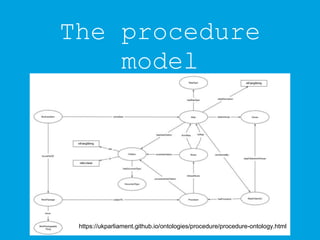
The procedure
model
https://ukparliament.github.io/ontologies/procedure/procedure-ontology.html
The maps
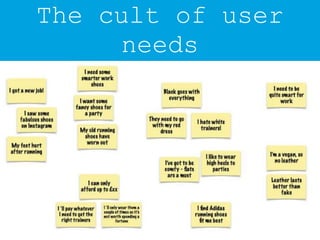
The cult of user
needs
What we’ve made
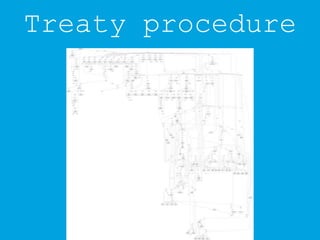
Treaty procedure
Treaty procedure
Procedural light cone
Precedence as a
query
The fish of
affirmation
Emergent
possibilities
Afterword
Retrospective
coherence

Coping with complexity

Editor's Notes

  • #3 Hello I’m Anya, a librarian in the House of Commons Library I’m here with my colleague, Michael, a data architect in the Parliamentary Digital Service And a big fan of librarians
  • #4 We’re going to be talking about what Parliament is And what it isn’t How Parliament’s structured What that means for software What software means for information management On the nature of organisational complexity And what Domain Driven Design can do to help out All in the context of managing information to support secondary legislation
  • #5 So first up, what is Parliament
  • #6 To explain Parliament I need to explain what it isn’t Parliament is not Government We have been asked many times whether we work for the Civil Service And it’s been assumed many times we are somehow associated with the Government Digital Service Neither of these things are true The only thing we really share with Civil Servants are the pubs around Westminster And even then, we tend to scorn their queuing technique
  • #7 So what is Government? They are accountable to Parliament And through Parliament to the public They propose new laws to Parliament And they run government departments from DEFRA to the Home Office
  • #8 Parliament on the other hand is mainly there to hold Government to account It allows inputs from citizens And it debates current issues in order to influence both Government and wider society
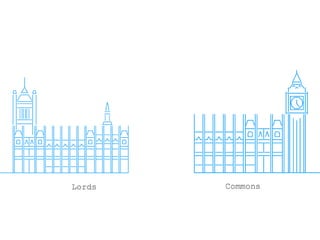
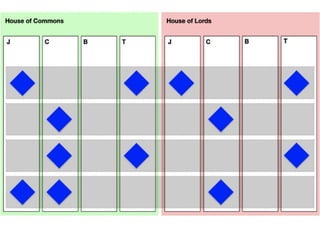
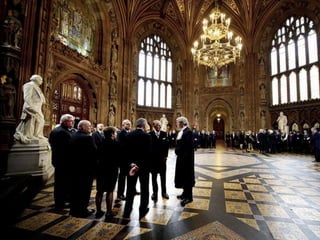
  • #9 The second thing to know about Parliament is it doesn’t really exist There is no single sense of Parliament There is the House of Commons - the democratically elected lower chamber There is the House of Lords - the upper chamber of Parliament, with members appointed. In a fashion. And there is The Crown. Or the Queen in Parliament. As separate from the Queen as a person. The Queen is the Head of State: she opens every session of Parliament and agrees legislation Over time, the powers of the Crown have diminished. But some matters are still reserved under Royal Prerogative Matters like declaring war, ratifying treaties and proroguing Parliament for instance Which some of you may remember being called into play in the Brexit debates So Parliament is not a single institution A more realistic drawing might look like...
  • #10 This At least if we put the Queen to one side for a moment The Commons and the Lords are independent organisations There is no one person in charge of Parliament There is no common ruleset, though the way in which the two Houses operate may be interlinked So if there’s no such thing as Parliament, what’s the big building about? Think of it as a conference centre hosting two separate but interlinked conferences and you wouldn’t be far wrong As some of you may know, the word Parliament is derived from the old French parlement, which means discussion or discourse
  • #11 The third and final thing you need to know is how complicated the internal structures are The are Table Offices, Legislation Offices, Journal Offices, Vote Offices, Committee Offices And all of this is duplicated across the two Houses Individual offices are largely autonomous One person in each House has oversight of all of them The workflow between offices typically being facilitated by documents being exchanged at the end of some process
  • #12 So, that is Parliament for beginners On to one of the problems we’ve been trying to solve
  • #13 In 2018 we were asked to make a publicly available Statutory Instrument tracking service And we did This talk is kind of about that But hopefully some of what we cover will be applicable anywhere and to anything
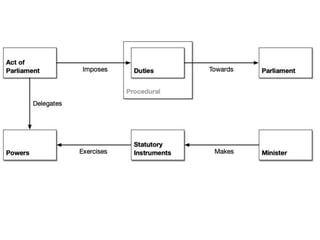
  • #14 For those new to Statutory Instruments Acts of Parliament delegate certain powers to ministers Ministers may create secondary legislation under these powers so long as they comply with certain duties toward Parliament In the UK SIs are the most frequently used type of secondary legislation
  • #15 The important thing in terms of our time scales was that much of the legislation required to implement brexit was expected to arrive in the form of statutory instruments And indeed did Since then, we’ve all been through the pandemic Much of the legislation used to deal with that has also been in the form of statutory instruments
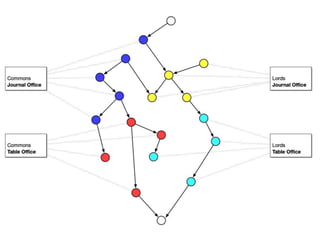
  • #16 Almost all offices in both Houses touch on statutory instrument procedure Both Journal Offices, both Table Offices and various committees In order to track an SI one needs to track the activities of assorted committees and offices represented here You need to know which committees are likely to scrutinise an SI, when those committees tend to meet, when those committees tend to publish reports and where those committees tend to publish reports And that’s just the committee part People found it difficult to track the journey of an SI through Parliament Even Members of Parliament may have struggled
  • #17 At this point, you may well be thinking well, this is interesting but it’s unlikely I’ll ever have to model a parliamentary procedure in my day job Or you may be thinking this really isn’t interesting at all You may, in fact, be doom scrolling Twitter as I speak But, whilst the details may be different, we hope most of this talk is applicable to any reasonably sized organisation
  • #18 So we are information modellers and managers. We think tracking an SI is an information management problem But information management is often no-one’s job
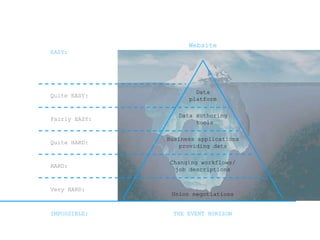
  • #19 At this point we turn to our trusty iceberg metaphor Making websites, visualisations and querying data is relatively easy Making a data platform and models that are as flexible as Parliament is harder Managing the information is harder still Managing the information when It’s not in anyone’s job description starts to get impossible And you pretty quickly reach the event horizon of the possible But, the problem is more than just jobs and roles
  • #20 Information management is only ever as good as the tools available How those tools are commissioned and paid for influences and constrains the shape of the data they produce
  • #21 Given each office has their own view of the problems they need to solve, we often end up commissioning tools to digitise existing office bound processes and missing out on the bigger picture This is not peculiar to Parliament At the BBC, the people managing “talent” – the people you see on air – would commission a system to handle talent The people responsible for complaints would have their own system to manage that The broadcast engineers had a system to handle transmission times The schedulers a system to handle scheduling And etc The systems were not designed to interoperate so they could never be any more than the sum of their disjointed parts
  • #22 You may well have heard the phrase don’t put your organisational structure on the web No one being particularly interested in your reporting lines But with disjointed information commissioned from the perspective of a single office, this is often inescapable
  • #23 This is a picture of data.parliament. It is one of Parliament’s open data portals. But the problem of disjoined information is hopefully obvious Each large blob on that diagram is pretty much analogous to an internal system And each system is pretty much analogous to an office The blob at the top right represents division data – how Members vote in Parliament It is connected to our Member records It is not connected to the things they were dividing on
  • #24 And this is the result on the website Upwards of 50 different domains, none of them terribly well interlinked This is a old picture Lots of these microsites have now been replaced But the general point holds true
  • #25 Having listened to us thus far, you may well be thinking, well this slide doesn’t make much sense Please bear with us
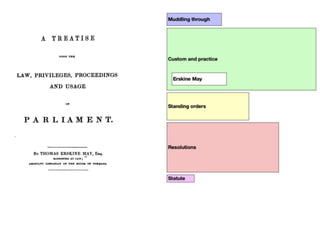
  • #26 Parliamentary procedure is, broadly speaking, the rules and conventions of how parliamentary business gets done The image on the right, we stole from Paul Evans - a retired Clerk of Committees in the House of Commons It shows the components that inform procedure The further down the stack the more immutable The larger the block the more often it comes into play In order to map procedure we need to take account of statute, standing orders, speaker rulings and precedence And we also need to take account of “muddling through” because improvisation is how a lot of things work
  • #27 Taking those components and working from the bottom up, let’s talk about statute or legislation This is a picture of a room in Victoria Tower where Acts of Parliament - printed on vellum - are stored Some of the proceedings of both Houses are set out in legislation The Statutory Instrument Act 1946 being the obvious one for the purposes of this talk In reality only a very small subset of procedure is set out in legislation
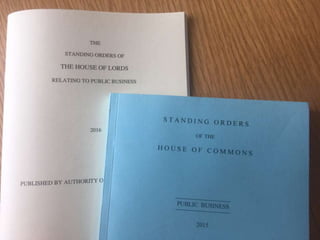
  • #28 Skipping over resolutions of the House, these are the standing orders - the written rules which regulate the proceedings of each House There are two sets of rules because the two Houses do similar things, but in slightly different ways And, once again, they don’t cover everything
  • #29 On top of the rules, there is precedent, or “custom and practice” - things that are permissible because they've been permitted in the past Like the rest of our constitution, much of parliamentary procedure has developed over the centuries, and isn’t written down in the Standing Orders This is Erskine May. Parliament’s Bible. it collects precedent in the form of narrative accounts So we have a fuzzy rule set: events test the rules, the organisation adapts, new processes emerge It doesn’t end there though
  • #30 And on top of rules and precedent there are people A lot of politics is about people Some things happen on stage, some things off stage Even where there are rules, implementation is subject to interpretation You might remember that some of Speaker Bercow’s interpretation of the rules received quite a lot of attention during the brexit period Occasionally, there are no rules set out anywhere We’re currently in the midst of mapping a procedure that is set out in neither legislation nor standing orders and which has never happened before We would say more, but we can’t But again, Parliament is not special Rules + customs and practice + people is almost always true, of any organisation
  • #31 This is Cynefin – a knowledge organisation framework by Dave Snowden It’s designed to give organisations some sense of situational awareness To know which space or spaces they’re operating in and act accordingly Much software is designed and built on the assumption that Parliament – or any other organisation - operates in a complicated space And whilst some bits of Parliament are complicated, it is, at heart, a complex adaptive system Which is why you’ll often hear us banging on about emergent behaviours Tightly coupling the implementation of software and data models to defined rulesets makes the software and its resulting information brittle and liable to break when underlying rulesets are adapted or reinterpreted We’re sure people in the audience will be familiar with software insisting that a piece of information is mandatory when that information doesn’t exist Whilst we may wish to be conservative on output, it is always best to be liberal on input
  • #32 In order to make services that meet needs outside individual offices we need to step back and look for new patterns that don’t stop at office walls And we need to be aware of both complications and complexity
  • #33 This our bible Domain Driven Design by Eric Evans It has been described as somewhere between profound and self-evident And we’d recommend reading at least the first three chapters to almost anyone
  • #34 You may have heard of agile It’s a response to a complex situation and the need to probe, sense and respond And Domain Driven Design is a technique emerging from the agile development community Like agile it emphasises collaboration over contract negotiation
  • #35 Usually the collaboration takes the form of gathering around a whiteboard and lots of listening Most of the work is probing for definitions, always accepting that the same words may have different definitions in different contexts Importantly, it’s not about one person speaking and one person drawing The aim is to draw back at each other As Eric Evans said, if you give someone a diagram they will agree with you. Get them to draw it and you see the difference The aim is to explore the domain from as many perspectives as possible
  • #36 So, some tips for domain modelling It’s important to say, we’ve found these work for us But there are no silver bullets Your mileage may vary
  • #37 This is where we’re pleased to be speaking at a virtual event Where it’s unlikely we’ll be heckled off stage The slide is incorrect of course There is such a thing as metadata, it’s just not usually what people mean when they say it Metadata is data about data, and most of the things people refer to as metadata are also real world things. The author of a book is a person – or a corporate author It’s not a string, however controlled An artist performing a music track is a person or a group of people Factory Records was an organisation, not some text in a ”metadata” field This is possibly the trickiest thing when you’re switching from taxonomies to ontologies When domain modelling think about things And thingyness
  • #38 You’ll probably arrive at a domain modelling session with questions in mind And sometimes conversation will drift away from those questions Let it drift Unlike some practitioners of user research, try not to arrive with a script and let the conversation go where it takes you
  • #39 Try not to hide behind a professional persona. Easier perhaps for some of us than others Active listening is something of a cliché but useful here And also exhausting Never attempt a domain modelling session alone. At some point you’ll be drawing and tune out It’s useful to have people along to help you listen and people who can pick up the attention baton when you’re clearly flagging Be empathetic and see things from the participants perspective
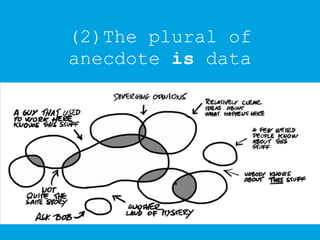
  • #40 No matter what the statisticians tell us, the plural of anecdote is data This is a picture taken from the book Event Storming by Alberto Brandolini We’re sure many of you will recognise the bits of an organisation that only Pauline in accounts knows about Any complex environment relies more on narrative than “rules” People share stories and stories shape the environment Dave Snowden - of Cynefin fame - has some excellent observations on the value of stories in work places
  • #41 It’s often helpful to invite more than one domain expert to any session It’s even more helpful if they’re at different levels of seniority But not so far separated they’re afraid to disagree Some of our best sessions start with disagreement
  • #42 How organisations think they work and how they work are two different things Think of all those cascaded emails you already knew the contents of Find out how networks work in your organisation Bear in mind organisations are porous Twitter can be your friend
  • #43 And lastly, if you want useful stories, the people with the best ones are often retired We work with a number of retired clerks all of whom have many great stories to tell
  • #44 And some more tips around the kinds of things you may want to question Try not to conflate identity with the naming or labelling of things. We have a recurrent problem with parliamentary sessions being identified by their start and end dates. The latter being subject to change Think about whether the thing you’re modelling has agency. Can it effect changes in the world Functional Requirements for Bibliographic Records – or FRBR – is a handy reference point for things far beyond document management And questions around cardinality are key. How many of those things can that thing have is always worth asking
  • #45 Warning: this slide has no scientific basis But based on experience, many an information project foundered on the rocks of cardinality
  • #46 So then, back to SIs
  • #47 When we first started on the SI service, everyone we met brought us a flowchart All drawn from a certain perspective and none complete Over several months we talked and sketched and brought together multiple perspectives
  • #48 The result was a process model implemented as an RDF ontology Or a procedure model – procedure being Parliament’s word for process It allows us to state that, given what has happened, what may, must and can’t happen next A clerk would not recognise this model It is generic, having no domain knowledge or domain language encoded
  • #49 Whilst the model may be generic, layered on top are procedural maps Most of our time is spent mapping procedures on top of the model This is an example of a procedure map for made affirmative statutory instruments
  • #50 You may have noticed that we’ve not talked about what users might need from an SI tracking service We find that an emphasis on user needs isn’t always helpful By concentrating on describing the domain we don’t lock ourselves into single solutions Not only do needs differ across user groups, sometimes our users have needs that are diametrically opposed to the needs of other users This being the nature of politics
  • #51 So after all this talking and sketching and listening to lots of stories What have we made?
  • #52 This is the statutory instrument website that Parliament asked for – you can use it on the public web to find out about SIs before Parliament. A website that can flex and adapt as Parliament flexes and adapts In collaboration with the Journal Offices and committees we’re making changes to procedure maps on an almost weekly basis Not because we did it wrong but because procedure evolves
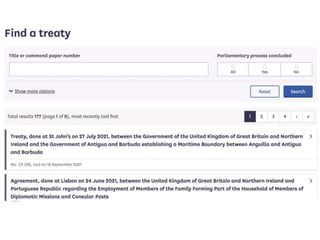
  • #53 By understanding the domain, choosing the right bounded contexts we can do more Because we now have a generic model for procedure we can – with relative ease – map new procedures over the top Post brexit, treaties have obviously become rather important so in 2019 we were asked to build a tracking service for treaties This is a map of the treaty procedure as set out by the Constitutional Reform and Governance Act 2010 With additional bells and whistles as set out in standing orders and in precedence Because no one ruleset is ever complete
  • #54 And this is that same map, as drawn by a machine PAUSE
  • #55  And with almost no work we made a website and a library of queries for treaty procedure too
  • #56 We’ve already mentioned that the maps can be parsed by machines to determine - from what has happened - what may, must and shouldn’t happen next We call this the light cone of procedural possibilities We can use this data to alert Members to points at which they can intervene, for example: from this point on and for the next 40 days you can table an objection to this SI
  • #57 And we have a pot of data we can query for precedence This is a SPARQL query – something we actually use to support staff working across Parliament Queries such as: when did X and Y both happen when Z didn’t
  • #58 We can use the pot of data to look for patterns This is one example showing the number of days between laying and approval of draft affirmative instruments More importantly, the queries are repeatable
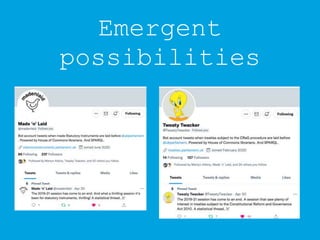
  • #59 Strangely enough, nobody asked for Twitter bots for SIs and treaties but a couple of hours work and we now have 239 people following avidly
  • #60 Information management is hard work Understanding the domain is not quick But well modelled, well managed information is generative Possibilities emerge when you take the time and trouble to understand the domain We often ask ourselves – if Erskine May had had a computer – what would he have done We think possibly… He would have used it to build a graph of knowledge of parliamentary business And built a precedence engine out of data
  • #61 And just when you thought you were rid of us And could go and have your tea
  • #62 We’re back with Dave Snowden He talks about retrospective coherence In other words, we tell ourselves stories to make what has happened seem like it was always inevitable This talk and most other talks being great examples of that In retrospect we can make it sound like we had a plan That we always knew we were working toward machine readable parliamentary procedure Reader – we did not know this Like much else, we muddled through And any narrative we may have attempted is only possible through the benefit of hindsight You shouldn’t trust our story anymore than you’d trust any other