Drought in Australia
By: Imogen & Sienna
What Are Droughts?
• Droughts are a particular amount of time of below average
precipitation in a significant region, resulting in prolonged
shortages in the water supply, whether atmospheric, surface water
or ground water.
• A drought can last for months, years, or maybe declared after as
few as a fortnight.
• It can have a consequential impact on the ecosystem and agriculture
of the affected region and harm to the local economy.
What are Droughts ?
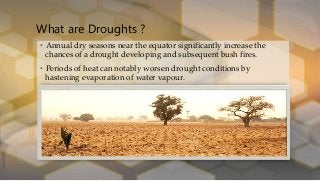
• Annual dry seasons near the equator significantly increase the
chances of a drought developing and subsequent bush fires.
• Periods of heat can notably worsen drought conditions by
hastening evaporation of water vapour.
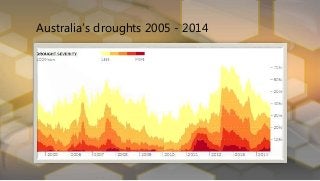
Australia’s droughts 2005 - 2014
4.3
2.5
3.5
4.5
2.4
4.4
1.8
2.8
2 2
3
5
CATEGORY 1 CATEGORY 2 CATEGORY 3 CATEGORY 4
Series 1 Series 2 Series 3
Dry Season
• Within the tropics, distinct, wet and dry seasons emerge due to the
movement of the Intertropical Convergence Zone or Monsoon
trough.
• The dry season greatly increases drought occurrence, and is
characterised by its low humidity, with watering holes and rivers
drying up.
• Since water vapour becomes more energetic, with increasing
temperature, more water vapour is required to increase relative
humidity values to one-hundred percent at higher temperatures to
fall to the dew point.
Dry Season
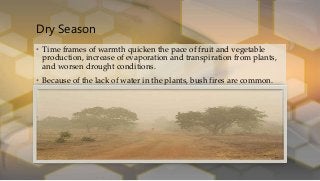
• Time frames of warmth quicken the pace of fruit and vegetable
production, increase of evaporation and transpiration from plants,
and worsen drought conditions.
• Because of the lack of water in the plants, bush fires are common.
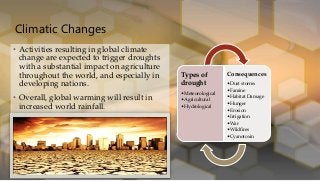
Climatic Changes
• Activities resulting in global climate
change are expected to trigger droughts
with a substantial impact on agriculture
throughout the world, and especially in
developing nations.
• Overall, global warming will result in
increased world rainfall.
Types of
drought
•Meteorological
•Agricultural
•Hydrological
Consequences
•Dust storms
•Famine
•Habitat Damage
•Hunger
•Erosion
•Irrigation
•War
•Wildfires
•Cyanotoxin
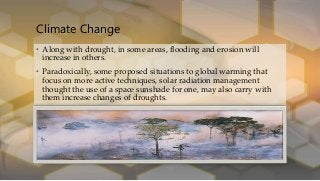
Climate Change
• Along with drought, in some areas, flooding and erosion will
increase in others.
• Paradoxically, some proposed situations to global warming that
focus on more active techniques, solar radiation management
thought the use of a space sunshade for one, may also carry with
them increase changes of droughts.
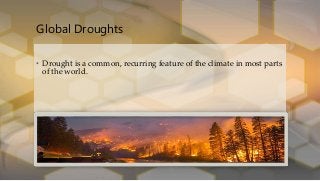
Global Droughts
• Drought is a common, recurring feature of the climate in most parts
of the world.
The End

Droughts sienna and imogen

  • 1.
    Drought in Australia By:Imogen & Sienna
  • 2.
    What Are Droughts? •Droughts are a particular amount of time of below average precipitation in a significant region, resulting in prolonged shortages in the water supply, whether atmospheric, surface water or ground water. • A drought can last for months, years, or maybe declared after as few as a fortnight. • It can have a consequential impact on the ecosystem and agriculture of the affected region and harm to the local economy.
  • 3.
    What are Droughts? • Annual dry seasons near the equator significantly increase the chances of a drought developing and subsequent bush fires. • Periods of heat can notably worsen drought conditions by hastening evaporation of water vapour.
  • 4.
    Australia’s droughts 2005- 2014 4.3 2.5 3.5 4.5 2.4 4.4 1.8 2.8 2 2 3 5 CATEGORY 1 CATEGORY 2 CATEGORY 3 CATEGORY 4 Series 1 Series 2 Series 3
  • 5.
    Dry Season • Withinthe tropics, distinct, wet and dry seasons emerge due to the movement of the Intertropical Convergence Zone or Monsoon trough. • The dry season greatly increases drought occurrence, and is characterised by its low humidity, with watering holes and rivers drying up. • Since water vapour becomes more energetic, with increasing temperature, more water vapour is required to increase relative humidity values to one-hundred percent at higher temperatures to fall to the dew point.
  • 6.
    Dry Season • Timeframes of warmth quicken the pace of fruit and vegetable production, increase of evaporation and transpiration from plants, and worsen drought conditions. • Because of the lack of water in the plants, bush fires are common.
  • 7.
    Climatic Changes • Activitiesresulting in global climate change are expected to trigger droughts with a substantial impact on agriculture throughout the world, and especially in developing nations. • Overall, global warming will result in increased world rainfall. Types of drought •Meteorological •Agricultural •Hydrological Consequences •Dust storms •Famine •Habitat Damage •Hunger •Erosion •Irrigation •War •Wildfires •Cyanotoxin
  • 8.
    Climate Change • Alongwith drought, in some areas, flooding and erosion will increase in others. • Paradoxically, some proposed situations to global warming that focus on more active techniques, solar radiation management thought the use of a space sunshade for one, may also carry with them increase changes of droughts.
  • 9.
    Global Droughts • Droughtis a common, recurring feature of the climate in most parts of the world.
  • 10.