Wikipedia as a source of scientific
          information


                   Tim Vickers
          Washington University, St Louis

                 Michael Laurent
       Katholieke Universiteit Leuven, Belgium
Scientific literacy is low

• 60% believe they have not eaten GM foods.
• 54% heard "nothing at all" about nanotechnology.
• 70% either "not very clear" or "not clear at all" on difference
  between reproductive and therapeutic cloning.
• 9% can say what a stem cell is
                            National Science Board's Science and Engineering Indicators 2008


• Funding dependent on public support
• Issues hard to discuss without background
    • Evolution
    • Animal testing
    • Viruses and antibiotics

• Internet and TV sources of science information
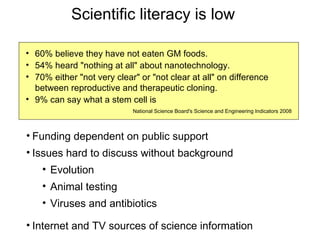
Wikipedia: a prominent information source
• 4th most-accessed website
• Search engines
• Wikipedia has high visibility
  • 3,600 keywords, in first
    10 results in 80% of
    cases
• Free access.
• Over 270 languages

                                  Laurent MR, Vickers TJ. “Seeking health information
                                  online: does Wikipedia matter?” J. Am. Med. Inform.
                                  Assoc. (2009)
H1N1 influenza
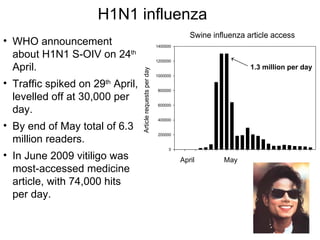
                                                                          Swine influenza article access
• WHO announcement                                           1400000

  about H1N1 S-OIV on 24th                                   1200000
  April.                                                                                   1.3 million per day


                                  Article requests per day
                                                             1000000

• Traffic spiked on 29th April,                              800000
  levelled off at 30,000 per
                                                             600000
  day.
                                                             400000
• By end of May total of 6.3
                                                             200000
  million readers.
                                                                  0
• In June 2009 vitiligo was                                            April       May
  most-accessed medicine
  article, with 74,000 hits
  per day.
Up-to-date: “2009 swine flu outbreak”
• Created April 25th.
• One day later, article contained:
   • 22,000 words and 44 references
   • Mostly news articles
• Rapidly updated:
   • Dawood et. al. “Emergence of a novel
     swine-origin influenza A (H1N1) virus
     in humans.” NEJM on-line May 7.
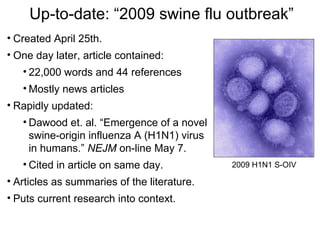
   • Cited in article on same day.           2009 H1N1 S-OIV

• Articles as summaries of the literature.
• Puts current research into context.
Coverage in depth
• About 18,000 medicine articles and 19,000 cell biology articles
    • Range from 2-acetolactate mutase, adipokines to asprin
• Articles on every enzyme, most human genes, ncRNAs
• Approx 60-70% of diseases have articles (ICD-10 codes)

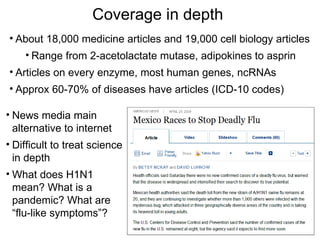
• News media main
  alternative to internet
• Difficult to treat science
  in depth
• What does H1N1
  mean? What is a
  pandemic? What are
  “flu-like symptoms”?
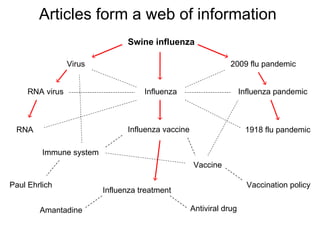
Articles form a web of information
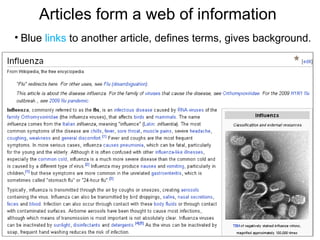
• Blue links to another article, defines terms, gives background.
Articles form a web of information
                               Swine influenza

                 Virus                                         2009 flu pandemic


     RNA virus                      Influenza                       Influenza pandemic


 RNA                           Influenza vaccine                     1918 flu pandemic

         Immune system
                                                   Vaccine

Paul Ehrlich                                                          Vaccination policy
                         Influenza treatment

        Amantadine                                 Antiviral drug
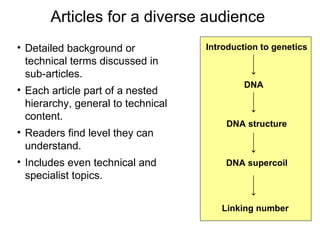
Articles for a diverse audience
• Detailed background or            Introduction to genetics
  technical terms discussed in
  sub-articles.
                                             DNA
• Each article part of a nested
  hierarchy, general to technical
  content.
                                        DNA structure
• Readers find level they can
  understand.
• Includes even technical and           DNA supercoil
  specialist topics.


                                       Linking number
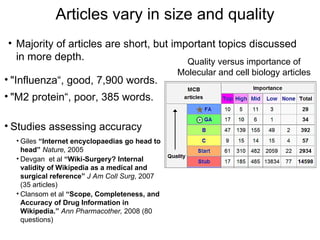
Articles vary in size and quality
• Majority of articles are short, but important topics discussed
  in more depth.                         Quality versus importance of
                                                Molecular and cell biology articles
• "Influenza“, good, 7,900 words.
• "M2 protein“, poor, 385 words.

• Studies assessing accuracy
  • Giles “Internet encyclopaedias go head to
    head” Nature, 2005
  • Devgan et al “Wiki-Surgery? Internal
    validity of Wikipedia as a medical and
    surgical reference” J Am Coll Surg, 2007
    (35 articles)
  • Clansom et al “Scope, Completeness, and
    Accuracy of Drug Information in
    Wikipedia.” Ann Pharmacother, 2008 (80
    questions)
Summary
• High visibility
• Rapidly updated
• Interlinked articles
   • Background
   • Nested structure
• Articles generally accurate, but many short or incomplete
• Expert contributors needed
Acknowledgments

Wikimedia Foundation

Michael Laurent

National Institutes of Health

2009 NIH Talk on Wikipedia

  • 1.
    Wikipedia as asource of scientific information Tim Vickers Washington University, St Louis Michael Laurent Katholieke Universiteit Leuven, Belgium
  • 2.
    Scientific literacy islow • 60% believe they have not eaten GM foods. • 54% heard "nothing at all" about nanotechnology. • 70% either "not very clear" or "not clear at all" on difference between reproductive and therapeutic cloning. • 9% can say what a stem cell is National Science Board's Science and Engineering Indicators 2008 • Funding dependent on public support • Issues hard to discuss without background • Evolution • Animal testing • Viruses and antibiotics • Internet and TV sources of science information
  • 3.
    Wikipedia: a prominentinformation source • 4th most-accessed website • Search engines • Wikipedia has high visibility • 3,600 keywords, in first 10 results in 80% of cases • Free access. • Over 270 languages Laurent MR, Vickers TJ. “Seeking health information online: does Wikipedia matter?” J. Am. Med. Inform. Assoc. (2009)
  • 4.
    H1N1 influenza Swine influenza article access • WHO announcement 1400000 about H1N1 S-OIV on 24th 1200000 April. 1.3 million per day Article requests per day 1000000 • Traffic spiked on 29th April, 800000 levelled off at 30,000 per 600000 day. 400000 • By end of May total of 6.3 200000 million readers. 0 • In June 2009 vitiligo was April May most-accessed medicine article, with 74,000 hits per day.
  • 5.
    Up-to-date: “2009 swineflu outbreak” • Created April 25th. • One day later, article contained: • 22,000 words and 44 references • Mostly news articles • Rapidly updated: • Dawood et. al. “Emergence of a novel swine-origin influenza A (H1N1) virus in humans.” NEJM on-line May 7. • Cited in article on same day. 2009 H1N1 S-OIV • Articles as summaries of the literature. • Puts current research into context.
  • 6.
    Coverage in depth •About 18,000 medicine articles and 19,000 cell biology articles • Range from 2-acetolactate mutase, adipokines to asprin • Articles on every enzyme, most human genes, ncRNAs • Approx 60-70% of diseases have articles (ICD-10 codes) • News media main alternative to internet • Difficult to treat science in depth • What does H1N1 mean? What is a pandemic? What are “flu-like symptoms”?
  • 7.
    Articles form aweb of information • Blue links to another article, defines terms, gives background.
  • 8.
    Articles form aweb of information Swine influenza Virus 2009 flu pandemic RNA virus Influenza Influenza pandemic RNA Influenza vaccine 1918 flu pandemic Immune system Vaccine Paul Ehrlich Vaccination policy Influenza treatment Amantadine Antiviral drug
  • 9.
    Articles for adiverse audience • Detailed background or Introduction to genetics technical terms discussed in sub-articles. DNA • Each article part of a nested hierarchy, general to technical content. DNA structure • Readers find level they can understand. • Includes even technical and DNA supercoil specialist topics. Linking number
  • 10.
    Articles vary insize and quality • Majority of articles are short, but important topics discussed in more depth. Quality versus importance of Molecular and cell biology articles • "Influenza“, good, 7,900 words. • "M2 protein“, poor, 385 words. • Studies assessing accuracy • Giles “Internet encyclopaedias go head to head” Nature, 2005 • Devgan et al “Wiki-Surgery? Internal validity of Wikipedia as a medical and surgical reference” J Am Coll Surg, 2007 (35 articles) • Clansom et al “Scope, Completeness, and Accuracy of Drug Information in Wikipedia.” Ann Pharmacother, 2008 (80 questions)
  • 11.
    Summary • High visibility •Rapidly updated • Interlinked articles • Background • Nested structure • Articles generally accurate, but many short or incomplete • Expert contributors needed
  • 12.