“THE BLACK
PRINCE”
-IN CONTEXT OF BRITISH
COLONIALISM
-ENCOUNTERBETWEEN
TWOCULTURES
Major Historical Events
Death of
Maharaja
Ranjit Singh
and Power
struggle
First Anglo-
Sikh war and
defeat of the
empire
End of Sikh
empire and
British took
custody of
Duleep Singh
Converted to
Christianity in
1853 and was
sent to
England
Known as the
"The Black
Prince of
Perthshire"
Visited India
many times,
but never
allowed to visit
Punjab
Returned
to
Sikhism
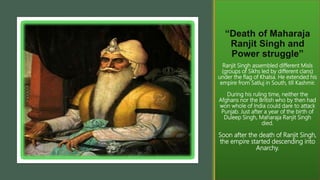
“Death of Maharaja
Ranjit Singh and
Power struggle”
Ranjit Singh assembled different Misls
(groups of Sikhs led by different clans)
under the flag of Khalsa. He extended his
empire from Satluj in South, till Kashmir.
During his ruling time, neither the
Afghans nor the British who by then had
won whole of India could dare to attack
Punjab. Just after a year of the birth of
Duleep Singh, Maharaja Ranjit Singh
died.
Soon after the death of Ranjit Singh,
the empire started descending into
Anarchy.
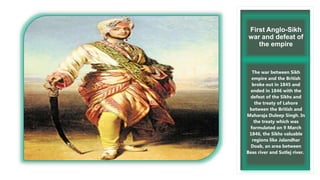
First Anglo-Sikh
war and defeat of
the empire
The war between Sikh
empire and the British
broke out in 1845 and
ended in 1846 with the
defeat of the Sikhs and
the treaty of Lahore
between the British and
Maharaja Duleep Singh. In
the treaty which was
formulated on 9 March
1846, the Sikhs valuable
regions like Jalandhar
Doab, an area between
Beas river and Sutlej river.
COUNT…
THELAHOREDURBARWASALSOREQUIREDTOPAYANINDEMNITYOF15MILLIONRUPEES.
BECAUSEITCOULDNOTREADILYRAISETHISSUM,ITCEDEDKASHMIR,HAZARAHANDALL
THEFORTS,TERRITORIES,RIGHTSANDINTERESTSINTHEHILLCOUNTRIESSITUATED
BETWEENTHERIVERSBEASANDINDUSTOTHEEASTINDIACOMPANYWORTHTEN
MILLIONOFRUPEES.
THEJAMMUANDKASHMIRCOMMANDERGULABLATERBOUGHTTHESTATEOFJ&KFROM
THEBRITISHINJUSTRS7.5MILLION.HEWASALSOGRANTEDTHETITLEOFMAHARAJAOF
J&K.
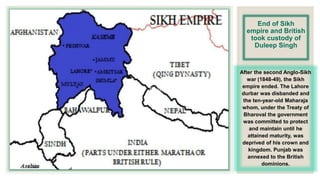
End of Sikh
empire and British
took custody of
Duleep Singh
After the second Anglo-Sikh
war (1848-49), the Sikh
empire ended. The Lahore
durbar was disbanded and
the ten-year-old Maharaja
whom, under the Treaty of
Bharoval the government
was committed to protect
and maintain until he
attained maturity, was
deprived of his crown and
kingdom. Punjab was
annexed to the British
dominions.
Count…Count…
DULEEPSINGHWAS REMOVEDFROMTHE PUNJABTO
FATEHGARH,ASMALLVILLAGEIN FARRUKHABAD
DISTRICTINTHETHEN NORTH-WESTPROVINCE,WHERE
HEARRIVEDIN FEBRUARY1850.THE BRITISHTOOK
CARE OFTHE MAHARAJAAND HEWAS EDUCATEDIN
ENGLISHWAYBYPRIVATETUTORS.
Count…
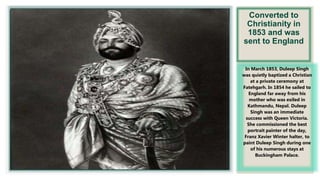
Converted to
Christianity in
1853 and was
sent to England
In March 1853, Duleep Singh
was quietly baptized a Christian
at a private ceremony at
Fatehgarh. In 1854 he sailed to
England far away from his
mother who was exiled in
Kathmandu, Nepal. Duleep
Singh was an immediate
success with Queen Victoria.
She commissioned the best
portrait painter of the day,
Franz Xavier Winter halter, to
paint Duleep Singh during one
of his numerous stays at
Buckingham Palace.
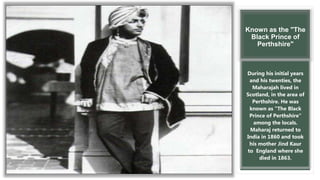
Known as the "The
Black Prince of
Perthshire"
During his initial years
and his twenties, the
Maharajah lived in
Scotland, in the area of
Perthshire. He was
known as "The Black
Prince of Perthshire"
among the locals.
Maharaj returned to
India in 1860 and took
his mother Jind Kaur
to England where she
died in 1863.
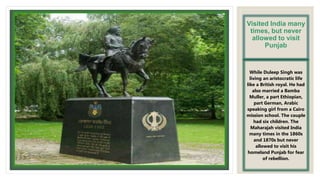
Visited India many
times, but never
allowed to visit
Punjab
While Duleep Singh was
living an aristocratic life
like a British royal. He had
also married a Bamba
Muller, a part Ethiopian,
part German, Arabic
speaking girl from a Cairo
mission school. The couple
had six children. The
Maharajah visited India
many times in the 1860s
and 1870s but never
allowed to visit his
homeland Punjab for fear
of rebellion.
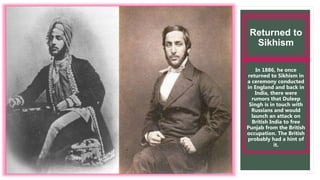
Returned to
Sikhism
In 1886, he once
returned to Sikhism in
a ceremony conducted
in England and back in
India, there were
rumors that Duleep
Singh is in touch with
Russians and would
launch an attack on
British India to free
Punjab from the British
occupation. The British
probably had a hint of
it.
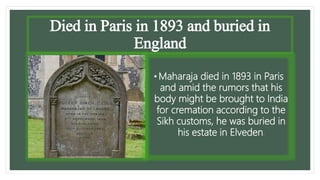
Died in Paris in 1893 and buried in
England
• Maharaja died in 1893 in Paris
and amid the rumors that his
body might be brought to India
for cremation according to the
Sikh customs, he was buried in
his estate in Elveden.
• When we look this film with the lens of Colonial perspective we can get the idea that the
Britishers have with so called notions of ruling and making people colonized.
• After the Death of Maharaja Ranjit Singh Anarchy took place in his region and then
catastrophes in sequence started happening, such as First Anglo-Sikh war and defeat of
the empire broke out in 1845 and ended in 1846 between Sikhs and British.
• After the second Anglo-Sikh war (1848-49), the Sikh empire ended and the Punjab was
annexed to the British dominions.
• Duleep sinh was removed to Punjab to Fatehgath.
• The prince was under dominance of British raj, they protect the prince but never give a
importance or courtesy of king.
• The Black prince it self is a metaphor which gives clear idea of “ Being colonized ”
• The colonial studies includes the study of skin color and racism , which we can see in
this movie “ The Black Prince”.
In context of British Colonialism
Encounter between Two Cultures
• Cultural perspective played a strong remarks in History to each life, also it effects our art and
life. In this movie we can get the notions of strong cultural connotations by colonizer’s side
along with colonized people.
• Converted to Christianity in 1853 and was sent to England, culture firmly includes Religion as
part of culture.
• Known as the "The Black Prince of Perthshire“- The prince lived in England and after he was baptized
privately at Fatehgadh he known as prince of perthshire.
• While Duleep Singh was living an aristocratic life like a British royal, Visited India many times, but never
allowed to visit Punjab Punjab for fear of rebellion.
•
In 1886, he once returned to Sikhism and back in India to conduct a ceremony, rumors that Duleep Singh is
in touch with Russians and would launch an attack on British India to free Punjab from the British
occupation
•
As per my point of view The Black Prince is process of “ Making colonized softly” , British government
ruled and colonized India’s culture and powers too.
Prepared by Tamsa Pandya
tamsapandya25@gmail.com
Sem-3, Department of English
MKBU
Thank You

The black prince.pptx by tamsa

  • 1.
    “THE BLACK PRINCE” -IN CONTEXTOF BRITISH COLONIALISM -ENCOUNTERBETWEEN TWOCULTURES
  • 2.
    Major Historical Events Deathof Maharaja Ranjit Singh and Power struggle First Anglo- Sikh war and defeat of the empire End of Sikh empire and British took custody of Duleep Singh Converted to Christianity in 1853 and was sent to England Known as the "The Black Prince of Perthshire" Visited India many times, but never allowed to visit Punjab Returned to Sikhism
  • 3.
    “Death of Maharaja RanjitSingh and Power struggle” Ranjit Singh assembled different Misls (groups of Sikhs led by different clans) under the flag of Khalsa. He extended his empire from Satluj in South, till Kashmir. During his ruling time, neither the Afghans nor the British who by then had won whole of India could dare to attack Punjab. Just after a year of the birth of Duleep Singh, Maharaja Ranjit Singh died. Soon after the death of Ranjit Singh, the empire started descending into Anarchy.
  • 4.
    First Anglo-Sikh war anddefeat of the empire The war between Sikh empire and the British broke out in 1845 and ended in 1846 with the defeat of the Sikhs and the treaty of Lahore between the British and Maharaja Duleep Singh. In the treaty which was formulated on 9 March 1846, the Sikhs valuable regions like Jalandhar Doab, an area between Beas river and Sutlej river.
  • 5.
  • 6.
    End of Sikh empireand British took custody of Duleep Singh After the second Anglo-Sikh war (1848-49), the Sikh empire ended. The Lahore durbar was disbanded and the ten-year-old Maharaja whom, under the Treaty of Bharoval the government was committed to protect and maintain until he attained maturity, was deprived of his crown and kingdom. Punjab was annexed to the British dominions. Count…Count…
  • 7.
    DULEEPSINGHWAS REMOVEDFROMTHE PUNJABTO FATEHGARH,ASMALLVILLAGEINFARRUKHABAD DISTRICTINTHETHEN NORTH-WESTPROVINCE,WHERE HEARRIVEDIN FEBRUARY1850.THE BRITISHTOOK CARE OFTHE MAHARAJAAND HEWAS EDUCATEDIN ENGLISHWAYBYPRIVATETUTORS. Count…
  • 8.
    Converted to Christianity in 1853and was sent to England In March 1853, Duleep Singh was quietly baptized a Christian at a private ceremony at Fatehgarh. In 1854 he sailed to England far away from his mother who was exiled in Kathmandu, Nepal. Duleep Singh was an immediate success with Queen Victoria. She commissioned the best portrait painter of the day, Franz Xavier Winter halter, to paint Duleep Singh during one of his numerous stays at Buckingham Palace.
  • 9.
    Known as the"The Black Prince of Perthshire" During his initial years and his twenties, the Maharajah lived in Scotland, in the area of Perthshire. He was known as "The Black Prince of Perthshire" among the locals. Maharaj returned to India in 1860 and took his mother Jind Kaur to England where she died in 1863.
  • 10.
    Visited India many times,but never allowed to visit Punjab While Duleep Singh was living an aristocratic life like a British royal. He had also married a Bamba Muller, a part Ethiopian, part German, Arabic speaking girl from a Cairo mission school. The couple had six children. The Maharajah visited India many times in the 1860s and 1870s but never allowed to visit his homeland Punjab for fear of rebellion.
  • 11.
    Returned to Sikhism In 1886,he once returned to Sikhism in a ceremony conducted in England and back in India, there were rumors that Duleep Singh is in touch with Russians and would launch an attack on British India to free Punjab from the British occupation. The British probably had a hint of it.
  • 12.
    Died in Parisin 1893 and buried in England • Maharaja died in 1893 in Paris and amid the rumors that his body might be brought to India for cremation according to the Sikh customs, he was buried in his estate in Elveden.
  • 13.
    • When welook this film with the lens of Colonial perspective we can get the idea that the Britishers have with so called notions of ruling and making people colonized. • After the Death of Maharaja Ranjit Singh Anarchy took place in his region and then catastrophes in sequence started happening, such as First Anglo-Sikh war and defeat of the empire broke out in 1845 and ended in 1846 between Sikhs and British. • After the second Anglo-Sikh war (1848-49), the Sikh empire ended and the Punjab was annexed to the British dominions. • Duleep sinh was removed to Punjab to Fatehgath. • The prince was under dominance of British raj, they protect the prince but never give a importance or courtesy of king. • The Black prince it self is a metaphor which gives clear idea of “ Being colonized ” • The colonial studies includes the study of skin color and racism , which we can see in this movie “ The Black Prince”. In context of British Colonialism
  • 14.
    Encounter between TwoCultures • Cultural perspective played a strong remarks in History to each life, also it effects our art and life. In this movie we can get the notions of strong cultural connotations by colonizer’s side along with colonized people. • Converted to Christianity in 1853 and was sent to England, culture firmly includes Religion as part of culture. • Known as the "The Black Prince of Perthshire“- The prince lived in England and after he was baptized privately at Fatehgadh he known as prince of perthshire. • While Duleep Singh was living an aristocratic life like a British royal, Visited India many times, but never allowed to visit Punjab Punjab for fear of rebellion. • In 1886, he once returned to Sikhism and back in India to conduct a ceremony, rumors that Duleep Singh is in touch with Russians and would launch an attack on British India to free Punjab from the British occupation • As per my point of view The Black Prince is process of “ Making colonized softly” , British government ruled and colonized India’s culture and powers too.
  • 15.
    Prepared by TamsaPandya tamsapandya25@gmail.com Sem-3, Department of English MKBU Thank You