The Way to
Wealth
Brought To You By; Chuck Thompson of TTC Media
Digital Publishing; August, 2013
http://www.gloucestercounty-va.com Visit us.
Courteous Reader,
I have heard that nothing gives an Author so great Pleasure, as to find his Works respectfully
quoted by other learned Authors. This Pleasure I have seldom enjoyed; for tho’ I have been, if
I may say it without Vanity, an eminent Author of Almanacks annually now a full Quarter of a
Century, my Brother Authors in the same Way, for what Reason I know not, have ever been
very sparing in their Applauses; and no other Author has taken the least Notice of me, so that
did not my Writings produce me some solid Pudding, the great Deficiency of Praise would
have quite discouraged me.
I concluded at length, that the People were the best Judges of my Merit; for they buy my
Works; and besides, in my Rambles, where I am not personally known, I have frequently
heard one or other of my Adages repeated, with, as Poor Richard says, at the End on’t; this
gave me some Satisfaction, as it showed not only that my Instructions were regarded, but
discovered likewise some Respect for my Authority; and I own, that to encourage the Practice
of remembering and repeating those wise Sentences, I have sometimes quoted myself with
great Gravity.
Judge then how much I must have been gratified by an Incident I am going to relate to you. I
stopt my Horse lately where a great Number of People were collected at a Vendue of
Merchant Goods. The Hour of Sale not being come, they were conversing on the Badness of
the Times, and one of the Company call’d to a plain clean old Man, with white Locks, Pray,
Father Abraham, what think you of the Times? Won’t these heavy Taxes quite ruin the
Country? How shall we be ever able to pay them? What would you advise us to?—
Father Abraham stood up, and reply’d, If you’d have my Advice, I’ll give it you in short, for
a Word to the Wise is enough, andmany Words won’t fill a Bushel, as Poor Richard says.
They join’d in desiring him to speak his Mind, and gathering round him, he proceeded as
follows;
“Friends, says he, and Neighbours, the Taxes are indeed very heavy, and if those laid on by
the Government were the only Ones we had to pay, we might more easily discharge them; but
we have many others, and much more grievous to some of us. We are taxed twice as much
by our Idleness, three times as much by our Pride, and four times as much by our Folly, and
from these Taxes the Commissioners cannot ease or deliver us by allowing an Abatement.
However let us hearken to good Advice, and something may be done for us; God helps them
that help themselves, as Poor Richard says, in his Almanack of 1733.
It would be thought a hard Government that should tax its People one tenth Part of their Time,
to be employed in its Service. But Idleness taxes many of us much more, if we reckon all that
is spent in absolute Sloth, or doing of nothing, with that which is spent in idle Employments or
Amusements, that amount to nothing. Sloth, by bringing on Diseases, absolutely shortens
Life. Sloth, like Rust, consumes faster than Labour wears, while the used Key is always
bright, as Poor Richard says. But dost thou love Life, then do not squander Time, for that’s
the Stuff Life is made of, as Poor Richard says.—How much more than is necessary do we
spend in Sleep! forgetting that The sleeping Fox catches no Poultry, and that there will be
sleeping enough in the Grave, as Poor Richard says. If Time be of all Things the most
precious, wasting Time must be, as Poor Richard says, the greatest Prodigality, since, as he
elsewhere tells us, Lost Time is never found again; and what we call Time-enough, always
proves little enough; Let us then be up and be doing, and doing to the Purpose; so by
Diligence shall we do more with less Perplexity.Sloth makes all Things difficult, but Industry all
easy, as Poor Richard says; and He that riseth late, must trot all Day, and shall scarce
overtake his Business at Night. While Laziness travels so slowly, that Poverty soon overtakes
him, as we read in Poor Richard, who adds, Drive thy Business, let not that drive thee;
andEarly to Bed, and early to rise, makes a Man healthy, wealthy and wise.
So what signifies wishing and hoping for better Times. We may make these Times better if we
bestir ourselves. Industry need not wish, as Poor Richard says, andHe that lives upon Hope
will die fasting. There are no Gains, without Pains; then Help Hands, for I have no Lands, or if
I have, they are smartly taxed. And, as Poor Richard likewise observes, He that bath a Trade
bath an Estate, and He that bath a Calling bath an Office of Profit and Honour; but then
the Trade must be worked at, and the Calling well followed, or neither the Estate, nor
the Office, will enable us to pay our Taxes.—If we are industrious we shall never starve; for,
as Poor Richard says, At the working Man’s House Hunger looks in, but dares not enter. Nor
will the Bailiff nor the Constable enter, for Industry pays Debts, while Despair encreaseth
them, says Poor Richard.—What though you have found no Treasure, nor has any rich
Relation left you a Legacy, Diligence is the Mother of Good luck, as Poor Richard says,
and God gives all Things to Industry. Thenplough deep, while Sluggards sleep, and you shall
have Corn to sell and to keep, says Poor Dick. Work while it is called To-day, for you know
not how much you may be hindered To- morrow, which makes Poor Richard say, One To-day
is worth two To-morrows; and farther, Have you somewhat to do To-morrow, do it To-day. If
you were a Servant, would you not be ashamed that a good Master should catch you idle?
Are you then your own Master, be ashamed to catch yourself idle, as Poor Dick says. When
there is so much to be done for yourself, your Family, your Country, and your gracious King,
be up by Peep of Day; Let not the Sun look down and say, Inglorious here be lies. Handle
your Tools without Mittens; remember that the Cat in Gloves catches no Mice, as Poor
Richard says. ’Tis true there is much to be done, and perhaps you are weak handed, but stick
to it steadily, and you will see great Effects, for constant Dropping wears away Stones, and
byDiligence and Patience the Mouse ate in two the Cable; and little Strokes fell great Oaks,
as Poor Richard says in his Almanack, the year I cannot just now remember.
Methinks I hear some of you say, Must a Man afford himself no Leisure?—I will tell thee, my
Friend, what Poor Richard says, Employ thy Time well if thou meanest to gain Leisure;
and, since thou art not sure of a Minute, throw not away an Hour. Leisure, is Time for doing
something useful; this Leisure the diligent Man will obtain, but the lazy Man never; so that,
as Poor Richard says, a Life of Leisure and a Life of Laziness are two Things. Do you imagine
that Sloth will afford you more Comfort than Labour? No, for as Poor Richard says, Trouble
springs from Idleness, and grievous Toil from needless Ease. Many without Labour, would live
by their WITS only, but they break for want of Stock. Whereas Industry gives Comfort, and
Plenty, and Respect: Fly Pleasures, and they’ll follow you. The diligent Spinner has a large
Shift; and now I have a Sheep and a Cow, every Body bids me Good morrow; all which is well
said by Poor Richard.
But with our Industry, we must likewise be steady, settled and careful, and oversee our own
Affairs with our own Eyes, and not trust too much to others; for, as Poor Richard says,
I never saw an oft removed Tree,
Nor yet an oft removed Family,
That throve so well as those that settled be.
And again, Three Removes is as bad as a Fire; and again, Keep thy Shop, and thy Shop will
keep thee; and again, If you would have your Business done, go; If not, send. And again,
He that by the Plough would thrive,
Himself must either hold or drive.
And again, The Eye of a Master will do more Work than both his Hands; and again, Want of
Care does us more Damage than Want of Knowledge; and again, Not to oversee Workmen,
is to leave them your Purse open. Trusting too much to others Care is the Ruin of many; for,
as the Almanack says, In the Affairs of this World, Men are saved, not by Faith, but by the
Want of it; but a Man’s own Care is profitable; for, saith Poor Dick, Learning is to the Studious,
and Riches to the Careful, as well as Power to the Bold, and Heaven to the Virtuous. And
farther, If you would have a faithful Servant, and one that you like, serve yourself. And again,
he adviseth to Circumspection and Care, even in the smallest Matters, because sometimes a
little Neglect may breed great Mischief; adding, For want of a Nail the Shoe was lost; for want
of a Shoe the Horse was lost; and for want of a Horse the Rider was lost, being overtaken
and slain by the Enemy, all for want of Care about a Horse-shoe Nail.
So much for Industry, my Friends, and Attention to one’s own Business; but to these we must
add Frugality, if we would make our Industry more certainly successful. A Man may, if he
knows not how to save as he gets, keep his Nose all his Life to the Grindstone, and die not
worth a Groat at last. A fat Kitchen makes a lean Will, as Poor Richard says; and,
Many Estates are spent in the Getting,
Since Women for Tea forsook Spinning and Knitting,
And Men for Punch forsook Hewing and Splitting.
If you would be wealthy, says he, in another Almanack, think of Saving as well as of Getting:
The Indies have not made Spain rich, because her Outgoes are greater than her Incomes.
Away then with your expensive Follies, and you will not have so much Cause to complain of
hard Times, heavy Taxes, and chargeable Families; for, as Poor Dick says,
Women and Wine, Game and Deceit,
Make the Wealth small, and the Wants great.
And farther, What maintains one Vice, would bring up two Children. You may think perhaps,
That a little Tea, or a little Punch now and then, Diet a little more costly, Clothes a little finer,
and a little Entertainment now and then, can be no great Matter; but remember what Poor
Richard says, Many a Little makes a Mickle; and farther, Beware of little Expenses; a small
Leak will sink a great Ship; and again, Who Dainties love, shall Beggars prove; and
moreover, Fools make Feasts, and wise Men eat them.
Here you are all got together at this Vendue of Fineries and Knicknacks. You call them Goods,
but if you do not take Care, they will prove Evils to some of you. You expect they will be
sold cheap, and perhaps they may for less than they cost; but if you have no Occasion for
them, they must be dear to you. Remember what Poor Richard says, Buy what thou hast no
Need of, and ere long thou shalt sell thy Necessaries. And again, At a great Pennyworth
pause a while: He means, that perhaps the Cheapness is apparent only, and not real; or the
Bargain, by straitning thee in thy Business, may do thee more Harm than Good. For in
another Place he says, Many have been ruined by buying good Pennyworths. Again, Poor
Richard says, ’Tis foolish to lay out Money in a Purchase of Repentance; and yet this Folly is
practised every Day at Vendues, for want of minding the Almanack. Wise Men, as Poor
Dick says, learn by others Harms, Fools scarcely by their own; but,Felix quem faciunt aliena
Pericula cautum. Many a one, for the Sake of Finery on the Back, have gone with a hungry
Belly, and half starved their Families; Silks and Sattins, Scarlet and Velvets, as Poor
Richard says, put out the Kitchen Fire.
These are not the Necessaries of Life; they can scarcely be called the Conveniencies, and
yet only because they look pretty, how many want to have them. The artificial Wants of
Mankind thus become more numerous than the natural; and, as Poor Dicksays, For
one poor Person, there are an hundred indigent. By these, and other Extravagancies, the
Genteel are reduced to Poverty, and forced to borrow of those whom they formerly despised,
but who through Industry and Frugality have maintained their Standing; in which Case it
appears plainly, that a Ploughman on his Legs is higher than a Gentleman on his Knees,
as Poor Richard says. Perhaps they have had a small Estate left them, which they knew not
the Getting of; they think’Tis Day, and will never be Night; that a little to be spent out of so
much, is not worth minding; (a Child and a Fool, as Poor Richard says, imagine Twenty
Shillingsand Twenty Years can never be spent) but, always taking out of the Meal-tub, and
never putting in, soon comes to the Bottom; then, as Poor Dick says, When the Well’s dry,
they know the Worth of Water. But this they might have known before, if they had taken his
Advice; If you would know the Value of Money, go and try to borrow some; for, he that goes a
borrowing goes a sorrowing; and indeed so does he that lends to such People, when he
goes to get it in again.—Poor Dick farther advises, and says,
Fond Pride of Dress, is sure a very Curse;
E’er Fancy you consult, consult your Purse.
And again, Pride is as loud a Beggar as Want, and a great deal more saucy. When you have
bought one fine Thing you must buy ten more, that your Appearance may be all of a Piece;
but Poor Dick says, ’Tis easier to suppress the first Desire, than to satisfy all that follow it. And
’Tis as truly Folly for the Poor to ape the Rich, as for the Frog to swell, in order to equal the
Ox.
Great Estates may venture more,
But little Boats should keep near Shore.
’Tis however a Folly soon punished; for Pride that dines on Vanity sups on Contempt, as Poor
Richard says. And in another Place, Pride breakfasted with Plenty, dined with Poverty, and
supped with Infamy. And after all, of what Use is this Pride of Appearance, for which so much
is spised, but who through Industry andFrugality have maintained their Standing; in which
Case it appears plainly, that a Ploughman on his Legs is higher than a Gentleman on his
Knees, as Poor Richard says. Perhaps they have had a small Estate left them, which they
knew not the Getting of; they think ’Tis Day, and will never be Night; that a little to be spent
out of so much, is not worth minding; (a Child and a Fool, as Poor
Richard says, imagine Twenty Shillings and Twenty Years can never be spent) but, always
taking out of the Meal- tub, and never putting in, soon comes to the Bottom; then, as Poor
Dick says, When the Well’s dry, they know the Worth of Water. But this they might have
known before, if they had taken his Advice; If you would know the Value of Money, go and try
to borrow some; for, he that goes a borrowing goes a sorrowing; and indeed so does he that
lends to such People, when he goes to get it in again.—Poor Dick farther advises, and says,
Fond Pride of Dress, is sure a very Curse;
E’er Fancy you consult, consult your Purse.
And again, Pride is as loud a Beggar as Want, and a great deal more saucy. When you have
bought one fine Thing you must buy ten more, that your Appearance may be all of a Piece;
but Poor Dick says, ’Tis easier to suppress the first Desire, than to satisfy all that follow it. And
’Tis as truly Folly for the Poor to ape the Rich, as for the Frog to swell, in order to equal the
Ox.
Great Estates may venture more,
But little Boats should keep near Shore.
’Tis however a Folly soon punished; for Pride that dines on Vanity sups on Contempt,
as Poor Richard says. And in another Place, Pride breakfasted with Plenty, dined with
Poverty, and supped with Infamy. And after all, of what Use is this Pride of Appearance, for
which so much is risked, so much is suffered? It cannot promote Health, or ease Pain; it
makes no Increase of Merit in the Person, it creates Envy, it hastens Misfortune.
What is a Butterfly? At best
He’s but a Caterpillar drest.
The gaudy Fop’s his Picture just,
as Poor Richard says.
But what Madness must it be to run in Debt for these Superfluities! We are offered, by the
Terms of this Vendue, Six Months Credit; and that perhaps has induced some of us to attend
it, because we cannot spare the ready Money, and hope now to be fine without it. But, ah,
think what you do when you run in Debt; You give to another Power over your Liberty. If you
cannot pay at the Time, you will be ashamed to see your Creditor; you will be in Fear when
you speak to him: you will make poor pitiful sneaking Excuses, and by Degrees come to lose
your Veracity, and sink into base downright lying; for, as Poor Richard says, The second Vice
is Lying, the first is running in Debt. And again, to the same Purpose, Lying rides upon Debt’s
Back. Whereas a freeborn Englishman ought not to be ashamed or afraid to see or speak to
any Man living. But Poverty often deprives a Man of all Spirit and Virtue: ’Tis hard for an
empty Bag to stand upright, as Poor Richard truly says.
What would you think of that Prince, or that Government, who should issue an Edict
forbidding you to dress like a Gentleman or a Gentlewoman, on Pain of Imprisonment or
Servitude? Would you not say, that you are free, have a Right to dress as you please, and
that such an Edict would be a Breach of your Privileges, and such a Government tyrannical?
And yet you are about to put yourself under that Tyranny when you run in Debt for such
Dress! Your Creditor has Authority at his Pleasure to deprive you of your Liberty, by confining
you in Goal for Life, or to sell you for a Servant, if you should not be able to pay him! When
you have got your Bargain, you may, perhaps, think little of Payment; but Creditors, Poor
Richard tells us, have better Memories than Debtors; and in another Place says, Creditors
are a superstitious Sect, great Observers of set Days and Times. The Day comes round
before you are aware, and the Demand is made before you are prepared to satisfy it. Or if you
bear your Debt in Mind, the Term which at first seemed so long, will, as it lessens, appear
extreamly short. Time will seem to have added Wings to his Heels as well as
Shoulders. Those have a short Lent, saith Poor Richard, who owe Money to be paid at
Easter. Then since, as he says, The Borrower is a Slave to the Lender, and the Debtor to the
Creditor, disdain the Chain, preserve your Freedom; and maintain your Independency:
Be industrious and free; be frugal and free. At present, perhaps, you may think yourself in
thriving Circumstances, and that you can bear a little Extravagance without Injury; but,
For Age and Want, save while you may;
No Morning Sun lasts a whole Day,
as Poor Richard says.—Gain may be temporary and uncertain, but ever while you live,
Expence is constant and certain; and ’Tis easier to build two Chimnies than to keep one in
Fuel, as Poor Richard says. So rather go to Bed supperless than rise in Debt.
Get what you can, and what you get hold;
’Tis the Stone that will turn all your Lead into Gold,
as Poor Richard says. And when you have got the Philosopher’s Stone, sure you will no
longer complain of bad Times, or the Difficulty of paying Taxes.
This Doctrine, my Friends, is Reason and Wisdom; but after all, do not depend too much
upon your own Industry, and Frugality, and Prudence, though excellent Things, for they may
all be blasted without the Blessing of Heaven; and therefore ask that Blessing humbly, and be
not uncharitable to those that at present seem to want it, but comfort and help them.
Remember Job suffered, and was afterwards prosperous.
And now to conclude, Experience keeps a dear School, but Fools will learn in no other, and
scarce in that; for it is true, we may give Advice, but we cannot give Conduct, as Poor
Richard says: However, remember this, They that won’t be counselled, can’t be helped,
as Poor Richard says: And farther, That if you will not hear Reason, she’ll surely rap your
Knuckles.
Thus the old Gentleman ended his Harangue. The People heard it, and approved the
Doctrine, and immediately practised the contrary, just as if it had been a common Sermon; for
the Vendue opened, and they began to buy extravagantly, notwithstanding all his Cautions,
and their own Fear of Taxes.—I found the good Man had thoroughly studied my Almanacks,
and digested all I had dropt on those Topicks during the Course of Five-and-twenty Years.
The frequent Mention he made of me must have tired any one else, but my Vanity was
wonderfully delighted with it, though I was conscious that not a tenth Part of the Wisdom was
my own which he ascribed to me, but rather the Gleanings I had made of the Sense of all
Ages and Nations. However, I resolved to be the better for the Echo of it; and though I had at
first determined to buy Stuff for a new Coat, I went away resolved to wear my old One a little
longer. Reader, if thou wilt do the same, thy Profit will be as great as mine. I am, as ever,
Thine to serve thee,
July 7, 1757.
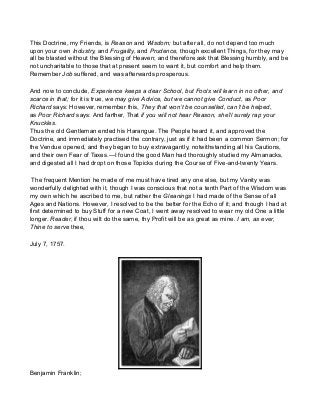
Benjamin Franklin;

The Way To Wealth

  • 1.
    The Way to Wealth BroughtTo You By; Chuck Thompson of TTC Media Digital Publishing; August, 2013 http://www.gloucestercounty-va.com Visit us. Courteous Reader, I have heard that nothing gives an Author so great Pleasure, as to find his Works respectfully quoted by other learned Authors. This Pleasure I have seldom enjoyed; for tho’ I have been, if I may say it without Vanity, an eminent Author of Almanacks annually now a full Quarter of a Century, my Brother Authors in the same Way, for what Reason I know not, have ever been very sparing in their Applauses; and no other Author has taken the least Notice of me, so that did not my Writings produce me some solid Pudding, the great Deficiency of Praise would have quite discouraged me. I concluded at length, that the People were the best Judges of my Merit; for they buy my Works; and besides, in my Rambles, where I am not personally known, I have frequently heard one or other of my Adages repeated, with, as Poor Richard says, at the End on’t; this gave me some Satisfaction, as it showed not only that my Instructions were regarded, but discovered likewise some Respect for my Authority; and I own, that to encourage the Practice of remembering and repeating those wise Sentences, I have sometimes quoted myself with great Gravity. Judge then how much I must have been gratified by an Incident I am going to relate to you. I stopt my Horse lately where a great Number of People were collected at a Vendue of Merchant Goods. The Hour of Sale not being come, they were conversing on the Badness of the Times, and one of the Company call’d to a plain clean old Man, with white Locks, Pray, Father Abraham, what think you of the Times? Won’t these heavy Taxes quite ruin the Country? How shall we be ever able to pay them? What would you advise us to?— Father Abraham stood up, and reply’d, If you’d have my Advice, I’ll give it you in short, for a Word to the Wise is enough, andmany Words won’t fill a Bushel, as Poor Richard says. They join’d in desiring him to speak his Mind, and gathering round him, he proceeded as follows;
  • 2.
    “Friends, says he,and Neighbours, the Taxes are indeed very heavy, and if those laid on by the Government were the only Ones we had to pay, we might more easily discharge them; but we have many others, and much more grievous to some of us. We are taxed twice as much by our Idleness, three times as much by our Pride, and four times as much by our Folly, and from these Taxes the Commissioners cannot ease or deliver us by allowing an Abatement. However let us hearken to good Advice, and something may be done for us; God helps them that help themselves, as Poor Richard says, in his Almanack of 1733. It would be thought a hard Government that should tax its People one tenth Part of their Time, to be employed in its Service. But Idleness taxes many of us much more, if we reckon all that is spent in absolute Sloth, or doing of nothing, with that which is spent in idle Employments or Amusements, that amount to nothing. Sloth, by bringing on Diseases, absolutely shortens Life. Sloth, like Rust, consumes faster than Labour wears, while the used Key is always bright, as Poor Richard says. But dost thou love Life, then do not squander Time, for that’s the Stuff Life is made of, as Poor Richard says.—How much more than is necessary do we spend in Sleep! forgetting that The sleeping Fox catches no Poultry, and that there will be sleeping enough in the Grave, as Poor Richard says. If Time be of all Things the most precious, wasting Time must be, as Poor Richard says, the greatest Prodigality, since, as he elsewhere tells us, Lost Time is never found again; and what we call Time-enough, always proves little enough; Let us then be up and be doing, and doing to the Purpose; so by Diligence shall we do more with less Perplexity.Sloth makes all Things difficult, but Industry all easy, as Poor Richard says; and He that riseth late, must trot all Day, and shall scarce overtake his Business at Night. While Laziness travels so slowly, that Poverty soon overtakes him, as we read in Poor Richard, who adds, Drive thy Business, let not that drive thee; andEarly to Bed, and early to rise, makes a Man healthy, wealthy and wise. So what signifies wishing and hoping for better Times. We may make these Times better if we bestir ourselves. Industry need not wish, as Poor Richard says, andHe that lives upon Hope will die fasting. There are no Gains, without Pains; then Help Hands, for I have no Lands, or if I have, they are smartly taxed. And, as Poor Richard likewise observes, He that bath a Trade bath an Estate, and He that bath a Calling bath an Office of Profit and Honour; but then the Trade must be worked at, and the Calling well followed, or neither the Estate, nor the Office, will enable us to pay our Taxes.—If we are industrious we shall never starve; for, as Poor Richard says, At the working Man’s House Hunger looks in, but dares not enter. Nor will the Bailiff nor the Constable enter, for Industry pays Debts, while Despair encreaseth them, says Poor Richard.—What though you have found no Treasure, nor has any rich Relation left you a Legacy, Diligence is the Mother of Good luck, as Poor Richard says, and God gives all Things to Industry. Thenplough deep, while Sluggards sleep, and you shall have Corn to sell and to keep, says Poor Dick. Work while it is called To-day, for you know not how much you may be hindered To- morrow, which makes Poor Richard say, One To-day is worth two To-morrows; and farther, Have you somewhat to do To-morrow, do it To-day. If you were a Servant, would you not be ashamed that a good Master should catch you idle?
  • 3.
    Are you thenyour own Master, be ashamed to catch yourself idle, as Poor Dick says. When there is so much to be done for yourself, your Family, your Country, and your gracious King, be up by Peep of Day; Let not the Sun look down and say, Inglorious here be lies. Handle your Tools without Mittens; remember that the Cat in Gloves catches no Mice, as Poor Richard says. ’Tis true there is much to be done, and perhaps you are weak handed, but stick to it steadily, and you will see great Effects, for constant Dropping wears away Stones, and byDiligence and Patience the Mouse ate in two the Cable; and little Strokes fell great Oaks, as Poor Richard says in his Almanack, the year I cannot just now remember. Methinks I hear some of you say, Must a Man afford himself no Leisure?—I will tell thee, my Friend, what Poor Richard says, Employ thy Time well if thou meanest to gain Leisure; and, since thou art not sure of a Minute, throw not away an Hour. Leisure, is Time for doing something useful; this Leisure the diligent Man will obtain, but the lazy Man never; so that, as Poor Richard says, a Life of Leisure and a Life of Laziness are two Things. Do you imagine that Sloth will afford you more Comfort than Labour? No, for as Poor Richard says, Trouble springs from Idleness, and grievous Toil from needless Ease. Many without Labour, would live by their WITS only, but they break for want of Stock. Whereas Industry gives Comfort, and Plenty, and Respect: Fly Pleasures, and they’ll follow you. The diligent Spinner has a large Shift; and now I have a Sheep and a Cow, every Body bids me Good morrow; all which is well said by Poor Richard. But with our Industry, we must likewise be steady, settled and careful, and oversee our own Affairs with our own Eyes, and not trust too much to others; for, as Poor Richard says, I never saw an oft removed Tree, Nor yet an oft removed Family, That throve so well as those that settled be. And again, Three Removes is as bad as a Fire; and again, Keep thy Shop, and thy Shop will keep thee; and again, If you would have your Business done, go; If not, send. And again, He that by the Plough would thrive, Himself must either hold or drive. And again, The Eye of a Master will do more Work than both his Hands; and again, Want of Care does us more Damage than Want of Knowledge; and again, Not to oversee Workmen, is to leave them your Purse open. Trusting too much to others Care is the Ruin of many; for, as the Almanack says, In the Affairs of this World, Men are saved, not by Faith, but by the Want of it; but a Man’s own Care is profitable; for, saith Poor Dick, Learning is to the Studious, and Riches to the Careful, as well as Power to the Bold, and Heaven to the Virtuous. And farther, If you would have a faithful Servant, and one that you like, serve yourself. And again, he adviseth to Circumspection and Care, even in the smallest Matters, because sometimes a little Neglect may breed great Mischief; adding, For want of a Nail the Shoe was lost; for want of a Shoe the Horse was lost; and for want of a Horse the Rider was lost, being overtaken and slain by the Enemy, all for want of Care about a Horse-shoe Nail. So much for Industry, my Friends, and Attention to one’s own Business; but to these we must add Frugality, if we would make our Industry more certainly successful. A Man may, if he
  • 4.
    knows not howto save as he gets, keep his Nose all his Life to the Grindstone, and die not worth a Groat at last. A fat Kitchen makes a lean Will, as Poor Richard says; and, Many Estates are spent in the Getting, Since Women for Tea forsook Spinning and Knitting, And Men for Punch forsook Hewing and Splitting. If you would be wealthy, says he, in another Almanack, think of Saving as well as of Getting: The Indies have not made Spain rich, because her Outgoes are greater than her Incomes. Away then with your expensive Follies, and you will not have so much Cause to complain of hard Times, heavy Taxes, and chargeable Families; for, as Poor Dick says, Women and Wine, Game and Deceit, Make the Wealth small, and the Wants great. And farther, What maintains one Vice, would bring up two Children. You may think perhaps, That a little Tea, or a little Punch now and then, Diet a little more costly, Clothes a little finer, and a little Entertainment now and then, can be no great Matter; but remember what Poor Richard says, Many a Little makes a Mickle; and farther, Beware of little Expenses; a small Leak will sink a great Ship; and again, Who Dainties love, shall Beggars prove; and moreover, Fools make Feasts, and wise Men eat them. Here you are all got together at this Vendue of Fineries and Knicknacks. You call them Goods, but if you do not take Care, they will prove Evils to some of you. You expect they will be sold cheap, and perhaps they may for less than they cost; but if you have no Occasion for them, they must be dear to you. Remember what Poor Richard says, Buy what thou hast no Need of, and ere long thou shalt sell thy Necessaries. And again, At a great Pennyworth pause a while: He means, that perhaps the Cheapness is apparent only, and not real; or the Bargain, by straitning thee in thy Business, may do thee more Harm than Good. For in another Place he says, Many have been ruined by buying good Pennyworths. Again, Poor Richard says, ’Tis foolish to lay out Money in a Purchase of Repentance; and yet this Folly is practised every Day at Vendues, for want of minding the Almanack. Wise Men, as Poor Dick says, learn by others Harms, Fools scarcely by their own; but,Felix quem faciunt aliena Pericula cautum. Many a one, for the Sake of Finery on the Back, have gone with a hungry Belly, and half starved their Families; Silks and Sattins, Scarlet and Velvets, as Poor Richard says, put out the Kitchen Fire. These are not the Necessaries of Life; they can scarcely be called the Conveniencies, and yet only because they look pretty, how many want to have them. The artificial Wants of Mankind thus become more numerous than the natural; and, as Poor Dicksays, For one poor Person, there are an hundred indigent. By these, and other Extravagancies, the Genteel are reduced to Poverty, and forced to borrow of those whom they formerly despised, but who through Industry and Frugality have maintained their Standing; in which Case it appears plainly, that a Ploughman on his Legs is higher than a Gentleman on his Knees, as Poor Richard says. Perhaps they have had a small Estate left them, which they knew not the Getting of; they think’Tis Day, and will never be Night; that a little to be spent out of so much, is not worth minding; (a Child and a Fool, as Poor Richard says, imagine Twenty Shillingsand Twenty Years can never be spent) but, always taking out of the Meal-tub, and
  • 5.
    never putting in,soon comes to the Bottom; then, as Poor Dick says, When the Well’s dry, they know the Worth of Water. But this they might have known before, if they had taken his Advice; If you would know the Value of Money, go and try to borrow some; for, he that goes a borrowing goes a sorrowing; and indeed so does he that lends to such People, when he goes to get it in again.—Poor Dick farther advises, and says, Fond Pride of Dress, is sure a very Curse; E’er Fancy you consult, consult your Purse. And again, Pride is as loud a Beggar as Want, and a great deal more saucy. When you have bought one fine Thing you must buy ten more, that your Appearance may be all of a Piece; but Poor Dick says, ’Tis easier to suppress the first Desire, than to satisfy all that follow it. And ’Tis as truly Folly for the Poor to ape the Rich, as for the Frog to swell, in order to equal the Ox. Great Estates may venture more, But little Boats should keep near Shore. ’Tis however a Folly soon punished; for Pride that dines on Vanity sups on Contempt, as Poor Richard says. And in another Place, Pride breakfasted with Plenty, dined with Poverty, and supped with Infamy. And after all, of what Use is this Pride of Appearance, for which so much is spised, but who through Industry andFrugality have maintained their Standing; in which Case it appears plainly, that a Ploughman on his Legs is higher than a Gentleman on his Knees, as Poor Richard says. Perhaps they have had a small Estate left them, which they knew not the Getting of; they think ’Tis Day, and will never be Night; that a little to be spent out of so much, is not worth minding; (a Child and a Fool, as Poor Richard says, imagine Twenty Shillings and Twenty Years can never be spent) but, always taking out of the Meal- tub, and never putting in, soon comes to the Bottom; then, as Poor Dick says, When the Well’s dry, they know the Worth of Water. But this they might have known before, if they had taken his Advice; If you would know the Value of Money, go and try to borrow some; for, he that goes a borrowing goes a sorrowing; and indeed so does he that lends to such People, when he goes to get it in again.—Poor Dick farther advises, and says, Fond Pride of Dress, is sure a very Curse; E’er Fancy you consult, consult your Purse. And again, Pride is as loud a Beggar as Want, and a great deal more saucy. When you have bought one fine Thing you must buy ten more, that your Appearance may be all of a Piece; but Poor Dick says, ’Tis easier to suppress the first Desire, than to satisfy all that follow it. And ’Tis as truly Folly for the Poor to ape the Rich, as for the Frog to swell, in order to equal the Ox. Great Estates may venture more, But little Boats should keep near Shore. ’Tis however a Folly soon punished; for Pride that dines on Vanity sups on Contempt, as Poor Richard says. And in another Place, Pride breakfasted with Plenty, dined with Poverty, and supped with Infamy. And after all, of what Use is this Pride of Appearance, for which so much is risked, so much is suffered? It cannot promote Health, or ease Pain; it makes no Increase of Merit in the Person, it creates Envy, it hastens Misfortune.
  • 6.
    What is aButterfly? At best He’s but a Caterpillar drest. The gaudy Fop’s his Picture just, as Poor Richard says. But what Madness must it be to run in Debt for these Superfluities! We are offered, by the Terms of this Vendue, Six Months Credit; and that perhaps has induced some of us to attend it, because we cannot spare the ready Money, and hope now to be fine without it. But, ah, think what you do when you run in Debt; You give to another Power over your Liberty. If you cannot pay at the Time, you will be ashamed to see your Creditor; you will be in Fear when you speak to him: you will make poor pitiful sneaking Excuses, and by Degrees come to lose your Veracity, and sink into base downright lying; for, as Poor Richard says, The second Vice is Lying, the first is running in Debt. And again, to the same Purpose, Lying rides upon Debt’s Back. Whereas a freeborn Englishman ought not to be ashamed or afraid to see or speak to any Man living. But Poverty often deprives a Man of all Spirit and Virtue: ’Tis hard for an empty Bag to stand upright, as Poor Richard truly says. What would you think of that Prince, or that Government, who should issue an Edict forbidding you to dress like a Gentleman or a Gentlewoman, on Pain of Imprisonment or Servitude? Would you not say, that you are free, have a Right to dress as you please, and that such an Edict would be a Breach of your Privileges, and such a Government tyrannical? And yet you are about to put yourself under that Tyranny when you run in Debt for such Dress! Your Creditor has Authority at his Pleasure to deprive you of your Liberty, by confining you in Goal for Life, or to sell you for a Servant, if you should not be able to pay him! When you have got your Bargain, you may, perhaps, think little of Payment; but Creditors, Poor Richard tells us, have better Memories than Debtors; and in another Place says, Creditors are a superstitious Sect, great Observers of set Days and Times. The Day comes round before you are aware, and the Demand is made before you are prepared to satisfy it. Or if you bear your Debt in Mind, the Term which at first seemed so long, will, as it lessens, appear extreamly short. Time will seem to have added Wings to his Heels as well as Shoulders. Those have a short Lent, saith Poor Richard, who owe Money to be paid at Easter. Then since, as he says, The Borrower is a Slave to the Lender, and the Debtor to the Creditor, disdain the Chain, preserve your Freedom; and maintain your Independency: Be industrious and free; be frugal and free. At present, perhaps, you may think yourself in thriving Circumstances, and that you can bear a little Extravagance without Injury; but, For Age and Want, save while you may; No Morning Sun lasts a whole Day, as Poor Richard says.—Gain may be temporary and uncertain, but ever while you live, Expence is constant and certain; and ’Tis easier to build two Chimnies than to keep one in Fuel, as Poor Richard says. So rather go to Bed supperless than rise in Debt. Get what you can, and what you get hold; ’Tis the Stone that will turn all your Lead into Gold, as Poor Richard says. And when you have got the Philosopher’s Stone, sure you will no longer complain of bad Times, or the Difficulty of paying Taxes.
  • 7.
    This Doctrine, myFriends, is Reason and Wisdom; but after all, do not depend too much upon your own Industry, and Frugality, and Prudence, though excellent Things, for they may all be blasted without the Blessing of Heaven; and therefore ask that Blessing humbly, and be not uncharitable to those that at present seem to want it, but comfort and help them. Remember Job suffered, and was afterwards prosperous. And now to conclude, Experience keeps a dear School, but Fools will learn in no other, and scarce in that; for it is true, we may give Advice, but we cannot give Conduct, as Poor Richard says: However, remember this, They that won’t be counselled, can’t be helped, as Poor Richard says: And farther, That if you will not hear Reason, she’ll surely rap your Knuckles. Thus the old Gentleman ended his Harangue. The People heard it, and approved the Doctrine, and immediately practised the contrary, just as if it had been a common Sermon; for the Vendue opened, and they began to buy extravagantly, notwithstanding all his Cautions, and their own Fear of Taxes.—I found the good Man had thoroughly studied my Almanacks, and digested all I had dropt on those Topicks during the Course of Five-and-twenty Years. The frequent Mention he made of me must have tired any one else, but my Vanity was wonderfully delighted with it, though I was conscious that not a tenth Part of the Wisdom was my own which he ascribed to me, but rather the Gleanings I had made of the Sense of all Ages and Nations. However, I resolved to be the better for the Echo of it; and though I had at first determined to buy Stuff for a new Coat, I went away resolved to wear my old One a little longer. Reader, if thou wilt do the same, thy Profit will be as great as mine. I am, as ever, Thine to serve thee, July 7, 1757. Benjamin Franklin;