i
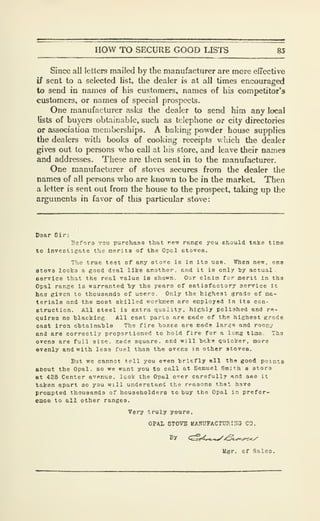
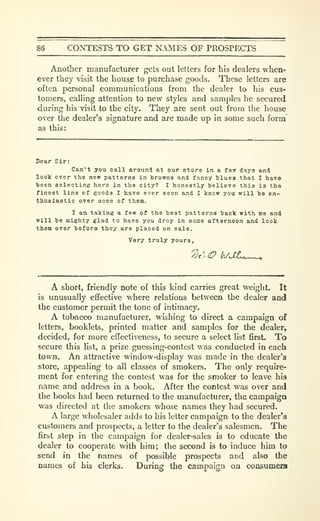
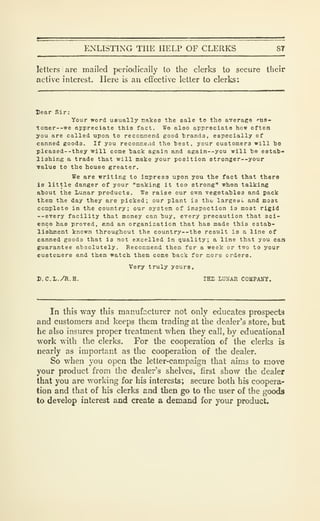
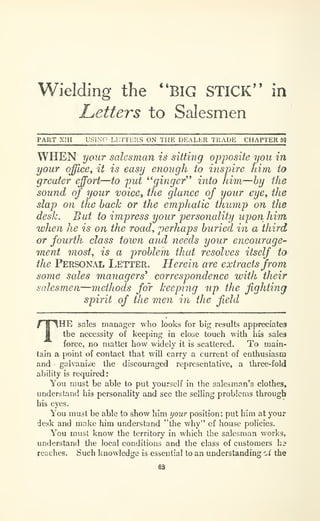
5721
P9f; Rn si lias 3
v.? corre spoil-
dence
.
>s^.
.JS<?.
(Ct-jy.*
Southern Branch
of the
University of California
Los Angeles
Form L-1
V.5
ik
This book is DUE on the last date stamped below
APR 1 9 1923
^^t- 2 71328
JUL 3
DEC ^ -
/j>^
^A^/^Ut^ryu^
^^
^UH ? ^m>-
Prp4 fdfjff
JAN 5 1925
JAN 2 2 192§
APR 1 3 19:|1
^^f ^
.,
- -r^S^
APf?i3^
APRl 81949
IWAR 2 4 195G
-^'V4 I95b
RETD BOOK BOX
APRl9 195i..,
_ i?i.
i-"-f S£^i'
Form L-9-2wi-7,'22
Gt
BUSINESS
CORRESPONDENCE
VOLUME III
HOW TO HANDLE THE DISTANT CUS-
TOMER: 23 chapters and extracts from 2^3
actual letters on keeping in touch with the deal-
er's trade by mail and getting business from re-
tailers; how to open up new territory; how to
bring in the money due; how to handle and
eliminate complaints^ and make adjustments; and
how to make the letter a factor in every phase of
selling
A. W. SHAW COMPANY
Cass, Huron and Erie Streets, Chicago
299 Madison Avenue, New York
43-44 Shoe Lane, London, E. C.
4010G
Copyright, 1911. by
The System Company
1st Printing, July, 1911
2iid PriutinE. October, 1911
3rd Printing, April. 1917
4tL Printing. November, 1917
5th Printing, November, 1918
Gth Printing, March, 1919
7th Printing. February, 1920
8h Printing. July, 1920
9th Printing. April. 1922
Printed in U. S. A.
^
H ^
3^^
CONTENTS
S BUSINESS CORRESPONDENCE
VOLUME III
PART XI
How To Get Business From Dealers
Chapter Pack
Putting Propositions to the Dealer in Letters • . 5
How to Get Business by Mail from Dealers » . . 17
Gretting Business from Four-Corner I'owns • • « 25
PART XII
How to Open New Territory by Letter
52: Opening New Selling Fields by Mail . . • . 34>
63: How Manufacturers Drum up Trade for the Dealer . 41
64: How to Interest New Dealers by Correspondence • . 47
55', Building Up a Trade for the Retailer « • • . 54
PART XIII
Usin^ Letters on the Dealer Trade
66 il Introducing the Salesman and Backing Him Up , • 60
57:. Keeping In Touch with the Dealer By Mail . . « 71
58: Cooperating with the Dealer in Campaign on Consumers 78
69: Wielding the Big Slick in Letters to Salesmen . . 88
60: Salesman's Letters That Keep Up a Customer's Interest 95
CONTEXTS
PART XIV
Collecting' Money by Mail
How to Collect Mercantile Accounts by Letter
How the Retailer Collects Accounts bj' Mail .
How to Make Instalment Collections .
How Petty Accounts are Collected .
Collection Schemes for Use When Other Methods Fail
Holdinfi the Trade of the Poor Credit Risk .
107
118
126
130
147
156
PART XV
Handling the hong-Distance Customer
Making Capital Out of Complaints
The House Policy in Handling Routine Complaints
Finding the Right Attitude Toward Complaints
How to Systematize the Complaint Department
How to Eliminate Complaints . . . .
170
177
136
196
bos
Index ... ...... 210
Putting Propositions to the
Dealer in Letters
PART Xt HOW TO GET BUSINESS FROM DEALERS CHAPTER 49
IT is not the selling scheme cdone^ nor ilie special
terms, nor tlie exclusive privilegey nor any of the
other tricks in the salesman's pack that finally
swing the dealer from the **prospect^' list to the
customer list; it is the MANNER IN wmcH THESE
PROPOSITIONS ARE PRESENTED TO EIM. There is a
right and a wrong method of approaching him by
mail—o5 illustrated on the following 11 pages
THE average manufacturer is so much in love with his
product that he camiot get away from it. He con-
stantly talks to the dealer of his article as an article
while it is in reality a «)mmodity of trade. His most
common as well as his most disastrous mistake in his
selling argument is to lose sight of the great fundamental prin-
ciple on which all dealer argujnents must hinge—the fact that
merchandise is merely the vehicle by which profits are conveyed
to the dealer.
As long as the manufacliirer fails to adjust his viewpoint
to that of the dealer; as long as he attempts to interest the
retailer with arguments on quality and adaptability while
he should be talking profits, sales, customers, his letters will
fail in their mission.
The reason is not difficult to understand. Stop and con-
sider that the function the dealer plays in the world of industry
is to supply a medium through which goods are conveyed from
the producer to the consumer—that his function is to dis-
ribute produce, not to use it—and you will understand why
oerchandise as mere merchandise does not interest him. The
KNOW THE DEALER'S PROBLEMS
dealer's business is the selling medium, and his love b not for
the game but for gain: he is looking for the profits that the
handling of goods—the distributioa of an article—must offer
him. If the article offers no gain, he is not interested.
Come down to the every-day principle, that the dealer is
just a plain, ordinary man, with the same inclinations, the
same preferences and prejudices, the same degree of human
selfishness that you or I or other men in business have; that
if you offer him something by which to gain customers, trade,
prosperity, he is interested, and your appeal will reach home.
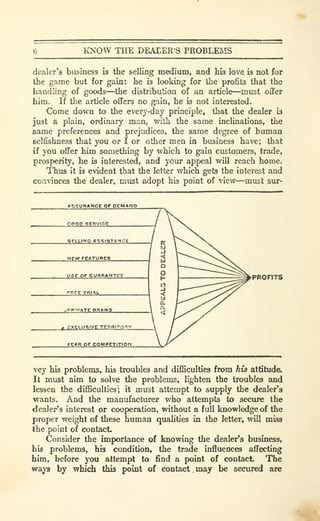
Thus it is evident that the letter which gets the interest and
con^^nces the dealer, must adopt his point of view—must sur-
• SSOqANCE OF PEM«ND
GOOD SER'/lce
SELUING ASSISTANCE
NEW TEATUBES
USE or GUABANTCE
FBEE TRIAL
^Pff'WATE BnANO
f exCLUSIVE TERRITORY
FEAR or COMPETITIOM
PRORTS
vey his problems^, his troubles and diflSculties from his attitude.
It must aim to solve the problems, lighten the troubles and
lessen the difficulties"; it must attempt to supply the dealer's
wants. And the manufactiurer who attempts to secure the
dealer's interest or cooperation, without a full knowledge of the
proper weight of these human qualities in the letter, will misa
the point of contact
Consider the importance of knowing the dealer's business,
his problems, his condition, the trade influences affecting
him, before you attempt to find a point of contact. The
ways by which this point of contact . may be secured are
APPEALING TO THE DEALER S JUDGMENT 7
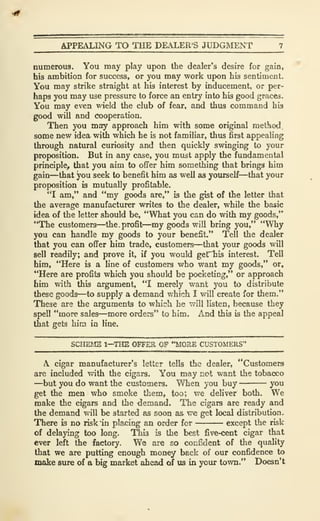
numerous. You may play upon the dealer's desire for gain,
his ambition for success, or you may work upon his sentiment.
You may strike straight at his interest by inducement, or per-
haps you may use pressure to force an entry into his good graces.
You may even vi'ield the club of fear, and thus command his
good will and cooperation.
Then you may approach him with some original method,
some new idea with which he is not familiar, thus first appealing
through natural curiosity and then quickly swinging to your
proposition. But in any case, you must apply the fundamental
principle, that you aim to offer him something that brings him
gain—that you seek to benefit him as well as yourself—that your
proposition is mutually profitable.
"I am," and "my goods are," is the gist of the letter that
the average manufacturer writes to the dealer, while the basic
idea of the letter should be, "What you can do with my goods,"
"The customers—the. profit—my goods will bring you," "Why
you can handle my goods to your benefit." Tell the dealer
that you can offer him trade, customers—that your goods will
sell readily; and prove it, if you would gerliis interest. Tell
him, "Here is a line of customers who want my goods," or,
"Here are profits which you should be pocketing," or approach
him with this argument, "I merely want you to distribute
these goods—to supply a demand which I will create for them."
These are the arguments to which he will listen, because they
spell "more sales—more orders" to him. And this is the appeal
that gets him in line.
SCHEME 1—THE OFFEH. OF "MORE CUSTOMERS"
A cigar manufacturer's letter tells the dealer, "Customers
are included vsith the cigars. You may not want the tobacco
—but you do want the customers. When you buy you
get the men who smoke them, too; we deliver both. We
make the cigars and the <lemand. The cigars are ready and
the demand will be started as soon as we get local distribution.
There is no risk in placing an order for except the risk
of delaying too long. This is the best five-cent cigar that
ever left the factory. We are so confident of the quality
that we are putting enough money back of our confidence to
make sure of a big market ahead of us in your tovm." Doesn't
8 EXAMPLES OF GOOD SELLING POINTS
this letter offer hit the target, when it is aimed at the man who
i3 looking for the margin that sales on an article bring
him? The possibilities of future gain influences the retailer
and the argument is effective.
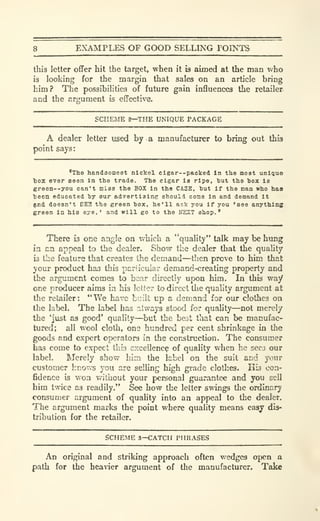
SCHEME 2—THE UNIQUE PACKAGE
A dealer letter used by a manufacturer to bring out this
point says:
'The handsomest nickel cigar--packed In the moat unique
tox ever seen In the trade. The cigar is ripe, hut the hox is
green--you can't miss the BOX in the CASE, but if the man who haa
teen educated hy our advertiaine should come in and demand it
^nd doesn't BE3 the green box, he'll ask you if you 'see anything
sreen In his eye,' and will go to the irEXT shop.'
There is one angle on which a "quality" talk may be himg
in an appeal to the dealer. Show the dealer that the quahty
is the feature that creates the demand—then prove to him that
your product has this particular demand-creating property and
the argument comes to bear directly upon him. In this way
one producer aims ia his letter to direct the quality argument at
the retailer: "We have built up a demand for our clothes oa
the label. The label has always stood for quahty—not merely
the Must as good' quality—but the best that can be manufac-
tured; all wool cloth, one hundred per cent shrinkage in the
goods and expert operators in the construction. The consumer
has come to expect this excellency of quality when he sees our
label. Merely show him the label on the suit and your
customer knows you are selling high grade clothes. His con-
fidence is won v?ithout your personal guarantee and you sell
him twice as readily." See how the letter swings the ordinary
consumer argument of quality into an appeal to the dealer.
The argument marks the point where quality means easy dis-
tribution for the retailer.
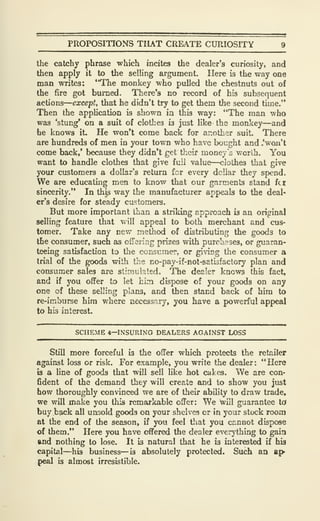
SCHEME 3—CATCH PHRASES
An original and striking approach often wedges open a
path for the heaner argument of the manufacturer. Take
PROPOSITIONS THAT CREATE CURIOSITY 9
the catchy phrase which incites the dealer's curiosity, and
then apply it to the selling argument. Here is the way one
man writes: "The monkey who pulled the chestnuts out of
the fire got burned. There's no record of his subsequent
actions
—
except, that he didn't try to get them the second time.**
Then the application is shown ia this way: "The man who
was 'stung* on a suit of clothes is just like the monkey—and
he knows it He won't come back for another suit. There
are hundreds of men in your town who have bought and .'won't
come back,' because they didn't get theii' money's worih. You
want to handle clothes that give fuii value—clothes that give
your customers a dollar's return for every dollar they spend.
We are educating men to know that our garments stand fc|
sinceri^." In this way the manufacturer appeals to the deal'
er's desire for steady ciLstomers.
But more important than a striking approach is an original
selling feature that will appeal to both merchant and cus-
tomer. Take any new method of distributing the goods to
the consumer, such as ofiering prizes with purchases, or guaran-
teeing satisfaction to the consuraer, or giving the consumer a
trial of the goods with the no-pay-if-not-satisfactory plan and
consumer sales are stimulated. The dealer knows this fact,
and if you offer to let hlzn dispose of your goods on any
one of these selling plans, and then stand back of him to
re-imburse hira where necessary, you have a powerful appeal
to his interest.
SCHEME 4—INSURING DEALERS AGAINST LOSS
Still more forceful is the offer which protects the retailer
against loss or risk. For example, you write the dealer: "Here
b a line of goods that will sell like hot cakes. We are con-
6dent of the demand they will create and to show you just
how thoroughly convinced we are of their ability to draw trade,
we will make you this remarkable offer: We will guarantee td
buy back all unsold goods on your shelves or in your stock room
at the end of the season, if you feel that you ccnnot dispose
of them." Here you have offered the dealer everything to gain
and nothing to lose. It is natural that he is interested if his
capital—his business—is absolutely protected. Such an up-
peal is almost irresistible.
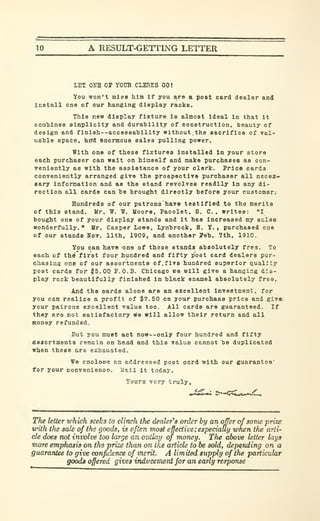
10 A RESULT-GETTING LETTER
LET OBB or VOTO CLERKS 00!
You won't nilBS him If you are a poet card dealer and
Install one of our hanging display racks.
This new display fixture is almost ideal in that it
comhlnes simplicity and durability of construction, heauty of
design and f ini8h--acceB8a'billty without, the sacrifice of val-
uahle space, )Eirfd Enormous sales pulling power.
With one of these fixtures Installed In your store
each purchaser can wait on himself and make purchases as con-
veniently as with the assistance of your clerk. Price cards
conveniently arranged give the prospectlTO purchaser all necea»
eary infoi^ation and as the stand revolves readily in any di-
rection all cards can be brought directly before your customer.
Hundreds of our patrons have testified to tho merits
of this stand. Mr. W. T. Moore, Pacolet, S. C. , writes: "I
bought one of your display stands and it has increased my sales
wonderfully." Mr. Casper Lowe, Lynbrock, B. Y. » purchased one
of our Btando Hot. 11th, 1909, and another 7eb. 7th. 1910.
You can have one of these stands absolutely free. To
each of th^first four hundred and fifty post card dealers pur-
chasing one of our assortments of.fivo hundred superior quality
post cards for |5.00 r.O.B. Chicago we will give a hanging dis-
play rack beautifully finished in black enamel absolutely free.
And the cards alone are an excellent investment, for
you can realize a profit of ^7.50 on your purchase price and givei
your patrons excellent value too. All cards are guaranteed. If
they are not satiofactory we will allow their return and all
money refunded.
But you nruBt act now--only four hundred and fifty
fisiiortments remain on hand and this value cannot be duplicated
when these are exhausted.
We enoloso an addressed poet card with our guarantee'
tor your convenienoo. Kail it today.
Yours very truly.
The letter which seeks fxt clinch the dealer's order by an offer of some prize
with the sale of the goods, is often most effective ;e&peciaUy when the arti-
cle does not involve too large an ouilap of money. The above letter lays
more emphasis on the prize than on the article to be sold, depending on a
guarantee to give confidence of merit. A limited supply of the particular
goods offered gives inducement for an early response
SCHE]IES THAT LESSEN THE DEALER'S RISKS 11
Then take the same guarantee against risk from the angle
of a thirty-days* free trial, with payment for the goods after the
dealer has tried their selling power for a certain period. The
effectiveness of thb appeal lies in the absolute protection of the
dealer. The impression of confidence carried with an offer
of goods without a payment down at once commands the
dealer's confidence. When the goods are on the shelves of the
dealer, or displayed ia his store, their sale is practically assured.
SCHEME 5—THE FREE TRIAL
This is a clinching appeal. It does not interfere in any
way with any other pla,n of selling, but may be used as addi-
tional force where the dealer is hard to convince. For example,
one manufacturer uses this letter argument:
"You can place our toilet soaps on display in your
store. Give them prominence and arrange them attractively. Wa
know the demand they will create--the sales they will bring you.
To back up our confidence, wo will put in a stock for your trial
at OUR RISE. You sell them, collect your commission and pay ua
for the stock, AFTER you have proven their sales value. You
Incur no obligation. If you find you can't dispose of them, wo
will accept their return without argument."
This manufacturer goes to the very boundaries of "good
business" in his aim to get the dealer's interest.
SCHEME 6—DIRECTIONS FOR DISPLAYING GOODS
If you remember that the dealer is ambitious—that he has
an inborn desire to increase his business, to build it up on a
substantial basis, and that, to satisfy this desire, he must sell
more goods secure more profits, you may appeal effectively
by giving him selling instruction in your letters. This is a
subject that requires great tact, since the opportunity to
offend by assuming his inability to sell is ever present.
To efifectually ward off possible offence, one manufacturer
gives such information a distinct "news value'* and suggests
that it might be applicable.
12 HELPING THE DEALER SELL
For example, he writes, "Our displcv expert last week
arranged a window in B , which, our dealer there tells us,
has pulled big results. It was used in this way," and then
the letter describes how a practical window display is arranged.
Then to show its application, the letter suggests, "Perhaps
thb same scheme would be apphcable in your store. I am
giving you this information because I want you to know
of the most successful schema that are being used to insure
larger sales." In this way the manufacturer secured the in-
terest of the dealer through his evident desire to aid in retail
selling. Many concerns publish and send out periodic bul-
letins or booklets filled with useful selling hints and suggestions
for the retailer. Still another concern offers the dealer a free
course in salesmanship for his clerksr supplying the .experience
of an expert for the purpose.
SCHEME 7—LOCAL NEWSPAPER ADVERTISING
Still another manufacturer offers advertising assistance as
an inducement. "You would like to have these goods adver-
tised in your local paper over ycur name, wouldn't you ? Your
business v/ould benefit greatly through any advertising over
your name and address, if used in your local mediums where
your customers and your competitors' customers could see it.
We will conduct a two months' advertising campaign for you
and in this way keep customers coming to your store." Such
an offer gets close to the retailer's heart. The plan not
only advertises the particular line of goods, but it booms his
business generally. Another plan offers to supply the dealer
with all his printed matter to be used on customers.
SCHEME 8—THE "PRIVATE ERAND"
Often the offer of goods made up for a dealer's private
brand, is the inducement that gets his order. Take, for
instance, the letter offering to the dealer a line of groceries
or shoes or merchandise, marked with his name and address,
or manufactured and put up under the name of his store;
then the dealer, who wants to advertise his place of business,
and who appreciates the prestige that a private brand gives
to his store, finds the opportunity he has been looking
GIVING rUBLTCITY TO THE DEAI.Ell 13
for at little or no additional cost over similar goods he has
been selling.
SCHEME »—QUICK SERVICE
Service is another argument to which the dealer cannot
remain deaf. He wants to know why it will pay him to get his
goods from you rather than from the other manufacturer.
Show him that you can make deliveries, say, five days quicker;
that your means of transportation insure belter treatment of
his goods en route; or that your house adopts a policy of abso-
lute time limit shipments, not varying one day from a fixed
schedule. Write him: "Your greatest problem is how you may
get the goods to your customers sooner. ^Ve guarantee a six-
day service;" or say to him, "You would like to make your
jobber's stock room an annex to your store, wouldn't you ?
Then, here is the way you can do it. Here is a way you can
carry a double stock of goods without increasing your store
space. We give a twenty-four hour service, which enables
you to take an order from your customer and supply the goods
the next day."
To carry this idea one step further, the manufacturer may
even work upon the sentiment of the dealer. Where the sales-
man writes the dealer, letters assume an intimate personal
attitude. They appeal so strongly because the dealer is on
terms of intimacy with the writer. The salesman knows and
uses intimate points of contact to strengthen his grip on the
dealer's interest. The selling arguments he may use in his
letters therefore carry unusual weight.
SCHEME 10—PERSONAL ADVICE FROM SALESMEN
"^Tiat you need, is a line of goods that will answer this or
that demand in your town," the salesman says in his letter,
and the <iealer believes it because he has confidence in the sales-
man. •
He realizes that the salesman knows the exact conditions
of his business. Or the salesman says. "You want to deal with
a house that will guarantee you against loss through overstock-
ing or damaged goods in shipment. Our concern will absolutely
guarantee this—I'll tell you frankly that you can expect only
square dealing' from them," and the dealer believes it because
14 PROMPT DELIVERIES AS A SELLING FACTOR
he has learned to put confidence in the salesman. "We are
watching out for your interests as well as ours," the salesman
writes, and the merchant is confident that such b the case.
SCHEME 11—THE INDUCEMENT OF AN ESTABLISHED DEMAND
But the effectiveness of pressure on the dealer as a method
of appeal overshadows the majority of other means of approach.
Pressure may be brought to bear on the retailer to compel
his attention—with the alternative of his losing attractive profits
and evident customer trade. "Take this line of goods with
the demand supplied, or lose big profits," is a club which
forces the dealer's interest. You may go to the consumer
with letters and create a demand or trial sales or customers
—
you build up a trial order business with the consumers. Then
ofiFer the prospects or the established customers along
with the bill of goods and the dealer can hardly turn
you away.
SCHEME 12—CREATING A DEMAND BY CIRCULARS
Or, you may say to the merchant: "I am flooding the shoe
buyers of your town with literature, and educating them to
know the value of and to want the shoes I am manufac-
turing; I am going to create a big demand for these shoes
for some dealer. Do you want the business—do you want
the sales this demand will assure you ? If you but say the
word I will direct these buyers to your store. You must,
however, take a stock of my goods to supply this demand,
because these consumers won't want any other shoe be-
cause I will shov; them this is the one best suited to their
needs. J am not asking you to buy a big bill of shoes
—
just enough to supply the wants of the people I will send
to you.'' Then send customers to the dealer's store. He
cannot supply the goods because he hasn't them, but
let a few more customers ask for those specific goods and
leave his store to ask for them elsewhere, and he will
come running to stock up. It is more than he can stand,
to see business slipping away from him. The pressure
of the possible business becomes too great for his indiffer-
ence and the problem of appeal is solved.
THE "NEGATIVE APPEAL" 15
Even though he does not want to axld new lines, he
hates to see his competitors getting the additional business.
He is often persuaded to Hsten to tlie manufacturer's argument
rather than see the "dealer across the street" benefit. Thus,
the surest method of reaching your man may be by a nega-
tive appeal.
In this way the dealer is tactfully shown that if he does not
take the line a competitor will. But in flourishing the
•'big stick," the greatest tact must be employed. You
cannot say to the dealer, "If you don't take this proposi-
tion, I'll offer it to your competitor and let him get an advan-
tage over you," because the natural independence of the man
will assert itself and he will usually tell you to *'Go hang your-
self," or something equally pertinent. But if you approach
him in a smooth way—covering the blunt threat with velvet
—
you can secure cooperation.
No matter how velvety the language may be, the compelling
force of the argument is evident, because of the suggestion that
unless the dealer takes over the lines of goods he must relin-
quish a sure source of profit to his competitor. The fear
of giving his competitor the advantage makes the appeal
effective.
SCHEME 13—GETTING COMMENDATION FROM LOCAL ORGANIZATIONS
This idea may be carried a step further. A local sell-
ing factor which will compel the dealer's attention through
the fear of possible loss of his other trade, may be brought
into cooperation with the manufacturer. For example, the
manufacturer may secure the cooperation of a local organiza-
tion or business concern under promise of some prize or finan-
cial inducement.
There is a general principle that should be observed by
manufacturers in their letters to dealers. It is to assume
different attitudes towards dealers in different sections of
the country. The natural surroundings of the dealer, the
atmosphere and the environment, affect his viewpoint.
If you would reach the westerner most effectively,
talk quantity to him. Speak in large figures, give less
attention to details of the argument and hammer on ser-
vice.
j6 LOCATION MUST BE CONSIDERED
To the southerner talk cheapness and price, in your letters.
Make your references only to small quantities. When writ-
ing the easterner pound on the arguments that refer to
quality and the superiority of your product over other products,
assume that his consumers want only quality.
There is yet another point to remember in appealing to
dealers by letter. It lies in tlie mechanical make-up of the letter.
This appeal is to the senses of the man. Take every procautioa
to see that your letters are neatly made up. Poorly written
letters, smutty paper or careless folding fail to carry the desiredf
impression of value. "Make every letter so perfect in its detail
that the man who receives it will know it is a thing of value
—
that it was created with great care—'ha„ it is the result of un-
usual painstaking and that it should be handled as though it
were as valuable as the priceless vase or jewel," is the instruc-
tion a western manufacturer gives to his correspondents.
In the same way, make your English unquestionable. A
certain colloquial tone without sacrifice of dignity adds fofce,
because it ge's more nearly on the level of the dealer.
In seeking to reach the dealer and secure his interest
and cooperation you must first consider the man and his bus-
iqess. You must adopt his viewpoint and talk "profits" for his
business. You must adopt his viewpoint when you argue that
your product is the goods he wants to handle. Yoa must aim
to aid him in his work of distribution. Then you will secure
the finer appeal that the manufacturer^ letter shouki convey.
How To Get Business^!/ Mail
From Dealers
PART XI HOW TO GET BUSINESS FROM DEALERS CHAPTER 50
THE AVERAGE retailer has a natural mistrust
of new and untried goods. He is prejudiced in
favor of lines he has already handled. He is
correspondingly reluctant to consider new propo-
sitions. To overcome this inertia the manidac-
turer must resort to unique talking points. Mere
are some successful ways of presenting these points
in letters
THE average produet follows an established route between
factory and consumer. Midway on this route stands
the retailer. The product stops on his shelves until
it is handed out to the consumer.
From the standpoint of the manufacturer the biggest prob-
lem is to interest the retailer. In all probability this retailer
cares nothing for a new proposition. He does not want to load
himself up with more stock; he does not want to tie up more
capital in his business; he is prejudiced in favor of the goods
and the brands that he has always handled; he is doubtful of
the demand that there may be for the new product. So preju-
diced is he against new lines that he is reluctant to give the
manufacturer's proposition a hearing.
To overcome this inertia and secure the cooperation of
the merchant it is necessary to have some unique talking point,
some unusual feature or some material inducement that will
appeal to his bankbook. The manufacturer who goes on
the market with a new product may start his campaign . with
advertising in newspapers and magazines to create a demand
among the consumers and then go to the dealers with a force
17
18 OFFER A PRIZE TO DEALERS
of salesmen to secure their orders, but this method is expensive
and not always successful, and so, in many cases, the letter has
been substituted for the salesman, for the letter does the work
at a cost which enables the manufacturer to cover a large terri-
tory quickly.
As is pointed out in the chapters on Opening New Terri-
tory, the appeal to the consumer must be on the quality of the
goods or some improvement or novel feature, while the sole
appeal to the dealer is customers—sales—profits. And to
reach him by letter the manufacturer or tlie wholesaler must
have some original scheme or some cash-register inducement
that will call forth an order. The letters to the dealer must
hammer on three points: the fact that there is a demand for
the goods; that the merit of the produet assures satisfaction,
and that the dealer will have certain profits. As few goods are
sold by a single letter, these different arguments may be used
in a series of follow-up letters, but arguments alone will win
comparatively few orders. There must be specific schemes
and unusual inducements if orders are to be pulled by mail,
and this chapter takes up schemes that have proved success-
ful—schemes that have sold goods and converted a trial order
merchant into a steady customer.
First and last, the only proposition that grips the merchant
is some practical assistance in moving the goods. The most
familiar plan is cooperation in advertising, the manufacturer
furnishing booklets, cards, posters and cuts, or paying for
ad,vertising, or sending out letters to prospects.
This prize-with-dealer's-order scheme may apply to any
article of every-day demand. Take for instance the sale of
post cards to retailers and stationers. One manufacturer
opens his letter in this way:
•"There ere one hundred and forty-two pest c&rd dealers
en our booka who r.ave written us personal letters stating that
our special display raoka have aicro tiian doubled their Bales
th9 past three months. That's why this letter ia of vital iia-
portance to you who ere trying in every fay to insrcaee-your
fcp.les and elin:infite personal labor at the ease time.
"Think of hundreds of people? rho vleit ycur store end
»ho would purchase post cards if a larce diopiay were forcitly
PRIZES OF FREE GOODS 19
brought to their attention. This is exaotly what the rack do««
for you. WB SEHD IT FR5B OP CHAKGB with every order of 1 loa
dollars and over. You usa it and keep it as long as ycu cuctlnae
to 3oll our cards.
"He bavo fivo-hu.Tdrod-card assortmento consictius of
tn enormoua variety of fancy. Tiew. huBoroua, air hrueh, birth-
day and greeting cards at J5.00 F. 0. B. Chicaeo. Theas carda
are fully guaranteed in all reapecta and If the BEeortnient dcea
not fully meet your requirenente and please you we will ccn-
slder it a favor to have the entire ehipment returned. Only
two hundred and twenty-five of these aasortmenta remain on
hand. You must act today If you want one. Simply mark an (7>
on the enclosed addreaaed post card and nail it today. Stand
and cards will go forward at once."
The guarantee of satisfaction reassures the dealer and the
limited number of sets available is a do-it-now spur that induces
the reader to reach for his pen at once.
A clothing manufacturer put it up to the merchant in this
way:
" In this letter you will f inl a special offer cf
a fine custom made suit of clothes free of C08t--'but this was
not the message we started to give you. You need help in push-
ing sales of clothes. When a dealer puts Sackman clothes on his
shelves we help him sell them. We help him adverti88--send us
lists of customers and we will write them letters and send theai
etyle hoo'jilets. You want cuts for your local newspaper adver-
tising to make it distinctive t»nd appealins and »:e will supply
them for you.
" But here's the poiiit--wa' re eoing to offer you
more--for a short period. For tho next fifteen days we are go-
ing to give with every two hundred dollar order of clothes, a
fine tailored cult to the dealer FREB. Te will send samples
of cloth for ycu to select from and promise you one of the hand-
somest suits you ever wore. This offer is dated from August
^enth. That means that to get the suit, your order miiat reach
US before the twenty-fifth. An order blank ie enclosed. Sign
the blank today and mail to ueT, Tomorrow ycu bfesin getting the
eellln? service for tie clothes, and within ter. days ycu have a
suit in addition r
A present with every purchase of considerable size often
plays up>on the dealer's desire for "goods that he can get for
nothing." It has been proved in many instances that an
20 GIVING PRESENTS TO CUSTOMERS
offer of a small quantity of the goods free tvitii the regufer
orders of a certain amount, will swing the sale more
readily than an offer of a discount or a cut rate equivalent
to the value of the present. This is because of the impres-
sion of inferiority carried by the cut price and special dis-
count. To cut rates implies that there is not suScient de-
mand for the product. Along this line of appeal was an
offer by a soap manufacturer:
"With o'T'ery twenty cases of our Violet Brand soap, we
win give you on© case absolutely free Your sales on this ad-
ditional case will 'brine you a clean prolit You will need
fully twenty cases and by ordering that number at one time you
will secure this valuable cresent "
Still another scheme of giving presents with purchases of
goods has been used by manufacturers. It is to offer a present
with each purchase—an inducement to get customers into the
dealer's store. This letter was used by a shoe dealer:
"You want more customers. You want more eale8--and
the profits they bring you. We have decided to offer a present
with every pair of our shoes purchased in your store. It is a
newly patented shining outfit. It consists of a box of the best
grade Shinum on the market, a fine bristle brush and a lambs
wool shiner. This is an attractive and valuable present. It la
the very thing every shoe buyer wants. Your sales will Jump
fifty per cent through the Inducement of this present and the
quality of the leather and the workmanship In our shoeo will
bring the customers back."
To make the prize offer more generally effective, a special
advertising campaign was outlined. This campaign was used
as a fiirther inducement:
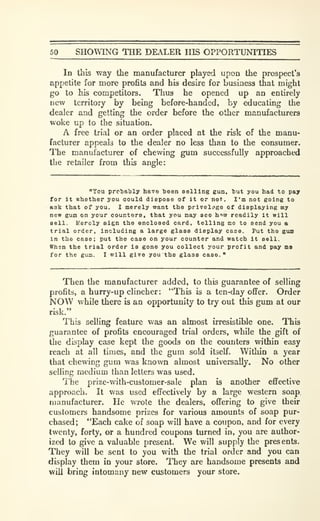
"Your p^roflts on soap sales are limited. You can't
«ell more soap without some inducement to bring in more buyers--
new customers. During the summer we are going to give away base
"balls to the boys of your town who save our seals. They can't
get the seals unless their mothers buy this aoap, but that free
TRIAL OFFERS TO PROVE QUALITY 21
baseball (and It la well made) will have every boy teasing his
mother to buy this eoap. Each cake of Pure Cream soap contains &
seal. Five seals call for a baoe bell. These prize base balls
are furnished by us and sent to you with the case of soap- -send
In the order today and have every boy in town plug for your
store.
"Vo will advortlsa Para Cream soap and the free base
balls In your local papers. Tou want to be one of the retailers
handling it. The enclosed order blank includes the special offer.
You need only write your name at the bottom and the trial case oj
soap will be sent at once. Unless you want your competitors to
reap the harvest of this caEpalgn, fill out the blank and mail
to US today.
"
One of the most effective schemes for clinching the dealer's
order is to guarantee sales—to OiTer him the privilege of
returning unsold goods at the end of a certain period
in case he so desires. A wholesale mercantile house,
which aimed to put out a line of hosiery selling for more money
than the average brands because of a new feature in its manu-
facture, sent out this letter:
"When you order a stocic of hosiery you never know just
how long there will be a demand for that particular grade of
goods. You may have to dispose of any surplus stock by selling
at reduced prices, cutting your profits, and there is always the
chance that you will lose money on the order
"So certain are we of the demand for Elwood brand
hosiery, which is made with a double wo-sen heel and toe that we
are prepared to protect you ab3olutely--to guarantee you a sat-
isfactory sale on Elwood brand and make this exceptional offer:
We guarantee to take back all unsold goods, and refund your money
at the end of the season, if you feel that you do not wish to
carry them longer.
"
The dealer, given confidence by the guarantee from the
manufacturer, is made to feci that he is taking small risk. The
sale of the goods js practically assured and seldom are unsold
goods returned at the close of the season.
A thirty-day trial offer is one of the most effective argu-
ments in a "selling campaign. It is an absolute guarantee that
can be adapted so that it will not conflict with the working of
any other limited offer or scheme of a temporary nature. Fol-
lowing arguments consis^nt with good quality and economical
22 PLAYING UP DISTINGUISHING FEATURE
value, this scheme frequently proves the final inducement to
bring the sale. It adjusts itself to almost any product. A
concrete illustration is found in the letter of a tooth brush
manufacturer who WTote the dealers:
"By accepting our 30-day trial offer, you can prcve for
yourself that the Olire tooth brush is all that we claim for it.
Just to convince you that it will aell even more readily than wo
have claimed, we agree to fill thia order on a 30-day free trial
taals. If for any reason you do not wish to continue selling
thi3 brand of brushes after the 30-day trial--simply ship hack
the unsold part of the order at our expense and mail us a check
for the brushes you have sold.
"
There can be no more effective way of securing the
dealer's confidence. He takes no risk, incurs no expense,
and until the end of the thirty days may sell the article and
collect his profits without incurring any responsibihty.
A special feature or distinguishing characteristic furnishes
a selling argument that is most advantageous, and manu-
facturers frequently add attachments to machines or put
on some new apphance with the primary object of pro-
viding a talking point. The attachment may be something
that is very seldom used, but it gives a distinguishing char-
acteristic that tips the scale in favor of that particular ma-
chine or device.
A manufacturer whose sales failed to come up to expecta-
tions added a distinguishing feature and wrote this letter
to dealers:
"A good safety razor must fill every demand of the man
vho uses it or your sale will be small. Every good safety razor
should be made to come apart easily in order to cleanse It. If
it doesn't the razor will rust and your customers will bo dis-
satisfied. The Sanito safety razor permits the ub-o of the blado
as though it wore a straight, old fashioned razor, for" times
when the man using it wants to trim about hie beard. -Cntil you
have a razor with all these appliances you won't bo able to eell
half the men in your town."
GETTING DEALERS' NAMES FROM CONSUMERS 23
The dealer was plied with these arguments on the spe-
cial selling features of the article, and in addition to the letters,
all inquiries coming to the manufacturer from consumers as the
result of the advertising were forwarded to him. Then the sale-
clinching letter followed:
"Sahlto razors come apart by sliaply preielng a small
spring on ihd olde-and may "be cleaned and dried e&ally. It takes
only a moment. The Sanito baa an aujclllary handle which permits
the use of the h'lade as a straight razor. This makes it equal to
every etoergferrcy. And icen vrill appreciate this fact. You want to
eeli thi» razor; you want the additional salea and profits that a
POPULAR RAZOK with a POPULAR FBICS will hrins you. "
The special feature of the article rendering it more
adaptable to the needs of buyers, may be played upon to
get the dealer's order. The campaign of the razor manufac-
turer is an example of how the special selling feature may be
used. The scheme adjusts itself as readily to other devices.
Through a direct appeal to women, a wholesaler of a new
brand of codfish secured an effective approach for his letters
to dealers. He offered a five-pound box of XX brand codfish
to any one who sent in a cooking receipt.
When a cooking receipt came from the housewife, he
immediately wrote, thanking her for it, and explaining the
proposition which hooked up with a selling scheme this
way:
"Of course you know that we nerer distribute direct to
consumers. We send the prize box of fieh to dealers who distrib-
ute them. So if you will send us tho name of your regular grocer
wo will mail him the codfish and give hia instructions to deliver
to you. *•
In this way the name of the dealer was secured and a wide
opening made through which to get his business. A letter ac-
companying the prize codfish told the dealer, "We are sending
you a box of our extra fine brand of codfish, which is creating so
much interest all over the country, and ask that you give it
to Mrs. Blank when she calls." Then a special proposition
was made to the dealer, pointing out the desirability of
carrying XX iu stock.
24 THE LURE OF THE "PRIVATE BRAND"
A series of dealer letters followed the sending of a prize
box of fish, and so eflFective was the approach that this par-
ticular wholesaler sold over forty per cent of the dealers
written.
The scheme is not limited to one product. It is applicable
to any food stuff sold through dealers to consumers.
Originality in the letter itself is often effective as an order-
getter. A Boston wholesale grocer employed a scheme in
his letters to give an added impression of value to a brand
of sardines which were purchased through a London
broker. So instead of writing the dealers personally, he sent
out letters over the signature of the London broker and on the
brokers personal stationery. This letter recommended that
particular brand of sardines, called attention to the whole-
saler as the local jobber, and gave the dealer confidence.
Then the wholesaler followed this up with a personal letter
which produced the desired results. The foreign mailed
letter held an unusual appeal to the dealer, and seemed to
impress him with the fine quality of the sardines.
As a direct approach to the dealer by the manufacturer,
the offer of a "Private Brand" of goods is very effective. This
scheme gives the manufacturer an appealing argument for
his goods without preliminary creation of consumer demand.
It offers the dealer an opportunity to adjust the goods to his
particular business and to put his personal O. K. on the product.
Price is also a strong argument in this scheme, since the manu-
facturer is usually willing to quote a lower price when a con-
siderable quantity of goods are sold under contract.
While this scheme may or may not be backed up by an offer
of the manufacturer to aid the dealer in turning the goods by
advertising, circularizinrj or store display, it is usually a strong
inducement to clinch the dealer's business.
Although it is evident that every scheme for getting the
dealer's business must be twisted and moulded to suit condi-
tions in the selling field and in the manufacturer's business,
these examples outline the fundamental principles of several
successful campaigns.
Getting Business From Four-
Comer Towns
PART XI HOW TO GET BUSINESS FROM DEALERS CHAPTER 51
IN EVERY state there are hundreds of Utile coun-
try merchantsf situated off the main highways of
business^ w}wse orders most manufacturers and
jobbers never solicit. These are the obscure cross-
roads dealers on whom salesmen seldom call
because of the difficulty of reaching them. Al-
though 'practically inaccessible, each is usually in
the heart of a prosperous farming community—
the center of a cluster of homes. Yet a great
bulk of his trade can be handled by mail—by
methods explained in this chapter
TAKE your map of Illinois, or Pennsylvania, or Nebraska,
and run your finger down one of the railroad lines.
You will find familiar names that appear on the
salesman's order blanks. But on the branch lines and in the
open spaces in light face type you will find Roseville and
Middle Creek and Brown Center. Look up their population
and you will find their inhabitants number anywhere from
twenty to two hundred and twenty. Your order blanks show
no records of sales in these towns, or at most records are
widely separated.
The business of the four-corner town merchant has not
been extensively cultivated by the majority of manufac-
turers. His stock is usually so meager and his orders so
small that an expensive salesman's visit is not warranted.
Then the salesman usually steers clear of this class of deal-
ers for the trip over country roads requires too much time.
25
23 WHERE TO GET USTS OF SMALL RETAILERS
Frequently it would be necessary to insist upon cash orders,
for the merchant may not be rated, or his rating may be too
low to allow a line of credit.
But the small dealer's business can be secured, provided he
is solicited in the right way. In fact, here is a large field,
entirely neglected by hundreds of concerns that might get
in on this extra business if they went after it in an enlightened
and systematic way. It is a primary necessity, however, that
the product is one for which a demand already exists or can be
easily created—staples that are in use everywhere.
Practically all this businiess is now secured by general mail-
order houses, simply because they are the only concerns that
have made any real effort to get it. There is no reason why
the manufacturer could not adept the mail-order plan of getting
this business and thereby add a desirable outfet for his goods.
He can organize a small mail-order department as an adjunct
to his regular selling plan. Nor is this a difficult problem.
It b highly profitable, because the selling costs are so
small.
To start such a department you must have the names and
addresses of dealers not reached by regular salesmen. Then
you must Ikt and classify these names. Names may be copied
from mercantile agency books but they list the names of only
the larger merchants. A more detailed method, though
more thorough, is to write to bankers, or newspaper men, or
railroad station agents, and ask for the names of storekeepers
removed from the main business centers. The merchants must
have dealings with some bank in the adjacent town, they must
get supplies from railroads, and they often advertise in the coun-
try papers. In asking for the names it is well to state frankly
the purpose for which you want the names, for while country
business men are usually very accommodating in such matters,
they are suspicious of city business methods. Some concerns
pay a small sum for lists of names or send some souvenir that
the recipient will appreciate.
A third method is to advertise for names. With maga-
zines as a medium, one sales manager used this copy:
"This ofTer is for small town retail merchants," and then fol-
lows the specific proposition; "If you have trouble in getting
trade, or if you have difficulty in holding customers, I can help
you. My business is supplpng Small country merchants with
THE PERSONAL VERSUS THE FORM LETTER 27
helpful hints on how to attract trade by window and store dis-
plays, and how to hold trade against the competition of city
bargain counters. There is no charge for this information
which includes a 200-page booklet telling how to run a retail
store successfully. Write for the- booklet." The names of
merchants who asked for this information form the basis of
a prospects' list.
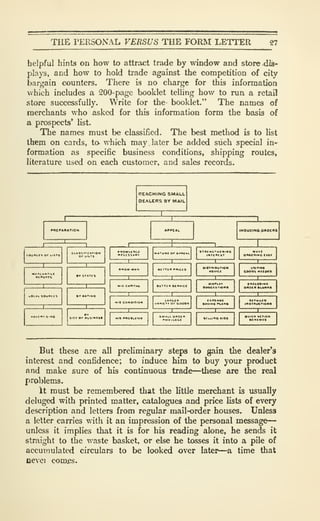
The names must be classified. The best method is to list
them on cards, to which may later be added such special in-
formation as specific business conditions, shipping routes,
literature used on each customer, and sales records.
PRtPAAATlOM
RCACHING SMALL
DEALERS BY MAIL
INOUCfNO.OAOCnS
f
58 KNOM.EDGE OF LOCAL CONDITIONS
It is only the letter under first class posLige which carries
the impression of the personal message. Give your letter
the more effective appeal of the two-cent mailing. Where
the proposition involves as large an outlay as an order of stock
from a merchant, every possible detail which may add force
to the appeal, must be carefully weighed. The four-corners*
merchant has learned to "spot" a form letter, and it is a mistake
to send him a circular letter, poorly filled in, or carelessly signed,
in the belief that he will think it a personal message. He
knows the difference, and a printed page or an undisguised
general communication makes a better impression than a
"sloppy" form letter.
Before you approacn the small dealer with your proposi-
tion, you must know your man. You must know the condi-
tions surrounding his business, his problems and his limitations.
The difficulties he encounters in selling—the obstacles that
hinder the development of his business—are unlike those of any
other class of dealers. Usually he has no adequate stock room,
no attractive display space, and frequently insufficient capital
to buy a large stock of any line, even though he might want
to. He must fight against great odds in competition. Mail-
order houses are his greatest bugbear, because they often take
the cream of his customers' trade—leaving him only the emer-
gency accommodation business. Then he must fight to keep
his customers' patronage and discourage their periodic trips
to the county seat or near-by city stores. Besides, he has no
adequate medium of attracting trade as has the town merchant
with his newspaper advertising. All these problems you must
know and understand. You must be a merchant at heart
if you would talk understandingly to the merchant.
A sentence, or a phrase, or even one word, may betray
to the merchant the fact that the writer of the letter fails to
appreciate his specific business problems, and thus kill tlie other-
wise effective a'rgument. Hence the importance of knowing
tiiese conditions. Take for instance the argument intended
to persuade the dealer that a certain brand of soaps will
best meet the needs of his customers. Here a suggestion that
he order a quantity out of keeping with the demand shows
him that you fail to appreciate how small his trade is. Or the
suggestion that a quantity of cut glass dishes be added to his
stock of glassware, when it is only in rare cases that the cross-
THE ARGUMENT OF "MORE PROFITS" 29
roads merchant has a call for such an article, immediately
convinces him that you fail to understand his class of trade.
A loss of confidence is the natural result. All other advice
becomes valueless.
In your letters that seek to carry an element of per-
sonality, keep to the level of the country merchant. Don't
shoot over his head; for instance, don't use the same phrase-
ology that you would employ when you address a city banker.
Convey the message to the little dealer in phraseology with
which he is familiar; use colloquialisms without sacrifice of
dignity.
It is always human interest that reaches out and touches
the cross-roads merchant—the letter that dips into the midst
of his interests is frank, homely, personal and enthusiastic.
Keep to these standards in your message and you will drive
the argument straight through the dealer's natural conserva-
tism.
Your letter must strike a vital point in his business in its
opening paragraph. To secure an effective angle on which
to base your approach, consider the things which most vitally
interest him. Like his city competitor he wants to enlarge
his business. He wants to get more sales and profits.
His ever insufficient capital gives an opening for this letter
to reach,him effectively:
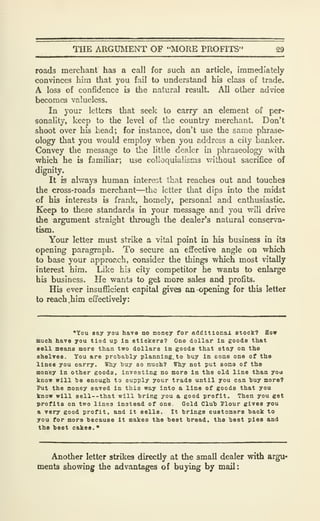
"You say you have no money for additionax stock? How
much, have you tied up in stickers? One dollar in goods that
sell means more than two dollars in goods that stay on the
shelves. You are prohably planning. to huy in some one of the
lines you carry. Why buy so nuch? Why not put soma of the
money in other goods, investing no more in the old line than you
know will he enough to supply your trade until you can huy more?
Put the money saved in this way into a line of goods that you
know will sell--that will bring you a good profit. Then you get
profits on two lines instead of one Gold Club Jlour gives you
a very good profit, and it eells. It brings customers back to
you for mors because it makes the best bread, the best pies and
the beet cakes.
*
Another letter strikes directly at the small dealer with argu*
ments showing the advantages of buying by mail:
80 WHERE TO SELL BROKEN T,OTS
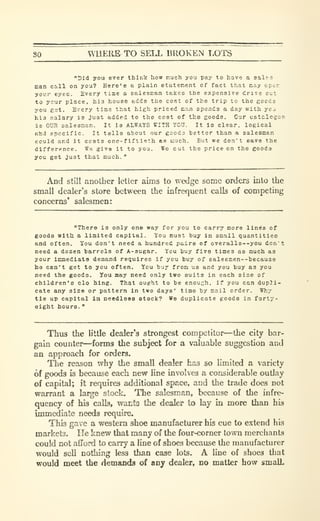
"Did you ever think how much you pay to have a salea
Ban cill on you? Here'o a plain statement of fact that cay oper.
your eyes. Every tiae a salesman takes the expensive dri^e out
to ycur place, his house adds the coBt of the trip to the goods
you get. Every time that high priced nan spends a day with you
his salary is Just added to the cost of the goods. Our catalcjus
is OUH oalesaan. It la ALWAYS WITH YCU. It Is clear, logical
ahd specific. It tells about our goodo better than a saleemen
could and it costs one-flftleth as much. But we don't save the
difference. We glva it to you. Wo cut the price on the goods
you get Just that much.
"
And stiil another letter aims to wedge some orders into the
small dealer's store between the infrequent calls of competing
concerns' salesmen:
"There is only one way for you to carry more lines of
goods witU a limited capital. You must buy in small quantities
and often. You don't need a hundred paire of overalls--you don't
need a dozen barrels of A-ougar. You buy five times as much as
your Icmediata demand reijulres if you buy of sale6men--becau3a
ho can't get to you often. You buy from us and you buy as you
need the goods. You may need only two suits in each sise of
children's clo hing. That ought to be enough, if you can dupli-
cate any size or pattern in two days' time by mail order. Why
tie up capital ia needless stock? We duplicate goods in forty-
eight hours.
"
Thus the little dealer's strongest competitor—the city bar-
gain counter—forms the subject for a valuable suggestion and
an approach for orders.
The reason why the small dealer has so limited a variety
of goods is because each new line involves a considerable outlay
of capital; it requires additional space, and the trade does not
warrant a large stock. The salesman, because of the infre-
quency of his calls, wants the dealer io lay in more than his
immediate needs require.
This gave a western shoe manufacturer his cue to extend his
markets. He knew that many of the four-corner town merchants
could not afford to carry a line of shoes because the manufacturer
would sell nothing less than case lots. A line of shoes that
would meet the demands of any dealer, no matter how smalL
HOW TO OUTLINE SELLING PLANS FOR DEALERS 31
would necessitate too heavy an outlay of money, with the
whole-case policy. So he determined to sell less than case
lots.
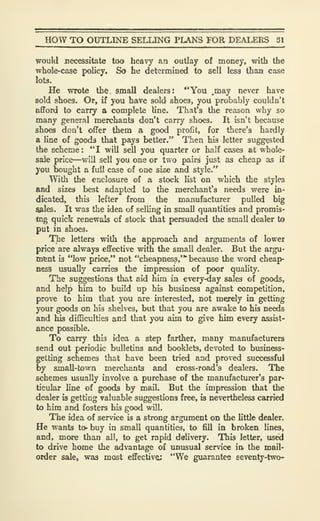
He wrote the. small dealers: **You .may never have
sold shoes. Or, if you have sold shoes, you probably couldn't
afford to carry a complete line. That's the reason why so
many general merchants don't carry shoes. It isn't because
shoes don't offer them a good profit, for there's hardly
a line of goods that pays better." Then his letter suggested
the scheme: "I will sell you quarter or half cases at whole-
sale price—will sell you one or two pairs just as cheap as if
you bought a full case of one size and style."^
With the enclosure of a stock list on which the styles
and sizes best adapted to the merchant's needs were in-
dicated, this lefter from the manufacturer pulled big
^les. It was the idea of selling in small quantities and promis-
ing quick renewals of stock that persuaded the small dealer to
put in shoes.
The letters with the approach and arguments of lower
price are always effective with the small dealer. But the argu-
ment is "low price," not "cheapness,"* because the word cheap-
ness usually carries the impression of poor quality.
The suggestions that aid him in every-day sales of goods,
and help him to build up his business against competition,
prove to him that you are interested, not merely in getting
your goods on his shelves, but that you are awake to his needs
and his difficulties and that you aim to give him every assist-
ance possible.
To carry this idea a step farther, many manufacturers
send out periodic bulletins and booklets, devoted to business-
getting schemes that have been tried and proved successful
by small-town merchants and cross-road's dealers. The
schemes usually involve a purchase of the manufacturer's par-
ticular line of goods by mail. But the impression that the
dealer is getting valuable suggestions free, is nevertheless carried
to him and fosters his good will.
The idea of service is a strong argument on the little dealer.
He wants to- buy in small quantities, to fill in broken lines,
and, mOTe than all, to get rapid delivery. This letter, used
to drive home the advantage of unusual service ia the mail-
order sale, was most effective; *'We guarantee seventy-two-
32 QUICK DELIVERIES AS A SELLING ARGUMENT
hour deliveries to customers within a radius of one hundred
miles. This is a hard and fast poHcy of ours. It practically
makes our great stock room an addilion to your store, since
you can fill in broken lines, duplicate goods, and supply your
customer's orders on new lines wilhia three days."
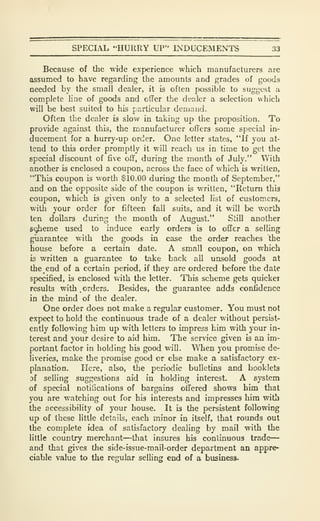
24 SUIT TRIAL ORDER, FORM A
CONSISTS OF 4 MEN'S SUITS EACH. TO RETAIL AT SIX PRICES i.12:
SIO.OO, $12.50, SI 3.50, $1 5.0O, $16.50, $18.00
TOTAL COSt'whOLESALE $216 00; SELLS TOR S342 00. PROFIT S126 00.
SHIP THE ABOVJ ASSORTMENT OF "BLAN K BR AND" CLOTH I NO TO APPLY
'
SEASON AND. WILL RETURN'ANY, ORALLON RECEIPT OF
SHIPMENT. THAT IS NOT ENTIRELY SATISFACTORY
PRING t,
INTER j
24 SUIT TRIAL ORDER, FORM
CONSISTS OF 4 MEN'S SUITS EACH, TO RETAIL AT SIX PRICES. VIZ:
$12.50, S13.50, $15.00, S16.50, SI 8.00, S20.60
TOTAL COST WHOLESALE $240l00: SELLS FOR $302 00. PROFIT $142.00
SHIP THE ABOVE ASSORTMENT OF "BLAWK BnAND" CLOTH 1 NO TO APPLY
SPRING  SEASON AND. WILL RETURN ANY. OR ALL ON RECEIPT OF
WINTtH )
SHIPMENT, THAT IS NOT ENTIRELY SATISFACTORY
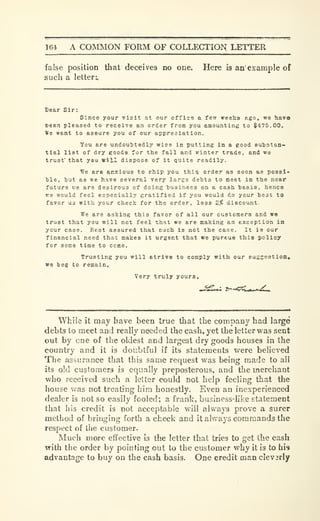
(POST OFFICE).
. SHIPPING POINT.
OEPT, NO. 1
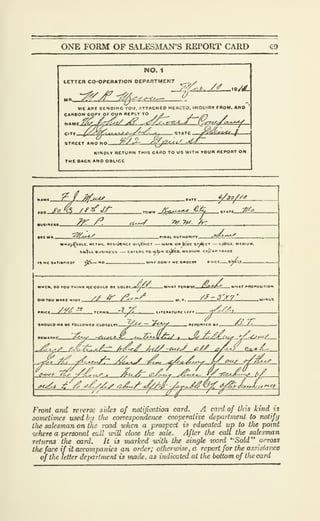
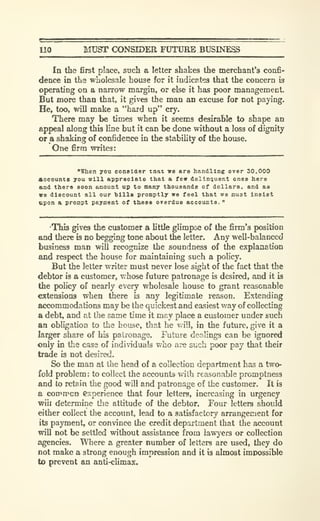
One manufacturer puts up trial orders, selecting goods that will meel the
dejnf,rui of tlie small dealer. It is certainly easij for tlie dealer to Jul out
whichever form lie wants
But a sale clincher must be put on the ktter. This is merely
making it easy for the recipient to answer and order. A return
envelope should accompany the letter, and reference made
to it in some such way as this: "Just slip your order in the
enclosed stamped envelope so it will reach the proper depart-
ment head and insure prompt attention." An order blank
slip with specific directions for ordering should be enclosed,
as simplicity and convenience are vitally important.
SPECIAl. "HURRY UP" LNDUCEMENTS 33
Because of the wide experience which manufacturers are
assumed to have regarding the amounts and grades of goods
needed by the small dealer, it is often possible to suggest a
complete line of goods and offer the dealer a selection which
will be best suited to his particular demand.
Often the dealer is slow in taking up the proposition. To
provide against this, the manufacturer offers some special in-
ducement for a hurry-up order. One letter states, "If you at-
tend to this order promptly it will reach us in time to get the
special discount of five off, during the month of July." With
another is enclosed a coupon, across the face of which is written,
"This coupon is worth $10.00 during the month of September,"
and on the opposite side of the coupon is written, "Return this
coupon, which is given only to a selected list of customers,
with your order for fifteen fall suits, and it will be worth
ten dollars during the month of August." Still another
S(jheme used to induce early orders is to offer a selling
guarantee with the goods in case the order reaches the
house before a certain date. A small coupon, on which
is written a guarantee to take back all unsold goods at
the end of a certain period, if they are ordered before the date
specified, is enclosed with the letter. This scheme gets quickei
results with .orders. Besides, the guarantee adds confidence
in the mind of the dealer.
One order does not make a regular customer. You must not
expect to hold the continuous trade of a dealer without persist-
ently following him up wih letters to impress him with your in-
terest and your desire to aid him. The service given is an im-
portant factor in holding his good will. When you promise de-
liveries, make the promise good or else make a satisfactory ex-
planation. Here, also, the periodic bulletins and booklets
of selling suggestions aid in holding interest. A system
of special notifications of bargains offered shows him that
you are watching out for his interests and impresses him with
the accessibility of your house. It is the persistent following
up of these little details, each minor in itself, that rounds out
the complete idea of satisfactory dealing by mail with the
little country merchant—tliat insures his continuous trade
—
and that gives the side-issue-mail-order department an appre-
ciable value to the regular selling end of a business.
Opening New Selling Fields
by Mail
PART XII HOW TO OPEN NEW TERRITORY BV LETTER CHAPTKR 5j
'
IF TRADE were limited to the customers who
came into 'personal touch iviih the salesmen, buy-
ing aJid selling ivould be limited to the corner
store and local factories. But the mails have en-
abled the buyer to seek wider markets, overcoming
the handicaps of distance. To find such buyers
is the aim of every house that can extend its field
of operations by selling goods by letter. Here
are some ivays by which it has been done
MARKETING a product hitherto entirely unknown,
or expanding a business to a new field of trade, is
a big undertaking. Every producer, whether he
is the bead of a small business with a limited capital, or of a
great corporation with a hundred-thousand-dollar selling ap-
propriation, must evolve some effective method for extending
his markets. He must follovv' the road of least resistance and
cultivate inexpensive systems, for his profits will de-
pend, not so much upon the cost of production, as upon the
marketing of his goods at the least possible expense.
There arc several ways of marketing goods in a new terri-
tory—usually expensive and slow in producing results. Or, de-
mand may be created in time through high-priced advertising,
or salesmen may be sent into the field to "work up business"
—
another slow and expensive method.
The simple and economical scheme is to use letters as the
selling medium. They creep in silently behind the competitor
and insert the wedge that opens an entry for the new product.
THE ATTITUDE OF THE DEALER 35
They impress the consumer with arguments on quah'ty and
merit; they educate him to prefer this article for some good
reason and thus create a demand. They get customers and
build up trade. Usually the manufacturer does not care
to sell direct to the consumer—he is a producer and v/ants to
avoid the details of retailing—and with a following of customers
to oflFer with his goods to the dealer, he commands atiention.
In starting a campaign to educate the consumers in a new
territory three things are necessary: to determine the extent
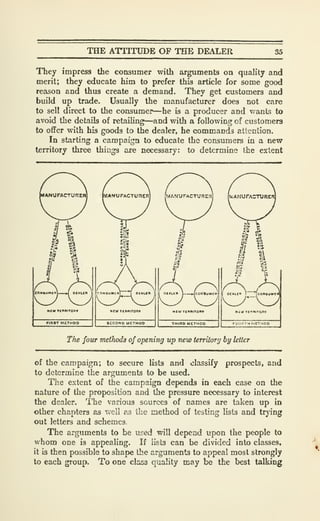
The four methods of opening up new territory by letter
of the campaign; to secure lists and classify prospects, and
to determine the arguments to be used.
The extent of the campaign depends in each case on the
nature of the proposition and the pressure necessary to interest
the dealer. The various sources of names are taken up in
other chapters as well as the method of testing lists and trying
out letters and schemes,
The arguments to be used will depend upon the people to
whom one is appealing. If lists can be divided into classes,
it is then possible to shape the arguments to appeal most strongly
to each group. To one class quality may be the best talking
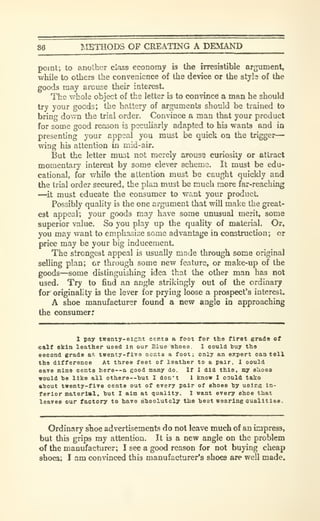
86 IiIBTHODS OF CREATING A DEMAND
point; to another class economy is the iireaistible argument,
while to others the convenience of the device or the styb of the
goods may aroiise their interest.
The whole object of the letter is to convince a man he should
try your goods; the battery of arguments should be trained to
bring down the trial order. Convince a man that your product
for some good reason is peculiarly adapted to his wants and in
presenting your appeal you must be quick on the trigger
—
wing his attention in mid-air.
But the letter must not merely arouse curiosity or attract
momentary interest by some clever scheme. It must be edu-
cational, for while the attention must be caught quickly and
the trial order secured, the plan must be much more far-reaching
—^it must educate the consumer to want your product.
Possibly quality is the one argument that will make the great-
est appeal; your goods may have some unusual merit, some
superior value. So you play up the quality of material. Or,
you may want to emphasize some advantage in construction; or
price may be your big inducement.
The strongest appeal is usually made through some original
selling plan; or through some new feature, or make-up of the
goods—some distinguishing idea that the other man has not
used. Try to find an angle strikingly out of the ordinary
for" originality is the lever for prying loose a prospect's interest.
A shoe manufacturer found a new angle in approaching
the consumer:
1 pay twenty-eicut cents a foot for the first grade of
calf skin leather used in our Blue shoes. I could buy the
second grade at. twepty-flva cents a foot; only an expert can telX
the difference At three feet of leather to a pair. I oould
eave nine cents here--a good many do. If I did this, my ehoea
would be like all othere--but I don't I know I oould tako
about twenty-five cents out of every pair of shoes by uslrg In-
ferior material, but I aim at quality. 1 want every shoe that
leaves our factory to have absolutely the best wearing aualltles.
Ordinary sTioe advertisements do not leave much of an impress,
but this grips my attention. It is a new angle on the problem
of the manufacturer; I see a good reason for not buying cheap
shoea; I am convinced this manufacturer's shoes are well made.
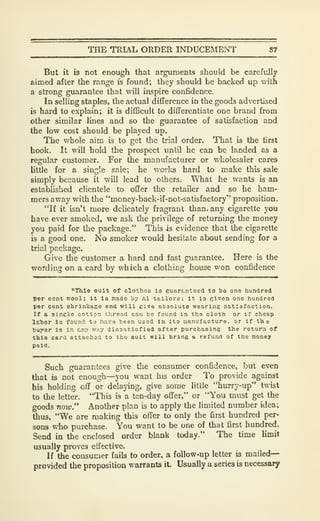
THE TRIAL ORDER INDUCEMENT 87
But it 13 not enough that arguments should be carefully
aimed after the range is found; they should be backed up with
a strong guarantee that will inspire confidence.
In selling staples, the actual diflference in the goods advertised
is hard to explain; it is difficult to differentiate one brand from
other similar lines and so the guarantee of satisfaction and
the low cost should be played up.
The whole aim is to get the trial order. That is the first
hook. It will hold the prospect until he can be landed as a
regular customer. For the manufacturer or wholesaler cares
little for a single sale; he worlds hard to make this sale
simply because it will lead to others. What he wants is an
established clientele to offer the retailer and so he ham-
mers away with the "money-back-if-not-satisfactory" proposition.
"If it isn't more delicately fragrant than, any cigarette you
have ever smoked, we ask the privilege of returning the money
you paid for the package." This is evidence that the cigarette
is a good one. No smoker would hesitate about sending for a
trial package.
Give the customer a hard and fast guarantee. Here is the
wording on a card by which a clothing house won confidence
"Tlilo -suit of clothes 19 guaranteed to be one hundred
per cont wool; it Xa made '07 Al tailors; It la given one hundred
per cent ehrinkage and will eive absolute wearing satisfaction.
If a slnele cotton thread can ba found in the cloth or if cheap
leljor l3 found to have been used In its manufacture, or if the
buyer is in any way diosatlefied after purchasing the return of
this card attached to the suit will bring a refund of the money
paid.
Such guarantees give the consumer confidence, but even
that is not enough—you want his order To provide against
his holding off or delaying, give some little "hurry-up" twist
to the letter. "This is a ten-day offer," or "You must get the
goods now" Another plan is to apply the limited number idea;
thus, "We are making this offer to only the first hundred per-
sons who purchase. You want to be one of that first hundred.
Send in the enclosed order blank today." The time limit
usually proves effective.
If the consumer fails to order, a follow-up letter is mailed
—
provided the proposition warrants it Usually a series is necessary
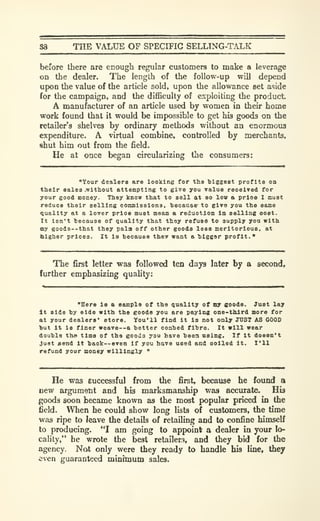
88 THE VALUE OF SPECIFIC SELLING-TALK
before there are ecough regular customers to make a leverage
on the dealer. The length of the follow-up will depend
upon the value of the article sold, upon the allowance set aside
for the campaign, and the difficulty of exploiting the product.
A manufacturer of an article used by women in their home
work found that it would be impossible to get his goods on the
retailer's shelves by ordinary methods without an enormous
expenditure. A virtual combine, controlled by merchants,
shut him out from the field.
He at once began circularizing the consumers:
"Your dealers are looking for the 1)122681 profits on
their sales .without attempting to give you value received for
your good money- They know that to sell at so low a price I must
reduce their selling comnissiona. hecatise' to give you the same
Quality at a lover prioe must mean a reduction la selling cost.
It isn't because of quality that they refuse to supply you with
my goods--that they pala off other goods less meritorious, at
blgher prices. It is because tbev want a bigger profit."
The first letter was followed ten days later by a second,
further emphasizing quality:
"Here Is a sample of the quality of oy eoods. Just lay
It side by side with the goods you are paying one-third more for
at your dealers* store. You'll find It is not only JUST AS COOS
but It is finer weave--a better coabed fibre. It will wear
double the time of the goods you have beea using. If It doesn't
Just £end It back—even If you have used and soiled it. I'll
refund your noney willingly "
He was successful from the first, because he found a
new argument and his marksmanship was accurate. His
goods soon became known as the most popular priced in the
field. When he could show long lists of customers, the time
was ripe to leave the details of retailing and to confine himself
to producing. "I am going to appoint a dealer in your lo-
cality," he wrote the best retailer.^, and they bid for the
agency. Not only were they ready to handle his line, they
-even guaranteed minituutn sales.
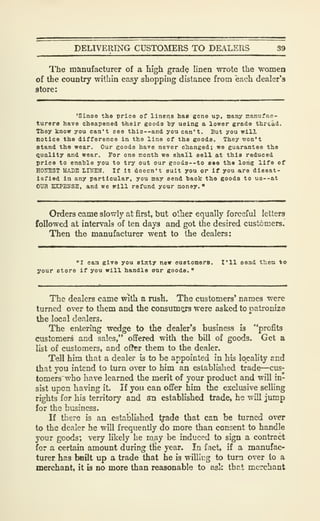
DELIVERING CUSTOMERS TO DEALERS 39
The manufacturer of a high grad? linen wrote the "women
of the country within easy shopping distance from each dealer's
store:
'Sinoe the price of linens has gone up, many manufac-
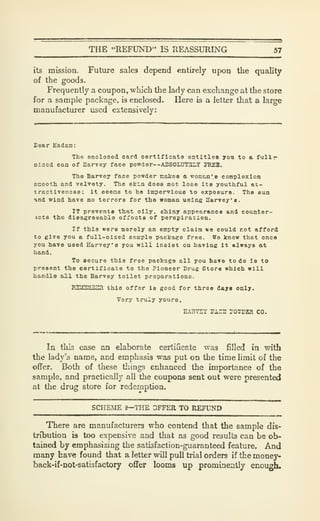
turers have cheapened their goods by using a lower grade thread.
They know you can't see this —and you can't. But you will
notice the difference in the line of the goods. They won't
stand the wear. Our goods have never changed; we guarantee the
Quality and wear. Tor one nonth we shall sell at this reduced
price to enahle you to try out our eood3--to see the long life of
HOraST ISADE LINEN. If it doecn't suit you or if you are dissat-
isfied in any particular, you may send baok the goods to U3--at
OUR EXPENSE, and we will refund your money."
Orders came slowly at first, but otlier equally forceful letters
followed at intervals of ten days and got the desired customers.
Then the manufacturer went to the dealers:
"I can give you sixty new customers. I'll send them *o
your store if you will handle our goods."
The dealers came with a rush. The customers' names were
turned over to them and the consum^jrs were asked to patroniza
the local dealers.
The entermg wedge to the dealer's business is "profits
customers and sales," offered with the bill of goods. Get a
list of customers, and oflher them to the dealer.
Tell him that a dealer is to be appointed in his locality and
that you intend to turn over to him an established trade—cus-
tomers'who have learned the merit of your product and will in-
sist upon having it. If you can offer him the exclusive selling
rights for his territory and an established trade, he will jump
for the business.
If there is an established tyade that can be turned over
to the dealer he will frequently do more than consent to handle
your goods; very likely he m.ay be induced to sign a contract
for a certain amount during tKe year. In fact, if a manufac-
turer has boilt up a trade that he is williug to turn over to a
merchant, it is no more than reasonable to ask that merchant
40 TIIE SPUR OF COMPETITION
to agree to buy a definite amount of goods during the year,
thus assuring his active interest in pushing their sale.
One firm writes to prospective dealers at this stage of the
negotiations:
"Since we are giving you an r^saured business —certain
profits, customers who will come to your store, while all you
have to do is to hand them out our goods and collect your pro-
fit3--it is only fair that you guarantee to treat these cus-
tomers wall. We want to make euro that when they come hack again
and again for our goods they will not he disappointed; we want
to make aure that you will keep these goods on your shelveo."
With this argument ai?d the leverage of certain customers
to whom the dealer may sell other goods, he is persuaded to
sign a contract for a specified quantity to be used during
the year—and having agreed to buy them, he is certaia to push
their sale.
If he falls down or loses interest, the manufacturer can go
out on a ^till hunt and work up more trade, and then go to
the dealer and say, "Look here what we have picked up
—
business that you ought to get, for it is right at your door. Go
after it hard, or we will have to place our line v/ith some other
dealer who appreciates this field."
No merchant cares to contemplate having a line taken away
from him and given to a more progressive competitor—and have
this competitor make capital out of the change^ It spurs him
to greater activity.
The manufacturer or the wholesaler who can appeal directly
to the consumer and develop a retail trade by mail possesses
a leverage that will force open the doors of the most conserva-
tive merchants; induce them to bid for the business and then
keep a pressure behind them that assures their continued
activity in pushing the goods.
Get the consumers; establish a clientele and your problem
of opening new territory through the retailers is solved.
How Manufacturers Drum
Up Trade For The DEALER
PART XII HOW TO OPEN NEW TERRITORY DY LETTER CHAPTER 53
THE DEALER does not care for merchan-
dise on his shelves, he wants trade. The big-
ger the demand for his goods, the greater are his
profits—and proportionally greater are his pur-
chases from the manufacturer. Hence it is to
the manufacturer's interest, not only to sell his
PRODUCTS to the dealer, but to deliver the DE-
MAND FOR THOSE PRODUCTS as well.
This chapter explains hoio some manufacturers
created a market for their goods as a lever in
getting the dealer's order
THE letter campaign which aims at developing a new
territory or marketing an unknown product, may be
directed at the dealer and the consumer simultaneously.
Instead of building up a clientele of mail-order cus-
tomers, the manufacturer may induce the dealer to
supply the demand immediately. The detai's of con-
ducting a' retail business are avoided, and the co-
operation of the dealer i§ secured in turning the trial
order into established trade.
Old selling arguments, price and quality—unless extraor-
dinary—fail to get under the skin of the dealer when applied
to a new and untried article. Why should he add a
new line and go out to drum up interest in it? Why should
he? What's the inducement? He must be offered more
than mere merchandise. His interests are along the lines of
sales, profits, customers, service. He cares nothing for the
42 THE DOUBLE-BARRELED LETTER CMIPAIGN
goods—^anyone can fill up a store with goods. What he wants is
a demand—trade. Give him a demand along with the goods.
It is a distinguishing feature of an article that appeals to
the consumer, while the selling power of this feature gets the
dealer's interest.
First, in this double-barreled campaign, play upon the fact,
in your letter to the dealer, that you have a feature with which to
secure the consumer's interest and get his business. Hammer
on your elaborate plans for circularizing the consumer in your
opening campaign—and you will have him taking notice.
Besiege the dealer with arguments on profits, sales, new busi-
ness that the campaign will create.
The success of this method depends largely upon the skill
shown in handling the arguments. You must make your new
feature or your better quality create a desire and then use the
other end of the club on the dealer—make him put in jour
products to supply the demand.
The clothing liianufacturer writes to the consumer.
"Just take thia coupon to ISr. Brown's etore and tell
him you want to try en a suit that's made RIC-HT--tell him you
trant only the clothes sold under our guarantee and show hias tho
coupon with its signed guarantee He will give you a try-on.
You are not in anyway o'bligated--you don't need to buy. Just go
in today and look ova:- the styles "
To the dealer he writes:
"Take care of your customers and they'll taJce care of
you. There's no profit in selling a man his first suit if that
one sale turns out to he your last to him.
"The first order means established trade—and we ara
BOing to get those first orders. $100,000 is being spent thie
opring in advertising our Uadeweli garments. Hot only in general
publicity but letters, personal letters, will be sent out to ths
desirable prospects. These letters will reach not only your
customers but many men who have never been in your store. You
g£.t this advertising free and you get their trade by putting in
enough of a stock so these oustomers will not be disappointed
when they call on you. We will do the rest; we will get them
into your store; we will furnish goods that will almost sell
themselves--it is up to you to show the Madewell garments and
•profit by this new business. •'
THE SOMETHING-FOR-NOTHING ARGUMENT 43
Style, fit, wearing qualities—these are the arguments you
use on the consumer; free advertising, new business, satisfied
customers, more profits—these are the arguments that land the
dealer. Once his order is placed, his money invested
in the goods, it is easy to get him to cooperate in push-
ing them.
A shoe manufacturer entering the field found it hard to
break into the retail stores with the hand-me-down arguments
of price and quahty, so he began to look for the weak point in
the manufacture of shoes. He decided it was the fit, and so he
loaded his letters with the one argument—fit. The letter to
the consumer called attention to the fact that this shoe was
made in quarter sizes, which mean absolute shoe comforL
"In3tead of having to wear your shoes six months befor«»
they are soft and plia'blo to your feet. Simply stick your feet
into the shoes.
"1 know you are Incredulous. I know you will not tako
my statements for any more than you have t&ken others; hut I am
willing to pay you to investigate. In order to show you that
everything I claim is hased on absolute fact, I am making you
this offer: within the next ten days you will take this letter
to your local dealer and with each pair of shoes you try on and
wear across the room, he will give you one of our celehrated
merserized shoe poll3hers--something ahsolutely new—simply rul)
it on the shoe two or three times and you will have a polish as
good as a hoothlack could give you in an hour's lahor. I am
willing to do this In order to get you to try on the shoe.*
Here an inducement was offered that was sure to bring the
recipient into the store, for the "something-for-nothing" propo-
sition touches a vulnerable spot in human nature.
An ^vance copy of this letter was sent to all the shoe mer-
ebants in a town. Each dealer was asked frankly if he could
afford to turn down these customers; if he was going to stand
idly by while thousands of customers marched into his com-
petitor's store.
"In fifteen days I'll have all the shoe users —every
buyer in town--flooded with letters similar to these enclosed.
I'm going to galvanize your town with these letters. I'm going
to send lots of buyers to s6me stores--! don't know yours will
be among them but I hope so.
"
44 GUARANTEEING DISPOSITION OF STOCK
To put on the final clincher, the manufacturer adds that it
Is a thirty-day offer, and he further, agrees to take back all
unsold shoes at the end of sixty days.
It is an irresistible offer. He cannot turn it down. Like
the consumer, he is told that the manufacturer knows that he is
incredulous, that he has heard all these things before, but
that the things now claimed are to be lived up to. He is offered
an opportunity to try out the proposition at a small investment.
Thus the dealer trade is established. The new territory is
opened up.
The consumers' side of the campaign may be carried one
step further, in order to give more weight to the club used on
the dealer. If you offer to send buyers to the store of the dealer,
instead of mere prospects, he will come on his knees to you.
A scheme of this kind was nsed by the manufacturer of
embroidery silk in a territory where his previous attempts to
establish trade had met failure.
He began a sales letter campaign direct' on the women
consumers. "With a certain amount of silk," the letter
promised, "a stamped piece ready for embroidery would be
given away free," and thousands of women were attracted by
the offer.
The purpose of the campaign, however, was not to create
a mail-order business, and purposely the stamped piece given
away required twice as much silk as the order accompanying
it. This insured a second purchase from each woman.
The manufacturer shaped his campaign so that a dealer
in each town should fill this second order. As rapidly as
possible the names of the first purchasers were classified by
towns. As soon as an impressive list had been collected the
leading dry goods house was assured that twenty, or forty, or
one hundred women wanted the company's silks—were ac-
tually waiting to buy them.
A successful milling company adopted the "double-bar-
reled-letter-campaign-on-consumer-and-dealer" plan to market
a new flour. It was the best grade of flour it had ever put out
—the very best it could make, and the natural course was to
make superiority the distinguishing feature. But any num-
ber of concerns were playing up quality—and shouting
just as loud—so it was not likely attention could be attracted
in that way.
THE "FREE SAIMTLE" COUPON 45
The guarantee was adopted both on the consumer and
on the dealer. Tested arguments were used in letters to the
women of the better class:
"We want to reach women who are looking for a truly
superior flour--a flour that will give the most complete satis-
faction, the best and most economical results that are possible.
M?8 have such a brand of flour It is TAR SUPERIOR to other
brands and we want to prove It to you. So we make this unusual
offer. You try our flour AT OUR risk—not at yours "
A couple of paragraphs were devoted to "reasons why"
the flour is superior and then the inducement was made:
"Try a sack of our flour, making as many bakings as
you wish. If you are not then satisfied that it is the best
flour that you can buy. your money will be returned without
argument All we ask is that you hand this coupon to your
grocer If your grocer does not sell our flour ho can easily
get It for you. If he won't, put a stamp on this coupon where
our address is given, sign your name with the name of your grocer
In the space and drop It in the mail box. Wa will see that he
supplies you. Do it today before you forget it "
1 coupon was enclosed—a coupon always possesses more
value than a plain letter or a free-for-all offer—and plainly stated
that the lady was to be the sole judge of the merit of the flour
and that a partly used sack could be returned for a refund of
the money.
To the dealers the manufacturers wrote:
"We are writing YOUR customers as well as every flour
user in your locality. We are flooding your customers as well
as your competitor's trade with reasons why they should use this
flour in preference to any other. Here is your chance to get an
advantage over your competitors. We will send hundreds of their
customers to your store inquiring for ovr flour. They won't
take any other because we have offered them an unusual money-
back-lf-not-satisfactory-after-using-guarantee. No other con-
cerns have offered them this. Get their business when it comes.
Don't~Io3e~l;he profit by letting them go elsewhere. Get a trial
ehipment now and supply thi-a demand. Pill out the enclosed trial
order blank and mail to us today."
46 THE RiVPID FIRE FOLLOW-UP
These arguments were applied in a series of ten letters.
The consumers got a letter every ten days; the dealers at the same
time. Orders came in by the hundred because the consumers
kept asking the dealers to get them a trial sack. Dealers were
forced to comply with the conditions made by the manufacturers,
because they wanted the profits of the sales. The consumer
guarantees brought back only here and there a request for
refunded money, because the flour, once given a fair trial,
showed its merit. When the- plan was running smoothly, the
managers decided to balance their books to determine how
near their estimates had hit the actual expenses of the cam-
paign. There was hardly a shade of difference.
This is the most familiar method of entering new territory
—
a campaign that centers on both the consumer and the
dealer. The advantage is that it may be used successfully ia
any line of business—dry goods, clothing, groceries, drugs,
novelties, specialties—they are all successfully marketed in this
way. It is effective been use of the double pressure that may
be exerted; the manufacturer and the consumer are both urging
the dealCT to handle the article; the manufacturer and the
dealer are both urging the consumer to use it.
There is hardly a business that does not have to fight for
an opening. Every manufacturer, importer, jobber and whole-
saler has to work to have the retailers handle his particular
line of goods. The merchant is besieged on ail sides by
salesmen and by propositions that are tempting~but his capital,
his space and the character of his trade necessitate his selecting
his lines carefully. It is so easy to buy goods; it is so hard to
establish a trade tl^at the manufacturer who will create that
demand for him, give him free advertising and lure cus-
tomers into his store, is surest of his trade. The campaigu
on consumer and dealer lands the business when either cam-
paign alone would fail.
How to Interest New Dealers
by Correspondence
PART Xll HOW TO OPEN NEW TERRITORY BY LETTER CHAPTER 54
DEALERS handle a manufacturer s froducts
because of the inducements of PftiCE, Exclusive
Territory, special Selling Plans or similar
specific advantages that the manufacturer can
ofer. To the extent that such selling propositions
can he put up to the dealer by maiU to that extent
is the manufacturer's selling f.eld eiilarged. In
this chapter are illustrated some of the methods
by which manufacturers have opened up new ter-
ritory by means of letters to dealers—letters that
offer attractive inducements in attractive form
THE problem of the manufacturer is to get the dealer
to handle his product. One manufacturer may reach
this end most readily by taking the circuitous route of
working up a clientele and using it as a bait to get the retailer,
another may make a flank attack, getting customers to bring
pressure in the rear while he brings pressure in front. A third
manufacturer may not be able to use either method effectively;
he may find it better to go direct to the dealer and make induce-
ments that will get his orders.
While quality and price do service here, as in every selling
campaign, every manufacturer strives to get his product in a
class by itself; he strives for some distinctive feature; some
actual improvement; some good talking point. He realizes
how difficult is the problem of introducing any product that is
merely "just as good as" old familiar brands. It must be better
or there must be some selling advantage if the live dealers are to
handle his product in addition to or in place of other goods.
47
4S EXCLUSIVE SELLING RIGHTS
The merchant moves in the course of least resistance
—
and that is to carry the goods he has previously sold, the
goods with which his trade is familiar. To change his course,
additional profits is the lure tha.t must be presented in some form
—more customers, more sales, a bigger business.
One of the familiar schemes is to oflfer the dealer exclusive
rights in his tov>'n. From chewing gum to automobiles, the
exclusive selling rights have a povv'crful appeal. The more
widely advertised the particular machine or brand or trademark,
the more ready is the dealer to take advantage of this publicity.
Here is the v/ay a manufacturer approaches the dealer
with an exclusive selling representative proposition:
Sear Sir:
Vou would not be justified, of course, in selling our
eafety razors unleaa you could make la«rger profits than you are
tion making.
But if you were convinced that you could make from
10^ to 20^ more profit than you are makine at present, you
Wouldn't hesitate a moment about taking on our line, would you?
Well that's exactly what you can do with our safety
razors.
Remember, when you buy of ua the transaction doesn't
end with our sending you the razors. We actually eeli the razors
for you.
First, by the enormoua magazine advertlslne which we
are constantly doing and which will cause people to oome to your
Store and ask for our razors.
Second, by use of printed matter bearing your came and
address which we furnish you free of charge.
Finally, be;ar In mind that you will be handling goods
With a reputation, and the very fact that you represent us in
your locality will add to your prestige, and this means dollars
to vou.
If you place an order for two dozen safety razors wo
will give you the exclusive selling rights in your city. The
demand will bo created; it is certain to grow. Are you going to
profit by this businoos or is your competitor?
Why not make the start to-day--you'll never regret It.,
Yours for greater profits,
SAHITO SAFETY RAZOR CO.
PLAYING UP NOVEL TALKING POINTS i9
Aside from improvements, better quality, and exclusive scll-
intr rights, there is the opportunity to interest the dealer in
some new article, such as a firelcss cooker, or the vacuum
cleaner. Here again the manufacturer has an abundance of
material for talking points, as progressive dealers are always
ready to take advantage of a growing demand.
Frequently the dealer can be waked up to some new oppor-
tunity. You may be able to point out to him the way to de-
velop some additional line of trade,
A manufacturer of automobile accessories opened up a
good territory by the application of this idea. He learned that
a new macadam road, then under process of construction,
would materially lessen the distance between two cities. It
would inevitably become a popular route for automobiles.
He immediately secured the names of hardware dealers in the
towns along the route, and began an educational campaign. The
significance of the new road had not occurred to them. He wrote
:
"Your new macadam route Ijetween B and W will te
completed early in the summer. Think of the great field that
will he opened up to automohilista hy this road. B is a city
cf half a million, with over ten thousand machines used solely
for pleasure riding. It la a safe estimate that half the auto-
mohiles owned in these two cities will use your road every month.
"You can see what a demand for automohile accessories
and supplies will be created. You are naturally in a position to-
supply th.i.s demand. You want the additional husineas and the
fine profits that the sales of automohilo accessories and sup-
plies offer. You can easily arrange to install a small depart-
ment in your husiness place for such stock.
"
And then the letters pointed out the special advantages of
the particular line of accessories offered. As a clincher the
manufacturer wrote:
/
"You don't want to wait until others have estahlished
a trade with the automobilists. You want to be Just a little
ahead of the other fellow3--you want to get the jump on them and
get your name among the motorists as the best place in the ter-
ritory for supplies. Here is a list of accessories that you will
need at first. Check off the amounts of each article you want
tand mail the list today. We will send complete instructions re-
garding the best way to arrange your stock and handle the business. "
50 SHOWING THE DEALER HIS OPPORTUNITIES
In this way the manufacturer played upon the prospect's
appetite for more profits and his desire for business that might
go to his competitors. Thus he opened up an entirely
new territory by being before-handed, by educating the
dealer and getting the order before the other manufacturers
woke up to the situation.
A free trial or an order placed at the risk of the manu-
facturer appeals to the dealer no less than to the consumer.
The manufacturer of chewing gum successfully approached
the retailer from this angle:
"You probably have been selling gum, but you had to pay
for It whether you could dispose of it or not. I'm not going to
ask that of you. I merely want the privelijge of displaying my
new gum on your counters, that you may see how readily it will
sell. Merely sign the enclosed card, telling me to send you a
trial order, including a large glass display case. Put the gua
in the case; put the case on your counter and watch it sell.
Whsn the trial order is gone you collect your profit and pay ms
for the gum. I will give you the glass case."
Then the manufacturer added, to this guarantee of selling
profits, a hurry-up clincher: "This is a ten-day offer. Order
NOW while there is an opportunity to try out this gum at our
risk."
This selling feature was an almost irresistible one. This
guarantee of profits encouraged trial orders, while the gift of
the display case kept the goods on the counters within easy
reach at all times, and the gum sold itself. Within a year
that chewing gum was known almost universally. No other
selling medium than letters was used.
The prize-with-customer-sale plan is another effective
approach. It was used effectively by a large western soap,
manufacturer. He wrote the dealers, offering to give their
customers handsome prizes for various amounts of soap pur-
chased; "Each cake of soap will have a coupon, and for every
twenty, forty, or a hundred coupons turned in, you are author-
ized to give a valuable present. We will supply the presents.
They will be sent to you with the trial order and you can
display them in your store. They are handsome presents and
will bring intomany new customers your store.
FEIEE DEMONSTRATIONS A INIAGNET 61
Something for nothing always attracts customers. Offer
them a prize with a certain number of purchases and they will
keep buying until they secure the present. Dealers know this.
Therefore, when you offer the dealer a legitimate profit on
his sales, plus presents for his customers, he is interested, for the
inducement is something tangible—it will draw trade to his store.
In addition to the usual selling argument used, one manu-
facturer of a mechanical device offered to give the dealer a
delivery cart, made to represent the article. "This cart will
be a constant reminder to your customers that you sell this
article, and it will be a continuous advertisement for you,"
Concerns making food products have found the free dem-
onstration proposition a winner with many merchants. If
the firm is trying to place a new breakfast food or a brand of
canned goods or a beverage, the merchant may be induced ta
put in at least a small order on the strength of a demonstration
which the manufacturer will conduct at the store. A personal
representative will take charge of it; the demonstration will
be advertised in the newspaper and by personal invitations
to the ladies to call and sample the product. No man-
ufacturer goes to the expense of such a campaign unless
his goods have merit that will lead to sales. So if the mer-
chant is not asked to lay in too big a stock, this proposition
is almost sure to get his name to an order blank.
Frequently a manufacturer will try to secure some local
influence to help push his goods onto the merchant's shelves.
An advertising contract dangled before the eyes of a news-
paper man will usually induce him to use his influence with
a local dealer to add a new hne:
"Would you like a contract for 350 inches of roofing
advertising? This is all new busineeQ. busineso that has never
been placed in weekly papers before. Electros of the ads are
furnished; you will be at no expense in handling this high class
advertising.
"If you want this business, go to some local dealer
and get him to place an order for 100.000 feet of double strength
roofing. This is the best roofing ever placed on the market; it
will be easy for any dealer to dispose of this amount in a few
weeks but he takes no risk, for the manufacturera will buy back
at the end of the year all unsold material. "
62 WORKING THROUGH LOCAL ORGANIZATIONS
"And if your paper makea good on this advertising it
will be a year-in and year-out source of income. The whole
thing hinges upon your confidence in your own medium as a method
of selllns roofing."
Such propositions are usually made through an adver-
tising agency and the newspaper man 13 often glad to act
as salesman, for the advertising is "velvet"—business that
he could not otherwise get. Then, too, he wants to stand
well with the agency in order to get its future orders.
The dealer is usually anxious to curry favor with the press
and will go further for the local newspaper man than for any
salesman the manufacturer might send out. Sometimes the
agency writes to the dealer at the same time to pave the way
for the call from the newspaper man:
"We are getting ready right now to sell more roofing
in your section than has ever been sold there before. Some dealer
can pocket the profits without HISKIHG OSB PEH2JY. Scores of new
customero can be brought to your doors asking for Double-atrengtli
rorfing. Do you want then? Your competitor's customers will
ccae to you looking for Doubla-strength. You may be able to
make them your customers on other lines as well. Do you want
tha opportunity? Only one man in a town oan sell this roofing.
That means that if we form a connaotion, tha undivided profits
from the e&les of our gooda are yours as long as we stay to-
gether. You are the only man wo havo written to because you can
handle the distribution most conveniently."
Occasionally other local influences are^ available. Manu-
facturers in unionizing a factory frequently get the local labor
leaders in strong union towns to bring pressure to bear on the
merchants to handle their goods, and in many places this is
a powerful influence. In rural districts the manufacturer
may be able to work through some grange organization, and
if some prominent individual can be induced to try a new
machine or device or line of goods, his name as a reference
carries weight with the dealer, and the same argument by which
the manufacturer induces the retailer to put in a new product
b available for the merchant in moving the good.s.
Dealers are almost always impressed by the pubhcity given
to any widely advertised article. Many manufacturers con-
THE INFLUENCE OF IVIAGAZINE ADVERTISING 63
cede that the principal benefit to be derived from expensive
magazine advertising is the effect it has on the dealer, for oa
the strength of these big appropriations many retailers are in-
duced to lay in a stock of goods, the only advantage of which
is the wide publicity given to the brands or trade marks. Man-
ufacturers try to persuade the merchants to put in a stock be-
fore the first gun of the campaign is fired, but there are some
who never climb into the wagon until the procession starts.
Here is the way one manufacturer wrote to his luke-warm
prospects just after a campaign had started:
"last week the houee advertised in all the leading
nagazines. Special French Edge Mattresses, full size--60
poundS'-regular price 030.00 at the reduced price of $16.60
each. I know froic inquiries thet a display in your window will
bring in the sales and profits to you. To insure you a good
profit, I can quote you--on lots of twelve.
"This offer is limited, for our whole purpoeo at thla
tiae is to get a live dealer in each tcvn. If you don't want to
handle this line, someone else will, so we can't he expected to
hold the field open in your city. It neans profits to you if yoo
get husy now Write at once or telegraph at cur expense."
Exclusive rights, the money-back-if-not-sold proposition,
free advertising* in some form, or a demonstration, first in the
field with a new article, pressure from some local source
these are the methods used by manufacturers in campaigning
to get the dealer. Special inducements or outside influences
are the forces that move the retailer. The proposition is always
viewed from behind the cash register and the manufacturer
has a hard road to travel in introducing his new product unless
it has some ob-nous advantage, some convincing talking point
or a selling margin that will magnetize the retailer's store and
attract customers for that particular article.
Building Up A Trade For
the Retailer
PART XII HOW TO OPEN NEW TERRITORY BY LETTER CHAPTER 53
THE SHOP-KEEPER naturally buys the ''lines''
that he can sell most readily; his greatest profits
come from the goods for which there is the biggest
demand. He gives preference, therefore, to mer-
chandise for which the market has been created.
The manufacturer who assists the dealer to create
the market paves the way for future orders.
This is one way of doing it
MANY manufacturers seek merely to get their goods
on the merchant's shelves, depending entirely upon
the efforts of the dealer to sell theni, and order more^
If their products are new or possess some conspicuous merit
or improvement, this may be sufficient, but with the staples,
where competition is keen, many manufacturers are not con-
tent to await the slow growth of trade built up by merchants
who have no incentive for pushing one Une in preference to
others
The ambitious manufacturer is not only willing but
anxious to help the merchanL He wants to stimulate the
demand for his goods; he is ready to spend money in adver-
tising in giving demonstrations, in distributing samples—any-
thmg to bring his products to the favorable attention of the
public.
The first step is to secure the cooperation of the dealer,
and the offer to conduct a local publicity campaign is usually
a lever that brings the desirable merchants into line. The most
familiar scheme is to supply the dealer with a stock of samples,
provided he agrees to distribute them and to carry sufficient
5«
THE DISTRIBUTION OF FREE SAMPLES 55
stock to take care of any demand that may be created. As the
manufacturer finances the campaign, the merchant is in the
position of having little or nothing to lose and much to gain.
The work of distributing the samples is slight compared to
the benefit he derives from bringing so many possible cus-
tomers into his store.
When his interest is enlisted the merchant can help the
cause along by furnishing the manufacturer with names
of customers and prospects. Frequently his own sta-
tionery is used to give the letter to them a more inti-
mate tone.
Another great service the dealer can render is in handling
the samples. For instance, the recipient is much more favor-
ably irnpresscd if the merchant reaches up to a shelf and takes
down a sample than if he dives under the counter and drags
it forth from some hidden box. Then, too, a casual word
about the quality of the goods or calling the recipient's atten-
tion to some new feature leaves an impression that is hkely
to germinate into a demand for something more than a sample.
These little points are urged upon the dealer as his share ia
making the campaign a success.
SCHEME 1—THE CARD THAT IS EXCHANGEES FOR A FREE SAMPL^
These preliminary steps having been taken, the manufacturer
goes out to round up possible customers. Here is the letter
sent out by the distributers of a new brand of coffee:
Dear Uadeua:
Will you let us ohow you shat dellciouo coffee 25
cents a pound nill buy?
Then get a package of B. B. brand and try It at our
risk.
You would scarcely believe that such delioloua coffoa
could bo sold at 25 cent3--unle83 you happened to know that the
flavor of coffee depends largely upon the blending.
The blending of coffee has been a life study with us.
We know just how much of ono kind to use for richness, of another
for delicious flavor and of a third for its exquisite aro.vi.
The result la the B. B. blend that wo want you to try.
56 COUPONS AND CERTIFICATES
The B. B. is sealed in air tight packages while crlep
from the oven. Our roaeter, a nan of thirty years' experience,
can toll you, by the look of the coffee berries, just how much
lieat 13 necessary to bring out their full flavor and fragr&nce.
The Central Grocery will' handle the B. B. coffee, and
«e have instructed the proprietor to give you a sample package
with our complimentB. Tailce it home and try it--that i8 all wa
ASk.
Remember you can purchase a pound package for 25
cents. If you like the sample, try a full package, and remember
that if you are not entirely satisfied that it is the most
delicious coffee you ever tasted for that price, one word to tha
Central Grocery and they will refund your money.
Don't be satisfied until you know what delicious
coffee your twenty-five cents will buy.
Very truly yours.
Samples promiscuously handed out or piled up on thQ coun-
ter or in a basket with a "Take One" card, do not begin to bring
such results as the samples that are judiciously distributed after
a letter has interested the recipient in the article.
This lure of the free sample appeals to the men no less thaa.
to the women, if the article is something they use. Distributers
of tobacco products use this method frequently.
After a dealer has been secured in a place, a company
sends out the following letter to known smokers of the better
grade of cigars:
"Wouldn't you like to find a cigar that combines Just
tr.e right blendlnR to give it aroma and fragrance, without the
usual weedy taste? These cigars ere made of the finest selected
Havana leaf --but we shall not try to describe them- instead wa
ere going to give j-ou one, just a sample, that you may try it,
without spending your Boney, and judge "for yourself. Go into
Brown'9 store tcmcrrow noon after lunch snd give him this coupon,
Ee will hand ycu e cigar with cur ccmpllments. °
Such methods are more expensive, but they bring results..
The letter can be depended upon to pull the prospect into the
store for the sample, and haing done this, it has accomplished,
THE "REFUND" IS REASSURING 57
its mission. Future sales depend entirely upon the quality
of the goods.
Frequently a coupon, which the lady can exchange at the store
for a sample package, is enclosed. Here is a letter that a large
manufactxirer used extensively:
Dear Hadaa:
Tho enclosed card certificate entitles yoa to e fullr
sized can of Harvey face powder--ABS0LUT2LY JTIEB.
The Harvey face powder matee a wome.n'e complexion
snooth and velvety. The ekla does not looe ite youthful at-
tractiveness: it eeene to be impervious to exposure. The eua
ind wind have no terrors for the woman using Harvey**.
IT prevents that oily, ehiny appearance and counter-
icta the disagreeable offoots of perepiratlon.
If this were merely an empty clala we could not afford
to give you a full-sized sample package free. We know that once
you have used Harvey's you will insist on having It always at
hand.
To secure this free package ell you have to do le to
present the certificate to the Pioneer Drug Store which will
handle all the Harvey toilet preparatlono.
RTafTIMBlgl this offer is good for three dayt only.
Very truiy yours,
nXRVSTi TACS P0TE3ra CO.
In this case an elaborate certificate was filled in with
the lady's name, and emphasis was put on the time limit of the
offer. Both of these things enhanced the importance of the
sample, and practically all the coupons sent out were presented
at the drug store for redemption.
SCHEME ?—THE OFFER TO REFUND
There are manufacturers who contend that the sample dis-
tribution is too expensive and that as good results can be ob-
tained by emphasizing the satisfaction-guaranteed feature. And
many have found that a letter will pull trial orders if the money-
back-if-not-satisfactory offer looms up promineatly enough.
58 THE "MONEY BACK" PROPOSITION
A large coffee house found this method effective, but made
the campaii^n more personal by mailing out letters on the
dealer's stationery over his signature w-ith a hard and fast
guarantee to refund the money for every package that did not
prove absolutely satisfactory:
"You will find any grade of coffee here you want; we
carry all the well known trands. But jxxet now we want to suggest
your trying a package of Eupero--a new trend that seems to us to
have just the blending to make "it popular with those who want
the test.
"Of course you may not like it for tastes naturally
differ. But eo confident are we that Supero will please you that
we will take back broken packages and refund the full purchase
price, if you are not satisfied.
"We know some coffee will come back for there is noth-
ing that will please everyone but we are convinced that ninety-
five per cent of the trial users will be delighted with it. That
is why we make this absolute guarantee of satisfaction.
"May we not Include a package with your next order for
groceries?''
The manufacturer of course has to back up the dealer in
the refund without question, but it is assumed that no one makes
such an offer unless he is reasonably sure that the product will
caxry satisfaction.
In these schemes the letter forms the keystone of the pubh'city
campaign. It is the most formidable agency in opening up
new territory, but it must be used with care to direct every
letter to a likely customer and thereby avoid costly leak-
age. Create the demand and center the pioneer work on
a single dealer—the demand will then force other dealers to
put in the line if it is a staple that can be handled by different
merchants.
SCHEME 3—PRIVATE DEMONSTRATIONS
There are products that cannot be advertised by samples
or by a public demonstration, but this does not prevent manu-
facturers from doing effective work in bringing customersl
.to the dealers.
LETTERS THAT EXPLAIN •HOW" 55
The manufacturer of automobiles uses personal letters
extensively to round up prospects and get tliem to call on the
local dealer or representative. These letters bulge with "reason
why" copy, showing how easy it is to maintain the car and how
cheaply it can be operated. Here is part of a letter that
points the way to the dealer:
"The Klngley is not an assembled car, tli3 parts comlns
from all parts of the country. Every part except the magneto
and the tires are made in our own plant or expressly for us.
"The raw materials and the finished parts are 8ubmi-tte4
to the most rigid teats and the most careful inspection. Hor
are we satisfied with a floor test; every completed machine l3
thoroughly tested on the road,.
"But It is hard to carry conviction by letter—go to
Ur. Wallace, our local representative, and ha will gladly give
you a convincing demonstration. Or teleohono Central 689 and .ha
will call with the machine.
"We are glad of this opportunity of writing you but V9
don't Bell machines by letter--the other fellow may be able to
write Just as good a letter but he can't show you such a reli-
able, durable, economical machine at thia price."
The letter to the consumer must play up quality, merit and spe-
cial advantages offered. The dealer sees only the selling feature,,
but the consumer must be reached from the angle of desirability
for some specific reason. If you can show the dealer that your
goods have "convertible" qualities there is littTe trouble ia
opening up new territory by letter. If the article has novel
or distinguishing features they can be utilized in interesting
the prospect; otherwise the sample, the free trial and the satis-
faction-guaranteed arguments must be brought into service
to interest the consumer and pull him into the store—all that
a letter can be expected to do.
Introducing The Salesman
And Backing Him Up
PART XIII USING LETTERS ON THE DEALER TRADE CHAPTER 56
THERE WAS a time—and not so very long ago
—when a salesman was given a state WMp arm told
to go out and get the business. But today^ the pro-
gressive house assists the salesman by a care-
fully planned LETTER CAMPAIGN. If it is a new
housey it secures a list of prospects and introduces
itself by maily gives information abovi its goods
una shows the dealer Iww he -mighi profit by
haridling them. CONFIDENCE IS EsTABLBBED arid
the way paved for the salesman. After the pros-
pect bec6)ties ' a customer^ letters between sales'
vmns calls keep the name of the house and its
product before him. At every stage, letters co-
operate with the salesman—hack him up and.
reinforce his personal efforts
EVERY house selling through salesmen can use to advaa-
tage some form of cooperative service that will back up
the men in the field, relieve them of many details and
gather up the shag ends of business.
Whether the product is a specialty or a staple, whether sold
direct to consumer or through dealers, the cooperative letters
are of great assistance. Much of the preliminary work of
introducing a product and educating prospects can be carried
on by letter, paving the way for the salesman to enter at
the proper time and close the sale.
Advertising plays an important part in introducing new
products and preparing the field for the saleeman but the letter
LOCATING NEW PROSPECTS 81
is the most valuable auxiliary, as it can be made applicable to
the small jobber and the large manufacturer.
The educational work may extend over months and by using
letters for this purpose the salesman can center all his efforts on
a final canvass that will get the order. If the product is a
staple the letter may be used to introduce new policies or methods
and to stimulate the business in the less productive territories.
Effectiveness in auxiliary service can not be obtained without
an organization in the correspondence department that will
insure a discriminate handling of the letters. It must provide
some system for securing accurate information about the condi-
tions in the field; a reliable method of keeping in touch with the
salesmen and a method of checking lists, mailings and replies.
A knowledge of conditions on the firing line is secured through
salesmen's reports and letters from prospects. Most houses
require their travelers to furnish data that will enable the cor-
respondents to strike a personal note in their letters. Salesmen
are also required to report changes in routes—which are followed
by a map and tack system—so that new prospects can be turned
over at any time or instructions sent out.
Keeping department records is comparatively easy. A card
is filled out when an inquiry comes in and additional data is
secured from salesmen's reports. Each card should be a his-
tory of the relations, showing sales or reasons for not buying
and other information that will assist the correspondent.
One of the most important services of the cooperative letter
is to locate possible buyers in order to avoid wasting time and
money on persons who are not likely to develop into purchasers.
So the original letter must offer an inducement to the
inquiry, so worded that it will not attract curiosity seekers.
To get a line on those who may possibly need a cash register,
one manufacturer says in his letter:
"2ven though you may not need a cash register In your
store at the present tiae, any auggestiona that will stop leaka
In your profits will ha valuahle to you. Juat sisn the enclosed
return card and, without ohligating yourself in any way, you can
secure one of our booklets on 'Elininating Errors in Handling the
Cash,' which is packed full of intensely interesting schemes and
plana used hy live, progressive husiness nen. "
62 APPEALING TO THE DEALER'S JUDGMENT
While the booklet gives some valuable information, it is in
reality an educational document on the use of cash registers.
The request for the booklet or other inducement offered,
turns the indefinite name into a likely prospect and the inquiry
is followed up with a selling proposition. This campaign aims
merely to get an indication of interest so the house may know
when to turn the procpect over to a salesman. But it goes
further and creates confidence in house, proposition and goods.
This letter, however, should pave the way for the approach
of the salesman. It must lead up to the personal factor in the
sale with the letter campaign, and do this so as not to frighten
away the prospective buyer.
Incase the product is one that goes to the dealer, his confidence
is gained by some assurance that the article v/ill sell readily.
The letter should impress upon the merchant that he takes no
risk in stocking up on goods that are sure to bring back quick
profits. So a manufacturer, seeking to make the sale to dealers
easy for his salesman, writes:
"We don't expect you to take our word, absolutely--all
we aak ia an opportunity to prove the claims we make for these
garments. We are so confident, however, that the goods will al-
most sell themselves, that It is possible to make you this un-
usual offer: you try the goods, and we agree to take back any
unsold garments at the end of sixty days "
If the product is such that a sample can hs sent, this !3 the
strongest method of creating confidence in the goods. Thus the
selling plan of a corset manufacturer is to send samples to
prospective buyers as soon as any signs of interest is shown.
And he seeks to gain their confidence by an ''up-to-you'*
letter. A large wholesaler strikes straight at the dealer's in-
terest, by an appeal to his business judgment:
"Suppose you can't sell a big stock of these goods
right off the bat; you will sell a few, and ycu aty bo sura of
this fact: those who buy will come back again. And here is the
point; In case you find that you can use a stock of our corsota.
we will agree to advertise in your local papers and to circular-
ize the women of your com^iunity with our literature. We will
direct the trade to your Dtore If you will talco oare of It. "
FAI^JMING THE PROSPECT'S INTEREST 63
To introduce the salesman to a prospective buyer re-
quires considerable tact. It is not usually advisable for a
letter of introduction to ask point blank for the privilege of
sending a salesman to the prospect. Few men care to be
bothered by salesmen unless they are decidedly interested in a
proposition or unless a demonstration is necessary to satisfy
them regarding some particular advantage in the product. Even
« hen a demonstration is necessary, the prospect hesitates to ask
a salesman to call for fear that he vv'ill feel obligated to buy.
So the introductory letter must bring forward the salesman
very diplomatically. One clothing house opens the path for
its representative in this way:
"You have examined the aamplea sc mailed yci and prolja-
tly tested them thoroughly by this time. But any tests you might
Cive them would not be as satiBfactory to you as a few minutes'
tcilk with our oale3man--or possibly his personal demonstration.
Co when Er. Jones visits your town next week we will tare him
call oy> you and talk over the proposition. "
The prospect may reply that he will see the salesman on the
understanding that he does not agree to place an order; more
likely he will not answer at all. In any event, the salesman i3
notified that the prospect is "open." For convenience and
economy, a form post card is frequently used giving the pros-
pect's name and address, together with any special information
that the salesman should know.
So by this cooperative service, th*> salesman's hardest
work—the education of the prospect to the buying point and the
approach to the order—is made easier. The goods are known,
the proposition has been made clear and the prospect expects a
personal call. Then if he lands the order the notification card
is usually returned with the word "sold" marked across its
face, together with the order. If he fails to close the sale he
writes the house the facts which will indicate just what treatment
the prospect should receive from later letters.
For convenience in handling these reports, one manufacturer
supplies salesmen with form cards, on which he notes any in-
formation which may be useful to the house in a later follow-up.
Then this card is placed in an index labeled "Special Educational
Letters" or, "Prospects Seen and Not Closed." Since the sales
64 SMOOTHING THE WAY FOR THE SALES^LN
man inay be called back to complete the sale, copies of these
letters, whether educational or merely reminders, are sent to him.
Often after the personal call, the arguments used oa the
prospect by letter will be more effective if sent out over the
salesman's signature. The touch of indiuduality adds effect-
iveness. Many firms even send such mailings out on the sales-
man's personal letter paper. Others make up the letters and
send them to the salesman for mailing. The careless use of
such letters is checked by requiring the salesman to pay the
postage and his extra expense may be covered by an additional
commission on sales.
//VV/^
OfTLCMEK.
Wl WOULD BE PtCftSEO TO HAVE « BEPBt SE K T ATI V £ CALl
ON OUR MM
J^^^9 ^
»airiT»«r^l<AT //^^ O'CLOCK. AND EXPLAIN THE CMALLENOt ANO
8H0AI US SAMPII3 OP THE WORK DONE On THIS WACMiflC
MA«.r (S^gg^-iT^ rr^,^ -•'
C/a-Vc^^i-^g^Ky Y- ^
.
» <;g^^^l^^f , , /?-£-.
A double post card sent to the 'prospect vnih a request that he name a date
on tfie allaclied card when a representative viaij call. This is often an
effective meUwd of insuring a hearing for the salesman
In many cases the refusal of the prospect to order is but
temporary. His *'do" merely indicates that he fails to appre-
ciate its particular value to him, or possibly some business
condition temporarily makes it impractical for him to order.
So with the salesmen's "visit report card" the house
indicates the course to be followed. It may be necessary
to follow up the prospect with another series of educational let-
ters, or merely keep the prospect in touch with the proposition,
until he is in position to handle the goods.
Then when the salesman has been called back to the pros-
pect and has secured the signature on the order blank, the
THE VARIED USE OFPOST CARDS 65
Every business man can use post cards; three different uses are shown above
The first, containing a map, gives emphasis to the favorable location of a
hotel; the second is a colored advertisitig card containing at the side the
name and address of the local dealer; the third is a novel return post card
on which a business man may readily indicate the most convenient time for
the salesman to call
66 MAILING FOLDERS ARE ATTENTION-GETTERS
Colored cards and mailing folders are now a factor in business. At the
top are shown part of a series mailed in a sales campaign for a new brand
of tobacco. The cards are folded twice and a one cent stamp is used as a
seal to hold the fold together. Three lower views are colored cards illus-
trating products that are tvidely advertised; the fourth card is one of a
series sent out by a bank to advertise its savings department
CETTING THE DEALEJl IN THE RIGHT MOOD 67
house cooperative letters must put the buyer into the "right
mood" before the goods are received. Whether the product is
a specialty or a staple, it is an asset to have the good will of pur-
chasers. The prompt acknowledgment of orders and care in
shipping go a long way towards creating this spirit.
One manufacturer follows the shipment notices a step
farther and secures names of prospects from the buyer. "Aren't
there one or two of your business friends who are in the market
for our product?" he asks in his letter. As an inducement he
ofTers small commissions on any sales made to prospects whose
names are furnished in this way.
Then an approach can be made under specially favorable
conditions. A letter is doubly effective if it opens with some
such approach as this: "Your friend, Mr. Blank, suggested
that you would soon be in the market for our goods," or, "When
we left one of our machines at Mr. Brown's store last week,
he suggested that you might be interested in our proposition."
Or, in case the prospect is hard to convince, the house baa
the additional backing of the buyer. For example, one manu-
facturer of gas engines uses the influence of purchasers in this
way: "Why not talk with Mr, Blank and see what he thinks
of our engine and its efliciency?"
If the buyer has indicated a willingness to cooperate in
future sales, the effectiveness of an argument of this kind
in letters that precede the call of the salesman, is obvious:
"Take a leiaura monent and go over to Ur. Blank's place
where we last week installed a Radiating System. Aak a tnan who
has used our heating system and you will readily lea^-n of its
practical advantages. See our Radiating System in practical
operation and then remember that we hack it up hy our hinding
guarantee of satisfaction."
But if the first order is sent to the dealer on a guarantee,
then house cooperative letters not only emphasize the uigh
quality of the goods but suggest ways of moving them from the
dealer's shelves, and they impress tlie buyer with the desire of
the house to aid him, incidentally keeping his mind focused
on future orders.
A wholesale grocery follows up the trial order with a
letter designed to aid the dealer in turning the goods.
68 PRACTICAL HELP IN TUPJslNG GOODS
for it realizes how easily the dealer can swing sales for his pro-
duct. Here are the opening paragraphs:
"Ju3t Btop to consider and you will remem'ber that fully
one-third of your sales on any articles come through some re-
minder to your customers that they need the goods. Then think
how important it is that you display goods where your customers
will see them and Tae reminded.
"Can't you arrange them attractively on your shelveev
Or perhaps arrange a window display? Either plan is bound to
help you m turning out the goods. Our specialty man. Mr. Blank,
will be able to give you some valuable suggestions. He will
visit you again during the next two weeks, probably about the
12th of the conth Talk the matter over with him then "
Another purpose is often served by the house cooperative
letter in helping tlie salesman to push a new brand of goods.
A letter that shows the dealer a possible loss in profits or in
customers by not handling the new brand, is usually helpful in
bringing him into line. One wholesaler sends out a letter of
this kind in advance of the salesman's call:
Dear Sir:
Have you figured ourt what It costa you not to handle
our new Government Seal Lard?
It is costing you--each day—the time and the labor of,
eay.-one hundred diggings out of the tub--on(J hundred weighings
--one hundred wrappings, and one hundred tleings.
Then it is costing you the value of endless .overweight.
It is costing you—and this is the biggest item—cus-
tom that you might have, but are now losing, of people who want
their food for family use safeguarded against dust and unsani-
tary handling--tha people who mates the best customars and are
most worth pleasing. Our new Gove rtynont Seal Lard comes In
air-tight paila.
Set these figures over against the difference in prlco
Cf Government Seal end ordinary lard and you will understand whj
Government Seal costs less than any lard you buy in bulk. Talk
to Mr. Brown when he «alla —he will show you some interesting
figures on this matter.
Very truly yours,
ONE FORM OF SALESMAN'S REPORT CARD C9
NO. 1
LETTER CO-OPERATION PEPARTMENT
y><r-(^
_2jp-'A, /^ 19/l£.
WE An« SENOrMG YOU. «TTACH£0 HtHETO. IWQUIBV moM, ANO
CARBON COPY OF Oun «IPLV TO
^ , ^
C!T»
STRECT A NO «.r. ^/^ ^:^/2<^</
'^^-^ f
KINDLY RETURN THIS CARD TO US WITH YOUR REPORT ON
THE BACK ANO OBLIGE
<s>-^
<?^//
;^/^
^^Ui^ _,, „,„_^^
S«»K>- OUSlNtSS C*T(RS TO H^<t CI^SS. UCOIUM. CflJiAP TBAOt
V^- *V OONT He ORDCm
4 CM. DO TOU TMINK ^Z COULD BC SOLDf- ^AT PRO^osn
OIDYOU MAKE MIU9 .
// ir /^.^V /f'Sy?'
Birr yVS TC«MS '^^ -^ - t»TI«
SHOULD HI flC rOLLOWCD.CLOSILin
nCMARKS.
-f^Ju
. ncPOATco er X^TT
e^/ > . ^ /f.€;^,.^ '/-^^.y
£z:r.^A:t Atdj' A^y/-t^^ jg^ ^AJ^ G^^
-^tX /^ -jr^o.^.x/T' y^^^ 7^1^ -^^^^l-^^Ly L^^>^^ r/^.^^
<^C<rf<>'<T >^o/^ ^zA-c^ ..^lo^^ iy^-zZLajt^^ //
.c^<^ tt' t^ /f^^^/Ay ajL^
Tv.^^
Fronf Gruf reverse sides of notification card. A card of this kind ii
sometimes used by tJie corresporuknce cooperative department to notify
ilie salesman on the road wlien a prospect is educated up to the point
where a personal cull will close tJie sale. After the call the salesman
returns the card. It is marked with the single word "SoW" arross
Ike face if it accompanies an order; otlierunse,a report for the assistaiice
of the letter dejiartment is made, as indicated at tlie bottom of tlte card
70 RELIEVING THE SALESMAN OF DETAILS
After the dealer has received a letter of this kind, the sales-
man, following a few days later, finds him in a more receptive
mood. The letter started him thinking and the sale was half
completed. So the cooperative letters, besides handling pro-
spective customers up to the point of the sale, turning con-
sumer-buyers into assistants to the salesman, and insuring satis-
faction to the dealer's trial-order, may also aid the representa-
tive in his regular customer calls.
» There is still another important function of this cooperative
service—assisting in the disposal of the inevitable "left-overs."
The small dealer usually depends upon these odds and ends
from the manufacturer to furnish the material for his retail
store " leaders " and the salesman is usually too intent up>on
selling his regular stock to devote valuable time to " left-overs
'*
and "cut-price" goods.
So house-letters take this work off the shoulders of the
salesman. They announce the fact that such goods are ready
for disposal, quote the prices, do all the educational work and
frequently land the order. Or, if they do not actually secure
the order, they have " worked up the sale" so that it is little
more than formality for the salesman to pick it up—leaving
him free to devote his time to the more important lines.
The field for house cooperative letters, considering the many
angles from which they may be applied, are a vitally im-
portant factor to the salesman in the field. When you con-
sider that the average salesman, either because of limited
time or the small margin on these goods, must neglect them al-
together, or, at the best, handle them in an unsatisfactory man-
ner, the pressing need of cooperative letters becomes apparent.
As auxiliary sales-producers, they have proved their value in al-
most every line of business —they are one of the most coa*
venient and profitable forces in trade building.
Keeping In Touch With The
Dealer By Mail
PART XIII USING LETTERS ON THE DEALER TRADE CHAPTER 57
ONE OF the hard problems of the wholesaler^
manufacturer and jobber is to Maintain a Point
OF Contact with the distant dealer. The loyal
salesman is a good medium, but such a medium,
lacks permanency. The house tliat seeks to hold
the dealer with stronger bonds, reinforces the work
of salesmen by letters between calls. How such let-
ters can be made to DEVELOP GOOD will and keep
a current of mutual interest circidating between
the house and the dealer is here described
ONE of the large manufacturers of shoes, not long ago,
found the business in certain sections steadily falling
off. Some of the heaviest buyers v/ere cutting down
their orders; several accounts were closed.
The trouble could not be with the shoes, for the same rigid
standard was maintained. The loss of business was evidently
due to changes in the sales department. One veteran salesman
had died, a second had retired, a third had resigned to go with
another concern, and there had been a general shifting of terri-
tories to the great detriment of the business.
The company had always paid big salaries and hired good
salesmen, dejiending upon them lb bring in the business. Evi-
dently it had been a mistake to depend so entirely on salaried
representatives. No effort had ever been mad6 to bring the
dealers into personal touch with the house. Customers were
loyal to salesmen rather than to the company; the salesmen
carried the trade—not the house*
71
72 ESTABLISHING A POINT OF CONTACT
The necessity of adopting a new policy was apparent. Let-
ters were sent out over the president's signature, asking the
dealers about local conditions, what the prospects were for
trade, what ways they could suggest for pushing their business.
The letter went on to outline an extensive advertising plans
asking the dealer's advice regarding it and urging him to make
suggestions as to changes in the proposed campaign.
The letter was an intimate man-to-man talk based on the
mutual interests of manufacturer and retailer- and emphasized
the desirability of getting together to try out some new trade-
winning schemes. Not a word was said about sales; no refer-
ence was made to the falling off in orders; the letter aimed to
establish a point of contact between the house and the dealer
—
nothing more. The merchants replied, almost to a man.
Where specific suggestions were made, the house planned aspecial
advertising campaign. Space was taken in the local papers, the
house preparing "copy" and paying half the cost; window-
trims were suggested and special sale schemes worked out.
Within six months the company had not only gained the
ground it had lost, but new records were being made. Distant
dealers began to look on the company as something more than
a factory; it gradually acquired a personality; it took a warm
interest in the problems of the retailer and offered help, not in
a perfunctory sort of way, but as if it were a pleasure to cooperate
with the distributers. The salesman was not ignored; the aim
was to develop a spirit of team work—to convince the salesman
and the dealer that the best scores could be made by working
together—cooperating—playing the "inside game."
In two years the business was doubled The increase in
sales was attributed to the new attitude—Ireeping in touch with
the dealers by letters, following them up between the calls of the
salesmen, maintaining a point of contact at all times.
Such a relationship is the most effective barrier against com-
petition and makes the dealer feel that a house has an interest
in him beyond the filling of the next order.
Progressive manufacturers and wholesalers are learning that
mutual good will and a spirit of cooperation are vital factors in
trade-building and dividend-papng, and the letter is the natural
medium for keeping the house in close touch with customers.
The letter serves more than one good end; it promotes
closer relations; it keeps the house and its line before the dealer:
LETTERS THAT CARRY INTEREST
it guards against the vest-pocket rule of salesmen; it holds trade
for salesmen and gets advice on policies, methods and plans.
The effectiveness of the letters sent out by a house depends
largely upon an accurate knowledge of the customer and condi-
tions in his territory. Nothing deflects a customer's interest
more quickly than a letter betraying ignorance of past transac-
tions or his relations with the house. Just as truly, the subtle
flattery of a letter showing an intimate knowledge of a customer
and manifesting a genuine interest in his welfare tightens the
bonds that hold him to the house.
The letters need not be individual in all cases. Announce-
ments of changes in prices, the addition of new lines, and general
trade news is sent to ail the customers, but the clever correspond-
ent tries to get away from stilted formality, making the recipi-
ent feel that he is one whom the house never loses sight of when
it has information that may be of interest. The form letter may
be used, also, in educational work, pointing out the advantages
of certain goods, and suggesting trade-getting schemes. A
wholesale paper-house writes to all its customers at least once
a month, calling attention to some line of paper which is
especially adapted for a certain Hne of work:
Dear Sir-
The next man who comes in and wants some stationery
that is a little out of the ordinary, a little better than the
other fellow's, show him the enclosed samples of Quaker Bond.
We don't claim this is the best bond made: we do claim
you can't equal it at the price. Then. too. the new Vellum finish
gives a tone of quality that will give distinction to a letter-
head or envelope. We enclose samples of white, opaline, azure
and rusaet. Envelopes are carried In stock in these colors in
6i and Baroni&l sizes
Many printers are using Quaker Bond for their own
stationery and they find it most effective advertising Let us
know what you think of it.
Very sincerely yours,
THE CEilTEAl PAPEH CO.
By 3-^ (i? h/.SLc—
^
UDW/LK ligr. Country Icpt.
74 MAKING GOOD USE OF TESTIMONIALS
Such a letter is primarily a form of advertising, yet it is cer-
tain to be read, for the artistically printed samples give valua-
ble suggestions.
— Another house sends out every month a bulletin of special
bargains—broken lines, job lots and odd sizes on which special
prices are quoted. This bulletin not only enables the house
to get rid of its accumulation of odds and ends, but it carries
with it a letter, calling attention to these special prices to the
"'regular customers," affording them the same opportunities
for "close buying" as if they were in the city.
If a letter serves no other purpose, it is worth its cost in keep-
ing the name of the house and its goods before the trade. A
coffee house in Chicago attributes its great success largely to the
way it recognizes orders. Even the smallest order calls forth a
letter thanking the sender for remembering the house:
"Your 'business is important to us; we are just as glad
of this order as if it were from our largest city customer for it
shows that you like our coffee and find our service satisfac-
tory. A dozen small orders mean more to us than one large order
for they mean that twelve dealers are creating a demand for our
trands, a demand that will increase. This means that your
businece will grow and then our husiness will grow.
"
Such a message puts the small dealer in the right attitude;
makes him feel that his orders are really appreciated.
Another concern keeps its name and goods before customers
by testimonial letters sent out at regular intervals:
"0. L. Kason at CanJral City put In the Union line l»3t
Kay; every montli since then hie orders have been larger."
"SiaitlL.& Smith of Cedar Creek added the Union line a
year ago^ Last week they wrote ui): 'Our sales on canned goods
have more t^an doubled since wo began handling your products. •"
"The Vittb. ATenue Crooer at Vilson Harbor writes:
*Union canned goods ffell themseJ.vea. Send us enclosed order at
once. Thought we had enough to last ub until your man Butler got
around next month, but our stock la already running low. •
'
'TEAM WORK" WITH THE SALESI^UN 75
These letters contain a little folder describing the Union
goods, but that is all. Not a word is written about buying;
but the letters keep the line before the dealers, and by show-
ing what other merchants are doing they make it easier for the
salesmen to close an order.
The aim of the successful correspondent is to seize upon every
opportunity to write to the customer and show an interest in
his business. Getting orders is a secondary consideration.
JAN FEB
NAI.1C
76 WINNING THE DEALER'S COOPERATION
trade that it is hb to carry to a rival firm if he so desires. The
cost of the letters that establish and maintain this point of
contact may be charged up to insurance on future business.
If a complaint comes in it may be turned over to the
salesman to adjust. At the same time, letters to the cus-
tomer make it plain that the salesman is acting under
instructions from the house and is merely carrying out the policy
of the house in settling the claim. If a large order is given a
salesman the house writes and thanks the customer—deftly the
impression is carried that the order was not given to the sales*
man, but to the house throvgh the salesman.
The attitude is taken that salesmen are not sent out to get
business and to stock up the dealer, but rather to assist the
dealer in selecting lines best suited for his trade, making it eas-
ier for him to place his orders.
This does not mean that the salesman is restricted in his
work—it merely applies to the attitude towards the dealer.
In fact, there is no greater function of the house-letter than to
prepare the dealers for^ the salesman's coming and persuade
them to hold their orders for him. Letters between calls supple-
ment the canvass of the salesman, bring out new features and
give the retailer opportunity to consider a proposition more
fully. This is most necessary in introducing a new line and in
educating the trade to better grades. This letter was sent
to awaken an interest in advance of the salesman's call:
Dear Sir:
You have teen dealing in building materials long enough
to know what the roofing problems are to architects and con-
tractors.
Shingles, tiling, patent roof ing3--doubtlea8 you havo
handled them all. This is all the more reason T7hy you will be
interested in the sample of Reaisto concrete roofing that wo are
sending you.
Here is a concrete shingle that is light enough in
weight to be practical yet strong enough to defy sun, rain and
wind Concrete is the only material that Improves by exposure
<to the weather; the only material that is absolutely indea-
troctible by fire.
Reaisto shingles need no repairs, no painting The.
(first cost is the only cost.
MAKING LOYALTY AN ASSET 77
Our Ur. Bates will t'e in Eelsey next week to tell you
more atout the Resisto and to talk to any builders whom you
think might be interested. Meanwhile, we suggest that you soak
this sample Resisto in a pail of water, put it in the fire
and subject it to any other test you can think of just to con-
vince yourself of its Indestructibility. Then we'd be glad to
have you tell us what you think of it and got expressions from
the contractors.
Very truly,
WLK/TR. THE RESISTO SHINGLE MFG. CO.
Here is a letter that brings the dealer and the wholesaler
together on common ground, at the same time paving the way
for the salesman. In this particular case few sales were made
the first trip because the product was so new that dealers were
slow to tie up any money in it, but the salesman reported fully
to the house just what objections each dealer made, what excuses
he offered for not buying, and tliese specific reports enabled
the correspondence department to carry ori a regular course of
instruction by mail, and by the time the second trip was made
the majority of the dealers placed orders.
Many houses urge their customers to send rush orders direct
instead of waiting for the salesman, and as the salesmen are
given credit for such sales, they encourage it. In this way the
dealer gets in the habit of placing at least a portion of his busi-
ness direct, and this naturally brings him a little closer to his
source of supplies.
There is no surer way to get a man interested in your house
and your policies and your goods than to ask him for his opinion
about them and ask for advice about improving your service.
It is human nature to feel flattered when our advice is asked and
the correspondent approaches 100 per cent efficiency who makes
a distant customer feel that his views are of enough importance
to the house to be considered in determining its future policies.
The house must maintain a point of contact with its customers
and the letter performs this service easily and economically.
It not only guards against the "vest-pocket" rule of sales-
men, but it has a constructive function as well in creating a
spirit of actual cooperation, giving the house the benefit of
customers' ideas and suggestions—it becomes a magnet in draw-
ing future orders.
Cooperating With the Dealer
In Campaign On Consumers
PART XIII USING LETTERS ON THE DEALER TRADE CHAPTER 58
THE MANUFACTURER who is satisfied when
he makes a sale to the retailer is not getting the
most out of his field. By Intensive Cultivation
his sales can he multiplied many-fold—by cooper-
ating with the dealer in the development of the re-
tail trade, for re-orders ivill not come in until the
merchant disposes of his stock. Getting the dealer
enthused over your goods is thefirst thing that can be
done by letter; then he can be coached in methods of
pushing sales by bringing more people to his store
and CREATING A DESIHE for this pariicidar product
or brand. This chapter takes up specific ways of
interesting the dealer and his clerks and getting
their cooperation by showing how it is to their
advantage to push the sales
ARKETING goods through dealers does not end
with the filling of orders. The manufacturer or
wholesaler who stops there, depending upon the
dealer to turn over the goods without any selling assistance,
b likely to find, at the close of the season, that his sales have
been discouragingly small.
As a distributer, a dealer is likely to hand a product over
the counter when customers ask for it—and no faster. He sells
goods for the profit and if the profit on some article or brand is
large, he may use special means of pushing the sales; he may
advertise the goods, or call attention to them by attractive
78
NEED OF APPLYING SPUR TO DEALER 79
store and winjiow displays. If the profit is slightly less than
on a similar product, and the demand is not specific, he is
naturally prompted to keep it in the background and to push
the brand that ^Vcs him better returns.
It is obviously^ an advantage, therefore, to watch the sale
of your product after the dealer's order iias been filled and the
goods are on his shelves. If the goods Daove slowly, and the
dealer is inclined to let them "sell themselves,* the manu-
facturer cannot afford to stand idly by and let them grow stale
under the counter. Yet such a condition offers a big opportunity
to step into the selling field and create a demand, and to show
the dealer that your product is a profitable line to handle. It
offers you an opening to show your interest beyond the s^le.
The average dealer needs a cooperative spur. He may be
indifferent; likely he would not know the best way to speed up
sales on a particular commodity, even if he wanted to.
While the amount of goods he can handle depends largely
upon the size of the community and the character of his trade,
an educational campaign on the quality or adaptability of your
goods will create additiorial interest from , consumers and the
selling limit can be raised to a gratifying figure.
You might advertise through magazines, newspapers, or
other mediums; you might arrange attractive displays for the
dealer, or send a sales-force into his territory to talk your goods
and send more buyers to his store. These methods are in suc-
cessful use, but more practical by far is the plan of writing
letters to customers whose names the dealer furnishes, or
sending letters, catalogues and circuliars to consumers gen-
erally in the retailer's territory—securing the names in the usual
"list gathering" methods.
A letter campaign is • usually the least expensive plan of
reaching the consumers, and it is adaptable to any line. There
are three different channels through which this advertising may
reach consumers:
It may b6 mailed direct from the house, backing up the
offer of goods with manufacturer's or wholesaler's guarantee.
The letters and circulars may be sent direct from the house,'
although written on the dealer's stationery, over his signature.
The advertising may be sent out by the dealer direct;
the house supplying him with all the "literature" necessary for
the campaign, prepared on his personal stationery.
80 GETTING THE DEALER'S INFLUENCE
To begin with, you must be sure that the dealer will do his
part, but it is usually easy to secure his interest for he has
nothing to lose and everything to gain.
The greater the dealer's interest, the greater will be the
success of the campaign. Even though the letters fail to bring
big results, the active interest of the dealer, and his redoubled
efforts to push the goods, will sell them. It lies in the dealer's
power very largely to decide what goods shall be pushed and
if he has the confidence of his customers he can almost always
substitute for an advertised or trade-marked line if he wants
to—this is especially true in food products, where the buyer
depends almost entirely upon the word of the grocer as to the
best quality in goods. If the dealer's cooperation can be se-
cured, the success of the campaign is assured, .o the aim of a
letter campaign is not alone to increase the consuu.crs interest,
but to stimulate the dealer's activity in selling your goods.
In the letter campaign, it is not necessary to introduce sales-
manship but merely to create desire—the dealer can be depended
upon to make the sale after you get the interested prospect into
his store. Impress upon the prospect that he is not expected to
buy; that you merely want to acquaint him with your goods so
that when he is in the market he will know more about qualities
and values. Here is the letter from a clothing manufacturer:
"Ha^e you ever worn a custom tailored Bult--do, you
know that it can te made to drape and fit exactly as though it
were cut end fitted ty your local tailor?
"John Black has a complete line of sample3--and be la
wearing one of our suite. Stop in at his place and see what you
think of It. You needn't order--you may not be ready to huy
That Isn't the point. All we want you to do is to examine these
goods, see the kind of fit we can give you and learn how much
Kood, hard casb we can save you.
"
And to make it as easy as possible for him to visit the local
dealer, give specific directions:
"llr. Blank is our repre3entativ0--you know where he is.
Just two doors west of the post office on First street. He has a
machir© in operation and will take pleasure in showing It to you
even thouKh you are not in the market Just at this time."
DIRECTING CUSTOMERS TO THE DEALER «1
It is an effective scheme to offer him some special induce-
ment to visit your dealer. This Is how one wholesaler did it:
"xno first one hundred poroona buying fifty eronts^worth
of the Wilson silka will bo given a protty embroidery ^BJttem
free. Tieee are handsome patterns and you had better BfiJce it a
point to eo-lnto Brovm'o atore this afternoon and ooo If you
don't want one--PHiC3, "
And in the same letter that you direct th6 pmspective buyer
to the dealer's store, you brand the distinguishing feature of
your product on his mind by using phrases of this kind:
"Our gannenta are shrunk one hundred per cent. Ts
gvarantee it. "
"This pen will not leal:--cannot leak. Couldn't get
your fingers soiled if you tried to. Come In and we will prove
it to you.
"This is ntade of aluminum and cannot be broken, making
It more aerviceable than any other attachment of the kind on
the market.""
Then when the prospective buyer goes to the store, he will
ask to see that particular product and no other.
The manufacturer-consumer letter, to be effective, should
go fuilher, and take up the sahent points that make the article
desirable or adaptable to the user's needs. It must point out
to him the reasons why it is adapted to his wants by embodying
the interest-creating features of the good sales-letter, although
leading up to a "call" instead of a "sale."
A wholesale baker used letters effectively on names fur-
nished by the retailers. Here is the first letter in a campaign:
Dear Uadam:
Years ago, when your great-great-grandmother knitted
the children's hosiery, made all the shirto, nearly all th>
clothing and many of the household necessities, she did it be-
cause there was no other way to ge^ them. You don't do It today
for the reason that you can buy a better "ready-to-wear" artlol*
Cheaper than- you can fflalM it.
8^ FOUR FUNCTIONS OF A LETTER
The eame holds true with braad. Our grandmothers wer«
famous h re ad makers —prize winners But they worked hard and
had few of the comforts of today Eoro. ecienco. skill, machinery
and pure food laws, together with expert workmen and high grade
flour, have produced wonders In hread making. They have made it
posslhla for you to buy bread cheaper than you can make it You
can saTO your atrength, your tlme--and money.
Brown & Co brands
—
Perfection. Butternut Pioneer and
Spoolal--are the appetizing results of long and progressive
bread mstking the cleanest of workrooms, the latest machinery,
large autoiratio ovens and equipment that allows the lowest cost
In tha making, and consequently the lowest cost to you.
If you buy broad, instead of makinff it, you want only the
best —it costs no more than the other kinds A trial «ill con-
vince you that oura is tha best Call up tha Fourth Avenue Groc-
ery, which sells our brands and have aomo daXlvered—do it irhen
you order your groceries tomorrow
Very truly youre.
If the dealer reminds Mrs Smith, when ordering sugar and
potatoes of Blank & Co.'s breads, aad suggests sending a few
loaves, the sales are bound to increase rapidly. Here is where
there should be good team work between the wholesaler and the
dealer^ cooperation should be active and consistent.
On some Unes, such as specialties or new products, the propo*
sitioa is not so simple, for the educational work takes much
longer. The letter, in such cases, should have four specific
purposes: picking up prospects, educating them, creating a
desire to possess the article or goods, and turning the prospects
over to the dealer to "close."
If the list is a selected one, such as inquiries secured through
magazine advertising, these purposes are more readily accom-
plished as the prospect is already interested to a degree. But
the aim is always the same: stimulate the interest and get
the prospect into the store.
Even where the letter has created a desire for the goods
its force may be wasted unless it impresses the name of the dealer
upon the mind of the reader. Make the name stand out prom-
inently near the close of the letter. Some houses accomplish
this by a sentence of this kind: "Mr. Jones, 212 Main Street,
handles our line—^you can easily reach him and he will be
LETTERS ON DEALER'S STATIONERY 8*
glad to tell you further details and show you the goods." Or,
lor simplicity, they merely write the dealer's name and street
(address at the bottom of the page; Others have clever schemes
by which to impress the name of the dealer and his address
upon the' minds- of the inquirers. For example, a clothing
manufacturer encloses with his letter an attractively en-
graved card, which reads: "This will introduce you to our
dealer in your city, who will be very glad to show you our
latest line of exclusive fashion ideas. Should you decide to
order any clothes through him, you can rest assured that your
o»der will receive our most painstaking attention." At the top
of this card is a space where the inquirer's name is filled in and
another space, surrounded by a heavy border, where the dealer's
name and address is typewritten so it stands out conspicuously.
If the dealer is well known in his locality and has consider-
able prestige, letters sent out over his signature and on his per-
sonal stationery are sure to give more confidence to buyers. It
accomplishes all the purposes of the manufacturer's letter, and
is usually more effective, because the retailer is known personally
to the recipient. So the house writes the letter from the dealer's
attitude, adding here and there a touch of local color. Then
tlie mailing is sent out direct from the house or turned over
to the dealer, so that the letters may have a local postmark.
Take the grocer, for example. A personal letter from him
to consumers in his locality, whether to his customers or those
of his competitor, always carries weight. Here is a letter from
a manufacturer that is written at the house but bearing all the
earmarks of a personal letter from the dealer. It aims to get the
buyer to the dealer's store by two distinct methods—the special
advantages of the goods and by the assurance that they can
only be obtained from the one grocer in that locality:
Dear Uadam:
There la no need of your tioillng. broiling, baking and
atewlng In aa overheated kitchen If you have BVBR-READY meats in
your pantry. They need no cooking and are always ready to serve,
hot or oold, in a hundred appetizing ways.
BVBR-READY meats could not be more savory or delicious
If prepared in your own kitchen. The government inspection
makes you sure of their purity. Every week an increasing number
84 INSPIRING CUSTOMERS CONFIDENCE
of custonera ars using theas prepered ireata. for t.hpy are cnn-
venlent; thoy are always ready to serve, thpy are unexcellsd
In quality.
Do not take our word for it Try them anl -Re. one
trill will show you why your nelijhbors are so ent hu 3 i as t It- o^er
FVER-RSADY naata This store alone handles this t-and and I
hope the next time "ou are In this vicinity you will drop In and
easiple some of them and take home a can.
Very truly youra.
A letter of this kind—the dealer's personal letter—may be
used advantageously to couple up with the manufacturer's answer
to an inquiry, the manufacturer sending out both letters; the
dealer'3 personal letter going out a few days after his own.
The prospect gets the impression that his inquiry has received
double attention. Often to gain an approach for the dealer's
personal letter, a direct reference is made to the inquiry:
Bsar Sii
Brown & Cozipany have written us about ycur inquiry and,
Hiougil you havo probably received a cataloeue and other deacrlp-
tivs natter direct fron theai, we want to invite you 10 call at
our etore where you can see the Wellington cachinn in actual op-
eration. It will be a pleasure to talk with you personally and
explain any of '.aa features that may not be perfectly clear
to you.
Very respectfully.
In case these dealer's personal letters are sent out from the
local territory, the dealer must have a list of the inquirers
so he can couple up the two letters. One nianufacturer uses a
simple device for accomplishing this. The dealer is first sup-
plied with coupling-up letters, then with the manufacturer's
reply to an inquiiy, is sent a slip bearing the name and address
of the local dealer. At the top 13 tlic name of the inquirer.
These slips are duplicat<xl to the dealer, who mails the coupling-
up letters to the addresses given on the inquirers* cards.
HOW TO SECURE GOOD LISTS 85
Since all letters mailed by the manufacturer are more effective
if sent to a selected list, the dealer is at all times encouraged
to send in names of his customers, names of his competitor's
customers, or names of special prospects.
One manufacturer asks the dealer to send him any local
lists of buyers obtainable, such as telephone or city directories
or association memberships, A baking powder house supplies
the dealers with books of cooking receipts which the dealer
gives out to persons who call at his store, and leave their names
and addresses. These are then sent in to the manufacturer.
One manufacturer of stoves secures from the dealer the
names of all f>ersons who are known to be in the market. Then
a letter is sent out from the house to the prospect, taking up the
arguments in favor of this particular stove:
Doar Sir:
Befora you purchase that re^ range you should take tine
to Inveetieate the merits of the Opal stovee.
The true test of any atove is In Its use. When new. one
Btovs looks a good deal like another, and it is only by actual .
eervice that the real Talue le shown. Our clcin for merit In the
Opal range is warranted "by the years of satisfactory service It
has given to thousands of uoern. Only the highest grade of ma-
terials and the most skilled vyorkiiien are employed in its con-
struction. All steel is extra quality, highly polished and re-
quires no blacking. All cast parts are made of the highest g.-ade
oast iron obtainable The fire boxes are made large and roocy
and are correctly proportioned to hold fire for a long ttiae. Ths
ovens are full size, lade square, and will bake quicker, more
evenly and with less fuel than the ovens in other stoires.
But we cannot tell you even briefly all the good points
about the Opal, so we want you to call at Samuel Smith s store
et 428 Center avenue, look the Opal over carefully and aee it
taken apart so you will understand the reasons that have
prompted thousands of householders to buy the Opal in prefer-
ence to all other ranges.
Very truly yours,
OPAL STOVE UANUFACTURirrC} CO.
By <^i4^,..^/2^^.^
Ugr. of Sales.
86 CONTESTS TO GET NAMES OF PROSPECTS
Another manufacturer gets out letters for his dealers when-
ever they visit the hous^ to purchase goods. These letters are
often personal communications from the dealer to his cus-
tomers, calling attention to new styles and samples he secured
during his visit to the city. They are sent out from the house
over the dealer's signature and are made up in some such form
as this:
Dear Sir:
Can't you call around at our store in a fsw days and
loolc over the new patterns in browns and fancy blues that I have
been selecting here in the city? I honestly believe this is the
finest line of goods I have ever seen and I knew you will be en-
thusiastic over some of them.
I am taking a few of the best patterns back with me and
will be mighty glad to have you drop in some afternoon and look
them over before they are placed on sale.
Very truly yours.
A short, friendly note of this kind carries great weight. It
is unusually effective where relations between the dealer and
the customer permit the tone of intimacy.
A tobacco manufacturer, wishing to direct a campaign of
letters, booklets, printed matter and samples for the dealer,
decided, for more effectiveness, to secure a select list first. To
secure this list, a prize guessing-contest was conducted in each
town. An attractive window-display was made in the dealer's
store, appealing to all classes of smokers. The only require-
ment for entering the contest was for the smoker to leave his
name and address in a book. After the contest was over and
the books had been returned to the manufacturer, the campaign
was directed at the smokers whose names they had secured.
A large wholesaler adds to his letter campaign to the dealer*3
customers and prospects, a letter to the dealer's salesmen. The
first step in the campaign for dealer-sales is to educate the
dealer to cooperate with him; the second & to induce him to
send in the names of possible prospects and also the
names of his clerks. During the Campaign on consumera
ENLISTING THE HELP OF CLERKS 87
letters are mailed periodically to the clerks to secure their
active interest. Here is an effective letter to clerks:
Dear Sir:
Your word usually nakea the sale to the average f-ua-
tomer--we appreciate this fact. We also appreciate how often
you are called upon to recommend good trands, especially of
canned goods. If you recoimnend the heat, your customers will be
pleased-'they will come hack again and again--you will he estab-
lishing a trade that will make your position stronger--your
value to the house greater.
We are writing to impress upon you the fact that there
Is little danger of your "making it too strong" when talking
about the Lunar products. We raise our own vegetables and pack
them the day they are picked; our plant is tho largeai. and most
complete in the country; our system of inspection is most rigid
--every facility that money can buy, every precaution that sci-
ence has proved, and an organization that has made this estab-
lishment known throughout the country--the result is a line of
canned goods that is not excelled In quality; a line that you can
guarantee absolutely. Recommend them for a week or two to your
customers and then watch them come back for more orders.
Very truly yours,
D.C.L./R.H. TEE LUNAR COMPAUY.
In this way this manufcicturer not only educates prospects
and customers and keeps them trading at the dealer's store, but
he also insures proper treatment when they call, by educational
work with the clerks. For the cooperation of the clerks is
nearly as important as the cooperation of the dealer.
So when you open the letter-campaign that aims to move
your product from the dealer's shelves, first show the dealer
that you are working for his interests; secure both his coopera-
tion and that of his clerks and then go to the user of the goods
to develop interest and create a demand for your product.
Wielding the "BIG STICK" in
Letters to Salesmen
PART Xm USING Li:n CIIS ON THE DEALER TRADE CHAPTER sq
WHEN your salesman is sitting opj)osite you in
your office^ it is easy enough to ins-pire him to
greater effort
—to put *' ginger'* into him—by the
sound of your voice, the glance oj your eye, the
slap on the back or the emphatic thump on the
desk. But to impress your personality upon him
when he is on the road, perhaps buried in a third
or fourth class town and needs your encourage-
inent most^ is a problem that resolves itself to
the Personal Letter. Herein are extracts from
some sales managers* correspondence with their
salesmen—methods for keeping up the fighting
spirit of the men in the field
THE sales manager who looks for big results appreciates
the necessity of keeping in close touch with his sales
force, no matter how widely it is scattered. To main-
tain a point of contact that will carry a current of enthusiasm
and galvanize the discouraged representative, a three-fold
ability is required:
You must be able to put yourself in the salesman's clothes,
understand his personality and see the selling problems through
his eyes.
You must be able to show him your position; put him at your
desk and make him understand "the why" of house policies.
You must know the territory in which the salesman v/orks,
understand the local conditions and the class of customers hi
reaches. Such knowledge is essential to an understanding oi" the
sa
PUTTING GINGER INTO THE FIELD FORCE 8&
field problems and without this understanding the sales manager
cannot give real help or inject much enthusiasm
The salesman is the human factor—the connecting link
between house and customer. His treatment of customers
should reflect the character and policy of the house. His attitude
should create the same degree of confidence that you, as sales
manager, would create were you able to handle each customer
in person. This is the ideal to hold up before the sales force.
You aim to educate the salesman to the importance and
responsibility of his position, to direct his efforts into productive
channels and to keep him interested and working at top notch
efficiency. Except for occasional conventions or meetings,
you must rely upon letters to recharge his energies.
In order to make these letters effective it is necessary to knov;
where a salesman can be reached at all times. This necessitates
a daily report by which each man's route can be followed by a
map and tack system. Customer reports give data regarding
selling conditions in each territory and a weekly summary of
sales enables the sales manager to keep his finger on the business
and on the v.ork of every man.
The experienced salesman learns to read between the lines
of the salesmen's reports, detect lagging interest, determine
when they are working from a wrong angle, interpret the
hidden note of discouragement and with letters charged
with enthusiasm and helpful suggestions, brace them up and
get them going under full headway again.
But these letters do much more than impart ginger and
inspire confidence. They are frequently educational in the
strictest sense of the word. Various arguments are taken up,
and anecdotes are related showing how selling problems have
been solved, difficulties met, obstacles overcome. A salesman
may never recognize his own weakness until he sees just how
some other man has been able to increase his sales.
It is obvious that the salesman must be supplied with price
changes, market reports and suggestions for handling emer-
gency propositions. !Many houses employing large forces of
salesmen send out house bulletins, daily or weekly, instead of
letters' to give this information. The bulletin is usually a email
pamphlet made up as attractively as possible without incurring
too great expense. It discusses house policies from the view-
point of both house and salesman; takes up questions of compe-
90 EDUCATIONAL WORK BY LETTERS
tition and methods of meeting arguments; reproduces sugges-
tions offered by salesmen; carries warnings against poor selling
arguments, misdirected energies and the dangers of wasting
valuable time. Then it outlines advertising campaigns that
may be available as selling arguments.
Time after time the brilliant beginner falls down because
he lets his own magnetic ability to take orders blind him to the
The house should keep in close touch with its field forces and this cliart
indicates the many ways in which letters may be used for gingering up tlie
distant representatives
necessity of keeping the shag ends of his business picked up.
He neglects details, taking orders with never a thought of how
or when they can be filled.
Either house bulletins or letters explain the mistake of this
attitude and suggest remedies. A little ginger plus some hard
sense talk, puts the spur on the jagging salesman and opens
the eyes of the man who is easily discouraged.
Some concerns conduct educational letter campaigns which
carry the salesman mentally through the various departments
SENDING SPECIFIC INSTRUCTIONS 91
of the business. He is shown operations in factory and ware-
house, detaib of shipping and bilhng rooms and working sys-
tems of the credit and collection departments.
Salesmen must be inspired to raise their efficiency; they
must feel sure footed. Confidence in one's ability is the keynote
of success, and m letters to salesmen, hammer on thia
idea continually: "You can do anything any other person
has done, if you do what he has done to accomplish it."
Some men are handled by letting them alone; others are
handled by sympathy; others by analytical criticism; others by
direct and specific advice. No rule fits them all—or any two,
but every letter sent out must be intended to leave the man in a
better frame of mind. It should convince him that no matter
how his disappointments have piled up, he is sure to demonstrate
his power if he keeps at it, and does things right.
Giving the salesman some specific thing to accomplish often
gets results. For example, an insurance manager wrote an agent:
"Go over to So-and-So and Insure him for $10,000. He
rill tell you that he doesn't want the policy, tut I know he does. "
It is often a surprise what specific instructions such as these
will accomplish Agents who have been falling down frequently
regain their stride under such a spur. The influence of a strong,
personality upon a salesman is grea c, and the man who has been
aimlessly looking up and down the street, will apply himself
with new vigor if his energy is properly directed.
Many times it is possible to turn to account the disappoint-
ments and discouragements which make men falter. If sales-
men can be made to realize that the very difficulties of their
calling give them their Uving, they will find a new incentive.
See how this letter gives the beginner a new outlook
:
"Seme salesmen forget that the difficulties In the bus-
iness are the stones in the wall which protects them in their
field of labor. Were the business suddenly to become easy, a
thousand times p.^ many men would be rushing into it as rushed to
the ElondHfe for gold. Were it not difficult, the 'diggings' you
have staked out would very soon be exhausted. "
fiS NEVER BELITTLE A SALESMA^^S ABILITY
"WTien a man thinks of his calling in this h'ght, he is nerved
to go ahead. There are many such diplomatic turns the mana-
ger may give to complaints, generating inspirational advice
from the discourafrement.o
Deprecate any complaints from men that this "or that sales-
man was specially favored by circumstances. Seek to impress
upon all that application, determination and perseverance will
accomplish almost anything. Point out that "luck" really
undermines a man's strength and makes his future success less
secure, even though he m.ay profit temporarily. The force of
such an argument often nerves men on although they had been
ready to quit the struggle
Follow the general idea of this letter:
"I have come to look upon it as a pity that circuE-
etances Bhould ever combine to place men of much ability in a po-
Dition where they are not obliged to becin with a struggle for
existence; for most individuals ere so constituted that they are
obliged to do so. The saving event in many a nan's life is the
tlow that takes away the props thst have supported him and leaves
him to look out for himself, ifany persons havo tcld me that this
is true of their own lives."
Tlie men who receive a letter like this, come to look upon
"luck" from a new angle. The sales manager may deal in
platitudes and time-worn ginger talks but they are new to the
young salesmen and help them see their problems in a broad way.
Men do not think out these things for themselves at first.
They must be educated. Take a man out and tell him to jump
over a five-foot hurdle and he will say he can't do it. To train
hira to jump, you give him lower hurdles, and raise them gradu-
ally. To lift men by degrees into a knowledge of their own powers
and the ability to use them is the aim of the sales manager.
Never discourage a man by running down his ability. On
the contrary, tell him how much he is really capable of doing.
An example is very valuable in getting men to work. Show
them what other men are doing, or have done, and point out
that the men who accomplished such marvelous results are
only like the common run of mankind.
Even the best salesman out on the road will at times falter
and lose faith in himself unless he is galvanized from the office.
AN ARGUMENT THAT APPEALS TO FIELD MEN 93
The struggle is hard, and he is away from the inspiring influences
of the house and the magnetic touch of the men who swing the
thing along. A letter of fault-finding, a "roast" from the home
office, a discourtesy from his manager, reflects itself disastrously.
Ve&r Mr. Cochrane:
The correspondence 1 have Just had with one of our
field men working a difficult territory is eo preenant with
6U£geBtlon that I am going to pass it on to you.
Mr. Geo. I.. Brown, working the countlea of Winneshiek
end Howard, in Iowa, wrote ne on August eighth last that ho had
ahout decided to go into the land husinesa aa he had "been offered
& guarantee of twenty-five hundred dollars and expenses a year.
I wrote Mr. Brown the tenth as follows:
"To my personal knowledge we have not a field mart
making less than twenty-five hundred dollars yearly who does not
fail to worJc regularly eight hours a day.
"The field man who plans hio time and who spends eight
hours a day out among his prospects makes three —f ive--eiKht--
ten thousand dollars —no natter what the territory.
"The opportunities are greater In insurance than in
any other line today for the man who will put in tha time. So,
before changing to any other line, I want you to try the eight*
hour-a-day plan--and see how profits' foot up.
"
Fifteen days later, I was pleased to receive tne
following wire from Mr. Brown:
"Eeep my name on the agency list. Have written forty'
two thousand dollars in two weeks."
And--remem'ber : This was the 8$ne man in the same ter
ritory. He merely tried the plan of working Eystematically
eight full hours a day in the face of every possible discour-
agement.
Uost cordially,
Uanager of Agencies.
The inspirational letter is especially needed for gingering up insurance
solicitors, and the field force can be greatly stimulated by the manager who
understands how to apply the spur by letter. The above letter proved
unusually effective in holding men dovm to their vxrrk
94 STUDY THB WEAKNESS OF INDIVIDUALS
On the other hand, any man worth having is worth treating
diplomatically.
For example, here is an idea that has Been effectively used:
"There Is a vast difference tietween a proper under-
standing of one's own aldllty and a deternination to make th»
best of it, and offensive egotism. It is absolutely necessary
for every man to believe in liimaelf before ho can make the moet
of himself.
"
To get men to exercise their powers in initiative requires
pressure from above. The manager cannot sit in his office and
expect his sales force to keep up their enthusiasm without encour-
agement.
No matter what the incident or occasion for the letter, the
keen manager can turn it to account by using it as an inspiration-
builder. If it is patience the man needs, you can give him a
little talk that will leave him in the right frame of mind by
a letter of this kind:
"~ "One of the most essential requisites in the accom-
plishment of any really great matter is patience--not the pa-
tience which sits and folds its hands and waits, liacawber-like.
for 'aomething to turn up,' but the self-control which never
Jeopardizes or upsets a plan by forcing it at the wrong moment.
The man who possesses that kind of patience always finds plenty
to do in the meantime.
"
If the man has scattered his energies, there is splendid
occasion for a homily on concentration.
The letter ought to be the reflection of the same influences
that exei't themselves in the office: to put a hand on the shoulder
of a worker, or give him a handclasp, or say things to bim as
in person, and send him away full of enthusiasm and determina-
tion to work as he never worked before—this is the real func-
tion of the letter to the salesman.
Salesman 's Letters That Keep
Up a CUSTOMER'S Interest
PAKT XIII USING LEITHRS ON THE DI.ALhll 1 KAUb: CllAriLll 60
TO HOLD a customer s attention when the
salesman is face to face with him is a simple
matter. But to keep the salesman in the CL'S-
tomer's mlnd during the intervals between calls,
especially at those times when he is about to place
orders for goods^ is a problem that is solved
by the salesman s letters—letters ranging from
hastily-penned personal messages written from
various places en route, to form letters sent
out from the home office over the salesman's
mechanically reproduced signature, lloio these
letters are 'prepared, and how they are used is
described in this chapter
CONCERNS that depend upon the salesman's per-
sonahty to make their letters more eirectivc, use one of
these methods of producing them:
The salesman's letter written at his hotel.
House form letters—sent to salesmen for signature, post-
script and personal supervision in mailing.
House form letters—mailed from the house over the
salesman's signature, applied mechanically.
The salesman's hotel written letter carries the most intimate
message, gets closest to the customer and is consequently the
strongest in its appeal. It commands attention. It is the
most adequate substitute for the personal call. It adds force
to arguments, because explanations may be read and studied
over during the customer's leisure moments. It builds an easy
96 WAYS OF EMPHASIZING SALIENT FEATURES
approach for a sale at a later call by keeping the proposition
fresh in the customer's mind without an appearance of too
much persistence.
It is usually advisable to leave an opening for a follow-
up letter at the time of the call. One alert salesman notes
on his customer's desk memorandum tlie date when he expects
to return, remarking as he does so: "You may want to reach
me before that date; I'll just drop you a line from time to time
to keep in touch with you."
Thus the stage is set for the entrance of his letters, which
may deal with purely business matters, or they may relate
wholly to matters of a personal or private nature.
A week after making the call, the salesman may express
his reafinterest in the customer by writing:
"In my kurry to catoh the 10:46 tha other morning I may
net have explained fully soice of the eelling features poseeased
Cy our AAA Corsets.
"
Then he goes on and reviews his arguments, pointing out
the advantages in handling his line. Or, he may emphasize
some one point that he had not played up sufficiently:
"Did I make it clear to you that there ia tut one re-
frigerator manufactured in this country using genuine porcelain
food compartments, and that ia the Alaska? There are plenty of
Imitations of one kind or another under misleading names. Some
of tttem are good refrigerators tut none of them will give such
eervice as the Alaska.
"
Some service argument is always effective and seized upon
by salesmen with pleasure:
"I received word from headquarters this morning that
the new factory v.a3 opened yesterday. This Is equipped with the
most modern machinery and it practically doubles our capacity.
We are now prepared to give you hotter service than ever hefore--
ietter service than any other house in the country. Wire a rush
order and see how we take care of you.
"
PUTTING NEWS VALUE INTO LETTERS 97
Another effective letter to a customer vshows him how
the salesman keeps his individual problems in mind:
"On my return trip I am going to tell you about a clever
window I saw at the People's Store at Benton. They have a corner
window Just like yours, and the minute I eaw the trim and the
crowd it attracted I said to myself: 'There's Just the thing
for Watson, ' and I arranged to have a photograph taken and can
show you just how the stunt was worked —you'll te needing a new
line of neckwear hy the time I get hack."
A selling scheme is offered as well as goods, and salesmen
from rival houses will find it practically impossible to get an
order from Watson as long as this man is taking such a per-
sonal interest in the development of his business.
News of market conditions that will bear directly on a
sale, offers opportunity for some such letter as this:
"The weather conditions of the past few weeks Indicate
a shortag^in the wheat crop. Prices of flour are sure to ad-
vance. I cannot advise you too strongly to place orders for sev-
eral car loads at once. New Doninion flour is as safe an invest-
ment as government honds—and will yield many times the profit."
Give the salesman ammunition such as a special offer on
goods and he may get orders by mail from his customers. He
may send letters back over the territory just covered and save
the time and expense that a return call would involve. This
letter is a good illustration:
"Xook at the enclosed display stunt.
"Our display experts have proven that It doubles
sales. It certainly is the most attractive scheme you'll see
this year.
•The house has promised to give you one of these
display racks--mind you. give it you, if you will advance your
fall order a week or two and take the full gross of platea.
"This is a ten-day offer and I can't reach you within
that time. Use the enclosed order blank and reach me at fienioi..
Hotel Columbia.
i)8 SHOWING REAL INTEREST IN CUSTOMERS
Special price tips often secure OrcJers by mail when the
salesman is pressed for time. The fact that a salesman makes
a special proposition of this kind not only shows his interest in
the customer, but impresses him with the "time limit" or the
''limited supply," inducing him to "order now."
The salesman's cooperative letter assists the house in the quick
adjustment of complaints, and most salesmen feel that their
time is well spent in personally straightening out kinks, as
it gives an opportunity to show that their interest really ex-
tends beyond taking the order. Here is the way one salesman
handled such a situation:
"Notification of your complaint haa just reached flie.but
Have not reoeiTod particulars regardins the exact nature of the
trouble. Write me fully and I can doubtless tell you Just how
to remedy it. Be assured there ia nothing seriously wrong with
your machine, for every one is thoroughly tested before being
chipped. The trouble is due to sona little part that is not just
properly adjusted. If you can't explain the situation thor-
oughly in a letter, wire me and I'll change ay route so as to
reach CenterTille Saturday night and get the machine running
properly.
"
Often a clever twist may be applied by the salesman, in
cases of unjust complaints, by which his letters will save future
sales. A buyer who had overstocked tried to place the blame
on the house, but the salesman smoothed over the imagined
difficulty and tactfully thrust upon the customer an obligation
to hold his next order for the house:
"1 was sincerely sorry to receive notice from the
house that you claim the books snipped were not as ordered. I
have never known the sales or shipping department to maVe a sim-
ilar mi8take--in fact, Ky experience tells mo that they are un-
usually painstaking and careful.
"Even though the house investigation indicated noth-
ing wrong, I can promise that your interests will be considered
first.
'You'll agree with me I'm 6ure, that they have met
your complaint with all fairness when they allow the books re-
turned. Don't take the time to thank me now. I'll call in a
month with my fall sampler and you can do it then.*
HOAV ONE FIRM VARIES ITS STATIONERY 99
The Nt- '-t: Fd^--." Company
100 MAKING USE OF DIFFERENT LETTERHEADS
'111 I » "F'b v'-S
f>y>w- Ao(//Hls (on//Hint/
,'nui l^/' >!,.<!.(, n.r
Aiiieucan Fyfie: I'oundcrs Cc)mj)any
i-:i< w I vi'K rorxni-Ks (
(
-^!i' Wi
yhncjican "'Uilpc FaiintJcrs Conipitnii
fi;i'iii!!i:ii!i;iiii!^ii'i?iii!i'iiiiii'ifii:ii!!i(i;:';ifii;i!i[i'iiiF!i':i^
ill II
I
For different departments, to handle different classes of correspondence, or
simply to vary their follow-up, varying letterheads are used
THE ATTITUDE THAT IMAKES FRIENDS 101
The salesman is often the first to see the injustice of de-
lays and mistakes in shipping, and the best judge as to the
responsibility for overstocking or damaged goods. His letter,
backing up the house letter, goes a long way towards smooth-
ing out the trouble. He may seek only to back up the house
and give the customer assurance of fair treatment. For example:
"I aa very sorry to learn that the Cocheo Tweed was
lamaged In shipment. The house will speedily make it good--in
fact, I have heen advised that the perfect stock will te ex-
pressed to you prepaid this week.
"
Matters of purely private interest never fail to get under the
the skin of the customer. If the salesman can establish a point
of contact through some medium entirely removed from busi-
ness, he may overcome indifference and even break down preju-
dices, A western salesman who had been unable to land an order
from a customer previously antagonized by some house policy,
learned that this man's one particular hobby was thoroughbred
horses, so he wrote the customer, just previous to his visit:
"I'm coming over to looK at your stables. I'm inter-
ested in fine stock and I'm told your stable is the best in
this section.
"
The customer greeted him warmly when he called. They
talked "horse" for an hour. Then the salesman inserted the
fine edge of his "canvass," and found his man receptive. In
ten minutes after reaching his customer's office, the sale was
closed, and they were talking "horse" again.
To another customer, a golf enthusiast, the salesman wrote
in this way:
"Garden played in his best form at the All Western, but
he sprained his ankle. Can't you write him a note? I hope we
can find tlnie to play a round next time I am in Green Valley."
Aiding the customer in his private affairs, and thereby
making him indebted to the salesman is one of the possibilities
102 FILING DATA ABOUT CUSTOMERS
of a letter. A tip on the market, an unusual investment opportun-
ity, a word of sjinpathy on account of sickness in the family—
the avenues of approach are innumerable for the alert salesman.
Tact is always essential and the salesman should adopt the
viewpomt of the person to whom he is writing and take up
whatever phase of a subject will appeal most to him.
This requires an extensive knowledge of trade, house and
customers. If the salesman tries to carry all this in his mind
he will "miss goal" frequently. He should have a system of
gathering these facts and filing them for quick reference.
A good method for gathering and keeping track of news
is to make out a customer card on which can be entered the
POSTSCRIPTS THAT GIVE THE "PERSONAL" TOUCH 103
Some simple method of classifying these cards is neces-
sary. One method is to use a small file, lettered and tabbed to
enable the salesman to got any particular card without difficulty.
A "tickler system" is sometimes employed. This is a simple
box with guide cards numbered from one to thirty-one and
another set of cards numbered from one to twelve, indicating
the days and months. Behind the card indicating the date on
Tvhich a customer is to be WTitten, the customer card is in-
serted and it comes up mechanically for attention on that date.
To save time for the salesman the house may get out a
form letter and send it to him for his signature, a postscript
and mailing. These letters lack the intimate personal feature,
but they carry inspiration and more forceful arguments
than can be written by the majority of salesmen. The
salesman can sign and postscript twenty form letters in the
time it would take him to write a couple of personal messages.
Some situation may arise making it desirable to cover a large
territory quickly, and the subject demands both skilled prep-
aration and an intimate appeal. Here the form letter signed
by the salesman fills the requirement. The postscript and signa-
ture add personality; the post-mark, since the letter is mailed from
a point in the field, assures attention from the customer.
The actual sales value of such letters was shown in a Chicago
wholesale dry goods house, that had on hand a quantity of a
certain brand of hosiery that had proved a slo:w seller. A cut
was made to dispose of the surplus stock.
The manager decided upon a letter campaign. Letters were
written from the attitude of the salesmen, in the first person,
and sent to salesmen in the territories for signature and post-
script. Merchants who had refused the stock were reached by
the cut price and more than one-third of them placed orders.
Formal house announcements, price, quotation, seasonal
openings and new house policies are usually cold and im-
personal. But add the salesman's signature and an intimate
postscript, and they glow with warmth and personality.
A sentence, written at the bottom of the generalizing form
letter, adds an indiddual message that gives to it the vitality
of a personal letter.
Even if the salesman's memory does not furnish him with
ideas for postscripts that add local color to a letter, his "Pocket
Album of Buyers" or his customer file will give him the neces»
104 A SYSTEM FOR HANDLING FORM LETTERS
sary suggestions either of a business or a private nature. His
card file says that Jones is intensely interested in the. temper-
ance question, and he adds the postscript:
"You remember our discussions oven that local option
6ght at B -? Well, you win. The drys carried the county
—hands down."
Or his file memoranda says that Brown is a warm social-
ist, and he takes the cue for his postscript:
RECORD OXGALLS
- PCMARKS.
This is a simple and convenient form of card on which tlie salesman may
keep a record of his regidar customers. The upper form sliows the face
aria the lower tlie back side of tfiecard. Space is provided for all the
information iJmt is required by the average salesman
"Your friend Whitney spoke to over ten thousand people
at Central City last night. I went out to hear him and was
quite favorably impressed."
In the letter itself, the personal pronoun is always used and
the mechanical details of make-up are watched closely to give the
impression of the salesman's personally dictated message. To
narrow a generally applicable subject down to a more indi-
vidual appeal, is of foremost importance, and this makes it neces-
sary for the house correspondent to have a complete knowledge
of trade conditions, customers and the salesman's work.
For example, all the customers in a western territory may
be affected by a poor wheat crop, or an eastern territory may be
especially affected by labor conditions, or a southern section
SPECUL INFORMATION THAT CO:IPELS INTEREST 105
may be afTcctcd by a demoralizing political campaign. The
correspondent must keep in touch with local conditions and
make use of such information.
To segregate the form letters going into different territories,
a simple system may be adopted. A series of code' numbers or
letters indicate the different salesmen and their territories. Each
customer card is marked with its code number or letter and
when the envelopes are addressed, this code, marked on the
outside in an inconspicuous manner, shows to which territory
they belong. They are then grouped by territories; form letters
are filled in and laid out with the envelopes and sent to the
various salesmen.
There is another class of letters—the third method of creating
closer appeal by employing the personality of the salesman.
These are the house form letters, given a more intimMe
application by being written in the first person and the salesman's
signature is applied mechanically. As in the use of the "post-
script" letter, this medium of approach may involve all
but the most individual matters, since it can deal with any
subject that applies to an entire class of customers. Its
most effective use in customer handling, however, is in supply-
ing a medium for subjects that do not need the detailed formula
of adding a postscript. This includes such form letters and
house communications as deal with announcements of a very
general application—any message that should reach the cus-
tomers between calls of the salesman, needs a more personal
touch than the house form letter can supply. Here the use
of the salesman's signature is enough to destroy the otherwise
cold formality.
A scheme of this kind was applied by a dental supply house
manager m letters to a certain class of graduating students and
unusual results were secured. This sales manager had to
fight five competing houses, all strongly entrenched. His
salesmen had been meeting the students and building an
acquaintance upon which to land sales of supplies at the
close of the state examinations, but salesmen for the other
houses were equally active. The sales manager secured,
through his friendship with state officials, a list of the suc-
cessful students before the returns were published.
How to give out the information, get the credit for the
Scheme and land the orders, was the question. He decided to
106 THE POSTAL AND MAIL FOLDER USEFUL
send letters through his salesmen. A form letter giving out
the news and tactfully taking the credit, was written in the
first person, signed and mailed by the salesmen, each sales-
man reaching the students he had especially cultivated.
The letter, in its closing clause, inserted the fine edge of the
sales argument, in this way:
"You win Ije locating eoon, and you'll want to look
around pretty carefully before deciding on your office equip-
Bent. Better take a moment and come in to talk over this matter.
Wr. Black, our manager, can give you some valuable euggestlono.
This letter put on the one final clincher that swung the
business. Not only did it give the salesmen an advantage,
but it brought buyers direct to the house.
Where the list of customers runs into the thousands, some
mechanical system must be used for applying the signature.
One western concern adopts this simple though effective method:
code numbers, marked on each customer card, indicating the
salesman covering the territory, are transferred to the envelopes
during the addressing work. These envelopes aii-e sorted by
code number and filed separately, and an equal number of
letters laid with them. Then girls with rubber stamps quickly
add the salesman's signature.
There is still another medium of reaching customers: the
postal or mail-folder, may be used under certain conditions
by the salesman. Its duties are best adapted, however, to
antiouncements of calls and reminders that require only a
brief message. These cards may be a regular form, supplied
by the house and filled in by the salesman at his hotel. Their
greatest advantage lies in the convenience in mailing and
cheapness. Many salesmen sit up nights thinking out new
ideas and clever ways of getting out announcement cards
—
something original that will more strongly impress upon the
customer the date of their next call.
How to Collect Mercantile Ac*
counts by LETTER
PART XIV COLLECTING MONEY BY MAIL CHAPTER 61
THE CUSTOMER %vho is ''no good'' is so
quickly branded by mercantile agencies hat few
losses occur through him. The troubles of the
credit man come from the HONEST Debtor who is
delinquent through unforeseen circumstances, and
the Trickster who is ''sure 'pay'* but who re-
sorts to any scheme to defer settlements. The
problem of forcing collections from these two
classes of customers^ at the same time retaining
their ircme, requires tact and a penetrating knowl-
edge of human nature and of business practice
—as explained in this chapter
IT
IS comparatively easy to order goods—it is another
thing to pay for them. The assertion that selling merchan-
dise is the hardest problem in the business world, is chal-
lenged by the men in charge of the collections for large wholesale
houses and manufacturing concerns.
The importance of the collection letter makes it necessary to
weigh every word carefully. If a sales letter goes v/rong the
house merely loses the sale—it still has the goods on its shelves;
if the collection letter falls down the house loses, not only its
profit on the sale, but the goods as well. The sales letter that
misses the mark does not prevent the house from coming right
back the next week with another proposition to the same in-
dividual. But if the collection letter runs amuck, the gates are
closed, shutting off future business relations between the house
and the merchant.
108 COiAIMERCIAL VERSUS INSTAUMENT ACCOUNTS
The sales letter persuades a man to take something on which
he believes he can make money; the collection letter must induce
him to give up that which he has acquired by toil and hard work.
The poor selling letter is tossed into the waste basket and for-
gotten, but the undiplomatic collection letter may offend a man,
and he will not forget it—he will charge it up against the house
and do business with some other concern.
Collections usually fall into two divisions: commercial ac-
counts and instalment accounts, each of which presents its own
problems. This chapter will deal with mercantile accounts
and how they should be handled.
Most credit men divide debtors- into three classes: the honest
debtors, who are delinquent through poor management or because
of circumstances over which he has no control; the tricksters, who
are looked upon as sure but slow pay—men who know all
the clever devices for delaying payment for the sake of the
interest on their money; and theI^there are tlie dishonest debtors,
who try to beat their creditors by hook or crook.
The merchant who is "no good" is soon reported by the
agencies and dealings with him should be on a cash-with-order
basis or goods should be sent Qut C. O. D. It is over the other
two classes that the credit men lose sleep—the men who are nat-
urally or unavoidably slow and men who will do anything
to hold onto their money for a few weeks or even for a few days.
All credit letters, no matter to which class they are directed,
must have tact and firmness—tact in making the appeal that is
most likely to strike home and firmness to give the impression
that there is no alternative: the debt must be paid. And so it
is necessary for the letter to have individuality, yet be pliable
enough to shape itself to fit individual cases. On this account,
many concerns are discarding form collection letters almost
altogether, and the writers who make the high scores in collect-
ing money by mail, study tlie individuals to whom they are writing,
try to understand their problems, sympathize with their dis-
appointments, and give to their letters an intimate personal
touch—the while remaining firm in their attitude that the obUga-
tion must be taken care of fully and promptly.
It is necessary for the man who writes the collection letter
to have a most complete knowledge of the debtor's condition
—his past record, the size and character of his business, his
reputation, his competition, the local problems and any other
PERSONAL ELEMENT IN A COLLECTION LETTER 109
facts that he can secure from letters, from salesmen, from com-
mercial agencies and from other sources of information.
When it comes to writing the letter, do not lose sight of the
fact that a debt is a plain business obligation; do not let the
debtor look at it in any other light. Whether the letter is the
first reminder or the last in your follow-up, it should have this
attitude: the bill is an obligation that cannot be avoided. At the
first intimation that you fear he is not going to pay, he will be
encouraged to think up new excuses for deferring the payment
or of evading it altogether.
Another fundamental principle of the collection letter is the
necessity forgiving it life; makiBgat breathe a spirit of human
interest. Don't treat the debtor as if he were a criminal trying to
escape punishment. Even though you may be convinced that
he is a rogue, telling him so, is a poor way of getting
your money. The letter can be firm and dignified without
being insulting. If it is a new experience to a man to be abused
he will be too sore to respond, and if he is a "professional dead
beat" to whom insults are every-day occurrences, your letter will
not stir hira to action. Another approach must be found.
Show a man politely that you mean business, impress upon him
that you intend to give him a square deal and that you expect the
same from him. Show him how it is to his advantage to settle
the obligation; remember the "you" element, and that it is a
mistake to write the collection letter from the standpoint of "I"
and "my," just the same as it is in the sales letter. Emphasize
the "you"—point out to the debtor how it is to his interest to
settle the account and keep his record clean.
There is no more common mistake than to make an appeal
for money on the ground that it is needed. Here is a familiar
form of letter:
"Ue dislike to remind you again of your account
CUBOuntlng to $ but we find ourselves short of funds Just at
this time and will appreciate a prompt remittance. Under other
circumstances we might he very glad to grant you a further ex-
tension of credit, but Just now we must Insist upon an Immediate
eettlqment.
"I an enclosing a return envelope and will look for
your renlttancer c6 cover this amount by the next mall."
110 MUST CX)NSIDER FUTURE BUSINESg
In the first place, such a letter shakes the merchant's confi-
dence in the wholesale house for it indicates that the concern is
operating on a narrow margin, or else it has poor management.
But more than that, it gives the man an excuse for not paying.
He, too, will make a "hard up" cry.
There may be times when it seems desirable to shape an
appeal along this line but it can be done without a loss of dignity
or a shaking of confidence in the stability of the house.
One firm writes:
"When you consiaer mat we aro handling over 30.000
Accounts you will appreciate that a fe« dellniiuent ones here
and there soon amount up to many thousands of dollars, and as
ve discount all our hills promptly we feel that we must insist
upon a prompt payment of these overdue accounts.
"
This gives the customer a little glimpse of the firm's position
and there is no begging tone about the letter. Any well-balanced
business man will recognize the soundness of the explanation
and respect the house for maintaining such a policy.
But the letter writer must never lose sight of the fact that the
debtor is a customer, whose future patronage is desired, and it is
the policy of nearly every wholesale house to grant reasonable
extensions when there is any legitimate reason. Extending
accommodations may be the quickest and easiest way of collecting
a debt, and at llie same time it may place a customer under such
an obligation to the house, that he v.ill, in the future, give it a
larger share of his patix^nage. Future dealings can be ignored
only in the case of individuals who are such poor pay that their
trade is not desired.
So the man at the head of a collection department has a two-
fold problem: to collect the sxxounta with reasonable promptness
and to retain the good will and patronage of the customer. It is
a common experience that four letters, increasing in urgency
will determine the attitude of the debtor. Four letters should
either collect the account, lead to a satisfactory arrangement for
its payment, or convince the credit department that the account
will not be settled without assistance from lawyers or collection
agencies. WTiere a greater number of letters are used, they do
not make a strong enough impression and it is almost impossible
to prevent an anti-climax.
THE FIRST COLLECTION LETTER OF A SERIES 111
It is obvious that the first letter should be very friendly
and merely call the customer's attention to the fact th ^t his
account is overdue. The attitude should be taken that the
matter has doubtless escaped his attention, and the barbed point
may be concealed by a little selling talk about some new
li.nes of goods, or some personal comment on subjects of mu-
tual interest.
Here is the way a wholesale paper house wrote to one
of its customers who had failed to remit with his usual prompt-
ness:
Dear Mr. Smith:
In running over tne Books this morning, I happened to
nctloe that your Octoher bill has not been paid. This is not
irorryinz.me at all for I have no doubt it haa simply escaped
yonr attention and so I am writing Just to remind you of it and.
If oonvcniont, I will be very glad if you will send us a draft
not later than the 20th.
1 was down in the shipping room yesterday when a
new line of envelopes was opened--a high grade linen finish
Bade from Bismark Bond. The sample I have enclosed is made
from 20 lb. stock and is priced at {1.20 per thousand. Isn't It
a dandy? Compare it with any 15^ bond and see if it isn't the
biggest bargain you nave run across in many a day. It comes in
white, azure, golden-rod and canary. Better include a few
thousand of these envelopes with etook to match In your next
ordor. Show them to your customers. They will be ready sellers.
Very cordially yours.
Such letters as this possess great pulling power. In the
majorify of cases, such accounts have not been settled because
the customers were rushed with work and neglected to hustle
in their own collections. There is nothing about such a letter
that will give ofFense, and usually its spirit will be appreciated.
Not only will the letter bring in the belated remittance, but it
also carries a selling talk that frequently pulls an order in
the same envelope with the draft.
If such a letter does not call forth a reply, a second and
more urgent letter should be sent out not more than ten days
ttfter the first.
112 THE SECOND COLLECTION LETTER
The following is a second letter that proved effective in many
cases:
Sear Ur. Smltb:
As you know, your account is now considerably overduo,
and I am wondering why we have not received a remittanoe or a
reply to our letter of the 13th.
A duplicate statement of the account is enclosed and I
wish you would please let us know if there are any items which
do not agree with your books, so that we can adjust any
discrepancy
If our statement does agree, a remittance will 'bo
much appreciated. May we not receive your check by retura
nail?
By the way, what did you think of the sample of
Bismark Bond envelopes which 1 sent you? These are proving ons
of the big sensations in the printing world and I am sure you
will find them a very profitable line to carry in etock.
Very truly yours.
It is generally agreed that sales talk in subsequent letters is
wasted. The third and fourth letters must be short, sharp and
to the point.- Here is the third letter that is used where the first
two have failed to bring; results:
Dear Sir:
Tour attention has twice "been called to your unpaid
Bccoant, but for some reason you have not replied to our letters.
Our terms, as you know, ere thirty days and we cannot
allow a longer ewtension except by special agreement. Uay we
expect your check by return mail? If you cannot send the whole
amount of $94.30, send at least a part. Failing to reoei'^e a
remittance, we will draw on you on the 6th.
Very truly yours,
WIELDING THE BIG STICK 113
There may be, of course, exceptional cases where it is desir-
able to send out more letters to coax a collection from a customer
but in the majority of instances the creditor is justified in taking
more drastic steps to force payment, if three letters fail to call
forth either a remittance or an explanation. The fourth letter
need be little more than a notification of the fact that the account
will be turned over to an attorney or collection agency. A
fourth letter is usually short and something like this:
"Our three requests for payment of your October bill
have been ignored. As this acoou.it is long past due, and we
bare not roceived even an explanation for this delinquency, W9'
feol that we cannot carry it longer on our books, and unless It
Is paid by the 22nd we shall, without further notice, turn It
over to our attorneys for oolleotion."
At times, however, the fourth letter may be longer in order
to impress upon the customer the undesirability of having legal
action commenced. Here is one used by a successful collector:
Dear Sir:
In order to do you no Injustiod b; taking lesal aotloft
which might in any way affect your credit standing or reflect
upon your integrity, we offer you this final opportunity to
settle your account with us direct. Your continued neglect dt
this obligation leads us to one conclusion, but it is hard for us
to believe that a man of your reputation and standing vould at-
tempt to evade payment of a Just debt.
Unless we hear from you within ten days with a sub-
ctantlal payment to apply on the account we will be convinced
absolutely of your intent to evade payment of this obligation,
and the account will be referred to our legal department with.
Instructions to take any action necessary to bring about an
immediate settlement irrespective of the effect of such action
upon you. This is our final notice and should we fail to hear
from you within ten days, as above stated, the matter will be
placed with our attorneys with instructiona to take any actloo
necessary to effect a quick settlement.
Very truly yours.
114 AN EXAMPLE OF TACT IN COLLECTING
It seldom happens that matters go this far without a rer !y
from the customer. If a man has been in business and expects
to continue in business, he realizes that such negligence on his
part is suicidal to his reputation. The ""uorth while" buyer
who neglects payment always has a rea?< i for his delay and he
does not wait until the third or fourth letter has been sent to
him before he makes some explanation. Usually he has a com-
plaint or has been disappointed in his own collections, or has
met with reverses that prevent his taking care of his obligations
Dear Sir:
Your attention is called to our letters of Sept. 7th,
Bept. 30th, Oct. 16th, Kov. 11th and Hot. 15th, in which we ap-
pealed to you in very urgent, polite terms for payment of your
June and July hills. To none of these letters have we received
any reply;
In these days of close competition, when quality and
price are aiming at achieving the uppermost notch, it is abso-
lutely necessary to collect promptly in order to he able to pur-
chase raw materials in large quantities at cash prices. If we
don't require this of our customers, and our competitors do rc^
fluire it of theirs, we shall find ourselves at a disadvantage as
to cost of production and unable to compete as successfully a^ wa
should. This inability will react to the disadvantage of our
customers, who will also he adversely affected in their com-
petition with the custoaors of our competitors.
TESKXPOBU, for your sake as well as our own, we mui. i;
insist on prompt payments. It is not right to let our money lie
Idle in your possession when it should be ia use, purchaslnc raw
materials for our henefit and for yours.
Wa reooniaend to your appreciative attention this view
of the financial end of our dealings, and hope you will respond
by return mail, for we ere informed that you are well able to pay
and only need the right kind of appeal, which we trust we aro
now making.
Very truly yours.
(^^^i>'c.<rz.<^<2o
yHere is a clever letter sent h'j a paint and varnish company to ciis!omers
at knows to be responsible but negligent about paying bills. TIis argument
Wiat it is to the financial advantage of the debtor as well as to the creditor
to pay up promptly is neatly and convincingly introduced
COOPERATION IN RAISING FUNDS 115
with usual promptness. The credit man makes a serious mis-
take if he does not put forth a determined effort to find out
these reasons before he threatens to place the account in the
hands of an attorney, for after he has once made this threat
he should invariably "make good."
After all, the big problem with the average wholesale house
is not with bad accounts but with poor accounts—merchants
who are naturally honest, men who want to pay their bills,
but who through lack of capital, or inefficiency, or too great
leniency with their own debtors, are slow pay. And so the
problem of the credit manager is not to use the "big stick,"
but to make an appeal that will induce the debtor to bestir
himself and make some turn by v/hich this particular obligation
can be met. Tact, diplornacy and judgment collect more
accounts than threats and prosecutions. The actual difference
in results between the big stick method and diplomacy is shown
by the experience of a Chicago wholesale house.
An Iowa dealer owed the concern five hundred dollars.
Two congenial letters had failed to bring an explanation other
than a reply that he simply did not have the money at the
time. Following blindly in his routine collection process, the
credit man sent this customer a brief communication telling
him to find the money somewhere or go to court. Suit fol-
lowed, the merchant went into bankruptcy, and the firm ulti-
mately received less than thirty per cent of its claim.
Six months later, however, with a new credit man at the desk,
a similar situation arose with an Indiana custoiftr on a six hun«
dred dollar account. Delaying summary action, the credit man
proceeded to make a thorough investigation of the case. In a few
days he found that the customer, although temporarily embar-
rassed, had always been a shrewd and careful merchant, and that,
if given time, he would undoubtedly regain a sound financial
position. As a result he wrote the dealer in this manner:
Dear Hr. Brown:
We fully appreciate the clrcumstancea that have made
It Imposaible for you to settle your account with us before this
time, and as an appreciation of the promptness with which you
have always met your bills in the past wo are now glad to extend
70U any reasonable accommodation.
116 A DIPLOMAT THE BEST COLLECTOR
What amount could you arrange to pay us monthly on
your present account? If you -can make regular payments on it.
"K"* will he glad to ship you in the meantima any gooda you may (ie«
aire up to a reasonable figure, and you can settle for them on
receipt of the statemenr. each month. This plan shoald work no
hardship to you, and it will onablo us to continue doing huel-
jijess on our long-standing friendly hasla. Let us hear from you
at onoe.
Very cordially youra.
To this letter the merchant replied, offering to pay $50
each month. This the credit man succeeded in raising to
$60, offering to ship the merchant new goods up to the value of
$100 monthly, to be paid for promptly.
On this basis the $600 account was settled in full, the firm
secured current business for which it was paid promptly, and a
year later, when the customer had reinforced his bank balance,
the house had a virtual monopoly of hb trade in its line.
^ It should be observed, too, that through the credit man's
strategy, the offer of a rate of payment came from the merchant
himself. In this way the former succeeded in drawing the
dealer out, getting an insight into his financial condition and
betraying none of his own eagerness to secure a settlement.
This is one example of how cautious and considerate treat-
ment of the customer, and an understanding of his case just
at the critical time may point the way to a compromise rather
than to the court.
To give instructions in collecting money by mail would
be to conduct a course in diplomacy. The chief fault with
the ordinary collection letter is that it follows too religiously
on the trail of the stereotyped paper salesman. It contains
too much machinery and not enough personality. Be just as
human in asking a man to pay what he owes you as you are
in asking him to buy your goods. Try to understand him and
then let him know that you do understand him; talk to him
about his obligations as you did about his needs.
"Short credits make long friendships," is a familiar saying
with credit men. Even the business man who has to hustle
hard to make his collections and to meet his biUs thinks more of
the wholesale house that insists upon. prompt payment. This
THREATS ONLY AS A LAST RESORT 117
course challenges hb respect; it gives him confidence in the
policies and tlie management of the house.
And to do this, of course, it is necessary to understand human
nature. For example, flattery is a subtle weapon in collecting
accounts—just as it is in other dealings. One very successful
correspondent has a pJan of writing a personal letter to a delin-f
quent, saying that his firm has decided to draw on all delin-.
quenl3 in a few days; that he takes the liberty to write ]Mr.
Blank, believing that he prefers not to be drawn on and sug-
gesting that if check is received within a week, the draft
will not be sent out. This plan not only gets the money, but
it gives the customer a more friendly feeling towards the
credit man who so kindly "tipped him off.'*
Many credit men advocate making the debtor a proposal
such as this:
"If you will Bond flOO by the lOtli you may wait until
tb.9 20th to forward tha balance."
But in adopting this kind of a policy it must be remem-
bered that no promises should be made that you are not prepared
to .live up to. For after once granting an exteasion of time you
cannot well enforce earher payment.
Remember always that most men want to pay their debt^
and do not consider any man dishonest until he has proven
himself so. Many a collector gets mad and writes
vitriolic letters to the delinquent. This may relieve his feel-
ings, but it doesn't collect the money very often. The tact
which points olit to a dealer the desirability of keeping his
credit good for the sake of futiu-e business; the personal touch
that offers helpful suggestions for meeting an embarrassing
situation—these are the elements that make the collection
letters pull. Do not resort to threats of severity until conditions
absolutely demand them. The debtor who has been harried
and aggravated by the ordinary "give me my money" letter
will have a pleasant surprise if yoii first show him a personal
understanding of his case. And your cordial willingness to
be rieasonable will get your money while the man who resorts
to. early threats waits for his.
How The Retailer COLLECTS
Accounts by Mail
PART XIV COLLECTING MONEY BY MAIL CHAPTER 68
ANY RETAILER can collect money that is due
him by force—if fie is willing to lose the customer.
But to induce his customers to settle their hills
loithout antagonizing them and LOSING THEIR
Trade requires TACT—tact in methods of ap-
proaching them and in the time of approaching
them. The various types of credit-risksy and the
various methods of handlina their accounts^ are
described in this chapter
'O business can be conducted by hard acd fast rules; no
department reaches its highest efSciency by following a
rigid course. Changing .conditions and new factors
necessitate a policy that may be adapted to meet immediate
needs. A good salesman studies each possible buyer before
he makes the first advance toward a sale; he "sizes up" the
man, his office, his desk, the furnishings, the decorations,
the way the man himself is dressed, his attitude—all these
things are taken in at a glance by the soUcitor who shapes
his canvass to fit in with the personality of the prospect.
Follow the methods of a successful advertiser and you will
find him feeling his way cautiously into the confidence of
the class he wants to interest.
And this same policy should be found back of the methods
of the retail collector. Ask the successful merchant what
is the foremost consideration in making collections and
he will probably tell you that it is the mental attitude
of the customer. While his first purpose is to collect the
118
THREE REASONS FOR ASKING A SETTLEVIENT •
119
bill, it is likewise essential to hold tlie buyer's trade. To
retain this patronage, it is necessary to consider the cus-
tomer's attitude towards the house—the psychological effect
of debts and duns must be understood.
There are two reasons why the merchant should aim to
have accounts settled promptly: in the first place, the
house should have the money that rightly belongs to it
—
that is the only way to do business successfully; and in the
second place, as long as the customer keeps his account
paid up he feels a certain satisfaction in dealing at the
store. '
He knows that his business is desired, that his pur-
chases will receive prompt attention and that he may depend
upon the store's best service.
But if he gets behind in his account he is likely
to transfer his patronage to another store. Every credit
man knows that it is human nature for debtors to- shua
their creditors. He knows that a man, although he may
be perfectly honest, feels an irresistible temptation to cross
over to the other side of the street when he sees another
man whom he owes five dollars. And just so the retail
customer who is delinquent does his trading elsewhere
rather than increase his bill and run the risk of being
turned down. So it is not merely the matter of getting in
the money, for prompt collections keep the customer's con-
science clear and usually assures the continuation of his
patronage.
When it comes to' writing 'collection letters, the credit man
cannot betray to a deUnquent customer the slightest suspicion
the account may not be paid. It would be a great mistake to make
this an excuse for writing to the delinquent. Retail collection
letters are usually based upon one of three reasons for asking
settlement. First, payment may be asked merely as a matter of
routine—^because it is the established policy of the store to require
the settlement of all bills at a certain date, frequently the tenth of
the month following purchase. In the second place, the letter
may take the attitude that it is desired simply to keep the rela-
tions of the store and customer straight, and the delinquent is
asked to check over the enclosed statement of account and
immediately report il the store is in error on any of its charges.
And finally the position may be taken that the account has
undoubtedly been overlooked and the letter takes the form
120 THE THREE CLASSES OF CREDIT CUSTOMERS
of a reminder. The class of customer must determine the
language in which requests for settlement should be clothed
and the method for following up.
In general, credit customers fall into three classes. First are
the buyers whose credentials are just good enough to allow the
store to grant Ihem a charge privilege. This class is made
up largely of working men whose income is just sufficient
to carry them over the border line of safety. These men
arc generally good as long as they have employment, but
a definite Umit is usually placed upon their monthly credit,
and if they fail to come in *'after pay day," a collector
is sent out or letters are written making it plain that fuiv
ther credit will be refused unless their bills are met
promptly.
Comprising the second division are customers of fair income
and ordinary reliability. In this class are listed the majority of
every store's credit buyers and they are granted any reasonable
concession in time extension because their patronage is one of the
firm's most valued assets.
In the third class are the gilt-edge risks—customers whose
absolute reliabihty is unquestioned and whose accounts are con-
sidered on the store's books as good as cash. In this class,
however, there are frequently a number who are extremely slow
pay. Nearly every retailer can tell of people who are living
beyond their income, and while they have the property back
of them that makes them good pay, "the butcher, the baker, the
candlestick maker" are frequently stood off for an exasper-
atingly long time.
Customers in these three divisions are so different that most
merchants have a distinct course of procedure for each class.
Ordinarily, statements are rendered on the first of the month,
specifying the date on or before which payment is expected. If
a customer of the first class lets his bill run a few days be-
yond this date a letter is addressed to him which is little
more than a brief, courteous request for a prompt settlement.
If this does not bring in the money, anotlier letter goes out
ten days later. This letter should be more than a statement
of delinquency; it should give a reason for asking payment.
While it should be very careful not to reflect on the customer's
credit, it may ask a settlement solely on the ground of,
joutine or necessity:
LETTERS THAT START "SLOW PAY" CUSTOMERS 121
Bear Sir:
ffe are surprised and dleappolnted at your failure to
eettle your bill amounting to $ regarding which we wrota
you on the 12th, As you know, our terms call for payment not
later than the 10th of the month following purchases. As this la
an estahlished policy we will thank you to give this your Im-
r^diate attention.
Very truly yours.
If two letters fail to bring results or an explanation, the
third can take the attitude of injury because of the cus-
tomer's discourtesy. This form is used by a successful retailer:
Sear Sir:
Wo have twice written you regarding the delinquent
condition of your account, hut In neither case have we received
80 much as a word In reply. Reluctant as we are to helieTe that
you would deliberately disregard a natter of this kind, we still
feel that you are not according us proper treatment, in view of
the many accommoda*i''.'i3 we have extended to you in the past. We
wish to emphasize the necessity of settling this account not
later than the 25th.
Very truly yours.
The tone of such a letter is calculated not only to impress the
customer with the importance of conforming to the store's credit
terms, but to suggest that continued neglect may result in the
withdrawal of his c'^arge privilege. While this letter con-
tains no specific warning, it is usually sufficient to bring
in the customer unless he is a "fly by night" who trades up
to the limit with one merchant and then opens an account at
some other store.
Few retailers carry collection correspondence with this class
of buyers beyond the third letter. • As the accounts are all
local it is much better to send a personal collector to get
cither the money or an explanation of the delinquency. If a
fourth letter is used, it is little more than a notification that the
122 TACT IN HANDLING RELLBLE CUSTOMERS
store feels warranted in taking more drastic measures to enforce
the payment. Por tiie store's own protection, it b usually
advisable to get busy with the "big stick" before the debtor
leaves town—men of this class usually move as soon as their
credit is exhausted—for men who do not respond in some way
to the first three letters are of no further value as credit customers.
Greater leniency and consideration, however, will mark the
handhng of the second class, the ordinarily reliable customer.
Here, too, a simple memorandum of delinquency is sent to the
debtor a week or ten days after the bill matures, or a second
statement is mailed out the twentieth of the month, requesting
immediate attention. A great majority of customers, accustomed
to paying all bills monthly, need no further reminder. If the
second statement or reminder does not receive attention, a letter
should suggest the necessity of some response. For example:
Sear Sir:
The fact that we have not receivod a reply to our re-
cent statementB regarding your account, forces us to helleTe
that they must hare heon OTsrlooked. Or, have you some particu-
lar reason for delaying payment? Ao you will note, this account
is now considerahly past due, and whatever the reasons may ho,
we would request that you advise us just as soon as possihlo that
«e may know definitely what to depend upon.
Very truly yours.
The trade of this class is always to be retained if possible
and no arbitrary action should be taken until the delinquent has
been given every opportunity to pay up. Another letter
should make clear the firm's position somewhat in this manner:
Sear Sir:
We are at a loss to understand why we have had no re-
sponse to the various letters we have written you regarding your
account. It has been our endeavor to accord you every consid-
eration and yet to impress you with the importance of attending
to your account. You must appreciate the fact that n&glect of
this bill and your failure to make any satisfactory explanation
will inevitably reflect adversely on your credit standing.
THE DANGERS OF LONG LETTERS 123
Will you not give this matter your Immediate attention.
Bending ue a remittance that will oover at least part of the
account If you are unable to<.B<alce the entire payment at this
time?
Sxpectlng to hear from you promptly. I am
Very elnoerely youra.
It will be observed that all of these letters are very brief. It
b a mistake to make them otherwise. To go into details and
lengthy explanations not only wastes time but it is certain to
detract from the dignity of the firm's attitude and to indicate
anxiety on the store's part lest the account might be lost. Nor is
there any use in addressing more than four statements or letters
to the ordinary debtor. When the delinquency reaches a point
where arguments or veiled threats are necessary to secure a settle-
ment, or warnings that legal steps come next, they can be made
much better and more effective by a personal collector than on
paper.
When a customer's delinquency reaches a certain point, a
personal talk in the credit man's office or with the proprietor of
the store will accomplish more than any number of letters. For
this reason a ruse is sometimes employed in large stores solely for
the purpose of getting the buyer into the presence of the credit
man. In one store the closed account scheme is used. A woman
whose account is considerably past due and who has failed to
respond to two or three letters, comes in a-nd buys a small bill of
goods. The ticket goes up to the credit department and comes
back with advice that the account hns been closed—evidently
at her request. Immediately she fiies to indignant protest—cue
for the floor walker's entrance. He suggests at once that she go
personally and see the credit man—no doubt there has been
some mistake—she can straighten it out.
She goes—and the credit man gets the opportunity which he
wanted. It is his turn to protest now—and to apologize. The
account seemed to have been closed two weeks before, evidently
at her request; it was somewhat overdue—he had supposed, of
course, that possibly she wanted to refrain from further buying
until she had caught up or that she had some other reason, but
evidently it had all been a mistake; it would be re-opened at
once and today's purchase passed through.
yzi IVIAKING TlIE "GILT EDGED" CUSTOMERS PAY
Before the customer leaves the oflSce, however, she almost in-
variably makes a definite promise to pay up the back account at
some specific date—which is just what the credit man wants.
He brings her to his oflBce, secures a specific understanding
as to settlement, and the memory of the little session is sure to
have a good efl^ect on the payment of future bills.
Application of the collection process to the "good as gold"
class differs from that used on the second division, chiefly, in that
almost any reasonable extensions are granted. •
And when an
account is permitted to run for some time, five, six, or even seven
letters may be written before a collector is sent out or strenuous
measures are resorted to. While the financial ability of people
in this class prompts the store to be very liberal with them, still,
not even good accounts can be neglected indefinitely for the
monthly purchases are usually large and one such account may
involve more money than those of a dozen ordinary customers.
A merchant would soon have his entire capital tied up in book
accounts if he neglected such collections altogether.
The first three letters to a gilt edged customer should be sim-
ilar to those addressed to the second class. A fourth, however,
may ask if there is any misunderstanding of the account, or it
may request a partial settlement.
While a merchant should never make the plea that he is
*
hard up" he may set forth some plausible reason for requesting
an immediate payment, such as the making of extensive improve-
ments, building an addition, establishing a new department, or
a desire to discount his bills on an unusually large purchase of
goods. WTiile such appeals would not be advisable in the larger
cities, they are effective in the smaller places and do not reflect
on the standing of the dealer.
In this class are many women who have no appreciation of the
necessity of regular payments and frequently they are people of
such social standing that they have no fears of the store's
taking radical action against them. They are all perfectly able
to pay and the chances are a thousand to one they will pay
eventually. Under the circumstances, the credit man, or the
merchant, if he handles such accounts himself, must call tact to
the rescue and show no small degree of patience. Letters are
employed more as suggestive reminders than as actual collectors.
By the time the average customer has received five or six courte-
ous letters, he h usually moved to make some response.
ORG.NIZATIONS TILVT RECORD CREDIT-IUTINGS 125
1 . . II. —————
Too much latitude in the extension of credit and too great
liixily in the collecting of bills result in more failures in,the
mercantile world every year than any other one cause. Retailers
are gradually waking up to this fact, and many are taking the
stand that no customer's trade h so desirable that it will pay to
carry an account on the books for six months or a year.
The strenuous competition in most citieo and the narrowing
margin of profits on all lines of goods, make it necessary for the
successful merchant to look well to his collections. This
condition has led, in many cities, to the organization of business
men's associations or credit associations for the purpose of
disseminating information on the credit experiences of" the
different business men. In many places, evdry resident of the
town 13 rated, and the rating lists are periodically revised. A
secret code of letters or numbers give the standing of a citizen as
good pay, slov/ pay, or not entitled to credit. Such an organiza-
tion prevents a man from straining his credit to the snapping
point with one merchant and then going to another merchant,
and so on, until he has "gotten into" every dealer in town.
WTiere such organizations are known to be active, there caa
be no more effective letter to the delinquent than to inform him
that the account will be turned over to the association to handle ia
such way as it may deem bestv In one town, rubber stamps are
furnished to the members to use on statements, advising the
recipient that if the account is not settled at a certain time it will
be handled by the association. The very vagueness of this
threat proves effective. The individual does not know what
may happen to him—he may be sued, he may be blacklisted, he
may be discredited in the community—and this uncertainty is
effective when other means of collecting accounts have failed.
In the average-sized town where the merchants know their
customers personally, the collection letter makes an appeal that
is specifically aimed at the delinquent, and in all cases the retailer
will strain a point to grant accommodations which will retain the
good will and patronage of a customer. But no consideration of
future trade will justify so much leniency in the matter of collec*
tioDS that the merchant's own credit is likely to be affected.
How To Make INSTALMENT
Collections
PART XIV COLLECTING MONEY BY MAIL CHAPTER 63
INSTALMENT accounts differ from ordinary
accounts in that *' future business''—that bugaboo
that hangs over the head of every credit man—is
not a primary consideration. The retail cus-
tomer who makes a purchase of a set of books, for
example, on the instalment basis, must be
handled by methods that are peculiar to that class
of buyers, and must be followed up even to the
POINT OP RE-SELLTNG THE GOODS, if necessary, in
order to meet possible efforts to postpone payments.
On the following pages are illustrated the
methods by which these conditions are met
LETTERS written to collect instalment accounts are
different from commercial letters because the future
busmess is seldom to be considered. The sole problem is
to get in the money; retaining, if possible, the good will of the
customer. And to be a good instalment collector, one must be
a good salesman as well. For the easiest way to get in the
money is not to talk moral responsibility or legal obligation
but to re-sell the article—make the delinquent satisfied with his
purchase, so he will want to keep it.
Before one can write a collection letter that may be expected to
pull, he must consider the appeal to be made, the position of the
man to whom it is written—not always as an individual, but as a
class. The dealer, for instance, is the chief source of the whole-
saler's and the manufacturer's business—he always represents
potential trade. Therefore, he is to be encouraged and looked
upon as a buyer, not as a debtor.
TJNUSCAL FEiVTURES OF AN INSTALMENT 127
The retail customer occupies a somewhat diflferent position.
To the retad credit man the problem is one of keeping the
customer in the right mental attitude toward the store; to get the
money, of course, and to guard against that tendency to shy,
which an overgrown account is certain to develop.
Consider now the instalment buyer: why does he purchase
on small payments? What is his frame of mind toward you,
the man of whom he buys ?
If he purchases clothing, furniture or other merchandise that
can ordinarily be obtained at any retail store, he is imquestion-
ably buying on instalments simply because he has not the
money to pay cash. He comes to you because you oflFer him
long-time craiit—a concession he cannot get elsewhere. He is,
therefore, under more than the ordinary obligation to pay. He
is under a double obligation to respond promptly to any
reasonable request you may make.
On the other hand, there are some purchasers who buy
articles on small payments, when they could well afford to pay
cash, because of the convenience it affords or because they want
the article to "pay for itself." In such cases, the transaction is
not so much a matter of needed credit as of obligation assumed,
and the buyer usually makes his payments at stated times accord-
ing to the terms of his contract.
Collection letters to any instalment buyer will appeal either
to the purchaser's honor—his willingness to recognize Golden
Rule principle; or his obligation to do what he has agreed to
do—to carry out his contract; or rekindle his desire to keep the
article or merchandise.
Every concern selling goods on the instalment plan should
keep the debtor from falling behind more than one payment.
If the debtor falls behind two payments, the account is just
that much harder to collect; and if three instalments come
due, it is necessary to take some decisive action in order to
bring in the money before the debtor gets hopelessly behind.
In no other class of collection work can form letters be used
so effectively. This is because instalment sales are on a uni-
form basts and debtors may be classified, but there is danger of
falling into a form-letter routine and missing many collections
that strong, personal letters would bring in.
If a customer does not make his payments with the usual
promptness, a second statement is invariably sent him. It is
128 THE FIRST "REMINDER" OF AN INSTALMENT
marked "Second Notice," and if this does not bring a response
within ten days or two weeks, a letter is sent calling attention to
the fact that the account has probably been overlooked. Usually
emphasis is made of the importance of keeping these instalments
paid up promptly.
One instalment house uses this letter for the first reminder:
Sear Sir:
Ve wish to c&ll your atteotioa to tho fact that tha
(ayment of $50 on your aooount is dov paet due and *e till thank
you to remit this aaouat at your earliest oonreaience.
It will he appreciated if you will eend us your check
for the overdue payment and wa are euro you will find it to your
advantage to see that future installments are paid promptly
each month.
Very truly yours.
'^/„t^»/ ^/4^4»t-5^t-
If a coiurteous letter like this does not bring the money or a
reply giving some reason why the payment has not been made, a
second letter should be sent out in ten or fifteen days; more
urgent in tone, cautioning the debtor against the inconvenience
that the accumulation of instalments may cause, and bringing
the matter to a head by insisting on payment by a certain date.
One house, selling to business men, gives the promptness and
regularity it expects, a specific application in this manner:
Xear 81r:
You undouhtedly.havo our last letter eomewhere on your
desk and you have heen expecting to send that check at the first
opportunity hut each day the matter has slipped your mind. Bow,
let us make two requests: Uake a memorandum on your calendar
pad of the other payments so they wll3 cone to your attention
each month; and send us a check to cover the past due payment
today. Then we will have no occasion, to trouble you with re*
Binders in the future.
Very truly youre.
AN UNUSUALLY EFFECTIVE LETTER 129
This short reminder is usually sufficient for the business
man to whom it is directed. There is not the slightest sugges-
tion that the letter is more than a reminder or that the house is
beginning to worry about the account. Most instalment
houses send out a third letter, similar in tone, but a little more
insistent, emphasizing the favor shown in permitting the pay-
ments to become long overdue, and appealing to the custom-
er's sense of honor and fair play. Here is an efifective letter of
this type:
"Certainly it is moat unusual to give a definite pron-
Iso to pay. and then allow your instalments to become long past
due without making any endearor to take care of them. We have
relied upcn your word. Would it not be fair to at least tell ua
If there is ecoe reason why these payments have not been met as
agreed? Kindly let ua hear from you immediately."
It is probable ihat by this time the delinquent has replied,
stating his complaint or giving his reasons for not continuing the
payments, and the collector can then shape his letter to dovetail
into the angles presented by the particular case. And this
should always be done, for thousands of accounts are lost annually
because customers Vv'ho might have been coaxed back by a
personal letter have been riled by blunt, or threatening, or sar-
castic form letters. A great many collectors have a uni-
form policy of sending out two or three reminders and then
they proceed to "put on the screws."
The wise collec'x>r, upon learning the cause of non-payment
merely alludes in the most indirect way, to the iron hand; he
throws himself heart and soul into the overcoming of objections
with arguments and persuasion—salesmanship. The indifferent
or dissatisfied customer must be re-sold. The successful in-
stalment houses are those that develop just as much cleverness
in the collection department as they do in the sales department.
Threats give way t'- selling schemes and plans for re-interesting
the customer. Diffcent .arguments and different lines of ap-
proach are devised, tested and developed just the same as
with selling letters.
A publishing house, selling a historical work on instalments,
tries to answfr fully the objections that are made. Here is a
typical letter;
130 HOW INSTALMENT CUSTOMERS ARE RESOLD
Sear Sir:
Your feeling of disappointment In the Romance of Anerl-
oan History is due, I bm poaitlTe, to tho fact that you have not
had time to read the books or look them over carefully. The
worth of a historical work cannot be appreciated immedlately--
Its value is cumulative. Every year you will get more out of it
..more satisfaction and more knowledge.
Your boys will soon be old enough to read these books
It is a duty you, as a father, owe to them to put the best liter-
ature within their reach. The elaborate illustrations will in-
terest them; the romance of American history will fascinate
them; every page will give them Information about the develop-
ment of the country's resources, its industries and its civlo
in8titutiona--knowledge that will be almost invaluable in
meeting the larger problems of life.
The children of today will be the men of tomorrow--tho
Importance of the position your boys will occupy will depend on
the preparation you give them and there is probably no greater
Influence in their lives than the books they read. What does
$5 00 a month for three months mean to a man like yourself when
compared to the satisfaction you will have in knowing that you
are giving your boys the best literature that money will buy?
Look over the table of contents again, see the wide
range of subjects touched upon--8ubJect8 of practical, every-
day value.
While we could force you to live up to your contract »»
don't want to do that, we want you to keep these books because
you appreciate their worth, not only toyoureeif but to your
family. We want you to feel glad that these books are on your
table--books that you will take satisfaction in loaning to your
Qeighbors.
Does this not appeal to you? Will you not .decide SOW
to keep these books and send us a check covering the first
month's payment?
Very truly yours.
Before writing this letter the correspondenl learned from the
sale record that the buyer was a lumberman in a small town
—
probably a man who did not care much for books of this charac-
ter. The record showed that he was married and had three
children. His letter contained no specific objection—he wasn't
interested in the books, he didn't have much time for reading
and his boys weren't old enough to care for them. From this
WHEN INSTALMENTS ARE OVERDUE 131
the correspondent took his cue; deftly he wove the argument
around the boys' education—the one point he rightly guessed
would strike home with the father. He cleverly wound up with a
reminder that collection could be forced and while there was no
suggestion of a threat, between the lines could be read a message
that was more effective than a direct demand to "pay up." The
letter called forth an immediate remittance because it had been
accurately aimed; it re-sold the set of books.
Every instalment house recognizes the desirability of a
cash-up proposition if three letters fall to land a payment.
Practically all instalment contracts have the provision that if
two instalments become overdue a firm may demand either a
return of the goods or payment of the whole remaining purchase
price. Of course the firm prefers to collect the money, and so
much more preferable is this course, that to bring in the cash
new inducements are offered.
These inducements may be either in the form of a cash dis-
count or an offer of some additional article free for an immediate
settlement. Here is a letter that is used to get the cash from
delinquents:
Dear Sir:
You have violated your contract wltn us and have failed
to give our repeated statements, notices and letters regarding
your delinquent account tusiness-like attention. You have even
denied us the ordinary courtesy of replying to our communica-
tions. Naturally, this would lead us to but one conclusion--
Intent to evade payment of the obligation.
As you know, this is a binding obligation; but before
turning it over to our legal department for collection, I am
going to mailce one more effort to reach an amicable settlement.
I am going to make it to your advantage to take care of this ac-
count right away. Your balance is $24. If you will send me a
check covering this amount, I will send you absolutely free (we
will even pay express charges) a copy of the American Popular
Dictionary. This is a volume of 676 pages, giving the proper
spelling, pronunciation and definition of more words than
any other dictionary of similar size that can bo bought at
any price. It contains simplified rules of spelling, a summary
of the postal laws, tables of weights and measures, a complete
list of the foreign words and phrases commonly used in social
and business corr83pondenoe--thirty-8even pages of specific in-
formation which everyone should have at hand for aulck referenoo
132 "HOME-MADE" COLLECTION AGENCIES
This book Is bound in flexible leather cover and
thousands of copies have been sold for $4.50. We have only a
few copies of this book available and if you desire to take ad-
vantage of this remarkable offer, it will be neceesary for you
to send your check immediately.
Don't go to any trouble--BiiBply nail your reiittanca
Vlth this letter in the enclosed envelope and as soon as it
reaches my desk, the book will be shipped.
Bemember the time limit on this offer and realt now.
Very truly yours.
If this offer is not accepted, the only recourse is to turn the
account over to an attorney or an adjustment bureau.
Many instalment houses maintain a collection bureau of
their own, operating it under some impressive name, such as the
National Mercantile and Adjustment Agency or the Central
Adjustment and Collection Bureau.
There is nothing to indicate that this bureau is connected
with the house, and impressive letterheads give emphasis to
the organization's ability to collect accounts "where others
fail." The first letter sent out by a collection agency reads in
this way-
Sear Sir:
The Johnson Home Purnahing Company of Chicago has
placed with us for adjustment, your account amounting to $48.30.
As we wish to afford you an opportunity to make an amicable set-
tlement, we should like to have you advise us fully by return
mail your reasons for not taking care of this obligation. We
judge that it is simply an oversight on your part and your
prompt attention will save both of us the embarrassment of hav-
ing this matter taken into the court.
It la hoped you will appreciate this courtesy and that
this letter will meet with a prompt response in the way of a re-
Bittance, or some definite statemant as to when a settlement can
Ise made.
Very truly yours,
It^LL COLLECTIHG BUEEA'J.
THE MAN-TO-MAN APPEAL OR THE COURTS? ,133
If no reply to this letter is received within two weeks, this
second letter is sent out:
Dear Sir:
We are surprised that r.o reapcnse has been received to
our letter regardinij the account recently referred to us by the
Johnson Hone rurniahing Company for collection.
It would seem to us that you would think too much of
your local credit standing to allow this small item to be re-
ferred to our local correspondent in your city, so we aro de-
laying the bringing of suit in this matter, simply to give you
one more opportunity to arrange for an amicable ecttlcaent.
However, unless some oatisfactory understanding is reached
within the next fifteen days, wo will instruct our attorney in
your town to take inmediate actlcn to force payment.
Very truly youro,
RfiLL COLLECTIHG rUHSAV.
Sometimes a third^ letter is sent out, but usually v?hen the
correspondence has reached this stage and fails to bring results
the account is turned over to an attorney for collection.
There are serious objections to this course, however, for at-
torneys are not much interested in small collections r.nd an en-
tire follow-up system is required for keeping track of an account.
:::H
134. K.ST RESORT SCHEMES
Comparatively little is collected, because of exemptions, re-
movab and other causes, and when a collecliou is made the
attorney gets a large per cent of it.
So the thi-eat and the lawyer are being discarded by many
instalment houses in favor of die cash-up iuducement and the
re-seliing plan. The fact is becoming more evident that if an
account is collectible at all, other means can be devised,
more expeditious and more effective than through legal steps.
The man-to-man appeal reaches many who are im-
mime from the debtor's court and it gets action from those
who are simply negligent or "stalling" to keep from paying the
balance just as long as possible.
One clever collector by mail has had remarkable success in
bringing in the money on small accounts, that were almost hope-
lessly delinquent, by an appeal made on the basis of "Now
vre understand each other, let's be square." It w a man-to-man
method that gets many a dollar that threats would never pull.
Here is one of his best letters:
I3ec.r Sir:
"Huh! Another dunning letter? Those people needn't Tie
80 nervous. Tlioy'll fet their money--sometime. "
That's probably what you said when you saw this letter
But instead of tossing this aside for "tomcrrow" or junking it
altogether, just stop this time and consider US for a moment.
We don't like to write dunning letters any better than
you like to get them, but you see you have a little of our
inoney--$6. That isn't much and of course you intend to pay it.
But let's square this thing up NOW. Don't read an-
other letter Until you have wrapped your check in this one and
Eailsd it back in the enclosed addressed envelope. That will
just rescue your name from our "unfair" list and you don't know
bow jEuch we will appreciato it
Very truly yours.
After all, success in collecting instalment accounts is largely
a matter of understanding your customers and concentrating
your efforts so as .to keep them from getting behind. It
HOW ONE SUCCESSFUL SYSTEM WORKS les
is far more difficult to collect two instalments than it is
one, and the further behind a customer falls, the less profitable
his purchase becomes to you. Early persistence is better than
later sacrifices.
If a man falls behind in his payments it is not only harder
for him to pay up, but with each passing week he loses his
desire to go on with his contract if there h any way of avoid-
ing it. 1"he man who is satisfied with his deal will either
keep up the payments or make some explanation that will
lead to further concessions as to time-
But if the man falls behind, get him to reply by some clever
question, get him to state his objection and then re-sell him.
Bring new selling arguments to bear; overcome his objection by
arguments, proofs, persuasion; make him want to keep the
goods; make him willing to continue the payments.
A mail-order specialty house, selling on instalments and
allowing a free trial of the goods without an order deposit, has
worked out a highly satisfactory collection system. While this
method might not be adaptable to all businesses, it has reduced
the collection losses to a very small per cent for this growing
concern.
At the expiration date of the trial, a letter to the purchaser
expresses the hope that the goods have proved entirely satis-
factory and attention is called to tJie fact that under the terms
of the contract, which was properly signed and recorded, the
first payment is now due. The letter adds that in case there
has been any delay in the transportation a report should be sent
at once, so that an investigation can be made.
About a week before the second instalment becomes due,
in case, the purchaser is still in default, a little additional severity
of tone is adopted. This second letter opens with the statement
that according to the terms of the contract, which the customer
signed, the first payment on the goods is overdue and must be
taken care of at once. Then, to make the urgency of the
payment a little more forceful, the letter adds:
"In fact.iyou will notice ty coneultlng the duplicate
contract you hold, that the Becond inetalment la nearly due. And
elnoe thla second Inatalnent date Is oo close, wo hope you will
llnd it convenient to mail thia payment along with the first,"
13G FEAR OF NOTORIETY BRINGS IN I^IONEY
Tn case no reply is received to tliis letter within five days,
a plain statement is sent out, stamped in red ink "Overdue,"
and uith the t}'pevvTitten sentence underneath:
"Won't you taice care of this payment at once? We are
balancing our books at the present time and we want to check up
your account.
"
Again five days are allowed to elapse and then another
statement is sent which also bears the red-inked stamp,
"Overdue," and in addition this typewritten sentence at the
bottom:
"Won't you tell us If there is any reason why you
ehould not pay this first iastalmont at once?"
After another five days have passed, the second payment
has become due and although no harsh measures for collection
have been hinted at, it has been found advisable, at this point,
to adopt the "must be paid noio" attitude. So a threat is
made that usually strikes home. Two schemes for accom-
plishing this have been tried with almost equal success. If
the record of the sale indicates that the customer is a person who
might dislike notoriety, this letter is sent:
"You don't want to force us to wrlta your friends In
thl8 matter. It would be embarrassing to you. But we must know
why you pay no attention to our lett;ers---we must find out some-
thing regarding your work and your financial condition, that wa
may know just what the chances are of your paying for the goods
you bought. You will compel us to ask your references and
friends to get this information unless you give us a definita
date when you will take up this matter. We will wait five days
for your answer before subjecting you to treatment which eeems
to us rather eevare, considering the email amount of your
obligation.
K no rcplyhas been received to this letter the purchaser is
placed in the "last resort" class. A letter of this kind goes out;
FEAR OF CREDIT LOSS IS STRONG 137
"As you possitily know, wc aro mem'bers of a Merchants'
credit and Trust Association, which aims to keep all merchants
end mail-order houses informed as to the credit of all persons
who buy goods on tine. This association extends everywhere--
even to the little stores in the country. Its purpose is to aa-
Eure safety in allowing credit to any persons seeking it. By
our promises to this association, we are compelled to make a
report on all persons purchasing goods, and this places us in an
embarraBsing position regarding your case.
"We don't want to report your credit as BAD, and thus
cut you off from any possible credit In future from merchants all
ever the country as well as from mail-order hou3es--'because your
account is too small to warrant such a disastrous course. Ec-
sides. we feel that perhaps it is not a lack of willingness on
your part to pay, hut rather some extenuating circumstances that
make it impossible, temporarily, for you to handle the account.
By your failure to answer any of our letters, you are simply
compelling us to make this report, while in reality you probably
are willing to pay as soon as you aro better fixed financially.
So we are inclined to wait a few days —to hold the report over
until the 12th, believing that you will tell ua Just what the
trouble ie rather than force us to take this steD."
If no reply to this letter is received it is safe to assume that
llie custoraer needs tracing, for if a man is stalling he will fix;
up some excuse tc offer, for by so doing—which is what ha
wants, he plays for time.
A second method is used where the sale record indicates
that a reference to legal steps might strike the delinquent
with fear.
After the second instalment has lapsed for some time-
long enough to indicate that the purchaser h not desirable as a
customer, so the only thought is to get in the money, a letter
of this nature is mailed:
"776 don't want to adopt stringent measures to collect
thla small account--we don'-i want to put It in the hands of the
legal department, unless you force ua to do it. But that la Just
what you are going to do, unless you answer our letters and
tell us what the trouble is within the next ten days.
"
When this letter fails to get the reply, a letter written on the
stationery of the Legal Department is sent out bearing the
simple statement:
138 LAST RESORT MEASURES
"Your account haa been placed in our hands for collec-
tion. As you muat know, it ia Just sa disagreeable to us as It l3
to you to force a settlement. So we want to avoid harsh methods
until wo are absolutely satisfied thtt you are unwilling to pay.
If there is any reason for not closing this account at once, wo
will expect you to tell us within the next eight days."
Failure to get an answer to this letter Is taken as eidence
that last resort measures must be adopted. So the next letter
aims to strike fear to the purchaser's mind from a different
angle. Extreme tact is essential to the wording that goes into it.
Here is one that has been used to good effect:
"lou aust know the Government lawa regarding the uao of
the Bails for fraudulent purposes. The government accepts na
'ifo' or 'ands' as an excuse —it punishes where Justice
should he dealt. Mo man can expect to violate the federal laws
without suffering the consequences. We have your signature on
the returned duplicate of invoice—It is regular. Our aide of
the sale has teen straightforward end honorable. Can you say aa
much? What do you think the sicned invoice, we hold, must indi-
cate to us? We'll tell you. It Indicates an evident Intention
to obtain goods under false pretenses through the use of the
'
United States mails. This ia a penitentiary offense. While we
feel that to pursue the course laid out for us on such a small
account would be harsh--lnasmuch as there may be some alstake--
you will force us to coianenco an inveatlgation. Unless we hear
from you within the next atx days we will be compelleii to start
the machinery of investigation."
In case the account b large enough to. warrant it, this in-
vestigation is actually started after a reasonable lapse of time,
since it is safe to assume, that you are dealing with an unre-
sponsible person who is immune to ordinary threats. But the
purpose of this entire series of letters is to approach the de-
linquent from different angles, one of which is likely to touch a
tender spot, and experience shows that most men can be worked
in this way. The justness of the debt and the uncertainty of
the consequences if the threats are carried out brings most de-
linquents scurrying to cover.
How Petty Accounts
are Collected
PART XIV COLLECTING MONEY BY MAIL CH.'UPTER ft4
THE SMALL ACCOUNT that becomes over-
due is a common form of annoyance and often of
actual loss to the house. The time and Tncmcy
spent in forcing a delinquent to fay mai^ eat
wp the 'profits of several good accounts, and it not
infrequently loses a good customer. In order
to handle these petty accounts profitably^ the
manner of collecting them must be REDUCED TO
A MATTER OP ROUTINE that requires the mini-
mum of effort and expense. How to do this,
yet to give each colleciion letter the appearance
o/" a SPECIAL and PERSONAL CO^IMUlTfCATION that
18 not offensive, is the aim of the shrewd credit
Tiian and collection manager
TRITAL accounts, accounts too small to receive more than
the merest routine attention, are often the cemetery for
profits. These accounts are peculiar to certa-in lines of
business and present a perplexing problem, for the time required
to collect one account personally will frequently wipe out
the profits of half a dozen other accounts.
Many houses nominally doing a cash business are compelled,
as a matter of occasional courtesy to patrons, to charge little
items on tlie. will-pay-in-a-day-or-two basis. Other houses,
such as music stores, make a regular practice of charging small
items, like sheet music, ^purely as a matter of accommodation.
A good many Dewspapers and magazines find it profitable to bill
140 A SERIES OF COLLECTION LETTERS
LETTER NO. 1
Uy Dear Sir-
You 111 find encloood a s'.alo-
aent of account ehowtns balanca of
tlO dua u«
In dealing direct with tha
• aoker tho accounts are nocoasarUy
eaall and of great number, and I can-
not thareforo afford to be at euch
•ipenae for collection I hope you
111 take thla Into conalderat Ion and
that It »lll bo conTonUnt for you to
nelie ce an Immediate reolttance cot-
•rlng thlg eoall anount.
I rot only »lsh to oa^e ityaalf
tl:o trouble of for»srair.!! another
Btatcncnt. but I ao quite aa annloua
to BOTe you tho annoyance of receiv-
ing another rocilndar-
Slncerely your
i^t-^c:?^?.
LETTER NO 2
Uy Dear Sir
I ao enclosing another atate-
oent ahoirlna a balance of JlO In my
faTor I belleie you ha>e been urgeA
once or twice ))efore for pays^nt on
thla account, and I do not write ttal*
letter so much to urge you again for
ptiycieBt as 1 do In hopes that we oay
arrlTs at an adjustment ct the ac-
count, which will save both you and
ffls further annoyanca in auch a saalX
matter.
1 aa putting ny cigarettes
upon the market strictly upon honor,
ond depend upon their being so good
that CTeryooe who geta them will want
to pay for thea If this 19 not tVo
feeling In your caao. however, ond
you will write OS a llnp staling that
you do not wlat to pay the account. I
will cross It off with perfect good
win. but of courae I would rather
SlDcerely yo
hU^Tf
AN INFORMAL REMINDER 141
subscriptions on trial, and news dealers conduct a business that
is made up entirely of petty accounts that are payable monthly.
Then thcie are the telephone companies collecting their rentals
monthly. Newspapers that accept classified advertisements by
telephone or by mail also. have a petty account problem to deal
with and nearly all drug stores and retail merchants have some
petty accounts on their books—accommodation business on
which the small margin of profit necessitates bringing in col-
lections at the minimum expenditure.
All of these accounts are alike in three things : first, the debtor
generally forgets all £:,bout the bill or he neglects to pay it
because of its very triviality; second, this forgetfulness or neglect,
usually, is the sole obstacle in the way of collection; and third,
the collection "attack" must be right at the point—^getting the
customer to act at once—to pay in cash instead of good in-
tentions.
The first letter must be a reminder, nothing more, but giving
enough of the details of the transaction to brizig it back clearly
to the mind of the customer so as to get the xncney withoutany
delay or expense for explanation. Frequently a regular bill is
sent giving sufhcient data to bring all the facts regarding the
transaction to the mind of the customer.
A music house in Nashville brings an account to the atten-
tion of the customer in an eflfective way with tJiis informal
note:
"Unless you are lilrely to tie in the store in the next
day or two, will you send our cashier check or currency for $__
to talce care of the little charge of sheet music vrhioh you pur-
chased the other da;'?"
There is none of the jar of a typical collection letter about this
note—it is more of an appeal for a reciprocation of courtesy
extended: we extended a courtesy to you in charging this little
purchase, will you not now extend a. courtesy to us by sending
over the money right away?
First letters, while maintaining the cordial tone necessary
toward desirable trade, invariably fix a shoii; time limit for
payment, fixing attention on the necessity for immediate
aciioiv
142 FINDING AN UNUSUAL APPROACH
Following the first letter or statement, a second statement is
frequently mailed out on which is printed or stamped in red ink
an attention-getting notice:
AST DUE!This account has,no douht,escaped
your notice. Please favor tis with
a remittance by return nuiil ?
Another music house in an Ohio city asks every customer
£o put his initials on sales checks where the goods are not
paid for at the counter, and then uses this as a lever for prompt
collection:
"The I. 0. U. Which you gave us to cover your purcnaee
cf yesterday is held by our cashier. You may redeem this at
your conver.ienoe any tine before next Saturday.
"We carry no charge accounts but are always glad to de«
ilver email itame on memorandum, asking only that they be ta):en
care of before the next week-end.
"
Offense cannot be taken at this procedure and yet it impresses
upon the cusLomer in a very vivid way a sm^il obligation that
he might otherwise neglect.
Such a letter as this is used only by houses doing essentially
a cash business. With concerns that mal'.e a practice of charging
purchases, the collection approach must be different, but still
turn on some suggestion for immediate pajTuent. A book pub-
lisher who sells a $2.00 book on a five days' approval basis,
writes:
Dear Sir.
The five days agreed upon for the examination of the
Mechanic's Hand Book have gone by and we know without even asking
that the book has already made itself almost Indispensable to
you.
W:aY SMALL ACCOUNTS ARE TROUBLESOME 143
will you DOT oloao the traas&otlon ty remitting the
$2.00 In whatever form la aOat oonvenlent for you?
Fold a 92.00 hill In this ah'eet If you like and' mall It
tack In the addreaaed envelope enolo8fid--va vlll take the risk
of loss If It la Balled at onoe.
Very truly youra.
These letters are all short—an essential quality not only in
first letters but in all the letters of a series intended to collect
accounts of thb character. Anyone who has a trivial pur-
chase charged, resents having it treated as a serious matter,
so thai a short, crisp note making the one point of "pay
Qow*' is essential.
One Chicago house, which handles a large nimiber of petty
accounts, combines the idea of novelty with that other ele-
ment of appeal—the "you" element. This second letter runs:
Sear Sir:
You douhtloas have our laet letter on your desk aoao-
where expecting to give it attention as soon as you havo a
moment to spare.
iTe certainly do not 7l4h to seem unduly insistent ahout
80 small & matter as this little aooount but you, as a hualness
man, will readily appreciate OUR position. If we are called upon
to spend even postage to collect each of these small hills. It
really works a hardship upon us. Therefore we ask you to send
us TODAY check or currency for the a"oovo amount.
We know you will cheerfully comply with )t^i8 request
and then we. sh&ll not have to trouble you again with remindera.
Very truly yours.
At the head of this form letter is a space for the amount of
the bill, which makes the letter very easy to fill in.
The third letter on these accounts is bound to assume a tone
of greater seriousness. In fact, it must make plain that the
creditor has a grievance against the debtor for not having
paid attention to the^preccding two reminders.
144 THE SECOND AND THIRD FOLLOW-UPS
Men who have been successful in collecting these petty
accounts agree thcat the stereotyped formal note asking for
payment is not eflfectivc. So the collector must seek for original-
ity; he must cudgel his brain to find new avenues of approach,
new phrases for his appeal. In the second letter it is espe-
cially desirable to introduce the element of novelty. If an ac-
count has been neglected for several weeks, a dry reminder that
"you haven't paid yet" is not likely to extract the money.
One firm combines a statement of its grievance and a
review of the facts in connection with the account, so that
there may be no possible misunderstanding in the mind of
the customer of exactly what the account is for and why
it should be paid without further delay. This letter reads:
Dear Sir:
We have twice reminded you ae politely aa wo know how
Of your account amounting to $7.50.
Do you not think it l3 rather unfair to cause us to
write several letters in order to collect this trivial l}.ttle
1)111. especially in view of these facta:
1. We delivered these goods to you at your store with-
out payment as a matter of especial accoEimo-
dation to you.
2. You ^ero at perfect liherty to return the goods
and have the charge canceled had you so
desired.
3. You have not returned the goods or Indicated any
question as to the correctness of the charge,
and,
4. We naturally expect accommodation charges like
this paid promptly upon request. Certainly
we do not anticipate having to write three
letters to obtain settlement.
We fully appreciate that this item is very inconEe-
Ouential from your point of view, hut it would really help we
greatly if you would dispose of it now hy a procpt renittanoe,
not hecause of the amount involved so much as the handling
Vblch each one of the'se email accounts require.
Very truly yours.
SCHEMES THAT BRING IN THE CASH 145
The last paragraph is intended to relieve, somewhat, the
smart left by the sting of criticism. The letter usually ends
with a request for a check before the end of the week.
If a fourth letter is used it must contain a mild threat that
the next step is to turn the account over to a collection agency, or
something of that kind.
This note may be a very short one, or it may dwell
at aoine length on the regret experienced in having to
enforce payment of such a trivial account. Usually every
firm has an established policy regarding this fourth letter ac-
cording to the nature of its business.
Unless it is the intention to turn the account over to a col-
lection Rgency, it is best to frame the fourth and final appeal in
a pcrsii olive tone rather than as a final demand.
One house uses this persuasive appeal in its fourth letter:
Dear Sir:
You don't like to get dunning letters.
Ve don't like to write them.
Already wc have written you three times regarding this
little account of $7.50. That's too mr.ch, isn't it? Too nuoh.
bother for you over such a trifle--too much bother for us to get
what belongs to us.
Of course, you are going to pay this amount soon--but
if you please, we'll take the money now as it's past due.
Sow, do the square thing. Don't let this sheet out of
your hands until you wrap your check in it and mail it back in
the enclosed addressed envelope, so that we will not be put to
the unpleasant necessity of cutting you from our list of those
wb.0 are entitled to credit accommodations.
Very truly yours.
Many firms, whose business is made up largely of small
accounts, find it necessary at times to wield the "big stick."
One of the effective ways is to send out letters written on
the stationery of their own lawyer or in the name of a house
collection agency, as previously described.
I4G ^VIELDING THE 'BIG STICK'
Some concerns feel tliat this course is undignified but many
of the largest newspapers, telephone companies and news dealers
in the country maintain adjustment bureaus for this purpose.
Collection managers are always seeking some scheme
for handling these accounts without the necessity of filling in ancf
addressing individual form letters. An eastern publisher has
devised a series of collection slips which are used in the collection
of subscription accounts. These slips of paper are of uniform
size, made to fit an outlook envelope. They are gotten up in
rather attractive style so as to be pleasing to the eye. The whole
series may be filled in by carbon copy process immediately
after the order is entered. This publisher writes the name and
address and the amount of the bill on the five collection slips,
which constitute the series, at the time he makes out the bill.
Each slip contains a distinct collection appeal and the results the
publisher has obtained from tliis method of collection are fully
as satisfactory as the more individual appeal contained in the
form letter and it is a much less expensive method of handling
the business.
This publisher's collection manager has come to the conclu-
sion that the form letter is nowso generally known and recognized,
not only by men in business but by everyone else, that its old time
force as a dictated communication is practically lost; and he has
found that -whatever advantage there may be in this factor
is more than offset by the novelty of the scheme which he uses,
and the appeal of the novelty itself on the minds of the debt-
ors. Everyone likes a good scheme—a new idea—and this
is recognized as such. The larjje returns from these collec-
tion slips are perhaps as much an expression of appreciation of
the scheme itself as a response to the request for payment.
Just as a good salesman is forever searching for new schemes,
new ideas, new angles of approach, just so the collection manager
"sweats blood" in trying to think up new schemes for bringing
in the money. Persuasion is effective when given a new angle.
The element of novelty is an account-saver. Schemes, new
ideas, new methods^ of approach, new appeals—these are the
vehicles that bring in the money and retain the good will of
the customer.
Collection SCHEMES for Use
When Other Methods Fail
PART XiV COLLECTING MONEY BY MAIL CHAPTl^R r>5
THE USUAL methods of inducing delijiquent
customers to ''pay up'' sometimes fail. In such
cases the collector must resort to exceptional
tactics; he must use whatever weapons the
exigencies of the occasion demand. But he
must never lose sight of the main object of his
activities—to Collect the Cash. The very nov-
elty of his plan of attack often wins out when
other schemes prove ineffectual. Here are FIF-
TEEN SCHEMES that are employed by some
of the cleverest collectors in the busiiiess
TIMES come in every credit man's experience when the
old methods fail. Hard-shelled debtors manage to pass
every guard of precaution, and set themselves down with
seeming immovability upon the firm's boolcs. Chronic de-
Knquents manage to get past the border-line of credit. They
are proof against all ordinary collection methods. Trained upon
them, statements and second notices fall without effect. The
cleverest letters lose their pulling power.
Such debtors must be grouped into a class by themselves.
They are subjects for the credit man's ingenuity. And it is for
these that unusual collection schemes must be devised.
Every credit man knov/s this situation, whether his business
is wholesale or retail, and the conditions are the same in the
regular mercantile establishments and in the instalment houses.
These schemes have bepn used successfully and will offer
suggestions to every collector. If the debtor is remotely located,
U7
148 USING THE ^YIRE TO HURRY COLLECTIONS
it is often possible to get results by deserting the mails and turn-
ing to the more speedy and urgent ways of communication.
SCHEME 1—A LON'G-DISTANXE TELEPHONE TALK
A St. Paul wholdsaler had written two or three letters to a
merchant in another state who owed the house $4iOO.OO. The
debtor replied with glowing promises to pay, but persistently neg-
lected to name a date. Then the credit man resorted to the wire.
Atfifty cents a minute, he got the merchant into the telephone
booth and talked to him in heart-to-heart fashion. He told
him that the house was under heavy expense at the time and
simply wanted to know when it could count on his check.
Consistency with his letters compelled the merchant to be
courteous and the novel effect of a three-hundred-mile call on
the wire prompted him to make up his mind quickly. Settle-
ment was promised in tea days. Better than his word, he had,
a check on the credit man's desk less than a week later.
The 'phone call had given the collection efforts that personal
contact tliat the letters had almost reached, but not quite. Like
the quick trip for a personal conference that lands so many
lagging but good-intentioned debtors, the long distance wire is a
net that will pull in tardy payers when the best of letters fail.
SCHEME 2—USING THE LETTERGRAM. AS A FOLLOW-UP
Since the "night letter" service went into effect, at least one
wholesaler has used it in his collection work. One cannot open-
ly dun a customer by wire, for it is illegal under the blackmail
laws to give publicity to a buyer's indebtedness. But this dealer
uses the wire most effectively as a follow-up.
A customer ordered a bill of seasonable goods, ignoring a
back account. The v/holesaler knew the dealer was in a rush
and so used the oi-der as a lever and telegraphed him:
"T?hen office closed tonight, no reply had tieen received
to our letter of the eighth, asking for a settlement of your ac-
count. Has check heen mailed? Your rush order is ready in the
ohipping department, hut we feel we cannot let it go forward
L'ntil this matter has been adjusted. If you have mailed chock,
please wire us collect eo goods can go forward tomorrow. "
L.ST DISCOUNT DAY REMINDERS 14D
Such a telegram as this is permissible, because it really
asks regarding the account only as a matter of informa-
tion.. From the merchant, who is anxiously awaiting his
goods, it is practically certain to secure at least a partial
remittance.
SCHEME 3—RIVETING ATTENTION ON LAST DISCOUNT DAY
In cases where a special discount is allowed for payment
within, say, thirty days, it is a good plan to remind the customer
a day or so ahead of the date when this discount period expires.
One firm makes a very clever use of a telegram in this connection.
On each customer's bill is printed in red ink a statement to the
effect that if it is paid by a certain date—thirty days from the
date the goods were supplied—that a special discount of two and
a half per cent will be allowed him. Suppose this discount
period expires on December 15th. On the morning of De-
cember 14th, the customer will receive a telegmm worded:
Today is the last day for discount on Hovem'ber account.
JAMK3 JOHIiSOU & CO.
This acts as a strong reminder to the customer and impresses
upon him the necessity of sending the check the day the telegram
is received.
The plan takes into consideration the fact that, when
the average man receives a routine statement or a request
for payment of a bill, he puts it aside for further attention and
in many cases it gets mislaid and is forgotten.
The telegram scheme guards against this—it demands im-
mediate attention, and usually gets it. The customer has no
excuse to say, *'I intended to take the discount but forgot
when it was due."
SCHEME 4—A CALENDAR PAD "REMINDER"
A more gentle, but highly suggestive, scheme is used
systematically by an eastern hat manufacturer. A week or
ten days before a bill 'n due the credit man sends the customer a
150 pro:mises tiiat coinie back home
card printed in facsimile of a leaf from a desk calendar
pad. The large figure on it, representing the day of the
month, shows the date the bill is due. In the blank space
belpw is printed in imitation of handwriting a memorandum,
so that the leaf reads:
AUGUST iO
/^^ry.^c ^^^^ -^..^ ^^ ^'f
SCHEME 5—QUOTING FROM CUSTOMERS' LETTERS
A somewhat similar scheme is used on the sensitive
debtor. One firm often collects the number of promises
that a debtor has made in letters written to the house, and
arranges them in one, two, three order on an attractive card
as follows:
John Black & Company,
Hughesville. U. Y. ,
PROMISED
Blank, Blank & Sona on--
Uay I0th--"W1H remit in ten dayo.
"
May 25th—"You will have check promptly by the 1st."
June 10th--"Acoount 3 are alow but will curely settle la
firteoa days.
"
ALL PROUISES UHFILLEB
Don't Promise Any More But Mail Check Today.
HOLDING UP ORDERS TO FORCE PAYMENT 151
The card is mailed with a special delivery stamp and it
makes an immediate impression. Ten cards were recently
sent out by a certain firm and eight brought in settlement
within five days.
SCHEME 6—THE ELOQUENT QUESTION MARK
Akin to this letter scheme is another equally as unique
that has aroused many lagging debtors. The house sends a
letter, by special delivery, formally addressed on the letterhead
but in the center of the page is simply a large interrogatioa
point printed ia red. The letter is signed as any ordinary letter.
The debtor may not catch the point instantly, but invariably
he will rummage in his mind for something that he has over-
looked or that has reference to the house sending the letter.
In the majority of cases he will hit on his account first.
SCHEME 7—HOLDING TIMELY PURCHASES PENDING PAYMENT
The leverage of the urgent order is just as good a medium
for the retail credit man as for the wholesaler. It is especially
effective if the goods ordered are intended for gifts, as is often
the case One big department store watches such purchases
carefully. For example, if a customer, who is back in her ac-
count, orders silverware engraved, the credit man waits until the
good3 are ready for delivery and then sends a polite note:
"The engraving department advlsea ^X9 that the set of
epoons you ordered are now ready and we had intended to send
them out to you this afternoon. We have Just noticed, however,
that your last month's account etill remains unpaid. Won't you
send ua a check to cover this at once? Then we can have the
spoons delivered immediately. We feel sure you would hardly
irant this account to become any larger on our hooks.
Two or three days before Christmas, or a wedding, or birth-
day, this scheme is bound to force the buyer to "pay-up."
SCHEME 8—FORCING COLLECTIONS ON C. O. D. DELIVERIES
Every retail credit man knows tlie value of any scheme
that will jolt the customer into a recognition of the condition
152 HARNESSING THE C. O. D. ORDER
of his or her account. One l>Ig store docs this through its
C. O.D. service. Suppose a lady customer, whose credit is per-
fectly good but who becomes negligent at times, lets her account
drag thirty days behind and then, without heeding the store's
letters, comes in and orders more goods. When the pur-
chase slip comes up for O. K. the credit man notes tlie con-
dition of the account and gives orders to have the goods sent
out C. O. D.
Next morning the driver rings the customer's doorbell and
asks, say $20, for the package he brings Instantly the
lady becomes indignant. There must be a mistake, she
insists. Her purchases are always charged. The driver,
however, has no alternative—he must take back the money or
the goods.
He suggests, however,—it is not the first time he has played
the part—that she call up the house by 'phone and ask the credit
man for an explanation. This is exactly what the latter has
counted on and in answer to her call he takes a hurried look at
the books and explains. Her account, he notes, is considerably
overdue. Probably some subordinate in the department,
unappreciative of tlie e^:tent of her patronage, had held up the
charge ticket. Of course it is unfortunate; tlie store apologizes;
the driver is called to the 'phone and told to leave the package.
The customer receives her goods in triumph, but she also
receives a jolt straight from the credit man regarding her
delinquency and he has had (^portunity to mention if per-
sonally, a thing he could not very well do without an excuse.
A day or two later a check is pretty sure to find its way to
his desk.
SCHEME 9—COLLF.CTING PAST DUE BILLS ON C. 0. D. ORDERS
Another store uses the C. O. D. purchase as a collection in a
somewhat different vvay. A customer, whose account has been
long neglected, comes in and orders goods sent out C. O. D.
The credit man leaps at the opening. A bill is made out for
the purchase, and to it is added the account on the books.
When the driver delivers the goods, he has with them
the statement in full and he has but one alternative—to take
back the money in full or the goods. If the customer wants
the articles badly, there is but one way to get them—pay the
•ERRORS' THAT BRIXG IN DELINQUENTS 153
entire bill. At least the scheme serves to rouse her to the delin-
quency and get her into touch with the credit man.
SCHEME 10—AN INTENTiON/i, ERROU IK THE STATEiMENT
A Michigan merchant stumbled onto a collection scheme by
accident—and then used it systematically. A farmer who lived
at such a distance that a personal call was impractical, owed
$10 for a long time. He was one of those men who are counted
as "sure pay sometime" but who are never hurried up by a little
thing hke a monthly statement or the ordinary collection letter.
One day he appeared at the store, highly indignant.
"Look here," he said, "I don't owe you any $20. I have
just received this statement and I know it is twice too much."
One glance at the sLatement showed the merchant that the
bookkeeper had made a mistake in filling in the amount of the
bill. It took but a few minutes to show the farmer the books
and convince him that it was an error—and then the merchant
in the suavest manner possible asked him when he could pay
the actual amount of the account. The upshot was that when
the farmer left the store he carried with him a corrected state-
ment ornamented ^ith the "Paid" stamp.
The merchant now goes through his books every month and
checks ofT the accounts that are to be billed at twice the
amount of the actual debt. Invariably the padded bill brings
the man in—sometimes he is angry, sometimes only protesting,
but it always gives an opportunity for a personal interviev/ and
a chance to talk the account over and arrive at some basis
for settlement.
SCHEME U—KOVEL WAY OF WIELDING "BIG STICK"
Carelessness is often responsible for slow payments. It is the
put-ofF merchant who annoys the credit man. This class must
therefore be handled in a way bordering on coercion. He must
often be goaded in the side. One concern rouses this procrasti-
nating merchant by having the advertising man write a short
news item covering a h}'pothetical law suit of its firm against a
certain debtor. The firm is given an execution of his property,
and the story is printed as a news item in ordinary newspaper
type, with a heading on it and a date line. This is torn as you
154 LAST RESORT SCHEMES
would tear a clipping, and pasted in the center of the letter to
the debtor. Undernaath the clipping is written on the type-
writer: " You would not want us to do the same by you, would
jou, Mr. ?"
SCHEME 12—THE PERSONAL CALL OF THE COLLECTOR.
Another effective scheme of the retail credit man is to play
on the average customer's horror of a personal collector. A
Chicago store uses this in a unique way. When the account
has run behind and the routine letters have failed to get a
response, the credit man calls the buyer on the 'phone.
"I just called you up to tell you," he says, "that I have a
memorandum on my desk to have one of our men call and see
you tomorrow. I find that your check has not come in as yet,
and I have called you so that if you wish you can wait until
tomorrow and hand it to him personally. This will save you
the bother of mailing it."
Of course the purpose of the telephone conversation is to
effect just the opposite result. The average debtor wants to
head off the collector, and, in many cases, this 'phone message
will call forth an urgent request not to have the collector come
around as the check will be mailed that m'ght.
SCHEME 13—THE "BAWLING OUT" METHOD OF COLLECTING
Then, occasionally, every retail credit man finds one debtor
on his books on whom even more extreme measures must be used.
Hope of retaining the customer's patronage is abandoned. The
only aim is to get the money. When a debtor reaches this stage
he is given by one store what it calls the "bawling out" process.
A real estate broker was indebted to a number of stores. The
credit man for the largest creditor felt that this man could pay
his bills if he wanted to and learned, upon investigation, that he
was actually hoarding considerable cash in order to handle
some deab which he very much desired to swing. Nat-
urally the credit man deubted the propriety of the customer's
using the merchant's money to run his business.
The collector called a number of times and letters were
written, but all to no effect. Then the firm's star collector
was called and the "bawling out" process prescribed. The
"CERTiriCATE OF CREDIT" APPEAL 155
collector decided to use it at the "psycholo^c^l moment. " So
each day he waited until the broker was in conference with one
of his clients; then he would open the office door and, in elevated
tones, ask the broker when he expected to pay that bill he had
been promising to settle for three months past. The real
.estate man stood the strain for a week, but constant fear of los-
ing a sale by the untimely entrance of this collector wore him
out, and at the seventh call he paid up.
SCHEME U—THE WOMAN COLLECTOR
One instalment house has been very successful in its bard
local collections by sending a lady collector to call on its men
delinquents. Few things are more embarrassing to a man
than to have a young woman approach him in an office full of
his associates, lean over his desk and in a stage whisper ask him
when he is going to pay the $10.00 he owes her firm. In nine
cases out of ten, with this pressure upon him, he vnll procure
the money on the spot, if he has to borrow it
SCHEME 15—THE CEaTIFlCATE OF CREDIT
Many houses have brought in the money by offering a senti-
mental inducement to the debtor. An instalment firm selhng
by mail makes clever use of a certificate of credit. At a certain
point in the follow-up, a letter is sent the customer enclosing a
sample certificate and explaining that as soon as the account is
settled in full a properly filled in and authorized certificate of
credit will be presented to him. This, it is pointed out, wUl be
a valuable asset to him in dealing with other concerns—in fact
in every transaction where his credit might be a factor.
The certificate, an elaborately lithographed affair, has been
found remarkably effective when used on country and small
town buyers. In their desire to possess a properly filled in cer-
tificate, many have paid their instalments before they fell due.
In any event, these schemes are more or less emergency
methods. Except in the last case, these methods are em-
ployed only when ordinary methods have been exhausted.
The clever letter is always the most diplomatic collector.
But it does not always win. When it faib, the scheme comes
into its own.
Holding' The Trade Of The
Poor Credit P^isk
PART XIV COLLECTING MONEY BY MAIL CHAPTER 69
THE POOR CREDIT mtmg of a customer
or of a prospective customer is ample reason for
limiting his dealings with the house. But to
restrict those dealings by refusing to sell goods is
not only cutting crff a possible source of present
profit^ but SHUTTING OFF the probability of FXJRTHER
DEAL^GS in that direction. Various ingenious
methods by which the experienced credit manager
^^
turns down^' poorhj-rated customers, and at
the same time retains all or part of their trade by
assisting them to handle it on a cash basis^furnish
some of the most profitable lessons in the study of
salesmanship by correspondence
iOSSIBLY Ibe hardest letter to write in the whole
field of business correspondence is the one which turns
down the order from a merchant having a poor rating
at the same time getting his business on a cash basis. And
this is a proposition that comes up almost daily to the credit
men in large wholesale houses and in manufacturing establLsh-
ments selling to dealers.
To the credit man, the world appears to be full of storekeepers
whose imaginations are greater than their capital—merchants
who dream of the great businesses they will build if they can
only get credit. It is only one out of a hundred v/ho makes a
noticeable success; some drift along, forever haunted by sight-
drafts and overdrafts, and the others sooner or later fail, and
158
PROFITABLE TRADE WITH THE SMALL DEALER 157
so wholesale houses are constantly on their guard against
losses from this class of customers.
At the same time, these hundred merchants represent a
Volume of business that the wholesaler cannot altogether ignore.
TVhile a' dealer's credit may be questionable he may have con-
siderable trade that it is very desirable to get if it can be se-
cured on a cash basis or if his orders can be held down to
a safe margin,
Human nature is so constituted that the "httle fellows"
who have not established a basis for credit are always the ones
who are most touchy of their reputation, and so great diplom-
acy is required in handling them in a way that will hold
their trade.
There are some firms that make no effort to secure any of
this business. If a merchant's rating is acceptable, well and
good, his orders will be filled, but if there is any doubt as to
his financial standing he is informed in no uncertain terms that
his patronage is not desired. But the credit man who is looking
after the larger interest of his house, always meets the vast
army of "^ttle fellows" with a welcoming hand and an en-
couraging smile.
If he must turn one down he does it so diplomatically that the
way will be left open to go after his business later on if the mer-
chant becomes thoroughly established. In every city there are
prosperous business men who started out wiih small capital
and were considered poor credit risks at one time. And so the
credit man must look upon every customer as a possible
Marshall Field.
The large-calibre credit man realizes, moreover, that he is
a salesman as well as a collector and must coddle along the small
dealers, even at the expense of an occasional lost account.
This is the price the house is willing to pay for the additional
business that could never be secured by limiting the credits
too strictly.
No definite rules can be laid down for handling this class of
business. The form letter is usually impractical, for each case
must be diplomatically handled with a full knowledge of the
standing, reputation and record of the customer. The letters given
in this chapter are not intended as models to be generally fol-
lowed, but they may point out certain attitudes that should be
guarded against and they may oiler some suggestions as to
158 AN UNDIPLOIMATIC DUN
diplomatic methods that have proved successful in holding the
business of this class of customers.
Here is a letter from a type foundry to one of its delinquent
customers:
£>oar Sir:
We are la receipt of your faror of the 7th, encloeinc
an order for
On referring to our ledger we find that you have a Icnj
overdue account on our ledger amounting to $54. 7G and we are
surpria^d that you ehould send us another order without enclos-
ing a draft to take care of this old deht.
Of course, we appreciate your business ana aim ta 'he
eery ilheral in our torma. You must admit that we have, been ez»
ceedingly lenient in your case. But it la not 'business-like to
ist these old accounts accumulate and it looks to us as if it
^ould be to your interest Just the sane aa it is to ours for you
to tako care of this obligation at once.
You must understand that wa have to call et halt soma*
time and so we do not feel warranted in filling this last order
tintil you send ua a remittance covering the old account. We
hope to receive a check toy return mail andi we will then fill
your order of the 9th
With toest wishes we are.
Very sincerely yours.
This letter was evidently written while the credit man was
"hot under the collar," but it is not unlike hundreds that pass
through the mails every day—letters that are sadly out of tune,
letters that are discordant in arguments and in language. If
the printer had some important job requiring material that
could be secured only from this particular tj'pe foundry, he
would probably hustle around and scrape up the money to set-
tle the old account. But it is equally probable that no more
orders would be sent to a house that handled his account in
this manner.
Even though he may have been negligent about his bills, the
house could ill-afford to collect the account at the expense
of his good will.
A LETTER THAT DOES NOT OFFEND 159
A new credit man coming to this foundry had a broader
grasp of the functions of his department, and in handling a
similar situation, wrote:
Sear Slr:
Your letter of 'tE« 9th aceompaDylng your order for ___
lias Just teen received. We thank you for favoring us with thla
>)U8lnes8.
Do you realize that your previous acdount for #34.76 Is
now overdue nearly three months? It may have heen overlooked,
although your attention has heea called to It seveial times.
We are at all times willing to grant our printer
friendo reasonahle aocommodations, but- w^en «e allow them to keep
addir.3 new accounts without offering a aat.cl'ement of their old
ohligations we feel we are doing both ourselves and the
customers an Injustloe.
Please understand that ite appreciate your business very
fflucli and we try to merit it hy tho quality of goods wa sell and
the treatment accorded our customers.
We hope, therefore, that you will send us your cheok for
this old account hy return mail, and Immediately upon its receipt
we will be very glad to give rc'ir order our very beat attention
and ship it to you promptly.
We trust you will look at this matter in the same'llght
fig we do and that you will give thla past due account your im-
mediate attention.
Vei'y truly yours
This letter is diplomatic; there are no harsh words, no
Abuse. And yet the point is made perfectly clear that further
credit cannot be secured imtil the old obligation has been wiped
off the books.
Throughout the letter there is evidence of a spirit of
fairness that will reach most men when bluster and bullying
would have no effect. The delinquent is made to feel, no mat-
ter what happens, that he has been treated courteously and
fairly, and the hotlse retains his good will.
The best credit man is not the one who has the smallest
percentage of bad accounts. Every hou^e establishes the per
cont o^ loss from bad debts which the business will stand and
160 A LETTER TO A POORLY-RATED PROSPECT
below which it does not want to go. So the good credit man
puts salesmanship into his letters and thinks not only of
keeping the loss from bad accounts from rising above the estab-
lished allowance, but also of increasing the volume of business
that his house is doing. He looks to the future as well as to
the past.
Here is the letter sent out by a Chicago wholesaler to a
customer on whom reports had not been satisfactory. It does
not tell the customer bluntly that his standing is not satis-
factory. A sugar coating is given to a bitter pill by assuring
him that the reports "do not give the required information,"
and as an inducement to secure his order on a cash basis, a
special discount is offered:
Dear Sir:
In seeking Information from the usual outside channels,
for tasing credit for you, we find our reports have not been
eufficient in detail to permit us to arrange this matter on an
etiuitatle basis. These reports all speak very highly of you in
a personal way, hut do not give us the required information in
the way of assets as compared with liabilities to enable us to
arrive at such a credit basis as ws feel you unijuestionably are
entitled to.
We assume you want our eoods for your early fall trade.
It is Imperative, therefore, that we ship immediately. We sug-
gest that on this order you arrange to favor us with draft, in
consideration of which we will be pleased to alloTr you a special
discount of Z%. Bear In mind that we suggest these terms only
on this first order, as we feel confident we can easily arrange
a credit basis for all future shipments we are positive you will
need in our line.
We sincerely trust you will take no personal exception
to our above suggestion, which we have made in your interest
Bolely.
Thanking you for the kindness of an immediate and, we
trust, favorable reply, we are,'
Yours very truly'.
While the merchant who received the letter was probably
disappointed, there was nothing about it to offend him and he
FORCING A PART PAYMENT 161
could have nothing but respect for the house that conducted
its affairs on such a courteous, yet business-hke basis. Asking
a delinquent for money can be just as dignified and courteous
as trying to sell him goods—and it keeps the customer ia a
friendly attitude. A 'grouchy" credit man may, in one letter,
lose to a house a business it had been years in developing.
Here is the letter from another wholesale house to a customer
who had been allowed a small line of credit but who had fallen
behind in his payments:
l)ear Sir:
After careful consideration of your recent letter wo
are sorry to inform you that we have decided to hold back the
order. We regret this, I assure you, quite as much as you do,
tut our unalterable rule of business in this regard leaves U8
no alternative,
We do not in the least like to lose your account, and
we sincerely trust we may, in the near future, come to 8om»
agreeable understanding.
It is to be hoped that^^you will soon dispose of the
property you mentioned in your last letter, and that its sale
will enable you to clear up the outstanding balances against you.
Our action with regard to your case is to be especially
regretted, owing to the lateness of tie year; we atill feel you
would be best served if you sent ue your remittance of $200.00,
and let the shipment go forward. We say this in all earnestness,
as we know what it means to go into the open market at this tlmo
to buy Christmas goods.
Should we not hear from you by next Thursday by wlro or
mall we will have to unpack your shipment and place back in
etock, as It is taking up valuable space.
Very truly yours.
This is in reality a collection letter aimed primarily "to get
the money" by deftly suggesting to the merchant how hard it
would be for him to go into the open market to buy Christmas
goods, and the fact is driven home that he cannot hope to have
his order filled without a substantial payment on account for
he is assured that the shipment will be unpacked unless he w
162 SALESRIANSHIP IN A COLLECTION LETTER
heard from by a specified time. This letter is a shrewd blend-
ing of coflecting and selling, and while it may hurt, it gives the
necessary prod to an easy-going merchanl.that he cannot expect
continued credit unless he looks more diligently to the payment
of his bills
A wholesale house was unable to secure the required in-
formation regarding a new merchant and wrote him:
Dear Sir:
Concernlne your valued order, we find It best to write
you directly relative to it in order that we may arrange the nat
ter of credit terms to your test adyantage.
ffe have experienced a little trouble in securins def-
inite Information for basing oredit. But after all, this is a
matter which concerns us alone and we would much rather secura
the necessary information direct from you than from outside
sources.' Our experience in the past has been that when we
have gathered information through outside channels, very fre-
Quently it does a merchant a serious injustice and it is there
fore always our preference to go direct for the facts we need;
as we are doing frankly in this case.
We enclose a statement and will appreciate it very
such if you will fill this out so we can determine upon a
credit basis from the facts you submit. It is understood, of
course, that this statement is to be held strictly confidential
and used only by ourselves.
The particular clese of goods which your order calla
for has proved one of the most popular lined that we are showing
this fall. You will find an immediate demand for it and one that
Bill prove very profitable for you.
We will appreciate an early reply, with statement prop-
erly filled out in detail, and immediately on receipt the order
will have our preferred attention. We trust to be able to make
Shipment at once.
Awaiting your reply, for which we thank you, we are.
Very truly yours,
This is a diplomatic letter, for it cleverly suggests to the
merchant that the house is doing him a favor in sending directly
to hirn for information, thus avoiding the injustice that might
A FORCEFUL REQUEST FOR CASH IN ADVANCE 1G3
follow from incomplete outside information. And then the
fourth paragraph brings in the selling talk intended to
stimulate the desire of the merchant to have his order filled
promptly.
A large grocery house, on receiving an unsatisfactory re-
port from the mercantile agencies, wrote this letter to a
would-be customer:
Daer Sir:
We Tiava studied the data regarding your f Inanel&l con-
dition and unless there la eomo mistake In the Information fur-
niehed us It would appear that your capital is not large enough
to Justify ua in letting your order go forward on our regular
terms
Your reputation Is well vouched for and on the score of
your good Intentione we are quite satisfied, but it is positive-
ly necessary in such Instances that your assets be such as voulA
aosuro us that you could taie care of maturing accounts; It is
not so much a Question of whether a dealer will pay a bill aa
-vhether he can pay it.
It is not at all Improbable that the data wo hafo is In-
correct and therefore we enclose a blanjc form which wa will aslE
you to fill in and mall us together with the names of a few
houses you have had dealings with.
If agreeable to you, please deduct Z% cash discount aa4
include remittance with your reply, and further delay on your
order will be unnecessary-- the shipment will then go forward at
once.
Very truly yours.
Such a letter is severe but m some cases necessary, espe-
cially with weU-meaning but inexperienced men who are enter-
ing the mercantile field with a limited capital and everything
about the business to learn. The third paragraph affords a
little balm for the sting, by the suggestion that the information
secured may be incorrect.
Some firms depend upon the "hard-up" argument for mak-
ing collections ^nd it is frequently the refuge behind which a
credit man tries to hide his real motive for denying credit—
a
164 A COMMON FORM OF COLLECTION LETTER
false position that deceives no one. Here is an' example of
such a letter:.
Dear Sir:
Since your vlait at our office a few weeks ago, we havo
ceen pleased to receive an order from you amounting to $475.00,
We want to assure you of our appreciation.
You are undoubtedly wise in putting in a good subatan-
tial list of dry eooda for the fall and winter trade, and we
trust' that you will dispose of it quite readily.
We are anxious to chip you thiq order as soon as possi-
ble, but as we have several very larsa debts to meet in the near
future T?e are desirous of doing business on a cash basis, hence
we would feci especially gratified if you would do your beat to
favor U3 with your check for the order, leas 2% discount.
We are asking this favor of all our customers and we
trust that you will not feel that we are making aa exception in
your case. Rest assured that cuch is not the case. It is our
financial need that makes it urgent that we pureue this policy
for some time to come.
Trusting you will strive to comply with our susseation*
ve beg to remain.
While it may have been true that the company had large
debts to meet and really needed the cash, yet the letter was sent
out by one of the oldest and largest dry goods houses in the
country and it is doubtful if its statements were believed
The assurance that this same request was being made to all
its old customers is equally preposterous, and the merchant
who received such a letter could not help feeling that the
house was not treating him honestly. Even an inexperienced
dealer is not so easily fooled; a frank, business-hke statement
that his credit is not acceptable will always prove a surer
method of bringing forth a check and it always commands the
respect of the customer.
Much more effective is the letter that tries to get the cash
with the order by pointing cut to the customer why it is to his
advantage to buy on the cash basis. One credit man cleverly
ADVANTAGES OF A "CASH VITH ORDER" SALE 165
points out how the tliree per cent discount for cash is just the
same as making an additional three per cent profit on hlg
goods and receiving this profit in cash before one of the crticles
is sold.
Another firm has an array of figures to show how seldom
merchants fail who buy for cash and keep up their own col-
lections.
"It ia not that we hesitate aCout extending credit but
we always take occasion to adrlse dealftfa to stick to the cash
policy as much as possible.
"
This sentence rings true in the credit letter because the firm
goes on to give specific reasons why such a policy is to the mer-
chant's advantage. The firm does not shake confidence in its
own management by the cry of needing money. The letter is
dignified and business-like. It carries conviction because the
reasons are logical and "good business."
And then there are credit men who talk to young business
men in a heart-to-heart maimer, telling them that they are
willing to extend the credit but it has been their experience
that it is advisable for merchants to go slov/ until they get estab-
lished and to order in small quantities until they are thoroughly
familiar with the needs of the field.
A firm in Chicago manufacturing physicians' and hospital
supplies writes in a similar way to young doctors who have
sent in their first order:
Dear Sir:
It ia a pleasure to Inform you that the replies re-
ceived from the persons whom you gave us as references as to
your personal standing and integrity aro very satisfactory and
we have accepted your order on the terms outlined in our previous
correspondence.
We notice, however, in looking over your list, a number
of articles for which we believe you will have no inmoliato need
--la fact, some of the Instruments aro used only for special op-
erations and are likely to remain la your case for many months
before you will have use for them.
166 ONE WAY OF REDUCING CREDIT RISKS
A8 our experience of over 30 years in equipping pnysi^
clana has taught us that the flnp.noial returns of a young
physician starting out in practice are not always as rapid ap he
may anticipate we would aueeest the emission of the instruinenta
we have enumerated helow. If occasion should arise for inunedi-
ate need of any of these instrxiaents they can bo supplied i)7
telegraph order within a few hours.
By reducing the amount of the order you will also re-
duce the amount of the payments, enabling you to put aside a sur-
plus which may be of considerable advantage in case of emergency.
We trust that our suggestion will bo taken In good part,
and In the interval, awaiting your instructions, we will have
your order made ready for shipment so that there may be no un-
becesaary delay.
Vory truly yours.
^jCijLX^id*.^
.
No one could take offense at this attitude—that is, no one
whose business is worth goicg after—and there is something
about the letter that shows a genuine interest on the part of the
firm. The doctor really feeb that the house is giving him
good advice, is looking to his interests as well as to its own
and so the order is cut down and it is done in such a way that
it increases the good wiD of the customer.
One of the every-day experiences of the credit man is
to pass on orders from customers who are inclined to stretch
their credit accommodations. The trick is to induce the cus-
tomer to reduce the size of his order without offending him.
Here is the way a wholesale grocery house bluntly handles
this class of business:
"ffe are not satisfied with the replies regardlaff your
standing. The total amount of your order would not warrant ua
In running any risk. If you are disposed to pay us on aocount,
half the invoice, $48.30, and promise to remit the balance In thtt
usual thirty days, we will send on the goods as quickly &s
possible.
"
Here is the diplomatic way in which a rival concern per-
suades the customer to reduce his order;
CUTTING DOWN THE ORDER IC7
Dear Sir:
Tour order for goods received. We are quite pleased to
hear from your part of the country, and wo trust that businesa
Is on the upward trend'in Streator
Your intention to put in a etoclc of flour for winter
trade Is good policy, but the brand you order ia uot one that we
feel will be an Al seller in Streator. It la. Of courae, possible
that you may be able to dispose of the entire order within a few
inontha, but our past experience teaches us that it ia always
teat for a dealer to go slow on a new brand of flour.
Instead of sending you a $300.00 order, we feel that it
will be to your advantage to try $100.00 worth of the flour
firet, and see how it sella. After that you will be in a posi-
tion to know positively whether thia brand will be an aaset or a
dead burden on your hands We never like to send any dealer a
till of goode that we think will not come up to his expectations
as a seller.
Now. up in the country districts of North Dakota this
hrand of flour which you desire is a big eeller. A large
demand has been created for it up there, but in your section
thia demand we feel has not been fully developed. Hence our
%dvice to you.
Very truly yours.
Country Credit Departii-nl
After reading this letter the merchant feels like thanking
the wholesale house for giving him such good advice and look-
ing after his interests by cautioning him not to tie up his capital
in an unsalable hne.
A credit man who tried, not very successfully, to combine
a collection and selling letter, wrote to a comparatively new
customer:
"He are in receipt of your valued order given our rep-
resentative, Mr. Hammond, and we wish to thank you. Our busi*
ness relations durinj our acquaintance have been very pleasant
and we trust have been profitable to both buyer and seller. We
note that the remittance for your last purchase--$288. 89--i3 10
ilays past due--a condition for which we are at a losa to account
--Bsrhapa an oversight on your part.
168 THE TRUE VERSUS THE FALSE NOTE
"Before shipping this large order—$978.30--«e would
take oecafrlon to euggeat that you oblige uo by reducing the
order to half the amount, owing to the fact that we have had
a very heavy demand on the ll"ne of goods you call for, and we
fear that we will run short before we can replenish our stoclc.
We ho.ve aelced others to aot on thle suggestion which is simply
a, course followed by every live and prosperous business house.'
The letter does not ring true; it has a hollow sound that
does not fool the buyer. The reference to the past-due account
and the request to reduce the order by half are so closely
connected that the thought in the credit man's mind is apparent
and the reader does not believe that the old customers have
been asked to reduce their orders on the same line of goods.
But here is a credit man facing an identical situation who
succeeded in having the order reduced. There is no suggestion
that the house is not doing exactly as it says.
Sear Sir:
We thank you for your order for eeml-porcelain ware,
Sfflountlng to $500. This line has proven so exceptionally popu-
lar this season that it has been practically impossible for us
to fill the demand In our usual prompt way.
It will be appreciated. Mr. Roe. as a special favor on
your part If you will permit us to reduce this order to $200 for
Immediate shipment. We are asking this favor from other cus-
tomers in order that we may let all share in the popular demand
for this very excellent lino.
We will hold the balance of your order on epeclal file
and would be pleased to receive your order for more of the line
at any later date that you may be In need of It. Let us assure
you that we will appreciate very sincerely your accommodating us
In this matter and regret that the demand for the line necessi-
tates our asking the favor of you.
Awaiting your very prompt reply and assuring you that
on receipt of It the, ordenwlll go forward immediately, wa
are.
Very truly yours.
(^^^f^.^T<Sl^^
THE REAL FUNCTIONS OF THE CREDIT MAN 169
An exceedingly diplomatic turn-down is used by a New York
house to u would-be credit customer:
Dear Sir:
Some tine ago the management enforced upon our sales
department a rule that all orders should be accompanied by cash.*
unless the account had been previously passed upon by our credit
department-
This opening is more than a clever turn-down; it is a skillful
«alcs argument as well. It takes off the personal affront of the
refusal, and indulges in a little confidence with the customer
that has the human ring. Any small confidence of this kind is
always a good thing.
From these letters it is very evident that no hard and fast
rules can be laid down for the guidance of credit men but some
practical suggestions may be found, showing what to avoid and
how these embarrassing situations may best be met.
If it were the function of the credit man to keep up collec-
tions and hold his bad accounts down to the minimum, his
task would be easy. It would be very simple to refuse sales
to everyone except the merchants who are known to be "good
pay." But the house wants to increase its business and too
strict a policy on the part of the credit man invariably means a
loss of customers. So every house fixes the per cent the business
will stand for bad accounts and the best credit man is he
who keeps close to this line. By falling below the fixed per cent
the management would complain to him that he is too strict,
driving business away, and this is just as bad as it is to let down
the bars and let in too many bad accounts.
So the problem of the credit man is to deal diplomatically
with the questionable customers; get their business on a cash
basis if possible; but if he cannot, point out to them how it is
to their advantage to reduce their orders to a level consistent
with the demands of their trade—orders that the house will be
glad to fill. He must have an eye to salesmanship and to col-
lections and write letters that will secure the maximum of busi-
ness at the minimum loss; he must be first and always, a diplomat
Making CAPITAL Out Of
Complaints
PART XV HANDLING THE LONG-DiSTANCE CUSTOMER CHAPTER 6l
WHEN A BUSINESS is at its height, there is
nothing that perplexes the head more than an in-
creasing number of complaints. These mistakes
are almost inevitable in a grooving organization;
the problem is to handle them in such a way that
they will not impair the firm's prestige—rather
y
to Turn Them into a Constructive Force. This
chapter shows how complaints have been turned to
orders and gives letters that have sounded har-
mony and pulled business on top of hard -to
-
handle complaints—letters that have resulted in
increased loyalty and tightened the hold of a firm
on its distant customers
WESTERN mail-order house recently established a new
promotion department, the purpose of which was to re-
vive the business of former customers. An examination
of the files showed large numbers of names which had not been
checked with order notations for two or three years—over a
hundred thousand altogether. An estimate of the cost of the
literature mailed to these addresses, without apparent returns
showed an enormous waste of ammunition. Added to the
actual expense of mailings, was the still greater item of the loss
of trade.
The manager determined to discover, if possmJe, the reason
for the severed relations and a letter was sent out, frankly
asking why the former customer had stopped buying. The
letter is printed in full on page 1G4 of Volume II,
170
ADJUSTMENTS THAT MADE SALES 171
The letter was first sent to a try-out list of 1,500 names and
the response was immediate—sixty-seven per cent; 229 letters
contained complaints and forty-six were entitled to cash adjust-
ments which cost $271.00. But orders amounting to $5,100
came in as a direct result of these letters. The cost of the
mailing and the adjustments, $483.00, was oflfset by new busi-
ness amounting to more than $5,000 and, in addition, the house
regained the good will of several thousand old customers, and
made certain at least a share of their future business.
One adjustment, for instance, amounting to $2.21 demanded
by a woman in Nebraska brought a $70.00 order by return
mail; a Louisiana customer claimed that he had been swindled
on a $16.00 purchase. The money was refunded and lead
to orders from the complainant and from several of his friends
—the amount was well up in the tliree figures. Every settlement
brought in later orders and also made a warm friend and
several thousand "boosters" performed an advertising service
that could not be measured in money terms.
These instances show what the "letter-adjuster" of complaints
can accomplish, when applied in the right way. The proper
handling of a complaint turns it into an advertLseraent. In the
hands of a diplomatic correspondent it becomes a basis upon
which to build business. It not only offers the house an oppor-
tunity to get in closer touch with the customer, and show a
genuine interest in him, but it brings to light weaknesses which
should be remedied for the sake of future business.
No matter whether a customer's grievance is real or imagi-
nary the house cannot afford to neglect him or ignore his cora-
plainL His future trade and the influence he may have on other
customers or prospects call for a prompt and satisfactory
settlement of the trouble. The successful mail-order houses are
all agreed on this one point: adjust a complaint at once, even
though it may be unreasonable, and try to capitalize that com-
plaint so it will pay dividends in future orders.
By tactfully wording the adjustment letter to give an impres-
sion of fairness and good intentions, an appeal is made to one
side of the customer that can be reached in no other way. Fair-
ness inspires fairness in return and the customer is quick to
respond to the interest manifested by the house.
The complaint may be settled so liberally that the customer
feels under obligations to reciprocate. Human iiaturc is such
172 FAIRNESS INSPIRES CONTIDENCE
that buyers not only appreciate generosity in complaint adjust-
ments but, usually, they show that apprect.ition.
Recently a stationer sent to a paper house for twenty boxes
of fancy stationery to be delivered to a firm of engravers. Some
little time after the goods were received by the stationer and
had been delivered, it was discovered that there were but 250
iastead of 500. The paper house insisted that 500 had been
delivered to the engraver and held a receipt. It was for " One
Package" and did not show the number of boxes it contained
but it was enough to shift the mistake onto the engravers.
After thorough investigation, the engraver wrote the distant
customer:
lear Sir:
T?e have gone over our records carefully tut do not find
any evidence of mistake or carelessness on our part. Your order
was to engrave the announcements received from the Central Paper
Company and we did so. The records show that only 250 went
through the department. As the paper ia very different from what
we ordinarily use, it is Inconceivahle that part of the stock
was mixed with another order.
As far as we can see, the mistaie was not ours, hut we
can readily see how it looks to you as if we had "slipped up" on
the order. Rather than to let you have such an impresoicn we are
having another 2.'i0 put through and will rush them to you hy pre-
paid express tomorrow.
We sincerely hope this will be satisfactory to you. and
assuring you of our regret for this unfortunate dolay. we are
Very truly yours,
THE SMITH & VTSSTON EUGRAVINO CO
The spirit of fairness shown by the engravers in adjusting
this complaint put the buyer under an obligation to favor that
house. He not only wanted to swing it enough business to make
up for any loss on the disputed order,, but he was convinced
that under all circumstances he would be "taken care of" and,
while the adjustment was expensive for the engravers, it led to
$400.00 worth of business during the next two years.
The cost of handling a complaint should not be considered
merely in relation to the order to which it refers; it should be
TIIE ATTITUDE IN H.NDLING COMPLAINTS 173
set over against the extension of good will and the insurance
of future business.
A reputation for fair adjustment of complaints is a strong
magnet to attract future orders. A liberal guarantee is always
a good selling point. One successful mail-order house, after
excluding the "chronic kickers," does everything possible within
the bounds of reason to satisfy ite customers, and the actual cost
in money and time is charged to a private account which is
labeled "Advertising." A reputation gained through such a
policy proves the best advertising obtainable. Such a reputation
is an intangible, yet an invaluable asset.
Another example of what a clever adjustment of a complaint
may do ir the way of bringing back old customers with new
business, is that of a manufacturer of gas lamps. Frequently a
new customer complains that a lamp is not giving satisfaction.
From the nature of the complaint, the manufacturer usually
knows that the trouble is in the adjustment of the burner.
He immediately writes a tactfully phrased letter, offering
first of all, to take back the lamp and refund the money paid
by the customer. Further down in the letter he suggests that
the complainant try a different adjustment before going to al! the
bother of taking out the light. He carefully outlines the method
of gas regulation by which the best results can be obtained.
In nearly every case the customer makes the adjustment
suggested and finds the lamps are entirely satisfactory. Very
often an order follows for enough lights to equip a customer's
liome or place of business. The willingness to refund the
money inspires confidence in the lamp and leads to a
desire to make a new triiil under different conditions. Usually
additional orders result—but here is the big point: the im-
mediate, unrestricted offer to refund the purchase price puts
the customer in the right frame of mind.
Many mail-order houses do not expect to make a profit on
initial orders because of the' cost of getting new customers, so
an established trade is essential to success. These houses look
upon the adjustment of a complaint as an investment, for it affords
an opportunity to inspire good will, and assure steady trade.
One suco3ssful southern mail-order house not only adjusts
complaints promptly, but it actually seeks a complaint and
follows up every adjustment until a reply is received giving assur"
ance that the customer is entirely satisfied. To a list of about
174 A SCHEME FOR GETTING COMPLAINTS
25,000 dormant customers, a letler was written, stating that the
business was about to be reorganized and the departments en-
larged. It mentioned plans for improving the service and re-
quested the customer to submit his own ideas along this line.
The suggestion was made that if tliere had been anj-thing un-
satisfactory in the past, the house should be told, in order to
prevent a recurrence of the same trouble. A stamped envelope
and a carefully priced, seasonable circular were enclosed.
The result: enough cash orders came in to pay for the
mailing and, what was much more important, the concern was
reinstated in the good graces of several thousand customers.
Another concern, manufacturing cash registers, keeps its cus»
iomers friendly by requesting immediate notification of any opera-
tion troubles. This letter was mailed to buyers in one territory:
Dear Sir:
la your cash register working eatlafactorily? Does it
carry out the system that you planned when you tiought it?
Does it accomplish everything you want it to do, or can
you suggest some improvement?
The year ie ahout over, and tefore it closes I want to
be sure every user ie thoroughly satisfied.
I would like to call on each one personally, tut as
there are over 14,000 in my territory it would require too much
timo td gst around.
If you are not getting just the results you want, we
«hall he glad to help you Kith any euggestiona we can make by
letter, and have a representative call if you wish.
You may chance to know three or four merchants who ought
to have cash registers, or who might be interested in them. I
ehould appreciate the favor very much If you would kindly send ma
their naies. This information will, of course, be treated ia
•confidence.
A stamped postal is enclosed for your convenlcnca ia
sending in these names.
Very truly yours.
SiBtrict Uanaser.
KEEPLXG CUSTOMERS IN A FRIENDLY MOOD 175
And this letter, together with A stamped return post card,
while costing $420 just for posLige, became an actual producer
of "dollars and cents" returns by the cooperation inspired through
the frank offer of assistance and willingness to guarantee satis-
faction along with the sale of goods, and as a by-product the
company received the names of several hundred prospects.
Another manufacturer, selling a mechanical specialty by
mail, sends out periodic letters to customers asking for com-
plaints, on which to build capital. This is one of the letters:
Daar Sir:
Thia 1b Juat to remind you that our Interest In the
Duplicator purchaaed ty you will continue as long as you bava
the machine--that if you are not getting satiEfaotory reaulta
from It, we wish to help you do ao. Unsatisfactory aervioe io
cnnoying to you and injurious to the reputation of tho Duplica-
tor. It l8 unprofitable alike to hoth of ua.
Therefore, if you are haTing AHY TROUBLE, Inform ua
J0ST WHAT IT IS. Read the enclosed "trouble torm" carefully and
answer the questions fully. Strike off a, copy letter from the
Duplicator after following instructions and send it along with
your letter. Wo make no ctiarse for any asalatanoe given to
oustomsrs.
Very truly yours,
THE ACirS lIAinj7ACTaai5(} CO.
Enclosed with this letter is a list of questions relating to
difficulties that might occur when the machine is operated by
an inexperienced person. The service offered to buyers keeps
them interested and by periodically soliciting complaints and
criticisms, this house keeps customers "boosting" its product.
One specialty house follows customers up at intervals, in this
same way, for ten years after they have purchased goods.
But sometimes even requests for "kicks" fail to bring the
reply from the disgruntled customers, so the house has no oppor-
tunity to show its v/illingness to make satisfactory adjustment
of their troubles and bring them back into the list of buyers.
For this class of inactive customers some strategy is necessary
to call forth a response.
One house. tried a unique scheme to get the customer to
State his case, by sending out this letter:
17G A CLEVER SCHEME TO GET COMPLAINTS
"We are eorry you find our goods unsatisfactory. We
would not have you diosatiefied with goods or service i"jjr many
times the amount of the order So won't you return the goods and
let ua refund your money?"
When the customer, in surprise, wrote that no complaint
had been made, no goods ordert-d or receiscd, the house immed-
iately followed up the reply in this way:
Dear Sir
We have investigated your record with our house and
find, as you say, that our previous letter was sent to you by
mistake. But I don't know as it was a mlotakc after all, for you
have not sent us an order for quite a while, and we are wondering
If our goods or service have been in any way unsatisfactory.
Won't you tell us frankly?
If anything has not been satisfactory, we want the
privilege of making it right. V7o want to ho sure you are satis-
fied and to renew our previous pleasant relations. So if any-
thing has been wrong, tell us of it and let uo adjust the matter.
If not, won't you look over the splendid offerings In our spring
catalogue, which is Just off the press and a copy of which we ara
mailing you?
Most cordially,
WBSTBRH RUBBER COKPAilY.
While this is merely a scheme and might not be approved by
some firms, it brought unusually good returns to this house and
resulted in renewed relations with a large number of dissat-
isfied customei-s whom it had been impossible to reach in any
other way.
Soliciting a complaint, when it may be turned into capital,
may prove more profitable than the soliciting of an order.
The receipt of a complaint, instead of being a necessary evil,
offers an opportunity for the house to extend its service—to
show a real concern for the customer's welfare—an interest
beyond the sale. And this, coming from the distant house to
a customer, unsolicited, establishes the confidence and good will
that builds up sales—and pays a large interest on the money
expended in adjustments.
ThQ House Policy in Handling
Routine Complaints
PART XV HANDUNG THE LONG-DISTANCE CUSTOMER CHAPTER 63
NO BUSINESS can operate without complaints
and the shrewd manager aims to handle them
promptly, satisfactorily and economically. The
majority of complaintsfall into definite groups and
most mail-order houses have Fixed Policies for
handling iJiem, Regardless of the system adopted,
the Distant CusTOivtER Must be Appeased, and
it is the aH of the letter writer to accomplish this
quicJiiy and at small expense to the house. Some
concerns make an immediate adjustment and then
start an investigation to discover the source of the
trouble; others, handling special products, investi-
gate before making an adjustment. This chapter
shows how these two attitudes are worked out and
the advantages that each awards
THERE is a certain class of houses that lose all interest
ih a sale' as soon as a customer's money is received.
But every successful concern has adopted this policy:
no transaction is completed until the man who spends his
money is satisfied. A dissatisfied customer is a serious
menace; he makes it a point to drive business away—he is the
danger signal standing between the house and future sales.
Usually it is a far better investment to satisfy one old cus-
tomer's claim than to spend the same amount of money locating
new prospects. And it is a better advertisement, for the assur-
ance that a house stands back of its goods is a powerful magnet
in pulling orders. The adjustment of a grievance invariably
leads to more orders; it puts "boosters" into the field.
177
178 rnoMrT attentiOxN the first essential
When the average customer makes a complaint, it is of vital
importance to him; if he holds a grievance, it is a serious mat-
ter, lie may be to blame; you may have been negligent, or
a third party may have been responsible, but no matter where the
fault lies the customer wants immediate consideration.
While some complaints are certain to come from unreason-
able persons, the percentage is so small with the average busi-
ness, that they can hardly be coasidered in adopting a uniform
house-policy for handling dissatisfied customers. Experience
shows that the buyer is an exception v/ho cannot be reached by
the right kind of a letter.
The tactless letter which says, "Your claim is altogether
unreasonable and could not be conceded," vdll only aggravate
wounded feelings. Bluntness, indiilerence and intolerance are
like so many slaps in the face.
But on the other hand, if the angry customer gets a reply of
this kind, "We are very glad to take tiiis matter up and assure
you that any mistake will be adjusted promptly and satisfac-
torily," it immediately takes tlie edge off his temper. A spirit
of fairness and a "we'll do our part" makes adjustment easy.
It is necessary to the satisfactory settlement of a complaint,
to reassure the claimant immediately. Promptness in replying
is the first essential. If a customer is compelled to wait for
a reply, his grievance grows rapidly. And the longer the
delay the more difficult becomes the adjustment.
One hoiLse turns the complaint-letter over at once to a special
department. Letters are answered on a regular time-schedule,
and the complaint is acknowledged promptly, even though
actual adjustment may require considerable time.
Obviously the same methods of handling complaints are
not applicable to all businesses but there is one fundamental
principle; keep the complainant in good humor and satisfy him
as far as consistent with circumstances and house-policy.
The manner of settlement depends upon whether the
cause of the complaint is readily traceable or whether it
needs careful investigation. The most familiar claims come
under a "routine complaint" classification, for which there
should be a settled policy of settlement. A certain number
of these complaints are apparently inevitable and can be
handled by a rotitine policy. They may be grouped in six
divisions: delayed shipments, goods damaged in transit.
COMPLAD^S HANDLED BY FIXED POLICIES 179
goods not as ordered, goods unsatisfactory, shortage, and ship-
ment lost.
*lf the remedy for any of these difficulties may be applied
quickly, form-letters are usually most economical and most
convenient. But if the complaint demands any particular
trcatraenj;, personally dictated letters handled only by corre-
spondents trained for this work are essential. The use of a
form-letter in such cases would merely increase the irritatioa
and the reply of a tactless letter-writer would only make
things worse.
In the handling of any complaint, whether just or unreason-
able, the aim is to settle it with the least expense. So in all
letters that deal with complaints the underlying principle is to
appease the customer quickly and at a small cost, and at
the same time strengthen the bond of interest.
A tiefinite policy is usually followed in handling all routine
complaints. For delayed shipment complaints one house finds a
form-letter of this kind most effective:
"We are sincerely sorry that there has been delay in
your shipment and we want to thank you for notifying us so
promptly. At the same time please accept our assurance of an im-
Dedlate Investigation. We will trace the shipment at once.
Won't you tell us if you are at any immediate inconvenience as
the result of the delay?"
When the cause of the delay has been traced no time is
tost in notifying the customer. In case the fault is that of
the house, the customer is told so frankly. The letter asks
if he can use the goods and a promise of better service is
made. If the customer refuses to accept this proposition, some
inducement is frequently offered, but if he still refuses, his
money is immediately returned.
Even though the difficulty arises from no fault of the house,
a willingness should be shown to assist the customer in every
possible way in getting satisfaction for his inconvenience
or loss.
It is a common experience that a short, snappy letter, evea
though it shows a warm interest in the affairs of the customer,
is never as effective as a lengthy personal letter taking up
every detail of the case. Here is one place where brevity
180 ^.lAIONG SETTLEAIENT WITH CARRIERS
should be avoided. This is especially true with country
and small-town customers. One letter of this kind opens:
"A careful Investigation shows us that your order of
the 19th, :7hich you say has not teen received, was filled and
turned over to the Blank Express Co. , the 25th--the same day It
was received. The enclosed receipt will show you how carefully
ve, as shippers, make consignments."
Then the letter continues with a detailed explanation of why
delays are often inevitable with the transportation companies.
This house offers, in the letter, to stand back of the customer
to insure that he loses nothing. It agrees, upon the return of a
notation from the local express agent stating that the goods have
not arrived, either to duplicate the goods or refund the money.
This is adjustment beyond the point where the house is responsi-
ble, but it has proved a wise policy since it gives a confidence
in the house that insures additional sales.
When goods are damaged in transit, as the result of care-
lessness or neglect of the transportation company, or as the
result of imperfect packing at the house, the letter acknowledging
the complaint usually paves the way for a quick settlement, at
minimum cost. Many concerns ask the customer to secure
the local freight agent's notation of the amount of damage and
the condition of the goods on their arrival. This is made on
the bill of lading and the bill is returned to the house, thus
avoiding any question that might arise over the amount involved.
With some articles, the damage may be repaired by the cus-
tomer, after an estimate of the probable cost has been accepted,
and the expense borne either directly or indirectly by the house.
In any case, it has been found most satisfactory to pay such
claim at once, looking to the transportation company to make
reimbursement later if it is responsible for the damage. With
mail-order houses where re-orders are an important factor
in the business, a cheerfully given refund or an entirely new
shipment, when the damaged goods are useless, is practically
the only thing to do.
Sometimes a fair valuation may be placed upon the damaged
goods and the customer may be asked to pay only for value re-
ceived. Transportation company reports are often long delayed
and settlements slow, so it is usually best to make immediat*
WHEN THE HOUSE TAKES THE BLAJVIE 181
adjustments to show the customer that the house wants to help
him—the house can better afford to wait for the settlement
with the carrier.
In handling the' complaint on goods that are not as ordered
to often an attempt is made to convince the customer by argu-
ment' that he should accept them. This is now considered a poor
business policy by the better class of mail-order managers.
While such complaints often arise through some fault of the cus-
tomer in ordering—which the investigation readily proves—ex-
perience shows that the most profitable method of settlement
in the long run, is to exchange the goods at the expense of the
house. A letter of this kind is usually most effective:
laar Sir:
'Wer are very aorry that you find tho gooda are not as
yt'U expected. We htve looked up the order and find that you in-
advertently gave the wrong numher, as you may readily see by tha-
enclosed duplicate. While we do not feel that we are in any way
at fault, we want to thank you Tor giving U3 the opportunity of
caking an explanation and of helping you out. If the goods are of
no use to you we will gladly exchange them, for we would not hav9
ycu dissatisfied for many times the small coct of shipment
charges
Very truly yours.
And many times the customer will keep the goods, rather
than ask so considerate a house to bear an unjust expense;
cr he will at least offer to pay the transportation cost.
But if the house is at fault through some mistake in the
shipping department, it is usually advisable to tell the customer
frankly. Point out to him that, even with the most careful at-
tention, mistJikes are sometimes inevitable; that the house sin-
cerely regrets any inconvenience that may have been incurred
through an employee's mistake; that if the customer cannot
use the goods they will be exchanged without expense to him,
and that in the future every effort will be made to guard against
similar trouble. Such a letter is certain to give the customer
a high opinion of tlie house and to make him a warmer friend
than before.
183 CASH DISCOUNT OFTEN EFFECTIVE
Sometimes a discount offered on the goods sent will induce
the customer to use them, even though they are not exactly as
ordered, and this is often a more profitable method of settlement
because of the expense of having the goods returned. And a
small reduction in price will often settle a claim that bears all
the ear-marks of an ugly situation.
The claim that the goods are unsatisfactory is the most
difiBcult to handle. It requires tact of the highest sort. So the
acknowledgment letter skilfully aims to ward off antagonism
and then discover exactly where the customer finds a fault.
Often it is merely a matter of opinion, and a little tactful ex-
planation in the second letter will end the matter. Perhaps the
customer fails to understand the nature and operation of the
article or its proper apphcalion. Then a letter educating him
to its qualities will restore him to a satisfied mood:
Dear Sir
Wo appreciate your f&lrnesa. Mr J nee. In advising ua
of your difficulty in malting Pacific Lead c .ver your surface
well. With painters who are accustomed to mixing ordinary leads
we can readily see hov easy It te to go wrong when first mix-
ing Pacific.
Pacific Le&d Is ground eo ouch finer than other leads
and It has a eo much better body that it offers more resistance
to the mixing paddle and makes the painter think he has not used
enough oil. and consequently, he continues to pour In the oil
until he has added eo much that It lm>alr8 the body of his paint.
If you will use precisely the same amount of oil by
meaeure with Pacific Lead as you would with ordinary brands when
first mixing Pacific, you will find that our product will cover'
far better than the other leads Gradually you can add more oil
to your subseQuent mixings of Pacific when you have become accus-
tomed to tho feel of the paddle In Pacific Lead. You will then
have a paint that will not only cover fully one-quarter more sur-
faeo than the brand you have been using, but one that will spread
easier under the brush, give you a decidedly whiter Job and
prove more durable.
If there are any other points lu t-..o connection that
are can advise you on. don't hesitate to call on us.
Very truly yours.
PACIFIC LBAD COMPAlTf.
MAKING IMMEDIATE ADJUSTMENTS 183
With a practical explanation the correspondent attempts to
bring the customer around to the house-attitude in tlie matter.
If the goods are obviously at fault in some particular, an imme-
diate reimbursement of money paid and expenses incurred is
offered and every effort made to show that the house aims to he
fair iu all its dealings. If the fault is merely an imaginary one,
the customer is treated as though he were as fair-minded as
the house, and is assured that the trouble is not at all seri-
ous. But the customer is never left while he feels that he has
been treated unjustly. If he refuses, absolutely, to be satisfied,
he is asked to return the goods.
This, method of handling the dissatisfied customer, with the
aver.-^ge mail-order house, is profitable because of the adver-
tising such a policy is certain to create. But it may not be
adapted to the concern selling expensive specialties.
In handling and adjusting the shortage claim it is vitally
important not to irritate customers through letters that carry
an impression of suspicion. The validity of the complaint, for
policy's sake, must be conceded. Wbile the house usually finds
an investigation necessary to avoid a recurrence of similar
claims, this should be made in a way that will not give offense.
Allowing such claims is almost always adisable.
Repeated complaints from the same customer are thoroughly
investigated by most concerns, for a dishonest customer is
seldom a profitable one; he should be eliminated from the
customer-file or kept under a special "Black List."
It is the policy of one house to refill all orders as soon as
it learns that the goods have failed to show up, provided the
claimant secures the signed notation of the local express or
freight agent that a shipment bag not been received. There is
little chance of heavy losses to the company hj this policy, for, in
case the goods cannot be located, the transportation company is
of course responsible and the additional transportation charges,
in case the shipment is found later on, is compensated for by
the good will created on the part of the customer^
With routine complaints an immediate adjustment and,
if necessary, a later investigation, is generally accepted ' as
the most profitable policy, if the amount involved is not too
large. But when an adjustment means the expenditure of a
considerable sum it is necessary for the house to know all the
details of the trouble before making^ or refusing a settlement.
1S4 HANDLING THE BIG COMPLAINT
A careful investigatiou usually indicates tlie most cfTcctive
policy to adopt.
As in the sctllcment of the small routine complaint, the mak-
ing of a big adjustment is strongly influenced by the attitude
of the house in its letters. • The bu}'cr of the goods always wants
assurance that his claim will receive immediate attention. So
the first purpose of the letter in handling detailed investiga-
tions and making big adjustments, is to show the willingness of
the house to be fair and just; to pave the way for such steps as
are necessary in the investigation and to keep the customer in
good humor until some definite action can be taken.
The actual investigation and adjustment of complaints
on big sales should be handled by a house-representative or
by a disinterested third party. One house that has estab-
lished an enviable reputation for fairness and equality in adjust-
ment matters, immediately upon tlie rcccij>t of the complaint,
mails a letter expressing regret that there is cause for dissatis-
faction, assures an immediate investigation, and promises an
early report. This first letter plays for time and aims to put
the customer in the right mental attitude.
Then, if the customer is not too far away, a representa-
tive is sent out to make a personal investigation. •
Otherwise
the services of a local attorney are secured and the investigation
made through him.
If this investigation shows a fault in the article sold—some
imperfection for which the house is to blame—an immediate
allowance is granted on the basis of the amount of damage in
the goods or tlic inconvenience incurred by the customer, or, if
unusable, the goods are replaced or purchase price refunded.
In case a transportation company is at fault, the customer is
so informed and every assistance possible is given him in secur-
ing satisfaction for his inconvenience or loss.
But v/here the customer is at fault, or where the claim 13
obviously unjust, the policy adopted depends largely upon
whether the house, for the sake of future business, can afford
to assume the claim, or stand pat on its rights in the case.
Where the refusal of a settlement may mean a big loss in
future business, it is often deemed advisable to make an allow-
ance, to meet the customer half-way, or to cut a certain percent*
age from the bill and "charge it to advertising." But the letter
granting this allowance should be so worded as to ward off
SATISFACTION NECESSAIIY FOR GROWTH 185
any impression that a "kick" is always followed by a shading
of the bill. The position taken by one house is clearly pre-
sented bv such letter as this:
"While we cannot feci in any way responsible, we rant
to ao ell in our power to help you. We aim to maintain the most
pleasant relations with all our customers, and believe our prev-
iouo more than satisfactory relations warrant an exception to
our usual rule In this particular case. So we have decided to
bear a part of the cost and allow you ten per cent on your bill "
If a claim is refused, it is always desirable to give the
customer the impression that the house cannot consistently con-
ceed his demands. This letter must be based entirely upon the
interests of the customer, and be made so reasonable that he
will be convinced of its fairness.
By calling his attention to the position of the house, and
then showing him the difference between its estabhshed policy
and his position; by showing him the damage the granting of his
demands might do the business; and lastly, by thanking him for
the opportunity of making an explanation, the "rough edges"
are smoothed over and he usually remains a loyal customer.
A very small percentage of big adjustments can be handled
by letter. Many concerns, selling delicate or very expensive
specialties, maintain traveling adjusters who settle claims
in the most profitable manner for the house. But in all cases,
the house backs up the adjuster with letters, the purpose of
which is to make his settlement more satisfactory.
Since there are very few business concerns today that are
without competition, this fact must at all times strongly infjuence
the method of handling a complaint: no one but the man at
the postoffice can be indifferent to future trade. The man v/ho
sells merchandise of any kind must seek at all times to satisfy;
he must appreciate the fact that considerate and sympathetic
treatment of customers is the only sure way to build business
on a sound foundation; and he must remember that the satis-
factory settlement of a real complaint is just as important to
the house that wants to grow, as the filling of an order.
Finding The Right Attitude
Toward COMPLAINTS
PART XV HANDLING THE LONG-DISTANCE CUSTOMER CHAPTER 09
IN HANDLING the distant customer who has a
frievancey there are twofactors that will determine
isfuture relations with the house: the satisfactory
adjustment of the complaint and the attitude
ASSUMED in maJcing the adjustment. And in many
cases the attitude show7i in the letters are the dom-
inant factory for if the customer is convinced that
the house intends to treat him honestly and fairly,
satisfactory adjustment is a matter of detail.
Whether adjustment should be made before inves-
tigation or whether investigation should precede
adjustment, and the attitude to assume, are the
practical svbjects taken up in this chapter
AVE you not at some time returned to a dealer an arti-
cle that was not satisfactory and had him grumble
about it and then slap down the money on the counter
in a way that hurt more than as if he had refused to take back
the goods ? You got a settlement just as far as money would
go but you walked out of the store vowing never to buy
another thing there. He squared things with your purse but
not with your ideas of good business; he entirely overlooked
your mental attitude; he lost a great opportunity to win your
loyalty—to take out insurance on your future business.
Thb policy is even more disastrous when applied in letters
and it has taken some mail-order men a long time to learn
that if a distant customer can be brought into the right mental
attitude toward the house, the actual adjustment of his com-.
SPECIFIC AND INVIOLADLE COMPLAINT RULES 187
plaint is a matter of detail—the pocketbook is easily appeased.
A mail-order house that had imperceptibly developed a los-
ing attitude toward complaints, finally found themselves in the
light of retrospection, the result of which was the organization
of a special complaint department with three specific and in-
violable rules: promptness in answering every complaint; a care-
ful consideration of the reasons for the complaint and probable
mentiil attitude of the complainant so tliat the reply can be
shaped to carry tlie impression of sympathetic and personal
interest; and third, an unwavering truthfulness and dignity that
will create respect and tighten the bonds between customer
and house.
Sooner or later every successful mail-order house discovers
this fundamental idea upon which effective handling of com-
plaints must be builded, whether they are insignificant or im-
portant, whether faults of the seller, or of the buyer, or due to
outside influences over which there can be no direct control,
the first thing to do is to impress upon the customer the intention
of the house to treat him fairly and honestly. The next thing
is to impress upon the correspondents the fact that the- cus-
tomer's interests must receive full and immediate consideration.
The house under no consideration should try to cover up or
ffloss over its own mistakes or find fault with the customer for hiso
errors.
A mail-order house sold a go-cart to a customer in Min-
nesota and complaint was made that is was badly marred and
scratched. The correspondent to whom the letter was re-
ferred wrote:
Dear Sir:
We are surprised that you should try to hold us respon-
eitle for tha damage to your go-cart for we have an inspection
service to guard against imperfect goods going out. Our packers
know just how to ship furniture so it will not te marred and I
feci certain that the damage was done in uncrating. Protiably a
nail was dragged across it or something of that kind and now you
look to U3 to make it good.
Under the circumstances it seems to us you ought to get
some furniture polish and it is pro'ba'ble a few minutes ru'bhing
would make the go-cart look as good as new. Tou can see what u
t)ig expense it would be to us to have the cart shippea back and
188 SHREWD HANDLING OF A COMPLAINT
another one delivered and in view of the fact that the damage was
prohably dona in unpacking, we do not think you should expect it.
Very truly yours,
TEE UID-TE8T2IR3 StJPPLT HOOSS.
It happened that a neighbor about that time ordered a
go-cart from a competing house and through a strange co-
incident, it, too, was marred. The correspondent replied to
the complaint:
Doar Sir:
You don't Icr.ow how Euch we regret that the go-cart
reached you in a damaged condition. While our records show that
the cart was all right in every way when it went through the in-
spection dspartment. yet under no circumstances would we want
Vou to keejj anythiae from our house that is unsatisfactory.
Prom what you write, 1 infer that tha cart is only
carred and scratched and I have not the least douht that a litti.9
cf our Charter Oak Furniture Polish will give just as fine a
finish as when the cart left the factory. We are sending you a
bottle and polishing cloth, and prohahly five nlautes* work
s?ill make the cart look as good as new.
But if if does not, we will make it rig'nt. Either we
will make you a cash rebate and you can keep the cart, or you oaa
return it at our expense and we will ship you a new ono, express
prepaid.
Won't you try the polish at once and let us know If it
is satisfactory? If it is, it. will save you an annoying delay ia
getting another cart. Please write us regarding it at once.
Very truly yours,
BROra & BHOWIl.
By ^^7^^..** /4»-*^<i~"
Sales Uanager*
In the first case, the customer was not in a very good mood
when he made his complaint and the letter he received rubbed
him the wrong way—put him in a frame of mind where noth-
ing would satisfy him. He wanted his pound of flesh. The
CALLING OUT WARRANTED COMPLAINl^ 189
cart had been sold under a strict guarantee and eventually the
company hud to refund the purchase price; it was out the
transportation charges both ways and it lost a good customer-
all on account of a wrong attitude in handling the complaint.
Meanwhile his neighbor, put in the right mood by the spirit
of fairness and the emphatic assurance that his trouble would
be fixed up at any cost, trial the furniture polish, made the car
look all right and told all his friends, "Brown & Brown certainly
treat their customers white."
These two cases, happening to neighbors at the same time,
illustrate the difference in attitudes of two houses. One house
is struggling along, hardly holding its own; the oilier has
trouble in extending its organization fast enough to keep up
with the growth of the business. Both houses are strong on
guarantees of satisfaction: the only radical difierence betweea
them is their attitude in handling long-distance customers.
A new concern is apt to be over-suspicious of the complaints
from unseen customers—distrustful of tliQ motive, but a convic-
tion of experience is that a very small ratio of false complaints
reach the average house, especially if the trade is in the rural
districts. One mail-order house estimates that ninety-nine per
cent of its customers are honest, and according to its records
not more than one-tenth of one per cent of the patrons make false
claims intentionally. Since it is better that crooked customers
should be disposed of at once, and as the number b so small, it
follows that the complaint department has a vital work—a con-
structive function in developing a business. On the proper
attitude toward complaints and a satisfactory policy of hand-
ling them, may depend the growth of the house, for unadjusted
complaints will in time ruin any business.
So with that mail-order house it is very necessary to main-
tain a relationship between house and customer that will call
out all complaints whether they are justified or not. If the
complaint is warranted, the house should know it and adjust it
and if it is a fancied grievance it is important to restore
cordial relations.
Because of the importance of this mental atmosphere, the
policy is often adopted of seeking complaints and making adjust-
ments in order to impress upon the minds of patrons the desire
to do the right thing at all times. To emphasize this position the
correspondence, complaint and advertising departments co-
190 LEARNING THE COiMPLAINANT'S ATTITUDE
operate with each other. Letters contain the reiterated assur-
ance that the liouse guarantees satisfaction and considers a
complaint a real favor. This atmosphere permeates the cor-
respondence and then back of it all is a rigid inspection that
assures absolute reliability of the product. Ready adjustments
are often the finest kind of advertisement—they insure satis-
faction and a continued good will which is an intangible but
very real asset.
To get the mental attitude and view-point of the customer 13
obviously one of the most important considerations. Many
complaint-corresjx)ndents brush aside all immediate surround-
ings and imagine themselves sitting in the customer's chair and
in his own mood. Then these four questions are Considered:
First. Has he any just cause for complaint?
Second. Is he writing through ignorance of some condition
or circumstance?
Third. Is anyone in this ofiSce either wholly or partly tO
blame for the complaint?
Fourth. Is he trying to impose on us ?
Usually these questions, if put honestly, can be decided
definitely, yes or no. And they are applicable to prac-
tically every business. To dodge them is a confession of in-
efficiency. They are the test of ability to write a fair, reason-
able letter. If the customer has a just cause for complaint,
he must be handled from that standpoint alone. If he has
not, the proposition is more difficult.
One house finds it well to begin all letters, whether in answer
to a just or an unjust complaint, in one of these ways:
"We are sorry you have been subjected to any annoyance;'*
"We understand your feelings on the subject;" "We regret that
we cannot see you in person to talk the matter over." The
question is always taken up from the customer's standpoint,
agreeing with him, taking the fight out of him in the very first
sentences.
"If we were buying," is the attitude of these letters, "we
should no doubt feel the same way."
Get at the complainant in the beginning, secure his atten-
tion and good will as a foundation for what you hope to impress
upon him later. This is the secret of good complaint-letter
writing, just as it is of good salesmanship: his own interests^
not yours, is the shortest route to the desired ends.
STULTIFYING EFFECT OF "COARSE" TORK 191
There is no doubt about the desirability of taking the edge
off the complainant's temper by starting with a word of sympa-
thy, agreeing with him, but the correspondent who does not un-
derstand the working of the human mind may spoil the effect of
his letter by "coarse" work.
A new correspondent in a manufacturing Tiouse selling by
mail was told to take the "you are right" attitude in answering
all complaint letters and wrote:
"We do not tlaae you for writing as you did In your
letter of the 3rd and we resret that the new franklin Sewing
VaohlBS Is not provlns eatlafaotory.
But wc find tho Bhipaant left here all right and the
trouble must be at your end of the line. 1 have no douht It le
due to the fact that you have not adjusted it properly. We know
there was no serious def'aot In the machine. I take it that the
trouhl-B i-ff due entirely to Igr.oranoe In operation."
The head correspondent pointed out the stultifying effect of
& letter where in one paragraph the complainant is assured
that he is not to blame and then in the next paragraph bluntly
told that the fault is all his. And this is the trouble with so
many letter writers: they get a more or less clear conception of
some fundamental principle but apply it so crudely that the effect
is entirely lost. In this particular case the head correspondent
re-dictated the two opening paragraphs:
"Thank you for calling our attention to the trouble yott
are having with your new Franklin Sewing Uashine. We always want
our oustomers to let us know at once when anything is wrong, and
nothing could please us mora than to have you write us In this
frank manner.
"It is hard to say definitely what causes tho trouble
eat we oaji assure you that it is nothing serious as all machinea
are tried out before shipping. Evidently in handling in tho
train or unpacking soma little part worked loose or worked tight
and all that is needed is a slight adjustment. The beauty of the
j?ranklin is that it la so simple in its meohanlem that you will
be able to adjust it Just as easily as our highest priced
uachinist.
"
192 HANDLING UNFAIR COMPLAINTS
Then the letter went on to give directions for locating the
seat of the trouble and remedying it.
Here again it was simply a case of finding the right attitude
and applying it intelligently.
It is (he mark of the skillful correspondent to enter into the
customer's viewpoint and admit at the start, not necessarily
the justice in the complaint but the propriety in bringing it di-
rectly to the house. This will put the customer in the right
Sear Uadasi-.
Wo are surprised that you should demand a money refund
on the Bhirt waist purchased hy you on the 12th of last month.
Please stop and consider that you have worn this garment for
fieveral "weeks, and that you have already had more than full
•value for the ercall anount you paid for it. Wo feel that your
attitude is unfair How long do you suppose we would remain in
business if all our customers used the things they tuy, and then
tried to return them several weeks later?
However, If you still insist that you have been de-
frauded, you may return the waist and wo will e'samino it care-
fully to determine whether you have any Just cause for a com-
plaint If we find that it is, as you claim, defective intha
grade of material used, we will refund your money.
Very truly yours.
Hhia letter was vyriiten to a long-time customer hy a smaU-caliher corre-
spondent who thought to save money by letting customers understand they
could not impose on the house. It meant not merely the loss of a good
customer, hut the falling off of orders from her section indicated tliat the
house was given a bad name which it would take years to live down. The
corresponderd vxis soon replaced by one who understood the value of a
customer's good will, and how he handled a similar complarnt is fhown
by the letter on the opposite page
mood for the explanation that follows without violating any
ethical standards or without putting the house in a ridiculous
attitude.
If a complaint is unfair to the house, the complaining cus-
tomer should be shown, from his own angle, that the house can
not concede the demands without jeopardizing its own in-
terests and the interests of its customers. These lettera might
RE-ESTABLISIUNG GOOD WILL 1S3
show that such and such a price or policy would mean poorer
qualities, or the failure of some vital plan for the actual benefit
of the customers, or unfair discrimination which could not fail
to hurt the customer in the end.
rear Uadam:
We want to thank you for callirs our attention to tlin
isperfeot garment nhicji you .bought several weelcs ago.
You don't know how we regret ouch occurrences as this.
hut with the great nuaher of garments that daily pass through
the Inspection department , It la apparently inevitahle that onca
In a while an Imperfection will slip by unnoticed. You may to
sure we aim to eliminate such mistakes entirely, and so we feel
very grateful when a customer takes the trouble of notifying us.
We are very glad to comply with your request for a dup-
licate of the waist you ordered, even though you have worn the
one previously sent, and we assure you that we would not havo ycu
wear an Imperfect garment or feel dissatisfied with the goods ycu
receive from us for many times the price of this one particular
waist. It 'Is our policy to glvo eatisfaction always, to all
our customers.
So, we are expressing another garment to you today,
prepaid, and feel sure you will find It perfect and in every way
satisfactory. We hope that our previously pleasant relations
will oontinue, and th&t you will. In your future orders, fizul no
cause for complaiat.
Very sincerely, youra.
This letter represents tlie attitude now adopted by most of the larger TnaU-
order houses. While tlw actual cost of the adjustment of the complaint,
including express charges arui time of correspondents, amounted to nearly
$2.00, it was considered a small price to pay for tlie re-establishment of
good vrdl and for the publicity the pleased customer was certain to give
the hxmse. It is contervded thai the expense is justified by tlie advertising
the house receives
Misunderstandings, too, are usually explained most suc-
cessfully with this pohcy of putting the customer's interests in
the lime-lighL There is always some twist that can be given
to an argument which will appeal to the self-interest and reasoa
194 PURPOSE OF ADJUSTMENT LETTER
of the buyer. Then this attitude makes it easier to assume a
more rigid adherence to a settled house-policy and to hold a
tighter rein over customers where this is necessary.
The tactless letter that starts out by telling about the pre-
cautions which the house takes to guard against just such
errorg; that goes on at length describing the system of inspec-
tion, packing and shipping; that intimates the customer must
be misrepresenting or is a crank—and then, after he is mad
through and through, winds up by saying that if the goods are
returned the order will be replaced, is unpolitic in the extreme.
If it is the intention to send new goods or refund the money,
say so quickly—and make a friend; thanlc the customer for
callLi§!g the matter to your attention, and then, if it ssems de-
sirable, tell about the rules for inspection and shipping, instead
of insinuating that the mistake must be at the other end of
the line. Admit that there is liability of errot" in the best-
arranged systems, and express regret that such a slip has oc-
curred.
The difference in these two attitudes is illustrated in the
letters reproduced on pages 192 and 193. The actual adjust-
ment is the same in both cases but in one the attitude would
alienate the customer and in the other would bind him closer to
the house.
If the policy is to show a disposition to be fail? and guard
against the return of the goods, as in the case of the concern
which depends more upon the one-time order than the future
re-orders, tactfulness is again the instrument that is indispensa-
ble. While with concerns of this class the same attitude of
interest and consideration for the customer's side of the difficulty
is found essential, the purpose of the adjustment letter is to
carry the impression that the house has been fair and aims never
to deceive. Here the whole idea is to persuade the customer to
keep the goods and at the same time make him satisfied. It is
often found necessary practically to re-sell the goods before
this may be accomplished. 'So settlement letters of this kind
are frequently made educational, always bearing closely upon
the source of the complaint. When dissatisfaction is caused
through an incomplete knowledge before the sale of the exact
nature of the goods, an educational letter creates a new desire.
To assume in these cases that customers are always right
is not only disastrous, but an incentive to dishonesty as well.
RE-SELLING THE AGGRIEVED CUSTOMER 195
How not to handle a complaint from a customer who wants
to return goods with which he is dissatisfied is shown by a letter
from an eastern publishing house:
Cear Sir:
We have your letter of recent date. We note you state
the books do not meet your expectation. If you expscted or in-
tended these hooks for any particular purpose, you did not so
advise us. We had no means of judging from your order as to what
you expected of these books, and you understand we could not
stop to inquire.
When you gave us an unconditional order we presumed, of
oourse, you' knew what you were buying. We cannot stop to inquirj
tt every purchaser what use he expects to make of these books.
It would be useless for you to attempt to return the
books as we could not accept them.
Yours truly.
This letter sounds as if the writer were trying to rub vinegar
and salt into the wounds of the aggrieved purchaser instead of
trying to sooth him and re-sell him. How such a complaint
can be handled cleverly and save the order is shown in the
letter on page 130. The proper altitude is to re-awaken
the desire to keep the books. Salemanship may be just as nec-
essary in handling the complaint as in securing the order. In
fact, making the customer feel satisfied is the highest achieve-
ment of the salesman.
One of the most successful mail-order houses of the country
sums up its attitude in handling complaints as "promptness,
absolute truthfulness and unfaltering courtesy.'* Fixing respon-
sibility for an error is not the thing that concerns the customer:
what he wants is the prompt assurance that his grievance will
be taken care of in a spirit of fairness. As a matter of business
a complaint must be settled equitably—as a matter of future
trade, it must be settled promptly and in a way that will leave
the customer in the right frame of mind. The actual adjust-
ment is frequently a costly process", using the right attitude costs
nothing and yet it is the most important factor of aH in re-estab-
lishing good will and in securing future business.
How To Systematize The
Complaint Department
PART XV HANDLING THE LONG-DISTAN'CK CUSTOMER CHAPTER 70
A CERTAIN NUMBER o/ com.j)lamts are in-
evitable in any business^ but the mail-order house,
with the many opportunities for mistakes in order-
ing, infilling orders, in packing and in transport-
ing goods to distant customers, necessarily has
more complaints to handle than the retailer ivho
shoivs an article or goods to a customer before a
sale is made. TlTE BiG PROBLEM is to ADJUST
All COIMTLAINTS PEOIVirTLY and at the S^LLLEST
Cost. To do this, system is necessary—system in
handling the clerical routine, in tracing or replac-
ing the goods or refunding the purchase price and
locating the cause of the error. How this may
he done is the subject of this chapter
NOT long ago a rapidly growing mail-order concern
shipped an expensive range to a Montana buyer. It
was refused because of a broken part. A duplicate
range was sent, and refused for the same reason. A settiemenl
was finally effected by making a liberal discount on the bill.
The sale cost the house $33.43.
But il happened to come to the notice of the general raanr-ger
and indicated a serious lack of system in some departments of
the house. He made an investigation that brought to light
over fifty returned stoves—damaged and useless until repaired—
that instead of being checked out for repairs when refused and
returned, had gone back into the regular stock and sooner or
later would be sent out again. No record of returned goods
I9a
A FOUR-FOLD EFFICIENCY POLICY 107
or of the complaints that accompanied them, had been kept.
The house had outgrown the system that had been used years
before for keeping such information, and an adequate system
had never been installed—a situation that every mail-order
house is likely to meet at some stage of its development.
An inadequate complaint correspondence department, to-
gether with insufficient checking by complaint clerks and
tracers, had left records so indefinite or in such confusion that
they were useless.
A reorganization of the complaint department was neces-
sary to guard against repetitions of such costly mistakes. It
was decided to establish a definite route through which com-
plaints must go before being turned over to the filing clerk and
marked "adjusted." The management aimed to promote
efficiency along four definite lines:
1. By prompt and efficient handling of correspondence
and by securing the proper attitude in letters to complaining
customers.
2. By making the investigations as easy as possible, ar-
ranging for cooperation between tracers and correspondents.
3. By preventing confusion and inaccuracy in keeping
records; leaving them comprehensive and convenient for future
reference.
4. By locating any weakness in goods or service so that a
remedy could be applied at once.
First of all, the name "Complaint Depiartment," was dropped,
because of the psychological effect on customers. "Adjusting
Bureau" was adopted instead and all printed matter and rubber
stamps were changed to conform to the new idea. Capable
correspondents were put under the direction of an expert com-
plaint man, who was held responsible for the v/ork and for the
reports of clerks and tracers.
Next came the perfection of some system for rapid handling
of incoming claim correspondence. A "complaint basket"
was added to the mailing table, into which the sorters put
letters that should go to the complaint department. To each
of these letters is attached a "correspondence schedule" slip,
showing what departments it must pass through before filing.
The date and hour when a letter should clear each department
is indicated on this slip. To insure a close adherence to the time-
schedule, each department handling the letter is required to
198 A SCHEDULE SLIP TO ENSURE PRO]IPTNESS
stamp on it the hour of clearance. For example, if a customer
demands the exchange Qf goods, the adjustment calls for three
distinct operations: the receipt of the complaint is first acknowl-
edged ; the goods previously sent are traced to discover the source
of the trouble, and the duplicated goods are packed and shipped.
The correspondence department forwards the answered letter
to the tracer, who makes a notation of the result of his in-
vestigation and after attaching it to the letter forwards it to
the order department. From the order department, the
letter and memorandum is returned to the correspondence
department foi filing and the attached schedule slip shows
WEDNESDAY
SCHEDULE SLIP
HOW TRACER RECORDS ARE KEPT 19»
effect is made on a report slip attached to the letter, and a dupli-
cate is sent to the accounting or auditing department.
If the complaint concerns a. package that has been missent,
the tracer goes to the shipping or packing department, locates
the missing package or takes it Up with the transportation
company and investigates tlic cause of the error. The
missing goods may have been missent, lost or stolen in
transit, in which case it is the tracer's place to see that they
are properly delivered or duplicate goods sent, or a refund made.
To systematise these investigations, a "claim tracer ticket"
with all special instructions attached is given each tracer. This
b filled out after the investigation is made and attached to the
original letter. A duplicate is left with the department at fault,
as a gliard against similar errors. This is the form of tracer
ticket used by one large firm
:
CLAIM TRACER
CONTENTS or PACKAGE.
CONSIONCO TO
ADDRESS
EXPRESS CO.
R. R. .
A form of claim tracer ticlcet furnished each person making investigations
by one successful house to systematize this work. The tracer is attached
to thx original letter aiui filed for future reference
The report of the tracer is valuable for reference, and is
turned in with the original letter, and a notation of the settle-
ment made and copies of all correspondence sent. Then
all information regarding it is transferred to an "adjustment
card" for convenience in later reference. These cards are
filed alphabetically. Original reports are filed in an adjust-
ment correspondence file and the adjustment card in a separate
200 A SEVIPLE COMPLAINT SYSTEM
card file. Thus all data connected with the adjusting of the
complaint is convenient of access and a periodic examination
of the adjustment cards shows accurately how eflSciently the
work is being carried on, and also indicates weaknesses in any
particular department.
To provide a record of returned goods, the receiving clerk
makes out a ''Returned Goods" slip, in triplicate form, on which
is entered the name of the complainant and a description of
the returned goods. One copy goes to the file with the orig-
inal records, the second goes to the filing clerk, who makes
CHECKING RECORDS BY DEPARTSIENTS 201
requirements of almost any business. The significant thing to
remember is that system is as necessary in llie complaint depart-
ment as in handling of orders. It is tiie only safeguard against
heavy complaint losses.
It may b2 advisable with some concerns to usa even more
detailed records of adjustments. One large mail-order house
watches claims by departments. A department record sheet
is made out for monthly reports on the number of claims. Thb
777::^ rn;;?
COMPLAINT
COMPLAINTS
The upper sheet is the regidar cudomefs adpsstmevi card containing
the complete record of the daim end ii» settkmerj.. The middb card is a
record of defective goods s^ to ihi factory inspector, a duplicate of which
is placed with the original order and correspondence. The lower card is
the departmental monihly report sheet ehmving the fvM record of com-
flairds by dcparlmonts
sheet has the names of the various departments ranged along
the top of the sheet and spaces at the side for the names of
complaining customers. In the spaces oppcsite the customer's
name and in the column of the department which handles the
goods, aje placed the number of complaints for the mbcth.
Each space is sufficiently large to hold several numbers.
By footing the departmental sheet at the end of each month,
the number of complaints lodged against each department js,
readily determined and the number of complaints each customer
has made is also shown. This sheet therefore becomes an accur-
ate check both on department and on customers.
202 THIS SYSTEM APPLICABLE ANYWHERE
_.
Another monthly report card is sometimes kept, which shows
the pieces of each class of goods returned. This is kept in two
columns under each heading. The left-hand column contains
the number of returned pieces of goods that may be placed back
in stock; the other shows the pieces received in bad con-
dition. Then, in order to relieve the receiving clerk of carry-
ing too many slips of goods returned, a weekly report is made
up, showing what disposition he has made of them.
A monthly report, giving a summary of all complaints
showing where the responsibility rests, and indicating the settle
ment made, is turned over to the manager for his inspection.
This gives him the information necessary for shaping new policies
or tightening up the organization whenever ineflBciency may
be apparent.
These systems have proved practical in the most exacting
mail-order businesses and are applicable, at least in part, to the
average house.
The fundamental principle on which the adjusting depart-
ment should be systematized is to provide quick, intelligent
and effective handling of every complaint. There is need-
less expense and loss of patronage resulting from complaints
that are not handled expeditiously. Systematizing not only
aids in eliminating complaints, by showing the source of the
trouble so the remedy may be applied, but by careful records
of past difficulties the house is at all times protected against
false claims, and the knowledge that negligence is certain to be
detected keys up the efficiency of all who have anything to do
with filKcg orders.
How To Eliminate
Complaints
PART XV HANDLING THE LONG-DISTANCE CUSTOMER CHAPTiJi 71
ALL CONCERNS doing business by mail have
a common problem: keeping the number of cam-
plaints down to the minimum. This chapter
shows how inspection in the factory and in the
shipping department keeps down errors; hoiv
stock reports prevent delays from shortage and, by
Placing Responsibility, guard against careless-
ness. It shows how customers may be educated
to the use and operation of new products and how
complaints may be forestalled—methods and
systems in successful operation in some of the
largest houses in the country
ONE big obstacle in handling distant customers is
the high cost of complaint settlements. With the aver-
age house, an immediate adjustment of claims is not
only advisable, but by many considered absolutely essential.
Refusing to settle a claim, even though the house is not at
fault, creates an undercurrent of dissatisfaction that sooner
or later is reflected in a loss of business. So the big problem
is not how to handle complaints, but hov*^ to eliminate them.
Cutting out the "kicks," by adopting methods and systems
that will remove the causes, is a vital part of business manage-
ment. There are four distinct systems to prevent errors and
delays that may be installed in the average organization:
1. An inspection system which guarantees the quality of
products; and prevents complaints regarding goods.
203
204 INSPECTION SYSTEMS TO KEEP UP QUALITY
2. A products-distributing system which assures a suffi-
cient quantity of goods or of stock on hand and in shape
for immediate shipment from the warehouse. This is to pre-
vent complaints from delay in filling orders.
3. An oicter and shipping system which assures ac-
curacy in filling orders, and cuts down the number of complaints
on the wrong goods sent.
4. Some method of encouraging cooperation, which keeps
the working force interested in the business. This tends to
lessen tiie errors due to carelessness and ignorance.
Inspection in both factory and warehouse is absolutely essen-
tial to a standard quality. No factory is so perfectly organized
that mistakes will not occur—no selling organization should
overlook the necessity for some method of detecting imperfec-
tions before they reach the consumer. The house having
both a factory and a mail-sales organization, finds this double
inspection system the only safe method of eliminating com-
plaints on quaUty. These systems are distinct, one representing
the producing end and the other the distributing end.
In some houses the majority of complaints come from im-
perfect goods, and the more rigidly the standard is maintained,
the fewer "kicks" will be registered. Take the factory or manu-
facturing end as the first source of trouble through imperfect
quality. Here inspection cannot be too rigid. In testing and
inspecting manufactured products, such as machines or appa-
ratus, most reputable concerns allow plenty of time for a com-
plete examination of the goods. No pressure of orders will jus-
tify slighting this inspection of raw materials, and during the
process of manufacture all operations are under the supervi-
sion of foremen responsible for maintaining a fixed standard.
Another test is usually made after the assembling of parts,
and the machine or apparatus is put in actual operation
to detect any imperfection. In order to locate responsibility,
if imperfections should be discovered later, it is advisable to
have the inspector put his initials on the article. A checking
ticket sometiines accompanies an article to the warehouse.
This has the name or initials of the chief inspector. Full re-
ports of daily tests are sometimes required for the warehouse
and the factory manager. With such a system it is practically
impossible for carelessness to survive, for it permits the im-
mediate placing of responsibility.
DAILY REPORTS A CHECK ON ERRORS 20.5
Close inspection is also necessary with all manufactured
articles, such as shoes, clothes, prepared food-stuffs, and
so on. Where packing is done at the factory, this must also
be inspected properly. And the same precaution should be
taken to make later investigation easy. The first step in
securing a standard quality of the product is the establishment
of proper factory precautions. The second inspection, when an
order is filled, is equally important. It is necessary for inspec-
tors to have a thorough knowledge of the goods which go through
their hands. This examination is a further guard against
visible defects which originate in the factory.
One of the largest mail-order houses in the country has
established a department, the sole purpose of which is to trace
back complaints to the cause in order to devise a remedy
and apply it. This department has none of the duties of the
regular department; it takes up the investigation just where the
regular house investigation stops because of limited time and pur-
sues the trouble to its source. For example, if several complaints
of broken parts on a stove indicate that there is a fault in the
manufacture of that part, the factory is notified of an imper-
fection, and instructed to take steps to prevent future trouble.
But the investigating department goes beyond this point. It goes
to the factory, finds where the wrong materials or methods are
used, and sees that the quality is brought up to standard.
But even with inspection systems that bring the output to
the highest possible standard, a house may still be burdened
with complaints, because of delays in filling orders. To
eliminate such complaints, some plan is necessary to keep the
right quantity of stock ready for shipment. Since the average
department buyer or manager is apt to underestimate the de-
mand at times or perhaps to overstock, this factor in distribu-
tion must provide for a system by which the quantity of goods
on hand can be watched. The manager of sales has compara-
tive records, showing the amount of business done in previous
months and years, and many concerns make up an estimate
from this information to guard against a shortage in any line.
In tiais report, a minimum quantity as well as a maximum quan-
tity is usually fixed, and to prevent stock dropping below this
minimum, reports are made periodically to the proper authori-
ties. Under this system, any indication of a heavier or
lighter demand will be immediately provided for.
206 HOW TO GUARD AGAINST SHORT STOCKS
Below is shown a stock report used by one mail-order house.
This shows at the end of the week the stock on hand in each
department and enables the buyer to keep "ahead of the game,"
thus eliminating the complaints that might otherwise come from
delays in shipment, or the substitution of other products.
The lack of system in handling orders, in packing and in
shipping is probably the most frequent cause of complaints
in the majority of mail-order houses. A simple multiple-
carbon system will go far to prevent errors by clerks, for in this
way one man can keep tab on a large number of orders; then
when shipments are going slow he can immediately sink in
the spurs. Errors in shipments and invoices are brought to
light and responsibility readily traced—which is the surest way of
guarding against a recurrence of the trouble.
Some effectual system of checking is necessary to guard
against errors in packing and shipping. In one house the orders
are made out in duplicate by the shipping clerk, and checked
and routed by the forwarder. The forwarder holds a check on
the shipping clerk. For instance, if the order is for a mechan-
ical device, it usually has a printed list of items and parts. The
order is assembled by the shipping clerk, and all these parts are
carefully checked off. Then the forwarder goes over the parts
once more, and rechecks them from the printed list. He affixes
his signature and becomes directly responsible for the correct-
STOCK REPORT
OFPT.
ELIMINATING SHORTAGE COMPLAINTS 207
ness of the order. The goods must then pass through the hands
of the packers, where similar rules ai-e followed.
A general mail-order house, to insure rapid handling of
goods, stamps the time of receipt on the incoming order, thea
stamps the hour when it should go through each department
—
packing, checking and shipping. Space is provided on the
duplicate order blank for the time schedule and a "back-order
ticket" from the shipping room makes it possible to keep tab
on the order and see that the goods are started on time.
Most large concerns have a routing department which deter-
mines the route for shipping and decides whether it is best to
send by express or freight whenever customers fail to give
instructions on such points.
Every house is occasionally caught short on some line, and
when this happens the only thing is to send part of the order
with an explanation that the other articles will follow later.
To eliminate shortage complaints, caused by carelessness in
packing, when the articles are so small that there is a danger of
their being left on the packing table or dropped, a system of
double checking is often used. To avoid complaints from the
customer after the goods are received, he is asked to check over
the invoice at the freight station or when unpacked, and if
there is a shortage or damaged goods, to get a signed statement
to that effect from the agent of the company.
It is possible to ward off later complaints by enclosing a
letter of this kind with the invoice:
"Ciieok over this invoice carefully. See that every-
thing is correct. Be sure that the goods are not damaged and
that no article is missing. In case we have not heard to the
contrary within the next six days, we will assume that the in-
voice is correct. "
This strengthens the position of the house by affording an
opportunity to correct mistakes before complaint can be made.
The leading mail-order houses make it a special point to
create good will, and they aim to inspire such confidence that
the customer will expect to be pleased—an attitude prompts
him to overlook little imperfections in the service.
One large concern goes to great lengths to create this attitude,
looking upon it as one of the factors in its success. Every piece
KEEPING THE CUSTOMER FRIENDLY
of literature it sends out is carefully written to inspire
confidence, interest and a spirit of cooperation. Cata-
logues, order blanks and other printed matter impress up-
on the customer the chance of freight delays, and educate
him to associate delays with the railroad company, at the
same time encouraging him to order long enough in ad-
vance to guard against any disappointment due to some un-
avoidable delay.
It is even possible to strengthen the position of the house by
writing the customer when an order will be shipped and sug-
gesting any particular attention that should be given his ship-
ment. This flatters the buyer and shows him tliat the house
is anxious to give all possible attention to his order.
Many concerns have found it "good business" to go direct
to the working force and engender the proper feeling of co-
operation among the men, to secure greater efficiency in the
house service and in this way ward off many errors. Executive
officers hold frequent meetings, either including all the depart-
ment heads or taking in tlie entire working staff of some de-
partment, to discuss conditions in service. Sometimes a meeting
of the entire working force is held. Employees are encouraged
to tell of any difficulties which they believe should be remedied.
These meetings also consider the complaints received and ways
of eliminating them.
A house that has been especially successful in eliminating
complaints, makes an immediate adjustment, and then starts
an investigation to find the cause. This may involve a dozen
ramifications, but the policy of this house is never to hesitate
over the expense of any such investigation, for while the original
claim may have been only a dollar, and it may take ten dollars
to locate the source of trouble, the money is well spent.
The evident willingness to back up a product has a psycho-
logical effect upon customers. As long as the customer is sure
that the house will meet him more than half way when he is
dissatisfied, he is less liable to complain.
Complaints may sometimes be anticipated and warded off.
If some article has brought in several complaints, or enough to
show that it has not been up to standard, it is safe to assume
that other complaints will come from the same source. One
house anticipates such complaints by educating the customer
and tlaereby avoiding dissatisfaction that would inevitably lead
A POLICY OF FORESTALLING COMPLAINTS 209
to a complaint. For instance, a mail-order manufacturer of
paints guards against complaints by a letter of this kind:
"One or two of our customers have advised ua that our
Double X grade of EVER-RBADY paints does not spread readily. la
each instance this was not the fault of the paint hut of tha
persons applying it, for they attempted to mix other ingredients
with it. So we want to warn you now, hefore you have any trouble
along this line, to use the paint just as directed. And he rery
careful to stir it thoroughly hefore applying it."
Another house headed off complaints where a mistake
had been made on a cream separator, sold bv mail, by rushing
a letter of this kind through to customers:
"We are sincerely sorry that, through a mistake in ae-
semhling the stock, an imperfect skimming device was sent out oa
a small lot of these separators. Your separator was one of this
lot. To save you any possible trouble with this skimmer, we are
sending you a duplicate to take the place of the imuerfeot one.
Please use It whether you have had any difficulty or not, and w«
will appreciate it greatly if you will ship the imperfect one
tack to UB at once.
"
In this way a possible complaint was guarded against,
although the method proved a costly one for the house.
But any plan for eliminating complaints is costly. Checking
and inspection systems are a big expense, but the outlay is of
small consideration to a reputable house in comparison to good
will and future business. To adjust an individual complaint
may mean surrendering not only the profit on a sale but several
times the amount of the order. The ambitious mail-order man
does not balk at the cost, for satisfaction is the key-stone of
his business; without it the whole structure tumbles upon him.
Adjust the complaint in hand and see that it does not occur
again if it can possibly be avoided—this is the only policv on
which a mail-order business can be conducted successfuhy.
INDEX
Volumes I to III
Key:—^This complete index for all three volumes of Business
Correspondence is arranged according to subjects alphabetically and
cross indexed under the various subjects into which they fall.
Roman numerals in parenthesis indicate volumes. Arabic numerals,
indicate pages of volumes.
Address cards, How to handle (See also Lists) —(Part) . (II) 88
Adjustments (See also Complaints) —(Chapter) . . (Ill) 170
Answers (See also Replies and Inquiries) ... (I) 156
Appeal, How to get (Part) (I) 201
Arguments that make, (Charts) . (I) 132, 207, 220, (III) 6
Kinds of (I) 139, 204, 220, (III) 6
Man-to-man, How to get .... (I) 78, 101
" Personal, Schemes for getting .... (I) 199
" " Dealer, Attitude to assume in (Chapter) (III) 5
" " " More customers offer that makes (III) 7
" " " Practical assistance offer . (HI) H" " " Private brand offer that makes (HI) 12
" " " Profits offer that makes . . (HI) 6
" " " Quick service promise . . (HI) 13
" " Farmer's, Arguments to use in (Chapter) (1)230,231
" "
Clearness necessary to . (I) 236
" " "
How to use price in . . (I) 228
" " "
How to use tree trial offer in (I) 229
" " "
How to use guarantee offer in (I) 229
" " "
How to use premium offer in (I) 233
" "
Something for nothing offer in (I) 235
" " Man's, Making ambition the talking
point in—(Chapter) . (I) 217
" " " Necessity for logic in . . (I) 225
" " " Universal approach through of-
fer of more money in . . (I) 216
Women's, Little catches in —(Chapter) (1)209,210
' " "
How to arouse curiosity in (1)205,206
" " "
How to employ flattery in . (I) 214
" " "
How to use salesmanship in (1)211,212
Appearance, How to plan the letter— (Part) ... (I) 102
Form letter. Individualizing the —(Chapter) (I) 90
" " Attention-getting schemes for . (I) 102
" " Disguising, Schemes for . . (I) 93
" " Enclosures that improve . . (I) 101
" " " Errors in, How to avoid . . (I) 97
Fill-ins that improve . . (I) 89
Sio
BUSINESS CORRESrONDENCE 211
(I) 96
(1) 103
(I) 117
(I) 104,
(I) 104
Appearance, Form letter versus circular
" Letterhead, Distinction in—(Chapter)
*' " Appeal to classes by
" " Conventional
" " Eccentric ....Mechanical, How to make up . . (I) 91,97,109
*'
Policy and quality in. Uniformity of—(Chapter) (I) 115,119
" Policy and quality in. Rules for getting . (I) 117
" Stationery, Impression created by—(C hapter) (I) 103
" " Grades and quality for . . (I) 105
" Typographical, How toimprove—(Chapter) (1) 98, 113
" " Envelope, Printing . . (1) 109
" " Mechanical processes for (I) 110, 111, 112
Uniformity of -(Chapter) .... (I) 122
" Rules for (I) 123
" " " Stenographer aids that get (I) 126
Attention, Attracting, Schemes for—(^Chapter) . . (11) 125
Catch lines and stickers for . . (II) 128
Colors effective in .... (11)126,127
" " Coupling up scheme and message (II) 129
Business letter, Definition of (I) 71
" Advantages and functions of (Chart) (1)7,8,9,10,12
" " Analysis of. How to make ... (I) 5
" closing. How to make effective (Chapter) (I) 51
" " " clinchers. How to use . . (I) 53, 55
" " " enclosures. Avoiding too many (I) 166
" " " " Importance of . (1)165, 166
•'
" " Signatures for. Personality in . (1)163,164
" " " Questions in. Ways for using . (I) 149
**
" envelopes. Styles of (I) 102
" " form. Principles of (I) 71
" headings. Distinctive .... (I) 102
" ^ Requisites of, General . (I) 72,78
Business letter, Limitations of (I) 14
" " Machine made, (See also Appearance) . (I) 90
" originality. How to get—(Chapter) _.
(I) 79
" " " Man-to-man attitude that gives (I) 80
" " " News element in . (I) 87, 88, 89
Personal note in . . . (I) 83, 84
Straight talks in ... (I) 85,86
You element in ... (I) 85,86
" " Policy and quality of the—(Chapter) . (I) 115
" " Preparation of —(Chapter) ... (I) 5
Material to use in . . (I) 15, 17, 21
" " propositions. How to present —(Chapter) (I) 39
" " " Arguments for, (See Argu-
ments) . . . (1)46,9, (HI) 150
" " " Arrangement of . . . (I) 49
" '* " Descriptions of. Clearness in (I) 41
" " " Explanation of . • . (I) 41, 45
" " " Price in. How to bring in . (I) 50
*' " " Summary of, Advantages . (I) 44
* " starting. Principles for—(Chapter) . . (I) 29
412 INDEX
Business letter starting. Declarative sentence in . . (1) 146
" " " Direct command in . . . (I) M7
" " " Mental shock in. How to give (I) 32, 36
" " " Offer of help in, How to use (I) 148, 149
' " *' Straight question in . . . (I) 146
" " stationery. How to prepare . . . (II) 63
" " style. How to acquire good —(Chapter) . (I) 60
" " " Hang-togetlier in, How to insure . (I) 64, 67
'•
" " Requisites of. General ... (I) 62, 63
Campaigns, Methods for using letters in (See also Dealers) (III) 34
Circulars, How to handle (I) 96
Clinchers How to use (See also Business Letter) . . (I) 53, 55
Closing, How to plan (See also Business Letter) . . (I) 51
" Danger of exaggeration in (I) 54>
'*
Dry climax always fatal in (I) 56
" Importance of persuasion and inducement in . (I) 51
" Inducements that get the order in . . • (I) 55, 57
Coin cards. Schemes for applying (See enclosures) . . (I) 197
Collections, How to handle mail—(Part) .... (HI) 107
Collections, Dunning letters in, Psychology of
(III) 108, 110, 114, 118, 121, 123, 135, 158, 168
" Instalment, How to handle—(Chapter) . (Ill) 126
" " Collection agency schemes for . (111)132,133
" " Last resort schemes for .(111)134,135,138
" " Man-to-man appeal in . . (HI) 133
« " Reselling the customer in . . (111)130,131
" Last Resort, How to make—(Chapter) . (HI) 147
" " " Forcing C. O. D. payments in . (111)151,152
" " " Holding purchases in . . (HI) 151
" " " Intentional error in . . . (HI) 153
•• " " Personal collectors in . . (111)154,155
••
" " Quoting customer's promises . (HI) 150
•'
" *' Reminder for. Special forms of (HI) 149
" " Telephone and telegram in, . (HI) 148
" Mercantile, Attitude of credit men in (Chapter) (III) 107
'• " Big stick in. When to wield . (111)113,117
•* " Salesmanship in the letters for . (HI) 111
" " Tact and cooperation in . . (111)114,115
• Petty, How to handle-(Chapter) . . (HI) 139
" " Schemes that pulled well in . . (Ill) 142, 144, 155
" Poorcredit, Diplomacy required in —(Chapter) (HI) 156
" " "Forcing a part payment in. Plans for (HI) 161
' " " Getting cash "with the order (III) 163, 164, 165
" " " Investigating the credit risk in, (HI) 168
Reducing risks in . . .
_
. . . (111)165,167
" Retailaccount, Attitude to adopt in —(Chapter) (III) 118
" " " Credit rating organizations • (HI) 125
'; Reliable Slow Pay . . (HI) 122
" Statements in. How to send .... (HI) 153
Complaints, How to make capital from —(Chapter) . (HI) 180
" Adjustments of. How to make . . . (HI) 182
•*
Adjustments of. Big, Methods of handling . (Ill) 184
• Attitude in letters toward f . . . (Ill) 173
BUSINESS CORRESPONDENCE 213
Complaints, Department, How to systematize —(Chapter) (III) 196
Records of. How to handle . (HI) 201
Returned goods Checks for . (Ul) 200
Tracer records for . . . (01)128,199
" Eliminating, Systems for—(Chapter) . . (HI) 203
" *'
Daily reports that help in . (HI) 205
** " Form of stock report that aids (HI) 206
" " Policy of forestalling kicks (HI) 209
**
Mail order, Schemes for getting . . . (IH) 173, 17-1
**
Routine, How to handle—(Chapter) . . (ill) 177
" " Adjusting, Long personal letters in (HI) 179
Making cash refund in . . . (in)171,173
" " Time schedule for letters in . . (Ill) 178
Concentration, Schemes for fixing—(Chapter) . . . (II) 130
" Illustrations that fix. Plans for using . (II) 137
*•
Mechanical schemes to develop interest by (II) 132
•
Pen written letter that gets . . . (II) 136
**
Summaries that force (II) 136
Unique enclosures that fix . . (11)131,135,138
Correspondence, Business (See also Business Letter) (I) 5
Coupons, How to utilize (See also Enclosures) . . (I) 187
Deals, How to close by letters (See also Sales) . . (I) 128
Dealers, Letters in connection with —(Part) . . . (11) 183
" Appeals to. How to make—(Chapter) . . (Ill) 5
*' " " Arguments to use in (See Arguments) (III) 16
" " " Attention-getting schemes in . (HI) 8
" Campaigns on. How to conduct—(Part) . . (Ill) 34
" " " Economical use of letters in . (HI) 34
** *'
" Free sample distribution in . (HI) 55
** ** " How manufacturers use letters in (HI) 41
" " " Inducements that pull orders in (III) 43
" new territories, How to handle —(Part) . . (Ill) 34
Attitude of buyers in . . (HI) 35
" " "
Creating demand in . . (HI) 36
" " " Four metlious of opening
(Chart) . . . (HI) 35,41,47,54
" Retail, How to get business from —(Chapter) . (Ill) 17
" " Methods of approaching .... (HI) 5
" " Oti'ers to. Demonstration ... (HI) 51
" Free Goods . . . (111)19,44,46
" " Guaranteed Goods . . (10)19,45,58,59
" " Private brands . . . (HI) 24
" " Prizes (HI) 18
" Trial (111)21,22,39
*' " Schemes for forcing orders from (111)23,40,55,57
" retail trade. How merchants use letters in —(Part) (II) 171
" Appeals to (11)171,180,181,190,191,192,193
" " " Circularizing store buyer in . . (11)197,205
" " " Clerks' personal notes in (11)192,198.204
•* " " Compiling lists for (See lists) (11)181,206,207
** " " Confidential discount cards in (II) 192
•* " " Cooperating with miinufacturers in (TI) 199
•* " " Extending, Schemes for—(Chapter) (II) 200
314 INDEX
Dealers retail trade, Holding, Schemes for —(Chapter) (II) 189
" " " Mail orders from, How to handle (II) 203
" Offers in, . . (II) 200, 201, 209, 210, 211
" Out-of-town, Reaching—(Chapter) (II) 208
" Prospects' Names for, (See Lists) (11)201,205
" Small town. How to get business from (Chapter) (III)
(III)
(III)
(III)
(III)
(HI)
(I)
(1)
(I)
(I)
25
27
28,33
27
26,72
30,32
165
164.
187
39,45
(1)166,171
(1)166,172
(I) 32
(I) 149
(I) 168
(1)44,77,80
(I) 166
(I) 183
(I) 149
(1)159,168
(II) 88
3,78102,(11)73
Appeals to. Kinds of (Chart)
" " " Arguments to use in letters to
" '* " Form letters to. How to prepare
" " " Lists of, How to get (See also Lists
" " " Offers to. Handling (See Offers)
Enclosures, How to handle —(Chapter)
" Addressed envelope. Necessity for
" Coupon, How to use ...." Descriptive, How to use ....*'
Facsimile testimonial. Kinds of
"
Guarantee, Forms of ...." Illustrations of
" Introductory card. How to use
" Kinds of. Effective —(Chart)
"
Methods for coupling letters with ,
"
Order blank, How to use
"
Postal regulations for ...."
Return card. How to use ...." Sample, How to use
Filing names, (See also Lists)
" Plans for (III) 122, 165, 174, (II) 93, 94, (III) 7
Fill-ins, How to make (See also Appearance) ... (I) 93
Follow-up, How to handle— (Part) (II) 5
" appearance. How to plan —(Chapter) . . (II) 63
** " Cliange of stationery desirable for (II) 64
" " Enclosures and colored cards for (II) 70
" " Envelopes that strengthen, Styles of (II) 69
" application in selling —(Chapter) . . . (II) 5,6
" arguments. How to handle the—(Chapter) . (II) 24
Angles for—(Chapter) . . _ . (II) 33
" " Dry Climax in. How to guard against (II) 27
" " Examples of wrong and right . . (II) 26
" *'
Grouping schemes for . . . (II) 25
Methods for finding appealing . (II) 31,39
" *'
Propositions in. Arrangement of . (II) 28
" " Schemes for selling land with . (II) 41
" campaign. When to use (11) 21
"
Continuous, How to use the—(Chapter) . . (II) 17
" Continuous, Businesses that use . . . (II) 19
Different kinds of—(Chart) .... (II) 16,20
Fmictions of--(Chart) (II) 7,8
"
Getting inquiries by, Plans for . . . . (II) 10
"
Getting orders by the. Schemes for . . . (II) 11
'*
Keeping trade lined up with the ... (II) 9
" Making personal (See also Appearance) . . (II) 10
mailing lists. How to keep up the—(Chapter) (II) 71
*' " Keeping names for ... (II) 72
BUSINESS CORRESPONDENCE 215
Follow-up mailing lists. Schemes for cleaning up . . (11)73,75,76
"
mistakes, How to avoid —(Chapter) . . (II) 77
"
mistakes. Schemes for checking . , (11)81,82,83,85
"
offers, How to make —(Chapter) . .
" " Combining several inducements in the
" " Danger of promising too much at first in
" " Dangers from scaling prices in
" " Limiting time of . . .
" " Tact in. Necessity for using .
"
Specialized, How to use—(Chapter)
" "
Giving personal treatment in
" " Methods of classifying inquiries in
" " Splits in, What to do with .
" talking points, (See also Talking Points)
" Wear-out, Utility of the ....Form Letters, How to shape the idea behind
" " How to handle —(Chapter) .
" " Idea behind not always apparent in
" " Pulling power in. Schemes that get .
" " Strategy in. Schemes for using .
Guarantee, How to use the (See also Enclosures) .
Inducements, (See also Sales and Inquiries) —(Chapter) (II) 140
" Combining several (II) 143
" Premium, Where to use . (II) 210 (II) 144
Price . . • .
(I) 137, 138, 185 (II) 141
" Service, Getting a talking point from . (II) 147
" Schemes that make . . (1)53,55,56141.167,186
"
Telegram, Hurrying orders by . . .(1)138(11)176
Inquiries, How to get (See also Replies) —(Chapter) . (I) 141
Bringing hack. Methods of using letters for (I) 50
(11)
(11)
(11)
(11)
(11)
(11)
(11)
(")
(11)
(11)
(11)
(11)
(11)
(I)
(11)
(11)
(11)
(1)171,172
43
48
54
47
45,46
51
56
58,62
61
59
42
21,22
120
90
122
121
124
Inducements that get, General
" " " Free trial
(1)141,165,185
(I) 193
" " " " Introductory price . (I) 190
" " " " Last chance ... (I) 187
• " " " Limited time ... (I) 187
" " " " Money back ... (I) 193
" Smoothing the way for —(Chart) ... (I) 187
" " •' " " Use of order blanks in, (I) 185
" Quick action, How to force .... (I) 185
Instalments, How to collect (See Collection) —(Chapter) (III) 126
Interest, Awakening dead prospects —(Chapter) . (II) 162
" Making personal appeal to rouse dormant . (II) 163
" IVIan to man appeal to awaken. Schemes for (II) 167
" Mental shock wakes dead (II) 169
" New inducement often effective in reviving dead (II) 166
Letterheads, Distinctive (See Appearance)—(Chapter) (I) 103
Letterheads, Illustrations of (I) 62, 63, 66, 96 (II) 49, 50
Lists, How to handle—(Part) ...... (II) 88
Checking returns on —(Chapter) .... (II) 106
Compiling, Names for —(Chapter) .... (II) 88
" Books of rating . . . (II) 90
••
Directory .... (II) 91
" " " Rewards that get . . . (II) 94
S16 INDEX
Lists, Compiling Names, for. Soliciting .... (II) 71, 92
" " Addressing company . . (II) 97
• " " " Schemes of getting (I) 124 (III) 111. lU,
131, 132, 142, 143, Ido, 168 (III) 61,83, 84, 85, 98
" Filing Names in—(Chapter) (II) 98
" Alphabetically .... (II) 100
" " " Colored card systems of . . (II) 101
" " " Geographically .... (II) 99
- General systems of (I) 124 (II) 61, 85, 86, 87,
100,105 (III) 111,114,131,132,142,165.168
(II) 106
(11)107,108
(11)
(11)
(H)
(11)
(H)
(11)
(II)
(11)
(I)
109
95
102
105
118
89,90
113
171
90
(1)186,187
62
" Keying Correspondence from —(Chapter)
" " " " General methods of
" " '*
Private marks for
" Live, How to get
" Recording, Systems for ...." Revising, Schemes for ...." Selecting, Plans for . ...
" Sources of —(Chart)
" Testing mailings to—(Chapter)
Local Trade, How to drum up (See also Dealers)
Machine letters. How to make individual (See Appearance)
Mailing cards. How to use (See also Post Card)
Manufacturer's Letters (Wholesalers' and Jobbers') —(Part) (III;
*'
" Cooperating with salesmen by
use of—(Chapter) . . . (1X1)60,61,93
" " Cooperating with dealers by use of
(Chapter) . . .
_
. . (Ill)
*• " Dealer's prestige in. Making use of (III)
•• " Functions of (Ill)
" Getting the clerk's interest by . (Ill)
•* **
Getting the consumer into the
^dealer's store with . . (111)79,80,81
•• " Keeping in touch with dealers by
use of
—^Chapter)
'* **
Methods or keeping in touch with
salesmen by—(Chart) .
•* '*
Paving way for salesmen with
'* " Ile-inforcing salesmen's work by
use of —(Chapter)
" " Salesmen's report cards that show
results of ... .
Merchants, Letters in the trade of (See also Dealers)
Names, How to handle (See also Lists) —(Part)
Offers, How to make (See also Sales)
Order Blanks, How to use (See also enclosures)
Orders, How to get (See also Sales) —(Chapter)
Originality, How to get (See also Business Letter)
Persuasion, How to use (See also Business Letter)
Post Card, How to sell by (See also Enclosures) —(Chapter)
" " folders. Double and triple. How to use
" " Fmictions of. Four (1)175,177
" " illustrations (1)186.187.193
" " Mailing, Colored, Cost of the . . . . (I) 181
(III)
78
83
61,82
87
71
(in)
BUSINESS CORRESPONDENCE 217
Post Card mechanical make-up (I) 180
" " order blanks, Schemes for using ... (I) 176
" " postal regulations (I) 183
Postscripts, How to use .... (I) 98 (III) 104
Propositions, Last resort, How to make—(Chapter) . (II) 156
" " " Letters, telegrams, etc., in, . (II) 161
" " " Personal guarantee for . . (II) 159
" " " Trial offer inducement for . (II) 158
" Premium offer for . . , (II) 160
"
Presenting, Plans for (See also Business Letter) (1)161, 171
Pull, Schemes that make letters (See also Appeal) . (I) 201 (II) 173
Replies, Handling—(Chapter) . _. .
_
. . . (II) 149
" Appeal to curiosity effective in getting . . (II) 154
*'
Following the line of the prospects' needs to get (II) 150
" Holding proof until asked for to get . . (II) 151
" Introductory offer propositions to bring . . (II) 153
" Sending out tracer to get. Schemes for . . (II) 152
" Writing, Plans for (See also Inquiries) —(Chapter) (I) 184
" " Arguments to use in .... (I) 196
" " Cheerfulness in. Psychological effect of (I) 156
" " Completeness in. Necessity for . . (I) 158
" " Promptness in, (I) 155
Retail trade. Using letters in (See also Dealers) —(Pai't) (II) 171
Sales How to make by letter—(Chapter) . . . (1)151,152
" clinchers. Plans for using ... (I) 130,131,163,164
" delays. How to prevent (I) 154
" enclosures. How to use (See also Enclosures) . (I) 165
" enclosures. How to offer sample . . • (I) 1^3, 155, 168
" inducements, Kinds of .... (I) 53, 56 137, 139
" introductory letter. Elements of .... (1)129,131
" inquiry. How to answer the (See also Replies) . (1) 131, 162
" offers. Different kinds of (See also offers) . . (I) 137, 138
" replies. How to handle (See also inquiries) . . (I) 137
" replies. Inducements that will bring (See also Replies) (1)139, 141
" statements. How to make specific .... (1) 134
" summary. Necessity for (I) 138
Salesmen's Letters, Attitude towards customers in(Chapter) (111)101, 105
Filing data for . . . . . (111)102,104
" **
Four methods of producing . . (Ill) 96
" " Interesting customers with—(Chapter) (III) 95
" " Postal and mail folders in place of . (HI) 106
" " Postscripts in. How to apply . . (Ill) 103
Samp/es, How to use (See also enclosures and Sales) . (1)139,148
Samples, Illustrations of (I) 153
Settlements, How to get (See also Collections)—(Part) . (Ill) 107
Signatures, How to apply form letter .... (I) 164
Store Trade, How to build up (See also Dealers) . . (II) 171
Style, Requisites of (See also Business Letter) —(Chapter) (I) 60,61
Talking Points, How to handle (See also Arguments) . (I) 15
" " Classifying, selecting, testing and filing (1)18,19,20,21
''"'^
" _
Sources of material for .... (I) 16,17
Territory opening. How to use letters in (See also Dealers) (III) 34
Testimonials, How to use (See also Enclosures) . . (1)134, 165
218 INDEX
INDEX TO LETTERS
Action, Paragraphs that prompt — (I) 135, 136.
188, 189, 190, 191, 19-2, 193, 194, 195, 198 (II) 46,47
clvance in price argument, How to use . . (II) 141,146,159
A.ppcal, Effective and clever. Examples of ...(I) 98, 100, 101, 216, 217, 218 (II) 157. 163, 164
" that gets attention (I) 147
to farmers. Examples of (I) 232, 233, 2:54
Investment ..... (I) 217,222,225,226
'*
Man-to-man, Reviving customers by . . . (II) 167
" to merchants (1^^) ^'^^
" to women. . .(1)203,205.207,208,209,211,212,213
Argument, Inducement and proof. Effective use of (I) 45, 168, 182
Assertion, Unsupported, Weakness of .... (I) 136
.ttention-getting schemes (I) 101
Attitude in complaint letters, (Ill) 172, 181
" Illustration of man-to-man .... (I) 83, 86, 87
" Right and wrong . . . (I) 144, 145, 162, 163, 219, 220
Brevity, Illustrating unpardonable (II) 83
papital out of current events, making . (1)88,89(11)132,158
Catalogue, How to ink the letter with the ... (I) 156
Closing paragraphs. Examples of poor . . (I) 54, 56, 57, 58, 59
Collection letter, Agency (Ill) 132, 133
" " containing salesmanship. Example of . (HI) 162
" " showing advantages of cash with order (111)163,165
" Right attitude and schemes for (III) 110, 111, 142, 143
" " quoting from delinquent's letter . . (HI) 150
"
letters, Familiar forms of (Ill) 109
Tact and crudenessin (III) 114, 115, 135, 136, 137, 138
*' " used in the following up . . (111)145,146
" " Use of inducement in . . . . (HI) 130, 131
" " used on instalment accounts . (111)128,129
used on retail trade . . . (111)121,122
" " showing false versus true note (111)166,169,170
" " used as a last resort . . . (111)134,138
Complaints, Clever letter that gets (HI) 176
Confidence, Taking reader into writer's .... (II) 166
Continuity, Illustration of (I) 76
Continuity Ijroken by one poor paragraph ... (I) 134
Credit letter. Holding up an order to force collection in (HI) 163
" Poor Risk, Diplomatic and undiplomatic letters to, (III) 161, 162
" Poor risk. Rewritten (HI) 161
Customers, Schemes for getting new
(II) 122, 215 (HI) 45, 56, 58, 84, 86
Dealer letters, Inducements in. Illustrations of (II) 174, 175, 187 (III) 8
" " emphasizing special prices . . (II) 143 (HI) 113
" " Trade getting letters from wholesalers and
manufacturers used as (HI) 18, 19,
20, 21, 22, 23, 29, 30, 36, 38, 39,
42, 43, 45, 48, 49, 50, 51, 52, 53, 55, 56, 78
" " written while on trip to city . . . (II) 193
" " used in getting lists of prospects . . (II) 194
BUSINESS CORRESPONDENCE 219
(11)17,18,32
(II) 8
29,38 (111)112,113
(I) 94
(I) 93, 125
(II) 12 i
52 (III) 91
(II) 48, 49
(II) 154
(11)134,135
(II) 36,37
(11)139,151
(III) 23, 24
(II) 73, 74
(II) 53
(III) 87
(I)
(I) 84
Demonstration offer. Effectiveness of. Illustrations of . (II) 142
Descriptions, Effective (I) 42, 43
Follow-up angles, Kinds used in selling real estate (II) 31,40,41,42
"
Continuous, Nine letter angles for
" as an educational medium
" Good and poor examples of . (II)
Fill-in, Illustrations of poor and effective
Form letters. Wrong and right methods of handling
Getting orders through voting contest
Ginger talk, Effective examples of
Inducement, Schemes for playing up the
Information, Straightforward request for
Interest, Paragraphs for getting .
" Illustrations of personal
" Novel ideas of arousing
" in customers after purchase is made
Lists, Appeal for cooperation in checking
Making it easy to answer. Letters that have pulled by
Manufacturers' letters to clerks
" to educate . (II) 123 (III) 61,63,65,66
" for customer trade , . (Ill) 73, 74, 76, 77
Mistakes to avoid, Wrong attitude (II) 81, 82
Offer, Giving reason for special (11)146,156
Otter, of the cheaper substitute (II) 55
Opening, Non-essential paragraphs in . . (I) 38, 39, 49
Openings, Original . . , . (I) 32,33,34,35,36,37,81,82
Overcome objections, Ex"plaining application of prod-
uct to . . . (Ill) 182
Point of contact. Good illustration of (I) 85
Pen written letter to impress reader (II) 136
Persuasion, Examples of good and poor .... (I) 52,55
Premiums, Offering (II) 49, 160
Presentation, Effective (I) 135
Proposition, Showing how to split up (II) 50
Prospects, Applying stimulant to dormant . . . (II) 169
Prospect's needs. Schemes for getting line on . . . (II) 121
Postals, Specimen of business-getting (I) 183
Pulling power increased by effective enclosures . . (II) 133
References, Good use of (I) 48
Reply, Clever scheme for getting (T) 143, 147, 148, 149 (11)152, 153
Reply to an inquiry. Good and poor (1)158,159
Sales letter. Good example of (I) 133
Salesmen's letters to dealers . . . (Ill) 96, 97, 98, 101
Service inducements. How to play up .... (II) 147
Style, Forceful, Good and poor examples of . . . (1)223, 224
" emphasizing "you" element (1)179,180
" Good and poor solicitation . . . (II) 176, 177, 181
" Specific statements in . . . (1)46 47 (11)39,184
" Unity, Sequence, Logic and Climax in . . (1)72,73,77,82
Subject heading. Use of (I) 156
Summary, Good examples of (I) 44
Tabular matter, How to use (II) 35
Talking Points, Coupling up ... . . (Ill) 138
3 1 158 00781 4170
UC SOUTHERN REGIONAL LIBRARY FACILITY
AA 001095 105 i
SOUTHERN BRANCH,
UNIVERSITY OF CALIFORNIA,
LIBRARY, f
Business Correspondence Vol. 3

Business Correspondence Vol. 3

  • 2.
    i 5721 P9f; Rn silias 3 v.? corre spoil- dence . >s^. .JS<?. (Ct-jy.* Southern Branch of the University of California Los Angeles Form L-1 V.5 ik
  • 3.
    This book isDUE on the last date stamped below APR 1 9 1923 ^^t- 2 71328 JUL 3 DEC ^ - /j>^ ^A^/^Ut^ryu^ ^^ ^UH ? ^m>- Prp4 fdfjff JAN 5 1925 JAN 2 2 192§ APR 1 3 19:|1 ^^f ^ ., - -r^S^ APf?i3^ APRl 81949 IWAR 2 4 195G -^'V4 I95b RETD BOOK BOX APRl9 195i.., _ i?i. i-"-f S£^i' Form L-9-2wi-7,'22 Gt
  • 5.
    BUSINESS CORRESPONDENCE VOLUME III HOW TOHANDLE THE DISTANT CUS- TOMER: 23 chapters and extracts from 2^3 actual letters on keeping in touch with the deal- er's trade by mail and getting business from re- tailers; how to open up new territory; how to bring in the money due; how to handle and eliminate complaints^ and make adjustments; and how to make the letter a factor in every phase of selling A. W. SHAW COMPANY Cass, Huron and Erie Streets, Chicago 299 Madison Avenue, New York 43-44 Shoe Lane, London, E. C. 4010G
  • 6.
    Copyright, 1911. by TheSystem Company 1st Printing, July, 1911 2iid PriutinE. October, 1911 3rd Printing, April. 1917 4tL Printing. November, 1917 5th Printing, November, 1918 Gth Printing, March, 1919 7th Printing. February, 1920 8h Printing. July, 1920 9th Printing. April. 1922 Printed in U. S. A.
  • 7.
    ^ H ^ 3^^ CONTENTS S BUSINESSCORRESPONDENCE VOLUME III PART XI How To Get Business From Dealers Chapter Pack Putting Propositions to the Dealer in Letters • . 5 How to Get Business by Mail from Dealers » . . 17 Gretting Business from Four-Corner I'owns • • « 25 PART XII How to Open New Territory by Letter 52: Opening New Selling Fields by Mail . . • . 34> 63: How Manufacturers Drum up Trade for the Dealer . 41 64: How to Interest New Dealers by Correspondence • . 47 55', Building Up a Trade for the Retailer « • • . 54 PART XIII Usin^ Letters on the Dealer Trade 66 il Introducing the Salesman and Backing Him Up , • 60 57:. Keeping In Touch with the Dealer By Mail . . « 71 58: Cooperating with the Dealer in Campaign on Consumers 78 69: Wielding the Big Slick in Letters to Salesmen . . 88 60: Salesman's Letters That Keep Up a Customer's Interest 95
  • 8.
    CONTEXTS PART XIV Collecting' Moneyby Mail How to Collect Mercantile Accounts by Letter How the Retailer Collects Accounts bj' Mail . How to Make Instalment Collections . How Petty Accounts are Collected . Collection Schemes for Use When Other Methods Fail Holdinfi the Trade of the Poor Credit Risk . 107 118 126 130 147 156 PART XV Handling the hong-Distance Customer Making Capital Out of Complaints The House Policy in Handling Routine Complaints Finding the Right Attitude Toward Complaints How to Systematize the Complaint Department How to Eliminate Complaints . . . . 170 177 136 196 bos Index ... ...... 210
  • 9.
    Putting Propositions tothe Dealer in Letters PART Xt HOW TO GET BUSINESS FROM DEALERS CHAPTER 49 IT is not the selling scheme cdone^ nor ilie special terms, nor tlie exclusive privilegey nor any of the other tricks in the salesman's pack that finally swing the dealer from the **prospect^' list to the customer list; it is the MANNER IN wmcH THESE PROPOSITIONS ARE PRESENTED TO EIM. There is a right and a wrong method of approaching him by mail—o5 illustrated on the following 11 pages THE average manufacturer is so much in love with his product that he camiot get away from it. He con- stantly talks to the dealer of his article as an article while it is in reality a «)mmodity of trade. His most common as well as his most disastrous mistake in his selling argument is to lose sight of the great fundamental prin- ciple on which all dealer argujnents must hinge—the fact that merchandise is merely the vehicle by which profits are conveyed to the dealer. As long as the manufacliirer fails to adjust his viewpoint to that of the dealer; as long as he attempts to interest the retailer with arguments on quality and adaptability while he should be talking profits, sales, customers, his letters will fail in their mission. The reason is not difficult to understand. Stop and con- sider that the function the dealer plays in the world of industry is to supply a medium through which goods are conveyed from the producer to the consumer—that his function is to dis- ribute produce, not to use it—and you will understand why oerchandise as mere merchandise does not interest him. The
  • 10.
    KNOW THE DEALER'SPROBLEMS dealer's business is the selling medium, and his love b not for the game but for gain: he is looking for the profits that the handling of goods—the distributioa of an article—must offer him. If the article offers no gain, he is not interested. Come down to the every-day principle, that the dealer is just a plain, ordinary man, with the same inclinations, the same preferences and prejudices, the same degree of human selfishness that you or I or other men in business have; that if you offer him something by which to gain customers, trade, prosperity, he is interested, and your appeal will reach home. Thus it is evident that the letter which gets the interest and con^^nces the dealer, must adopt his point of view—must sur- • SSOqANCE OF PEM«ND GOOD SER'/lce SELUING ASSISTANCE NEW TEATUBES USE or GUABANTCE FBEE TRIAL ^Pff'WATE BnANO f exCLUSIVE TERRITORY FEAR or COMPETITIOM PRORTS vey his problems^, his troubles and diflSculties from his attitude. It must aim to solve the problems, lighten the troubles and lessen the difficulties"; it must attempt to supply the dealer's wants. And the manufactiurer who attempts to secure the dealer's interest or cooperation, without a full knowledge of the proper weight of these human qualities in the letter, will misa the point of contact Consider the importance of knowing the dealer's business, his problems, his condition, the trade influences affecting him, before you attempt to find a point of contact. The ways by which this point of contact . may be secured are
  • 11.
    APPEALING TO THEDEALER S JUDGMENT 7 numerous. You may play upon the dealer's desire for gain, his ambition for success, or you may work upon his sentiment. You may strike straight at his interest by inducement, or per- haps you may use pressure to force an entry into his good graces. You may even vi'ield the club of fear, and thus command his good will and cooperation. Then you may approach him with some original method, some new idea with which he is not familiar, thus first appealing through natural curiosity and then quickly swinging to your proposition. But in any case, you must apply the fundamental principle, that you aim to offer him something that brings him gain—that you seek to benefit him as well as yourself—that your proposition is mutually profitable. "I am," and "my goods are," is the gist of the letter that the average manufacturer writes to the dealer, while the basic idea of the letter should be, "What you can do with my goods," "The customers—the. profit—my goods will bring you," "Why you can handle my goods to your benefit." Tell the dealer that you can offer him trade, customers—that your goods will sell readily; and prove it, if you would gerliis interest. Tell him, "Here is a line of customers who want my goods," or, "Here are profits which you should be pocketing," or approach him with this argument, "I merely want you to distribute these goods—to supply a demand which I will create for them." These are the arguments to which he will listen, because they spell "more sales—more orders" to him. And this is the appeal that gets him in line. SCHEME 1—THE OFFEH. OF "MORE CUSTOMERS" A cigar manufacturer's letter tells the dealer, "Customers are included vsith the cigars. You may not want the tobacco —but you do want the customers. When you buy you get the men who smoke them, too; we deliver both. We make the cigars and the <lemand. The cigars are ready and the demand will be started as soon as we get local distribution. There is no risk in placing an order for except the risk of delaying too long. This is the best five-cent cigar that ever left the factory. We are so confident of the quality that we are putting enough money back of our confidence to make sure of a big market ahead of us in your tovm." Doesn't
  • 12.
    8 EXAMPLES OFGOOD SELLING POINTS this letter offer hit the target, when it is aimed at the man who i3 looking for the margin that sales on an article bring him? The possibilities of future gain influences the retailer and the argument is effective. SCHEME 2—THE UNIQUE PACKAGE A dealer letter used by a manufacturer to bring out this point says: 'The handsomest nickel cigar--packed In the moat unique tox ever seen In the trade. The cigar is ripe, hut the hox is green--you can't miss the BOX in the CASE, but if the man who haa teen educated hy our advertiaine should come in and demand it ^nd doesn't BE3 the green box, he'll ask you if you 'see anything sreen In his eye,' and will go to the irEXT shop.' There is one angle on which a "quality" talk may be himg in an appeal to the dealer. Show the dealer that the quahty is the feature that creates the demand—then prove to him that your product has this particular demand-creating property and the argument comes to bear directly upon him. In this way one producer aims ia his letter to direct the quality argument at the retailer: "We have built up a demand for our clothes oa the label. The label has always stood for quahty—not merely the Must as good' quality—but the best that can be manufac- tured; all wool cloth, one hundred per cent shrinkage in the goods and expert operators in the construction. The consumer has come to expect this excellency of quality when he sees our label. Merely show him the label on the suit and your customer knows you are selling high grade clothes. His con- fidence is won v?ithout your personal guarantee and you sell him twice as readily." See how the letter swings the ordinary consumer argument of quality into an appeal to the dealer. The argument marks the point where quality means easy dis- tribution for the retailer. SCHEME 3—CATCH PHRASES An original and striking approach often wedges open a path for the heaner argument of the manufacturer. Take
  • 13.
    PROPOSITIONS THAT CREATECURIOSITY 9 the catchy phrase which incites the dealer's curiosity, and then apply it to the selling argument. Here is the way one man writes: "The monkey who pulled the chestnuts out of the fire got burned. There's no record of his subsequent actions — except, that he didn't try to get them the second time.** Then the application is shown ia this way: "The man who was 'stung* on a suit of clothes is just like the monkey—and he knows it He won't come back for another suit. There are hundreds of men in your town who have bought and .'won't come back,' because they didn't get theii' money's worih. You want to handle clothes that give fuii value—clothes that give your customers a dollar's return for every dollar they spend. We are educating men to know that our garments stand fc| sinceri^." In this way the manufacturer appeals to the deal' er's desire for steady ciLstomers. But more important than a striking approach is an original selling feature that will appeal to both merchant and cus- tomer. Take any new method of distributing the goods to the consumer, such as ofiering prizes with purchases, or guaran- teeing satisfaction to the consuraer, or giving the consumer a trial of the goods with the no-pay-if-not-satisfactory plan and consumer sales are stimulated. The dealer knows this fact, and if you offer to let hlzn dispose of your goods on any one of these selling plans, and then stand back of him to re-imburse hira where necessary, you have a powerful appeal to his interest. SCHEME 4—INSURING DEALERS AGAINST LOSS Still more forceful is the offer which protects the retailer against loss or risk. For example, you write the dealer: "Here b a line of goods that will sell like hot cakes. We are con- 6dent of the demand they will create and to show you just how thoroughly convinced we are of their ability to draw trade, we will make you this remarkable offer: We will guarantee td buy back all unsold goods on your shelves or in your stock room at the end of the season, if you feel that you ccnnot dispose of them." Here you have offered the dealer everything to gain and nothing to lose. It is natural that he is interested if his capital—his business—is absolutely protected. Such an up- peal is almost irresistible.
  • 14.
    10 A RESULT-GETTINGLETTER LET OBB or VOTO CLERKS 00! You won't nilBS him If you are a poet card dealer and Install one of our hanging display racks. This new display fixture is almost ideal in that it comhlnes simplicity and durability of construction, heauty of design and f ini8h--acceB8a'billty without, the sacrifice of val- uahle space, )Eirfd Enormous sales pulling power. With one of these fixtures Installed In your store each purchaser can wait on himself and make purchases as con- veniently as with the assistance of your clerk. Price cards conveniently arranged give the prospectlTO purchaser all necea» eary infoi^ation and as the stand revolves readily in any di- rection all cards can be brought directly before your customer. Hundreds of our patrons have testified to tho merits of this stand. Mr. W. T. Moore, Pacolet, S. C. , writes: "I bought one of your display stands and it has increased my sales wonderfully." Mr. Casper Lowe, Lynbrock, B. Y. » purchased one of our Btando Hot. 11th, 1909, and another 7eb. 7th. 1910. You can have one of these stands absolutely free. To each of th^first four hundred and fifty post card dealers pur- chasing one of our assortments of.fivo hundred superior quality post cards for |5.00 r.O.B. Chicago we will give a hanging dis- play rack beautifully finished in black enamel absolutely free. And the cards alone are an excellent investment, for you can realize a profit of ^7.50 on your purchase price and givei your patrons excellent value too. All cards are guaranteed. If they are not satiofactory we will allow their return and all money refunded. But you nruBt act now--only four hundred and fifty fisiiortments remain on hand and this value cannot be duplicated when these are exhausted. We enoloso an addressed poet card with our guarantee' tor your convenienoo. Kail it today. Yours very truly. The letter which seeks fxt clinch the dealer's order by an offer of some prize with the sale of the goods, is often most effective ;e&peciaUy when the arti- cle does not involve too large an ouilap of money. The above letter lays more emphasis on the prize than on the article to be sold, depending on a guarantee to give confidence of merit. A limited supply of the particular goods offered gives inducement for an early response
  • 15.
    SCHE]IES THAT LESSENTHE DEALER'S RISKS 11 Then take the same guarantee against risk from the angle of a thirty-days* free trial, with payment for the goods after the dealer has tried their selling power for a certain period. The effectiveness of thb appeal lies in the absolute protection of the dealer. The impression of confidence carried with an offer of goods without a payment down at once commands the dealer's confidence. When the goods are on the shelves of the dealer, or displayed ia his store, their sale is practically assured. SCHEME 5—THE FREE TRIAL This is a clinching appeal. It does not interfere in any way with any other pla,n of selling, but may be used as addi- tional force where the dealer is hard to convince. For example, one manufacturer uses this letter argument: "You can place our toilet soaps on display in your store. Give them prominence and arrange them attractively. Wa know the demand they will create--the sales they will bring you. To back up our confidence, wo will put in a stock for your trial at OUR RISE. You sell them, collect your commission and pay ua for the stock, AFTER you have proven their sales value. You Incur no obligation. If you find you can't dispose of them, wo will accept their return without argument." This manufacturer goes to the very boundaries of "good business" in his aim to get the dealer's interest. SCHEME 6—DIRECTIONS FOR DISPLAYING GOODS If you remember that the dealer is ambitious—that he has an inborn desire to increase his business, to build it up on a substantial basis, and that, to satisfy this desire, he must sell more goods secure more profits, you may appeal effectively by giving him selling instruction in your letters. This is a subject that requires great tact, since the opportunity to offend by assuming his inability to sell is ever present. To efifectually ward off possible offence, one manufacturer gives such information a distinct "news value'* and suggests that it might be applicable.
  • 16.
    12 HELPING THEDEALER SELL For example, he writes, "Our displcv expert last week arranged a window in B , which, our dealer there tells us, has pulled big results. It was used in this way," and then the letter describes how a practical window display is arranged. Then to show its application, the letter suggests, "Perhaps thb same scheme would be apphcable in your store. I am giving you this information because I want you to know of the most successful schema that are being used to insure larger sales." In this way the manufacturer secured the in- terest of the dealer through his evident desire to aid in retail selling. Many concerns publish and send out periodic bul- letins or booklets filled with useful selling hints and suggestions for the retailer. Still another concern offers the dealer a free course in salesmanship for his clerksr supplying the .experience of an expert for the purpose. SCHEME 7—LOCAL NEWSPAPER ADVERTISING Still another manufacturer offers advertising assistance as an inducement. "You would like to have these goods adver- tised in your local paper over ycur name, wouldn't you ? Your business v/ould benefit greatly through any advertising over your name and address, if used in your local mediums where your customers and your competitors' customers could see it. We will conduct a two months' advertising campaign for you and in this way keep customers coming to your store." Such an offer gets close to the retailer's heart. The plan not only advertises the particular line of goods, but it booms his business generally. Another plan offers to supply the dealer with all his printed matter to be used on customers. SCHEME 8—THE "PRIVATE ERAND" Often the offer of goods made up for a dealer's private brand, is the inducement that gets his order. Take, for instance, the letter offering to the dealer a line of groceries or shoes or merchandise, marked with his name and address, or manufactured and put up under the name of his store; then the dealer, who wants to advertise his place of business, and who appreciates the prestige that a private brand gives to his store, finds the opportunity he has been looking
  • 17.
    GIVING rUBLTCITY TOTHE DEAI.Ell 13 for at little or no additional cost over similar goods he has been selling. SCHEME »—QUICK SERVICE Service is another argument to which the dealer cannot remain deaf. He wants to know why it will pay him to get his goods from you rather than from the other manufacturer. Show him that you can make deliveries, say, five days quicker; that your means of transportation insure belter treatment of his goods en route; or that your house adopts a policy of abso- lute time limit shipments, not varying one day from a fixed schedule. Write him: "Your greatest problem is how you may get the goods to your customers sooner. ^Ve guarantee a six- day service;" or say to him, "You would like to make your jobber's stock room an annex to your store, wouldn't you ? Then, here is the way you can do it. Here is a way you can carry a double stock of goods without increasing your store space. We give a twenty-four hour service, which enables you to take an order from your customer and supply the goods the next day." To carry this idea one step further, the manufacturer may even work upon the sentiment of the dealer. Where the sales- man writes the dealer, letters assume an intimate personal attitude. They appeal so strongly because the dealer is on terms of intimacy with the writer. The salesman knows and uses intimate points of contact to strengthen his grip on the dealer's interest. The selling arguments he may use in his letters therefore carry unusual weight. SCHEME 10—PERSONAL ADVICE FROM SALESMEN "^Tiat you need, is a line of goods that will answer this or that demand in your town," the salesman says in his letter, and the <iealer believes it because he has confidence in the sales- man. • He realizes that the salesman knows the exact conditions of his business. Or the salesman says. "You want to deal with a house that will guarantee you against loss through overstock- ing or damaged goods in shipment. Our concern will absolutely guarantee this—I'll tell you frankly that you can expect only square dealing' from them," and the dealer believes it because
  • 18.
    14 PROMPT DELIVERIESAS A SELLING FACTOR he has learned to put confidence in the salesman. "We are watching out for your interests as well as ours," the salesman writes, and the merchant is confident that such b the case. SCHEME 11—THE INDUCEMENT OF AN ESTABLISHED DEMAND But the effectiveness of pressure on the dealer as a method of appeal overshadows the majority of other means of approach. Pressure may be brought to bear on the retailer to compel his attention—with the alternative of his losing attractive profits and evident customer trade. "Take this line of goods with the demand supplied, or lose big profits," is a club which forces the dealer's interest. You may go to the consumer with letters and create a demand or trial sales or customers — you build up a trial order business with the consumers. Then ofiFer the prospects or the established customers along with the bill of goods and the dealer can hardly turn you away. SCHEME 12—CREATING A DEMAND BY CIRCULARS Or, you may say to the merchant: "I am flooding the shoe buyers of your town with literature, and educating them to know the value of and to want the shoes I am manufac- turing; I am going to create a big demand for these shoes for some dealer. Do you want the business—do you want the sales this demand will assure you ? If you but say the word I will direct these buyers to your store. You must, however, take a stock of my goods to supply this demand, because these consumers won't want any other shoe be- cause I will shov; them this is the one best suited to their needs. J am not asking you to buy a big bill of shoes — just enough to supply the wants of the people I will send to you.'' Then send customers to the dealer's store. He cannot supply the goods because he hasn't them, but let a few more customers ask for those specific goods and leave his store to ask for them elsewhere, and he will come running to stock up. It is more than he can stand, to see business slipping away from him. The pressure of the possible business becomes too great for his indiffer- ence and the problem of appeal is solved.
  • 19.
    THE "NEGATIVE APPEAL"15 Even though he does not want to axld new lines, he hates to see his competitors getting the additional business. He is often persuaded to Hsten to tlie manufacturer's argument rather than see the "dealer across the street" benefit. Thus, the surest method of reaching your man may be by a nega- tive appeal. In this way the dealer is tactfully shown that if he does not take the line a competitor will. But in flourishing the •'big stick," the greatest tact must be employed. You cannot say to the dealer, "If you don't take this proposi- tion, I'll offer it to your competitor and let him get an advan- tage over you," because the natural independence of the man will assert itself and he will usually tell you to *'Go hang your- self," or something equally pertinent. But if you approach him in a smooth way—covering the blunt threat with velvet — you can secure cooperation. No matter how velvety the language may be, the compelling force of the argument is evident, because of the suggestion that unless the dealer takes over the lines of goods he must relin- quish a sure source of profit to his competitor. The fear of giving his competitor the advantage makes the appeal effective. SCHEME 13—GETTING COMMENDATION FROM LOCAL ORGANIZATIONS This idea may be carried a step further. A local sell- ing factor which will compel the dealer's attention through the fear of possible loss of his other trade, may be brought into cooperation with the manufacturer. For example, the manufacturer may secure the cooperation of a local organiza- tion or business concern under promise of some prize or finan- cial inducement. There is a general principle that should be observed by manufacturers in their letters to dealers. It is to assume different attitudes towards dealers in different sections of the country. The natural surroundings of the dealer, the atmosphere and the environment, affect his viewpoint. If you would reach the westerner most effectively, talk quantity to him. Speak in large figures, give less attention to details of the argument and hammer on ser- vice.
  • 20.
    j6 LOCATION MUSTBE CONSIDERED To the southerner talk cheapness and price, in your letters. Make your references only to small quantities. When writ- ing the easterner pound on the arguments that refer to quality and the superiority of your product over other products, assume that his consumers want only quality. There is yet another point to remember in appealing to dealers by letter. It lies in tlie mechanical make-up of the letter. This appeal is to the senses of the man. Take every procautioa to see that your letters are neatly made up. Poorly written letters, smutty paper or careless folding fail to carry the desiredf impression of value. "Make every letter so perfect in its detail that the man who receives it will know it is a thing of value — that it was created with great care—'ha„ it is the result of un- usual painstaking and that it should be handled as though it were as valuable as the priceless vase or jewel," is the instruc- tion a western manufacturer gives to his correspondents. In the same way, make your English unquestionable. A certain colloquial tone without sacrifice of dignity adds fofce, because it ge's more nearly on the level of the dealer. In seeking to reach the dealer and secure his interest and cooperation you must first consider the man and his bus- iqess. You must adopt his viewpoint and talk "profits" for his business. You must adopt his viewpoint when you argue that your product is the goods he wants to handle. Yoa must aim to aid him in his work of distribution. Then you will secure the finer appeal that the manufacturer^ letter shouki convey.
  • 21.
    How To GetBusiness^!/ Mail From Dealers PART XI HOW TO GET BUSINESS FROM DEALERS CHAPTER 50 THE AVERAGE retailer has a natural mistrust of new and untried goods. He is prejudiced in favor of lines he has already handled. He is correspondingly reluctant to consider new propo- sitions. To overcome this inertia the manidac- turer must resort to unique talking points. Mere are some successful ways of presenting these points in letters THE average produet follows an established route between factory and consumer. Midway on this route stands the retailer. The product stops on his shelves until it is handed out to the consumer. From the standpoint of the manufacturer the biggest prob- lem is to interest the retailer. In all probability this retailer cares nothing for a new proposition. He does not want to load himself up with more stock; he does not want to tie up more capital in his business; he is prejudiced in favor of the goods and the brands that he has always handled; he is doubtful of the demand that there may be for the new product. So preju- diced is he against new lines that he is reluctant to give the manufacturer's proposition a hearing. To overcome this inertia and secure the cooperation of the merchant it is necessary to have some unique talking point, some unusual feature or some material inducement that will appeal to his bankbook. The manufacturer who goes on the market with a new product may start his campaign . with advertising in newspapers and magazines to create a demand among the consumers and then go to the dealers with a force 17
  • 22.
    18 OFFER APRIZE TO DEALERS of salesmen to secure their orders, but this method is expensive and not always successful, and so, in many cases, the letter has been substituted for the salesman, for the letter does the work at a cost which enables the manufacturer to cover a large terri- tory quickly. As is pointed out in the chapters on Opening New Terri- tory, the appeal to the consumer must be on the quality of the goods or some improvement or novel feature, while the sole appeal to the dealer is customers—sales—profits. And to reach him by letter the manufacturer or tlie wholesaler must have some original scheme or some cash-register inducement that will call forth an order. The letters to the dealer must hammer on three points: the fact that there is a demand for the goods; that the merit of the produet assures satisfaction, and that the dealer will have certain profits. As few goods are sold by a single letter, these different arguments may be used in a series of follow-up letters, but arguments alone will win comparatively few orders. There must be specific schemes and unusual inducements if orders are to be pulled by mail, and this chapter takes up schemes that have proved success- ful—schemes that have sold goods and converted a trial order merchant into a steady customer. First and last, the only proposition that grips the merchant is some practical assistance in moving the goods. The most familiar plan is cooperation in advertising, the manufacturer furnishing booklets, cards, posters and cuts, or paying for ad,vertising, or sending out letters to prospects. This prize-with-dealer's-order scheme may apply to any article of every-day demand. Take for instance the sale of post cards to retailers and stationers. One manufacturer opens his letter in this way: •"There ere one hundred and forty-two pest c&rd dealers en our booka who r.ave written us personal letters stating that our special display raoka have aicro tiian doubled their Bales th9 past three months. That's why this letter ia of vital iia- portance to you who ere trying in every fay to insrcaee-your fcp.les and elin:infite personal labor at the ease time. "Think of hundreds of people? rho vleit ycur store end »ho would purchase post cards if a larce diopiay were forcitly
  • 23.
    PRIZES OF FREEGOODS 19 brought to their attention. This is exaotly what the rack do«« for you. WB SEHD IT FR5B OP CHAKGB with every order of 1 loa dollars and over. You usa it and keep it as long as ycu cuctlnae to 3oll our cards. "He bavo fivo-hu.Tdrod-card assortmento consictius of tn enormoua variety of fancy. Tiew. huBoroua, air hrueh, birth- day and greeting cards at J5.00 F. 0. B. Chicaeo. Theas carda are fully guaranteed in all reapecta and If the BEeortnient dcea not fully meet your requirenente and please you we will ccn- slder it a favor to have the entire ehipment returned. Only two hundred and twenty-five of these aasortmenta remain on hand. You must act today If you want one. Simply mark an (7> on the enclosed addreaaed post card and nail it today. Stand and cards will go forward at once." The guarantee of satisfaction reassures the dealer and the limited number of sets available is a do-it-now spur that induces the reader to reach for his pen at once. A clothing manufacturer put it up to the merchant in this way: " In this letter you will f inl a special offer cf a fine custom made suit of clothes free of C08t--'but this was not the message we started to give you. You need help in push- ing sales of clothes. When a dealer puts Sackman clothes on his shelves we help him sell them. We help him adverti88--send us lists of customers and we will write them letters and send theai etyle hoo'jilets. You want cuts for your local newspaper adver- tising to make it distinctive t»nd appealins and »:e will supply them for you. " But here's the poiiit--wa' re eoing to offer you more--for a short period. For tho next fifteen days we are go- ing to give with every two hundred dollar order of clothes, a fine tailored cult to the dealer FREB. Te will send samples of cloth for ycu to select from and promise you one of the hand- somest suits you ever wore. This offer is dated from August ^enth. That means that to get the suit, your order miiat reach US before the twenty-fifth. An order blank ie enclosed. Sign the blank today and mail to ueT, Tomorrow ycu bfesin getting the eellln? service for tie clothes, and within ter. days ycu have a suit in addition r A present with every purchase of considerable size often plays up>on the dealer's desire for "goods that he can get for nothing." It has been proved in many instances that an
  • 24.
    20 GIVING PRESENTSTO CUSTOMERS offer of a small quantity of the goods free tvitii the regufer orders of a certain amount, will swing the sale more readily than an offer of a discount or a cut rate equivalent to the value of the present. This is because of the impres- sion of inferiority carried by the cut price and special dis- count. To cut rates implies that there is not suScient de- mand for the product. Along this line of appeal was an offer by a soap manufacturer: "With o'T'ery twenty cases of our Violet Brand soap, we win give you on© case absolutely free Your sales on this ad- ditional case will 'brine you a clean prolit You will need fully twenty cases and by ordering that number at one time you will secure this valuable cresent " Still another scheme of giving presents with purchases of goods has been used by manufacturers. It is to offer a present with each purchase—an inducement to get customers into the dealer's store. This letter was used by a shoe dealer: "You want more customers. You want more eale8--and the profits they bring you. We have decided to offer a present with every pair of our shoes purchased in your store. It is a newly patented shining outfit. It consists of a box of the best grade Shinum on the market, a fine bristle brush and a lambs wool shiner. This is an attractive and valuable present. It la the very thing every shoe buyer wants. Your sales will Jump fifty per cent through the Inducement of this present and the quality of the leather and the workmanship In our shoeo will bring the customers back." To make the prize offer more generally effective, a special advertising campaign was outlined. This campaign was used as a fiirther inducement: "Your p^roflts on soap sales are limited. You can't «ell more soap without some inducement to bring in more buyers-- new customers. During the summer we are going to give away base "balls to the boys of your town who save our seals. They can't get the seals unless their mothers buy this aoap, but that free
  • 25.
    TRIAL OFFERS TOPROVE QUALITY 21 baseball (and It la well made) will have every boy teasing his mother to buy this eoap. Each cake of Pure Cream soap contains & seal. Five seals call for a baoe bell. These prize base balls are furnished by us and sent to you with the case of soap- -send In the order today and have every boy in town plug for your store. "Vo will advortlsa Para Cream soap and the free base balls In your local papers. Tou want to be one of the retailers handling it. The enclosed order blank includes the special offer. You need only write your name at the bottom and the trial case oj soap will be sent at once. Unless you want your competitors to reap the harvest of this caEpalgn, fill out the blank and mail to US today. " One of the most effective schemes for clinching the dealer's order is to guarantee sales—to OiTer him the privilege of returning unsold goods at the end of a certain period in case he so desires. A wholesale mercantile house, which aimed to put out a line of hosiery selling for more money than the average brands because of a new feature in its manu- facture, sent out this letter: "When you order a stocic of hosiery you never know just how long there will be a demand for that particular grade of goods. You may have to dispose of any surplus stock by selling at reduced prices, cutting your profits, and there is always the chance that you will lose money on the order "So certain are we of the demand for Elwood brand hosiery, which is made with a double wo-sen heel and toe that we are prepared to protect you ab3olutely--to guarantee you a sat- isfactory sale on Elwood brand and make this exceptional offer: We guarantee to take back all unsold goods, and refund your money at the end of the season, if you feel that you do not wish to carry them longer. " The dealer, given confidence by the guarantee from the manufacturer, is made to feci that he is taking small risk. The sale of the goods js practically assured and seldom are unsold goods returned at the close of the season. A thirty-day trial offer is one of the most effective argu- ments in a "selling campaign. It is an absolute guarantee that can be adapted so that it will not conflict with the working of any other limited offer or scheme of a temporary nature. Fol- lowing arguments consis^nt with good quality and economical
  • 26.
    22 PLAYING UPDISTINGUISHING FEATURE value, this scheme frequently proves the final inducement to bring the sale. It adjusts itself to almost any product. A concrete illustration is found in the letter of a tooth brush manufacturer who WTote the dealers: "By accepting our 30-day trial offer, you can prcve for yourself that the Olire tooth brush is all that we claim for it. Just to convince you that it will aell even more readily than wo have claimed, we agree to fill thia order on a 30-day free trial taals. If for any reason you do not wish to continue selling thi3 brand of brushes after the 30-day trial--simply ship hack the unsold part of the order at our expense and mail us a check for the brushes you have sold. " There can be no more effective way of securing the dealer's confidence. He takes no risk, incurs no expense, and until the end of the thirty days may sell the article and collect his profits without incurring any responsibihty. A special feature or distinguishing characteristic furnishes a selling argument that is most advantageous, and manu- facturers frequently add attachments to machines or put on some new apphance with the primary object of pro- viding a talking point. The attachment may be something that is very seldom used, but it gives a distinguishing char- acteristic that tips the scale in favor of that particular ma- chine or device. A manufacturer whose sales failed to come up to expecta- tions added a distinguishing feature and wrote this letter to dealers: "A good safety razor must fill every demand of the man vho uses it or your sale will be small. Every good safety razor should be made to come apart easily in order to cleanse It. If it doesn't the razor will rust and your customers will bo dis- satisfied. The Sanito safety razor permits the ub-o of the blado as though it wore a straight, old fashioned razor, for" times when the man using it wants to trim about hie beard. -Cntil you have a razor with all these appliances you won't bo able to eell half the men in your town."
  • 27.
    GETTING DEALERS' NAMESFROM CONSUMERS 23 The dealer was plied with these arguments on the spe- cial selling features of the article, and in addition to the letters, all inquiries coming to the manufacturer from consumers as the result of the advertising were forwarded to him. Then the sale- clinching letter followed: "Sahlto razors come apart by sliaply preielng a small spring on ihd olde-and may "be cleaned and dried e&ally. It takes only a moment. The Sanito baa an aujclllary handle which permits the use of the h'lade as a straight razor. This makes it equal to every etoergferrcy. And icen vrill appreciate this fact. You want to eeli thi» razor; you want the additional salea and profits that a POPULAR RAZOK with a POPULAR FBICS will hrins you. " The special feature of the article rendering it more adaptable to the needs of buyers, may be played upon to get the dealer's order. The campaign of the razor manufac- turer is an example of how the special selling feature may be used. The scheme adjusts itself as readily to other devices. Through a direct appeal to women, a wholesaler of a new brand of codfish secured an effective approach for his letters to dealers. He offered a five-pound box of XX brand codfish to any one who sent in a cooking receipt. When a cooking receipt came from the housewife, he immediately wrote, thanking her for it, and explaining the proposition which hooked up with a selling scheme this way: "Of course you know that we nerer distribute direct to consumers. We send the prize box of fieh to dealers who distrib- ute them. So if you will send us tho name of your regular grocer wo will mail him the codfish and give hia instructions to deliver to you. *• In this way the name of the dealer was secured and a wide opening made through which to get his business. A letter ac- companying the prize codfish told the dealer, "We are sending you a box of our extra fine brand of codfish, which is creating so much interest all over the country, and ask that you give it to Mrs. Blank when she calls." Then a special proposition was made to the dealer, pointing out the desirability of carrying XX iu stock.
  • 28.
    24 THE LUREOF THE "PRIVATE BRAND" A series of dealer letters followed the sending of a prize box of fish, and so eflFective was the approach that this par- ticular wholesaler sold over forty per cent of the dealers written. The scheme is not limited to one product. It is applicable to any food stuff sold through dealers to consumers. Originality in the letter itself is often effective as an order- getter. A Boston wholesale grocer employed a scheme in his letters to give an added impression of value to a brand of sardines which were purchased through a London broker. So instead of writing the dealers personally, he sent out letters over the signature of the London broker and on the brokers personal stationery. This letter recommended that particular brand of sardines, called attention to the whole- saler as the local jobber, and gave the dealer confidence. Then the wholesaler followed this up with a personal letter which produced the desired results. The foreign mailed letter held an unusual appeal to the dealer, and seemed to impress him with the fine quality of the sardines. As a direct approach to the dealer by the manufacturer, the offer of a "Private Brand" of goods is very effective. This scheme gives the manufacturer an appealing argument for his goods without preliminary creation of consumer demand. It offers the dealer an opportunity to adjust the goods to his particular business and to put his personal O. K. on the product. Price is also a strong argument in this scheme, since the manu- facturer is usually willing to quote a lower price when a con- siderable quantity of goods are sold under contract. While this scheme may or may not be backed up by an offer of the manufacturer to aid the dealer in turning the goods by advertising, circularizinrj or store display, it is usually a strong inducement to clinch the dealer's business. Although it is evident that every scheme for getting the dealer's business must be twisted and moulded to suit condi- tions in the selling field and in the manufacturer's business, these examples outline the fundamental principles of several successful campaigns.
  • 29.
    Getting Business FromFour- Comer Towns PART XI HOW TO GET BUSINESS FROM DEALERS CHAPTER 51 IN EVERY state there are hundreds of Utile coun- try merchantsf situated off the main highways of business^ w}wse orders most manufacturers and jobbers never solicit. These are the obscure cross- roads dealers on whom salesmen seldom call because of the difficulty of reaching them. Al- though 'practically inaccessible, each is usually in the heart of a prosperous farming community— the center of a cluster of homes. Yet a great bulk of his trade can be handled by mail—by methods explained in this chapter TAKE your map of Illinois, or Pennsylvania, or Nebraska, and run your finger down one of the railroad lines. You will find familiar names that appear on the salesman's order blanks. But on the branch lines and in the open spaces in light face type you will find Roseville and Middle Creek and Brown Center. Look up their population and you will find their inhabitants number anywhere from twenty to two hundred and twenty. Your order blanks show no records of sales in these towns, or at most records are widely separated. The business of the four-corner town merchant has not been extensively cultivated by the majority of manufac- turers. His stock is usually so meager and his orders so small that an expensive salesman's visit is not warranted. Then the salesman usually steers clear of this class of deal- ers for the trip over country roads requires too much time. 25
  • 30.
    23 WHERE TOGET USTS OF SMALL RETAILERS Frequently it would be necessary to insist upon cash orders, for the merchant may not be rated, or his rating may be too low to allow a line of credit. But the small dealer's business can be secured, provided he is solicited in the right way. In fact, here is a large field, entirely neglected by hundreds of concerns that might get in on this extra business if they went after it in an enlightened and systematic way. It is a primary necessity, however, that the product is one for which a demand already exists or can be easily created—staples that are in use everywhere. Practically all this businiess is now secured by general mail- order houses, simply because they are the only concerns that have made any real effort to get it. There is no reason why the manufacturer could not adept the mail-order plan of getting this business and thereby add a desirable outfet for his goods. He can organize a small mail-order department as an adjunct to his regular selling plan. Nor is this a difficult problem. It b highly profitable, because the selling costs are so small. To start such a department you must have the names and addresses of dealers not reached by regular salesmen. Then you must Ikt and classify these names. Names may be copied from mercantile agency books but they list the names of only the larger merchants. A more detailed method, though more thorough, is to write to bankers, or newspaper men, or railroad station agents, and ask for the names of storekeepers removed from the main business centers. The merchants must have dealings with some bank in the adjacent town, they must get supplies from railroads, and they often advertise in the coun- try papers. In asking for the names it is well to state frankly the purpose for which you want the names, for while country business men are usually very accommodating in such matters, they are suspicious of city business methods. Some concerns pay a small sum for lists of names or send some souvenir that the recipient will appreciate. A third method is to advertise for names. With maga- zines as a medium, one sales manager used this copy: "This ofTer is for small town retail merchants," and then fol- lows the specific proposition; "If you have trouble in getting trade, or if you have difficulty in holding customers, I can help you. My business is supplpng Small country merchants with
  • 31.
    THE PERSONAL VERSUSTHE FORM LETTER 27 helpful hints on how to attract trade by window and store dis- plays, and how to hold trade against the competition of city bargain counters. There is no charge for this information which includes a 200-page booklet telling how to run a retail store successfully. Write for the- booklet." The names of merchants who asked for this information form the basis of a prospects' list. The names must be classified. The best method is to list them on cards, to which may later be added such special in- formation as specific business conditions, shipping routes, literature used on each customer, and sales records. PRtPAAATlOM RCACHING SMALL DEALERS BY MAIL INOUCfNO.OAOCnS f
  • 32.
    58 KNOM.EDGE OFLOCAL CONDITIONS It is only the letter under first class posLige which carries the impression of the personal message. Give your letter the more effective appeal of the two-cent mailing. Where the proposition involves as large an outlay as an order of stock from a merchant, every possible detail which may add force to the appeal, must be carefully weighed. The four-corners* merchant has learned to "spot" a form letter, and it is a mistake to send him a circular letter, poorly filled in, or carelessly signed, in the belief that he will think it a personal message. He knows the difference, and a printed page or an undisguised general communication makes a better impression than a "sloppy" form letter. Before you approacn the small dealer with your proposi- tion, you must know your man. You must know the condi- tions surrounding his business, his problems and his limitations. The difficulties he encounters in selling—the obstacles that hinder the development of his business—are unlike those of any other class of dealers. Usually he has no adequate stock room, no attractive display space, and frequently insufficient capital to buy a large stock of any line, even though he might want to. He must fight against great odds in competition. Mail- order houses are his greatest bugbear, because they often take the cream of his customers' trade—leaving him only the emer- gency accommodation business. Then he must fight to keep his customers' patronage and discourage their periodic trips to the county seat or near-by city stores. Besides, he has no adequate medium of attracting trade as has the town merchant with his newspaper advertising. All these problems you must know and understand. You must be a merchant at heart if you would talk understandingly to the merchant. A sentence, or a phrase, or even one word, may betray to the merchant the fact that the writer of the letter fails to appreciate his specific business problems, and thus kill tlie other- wise effective a'rgument. Hence the importance of knowing tiiese conditions. Take for instance the argument intended to persuade the dealer that a certain brand of soaps will best meet the needs of his customers. Here a suggestion that he order a quantity out of keeping with the demand shows him that you fail to appreciate how small his trade is. Or the suggestion that a quantity of cut glass dishes be added to his stock of glassware, when it is only in rare cases that the cross-
  • 33.
    THE ARGUMENT OF"MORE PROFITS" 29 roads merchant has a call for such an article, immediately convinces him that you fail to understand his class of trade. A loss of confidence is the natural result. All other advice becomes valueless. In your letters that seek to carry an element of per- sonality, keep to the level of the country merchant. Don't shoot over his head; for instance, don't use the same phrase- ology that you would employ when you address a city banker. Convey the message to the little dealer in phraseology with which he is familiar; use colloquialisms without sacrifice of dignity. It is always human interest that reaches out and touches the cross-roads merchant—the letter that dips into the midst of his interests is frank, homely, personal and enthusiastic. Keep to these standards in your message and you will drive the argument straight through the dealer's natural conserva- tism. Your letter must strike a vital point in his business in its opening paragraph. To secure an effective angle on which to base your approach, consider the things which most vitally interest him. Like his city competitor he wants to enlarge his business. He wants to get more sales and profits. His ever insufficient capital gives an opening for this letter to reach,him effectively: "You say you have no money for additionax stock? How much, have you tied up in stickers? One dollar in goods that sell means more than two dollars in goods that stay on the shelves. You are prohably planning. to huy in some one of the lines you carry. Why buy so nuch? Why not put soma of the money in other goods, investing no more in the old line than you know will he enough to supply your trade until you can huy more? Put the money saved in this way into a line of goods that you know will sell--that will bring you a good profit. Then you get profits on two lines instead of one Gold Club Jlour gives you a very good profit, and it eells. It brings customers back to you for mors because it makes the best bread, the best pies and the beet cakes. * Another letter strikes directly at the small dealer with argu* ments showing the advantages of buying by mail:
  • 34.
    80 WHERE TOSELL BROKEN T,OTS "Did you ever think how much you pay to have a salea Ban cill on you? Here'o a plain statement of fact that cay oper. your eyes. Every tiae a salesman takes the expensive dri^e out to ycur place, his house adds the coBt of the trip to the goods you get. Every time that high priced nan spends a day with you his salary is Just added to the cost of the goods. Our catalcjus is OUH oalesaan. It la ALWAYS WITH YCU. It Is clear, logical ahd specific. It tells about our goodo better than a saleemen could and it costs one-flftleth as much. But we don't save the difference. We glva it to you. Wo cut the price on the goods you get Just that much. " And stiil another letter aims to wedge some orders into the small dealer's store between the infrequent calls of competing concerns' salesmen: "There is only one way for you to carry more lines of goods witU a limited capital. You must buy in small quantities and often. You don't need a hundred paire of overalls--you don't need a dozen barrels of A-ougar. You buy five times as much as your Icmediata demand reijulres if you buy of sale6men--becau3a ho can't get to you often. You buy from us and you buy as you need the goods. You may need only two suits in each sise of children's clo hing. That ought to be enough, if you can dupli- cate any size or pattern in two days' time by mail order. Why tie up capital ia needless stock? We duplicate goods in forty- eight hours. " Thus the little dealer's strongest competitor—the city bar- gain counter—forms the subject for a valuable suggestion and an approach for orders. The reason why the small dealer has so limited a variety of goods is because each new line involves a considerable outlay of capital; it requires additional space, and the trade does not warrant a large stock. The salesman, because of the infre- quency of his calls, wants the dealer io lay in more than his immediate needs require. This gave a western shoe manufacturer his cue to extend his markets. He knew that many of the four-corner town merchants could not afford to carry a line of shoes because the manufacturer would sell nothing less than case lots. A line of shoes that would meet the demands of any dealer, no matter how smalL
  • 35.
    HOW TO OUTLINESELLING PLANS FOR DEALERS 31 would necessitate too heavy an outlay of money, with the whole-case policy. So he determined to sell less than case lots. He wrote the. small dealers: **You .may never have sold shoes. Or, if you have sold shoes, you probably couldn't afford to carry a complete line. That's the reason why so many general merchants don't carry shoes. It isn't because shoes don't offer them a good profit, for there's hardly a line of goods that pays better." Then his letter suggested the scheme: "I will sell you quarter or half cases at whole- sale price—will sell you one or two pairs just as cheap as if you bought a full case of one size and style."^ With the enclosure of a stock list on which the styles and sizes best adapted to the merchant's needs were in- dicated, this lefter from the manufacturer pulled big ^les. It was the idea of selling in small quantities and promis- ing quick renewals of stock that persuaded the small dealer to put in shoes. The letters with the approach and arguments of lower price are always effective with the small dealer. But the argu- ment is "low price," not "cheapness,"* because the word cheap- ness usually carries the impression of poor quality. The suggestions that aid him in every-day sales of goods, and help him to build up his business against competition, prove to him that you are interested, not merely in getting your goods on his shelves, but that you are awake to his needs and his difficulties and that you aim to give him every assist- ance possible. To carry this idea a step farther, many manufacturers send out periodic bulletins and booklets, devoted to business- getting schemes that have been tried and proved successful by small-town merchants and cross-road's dealers. The schemes usually involve a purchase of the manufacturer's par- ticular line of goods by mail. But the impression that the dealer is getting valuable suggestions free, is nevertheless carried to him and fosters his good will. The idea of service is a strong argument on the little dealer. He wants to- buy in small quantities, to fill in broken lines, and, mOTe than all, to get rapid delivery. This letter, used to drive home the advantage of unusual service ia the mail- order sale, was most effective; *'We guarantee seventy-two-
  • 36.
    32 QUICK DELIVERIESAS A SELLING ARGUMENT hour deliveries to customers within a radius of one hundred miles. This is a hard and fast poHcy of ours. It practically makes our great stock room an addilion to your store, since you can fill in broken lines, duplicate goods, and supply your customer's orders on new lines wilhia three days." 24 SUIT TRIAL ORDER, FORM A CONSISTS OF 4 MEN'S SUITS EACH. TO RETAIL AT SIX PRICES i.12: SIO.OO, $12.50, SI 3.50, $1 5.0O, $16.50, $18.00 TOTAL COSt'whOLESALE $216 00; SELLS TOR S342 00. PROFIT S126 00. SHIP THE ABOVJ ASSORTMENT OF "BLAN K BR AND" CLOTH I NO TO APPLY ' SEASON AND. WILL RETURN'ANY, ORALLON RECEIPT OF SHIPMENT. THAT IS NOT ENTIRELY SATISFACTORY PRING t, INTER j 24 SUIT TRIAL ORDER, FORM CONSISTS OF 4 MEN'S SUITS EACH, TO RETAIL AT SIX PRICES. VIZ: $12.50, S13.50, $15.00, S16.50, SI 8.00, S20.60 TOTAL COST WHOLESALE $240l00: SELLS FOR $302 00. PROFIT $142.00 SHIP THE ABOVE ASSORTMENT OF "BLAWK BnAND" CLOTH 1 NO TO APPLY SPRING SEASON AND. WILL RETURN ANY. OR ALL ON RECEIPT OF WINTtH ) SHIPMENT, THAT IS NOT ENTIRELY SATISFACTORY (POST OFFICE). . SHIPPING POINT. OEPT, NO. 1 One manufacturer puts up trial orders, selecting goods that will meel the dejnf,rui of tlie small dealer. It is certainly easij for tlie dealer to Jul out whichever form lie wants But a sale clincher must be put on the ktter. This is merely making it easy for the recipient to answer and order. A return envelope should accompany the letter, and reference made to it in some such way as this: "Just slip your order in the enclosed stamped envelope so it will reach the proper depart- ment head and insure prompt attention." An order blank slip with specific directions for ordering should be enclosed, as simplicity and convenience are vitally important.
  • 37.
    SPECIAl. "HURRY UP"LNDUCEMENTS 33 Because of the wide experience which manufacturers are assumed to have regarding the amounts and grades of goods needed by the small dealer, it is often possible to suggest a complete line of goods and offer the dealer a selection which will be best suited to his particular demand. Often the dealer is slow in taking up the proposition. To provide against this, the manufacturer offers some special in- ducement for a hurry-up order. One letter states, "If you at- tend to this order promptly it will reach us in time to get the special discount of five off, during the month of July." With another is enclosed a coupon, across the face of which is written, "This coupon is worth $10.00 during the month of September," and on the opposite side of the coupon is written, "Return this coupon, which is given only to a selected list of customers, with your order for fifteen fall suits, and it will be worth ten dollars during the month of August." Still another S(jheme used to induce early orders is to offer a selling guarantee with the goods in case the order reaches the house before a certain date. A small coupon, on which is written a guarantee to take back all unsold goods at the end of a certain period, if they are ordered before the date specified, is enclosed with the letter. This scheme gets quickei results with .orders. Besides, the guarantee adds confidence in the mind of the dealer. One order does not make a regular customer. You must not expect to hold the continuous trade of a dealer without persist- ently following him up wih letters to impress him with your in- terest and your desire to aid him. The service given is an im- portant factor in holding his good will. When you promise de- liveries, make the promise good or else make a satisfactory ex- planation. Here, also, the periodic bulletins and booklets of selling suggestions aid in holding interest. A system of special notifications of bargains offered shows him that you are watching out for his interests and impresses him with the accessibility of your house. It is the persistent following up of these little details, each minor in itself, that rounds out the complete idea of satisfactory dealing by mail with the little country merchant—tliat insures his continuous trade — and that gives the side-issue-mail-order department an appre- ciable value to the regular selling end of a business.
  • 38.
    Opening New SellingFields by Mail PART XII HOW TO OPEN NEW TERRITORY BV LETTER CHAPTKR 5j ' IF TRADE were limited to the customers who came into 'personal touch iviih the salesmen, buy- ing aJid selling ivould be limited to the corner store and local factories. But the mails have en- abled the buyer to seek wider markets, overcoming the handicaps of distance. To find such buyers is the aim of every house that can extend its field of operations by selling goods by letter. Here are some ivays by which it has been done MARKETING a product hitherto entirely unknown, or expanding a business to a new field of trade, is a big undertaking. Every producer, whether he is the bead of a small business with a limited capital, or of a great corporation with a hundred-thousand-dollar selling ap- propriation, must evolve some effective method for extending his markets. He must follovv' the road of least resistance and cultivate inexpensive systems, for his profits will de- pend, not so much upon the cost of production, as upon the marketing of his goods at the least possible expense. There arc several ways of marketing goods in a new terri- tory—usually expensive and slow in producing results. Or, de- mand may be created in time through high-priced advertising, or salesmen may be sent into the field to "work up business" — another slow and expensive method. The simple and economical scheme is to use letters as the selling medium. They creep in silently behind the competitor and insert the wedge that opens an entry for the new product.
  • 39.
    THE ATTITUDE OFTHE DEALER 35 They impress the consumer with arguments on quah'ty and merit; they educate him to prefer this article for some good reason and thus create a demand. They get customers and build up trade. Usually the manufacturer does not care to sell direct to the consumer—he is a producer and v/ants to avoid the details of retailing—and with a following of customers to oflFer with his goods to the dealer, he commands atiention. In starting a campaign to educate the consumers in a new territory three things are necessary: to determine the extent The four methods of opening up new territory by letter of the campaign; to secure lists and classify prospects, and to determine the arguments to be used. The extent of the campaign depends in each case on the nature of the proposition and the pressure necessary to interest the dealer. The various sources of names are taken up in other chapters as well as the method of testing lists and trying out letters and schemes, The arguments to be used will depend upon the people to whom one is appealing. If lists can be divided into classes, it is then possible to shape the arguments to appeal most strongly to each group. To one class quality may be the best talking
  • 40.
    86 IiIBTHODS OFCREATING A DEMAND point; to another class economy is the iireaistible argument, while to others the convenience of the device or the styb of the goods may aroiise their interest. The whole object of the letter is to convince a man he should try your goods; the battery of arguments should be trained to bring down the trial order. Convince a man that your product for some good reason is peculiarly adapted to his wants and in presenting your appeal you must be quick on the trigger — wing his attention in mid-air. But the letter must not merely arouse curiosity or attract momentary interest by some clever scheme. It must be edu- cational, for while the attention must be caught quickly and the trial order secured, the plan must be much more far-reaching —^it must educate the consumer to want your product. Possibly quality is the one argument that will make the great- est appeal; your goods may have some unusual merit, some superior value. So you play up the quality of material. Or, you may want to emphasize some advantage in construction; or price may be your big inducement. The strongest appeal is usually made through some original selling plan; or through some new feature, or make-up of the goods—some distinguishing idea that the other man has not used. Try to find an angle strikingly out of the ordinary for" originality is the lever for prying loose a prospect's interest. A shoe manufacturer found a new angle in approaching the consumer: 1 pay twenty-eicut cents a foot for the first grade of calf skin leather used in our Blue shoes. I could buy the second grade at. twepty-flva cents a foot; only an expert can telX the difference At three feet of leather to a pair. I oould eave nine cents here--a good many do. If I did this, my ehoea would be like all othere--but I don't I know I oould tako about twenty-five cents out of every pair of shoes by uslrg In- ferior material, but I aim at quality. 1 want every shoe that leaves our factory to have absolutely the best wearing aualltles. Ordinary sTioe advertisements do not leave much of an impress, but this grips my attention. It is a new angle on the problem of the manufacturer; I see a good reason for not buying cheap shoea; I am convinced this manufacturer's shoes are well made.
  • 41.
    THE TRIAL ORDERINDUCEMENT 87 But it 13 not enough that arguments should be carefully aimed after the range is found; they should be backed up with a strong guarantee that will inspire confidence. In selling staples, the actual diflference in the goods advertised is hard to explain; it is difficult to differentiate one brand from other similar lines and so the guarantee of satisfaction and the low cost should be played up. The whole aim is to get the trial order. That is the first hook. It will hold the prospect until he can be landed as a regular customer. For the manufacturer or wholesaler cares little for a single sale; he worlds hard to make this sale simply because it will lead to others. What he wants is an established clientele to offer the retailer and so he ham- mers away with the "money-back-if-not-satisfactory" proposition. "If it isn't more delicately fragrant than, any cigarette you have ever smoked, we ask the privilege of returning the money you paid for the package." This is evidence that the cigarette is a good one. No smoker would hesitate about sending for a trial package. Give the customer a hard and fast guarantee. Here is the wording on a card by which a clothing house won confidence "Tlilo -suit of clothes 19 guaranteed to be one hundred per cont wool; it Xa made '07 Al tailors; It la given one hundred per cent ehrinkage and will eive absolute wearing satisfaction. If a slnele cotton thread can ba found in the cloth or if cheap leljor l3 found to have been used In its manufacture, or if the buyer is in any way diosatlefied after purchasing the return of this card attached to the suit will bring a refund of the money paid. Such guarantees give the consumer confidence, but even that is not enough—you want his order To provide against his holding off or delaying, give some little "hurry-up" twist to the letter. "This is a ten-day offer," or "You must get the goods now" Another plan is to apply the limited number idea; thus, "We are making this offer to only the first hundred per- sons who purchase. You want to be one of that first hundred. Send in the enclosed order blank today." The time limit usually proves effective. If the consumer fails to order, a follow-up letter is mailed — provided the proposition warrants it Usually a series is necessary
  • 42.
    88 THE VALUEOF SPECIFIC SELLING-TALK before there are ecough regular customers to make a leverage on the dealer. The length of the follow-up will depend upon the value of the article sold, upon the allowance set aside for the campaign, and the difficulty of exploiting the product. A manufacturer of an article used by women in their home work found that it would be impossible to get his goods on the retailer's shelves by ordinary methods without an enormous expenditure. A virtual combine, controlled by merchants, shut him out from the field. He at once began circularizing the consumers: "Your dealers are looking for the 1)122681 profits on their sales .without attempting to give you value received for your good money- They know that to sell at so low a price I must reduce their selling comnissiona. hecatise' to give you the same Quality at a lover prioe must mean a reduction la selling cost. It isn't because of quality that they refuse to supply you with my goods--that they pala off other goods less meritorious, at blgher prices. It is because tbev want a bigger profit." The first letter was followed ten days later by a second, further emphasizing quality: "Here Is a sample of the quality of oy eoods. Just lay It side by side with the goods you are paying one-third more for at your dealers* store. You'll find It is not only JUST AS COOS but It is finer weave--a better coabed fibre. It will wear double the time of the goods you have beea using. If It doesn't Just £end It back—even If you have used and soiled it. I'll refund your noney willingly " He was successful from the first, because he found a new argument and his marksmanship was accurate. His goods soon became known as the most popular priced in the field. When he could show long lists of customers, the time was ripe to leave the details of retailing and to confine himself to producing. "I am going to appoint a dealer in your lo- cality," he wrote the best retailer.^, and they bid for the agency. Not only were they ready to handle his line, they -even guaranteed minituutn sales.
  • 43.
    DELIVERING CUSTOMERS TODEALERS 39 The manufacturer of a high grad? linen wrote the "women of the country within easy shopping distance from each dealer's store: 'Sinoe the price of linens has gone up, many manufac- turers have cheapened their goods by using a lower grade thread. They know you can't see this —and you can't. But you will notice the difference in the line of the goods. They won't stand the wear. Our goods have never changed; we guarantee the Quality and wear. Tor one nonth we shall sell at this reduced price to enahle you to try out our eood3--to see the long life of HOraST ISADE LINEN. If it doecn't suit you or if you are dissat- isfied in any particular, you may send baok the goods to U3--at OUR EXPENSE, and we will refund your money." Orders came slowly at first, but otlier equally forceful letters followed at intervals of ten days and got the desired customers. Then the manufacturer went to the dealers: "I can give you sixty new customers. I'll send them *o your store if you will handle our goods." The dealers came with a rush. The customers' names were turned over to them and the consum^jrs were asked to patroniza the local dealers. The entermg wedge to the dealer's business is "profits customers and sales," offered with the bill of goods. Get a list of customers, and oflher them to the dealer. Tell him that a dealer is to be appointed in his locality and that you intend to turn over to him an established trade—cus- tomers'who have learned the merit of your product and will in- sist upon having it. If you can offer him the exclusive selling rights for his territory and an established trade, he will jump for the business. If there is an established tyade that can be turned over to the dealer he will frequently do more than consent to handle your goods; very likely he m.ay be induced to sign a contract for a certain amount during tKe year. In fact, if a manufac- turer has boilt up a trade that he is williug to turn over to a merchant, it is no more than reasonable to ask that merchant
  • 44.
    40 TIIE SPUROF COMPETITION to agree to buy a definite amount of goods during the year, thus assuring his active interest in pushing their sale. One firm writes to prospective dealers at this stage of the negotiations: "Since we are giving you an r^saured business —certain profits, customers who will come to your store, while all you have to do is to hand them out our goods and collect your pro- fit3--it is only fair that you guarantee to treat these cus- tomers wall. We want to make euro that when they come hack again and again for our goods they will not he disappointed; we want to make aure that you will keep these goods on your shelveo." With this argument ai?d the leverage of certain customers to whom the dealer may sell other goods, he is persuaded to sign a contract for a specified quantity to be used during the year—and having agreed to buy them, he is certaia to push their sale. If he falls down or loses interest, the manufacturer can go out on a ^till hunt and work up more trade, and then go to the dealer and say, "Look here what we have picked up — business that you ought to get, for it is right at your door. Go after it hard, or we will have to place our line v/ith some other dealer who appreciates this field." No merchant cares to contemplate having a line taken away from him and given to a more progressive competitor—and have this competitor make capital out of the change^ It spurs him to greater activity. The manufacturer or the wholesaler who can appeal directly to the consumer and develop a retail trade by mail possesses a leverage that will force open the doors of the most conserva- tive merchants; induce them to bid for the business and then keep a pressure behind them that assures their continued activity in pushing the goods. Get the consumers; establish a clientele and your problem of opening new territory through the retailers is solved.
  • 45.
    How Manufacturers Drum UpTrade For The DEALER PART XII HOW TO OPEN NEW TERRITORY DY LETTER CHAPTER 53 THE DEALER does not care for merchan- dise on his shelves, he wants trade. The big- ger the demand for his goods, the greater are his profits—and proportionally greater are his pur- chases from the manufacturer. Hence it is to the manufacturer's interest, not only to sell his PRODUCTS to the dealer, but to deliver the DE- MAND FOR THOSE PRODUCTS as well. This chapter explains hoio some manufacturers created a market for their goods as a lever in getting the dealer's order THE letter campaign which aims at developing a new territory or marketing an unknown product, may be directed at the dealer and the consumer simultaneously. Instead of building up a clientele of mail-order cus- tomers, the manufacturer may induce the dealer to supply the demand immediately. The detai's of con- ducting a' retail business are avoided, and the co- operation of the dealer i§ secured in turning the trial order into established trade. Old selling arguments, price and quality—unless extraor- dinary—fail to get under the skin of the dealer when applied to a new and untried article. Why should he add a new line and go out to drum up interest in it? Why should he? What's the inducement? He must be offered more than mere merchandise. His interests are along the lines of sales, profits, customers, service. He cares nothing for the
  • 46.
    42 THE DOUBLE-BARRELEDLETTER CMIPAIGN goods—^anyone can fill up a store with goods. What he wants is a demand—trade. Give him a demand along with the goods. It is a distinguishing feature of an article that appeals to the consumer, while the selling power of this feature gets the dealer's interest. First, in this double-barreled campaign, play upon the fact, in your letter to the dealer, that you have a feature with which to secure the consumer's interest and get his business. Hammer on your elaborate plans for circularizing the consumer in your opening campaign—and you will have him taking notice. Besiege the dealer with arguments on profits, sales, new busi- ness that the campaign will create. The success of this method depends largely upon the skill shown in handling the arguments. You must make your new feature or your better quality create a desire and then use the other end of the club on the dealer—make him put in jour products to supply the demand. The clothing liianufacturer writes to the consumer. "Just take thia coupon to ISr. Brown's etore and tell him you want to try en a suit that's made RIC-HT--tell him you trant only the clothes sold under our guarantee and show hias tho coupon with its signed guarantee He will give you a try-on. You are not in anyway o'bligated--you don't need to buy. Just go in today and look ova:- the styles " To the dealer he writes: "Take care of your customers and they'll taJce care of you. There's no profit in selling a man his first suit if that one sale turns out to he your last to him. "The first order means established trade—and we ara BOing to get those first orders. $100,000 is being spent thie opring in advertising our Uadeweli garments. Hot only in general publicity but letters, personal letters, will be sent out to ths desirable prospects. These letters will reach not only your customers but many men who have never been in your store. You g£.t this advertising free and you get their trade by putting in enough of a stock so these oustomers will not be disappointed when they call on you. We will do the rest; we will get them into your store; we will furnish goods that will almost sell themselves--it is up to you to show the Madewell garments and •profit by this new business. •'
  • 47.
    THE SOMETHING-FOR-NOTHING ARGUMENT43 Style, fit, wearing qualities—these are the arguments you use on the consumer; free advertising, new business, satisfied customers, more profits—these are the arguments that land the dealer. Once his order is placed, his money invested in the goods, it is easy to get him to cooperate in push- ing them. A shoe manufacturer entering the field found it hard to break into the retail stores with the hand-me-down arguments of price and quahty, so he began to look for the weak point in the manufacture of shoes. He decided it was the fit, and so he loaded his letters with the one argument—fit. The letter to the consumer called attention to the fact that this shoe was made in quarter sizes, which mean absolute shoe comforL "In3tead of having to wear your shoes six months befor«» they are soft and plia'blo to your feet. Simply stick your feet into the shoes. "1 know you are Incredulous. I know you will not tako my statements for any more than you have t&ken others; hut I am willing to pay you to investigate. In order to show you that everything I claim is hased on absolute fact, I am making you this offer: within the next ten days you will take this letter to your local dealer and with each pair of shoes you try on and wear across the room, he will give you one of our celehrated merserized shoe poll3hers--something ahsolutely new—simply rul) it on the shoe two or three times and you will have a polish as good as a hoothlack could give you in an hour's lahor. I am willing to do this In order to get you to try on the shoe.* Here an inducement was offered that was sure to bring the recipient into the store, for the "something-for-nothing" propo- sition touches a vulnerable spot in human nature. An ^vance copy of this letter was sent to all the shoe mer- ebants in a town. Each dealer was asked frankly if he could afford to turn down these customers; if he was going to stand idly by while thousands of customers marched into his com- petitor's store. "In fifteen days I'll have all the shoe users —every buyer in town--flooded with letters similar to these enclosed. I'm going to galvanize your town with these letters. I'm going to send lots of buyers to s6me stores--! don't know yours will be among them but I hope so. "
  • 48.
    44 GUARANTEEING DISPOSITIONOF STOCK To put on the final clincher, the manufacturer adds that it Is a thirty-day offer, and he further, agrees to take back all unsold shoes at the end of sixty days. It is an irresistible offer. He cannot turn it down. Like the consumer, he is told that the manufacturer knows that he is incredulous, that he has heard all these things before, but that the things now claimed are to be lived up to. He is offered an opportunity to try out the proposition at a small investment. Thus the dealer trade is established. The new territory is opened up. The consumers' side of the campaign may be carried one step further, in order to give more weight to the club used on the dealer. If you offer to send buyers to the store of the dealer, instead of mere prospects, he will come on his knees to you. A scheme of this kind was nsed by the manufacturer of embroidery silk in a territory where his previous attempts to establish trade had met failure. He began a sales letter campaign direct' on the women consumers. "With a certain amount of silk," the letter promised, "a stamped piece ready for embroidery would be given away free," and thousands of women were attracted by the offer. The purpose of the campaign, however, was not to create a mail-order business, and purposely the stamped piece given away required twice as much silk as the order accompanying it. This insured a second purchase from each woman. The manufacturer shaped his campaign so that a dealer in each town should fill this second order. As rapidly as possible the names of the first purchasers were classified by towns. As soon as an impressive list had been collected the leading dry goods house was assured that twenty, or forty, or one hundred women wanted the company's silks—were ac- tually waiting to buy them. A successful milling company adopted the "double-bar- reled-letter-campaign-on-consumer-and-dealer" plan to market a new flour. It was the best grade of flour it had ever put out —the very best it could make, and the natural course was to make superiority the distinguishing feature. But any num- ber of concerns were playing up quality—and shouting just as loud—so it was not likely attention could be attracted in that way.
  • 49.
    THE "FREE SAIMTLE"COUPON 45 The guarantee was adopted both on the consumer and on the dealer. Tested arguments were used in letters to the women of the better class: "We want to reach women who are looking for a truly superior flour--a flour that will give the most complete satis- faction, the best and most economical results that are possible. M?8 have such a brand of flour It is TAR SUPERIOR to other brands and we want to prove It to you. So we make this unusual offer. You try our flour AT OUR risk—not at yours " A couple of paragraphs were devoted to "reasons why" the flour is superior and then the inducement was made: "Try a sack of our flour, making as many bakings as you wish. If you are not then satisfied that it is the best flour that you can buy. your money will be returned without argument All we ask is that you hand this coupon to your grocer If your grocer does not sell our flour ho can easily get It for you. If he won't, put a stamp on this coupon where our address is given, sign your name with the name of your grocer In the space and drop It in the mail box. Wa will see that he supplies you. Do it today before you forget it " 1 coupon was enclosed—a coupon always possesses more value than a plain letter or a free-for-all offer—and plainly stated that the lady was to be the sole judge of the merit of the flour and that a partly used sack could be returned for a refund of the money. To the dealers the manufacturers wrote: "We are writing YOUR customers as well as every flour user in your locality. We are flooding your customers as well as your competitor's trade with reasons why they should use this flour in preference to any other. Here is your chance to get an advantage over your competitors. We will send hundreds of their customers to your store inquiring for ovr flour. They won't take any other because we have offered them an unusual money- back-lf-not-satisfactory-after-using-guarantee. No other con- cerns have offered them this. Get their business when it comes. Don't~Io3e~l;he profit by letting them go elsewhere. Get a trial ehipment now and supply thi-a demand. Pill out the enclosed trial order blank and mail to us today."
  • 50.
    46 THE RiVPIDFIRE FOLLOW-UP These arguments were applied in a series of ten letters. The consumers got a letter every ten days; the dealers at the same time. Orders came in by the hundred because the consumers kept asking the dealers to get them a trial sack. Dealers were forced to comply with the conditions made by the manufacturers, because they wanted the profits of the sales. The consumer guarantees brought back only here and there a request for refunded money, because the flour, once given a fair trial, showed its merit. When the- plan was running smoothly, the managers decided to balance their books to determine how near their estimates had hit the actual expenses of the cam- paign. There was hardly a shade of difference. This is the most familiar method of entering new territory — a campaign that centers on both the consumer and the dealer. The advantage is that it may be used successfully ia any line of business—dry goods, clothing, groceries, drugs, novelties, specialties—they are all successfully marketed in this way. It is effective been use of the double pressure that may be exerted; the manufacturer and the consumer are both urging the dealCT to handle the article; the manufacturer and the dealer are both urging the consumer to use it. There is hardly a business that does not have to fight for an opening. Every manufacturer, importer, jobber and whole- saler has to work to have the retailers handle his particular line of goods. The merchant is besieged on ail sides by salesmen and by propositions that are tempting~but his capital, his space and the character of his trade necessitate his selecting his lines carefully. It is so easy to buy goods; it is so hard to establish a trade tl^at the manufacturer who will create that demand for him, give him free advertising and lure cus- tomers into his store, is surest of his trade. The campaigu on consumer and dealer lands the business when either cam- paign alone would fail.
  • 51.
    How to InterestNew Dealers by Correspondence PART Xll HOW TO OPEN NEW TERRITORY BY LETTER CHAPTER 54 DEALERS handle a manufacturer s froducts because of the inducements of PftiCE, Exclusive Territory, special Selling Plans or similar specific advantages that the manufacturer can ofer. To the extent that such selling propositions can he put up to the dealer by maiU to that extent is the manufacturer's selling f.eld eiilarged. In this chapter are illustrated some of the methods by which manufacturers have opened up new ter- ritory by means of letters to dealers—letters that offer attractive inducements in attractive form THE problem of the manufacturer is to get the dealer to handle his product. One manufacturer may reach this end most readily by taking the circuitous route of working up a clientele and using it as a bait to get the retailer, another may make a flank attack, getting customers to bring pressure in the rear while he brings pressure in front. A third manufacturer may not be able to use either method effectively; he may find it better to go direct to the dealer and make induce- ments that will get his orders. While quality and price do service here, as in every selling campaign, every manufacturer strives to get his product in a class by itself; he strives for some distinctive feature; some actual improvement; some good talking point. He realizes how difficult is the problem of introducing any product that is merely "just as good as" old familiar brands. It must be better or there must be some selling advantage if the live dealers are to handle his product in addition to or in place of other goods. 47
  • 52.
    4S EXCLUSIVE SELLINGRIGHTS The merchant moves in the course of least resistance — and that is to carry the goods he has previously sold, the goods with which his trade is familiar. To change his course, additional profits is the lure tha.t must be presented in some form —more customers, more sales, a bigger business. One of the familiar schemes is to oflfer the dealer exclusive rights in his tov>'n. From chewing gum to automobiles, the exclusive selling rights have a povv'crful appeal. The more widely advertised the particular machine or brand or trademark, the more ready is the dealer to take advantage of this publicity. Here is the v/ay a manufacturer approaches the dealer with an exclusive selling representative proposition: Sear Sir: Vou would not be justified, of course, in selling our eafety razors unleaa you could make la«rger profits than you are tion making. But if you were convinced that you could make from 10^ to 20^ more profit than you are makine at present, you Wouldn't hesitate a moment about taking on our line, would you? Well that's exactly what you can do with our safety razors. Remember, when you buy of ua the transaction doesn't end with our sending you the razors. We actually eeli the razors for you. First, by the enormoua magazine advertlslne which we are constantly doing and which will cause people to oome to your Store and ask for our razors. Second, by use of printed matter bearing your came and address which we furnish you free of charge. Finally, be;ar In mind that you will be handling goods With a reputation, and the very fact that you represent us in your locality will add to your prestige, and this means dollars to vou. If you place an order for two dozen safety razors wo will give you the exclusive selling rights in your city. The demand will bo created; it is certain to grow. Are you going to profit by this businoos or is your competitor? Why not make the start to-day--you'll never regret It., Yours for greater profits, SAHITO SAFETY RAZOR CO.
  • 53.
    PLAYING UP NOVELTALKING POINTS i9 Aside from improvements, better quality, and exclusive scll- intr rights, there is the opportunity to interest the dealer in some new article, such as a firelcss cooker, or the vacuum cleaner. Here again the manufacturer has an abundance of material for talking points, as progressive dealers are always ready to take advantage of a growing demand. Frequently the dealer can be waked up to some new oppor- tunity. You may be able to point out to him the way to de- velop some additional line of trade, A manufacturer of automobile accessories opened up a good territory by the application of this idea. He learned that a new macadam road, then under process of construction, would materially lessen the distance between two cities. It would inevitably become a popular route for automobiles. He immediately secured the names of hardware dealers in the towns along the route, and began an educational campaign. The significance of the new road had not occurred to them. He wrote : "Your new macadam route Ijetween B and W will te completed early in the summer. Think of the great field that will he opened up to automohilista hy this road. B is a city cf half a million, with over ten thousand machines used solely for pleasure riding. It la a safe estimate that half the auto- mohiles owned in these two cities will use your road every month. "You can see what a demand for automohile accessories and supplies will be created. You are naturally in a position to- supply th.i.s demand. You want the additional husineas and the fine profits that the sales of automohilo accessories and sup- plies offer. You can easily arrange to install a small depart- ment in your husiness place for such stock. " And then the letters pointed out the special advantages of the particular line of accessories offered. As a clincher the manufacturer wrote: / "You don't want to wait until others have estahlished a trade with the automobilists. You want to be Just a little ahead of the other fellow3--you want to get the jump on them and get your name among the motorists as the best place in the ter- ritory for supplies. Here is a list of accessories that you will need at first. Check off the amounts of each article you want tand mail the list today. We will send complete instructions re- garding the best way to arrange your stock and handle the business. "
  • 54.
    50 SHOWING THEDEALER HIS OPPORTUNITIES In this way the manufacturer played upon the prospect's appetite for more profits and his desire for business that might go to his competitors. Thus he opened up an entirely new territory by being before-handed, by educating the dealer and getting the order before the other manufacturers woke up to the situation. A free trial or an order placed at the risk of the manu- facturer appeals to the dealer no less than to the consumer. The manufacturer of chewing gum successfully approached the retailer from this angle: "You probably have been selling gum, but you had to pay for It whether you could dispose of it or not. I'm not going to ask that of you. I merely want the privelijge of displaying my new gum on your counters, that you may see how readily it will sell. Merely sign the enclosed card, telling me to send you a trial order, including a large glass display case. Put the gua in the case; put the case on your counter and watch it sell. Whsn the trial order is gone you collect your profit and pay ms for the gum. I will give you the glass case." Then the manufacturer added, to this guarantee of selling profits, a hurry-up clincher: "This is a ten-day offer. Order NOW while there is an opportunity to try out this gum at our risk." This selling feature was an almost irresistible one. This guarantee of profits encouraged trial orders, while the gift of the display case kept the goods on the counters within easy reach at all times, and the gum sold itself. Within a year that chewing gum was known almost universally. No other selling medium than letters was used. The prize-with-customer-sale plan is another effective approach. It was used effectively by a large western soap, manufacturer. He wrote the dealers, offering to give their customers handsome prizes for various amounts of soap pur- chased; "Each cake of soap will have a coupon, and for every twenty, forty, or a hundred coupons turned in, you are author- ized to give a valuable present. We will supply the presents. They will be sent to you with the trial order and you can display them in your store. They are handsome presents and will bring intomany new customers your store.
  • 55.
    FEIEE DEMONSTRATIONS AINIAGNET 61 Something for nothing always attracts customers. Offer them a prize with a certain number of purchases and they will keep buying until they secure the present. Dealers know this. Therefore, when you offer the dealer a legitimate profit on his sales, plus presents for his customers, he is interested, for the inducement is something tangible—it will draw trade to his store. In addition to the usual selling argument used, one manu- facturer of a mechanical device offered to give the dealer a delivery cart, made to represent the article. "This cart will be a constant reminder to your customers that you sell this article, and it will be a continuous advertisement for you," Concerns making food products have found the free dem- onstration proposition a winner with many merchants. If the firm is trying to place a new breakfast food or a brand of canned goods or a beverage, the merchant may be induced ta put in at least a small order on the strength of a demonstration which the manufacturer will conduct at the store. A personal representative will take charge of it; the demonstration will be advertised in the newspaper and by personal invitations to the ladies to call and sample the product. No man- ufacturer goes to the expense of such a campaign unless his goods have merit that will lead to sales. So if the mer- chant is not asked to lay in too big a stock, this proposition is almost sure to get his name to an order blank. Frequently a manufacturer will try to secure some local influence to help push his goods onto the merchant's shelves. An advertising contract dangled before the eyes of a news- paper man will usually induce him to use his influence with a local dealer to add a new hne: "Would you like a contract for 350 inches of roofing advertising? This is all new busineeQ. busineso that has never been placed in weekly papers before. Electros of the ads are furnished; you will be at no expense in handling this high class advertising. "If you want this business, go to some local dealer and get him to place an order for 100.000 feet of double strength roofing. This is the best roofing ever placed on the market; it will be easy for any dealer to dispose of this amount in a few weeks but he takes no risk, for the manufacturera will buy back at the end of the year all unsold material. "
  • 56.
    62 WORKING THROUGHLOCAL ORGANIZATIONS "And if your paper makea good on this advertising it will be a year-in and year-out source of income. The whole thing hinges upon your confidence in your own medium as a method of selllns roofing." Such propositions are usually made through an adver- tising agency and the newspaper man 13 often glad to act as salesman, for the advertising is "velvet"—business that he could not otherwise get. Then, too, he wants to stand well with the agency in order to get its future orders. The dealer is usually anxious to curry favor with the press and will go further for the local newspaper man than for any salesman the manufacturer might send out. Sometimes the agency writes to the dealer at the same time to pave the way for the call from the newspaper man: "We are getting ready right now to sell more roofing in your section than has ever been sold there before. Some dealer can pocket the profits without HISKIHG OSB PEH2JY. Scores of new customero can be brought to your doors asking for Double-atrengtli rorfing. Do you want then? Your competitor's customers will ccae to you looking for Doubla-strength. You may be able to make them your customers on other lines as well. Do you want tha opportunity? Only one man in a town oan sell this roofing. That means that if we form a connaotion, tha undivided profits from the e&les of our gooda are yours as long as we stay to- gether. You are the only man wo havo written to because you can handle the distribution most conveniently." Occasionally other local influences are^ available. Manu- facturers in unionizing a factory frequently get the local labor leaders in strong union towns to bring pressure to bear on the merchants to handle their goods, and in many places this is a powerful influence. In rural districts the manufacturer may be able to work through some grange organization, and if some prominent individual can be induced to try a new machine or device or line of goods, his name as a reference carries weight with the dealer, and the same argument by which the manufacturer induces the retailer to put in a new product b available for the merchant in moving the good.s. Dealers are almost always impressed by the pubhcity given to any widely advertised article. Many manufacturers con-
  • 57.
    THE INFLUENCE OFIVIAGAZINE ADVERTISING 63 cede that the principal benefit to be derived from expensive magazine advertising is the effect it has on the dealer, for oa the strength of these big appropriations many retailers are in- duced to lay in a stock of goods, the only advantage of which is the wide publicity given to the brands or trade marks. Man- ufacturers try to persuade the merchants to put in a stock be- fore the first gun of the campaign is fired, but there are some who never climb into the wagon until the procession starts. Here is the way one manufacturer wrote to his luke-warm prospects just after a campaign had started: "last week the houee advertised in all the leading nagazines. Special French Edge Mattresses, full size--60 poundS'-regular price 030.00 at the reduced price of $16.60 each. I know froic inquiries thet a display in your window will bring in the sales and profits to you. To insure you a good profit, I can quote you--on lots of twelve. "This offer is limited, for our whole purpoeo at thla tiae is to get a live dealer in each tcvn. If you don't want to handle this line, someone else will, so we can't he expected to hold the field open in your city. It neans profits to you if yoo get husy now Write at once or telegraph at cur expense." Exclusive rights, the money-back-if-not-sold proposition, free advertising* in some form, or a demonstration, first in the field with a new article, pressure from some local source these are the methods used by manufacturers in campaigning to get the dealer. Special inducements or outside influences are the forces that move the retailer. The proposition is always viewed from behind the cash register and the manufacturer has a hard road to travel in introducing his new product unless it has some ob-nous advantage, some convincing talking point or a selling margin that will magnetize the retailer's store and attract customers for that particular article.
  • 58.
    Building Up ATrade For the Retailer PART XII HOW TO OPEN NEW TERRITORY BY LETTER CHAPTER 53 THE SHOP-KEEPER naturally buys the ''lines'' that he can sell most readily; his greatest profits come from the goods for which there is the biggest demand. He gives preference, therefore, to mer- chandise for which the market has been created. The manufacturer who assists the dealer to create the market paves the way for future orders. This is one way of doing it MANY manufacturers seek merely to get their goods on the merchant's shelves, depending entirely upon the efforts of the dealer to sell theni, and order more^ If their products are new or possess some conspicuous merit or improvement, this may be sufficient, but with the staples, where competition is keen, many manufacturers are not con- tent to await the slow growth of trade built up by merchants who have no incentive for pushing one Une in preference to others The ambitious manufacturer is not only willing but anxious to help the merchanL He wants to stimulate the demand for his goods; he is ready to spend money in adver- tising in giving demonstrations, in distributing samples—any- thmg to bring his products to the favorable attention of the public. The first step is to secure the cooperation of the dealer, and the offer to conduct a local publicity campaign is usually a lever that brings the desirable merchants into line. The most familiar scheme is to supply the dealer with a stock of samples, provided he agrees to distribute them and to carry sufficient 5«
  • 59.
    THE DISTRIBUTION OFFREE SAMPLES 55 stock to take care of any demand that may be created. As the manufacturer finances the campaign, the merchant is in the position of having little or nothing to lose and much to gain. The work of distributing the samples is slight compared to the benefit he derives from bringing so many possible cus- tomers into his store. When his interest is enlisted the merchant can help the cause along by furnishing the manufacturer with names of customers and prospects. Frequently his own sta- tionery is used to give the letter to them a more inti- mate tone. Another great service the dealer can render is in handling the samples. For instance, the recipient is much more favor- ably irnpresscd if the merchant reaches up to a shelf and takes down a sample than if he dives under the counter and drags it forth from some hidden box. Then, too, a casual word about the quality of the goods or calling the recipient's atten- tion to some new feature leaves an impression that is hkely to germinate into a demand for something more than a sample. These little points are urged upon the dealer as his share ia making the campaign a success. SCHEME 1—THE CARD THAT IS EXCHANGEES FOR A FREE SAMPL^ These preliminary steps having been taken, the manufacturer goes out to round up possible customers. Here is the letter sent out by the distributers of a new brand of coffee: Dear Uadeua: Will you let us ohow you shat dellciouo coffee 25 cents a pound nill buy? Then get a package of B. B. brand and try It at our risk. You would scarcely believe that such delioloua coffoa could bo sold at 25 cent3--unle83 you happened to know that the flavor of coffee depends largely upon the blending. The blending of coffee has been a life study with us. We know just how much of ono kind to use for richness, of another for delicious flavor and of a third for its exquisite aro.vi. The result la the B. B. blend that wo want you to try.
  • 60.
    56 COUPONS ANDCERTIFICATES The B. B. is sealed in air tight packages while crlep from the oven. Our roaeter, a nan of thirty years' experience, can toll you, by the look of the coffee berries, just how much lieat 13 necessary to bring out their full flavor and fragr&nce. The Central Grocery will' handle the B. B. coffee, and «e have instructed the proprietor to give you a sample package with our complimentB. Tailce it home and try it--that i8 all wa ASk. Remember you can purchase a pound package for 25 cents. If you like the sample, try a full package, and remember that if you are not entirely satisfied that it is the most delicious coffee you ever tasted for that price, one word to tha Central Grocery and they will refund your money. Don't be satisfied until you know what delicious coffee your twenty-five cents will buy. Very truly yours. Samples promiscuously handed out or piled up on thQ coun- ter or in a basket with a "Take One" card, do not begin to bring such results as the samples that are judiciously distributed after a letter has interested the recipient in the article. This lure of the free sample appeals to the men no less thaa. to the women, if the article is something they use. Distributers of tobacco products use this method frequently. After a dealer has been secured in a place, a company sends out the following letter to known smokers of the better grade of cigars: "Wouldn't you like to find a cigar that combines Just tr.e right blendlnR to give it aroma and fragrance, without the usual weedy taste? These cigars ere made of the finest selected Havana leaf --but we shall not try to describe them- instead wa ere going to give j-ou one, just a sample, that you may try it, without spending your Boney, and judge "for yourself. Go into Brown'9 store tcmcrrow noon after lunch snd give him this coupon, Ee will hand ycu e cigar with cur ccmpllments. ° Such methods are more expensive, but they bring results.. The letter can be depended upon to pull the prospect into the store for the sample, and haing done this, it has accomplished,
  • 61.
    THE "REFUND" ISREASSURING 57 its mission. Future sales depend entirely upon the quality of the goods. Frequently a coupon, which the lady can exchange at the store for a sample package, is enclosed. Here is a letter that a large manufactxirer used extensively: Dear Hadaa: Tho enclosed card certificate entitles yoa to e fullr sized can of Harvey face powder--ABS0LUT2LY JTIEB. The Harvey face powder matee a wome.n'e complexion snooth and velvety. The ekla does not looe ite youthful at- tractiveness: it eeene to be impervious to exposure. The eua ind wind have no terrors for the woman using Harvey**. IT prevents that oily, ehiny appearance and counter- icta the disagreeable offoots of perepiratlon. If this were merely an empty clala we could not afford to give you a full-sized sample package free. We know that once you have used Harvey's you will insist on having It always at hand. To secure this free package ell you have to do le to present the certificate to the Pioneer Drug Store which will handle all the Harvey toilet preparatlono. RTafTIMBlgl this offer is good for three dayt only. Very truiy yours, nXRVSTi TACS P0TE3ra CO. In this case an elaborate certificate was filled in with the lady's name, and emphasis was put on the time limit of the offer. Both of these things enhanced the importance of the sample, and practically all the coupons sent out were presented at the drug store for redemption. SCHEME ?—THE OFFER TO REFUND There are manufacturers who contend that the sample dis- tribution is too expensive and that as good results can be ob- tained by emphasizing the satisfaction-guaranteed feature. And many have found that a letter will pull trial orders if the money- back-if-not-satisfactory offer looms up promineatly enough.
  • 62.
    58 THE "MONEYBACK" PROPOSITION A large coffee house found this method effective, but made the campaii^n more personal by mailing out letters on the dealer's stationery over his signature w-ith a hard and fast guarantee to refund the money for every package that did not prove absolutely satisfactory: "You will find any grade of coffee here you want; we carry all the well known trands. But jxxet now we want to suggest your trying a package of Eupero--a new trend that seems to us to have just the blending to make "it popular with those who want the test. "Of course you may not like it for tastes naturally differ. But eo confident are we that Supero will please you that we will take back broken packages and refund the full purchase price, if you are not satisfied. "We know some coffee will come back for there is noth- ing that will please everyone but we are convinced that ninety- five per cent of the trial users will be delighted with it. That is why we make this absolute guarantee of satisfaction. "May we not Include a package with your next order for groceries?'' The manufacturer of course has to back up the dealer in the refund without question, but it is assumed that no one makes such an offer unless he is reasonably sure that the product will caxry satisfaction. In these schemes the letter forms the keystone of the pubh'city campaign. It is the most formidable agency in opening up new territory, but it must be used with care to direct every letter to a likely customer and thereby avoid costly leak- age. Create the demand and center the pioneer work on a single dealer—the demand will then force other dealers to put in the line if it is a staple that can be handled by different merchants. SCHEME 3—PRIVATE DEMONSTRATIONS There are products that cannot be advertised by samples or by a public demonstration, but this does not prevent manu- facturers from doing effective work in bringing customersl .to the dealers.
  • 63.
    LETTERS THAT EXPLAIN•HOW" 55 The manufacturer of automobiles uses personal letters extensively to round up prospects and get tliem to call on the local dealer or representative. These letters bulge with "reason why" copy, showing how easy it is to maintain the car and how cheaply it can be operated. Here is part of a letter that points the way to the dealer: "The Klngley is not an assembled car, tli3 parts comlns from all parts of the country. Every part except the magneto and the tires are made in our own plant or expressly for us. "The raw materials and the finished parts are 8ubmi-tte4 to the most rigid teats and the most careful inspection. Hor are we satisfied with a floor test; every completed machine l3 thoroughly tested on the road,. "But It is hard to carry conviction by letter—go to Ur. Wallace, our local representative, and ha will gladly give you a convincing demonstration. Or teleohono Central 689 and .ha will call with the machine. "We are glad of this opportunity of writing you but V9 don't Bell machines by letter--the other fellow may be able to write Just as good a letter but he can't show you such a reli- able, durable, economical machine at thia price." The letter to the consumer must play up quality, merit and spe- cial advantages offered. The dealer sees only the selling feature,, but the consumer must be reached from the angle of desirability for some specific reason. If you can show the dealer that your goods have "convertible" qualities there is littTe trouble ia opening up new territory by letter. If the article has novel or distinguishing features they can be utilized in interesting the prospect; otherwise the sample, the free trial and the satis- faction-guaranteed arguments must be brought into service to interest the consumer and pull him into the store—all that a letter can be expected to do.
  • 64.
    Introducing The Salesman AndBacking Him Up PART XIII USING LETTERS ON THE DEALER TRADE CHAPTER 56 THERE WAS a time—and not so very long ago —when a salesman was given a state WMp arm told to go out and get the business. But today^ the pro- gressive house assists the salesman by a care- fully planned LETTER CAMPAIGN. If it is a new housey it secures a list of prospects and introduces itself by maily gives information abovi its goods una shows the dealer Iww he -mighi profit by haridling them. CONFIDENCE IS EsTABLBBED arid the way paved for the salesman. After the pros- pect bec6)ties ' a customer^ letters between sales' vmns calls keep the name of the house and its product before him. At every stage, letters co- operate with the salesman—hack him up and. reinforce his personal efforts EVERY house selling through salesmen can use to advaa- tage some form of cooperative service that will back up the men in the field, relieve them of many details and gather up the shag ends of business. Whether the product is a specialty or a staple, whether sold direct to consumer or through dealers, the cooperative letters are of great assistance. Much of the preliminary work of introducing a product and educating prospects can be carried on by letter, paving the way for the salesman to enter at the proper time and close the sale. Advertising plays an important part in introducing new products and preparing the field for the saleeman but the letter
  • 65.
    LOCATING NEW PROSPECTS81 is the most valuable auxiliary, as it can be made applicable to the small jobber and the large manufacturer. The educational work may extend over months and by using letters for this purpose the salesman can center all his efforts on a final canvass that will get the order. If the product is a staple the letter may be used to introduce new policies or methods and to stimulate the business in the less productive territories. Effectiveness in auxiliary service can not be obtained without an organization in the correspondence department that will insure a discriminate handling of the letters. It must provide some system for securing accurate information about the condi- tions in the field; a reliable method of keeping in touch with the salesmen and a method of checking lists, mailings and replies. A knowledge of conditions on the firing line is secured through salesmen's reports and letters from prospects. Most houses require their travelers to furnish data that will enable the cor- respondents to strike a personal note in their letters. Salesmen are also required to report changes in routes—which are followed by a map and tack system—so that new prospects can be turned over at any time or instructions sent out. Keeping department records is comparatively easy. A card is filled out when an inquiry comes in and additional data is secured from salesmen's reports. Each card should be a his- tory of the relations, showing sales or reasons for not buying and other information that will assist the correspondent. One of the most important services of the cooperative letter is to locate possible buyers in order to avoid wasting time and money on persons who are not likely to develop into purchasers. So the original letter must offer an inducement to the inquiry, so worded that it will not attract curiosity seekers. To get a line on those who may possibly need a cash register, one manufacturer says in his letter: "2ven though you may not need a cash register In your store at the present tiae, any auggestiona that will stop leaka In your profits will ha valuahle to you. Juat sisn the enclosed return card and, without ohligating yourself in any way, you can secure one of our booklets on 'Elininating Errors in Handling the Cash,' which is packed full of intensely interesting schemes and plana used hy live, progressive husiness nen. "
  • 66.
    62 APPEALING TOTHE DEALER'S JUDGMENT While the booklet gives some valuable information, it is in reality an educational document on the use of cash registers. The request for the booklet or other inducement offered, turns the indefinite name into a likely prospect and the inquiry is followed up with a selling proposition. This campaign aims merely to get an indication of interest so the house may know when to turn the procpect over to a salesman. But it goes further and creates confidence in house, proposition and goods. This letter, however, should pave the way for the approach of the salesman. It must lead up to the personal factor in the sale with the letter campaign, and do this so as not to frighten away the prospective buyer. Incase the product is one that goes to the dealer, his confidence is gained by some assurance that the article v/ill sell readily. The letter should impress upon the merchant that he takes no risk in stocking up on goods that are sure to bring back quick profits. So a manufacturer, seeking to make the sale to dealers easy for his salesman, writes: "We don't expect you to take our word, absolutely--all we aak ia an opportunity to prove the claims we make for these garments. We are so confident, however, that the goods will al- most sell themselves, that It is possible to make you this un- usual offer: you try the goods, and we agree to take back any unsold garments at the end of sixty days " If the product is such that a sample can hs sent, this !3 the strongest method of creating confidence in the goods. Thus the selling plan of a corset manufacturer is to send samples to prospective buyers as soon as any signs of interest is shown. And he seeks to gain their confidence by an ''up-to-you'* letter. A large wholesaler strikes straight at the dealer's in- terest, by an appeal to his business judgment: "Suppose you can't sell a big stock of these goods right off the bat; you will sell a few, and ycu aty bo sura of this fact: those who buy will come back again. And here is the point; In case you find that you can use a stock of our corsota. we will agree to advertise in your local papers and to circular- ize the women of your com^iunity with our literature. We will direct the trade to your Dtore If you will talco oare of It. "
  • 67.
    FAI^JMING THE PROSPECT'SINTEREST 63 To introduce the salesman to a prospective buyer re- quires considerable tact. It is not usually advisable for a letter of introduction to ask point blank for the privilege of sending a salesman to the prospect. Few men care to be bothered by salesmen unless they are decidedly interested in a proposition or unless a demonstration is necessary to satisfy them regarding some particular advantage in the product. Even « hen a demonstration is necessary, the prospect hesitates to ask a salesman to call for fear that he vv'ill feel obligated to buy. So the introductory letter must bring forward the salesman very diplomatically. One clothing house opens the path for its representative in this way: "You have examined the aamplea sc mailed yci and prolja- tly tested them thoroughly by this time. But any tests you might Cive them would not be as satiBfactory to you as a few minutes' tcilk with our oale3man--or possibly his personal demonstration. Co when Er. Jones visits your town next week we will tare him call oy> you and talk over the proposition. " The prospect may reply that he will see the salesman on the understanding that he does not agree to place an order; more likely he will not answer at all. In any event, the salesman i3 notified that the prospect is "open." For convenience and economy, a form post card is frequently used giving the pros- pect's name and address, together with any special information that the salesman should know. So by this cooperative service, th*> salesman's hardest work—the education of the prospect to the buying point and the approach to the order—is made easier. The goods are known, the proposition has been made clear and the prospect expects a personal call. Then if he lands the order the notification card is usually returned with the word "sold" marked across its face, together with the order. If he fails to close the sale he writes the house the facts which will indicate just what treatment the prospect should receive from later letters. For convenience in handling these reports, one manufacturer supplies salesmen with form cards, on which he notes any in- formation which may be useful to the house in a later follow-up. Then this card is placed in an index labeled "Special Educational Letters" or, "Prospects Seen and Not Closed." Since the sales
  • 68.
    64 SMOOTHING THEWAY FOR THE SALES^LN man inay be called back to complete the sale, copies of these letters, whether educational or merely reminders, are sent to him. Often after the personal call, the arguments used oa the prospect by letter will be more effective if sent out over the salesman's signature. The touch of indiuduality adds effect- iveness. Many firms even send such mailings out on the sales- man's personal letter paper. Others make up the letters and send them to the salesman for mailing. The careless use of such letters is checked by requiring the salesman to pay the postage and his extra expense may be covered by an additional commission on sales. //VV/^ OfTLCMEK. Wl WOULD BE PtCftSEO TO HAVE « BEPBt SE K T ATI V £ CALl ON OUR MM J^^^9 ^ »airiT»«r^l<AT //^^ O'CLOCK. AND EXPLAIN THE CMALLENOt ANO 8H0AI US SAMPII3 OP THE WORK DONE On THIS WACMiflC MA«.r (S^gg^-iT^ rr^,^ -•' C/a-Vc^^i-^g^Ky Y- ^ . » <;g^^^l^^f , , /?-£-. A double post card sent to the 'prospect vnih a request that he name a date on tfie allaclied card when a representative viaij call. This is often an effective meUwd of insuring a hearing for the salesman In many cases the refusal of the prospect to order is but temporary. His *'do" merely indicates that he fails to appre- ciate its particular value to him, or possibly some business condition temporarily makes it impractical for him to order. So with the salesmen's "visit report card" the house indicates the course to be followed. It may be necessary to follow up the prospect with another series of educational let- ters, or merely keep the prospect in touch with the proposition, until he is in position to handle the goods. Then when the salesman has been called back to the pros- pect and has secured the signature on the order blank, the
  • 69.
    THE VARIED USEOFPOST CARDS 65 Every business man can use post cards; three different uses are shown above The first, containing a map, gives emphasis to the favorable location of a hotel; the second is a colored advertisitig card containing at the side the name and address of the local dealer; the third is a novel return post card on which a business man may readily indicate the most convenient time for the salesman to call
  • 70.
    66 MAILING FOLDERSARE ATTENTION-GETTERS Colored cards and mailing folders are now a factor in business. At the top are shown part of a series mailed in a sales campaign for a new brand of tobacco. The cards are folded twice and a one cent stamp is used as a seal to hold the fold together. Three lower views are colored cards illus- trating products that are tvidely advertised; the fourth card is one of a series sent out by a bank to advertise its savings department
  • 71.
    CETTING THE DEALEJlIN THE RIGHT MOOD 67 house cooperative letters must put the buyer into the "right mood" before the goods are received. Whether the product is a specialty or a staple, it is an asset to have the good will of pur- chasers. The prompt acknowledgment of orders and care in shipping go a long way towards creating this spirit. One manufacturer follows the shipment notices a step farther and secures names of prospects from the buyer. "Aren't there one or two of your business friends who are in the market for our product?" he asks in his letter. As an inducement he ofTers small commissions on any sales made to prospects whose names are furnished in this way. Then an approach can be made under specially favorable conditions. A letter is doubly effective if it opens with some such approach as this: "Your friend, Mr. Blank, suggested that you would soon be in the market for our goods," or, "When we left one of our machines at Mr. Brown's store last week, he suggested that you might be interested in our proposition." Or, in case the prospect is hard to convince, the house baa the additional backing of the buyer. For example, one manu- facturer of gas engines uses the influence of purchasers in this way: "Why not talk with Mr, Blank and see what he thinks of our engine and its efliciency?" If the buyer has indicated a willingness to cooperate in future sales, the effectiveness of an argument of this kind in letters that precede the call of the salesman, is obvious: "Take a leiaura monent and go over to Ur. Blank's place where we last week installed a Radiating System. Aak a tnan who has used our heating system and you will readily lea^-n of its practical advantages. See our Radiating System in practical operation and then remember that we hack it up hy our hinding guarantee of satisfaction." But if the first order is sent to the dealer on a guarantee, then house cooperative letters not only emphasize the uigh quality of the goods but suggest ways of moving them from the dealer's shelves, and they impress tlie buyer with the desire of the house to aid him, incidentally keeping his mind focused on future orders. A wholesale grocery follows up the trial order with a letter designed to aid the dealer in turning the goods.
  • 72.
    68 PRACTICAL HELPIN TUPJslNG GOODS for it realizes how easily the dealer can swing sales for his pro- duct. Here are the opening paragraphs: "Ju3t Btop to consider and you will remem'ber that fully one-third of your sales on any articles come through some re- minder to your customers that they need the goods. Then think how important it is that you display goods where your customers will see them and Tae reminded. "Can't you arrange them attractively on your shelveev Or perhaps arrange a window display? Either plan is bound to help you m turning out the goods. Our specialty man. Mr. Blank, will be able to give you some valuable suggestions. He will visit you again during the next two weeks, probably about the 12th of the conth Talk the matter over with him then " Another purpose is often served by the house cooperative letter in helping tlie salesman to push a new brand of goods. A letter that shows the dealer a possible loss in profits or in customers by not handling the new brand, is usually helpful in bringing him into line. One wholesaler sends out a letter of this kind in advance of the salesman's call: Dear Sir: Have you figured ourt what It costa you not to handle our new Government Seal Lard? It is costing you--each day—the time and the labor of, eay.-one hundred diggings out of the tub--on(J hundred weighings --one hundred wrappings, and one hundred tleings. Then it is costing you the value of endless .overweight. It is costing you—and this is the biggest item—cus- tom that you might have, but are now losing, of people who want their food for family use safeguarded against dust and unsani- tary handling--tha people who mates the best customars and are most worth pleasing. Our new Gove rtynont Seal Lard comes In air-tight paila. Set these figures over against the difference in prlco Cf Government Seal end ordinary lard and you will understand whj Government Seal costs less than any lard you buy in bulk. Talk to Mr. Brown when he «alla —he will show you some interesting figures on this matter. Very truly yours,
  • 73.
    ONE FORM OFSALESMAN'S REPORT CARD C9 NO. 1 LETTER CO-OPERATION PEPARTMENT y><r-(^ _2jp-'A, /^ 19/l£. WE An« SENOrMG YOU. «TTACH£0 HtHETO. IWQUIBV moM, ANO CARBON COPY OF Oun «IPLV TO ^ , ^ C!T» STRECT A NO «.r. ^/^ ^:^/2<^</ '^^-^ f KINDLY RETURN THIS CARD TO US WITH YOUR REPORT ON THE BACK ANO OBLIGE <s>-^ <?^// ;^/^ ^^Ui^ _,, „,„_^^ S«»K>- OUSlNtSS C*T(RS TO H^<t CI^SS. UCOIUM. CflJiAP TBAOt V^- *V OONT He ORDCm 4 CM. DO TOU TMINK ^Z COULD BC SOLDf- ^AT PRO^osn OIDYOU MAKE MIU9 . // ir /^.^V /f'Sy?' Birr yVS TC«MS '^^ -^ - t»TI« SHOULD HI flC rOLLOWCD.CLOSILin nCMARKS. -f^Ju . ncPOATco er X^TT e^/ > . ^ /f.€;^,.^ '/-^^.y £z:r.^A:t Atdj' A^y/-t^^ jg^ ^AJ^ G^^ -^tX /^ -jr^o.^.x/T' y^^^ 7^1^ -^^^^l-^^Ly L^^>^^ r/^.^^ <^C<rf<>'<T >^o/^ ^zA-c^ ..^lo^^ iy^-zZLajt^^ // .c^<^ tt' t^ /f^^^/Ay ajL^ Tv.^^ Fronf Gruf reverse sides of notification card. A card of this kind ii sometimes used by tJie corresporuknce cooperative department to notify ilie salesman on the road wlien a prospect is educated up to the point where a personal cull will close tJie sale. After the call the salesman returns the card. It is marked with the single word "SoW" arross Ike face if it accompanies an order; otlierunse,a report for the assistaiice of the letter dejiartment is made, as indicated at tlie bottom of tlte card
  • 74.
    70 RELIEVING THESALESMAN OF DETAILS After the dealer has received a letter of this kind, the sales- man, following a few days later, finds him in a more receptive mood. The letter started him thinking and the sale was half completed. So the cooperative letters, besides handling pro- spective customers up to the point of the sale, turning con- sumer-buyers into assistants to the salesman, and insuring satis- faction to the dealer's trial-order, may also aid the representa- tive in his regular customer calls. » There is still another important function of this cooperative service—assisting in the disposal of the inevitable "left-overs." The small dealer usually depends upon these odds and ends from the manufacturer to furnish the material for his retail store " leaders " and the salesman is usually too intent up>on selling his regular stock to devote valuable time to " left-overs '* and "cut-price" goods. So house-letters take this work off the shoulders of the salesman. They announce the fact that such goods are ready for disposal, quote the prices, do all the educational work and frequently land the order. Or, if they do not actually secure the order, they have " worked up the sale" so that it is little more than formality for the salesman to pick it up—leaving him free to devote his time to the more important lines. The field for house cooperative letters, considering the many angles from which they may be applied, are a vitally im- portant factor to the salesman in the field. When you con- sider that the average salesman, either because of limited time or the small margin on these goods, must neglect them al- together, or, at the best, handle them in an unsatisfactory man- ner, the pressing need of cooperative letters becomes apparent. As auxiliary sales-producers, they have proved their value in al- most every line of business —they are one of the most coa* venient and profitable forces in trade building.
  • 75.
    Keeping In TouchWith The Dealer By Mail PART XIII USING LETTERS ON THE DEALER TRADE CHAPTER 57 ONE OF the hard problems of the wholesaler^ manufacturer and jobber is to Maintain a Point OF Contact with the distant dealer. The loyal salesman is a good medium, but such a medium, lacks permanency. The house tliat seeks to hold the dealer with stronger bonds, reinforces the work of salesmen by letters between calls. How such let- ters can be made to DEVELOP GOOD will and keep a current of mutual interest circidating between the house and the dealer is here described ONE of the large manufacturers of shoes, not long ago, found the business in certain sections steadily falling off. Some of the heaviest buyers v/ere cutting down their orders; several accounts were closed. The trouble could not be with the shoes, for the same rigid standard was maintained. The loss of business was evidently due to changes in the sales department. One veteran salesman had died, a second had retired, a third had resigned to go with another concern, and there had been a general shifting of terri- tories to the great detriment of the business. The company had always paid big salaries and hired good salesmen, dejiending upon them lb bring in the business. Evi- dently it had been a mistake to depend so entirely on salaried representatives. No effort had ever been mad6 to bring the dealers into personal touch with the house. Customers were loyal to salesmen rather than to the company; the salesmen carried the trade—not the house* 71
  • 76.
    72 ESTABLISHING APOINT OF CONTACT The necessity of adopting a new policy was apparent. Let- ters were sent out over the president's signature, asking the dealers about local conditions, what the prospects were for trade, what ways they could suggest for pushing their business. The letter went on to outline an extensive advertising plans asking the dealer's advice regarding it and urging him to make suggestions as to changes in the proposed campaign. The letter was an intimate man-to-man talk based on the mutual interests of manufacturer and retailer- and emphasized the desirability of getting together to try out some new trade- winning schemes. Not a word was said about sales; no refer- ence was made to the falling off in orders; the letter aimed to establish a point of contact between the house and the dealer — nothing more. The merchants replied, almost to a man. Where specific suggestions were made, the house planned aspecial advertising campaign. Space was taken in the local papers, the house preparing "copy" and paying half the cost; window- trims were suggested and special sale schemes worked out. Within six months the company had not only gained the ground it had lost, but new records were being made. Distant dealers began to look on the company as something more than a factory; it gradually acquired a personality; it took a warm interest in the problems of the retailer and offered help, not in a perfunctory sort of way, but as if it were a pleasure to cooperate with the distributers. The salesman was not ignored; the aim was to develop a spirit of team work—to convince the salesman and the dealer that the best scores could be made by working together—cooperating—playing the "inside game." In two years the business was doubled The increase in sales was attributed to the new attitude—Ireeping in touch with the dealers by letters, following them up between the calls of the salesmen, maintaining a point of contact at all times. Such a relationship is the most effective barrier against com- petition and makes the dealer feel that a house has an interest in him beyond the filling of the next order. Progressive manufacturers and wholesalers are learning that mutual good will and a spirit of cooperation are vital factors in trade-building and dividend-papng, and the letter is the natural medium for keeping the house in close touch with customers. The letter serves more than one good end; it promotes closer relations; it keeps the house and its line before the dealer:
  • 77.
    LETTERS THAT CARRYINTEREST it guards against the vest-pocket rule of salesmen; it holds trade for salesmen and gets advice on policies, methods and plans. The effectiveness of the letters sent out by a house depends largely upon an accurate knowledge of the customer and condi- tions in his territory. Nothing deflects a customer's interest more quickly than a letter betraying ignorance of past transac- tions or his relations with the house. Just as truly, the subtle flattery of a letter showing an intimate knowledge of a customer and manifesting a genuine interest in his welfare tightens the bonds that hold him to the house. The letters need not be individual in all cases. Announce- ments of changes in prices, the addition of new lines, and general trade news is sent to ail the customers, but the clever correspond- ent tries to get away from stilted formality, making the recipi- ent feel that he is one whom the house never loses sight of when it has information that may be of interest. The form letter may be used, also, in educational work, pointing out the advantages of certain goods, and suggesting trade-getting schemes. A wholesale paper-house writes to all its customers at least once a month, calling attention to some line of paper which is especially adapted for a certain Hne of work: Dear Sir- The next man who comes in and wants some stationery that is a little out of the ordinary, a little better than the other fellow's, show him the enclosed samples of Quaker Bond. We don't claim this is the best bond made: we do claim you can't equal it at the price. Then. too. the new Vellum finish gives a tone of quality that will give distinction to a letter- head or envelope. We enclose samples of white, opaline, azure and rusaet. Envelopes are carried In stock in these colors in 6i and Baroni&l sizes Many printers are using Quaker Bond for their own stationery and they find it most effective advertising Let us know what you think of it. Very sincerely yours, THE CEilTEAl PAPEH CO. By 3-^ (i? h/.SLc— ^ UDW/LK ligr. Country Icpt.
  • 78.
    74 MAKING GOODUSE OF TESTIMONIALS Such a letter is primarily a form of advertising, yet it is cer- tain to be read, for the artistically printed samples give valua- ble suggestions. — Another house sends out every month a bulletin of special bargains—broken lines, job lots and odd sizes on which special prices are quoted. This bulletin not only enables the house to get rid of its accumulation of odds and ends, but it carries with it a letter, calling attention to these special prices to the "'regular customers," affording them the same opportunities for "close buying" as if they were in the city. If a letter serves no other purpose, it is worth its cost in keep- ing the name of the house and its goods before the trade. A coffee house in Chicago attributes its great success largely to the way it recognizes orders. Even the smallest order calls forth a letter thanking the sender for remembering the house: "Your 'business is important to us; we are just as glad of this order as if it were from our largest city customer for it shows that you like our coffee and find our service satisfac- tory. A dozen small orders mean more to us than one large order for they mean that twelve dealers are creating a demand for our trands, a demand that will increase. This means that your businece will grow and then our husiness will grow. " Such a message puts the small dealer in the right attitude; makes him feel that his orders are really appreciated. Another concern keeps its name and goods before customers by testimonial letters sent out at regular intervals: "0. L. Kason at CanJral City put In the Union line l»3t Kay; every montli since then hie orders have been larger." "SiaitlL.& Smith of Cedar Creek added the Union line a year ago^ Last week they wrote ui): 'Our sales on canned goods have more t^an doubled since wo began handling your products. •" "The Vittb. ATenue Crooer at Vilson Harbor writes: *Union canned goods ffell themseJ.vea. Send us enclosed order at once. Thought we had enough to last ub until your man Butler got around next month, but our stock la already running low. • '
  • 79.
    'TEAM WORK" WITHTHE SALESI^UN 75 These letters contain a little folder describing the Union goods, but that is all. Not a word is written about buying; but the letters keep the line before the dealers, and by show- ing what other merchants are doing they make it easier for the salesmen to close an order. The aim of the successful correspondent is to seize upon every opportunity to write to the customer and show an interest in his business. Getting orders is a secondary consideration. JAN FEB NAI.1C
  • 80.
    76 WINNING THEDEALER'S COOPERATION trade that it is hb to carry to a rival firm if he so desires. The cost of the letters that establish and maintain this point of contact may be charged up to insurance on future business. If a complaint comes in it may be turned over to the salesman to adjust. At the same time, letters to the cus- tomer make it plain that the salesman is acting under instructions from the house and is merely carrying out the policy of the house in settling the claim. If a large order is given a salesman the house writes and thanks the customer—deftly the impression is carried that the order was not given to the sales* man, but to the house throvgh the salesman. The attitude is taken that salesmen are not sent out to get business and to stock up the dealer, but rather to assist the dealer in selecting lines best suited for his trade, making it eas- ier for him to place his orders. This does not mean that the salesman is restricted in his work—it merely applies to the attitude towards the dealer. In fact, there is no greater function of the house-letter than to prepare the dealers for^ the salesman's coming and persuade them to hold their orders for him. Letters between calls supple- ment the canvass of the salesman, bring out new features and give the retailer opportunity to consider a proposition more fully. This is most necessary in introducing a new line and in educating the trade to better grades. This letter was sent to awaken an interest in advance of the salesman's call: Dear Sir: You have teen dealing in building materials long enough to know what the roofing problems are to architects and con- tractors. Shingles, tiling, patent roof ing3--doubtlea8 you havo handled them all. This is all the more reason T7hy you will be interested in the sample of Reaisto concrete roofing that wo are sending you. Here is a concrete shingle that is light enough in weight to be practical yet strong enough to defy sun, rain and wind Concrete is the only material that Improves by exposure <to the weather; the only material that is absolutely indea- troctible by fire. Reaisto shingles need no repairs, no painting The. (first cost is the only cost.
  • 81.
    MAKING LOYALTY ANASSET 77 Our Ur. Bates will t'e in Eelsey next week to tell you more atout the Resisto and to talk to any builders whom you think might be interested. Meanwhile, we suggest that you soak this sample Resisto in a pail of water, put it in the fire and subject it to any other test you can think of just to con- vince yourself of its Indestructibility. Then we'd be glad to have you tell us what you think of it and got expressions from the contractors. Very truly, WLK/TR. THE RESISTO SHINGLE MFG. CO. Here is a letter that brings the dealer and the wholesaler together on common ground, at the same time paving the way for the salesman. In this particular case few sales were made the first trip because the product was so new that dealers were slow to tie up any money in it, but the salesman reported fully to the house just what objections each dealer made, what excuses he offered for not buying, and tliese specific reports enabled the correspondence department to carry ori a regular course of instruction by mail, and by the time the second trip was made the majority of the dealers placed orders. Many houses urge their customers to send rush orders direct instead of waiting for the salesman, and as the salesmen are given credit for such sales, they encourage it. In this way the dealer gets in the habit of placing at least a portion of his busi- ness direct, and this naturally brings him a little closer to his source of supplies. There is no surer way to get a man interested in your house and your policies and your goods than to ask him for his opinion about them and ask for advice about improving your service. It is human nature to feel flattered when our advice is asked and the correspondent approaches 100 per cent efficiency who makes a distant customer feel that his views are of enough importance to the house to be considered in determining its future policies. The house must maintain a point of contact with its customers and the letter performs this service easily and economically. It not only guards against the "vest-pocket" rule of sales- men, but it has a constructive function as well in creating a spirit of actual cooperation, giving the house the benefit of customers' ideas and suggestions—it becomes a magnet in draw- ing future orders.
  • 82.
    Cooperating With theDealer In Campaign On Consumers PART XIII USING LETTERS ON THE DEALER TRADE CHAPTER 58 THE MANUFACTURER who is satisfied when he makes a sale to the retailer is not getting the most out of his field. By Intensive Cultivation his sales can he multiplied many-fold—by cooper- ating with the dealer in the development of the re- tail trade, for re-orders ivill not come in until the merchant disposes of his stock. Getting the dealer enthused over your goods is thefirst thing that can be done by letter; then he can be coached in methods of pushing sales by bringing more people to his store and CREATING A DESIHE for this pariicidar product or brand. This chapter takes up specific ways of interesting the dealer and his clerks and getting their cooperation by showing how it is to their advantage to push the sales ARKETING goods through dealers does not end with the filling of orders. The manufacturer or wholesaler who stops there, depending upon the dealer to turn over the goods without any selling assistance, b likely to find, at the close of the season, that his sales have been discouragingly small. As a distributer, a dealer is likely to hand a product over the counter when customers ask for it—and no faster. He sells goods for the profit and if the profit on some article or brand is large, he may use special means of pushing the sales; he may advertise the goods, or call attention to them by attractive 78
  • 83.
    NEED OF APPLYINGSPUR TO DEALER 79 store and winjiow displays. If the profit is slightly less than on a similar product, and the demand is not specific, he is naturally prompted to keep it in the background and to push the brand that ^Vcs him better returns. It is obviously^ an advantage, therefore, to watch the sale of your product after the dealer's order iias been filled and the goods are on his shelves. If the goods Daove slowly, and the dealer is inclined to let them "sell themselves,* the manu- facturer cannot afford to stand idly by and let them grow stale under the counter. Yet such a condition offers a big opportunity to step into the selling field and create a demand, and to show the dealer that your product is a profitable line to handle. It offers you an opening to show your interest beyond the s^le. The average dealer needs a cooperative spur. He may be indifferent; likely he would not know the best way to speed up sales on a particular commodity, even if he wanted to. While the amount of goods he can handle depends largely upon the size of the community and the character of his trade, an educational campaign on the quality or adaptability of your goods will create additiorial interest from , consumers and the selling limit can be raised to a gratifying figure. You might advertise through magazines, newspapers, or other mediums; you might arrange attractive displays for the dealer, or send a sales-force into his territory to talk your goods and send more buyers to his store. These methods are in suc- cessful use, but more practical by far is the plan of writing letters to customers whose names the dealer furnishes, or sending letters, catalogues and circuliars to consumers gen- erally in the retailer's territory—securing the names in the usual "list gathering" methods. A letter campaign is • usually the least expensive plan of reaching the consumers, and it is adaptable to any line. There are three different channels through which this advertising may reach consumers: It may b6 mailed direct from the house, backing up the offer of goods with manufacturer's or wholesaler's guarantee. The letters and circulars may be sent direct from the house,' although written on the dealer's stationery, over his signature. The advertising may be sent out by the dealer direct; the house supplying him with all the "literature" necessary for the campaign, prepared on his personal stationery.
  • 84.
    80 GETTING THEDEALER'S INFLUENCE To begin with, you must be sure that the dealer will do his part, but it is usually easy to secure his interest for he has nothing to lose and everything to gain. The greater the dealer's interest, the greater will be the success of the campaign. Even though the letters fail to bring big results, the active interest of the dealer, and his redoubled efforts to push the goods, will sell them. It lies in the dealer's power very largely to decide what goods shall be pushed and if he has the confidence of his customers he can almost always substitute for an advertised or trade-marked line if he wants to—this is especially true in food products, where the buyer depends almost entirely upon the word of the grocer as to the best quality in goods. If the dealer's cooperation can be se- cured, the success of the campaign is assured, .o the aim of a letter campaign is not alone to increase the consuu.crs interest, but to stimulate the dealer's activity in selling your goods. In the letter campaign, it is not necessary to introduce sales- manship but merely to create desire—the dealer can be depended upon to make the sale after you get the interested prospect into his store. Impress upon the prospect that he is not expected to buy; that you merely want to acquaint him with your goods so that when he is in the market he will know more about qualities and values. Here is the letter from a clothing manufacturer: "Ha^e you ever worn a custom tailored Bult--do, you know that it can te made to drape and fit exactly as though it were cut end fitted ty your local tailor? "John Black has a complete line of sample3--and be la wearing one of our suite. Stop in at his place and see what you think of It. You needn't order--you may not be ready to huy That Isn't the point. All we want you to do is to examine these goods, see the kind of fit we can give you and learn how much Kood, hard casb we can save you. " And to make it as easy as possible for him to visit the local dealer, give specific directions: "llr. Blank is our repre3entativ0--you know where he is. Just two doors west of the post office on First street. He has a machir© in operation and will take pleasure in showing It to you even thouKh you are not in the market Just at this time."
  • 85.
    DIRECTING CUSTOMERS TOTHE DEALER «1 It is an effective scheme to offer him some special induce- ment to visit your dealer. This Is how one wholesaler did it: "xno first one hundred poroona buying fifty eronts^worth of the Wilson silka will bo given a protty embroidery ^BJttem free. Tieee are handsome patterns and you had better BfiJce it a point to eo-lnto Brovm'o atore this afternoon and ooo If you don't want one--PHiC3, " And in the same letter that you direct th6 pmspective buyer to the dealer's store, you brand the distinguishing feature of your product on his mind by using phrases of this kind: "Our gannenta are shrunk one hundred per cent. Ts gvarantee it. " "This pen will not leal:--cannot leak. Couldn't get your fingers soiled if you tried to. Come In and we will prove it to you. "This is ntade of aluminum and cannot be broken, making It more aerviceable than any other attachment of the kind on the market."" Then when the prospective buyer goes to the store, he will ask to see that particular product and no other. The manufacturer-consumer letter, to be effective, should go fuilher, and take up the sahent points that make the article desirable or adaptable to the user's needs. It must point out to him the reasons why it is adapted to his wants by embodying the interest-creating features of the good sales-letter, although leading up to a "call" instead of a "sale." A wholesale baker used letters effectively on names fur- nished by the retailers. Here is the first letter in a campaign: Dear Uadam: Years ago, when your great-great-grandmother knitted the children's hosiery, made all the shirto, nearly all th> clothing and many of the household necessities, she did it be- cause there was no other way to ge^ them. You don't do It today for the reason that you can buy a better "ready-to-wear" artlol* Cheaper than- you can fflalM it.
  • 86.
    8^ FOUR FUNCTIONSOF A LETTER The eame holds true with braad. Our grandmothers wer« famous h re ad makers —prize winners But they worked hard and had few of the comforts of today Eoro. ecienco. skill, machinery and pure food laws, together with expert workmen and high grade flour, have produced wonders In hread making. They have made it posslhla for you to buy bread cheaper than you can make it You can saTO your atrength, your tlme--and money. Brown & Co brands — Perfection. Butternut Pioneer and Spoolal--are the appetizing results of long and progressive bread mstking the cleanest of workrooms, the latest machinery, large autoiratio ovens and equipment that allows the lowest cost In tha making, and consequently the lowest cost to you. If you buy broad, instead of makinff it, you want only the best —it costs no more than the other kinds A trial «ill con- vince you that oura is tha best Call up tha Fourth Avenue Groc- ery, which sells our brands and have aomo daXlvered—do it irhen you order your groceries tomorrow Very truly youre. If the dealer reminds Mrs Smith, when ordering sugar and potatoes of Blank & Co.'s breads, aad suggests sending a few loaves, the sales are bound to increase rapidly. Here is where there should be good team work between the wholesaler and the dealer^ cooperation should be active and consistent. On some Unes, such as specialties or new products, the propo* sitioa is not so simple, for the educational work takes much longer. The letter, in such cases, should have four specific purposes: picking up prospects, educating them, creating a desire to possess the article or goods, and turning the prospects over to the dealer to "close." If the list is a selected one, such as inquiries secured through magazine advertising, these purposes are more readily accom- plished as the prospect is already interested to a degree. But the aim is always the same: stimulate the interest and get the prospect into the store. Even where the letter has created a desire for the goods its force may be wasted unless it impresses the name of the dealer upon the mind of the reader. Make the name stand out prom- inently near the close of the letter. Some houses accomplish this by a sentence of this kind: "Mr. Jones, 212 Main Street, handles our line—^you can easily reach him and he will be
  • 87.
    LETTERS ON DEALER'SSTATIONERY 8* glad to tell you further details and show you the goods." Or, lor simplicity, they merely write the dealer's name and street (address at the bottom of the page; Others have clever schemes by which to impress the name of the dealer and his address upon the' minds- of the inquirers. For example, a clothing manufacturer encloses with his letter an attractively en- graved card, which reads: "This will introduce you to our dealer in your city, who will be very glad to show you our latest line of exclusive fashion ideas. Should you decide to order any clothes through him, you can rest assured that your o»der will receive our most painstaking attention." At the top of this card is a space where the inquirer's name is filled in and another space, surrounded by a heavy border, where the dealer's name and address is typewritten so it stands out conspicuously. If the dealer is well known in his locality and has consider- able prestige, letters sent out over his signature and on his per- sonal stationery are sure to give more confidence to buyers. It accomplishes all the purposes of the manufacturer's letter, and is usually more effective, because the retailer is known personally to the recipient. So the house writes the letter from the dealer's attitude, adding here and there a touch of local color. Then tlie mailing is sent out direct from the house or turned over to the dealer, so that the letters may have a local postmark. Take the grocer, for example. A personal letter from him to consumers in his locality, whether to his customers or those of his competitor, always carries weight. Here is a letter from a manufacturer that is written at the house but bearing all the earmarks of a personal letter from the dealer. It aims to get the buyer to the dealer's store by two distinct methods—the special advantages of the goods and by the assurance that they can only be obtained from the one grocer in that locality: Dear Uadam: There la no need of your tioillng. broiling, baking and atewlng In aa overheated kitchen If you have BVBR-READY meats in your pantry. They need no cooking and are always ready to serve, hot or oold, in a hundred appetizing ways. BVBR-READY meats could not be more savory or delicious If prepared in your own kitchen. The government inspection makes you sure of their purity. Every week an increasing number
  • 88.
    84 INSPIRING CUSTOMERSCONFIDENCE of custonera ars using theas prepered ireata. for t.hpy are cnn- venlent; thoy are always ready to serve, thpy are unexcellsd In quality. Do not take our word for it Try them anl -Re. one trill will show you why your nelijhbors are so ent hu 3 i as t It- o^er FVER-RSADY naata This store alone handles this t-and and I hope the next time "ou are In this vicinity you will drop In and easiple some of them and take home a can. Very truly youra. A letter of this kind—the dealer's personal letter—may be used advantageously to couple up with the manufacturer's answer to an inquiry, the manufacturer sending out both letters; the dealer'3 personal letter going out a few days after his own. The prospect gets the impression that his inquiry has received double attention. Often to gain an approach for the dealer's personal letter, a direct reference is made to the inquiry: Bsar Sii Brown & Cozipany have written us about ycur inquiry and, Hiougil you havo probably received a cataloeue and other deacrlp- tivs natter direct fron theai, we want to invite you 10 call at our etore where you can see the Wellington cachinn in actual op- eration. It will be a pleasure to talk with you personally and explain any of '.aa features that may not be perfectly clear to you. Very respectfully. In case these dealer's personal letters are sent out from the local territory, the dealer must have a list of the inquirers so he can couple up the two letters. One nianufacturer uses a simple device for accomplishing this. The dealer is first sup- plied with coupling-up letters, then with the manufacturer's reply to an inquiiy, is sent a slip bearing the name and address of the local dealer. At the top 13 tlic name of the inquirer. These slips are duplicat<xl to the dealer, who mails the coupling- up letters to the addresses given on the inquirers* cards.
  • 89.
    HOW TO SECUREGOOD LISTS 85 Since all letters mailed by the manufacturer are more effective if sent to a selected list, the dealer is at all times encouraged to send in names of his customers, names of his competitor's customers, or names of special prospects. One manufacturer asks the dealer to send him any local lists of buyers obtainable, such as telephone or city directories or association memberships, A baking powder house supplies the dealers with books of cooking receipts which the dealer gives out to persons who call at his store, and leave their names and addresses. These are then sent in to the manufacturer. One manufacturer of stoves secures from the dealer the names of all f>ersons who are known to be in the market. Then a letter is sent out from the house to the prospect, taking up the arguments in favor of this particular stove: Doar Sir: Befora you purchase that re^ range you should take tine to Inveetieate the merits of the Opal stovee. The true test of any atove is In Its use. When new. one Btovs looks a good deal like another, and it is only by actual . eervice that the real Talue le shown. Our clcin for merit In the Opal range is warranted "by the years of satisfactory service It has given to thousands of uoern. Only the highest grade of ma- terials and the most skilled vyorkiiien are employed in its con- struction. All steel is extra quality, highly polished and re- quires no blacking. All cast parts are made of the highest g.-ade oast iron obtainable The fire boxes are made large and roocy and are correctly proportioned to hold fire for a long ttiae. Ths ovens are full size, lade square, and will bake quicker, more evenly and with less fuel than the ovens in other stoires. But we cannot tell you even briefly all the good points about the Opal, so we want you to call at Samuel Smith s store et 428 Center avenue, look the Opal over carefully and aee it taken apart so you will understand the reasons that have prompted thousands of householders to buy the Opal in prefer- ence to all other ranges. Very truly yours, OPAL STOVE UANUFACTURirrC} CO. By <^i4^,..^/2^^.^ Ugr. of Sales.
  • 90.
    86 CONTESTS TOGET NAMES OF PROSPECTS Another manufacturer gets out letters for his dealers when- ever they visit the hous^ to purchase goods. These letters are often personal communications from the dealer to his cus- tomers, calling attention to new styles and samples he secured during his visit to the city. They are sent out from the house over the dealer's signature and are made up in some such form as this: Dear Sir: Can't you call around at our store in a fsw days and loolc over the new patterns in browns and fancy blues that I have been selecting here in the city? I honestly believe this is the finest line of goods I have ever seen and I knew you will be en- thusiastic over some of them. I am taking a few of the best patterns back with me and will be mighty glad to have you drop in some afternoon and look them over before they are placed on sale. Very truly yours. A short, friendly note of this kind carries great weight. It is unusually effective where relations between the dealer and the customer permit the tone of intimacy. A tobacco manufacturer, wishing to direct a campaign of letters, booklets, printed matter and samples for the dealer, decided, for more effectiveness, to secure a select list first. To secure this list, a prize guessing-contest was conducted in each town. An attractive window-display was made in the dealer's store, appealing to all classes of smokers. The only require- ment for entering the contest was for the smoker to leave his name and address in a book. After the contest was over and the books had been returned to the manufacturer, the campaign was directed at the smokers whose names they had secured. A large wholesaler adds to his letter campaign to the dealer*3 customers and prospects, a letter to the dealer's salesmen. The first step in the campaign for dealer-sales is to educate the dealer to cooperate with him; the second & to induce him to send in the names of possible prospects and also the names of his clerks. During the Campaign on consumera
  • 91.
    ENLISTING THE HELPOF CLERKS 87 letters are mailed periodically to the clerks to secure their active interest. Here is an effective letter to clerks: Dear Sir: Your word usually nakea the sale to the average f-ua- tomer--we appreciate this fact. We also appreciate how often you are called upon to recommend good trands, especially of canned goods. If you recoimnend the heat, your customers will be pleased-'they will come hack again and again--you will he estab- lishing a trade that will make your position stronger--your value to the house greater. We are writing to impress upon you the fact that there Is little danger of your "making it too strong" when talking about the Lunar products. We raise our own vegetables and pack them the day they are picked; our plant is tho largeai. and most complete in the country; our system of inspection is most rigid --every facility that money can buy, every precaution that sci- ence has proved, and an organization that has made this estab- lishment known throughout the country--the result is a line of canned goods that is not excelled In quality; a line that you can guarantee absolutely. Recommend them for a week or two to your customers and then watch them come back for more orders. Very truly yours, D.C.L./R.H. TEE LUNAR COMPAUY. In this way this manufcicturer not only educates prospects and customers and keeps them trading at the dealer's store, but he also insures proper treatment when they call, by educational work with the clerks. For the cooperation of the clerks is nearly as important as the cooperation of the dealer. So when you open the letter-campaign that aims to move your product from the dealer's shelves, first show the dealer that you are working for his interests; secure both his coopera- tion and that of his clerks and then go to the user of the goods to develop interest and create a demand for your product.
  • 92.
    Wielding the "BIGSTICK" in Letters to Salesmen PART Xm USING Li:n CIIS ON THE DEALER TRADE CHAPTER sq WHEN your salesman is sitting opj)osite you in your office^ it is easy enough to ins-pire him to greater effort —to put *' ginger'* into him—by the sound of your voice, the glance oj your eye, the slap on the back or the emphatic thump on the desk. But to impress your personality upon him when he is on the road, perhaps buried in a third or fourth class town and needs your encourage- inent most^ is a problem that resolves itself to the Personal Letter. Herein are extracts from some sales managers* correspondence with their salesmen—methods for keeping up the fighting spirit of the men in the field THE sales manager who looks for big results appreciates the necessity of keeping in close touch with his sales force, no matter how widely it is scattered. To main- tain a point of contact that will carry a current of enthusiasm and galvanize the discouraged representative, a three-fold ability is required: You must be able to put yourself in the salesman's clothes, understand his personality and see the selling problems through his eyes. You must be able to show him your position; put him at your desk and make him understand "the why" of house policies. You must know the territory in which the salesman v/orks, understand the local conditions and the class of customers hi reaches. Such knowledge is essential to an understanding oi" the sa
  • 93.
    PUTTING GINGER INTOTHE FIELD FORCE 8& field problems and without this understanding the sales manager cannot give real help or inject much enthusiasm The salesman is the human factor—the connecting link between house and customer. His treatment of customers should reflect the character and policy of the house. His attitude should create the same degree of confidence that you, as sales manager, would create were you able to handle each customer in person. This is the ideal to hold up before the sales force. You aim to educate the salesman to the importance and responsibility of his position, to direct his efforts into productive channels and to keep him interested and working at top notch efficiency. Except for occasional conventions or meetings, you must rely upon letters to recharge his energies. In order to make these letters effective it is necessary to knov; where a salesman can be reached at all times. This necessitates a daily report by which each man's route can be followed by a map and tack system. Customer reports give data regarding selling conditions in each territory and a weekly summary of sales enables the sales manager to keep his finger on the business and on the v.ork of every man. The experienced salesman learns to read between the lines of the salesmen's reports, detect lagging interest, determine when they are working from a wrong angle, interpret the hidden note of discouragement and with letters charged with enthusiasm and helpful suggestions, brace them up and get them going under full headway again. But these letters do much more than impart ginger and inspire confidence. They are frequently educational in the strictest sense of the word. Various arguments are taken up, and anecdotes are related showing how selling problems have been solved, difficulties met, obstacles overcome. A salesman may never recognize his own weakness until he sees just how some other man has been able to increase his sales. It is obvious that the salesman must be supplied with price changes, market reports and suggestions for handling emer- gency propositions. !Many houses employing large forces of salesmen send out house bulletins, daily or weekly, instead of letters' to give this information. The bulletin is usually a email pamphlet made up as attractively as possible without incurring too great expense. It discusses house policies from the view- point of both house and salesman; takes up questions of compe-
  • 94.
    90 EDUCATIONAL WORKBY LETTERS tition and methods of meeting arguments; reproduces sugges- tions offered by salesmen; carries warnings against poor selling arguments, misdirected energies and the dangers of wasting valuable time. Then it outlines advertising campaigns that may be available as selling arguments. Time after time the brilliant beginner falls down because he lets his own magnetic ability to take orders blind him to the The house should keep in close touch with its field forces and this cliart indicates the many ways in which letters may be used for gingering up tlie distant representatives necessity of keeping the shag ends of his business picked up. He neglects details, taking orders with never a thought of how or when they can be filled. Either house bulletins or letters explain the mistake of this attitude and suggest remedies. A little ginger plus some hard sense talk, puts the spur on the jagging salesman and opens the eyes of the man who is easily discouraged. Some concerns conduct educational letter campaigns which carry the salesman mentally through the various departments
  • 95.
    SENDING SPECIFIC INSTRUCTIONS91 of the business. He is shown operations in factory and ware- house, detaib of shipping and bilhng rooms and working sys- tems of the credit and collection departments. Salesmen must be inspired to raise their efficiency; they must feel sure footed. Confidence in one's ability is the keynote of success, and m letters to salesmen, hammer on thia idea continually: "You can do anything any other person has done, if you do what he has done to accomplish it." Some men are handled by letting them alone; others are handled by sympathy; others by analytical criticism; others by direct and specific advice. No rule fits them all—or any two, but every letter sent out must be intended to leave the man in a better frame of mind. It should convince him that no matter how his disappointments have piled up, he is sure to demonstrate his power if he keeps at it, and does things right. Giving the salesman some specific thing to accomplish often gets results. For example, an insurance manager wrote an agent: "Go over to So-and-So and Insure him for $10,000. He rill tell you that he doesn't want the policy, tut I know he does. " It is often a surprise what specific instructions such as these will accomplish Agents who have been falling down frequently regain their stride under such a spur. The influence of a strong, personality upon a salesman is grea c, and the man who has been aimlessly looking up and down the street, will apply himself with new vigor if his energy is properly directed. Many times it is possible to turn to account the disappoint- ments and discouragements which make men falter. If sales- men can be made to realize that the very difficulties of their calling give them their Uving, they will find a new incentive. See how this letter gives the beginner a new outlook : "Seme salesmen forget that the difficulties In the bus- iness are the stones in the wall which protects them in their field of labor. Were the business suddenly to become easy, a thousand times p.^ many men would be rushing into it as rushed to the ElondHfe for gold. Were it not difficult, the 'diggings' you have staked out would very soon be exhausted. "
  • 96.
    fiS NEVER BELITTLEA SALESMA^^S ABILITY "WTien a man thinks of his calling in this h'ght, he is nerved to go ahead. There are many such diplomatic turns the mana- ger may give to complaints, generating inspirational advice from the discourafrement.o Deprecate any complaints from men that this "or that sales- man was specially favored by circumstances. Seek to impress upon all that application, determination and perseverance will accomplish almost anything. Point out that "luck" really undermines a man's strength and makes his future success less secure, even though he m.ay profit temporarily. The force of such an argument often nerves men on although they had been ready to quit the struggle Follow the general idea of this letter: "I have come to look upon it as a pity that circuE- etances Bhould ever combine to place men of much ability in a po- Dition where they are not obliged to becin with a struggle for existence; for most individuals ere so constituted that they are obliged to do so. The saving event in many a nan's life is the tlow that takes away the props thst have supported him and leaves him to look out for himself, ifany persons havo tcld me that this is true of their own lives." Tlie men who receive a letter like this, come to look upon "luck" from a new angle. The sales manager may deal in platitudes and time-worn ginger talks but they are new to the young salesmen and help them see their problems in a broad way. Men do not think out these things for themselves at first. They must be educated. Take a man out and tell him to jump over a five-foot hurdle and he will say he can't do it. To train hira to jump, you give him lower hurdles, and raise them gradu- ally. To lift men by degrees into a knowledge of their own powers and the ability to use them is the aim of the sales manager. Never discourage a man by running down his ability. On the contrary, tell him how much he is really capable of doing. An example is very valuable in getting men to work. Show them what other men are doing, or have done, and point out that the men who accomplished such marvelous results are only like the common run of mankind. Even the best salesman out on the road will at times falter and lose faith in himself unless he is galvanized from the office.
  • 97.
    AN ARGUMENT THATAPPEALS TO FIELD MEN 93 The struggle is hard, and he is away from the inspiring influences of the house and the magnetic touch of the men who swing the thing along. A letter of fault-finding, a "roast" from the home office, a discourtesy from his manager, reflects itself disastrously. Ve&r Mr. Cochrane: The correspondence 1 have Just had with one of our field men working a difficult territory is eo preenant with 6U£geBtlon that I am going to pass it on to you. Mr. Geo. I.. Brown, working the countlea of Winneshiek end Howard, in Iowa, wrote ne on August eighth last that ho had ahout decided to go into the land husinesa aa he had "been offered & guarantee of twenty-five hundred dollars and expenses a year. I wrote Mr. Brown the tenth as follows: "To my personal knowledge we have not a field mart making less than twenty-five hundred dollars yearly who does not fail to worJc regularly eight hours a day. "The field man who plans hio time and who spends eight hours a day out among his prospects makes three —f ive--eiKht-- ten thousand dollars —no natter what the territory. "The opportunities are greater In insurance than in any other line today for the man who will put in tha time. So, before changing to any other line, I want you to try the eight* hour-a-day plan--and see how profits' foot up. " Fifteen days later, I was pleased to receive tne following wire from Mr. Brown: "Eeep my name on the agency list. Have written forty' two thousand dollars in two weeks." And--remem'ber : This was the 8$ne man in the same ter ritory. He merely tried the plan of working Eystematically eight full hours a day in the face of every possible discour- agement. Uost cordially, Uanager of Agencies. The inspirational letter is especially needed for gingering up insurance solicitors, and the field force can be greatly stimulated by the manager who understands how to apply the spur by letter. The above letter proved unusually effective in holding men dovm to their vxrrk
  • 98.
    94 STUDY THBWEAKNESS OF INDIVIDUALS On the other hand, any man worth having is worth treating diplomatically. For example, here is an idea that has Been effectively used: "There Is a vast difference tietween a proper under- standing of one's own aldllty and a deternination to make th» best of it, and offensive egotism. It is absolutely necessary for every man to believe in liimaelf before ho can make the moet of himself. " To get men to exercise their powers in initiative requires pressure from above. The manager cannot sit in his office and expect his sales force to keep up their enthusiasm without encour- agement. No matter what the incident or occasion for the letter, the keen manager can turn it to account by using it as an inspiration- builder. If it is patience the man needs, you can give him a little talk that will leave him in the right frame of mind by a letter of this kind: "~ "One of the most essential requisites in the accom- plishment of any really great matter is patience--not the pa- tience which sits and folds its hands and waits, liacawber-like. for 'aomething to turn up,' but the self-control which never Jeopardizes or upsets a plan by forcing it at the wrong moment. The man who possesses that kind of patience always finds plenty to do in the meantime. " If the man has scattered his energies, there is splendid occasion for a homily on concentration. The letter ought to be the reflection of the same influences that exei't themselves in the office: to put a hand on the shoulder of a worker, or give him a handclasp, or say things to bim as in person, and send him away full of enthusiasm and determina- tion to work as he never worked before—this is the real func- tion of the letter to the salesman.
  • 99.
    Salesman 's LettersThat Keep Up a CUSTOMER'S Interest PAKT XIII USING LEITHRS ON THE DI.ALhll 1 KAUb: CllAriLll 60 TO HOLD a customer s attention when the salesman is face to face with him is a simple matter. But to keep the salesman in the CL'S- tomer's mlnd during the intervals between calls, especially at those times when he is about to place orders for goods^ is a problem that is solved by the salesman s letters—letters ranging from hastily-penned personal messages written from various places en route, to form letters sent out from the home office over the salesman's mechanically reproduced signature, lloio these letters are 'prepared, and how they are used is described in this chapter CONCERNS that depend upon the salesman's per- sonahty to make their letters more eirectivc, use one of these methods of producing them: The salesman's letter written at his hotel. House form letters—sent to salesmen for signature, post- script and personal supervision in mailing. House form letters—mailed from the house over the salesman's signature, applied mechanically. The salesman's hotel written letter carries the most intimate message, gets closest to the customer and is consequently the strongest in its appeal. It commands attention. It is the most adequate substitute for the personal call. It adds force to arguments, because explanations may be read and studied over during the customer's leisure moments. It builds an easy
  • 100.
    96 WAYS OFEMPHASIZING SALIENT FEATURES approach for a sale at a later call by keeping the proposition fresh in the customer's mind without an appearance of too much persistence. It is usually advisable to leave an opening for a follow- up letter at the time of the call. One alert salesman notes on his customer's desk memorandum tlie date when he expects to return, remarking as he does so: "You may want to reach me before that date; I'll just drop you a line from time to time to keep in touch with you." Thus the stage is set for the entrance of his letters, which may deal with purely business matters, or they may relate wholly to matters of a personal or private nature. A week after making the call, the salesman may express his reafinterest in the customer by writing: "In my kurry to catoh the 10:46 tha other morning I may net have explained fully soice of the eelling features poseeased Cy our AAA Corsets. " Then he goes on and reviews his arguments, pointing out the advantages in handling his line. Or, he may emphasize some one point that he had not played up sufficiently: "Did I make it clear to you that there ia tut one re- frigerator manufactured in this country using genuine porcelain food compartments, and that ia the Alaska? There are plenty of Imitations of one kind or another under misleading names. Some of tttem are good refrigerators tut none of them will give such eervice as the Alaska. " Some service argument is always effective and seized upon by salesmen with pleasure: "I received word from headquarters this morning that the new factory v.a3 opened yesterday. This Is equipped with the most modern machinery and it practically doubles our capacity. We are now prepared to give you hotter service than ever hefore-- ietter service than any other house in the country. Wire a rush order and see how we take care of you. "
  • 101.
    PUTTING NEWS VALUEINTO LETTERS 97 Another effective letter to a customer vshows him how the salesman keeps his individual problems in mind: "On my return trip I am going to tell you about a clever window I saw at the People's Store at Benton. They have a corner window Just like yours, and the minute I eaw the trim and the crowd it attracted I said to myself: 'There's Just the thing for Watson, ' and I arranged to have a photograph taken and can show you just how the stunt was worked —you'll te needing a new line of neckwear hy the time I get hack." A selling scheme is offered as well as goods, and salesmen from rival houses will find it practically impossible to get an order from Watson as long as this man is taking such a per- sonal interest in the development of his business. News of market conditions that will bear directly on a sale, offers opportunity for some such letter as this: "The weather conditions of the past few weeks Indicate a shortag^in the wheat crop. Prices of flour are sure to ad- vance. I cannot advise you too strongly to place orders for sev- eral car loads at once. New Doninion flour is as safe an invest- ment as government honds—and will yield many times the profit." Give the salesman ammunition such as a special offer on goods and he may get orders by mail from his customers. He may send letters back over the territory just covered and save the time and expense that a return call would involve. This letter is a good illustration: "Xook at the enclosed display stunt. "Our display experts have proven that It doubles sales. It certainly is the most attractive scheme you'll see this year. •The house has promised to give you one of these display racks--mind you. give it you, if you will advance your fall order a week or two and take the full gross of platea. "This is a ten-day offer and I can't reach you within that time. Use the enclosed order blank and reach me at fienioi.. Hotel Columbia.
  • 102.
    i)8 SHOWING REALINTEREST IN CUSTOMERS Special price tips often secure OrcJers by mail when the salesman is pressed for time. The fact that a salesman makes a special proposition of this kind not only shows his interest in the customer, but impresses him with the "time limit" or the ''limited supply," inducing him to "order now." The salesman's cooperative letter assists the house in the quick adjustment of complaints, and most salesmen feel that their time is well spent in personally straightening out kinks, as it gives an opportunity to show that their interest really ex- tends beyond taking the order. Here is the way one salesman handled such a situation: "Notification of your complaint haa just reached flie.but Have not reoeiTod particulars regardins the exact nature of the trouble. Write me fully and I can doubtless tell you Just how to remedy it. Be assured there ia nothing seriously wrong with your machine, for every one is thoroughly tested before being chipped. The trouble is due to sona little part that is not just properly adjusted. If you can't explain the situation thor- oughly in a letter, wire me and I'll change ay route so as to reach CenterTille Saturday night and get the machine running properly. " Often a clever twist may be applied by the salesman, in cases of unjust complaints, by which his letters will save future sales. A buyer who had overstocked tried to place the blame on the house, but the salesman smoothed over the imagined difficulty and tactfully thrust upon the customer an obligation to hold his next order for the house: "1 was sincerely sorry to receive notice from the house that you claim the books snipped were not as ordered. I have never known the sales or shipping department to maVe a sim- ilar mi8take--in fact, Ky experience tells mo that they are un- usually painstaking and careful. "Even though the house investigation indicated noth- ing wrong, I can promise that your interests will be considered first. 'You'll agree with me I'm 6ure, that they have met your complaint with all fairness when they allow the books re- turned. Don't take the time to thank me now. I'll call in a month with my fall sampler and you can do it then.*
  • 103.
    HOAV ONE FIRMVARIES ITS STATIONERY 99 The Nt- '-t: Fd^--." Company
  • 104.
    100 MAKING USEOF DIFFERENT LETTERHEADS '111 I » "F'b v'-S f>y>w- Ao(//Hls (on//Hint/ ,'nui l^/' >!,.<!.(, n.r Aiiieucan Fyfie: I'oundcrs Cc)mj)any i-:i< w I vi'K rorxni-Ks ( ( -^!i' Wi yhncjican "'Uilpc FaiintJcrs Conipitnii fi;i'iii!!i:ii!i;iiii!^ii'i?iii!i'iiiiii'ifii:ii!!i(i;:';ifii;i!i[i'iiiF!i':i^ ill II I For different departments, to handle different classes of correspondence, or simply to vary their follow-up, varying letterheads are used
  • 105.
    THE ATTITUDE THATIMAKES FRIENDS 101 The salesman is often the first to see the injustice of de- lays and mistakes in shipping, and the best judge as to the responsibility for overstocking or damaged goods. His letter, backing up the house letter, goes a long way towards smooth- ing out the trouble. He may seek only to back up the house and give the customer assurance of fair treatment. For example: "I aa very sorry to learn that the Cocheo Tweed was lamaged In shipment. The house will speedily make it good--in fact, I have heen advised that the perfect stock will te ex- pressed to you prepaid this week. " Matters of purely private interest never fail to get under the the skin of the customer. If the salesman can establish a point of contact through some medium entirely removed from busi- ness, he may overcome indifference and even break down preju- dices, A western salesman who had been unable to land an order from a customer previously antagonized by some house policy, learned that this man's one particular hobby was thoroughbred horses, so he wrote the customer, just previous to his visit: "I'm coming over to looK at your stables. I'm inter- ested in fine stock and I'm told your stable is the best in this section. " The customer greeted him warmly when he called. They talked "horse" for an hour. Then the salesman inserted the fine edge of his "canvass," and found his man receptive. In ten minutes after reaching his customer's office, the sale was closed, and they were talking "horse" again. To another customer, a golf enthusiast, the salesman wrote in this way: "Garden played in his best form at the All Western, but he sprained his ankle. Can't you write him a note? I hope we can find tlnie to play a round next time I am in Green Valley." Aiding the customer in his private affairs, and thereby making him indebted to the salesman is one of the possibilities
  • 106.
    102 FILING DATAABOUT CUSTOMERS of a letter. A tip on the market, an unusual investment opportun- ity, a word of sjinpathy on account of sickness in the family— the avenues of approach are innumerable for the alert salesman. Tact is always essential and the salesman should adopt the viewpomt of the person to whom he is writing and take up whatever phase of a subject will appeal most to him. This requires an extensive knowledge of trade, house and customers. If the salesman tries to carry all this in his mind he will "miss goal" frequently. He should have a system of gathering these facts and filing them for quick reference. A good method for gathering and keeping track of news is to make out a customer card on which can be entered the
  • 107.
    POSTSCRIPTS THAT GIVETHE "PERSONAL" TOUCH 103 Some simple method of classifying these cards is neces- sary. One method is to use a small file, lettered and tabbed to enable the salesman to got any particular card without difficulty. A "tickler system" is sometimes employed. This is a simple box with guide cards numbered from one to thirty-one and another set of cards numbered from one to twelve, indicating the days and months. Behind the card indicating the date on Tvhich a customer is to be WTitten, the customer card is in- serted and it comes up mechanically for attention on that date. To save time for the salesman the house may get out a form letter and send it to him for his signature, a postscript and mailing. These letters lack the intimate personal feature, but they carry inspiration and more forceful arguments than can be written by the majority of salesmen. The salesman can sign and postscript twenty form letters in the time it would take him to write a couple of personal messages. Some situation may arise making it desirable to cover a large territory quickly, and the subject demands both skilled prep- aration and an intimate appeal. Here the form letter signed by the salesman fills the requirement. The postscript and signa- ture add personality; the post-mark, since the letter is mailed from a point in the field, assures attention from the customer. The actual sales value of such letters was shown in a Chicago wholesale dry goods house, that had on hand a quantity of a certain brand of hosiery that had proved a slo:w seller. A cut was made to dispose of the surplus stock. The manager decided upon a letter campaign. Letters were written from the attitude of the salesmen, in the first person, and sent to salesmen in the territories for signature and post- script. Merchants who had refused the stock were reached by the cut price and more than one-third of them placed orders. Formal house announcements, price, quotation, seasonal openings and new house policies are usually cold and im- personal. But add the salesman's signature and an intimate postscript, and they glow with warmth and personality. A sentence, written at the bottom of the generalizing form letter, adds an indiddual message that gives to it the vitality of a personal letter. Even if the salesman's memory does not furnish him with ideas for postscripts that add local color to a letter, his "Pocket Album of Buyers" or his customer file will give him the neces»
  • 108.
    104 A SYSTEMFOR HANDLING FORM LETTERS sary suggestions either of a business or a private nature. His card file says that Jones is intensely interested in the. temper- ance question, and he adds the postscript: "You remember our discussions oven that local option 6ght at B -? Well, you win. The drys carried the county —hands down." Or his file memoranda says that Brown is a warm social- ist, and he takes the cue for his postscript: RECORD OXGALLS - PCMARKS. This is a simple and convenient form of card on which tlie salesman may keep a record of his regidar customers. The upper form sliows the face aria the lower tlie back side of tfiecard. Space is provided for all the information iJmt is required by the average salesman "Your friend Whitney spoke to over ten thousand people at Central City last night. I went out to hear him and was quite favorably impressed." In the letter itself, the personal pronoun is always used and the mechanical details of make-up are watched closely to give the impression of the salesman's personally dictated message. To narrow a generally applicable subject down to a more indi- vidual appeal, is of foremost importance, and this makes it neces- sary for the house correspondent to have a complete knowledge of trade conditions, customers and the salesman's work. For example, all the customers in a western territory may be affected by a poor wheat crop, or an eastern territory may be especially affected by labor conditions, or a southern section
  • 109.
    SPECUL INFORMATION THATCO:IPELS INTEREST 105 may be afTcctcd by a demoralizing political campaign. The correspondent must keep in touch with local conditions and make use of such information. To segregate the form letters going into different territories, a simple system may be adopted. A series of code' numbers or letters indicate the different salesmen and their territories. Each customer card is marked with its code number or letter and when the envelopes are addressed, this code, marked on the outside in an inconspicuous manner, shows to which territory they belong. They are then grouped by territories; form letters are filled in and laid out with the envelopes and sent to the various salesmen. There is another class of letters—the third method of creating closer appeal by employing the personality of the salesman. These are the house form letters, given a more intimMe application by being written in the first person and the salesman's signature is applied mechanically. As in the use of the "post- script" letter, this medium of approach may involve all but the most individual matters, since it can deal with any subject that applies to an entire class of customers. Its most effective use in customer handling, however, is in supply- ing a medium for subjects that do not need the detailed formula of adding a postscript. This includes such form letters and house communications as deal with announcements of a very general application—any message that should reach the cus- tomers between calls of the salesman, needs a more personal touch than the house form letter can supply. Here the use of the salesman's signature is enough to destroy the otherwise cold formality. A scheme of this kind was applied by a dental supply house manager m letters to a certain class of graduating students and unusual results were secured. This sales manager had to fight five competing houses, all strongly entrenched. His salesmen had been meeting the students and building an acquaintance upon which to land sales of supplies at the close of the state examinations, but salesmen for the other houses were equally active. The sales manager secured, through his friendship with state officials, a list of the suc- cessful students before the returns were published. How to give out the information, get the credit for the Scheme and land the orders, was the question. He decided to
  • 110.
    106 THE POSTALAND MAIL FOLDER USEFUL send letters through his salesmen. A form letter giving out the news and tactfully taking the credit, was written in the first person, signed and mailed by the salesmen, each sales- man reaching the students he had especially cultivated. The letter, in its closing clause, inserted the fine edge of the sales argument, in this way: "You win Ije locating eoon, and you'll want to look around pretty carefully before deciding on your office equip- Bent. Better take a moment and come in to talk over this matter. Wr. Black, our manager, can give you some valuable euggestlono. This letter put on the one final clincher that swung the business. Not only did it give the salesmen an advantage, but it brought buyers direct to the house. Where the list of customers runs into the thousands, some mechanical system must be used for applying the signature. One western concern adopts this simple though effective method: code numbers, marked on each customer card, indicating the salesman covering the territory, are transferred to the envelopes during the addressing work. These envelopes aii-e sorted by code number and filed separately, and an equal number of letters laid with them. Then girls with rubber stamps quickly add the salesman's signature. There is still another medium of reaching customers: the postal or mail-folder, may be used under certain conditions by the salesman. Its duties are best adapted, however, to antiouncements of calls and reminders that require only a brief message. These cards may be a regular form, supplied by the house and filled in by the salesman at his hotel. Their greatest advantage lies in the convenience in mailing and cheapness. Many salesmen sit up nights thinking out new ideas and clever ways of getting out announcement cards — something original that will more strongly impress upon the customer the date of their next call.
  • 111.
    How to CollectMercantile Ac* counts by LETTER PART XIV COLLECTING MONEY BY MAIL CHAPTER 61 THE CUSTOMER %vho is ''no good'' is so quickly branded by mercantile agencies hat few losses occur through him. The troubles of the credit man come from the HONEST Debtor who is delinquent through unforeseen circumstances, and the Trickster who is ''sure 'pay'* but who re- sorts to any scheme to defer settlements. The problem of forcing collections from these two classes of customers^ at the same time retaining their ircme, requires tact and a penetrating knowl- edge of human nature and of business practice —as explained in this chapter IT IS comparatively easy to order goods—it is another thing to pay for them. The assertion that selling merchan- dise is the hardest problem in the business world, is chal- lenged by the men in charge of the collections for large wholesale houses and manufacturing concerns. The importance of the collection letter makes it necessary to weigh every word carefully. If a sales letter goes v/rong the house merely loses the sale—it still has the goods on its shelves; if the collection letter falls down the house loses, not only its profit on the sale, but the goods as well. The sales letter that misses the mark does not prevent the house from coming right back the next week with another proposition to the same in- dividual. But if the collection letter runs amuck, the gates are closed, shutting off future business relations between the house and the merchant.
  • 112.
    108 COiAIMERCIAL VERSUSINSTAUMENT ACCOUNTS The sales letter persuades a man to take something on which he believes he can make money; the collection letter must induce him to give up that which he has acquired by toil and hard work. The poor selling letter is tossed into the waste basket and for- gotten, but the undiplomatic collection letter may offend a man, and he will not forget it—he will charge it up against the house and do business with some other concern. Collections usually fall into two divisions: commercial ac- counts and instalment accounts, each of which presents its own problems. This chapter will deal with mercantile accounts and how they should be handled. Most credit men divide debtors- into three classes: the honest debtors, who are delinquent through poor management or because of circumstances over which he has no control; the tricksters, who are looked upon as sure but slow pay—men who know all the clever devices for delaying payment for the sake of the interest on their money; and theI^there are tlie dishonest debtors, who try to beat their creditors by hook or crook. The merchant who is "no good" is soon reported by the agencies and dealings with him should be on a cash-with-order basis or goods should be sent Qut C. O. D. It is over the other two classes that the credit men lose sleep—the men who are nat- urally or unavoidably slow and men who will do anything to hold onto their money for a few weeks or even for a few days. All credit letters, no matter to which class they are directed, must have tact and firmness—tact in making the appeal that is most likely to strike home and firmness to give the impression that there is no alternative: the debt must be paid. And so it is necessary for the letter to have individuality, yet be pliable enough to shape itself to fit individual cases. On this account, many concerns are discarding form collection letters almost altogether, and the writers who make the high scores in collect- ing money by mail, study tlie individuals to whom they are writing, try to understand their problems, sympathize with their dis- appointments, and give to their letters an intimate personal touch—the while remaining firm in their attitude that the obUga- tion must be taken care of fully and promptly. It is necessary for the man who writes the collection letter to have a most complete knowledge of the debtor's condition —his past record, the size and character of his business, his reputation, his competition, the local problems and any other
  • 113.
    PERSONAL ELEMENT INA COLLECTION LETTER 109 facts that he can secure from letters, from salesmen, from com- mercial agencies and from other sources of information. When it comes to writing the letter, do not lose sight of the fact that a debt is a plain business obligation; do not let the debtor look at it in any other light. Whether the letter is the first reminder or the last in your follow-up, it should have this attitude: the bill is an obligation that cannot be avoided. At the first intimation that you fear he is not going to pay, he will be encouraged to think up new excuses for deferring the payment or of evading it altogether. Another fundamental principle of the collection letter is the necessity forgiving it life; makiBgat breathe a spirit of human interest. Don't treat the debtor as if he were a criminal trying to escape punishment. Even though you may be convinced that he is a rogue, telling him so, is a poor way of getting your money. The letter can be firm and dignified without being insulting. If it is a new experience to a man to be abused he will be too sore to respond, and if he is a "professional dead beat" to whom insults are every-day occurrences, your letter will not stir hira to action. Another approach must be found. Show a man politely that you mean business, impress upon him that you intend to give him a square deal and that you expect the same from him. Show him how it is to his advantage to settle the obligation; remember the "you" element, and that it is a mistake to write the collection letter from the standpoint of "I" and "my," just the same as it is in the sales letter. Emphasize the "you"—point out to the debtor how it is to his interest to settle the account and keep his record clean. There is no more common mistake than to make an appeal for money on the ground that it is needed. Here is a familiar form of letter: "Ue dislike to remind you again of your account CUBOuntlng to $ but we find ourselves short of funds Just at this time and will appreciate a prompt remittance. Under other circumstances we might he very glad to grant you a further ex- tension of credit, but Just now we must Insist upon an Immediate eettlqment. "I an enclosing a return envelope and will look for your renlttancer c6 cover this amount by the next mall."
  • 114.
    110 MUST CX)NSIDERFUTURE BUSINESg In the first place, such a letter shakes the merchant's confi- dence in the wholesale house for it indicates that the concern is operating on a narrow margin, or else it has poor management. But more than that, it gives the man an excuse for not paying. He, too, will make a "hard up" cry. There may be times when it seems desirable to shape an appeal along this line but it can be done without a loss of dignity or a shaking of confidence in the stability of the house. One firm writes: "When you consiaer mat we aro handling over 30.000 Accounts you will appreciate that a fe« dellniiuent ones here and there soon amount up to many thousands of dollars, and as ve discount all our hills promptly we feel that we must insist upon a prompt payment of these overdue accounts. " This gives the customer a little glimpse of the firm's position and there is no begging tone about the letter. Any well-balanced business man will recognize the soundness of the explanation and respect the house for maintaining such a policy. But the letter writer must never lose sight of the fact that the debtor is a customer, whose future patronage is desired, and it is the policy of nearly every wholesale house to grant reasonable extensions when there is any legitimate reason. Extending accommodations may be the quickest and easiest way of collecting a debt, and at llie same time it may place a customer under such an obligation to the house, that he v.ill, in the future, give it a larger share of his patix^nage. Future dealings can be ignored only in the case of individuals who are such poor pay that their trade is not desired. So the man at the head of a collection department has a two- fold problem: to collect the sxxounta with reasonable promptness and to retain the good will and patronage of the customer. It is a common experience that four letters, increasing in urgency will determine the attitude of the debtor. Four letters should either collect the account, lead to a satisfactory arrangement for its payment, or convince the credit department that the account will not be settled without assistance from lawyers or collection agencies. WTiere a greater number of letters are used, they do not make a strong enough impression and it is almost impossible to prevent an anti-climax.
  • 115.
    THE FIRST COLLECTIONLETTER OF A SERIES 111 It is obvious that the first letter should be very friendly and merely call the customer's attention to the fact th ^t his account is overdue. The attitude should be taken that the matter has doubtless escaped his attention, and the barbed point may be concealed by a little selling talk about some new li.nes of goods, or some personal comment on subjects of mu- tual interest. Here is the way a wholesale paper house wrote to one of its customers who had failed to remit with his usual prompt- ness: Dear Mr. Smith: In running over tne Books this morning, I happened to nctloe that your Octoher bill has not been paid. This is not irorryinz.me at all for I have no doubt it haa simply escaped yonr attention and so I am writing Just to remind you of it and. If oonvcniont, I will be very glad if you will send us a draft not later than the 20th. 1 was down in the shipping room yesterday when a new line of envelopes was opened--a high grade linen finish Bade from Bismark Bond. The sample I have enclosed is made from 20 lb. stock and is priced at {1.20 per thousand. Isn't It a dandy? Compare it with any 15^ bond and see if it isn't the biggest bargain you nave run across in many a day. It comes in white, azure, golden-rod and canary. Better include a few thousand of these envelopes with etook to match In your next ordor. Show them to your customers. They will be ready sellers. Very cordially yours. Such letters as this possess great pulling power. In the majorify of cases, such accounts have not been settled because the customers were rushed with work and neglected to hustle in their own collections. There is nothing about such a letter that will give ofFense, and usually its spirit will be appreciated. Not only will the letter bring in the belated remittance, but it also carries a selling talk that frequently pulls an order in the same envelope with the draft. If such a letter does not call forth a reply, a second and more urgent letter should be sent out not more than ten days ttfter the first.
  • 116.
    112 THE SECONDCOLLECTION LETTER The following is a second letter that proved effective in many cases: Sear Ur. Smltb: As you know, your account is now considerably overduo, and I am wondering why we have not received a remittanoe or a reply to our letter of the 13th. A duplicate statement of the account is enclosed and I wish you would please let us know if there are any items which do not agree with your books, so that we can adjust any discrepancy If our statement does agree, a remittance will 'bo much appreciated. May we not receive your check by retura nail? By the way, what did you think of the sample of Bismark Bond envelopes which 1 sent you? These are proving ons of the big sensations in the printing world and I am sure you will find them a very profitable line to carry in etock. Very truly yours. It is generally agreed that sales talk in subsequent letters is wasted. The third and fourth letters must be short, sharp and to the point.- Here is the third letter that is used where the first two have failed to bring; results: Dear Sir: Tour attention has twice "been called to your unpaid Bccoant, but for some reason you have not replied to our letters. Our terms, as you know, ere thirty days and we cannot allow a longer ewtension except by special agreement. Uay we expect your check by return mail? If you cannot send the whole amount of $94.30, send at least a part. Failing to reoei'^e a remittance, we will draw on you on the 6th. Very truly yours,
  • 117.
    WIELDING THE BIGSTICK 113 There may be, of course, exceptional cases where it is desir- able to send out more letters to coax a collection from a customer but in the majority of instances the creditor is justified in taking more drastic steps to force payment, if three letters fail to call forth either a remittance or an explanation. The fourth letter need be little more than a notification of the fact that the account will be turned over to an attorney or collection agency. A fourth letter is usually short and something like this: "Our three requests for payment of your October bill have been ignored. As this acoou.it is long past due, and we bare not roceived even an explanation for this delinquency, W9' feol that we cannot carry it longer on our books, and unless It Is paid by the 22nd we shall, without further notice, turn It over to our attorneys for oolleotion." At times, however, the fourth letter may be longer in order to impress upon the customer the undesirability of having legal action commenced. Here is one used by a successful collector: Dear Sir: In order to do you no Injustiod b; taking lesal aotloft which might in any way affect your credit standing or reflect upon your integrity, we offer you this final opportunity to settle your account with us direct. Your continued neglect dt this obligation leads us to one conclusion, but it is hard for us to believe that a man of your reputation and standing vould at- tempt to evade payment of a Just debt. Unless we hear from you within ten days with a sub- ctantlal payment to apply on the account we will be convinced absolutely of your intent to evade payment of this obligation, and the account will be referred to our legal department with. Instructions to take any action necessary to bring about an immediate settlement irrespective of the effect of such action upon you. This is our final notice and should we fail to hear from you within ten days, as above stated, the matter will be placed with our attorneys with instructiona to take any actloo necessary to effect a quick settlement. Very truly yours.
  • 118.
    114 AN EXAMPLEOF TACT IN COLLECTING It seldom happens that matters go this far without a rer !y from the customer. If a man has been in business and expects to continue in business, he realizes that such negligence on his part is suicidal to his reputation. The ""uorth while" buyer who neglects payment always has a rea?< i for his delay and he does not wait until the third or fourth letter has been sent to him before he makes some explanation. Usually he has a com- plaint or has been disappointed in his own collections, or has met with reverses that prevent his taking care of his obligations Dear Sir: Your attention is called to our letters of Sept. 7th, Bept. 30th, Oct. 16th, Kov. 11th and Hot. 15th, in which we ap- pealed to you in very urgent, polite terms for payment of your June and July hills. To none of these letters have we received any reply; In these days of close competition, when quality and price are aiming at achieving the uppermost notch, it is abso- lutely necessary to collect promptly in order to he able to pur- chase raw materials in large quantities at cash prices. If we don't require this of our customers, and our competitors do rc^ fluire it of theirs, we shall find ourselves at a disadvantage as to cost of production and unable to compete as successfully a^ wa should. This inability will react to the disadvantage of our customers, who will also he adversely affected in their com- petition with the custoaors of our competitors. TESKXPOBU, for your sake as well as our own, we mui. i; insist on prompt payments. It is not right to let our money lie Idle in your possession when it should be ia use, purchaslnc raw materials for our henefit and for yours. Wa reooniaend to your appreciative attention this view of the financial end of our dealings, and hope you will respond by return mail, for we ere informed that you are well able to pay and only need the right kind of appeal, which we trust we aro now making. Very truly yours. (^^^i>'c.<rz.<^<2o yHere is a clever letter sent h'j a paint and varnish company to ciis!omers at knows to be responsible but negligent about paying bills. TIis argument Wiat it is to the financial advantage of the debtor as well as to the creditor to pay up promptly is neatly and convincingly introduced
  • 119.
    COOPERATION IN RAISINGFUNDS 115 with usual promptness. The credit man makes a serious mis- take if he does not put forth a determined effort to find out these reasons before he threatens to place the account in the hands of an attorney, for after he has once made this threat he should invariably "make good." After all, the big problem with the average wholesale house is not with bad accounts but with poor accounts—merchants who are naturally honest, men who want to pay their bills, but who through lack of capital, or inefficiency, or too great leniency with their own debtors, are slow pay. And so the problem of the credit manager is not to use the "big stick," but to make an appeal that will induce the debtor to bestir himself and make some turn by v/hich this particular obligation can be met. Tact, diplornacy and judgment collect more accounts than threats and prosecutions. The actual difference in results between the big stick method and diplomacy is shown by the experience of a Chicago wholesale house. An Iowa dealer owed the concern five hundred dollars. Two congenial letters had failed to bring an explanation other than a reply that he simply did not have the money at the time. Following blindly in his routine collection process, the credit man sent this customer a brief communication telling him to find the money somewhere or go to court. Suit fol- lowed, the merchant went into bankruptcy, and the firm ulti- mately received less than thirty per cent of its claim. Six months later, however, with a new credit man at the desk, a similar situation arose with an Indiana custoiftr on a six hun« dred dollar account. Delaying summary action, the credit man proceeded to make a thorough investigation of the case. In a few days he found that the customer, although temporarily embar- rassed, had always been a shrewd and careful merchant, and that, if given time, he would undoubtedly regain a sound financial position. As a result he wrote the dealer in this manner: Dear Hr. Brown: We fully appreciate the clrcumstancea that have made It Imposaible for you to settle your account with us before this time, and as an appreciation of the promptness with which you have always met your bills in the past wo are now glad to extend 70U any reasonable accommodation.
  • 120.
    116 A DIPLOMATTHE BEST COLLECTOR What amount could you arrange to pay us monthly on your present account? If you -can make regular payments on it. "K"* will he glad to ship you in the meantima any gooda you may (ie« aire up to a reasonable figure, and you can settle for them on receipt of the statemenr. each month. This plan shoald work no hardship to you, and it will onablo us to continue doing huel- jijess on our long-standing friendly hasla. Let us hear from you at onoe. Very cordially youra. To this letter the merchant replied, offering to pay $50 each month. This the credit man succeeded in raising to $60, offering to ship the merchant new goods up to the value of $100 monthly, to be paid for promptly. On this basis the $600 account was settled in full, the firm secured current business for which it was paid promptly, and a year later, when the customer had reinforced his bank balance, the house had a virtual monopoly of hb trade in its line. ^ It should be observed, too, that through the credit man's strategy, the offer of a rate of payment came from the merchant himself. In this way the former succeeded in drawing the dealer out, getting an insight into his financial condition and betraying none of his own eagerness to secure a settlement. This is one example of how cautious and considerate treat- ment of the customer, and an understanding of his case just at the critical time may point the way to a compromise rather than to the court. To give instructions in collecting money by mail would be to conduct a course in diplomacy. The chief fault with the ordinary collection letter is that it follows too religiously on the trail of the stereotyped paper salesman. It contains too much machinery and not enough personality. Be just as human in asking a man to pay what he owes you as you are in asking him to buy your goods. Try to understand him and then let him know that you do understand him; talk to him about his obligations as you did about his needs. "Short credits make long friendships," is a familiar saying with credit men. Even the business man who has to hustle hard to make his collections and to meet his biUs thinks more of the wholesale house that insists upon. prompt payment. This
  • 121.
    THREATS ONLY ASA LAST RESORT 117 course challenges hb respect; it gives him confidence in the policies and tlie management of the house. And to do this, of course, it is necessary to understand human nature. For example, flattery is a subtle weapon in collecting accounts—just as it is in other dealings. One very successful correspondent has a pJan of writing a personal letter to a delin-f quent, saying that his firm has decided to draw on all delin-. quenl3 in a few days; that he takes the liberty to write ]Mr. Blank, believing that he prefers not to be drawn on and sug- gesting that if check is received within a week, the draft will not be sent out. This plan not only gets the money, but it gives the customer a more friendly feeling towards the credit man who so kindly "tipped him off.'* Many credit men advocate making the debtor a proposal such as this: "If you will Bond flOO by the lOtli you may wait until tb.9 20th to forward tha balance." But in adopting this kind of a policy it must be remem- bered that no promises should be made that you are not prepared to .live up to. For after once granting an exteasion of time you cannot well enforce earher payment. Remember always that most men want to pay their debt^ and do not consider any man dishonest until he has proven himself so. Many a collector gets mad and writes vitriolic letters to the delinquent. This may relieve his feel- ings, but it doesn't collect the money very often. The tact which points olit to a dealer the desirability of keeping his credit good for the sake of futiu-e business; the personal touch that offers helpful suggestions for meeting an embarrassing situation—these are the elements that make the collection letters pull. Do not resort to threats of severity until conditions absolutely demand them. The debtor who has been harried and aggravated by the ordinary "give me my money" letter will have a pleasant surprise if yoii first show him a personal understanding of his case. And your cordial willingness to be rieasonable will get your money while the man who resorts to. early threats waits for his.
  • 122.
    How The RetailerCOLLECTS Accounts by Mail PART XIV COLLECTING MONEY BY MAIL CHAPTER 68 ANY RETAILER can collect money that is due him by force—if fie is willing to lose the customer. But to induce his customers to settle their hills loithout antagonizing them and LOSING THEIR Trade requires TACT—tact in methods of ap- proaching them and in the time of approaching them. The various types of credit-risksy and the various methods of handlina their accounts^ are described in this chapter 'O business can be conducted by hard acd fast rules; no department reaches its highest efSciency by following a rigid course. Changing .conditions and new factors necessitate a policy that may be adapted to meet immediate needs. A good salesman studies each possible buyer before he makes the first advance toward a sale; he "sizes up" the man, his office, his desk, the furnishings, the decorations, the way the man himself is dressed, his attitude—all these things are taken in at a glance by the soUcitor who shapes his canvass to fit in with the personality of the prospect. Follow the methods of a successful advertiser and you will find him feeling his way cautiously into the confidence of the class he wants to interest. And this same policy should be found back of the methods of the retail collector. Ask the successful merchant what is the foremost consideration in making collections and he will probably tell you that it is the mental attitude of the customer. While his first purpose is to collect the 118
  • 123.
    THREE REASONS FORASKING A SETTLEVIENT • 119 bill, it is likewise essential to hold tlie buyer's trade. To retain this patronage, it is necessary to consider the cus- tomer's attitude towards the house—the psychological effect of debts and duns must be understood. There are two reasons why the merchant should aim to have accounts settled promptly: in the first place, the house should have the money that rightly belongs to it — that is the only way to do business successfully; and in the second place, as long as the customer keeps his account paid up he feels a certain satisfaction in dealing at the store. ' He knows that his business is desired, that his pur- chases will receive prompt attention and that he may depend upon the store's best service. But if he gets behind in his account he is likely to transfer his patronage to another store. Every credit man knows that it is human nature for debtors to- shua their creditors. He knows that a man, although he may be perfectly honest, feels an irresistible temptation to cross over to the other side of the street when he sees another man whom he owes five dollars. And just so the retail customer who is delinquent does his trading elsewhere rather than increase his bill and run the risk of being turned down. So it is not merely the matter of getting in the money, for prompt collections keep the customer's con- science clear and usually assures the continuation of his patronage. When it comes to' writing 'collection letters, the credit man cannot betray to a deUnquent customer the slightest suspicion the account may not be paid. It would be a great mistake to make this an excuse for writing to the delinquent. Retail collection letters are usually based upon one of three reasons for asking settlement. First, payment may be asked merely as a matter of routine—^because it is the established policy of the store to require the settlement of all bills at a certain date, frequently the tenth of the month following purchase. In the second place, the letter may take the attitude that it is desired simply to keep the rela- tions of the store and customer straight, and the delinquent is asked to check over the enclosed statement of account and immediately report il the store is in error on any of its charges. And finally the position may be taken that the account has undoubtedly been overlooked and the letter takes the form
  • 124.
    120 THE THREECLASSES OF CREDIT CUSTOMERS of a reminder. The class of customer must determine the language in which requests for settlement should be clothed and the method for following up. In general, credit customers fall into three classes. First are the buyers whose credentials are just good enough to allow the store to grant Ihem a charge privilege. This class is made up largely of working men whose income is just sufficient to carry them over the border line of safety. These men arc generally good as long as they have employment, but a definite Umit is usually placed upon their monthly credit, and if they fail to come in *'after pay day," a collector is sent out or letters are written making it plain that fuiv ther credit will be refused unless their bills are met promptly. Comprising the second division are customers of fair income and ordinary reliability. In this class are listed the majority of every store's credit buyers and they are granted any reasonable concession in time extension because their patronage is one of the firm's most valued assets. In the third class are the gilt-edge risks—customers whose absolute reliabihty is unquestioned and whose accounts are con- sidered on the store's books as good as cash. In this class, however, there are frequently a number who are extremely slow pay. Nearly every retailer can tell of people who are living beyond their income, and while they have the property back of them that makes them good pay, "the butcher, the baker, the candlestick maker" are frequently stood off for an exasper- atingly long time. Customers in these three divisions are so different that most merchants have a distinct course of procedure for each class. Ordinarily, statements are rendered on the first of the month, specifying the date on or before which payment is expected. If a customer of the first class lets his bill run a few days be- yond this date a letter is addressed to him which is little more than a brief, courteous request for a prompt settlement. If this does not bring in the money, anotlier letter goes out ten days later. This letter should be more than a statement of delinquency; it should give a reason for asking payment. While it should be very careful not to reflect on the customer's credit, it may ask a settlement solely on the ground of, joutine or necessity:
  • 125.
    LETTERS THAT START"SLOW PAY" CUSTOMERS 121 Bear Sir: ffe are surprised and dleappolnted at your failure to eettle your bill amounting to $ regarding which we wrota you on the 12th, As you know, our terms call for payment not later than the 10th of the month following purchases. As this la an estahlished policy we will thank you to give this your Im- r^diate attention. Very truly yours. If two letters fail to bring results or an explanation, the third can take the attitude of injury because of the cus- tomer's discourtesy. This form is used by a successful retailer: Sear Sir: Wo have twice written you regarding the delinquent condition of your account, hut In neither case have we received 80 much as a word In reply. Reluctant as we are to helieTe that you would deliberately disregard a natter of this kind, we still feel that you are not according us proper treatment, in view of the many accommoda*i''.'i3 we have extended to you in the past. We wish to emphasize the necessity of settling this account not later than the 25th. Very truly yours. The tone of such a letter is calculated not only to impress the customer with the importance of conforming to the store's credit terms, but to suggest that continued neglect may result in the withdrawal of his c'^arge privilege. While this letter con- tains no specific warning, it is usually sufficient to bring in the customer unless he is a "fly by night" who trades up to the limit with one merchant and then opens an account at some other store. Few retailers carry collection correspondence with this class of buyers beyond the third letter. • As the accounts are all local it is much better to send a personal collector to get cither the money or an explanation of the delinquency. If a fourth letter is used, it is little more than a notification that the
  • 126.
    122 TACT INHANDLING RELLBLE CUSTOMERS store feels warranted in taking more drastic measures to enforce the payment. Por tiie store's own protection, it b usually advisable to get busy with the "big stick" before the debtor leaves town—men of this class usually move as soon as their credit is exhausted—for men who do not respond in some way to the first three letters are of no further value as credit customers. Greater leniency and consideration, however, will mark the handhng of the second class, the ordinarily reliable customer. Here, too, a simple memorandum of delinquency is sent to the debtor a week or ten days after the bill matures, or a second statement is mailed out the twentieth of the month, requesting immediate attention. A great majority of customers, accustomed to paying all bills monthly, need no further reminder. If the second statement or reminder does not receive attention, a letter should suggest the necessity of some response. For example: Sear Sir: The fact that we have not receivod a reply to our re- cent statementB regarding your account, forces us to helleTe that they must hare heon OTsrlooked. Or, have you some particu- lar reason for delaying payment? Ao you will note, this account is now considerahly past due, and whatever the reasons may ho, we would request that you advise us just as soon as possihlo that «e may know definitely what to depend upon. Very truly yours. The trade of this class is always to be retained if possible and no arbitrary action should be taken until the delinquent has been given every opportunity to pay up. Another letter should make clear the firm's position somewhat in this manner: Sear Sir: We are at a loss to understand why we have had no re- sponse to the various letters we have written you regarding your account. It has been our endeavor to accord you every consid- eration and yet to impress you with the importance of attending to your account. You must appreciate the fact that n&glect of this bill and your failure to make any satisfactory explanation will inevitably reflect adversely on your credit standing.
  • 127.
    THE DANGERS OFLONG LETTERS 123 Will you not give this matter your Immediate attention. Bending ue a remittance that will oover at least part of the account If you are unable to<.B<alce the entire payment at this time? Sxpectlng to hear from you promptly. I am Very elnoerely youra. It will be observed that all of these letters are very brief. It b a mistake to make them otherwise. To go into details and lengthy explanations not only wastes time but it is certain to detract from the dignity of the firm's attitude and to indicate anxiety on the store's part lest the account might be lost. Nor is there any use in addressing more than four statements or letters to the ordinary debtor. When the delinquency reaches a point where arguments or veiled threats are necessary to secure a settle- ment, or warnings that legal steps come next, they can be made much better and more effective by a personal collector than on paper. When a customer's delinquency reaches a certain point, a personal talk in the credit man's office or with the proprietor of the store will accomplish more than any number of letters. For this reason a ruse is sometimes employed in large stores solely for the purpose of getting the buyer into the presence of the credit man. In one store the closed account scheme is used. A woman whose account is considerably past due and who has failed to respond to two or three letters, comes in a-nd buys a small bill of goods. The ticket goes up to the credit department and comes back with advice that the account hns been closed—evidently at her request. Immediately she fiies to indignant protest—cue for the floor walker's entrance. He suggests at once that she go personally and see the credit man—no doubt there has been some mistake—she can straighten it out. She goes—and the credit man gets the opportunity which he wanted. It is his turn to protest now—and to apologize. The account seemed to have been closed two weeks before, evidently at her request; it was somewhat overdue—he had supposed, of course, that possibly she wanted to refrain from further buying until she had caught up or that she had some other reason, but evidently it had all been a mistake; it would be re-opened at once and today's purchase passed through.
  • 128.
    yzi IVIAKING TlIE"GILT EDGED" CUSTOMERS PAY Before the customer leaves the oflSce, however, she almost in- variably makes a definite promise to pay up the back account at some specific date—which is just what the credit man wants. He brings her to his oflBce, secures a specific understanding as to settlement, and the memory of the little session is sure to have a good efl^ect on the payment of future bills. Application of the collection process to the "good as gold" class differs from that used on the second division, chiefly, in that almost any reasonable extensions are granted. • And when an account is permitted to run for some time, five, six, or even seven letters may be written before a collector is sent out or strenuous measures are resorted to. While the financial ability of people in this class prompts the store to be very liberal with them, still, not even good accounts can be neglected indefinitely for the monthly purchases are usually large and one such account may involve more money than those of a dozen ordinary customers. A merchant would soon have his entire capital tied up in book accounts if he neglected such collections altogether. The first three letters to a gilt edged customer should be sim- ilar to those addressed to the second class. A fourth, however, may ask if there is any misunderstanding of the account, or it may request a partial settlement. While a merchant should never make the plea that he is * hard up" he may set forth some plausible reason for requesting an immediate payment, such as the making of extensive improve- ments, building an addition, establishing a new department, or a desire to discount his bills on an unusually large purchase of goods. WTiile such appeals would not be advisable in the larger cities, they are effective in the smaller places and do not reflect on the standing of the dealer. In this class are many women who have no appreciation of the necessity of regular payments and frequently they are people of such social standing that they have no fears of the store's taking radical action against them. They are all perfectly able to pay and the chances are a thousand to one they will pay eventually. Under the circumstances, the credit man, or the merchant, if he handles such accounts himself, must call tact to the rescue and show no small degree of patience. Letters are employed more as suggestive reminders than as actual collectors. By the time the average customer has received five or six courte- ous letters, he h usually moved to make some response.
  • 129.
    ORG.NIZATIONS TILVT RECORDCREDIT-IUTINGS 125 1 . . II. ————— Too much latitude in the extension of credit and too great liixily in the collecting of bills result in more failures in,the mercantile world every year than any other one cause. Retailers are gradually waking up to this fact, and many are taking the stand that no customer's trade h so desirable that it will pay to carry an account on the books for six months or a year. The strenuous competition in most citieo and the narrowing margin of profits on all lines of goods, make it necessary for the successful merchant to look well to his collections. This condition has led, in many cities, to the organization of business men's associations or credit associations for the purpose of disseminating information on the credit experiences of" the different business men. In many places, evdry resident of the town 13 rated, and the rating lists are periodically revised. A secret code of letters or numbers give the standing of a citizen as good pay, slov/ pay, or not entitled to credit. Such an organiza- tion prevents a man from straining his credit to the snapping point with one merchant and then going to another merchant, and so on, until he has "gotten into" every dealer in town. WTiere such organizations are known to be active, there caa be no more effective letter to the delinquent than to inform him that the account will be turned over to the association to handle ia such way as it may deem bestv In one town, rubber stamps are furnished to the members to use on statements, advising the recipient that if the account is not settled at a certain time it will be handled by the association. The very vagueness of this threat proves effective. The individual does not know what may happen to him—he may be sued, he may be blacklisted, he may be discredited in the community—and this uncertainty is effective when other means of collecting accounts have failed. In the average-sized town where the merchants know their customers personally, the collection letter makes an appeal that is specifically aimed at the delinquent, and in all cases the retailer will strain a point to grant accommodations which will retain the good will and patronage of a customer. But no consideration of future trade will justify so much leniency in the matter of collec* tioDS that the merchant's own credit is likely to be affected.
  • 130.
    How To MakeINSTALMENT Collections PART XIV COLLECTING MONEY BY MAIL CHAPTER 63 INSTALMENT accounts differ from ordinary accounts in that *' future business''—that bugaboo that hangs over the head of every credit man—is not a primary consideration. The retail cus- tomer who makes a purchase of a set of books, for example, on the instalment basis, must be handled by methods that are peculiar to that class of buyers, and must be followed up even to the POINT OP RE-SELLTNG THE GOODS, if necessary, in order to meet possible efforts to postpone payments. On the following pages are illustrated the methods by which these conditions are met LETTERS written to collect instalment accounts are different from commercial letters because the future busmess is seldom to be considered. The sole problem is to get in the money; retaining, if possible, the good will of the customer. And to be a good instalment collector, one must be a good salesman as well. For the easiest way to get in the money is not to talk moral responsibility or legal obligation but to re-sell the article—make the delinquent satisfied with his purchase, so he will want to keep it. Before one can write a collection letter that may be expected to pull, he must consider the appeal to be made, the position of the man to whom it is written—not always as an individual, but as a class. The dealer, for instance, is the chief source of the whole- saler's and the manufacturer's business—he always represents potential trade. Therefore, he is to be encouraged and looked upon as a buyer, not as a debtor.
  • 131.
    TJNUSCAL FEiVTURES OFAN INSTALMENT 127 The retail customer occupies a somewhat diflferent position. To the retad credit man the problem is one of keeping the customer in the right mental attitude toward the store; to get the money, of course, and to guard against that tendency to shy, which an overgrown account is certain to develop. Consider now the instalment buyer: why does he purchase on small payments? What is his frame of mind toward you, the man of whom he buys ? If he purchases clothing, furniture or other merchandise that can ordinarily be obtained at any retail store, he is imquestion- ably buying on instalments simply because he has not the money to pay cash. He comes to you because you oflFer him long-time craiit—a concession he cannot get elsewhere. He is, therefore, under more than the ordinary obligation to pay. He is under a double obligation to respond promptly to any reasonable request you may make. On the other hand, there are some purchasers who buy articles on small payments, when they could well afford to pay cash, because of the convenience it affords or because they want the article to "pay for itself." In such cases, the transaction is not so much a matter of needed credit as of obligation assumed, and the buyer usually makes his payments at stated times accord- ing to the terms of his contract. Collection letters to any instalment buyer will appeal either to the purchaser's honor—his willingness to recognize Golden Rule principle; or his obligation to do what he has agreed to do—to carry out his contract; or rekindle his desire to keep the article or merchandise. Every concern selling goods on the instalment plan should keep the debtor from falling behind more than one payment. If the debtor falls behind two payments, the account is just that much harder to collect; and if three instalments come due, it is necessary to take some decisive action in order to bring in the money before the debtor gets hopelessly behind. In no other class of collection work can form letters be used so effectively. This is because instalment sales are on a uni- form basts and debtors may be classified, but there is danger of falling into a form-letter routine and missing many collections that strong, personal letters would bring in. If a customer does not make his payments with the usual promptness, a second statement is invariably sent him. It is
  • 132.
    128 THE FIRST"REMINDER" OF AN INSTALMENT marked "Second Notice," and if this does not bring a response within ten days or two weeks, a letter is sent calling attention to the fact that the account has probably been overlooked. Usually emphasis is made of the importance of keeping these instalments paid up promptly. One instalment house uses this letter for the first reminder: Sear Sir: Ve wish to c&ll your atteotioa to tho fact that tha (ayment of $50 on your aooount is dov paet due and *e till thank you to remit this aaouat at your earliest oonreaience. It will he appreciated if you will eend us your check for the overdue payment and wa are euro you will find it to your advantage to see that future installments are paid promptly each month. Very truly yours. '^/„t^»/ ^/4^4»t-5^t- If a coiurteous letter like this does not bring the money or a reply giving some reason why the payment has not been made, a second letter should be sent out in ten or fifteen days; more urgent in tone, cautioning the debtor against the inconvenience that the accumulation of instalments may cause, and bringing the matter to a head by insisting on payment by a certain date. One house, selling to business men, gives the promptness and regularity it expects, a specific application in this manner: Xear 81r: You undouhtedly.havo our last letter eomewhere on your desk and you have heen expecting to send that check at the first opportunity hut each day the matter has slipped your mind. Bow, let us make two requests: Uake a memorandum on your calendar pad of the other payments so they wll3 cone to your attention each month; and send us a check to cover the past due payment today. Then we will have no occasion, to trouble you with re* Binders in the future. Very truly youre.
  • 133.
    AN UNUSUALLY EFFECTIVELETTER 129 This short reminder is usually sufficient for the business man to whom it is directed. There is not the slightest sugges- tion that the letter is more than a reminder or that the house is beginning to worry about the account. Most instalment houses send out a third letter, similar in tone, but a little more insistent, emphasizing the favor shown in permitting the pay- ments to become long overdue, and appealing to the custom- er's sense of honor and fair play. Here is an efifective letter of this type: "Certainly it is moat unusual to give a definite pron- Iso to pay. and then allow your instalments to become long past due without making any endearor to take care of them. We have relied upcn your word. Would it not be fair to at least tell ua If there is ecoe reason why these payments have not been met as agreed? Kindly let ua hear from you immediately." It is probable ihat by this time the delinquent has replied, stating his complaint or giving his reasons for not continuing the payments, and the collector can then shape his letter to dovetail into the angles presented by the particular case. And this should always be done, for thousands of accounts are lost annually because customers Vv'ho might have been coaxed back by a personal letter have been riled by blunt, or threatening, or sar- castic form letters. A great many collectors have a uni- form policy of sending out two or three reminders and then they proceed to "put on the screws." The wise collec'x>r, upon learning the cause of non-payment merely alludes in the most indirect way, to the iron hand; he throws himself heart and soul into the overcoming of objections with arguments and persuasion—salesmanship. The indifferent or dissatisfied customer must be re-sold. The successful in- stalment houses are those that develop just as much cleverness in the collection department as they do in the sales department. Threats give way t'- selling schemes and plans for re-interesting the customer. Diffcent .arguments and different lines of ap- proach are devised, tested and developed just the same as with selling letters. A publishing house, selling a historical work on instalments, tries to answfr fully the objections that are made. Here is a typical letter;
  • 134.
    130 HOW INSTALMENTCUSTOMERS ARE RESOLD Sear Sir: Your feeling of disappointment In the Romance of Anerl- oan History is due, I bm poaitlTe, to tho fact that you have not had time to read the books or look them over carefully. The worth of a historical work cannot be appreciated immedlately-- Its value is cumulative. Every year you will get more out of it ..more satisfaction and more knowledge. Your boys will soon be old enough to read these books It is a duty you, as a father, owe to them to put the best liter- ature within their reach. The elaborate illustrations will in- terest them; the romance of American history will fascinate them; every page will give them Information about the develop- ment of the country's resources, its industries and its civlo in8titutiona--knowledge that will be almost invaluable in meeting the larger problems of life. The children of today will be the men of tomorrow--tho Importance of the position your boys will occupy will depend on the preparation you give them and there is probably no greater Influence in their lives than the books they read. What does $5 00 a month for three months mean to a man like yourself when compared to the satisfaction you will have in knowing that you are giving your boys the best literature that money will buy? Look over the table of contents again, see the wide range of subjects touched upon--8ubJect8 of practical, every- day value. While we could force you to live up to your contract »» don't want to do that, we want you to keep these books because you appreciate their worth, not only toyoureeif but to your family. We want you to feel glad that these books are on your table--books that you will take satisfaction in loaning to your Qeighbors. Does this not appeal to you? Will you not .decide SOW to keep these books and send us a check covering the first month's payment? Very truly yours. Before writing this letter the correspondenl learned from the sale record that the buyer was a lumberman in a small town — probably a man who did not care much for books of this charac- ter. The record showed that he was married and had three children. His letter contained no specific objection—he wasn't interested in the books, he didn't have much time for reading and his boys weren't old enough to care for them. From this
  • 135.
    WHEN INSTALMENTS AREOVERDUE 131 the correspondent took his cue; deftly he wove the argument around the boys' education—the one point he rightly guessed would strike home with the father. He cleverly wound up with a reminder that collection could be forced and while there was no suggestion of a threat, between the lines could be read a message that was more effective than a direct demand to "pay up." The letter called forth an immediate remittance because it had been accurately aimed; it re-sold the set of books. Every instalment house recognizes the desirability of a cash-up proposition if three letters fall to land a payment. Practically all instalment contracts have the provision that if two instalments become overdue a firm may demand either a return of the goods or payment of the whole remaining purchase price. Of course the firm prefers to collect the money, and so much more preferable is this course, that to bring in the cash new inducements are offered. These inducements may be either in the form of a cash dis- count or an offer of some additional article free for an immediate settlement. Here is a letter that is used to get the cash from delinquents: Dear Sir: You have violated your contract wltn us and have failed to give our repeated statements, notices and letters regarding your delinquent account tusiness-like attention. You have even denied us the ordinary courtesy of replying to our communica- tions. Naturally, this would lead us to but one conclusion-- Intent to evade payment of the obligation. As you know, this is a binding obligation; but before turning it over to our legal department for collection, I am going to mailce one more effort to reach an amicable settlement. I am going to make it to your advantage to take care of this ac- count right away. Your balance is $24. If you will send me a check covering this amount, I will send you absolutely free (we will even pay express charges) a copy of the American Popular Dictionary. This is a volume of 676 pages, giving the proper spelling, pronunciation and definition of more words than any other dictionary of similar size that can bo bought at any price. It contains simplified rules of spelling, a summary of the postal laws, tables of weights and measures, a complete list of the foreign words and phrases commonly used in social and business corr83pondenoe--thirty-8even pages of specific in- formation which everyone should have at hand for aulck referenoo
  • 136.
    132 "HOME-MADE" COLLECTIONAGENCIES This book Is bound in flexible leather cover and thousands of copies have been sold for $4.50. We have only a few copies of this book available and if you desire to take ad- vantage of this remarkable offer, it will be neceesary for you to send your check immediately. Don't go to any trouble--BiiBply nail your reiittanca Vlth this letter in the enclosed envelope and as soon as it reaches my desk, the book will be shipped. Bemember the time limit on this offer and realt now. Very truly yours. If this offer is not accepted, the only recourse is to turn the account over to an attorney or an adjustment bureau. Many instalment houses maintain a collection bureau of their own, operating it under some impressive name, such as the National Mercantile and Adjustment Agency or the Central Adjustment and Collection Bureau. There is nothing to indicate that this bureau is connected with the house, and impressive letterheads give emphasis to the organization's ability to collect accounts "where others fail." The first letter sent out by a collection agency reads in this way- Sear Sir: The Johnson Home Purnahing Company of Chicago has placed with us for adjustment, your account amounting to $48.30. As we wish to afford you an opportunity to make an amicable set- tlement, we should like to have you advise us fully by return mail your reasons for not taking care of this obligation. We judge that it is simply an oversight on your part and your prompt attention will save both of us the embarrassment of hav- ing this matter taken into the court. It la hoped you will appreciate this courtesy and that this letter will meet with a prompt response in the way of a re- Bittance, or some definite statemant as to when a settlement can Ise made. Very truly yours, It^LL COLLECTIHG BUEEA'J.
  • 137.
    THE MAN-TO-MAN APPEALOR THE COURTS? ,133 If no reply to this letter is received within two weeks, this second letter is sent out: Dear Sir: We are surprised that r.o reapcnse has been received to our letter regardinij the account recently referred to us by the Johnson Hone rurniahing Company for collection. It would seem to us that you would think too much of your local credit standing to allow this small item to be re- ferred to our local correspondent in your city, so we aro de- laying the bringing of suit in this matter, simply to give you one more opportunity to arrange for an amicable ecttlcaent. However, unless some oatisfactory understanding is reached within the next fifteen days, wo will instruct our attorney in your town to take inmediate actlcn to force payment. Very truly youro, RfiLL COLLECTIHG rUHSAV. Sometimes a third^ letter is sent out, but usually v?hen the correspondence has reached this stage and fails to bring results the account is turned over to an attorney for collection. There are serious objections to this course, however, for at- torneys are not much interested in small collections r.nd an en- tire follow-up system is required for keeping track of an account. :::H
  • 138.
    134. K.ST RESORTSCHEMES Comparatively little is collected, because of exemptions, re- movab and other causes, and when a collecliou is made the attorney gets a large per cent of it. So the thi-eat and the lawyer are being discarded by many instalment houses in favor of die cash-up iuducement and the re-seliing plan. The fact is becoming more evident that if an account is collectible at all, other means can be devised, more expeditious and more effective than through legal steps. The man-to-man appeal reaches many who are im- mime from the debtor's court and it gets action from those who are simply negligent or "stalling" to keep from paying the balance just as long as possible. One clever collector by mail has had remarkable success in bringing in the money on small accounts, that were almost hope- lessly delinquent, by an appeal made on the basis of "Now vre understand each other, let's be square." It w a man-to-man method that gets many a dollar that threats would never pull. Here is one of his best letters: I3ec.r Sir: "Huh! Another dunning letter? Those people needn't Tie 80 nervous. Tlioy'll fet their money--sometime. " That's probably what you said when you saw this letter But instead of tossing this aside for "tomcrrow" or junking it altogether, just stop this time and consider US for a moment. We don't like to write dunning letters any better than you like to get them, but you see you have a little of our inoney--$6. That isn't much and of course you intend to pay it. But let's square this thing up NOW. Don't read an- other letter Until you have wrapped your check in this one and Eailsd it back in the enclosed addressed envelope. That will just rescue your name from our "unfair" list and you don't know bow jEuch we will appreciato it Very truly yours. After all, success in collecting instalment accounts is largely a matter of understanding your customers and concentrating your efforts so as .to keep them from getting behind. It
  • 139.
    HOW ONE SUCCESSFULSYSTEM WORKS les is far more difficult to collect two instalments than it is one, and the further behind a customer falls, the less profitable his purchase becomes to you. Early persistence is better than later sacrifices. If a man falls behind in his payments it is not only harder for him to pay up, but with each passing week he loses his desire to go on with his contract if there h any way of avoid- ing it. 1"he man who is satisfied with his deal will either keep up the payments or make some explanation that will lead to further concessions as to time- But if the man falls behind, get him to reply by some clever question, get him to state his objection and then re-sell him. Bring new selling arguments to bear; overcome his objection by arguments, proofs, persuasion; make him want to keep the goods; make him willing to continue the payments. A mail-order specialty house, selling on instalments and allowing a free trial of the goods without an order deposit, has worked out a highly satisfactory collection system. While this method might not be adaptable to all businesses, it has reduced the collection losses to a very small per cent for this growing concern. At the expiration date of the trial, a letter to the purchaser expresses the hope that the goods have proved entirely satis- factory and attention is called to tJie fact that under the terms of the contract, which was properly signed and recorded, the first payment is now due. The letter adds that in case there has been any delay in the transportation a report should be sent at once, so that an investigation can be made. About a week before the second instalment becomes due, in case, the purchaser is still in default, a little additional severity of tone is adopted. This second letter opens with the statement that according to the terms of the contract, which the customer signed, the first payment on the goods is overdue and must be taken care of at once. Then, to make the urgency of the payment a little more forceful, the letter adds: "In fact.iyou will notice ty coneultlng the duplicate contract you hold, that the Becond inetalment la nearly due. And elnoe thla second Inatalnent date Is oo close, wo hope you will llnd it convenient to mail thia payment along with the first,"
  • 140.
    13G FEAR OFNOTORIETY BRINGS IN I^IONEY Tn case no reply is received to tliis letter within five days, a plain statement is sent out, stamped in red ink "Overdue," and uith the t}'pevvTitten sentence underneath: "Won't you taice care of this payment at once? We are balancing our books at the present time and we want to check up your account. " Again five days are allowed to elapse and then another statement is sent which also bears the red-inked stamp, "Overdue," and in addition this typewritten sentence at the bottom: "Won't you tell us If there is any reason why you ehould not pay this first iastalmont at once?" After another five days have passed, the second payment has become due and although no harsh measures for collection have been hinted at, it has been found advisable, at this point, to adopt the "must be paid noio" attitude. So a threat is made that usually strikes home. Two schemes for accom- plishing this have been tried with almost equal success. If the record of the sale indicates that the customer is a person who might dislike notoriety, this letter is sent: "You don't want to force us to wrlta your friends In thl8 matter. It would be embarrassing to you. But we must know why you pay no attention to our lett;ers---we must find out some- thing regarding your work and your financial condition, that wa may know just what the chances are of your paying for the goods you bought. You will compel us to ask your references and friends to get this information unless you give us a definita date when you will take up this matter. We will wait five days for your answer before subjecting you to treatment which eeems to us rather eevare, considering the email amount of your obligation. K no rcplyhas been received to this letter the purchaser is placed in the "last resort" class. A letter of this kind goes out;
  • 141.
    FEAR OF CREDITLOSS IS STRONG 137 "As you possitily know, wc aro mem'bers of a Merchants' credit and Trust Association, which aims to keep all merchants end mail-order houses informed as to the credit of all persons who buy goods on tine. This association extends everywhere-- even to the little stores in the country. Its purpose is to aa- Eure safety in allowing credit to any persons seeking it. By our promises to this association, we are compelled to make a report on all persons purchasing goods, and this places us in an embarraBsing position regarding your case. "We don't want to report your credit as BAD, and thus cut you off from any possible credit In future from merchants all ever the country as well as from mail-order hou3es--'because your account is too small to warrant such a disastrous course. Ec- sides. we feel that perhaps it is not a lack of willingness on your part to pay, hut rather some extenuating circumstances that make it impossible, temporarily, for you to handle the account. By your failure to answer any of our letters, you are simply compelling us to make this report, while in reality you probably are willing to pay as soon as you aro better fixed financially. So we are inclined to wait a few days —to hold the report over until the 12th, believing that you will tell ua Just what the trouble ie rather than force us to take this steD." If no reply to this letter is received it is safe to assume that llie custoraer needs tracing, for if a man is stalling he will fix; up some excuse tc offer, for by so doing—which is what ha wants, he plays for time. A second method is used where the sale record indicates that a reference to legal steps might strike the delinquent with fear. After the second instalment has lapsed for some time- long enough to indicate that the purchaser h not desirable as a customer, so the only thought is to get in the money, a letter of this nature is mailed: "776 don't want to adopt stringent measures to collect thla small account--we don'-i want to put It in the hands of the legal department, unless you force ua to do it. But that la Just what you are going to do, unless you answer our letters and tell us what the trouble is within the next ten days. " When this letter fails to get the reply, a letter written on the stationery of the Legal Department is sent out bearing the simple statement:
  • 142.
    138 LAST RESORTMEASURES "Your account haa been placed in our hands for collec- tion. As you muat know, it ia Just sa disagreeable to us as It l3 to you to force a settlement. So we want to avoid harsh methods until wo are absolutely satisfied thtt you are unwilling to pay. If there is any reason for not closing this account at once, wo will expect you to tell us within the next eight days." Failure to get an answer to this letter Is taken as eidence that last resort measures must be adopted. So the next letter aims to strike fear to the purchaser's mind from a different angle. Extreme tact is essential to the wording that goes into it. Here is one that has been used to good effect: "lou aust know the Government lawa regarding the uao of the Bails for fraudulent purposes. The government accepts na 'ifo' or 'ands' as an excuse —it punishes where Justice should he dealt. Mo man can expect to violate the federal laws without suffering the consequences. We have your signature on the returned duplicate of invoice—It is regular. Our aide of the sale has teen straightforward end honorable. Can you say aa much? What do you think the sicned invoice, we hold, must indi- cate to us? We'll tell you. It Indicates an evident Intention to obtain goods under false pretenses through the use of the ' United States mails. This ia a penitentiary offense. While we feel that to pursue the course laid out for us on such a small account would be harsh--lnasmuch as there may be some alstake-- you will force us to coianenco an inveatlgation. Unless we hear from you within the next atx days we will be compelleii to start the machinery of investigation." In case the account b large enough to. warrant it, this in- vestigation is actually started after a reasonable lapse of time, since it is safe to assume, that you are dealing with an unre- sponsible person who is immune to ordinary threats. But the purpose of this entire series of letters is to approach the de- linquent from different angles, one of which is likely to touch a tender spot, and experience shows that most men can be worked in this way. The justness of the debt and the uncertainty of the consequences if the threats are carried out brings most de- linquents scurrying to cover.
  • 143.
    How Petty Accounts areCollected PART XIV COLLECTING MONEY BY MAIL CH.'UPTER ft4 THE SMALL ACCOUNT that becomes over- due is a common form of annoyance and often of actual loss to the house. The time and Tncmcy spent in forcing a delinquent to fay mai^ eat wp the 'profits of several good accounts, and it not infrequently loses a good customer. In order to handle these petty accounts profitably^ the manner of collecting them must be REDUCED TO A MATTER OP ROUTINE that requires the mini- mum of effort and expense. How to do this, yet to give each colleciion letter the appearance o/" a SPECIAL and PERSONAL CO^IMUlTfCATION that 18 not offensive, is the aim of the shrewd credit Tiian and collection manager TRITAL accounts, accounts too small to receive more than the merest routine attention, are often the cemetery for profits. These accounts are peculiar to certa-in lines of business and present a perplexing problem, for the time required to collect one account personally will frequently wipe out the profits of half a dozen other accounts. Many houses nominally doing a cash business are compelled, as a matter of occasional courtesy to patrons, to charge little items on tlie. will-pay-in-a-day-or-two basis. Other houses, such as music stores, make a regular practice of charging small items, like sheet music, ^purely as a matter of accommodation. A good many Dewspapers and magazines find it profitable to bill
  • 144.
    140 A SERIESOF COLLECTION LETTERS LETTER NO. 1 Uy Dear Sir- You 111 find encloood a s'.alo- aent of account ehowtns balanca of tlO dua u« In dealing direct with tha • aoker tho accounts are nocoasarUy eaall and of great number, and I can- not thareforo afford to be at euch •ipenae for collection I hope you 111 take thla Into conalderat Ion and that It »lll bo conTonUnt for you to nelie ce an Immediate reolttance cot- •rlng thlg eoall anount. I rot only »lsh to oa^e ityaalf tl:o trouble of for»srair.!! another Btatcncnt. but I ao quite aa annloua to BOTe you tho annoyance of receiv- ing another rocilndar- Slncerely your i^t-^c:?^?. LETTER NO 2 Uy Dear Sir I ao enclosing another atate- oent ahoirlna a balance of JlO In my faTor I belleie you ha>e been urgeA once or twice ))efore for pays^nt on thla account, and I do not write ttal* letter so much to urge you again for ptiycieBt as 1 do In hopes that we oay arrlTs at an adjustment ct the ac- count, which will save both you and ffls further annoyanca in auch a saalX matter. 1 aa putting ny cigarettes upon the market strictly upon honor, ond depend upon their being so good that CTeryooe who geta them will want to pay for thea If this 19 not tVo feeling In your caao. however, ond you will write OS a llnp staling that you do not wlat to pay the account. I will cross It off with perfect good win. but of courae I would rather SlDcerely yo hU^Tf
  • 145.
    AN INFORMAL REMINDER141 subscriptions on trial, and news dealers conduct a business that is made up entirely of petty accounts that are payable monthly. Then thcie are the telephone companies collecting their rentals monthly. Newspapers that accept classified advertisements by telephone or by mail also. have a petty account problem to deal with and nearly all drug stores and retail merchants have some petty accounts on their books—accommodation business on which the small margin of profit necessitates bringing in col- lections at the minimum expenditure. All of these accounts are alike in three things : first, the debtor generally forgets all £:,bout the bill or he neglects to pay it because of its very triviality; second, this forgetfulness or neglect, usually, is the sole obstacle in the way of collection; and third, the collection "attack" must be right at the point—^getting the customer to act at once—to pay in cash instead of good in- tentions. The first letter must be a reminder, nothing more, but giving enough of the details of the transaction to brizig it back clearly to the mind of the customer so as to get the xncney withoutany delay or expense for explanation. Frequently a regular bill is sent giving sufhcient data to bring all the facts regarding the transaction to the mind of the customer. A music house in Nashville brings an account to the atten- tion of the customer in an eflfective way with tJiis informal note: "Unless you are lilrely to tie in the store in the next day or two, will you send our cashier check or currency for $__ to talce care of the little charge of sheet music vrhioh you pur- chased the other da;'?" There is none of the jar of a typical collection letter about this note—it is more of an appeal for a reciprocation of courtesy extended: we extended a courtesy to you in charging this little purchase, will you not now extend a. courtesy to us by sending over the money right away? First letters, while maintaining the cordial tone necessary toward desirable trade, invariably fix a shoii; time limit for payment, fixing attention on the necessity for immediate aciioiv
  • 146.
    142 FINDING ANUNUSUAL APPROACH Following the first letter or statement, a second statement is frequently mailed out on which is printed or stamped in red ink an attention-getting notice: AST DUE!This account has,no douht,escaped your notice. Please favor tis with a remittance by return nuiil ? Another music house in an Ohio city asks every customer £o put his initials on sales checks where the goods are not paid for at the counter, and then uses this as a lever for prompt collection: "The I. 0. U. Which you gave us to cover your purcnaee cf yesterday is held by our cashier. You may redeem this at your conver.ienoe any tine before next Saturday. "We carry no charge accounts but are always glad to de« ilver email itame on memorandum, asking only that they be ta):en care of before the next week-end. " Offense cannot be taken at this procedure and yet it impresses upon the cusLomer in a very vivid way a sm^il obligation that he might otherwise neglect. Such a letter as this is used only by houses doing essentially a cash business. With concerns that mal'.e a practice of charging purchases, the collection approach must be different, but still turn on some suggestion for immediate pajTuent. A book pub- lisher who sells a $2.00 book on a five days' approval basis, writes: Dear Sir. The five days agreed upon for the examination of the Mechanic's Hand Book have gone by and we know without even asking that the book has already made itself almost Indispensable to you.
  • 147.
    W:aY SMALL ACCOUNTSARE TROUBLESOME 143 will you DOT oloao the traas&otlon ty remitting the $2.00 In whatever form la aOat oonvenlent for you? Fold a 92.00 hill In this ah'eet If you like and' mall It tack In the addreaaed envelope enolo8fid--va vlll take the risk of loss If It la Balled at onoe. Very truly youra. These letters are all short—an essential quality not only in first letters but in all the letters of a series intended to collect accounts of thb character. Anyone who has a trivial pur- chase charged, resents having it treated as a serious matter, so thai a short, crisp note making the one point of "pay Qow*' is essential. One Chicago house, which handles a large nimiber of petty accounts, combines the idea of novelty with that other ele- ment of appeal—the "you" element. This second letter runs: Sear Sir: You douhtloas have our laet letter on your desk aoao- where expecting to give it attention as soon as you havo a moment to spare. iTe certainly do not 7l4h to seem unduly insistent ahout 80 small & matter as this little aooount but you, as a hualness man, will readily appreciate OUR position. If we are called upon to spend even postage to collect each of these small hills. It really works a hardship upon us. Therefore we ask you to send us TODAY check or currency for the a"oovo amount. We know you will cheerfully comply with )t^i8 request and then we. sh&ll not have to trouble you again with remindera. Very truly yours. At the head of this form letter is a space for the amount of the bill, which makes the letter very easy to fill in. The third letter on these accounts is bound to assume a tone of greater seriousness. In fact, it must make plain that the creditor has a grievance against the debtor for not having paid attention to the^preccding two reminders.
  • 148.
    144 THE SECONDAND THIRD FOLLOW-UPS Men who have been successful in collecting these petty accounts agree thcat the stereotyped formal note asking for payment is not eflfectivc. So the collector must seek for original- ity; he must cudgel his brain to find new avenues of approach, new phrases for his appeal. In the second letter it is espe- cially desirable to introduce the element of novelty. If an ac- count has been neglected for several weeks, a dry reminder that "you haven't paid yet" is not likely to extract the money. One firm combines a statement of its grievance and a review of the facts in connection with the account, so that there may be no possible misunderstanding in the mind of the customer of exactly what the account is for and why it should be paid without further delay. This letter reads: Dear Sir: We have twice reminded you ae politely aa wo know how Of your account amounting to $7.50. Do you not think it l3 rather unfair to cause us to write several letters in order to collect this trivial l}.ttle 1)111. especially in view of these facta: 1. We delivered these goods to you at your store with- out payment as a matter of especial accoEimo- dation to you. 2. You ^ero at perfect liherty to return the goods and have the charge canceled had you so desired. 3. You have not returned the goods or Indicated any question as to the correctness of the charge, and, 4. We naturally expect accommodation charges like this paid promptly upon request. Certainly we do not anticipate having to write three letters to obtain settlement. We fully appreciate that this item is very inconEe- Ouential from your point of view, hut it would really help we greatly if you would dispose of it now hy a procpt renittanoe, not hecause of the amount involved so much as the handling Vblch each one of the'se email accounts require. Very truly yours.
  • 149.
    SCHEMES THAT BRINGIN THE CASH 145 The last paragraph is intended to relieve, somewhat, the smart left by the sting of criticism. The letter usually ends with a request for a check before the end of the week. If a fourth letter is used it must contain a mild threat that the next step is to turn the account over to a collection agency, or something of that kind. This note may be a very short one, or it may dwell at aoine length on the regret experienced in having to enforce payment of such a trivial account. Usually every firm has an established policy regarding this fourth letter ac- cording to the nature of its business. Unless it is the intention to turn the account over to a col- lection Rgency, it is best to frame the fourth and final appeal in a pcrsii olive tone rather than as a final demand. One house uses this persuasive appeal in its fourth letter: Dear Sir: You don't like to get dunning letters. Ve don't like to write them. Already wc have written you three times regarding this little account of $7.50. That's too mr.ch, isn't it? Too nuoh. bother for you over such a trifle--too much bother for us to get what belongs to us. Of course, you are going to pay this amount soon--but if you please, we'll take the money now as it's past due. Sow, do the square thing. Don't let this sheet out of your hands until you wrap your check in it and mail it back in the enclosed addressed envelope, so that we will not be put to the unpleasant necessity of cutting you from our list of those wb.0 are entitled to credit accommodations. Very truly yours. Many firms, whose business is made up largely of small accounts, find it necessary at times to wield the "big stick." One of the effective ways is to send out letters written on the stationery of their own lawyer or in the name of a house collection agency, as previously described.
  • 150.
    I4G ^VIELDING THE'BIG STICK' Some concerns feel tliat this course is undignified but many of the largest newspapers, telephone companies and news dealers in the country maintain adjustment bureaus for this purpose. Collection managers are always seeking some scheme for handling these accounts without the necessity of filling in ancf addressing individual form letters. An eastern publisher has devised a series of collection slips which are used in the collection of subscription accounts. These slips of paper are of uniform size, made to fit an outlook envelope. They are gotten up in rather attractive style so as to be pleasing to the eye. The whole series may be filled in by carbon copy process immediately after the order is entered. This publisher writes the name and address and the amount of the bill on the five collection slips, which constitute the series, at the time he makes out the bill. Each slip contains a distinct collection appeal and the results the publisher has obtained from tliis method of collection are fully as satisfactory as the more individual appeal contained in the form letter and it is a much less expensive method of handling the business. This publisher's collection manager has come to the conclu- sion that the form letter is nowso generally known and recognized, not only by men in business but by everyone else, that its old time force as a dictated communication is practically lost; and he has found that -whatever advantage there may be in this factor is more than offset by the novelty of the scheme which he uses, and the appeal of the novelty itself on the minds of the debt- ors. Everyone likes a good scheme—a new idea—and this is recognized as such. The larjje returns from these collec- tion slips are perhaps as much an expression of appreciation of the scheme itself as a response to the request for payment. Just as a good salesman is forever searching for new schemes, new ideas, new angles of approach, just so the collection manager "sweats blood" in trying to think up new schemes for bringing in the money. Persuasion is effective when given a new angle. The element of novelty is an account-saver. Schemes, new ideas, new methods^ of approach, new appeals—these are the vehicles that bring in the money and retain the good will of the customer.
  • 151.
    Collection SCHEMES forUse When Other Methods Fail PART XiV COLLECTING MONEY BY MAIL CHAPTl^R r>5 THE USUAL methods of inducing delijiquent customers to ''pay up'' sometimes fail. In such cases the collector must resort to exceptional tactics; he must use whatever weapons the exigencies of the occasion demand. But he must never lose sight of the main object of his activities—to Collect the Cash. The very nov- elty of his plan of attack often wins out when other schemes prove ineffectual. Here are FIF- TEEN SCHEMES that are employed by some of the cleverest collectors in the busiiiess TIMES come in every credit man's experience when the old methods fail. Hard-shelled debtors manage to pass every guard of precaution, and set themselves down with seeming immovability upon the firm's boolcs. Chronic de- Knquents manage to get past the border-line of credit. They are proof against all ordinary collection methods. Trained upon them, statements and second notices fall without effect. The cleverest letters lose their pulling power. Such debtors must be grouped into a class by themselves. They are subjects for the credit man's ingenuity. And it is for these that unusual collection schemes must be devised. Every credit man knov/s this situation, whether his business is wholesale or retail, and the conditions are the same in the regular mercantile establishments and in the instalment houses. These schemes have bepn used successfully and will offer suggestions to every collector. If the debtor is remotely located, U7
  • 152.
    148 USING THE^YIRE TO HURRY COLLECTIONS it is often possible to get results by deserting the mails and turn- ing to the more speedy and urgent ways of communication. SCHEME 1—A LON'G-DISTANXE TELEPHONE TALK A St. Paul wholdsaler had written two or three letters to a merchant in another state who owed the house $4iOO.OO. The debtor replied with glowing promises to pay, but persistently neg- lected to name a date. Then the credit man resorted to the wire. Atfifty cents a minute, he got the merchant into the telephone booth and talked to him in heart-to-heart fashion. He told him that the house was under heavy expense at the time and simply wanted to know when it could count on his check. Consistency with his letters compelled the merchant to be courteous and the novel effect of a three-hundred-mile call on the wire prompted him to make up his mind quickly. Settle- ment was promised in tea days. Better than his word, he had, a check on the credit man's desk less than a week later. The 'phone call had given the collection efforts that personal contact tliat the letters had almost reached, but not quite. Like the quick trip for a personal conference that lands so many lagging but good-intentioned debtors, the long distance wire is a net that will pull in tardy payers when the best of letters fail. SCHEME 2—USING THE LETTERGRAM. AS A FOLLOW-UP Since the "night letter" service went into effect, at least one wholesaler has used it in his collection work. One cannot open- ly dun a customer by wire, for it is illegal under the blackmail laws to give publicity to a buyer's indebtedness. But this dealer uses the wire most effectively as a follow-up. A customer ordered a bill of seasonable goods, ignoring a back account. The v/holesaler knew the dealer was in a rush and so used the oi-der as a lever and telegraphed him: "T?hen office closed tonight, no reply had tieen received to our letter of the eighth, asking for a settlement of your ac- count. Has check heen mailed? Your rush order is ready in the ohipping department, hut we feel we cannot let it go forward L'ntil this matter has been adjusted. If you have mailed chock, please wire us collect eo goods can go forward tomorrow. "
  • 153.
    L.ST DISCOUNT DAYREMINDERS 14D Such a telegram as this is permissible, because it really asks regarding the account only as a matter of informa- tion.. From the merchant, who is anxiously awaiting his goods, it is practically certain to secure at least a partial remittance. SCHEME 3—RIVETING ATTENTION ON LAST DISCOUNT DAY In cases where a special discount is allowed for payment within, say, thirty days, it is a good plan to remind the customer a day or so ahead of the date when this discount period expires. One firm makes a very clever use of a telegram in this connection. On each customer's bill is printed in red ink a statement to the effect that if it is paid by a certain date—thirty days from the date the goods were supplied—that a special discount of two and a half per cent will be allowed him. Suppose this discount period expires on December 15th. On the morning of De- cember 14th, the customer will receive a telegmm worded: Today is the last day for discount on Hovem'ber account. JAMK3 JOHIiSOU & CO. This acts as a strong reminder to the customer and impresses upon him the necessity of sending the check the day the telegram is received. The plan takes into consideration the fact that, when the average man receives a routine statement or a request for payment of a bill, he puts it aside for further attention and in many cases it gets mislaid and is forgotten. The telegram scheme guards against this—it demands im- mediate attention, and usually gets it. The customer has no excuse to say, *'I intended to take the discount but forgot when it was due." SCHEME 4—A CALENDAR PAD "REMINDER" A more gentle, but highly suggestive, scheme is used systematically by an eastern hat manufacturer. A week or ten days before a bill 'n due the credit man sends the customer a
  • 154.
    150 pro:mises tiiatcoinie back home card printed in facsimile of a leaf from a desk calendar pad. The large figure on it, representing the day of the month, shows the date the bill is due. In the blank space belpw is printed in imitation of handwriting a memorandum, so that the leaf reads: AUGUST iO /^^ry.^c ^^^^ -^..^ ^^ ^'f SCHEME 5—QUOTING FROM CUSTOMERS' LETTERS A somewhat similar scheme is used on the sensitive debtor. One firm often collects the number of promises that a debtor has made in letters written to the house, and arranges them in one, two, three order on an attractive card as follows: John Black & Company, Hughesville. U. Y. , PROMISED Blank, Blank & Sona on-- Uay I0th--"W1H remit in ten dayo. " May 25th—"You will have check promptly by the 1st." June 10th--"Acoount 3 are alow but will curely settle la firteoa days. " ALL PROUISES UHFILLEB Don't Promise Any More But Mail Check Today.
  • 155.
    HOLDING UP ORDERSTO FORCE PAYMENT 151 The card is mailed with a special delivery stamp and it makes an immediate impression. Ten cards were recently sent out by a certain firm and eight brought in settlement within five days. SCHEME 6—THE ELOQUENT QUESTION MARK Akin to this letter scheme is another equally as unique that has aroused many lagging debtors. The house sends a letter, by special delivery, formally addressed on the letterhead but in the center of the page is simply a large interrogatioa point printed ia red. The letter is signed as any ordinary letter. The debtor may not catch the point instantly, but invariably he will rummage in his mind for something that he has over- looked or that has reference to the house sending the letter. In the majority of cases he will hit on his account first. SCHEME 7—HOLDING TIMELY PURCHASES PENDING PAYMENT The leverage of the urgent order is just as good a medium for the retail credit man as for the wholesaler. It is especially effective if the goods ordered are intended for gifts, as is often the case One big department store watches such purchases carefully. For example, if a customer, who is back in her ac- count, orders silverware engraved, the credit man waits until the good3 are ready for delivery and then sends a polite note: "The engraving department advlsea ^X9 that the set of epoons you ordered are now ready and we had intended to send them out to you this afternoon. We have Just noticed, however, that your last month's account etill remains unpaid. Won't you send ua a check to cover this at once? Then we can have the spoons delivered immediately. We feel sure you would hardly irant this account to become any larger on our hooks. Two or three days before Christmas, or a wedding, or birth- day, this scheme is bound to force the buyer to "pay-up." SCHEME 8—FORCING COLLECTIONS ON C. O. D. DELIVERIES Every retail credit man knows tlie value of any scheme that will jolt the customer into a recognition of the condition
  • 156.
    152 HARNESSING THEC. O. D. ORDER of his or her account. One l>Ig store docs this through its C. O.D. service. Suppose a lady customer, whose credit is per- fectly good but who becomes negligent at times, lets her account drag thirty days behind and then, without heeding the store's letters, comes in and orders more goods. When the pur- chase slip comes up for O. K. the credit man notes tlie con- dition of the account and gives orders to have the goods sent out C. O. D. Next morning the driver rings the customer's doorbell and asks, say $20, for the package he brings Instantly the lady becomes indignant. There must be a mistake, she insists. Her purchases are always charged. The driver, however, has no alternative—he must take back the money or the goods. He suggests, however,—it is not the first time he has played the part—that she call up the house by 'phone and ask the credit man for an explanation. This is exactly what the latter has counted on and in answer to her call he takes a hurried look at the books and explains. Her account, he notes, is considerably overdue. Probably some subordinate in the department, unappreciative of tlie e^:tent of her patronage, had held up the charge ticket. Of course it is unfortunate; tlie store apologizes; the driver is called to the 'phone and told to leave the package. The customer receives her goods in triumph, but she also receives a jolt straight from the credit man regarding her delinquency and he has had (^portunity to mention if per- sonally, a thing he could not very well do without an excuse. A day or two later a check is pretty sure to find its way to his desk. SCHEME 9—COLLF.CTING PAST DUE BILLS ON C. 0. D. ORDERS Another store uses the C. O. D. purchase as a collection in a somewhat different vvay. A customer, whose account has been long neglected, comes in and orders goods sent out C. O. D. The credit man leaps at the opening. A bill is made out for the purchase, and to it is added the account on the books. When the driver delivers the goods, he has with them the statement in full and he has but one alternative—to take back the money in full or the goods. If the customer wants the articles badly, there is but one way to get them—pay the
  • 157.
    •ERRORS' THAT BRIXGIN DELINQUENTS 153 entire bill. At least the scheme serves to rouse her to the delin- quency and get her into touch with the credit man. SCHEME 10—AN INTENTiON/i, ERROU IK THE STATEiMENT A Michigan merchant stumbled onto a collection scheme by accident—and then used it systematically. A farmer who lived at such a distance that a personal call was impractical, owed $10 for a long time. He was one of those men who are counted as "sure pay sometime" but who are never hurried up by a little thing hke a monthly statement or the ordinary collection letter. One day he appeared at the store, highly indignant. "Look here," he said, "I don't owe you any $20. I have just received this statement and I know it is twice too much." One glance at the sLatement showed the merchant that the bookkeeper had made a mistake in filling in the amount of the bill. It took but a few minutes to show the farmer the books and convince him that it was an error—and then the merchant in the suavest manner possible asked him when he could pay the actual amount of the account. The upshot was that when the farmer left the store he carried with him a corrected state- ment ornamented ^ith the "Paid" stamp. The merchant now goes through his books every month and checks ofT the accounts that are to be billed at twice the amount of the actual debt. Invariably the padded bill brings the man in—sometimes he is angry, sometimes only protesting, but it always gives an opportunity for a personal interviev/ and a chance to talk the account over and arrive at some basis for settlement. SCHEME U—KOVEL WAY OF WIELDING "BIG STICK" Carelessness is often responsible for slow payments. It is the put-ofF merchant who annoys the credit man. This class must therefore be handled in a way bordering on coercion. He must often be goaded in the side. One concern rouses this procrasti- nating merchant by having the advertising man write a short news item covering a h}'pothetical law suit of its firm against a certain debtor. The firm is given an execution of his property, and the story is printed as a news item in ordinary newspaper type, with a heading on it and a date line. This is torn as you
  • 158.
    154 LAST RESORTSCHEMES would tear a clipping, and pasted in the center of the letter to the debtor. Undernaath the clipping is written on the type- writer: " You would not want us to do the same by you, would jou, Mr. ?" SCHEME 12—THE PERSONAL CALL OF THE COLLECTOR. Another effective scheme of the retail credit man is to play on the average customer's horror of a personal collector. A Chicago store uses this in a unique way. When the account has run behind and the routine letters have failed to get a response, the credit man calls the buyer on the 'phone. "I just called you up to tell you," he says, "that I have a memorandum on my desk to have one of our men call and see you tomorrow. I find that your check has not come in as yet, and I have called you so that if you wish you can wait until tomorrow and hand it to him personally. This will save you the bother of mailing it." Of course the purpose of the telephone conversation is to effect just the opposite result. The average debtor wants to head off the collector, and, in many cases, this 'phone message will call forth an urgent request not to have the collector come around as the check will be mailed that m'ght. SCHEME 13—THE "BAWLING OUT" METHOD OF COLLECTING Then, occasionally, every retail credit man finds one debtor on his books on whom even more extreme measures must be used. Hope of retaining the customer's patronage is abandoned. The only aim is to get the money. When a debtor reaches this stage he is given by one store what it calls the "bawling out" process. A real estate broker was indebted to a number of stores. The credit man for the largest creditor felt that this man could pay his bills if he wanted to and learned, upon investigation, that he was actually hoarding considerable cash in order to handle some deab which he very much desired to swing. Nat- urally the credit man deubted the propriety of the customer's using the merchant's money to run his business. The collector called a number of times and letters were written, but all to no effect. Then the firm's star collector was called and the "bawling out" process prescribed. The
  • 159.
    "CERTiriCATE OF CREDIT"APPEAL 155 collector decided to use it at the "psycholo^c^l moment. " So each day he waited until the broker was in conference with one of his clients; then he would open the office door and, in elevated tones, ask the broker when he expected to pay that bill he had been promising to settle for three months past. The real .estate man stood the strain for a week, but constant fear of los- ing a sale by the untimely entrance of this collector wore him out, and at the seventh call he paid up. SCHEME U—THE WOMAN COLLECTOR One instalment house has been very successful in its bard local collections by sending a lady collector to call on its men delinquents. Few things are more embarrassing to a man than to have a young woman approach him in an office full of his associates, lean over his desk and in a stage whisper ask him when he is going to pay the $10.00 he owes her firm. In nine cases out of ten, with this pressure upon him, he vnll procure the money on the spot, if he has to borrow it SCHEME 15—THE CEaTIFlCATE OF CREDIT Many houses have brought in the money by offering a senti- mental inducement to the debtor. An instalment firm selhng by mail makes clever use of a certificate of credit. At a certain point in the follow-up, a letter is sent the customer enclosing a sample certificate and explaining that as soon as the account is settled in full a properly filled in and authorized certificate of credit will be presented to him. This, it is pointed out, wUl be a valuable asset to him in dealing with other concerns—in fact in every transaction where his credit might be a factor. The certificate, an elaborately lithographed affair, has been found remarkably effective when used on country and small town buyers. In their desire to possess a properly filled in cer- tificate, many have paid their instalments before they fell due. In any event, these schemes are more or less emergency methods. Except in the last case, these methods are em- ployed only when ordinary methods have been exhausted. The clever letter is always the most diplomatic collector. But it does not always win. When it faib, the scheme comes into its own.
  • 160.
    Holding' The TradeOf The Poor Credit P^isk PART XIV COLLECTING MONEY BY MAIL CHAPTER 69 THE POOR CREDIT mtmg of a customer or of a prospective customer is ample reason for limiting his dealings with the house. But to restrict those dealings by refusing to sell goods is not only cutting crff a possible source of present profit^ but SHUTTING OFF the probability of FXJRTHER DEAL^GS in that direction. Various ingenious methods by which the experienced credit manager ^^ turns down^' poorhj-rated customers, and at the same time retains all or part of their trade by assisting them to handle it on a cash basis^furnish some of the most profitable lessons in the study of salesmanship by correspondence iOSSIBLY Ibe hardest letter to write in the whole field of business correspondence is the one which turns down the order from a merchant having a poor rating at the same time getting his business on a cash basis. And this is a proposition that comes up almost daily to the credit men in large wholesale houses and in manufacturing establLsh- ments selling to dealers. To the credit man, the world appears to be full of storekeepers whose imaginations are greater than their capital—merchants who dream of the great businesses they will build if they can only get credit. It is only one out of a hundred v/ho makes a noticeable success; some drift along, forever haunted by sight- drafts and overdrafts, and the others sooner or later fail, and 158
  • 161.
    PROFITABLE TRADE WITHTHE SMALL DEALER 157 so wholesale houses are constantly on their guard against losses from this class of customers. At the same time, these hundred merchants represent a Volume of business that the wholesaler cannot altogether ignore. TVhile a' dealer's credit may be questionable he may have con- siderable trade that it is very desirable to get if it can be se- cured on a cash basis or if his orders can be held down to a safe margin, Human nature is so constituted that the "httle fellows" who have not established a basis for credit are always the ones who are most touchy of their reputation, and so great diplom- acy is required in handling them in a way that will hold their trade. There are some firms that make no effort to secure any of this business. If a merchant's rating is acceptable, well and good, his orders will be filled, but if there is any doubt as to his financial standing he is informed in no uncertain terms that his patronage is not desired. But the credit man who is looking after the larger interest of his house, always meets the vast army of "^ttle fellows" with a welcoming hand and an en- couraging smile. If he must turn one down he does it so diplomatically that the way will be left open to go after his business later on if the mer- chant becomes thoroughly established. In every city there are prosperous business men who started out wiih small capital and were considered poor credit risks at one time. And so the credit man must look upon every customer as a possible Marshall Field. The large-calibre credit man realizes, moreover, that he is a salesman as well as a collector and must coddle along the small dealers, even at the expense of an occasional lost account. This is the price the house is willing to pay for the additional business that could never be secured by limiting the credits too strictly. No definite rules can be laid down for handling this class of business. The form letter is usually impractical, for each case must be diplomatically handled with a full knowledge of the standing, reputation and record of the customer. The letters given in this chapter are not intended as models to be generally fol- lowed, but they may point out certain attitudes that should be guarded against and they may oiler some suggestions as to
  • 162.
    158 AN UNDIPLOIMATICDUN diplomatic methods that have proved successful in holding the business of this class of customers. Here is a letter from a type foundry to one of its delinquent customers: £>oar Sir: We are la receipt of your faror of the 7th, encloeinc an order for On referring to our ledger we find that you have a Icnj overdue account on our ledger amounting to $54. 7G and we are surpria^d that you ehould send us another order without enclos- ing a draft to take care of this old deht. Of course, we appreciate your business ana aim ta 'he eery ilheral in our torma. You must admit that we have, been ez» ceedingly lenient in your case. But it la not 'business-like to ist these old accounts accumulate and it looks to us as if it ^ould be to your interest Just the sane aa it is to ours for you to tako care of this obligation at once. You must understand that wa have to call et halt soma* time and so we do not feel warranted in filling this last order tintil you send ua a remittance covering the old account. We hope to receive a check toy return mail andi we will then fill your order of the 9th With toest wishes we are. Very sincerely yours. This letter was evidently written while the credit man was "hot under the collar," but it is not unlike hundreds that pass through the mails every day—letters that are sadly out of tune, letters that are discordant in arguments and in language. If the printer had some important job requiring material that could be secured only from this particular tj'pe foundry, he would probably hustle around and scrape up the money to set- tle the old account. But it is equally probable that no more orders would be sent to a house that handled his account in this manner. Even though he may have been negligent about his bills, the house could ill-afford to collect the account at the expense of his good will.
  • 163.
    A LETTER THATDOES NOT OFFEND 159 A new credit man coming to this foundry had a broader grasp of the functions of his department, and in handling a similar situation, wrote: Sear Slr: Your letter of 'tE« 9th aceompaDylng your order for ___ lias Just teen received. We thank you for favoring us with thla >)U8lnes8. Do you realize that your previous acdount for #34.76 Is now overdue nearly three months? It may have heen overlooked, although your attention has heea called to It seveial times. We are at all times willing to grant our printer friendo reasonahle aocommodations, but- w^en «e allow them to keep addir.3 new accounts without offering a aat.cl'ement of their old ohligations we feel we are doing both ourselves and the customers an Injustloe. Please understand that ite appreciate your business very fflucli and we try to merit it hy tho quality of goods wa sell and the treatment accorded our customers. We hope, therefore, that you will send us your cheok for this old account hy return mail, and Immediately upon its receipt we will be very glad to give rc'ir order our very beat attention and ship it to you promptly. We trust you will look at this matter in the same'llght fig we do and that you will give thla past due account your im- mediate attention. Vei'y truly yours This letter is diplomatic; there are no harsh words, no Abuse. And yet the point is made perfectly clear that further credit cannot be secured imtil the old obligation has been wiped off the books. Throughout the letter there is evidence of a spirit of fairness that will reach most men when bluster and bullying would have no effect. The delinquent is made to feel, no mat- ter what happens, that he has been treated courteously and fairly, and the hotlse retains his good will. The best credit man is not the one who has the smallest percentage of bad accounts. Every hou^e establishes the per cont o^ loss from bad debts which the business will stand and
  • 164.
    160 A LETTERTO A POORLY-RATED PROSPECT below which it does not want to go. So the good credit man puts salesmanship into his letters and thinks not only of keeping the loss from bad accounts from rising above the estab- lished allowance, but also of increasing the volume of business that his house is doing. He looks to the future as well as to the past. Here is the letter sent out by a Chicago wholesaler to a customer on whom reports had not been satisfactory. It does not tell the customer bluntly that his standing is not satis- factory. A sugar coating is given to a bitter pill by assuring him that the reports "do not give the required information," and as an inducement to secure his order on a cash basis, a special discount is offered: Dear Sir: In seeking Information from the usual outside channels, for tasing credit for you, we find our reports have not been eufficient in detail to permit us to arrange this matter on an etiuitatle basis. These reports all speak very highly of you in a personal way, hut do not give us the required information in the way of assets as compared with liabilities to enable us to arrive at such a credit basis as ws feel you unijuestionably are entitled to. We assume you want our eoods for your early fall trade. It is Imperative, therefore, that we ship immediately. We sug- gest that on this order you arrange to favor us with draft, in consideration of which we will be pleased to alloTr you a special discount of Z%. Bear In mind that we suggest these terms only on this first order, as we feel confident we can easily arrange a credit basis for all future shipments we are positive you will need in our line. We sincerely trust you will take no personal exception to our above suggestion, which we have made in your interest Bolely. Thanking you for the kindness of an immediate and, we trust, favorable reply, we are,' Yours very truly'. While the merchant who received the letter was probably disappointed, there was nothing about it to offend him and he
  • 165.
    FORCING A PARTPAYMENT 161 could have nothing but respect for the house that conducted its affairs on such a courteous, yet business-hke basis. Asking a delinquent for money can be just as dignified and courteous as trying to sell him goods—and it keeps the customer ia a friendly attitude. A 'grouchy" credit man may, in one letter, lose to a house a business it had been years in developing. Here is the letter from another wholesale house to a customer who had been allowed a small line of credit but who had fallen behind in his payments: l)ear Sir: After careful consideration of your recent letter wo are sorry to inform you that we have decided to hold back the order. We regret this, I assure you, quite as much as you do, tut our unalterable rule of business in this regard leaves U8 no alternative, We do not in the least like to lose your account, and we sincerely trust we may, in the near future, come to 8om» agreeable understanding. It is to be hoped that^^you will soon dispose of the property you mentioned in your last letter, and that its sale will enable you to clear up the outstanding balances against you. Our action with regard to your case is to be especially regretted, owing to the lateness of tie year; we atill feel you would be best served if you sent ue your remittance of $200.00, and let the shipment go forward. We say this in all earnestness, as we know what it means to go into the open market at this tlmo to buy Christmas goods. Should we not hear from you by next Thursday by wlro or mall we will have to unpack your shipment and place back in etock, as It is taking up valuable space. Very truly yours. This is in reality a collection letter aimed primarily "to get the money" by deftly suggesting to the merchant how hard it would be for him to go into the open market to buy Christmas goods, and the fact is driven home that he cannot hope to have his order filled without a substantial payment on account for he is assured that the shipment will be unpacked unless he w
  • 166.
    162 SALESRIANSHIP INA COLLECTION LETTER heard from by a specified time. This letter is a shrewd blend- ing of coflecting and selling, and while it may hurt, it gives the necessary prod to an easy-going merchanl.that he cannot expect continued credit unless he looks more diligently to the payment of his bills A wholesale house was unable to secure the required in- formation regarding a new merchant and wrote him: Dear Sir: Concernlne your valued order, we find It best to write you directly relative to it in order that we may arrange the nat ter of credit terms to your test adyantage. ffe have experienced a little trouble in securins def- inite Information for basing oredit. But after all, this is a matter which concerns us alone and we would much rather secura the necessary information direct from you than from outside sources.' Our experience in the past has been that when we have gathered information through outside channels, very fre- Quently it does a merchant a serious injustice and it is there fore always our preference to go direct for the facts we need; as we are doing frankly in this case. We enclose a statement and will appreciate it very such if you will fill this out so we can determine upon a credit basis from the facts you submit. It is understood, of course, that this statement is to be held strictly confidential and used only by ourselves. The particular clese of goods which your order calla for has proved one of the most popular lined that we are showing this fall. You will find an immediate demand for it and one that Bill prove very profitable for you. We will appreciate an early reply, with statement prop- erly filled out in detail, and immediately on receipt the order will have our preferred attention. We trust to be able to make Shipment at once. Awaiting your reply, for which we thank you, we are. Very truly yours, This is a diplomatic letter, for it cleverly suggests to the merchant that the house is doing him a favor in sending directly to hirn for information, thus avoiding the injustice that might
  • 167.
    A FORCEFUL REQUESTFOR CASH IN ADVANCE 1G3 follow from incomplete outside information. And then the fourth paragraph brings in the selling talk intended to stimulate the desire of the merchant to have his order filled promptly. A large grocery house, on receiving an unsatisfactory re- port from the mercantile agencies, wrote this letter to a would-be customer: Daer Sir: We Tiava studied the data regarding your f Inanel&l con- dition and unless there la eomo mistake In the Information fur- niehed us It would appear that your capital is not large enough to Justify ua in letting your order go forward on our regular terms Your reputation Is well vouched for and on the score of your good Intentione we are quite satisfied, but it is positive- ly necessary in such Instances that your assets be such as voulA aosuro us that you could taie care of maturing accounts; It is not so much a Question of whether a dealer will pay a bill aa -vhether he can pay it. It is not at all Improbable that the data wo hafo is In- correct and therefore we enclose a blanjc form which wa will aslE you to fill in and mall us together with the names of a few houses you have had dealings with. If agreeable to you, please deduct Z% cash discount aa4 include remittance with your reply, and further delay on your order will be unnecessary-- the shipment will then go forward at once. Very truly yours. Such a letter is severe but m some cases necessary, espe- cially with weU-meaning but inexperienced men who are enter- ing the mercantile field with a limited capital and everything about the business to learn. The third paragraph affords a little balm for the sting, by the suggestion that the information secured may be incorrect. Some firms depend upon the "hard-up" argument for mak- ing collections ^nd it is frequently the refuge behind which a credit man tries to hide his real motive for denying credit— a
  • 168.
    164 A COMMONFORM OF COLLECTION LETTER false position that deceives no one. Here is an' example of such a letter:. Dear Sir: Since your vlait at our office a few weeks ago, we havo ceen pleased to receive an order from you amounting to $475.00, We want to assure you of our appreciation. You are undoubtedly wise in putting in a good subatan- tial list of dry eooda for the fall and winter trade, and we trust' that you will dispose of it quite readily. We are anxious to chip you thiq order as soon as possi- ble, but as we have several very larsa debts to meet in the near future T?e are desirous of doing business on a cash basis, hence we would feci especially gratified if you would do your beat to favor U3 with your check for the order, leas 2% discount. We are asking this favor of all our customers and we trust that you will not feel that we are making aa exception in your case. Rest assured that cuch is not the case. It is our financial need that makes it urgent that we pureue this policy for some time to come. Trusting you will strive to comply with our susseation* ve beg to remain. While it may have been true that the company had large debts to meet and really needed the cash, yet the letter was sent out by one of the oldest and largest dry goods houses in the country and it is doubtful if its statements were believed The assurance that this same request was being made to all its old customers is equally preposterous, and the merchant who received such a letter could not help feeling that the house was not treating him honestly. Even an inexperienced dealer is not so easily fooled; a frank, business-hke statement that his credit is not acceptable will always prove a surer method of bringing forth a check and it always commands the respect of the customer. Much more effective is the letter that tries to get the cash with the order by pointing cut to the customer why it is to his advantage to buy on the cash basis. One credit man cleverly
  • 169.
    ADVANTAGES OF A"CASH VITH ORDER" SALE 165 points out how the tliree per cent discount for cash is just the same as making an additional three per cent profit on hlg goods and receiving this profit in cash before one of the crticles is sold. Another firm has an array of figures to show how seldom merchants fail who buy for cash and keep up their own col- lections. "It ia not that we hesitate aCout extending credit but we always take occasion to adrlse dealftfa to stick to the cash policy as much as possible. " This sentence rings true in the credit letter because the firm goes on to give specific reasons why such a policy is to the mer- chant's advantage. The firm does not shake confidence in its own management by the cry of needing money. The letter is dignified and business-like. It carries conviction because the reasons are logical and "good business." And then there are credit men who talk to young business men in a heart-to-heart maimer, telling them that they are willing to extend the credit but it has been their experience that it is advisable for merchants to go slov/ until they get estab- lished and to order in small quantities until they are thoroughly familiar with the needs of the field. A firm in Chicago manufacturing physicians' and hospital supplies writes in a similar way to young doctors who have sent in their first order: Dear Sir: It ia a pleasure to Inform you that the replies re- ceived from the persons whom you gave us as references as to your personal standing and integrity aro very satisfactory and we have accepted your order on the terms outlined in our previous correspondence. We notice, however, in looking over your list, a number of articles for which we believe you will have no inmoliato need --la fact, some of the Instruments aro used only for special op- erations and are likely to remain la your case for many months before you will have use for them.
  • 170.
    166 ONE WAYOF REDUCING CREDIT RISKS A8 our experience of over 30 years in equipping pnysi^ clana has taught us that the flnp.noial returns of a young physician starting out in practice are not always as rapid ap he may anticipate we would aueeest the emission of the instruinenta we have enumerated helow. If occasion should arise for inunedi- ate need of any of these instrxiaents they can bo supplied i)7 telegraph order within a few hours. By reducing the amount of the order you will also re- duce the amount of the payments, enabling you to put aside a sur- plus which may be of considerable advantage in case of emergency. We trust that our suggestion will bo taken In good part, and In the interval, awaiting your instructions, we will have your order made ready for shipment so that there may be no un- becesaary delay. Vory truly yours. ^jCijLX^id*.^ . No one could take offense at this attitude—that is, no one whose business is worth goicg after—and there is something about the letter that shows a genuine interest on the part of the firm. The doctor really feeb that the house is giving him good advice, is looking to his interests as well as to its own and so the order is cut down and it is done in such a way that it increases the good wiD of the customer. One of the every-day experiences of the credit man is to pass on orders from customers who are inclined to stretch their credit accommodations. The trick is to induce the cus- tomer to reduce the size of his order without offending him. Here is the way a wholesale grocery house bluntly handles this class of business: "ffe are not satisfied with the replies regardlaff your standing. The total amount of your order would not warrant ua In running any risk. If you are disposed to pay us on aocount, half the invoice, $48.30, and promise to remit the balance In thtt usual thirty days, we will send on the goods as quickly &s possible. " Here is the diplomatic way in which a rival concern per- suades the customer to reduce his order;
  • 171.
    CUTTING DOWN THEORDER IC7 Dear Sir: Tour order for goods received. We are quite pleased to hear from your part of the country, and wo trust that businesa Is on the upward trend'in Streator Your intention to put in a etoclc of flour for winter trade Is good policy, but the brand you order ia uot one that we feel will be an Al seller in Streator. It la. Of courae, possible that you may be able to dispose of the entire order within a few inontha, but our past experience teaches us that it ia always teat for a dealer to go slow on a new brand of flour. Instead of sending you a $300.00 order, we feel that it will be to your advantage to try $100.00 worth of the flour firet, and see how it sella. After that you will be in a posi- tion to know positively whether thia brand will be an aaset or a dead burden on your hands We never like to send any dealer a till of goode that we think will not come up to his expectations as a seller. Now. up in the country districts of North Dakota this hrand of flour which you desire is a big eeller. A large demand has been created for it up there, but in your section thia demand we feel has not been fully developed. Hence our %dvice to you. Very truly yours. Country Credit Departii-nl After reading this letter the merchant feels like thanking the wholesale house for giving him such good advice and look- ing after his interests by cautioning him not to tie up his capital in an unsalable hne. A credit man who tried, not very successfully, to combine a collection and selling letter, wrote to a comparatively new customer: "He are in receipt of your valued order given our rep- resentative, Mr. Hammond, and we wish to thank you. Our busi* ness relations durinj our acquaintance have been very pleasant and we trust have been profitable to both buyer and seller. We note that the remittance for your last purchase--$288. 89--i3 10 ilays past due--a condition for which we are at a losa to account --Bsrhapa an oversight on your part.
  • 172.
    168 THE TRUEVERSUS THE FALSE NOTE "Before shipping this large order—$978.30--«e would take oecafrlon to euggeat that you oblige uo by reducing the order to half the amount, owing to the fact that we have had a very heavy demand on the ll"ne of goods you call for, and we fear that we will run short before we can replenish our stoclc. We ho.ve aelced others to aot on thle suggestion which is simply a, course followed by every live and prosperous business house.' The letter does not ring true; it has a hollow sound that does not fool the buyer. The reference to the past-due account and the request to reduce the order by half are so closely connected that the thought in the credit man's mind is apparent and the reader does not believe that the old customers have been asked to reduce their orders on the same line of goods. But here is a credit man facing an identical situation who succeeded in having the order reduced. There is no suggestion that the house is not doing exactly as it says. Sear Sir: We thank you for your order for eeml-porcelain ware, Sfflountlng to $500. This line has proven so exceptionally popu- lar this season that it has been practically impossible for us to fill the demand In our usual prompt way. It will be appreciated. Mr. Roe. as a special favor on your part If you will permit us to reduce this order to $200 for Immediate shipment. We are asking this favor from other cus- tomers in order that we may let all share in the popular demand for this very excellent lino. We will hold the balance of your order on epeclal file and would be pleased to receive your order for more of the line at any later date that you may be In need of It. Let us assure you that we will appreciate very sincerely your accommodating us In this matter and regret that the demand for the line necessi- tates our asking the favor of you. Awaiting your very prompt reply and assuring you that on receipt of It the, ordenwlll go forward immediately, wa are. Very truly yours. (^^^f^.^T<Sl^^
  • 173.
    THE REAL FUNCTIONSOF THE CREDIT MAN 169 An exceedingly diplomatic turn-down is used by a New York house to u would-be credit customer: Dear Sir: Some tine ago the management enforced upon our sales department a rule that all orders should be accompanied by cash.* unless the account had been previously passed upon by our credit department- This opening is more than a clever turn-down; it is a skillful «alcs argument as well. It takes off the personal affront of the refusal, and indulges in a little confidence with the customer that has the human ring. Any small confidence of this kind is always a good thing. From these letters it is very evident that no hard and fast rules can be laid down for the guidance of credit men but some practical suggestions may be found, showing what to avoid and how these embarrassing situations may best be met. If it were the function of the credit man to keep up collec- tions and hold his bad accounts down to the minimum, his task would be easy. It would be very simple to refuse sales to everyone except the merchants who are known to be "good pay." But the house wants to increase its business and too strict a policy on the part of the credit man invariably means a loss of customers. So every house fixes the per cent the business will stand for bad accounts and the best credit man is he who keeps close to this line. By falling below the fixed per cent the management would complain to him that he is too strict, driving business away, and this is just as bad as it is to let down the bars and let in too many bad accounts. So the problem of the credit man is to deal diplomatically with the questionable customers; get their business on a cash basis if possible; but if he cannot, point out to them how it is to their advantage to reduce their orders to a level consistent with the demands of their trade—orders that the house will be glad to fill. He must have an eye to salesmanship and to col- lections and write letters that will secure the maximum of busi- ness at the minimum loss; he must be first and always, a diplomat
  • 174.
    Making CAPITAL OutOf Complaints PART XV HANDLING THE LONG-DiSTANCE CUSTOMER CHAPTER 6l WHEN A BUSINESS is at its height, there is nothing that perplexes the head more than an in- creasing number of complaints. These mistakes are almost inevitable in a grooving organization; the problem is to handle them in such a way that they will not impair the firm's prestige—rather y to Turn Them into a Constructive Force. This chapter shows how complaints have been turned to orders and gives letters that have sounded har- mony and pulled business on top of hard -to - handle complaints—letters that have resulted in increased loyalty and tightened the hold of a firm on its distant customers WESTERN mail-order house recently established a new promotion department, the purpose of which was to re- vive the business of former customers. An examination of the files showed large numbers of names which had not been checked with order notations for two or three years—over a hundred thousand altogether. An estimate of the cost of the literature mailed to these addresses, without apparent returns showed an enormous waste of ammunition. Added to the actual expense of mailings, was the still greater item of the loss of trade. The manager determined to discover, if possmJe, the reason for the severed relations and a letter was sent out, frankly asking why the former customer had stopped buying. The letter is printed in full on page 1G4 of Volume II, 170
  • 175.
    ADJUSTMENTS THAT MADESALES 171 The letter was first sent to a try-out list of 1,500 names and the response was immediate—sixty-seven per cent; 229 letters contained complaints and forty-six were entitled to cash adjust- ments which cost $271.00. But orders amounting to $5,100 came in as a direct result of these letters. The cost of the mailing and the adjustments, $483.00, was oflfset by new busi- ness amounting to more than $5,000 and, in addition, the house regained the good will of several thousand old customers, and made certain at least a share of their future business. One adjustment, for instance, amounting to $2.21 demanded by a woman in Nebraska brought a $70.00 order by return mail; a Louisiana customer claimed that he had been swindled on a $16.00 purchase. The money was refunded and lead to orders from the complainant and from several of his friends —the amount was well up in the tliree figures. Every settlement brought in later orders and also made a warm friend and several thousand "boosters" performed an advertising service that could not be measured in money terms. These instances show what the "letter-adjuster" of complaints can accomplish, when applied in the right way. The proper handling of a complaint turns it into an advertLseraent. In the hands of a diplomatic correspondent it becomes a basis upon which to build business. It not only offers the house an oppor- tunity to get in closer touch with the customer, and show a genuine interest in him, but it brings to light weaknesses which should be remedied for the sake of future business. No matter whether a customer's grievance is real or imagi- nary the house cannot afford to neglect him or ignore his cora- plainL His future trade and the influence he may have on other customers or prospects call for a prompt and satisfactory settlement of the trouble. The successful mail-order houses are all agreed on this one point: adjust a complaint at once, even though it may be unreasonable, and try to capitalize that com- plaint so it will pay dividends in future orders. By tactfully wording the adjustment letter to give an impres- sion of fairness and good intentions, an appeal is made to one side of the customer that can be reached in no other way. Fair- ness inspires fairness in return and the customer is quick to respond to the interest manifested by the house. The complaint may be settled so liberally that the customer feels under obligations to reciprocate. Human iiaturc is such
  • 176.
    172 FAIRNESS INSPIRESCONTIDENCE that buyers not only appreciate generosity in complaint adjust- ments but, usually, they show that apprect.ition. Recently a stationer sent to a paper house for twenty boxes of fancy stationery to be delivered to a firm of engravers. Some little time after the goods were received by the stationer and had been delivered, it was discovered that there were but 250 iastead of 500. The paper house insisted that 500 had been delivered to the engraver and held a receipt. It was for " One Package" and did not show the number of boxes it contained but it was enough to shift the mistake onto the engravers. After thorough investigation, the engraver wrote the distant customer: lear Sir: T?e have gone over our records carefully tut do not find any evidence of mistake or carelessness on our part. Your order was to engrave the announcements received from the Central Paper Company and we did so. The records show that only 250 went through the department. As the paper ia very different from what we ordinarily use, it is Inconceivahle that part of the stock was mixed with another order. As far as we can see, the mistaie was not ours, hut we can readily see how it looks to you as if we had "slipped up" on the order. Rather than to let you have such an impresoicn we are having another 2.'i0 put through and will rush them to you hy pre- paid express tomorrow. We sincerely hope this will be satisfactory to you. and assuring you of our regret for this unfortunate dolay. we are Very truly yours, THE SMITH & VTSSTON EUGRAVINO CO The spirit of fairness shown by the engravers in adjusting this complaint put the buyer under an obligation to favor that house. He not only wanted to swing it enough business to make up for any loss on the disputed order,, but he was convinced that under all circumstances he would be "taken care of" and, while the adjustment was expensive for the engravers, it led to $400.00 worth of business during the next two years. The cost of handling a complaint should not be considered merely in relation to the order to which it refers; it should be
  • 177.
    TIIE ATTITUDE INH.NDLING COMPLAINTS 173 set over against the extension of good will and the insurance of future business. A reputation for fair adjustment of complaints is a strong magnet to attract future orders. A liberal guarantee is always a good selling point. One successful mail-order house, after excluding the "chronic kickers," does everything possible within the bounds of reason to satisfy ite customers, and the actual cost in money and time is charged to a private account which is labeled "Advertising." A reputation gained through such a policy proves the best advertising obtainable. Such a reputation is an intangible, yet an invaluable asset. Another example of what a clever adjustment of a complaint may do ir the way of bringing back old customers with new business, is that of a manufacturer of gas lamps. Frequently a new customer complains that a lamp is not giving satisfaction. From the nature of the complaint, the manufacturer usually knows that the trouble is in the adjustment of the burner. He immediately writes a tactfully phrased letter, offering first of all, to take back the lamp and refund the money paid by the customer. Further down in the letter he suggests that the complainant try a different adjustment before going to al! the bother of taking out the light. He carefully outlines the method of gas regulation by which the best results can be obtained. In nearly every case the customer makes the adjustment suggested and finds the lamps are entirely satisfactory. Very often an order follows for enough lights to equip a customer's liome or place of business. The willingness to refund the money inspires confidence in the lamp and leads to a desire to make a new triiil under different conditions. Usually additional orders result—but here is the big point: the im- mediate, unrestricted offer to refund the purchase price puts the customer in the right frame of mind. Many mail-order houses do not expect to make a profit on initial orders because of the' cost of getting new customers, so an established trade is essential to success. These houses look upon the adjustment of a complaint as an investment, for it affords an opportunity to inspire good will, and assure steady trade. One suco3ssful southern mail-order house not only adjusts complaints promptly, but it actually seeks a complaint and follows up every adjustment until a reply is received giving assur" ance that the customer is entirely satisfied. To a list of about
  • 178.
    174 A SCHEMEFOR GETTING COMPLAINTS 25,000 dormant customers, a letler was written, stating that the business was about to be reorganized and the departments en- larged. It mentioned plans for improving the service and re- quested the customer to submit his own ideas along this line. The suggestion was made that if tliere had been anj-thing un- satisfactory in the past, the house should be told, in order to prevent a recurrence of the same trouble. A stamped envelope and a carefully priced, seasonable circular were enclosed. The result: enough cash orders came in to pay for the mailing and, what was much more important, the concern was reinstated in the good graces of several thousand customers. Another concern, manufacturing cash registers, keeps its cus» iomers friendly by requesting immediate notification of any opera- tion troubles. This letter was mailed to buyers in one territory: Dear Sir: la your cash register working eatlafactorily? Does it carry out the system that you planned when you tiought it? Does it accomplish everything you want it to do, or can you suggest some improvement? The year ie ahout over, and tefore it closes I want to be sure every user ie thoroughly satisfied. I would like to call on each one personally, tut as there are over 14,000 in my territory it would require too much timo td gst around. If you are not getting just the results you want, we «hall he glad to help you Kith any euggestiona we can make by letter, and have a representative call if you wish. You may chance to know three or four merchants who ought to have cash registers, or who might be interested in them. I ehould appreciate the favor very much If you would kindly send ma their naies. This information will, of course, be treated ia •confidence. A stamped postal is enclosed for your convenlcnca ia sending in these names. Very truly yours. SiBtrict Uanaser.
  • 179.
    KEEPLXG CUSTOMERS INA FRIENDLY MOOD 175 And this letter, together with A stamped return post card, while costing $420 just for posLige, became an actual producer of "dollars and cents" returns by the cooperation inspired through the frank offer of assistance and willingness to guarantee satis- faction along with the sale of goods, and as a by-product the company received the names of several hundred prospects. Another manufacturer, selling a mechanical specialty by mail, sends out periodic letters to customers asking for com- plaints, on which to build capital. This is one of the letters: Daar Sir: Thia 1b Juat to remind you that our Interest In the Duplicator purchaaed ty you will continue as long as you bava the machine--that if you are not getting satiEfaotory reaulta from It, we wish to help you do ao. Unsatisfactory aervioe io cnnoying to you and injurious to the reputation of tho Duplica- tor. It l8 unprofitable alike to hoth of ua. Therefore, if you are haTing AHY TROUBLE, Inform ua J0ST WHAT IT IS. Read the enclosed "trouble torm" carefully and answer the questions fully. Strike off a, copy letter from the Duplicator after following instructions and send it along with your letter. Wo make no ctiarse for any asalatanoe given to oustomsrs. Very truly yours, THE ACirS lIAinj7ACTaai5(} CO. Enclosed with this letter is a list of questions relating to difficulties that might occur when the machine is operated by an inexperienced person. The service offered to buyers keeps them interested and by periodically soliciting complaints and criticisms, this house keeps customers "boosting" its product. One specialty house follows customers up at intervals, in this same way, for ten years after they have purchased goods. But sometimes even requests for "kicks" fail to bring the reply from the disgruntled customers, so the house has no oppor- tunity to show its v/illingness to make satisfactory adjustment of their troubles and bring them back into the list of buyers. For this class of inactive customers some strategy is necessary to call forth a response. One house. tried a unique scheme to get the customer to State his case, by sending out this letter:
  • 180.
    17G A CLEVERSCHEME TO GET COMPLAINTS "We are eorry you find our goods unsatisfactory. We would not have you diosatiefied with goods or service i"jjr many times the amount of the order So won't you return the goods and let ua refund your money?" When the customer, in surprise, wrote that no complaint had been made, no goods ordert-d or receiscd, the house immed- iately followed up the reply in this way: Dear Sir We have investigated your record with our house and find, as you say, that our previous letter was sent to you by mistake. But I don't know as it was a mlotakc after all, for you have not sent us an order for quite a while, and we are wondering If our goods or service have been in any way unsatisfactory. Won't you tell us frankly? If anything has not been satisfactory, we want the privilege of making it right. V7o want to ho sure you are satis- fied and to renew our previous pleasant relations. So if any- thing has been wrong, tell us of it and let uo adjust the matter. If not, won't you look over the splendid offerings In our spring catalogue, which is Just off the press and a copy of which we ara mailing you? Most cordially, WBSTBRH RUBBER COKPAilY. While this is merely a scheme and might not be approved by some firms, it brought unusually good returns to this house and resulted in renewed relations with a large number of dissat- isfied customei-s whom it had been impossible to reach in any other way. Soliciting a complaint, when it may be turned into capital, may prove more profitable than the soliciting of an order. The receipt of a complaint, instead of being a necessary evil, offers an opportunity for the house to extend its service—to show a real concern for the customer's welfare—an interest beyond the sale. And this, coming from the distant house to a customer, unsolicited, establishes the confidence and good will that builds up sales—and pays a large interest on the money expended in adjustments.
  • 181.
    ThQ House Policyin Handling Routine Complaints PART XV HANDUNG THE LONG-DISTANCE CUSTOMER CHAPTER 63 NO BUSINESS can operate without complaints and the shrewd manager aims to handle them promptly, satisfactorily and economically. The majority of complaintsfall into definite groups and most mail-order houses have Fixed Policies for handling iJiem, Regardless of the system adopted, the Distant CusTOivtER Must be Appeased, and it is the aH of the letter writer to accomplish this quicJiiy and at small expense to the house. Some concerns make an immediate adjustment and then start an investigation to discover the source of the trouble; others, handling special products, investi- gate before making an adjustment. This chapter shows how these two attitudes are worked out and the advantages that each awards THERE is a certain class of houses that lose all interest ih a sale' as soon as a customer's money is received. But every successful concern has adopted this policy: no transaction is completed until the man who spends his money is satisfied. A dissatisfied customer is a serious menace; he makes it a point to drive business away—he is the danger signal standing between the house and future sales. Usually it is a far better investment to satisfy one old cus- tomer's claim than to spend the same amount of money locating new prospects. And it is a better advertisement, for the assur- ance that a house stands back of its goods is a powerful magnet in pulling orders. The adjustment of a grievance invariably leads to more orders; it puts "boosters" into the field. 177
  • 182.
    178 rnoMrT attentiOxNthe first essential When the average customer makes a complaint, it is of vital importance to him; if he holds a grievance, it is a serious mat- ter, lie may be to blame; you may have been negligent, or a third party may have been responsible, but no matter where the fault lies the customer wants immediate consideration. While some complaints are certain to come from unreason- able persons, the percentage is so small with the average busi- ness, that they can hardly be coasidered in adopting a uniform house-policy for handling dissatisfied customers. Experience shows that the buyer is an exception v/ho cannot be reached by the right kind of a letter. The tactless letter which says, "Your claim is altogether unreasonable and could not be conceded," vdll only aggravate wounded feelings. Bluntness, indiilerence and intolerance are like so many slaps in the face. But on the other hand, if the angry customer gets a reply of this kind, "We are very glad to take tiiis matter up and assure you that any mistake will be adjusted promptly and satisfac- torily," it immediately takes tlie edge off his temper. A spirit of fairness and a "we'll do our part" makes adjustment easy. It is necessary to the satisfactory settlement of a complaint, to reassure the claimant immediately. Promptness in replying is the first essential. If a customer is compelled to wait for a reply, his grievance grows rapidly. And the longer the delay the more difficult becomes the adjustment. One hoiLse turns the complaint-letter over at once to a special department. Letters are answered on a regular time-schedule, and the complaint is acknowledged promptly, even though actual adjustment may require considerable time. Obviously the same methods of handling complaints are not applicable to all businesses but there is one fundamental principle; keep the complainant in good humor and satisfy him as far as consistent with circumstances and house-policy. The manner of settlement depends upon whether the cause of the complaint is readily traceable or whether it needs careful investigation. The most familiar claims come under a "routine complaint" classification, for which there should be a settled policy of settlement. A certain number of these complaints are apparently inevitable and can be handled by a rotitine policy. They may be grouped in six divisions: delayed shipments, goods damaged in transit.
  • 183.
    COMPLAD^S HANDLED BYFIXED POLICIES 179 goods not as ordered, goods unsatisfactory, shortage, and ship- ment lost. *lf the remedy for any of these difficulties may be applied quickly, form-letters are usually most economical and most convenient. But if the complaint demands any particular trcatraenj;, personally dictated letters handled only by corre- spondents trained for this work are essential. The use of a form-letter in such cases would merely increase the irritatioa and the reply of a tactless letter-writer would only make things worse. In the handling of any complaint, whether just or unreason- able, the aim is to settle it with the least expense. So in all letters that deal with complaints the underlying principle is to appease the customer quickly and at a small cost, and at the same time strengthen the bond of interest. A tiefinite policy is usually followed in handling all routine complaints. For delayed shipment complaints one house finds a form-letter of this kind most effective: "We are sincerely sorry that there has been delay in your shipment and we want to thank you for notifying us so promptly. At the same time please accept our assurance of an im- Dedlate Investigation. We will trace the shipment at once. Won't you tell us if you are at any immediate inconvenience as the result of the delay?" When the cause of the delay has been traced no time is tost in notifying the customer. In case the fault is that of the house, the customer is told so frankly. The letter asks if he can use the goods and a promise of better service is made. If the customer refuses to accept this proposition, some inducement is frequently offered, but if he still refuses, his money is immediately returned. Even though the difficulty arises from no fault of the house, a willingness should be shown to assist the customer in every possible way in getting satisfaction for his inconvenience or loss. It is a common experience that a short, snappy letter, evea though it shows a warm interest in the affairs of the customer, is never as effective as a lengthy personal letter taking up every detail of the case. Here is one place where brevity
  • 184.
    180 ^.lAIONG SETTLEAIENTWITH CARRIERS should be avoided. This is especially true with country and small-town customers. One letter of this kind opens: "A careful Investigation shows us that your order of the 19th, :7hich you say has not teen received, was filled and turned over to the Blank Express Co. , the 25th--the same day It was received. The enclosed receipt will show you how carefully ve, as shippers, make consignments." Then the letter continues with a detailed explanation of why delays are often inevitable with the transportation companies. This house offers, in the letter, to stand back of the customer to insure that he loses nothing. It agrees, upon the return of a notation from the local express agent stating that the goods have not arrived, either to duplicate the goods or refund the money. This is adjustment beyond the point where the house is responsi- ble, but it has proved a wise policy since it gives a confidence in the house that insures additional sales. When goods are damaged in transit, as the result of care- lessness or neglect of the transportation company, or as the result of imperfect packing at the house, the letter acknowledging the complaint usually paves the way for a quick settlement, at minimum cost. Many concerns ask the customer to secure the local freight agent's notation of the amount of damage and the condition of the goods on their arrival. This is made on the bill of lading and the bill is returned to the house, thus avoiding any question that might arise over the amount involved. With some articles, the damage may be repaired by the cus- tomer, after an estimate of the probable cost has been accepted, and the expense borne either directly or indirectly by the house. In any case, it has been found most satisfactory to pay such claim at once, looking to the transportation company to make reimbursement later if it is responsible for the damage. With mail-order houses where re-orders are an important factor in the business, a cheerfully given refund or an entirely new shipment, when the damaged goods are useless, is practically the only thing to do. Sometimes a fair valuation may be placed upon the damaged goods and the customer may be asked to pay only for value re- ceived. Transportation company reports are often long delayed and settlements slow, so it is usually best to make immediat*
  • 185.
    WHEN THE HOUSETAKES THE BLAJVIE 181 adjustments to show the customer that the house wants to help him—the house can better afford to wait for the settlement with the carrier. In handling the' complaint on goods that are not as ordered to often an attempt is made to convince the customer by argu- ment' that he should accept them. This is now considered a poor business policy by the better class of mail-order managers. While such complaints often arise through some fault of the cus- tomer in ordering—which the investigation readily proves—ex- perience shows that the most profitable method of settlement in the long run, is to exchange the goods at the expense of the house. A letter of this kind is usually most effective: laar Sir: 'Wer are very aorry that you find tho gooda are not as yt'U expected. We htve looked up the order and find that you in- advertently gave the wrong numher, as you may readily see by tha- enclosed duplicate. While we do not feel that we are in any way at fault, we want to thank you Tor giving U3 the opportunity of caking an explanation and of helping you out. If the goods are of no use to you we will gladly exchange them, for we would not hav9 ycu dissatisfied for many times the small coct of shipment charges Very truly yours. And many times the customer will keep the goods, rather than ask so considerate a house to bear an unjust expense; cr he will at least offer to pay the transportation cost. But if the house is at fault through some mistake in the shipping department, it is usually advisable to tell the customer frankly. Point out to him that, even with the most careful at- tention, mistJikes are sometimes inevitable; that the house sin- cerely regrets any inconvenience that may have been incurred through an employee's mistake; that if the customer cannot use the goods they will be exchanged without expense to him, and that in the future every effort will be made to guard against similar trouble. Such a letter is certain to give the customer a high opinion of tlie house and to make him a warmer friend than before.
  • 186.
    183 CASH DISCOUNTOFTEN EFFECTIVE Sometimes a discount offered on the goods sent will induce the customer to use them, even though they are not exactly as ordered, and this is often a more profitable method of settlement because of the expense of having the goods returned. And a small reduction in price will often settle a claim that bears all the ear-marks of an ugly situation. The claim that the goods are unsatisfactory is the most difiBcult to handle. It requires tact of the highest sort. So the acknowledgment letter skilfully aims to ward off antagonism and then discover exactly where the customer finds a fault. Often it is merely a matter of opinion, and a little tactful ex- planation in the second letter will end the matter. Perhaps the customer fails to understand the nature and operation of the article or its proper apphcalion. Then a letter educating him to its qualities will restore him to a satisfied mood: Dear Sir Wo appreciate your f&lrnesa. Mr J nee. In advising ua of your difficulty in malting Pacific Lead c .ver your surface well. With painters who are accustomed to mixing ordinary leads we can readily see hov easy It te to go wrong when first mix- ing Pacific. Pacific Le&d Is ground eo ouch finer than other leads and It has a eo much better body that it offers more resistance to the mixing paddle and makes the painter think he has not used enough oil. and consequently, he continues to pour In the oil until he has added eo much that It lm>alr8 the body of his paint. If you will use precisely the same amount of oil by meaeure with Pacific Lead as you would with ordinary brands when first mixing Pacific, you will find that our product will cover' far better than the other leads Gradually you can add more oil to your subseQuent mixings of Pacific when you have become accus- tomed to tho feel of the paddle In Pacific Lead. You will then have a paint that will not only cover fully one-quarter more sur- faeo than the brand you have been using, but one that will spread easier under the brush, give you a decidedly whiter Job and prove more durable. If there are any other points lu t-..o connection that are can advise you on. don't hesitate to call on us. Very truly yours. PACIFIC LBAD COMPAlTf.
  • 187.
    MAKING IMMEDIATE ADJUSTMENTS183 With a practical explanation the correspondent attempts to bring the customer around to the house-attitude in tlie matter. If the goods are obviously at fault in some particular, an imme- diate reimbursement of money paid and expenses incurred is offered and every effort made to show that the house aims to he fair iu all its dealings. If the fault is merely an imaginary one, the customer is treated as though he were as fair-minded as the house, and is assured that the trouble is not at all seri- ous. But the customer is never left while he feels that he has been treated unjustly. If he refuses, absolutely, to be satisfied, he is asked to return the goods. This, method of handling the dissatisfied customer, with the aver.-^ge mail-order house, is profitable because of the adver- tising such a policy is certain to create. But it may not be adapted to the concern selling expensive specialties. In handling and adjusting the shortage claim it is vitally important not to irritate customers through letters that carry an impression of suspicion. The validity of the complaint, for policy's sake, must be conceded. Wbile the house usually finds an investigation necessary to avoid a recurrence of similar claims, this should be made in a way that will not give offense. Allowing such claims is almost always adisable. Repeated complaints from the same customer are thoroughly investigated by most concerns, for a dishonest customer is seldom a profitable one; he should be eliminated from the customer-file or kept under a special "Black List." It is the policy of one house to refill all orders as soon as it learns that the goods have failed to show up, provided the claimant secures the signed notation of the local express or freight agent that a shipment bag not been received. There is little chance of heavy losses to the company hj this policy, for, in case the goods cannot be located, the transportation company is of course responsible and the additional transportation charges, in case the shipment is found later on, is compensated for by the good will created on the part of the customer^ With routine complaints an immediate adjustment and, if necessary, a later investigation, is generally accepted ' as the most profitable policy, if the amount involved is not too large. But when an adjustment means the expenditure of a considerable sum it is necessary for the house to know all the details of the trouble before making^ or refusing a settlement.
  • 188.
    1S4 HANDLING THEBIG COMPLAINT A careful investigatiou usually indicates tlie most cfTcctive policy to adopt. As in the sctllcment of the small routine complaint, the mak- ing of a big adjustment is strongly influenced by the attitude of the house in its letters. • The bu}'cr of the goods always wants assurance that his claim will receive immediate attention. So the first purpose of the letter in handling detailed investiga- tions and making big adjustments, is to show the willingness of the house to be fair and just; to pave the way for such steps as are necessary in the investigation and to keep the customer in good humor until some definite action can be taken. The actual investigation and adjustment of complaints on big sales should be handled by a house-representative or by a disinterested third party. One house that has estab- lished an enviable reputation for fairness and equality in adjust- ment matters, immediately upon tlie rcccij>t of the complaint, mails a letter expressing regret that there is cause for dissatis- faction, assures an immediate investigation, and promises an early report. This first letter plays for time and aims to put the customer in the right mental attitude. Then, if the customer is not too far away, a representa- tive is sent out to make a personal investigation. • Otherwise the services of a local attorney are secured and the investigation made through him. If this investigation shows a fault in the article sold—some imperfection for which the house is to blame—an immediate allowance is granted on the basis of the amount of damage in the goods or tlic inconvenience incurred by the customer, or, if unusable, the goods are replaced or purchase price refunded. In case a transportation company is at fault, the customer is so informed and every assistance possible is given him in secur- ing satisfaction for his inconvenience or loss. But v/here the customer is at fault, or where the claim 13 obviously unjust, the policy adopted depends largely upon whether the house, for the sake of future business, can afford to assume the claim, or stand pat on its rights in the case. Where the refusal of a settlement may mean a big loss in future business, it is often deemed advisable to make an allow- ance, to meet the customer half-way, or to cut a certain percent* age from the bill and "charge it to advertising." But the letter granting this allowance should be so worded as to ward off
  • 189.
    SATISFACTION NECESSAIIY FORGROWTH 185 any impression that a "kick" is always followed by a shading of the bill. The position taken by one house is clearly pre- sented bv such letter as this: "While we cannot feci in any way responsible, we rant to ao ell in our power to help you. We aim to maintain the most pleasant relations with all our customers, and believe our prev- iouo more than satisfactory relations warrant an exception to our usual rule In this particular case. So we have decided to bear a part of the cost and allow you ten per cent on your bill " If a claim is refused, it is always desirable to give the customer the impression that the house cannot consistently con- ceed his demands. This letter must be based entirely upon the interests of the customer, and be made so reasonable that he will be convinced of its fairness. By calling his attention to the position of the house, and then showing him the difference between its estabhshed policy and his position; by showing him the damage the granting of his demands might do the business; and lastly, by thanking him for the opportunity of making an explanation, the "rough edges" are smoothed over and he usually remains a loyal customer. A very small percentage of big adjustments can be handled by letter. Many concerns, selling delicate or very expensive specialties, maintain traveling adjusters who settle claims in the most profitable manner for the house. But in all cases, the house backs up the adjuster with letters, the purpose of which is to make his settlement more satisfactory. Since there are very few business concerns today that are without competition, this fact must at all times strongly infjuence the method of handling a complaint: no one but the man at the postoffice can be indifferent to future trade. The man v/ho sells merchandise of any kind must seek at all times to satisfy; he must appreciate the fact that considerate and sympathetic treatment of customers is the only sure way to build business on a sound foundation; and he must remember that the satis- factory settlement of a real complaint is just as important to the house that wants to grow, as the filling of an order.
  • 190.
    Finding The RightAttitude Toward COMPLAINTS PART XV HANDLING THE LONG-DISTANCE CUSTOMER CHAPTER 09 IN HANDLING the distant customer who has a frievancey there are twofactors that will determine isfuture relations with the house: the satisfactory adjustment of the complaint and the attitude ASSUMED in maJcing the adjustment. And in many cases the attitude show7i in the letters are the dom- inant factory for if the customer is convinced that the house intends to treat him honestly and fairly, satisfactory adjustment is a matter of detail. Whether adjustment should be made before inves- tigation or whether investigation should precede adjustment, and the attitude to assume, are the practical svbjects taken up in this chapter AVE you not at some time returned to a dealer an arti- cle that was not satisfactory and had him grumble about it and then slap down the money on the counter in a way that hurt more than as if he had refused to take back the goods ? You got a settlement just as far as money would go but you walked out of the store vowing never to buy another thing there. He squared things with your purse but not with your ideas of good business; he entirely overlooked your mental attitude; he lost a great opportunity to win your loyalty—to take out insurance on your future business. Thb policy is even more disastrous when applied in letters and it has taken some mail-order men a long time to learn that if a distant customer can be brought into the right mental attitude toward the house, the actual adjustment of his com-.
  • 191.
    SPECIFIC AND INVIOLADLECOMPLAINT RULES 187 plaint is a matter of detail—the pocketbook is easily appeased. A mail-order house that had imperceptibly developed a los- ing attitude toward complaints, finally found themselves in the light of retrospection, the result of which was the organization of a special complaint department with three specific and in- violable rules: promptness in answering every complaint; a care- ful consideration of the reasons for the complaint and probable mentiil attitude of the complainant so tliat the reply can be shaped to carry tlie impression of sympathetic and personal interest; and third, an unwavering truthfulness and dignity that will create respect and tighten the bonds between customer and house. Sooner or later every successful mail-order house discovers this fundamental idea upon which effective handling of com- plaints must be builded, whether they are insignificant or im- portant, whether faults of the seller, or of the buyer, or due to outside influences over which there can be no direct control, the first thing to do is to impress upon the customer the intention of the house to treat him fairly and honestly. The next thing is to impress upon the correspondents the fact that the- cus- tomer's interests must receive full and immediate consideration. The house under no consideration should try to cover up or ffloss over its own mistakes or find fault with the customer for hiso errors. A mail-order house sold a go-cart to a customer in Min- nesota and complaint was made that is was badly marred and scratched. The correspondent to whom the letter was re- ferred wrote: Dear Sir: We are surprised that you should try to hold us respon- eitle for tha damage to your go-cart for we have an inspection service to guard against imperfect goods going out. Our packers know just how to ship furniture so it will not te marred and I feci certain that the damage was done in uncrating. Protiably a nail was dragged across it or something of that kind and now you look to U3 to make it good. Under the circumstances it seems to us you ought to get some furniture polish and it is pro'ba'ble a few minutes ru'bhing would make the go-cart look as good as new. Tou can see what u t)ig expense it would be to us to have the cart shippea back and
  • 192.
    188 SHREWD HANDLINGOF A COMPLAINT another one delivered and in view of the fact that the damage was prohably dona in unpacking, we do not think you should expect it. Very truly yours, TEE UID-TE8T2IR3 StJPPLT HOOSS. It happened that a neighbor about that time ordered a go-cart from a competing house and through a strange co- incident, it, too, was marred. The correspondent replied to the complaint: Doar Sir: You don't Icr.ow how Euch we regret that the go-cart reached you in a damaged condition. While our records show that the cart was all right in every way when it went through the in- spection dspartment. yet under no circumstances would we want Vou to keejj anythiae from our house that is unsatisfactory. Prom what you write, 1 infer that tha cart is only carred and scratched and I have not the least douht that a litti.9 cf our Charter Oak Furniture Polish will give just as fine a finish as when the cart left the factory. We are sending you a bottle and polishing cloth, and prohahly five nlautes* work s?ill make the cart look as good as new. But if if does not, we will make it rig'nt. Either we will make you a cash rebate and you can keep the cart, or you oaa return it at our expense and we will ship you a new ono, express prepaid. Won't you try the polish at once and let us know If it is satisfactory? If it is, it. will save you an annoying delay ia getting another cart. Please write us regarding it at once. Very truly yours, BROra & BHOWIl. By ^^7^^..** /4»-*^<i~" Sales Uanager* In the first case, the customer was not in a very good mood when he made his complaint and the letter he received rubbed him the wrong way—put him in a frame of mind where noth- ing would satisfy him. He wanted his pound of flesh. The
  • 193.
    CALLING OUT WARRANTEDCOMPLAINl^ 189 cart had been sold under a strict guarantee and eventually the company hud to refund the purchase price; it was out the transportation charges both ways and it lost a good customer- all on account of a wrong attitude in handling the complaint. Meanwhile his neighbor, put in the right mood by the spirit of fairness and the emphatic assurance that his trouble would be fixed up at any cost, trial the furniture polish, made the car look all right and told all his friends, "Brown & Brown certainly treat their customers white." These two cases, happening to neighbors at the same time, illustrate the difference in attitudes of two houses. One house is struggling along, hardly holding its own; the oilier has trouble in extending its organization fast enough to keep up with the growth of the business. Both houses are strong on guarantees of satisfaction: the only radical difierence betweea them is their attitude in handling long-distance customers. A new concern is apt to be over-suspicious of the complaints from unseen customers—distrustful of tliQ motive, but a convic- tion of experience is that a very small ratio of false complaints reach the average house, especially if the trade is in the rural districts. One mail-order house estimates that ninety-nine per cent of its customers are honest, and according to its records not more than one-tenth of one per cent of the patrons make false claims intentionally. Since it is better that crooked customers should be disposed of at once, and as the number b so small, it follows that the complaint department has a vital work—a con- structive function in developing a business. On the proper attitude toward complaints and a satisfactory policy of hand- ling them, may depend the growth of the house, for unadjusted complaints will in time ruin any business. So with that mail-order house it is very necessary to main- tain a relationship between house and customer that will call out all complaints whether they are justified or not. If the complaint is warranted, the house should know it and adjust it and if it is a fancied grievance it is important to restore cordial relations. Because of the importance of this mental atmosphere, the policy is often adopted of seeking complaints and making adjust- ments in order to impress upon the minds of patrons the desire to do the right thing at all times. To emphasize this position the correspondence, complaint and advertising departments co-
  • 194.
    190 LEARNING THECOiMPLAINANT'S ATTITUDE operate with each other. Letters contain the reiterated assur- ance that the liouse guarantees satisfaction and considers a complaint a real favor. This atmosphere permeates the cor- respondence and then back of it all is a rigid inspection that assures absolute reliability of the product. Ready adjustments are often the finest kind of advertisement—they insure satis- faction and a continued good will which is an intangible but very real asset. To get the mental attitude and view-point of the customer 13 obviously one of the most important considerations. Many complaint-corresjx)ndents brush aside all immediate surround- ings and imagine themselves sitting in the customer's chair and in his own mood. Then these four questions are Considered: First. Has he any just cause for complaint? Second. Is he writing through ignorance of some condition or circumstance? Third. Is anyone in this ofiSce either wholly or partly tO blame for the complaint? Fourth. Is he trying to impose on us ? Usually these questions, if put honestly, can be decided definitely, yes or no. And they are applicable to prac- tically every business. To dodge them is a confession of in- efficiency. They are the test of ability to write a fair, reason- able letter. If the customer has a just cause for complaint, he must be handled from that standpoint alone. If he has not, the proposition is more difficult. One house finds it well to begin all letters, whether in answer to a just or an unjust complaint, in one of these ways: "We are sorry you have been subjected to any annoyance;'* "We understand your feelings on the subject;" "We regret that we cannot see you in person to talk the matter over." The question is always taken up from the customer's standpoint, agreeing with him, taking the fight out of him in the very first sentences. "If we were buying," is the attitude of these letters, "we should no doubt feel the same way." Get at the complainant in the beginning, secure his atten- tion and good will as a foundation for what you hope to impress upon him later. This is the secret of good complaint-letter writing, just as it is of good salesmanship: his own interests^ not yours, is the shortest route to the desired ends.
  • 195.
    STULTIFYING EFFECT OF"COARSE" TORK 191 There is no doubt about the desirability of taking the edge off the complainant's temper by starting with a word of sympa- thy, agreeing with him, but the correspondent who does not un- derstand the working of the human mind may spoil the effect of his letter by "coarse" work. A new correspondent in a manufacturing Tiouse selling by mail was told to take the "you are right" attitude in answering all complaint letters and wrote: "We do not tlaae you for writing as you did In your letter of the 3rd and we resret that the new franklin Sewing VaohlBS Is not provlns eatlafaotory. But wc find tho Bhipaant left here all right and the trouble must be at your end of the line. 1 have no douht It le due to the fact that you have not adjusted it properly. We know there was no serious def'aot In the machine. I take it that the trouhl-B i-ff due entirely to Igr.oranoe In operation." The head correspondent pointed out the stultifying effect of & letter where in one paragraph the complainant is assured that he is not to blame and then in the next paragraph bluntly told that the fault is all his. And this is the trouble with so many letter writers: they get a more or less clear conception of some fundamental principle but apply it so crudely that the effect is entirely lost. In this particular case the head correspondent re-dictated the two opening paragraphs: "Thank you for calling our attention to the trouble yott are having with your new Franklin Sewing Uashine. We always want our oustomers to let us know at once when anything is wrong, and nothing could please us mora than to have you write us In this frank manner. "It is hard to say definitely what causes tho trouble eat we oaji assure you that it is nothing serious as all machinea are tried out before shipping. Evidently in handling in tho train or unpacking soma little part worked loose or worked tight and all that is needed is a slight adjustment. The beauty of the j?ranklin is that it la so simple in its meohanlem that you will be able to adjust it Just as easily as our highest priced uachinist. "
  • 196.
    192 HANDLING UNFAIRCOMPLAINTS Then the letter went on to give directions for locating the seat of the trouble and remedying it. Here again it was simply a case of finding the right attitude and applying it intelligently. It is (he mark of the skillful correspondent to enter into the customer's viewpoint and admit at the start, not necessarily the justice in the complaint but the propriety in bringing it di- rectly to the house. This will put the customer in the right Sear Uadasi-. Wo are surprised that you should demand a money refund on the Bhirt waist purchased hy you on the 12th of last month. Please stop and consider that you have worn this garment for fieveral "weeks, and that you have already had more than full •value for the ercall anount you paid for it. Wo feel that your attitude is unfair How long do you suppose we would remain in business if all our customers used the things they tuy, and then tried to return them several weeks later? However, If you still insist that you have been de- frauded, you may return the waist and wo will e'samino it care- fully to determine whether you have any Just cause for a com- plaint If we find that it is, as you claim, defective intha grade of material used, we will refund your money. Very truly yours. Hhia letter was vyriiten to a long-time customer hy a smaU-caliher corre- spondent who thought to save money by letting customers understand they could not impose on the house. It meant not merely the loss of a good customer, hut the falling off of orders from her section indicated tliat the house was given a bad name which it would take years to live down. The corresponderd vxis soon replaced by one who understood the value of a customer's good will, and how he handled a similar complarnt is fhown by the letter on the opposite page mood for the explanation that follows without violating any ethical standards or without putting the house in a ridiculous attitude. If a complaint is unfair to the house, the complaining cus- tomer should be shown, from his own angle, that the house can not concede the demands without jeopardizing its own in- terests and the interests of its customers. These lettera might
  • 197.
    RE-ESTABLISIUNG GOOD WILL1S3 show that such and such a price or policy would mean poorer qualities, or the failure of some vital plan for the actual benefit of the customers, or unfair discrimination which could not fail to hurt the customer in the end. rear Uadam: We want to thank you for callirs our attention to tlin isperfeot garment nhicji you .bought several weelcs ago. You don't know how we regret ouch occurrences as this. hut with the great nuaher of garments that daily pass through the Inspection department , It la apparently inevitahle that onca In a while an Imperfection will slip by unnoticed. You may to sure we aim to eliminate such mistakes entirely, and so we feel very grateful when a customer takes the trouble of notifying us. We are very glad to comply with your request for a dup- licate of the waist you ordered, even though you have worn the one previously sent, and we assure you that we would not havo ycu wear an Imperfect garment or feel dissatisfied with the goods ycu receive from us for many times the price of this one particular waist. It 'Is our policy to glvo eatisfaction always, to all our customers. So, we are expressing another garment to you today, prepaid, and feel sure you will find It perfect and in every way satisfactory. We hope that our previously pleasant relations will oontinue, and th&t you will. In your future orders, fizul no cause for complaiat. Very sincerely, youra. This letter represents tlie attitude now adopted by most of the larger TnaU- order houses. While tlw actual cost of the adjustment of the complaint, including express charges arui time of correspondents, amounted to nearly $2.00, it was considered a small price to pay for tlie re-establishment of good vrdl and for the publicity the pleased customer was certain to give the hxmse. It is contervded thai the expense is justified by tlie advertising the house receives Misunderstandings, too, are usually explained most suc- cessfully with this pohcy of putting the customer's interests in the lime-lighL There is always some twist that can be given to an argument which will appeal to the self-interest and reasoa
  • 198.
    194 PURPOSE OFADJUSTMENT LETTER of the buyer. Then this attitude makes it easier to assume a more rigid adherence to a settled house-policy and to hold a tighter rein over customers where this is necessary. The tactless letter that starts out by telling about the pre- cautions which the house takes to guard against just such errorg; that goes on at length describing the system of inspec- tion, packing and shipping; that intimates the customer must be misrepresenting or is a crank—and then, after he is mad through and through, winds up by saying that if the goods are returned the order will be replaced, is unpolitic in the extreme. If it is the intention to send new goods or refund the money, say so quickly—and make a friend; thanlc the customer for callLi§!g the matter to your attention, and then, if it ssems de- sirable, tell about the rules for inspection and shipping, instead of insinuating that the mistake must be at the other end of the line. Admit that there is liability of errot" in the best- arranged systems, and express regret that such a slip has oc- curred. The difference in these two attitudes is illustrated in the letters reproduced on pages 192 and 193. The actual adjust- ment is the same in both cases but in one the attitude would alienate the customer and in the other would bind him closer to the house. If the policy is to show a disposition to be fail? and guard against the return of the goods, as in the case of the concern which depends more upon the one-time order than the future re-orders, tactfulness is again the instrument that is indispensa- ble. While with concerns of this class the same attitude of interest and consideration for the customer's side of the difficulty is found essential, the purpose of the adjustment letter is to carry the impression that the house has been fair and aims never to deceive. Here the whole idea is to persuade the customer to keep the goods and at the same time make him satisfied. It is often found necessary practically to re-sell the goods before this may be accomplished. 'So settlement letters of this kind are frequently made educational, always bearing closely upon the source of the complaint. When dissatisfaction is caused through an incomplete knowledge before the sale of the exact nature of the goods, an educational letter creates a new desire. To assume in these cases that customers are always right is not only disastrous, but an incentive to dishonesty as well.
  • 199.
    RE-SELLING THE AGGRIEVEDCUSTOMER 195 How not to handle a complaint from a customer who wants to return goods with which he is dissatisfied is shown by a letter from an eastern publishing house: Cear Sir: We have your letter of recent date. We note you state the books do not meet your expectation. If you expscted or in- tended these hooks for any particular purpose, you did not so advise us. We had no means of judging from your order as to what you expected of these books, and you understand we could not stop to inquire. When you gave us an unconditional order we presumed, of oourse, you' knew what you were buying. We cannot stop to inquirj tt every purchaser what use he expects to make of these books. It would be useless for you to attempt to return the books as we could not accept them. Yours truly. This letter sounds as if the writer were trying to rub vinegar and salt into the wounds of the aggrieved purchaser instead of trying to sooth him and re-sell him. How such a complaint can be handled cleverly and save the order is shown in the letter on page 130. The proper altitude is to re-awaken the desire to keep the books. Salemanship may be just as nec- essary in handling the complaint as in securing the order. In fact, making the customer feel satisfied is the highest achieve- ment of the salesman. One of the most successful mail-order houses of the country sums up its attitude in handling complaints as "promptness, absolute truthfulness and unfaltering courtesy.'* Fixing respon- sibility for an error is not the thing that concerns the customer: what he wants is the prompt assurance that his grievance will be taken care of in a spirit of fairness. As a matter of business a complaint must be settled equitably—as a matter of future trade, it must be settled promptly and in a way that will leave the customer in the right frame of mind. The actual adjust- ment is frequently a costly process", using the right attitude costs nothing and yet it is the most important factor of aH in re-estab- lishing good will and in securing future business.
  • 200.
    How To SystematizeThe Complaint Department PART XV HANDLING THE LONG-DISTAN'CK CUSTOMER CHAPTER 70 A CERTAIN NUMBER o/ com.j)lamts are in- evitable in any business^ but the mail-order house, with the many opportunities for mistakes in order- ing, infilling orders, in packing and in transport- ing goods to distant customers, necessarily has more complaints to handle than the retailer ivho shoivs an article or goods to a customer before a sale is made. TlTE BiG PROBLEM is to ADJUST All COIMTLAINTS PEOIVirTLY and at the S^LLLEST Cost. To do this, system is necessary—system in handling the clerical routine, in tracing or replac- ing the goods or refunding the purchase price and locating the cause of the error. How this may he done is the subject of this chapter NOT long ago a rapidly growing mail-order concern shipped an expensive range to a Montana buyer. It was refused because of a broken part. A duplicate range was sent, and refused for the same reason. A settiemenl was finally effected by making a liberal discount on the bill. The sale cost the house $33.43. But il happened to come to the notice of the general raanr-ger and indicated a serious lack of system in some departments of the house. He made an investigation that brought to light over fifty returned stoves—damaged and useless until repaired— that instead of being checked out for repairs when refused and returned, had gone back into the regular stock and sooner or later would be sent out again. No record of returned goods I9a
  • 201.
    A FOUR-FOLD EFFICIENCYPOLICY 107 or of the complaints that accompanied them, had been kept. The house had outgrown the system that had been used years before for keeping such information, and an adequate system had never been installed—a situation that every mail-order house is likely to meet at some stage of its development. An inadequate complaint correspondence department, to- gether with insufficient checking by complaint clerks and tracers, had left records so indefinite or in such confusion that they were useless. A reorganization of the complaint department was neces- sary to guard against repetitions of such costly mistakes. It was decided to establish a definite route through which com- plaints must go before being turned over to the filing clerk and marked "adjusted." The management aimed to promote efficiency along four definite lines: 1. By prompt and efficient handling of correspondence and by securing the proper attitude in letters to complaining customers. 2. By making the investigations as easy as possible, ar- ranging for cooperation between tracers and correspondents. 3. By preventing confusion and inaccuracy in keeping records; leaving them comprehensive and convenient for future reference. 4. By locating any weakness in goods or service so that a remedy could be applied at once. First of all, the name "Complaint Depiartment," was dropped, because of the psychological effect on customers. "Adjusting Bureau" was adopted instead and all printed matter and rubber stamps were changed to conform to the new idea. Capable correspondents were put under the direction of an expert com- plaint man, who was held responsible for the v/ork and for the reports of clerks and tracers. Next came the perfection of some system for rapid handling of incoming claim correspondence. A "complaint basket" was added to the mailing table, into which the sorters put letters that should go to the complaint department. To each of these letters is attached a "correspondence schedule" slip, showing what departments it must pass through before filing. The date and hour when a letter should clear each department is indicated on this slip. To insure a close adherence to the time- schedule, each department handling the letter is required to
  • 202.
    198 A SCHEDULESLIP TO ENSURE PRO]IPTNESS stamp on it the hour of clearance. For example, if a customer demands the exchange Qf goods, the adjustment calls for three distinct operations: the receipt of the complaint is first acknowl- edged ; the goods previously sent are traced to discover the source of the trouble, and the duplicated goods are packed and shipped. The correspondence department forwards the answered letter to the tracer, who makes a notation of the result of his in- vestigation and after attaching it to the letter forwards it to the order department. From the order department, the letter and memorandum is returned to the correspondence department foi filing and the attached schedule slip shows WEDNESDAY SCHEDULE SLIP
  • 203.
    HOW TRACER RECORDSARE KEPT 19» effect is made on a report slip attached to the letter, and a dupli- cate is sent to the accounting or auditing department. If the complaint concerns a. package that has been missent, the tracer goes to the shipping or packing department, locates the missing package or takes it Up with the transportation company and investigates tlic cause of the error. The missing goods may have been missent, lost or stolen in transit, in which case it is the tracer's place to see that they are properly delivered or duplicate goods sent, or a refund made. To systematise these investigations, a "claim tracer ticket" with all special instructions attached is given each tracer. This b filled out after the investigation is made and attached to the original letter. A duplicate is left with the department at fault, as a gliard against similar errors. This is the form of tracer ticket used by one large firm : CLAIM TRACER CONTENTS or PACKAGE. CONSIONCO TO ADDRESS EXPRESS CO. R. R. . A form of claim tracer ticlcet furnished each person making investigations by one successful house to systematize this work. The tracer is attached to thx original letter aiui filed for future reference The report of the tracer is valuable for reference, and is turned in with the original letter, and a notation of the settle- ment made and copies of all correspondence sent. Then all information regarding it is transferred to an "adjustment card" for convenience in later reference. These cards are filed alphabetically. Original reports are filed in an adjust- ment correspondence file and the adjustment card in a separate
  • 204.
    200 A SEVIPLECOMPLAINT SYSTEM card file. Thus all data connected with the adjusting of the complaint is convenient of access and a periodic examination of the adjustment cards shows accurately how eflSciently the work is being carried on, and also indicates weaknesses in any particular department. To provide a record of returned goods, the receiving clerk makes out a ''Returned Goods" slip, in triplicate form, on which is entered the name of the complainant and a description of the returned goods. One copy goes to the file with the orig- inal records, the second goes to the filing clerk, who makes
  • 205.
    CHECKING RECORDS BYDEPARTSIENTS 201 requirements of almost any business. The significant thing to remember is that system is as necessary in llie complaint depart- ment as in handling of orders. It is tiie only safeguard against heavy complaint losses. It may b2 advisable with some concerns to usa even more detailed records of adjustments. One large mail-order house watches claims by departments. A department record sheet is made out for monthly reports on the number of claims. Thb 777::^ rn;;? COMPLAINT COMPLAINTS The upper sheet is the regidar cudomefs adpsstmevi card containing the complete record of the daim end ii» settkmerj.. The middb card is a record of defective goods s^ to ihi factory inspector, a duplicate of which is placed with the original order and correspondence. The lower card is the departmental monihly report sheet ehmving the fvM record of com- flairds by dcparlmonts sheet has the names of the various departments ranged along the top of the sheet and spaces at the side for the names of complaining customers. In the spaces oppcsite the customer's name and in the column of the department which handles the goods, aje placed the number of complaints for the mbcth. Each space is sufficiently large to hold several numbers. By footing the departmental sheet at the end of each month, the number of complaints lodged against each department js, readily determined and the number of complaints each customer has made is also shown. This sheet therefore becomes an accur- ate check both on department and on customers.
  • 206.
    202 THIS SYSTEMAPPLICABLE ANYWHERE _. Another monthly report card is sometimes kept, which shows the pieces of each class of goods returned. This is kept in two columns under each heading. The left-hand column contains the number of returned pieces of goods that may be placed back in stock; the other shows the pieces received in bad con- dition. Then, in order to relieve the receiving clerk of carry- ing too many slips of goods returned, a weekly report is made up, showing what disposition he has made of them. A monthly report, giving a summary of all complaints showing where the responsibility rests, and indicating the settle ment made, is turned over to the manager for his inspection. This gives him the information necessary for shaping new policies or tightening up the organization whenever ineflBciency may be apparent. These systems have proved practical in the most exacting mail-order businesses and are applicable, at least in part, to the average house. The fundamental principle on which the adjusting depart- ment should be systematized is to provide quick, intelligent and effective handling of every complaint. There is need- less expense and loss of patronage resulting from complaints that are not handled expeditiously. Systematizing not only aids in eliminating complaints, by showing the source of the trouble so the remedy may be applied, but by careful records of past difficulties the house is at all times protected against false claims, and the knowledge that negligence is certain to be detected keys up the efficiency of all who have anything to do with filKcg orders.
  • 207.
    How To Eliminate Complaints PARTXV HANDLING THE LONG-DISTANCE CUSTOMER CHAPTiJi 71 ALL CONCERNS doing business by mail have a common problem: keeping the number of cam- plaints down to the minimum. This chapter shows how inspection in the factory and in the shipping department keeps down errors; hoiv stock reports prevent delays from shortage and, by Placing Responsibility, guard against careless- ness. It shows how customers may be educated to the use and operation of new products and how complaints may be forestalled—methods and systems in successful operation in some of the largest houses in the country ONE big obstacle in handling distant customers is the high cost of complaint settlements. With the aver- age house, an immediate adjustment of claims is not only advisable, but by many considered absolutely essential. Refusing to settle a claim, even though the house is not at fault, creates an undercurrent of dissatisfaction that sooner or later is reflected in a loss of business. So the big problem is not how to handle complaints, but hov*^ to eliminate them. Cutting out the "kicks," by adopting methods and systems that will remove the causes, is a vital part of business manage- ment. There are four distinct systems to prevent errors and delays that may be installed in the average organization: 1. An inspection system which guarantees the quality of products; and prevents complaints regarding goods. 203
  • 208.
    204 INSPECTION SYSTEMSTO KEEP UP QUALITY 2. A products-distributing system which assures a suffi- cient quantity of goods or of stock on hand and in shape for immediate shipment from the warehouse. This is to pre- vent complaints from delay in filling orders. 3. An oicter and shipping system which assures ac- curacy in filling orders, and cuts down the number of complaints on the wrong goods sent. 4. Some method of encouraging cooperation, which keeps the working force interested in the business. This tends to lessen tiie errors due to carelessness and ignorance. Inspection in both factory and warehouse is absolutely essen- tial to a standard quality. No factory is so perfectly organized that mistakes will not occur—no selling organization should overlook the necessity for some method of detecting imperfec- tions before they reach the consumer. The house having both a factory and a mail-sales organization, finds this double inspection system the only safe method of eliminating com- plaints on quaUty. These systems are distinct, one representing the producing end and the other the distributing end. In some houses the majority of complaints come from im- perfect goods, and the more rigidly the standard is maintained, the fewer "kicks" will be registered. Take the factory or manu- facturing end as the first source of trouble through imperfect quality. Here inspection cannot be too rigid. In testing and inspecting manufactured products, such as machines or appa- ratus, most reputable concerns allow plenty of time for a com- plete examination of the goods. No pressure of orders will jus- tify slighting this inspection of raw materials, and during the process of manufacture all operations are under the supervi- sion of foremen responsible for maintaining a fixed standard. Another test is usually made after the assembling of parts, and the machine or apparatus is put in actual operation to detect any imperfection. In order to locate responsibility, if imperfections should be discovered later, it is advisable to have the inspector put his initials on the article. A checking ticket sometiines accompanies an article to the warehouse. This has the name or initials of the chief inspector. Full re- ports of daily tests are sometimes required for the warehouse and the factory manager. With such a system it is practically impossible for carelessness to survive, for it permits the im- mediate placing of responsibility.
  • 209.
    DAILY REPORTS ACHECK ON ERRORS 20.5 Close inspection is also necessary with all manufactured articles, such as shoes, clothes, prepared food-stuffs, and so on. Where packing is done at the factory, this must also be inspected properly. And the same precaution should be taken to make later investigation easy. The first step in securing a standard quality of the product is the establishment of proper factory precautions. The second inspection, when an order is filled, is equally important. It is necessary for inspec- tors to have a thorough knowledge of the goods which go through their hands. This examination is a further guard against visible defects which originate in the factory. One of the largest mail-order houses in the country has established a department, the sole purpose of which is to trace back complaints to the cause in order to devise a remedy and apply it. This department has none of the duties of the regular department; it takes up the investigation just where the regular house investigation stops because of limited time and pur- sues the trouble to its source. For example, if several complaints of broken parts on a stove indicate that there is a fault in the manufacture of that part, the factory is notified of an imper- fection, and instructed to take steps to prevent future trouble. But the investigating department goes beyond this point. It goes to the factory, finds where the wrong materials or methods are used, and sees that the quality is brought up to standard. But even with inspection systems that bring the output to the highest possible standard, a house may still be burdened with complaints, because of delays in filling orders. To eliminate such complaints, some plan is necessary to keep the right quantity of stock ready for shipment. Since the average department buyer or manager is apt to underestimate the de- mand at times or perhaps to overstock, this factor in distribu- tion must provide for a system by which the quantity of goods on hand can be watched. The manager of sales has compara- tive records, showing the amount of business done in previous months and years, and many concerns make up an estimate from this information to guard against a shortage in any line. In tiais report, a minimum quantity as well as a maximum quan- tity is usually fixed, and to prevent stock dropping below this minimum, reports are made periodically to the proper authori- ties. Under this system, any indication of a heavier or lighter demand will be immediately provided for.
  • 210.
    206 HOW TOGUARD AGAINST SHORT STOCKS Below is shown a stock report used by one mail-order house. This shows at the end of the week the stock on hand in each department and enables the buyer to keep "ahead of the game," thus eliminating the complaints that might otherwise come from delays in shipment, or the substitution of other products. The lack of system in handling orders, in packing and in shipping is probably the most frequent cause of complaints in the majority of mail-order houses. A simple multiple- carbon system will go far to prevent errors by clerks, for in this way one man can keep tab on a large number of orders; then when shipments are going slow he can immediately sink in the spurs. Errors in shipments and invoices are brought to light and responsibility readily traced—which is the surest way of guarding against a recurrence of the trouble. Some effectual system of checking is necessary to guard against errors in packing and shipping. In one house the orders are made out in duplicate by the shipping clerk, and checked and routed by the forwarder. The forwarder holds a check on the shipping clerk. For instance, if the order is for a mechan- ical device, it usually has a printed list of items and parts. The order is assembled by the shipping clerk, and all these parts are carefully checked off. Then the forwarder goes over the parts once more, and rechecks them from the printed list. He affixes his signature and becomes directly responsible for the correct- STOCK REPORT OFPT.
  • 211.
    ELIMINATING SHORTAGE COMPLAINTS207 ness of the order. The goods must then pass through the hands of the packers, where similar rules ai-e followed. A general mail-order house, to insure rapid handling of goods, stamps the time of receipt on the incoming order, thea stamps the hour when it should go through each department — packing, checking and shipping. Space is provided on the duplicate order blank for the time schedule and a "back-order ticket" from the shipping room makes it possible to keep tab on the order and see that the goods are started on time. Most large concerns have a routing department which deter- mines the route for shipping and decides whether it is best to send by express or freight whenever customers fail to give instructions on such points. Every house is occasionally caught short on some line, and when this happens the only thing is to send part of the order with an explanation that the other articles will follow later. To eliminate shortage complaints, caused by carelessness in packing, when the articles are so small that there is a danger of their being left on the packing table or dropped, a system of double checking is often used. To avoid complaints from the customer after the goods are received, he is asked to check over the invoice at the freight station or when unpacked, and if there is a shortage or damaged goods, to get a signed statement to that effect from the agent of the company. It is possible to ward off later complaints by enclosing a letter of this kind with the invoice: "Ciieok over this invoice carefully. See that every- thing is correct. Be sure that the goods are not damaged and that no article is missing. In case we have not heard to the contrary within the next six days, we will assume that the in- voice is correct. " This strengthens the position of the house by affording an opportunity to correct mistakes before complaint can be made. The leading mail-order houses make it a special point to create good will, and they aim to inspire such confidence that the customer will expect to be pleased—an attitude prompts him to overlook little imperfections in the service. One large concern goes to great lengths to create this attitude, looking upon it as one of the factors in its success. Every piece
  • 212.
    KEEPING THE CUSTOMERFRIENDLY of literature it sends out is carefully written to inspire confidence, interest and a spirit of cooperation. Cata- logues, order blanks and other printed matter impress up- on the customer the chance of freight delays, and educate him to associate delays with the railroad company, at the same time encouraging him to order long enough in ad- vance to guard against any disappointment due to some un- avoidable delay. It is even possible to strengthen the position of the house by writing the customer when an order will be shipped and sug- gesting any particular attention that should be given his ship- ment. This flatters the buyer and shows him tliat the house is anxious to give all possible attention to his order. Many concerns have found it "good business" to go direct to the working force and engender the proper feeling of co- operation among the men, to secure greater efficiency in the house service and in this way ward off many errors. Executive officers hold frequent meetings, either including all the depart- ment heads or taking in tlie entire working staff of some de- partment, to discuss conditions in service. Sometimes a meeting of the entire working force is held. Employees are encouraged to tell of any difficulties which they believe should be remedied. These meetings also consider the complaints received and ways of eliminating them. A house that has been especially successful in eliminating complaints, makes an immediate adjustment, and then starts an investigation to find the cause. This may involve a dozen ramifications, but the policy of this house is never to hesitate over the expense of any such investigation, for while the original claim may have been only a dollar, and it may take ten dollars to locate the source of trouble, the money is well spent. The evident willingness to back up a product has a psycho- logical effect upon customers. As long as the customer is sure that the house will meet him more than half way when he is dissatisfied, he is less liable to complain. Complaints may sometimes be anticipated and warded off. If some article has brought in several complaints, or enough to show that it has not been up to standard, it is safe to assume that other complaints will come from the same source. One house anticipates such complaints by educating the customer and tlaereby avoiding dissatisfaction that would inevitably lead
  • 213.
    A POLICY OFFORESTALLING COMPLAINTS 209 to a complaint. For instance, a mail-order manufacturer of paints guards against complaints by a letter of this kind: "One or two of our customers have advised ua that our Double X grade of EVER-RBADY paints does not spread readily. la each instance this was not the fault of the paint hut of tha persons applying it, for they attempted to mix other ingredients with it. So we want to warn you now, hefore you have any trouble along this line, to use the paint just as directed. And he rery careful to stir it thoroughly hefore applying it." Another house headed off complaints where a mistake had been made on a cream separator, sold bv mail, by rushing a letter of this kind through to customers: "We are sincerely sorry that, through a mistake in ae- semhling the stock, an imperfect skimming device was sent out oa a small lot of these separators. Your separator was one of this lot. To save you any possible trouble with this skimmer, we are sending you a duplicate to take the place of the imuerfeot one. Please use It whether you have had any difficulty or not, and w« will appreciate it greatly if you will ship the imperfect one tack to UB at once. " In this way a possible complaint was guarded against, although the method proved a costly one for the house. But any plan for eliminating complaints is costly. Checking and inspection systems are a big expense, but the outlay is of small consideration to a reputable house in comparison to good will and future business. To adjust an individual complaint may mean surrendering not only the profit on a sale but several times the amount of the order. The ambitious mail-order man does not balk at the cost, for satisfaction is the key-stone of his business; without it the whole structure tumbles upon him. Adjust the complaint in hand and see that it does not occur again if it can possibly be avoided—this is the only policv on which a mail-order business can be conducted successfuhy.
  • 214.
    INDEX Volumes I toIII Key:—^This complete index for all three volumes of Business Correspondence is arranged according to subjects alphabetically and cross indexed under the various subjects into which they fall. Roman numerals in parenthesis indicate volumes. Arabic numerals, indicate pages of volumes. Address cards, How to handle (See also Lists) —(Part) . (II) 88 Adjustments (See also Complaints) —(Chapter) . . (Ill) 170 Answers (See also Replies and Inquiries) ... (I) 156 Appeal, How to get (Part) (I) 201 Arguments that make, (Charts) . (I) 132, 207, 220, (III) 6 Kinds of (I) 139, 204, 220, (III) 6 Man-to-man, How to get .... (I) 78, 101 " Personal, Schemes for getting .... (I) 199 " " Dealer, Attitude to assume in (Chapter) (III) 5 " " " More customers offer that makes (III) 7 " " " Practical assistance offer . (HI) H" " " Private brand offer that makes (HI) 12 " " " Profits offer that makes . . (HI) 6 " " " Quick service promise . . (HI) 13 " " Farmer's, Arguments to use in (Chapter) (1)230,231 " " Clearness necessary to . (I) 236 " " " How to use price in . . (I) 228 " " " How to use tree trial offer in (I) 229 " " " How to use guarantee offer in (I) 229 " " " How to use premium offer in (I) 233 " " Something for nothing offer in (I) 235 " " Man's, Making ambition the talking point in—(Chapter) . (I) 217 " " " Necessity for logic in . . (I) 225 " " " Universal approach through of- fer of more money in . . (I) 216 Women's, Little catches in —(Chapter) (1)209,210 ' " " How to arouse curiosity in (1)205,206 " " " How to employ flattery in . (I) 214 " " " How to use salesmanship in (1)211,212 Appearance, How to plan the letter— (Part) ... (I) 102 Form letter. Individualizing the —(Chapter) (I) 90 " " Attention-getting schemes for . (I) 102 " " Disguising, Schemes for . . (I) 93 " " Enclosures that improve . . (I) 101 " " " Errors in, How to avoid . . (I) 97 Fill-ins that improve . . (I) 89 Sio
  • 215.
    BUSINESS CORRESrONDENCE 211 (I)96 (1) 103 (I) 117 (I) 104, (I) 104 Appearance, Form letter versus circular " Letterhead, Distinction in—(Chapter) *' " Appeal to classes by " " Conventional " " Eccentric ....Mechanical, How to make up . . (I) 91,97,109 *' Policy and quality in. Uniformity of—(Chapter) (I) 115,119 " Policy and quality in. Rules for getting . (I) 117 " Stationery, Impression created by—(C hapter) (I) 103 " " Grades and quality for . . (I) 105 " Typographical, How toimprove—(Chapter) (1) 98, 113 " " Envelope, Printing . . (1) 109 " " Mechanical processes for (I) 110, 111, 112 Uniformity of -(Chapter) .... (I) 122 " Rules for (I) 123 " " " Stenographer aids that get (I) 126 Attention, Attracting, Schemes for—(^Chapter) . . (11) 125 Catch lines and stickers for . . (II) 128 Colors effective in .... (11)126,127 " " Coupling up scheme and message (II) 129 Business letter, Definition of (I) 71 " Advantages and functions of (Chart) (1)7,8,9,10,12 " " Analysis of. How to make ... (I) 5 " closing. How to make effective (Chapter) (I) 51 " " " clinchers. How to use . . (I) 53, 55 " " " enclosures. Avoiding too many (I) 166 " " " " Importance of . (1)165, 166 •' " " Signatures for. Personality in . (1)163,164 " " " Questions in. Ways for using . (I) 149 ** " envelopes. Styles of (I) 102 " " form. Principles of (I) 71 " headings. Distinctive .... (I) 102 " ^ Requisites of, General . (I) 72,78 Business letter, Limitations of (I) 14 " " Machine made, (See also Appearance) . (I) 90 " originality. How to get—(Chapter) _. (I) 79 " " " Man-to-man attitude that gives (I) 80 " " " News element in . (I) 87, 88, 89 Personal note in . . . (I) 83, 84 Straight talks in ... (I) 85,86 You element in ... (I) 85,86 " " Policy and quality of the—(Chapter) . (I) 115 " " Preparation of —(Chapter) ... (I) 5 Material to use in . . (I) 15, 17, 21 " " propositions. How to present —(Chapter) (I) 39 " " " Arguments for, (See Argu- ments) . . . (1)46,9, (HI) 150 " " " Arrangement of . . . (I) 49 " '* " Descriptions of. Clearness in (I) 41 " " " Explanation of . • . (I) 41, 45 " " " Price in. How to bring in . (I) 50 *' " " Summary of, Advantages . (I) 44 * " starting. Principles for—(Chapter) . . (I) 29
  • 216.
    412 INDEX Business letterstarting. Declarative sentence in . . (1) 146 " " " Direct command in . . . (I) M7 " " " Mental shock in. How to give (I) 32, 36 " " " Offer of help in, How to use (I) 148, 149 ' " *' Straight question in . . . (I) 146 " " stationery. How to prepare . . . (II) 63 " " style. How to acquire good —(Chapter) . (I) 60 " " " Hang-togetlier in, How to insure . (I) 64, 67 '• " " Requisites of. General ... (I) 62, 63 Campaigns, Methods for using letters in (See also Dealers) (III) 34 Circulars, How to handle (I) 96 Clinchers How to use (See also Business Letter) . . (I) 53, 55 Closing, How to plan (See also Business Letter) . . (I) 51 " Danger of exaggeration in (I) 54> '* Dry climax always fatal in (I) 56 " Importance of persuasion and inducement in . (I) 51 " Inducements that get the order in . . • (I) 55, 57 Coin cards. Schemes for applying (See enclosures) . . (I) 197 Collections, How to handle mail—(Part) .... (HI) 107 Collections, Dunning letters in, Psychology of (III) 108, 110, 114, 118, 121, 123, 135, 158, 168 " Instalment, How to handle—(Chapter) . (Ill) 126 " " Collection agency schemes for . (111)132,133 " " Last resort schemes for .(111)134,135,138 " " Man-to-man appeal in . . (HI) 133 « " Reselling the customer in . . (111)130,131 " Last Resort, How to make—(Chapter) . (HI) 147 " " " Forcing C. O. D. payments in . (111)151,152 " " " Holding purchases in . . (HI) 151 " " " Intentional error in . . . (HI) 153 •• " " Personal collectors in . . (111)154,155 •• " " Quoting customer's promises . (HI) 150 •' " *' Reminder for. Special forms of (HI) 149 " " Telephone and telegram in, . (HI) 148 " Mercantile, Attitude of credit men in (Chapter) (III) 107 '• " Big stick in. When to wield . (111)113,117 •* " Salesmanship in the letters for . (HI) 111 " " Tact and cooperation in . . (111)114,115 • Petty, How to handle-(Chapter) . . (HI) 139 " " Schemes that pulled well in . . (Ill) 142, 144, 155 " Poorcredit, Diplomacy required in —(Chapter) (HI) 156 " " "Forcing a part payment in. Plans for (HI) 161 ' " " Getting cash "with the order (III) 163, 164, 165 " " " Investigating the credit risk in, (HI) 168 Reducing risks in . . . _ . . . (111)165,167 " Retailaccount, Attitude to adopt in —(Chapter) (III) 118 " " " Credit rating organizations • (HI) 125 '; Reliable Slow Pay . . (HI) 122 " Statements in. How to send .... (HI) 153 Complaints, How to make capital from —(Chapter) . (HI) 180 " Adjustments of. How to make . . . (HI) 182 •* Adjustments of. Big, Methods of handling . (Ill) 184 • Attitude in letters toward f . . . (Ill) 173
  • 217.
    BUSINESS CORRESPONDENCE 213 Complaints,Department, How to systematize —(Chapter) (III) 196 Records of. How to handle . (HI) 201 Returned goods Checks for . (Ul) 200 Tracer records for . . . (01)128,199 " Eliminating, Systems for—(Chapter) . . (HI) 203 " *' Daily reports that help in . (HI) 205 ** " Form of stock report that aids (HI) 206 " " Policy of forestalling kicks (HI) 209 ** Mail order, Schemes for getting . . . (IH) 173, 17-1 ** Routine, How to handle—(Chapter) . . (ill) 177 " " Adjusting, Long personal letters in (HI) 179 Making cash refund in . . . (in)171,173 " " Time schedule for letters in . . (Ill) 178 Concentration, Schemes for fixing—(Chapter) . . . (II) 130 " Illustrations that fix. Plans for using . (II) 137 *• Mechanical schemes to develop interest by (II) 132 • Pen written letter that gets . . . (II) 136 ** Summaries that force (II) 136 Unique enclosures that fix . . (11)131,135,138 Correspondence, Business (See also Business Letter) (I) 5 Coupons, How to utilize (See also Enclosures) . . (I) 187 Deals, How to close by letters (See also Sales) . . (I) 128 Dealers, Letters in connection with —(Part) . . . (11) 183 " Appeals to. How to make—(Chapter) . . (Ill) 5 *' " " Arguments to use in (See Arguments) (III) 16 " " " Attention-getting schemes in . (HI) 8 " Campaigns on. How to conduct—(Part) . . (Ill) 34 " " " Economical use of letters in . (HI) 34 ** *' " Free sample distribution in . (HI) 55 ** ** " How manufacturers use letters in (HI) 41 " " " Inducements that pull orders in (III) 43 " new territories, How to handle —(Part) . . (Ill) 34 Attitude of buyers in . . (HI) 35 " " " Creating demand in . . (HI) 36 " " " Four metlious of opening (Chart) . . . (HI) 35,41,47,54 " Retail, How to get business from —(Chapter) . (Ill) 17 " " Methods of approaching .... (HI) 5 " " Oti'ers to. Demonstration ... (HI) 51 " Free Goods . . . (111)19,44,46 " " Guaranteed Goods . . (10)19,45,58,59 " " Private brands . . . (HI) 24 " " Prizes (HI) 18 " Trial (111)21,22,39 *' " Schemes for forcing orders from (111)23,40,55,57 " retail trade. How merchants use letters in —(Part) (II) 171 " Appeals to (11)171,180,181,190,191,192,193 " " " Circularizing store buyer in . . (11)197,205 " " " Clerks' personal notes in (11)192,198.204 •* " " Compiling lists for (See lists) (11)181,206,207 ** " " Confidential discount cards in (II) 192 •* " " Cooperating with miinufacturers in (TI) 199 •* " " Extending, Schemes for—(Chapter) (II) 200
  • 218.
    314 INDEX Dealers retailtrade, Holding, Schemes for —(Chapter) (II) 189 " " " Mail orders from, How to handle (II) 203 " Offers in, . . (II) 200, 201, 209, 210, 211 " Out-of-town, Reaching—(Chapter) (II) 208 " Prospects' Names for, (See Lists) (11)201,205 " Small town. How to get business from (Chapter) (III) (III) (III) (III) (III) (HI) (I) (1) (I) (I) 25 27 28,33 27 26,72 30,32 165 164. 187 39,45 (1)166,171 (1)166,172 (I) 32 (I) 149 (I) 168 (1)44,77,80 (I) 166 (I) 183 (I) 149 (1)159,168 (II) 88 3,78102,(11)73 Appeals to. Kinds of (Chart) " " " Arguments to use in letters to " '* " Form letters to. How to prepare " " " Lists of, How to get (See also Lists " " " Offers to. Handling (See Offers) Enclosures, How to handle —(Chapter) " Addressed envelope. Necessity for " Coupon, How to use ...." Descriptive, How to use ....*' Facsimile testimonial. Kinds of " Guarantee, Forms of ...." Illustrations of " Introductory card. How to use " Kinds of. Effective —(Chart) " Methods for coupling letters with , " Order blank, How to use " Postal regulations for ...." Return card. How to use ...." Sample, How to use Filing names, (See also Lists) " Plans for (III) 122, 165, 174, (II) 93, 94, (III) 7 Fill-ins, How to make (See also Appearance) ... (I) 93 Follow-up, How to handle— (Part) (II) 5 " appearance. How to plan —(Chapter) . . (II) 63 ** " Cliange of stationery desirable for (II) 64 " " Enclosures and colored cards for (II) 70 " " Envelopes that strengthen, Styles of (II) 69 " application in selling —(Chapter) . . . (II) 5,6 " arguments. How to handle the—(Chapter) . (II) 24 Angles for—(Chapter) . . _ . (II) 33 " " Dry Climax in. How to guard against (II) 27 " " Examples of wrong and right . . (II) 26 " *' Grouping schemes for . . . (II) 25 Methods for finding appealing . (II) 31,39 " *' Propositions in. Arrangement of . (II) 28 " " Schemes for selling land with . (II) 41 " campaign. When to use (11) 21 " Continuous, How to use the—(Chapter) . . (II) 17 " Continuous, Businesses that use . . . (II) 19 Different kinds of—(Chart) .... (II) 16,20 Fmictions of--(Chart) (II) 7,8 " Getting inquiries by, Plans for . . . . (II) 10 " Getting orders by the. Schemes for . . . (II) 11 '* Keeping trade lined up with the ... (II) 9 " Making personal (See also Appearance) . . (II) 10 mailing lists. How to keep up the—(Chapter) (II) 71 *' " Keeping names for ... (II) 72
  • 219.
    BUSINESS CORRESPONDENCE 215 Follow-upmailing lists. Schemes for cleaning up . . (11)73,75,76 " mistakes, How to avoid —(Chapter) . . (II) 77 " mistakes. Schemes for checking . , (11)81,82,83,85 " offers, How to make —(Chapter) . . " " Combining several inducements in the " " Danger of promising too much at first in " " Dangers from scaling prices in " " Limiting time of . . . " " Tact in. Necessity for using . " Specialized, How to use—(Chapter) " " Giving personal treatment in " " Methods of classifying inquiries in " " Splits in, What to do with . " talking points, (See also Talking Points) " Wear-out, Utility of the ....Form Letters, How to shape the idea behind " " How to handle —(Chapter) . " " Idea behind not always apparent in " " Pulling power in. Schemes that get . " " Strategy in. Schemes for using . Guarantee, How to use the (See also Enclosures) . Inducements, (See also Sales and Inquiries) —(Chapter) (II) 140 " Combining several (II) 143 " Premium, Where to use . (II) 210 (II) 144 Price . . • . (I) 137, 138, 185 (II) 141 " Service, Getting a talking point from . (II) 147 " Schemes that make . . (1)53,55,56141.167,186 " Telegram, Hurrying orders by . . .(1)138(11)176 Inquiries, How to get (See also Replies) —(Chapter) . (I) 141 Bringing hack. Methods of using letters for (I) 50 (11) (11) (11) (11) (11) (11) (11) (") (11) (11) (11) (11) (11) (I) (11) (11) (11) (1)171,172 43 48 54 47 45,46 51 56 58,62 61 59 42 21,22 120 90 122 121 124 Inducements that get, General " " " Free trial (1)141,165,185 (I) 193 " " " " Introductory price . (I) 190 " " " " Last chance ... (I) 187 • " " " Limited time ... (I) 187 " " " " Money back ... (I) 193 " Smoothing the way for —(Chart) ... (I) 187 " " •' " " Use of order blanks in, (I) 185 " Quick action, How to force .... (I) 185 Instalments, How to collect (See Collection) —(Chapter) (III) 126 Interest, Awakening dead prospects —(Chapter) . (II) 162 " Making personal appeal to rouse dormant . (II) 163 " IVIan to man appeal to awaken. Schemes for (II) 167 " Mental shock wakes dead (II) 169 " New inducement often effective in reviving dead (II) 166 Letterheads, Distinctive (See Appearance)—(Chapter) (I) 103 Letterheads, Illustrations of (I) 62, 63, 66, 96 (II) 49, 50 Lists, How to handle—(Part) ...... (II) 88 Checking returns on —(Chapter) .... (II) 106 Compiling, Names for —(Chapter) .... (II) 88 " Books of rating . . . (II) 90 •• Directory .... (II) 91 " " " Rewards that get . . . (II) 94
  • 220.
    S16 INDEX Lists, CompilingNames, for. Soliciting .... (II) 71, 92 " " Addressing company . . (II) 97 • " " " Schemes of getting (I) 124 (III) 111. lU, 131, 132, 142, 143, Ido, 168 (III) 61,83, 84, 85, 98 " Filing Names in—(Chapter) (II) 98 " Alphabetically .... (II) 100 " " " Colored card systems of . . (II) 101 " " " Geographically .... (II) 99 - General systems of (I) 124 (II) 61, 85, 86, 87, 100,105 (III) 111,114,131,132,142,165.168 (II) 106 (11)107,108 (11) (11) (H) (11) (H) (11) (II) (11) (I) 109 95 102 105 118 89,90 113 171 90 (1)186,187 62 " Keying Correspondence from —(Chapter) " " " " General methods of " " '* Private marks for " Live, How to get " Recording, Systems for ...." Revising, Schemes for ...." Selecting, Plans for . ... " Sources of —(Chart) " Testing mailings to—(Chapter) Local Trade, How to drum up (See also Dealers) Machine letters. How to make individual (See Appearance) Mailing cards. How to use (See also Post Card) Manufacturer's Letters (Wholesalers' and Jobbers') —(Part) (III; *' " Cooperating with salesmen by use of—(Chapter) . . . (1X1)60,61,93 " " Cooperating with dealers by use of (Chapter) . . . _ . . (Ill) *• " Dealer's prestige in. Making use of (III) •• " Functions of (Ill) " Getting the clerk's interest by . (Ill) •* ** Getting the consumer into the ^dealer's store with . . (111)79,80,81 •• " Keeping in touch with dealers by use of —^Chapter) '* ** Methods or keeping in touch with salesmen by—(Chart) . •* '* Paving way for salesmen with '* " Ile-inforcing salesmen's work by use of —(Chapter) " " Salesmen's report cards that show results of ... . Merchants, Letters in the trade of (See also Dealers) Names, How to handle (See also Lists) —(Part) Offers, How to make (See also Sales) Order Blanks, How to use (See also enclosures) Orders, How to get (See also Sales) —(Chapter) Originality, How to get (See also Business Letter) Persuasion, How to use (See also Business Letter) Post Card, How to sell by (See also Enclosures) —(Chapter) " " folders. Double and triple. How to use " " Fmictions of. Four (1)175,177 " " illustrations (1)186.187.193 " " Mailing, Colored, Cost of the . . . . (I) 181 (III) 78 83 61,82 87 71 (in)
  • 221.
    BUSINESS CORRESPONDENCE 217 PostCard mechanical make-up (I) 180 " " order blanks, Schemes for using ... (I) 176 " " postal regulations (I) 183 Postscripts, How to use .... (I) 98 (III) 104 Propositions, Last resort, How to make—(Chapter) . (II) 156 " " " Letters, telegrams, etc., in, . (II) 161 " " " Personal guarantee for . . (II) 159 " " " Trial offer inducement for . (II) 158 " Premium offer for . . , (II) 160 " Presenting, Plans for (See also Business Letter) (1)161, 171 Pull, Schemes that make letters (See also Appeal) . (I) 201 (II) 173 Replies, Handling—(Chapter) . _. . _ . . . (II) 149 " Appeal to curiosity effective in getting . . (II) 154 *' Following the line of the prospects' needs to get (II) 150 " Holding proof until asked for to get . . (II) 151 " Introductory offer propositions to bring . . (II) 153 " Sending out tracer to get. Schemes for . . (II) 152 " Writing, Plans for (See also Inquiries) —(Chapter) (I) 184 " " Arguments to use in .... (I) 196 " " Cheerfulness in. Psychological effect of (I) 156 " " Completeness in. Necessity for . . (I) 158 " " Promptness in, (I) 155 Retail trade. Using letters in (See also Dealers) —(Pai't) (II) 171 Sales How to make by letter—(Chapter) . . . (1)151,152 " clinchers. Plans for using ... (I) 130,131,163,164 " delays. How to prevent (I) 154 " enclosures. How to use (See also Enclosures) . (I) 165 " enclosures. How to offer sample . . • (I) 1^3, 155, 168 " inducements, Kinds of .... (I) 53, 56 137, 139 " introductory letter. Elements of .... (1)129,131 " inquiry. How to answer the (See also Replies) . (1) 131, 162 " offers. Different kinds of (See also offers) . . (I) 137, 138 " replies. How to handle (See also inquiries) . . (I) 137 " replies. Inducements that will bring (See also Replies) (1)139, 141 " statements. How to make specific .... (1) 134 " summary. Necessity for (I) 138 Salesmen's Letters, Attitude towards customers in(Chapter) (111)101, 105 Filing data for . . . . . (111)102,104 " ** Four methods of producing . . (Ill) 96 " " Interesting customers with—(Chapter) (III) 95 " " Postal and mail folders in place of . (HI) 106 " " Postscripts in. How to apply . . (Ill) 103 Samp/es, How to use (See also enclosures and Sales) . (1)139,148 Samples, Illustrations of (I) 153 Settlements, How to get (See also Collections)—(Part) . (Ill) 107 Signatures, How to apply form letter .... (I) 164 Store Trade, How to build up (See also Dealers) . . (II) 171 Style, Requisites of (See also Business Letter) —(Chapter) (I) 60,61 Talking Points, How to handle (See also Arguments) . (I) 15 " " Classifying, selecting, testing and filing (1)18,19,20,21 ''"'^ " _ Sources of material for .... (I) 16,17 Territory opening. How to use letters in (See also Dealers) (III) 34 Testimonials, How to use (See also Enclosures) . . (1)134, 165
  • 222.
    218 INDEX INDEX TOLETTERS Action, Paragraphs that prompt — (I) 135, 136. 188, 189, 190, 191, 19-2, 193, 194, 195, 198 (II) 46,47 clvance in price argument, How to use . . (II) 141,146,159 A.ppcal, Effective and clever. Examples of ...(I) 98, 100, 101, 216, 217, 218 (II) 157. 163, 164 " that gets attention (I) 147 to farmers. Examples of (I) 232, 233, 2:54 Investment ..... (I) 217,222,225,226 '* Man-to-man, Reviving customers by . . . (II) 167 " to merchants (1^^) ^'^^ " to women. . .(1)203,205.207,208,209,211,212,213 Argument, Inducement and proof. Effective use of (I) 45, 168, 182 Assertion, Unsupported, Weakness of .... (I) 136 .ttention-getting schemes (I) 101 Attitude in complaint letters, (Ill) 172, 181 " Illustration of man-to-man .... (I) 83, 86, 87 " Right and wrong . . . (I) 144, 145, 162, 163, 219, 220 Brevity, Illustrating unpardonable (II) 83 papital out of current events, making . (1)88,89(11)132,158 Catalogue, How to ink the letter with the ... (I) 156 Closing paragraphs. Examples of poor . . (I) 54, 56, 57, 58, 59 Collection letter, Agency (Ill) 132, 133 " " containing salesmanship. Example of . (HI) 162 " " showing advantages of cash with order (111)163,165 " Right attitude and schemes for (III) 110, 111, 142, 143 " " quoting from delinquent's letter . . (HI) 150 " letters, Familiar forms of (Ill) 109 Tact and crudenessin (III) 114, 115, 135, 136, 137, 138 *' " used in the following up . . (111)145,146 " " Use of inducement in . . . . (HI) 130, 131 " " used on instalment accounts . (111)128,129 used on retail trade . . . (111)121,122 " " showing false versus true note (111)166,169,170 " " used as a last resort . . . (111)134,138 Complaints, Clever letter that gets (HI) 176 Confidence, Taking reader into writer's .... (II) 166 Continuity, Illustration of (I) 76 Continuity Ijroken by one poor paragraph ... (I) 134 Credit letter. Holding up an order to force collection in (HI) 163 " Poor Risk, Diplomatic and undiplomatic letters to, (III) 161, 162 " Poor risk. Rewritten (HI) 161 Customers, Schemes for getting new (II) 122, 215 (HI) 45, 56, 58, 84, 86 Dealer letters, Inducements in. Illustrations of (II) 174, 175, 187 (III) 8 " " emphasizing special prices . . (II) 143 (HI) 113 " " Trade getting letters from wholesalers and manufacturers used as (HI) 18, 19, 20, 21, 22, 23, 29, 30, 36, 38, 39, 42, 43, 45, 48, 49, 50, 51, 52, 53, 55, 56, 78 " " written while on trip to city . . . (II) 193 " " used in getting lists of prospects . . (II) 194
  • 223.
    BUSINESS CORRESPONDENCE 219 (11)17,18,32 (II)8 29,38 (111)112,113 (I) 94 (I) 93, 125 (II) 12 i 52 (III) 91 (II) 48, 49 (II) 154 (11)134,135 (II) 36,37 (11)139,151 (III) 23, 24 (II) 73, 74 (II) 53 (III) 87 (I) (I) 84 Demonstration offer. Effectiveness of. Illustrations of . (II) 142 Descriptions, Effective (I) 42, 43 Follow-up angles, Kinds used in selling real estate (II) 31,40,41,42 " Continuous, Nine letter angles for " as an educational medium " Good and poor examples of . (II) Fill-in, Illustrations of poor and effective Form letters. Wrong and right methods of handling Getting orders through voting contest Ginger talk, Effective examples of Inducement, Schemes for playing up the Information, Straightforward request for Interest, Paragraphs for getting . " Illustrations of personal " Novel ideas of arousing " in customers after purchase is made Lists, Appeal for cooperation in checking Making it easy to answer. Letters that have pulled by Manufacturers' letters to clerks " to educate . (II) 123 (III) 61,63,65,66 " for customer trade , . (Ill) 73, 74, 76, 77 Mistakes to avoid, Wrong attitude (II) 81, 82 Offer, Giving reason for special (11)146,156 Otter, of the cheaper substitute (II) 55 Opening, Non-essential paragraphs in . . (I) 38, 39, 49 Openings, Original . . , . (I) 32,33,34,35,36,37,81,82 Overcome objections, Ex"plaining application of prod- uct to . . . (Ill) 182 Point of contact. Good illustration of (I) 85 Pen written letter to impress reader (II) 136 Persuasion, Examples of good and poor .... (I) 52,55 Premiums, Offering (II) 49, 160 Presentation, Effective (I) 135 Proposition, Showing how to split up (II) 50 Prospects, Applying stimulant to dormant . . . (II) 169 Prospect's needs. Schemes for getting line on . . . (II) 121 Postals, Specimen of business-getting (I) 183 Pulling power increased by effective enclosures . . (II) 133 References, Good use of (I) 48 Reply, Clever scheme for getting (T) 143, 147, 148, 149 (11)152, 153 Reply to an inquiry. Good and poor (1)158,159 Sales letter. Good example of (I) 133 Salesmen's letters to dealers . . . (Ill) 96, 97, 98, 101 Service inducements. How to play up .... (II) 147 Style, Forceful, Good and poor examples of . . . (1)223, 224 " emphasizing "you" element (1)179,180 " Good and poor solicitation . . . (II) 176, 177, 181 " Specific statements in . . . (1)46 47 (11)39,184 " Unity, Sequence, Logic and Climax in . . (1)72,73,77,82 Subject heading. Use of (I) 156 Summary, Good examples of (I) 44 Tabular matter, How to use (II) 35 Talking Points, Coupling up ... . . (Ill) 138
  • 225.
    3 1 15800781 4170 UC SOUTHERN REGIONAL LIBRARY FACILITY AA 001095 105 i SOUTHERN BRANCH, UNIVERSITY OF CALIFORNIA, LIBRARY, f